Intelligence Contractors Make New Attempt To Provoke Tensions With North Korea
By William Craddick | Disobedient Media | March 8, 2019
It’s the second, but no less ludicrous, attempt in one week to sway the opinion of the public and President Donald Trump against the concept of denuclearization and peaceful dialogue with North Korea.
A March 8, 2019 report from National Public Radio (NPR) follows another by NBC News with sensational and misleading claims that satellite imagery released by private corporations with contractual ties to government defense and intelligence agencies show imminent preparations by the Democratic People’s Republic of Korea (DPRK) to engage in missile testing or the launch of a satellite from their facilities in Sanumdong, North Korea. An examination of the photos provided shows absolutely no indication of such activity.
I. Satellite Footage Of Sanumdong Facility Shows No Sign Of Imminent Launch
Images provided to NPR by private contractor DigitalGlobe consist of two low resolution images, one of a building in the Sanumdong complex and the other of a train sitting along a rail line. In neither photo is there any discernible amount of unusual activity.

Credit: Image ©2019 DigitalGlobe, Inc. Graphic: Alyson Hurt/NPR
The first image of a “production hall” bears a striking resemblance to a similar photo run by the Washington Post in July 2018 where unnamed intelligence officials claimed that North Korea was building one or possibly two liquid fueled ICBMs which appear to have never materialized or been used in any launch. The claims came one month after President Trump met with Chairman Kim Jong Un in Singapore for a historic summit between the United States and the DPRK.
NPR claims that the imagery shows “vehicle activity” occurring around the facility. Yet close inspection shows that the “activity” consists of a few inert vehicles, which appear to be a white pickup and white dump truck or flatbed parked in a permanent position next to piles of metal. The scene does not appear to be different from any number of sleepy yards of businesses that can be examined by members of the public on Google Maps.

Credit: Image ©2019 DigitalGlobe, Inc. Graphic: Koko Nakajima/NPR
The second image, according to NPR, shows rail cars sitting “in a nearby rail yard, where two cranes are also erected.” The photo simply shows a train car sitting inert with empty flatbed cars and hopper cars that are either filled with coal or empty. A second rail line similarly holds a number of hoppers and flatbed cars. Hopper cars in particular are totally unsuitable for the transportation of military technology such as missiles.
The tracks in the lower left corner are covered in snow, meaning that the train sat for many months through the winter or was backed into its position. Considering that US and international sanctions have caused an extreme scarcity of fuel in the DPRK it is likely that the trains have not moved for quite some time, unless their diesel engines were converted to burn coal or wood.
In short, there is absolutely no indication that several low resolution photos of a facility in North Korea have any activity in them outside of a few rusting vehicles that have sat without moving for some time.
II. NPR’s Sources Of Satellite Imagery Are Contractors For The CIA And Pentagon
The report by NPR lists two sources of satellite imagery – DigitalGlobe, Inc. and Planet Labs, Inc. As Disobedient Media has previously reported, DigitalGlobe is an American vendor of satellite imagery founded by a scientist who worked on the US military’s Star Wars ICBM defense program under President Ronald Reagan. DigitalGlobe began its existence in Oakland, CA and was seeded with money from Silicon Valley sources and corporations in North America, Europe and Japan. Headquartered in Westminster CO, DigitalGlobe works extensively with defense and intelligence programs. In 2016, it was revealed that DigitalGlobe was working with CIA chipmaker NVIDIA and Amazon Web Services to create an AI-run satellite surveillance network known as Spacenet.
Planet Labs is a private satellite imaging corporation based in San Francisco, CA that allows customers with the money to pay for an opportunity to gain access to next generation surveillance capabilities. In February 2016, Federal technology news source Nextgov noted a statement from former CIA Information Operations Center director and senior cyber adviser Sue Gordon that Planet Labs, DigitalGlobe and Google subsidiary Skybox Imaging were all working with the Pentagon’s National Geospatial-Intelligence Agency (NGA) to provide location intelligence. Planet Labs’ own website also lists press releases detailing past contracts for subscription access to high resolution imagery with the NGA.
The pervasive involvement of intelligence agencies and defense contractors in attempts to undermine negotiations with North Korea does not create confidence in the already shaky claims made by NPR regarding alleged preparations by the DPRK to participate in a missile launch. These contentions are not supported in substance by any tangible facts. As claims and pressure continue to build on President Donald Trump to abandon the peace process, there are multiple factions of the United States government who are running a real risk of behaving in manners which could be interpreted as open sedition or refusal to carry out the stated goals and policies of the President.
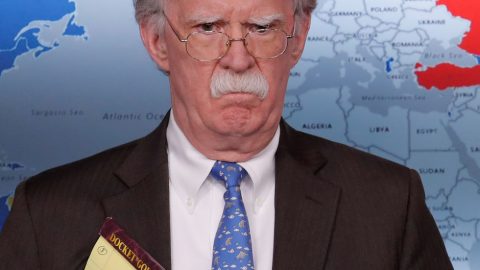
Bolton’s Act of Sabotage
By David Macilwain | American Herald Tribune | March 8, 2019
Across the Western world, there has been discussion and argument and consternation over the apparent failure to make progress on disarmament at the recent talks in Hanoi. Examination of the reasons for that failure has been replaced by speculation about the DPRK’s next move and suspicions about its motives, without any similar skepticism or doubts about the US intent and strategy. But such speculation is entirely misguided, and only possible because of ignorance of one key detail in the discussions in Hanoi.
Thanks mostly to the efforts of Australia’s former ambassador to South Korea and Vietnam, Richard Broinowski, whose diplomatic contacts in Canberra relayed inside information about the discussions, the alarming truth on why the talks suddenly fell apart was revealed to the SBS TV network, and to its listeners in the evening news broadcast on March 1st.
While media around the world, apparently including those not allied to the US, broadcast the press briefing by Donald Trump and Mike Pompeo laying the blame on North Korea for demanding all the sanctions be lifted, only SBS listeners got to hear what really happened, and thenceforth to see things in an entirely different light. As Richard Broinowski explained several days later writing on John Menadue’s influential blog Pearls and Irritations :
… “a well-informed senior Asian diplomatic source in Canberra has added another reason for the Summit’s breakdown: that Trump’s national security adviser, John Bolton, persuaded Trump to add another demand, without notice, that led to North Korean refusal and a premature end to the summit even before negotiations had begun.”
“The Asian diplomat recalled that John Bolton had been scheduled to visit Canberra at the end of February. But the visit was cancelled when he suddenly went to Hanoi instead, whether at Trump’s directive or on his own initiative being unclear. The diplomat’s understanding is that Bolton suggested to Trump that as well as demanding a complete inventory of North Korea’s nuclear weapons and delivery systems, Trump should also request details of the country’s chemical and biological arsenal, a demand Kim found unexpected, and for which he was unprepared, and refused. Trump then broke off the meeting before substantive negotiations had even begun.”
We may all too easily forget the anticipation before these crucial talks between Trump and Kim Jong Un, where it at least looked possible that Trump might “do a deal” on a basis that the North Koreans could accept. The early signs were more than promising, with Kim Jong Un assuring that he would not have been there had he not sought progress on denuclearisation, and Trump prepared to take him at his word. While “substantive negotiations” had not begun, the North Koreans had already suggested they would make very significant concessions in return for the lifting of some sanctions and some other commitments by the US to reduce tensions – “security guarantees” in other words.
It’s worth noting in this context that Sergei Lavrov, speaking at a parallel meeting of the Valdai Club in Ho Chi Minh city had stated quite clearly that the US must make significant concessions, rather than demanding that the DPRK completely denuclearise before lifting sanctions. As always it’s worth reading Lavrov’s wide-ranging and straightforward remarks on the poor state of the world and the destabilizing and destructive role being played by the US.
The necessity for lifting some sanctions on the DPRK is further emphasized by the news that their food production this year is severely restricted by the worst climatic conditions for a decade, making food imports and relief urgent. Their demands for sanctions relief in Hanoi concerned this issue rather than anything connected with the nuclear program.
The truth of the story of Bolton’s demands, which look very much like a planned act of sabotage, is beyond doubt and endorsed in statements from South Korea’s former unification minister Chong Se-Hyun published in Korean newspapers and reported elsewhere. The Sydney Morning Herald and the Australian also covered the story on the following Monday, but this was a temporary blip on their normally unchallenging sympathy for the official US viewpoint. Australia’s other State broadcaster the ABC, however, made no mention of it, simply repeating Trump’s cover-up claim on the sanctions removal.
These media along with their Western partners in officially approved disinformation are now once again adding to the rumor mill on “North Korea’s ongoing nuclear threat” with suspect stories about the renewal of a missile launching site. Satellite photos taken only hours after the failure of the talks claim to show such activity. The Australian Strategic Policy Institute, which has close links to government, has meanwhile warned that moves to scale down the annual war games proposed belatedly as a “goodwill gesture” by the US, are “dangerous and will embolden the North”.
Putting things into a wider perspective, former Australian ambassador to the UN and nuclear disarmament negotiator Richard Butler added his weight to the subject the following day with this footnote on Broinowski’s article:
“This report has now been confirmed by a report published in the March 4th edition of The Bulletin of the Atomic Scientists, which cites a statement by the DPRK Foreign Minister, Ri Yong-Ho, in Hanoi, that “John Bolton disrupted the talks by demanding that North Korea disclose its chemical and biological arsenal as well as its nuclear arsenals”. This would seem to answer the question I posed in my article on whether or not a spanner had been thrown into the works and if so, by whom? Not unusually, there seems to have been no report of this highly salient fact by western mainstream media.”
What matters here however is not simply to expose the misinformed and fraudulent claims made about the failure of the Hanoi talks. Bolton and his allies – whoever they are – evidently sought to sabotage the talks and the possibility of agreement and détente, against the intention of Donald Trump. The last thing they want is to lose the pretext for maintaining and expanding missile systems in the region aimed at threatening or “countering” China. An informative report from the East Asia Forum think-tank also makes this suggestion:
For many in the US security community the ‘no deal’ comes as a relief. There were concerns that Trump would be eager to rush into a deal, no matter what the costs of the concessions, to claim the diplomatic achievement for his administration. This seemed an over-urgent goal due to the impending report by FBI special prosecutor Robert Mueller on the Trump campaign’s ties to Russia and possible obstruction of justice, as well as the heat on Trump from his former fixer Michael Cohen’s damning testimony last week to Congress.
So far from returning to the US with an extra feather in his golden cap, Donald Trump came home to face the music, and not just from the Russia-gate witch-hunt. Even though he had called off the talks with Kim Jong Un, he had already engaged in friendly exchanges and pleasantries that some found offensive, inviting media to repeat the tired nonsense about his dealings with President Putin – that “Trump takes the advice of “dictators” over that of his own intelligence community”. (perhaps not an unwise move under the circumstances!)
The story of his brief meeting with Kim then immediately focussed on how Trump had “taken Kim’s word” over the case of Otto Warmbier, the detained American student allegedly killed by mistreatment in a North Korean hospital. The grotesque demand of the DPRK for $500 million compensation for his death from a US court illustrates the problem that many in the US seem to have in relating to those with a different viewpoint and different attitude. If similar suits were brought against the US government by relatives of the millions of North Koreans who have died over the last sixty-five years as a direct or indirect result of US aggression and sanctions, the US would be bankrupted.
It’s hard not to conclude that the man who was considered “too extreme” to join the regime of George W Bush because of his preference for armed attacks and even nuclear strikes over diplomacy has now launched a soft coup against his own President. Immediately following the Vietnam venture, Bolton was making threats of military action against Venezuela’s President Maduro which had a strange resonance. The demand that Venezuela’s democratically elected President be replaced by an unknown and unelected puppet selected and launched like a missile into Caracas by the US and its European allies is now being copied by the self-selected “Interim President of the United States”, John Bolton.
And a world under this new de facto President with his choice of puppet might just make us look back on the Golden Age of Trump if we are lucky enough to survive it.
The Stench of Color Revolution in Serbia
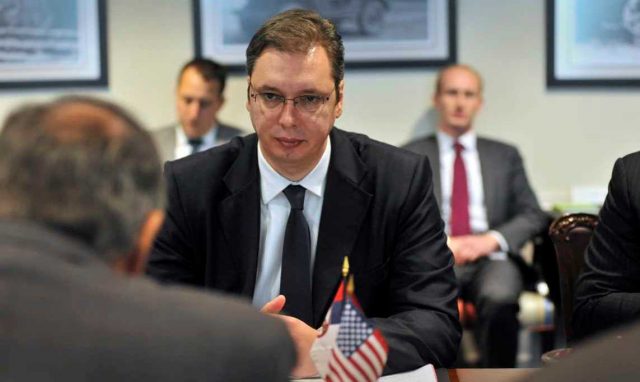
By Tim KIRBY | Strategic Culture Foundation | 08.03.2019
At any given moment there are mass protests happening somewhere for some reason. Whether the protestors have a legitimate call to arms is a very delicate question. However for the Mainstream Media things are much more black and white and this narrative is a critical component of each and every Color Revolution.
Over the last few months a protest movement has sparked up in Serbia and we are going to take a look at this via the mainstream media coverage of it. The actual motivations behind it (although proving motivation beyond a reasonable doubt is impossible) do not matter so much as what the media declares them to be. The Mainstream Media creates a narrative about the movement in order to either motivate us to sympathize with those in the streets (thus legitimizing them) or to be repulsed and afraid of them (thus blocking any chance of legitimacy). Ignoring the obvious and hoping it goes away is a common third option.
You will see this dynamic in action if we take a look at the BBC’s breakdown of the protests…
“Thousands of demonstrators in Serbia have rallied for the fifth week against President Aleksandar Vucic.
Protesters say the president has seized control of the media and launched attacks on the opposition and journalists.
An attack on opposition politician Borko Stefanovic by unknown assailants in November triggered the marches.
Opposition umbrella group Alliance for Serbia (SZS) says they were supporters of Mr Vucic – a claim authorities deny.”
At a quick glance this may seem very neutral but the first words of the article make a very bold hint to the subconscious of the reader. First off, the BBC makes it clear that the protestors are just normal Serbian citizens, when in fact all protests are organized and the more successful ones are organized by professional activists. Thousands of normal people on their own don’t just drop their lives for two months to walk around with signs in the hope of making some abstract changes. Even if the masses agree with the protestors there is no way to prove this.
The next form of manipulation is that the BBC and no other media outlet offers any other motives for the attack on Stefanovic other than “protestors say Vucic’s guys did it”, which essentially tells the reader that Vucic is guilty. There is no alternative and if anyone who supports you does a crime then you are guilty even if you have millions of supporters from all walks of life and levels of sanity.
Next if we take a look at Euronews’s situation breakdown then we can see that there is more Color Revolution language….
“What are their (the protestors’) demands?
They demand more media freedom and more coverage of opposition groups by the public broadcaster as well as an end to attacks on journalists and opposition figures.”
This is something that sounds nice and reasonable at first, but is actually impossible to implement because it is not a concrete demand. No matter what a government does the opposition could always claim that it is not enough.
For example, if the government in Country X banned Product Y and the population was organized to march to change the law then the government could legalize Product Y and the protestors would get what they want and go home. As long as the government did not look weak during this reversal on position this would pose no threat to causing a Color Revolution. That is why concrete demands are horrible if you want a regime change.
So how can make “media freedom” into a concrete demand? How many “opposition” members are needed in Serbia’s media and in what capacity would be “freedom”? I am sure Serbia has a few Neo-Nazis, Satanists and NAMBLA members in the hills somewhere, do they need access to the media too, they are opposition groups after all, right?
Euronews continues their breakdown…
“Vucic, who has served as president of Serbia since May 2017, became known for his nationalist stance following the breakup of Yugoslavia in 1992.”
In EU-speak being called a nationalist basically means you are a hardcore Hitlerian Nazi. (Deutsche Welle called him “Ultranationalistic”, meaning he is definitely an Ultra Nazi) Furthermore this text is placed a few lines above a picture of Vucic standing next to Vladimir Putin. This drives home the portrayal of him as the bad guy aligned with the Evil Putin. This photo is of some relevance as the protests did spark up around the time of a visit by the Russian President, but then again if you do a Google search for pictures of Vucic you can see him shaking hands with Xi, Trump and Merkel who all hold very different ideological views. They could have shown him in this article with the Angel I, the Queen of EU, but they chose the KGB dark Tsar instead on purpose.
Deutsche Welle early in the article mentioned above lays out the protestors supposed motivations in a very clear Color Revolution tone.
“… what they called a climate of “political violence” created by Vucic and his Serbian Progressive Party”
One would think that journalists, when hearing an accusation of a “climate of violence” would try to present the evidence regarding said violence but DW just sort of lets it fly to the readers that there is some kind of conditions for brutality somewhere, that are somehow consciously caused by one man – The President of Serbia. Violence is very easy to measure, an abstract climate of violence is not and therefore it is good Color Revolution rhetoric – you can accuse the enemy of widespread violence even if there is no actual violence.
DW continues their “journalism” by writing…
“A group of opposition leaders last week drafted an “agreement with the citizens” listing their next steps, including not to take part in an election until the conditions for a free and fair vote are met.”
If the people on Vucic’s side who are also activists made an “agreement with the citizens” would that also bear some sort of legitimacy? DW makes no effort to question by what authority the protestors assume they represent the masses of the nation. Every Mainstream Media outlet writes that there are “thousands” of protestors, yet thousands of people in any country that is not a tiny island are a small percent of the population at best.
So what we can see is that across the board the European Mainstream Media is saying.
- Some violence happened somehow so Vucic is responsible 100% (Regime Change Warranted)
- There is a climate of violence and Vucic is responsible 100% (Regime Change Warranted)
- The protestors are large in number (“thousands” of them!) and represent the average Serbian disgusted with Vucic (Regime Change Warranted)
- Vucic is some kind of ultra-mega Nazi because he is not ashamed of being Serbian and talked to Putin (Regime Change Warranted)
- The protestors’ impossibly vague demands must be met even though doing so is impossible, “muh rights”. (Regime Change Warranted)
Would Britain accuse Russia of hacking without evidence? It’s ‘highly likely’
By Simon Rite | RT | March 7, 2019
Answer the following question: When Sky News asked unnamed UK government sources whether Russia hacked the Institute of Statecraft, did they reply it was: ‘somewhat likely,’ ‘highly likely,’ or ‘don’t know’?
If you said it’s ‘highly likely’ you got the answer right.
So, in an exclusive report Sky News reveals that Britain’s National Crime Agency (NCA) is investigating a cyber attack on “the little-known Institute for Statecraft”, and that sources, which are only named as being from “Whitehall,” say it’s ‘highly likely’ Russia’s military intelligence service was behind it.
Furthermore, “Chris Donnelly, a former senior Ministry of Defence civil servant who co-founded the Institute for Statecraft, said he has little doubt who hacked it, though he has no “forensic proof.”
Shady GRU, anonymous sources, ‘highly likely,’ no “forensic proof”, and slap an exclusive tag on it. It’s the classic formula for a Russia story.
The cyber-hacks have actually concentrated on the Integrity Initiative which is run by the Institute for Statecraft. The Integrity Initiative says it aims to combat “disinformation used by Russia and others.” It’s main tactic against what it perceives as propaganda is to use propaganda.
It’s also been caught tweeting anti-Jeremy Corbyn material, which isn’t good considering they’re partly-funded by the UK Foreign Office.
Only in a story about Russia and the GRU would it be acceptable to place your trust in anonymous sources and a former MoD employee who runs a transparently anti-Russia programme staffed by former spies.
The Integrity Initiative files that were hacked have been leaked over a number of months, by someone calling themselves Anonymous.
The Sky News article, which doesn’t want to undermine the insinuation that only Russia could be to blame, says there is no proof that this Anonymous group is linked to the worldwide group of activist hackers of the same name. Even if there’s no ‘forensic proof,’ surely it’s ‘highly likely’ they are?
The MSM just realised the “Integrity Initiative” is a thing
… and it turns out it was all Russia’s fault

The actual listed address for The Integrity Initiative, and a handy visual metaphor for the absolute state of the place. Image source: UKColumn
By Kit Knightly | OffGuardian | March 7, 2019
For those of you who don’t know, the Integrity Initiative is (was?) a UK-government funded operation to “counter disinformation”. It was run under the auspices of the (fake) charity the Institute for Statecraft, paid for by the foreign office and intelligence agencies, and co-opted journalists to spread propaganda.
This was all revealed months ago, when internal documents were leaked online. (Moon of Alabama did great work on this, as did Kit Klarenberg).
Journalists and other influencers were collected into cells, what the Integrity Initiative’s (II) internal memos called “clusters”, usually by region. These clusters were tasked with “combating Russian disinformation”, or other polite translations of “disseminating propaganda”.
The II’s target list is short but predictable – it attacked Russia, Russian media and “Russian bots”. It attacked Scottish nationalists and the independence movement, and it attacked Jeremy Corbyn. Essentially, they turn the fire of their “clusters” on those perceived to be enemies of the status quo.
Those contributing to these clusters are then little more than attack dogs. They never call themselves that, of course, they have all sorts of mechanisms for defending themselves from the truth of their actions. That’s how the shallow have lived with the unconscionable since the beginning of time.
A good example of how this works is Scottish journalist David Leask – written about here by Craig Murrary.
We know from internal memos that Leask had a meeting with II personnel in late March of 2018. We know, from these notes, that Leask was “briefed” about how Scottish nationalism and independence played into Russia’s hands. Or the prevalence of “McBots” spreading anti-union messages on Twitter. He is “appraised of the dangers”, and then toddles off back to his computer, safe in the knowledge that – though he is doubtless writing about the government told him to write about – he’s making the world a safer, freer and better place. Somehow.
The details of the leaks are not important right now. They have been analysed and dissected in great detail already. The actual mechanics, how the different clusters worked, can be reasoned and guessed at, but never known for certain… short of more leaks.
What we DO know is that the foreign office spent millions of pounds funding an organisation which worked with journalists to spin pro-government narratives and smear the head of the opposition. This is a big deal. It should be enough to bring down the government, or least spark an investigation.
Neither happened. In fact, the content of these leaks was never reported in detail in the mainstream media. Indeed, it was barely covered at all – short of vague, snide opinion pieces about the UK “stooping to Russia’s level” and other childish nonsense. (The Guardian closed the comment section on that piece after 2 hours, when it was clear nobody was buying what they were trying to sell).
The detailed write-ups available are only on alternate media sites, or rebel academic groups. The only MP to raise the issue in Parliament was Chris Williamson… since hounded out of Labour under spurious charges of antisemitism. For the most part, the establishment simply ignored all mention if the Integrity Initiative.
Until now.
Now, months later, the media have awakened to the II’s presence. Sky reported today:
‘Highly likely’ GRU hacked UK institute countering Russian fake news
It’s a long, rambling article that contains only one important point: Chris Donnelly, head of the Institute for Statecraft, admits there is “no proof” Russia was behind the “hack”.
Everything past that point is moot. There’s no proof, there’s no evidence even (at least, none that we are shown). We have no reason to simply accept, on faith, the assertion of the NCA.
A simple analysis of motive would suggest that, of course the government are going to blame Russia. They have to shift focus from their now proven corruption. This is politics 101. Deflection and diversion. It’s old-fashioned and, unfortunately, it works. Especially when you have a small army of government-backed hacks to shovel your bullshit narrative down the public’s throat.
Exhibit A:
Note that nowhere in this story, or anywhere else, is the veracity of documents questioned. They are real. They are the truth. The mainstream media are attempting to undermine a known, proven truth by repeating – without analysis or question – a government-backed theory, for which they admit they have “no proof”.
Interestingly, both Cadwalladr and Deborah Haynes (the author of the Sky article) are named as members of the “UK Cluster” in the leaked documents.
So, essentially, we have journalists accused of working with a government propaganda office to smear Russia… who are defending themselves by spreading government propaganda which smears Russia. (It’s a very “My aunt, who I live with…” scenario). But when you only have the one card you’ve got to play it, and play it with conviction, I suppose.
All of this, of course, mirrors the leaked DNC e-mails from 2016. The e-mails proved corruption on behalf of Hillary Clinton, and yet were attacked in the media as being the result of “Russian hacking”. No evidence for Russian hacking has ever emerged, and WikiLeaks have said – dozens of times – that the e-mails were leaked by an insider.
In fact, the media’s defensive strategy is a move straight out of the DNC playbook:
“Yes I’m corrupt and malign, but you only know I’m corrupt and malign because the Russians hacked my e-mail!”
It’s not really anything like the brilliant defense they seem to think it is.
Kit Knightly is co-editor of OffGuardian. The Guardian banned him from commenting. Twice. He used to write for fun, but now he’s forced to out of a near-permanent sense of outrage.
Pure: Ten Points I Just Can’t Believe About the Official Skripal Narrative
By Craig Murray | March 7, 2019
I still do not know what happened in the Skripal saga, which perhaps might more respectfully be termed the Sturgess saga. I cannot believe the Russian account of Borishov and Petrov, because if those were their real identities, those identities would have been firmly established and displayed by now. But that does not mean they attempted to kill the Skripals, and there are many key elements to the official British account which are also simply incredible.
Governments play dark games, and a dark game was played out in Salisbury which involved at least the British state, Russian agents (possibly on behalf of the state), Orbis Intelligence and the BBC. Anybody who believes it is simple to identify the “good guys” and the “bad guys” in this situation is a fool. When it comes to state actors and the intelligence services, frequently there are no “good guys”, as I personally witnessed from the inside over torture, extraordinary rendition and the illegal invasion of Iraq. But in the face of a massive media campaign to validate the British government story about the Skripals, here are ten of the things I do not believe in the official account:
1) PURE
This was the point that led me to return to the subject of the Skripals, even though it has brought me more abuse than I had received in my 15 year career as a whistleblower.
A few months ago, I was in truth demoralised by the amount of abuse I was receiving about the collapse of the Russian identity story of Borishov and Petrov. I had never claimed the poisoning, if any, was not carried out by Russians, only that there were many other possibilities. I understood the case against the Russian state is still far from established, whoever Borishov and Petrov really are, and I did not (and do not) accept Bellingcat’s conjectures and dodgy evidence as conclusive identification. But I did not enjoy at all the constant online taunts, and therefore was not inclined to take the subject further.
It is in this mood that I received more information from my original FCO source, who had told me, correctly, that Porton Down could not and would not attest that the “novichok” sample was made in Russia, and explained that the formulation “of a type developed by Russia” was an agreed Whitehall line to cover this up.
She wanted to explain to me that the British government was pulling a similar trick over the use of the word “pure”. The OPCW report had concluded that the sample provided to them by the British government was “of high purity” with an “almost complete absence of impurities”. This had been spun by the British government as evidence that the novichok was “military grade” and could only be produced by a state.
But actually that is not what the OPCW technical experts were attempting to signal. The sample provided to the OPCW had allegedly been swabbed from the Skripals’ door handle. It had been on that door handle for several days before it was allegedly discovered there. In that time it had been contacted allegedly by the hands of the Skripals and of DC Bailey, and the gloves of numerous investigators. It had of course been exposed to whatever film of dirt or dust was on the door handle. It had been exposed to whatever pollution was in the rain and whatever dust and pollen was blowing around. In these circumstances, it is incredible that the sample provided “had an almost complete absence of impurities”.
A sample cannot have a complete absence of impurities after being on a used doorknob, outdoors, for several days. The sample provided was, on the contrary, straight out of a laboratory.
The government’s contention that “almost complete absence of impurities” meant “military grade” was complete nonsense. There is no such thing as “military grade” novichok. It has never been issued to any military, anywhere. The novichok programme was designed to produce an organo-phosphate poison which could quickly be knocked up from readily available commercial ingredients. It was not part of an actual defence industry manufacturing programme.
There is a final problem with the “of high purity” angle. First we had the Theresa May story that the “novichok” was extremely deadly, many times more deadly than VX, in minute traces. Then, when the Skripals did not die, it was explained to us that this was because it had degraded in the rain. This was famously put forward by Dan Kaszeta, formerly of US Intelligence and the White House and self-proclaimed chemical weapons expert – which expertise has been strenuously denied by real experts.
What we did not know then, but we do know now, is that Kaszeta was secretly being paid to produce this propaganda by the British government via the Integrity Initiative.
So the first thing I cannot believe is that the British government produced a sample with an “almost complete absence of impurities” from several days on the Skripals’ doorknob. Nor can I believe that if “extremely pure” the substance therefore was not fatal to the Skripals.
2) Raising the Roof
Three days ago Sky News had an outside broadcast from the front of the Skripals’ house in Salisbury, where they explained that the roof had been removed and replaced due to contamination with “novichok”.
I cannot believe that a gel, allegedly smeared or painted onto the doorknob, migrated upwards to get into the roof of a two storey house, in such a manner that the roof had to be destroyed, but the house inbetween did not. As the MSM never questions the official narrative, there has never been an official answer as to how the gel got from the doorknob to the roof. Remember that traces of the “novichok” were allegedly found in a hotel room in Poplar, which is still in use as a hotel room and did not have to be destroyed, and an entire bottle of it was allegedly found in Charlie Rowley’s house, which has not had to be destroyed. Novichok was found in Zizzi’s restaurant, which did not have to be destroyed.
So we are talking about novichok in threatening quantities – more than the traces allegedly found in the hotel in Poplar – being in the Skripals’ roof. How could this happen?
As I said in the onset, I do not know what happened, I only know what I do not believe. There are theories that Skripal and his daughter might themselves have been involved with novichok in some way. On the face of it, its presence in their roof might support that theory.
The second thing I do not believe is that the Skripals’ roof became contaminated by gel on their doorknob so that the roof had to be destroyed, whereas no other affected properties, nor the rest of the Skripals’ house, had to be destroyed.
3) Nursing Care
The very first person to discover the Skripals ill on a park bench in Salisbury just happened to be the Chief Nurse of the British Army, who chanced to be walking past them on her way back from a birthday party. How lucky was that? The odds are about the same as the chance of my vacuum cleaner breaking down just before James Dyson knocks at my door to ask for directions. There are very few people indeed in the UK trained to give nursing care to victims of chemical weapon attack, and of all the people who might have walked past, it just happened to be the most senior of them!
The government is always trying to get good publicity for its armed forces, and you would think that the heroic role of its off-duty personnel in saving random poisoned Russian double agents they just happened to chance across, would have been proclaimed as a triumph for the British military. Yet it was kept secret for ten months. We were not told about the involvement of Colonel Abigail McCourt until January of this year, when it came out by accident. Swollen with maternal pride, Col. McCourt nominated her daughter for an award from the local radio station for her role in helping give first aid to the Skripals, and young Abigail revealed her mother’s identity on local radio – and the fact her mother was there “with her” administering first aid.
Even then, the compliant MSM played along, with the Guardian and Sky News both among those running stories emphasising entirely the Enid Blyton narrative of “plucky teenager saves the Skripals”, and scarcely mentioning the Army’s Chief Nurse who was looking after the Skripals “with little Abigail”.
I want to emphasise again that Col. Alison McCourt is not the chief nurse of a particular unit or hospital, she is the Chief Nurse of the entire British Army. Her presence was kept entirely quiet by the media for ten months, when all sorts of stories were run in the MSM about who the first responders were – various doctors and police officers being mentioned.
If you believe that it is coincidence that the Chief Nurse of the British Army was the first person to discover the Skripals ill, you are a credulous fool. And why was it kept quiet?
4) Remarkable Metabolisms
This has been noted many times, but no satisfactory answer has ever been given. The official story is that the Skripals were poisoned by their door handle, but then well enough to go out to a pub, feed some ducks, and have a big lunch in Zizzi’s, before being instantly stricken and disabled, both at precisely the same time.
The Skripals were of very different ages, genders and weights. That an agent which took hours to act but then kicks in with immediate disabling effect, so they could not call for help, would affect two such entirely different metabolisms at precisely the same time, has never been satisfactorily explained. Dosage would have an effect and of course the doorknob method would give an uncontrolled dosage.
But that the two different random dosages were such that they affected each of these two very different people at just the same moment, so that neither could call for help, is an extreme coincidence. It is almost as unlikely as the person who walks by next being the Chief Nurse of the British Army.
5) 11 Days
After the poisoning of Charlie Rowley and Dawn Sturgess, the Police cordoned off Charlie Rowley’s home and began a search for “Novichok”, in an attitude of extreme urgency because it was believed this poison was out amidst the public. They were specifically searching for a small phial of liquid. Yet it took 11 days of the search before they allegedly discovered the “novichok” in a perfume bottle sitting in plain sight on the kitchen counter – and only after they had discovered the clue of the perfume bottle package in the bin the day before, after ten days of search.
The bottle was out of its packaging and “novichok”, of which the tiniest amount is deadly, had been squirted out of its nozzle at least twice, by both Rowley and Sturgess, and possibly more often. The exterior of the bottle/nozzle was therefore contaminated. Yet the house, unlike the Skripals’ roof space, has not had to be destroyed.
I do not believe it took the Police eleven days to find the very thing they were looking for, in plain sight as exactly the small bottle of liquid sought, on a kitchen bench. What else was happening?
6) Mark Urban/Pablo Miller
The BBC’s “Diplomatic Editor” is a regular conduit for the security services. He fronted much of the BBC’s original coverage of the Skripal story. Yet he concealed from the viewers the fact that he had been in regular contact with Sergei Skripal for months before the alleged poisoning, and had held several meetings with Skripal.
This is extraordinary behaviour. It was the biggest news story in the world, and news organisations, including the BBC, were scrambling to fill in the Skripals’ back story. Yet the journalist who had the inside info on the world’s biggest news story, and was actually reporting on it, kept that knowledge to himself. Why? Urban was not only passing up a career defining opportunity, it was unethical of him to continually report on the story without revealing to the viewers his extensive contacts with Skripal.
The British government had two immediate reactions to the Skripal incident. Within the first 48 hours, it blamed Russia, and it slapped a D(SMA) notice banning all media mention of Skripal’s MI6 handler, Pablo Miller. By yet another one of those extraordinary coincidences, Miller and Urban know each other well, having both been officers together in the Royal Tank Regiment, of the same rank and joining the Regiment the same year.
I have sent the following questions to Mark Urban, repeatedly. There has been no response:
To: mark.urban@bbc.co.uk
Dear Mark,
As you may know, I am a journalist working in alternative media, a member of the NUJ, as well as a former British Ambassador. I am researching the Skripal case.
I wish to ask you the following questions.
1) When the Skripals were first poisoned, it was the largest news story in the entire World and you were uniquely positioned having held several meetings with Sergei Skripal the previous year. Yet faced with what should have been a massive career break, you withheld that unique information on a major story from the public for four months. Why?
2) You were an officer in the Royal Tank Regiment together with Skripal’s MI6 handler, Pablo Miller, who also lived in Salisbury. Have you maintained friendship with Miller over the years and how often do you communicate?
3) When you met Skripal in Salisbury, was Miller present all or part of the time, or did you meet Miller separately?
4) Was the BBC aware of your meetings with Miller and/or Skripal at the time?
5) When, four months later, you told the world about your meetings with Skripal after the Rowley/Sturgess incident, you said you had met him to research a book. Yet the only forthcoming book by you advertised is on the Skripal attack. What was the subject of your discussions with Skripal?
6) Pablo Miller worked for Orbis Intelligence. Do you know if Miller contributed to the Christopher Steele dossier on Trump/Russia?
7) Did you discuss the Trump dossier with Skripal and/or Miller?
8) Do you know whether Skripal contributed to the Trump dossier?
9) In your Newsnight piece following the Rowley/Sturgess incident, you stated that security service sources had told you that Yulia Skripal’s telephone may have been bugged. Since January 2017, how many security service briefings or discussions have you had on any of the matter above.I look forward to hearing from you.
Craig Murray
The lack of openness of Urban in refusing to answer these questions, and the role played by the BBC and the MSM in general in marching in unquestioning lockstep with the British government narrative, plus the “coincidence” of Urban’s relationship with Pablo Miller, give further reason for scepticism of the official narrative.
7 Four Months
The official narrative insists that Borishov and Petrov brought “novichok” into the country; that minute quantities could kill; that they disposed of the novichok that did kill Dawn Sturgess. It must therefore have been of the highest priority to inform the public of the movements of the suspects and the possible locations where deadly traces of “novichok” must be lurking.
Yet there was at least a four month gap between the police searching the Poplar hotel where Borishov and Petrov were staying, allegedly discovering traces of novichok in the hotel room, and the police informing the hotel management, let alone the public, of the discovery. That is four months in which a cleaner might have fatally stumbled across more novichok in the hotel. Four months in which another guest in the same hotel might have had something lurking in their bag which they had picked up. Four months in which there might have been a container of novichok sitting in a hedge near the hotel. Yet for four months the police did not think any of this was urgent enough to tell anybody.
The astonishing thing is that it was a full three months after the death of Dawn Sturgess before the hotel were informed, the public were informed, or the pictures of “Borishov” and “Petrov” in Salisbury released. There could be no clearer indication that the authorities did not actually believe that any threat from residual novichok was connected to the movements of Borishov and Petrov.
Similarly the metadata on the famous CCTV images of Borishov and Petrov in Salisbury, published in September by the Met Police, showed that all the stills were prepared by the Met on the morning of 9 May – a full four months before they were released to the public. But this makes no sense at all. Why wait a full four months for people’s memories to fade before issuing an appeal to the public for information? This makes no sense at all from an investigation viewpoint. It makes even less sense from a public health viewpoint.
If the authorities were genuinely worried about the possible presence of deadly noivchok, and wished to track it down, why one earth would you wait for four months before you published the images showing the faces and clothing and the whereabouts of the people you believe were distributing it?
The only possible conclusion from the amazing four month delays both in informing the hotel, and in revealing the Borishov and Petrov CCTV footage to the public, is that the Metropolitan Police did not actually believe there was a public health danger that the two had left a trail of novichok. Were the official story true, this extraordinary failure to take timely action in a public health emergency may have contributed to the death of Dawn Sturgess.
The metadata shows Police processed all the Salisbury CCTV images of Boshirov and Petrov a month before Charlie Rowley picked up the perfume. The authorities claim the CCTV images show they could have been to the charity bin to dump the novichok. Which begs the question, if the Police really believed they had CCTV of the movements of the men with the novichok, why did they not subsequently exhaustively search everywhere the CCTV shows they could have been, including that charity bin?
The far more probable conclusion appears to be that the lack of urgency is explained by the fact that the link between Borishov and Petrov and “novichok” is a narrative those involved in the investigation do not take seriously.
8 The Bungling Spies
There are elements of the accepted narrative of Borishov and Petrov’s movements that do not make sense. As the excellent local Salisbury blog The BlogMire points out, the CCTV footage shows Borishov and Petrov, after they had allegedly coated the door handle with novichok, returning towards the railway station but walking straight past it, into the centre of Salisbury (and missing their first getaway train in the process). They then wander around Salisbury apparently aimlessly, famously window shopping which is caught on CCTV, and according to the official narrative disposing of the used but inexplicably still cellophane-sealed perfume/novichok in a charity donation bin, having walked past numerous potential disposal sites en route including the railway embankment and the bins at the Shell garage.
But the really interesting thing, highlighted by the blogmire, is that the closest CCTV ever caught them to the Skripals’ house is fully 500 metres, at the Shell garage, walking along the opposite side of the road from the turning to the Skripals. There is a second CCTV camera at the garage which would have caught them crossing the road and turning down towards the Skripals’ house, but no such video or still image – potentially the most important of all the CCTV footage – has ever been released.
However the 500 metres is not the closest the CCTV places the agents to the Skripals. From 13.45 to 13.48, on their saunter into town, Borishov and Petrov were caught on CCTV at Dawaulders coinshop a maximum of 200 metres away from the Skripals, who at the same time were at Avon Playground. The bin at Avon playground became, over two days in the immediate aftermath of the Skripal “attack”, the scene of extremely intensive investigation. Yet the Borishov and Petrov excursion – during their getaway from attempted murder – into Salisbury town centre has been treated as entirely pointless and unimportant by the official story.
Finally, the behaviour of Borishov and Petrov in the early hours before the attack makes no sense whatsoever. On the one hand we are told these are highly trained, experienced and senior GRU agents; on the other hand, we are told they were partying in their room all night, drawing attention to themselves with loud noise, smoking weed and entertaining a prostitute in the room in which they were storing, and perhaps creating, the “novichok”.
The idea that, before an extremely delicate murder operation involving handling a poison, a tiny accident with which would kill them, professionals would stay up all night and drink heavily and take drugs is a nonsense. Apart from the obvious effect on their own metabolisms, they were risking authorities being called because of the noise and a search being instituted because of the drugs.
That they did this while in possession of the novichok and hours before they made the attack, is something I simply do not believe.
9 The Skripals’ Movements
Until the narrative changed to Borishov and Petrov arriving in Salisbury just before lunchtime and painting the doorknob, the official story had been that the Skripals left home around 9am and had not returned. They had both switched off their mobile phones, an interesting and still unexplained point. As you would expect in a city as covered in CCTV as Salisbury, their early morning journey was easily traced and the position of their car at various times was given by the police.
Yet no evidence of their return journey has ever been offered. There is now a tiny window between Borishov and Petrov arriving, painting the doorknob apparently with the Skripals now inexplicably back inside their home, and the Skripals leaving again by car, so quickly after the doorknob painting that they catch up with Borishov and Petrov – or certainly being no more than 200 metres from them in Salisbury City Centre. There is undoubtedly a huge amount of CCTV video of the Skripals’ movements which has never been released. For example, the parents of one of the boys who Sergei was chatting with while feeding the ducks, was shown “clear” footage by the Police of the Skripals at the pond, yet this has never been released. This however is the moment at which the evidence puts Borishov and Petrov at the closest to them. What does the concealed CCTV of the Skripals with the ducks show?
Why has so little detail of the Skripals’ movements that day been released? What do all the withheld CCTV images of the Skripals in Salisbury show?
10 The Sealed Bottle
Only in the last couple of days have the police finally admitted there is a real problem with the fact that Charlie Rowley insists that the perfume bottle was fully sealed, and the cellophane difficult to remove, when he discovered it. Why the charity collection bin had not been emptied for three months has never been explained either. Rowley’s recollection is supported by the fact that the entire packaging was discovered by the police in his bin – why would Borishov and Petrov have been carrying the cellophane around with them if they had opened the package? Why – and how – would they reseal it outdoors in Salisbury before dumping it?
Furthermore, there was a gap of three months between the police finding the perfume bottle, and the police releasing details of the brand and photos of it, despite the fact the police believed there could be more out there. Again the news management agenda totally belies the official narrative of the need to protect the public in a public health emergency.
This part of the narrative is plainly nonsense.
Bonus Point – The Integrity Initiative
The Integrity Initiative specifically paid Dan Kaszeta to publish articles on the Skripal case. In the weekly collections of social media postings the Integrity Initiative sent to the FCO to show its activity, over 80% were about the Skripals.
Governments do not institute secret campaigns to put out covert propaganda in order to tell the truth. The Integrity Initiative, with secret FCO and MOD sourced subsidies to MSM figures to put out the government narrative, is very plainly a disinformation exercise. More bluntly, if the Integrity Initiative is promoting it, you know it is not true.
Most sinister of all is the Skripal Group convened by the Integrity Initiative. This group includes Pablo Miller, Skripal’s MI6 handler, and senior representatives of Porton Down, the BBC, the CIA, the FCO and the MOD. Even if all the other ludicrously weak points in the government narrative did not exist, the Integrity Initiative activity in itself would lead me to understand the British government is concealing something important.
Conclusion
I do not know what happened in Salisbury. Plainly spy games were being played between Russia and the UK, quite likely linked to the Skripals and/or the NATO chemical weapons exercise then taking place on Salisbury Plain yet another one of those astonishing coincidences.
What I do know is that major planks of the UK government narrative simply do not stand up to scrutiny.
Plainly the Russian authorities have lied about the identity of Borishov and Petrov. What is astonishing is the alacrity with which the MSM and the political elite have rallied around the childish logical fallacy that because the Russian Government has lied, therefore the British Government must be telling the truth. It is abundantly plain to me that both governments are lying, and the spy games being played out that day were very much more complicated than a pointless revenge attack on the Skripals.
I do not believe the British Government. I have given you the key points where the official narrative completely fails to stand up. These are by no means exhaustive, and I much look forward to reading your own views.
Fentanyl poisoned the Skripals – back to basics

johnplatinumgoss | March 5, 2019
You have to start at the beginning. In the beginning there was no military-grade nerve-agent even though Russia was being blamed for having planted it. In the beginning there was only fentanyl. Then on the second day God created the secret services and the world did not know good from evil.
Twelve months ago I had the Skripal saga’s chin tied up and was able to lay its body out stone-cold in its coffin. On 7 March 2018 I wrote on Craig Murray’s blog:
“I think . . . that is unlikely that these poor people will recover. If our spooks were involved in any way, and they are handling the investigation, then the Russian ex-spy and his daughter are hardly going to be given a chance to testify as to who did it. What really stinks is that from day one Russia was blamed by our media. That is the same media that have stopped Russian athletes from competing in sporting events with a catalogue of lies and misinformation.Just for your information, because most people do not see facts our media does not want them to see, Russia was 19th in WADA’s own list of doping offences for 2013. Other than China its athletes were tested more than any other country. The USA athletes were tested just over 7,000 times while Russian athletes were tested 12,500 times. Russia has a population of 143m while the USA has a population of 327m. This means per capita Russian athletes were tested four times more often than US athletes.
I think we know what happens next with the slagging off of Russia whoever is culpable.”
The “Blame Russia” meme has been hammered to death. Having invented the Novichok scenario there is no turning back for its inventors. You might have thought after the Christopher Steele “dodgy dossier” our former MI6 officers would have learnt something. Look at the featured image at the top of this blog-piece. Pablo Miller retweeted this in January 2017 mocking President Trump over the fake “golden showers” revelation that Miller himself probably had a hand in writing. It was a costly report that would later be shown to be, what the secret services specialise in – disinformation.
Sadly our “intelligence” services limp on from one blunder to another. It could well be that Sergey Skripal with his contacts in Russia, if he still had any, fed Steele and Miller at Orbis Business Intelligence this nonsense. Unfortunately these blunders may be the reason that we will never hear from the Skripals again.
Ten days after the Skripals ingested fentanyl Stephen Davies wrote the following letter to the Times over that newspaper’s alarmist headline, a headline which was panicking people of Salisbury into thinking they may have been poisoned by a nerve-agent and thus adding unnecessary burdens on an already overworked NHS.
“Sir, Further to your report (“Poison Exposure Leaves Almost 40 Needing Treatment”, Mar 14), may I clarify that no patients have experienced symptoms of nerve-agent poisoning in Salisbury and there have only ever been three patients with significant poisoning. Several people have attended the emergency department with concerns that they may have been exposed. None had symptoms of poisoning and none has needed treatment. Any blood tests performed have shown no abnormality. No member of the public has been contaminated by the agent involved. STEPHEN DAVIES, Consultant in Emergency Medicine, Salisbury NHS Foundation Trust”
Every medic at the hospital, every medic in Wiltshire, every medic in the country who could access the notes knew full well what it was. It was fentanyl. Try interviewing anybody at the hospital and they will not be allowed to speak to you unless it is a designated spokesperson.
On 5 March 2018 the Clinical Services Journal put out the story Response Unit Called As Salisbury Hospital Declares “Major Incident”. It said:
“Emergency personnel arrived to the scene, wearing full-body hazardous materials protective and an incident response unit was on site.
It followed an incident hours earlier in which a man and a woman were exposed to Fentanyl in the city centre. The opoid is 10,000 times stronger than heroin.”
This remained the medical diagnosis till long after the Skripals had gained consciousness. In fact it was not until 26 April that some person or persons unknown made the journal change the second quoted paragraph to:
“It followed an incident hours earlier in which a man and a woman were exposed to a substance in the city centre.”
Wisely, for those who do not believe a word of the government narrative, there was an addendum showing editing history.
“Note: This story was updated on 26 April 2018 to remove suggestion (which was widely speculated and reported at the time of writing) that the substance found was fentanyl.”
Ask a few questions. Why can our media not talk to the Skripals? Where are they imprisoned? Why can they not be visited by relatives? Why is parliament so quiet on the subject? If a military-grade nerve agent was used in Salisbury don’t you think the city would have gone into lockdown? I should hope it would.
If the Skripals are not dead those keeping them imprisoned do not do so in my name. So I urge everyone who cares for their fellow human-beings to go back to the beginning. You will discover that the novichok evil came after the beginning.
Integrity Initiative: The Sinister Chain of Events Leading Up to Salisbury
By Kit Klarenberg – Sputnik – March 4, 2019
In several reports to date, I’ve documented how the Integrity Initiative – the shadowy UK government-funded military intelligence front – and its assorted operatives and media assets systematically shaped news reporting on, and Whitehall’s response to, the apparent poisoning of Sergei Skripal and his daughter Yulia on 4 March 2018.
Now, on the anniversary of that fateful and ever-mystifying day, I’ll attempt to track some of the activities of the Initiative’s parent, the Institute for Statecraft, and other key figures and organizations directly and indirectly connected to the body in the years immediately prior.
Troublingly, the information collected here inevitably represents but a negligible fragment of a much wider clandestine picture. The full extent of the British state’s sinister and long-running secret machinations leading up to the Salisbury incident certainly isn’t ascertainable at this time, and may well never be.
‘Peculiar Struggle’
In July 2014, Institute for Statecraft ‘senior research fellow’ Victor Madeira wrote an article for the organization’s website, Russian Subversion — Haven’t we been here before?. In it, he suggested that far from a “new type of warfare”, the West’s tussle with Russia in the wake of the Maidan coup was “actually only the latest chapter in a 100-year-old playbook the Bolsheviks called active measures”, albeit “modernised to exploit the speed and reach of 21st-century mass/social media”.
After attempting to link various tactics employed by the Soviet Union to the modern day, Madeira somewhat chillingly concludes the piece with a quote from Ronald Lindsay, UK ambassador to Germany, who in February 1927 urged Whitehall to realise they were engaged in a “new kind of war” with the then-burgeoning Soviet Union.
“Anti-subversive measures could not be gradual; they had to be part of a package of ‘economic boycott, breach of diplomatic relations’ as well as ‘propaganda and counter-propaganda, pressure on neutrals.’ He argued a diplomatic breach with Moscow would at least turn ‘the present peculiar struggle into an armed conflict of the old-fashioned sort’ that Great Britain and the West could win,” Madeira records.
A document authored by the academic — who 2010 — 2014 tutored and lectured at Cambridge under former MI6 chief Richard Dearlove — in January 2015 (Russian Federation Sanctions ) makes clear he, and presumably his Institute employers, support Lindsay’s strategy and objectives.
The file sets out a number of “potential levers” for achieving a number of “main aims”, including “peace with Ukraine”, the “return” of Crimea, “behaviour change” and/or “regime change” — for, much to Madeira’s evident chagrin, the wave of sanctions imposed upon Russian individuals and businesses the previous March weren’t having a sufficiently deleterious impact on the Kremlin, or the Russian people.
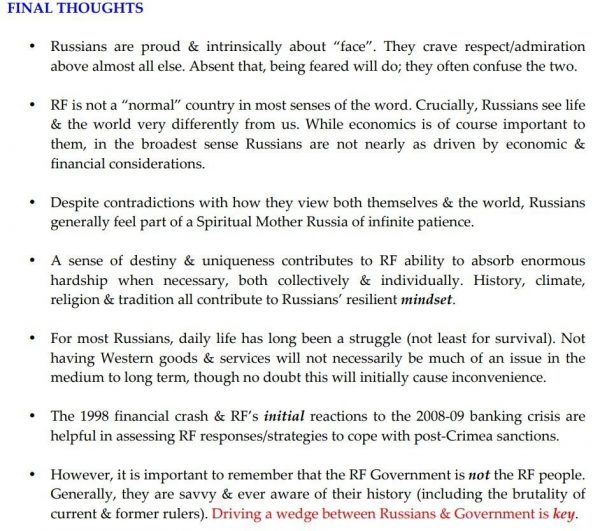
Victor Madeira’s Ruminations on the Russian People
“[Russia] is not a ‘normal’ country in most senses of the word. Crucially, Russians see life and the world very differently from us… Russians are not nearly as driven by economic and financial considerations… For most Russians, daily life has long been a struggle (not least for survival). Not having Western goods and services will not necessarily be much of an issue in the medium to long-term,” he wrote.
Moreover — and perhaps worst of all in Madeira’s mind — President Vladimir Putin — someone who “survived abysmal post-WW2 conditions” and “[believes] nothing the West can do is worse than what [he’s] already endured in life” — remains popular among the Russian public due to “the chaos” of the 1990s, and for having “restored stability, prosperity and pride”.
“Fear of renewed uncertainty and chaos… keeps Russians in check”, he writes — as a result, “driving a wedge between Russians and [their] government is key.”
The bullet-pointed “levers” that make up the bulk of the document span areas including ‘diplomacy’, ‘finance’, ‘security’, ‘technology’, ‘industry’, ‘military’, and even ‘culture’, and include; suspending or expelling Russia from “G8, WTO… and similar organisations”; “[expanding] existing sanctions regimes to anyone helping [Russia] break them”; “[arresting] every known RF agent — not least ‘agents of influence'”; “banning RF delegates” from a variety of international fora, “[advocating the] view RF [is] untrustworthy of hosting [international sporting events]; “[banning] Russian companies from launching IPOs in [the] West”‘; asset freezes and “visa bans” for the “top 100 RF government officials and [their] immediate families”; “[sanctioning] RF media”; and much, much more.
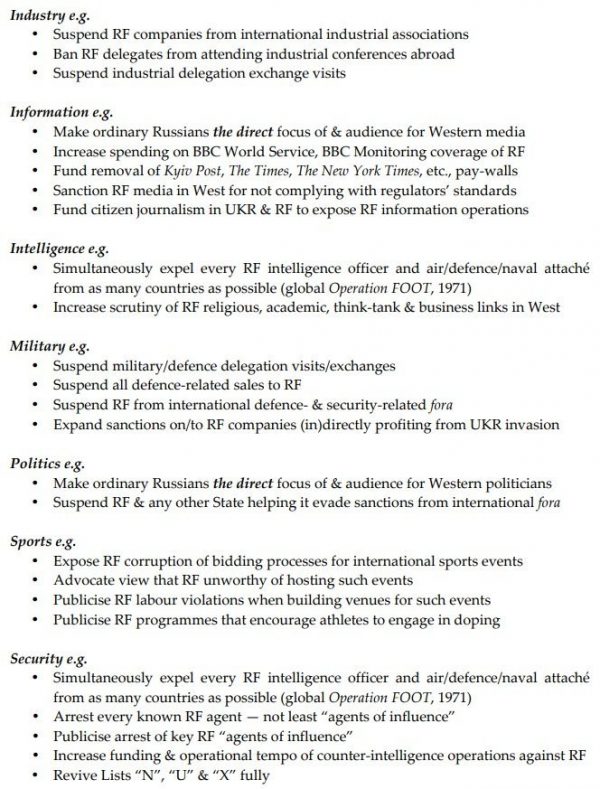
‘Potential Levers’ for Regime Change in Russia Outlined by Victor Madeira
Certain “levers” — such as suspending visits by the Bolshoi and Kirov Ballets to Western countries — are baffling, while others — for instance “repatriating” the children of Russian government studying abroad, or “[increasing] scrutiny” of Russian religious organizations in Western countries — appear wanton and excessive, if not outright barbarous.
However, one of Madeira’s suggestions, about which he was apparently so enthusiastic he mentions it thrice, “simultaneously [expelling] every RF intelligence officer and air/defence/naval attache from as many countries as possible (global ‘Operation Foot’)” — is especially striking.
Operation Foot saw 105 Soviet officials deported from the UK in September 1971 at the behest of then-Prime Minister Edward Heath, the largest expulsion of foreign state personnel by any government in history. Eerily, several mainstream media outlets would reference the historic mass defenestration when Whitehall successfully corralled 26 countries into expelling over 150 Russian diplomatic in response to the Salisbury incident, 27 March 2018.
‘Something Dreadful’
On 12 October 2016, Institute for Statecraft chief Chris Donnelly met with retired senior UK military official General Richard Barrons, Joint Forces Command chief 2013 — 2016. Their discussion was incendiary.
“We have led comfortable lives since the end of the Cold War. Wars have been away matches on our terms, with resources we have chosen to apply. Our institutions are now failing to deliver or being bypassed. Our world system is being challenged, by Russia, China… the power of initiative and decision is ebbing away from the West. [The] US can no longer protect us,” the document’s introduction states.
As 50 percent of the UK’s energy, and 40 percent of the UK’s food, is “from abroad”, the country “has vital interests in having the ability to engage globally, but that engagement will no longer be on our terms alone”. However, while in recent wars “the opposition had no peer capabilities and could pose no military threat” to the UK, the conflicts “have not required the full mobilisation of the military or any motivation of civilian society” and “given us the impression we can afford war at two percent GDP”, despite the UK needing “£7 billion just to our current force up to effectiveness”.
Moreover, “mixed success” in these conflicts is also said to have “left a bad aftertaste” with “no appetite for intervention” among the British public and politicians, and UK armed forces “cannot themselves speak out and say ‘we are broken’… as that would breach the rules of democratic control”.
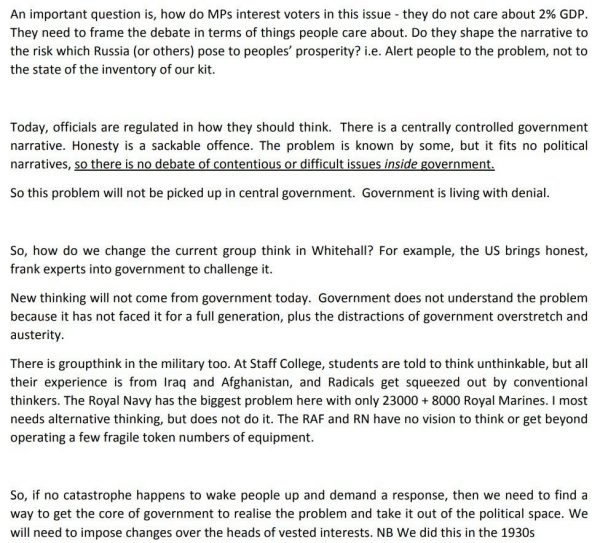
Record of Richard Barrons’ Meeting with Chris Donnelly
Barrons goes on to despair that the subordination of the military to civil servants and ministers in the Ministry of Defence means “the military do not do policy” — a state of affairs he believes must be radically changed, with the armed forces removed from government control and transformed into “an independent body outside politics”.
“Government is living in denial… We need discussion and debate as to how Russia can be managed and deterred. We need to deal with Russia by doing things that are serious… If no catastrophe happens to wake people up and demand a response, then we need to find a way to get the core of government to realise the problem and take [the military] out of the political space. We will need to impose changes over the heads of vested interests… [we] must either generate the debate or wait for something dreadful to happen to shock us into action. We must generate an independent debate outside government… there is not a moment to be lost,” Barrons concludes.
Serious Matters
Barrons’ fears of a loss of US military protection were no doubt widespread within the British establishment — for some time, US Presidential candidate Donald Trump had been questioning the necessity of NATO, advocating a protectionist and insular ‘America first’ agenda in respect of world affairs.
Likewise, Trump’s repeated suggestion of improved relations between Washington and Moscow should he become President were unquestionably unwelcome in many quarters — not least, of course, the offices of the Institute for Statecraft. It’s perhaps unsurprising then the organisation played a pivotal role in kickstarting ‘RussiaGate’.
The month after Donnelly’s meeting with Barrons, and mere weeks after Trump’s shock election victory, Andrew Wood — UK ambassador to Russia 1995 — 2000, and a member of the Institute’s ‘expert team’ — was a delegate at the eighth annual Halifax International Security Forum in Canada. Senator John McCain was also in attendance, and the pair would speak privately on the event’s sidelines about allegations of Trump’s collusion with the Russian state, in particular, the claims of former MI6 operative Christopher Steele, and his ‘Trump-Russia’ dossier.

Andrew Wood’s Institute for Statecraft Staff Profile
How and why McCain and Wood met, and precisely what they discussed, isn’t remotely clear — Wood has offered several wildly divergent accounts of the event since, variously suggesting the meeting was entirely chance and initiated by McCain due to the issue “being very much in the news”, that he approached McCain due to his personal concerns after being shown the dossier by Steele, and that he was actively “instructed” by Steele to relay the dossier’s contents to the Senator, without having actually seen a copy in full.
In any event, as a result of their conversation, the Senator dispatched his aide David Kramer, former assistant secretary of state in the Bush administration, to meet with Steele in London and discuss the dossier’s contents, and arrange for a copy to be sent to Washington. On 9 December, McCain met then-FBI Director James Comey and provided him with the dossier, which Comey then circulated across all US intelligence agencies. It would reach the desk of outgoing President Barack Obama and several senior members of Congress in the first week of January 2017.
This development would be reported 10 January by CNN — the article stated the dossier suggested Russian operatives possessed “compromising personal and financial information” about Trump, but the outlet refrained from publishing specific details of the dossier as they hadn’t been “independently corroborated”.
CNN breaking cover — the dossier had been an “open secret” among US journalists for some time by that point — would provide BuzzFeed News with the ‘public interest’ defense it required to justify publishing the dossier, which it did 11 January, despite acknowledging its contents were “unverified, and potentially unverifiable”, and contained “clear” factual errors.
In the days afterward, the publication was severely criticised by many other media outlets — Washington Post columnist Margaret Sullivan called the dossier “scurrilous allegations dressed up as an intelligence report meant to damage Donald Trump” — and the ethics of publishing unsubstantiated information offered by entirely anonymous sources was hotly debated.
However, these misgivings were quickly silenced, thanks in no small part to a number of esteemed ‘experts’ who vouched for Steele’s credibility in the media — the earliest, most enthusiastic and prominent being none other than Wood himself. He would describe Steele as “very professional and thorough in what he does”, and “a very competent, professional operator” who wouldn’t “make things up”, among other effusive plaudits.
It would take months for Wood to reveal he wasn’t merely ‘familiar’ with Steele, but the pair were in fact long-time friends — and moreover he was an “associate” of Steele’s firm (what form this relationship takes, and whether Wood receives any remuneration from Orbis Intelligence, remains uncertain). Conversely, his association with the Institute for Statecraft has never been acknowledged by the mainstream media, and would never have been known if it wasn’t for the leak of the organization’s internal files in November 2018.
The leak also revealed that in March 2017, the Integrity Initiative submitted a bid for Ministry of Defense funding — among its key performance indicators achieving a “tougher stance in government policy towards Russia”, the publication of “more information in the media on the threat of Russian active measures”, the growth of its cluster network “across Europe” and “greater awareness in all areas of society of the threat posed by Russian active measures to UK’s democratic institutions”.
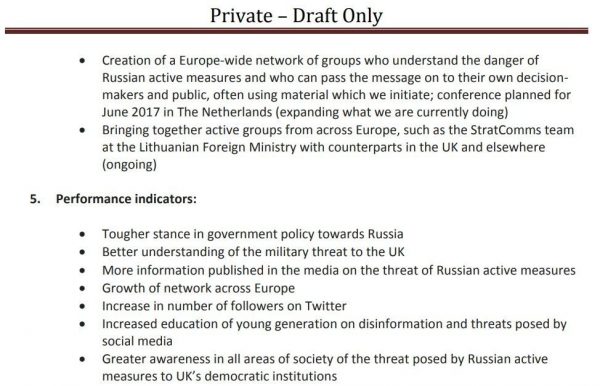
Integrity Initiative Bids for MoD Funding, March 2017
Russ to Judgement
BuzzFeed would again be used as a conduit for virulently anti-Russian propaganda in June, when it published a series of articles — From Russia With Blood – documenting 14 ‘suspicious deaths’ in Britain it claimed were potential or likely assassinations carried out by Russian “security services or mafia groups”, which UK authorities somehow failed to properly investigate.
The investigation caused something of a sensation, landing BuzzFeed in the running for a variety of prestigious journalism awards, including the Pulitzer and Orwell prizes — Investigations Editor Heidi Blake, who led the series, said her team’s work had cemented the outlet as a “major force in global news”.
However, examination of the seven articles offers much reason for scepticism. First and foremost, suggestions of possible Russian involvement in the deaths hinge almost entirely on the accusations of anonymous intelligence sources, without supporting documentation of any kind. In fact, the pieces often contain information directly contradicting the notion a featured individual was even murdered, let alone by Russians.
For instance, the third installment, The Man Who Knew Too Much, delved into the case of Dr. Matthew Puncher, a UK radiation scientist who’d been conducting work at a Russian nuclear facility, and was found stabbed to death in his kitchen in February 2016.
BuzzFeed notes Puncher’s wife Kathryn told investigators her husband tried to hang himself with a computer cable the the week prior, and Detective Constable Rachel Carter, who inspected the scene, told the inquest “there was no sign of a struggle, none of the furniture had been knocked over, and all the blood belonged to Puncher”, and she was “satisfied” he’d committed suicide as “all the information told us he was very depressed and no-one in his family seemed particularly surprised he had taken his own life”.
However, BuzzFeed had other ideas, stating “four American intelligence officials… believe he was assassinated”. Alternatively, a former senior Scotland Yard counter-terror officer unconnected to the case was quoted as suggesting — also anonymously — the Russian state could have given Puncher drugs to “create depression” and precipitate his suicide.
The fourth installment — The Secrets Of The Spy In The Bag — deals with Gareth Williams, the GCHQ codebreaker seconded to MI6 who died in a Pimlico flat owned by the spying agency in August 2010 and is similarly dubious in the extreme.
Williams’ demise is unambiguously mysterious — his decomposing naked body was found in a padlocked sports bag in the bath, although no fingerprints or traces of his DNA were found on the rim of the bathtub, bag, bag’s zip, or padlock, and an inquest ruled his death to be “unnatural and likely to have been criminally mediated”.
Litvinenko’s been in the news a lot the last couple of days, but nothing about MI6 spy Gareth Williams. The Met found it was ‘probably’ a self-inflicted ‘accident’ that he ended up padlocked inside a bag, in a bath, with none of his fingerprints on either. pic.twitter.com/wofSh40rvY
— dan barker (@danbarker) March 12, 2018
Ironically, much of the article’s content raises serious questions about the role of Williams’ employer’s in his death. For instance, BuzzFeed notes he’d been dead for around 10 days by the time his body was found, but astoundingly neither GCHQ nor MI6 had alerted authorities to his absence from work. It would take his sister informing GCHQ Williams was missing at 11:30 am GMT on 23 August for the agency to contact police — albeit five hours later.
The outlet also records how in the ensuing investigation police were prevented from interviewing Williams’ colleagues at MI6, or reviewing relevant documents, and instead forced to rely upon officers from national counter-terrorism force SO15, which took no formal statements from witnesses, and passed on only anonymised briefing notes to their Metropolitan force counterparts.
Conversely, BuzzFeed fails to mention coroner Dr. Fiona Wilcox ruling involvement of SIS staff in Williams’ death was a legitimate line of inquiry for police — instead again relying on the unsubstantiated claims of the anonymous quartet of US intelligence officials that Williams had been tracing international money-laundering routes used by organised crime groups to blame his probable murder on the Kremlin, and/or Russian gangsters.
The eponymous investigation — focusing on the suicide of Scot Young, an associate of oligarch Boris Berezovsky — is perhaps the series’ most puzzling, for more reasons than one. Young — a corrupt tycoon with clear criminal connections — lost all his money on a failed property endeavor, spent time in prison for contempt of court, and suffered a lengthy and costly divorce battle.
Such a litany of crippling personal calamities — and doctors’ appraisal of him as “paranoid, with a manic flavour” with a “complex delusional belief system” — would surely make Young at least a potential candidate for suicide watch, and indeed police concluded he’d taken his own life by throwing himself from his apartment window.
Three of his associates, Paul Castle, Robbie Curtis, and Johnny Elichaoff likewise “experienced dramatic financial [collapses]” in which they lost all their potentially ill-gotten gains, and subsequently took their own lives — Castle and Curtis both jumped in front of oncoming trains, while Elichaoff leaped off the roof of a London shopping centre.
Yet again though, the word of anonymous US intelligence officials is sufficient to perk BuzzFeed’s suspicions about all their deaths, the unnamed operatives saying Russia could have “engineered” their suicides “through manipulation and intimidation tactics”.
The article’s discussion of Berezovsky’s death is likewise suspect and contradictory, quoting Richard Walton, Scotland Yard’s former counter-terror commander, as saying his department investigated the exiled Russian’s death “very thoroughly” and “hadn’t been able to find any evidence of murder”. Fascinatingly though, in seeking to construct a case for Berezovsky being unlawfully killed, BuzzFeed notes business partner, Georgian oligarch Badri Patarkatsishvili, died from an apparent heart attack in 2008. American spy agencies are said to have intelligence suggesting he was murdered, and while predictably none is presented in the article, Patarkatsishvili was provably subject to at least one assassination plot prior to his death — and it certainly wasn’t Russian in origin.In 2007, covert recordings revealed three Georgian national security service officials had plotted to kill ‘Georgia’s Richest Man’ at the behest of then-President Mikheil Saakashvili. In one recording they debate the best means of execution, an official suggesting they use a poisonous substance which will “kill a person two hours after touching it”. “You smear [it] on the door handle,” they say — the precise method by which Sergei and Yulia were contaminated with novichok, according to UK authorities.
Whatever the meaning of that parallel, BuzzFeed’s series is highly significant, for it was fundamental to cementing the notion of frequent Kremlin-directed murders on British soil in the public consciousness in the year prior to Salisbury. Almost inevitably too, it was widely invoked in the immediate wake of the apparent poisoning as evidence, if not proof, of Russian state involvement.
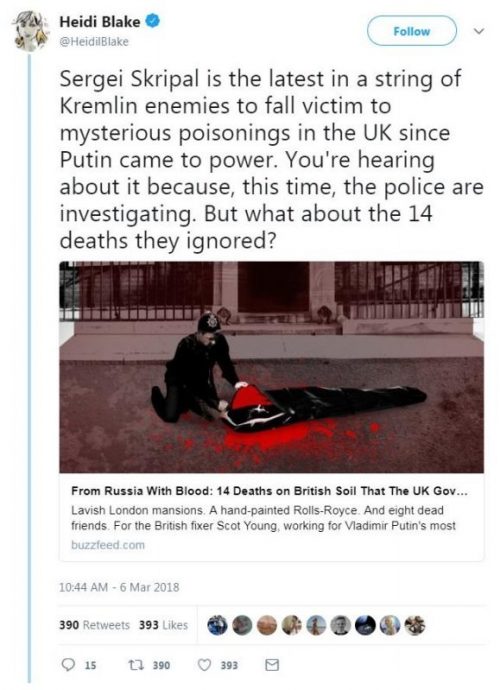
A Tweet by BuzzFeed Investigations Editor Heidi Blake on Skripal, Documented by Integrity Initiative
Among those seeking to connect From Russia With Blood with the attack on the Skripals was none other than BuzzFeed’s Heidi Blake herself. Her Twitter postings on the subject would be documented by the Integrity Initiative in regular roundups of social media activity relating to the incident — and reference to the series was made in an Initiative briefing document (likely circulated to journalists), Russian Lies and the Skripal Case, which called the “evidence” presented by her team’s investigation “compelling”.
So it was on 13 March 2018, nine days after the Salisbury incident, then-Home Secretary Amber Rudd announced British police and MI5 would reinvestigate the numerous ‘suspicious deaths’ detailed by BuzzFeed — a development the outlet reported rather triumphally. However, a mere four months later, Home Secretary Sajid Javid revealed police had determined there was “no basis on which to re-open any of the investigations”. Fittingly, in December an inquest concluded Alexander Perepilichnyy, one of the ‘BuzzFeed 14′, had died of entirely natural causes.
Whatever the truth of the matter, a month prior the Initiative invited Blake to head an hour-long ‘Investigative Masterclass’ at an event the organization convened at London’s Frontline Club — Tackling Tools of Malign Influence.
‘A Good Shepherd’
Also in June 2017, BBC Diplomatic Editor Mark Urban somewhat miraculously began conducting a series of interviews with Sergei Skripal in the latter’s Salisbury home.
“I was intending to write a book about East-West espionage… My intention was to focus the story on a handful of people, using their stories, and the moment these narratives intersected at Vienna airport, during the swap of 2010, as the key to its structure. Skripal was to be one of the central half-dozen or so stories… I was doing this in my own time — there was no contract. The only sense in which this was a ‘book’ in June 2017 was in my own imagination,” Urban claims.
Over the course of their discussions, Skripal would disclose much about his time in the intelligence services, spell as a double-agent for MI6, incarceration in Russia after discovery, and life in Britain post-exile — although his enduring patriotism Urban found particularly notable.
“[Skripal] is… an unashamed Russian nationalist, enthusiastically adopting the Kremlin line in many matters, even while sitting in his MI6-purchased house,” Urban records, “he was adamant, for example, Putin had not surreptitiously introduced Russian troops into east Ukraine, as much of the Western press reported. If regular units had gone in, he insisted, they would have been sitting in Kiev very soon.”
“The problem with the Ukrainians is they are incapable of leadership. They need Russia for that. The Ukrainians are simply sheep who need a good shepherd,” Skripal explained.
Such sentiments may explain why Skripal seemingly remained in regular contact with the Russian embassy after his arrival in the UK. Speaking to the Independent 7 March 2018, former Kremlin official Valery Morozov, an associate of Skripal likewise exiled to the UK, claimed Skripal had meetings with Russian military intelligence officers “every month”.
Strikingly, he also rejected the notion the apparent nerve agent attack had anything to do with the Kremlin.
“Putin can’t be behind this. I know how the Kremlin works, I worked there. Who is Skripal? He is nothing for Putin. Putin doesn’t think about him. There is nobody in Kremlin talking about former intelligence officer [sic] who is nobody. There is no reason for this. It is more dangerous for them for such things to happen,” Morozov cautioned.
Urban would bizarrely fail to reveal having bagged the unprecedentedly fortuitous scoop until three months after the Salisbury incident — an extremely curious delay, perhaps partially explained by his lucrative book deal with publisher Pan Macmillan being announced mere days later.
Yes, I met Sergei Skripal a few times in 2017 while working on a book project. He’s a remarkable man with a dry sense of humour and a great resilience given all he’s been through https://t.co/hfppMtFM0H
— Mark Urban (@MarkUrban01) July 4, 2018
The resultant work, The Skripal Files, was published in October — rather than a history of “East-West espionage”, the project had evolved into an extensive telling of the government’s official narrative on the Salisbury incident, buttressed by discussions of alleged Kremlin assassinations in the UK, and Skripal’s life and career.
However, while widely marketed as the “definitive account” of the affair, the name Pablo Miller doesn’t appear once in the text — an amazing oversight given Miller was Skripal’s MI6 recruiter and handler, and neighbour in Salisbury, rendered all the more perplexing by Miller and Urban once having served in the same tank regiment.
Miller’s connections to the Salisbury incident are unclear, and by design — immediately afterwards he deleted his LinkedIn account, which revealed him to be a Senior Analyst at Christopher Steele’s Orbis Intelligence, and on 7 March Whitehall issued a D-notice blocking mention of him in the mainstream media. Miller also has unclear connections to Integrity Initiative, his name appearing on a list of invitees to an event hosted by the organization, alongside representatives of the BBC, Porton Down, the FCO, the MOD and the US Embassy.
Adding to the intrigue, Initiative operative Dan Kaszeta — a “counterfeit” chemical weapons ‘expert’ who was the very first source to suggest Sergei and Yulia may have been struck by novichok, a mere four days after the Salisbury incident — noted he’d met Urban “several times over the past few years” in a glowing review of The Skripal Files (since removed from the web) he wrote for the organization in December 2018.
In what may just be an intensely spooky coincidence, as 2017 drew to a close British-American TV project Strike Back: Retribution – a spy-drama based on a novel of the same name by ex-SAS soldier Chris Ryan — began airing on Sky One in the UK. The series followed the activities of Section 20, a fictional branch of British Defence Intelligence, which conducts secretive high-risk missions throughout the globe.
‘Strike Back: Retribution’ Episode Summaries
In episode four, broadcast 21 November, it’s revealed character Ilya Zaryn — who Section 20 rescued from the clutches of a terrorist group — is, in fact, Karim Markov, a Russian scientist who murdered a number of his colleagues with novichok, and is assisting the terrorists in their nefarious schemes.In the next episode, Section 20 locate Zaryn/Markov in a laboratory in Turov, Belarus, where he’s found producing more novichok — but while they manage to destroy the facility and the nerve agent, the dastardly Russian escapes.
In the next, Section 20 track Markov to a lab in Pripyat, Ukraine — but in attempting to contain the nerve agent, Section 20 operative Natalie Reynolds is contaminated. The unit forces Markov to create an antidote, but is killed before he can concoct one — Reynolds’ fellow agent Thomas McAllister manages to improvise and save her, however.
The series would air early the next year in the US on Cinemax — the second episode featuring novichok was transmitted 2 March, two days prior to the Salisbury incident, the third 9 March, five days after.
Expecting the Unexpected
Mainstream hostility towards the Kremlin had been intense ever since 2014, but ‘RussiaGate’ pushed this antipathy into overdrive. Critical, aggressive and paranoid media reports and statements by politicians had become an essentially daily staple by the start of 2018.
CC0
UK Chief of General Staff Gen. Nick Carter (File)
Nonetheless, on 22 January General Nicholas Carter, UK Chief of General Staff, offered perhaps the most hawkish speech on Russia since the demise of the Soviet Union. Speaking at a Royal United Services Institute event, Carter described the country as the “most complex and capable state-based threat to our country since the end of the Cold War”, and warned hostilities could start “sooner than we expect”, particularly as he — ironically — claimed the Kremlin had “[convinced] ordinary Russians the West is a threat… We have been made to appear as the enemy”.
“If Russia sees itself in decline, and more able now to go to war than in the future, does this encourage them to think of war? Perhaps compare the situation today to 1912 when the Russian Imperial Cabinet assessed that it would be better to fight now, because by 1925 Russia would be too weak in comparison to a modernised Germany; and Japan, of course, drew similar conclusions in 1941. Russia worries, I think, that the West will achieve a technological offset in the next decade,” he cautioned.
Carter said the conflict — which he naturally envisaged being initiated by Russia — would “start with something we don’t expect”.
Not long after the speech, Operation Toxic Dagger was launched — a vast three week effort in which 40 Commando Royal Marines, Public Health England, the Atomic Weapons Establishment and Porton Down’s Defence Science and Technology Laboratory collaborated to prepare Britain’s armed forces for Chemical, Biological, Radiological and Nuclear operations by creating “realistic exercise scenarios based on the latest threat information”.
The endeavour included “company-level attacks and scenarios concerning CBRN vignettes, concluding with a full-scale exercise involving government and industry scientists and more than 300 military personnel”, with a “chemical decontamination area set up not merely to treat ‘polluted’ commandos, but also wounded prisoners”.
It was convened on Salisbury Plain — several of the Royal Marines taking part would be seconded to Operation Morlop, a multi-agency ‘clean-up’ effort launched in Salisbury in the wake of the poisoning of the Skripals, less than a fortnight after Operation Toxic Dagger was completed.
Skripal Might Want to Return to Russia, but Was Likely Prevented by UK – Journo
Sputnik – March 4, 2019
UK newspaper The Guardian today reported that British intelligence services investigated “frantic goings-on” at the Russian Embassy in the days prior to the Salisbury incident. Once again, however, this vague statement provides no clear evidence to directly implicate the Russian state in the poisoning.
Sputnik spoke to British journalist Mary Dejevsky and asked her what she made of this Guardian report, one year on after the case began.
Sputnik: What do you make of this Guardian report, one year on after the case began?
Mary Dejevsky: It was interesting that this report came out today, I think by the Press Association and The Guardian, citing intelligence reports about unusual activity at the Russian Embassy, because like all such reports based on intelligence, they’re hopelessly incomplete, because you would expect reports based on intelligence that somewhere in these reports the information would say “OK, unusual movement, unusual activity, who was actually there, what time, how many people etc.”…
But the way it is passed to the media, it is in these very indefinite terms, sort of tantalizing, tweaking the imagination, without giving chapter and verse. This is so characteristic of intelligence information that is leaked or provided deliberately to the media.
Sputnik: Why has there been so little attempt by the mainstream media to analyse or investigate the UK government’s allegations?
Mary Dejevsky: I have to say that personally, I’ve been very surprised at the lack of critique in the mainstream media. I think there’s been a little on Channel 4, a little on SKY News, but most of the press hasn’t really tackled it. I think that the British government, at least the authorities, have been incredibly successful in the way they have simply refused to answer questions.
Basically, they have handled the information on their own terms. They’ve decided to put out little titbits of information now and again like the CCTV, the camera footage of the supposed Russian agents in Salisbury or going through the airport. This has been done entirely on official terms and if you ask any questions about it, you get stonewalled.
Sputnik: Media said that the official UK version, although, to many, could seem plausible because of its simplicity, was however problematic and perhaps the UK had a different role in the case from the one it is putting across…
Mary Dejevsky: I would suggest that Sergei Skripal wanted to go back to Russia — at its most basic — let’s say he wanted to go back to Russia because he was homesick in the UK, because he lost his wife, because his elderly mother was ill in Russia; you can think of a lot of reasons why he would want to go home.
You then have to ask, why was he simply not allowed to go back to Russia? Maybe Sergei wanted to go back to Russia, but the British didn’t want to let him go back to Russia and wanted to stop him going, at least to stop him going then. Then you have to ask why? Was it because of the information he was privy to in the UK about the working state of UK intelligence or was it some information that he had?
Understanding How Canadian Diplomats Shape the News
By Yves Engler | Dissident Voice | March 3, 2019
Canadian diplomats abroad seek to shape coverage of their work. And the more nefarious their actions the harder they toil to “spin” what they’re doing as something positive.
During a recent interview Real News Network founder Paul Jay described how Canadian officials in Caracas attempted to shape his views of the country’s politics. Jay noted:
My first trip to Venezuela in 2004, I was producing the big debate show on Canadian TV called Counterspin on CBC Newsworld. … . I was a known quantity in Canada. And so when I was in Venezuela, I said I’ll go say hello to the Canadian embassy. I was trying to figure out what was going on in Venezuela. I figured some Counselor would pat me on the head and say welcome to Venezuela.
No, I got the number two chargé d’affaires that greeted me and brings me into a meeting room with seven members of the opposition who then for two hours beat me over the head with how corrupt the regime was, how awful it was, and so on…
What business does a Canadian embassy have with bringing a Canadian journalist into a room with opposition people, essentially trying to involve me in a conspiracy against the Venezuelan government. Canadian government role in Venezuela was promote and nurture the opposition.
Around the same time Canadian officials sought to convince Jay that Hugo Chavez’s government was corrupt, former Montréal Gazette reporter Sue Montgomery had a similar experience in Port-au-Prince. In “Parachute Journalism in Haiti: Media Sourcing in the 2003-2004 Political Crisis”, Isabel Macdonald writes:
Montgomery recalled being given anti-[President Jean-Bertrand] Aristide disinformation when she called the Canadian embassy immediately after she had been held up by armed men while driving through Port-au-Prince days before the [US/France/Canada] coup. Canada’s ambassador to Haiti, Kenneth Cook, told her, ‘We’ve got word that Aristide has given the order to the chimeres [purported pro- Aristide thugs] to do this kind of thing to international journalists because he’s not getting any support.’ According to Montgomery, Cook had urged her to tell the other international journalists who were staying at the same hotel: ‘I think you should let all your colleagues at the Montana know that it’s not safe for them.’
Given only two days to prepare for her assignment, Montgomery was ripe for official manipulation. Though she later realized the ambassador’s claim was ridiculous, Montgomery told other journalists at Hotel Montana (where most international journalists stay in Port-au-Prince) that Aristide’s supporters were targeting them.
The Canadian embassy in Port-au-Prince succeeded in influencing Canadian reporters’ coverage of the country. In her MA thesis titled “Covering the coup: Canadian news reporting, journalists, and sources in the 2004 Haiti crisis,” Isabel Macdonald concludes that the reporters dispatched to Port-au-Prince largely took their cues from official Canada. “My interviews revealed that journalists’ contacts with people working in the Canadian foreign policy establishment appear to have played a particularly important role in helping journalists to identify appropriate ‘legitimate’ sources.”
CBC reporter Neil MacDonald told Isabel MacDonald his most trusted sources for background information in Haiti came from Canadian diplomatic circles, notably the Canadian International Development Agency where his cousins worked. MacDonald also said he consulted the Canadian Ambassador in Port-au-Prince to determine the most credible human rights advocate in Haiti. Ambassador Cook directed him to Pierre Espérance, a coup backer who fabricated a “massacre” used to justify imprisoning the constitutional prime minister and interior minister. (When pressed for physical evidence Espérance actually said the 50 bodies “might have been eaten by wild dogs.”)
Almost all Canadian correspondents develop ties to diplomats in the field. Long-time Globe and Mail development reporter John Stackhouse acknowledges “Canadian political officers” in Indonesia for their “valuable insights” into the country during General Suharto’s rule. In Out of Poverty, Stackhouse also thanks “the Canadian diplomatic missions in Accra, Abidjan and Bamako [for their] … invaluable service in arranging interviews and field trips.” During a period in the mid-2000s when she wrote for the Globe and Mail and CBC, Madeleine Drohan conducted media workshops in Zambia, Tanzania, Kenya and elsewhere sponsored by the Canadian embassy, High Commission and Foreign Affairs (she taught journalist ethics!).
“One of the best Canadian foreign correspondents of the 1970s,” Jack Cahill discusses some ways diplomats relate to reporters in If You Don’t Like the War, Switch the Damn Thing Off!: The Adventures of a Foreign Correspondent. “The Canadian government”, the former Toronto Star reporter notes, “can be good to foreign correspondents if it thinks they are reliable and I had two passports, one for general purposes and one for difficult countries.”
In what may reflect his nationalism, Cahill dubs Canadian diplomats “more reliable” than their southern counterparts. Disparaging his US colleagues, he writes:
There is little doubt, however, that some US foreign correspondents depend almost entirely on their embassies, and thus indirectly the CIA, for their information. It is, after all, the natural thing to be attracted to the truth as propounded by one’s own countrymen in the Embassy offices, at the official briefings, and on the cocktail circuit. It’s this information, with its American slant on world affairs, that eventually fills much of Canada’s and the Western world’s news space.
Jay described his experience at the Embassy in Caracas mostly to highlight Canada’s long-standing hostility to the Hugo Chavez/Nicolas Maduro governments. But, his story also helps make sense of the dominant media’s alignment with Ottawa’s push for regime change in Venezuela today.
Globe and Mail Latin America correspondent Stephanie Nolen, for instance, promotes Canada’s last ambassador to Venezuela. Describing Ben Rowswell as “widely respected by Venezuelans while he was there”, Nolen recently retweeted Rowswell claiming: “the coup happened in July 2017 when Maduro suspended the constitution. The question now is how to fill the void – by backing the president who uses force to remain in power after his term expires, or the leader of Venezuela’s last remaining democratically elected body?” Rowswell has been quoted in at least a half dozen Globe and Mail articles about Venezuela in recent weeks.
Diplomats’ influence over international correspondents is one way the foreign policy establishment shapes discussion of Canadian foreign policy.
The Salisbury Poisoning One Year On: An Open Letter to the Metropolitan Police
By Rob Slane | The Blog Mire | March 3, 2019
Dear Assistant Commissioner Basu,
It is now a year since the events in Salisbury that shocked the nation, and indeed the world. Since then, your organisation has conducted an investigation into the case, and has laid out a case about what happened in a series of statements, notably those made on 5th September (no longer available on your website), in which two suspects were formally accused, and another on 22nd November, following the screening of the Panorama documentary: Salisbury Nerve Agent Attack — The Inside Story.
To those who have a superficial interest in the case, the explanations you have presented for what happened on 4th March 2018 may appear credible, especially since the British media has largely repeated them verbatim, even when they have been self-evidently flawed and contradictory. Indeed the press has steadfastly refused (or been refused) to ask some very obvious and much needed questions about them. But to those who have spent time looking at the incident, the explanations you have set out contain glaring omissions, factual errors (see here for more detail), and at least one scientific impossibility (more on this below). What I wish to do in this letter, is to set out some of the most important, and which I believe you owe it to the public to explain.
Why have we heard nothing from Sergei Skripal?
The most glaring problem with your case is the disappearance of Mr Skripal himself — and yes “disappearance” is the right word. It is now 12 months from the original incident, and about 11 months since it was announced that he had recovered. During that time there have been zero public appearances and — curiouser and curiouser — not even one public statement put out in his name. Additionally, it is known with certainty that he has not been in contact with his mother back in Russia — not on her birthday, not at New Year and not at Christmas — which has caused her great distress. This is not just odd; it is highly disturbing, especially given that Mr Skripal was said to be in the habit of contacting his mother every week prior to 4th March.
If I were to ask how you can account for this, I would anticipate an answer that includes the claim that any such statements, appearances, and contact are deemed dangerous to his security. Certain reports in the media have indeed stated or implied this. However, it will not wash, for two reasons:
Firstly, are we seriously expected to believe that the UK Intelligence Agencies are incapable of protecting Mr Skripal’s whereabouts and his safety, whether in a statement, a pre-recorded video, or in a call to his mother? The idea is self-evidently ludicrous.
Secondly, these apparent “security concerns” were somehow overcome with Yulia Skripal. Not only was a statement released in her name upon departure from Salisbury District Hospital, followed by a Reuters video of her reading out a pre-prepared statement, but she was also allowed reasonably regular contact with her family, including her cousin and grandmother — up to 24th July last year (that is, up to the point that she told her cousin that she “now understood everything”). If Yulia’s security can be protected, there is no reason that Sergei’s security can not also be guaranteed.
It is also worth noting that neither Sergei nor Yulia have once endorsed your explanation of the incident. Sergei has been silent, and as for Yulia, far from endorsing your version, in none of her statements or phone calls has she ever pointed the finger of blame at the Russian state for an assassination attempt on her and her father. In fact, she has repeatedly expressed a desire to go back to live in Russia — a very strange desire given what you claim happened to her, wouldn’t you agree?
To all intents and purposes, both Sergei and Yulia Skripal have now disappeared without trace — he since 4th March 2018, and she since 24th July 2018. In the absence of any plausible reason for this, it is reasonable to consider them both as being held against their will, without consular access, without legal representation, and without the ability to contact their next of kin. Needless to say these are very serious issues, and if confirmed would put the United Kingdom in breach of a number of international legal obligations. Yet there are of course very obvious steps that could be taken to assure the public that this is not the case.
And so I simply ask you this: what credible reason can you give as to why nothing has been heard from Mr Skripal since 4th March? Why has he been unable to contact his mother? And what credible reason can you give as to why Yulia appears to have been denied contact with her family since 24th July?
Why won’t you show where the suspects were going?
Your organisation has repeatedly stated that the CCTV footage of the two suspects at the Shell Garage on the Wilton Road shows them “in the vicinity of” and “on their way to” Mr Skripal’s house (or “the Skripal’s house” as statements bizarrely keep referring to it. Who, may I ask, is “The Skripal”?). This is misleading on two counts.
Firstly, the footage actually shows them some 500 yards or so from 47 Christie Miller Road, which cannot be conceivably described as “in the vicinity” in terms of proving that they actually went to the house. This evidence would not convince a discerning jury.
Secondly, it does not show them “on the way” to Mr Skripal’s house either. It is possible that they did go there, but the CCTV footage does not show this, since it gives no indication that they were preparing to cross the Wilton Road, which they would have had to do to get to Christie Miller Road (either via the passage to Montgomery Gardens or via Canadian Avenue).
However, there is more than this. The camera that was used to take footage of the two men covers the area where they walked past the garage, but does not cover those two routes to 47 Christie Miller Road mentioned above. What you failed to inform the public, however, is that there is another CCTV camera on the Shell garage, just past this one, that does cover these routes. As the following picture shows, it is located on the right-hand side of the front of the building (circled), facing the Wilton Road, almost exactly opposite the path to Montgomery Gardens (note: the camera that was used to take the footage that was aired is on the corner of the left-hand side of the building, just out of shot):

Had the two men crossed the Wilton Road to go through the passage to Montgomery Gardens, or even via Canadian Avenue, this camera would have recorded it. Had this camera recorded them going through either route, although it still wouldn’t have been conclusive proof that they went to number 47 Christie Miller Road, much less what they may have done had they gone there, it certainly would have been far more credible than the footage you did release. Yet you have chosen not to show it. Can you tell us why, and also whether the footage taken by this camera on the right of the building backs up your claims that they were “on their way” to Christie Miller Road?
Wot no CCTV?
The issue of CCTV is not just confined to what was and wasn’t shown of the two men on the Wilton Road, however. It remains a curious fact that aside from this and the other footage of them on the bridge at Fisherton Street — which by the way were released nearly nine months after the event — you have not released one bit of proper footage of the Skripals or other related events that day.
This is extraordinary, for a couple of reasons.
Firstly, such footage most certainly does exist. For example, there exists “really clear footage” of Sergei and Yulia Skripal feeding ducks with some local boys on the afternoon of 4th March, next to the Avon Playground. The time of this footage was around 13:45 which — it should be noted — is approximately 20-30 minutes after the Skripals were said to have come into contact with a nerve agent on the door handle of their home (more on this below).
Secondly, in the early days of the investigation, a number of places in the city centre were mooted as possible locations for the poisoning (namely Zizzis, The Mill pub, and the bench itself). However, despite the fact that “really clear” CCTV footage of these areas undoubtedly exists, and despite the fact that the public were being asked to come forward with information, you showed not even a second of footage of the pair in that area. The public were therefore being asked to come forward with information about two people who were on CCTV and could be clearly identified by it, but without so much as a few seconds of this CCTV being shown so that they could see what they looked like, what they were wearing, and where they were going.
All this simply adds to the nagging suspicion that this CCTV shows things that would cast huge doubt on the explanations you have given. However, it is even worse than this. In the first few days after the incident, CCTV footage was released of a couple walking through the Market Walk at 15:47, and it was stated by more than one news outlet that the pair were the Skripals. Of course it wasn’t them, and yet — given some witness statements that followed — these people were undoubtedly somehow involved in the events that followed. Yet, important as they were, they were quickly forgotten about in the days after that grainy CCTV footage of them was released, and were subsequently never mentioned by the media or the police thereafter. Why is this, since witness testimony leads to the belief that they were something to do with what happened?
What we have, then, is what you have described as a “fast moving” and “complex investigation”, in which you repeatedly appealed to the public for information, and yet refused to show the public anything of the CCTV footage that exists, which may well have helped to jog memories and so aid you in your investigations. Furthermore, since the explanation you have given for what happened (poisoning at the door handle) implies that nothing of note happened in The Maltings (other than the collapse at the bench), reasons of “national security” simply cannot apply. Therefore, what reason can you give for not showing CCTV from The Maltings to the public when you were appealing for information?
The Skripals, the suspects, the ducks and the bin
I mentioned above the CCTV footage taken of the Skripals at 13:45 on 4th March at the Avon Playground, which is in The Maltings. This is one of the most interesting incidents in the whole case, for a number of reasons.
Firstly, as already stated, the footage shows Mr Skripal and his daughter feeding ducks, with Mr Skripal actually handing bread to three local boys, one of whom apparently ate a piece, but none of whom became contaminated. This clearly suggests that Mr Skripal was not contaminated with nerve agent at that time.
Secondly, it shows Yulia carrying a red bag, which may seem inconsequential, but for the fact that the female caught on CCTV in the Market Walk (who wasn’t Yulia) was also carrying a distinctive red bag. Not to put too fine a point on it, given Mr Skripal’s tradecraft, duck-feed plus distinctive red bag has a definite “signalling to someone” quality about it.
Thirdly, and most remarkably of all, given the nature of your claims, at the same time as they were feeding ducks, the two suspects — Petrov and Boshirov — were in close proximity. And when I say close proximity, I mean far closer than the distance from the Shell Garage to 47 Christie Miller Road, which you describe as being “in the vicinity”. How so?
According to the image you released of the two men at 13:08, they were standing at the entrance to Summerlock Approach, which happens to be the road that leads to the Sainsbury’s car park, which happens to be the car park where Mr Skripal parked his car approximately 32 minutes later. They were then seen on CCTV obtained by the media walking past Dauwalders (coin and stamp shop) on Fisherton Street at 13:48. Crucially, they were coming from the direction of the town.
What this means is that after being photographed at Summerlock Approach, instead of walking directly to the train station, as your timeline suggested, they went back into town, either by doubling back down Fisherton Street, or by walking in a loop through Summerlock Approach, across the car park, and through the Maltings, before heading back to Fisherton Street via Malthouse Lane.
Dauwalders, where they were seen at 13:48, is less than 200 yards from the Avon Playground, where the Skripals were filmed at 13:45. And so we have the intriguing prospect of the two alleged assassins passing less than 200 yards from the pair they are alleged to have tried to assassinate, within 3 minutes of one another. Furthermore, given that the two suspects were coming from the direction of town when they passed the shop, it is entirely possible (although by no means certain) that they had actually come from the area of the Maltings, and therefore that they had, just moments before, been in even closer proximity of the Skripals.
The fact that the two suspects were closer to the Skripals at between 13:45-13:48 than they were at 11:58 outside the Shell garage, is of course extremely interesting. But what is particularly troubling about this episode is what your organisation has done with this information.
Firstly, you have left it out of your timeline, never once mentioning that the Skripals had taken a detour to feed the ducks — and it is indeed a detour if you are walking from Sainsbury’s car park to Zizzis or The Mill — and never once mentioning that the two suspects were in that area at the same time (which is really odd, given that you are trying to make a case against them).
But secondly, although this incident was ignored in your timeline, as if it were trivial, it was obviously highly significant. The reason we can be sure of this is that on the day following the incident (5th March), a large number of military personnel were extremely focused on the bin next to the Avon Playground as these videos — here and here — make clear. Why that bin, which is a significant distance from the bench (50 yards or so), and why was it such an object of intense focus?
To leave this location out of your timeline, and to fail to inform the public of the close proximity of the suspects to the Skripals at the time of the duck feed, is frankly bizarre. What credible explanation is there for this?
The absolute impossibility of your door handle explanation
I mentioned at the start that alongside the factual errors, glaring omissions, and inconsistencies in your case, there is also an impossibility. That is the explanation that the assassination attempt was carried out using a nerve agent sprayed on the door handle of 47 Christie Miller Road.
Leaving aside the absurdity of what has been described as an “oily substance” being sprayed by an atomiser (how does that work?); leaving aside the ridiculousness of people actually spraying it without wearing proper protective clothing; leaving aside the silliness of supposing that the deed was done in broad daylight whilst Mr Skripal and his daughter were in the house; leaving aside the difficulties involved in having both victims touching the door handle on their way out of the house; and leaving aside the frankly preposterous notion that having apparently done their deed, instead of leaving Salisbury immediately, the two men then walked across town, and rather than dumping the open bottle of “Novichok” they had apparently used, they allegedly dumped a bottle they hadn’t used (remember, Charlie Rowley’s box was, according to him, cellophane wrapped) — leaving all those irrational propositions aside, as I say there is an absolute impossibility in what you are asking us to accept.
In the BBC Panorama programme, Salisbury Nerve Agent Attack — The Inside Story, which was clearly made with official approval (the ex-head of MI6 and the Deputy Assistant Commissioner of the Metropolitan Police, Dean Haydon, both appearing and helping in the reconstruction of what is supposed to have happened), it was claimed throughout the programme that the substance used was not only incredibly toxic, but that it could kill even with the tiniest of amounts. One of the men who worked on the original Foliant Project to create these substances, Vil Mirzyanov, was asked how much was needed to kill a person. He replied:
“To kill a person, you need only 1mg. To be sure, 2mg.”
Now this obviously gives rise to a problem, which is why didn’t it kill Mr Skripal and his daughter, since they were both allegedly contaminated with far more than 2mg of the stuff? The answer given on the programme was supplied by Mr Mirzyanov, who said:
“Maybe the dose was not high enough. Salisbury was rainy and muggy. Novichok breaks down in damp conditions, reducing its toxicity. It’s the Achilles Heel of Novichok.”
Although this might sound plausible, it runs up against the buffers of the statement released on 4th May by the OPCW, who said this about the samples they collected at sites in Salisbury, including the door handle:
“The samples collected by the OPCW Technical Assistance Visit team concluded that the chemical substance found was of high purity, persistent and resistant to weather conditions.”
These statements, taken together, mean that your explanation is an absolute impossibility. If 2mg of “Novichok” is enough to certainly kill a person, as Mr Mirzyanov stated (corroborated by Deputy Assistant Commissioner Haydon who said there was enough in the bottle to kill thousands), then Mr Skripal and his daughter should be dead. If the reason they aren’t dead is because “Novichok” breaks down in damp conditions, then it is impossible for the OPCW to have found a substance that hadn’t broken down, which was of “high purity”, and which is resistant to weather conditions.
There is simply no way you can square these things. If it didn’t kill the Skripals because it had broken down in damp conditions, then the OPCW can’t have found a high purity substance that is persistent and resistant to weather conditions. But since the OPCW claim that this is exactly what they found, then it can’t have broken down in damp conditions and lost its toxicity, can it? One or the other, but not both.
Unless you can prove that a substance can lose its toxicity in just over an hour due to dampness (from the time it was allegedly sprayed to the time it was allegedly touched), only to regain its toxicity and be found to be resistant to weather conditions two weeks later, no rational person can possibly be expected to believe this explanation. It is obvious nonsense, utterly impossible, and discredits your entire account of what happened on 4th March.
In Conclusion
Along with other members of the public, I would love to be able to believe that your investigation has been based on all the evidence available, and that its conclusions (so far) are credible. Sadly, however, this is not possible, as the above issues (and plenty of others) demonstrate.
It was quite obvious from the outset, when the Government came to a conclusion before any evidence had been properly assessed, that any subsequent investigation had already been politicised. There was therefore little hope that the investigation would be impartial, and that if evidence was found to contradict the Government’s assessment, that it would be presented.
However, there was always a glimmer of hope that your organisation would refuse to bow to this politicisation, and instead conduct a truly independent investigation. Amongst other things, this would have involved:
- Mr Skripal and Yulia being allowed to give their account of what happened that day to the media, and the media allowed to freely ask questions
- A thorough account of the two suspects’ movements, rather than two highly selective bits of footage that imply where they went, but which leave out the footage that shows where they did actually go
- The release of CCTV footage showing what happened in The Maltings in order to appeal for witnesses to come forward
- Important information, such as the duck feed and the close proximity of the suspects to the Skripals at that time, being given out to the public, and included in the timeline
- An explanation of the poisoning that is actually scientifically credible
But since these elements have not been a part of your investigation, the public can have no confidence in your explanation and assessment of what happened on 4th March 2018, and has every right to suspect that they are part of what essentially appears to be a politically-driven cover up. That really is a great shame, not only in terms of understanding what really happened in the Salisbury and Amesbury incidents, but also in terms of the denting of trust in your organisation, and the authorities in general, in the long-term. I would like to hope that this potential denting in confidence in your organisation’s integrity in handling this case, which surely cannot give you cause for celebration, would lead you to take the initiative in now providing a more credible account of what took place.
Featured Video

Seyed M. Marandi: US-Iran War Inevitable: Kuwait and Bahrain May Fall
or go to
Aletho News Archives – Video-Images
From the Archives
USS Liberty Massacre: A Pivotal Moment in the Hostile Takeover of America
By Kevin Barrett | Crescent | Dhu al-Qa’dah 24, 1445
In corporate America, hostile takeovers are commonplace. They occur when an aggressor—a larger corporation or rich individuals—seizes control of a smaller corporation without asking permission.
What few recognize is that the United States itself has been subjected to a hostile takeover. Since the aggressor, the illegitimate settler colony known as “Israel,” is much smaller than the US, the takeover has necessarily been surreptitious.
As of June, 2024, Israel’s gradual takeover of the US has become obvious and undeniable—a proverbial “elephant in the living room.” … continue
Blog Roll
 Aletho News
- Seyed M. Marandi: US-Iran War Inevitable: Kuwait and Bahrain May Fall
- Leaders Condemn Ansarallah Attack on Saudi Arabia While Ignoring Illegal War Against Yemen
- Leaked: Britain’s Covert Iraqi Psyops Network
- Yemeni Armed Forces Warn Airlines Against Using Saudi Airports, Exempt Mecca and Medina
- Iran security chief says powers greater than US tried to conquer Iran but ended in ‘dustbin of history’
- Europe’s mounting social chaos… chickens coming home to roost for proxy war against Russia
- US-Russia Diesel Deal Becomes Massive Defeat for Ukraine
- Hormuz and the Looming Economic Catastrophe
- Dhubab offensive, media blitz and the rapid unraveling of Saudi-backed coalition’s new gambit
- Putin Conveys to Trump Iran’s Vision on Possible Conflict Resolution – Kremlin
- If Americans Knew
- Gaza: Ceasefire Anniversary Marks Year of Failed Promises
- The American Conservative: Mike Huckabee Should Resign
- A C-Section in Shackles: A Palestinian Woman’s Harrowing Birth in Israeli Detention
- ‘He’s Desperate’: AIPAC Begins Spending Against Abdul El-Sayed to Boost Mike Rogers:
- Trump, Hormuz, and the Looming Economic Catastrophe
- For three years, Israel has killed a child in Gaza every 71 minutes – Daily Update
- Israeli forces kill another child in Gaza – Daily Update
- Gaza ceasefire exists in name only, say more than 100 organizations
- Nearly 2 Million in Gaza Need Urgent Shelter Assistance as Winter Looms: IOM Chief Warns
- Suppressing Palestinian resistance: US charity under fire for AI monitoring of Gaza classrooms
- No Tricks Zone
- Germany’s Green Energy Debacle: High Energy Costs Force Kahla Porzellan to Close After 182 Years!
- New Study: 50 Years Of The Most Aggressive ‘Net Zero’ Policies Can Only Affect The Global Climate By 0.03°C
- US September “Heat” Was No Record…Many Records Set Decades Ago
- Latest European Green Energy Debacle; Portugal’s Largest Flagship Solar Park Insolvent!
- Green Energy Debacle: German Expert Professor Fritz Vahrenholt Warns Of Severe Economic And Social Consequences
- Two More Paleo Reconstructions Affirm Meters-Higher Sea Levels Across Ireland, Brazil 7000-6000 Years Ago
- New Study: Earth And Venus Surface Warmth Largely Explained By Convection And Lapse Rate, Not CO2 Or Radiation
- 2025 Nature Paper Claiming Worsening Global Drought Gets RETRACTED …Heavily Flawed
- New Study: ‘Global Drought Shows No Detectable Recent Acceleration Under Climate Warming’
- Economic Masterminds: German Socialists Suggest Taxing Productivity Gains Stemming From Using AI

