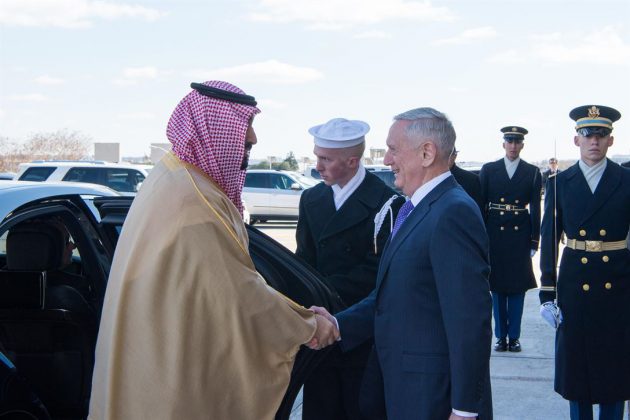
Defense Secretary Mattis welcomes Saudi Deputy Crown Prince and Defense Minister Mohammed bin Salman to the Pentagon, March 16, 2017. (DoD photo by Sgt. Amber I. Smith)
The Trump administration’s growing use of military force in Syria, Iraq, and Yemen has neoconservative hawks rooting for armed confrontation with what they view as the root of all evil in the Middle East: Iran.
Many of these armchair warriors recently cheered President Trump’s decision to take on the Assad regime — and Moscow — by firing 59 Tomahawk cruise missile at a Syrian air base alleged to be the source of a chemical weapons attack. But they urged him to do more.
Weekly Standard editor William Kristol tweeted, “Punishing Assad for use of chemical weapons is good. Regime change in Iran is the prize.”
Kristol co-founded the infamous Project on the New American Century in 1997 to promote American “global hegemony” and “challenge regimes hostile to our interests and values.” It began lobbying for the overthrow of Saddam Hussein as early as 1998, but always kept Iran in its sights as well.
With Saddam dead and Syria’s Assad stripped of much of his power, Iran is now at the center of neocon crosshairs. Kristol linked his recent tweet to a Washington Postcolumn by two stalwart advocates of ousting the mullahs in Tehran: Reuel Gerecht and Ray Takeyh.
Titled “How Trump Can Help Cripple the Iranian Regime,” their article called for putting the nuclear arms deal with Iran at risk in order to “stoke the volcano under Tehran and to challenge the regime.” The centerpiece of their bizarre argument was that the Iranian people would gratefully welcome the United States imposing “crippling sanctions” to destroy their economy in the name of “human rights.”
The authors were vague as to the details, but suggested that Iran’s ruling clerics would quickly succumb to a “popular rebellion” by “Iranian dissidents,” particularly if the United States sent “more American troops [to] both Syria and Iraq” to reinforce its message.
Gerecht, a died-in-the-wool neocon, was a former director of the Project for a New American Century’s Middle East Initiative. In 2001, he wrote, “Only a war against Saddam Hussein will decisively restore the awe that protects American interests abroad and citizens at home.”
In 2002, he further touted a U.S. invasion of Iraq as a way to “provoke riots in Iran — simultaneous uprisings in major cities that would simply be beyond the scope of regime-loyal specialized riot-control units.” Instead, the subsequent U.S. invasion backfired by putting a pro-Iran regime into power in Baghdad.
Iran in the Crosshairs
Today Gerecht is a senior fellow at the Foundation for Defense of Democracies, a neocon think tank dedicated to waging war against “militant Islam,” with a focus on Iran. Heavily funded by gambling magnate Sheldon Adelson, the Foundation was originally created to promote the agenda of hardline Israeli hawks.
The Foundation fought bitterly against the Iran nuclear deal, lest it open the door to a rapprochement between Washington and Tehran. Gerecht in particular demanded that the United States attack Iran rather than pursue diplomacy. “I’ve written about 25,000 words about bombing Iran,” he boasted in 2010. “Even my mom thinks I’ve gone too far.”
Gerecht’s side-kick, Ray Tayekh, is a senior fellow at the Council on Foreign Relations and was (briefly) an Iran adviser to Dennis Ross in Hillary Clinton’s State Department. A fierce critic of the nuclear deal, Tayekh joined the Iran Task Force of the right-wing Jewish Institute for National Security Affairs, which considers itself “the most influential group on the issue of U.S.-Israel military relations.” Tayekh has advocated covert support to Iranian dissidents, as well as to “Kurdish, Baluch, Arab, and other opposition groups fighting the regime.”
Regime change in Iran is the open goal of Prime Minister Netanyahu and other Israeli rightists. That’s why they consistently rejected findings by Israel’s intelligence community about the benefits to Israel’s security from the nuclear deal with Iran. By stoking opposition to the deal among their supporters in Congress, they aimed to kill any chance of cooperation between the United States and Iran.
Sen. Tom Cotton, R-Arkansas, said candidly, “the goal of our policy must be clear: regime change in Iran.”
Today the hardline Israeli/neocon agenda is still being pursued by hawks in Congress, who have introduced bills in both houses to ratchet up economic sanctions against Iran and designate a major branch of the country’s armed forces as a terrorist organization. If enacted — against the wishes of other signatories to the Iran nuclear deal — such measures could put the United States and Iran on a war footing.
Trump’s Team of Hawks
President Trump is unlikely to stand in their way. Ignoring the role of major Arab states in supporting such terrorist groups as al-Qaeda and ISIS, Trump named Iran “the number one terrorist state” and warned during his campaign that if Iranian patrol boats in the Persian Gulf continue to “make gestures that our people — that they shouldn’t be allowed to make, they will be shot out of the water.”
Trump has surrounded himself with anti-Iran hardliners who may be only too eager to give war a chance. His first national security adviser, retired Lt. Gen. Michael Flynn, co-authored a 2016 book with Michael Ledeen, a confidant of Israeli hawks and colleague of Gerecht at the Foundation for Defense of Democracy, on “How We Can Win the Global War Against Radical Islam and Its Allies.” Iran, of course, was their enemy number one.
Even with Flynn’s ouster, plenty of hawks remain. In recent congressional testimony, Army Gen. Joseph Votel, Commander of the U.S. Central Command, called Iran “the greatest long-term threat to stability” in the Middle East. He declared, “We need to look at opportunities where we can disrupt [Iran] through military means or other means their activities.”
Defense Secretary General James Mattis told a conference at the conservative Center for Strategic and International Studies in Washington last year, “Iran is not a nation-state; it’s a revolutionary cause devoted to mayhem.” The New York Timesreported that Mattis “was so hawkish on Iran as head of United States Central Command from 2010 to 2013 that the Obama administration cut short his tour.”
Mattis reportedly came close to ordering an act of war against Iran in early February — the boarding of an Iranian ship to look for weapons headed for Houthi rebels in Yemen. Such an incident could escalate rapidly out of control if Iran chose to retaliate against U.S. vessels in the Persian Gulf.
Alternatives to Conflict
The United States has better policy options than continuing to treat Iran as part of the Axis of Evil. A report issued last fall by the National Iranian American Council recommended that Washington build on the success of the Iran nuclear deal by drawing Iran into regional peace settlements, deescalating our military presence in the Persian Gulf, and encouraging Iran and Saudi Arabia to resolve their differences without superpower intervention.
The report echoed the advice of a prominent neocon heretic, Zalmay Khalilzad, former U.S. ambassador to both Afghanistan and Iraq.
“As someone who has negotiated with Iran over the years perhaps more than any other U.S. diplomat,” he observed last year, “I disagree with those who argue that talks with Iran are akin to capitulation. I have seen little evidence that isolation has or will alter Tehran’s behavior in the right direction. Nor do I share the view that it is impossible to negotiate win-win deals with the Iranians.”
Noting Iran’s cooperation with the United States against Al Qaeda after 9/11, and its help brokering political compromises in Afghanistan and Iraq until the Bush administration refused further engagement, Khalilzad wrote, “Under the right conditions, which must include a hard-headed approach and tough actions to check Iran’s ambitions, Washington can benefit from bringing Iran into multilateral forums where the United States and its partners have the opportunity to narrow differences, create rules of the road and solve problems. Moreover, today we have little choice but to engage Iran on these broader issues, because no factor is shaping the order of the Middle East as much as the rivalry between Iran and its Sunni Arab neighbors.”
“If we do not undertake this work,” he warned, “the problems of the region — extremism, terrorism and regional conflict — will continue to bleed over into our part of the world, particularly if the Westphalian state system disintegrates even further into sectarian morass.”
After US President Donald Trump ordered strikes in Syria and Afghanistan, he is receiving stronger support from a Washington establishment that sided with Democratic candidate Hillary Clinton during the 2016 election campaign.
Last week, under Trump’s orders, the US military fired 59 Tomahawk missiles at al-Shayrat airbase in Homs province in western Syria. This week, the Republican leader ordered the use of the largest non-nuclear bomb in the US arsenal on an area of eastern Afghanistan.
Trump’s these two moves, along with his war threats against North Korea, have endeared him to the people who support the agenda of the military-industrial complex and bankers, who profit from war.
MSNBC’s Joe Scarborough and Washington Post columnists David Ignatius and Charles Krauthammer, Trump’s former critics, are particularly appreciating Trump’s war efforts.
“Donald Trump is finally doing what we’ve been hoping and America has been hoping he would do,” Scarborough said on his Thursday broadcast. “You can tell, the National Security Council is not Steve Bannon’s play yard.”
Analysts are also praising Trump’s national security adviser, H.R. McMaster, and Defense Secretary James Mattis. Both officials were involved in the decisionmaking over the strike in Syria, another departure for a Republican president who previously opposed any such attack.
Krauthammer declared on Thursday that “the traditionalists are in the saddle. U.S. policy has been normalized. The world is on notice: Eight years of sleepwalking is over. America is back.”
In addition, CNN, which had viciously opposed Trump, has become a close supporter of Trump’s policies.
Following the April 7 attack on Syria, CNN host Fareed Zakaria said, “Donald Trump became president of the United States last night. I think this was actually a big moment.”
“For the first time really as president, he talked about international norms, international rules, about America’s role in enforcing justice in the world,” Zakaria said of Trump’s remarks explaining the military action.
Trump said he had ordered the strike in response to the April 4 chemical attack in the Arab country that he blamed on the Syrian government. The Syrian government has strongly denied any responsibility for the alleged gas attack.
On Thursday, a GBU-43/B Massive Ordnance Air Blast Bomb (MOAB), also known as the “mother of all bombs,” was dropped on a tunnel complex allegedly used by Daesh (ISIL) militants in Nangarhar province by an MC-130 aircraft, operated by US Air Force Special Operations Command, according to the Pentagon.
Trump praised America’s “incredible military” for dropping the bomb in Afghanistan.
“We have [an] incredible military. We are very proud of them and this was another very, very successful mission,” Trump told reporters at the White House on Thursday.
American political analyst Myles Hoenig told Press TV on Friday that with the MOAB strike in Afghanistan, President Trump has taken war to the next level.
“Hillary Clinton lost the White House but her mania for death and destruction lives on in Trump,” said Hoenig, a former Green Party candidate for Congress.
The US has no convincing evidence that the Syrian government was behind the alleged chemical weapons attack in Idlib, the Russian Ministry of Defense said, denying a CNN report claiming the US had intercepted Syrian military communications proving this.
“If the US intelligence services choose to keep their alleged evidence of crimes against humanity secret, there can only be one possible explanation – they simply have no irrefutable evidence,” the spokesman for the Russian Defense Ministry, Major General Igor Konashenkov, said on Friday, according to TASS.
The Russian Ministry of Defense said the CNN report was based on “pseudo-evidence” that the US media often uses to support Washington’s objectives.
“In line with a long-standing tradition, the Pentagon always mentions some ‘irrefutable’ evidence of atrocities in an attempt to justify every US violation of international law and, particularly, US military aggression against sovereign states. And the more contrived this pseudo-evidence is, the more secretive it is,” the spokesman added.
Last Friday, the US launched 59 Tomahawk cruise missiles from the Mediterranean Sea targeting the Syrian military’s Shayrat Airbase. The strike was ordered by US President Donald Trump in response to the alleged chemical weapons attack in Khan Shaykhun on April 4.
Russia has demanded that the US produce the evidence with which it allegedly established that chemical weapons were, indeed, flown out of an airfield in Homs province and used by the Syrian military.
Though the Pentagon has yet to offer any tangible proof, on Wednesday, CNN ran a report based on an ‘anonymous source’ claiming that the US military had intercepted communications between the Syrian military and chemical experts in which preparations for last week’s alleged chemical weapons attack were discussed.
Tehran says Washington is in no position to comment on the issue of human rights after the US imposed sanctions on an Iranian individual and an organization for what it called their “rights abuses.”
The United States on Thursday added Sohrab Soleimani, the supervisor of Security and Law Enforcement Deputyship at Iran’s Prisons Organization, and the Tehran Prisons Organization to its “human rights-related” sanctions list.
“The US government, due to its failed domestic and international record, is not in a position to comment or act on the human rights situation in other countries,” Iran’s Foreign Ministry spokesman Bahram Qassemi said Friday.
“Nor has any international authority trusted such responsibility with the US administration to assess on its own the human rights situation in other countries and to make decisions for them,” he added.
Sohrab Soleimani is the younger brother of Major General Qassem Soleimani, the commander of the Quds Force of Iran’s Islamic Revolution Guards Corps whose occasional sojourn among the Iraqi forces on the anti-Daesh battleground has drawn international attention.
Baghdad has hailed Soleimani as being among the “trustworthy” commanders for the Iraqi government.
This is the second time since US President Donald Trump’s January inauguration that Washington targets Iranian individuals and institutions with sanctions.
Qassemi said “unilateral and coercive sanctions” by the US are an “illegitimate measure which has negative effects on the enjoyment of human rights of individuals.”
“Such repetitive measures in line with specific political objectives of the American government, declaring unilateral sanctions under baseless allegation of human rights violations against individuals or entities of independent states, breach the tenets of international law and international human rights law and are illegitimate and illegal,” he said.
In March, the US State Department said Washington had sanctioned 30 foreign companies or individuals for transferring sensitive technology to Iran for its missile program or violating export controls on Iran, North Korea and Syria.
The move prompted Iran to announce retaliatory sanctions on 15 American companies over their support for Israeli crimes and terrorism.
“The American government’s interventionist measures, more than anything, are aimed at covering up the problems of human rights in that country and diverting world opinion from its crimes and its support for systematic and gross violations of human rights by some of its allies in the region, in particular the Zionist regime, which have dark human rights records,” Qassemi said on Friday.
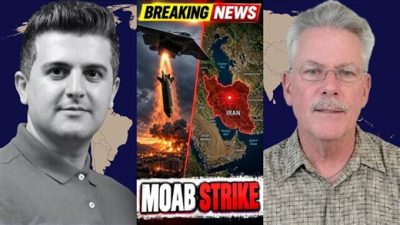
Welcome to New World Next Week – the video series from Corbett Report and Media Monarchy that covers some of the most important developments in open source intelligence news. This week:
Story #1: Slavery Returns To Africa As Migrants Sold At Open Markets In Libya http://bit.ly/2oBKEFX
Story #2: Sessions Orders DOJ To End Forensic Science Commission, Suspend Review Policy http://bit.ly/2pwqs5q
NWNW Flashback: FBI Crime Lab Unit Rife With Flawed Forensics (Jul. 31, 2014) http://bit.ly/2ouGqzp
NWNW Flashback: Man Wrongly Convicted With Bite Mark Evidence Confronts Bite Mark Analysts (Feb. 23, 2017) http://bit.ly/2nH9mFK
Mexican journalist and columnist for the El Financiero newspaper Fernando Garcia Ramirez has accused Russia of meddling in Mexican politics. According to him, “the dark hand” of Russian President Vladimir Putin has already reached Mexico, with Moscow trying to influence the presidential election in the country that is to take place next year.
In his article titled “The Russian Threat to Mexico” (“La amenaza rusa en México”), the journalist accused the Kremlin of allegedly attempting “to appoint its man” as the head of the country, referring to the opposition leader Andres Manuel López Obrador whom he called “an authoritarian populist.”
According to the journalist, Moscow’s ability to “influence” politics in any corner of the planet has been demonstrated many times. The examples, according to Ramirez, are the victory of Donald Trump in the United States, Brexit in Britain, and the recent defeat of former Italian Prime Minister Matteo Renzi in a referendum on constitutional reform.
Explaining the reasons why it might be beneficial for Russia to influence the election in Mexico, the newspaper columnist wrote that it would be “convenient” for Moscow to have an “anti-American” politician on this post.
The journalist also believes that the Kremlin will use the RT TV channel as “its favorite weapon” as well as “a key instrument of Russian propaganda.” According to him, the media source already has its agent in Mexico, referring to Mexican analyst John Ackerman, who published several critical articles about the Mexican authorities on the RT website.
Meanwhile, the article caused a wave of ridicule in social networks.”I have not seen such a frightening title and such an empty content for long time,” a man named Hugo Ortega Romero wrote.
“Ha-ha-ha, of course, Russia is to blame for absolutely everything,” Leonardo Guzmán Vázquez continued.
Mexican journalist Gabriel Infante Carrillo confessed in an interview with Sputnik Mundo that he also “almost died of laughter” when he read the article.
According to him, the article is part of a slander campaign against Lopez Obrador, leader of the left opposition, whose support in the country is growing. However, this has nothing to do with “external factors” and Russian media, Carillo argued.
“The article in the El Financiero is directed not so much against Russia but rather against the opposition leader Lopez Obrador, a leftist candidate in the upcoming presidential election. The fact is that his popularity has been growing, which is why the probability that he will win is quite high. That is why the media supporting the authorities do everything to discredit him. And thus, they decided to follow the example of their American colleagues, who never stop talking about the alleged Russian contribution to the victory of Donald Trump. Thus, we see another example of how artificial anti-Russian hysteria has been used for political purposes,” the journalist stated.
The UN, not the unilateral bombing of Syria should have been the first stop for US diplomacy, says whistleblowing former CIA analyst John Kiriakou. As for evidence the American politicians claim they have; he says “they are making this stuff up.”
On Wednesday Russia vetoed a UN resolution backed by the US and other Western powers, condemning the Khan Shaykhun incident on April 4 as a chemical attack and demanding Syria open up its military bases to inspections.
After the vote, Russia’s representative said the action taken by the US before an investigation had been held, was a violation of international law.
RT asked John Kiriakou, former CIA analyst, and whistleblower, whether supporters of Washington’s resolution will try to push for it again.
“I think they will. They usually do. The problem here though is that the UN should have been the first stop for US diplomacy. Rather than acting unilaterally and firing 59 cruise missiles, the State Department should have engaged the UN Security Council from the very beginning,” he said.
As to why the UN voted on the resolution without any clear evidence of Assad’s culpability for the Idlib incident and the logic behind it, Kiriakou opined “they were afraid of the conclusion.”
“There are professional intelligence officers on every side of this issue who are saying that everybody needs to slow down and look at the source of these chemicals. There are people on the ground, who are telling many of us that these chemicals were in a storage facility that is controlled by ISIS, that the Syrian military launched a conventional attack, and hit the storage facility – this was not a chemical attack by the Syrian government. We frankly don’t know what the facts are. We don’t know because it just simply hasn’t been investigated. I think the US and its allies on the Security Council need to slow down, need to send in UN inspectors to take a look, get the facts on the ground, and then report back to the Security Council. This bombing should never have taken place,” he said.
Meanwhile, in Moscow, Rex Tillerson was meeting with Russia’s Sergey Lavrov and President Vladimir Putin while on his first official visit to Russia as US Secretary of State.
He reiterated that the US are “quite confident” that the “chemical weapons attack carried out in Syria was planned, and directed, and executed by Syrian regime forces.” Earlier, the US Ambassador to the UN Nikki Haley said “We saw the evidence. The President saw the evidence. All of that is naturally classified.”
Kiriakou doesn’t rule out though that American politicians “are making this stuff up.”
“If they’ve already heard from their intelligence assets inside Syria – wow, they must have incredible assets inside Syria, because this [incident in Idlib] just happened. This whole story hasn’t even played out yet. So, how they’ve already got all the intelligence and analyzed it and then were able to use the analysis to formulate a policy that then enabled the President to bomb Syria?” he said. “If that’s true, I congratulate the CIA for its intelligence network inside Syria. The problem is – I don’t believe a word of it.”
In Kiriakou’s opinion, the US bombing of a Syrian airbase that followed the chemical incident was a political decision made by the White House who didn’t speak in advance with its allies.
“I don’t believe there was any intelligence. And I think this was done primarily for domestic consumption,” he said.
‘Designed to be vetoed’
The reason why the US-supported resolution was “rushed to the floor” is because “they wanted to be able to make their points,” said Daniel McAdams, executive director at the Ron Paul Institute.
“They wanted to be able to bash Syria, Russia, and Iran,” he told RT.
The analyst drew a parallel between the resolution and the Rambouillet Agreement – a US/NATO peace plan for Kosovo proposed to the then-Yugoslavia.
“Ironically we’re around the anniversary of the 1999 US bombings of Yugoslavia. But if you remember in Rambouillet [Slobodan] Milosevic and the government of Yugoslavia was presented with an agreement that there is no way they could sign, they would have opened the entire country to NATO forces. It was designed that way. It was designed to be vetoed to show recalcitrance to open the way for bombs. This is very reminiscent of this kind of approach. It is not a very serious approach. Although the consequences could be very serious,” he told RT.
McAdams also said that there’s already “a problem with a chain of evidence” regarding what happened in Khan Shaykhun.
“What is amazing – there has been no investigation whatsoever. The White House released a report [the day before] yesterday – this was a slam dunk as to what the US believes, that it was Assad who did it. But if you look at that report, it was unbelievably thin. It reminds one of the reports that they released proving the Russians hacked the elections. The intelligence community didn’t even sign off on this report. It didn’t have high confidence in the report,” he said.
While in Moscow, Tillerson reaffirmed the US administration’s view that the Assad era is coming to an end.
According to Joshua Landis from Center for Middle East Studies at the University of Oklahoma, the US has “certainly changed its rhetoric on Assad recently.”
“What it seems to be doing is finding the Obama doctrine in a sense falling in line with what President Obama did on Syria – a red line saying that Assad needed to step aside, but not actually doing anything to force him to step from office. That’s what we heard from the National Security advisor yesterday, who said: ‘Assad has to go, but it is not going to be America that makes him go,’” he told RT.
An anonymous senior US official told CNN that, while the US allegedly has proof that Damascus is responsible for the chemical incident in Idlib, Syria, it has uncovered no such evidence implicating Moscow, because Russia is wilier in scrambling its communications.
The anonymous official reportedly told the American news channel that the US intelligence community had intercepted communications “featuring Syrian military and chemical experts talking about preparations for the sarin attack in Idlib last week.” While the source failed to provide any concrete details about the alleged communication – such as when it was intercepted or what names or other information it contained – they did note that the US “did not know prior to the attack it was going to happen.”
CNN speculated that the communication had been sent prior to the incident, but was not processed until the US began investigating it.
The source added that “there are no intelligence intercepts that have been found directly confirming that Russian military or intelligence officials communicated about the attack,” but noted “the likelihood is the Russians are more careful in their communications to avoid being intercepted.”
The most specific proof the source could come up with was his observation that Russia has a surveillance drone, which he claimed “flew over the hospital that was treating people injured in the attack.”
CNN suggested that even if the US had evidence of Russia’s involvement, it might not go public with it, as “the US feels right now that it has made the case that Russian support for [Syrian President Bashar] Assad must end.”
The report is the latest in a long series based on anonymous sources – with undisclosed agendas citing vague evidence which is never submitted to public scrutiny – that the mainstream media has deployed to level accusations against Russia. The story that Russia allegedly meddled in the US election has become a dominant narrative for opponents of Donald Trump, who are still trying to explain his surprise victory.
The major media outlets’ eagerness to blame Russia for everything occasionally leads to embarrassment, however. A fairly spectacular example came in January, when the Washington Post was forced to backtrack on a story that falsely claimed Russia had hacked into Vermont’s power grid. The newspaper also sparked outrage in December by touting a list of “Russian propaganda” websites, which turned out to include many respected independent media sources.
The alarming trend is not limited to the US media, however. Last year, the Guardianfailed to accurately report on an Italian newspaper’s interview with Julian Assange. The British newspaper falsely painted WikiLeaks’ founder as a Trump supporter who would not criticize Moscow because he was presumably in league with the Russian government.
Some examples go back years. In 2014, the New York Times published photos of armed men, claiming that they were Russian troops on a clandestine mission in Ukraine. The newspaper had taken the images from the US State Department, and both had failed to properly verify them.
After several months of pushing the “Russiagate” conspiracy theory – a wild-eyed, all-encompassing but somewhat nebulous narrative involving U.S. President Donald Trump, Russian President Vladimir Putin, WikiLeaks, the Russian mob, assassinations and certain indiscretions with prostitutes in a Moscow hotel – the U.S. mainstream media is now reverting to its traditional role of downplaying conspiracy theories, particularly those raising questions about the intelligence surrounding the alleged chemical weapons attack in Syria last week.
On Monday, the New York Timespublished an article titled “Syria Conspiracy Theories Flourish, at Both Ends of the Spectrum,” which lamented the fact that websites on the left and the right have raised doubts about the casus belli for U.S. military action against Syria.
Noting that some alternative news sites have called the chemical attack a “false flag” operation and others have raised the question of whether Trump’s military action was a “wag the dog” diversion tactic, the Times pointedly attempts to “debunk” the internet memes that have been raising doubts about the chemical attack or calling into question the justification for the U.S. military action.
With an aggressiveness not seen at all when it comes to the unsubstantiated “Russian election-hacking” allegations, the Times fires back forcefully on matters such as whether President Bashar al-Assad had reason to use chemical weapons in the first place or whether anti-Assad forces may have had advance knowledge of the sarin attack. The Times article uses curt, all-caps responses to rebut these claims, such as flatly stating, “FALSE,” “NO EVIDENCE,” or “MISLEADING.”
The Times, for example, points out that Information Clearing House has argued that Assad lacked an obvious tactical or strategic reason to use chemical weapons, and therefore the attack may have actually been carried out by one of the terrorist groups operating in Syria such as Al-Nusra Front. As the Times responds, however, “THIS IS MISLEADING.”
Floating a few reasons that Assad’s forces might have conceivably been motivated to conduct a chemical attack, the Times argues that the attack was “consistent with Mr. Assad’s calculated strategy of attempting to drive out the civilian population in rebel strongholds through bombing neighborhoods and civilian targets.” The Syrian leader may have also “felt emboldened” by perceived shifts in U.S. foreign policies and priorities under Trump, the Times speculates.
Of course, this is simply guesswork on the part of the Times, which is not presenting any facts to counter doubts over the official story, but just responding to the doubts with more conjecture. The Times also seems to be cherry-picking some of the more easily “debunked” stories surrounding the Syria case, failing to address legitimate concerns over the lack of proof of Assad’s culpability. These include doubts raised by the former British ambassador to Syria, Peter Ford, who told BBC Radio last week that there is “no proof that the cause of the explosion was what they said it was.”
It would not make sense for Assad to launch such an attack, Ford said, claiming that it would be “totally self-defeating.” He also objected to the veracity of claims made by eyewitnesses who claimed that they saw chemical bombs dropping from the air. “Well, you cannot see chemical weapons dropping from the air,” he said. “Such testimony is worthless.”
There are also serious doubts as to whether Syria even possesses the chemical weapons in question, with the UN’s Organization for the Prohibition of Chemical Weapons noting that since 2013, “all of the chemical weapons declared by Syria were removed and destroyed outside of Syrian territory.”
While some governments have claimed that Syria’s declaration about its chemical weapons program may have been incomplete, the OPCW stresses that it has adapted itself “in unprecedented ways” in efforts “to remove, transport and destroy Syria’s declared chemical weapons stockpile in the midst of an active conflict zone.”
With this in mind, Sacha Llorenti, the Bolivian ambassador to the United Nations, last Friday blasted the United States for unilaterally attacking Syria, saying that it recalls the decision 14 years earlier to attack Iraq based on equally questionable intelligence. It is “vital to remember what history teaches us,” Llorenti said, citing the 2003 invasion of Iraq and holding up a photo of then-Secretary of State Colin Powell delivering false testimony to the UN Security Council on Iraq’s alleged weapons of mass destruction.
“Whereas an investigation would have allowed us to establish in an objective manner who is responsible for the [chemical] attacks [in Syria], this is an extreme, extreme violation of international law,” he said.
In addition to the doubts that have been raised at the United Nations, a number of the U.S.’s closest G7 allies have refused to implement additional sanctions against Syria without proof of Assad’s guilt.
As the BBC reported on Tuesday, “Sanctions against Russian and Syria will not be put in place until after an investigation into last week’s apparent chemical attack, British government sources said. Members of the G7 group of leading industrialised nations agreed to delay implementing sanctions until there was ‘hard and irrefutable evidence’ over the alleged chemical attack.”
Yet the New York Times and other mainstream U.S. outlets continue to report as undisputed fact that Assad’s government intentionally carried out this attack, and furthermore, that Moscow knew about it in advance.
The sorts of unequivocal retorts that the NYT uses against journalists and bloggers for raising doubts about the official stories could, of course, just as easily be applied to the official stories themselves. When the Associated Press, for example, reported on Tuesday that “The United States has made a preliminary conclusion that Russia knew in advance of Syria’s chemical weapons attack last week,” the Times could have responded with an emphatic all-caps retort such as “NO EVIDENCE.”
These retorts could also be used against the accusations of the Russian government engaging in a convoluted conspiracy to undermine Democratic nominee Hillary Clinton’s electoral chances by hacking John Podesta’s and the DNC’s emails in order to expose the Democratic establishment’s undermining of Bernie Sanders’ insurgent campaign while simultaneously “elevating” Trump’s candidacy in the media through the so-called “pied piper” strategy, with the evil geniuses of the Kremlin somehow knowing beyond a doubt that this information would sway voters in favor of voting for the least popular major-party nominee in a generation.
Just as the NYT has denounced theories surrounding the Syria chemical attack as lacking evidence, so too could the entire Russiagate narrative be picked apart as lacking any foundation in fact. All that one needs to do is actually read the U.S. intelligence assessment that dubiously concluded that Russia “interfered” in the election without offering anything approaching hard proof of this claim – spending seven full pages instead bashing the Russian network RT for its perceived biases.
Going through the Director of National Intelligence report from last January, the reader is left with few details as to how the extraordinary conclusion was reached that Russia “hacked” the election, which Sen. John McCain (R-Ariz.) and others have called an “act of war.”
The closest thing to evidence that could be found in the DNI report was regarding so-called Russian fingerprints on the hacking attacks of Podesta’s and the DNC’s emails, including malware associated with Russian hackers, as well as some Cyrillic letters and the phrase “Felix Edmundovich,” a reference to the founder of the Soviet Union’s secret police.
However, as revealed in subsequent WikiLeaks’ disclosures of the so-called Vault 7 documents, the CIA has developed numerous tools, including a library of foreign malware, that can be used to falsely implicate a foreign intelligence service in a cyber-attack. These revelations called into question the entire basis for Washington’s case against Moscow for allegedly interfering in the U.S. election, but besides a few articles in the alternative press, including at Consortium News, the revelations received scant attention.
Apparently, the disclosures of CIA hacking activities – including new revelations of the CIA deploying malware in Samsung televisions as covert listening devices to spy on unwitting Americans – were not the sort of conspiracy theory considered worthy of sustained media coverage in the United States. In contrast to the months of wall-to-wall coverage of Russiagate, the Vault 7 leaks were largely treated as a one-day story by the mainstream press.
The disparity in coverage speaks to a longstanding aversion of the mainstream media to what it considers illegitimate “new media” encroaching on its territory and peddling conspiracy theories and what is today called “fake news.” This hostility can be traced to the earliest days of the internet.
Twenty years ago, responding to a proliferation of alternative news sites on the World Wide Web – or what was called back then the “information superhighway” – Newsweek magazine ran a 1,800-word article entitled “Conspiracy Mania Feeds Our Growing National Paranoia.” In the piece, Newsweek denounced what it called “conspiracy freaks.”
Explaining a growing acceptance of conspiracy theories as evidence of “mass psychosis,” the article warned that the “ranks of the darkly deluded may be growing” as “conspiracism has become a kind of para-religion.” It took particular aim at the African-American community, which it described as “a hotbed of this kind of suspicion and mistrust,” for believing that “the CIA had spread the crack epidemic by backing Nicaraguan drug dealers whose profits went to the contras.”
Newsweek also criticized Oliver Stone, director of “Platoon” and “JFK,” and Chris Carter, the creator of the popular “X-Files” television series, for promoting dangerous ideas that had the effect of eroding trust in the government. “On ‘The X-Files,’ everything from who killed JFK to why the Buffalo Bills lose so many Super Bowls is traceable to a single master plan,” Newsweek sneered.
Of course, Newsweek wasn’t alone in scoffing at popular conspiracy theories in the ‘90s. In fact, it was conventional wisdom among “respectable” media that government leaders simply do not cross certain lines, and that certain stories, for example, regarding CIA involvement in the cocaine trade – no matter howmuchevidencebackedthemup – were off-limits. Those who failed to get on board with this groupthink, for example Gary Webb who wrote a widely disseminated series for the San Jose Mercury News about the CIA-crack cocaine connection, had their careers destroyed.
This trend continued into the 2000s, with millions of angry Americans still seething over the stolen election in 2000 told to “get over it,” and then called crazy for doubting the basis for George W. Bush’s case for invading Iraq in 2003.
A couple years later, those who raised questions about the government’s botched response to Hurricane Katrina were accused by the Washington Post of “racial paranoia” and hawking “conspiracy theories,” such as the widespread belief that New Orleans’ levees may have been intentionally blown up to protect rich neighborhoods at the expense of poorer ones, or to drive low-income African Americans out of town.
But skip ahead a decade, and oddly, this same media that historically has been so hostile to conspiracy theories was seen eagerly pushing conspiracy theories surrounding Clinton’s loss to Trump. Headlines of “Russian election hacking” were freely used by the Washington Post, CNN and the New York Times, despite the fact that there is zero evidence that Russia manipulated any voting machines in any state to alter the outcome of the election, or even any substantial proof offered to support the claims that the Kremlin attempted to influence voters’ decisions by exposing private emails between DNC officials.
Nevertheless, the Democrats and the media have coalesced around the conventional wisdom that the election was lost due to a Russian plot, which conveniently absolves the national Democratic Party of any responsibility for losing the election – for example by writing off the white working class vote or nominating a deeply flawed establishment candidate during a decidedly anti-establishment year – while simultaneously calling into question the legitimacy of Trump’s presidency.
It also feeds into the rallying cry that the Democrats have embraced since losing the election, which has been variations of the theme “This is not normal,” expressed by the hashtag #NotNormal on social media. This theme laments the loss of a more “normal” time, presumably personified by Trump’s predecessor, Barack Obama.
Typically, the slogan refers to Trump’s controversial dealings with Russia, his unconventional communication style and his extensively documented conflicts of interests, as well as perceived misogyny, nepotism, racism and incompetence in his administration.
Clearly, there is very little that can be considered “normal” about this administration, including the strange role of Trump’s daughter, Ivanka, who has moved into the White House while the First Lady, Melania Trump, lives in New York. The First Daughter reportedly was instrumental in convincing the President to carry out the unilateral attack on Syria. “Ivanka is a mother of three kids and she has influence. I’m sure she said: ‘Listen, this is horrible stuff,’” Ivanka’s brother Eric Trump told the Telegraph.
While that is certainly not normal, what the Democrats and the media are revealing through their #NotNormal campaign and the official conspiracy theories that they are promoting – while downplaying other theories or doubts about government claims – is how much they actually consider “normal.”
In today’s America, what is normal, according to the bipartisan consensus, are unilateral strikes against countries without evidence and in violation of international law. It is also apparently normal for televisions to spy on law-abiding citizens, and with drone strikes shooting up 432% under the Trump presidency so far, it is apparently quite normal to use flying robots to bomb suspected terrorists (and their eight-year old daughters) half-way around the world. Indefinite detention at the legal black hole of Guantanamo is also rather normal.
After all, these are all policies that have been in place for a decade and a half under both Democratic and Republican administrations, and hope seems to be dwindling for returning to a period of actual normalcy.
A professor who challenged the 2013 claims of a chemical attack in Syria is now questioning the Trump administration’s narrative blaming the Assad government for the April 4 attack in the Idlib province town of Khan Shaykhun.
On Tuesday, the White House released a declassified intelligence brief accusing Syrian President Bashar Assad of ordering and organizing the attack, in which Syrian planes allegedly dropped chemical ordnance on civilians in the rebel-held town.
The report “contains absolutely no evidence that this attack was the result of a munition being dropped from an aircraft,” wrote Massachusetts Institute of Technology (MIT) Professor Theodore Postol, who reviewed it and put together a 14-page assessment, which he provided to RT on Wednesday.
“I believe it can be shown, without doubt, that the document does not provide any evidence whatsoever that the US government has concrete knowledge that the government of Syria was the source of the chemical attack in Khan Shaykhun,” wrote Postol.
A chemical attack with a nerve agent did occur, he said, but the available evidence does not support the US government’s conclusions.
“I have only had a few hours to quickly review the alleged White House intelligence report. But a quick perusal shows without a lot of analysis that this report cannot be correct,” Postol wrote.
It is “very clear who planned this attack, who authorized this attack and who conducted this attack itself,” Defense Secretary James Mattis told reporters at the Pentagon on Tuesday.
Earlier in the day, White House spokesman Sean Spicer also said that doubting the evidence would be “doubting the entire international reporting crew documenting this.”
The report offered by the White House, however, cited “a wide body of open-source material” and “social media accounts” from the rebel-held area, including footage provided by the White Helmets rescue group documented to have ties with jihadist rebels, Western and Gulf Arab governments.
Postol was not convinced by such evidence.
“Any competent analyst would have had questions about whether the debris in the crater was staged or real,” he wrote. “No competent analyst would miss the fact that the alleged sarin canister was forcefully crushed from above, rather than exploded by a munition within it.”
Instead, “the most plausible conclusion is that the sarin was dispensed by an improvised dispersal device made from a 122mm section of rocket tube filled with sarin and capped on both sides.”
“We again have a situation where the White House has issued an obviously false, misleading and amateurish intelligence report,” he concluded, recalling the 2013 situation when the Obama administration claimed Assad had used chemical weapons against the rebels in Ghouta, near Damascus.
“What the country is now being told by the White House cannot be true,” Postol wrote, “and the fact that this information has been provided in this format raises the most serious questions about the handling of our national security.”
Almost immediately after video of the alleged chemical weapons attack in Idlib hit Western media, Assad was declared guilty by US news networks and political commentators. The front page of the New York Times on April 5th showed a heartbreaking image of a child wounded in the alleged chemical attack with a headline claiming Assad was responsible.
By the afternoon of April 7th, a US attack seemed inevitable as both Rex Tillerson and Trump said action would be taken.
Between Democrats and Republicans, a bipartisan consensus emerged, rare in the Trump presidency, whereby Assad was deemed guilty and Trump was goaded on to attack. The few voices of dissent seemed mostly concerned with the lack of constitutional approval for the strike
The night of the strike, US media snapped into DPRK-style, state media mode. TV pundits fell into a trance while expressing the “beauty” of American power being unleashed on a country already destroyed by 6 years of war.
Pundits described the attack as “surgical” despite the pentagon quietly admitting one of the missiles missed its target and they don’t know where it landed. My questions to both CENTCOM and the Secretary of Defense Office on the missing cruise missile have thus far gone unanswered. However, Syrian sources claim civilians were killed in the missile strike.
Trump justified the attack by invoking religiously themed buzzwords and unconvincing blather on the “beautiful babies” murdered in the chemical attack.
Following the attack, Trump officials’ statements indicated there was a shift towards regime change. UN ambassador Nikki Haley saidSunday that removing Assad is now a priority.
The Neocon sharks have started circling too. Bill Kristol tweeted that these strikes should be used to move towards regime change in Iran. Marco Rubio, Lindsey Graham, and John McCain have all joined in too, their mouths watering at the thought of ousting Assad.
But was Assad really responsible for the attack?
To ask such a question is to be deemed an “Assadist” by pundits and discourse police across the political spectrum.
Neither the lack of an independent investigation, nor the fact that nearly all the information on the alleged attack has come from rebel sources, who stand to benefit from a US response, is deemed sufficient cause for skepticism.
In a civilized society an actor is be presumed to be innocent until proven guilty. If guilt is determined, a legally justified course of action is taken. In the US however, if the accused is a US enemy, no evidence is needed, and even deranged conspiracies are given play in mainstream media coverage.
The best recent example of this is the US media’s conspiracy about Russia stealing the US election and working for Trump. The US media has stooped so low as to even push bizarre conspiracies by Louise Mensch. She recently claimed the 2014 uprising in Ferguson was a Russian plot.
In the case of the alleged attack on Khan Sheikhun, US officials and pro-war experts immediately declared Assad’s guilty and then cheered on an illegal use of force. This is all very reminiscent of the lead up to the Iraq war.
In an eerie coincidence, Michael R. Gordon, who with Judith Miller helped sell the Iraq WMD story to Americans, coauthored the New York Times April 4th article on Assad’s alleged sarin attack at Khan Sheikhun.
To help sell the sarin narrative, the US media brought on a doctor to describe the alleged attack that has been accused of helping kidnap journalists in his work with extremists.
When the US investigated its own airstrike in Mosul this March, it took a number of days before it admitted it had killed hundreds of civilians. Yet, guilt was immediately assigned in the Khan Sheikhun attack.
In 2013, the US media also rushed to the conclusion Assad used sarin in a horrific incident in Ghouta. The US was on the verge of attacking Assad then, but Obama decided against it. Obama claimed he held off because US intelligence voiced skepticism about Assad’s guilt.
The UN investigation on the Ghouta attack took almost a month and even its conclusions have been disputed.
In December of 2013, Seymour Hersh published a lengthy investigation into the 2013 attack in Ghouta and found reason to doubt Assad’s responsibility for attack. He was forced to publish it in the London Review of Books after the New York Times and the Washington Post refused to run it.
He reported that classified US reports claimed that Syria’s al Qaeda affiliate had “mastered the mechanics of creating sarin”.
A month after Hersh’s piece appeared, a MIT study cast further doubt on the US government’s story by demonstrating that the rockets used in the Ghouta attack couldn’t have flown as far as the US government claimed.
Ted Postol, one of the authors of the study said, “We were within a whisker of war based on egregious errors.”
In this latest alleged gas attack, a few individuals have dared question the state narrative.
The journalist Robert Parry has recently claimed there is much to be made of the fact that Mike Pompeo, the CIA Director, wasn’t among those helping sell this latest sarin story to the American people. He believes it indicates doubt in the CIA over Assad’s involvement.
Scott Ritter, a former UN weapons inspector in Iraq, has raised skepticism over Assad’s involvement. He says rebels have had chemical weapons facilities in Syria and some of the witnesses’ statements describe a strong smell during the attack, which indicates something other than sarin was used.
The Canadian government originally called for an investigation and stopped short of blaming Assad at the UN, but then later championed Trump’s strikes.
Groups like Organizations for the Prohibition of Chemical Weapons and Human Rights Watch are still investigating the alleged attack in Khan Sheikhun.
Whether these groups or others will be able to conduct an independent investigation is not known. But in usual fashion, the US had no interest in investigating facts, which may provide the wrong answers.
It’s possible that Assad carried out the attack, but just because he’s a reprehensible figure doesn’t mean there is no need to present evidence and conduct an independent investigation.
What’s clear now is that the US attack benefitted jihadi groups, has made further US military action more likely, and has increased the chances of a direct military confrontation with Russia. All of these results are very dangerous.
Future US military action in Syria should be resisted with popular pressure. History shows we can’t count on the media or pundits to act as the voice of reason.
Paul Gottinger is a journalist based in Madison, WI whose work focuses on the Middle East. He can be reached via Twitter @paulgottinger or email: paul.gottinger@gmail.com
Claims that Assad is using chemical weapons are like a barometer: when the Syrian army is doing well, they surface, notably in 2013, 2015 and now, just as the Syria government looks close to some kind of ‘victory’. Both times in the past the intelligence came from Mossad and the claims fizzled out, though the propaganda that it was ‘likely’ by the Syrian Army stuck in western perception. The current chemical ‘attack’, instantly hailed by Israel, occurred just as peace talks were beginning in Geneva. The source of the claim is, again, most likely Israel, though that’s not part of the media fireworks. Tillerson might have checked with the Russians, as Russian military were stationed at the airport.
That is the background to the bombing of the air base April 6, in retaliation for a suspected chemical weapons attack on civilians in rebel-held Idlib province two days before. National security adviser General Herbert McMaster solemnly declared, “We could trace this murderous attack back to that facility.” Secretary of State Rex Tillerson accused Russia of being either complicit or incompetent in failing to keep its 2013 promise of completely destroying Syria’s chemical weapons supply.
Kremlin spokesman Dmitry Peskov called it “an act of aggression against a sovereign country violating the norms of international law, and under a trumped-up pretext at that. Washington’s move substantially impairs Russian-US relations, which are in a deplorable state as it is.” Russia said it had suspended deconfliction channels with Washington, set up to avoid air collisions over Syria, though the Pentagon said it continued to use the channel.
Why would Assad launch chemical weapons when he was winning? The most plausible explanation was that the Syria air force hit a supply depot in rebel-held territory. That Assad would have ordered the use of chemical weapons was dismissed by Russian deputy UN ambassador, Vladimir Safronkov, who vetoed the usual US-sponsored Security Council resolution condemning Assad, suggesting it was altnews. “We have not yet any official or reliable confirmation” of what took place or who was responsible, said the UN special envoy for Syria, Staffan de Mistura, at a press conference after the incident. The EU echoed this, though European countries either supported the US strike or kept mum.
Safronkov warned the US, “If military action occurred, it will be on shoulders of those who initiated such doubtful and tragic enterprise. Look at Iraq, look at Libya.” Olof Skoog, Sweden’s ambassador to the United Nations, sounded a similar note. “I remember Hans Blix. Of course I’m concerned” about the possibility of a US attack in Syria.” Bolivia, a current member of the Security Council, requested an emergency session to address, and perhaps condemn, the US missile attack in Syria.
What makes the accusation doubly doubtful is the fact that Syria joined the international chemical weapons treaty in 2013, agreeing to renounce all use of chemical weapons, and through the mediation of Russia, to dispose of all that were in their hands. The deadline for destruction was 2014. Syria gave the Organisation for the Prohibition of Chemical Weapons an inventory of its chemical weapons arsenal and started its destruction in October 2013, two weeks before its formal entry into force. Idlib, the site of the current ‘attack’, has moved back and forth, and has been in rebel hands since 2015, and all the weapons were not yet removed.
As if scripted, ISIS stormed the Syrian army checkpoints in the nearby strategic town of Al-Furqalas.
Fate worse than death?
More civilians caught up in the Syrian conflict were killed by US-led coalitions than by ISIS or Russian-led forces in the last month, according to figures released by the Syrian Network for Human Rights. ISIS killed 119 civilians in Syria in March, with Russian forces believed to have killed 224 civilians in the same month. The SNHR found the international coalition forces, led by the US, killed 260 civilians.
At the same time as the US was loudly denouncing Syria’s supposed chemical attack, which killed 80, the US was responsible for killing 85 (an airstrike on a school west of Raqqa killed at least 33 people, just after a separate US strike on a mosque complex in the north-west of the country killed 52). But it is the chemical attack claim–hotly disputed by the Russians, who are the most privvy to Syrian affairs–that gets the headlines, though unless I’m mistaken, a wartime death is a wartime death. Each one a tragedy.
The upsurge in civilian deaths has been so sharp that it’s overwhelmed Airwars.org. The site had to scale back its monitoring of Russian airstrikes in Syria and focus instead on bombings carried out by the US and its allies. At its peak, ISIS controlled about 40% of Iraqi territory; now it controls about 10%. In both Iraq and Syria, the battles are now in cities, making bombing raids lethal to civilians. The easier part of the war, which involved targeted airstrikes in less densely populated areas, is over, and deaths are bound to increase with ‘boots on the ground’.
Trump confused
It is difficult to understand just what Trump has in mind to end the violence in Syria and Iraq. He promised not to increase US intervention abroad, but at the same time, vowed that as president he would “bomb the hell out of ISIS.” US-led coalition airstrikes in Iraq and Syria have already killed 1,500 civilians in just Iraq and Syria this month alone, more than three times the number killed in President Barack Obama’s final full month in office, according to Airwars.
Trump and his top aides had accepted in recent days the “reality” of Assad being in power, saying his ouster was no longer a priority, but the chemical weapons attack seemed to spur a rethink. When asked if this signalled a change in US policy, McMaster demurred. “I think what it does communicate is a big shift … in Assad’s calculus … because this is … the first time that the United States has taken direct military action against that regime or the regime of his father.”
Trump insists that the mainstream media lies, but then buys into the mainstream version of the war against Syria. He is being manipulated by the very forces he claims to oppose. What should be a sign of decisiveness looks more like another Trump gaffe. While the mainstream political world and media approved of the sabre-rattling, Trump’s own followers are against his bombing.
*Paul Joseph Watson, Infowars/ @PrisonPlanet. “I guess Trump wasn’t ‘Putin’s puppet’ after all, he was just another deep state/Neo-Con puppet. I’m officially OFF the Trump train. I’ll be focusing my efforts on Le Pen, who tried to warn Trump against this disaster.”
*Mike Cernovich, #NoMoreWars. ” Today over 500,000 people have watched my videos and streams. 90% are @realDonaldTrump supporters, none want war with Syria.”
*Radio host Laura Ingraham, @IngrahamAngle. “Missiles flying. Rubio’s happy. McCain ecstatic. Hillary’s on board. A complete policy change in 48 hrs.”
*Author Ann Coulter, @AnnCoulter. “The beloved rebels [sic] we’ll help by intervening in Syria: women forced into veils & posters of Osama hung on the walls.”
*Max Blumenthal. “US intervention would be the last hope for Syrian rebels, and a shot in the arm to al-Qaeda, which has grown to record size thanks to America’s military meddling across the Middle East. ”
*Even the readers at Breitbart, which is known as the home on the internet for pro-Trump coverage, rebelled against the attack.
Pacts made in hell
The parallel between the Russia-Syria anti-Trump campaigns by the establishment is obvious. The Russian spying hysteria (Obama expelled 35 diplomats in December 2016) and the support for lame-duck Ukraine was to prevent a new detente with Russia, and so far has worked. Trump doesn’t dare proceed with this key foreign policy objective. Originally, he tied relations with Russia with solving the crisis in Syria. “Let Russia do it.”
But in office, Trump instead strengthened ties with Saudi Arabia, signing a pact to work together in both Syria (Clinton’s “safe zones”) and Yemen. After a friendly White House meeting with Trump and Steve Bannon (the architect of Trump’s Muslim ban), Saudi Crown Prince Mohammed Bin Salman hailed Trump as “his Excellency,” describing him as a “true friend of Muslims who will serve the Muslim world in an unimaginable manner, opposite to the negative portrait of his Excellency that some have tried to promote.” The only real agreement with the Saudis is the obsession to attack Iran, a pact made in hell.
Historical parallels abound here. Just as Putin was understandably supportive of Trump’s campaign for the presidency, Soviet Russia in its time very much wanted to be friends with Hitler, the ultimate ‘pact made in hell’. Israel Shamir argues it was a good idea given the times; the problem was that Hitler had other priorities, and the Russian desire for peace and friendship did not fit in. Things today have reached a head, not quite Hitler’s Operation Barbarossa against Russia, although the economic sanctions against Russia are warfare by another name.
The current airstrike, which could have killed Russians, is more like the Cuban missile crisis. But there is no JFK (who was, in any case, assassinated for his desire for peace with the Soviet Union). What should have been a diplomatic triumph–the unfolding of peace with Russia and an end to the Syrian tragedy–has turned into renewed US support for ISIS and confrontation with Russia, both of which could spin out of control. Russian military personnel and aircraft are embedded with Syria’s, and Iranian troops and paramilitary forces are also on the ground helping Assad fight the array of opposition groups hoping to topple him. And then there’s Ukraine.
By Tony Cartalucci – New Eastern Outlook – 29.11.2017
The United States Air Force’s 59th Medical Wing’s molecular biology branch recently was revealed to have been collecting specifically Russian RNA and synovial (connective) tissue samples, prompting fears in Russia of a possible US directed ethnic-specific bioweapons program. … continue
This site is provided as a research and reference tool. Although we make every reasonable effort to ensure that the information and data provided at this site are useful, accurate, and current, we cannot guarantee that the information and data provided here will be error-free. By using this site, you assume all responsibility for and risk arising from your use of and reliance upon the contents of this site.
This site and the information available through it do not, and are not intended to constitute legal advice. Should you require legal advice, you should consult your own attorney.
Nothing within this site or linked to by this site constitutes investment advice or medical advice.
Materials accessible from or added to this site by third parties, such as comments posted, are strictly the responsibility of the third party who added such materials or made them accessible and we neither endorse nor undertake to control, monitor, edit or assume responsibility for any such third-party material.
The posting of stories, commentaries, reports, documents and links (embedded or otherwise) on this site does not in any way, shape or form, implied or otherwise, necessarily express or suggest endorsement or support of any of such posted material or parts therein.
The word “alleged” is deemed to occur before the word “fraud.” Since the rule of law still applies. To peasants, at least.
Fair Use
This site contains copyrighted material the use of which has not always been specifically authorized by the copyright owner. We are making such material available in our efforts to advance understanding of environmental, political, human rights, economic, democracy, scientific, and social justice issues, etc. We believe this constitutes a ‘fair use’ of any such copyrighted material as provided for in section 107 of the US Copyright Law. In accordance with Title 17 U.S.C. Section 107, the material on this site is distributed without profit to those who have expressed a prior interest in receiving the included information for research and educational purposes. For more info go to: http://www.law.cornell.edu/uscode/17/107.shtml. If you wish to use copyrighted material from this site for purposes of your own that go beyond ‘fair use’, you must obtain permission from the copyright owner.
DMCA Contact
This is information for anyone that wishes to challenge our “fair use” of copyrighted material.
If you are a legal copyright holder or a designated agent for such and you believe that content residing on or accessible through our website infringes a copyright and falls outside the boundaries of “Fair Use”, please send a notice of infringement by contacting atheonews@gmail.com.
We will respond and take necessary action immediately.
If notice is given of an alleged copyright violation we will act expeditiously to remove or disable access to the material(s) in question.
All 3rd party material posted on this website is copyright the respective owners / authors. Aletho News makes no claim of copyright on such material.

 Aletho News
