Iran rejects NATO claims on missile work
Press TV – July 11, 2016
The Iranian Foreign Ministry has dismissed a recent NATO communiqué concerning the Islamic Republic’s missile program as “a repetition of past baseless allegations.”
NATO, in a statement released on June 9, expressed “serious concern over the development of Iran’s ballistic missile program and continuing missile tests,” claiming that they “are inconsistent with UNSCR 2231.”
Resolution 2231 was adopted on July 20, 2015 to endorse a nuclear deal between Iran and six world powers — known as the Joint Comprehensive Plan of Action (JCPOA) — and puts no limits on Iran in terms of missile activities. The resolution merely “calls upon” Iran not to undertake any activity related to missiles “designed to be capable of” delivering nuclear weapons.
Iran says it is involved in no such missile work and has no such weapons.
“Not only does not Iran’s missile program have anything to do with the JCPOA…, but also, as reiterated numerous times, it is not in breach of Resolution 2231, either,” said Iranian Foreign Ministry Spokesman Bahram Qassemi on Monday in reaction to the NATO statement.
“As declared repetitively, our country’s missile capabilities merely fall within the framework of the Islamic Republic of Iran’s legitimate defense program, and [the missiles] are by no means designed to carry nuclear warheads,” he added.
Iran and the five permanent members of the UN Security Council — the United States, Britain, France, Russia and China — plus Germany struck the JCPOA on July 2015 and started implementing it on January 16 this year.
Under the deal, Iran agreed to limit its nuclear program and provide enhanced access to international atomic monitors in return for the termination of all nuclear-related sanctions imposed by the United States, the United Nations (UN) and the European Union (EU) against the country.
Jewish and Zionist Influence at the BBC
By Karl Radl | Semitic Controversies | October 4, 2015
Jewish influence, or power if you like, in mainstream media is one of those pink elephants in the room that everyone at some level realizes, but which badly needs to be openly discussed. This is happening more and more today due to, to their infinite credit, the efforts of the anti-Zionist left, which has found itself stymied by this influence and has spent some time documenting it. (1)
In order to contribute broadly to this discussion I thought it would be appropriate to explore the influence that Jews, be they pro or anti-Zionist, have in British state broadcaster; the BBC. This is important because the BBC has long been viewed, although less so today, as a relatively impartial broadcaster around the world and has been the subject of the umbrage of many a Zionist over the years.
The fact that Jews, as a minuscule part of the population of the British Isles, have so many members of their community in positions of power and influence in a state broadcaster committed to journalistic impartiality is obviously extremely concerning to any individual in their right mind. After all Jews, like any other group, are always going to promote their interests or push their particular perspective as a group and as such will knowingly or not distort the narrative to favour their perspective and interests.
When we look at the Executive Board we find the following individuals: (2)
Tony Hall (Director General, BBC)
Helen Boaden (Director, Radio)
Danny Cohen (Director, Television)
James Harding (Director of News and Current Affairs)
James Purnell (Director, Strategy and Digital)
Annie Bulford (Managing Director, Finance and Operations)
Tim Davie (CEO, BBC Worldwide and Director, Global)
Simon Burke (Non-Executive Director)
Sir Howard Stringer (Non-Executive Director)
Dame Fiona Reynolds (Non-Executive Director)
Sir Nicholas Hytner (Non-Executive Director)
Alice Perkins (Non-Executive Director)
Dharmash Mistry (Non-Executive Director)
Of these thirteen executives; three are jewish.
The executives who have jewish backgrounds are Danny Cohen, (3) James Harding (4) and Sir Nicholas Hytner. (5) This seems superficially reasonable until we note that, according to the 2011 census, jews are 0.5% of the British population. (6) Comparatively those of Jewish origin are 23% of the membership of the Executive Board of the BBC.
When we compare that to Indians who are a similar minority group in the United Kingdom; we note that while in the 2011 census they made up 2.3% of the British population. (7) They only have one representative (Dharmash Mistry) on the Executive Board of the BBC.
Therefore we can see that jews are both significantly over-represented among the individuals who are members of the Executive Board as well in them of themselves. In addition to being significantly over-represented relative to more populous ethnic minority groups such as those of Indian origin.
This situation becomes more concerning when we note that James Harding, one of the Jewish members, has made it explicitly clear that, after making the British daily The Times newsroom pro-Israel, he wants to do precisely the same at the BBC. (8)
This obviously already a violation of the BBC’s neutrality, which is explicitly required in its periodically renewed charter, since Harding is explicitly setting out to modify the BBC’s relative objectivity to a partisan pro-Israel stance.
Naturally Harding claims it is ‘injecting balance’ into the BBC newsroom, but such verbiage is a common linguistic trick (9) and is explicitly how Israel projects ‘soft power’ to attempt to create a pro-Israeli narrative (i.e. Hasbara). (10)
Even more concerning is the backgrounds of some of the other non-Jewish members of the Executive Board.
James Purnell is the former Chairman of the pro-Israel lobby group ‘Labour Friends of Israel’. (11) This group explicitly exist to influence the members and policy making of the Labour Party in Britain and has a substantial membership among Labour party Members of Parliament. (12)
Combined with James Harding this is enough cause for serious concern about jewish and Zionist influence within the Executive Board of the BBC.
However Sir Howard Stringer also has a strong Zionist connection given that he was the honorary chairman of the ‘American Jewish Committee’, a powerful Jewish communal organization dedicated to promoting Zionism in the United States, in 2004. (13)
That he has not repudiated his pro-Zionist views since this time is suggestive of the fact that Sir Howard continues to support the objectives and methods of the ‘American Jewish Committee’.
While Sir Nicolas Hytner, a Jewish member of the Executive Board, has often abused his positions in the world of acting and theatre to oppose the BDS (Boycott Divest Sanctions) movement against Israel. (14)
It is unlikely that Sir Nicholas will act any differently while he is part of the BBC’s Executive Board than he has when he was at the National Theatre. Indeed he has given us absolutely no reason to think he will do an about face on his track record of running political interference on behalf of Israel.
Danny Cohen, a jewish member of the Executive Board, has also publicly endorsed the Zionist cause only a year ago. (15) Since he has not given us reason to think otherwise; we may be confident that he will continue in his support for Israel and the pro-Zionist narrative.
Once we take the political affiliations of the Executive Board of the BBC into account we can see that all three of the Jewish members are openly pro-Israel/pro-Zionist, while two of the non-Jewish members are also pro-Israel/pro-Zionist.
This takes the pro-Israel/pro-Zionist bloc in the BBC’s Executive Board to five members, while none of the other members have any known anti-Israel/anti-Zionist convictions.
This means that 38% of the BBC’s Executive Board is pro-Israel/pro-Zionist. When added to the fact that three of those five members (James Harding, James Purnell and Sir Nicholas Hytner) have a track record of political interference on behalf of Israel in organizations then it becomes even more sinister.
When we further note that Harding is in charge of the BBC’s newsroom it suggests that the narrative the BBC will produce going forward will be pro-Israel/pro-Zionist and not in any way neutral.
James Purnell’s role as the head of Strategy and Digital makes him an invaluable ally for Harding in manipulating the pro-Israel/pro-Zionist narrative in such a way as to promote it as the ‘wave of the future’ for the BBC.
Danny Cohen’s role as the head of television, the BBC’s most powerful arm, is even more subversive given that it is by news, documentary/factual and entertainment television programming that many people, in the United Kingdom and elsewhere, get their informational prism with which they view the world.
We get an absolutely intolerable situation where the neutral BBC has been/is being progressively hijacked by avowed pro-Israel/pro-Zionist activists with the stated aim of abusing its reputation for neutrality in order to promote Israel politically and neutralize dissenting views/unflattering coverage.
When we look at the next organizational layer down, the BBC’s Executive Team, we find the following individuals: (16)
Ken MacQuarrie (Director, BBC Scotland)
Rhodri Talfan Davies (Director, BBC Cymru Wales)
Peter Johnston (Director, BBC Northern Ireland)
Peter Salmon (Director, England)
Ralph Rivera (Director, BBC Digital)
Valerie Hughes-D’Aeth (Director, HR)
David Jordan (Director, Editorial Policy and Standards)
Philip Almond (Director, Marketing and Audiences)
Alan Yentob (Creative Director)
Francesca Unsworth (Director, BBC World Service Group)
Of the ten members of the Executive Team; one is Jewish.
The member of the Executive Team with a Jewish background is Alan Yentob. (17)
Peter Salmon is sometimes listed as being Jewish, (18) but while ‘Salmon’ could well be a contraction of the common Ashkenazi surname ‘Salomon’ there is no evidence I can find of such occurring here. Indeed ‘Salmon’ is a perfectly English surname to have (19) and without evidence to the contrary we can only assume that Peter Salmon is not Jewish.
While Yentob’s presence in the Executive Team takes the Jewish representation on it to 10%. The fact that it is only one individual that is Jewish suggests that the numbers alone here relative to the Jewish representation in the population of the British Isles (i.e. 0.5%) are in some-way reasonable (as you cannot get less than 10% of the membership of the Executive Team with representation).
It is worth noting however that the Indian population in the United Kingdom (i.e. 2.3%) are not represented at all, while no other ethnic or religious minorities are represented either.
This makes Yentob’s presence rather concerning given the general lack of diversity among the BBC’s Executive Team since Jews are a tiny minority even by ethnic minority standards and their having a voice on the Executive Team while no others do is inconsistent with the BBC’s fervent support for racial diversity and propagation of an anti-nativist narrative. (20)
We also need remember that there are internal politics in every organization and while Yentob seems rather innocuous as the ‘Creative Director’; he has recently openly boasted that he is very closely involved in the running of the BBC in general. (21)
Some would dismiss this as merely hot air, but we know that Yentob has long been tipped as a potential future Director-General of the BBC. (22) It was also Yentob who lead the charge against those BBC journalists who dared to doubt the BBC party line on the Jimmy Savile paedophile scandal and branded them ‘traitors’. (23)
One wonders why the BBC’s ‘Creative Director’ would get so closely involved in such things if he was not a significant political force within the BBC’s internal political world?
Contrast that with the fact that no other members of the BBC’s Executive Team have been named as behaving in a similar manner or censoring their own employees on said scandal and we can see that Yentob, in spite of being only one man, is a political force to be reckoned with within the world of organizational politics in the BBC.
Yentob is also quite active in the Jewish community (24) and is known to produce programming that lionizes said community. (25)
While I cannot link him directly to Zionist activity; given his background and lionization of the Iraqi Jews (who immigrated to Israel). It is reasonable to assume that, while not an open political partisan, Yentob is at least willing to allow a pro-Israel/pro-Zionist narrative on the BBC. Therefore while Jewish and Zionist influence in the BBC’s Executive Team is seemingly small; the fact that its only known representation is an obvious key political player in the BBC is suggestive that at the very least there would be no significant resistance to a pro-Israel/anti-Zionist, as opposed to a neutral, narrative from the Executive Team.
When we move on to the BBC’s editors and correspondents we find the following individuals listed: (26)
Mark Easton (Home [UK] Editor)
Bridget Kendall (Diplomatic Correspondent)
Andrew Harding (Africa Correspondent)
Carrie Gracie (China Editor)
Soutik Biswas (Delhi Correspondent)
Katya Adler (Europe Editor)
Anthony Zurcher (North American Reporter)
Robert Peston (Economics Editor)
Kamal Ahmed (Business Editor)
Mark D’Arcy (Parliamentary Correspondent)
Laura Kuenssberg (Political Editor)
James Landale (Deputy Political Editor)
Rory Cellan-Jones (Technology Editor)
David Lee (North American Technology Reporter)
David Shukman (Science Editor)
Jonathan Amos (Science Correspondent)
Nick Triggle (Health Correspondent)
Fergus Walsh (Medical Correspondent)
Hugh Pym (Health Editor)
Branwen Jeffreys (Education Editor)
Sean Coughlan (Education Correspondent)
Will Gompertz (Arts Editor)
Of these twenty-two editors and correspondents; six are Jewish.
Those with a Jewish background are: Katya Adler, (27) Robert Peston, (28), Laura Kuenssberg, (29), David Shukman, (30) Jonathan Amos and Will Gompertz. (31)
This means that the representation of Jews among the BBC editors and correspondents is currently running at a frankly frightening 27%. Compare this with their representation in the British population (0.5%) and it becomes obviously a matter of likely pro-Jewish/pro-Israel/pro-Zionist bias.
It is more difficult to prove sympathies (one way or another) with the BBC’s editor and correspondents than with the BBC’s Executive Board and Executive Team. Since editors and correspondents by the nature of their profession are very aware of the need to carefully manage any statements they make outside of a professional context as they are aware of how closely scrutinized they will be once they pass into the public domain.
However something of the pro-Jewish/pro-Israel/pro-Zionist views of some of the editors and correspondents can be gleaned from the fact that both David Shukman (32) and Will Gompertz (33) have abused their positions to insert an unbalanced historical narrative of Jewish suffering into the content they have produced for the BBC.
Meanwhile Rory Cellan-Jones, the non-Jewish Technology Editor, has been a major figure in the anti-BDS/pro-Israel movement since early 2007 (34) and has abused, like James Harding and Sir Nicholas Hytner have done in the past, his position as a BBC editor to give credence to his pro-Israel views (which was regarded as a significant contribution to the Zionist cause by the website ‘Totally Jewish’). (35)
Then we have Robert Peston, the Jewish Economics Editor, who believes that his Jewish heritage has provided him with superior genes compared to non-Jewish heritage. (36)
This clearly suggests that Peston holds to some form of Jewish nationalism (i.e. Zionism) given these, essentially, Jewish supremacist sentiments that necessarily label non-Jews as inferior beings when compared to Jews.
I would also be remiss if I didn’t mention that Laura Kuenssberg is a very recent appointment to the position of Political Editor; previously the position was held, for several years, by Nick Robinson. He is, like Kuenssberg, Jewish. (37)
Interestingly Kuenssberg was promoted to the position of political editor over Robinson’s non-Jewish deputy James Landale, (38) which suggests that Kuenssberg may have been promoted (she was formerly merely a guest blogger) (39) merely because she is Jewish and Landale is not.
I cannot prove it one way or the other, but the otherwise inexplicable appointment of Kuenssberg over Landale would then explicable.
Given all this information we can see there at least four of BBC’s editors and correspondents (David Shukman, Will Gompertz, Robert Peston and Rory Cellan-Jones) who are pro-Jewish/pro-Israel/pro-Zionist activists, while three others (Katya Adler, Laura Kuenssberg and Jonathan Amos) are likely to be such.
This then suggests that the pro-Jewish/pro-Israel/pro-Zionist narrative that seems to be part of James Harding’s overt plan for the BBC would find at least seven supporters out of the twenty-two current editors and correspondents at the BBC (i.e. 32% of all those concerned).
What we can see from the foregoing analysis is that the BBC has a disproportionate number of Jewish ethnic and non-Jewish pro-Zionist activists, particularly on its Executive Board and among its editors and correspondents to seriously impede the BBC charter’s requirement for neutrality.
In essence the bald way of putting it is that the BBC has been all but captured by Jewish ethic and non-Jewish pro-Zionist activists. We should therefore reasonably expect the BBC, a-la James Harding’s explicit plan, to become a particularly insidious weapon in the Israeli Hasbara arsenal.
References
(1) Notably Grant Smith, 2006, ‘Deadly Dogma: How Neoconservatives Broke the Law to Deceive America’, 1st Edition, Institute for Research: Middle East Policy: Washington D.C.; James Petras, 2007, ‘Rulers and Ruled in the US Empire: Bankers, Zionists, Militants’, 1st Edition, Clarity: Atlanta; James Petras, 2014, ‘The Politics of Empire: The US, Israel and the Middle East’, 1st Edition, Clarity: Atlanta
(2) http://www.bbc.co.uk/aboutthebbc/insidethebbc/managementstructure/seniormanagement/
(3) http://www.thejc.com/articles/interview-danny-cohen
(4) http://www.thejc.com/news/uk-news/94037/jewish-editor-the-times-resigns
(5) http://www.thejc.com/arts/theatre/59361/how-nicholas-hytner-made-national-a-jewish-theatre
(6) http://www.thejc.com/news/uk-news/94111/census-2011-the-jewish-breakdown
(7) https://en.wikipedia.org/wiki/British_Indian#Population
(8) http://www.thejc.com/community/community-life/47916/signs-the-times-jcc
(9) See: http://www.sott.net/signs/hasbara.pdf
(10) http://www.jpost.com/Opinion/Op-Ed-Contributors/Hasbara-public-diplomacy-and-propaganda-358211
(11) http://www.palestinecampaign.org/tony-hall-defends-new-bbc-appointees/
(12) http://www.sourcewatch.org/index.php?title=Labour_Friends_of_Israel#Membership_and_Funding
(13) http://www.jewishjournal.com/circuit/article/the_circuit_20040430
(14) http://www.theguardian.com/uk/2006/dec/15/israel.booksnews
(15) http://www.gilad.co.uk/writings/2014/12/22/redress-online-bbc-executive-danny-cohen-publicly-endorses-key-zionist-mantra
(16) http://www.bbc.co.uk/aboutthebbc/insidethebbc/managementstructure/seniormanagement/
(17) http://www.jewishrenaissance.org.uk/jr-outloud/94-iraqi-and-jewish-in-london-today.html
(18) For example: http://radioislam.org/islam/english/jewishp/gbmedia/update.htm
(19) http://www.surnamedb.com/Surname/Salmon
(20) http://biasedbbc.org/blog/category/anti-british/; http://whitegenocideproject.com/the-bbcs-white-problem/
(21) http://www.independent.co.uk/news/people/profiles/alan-yentob-im-more-involved-in-running-the-bbc-than-people-think-8349048.html
(22) http://www.independent.co.uk/arts-entertainment/profile-alan-yentob-the-insiders-extrovert-1096476.html ; http://www.theguardian.com/media/2010/jun/13/alan-yentob-bbc-creative-director-imagine
(23) http://www.telegraph.co.uk/news/bbc/11887548/Alan-Yentob-branded-BBC-journalists-traitors-over-Savile-expose.html
(24) For example: http://www.thejc.com/community/community-life/57205/bbc-yentob-gets-role-young-norwood
(25) For example: http://www.bbc.co.uk/mediacentre/proginfo/2011/48/the-last-jews-of-iraq.html and http://www.thejc.com/news/the-diary/yentobs-expensive-account
(26) Compiled through the BBC’s online news portal: http://www.bbc.co.uk/news
(27) http://cosmos.ucc.ie/cs1064/jabowen/IPSC/php/authors.php?auid=15280
(28) http://www.theguardian.com/business/2012/jan/29/business-economics-journalists-reporting-celebrities
(29) https://en.wikipedia.org/wiki/Ekkehard_von_Kuenssberg
(30) http://www.bbc.co.uk/news/magazine-18440223
(31) http://www.bbc.co.uk/news/entertainment-arts-18262621
(32) http://www.bbc.co.uk/news/magazine-18440223
(33) http://www.bbc.co.uk/news/entertainment-arts-18262621
(34) http://www.jta.org/2007/05/30/archive/a-prominent-british-television-journalist-started-a-blog
(35) http://archive.totallyjewish.com/news/nuj-drops-boycott
(36) http://www.theguardian.com/business/2012/jan/29/business-economics-journalists-reporting-celebrities
(37) http://www.theguardian.com/media/2009/sep/26/diane-abbott-interviews-nick-robinson
(38) http://blogs.spectator.co.uk/steerpike/2015/07/bbc-twitter-gaffe-is-laura-kuenssberg-the-new-political-editor/
(39) http://www.bbc.co.uk/blogs/nickrobinson/2009/06/a_call_for_deba.html ; http://www.bbc.co.uk/blogs/nickrobinson/2009/08/prospective_mps_selection.html
The Media Against Jeremy Corbyn
The British media has launched an unprecedented campaign of disinformation against Jeremy Corbyn
By Ronan Burtenshaw | Jacobin | July 9, 2016
The British media has never had much time for Jeremy Corbyn.
Within a week of his election as Labour Party leader in September, it was engaging in a campaign the Media Reform Coalition characterized as an attempt to “systematically undermine” his position. In an avalanche of negative coverage 60 percent of all articles which appeared in the mainstream press about Corbyn were negative with only 13 percent positive. The newsroom, ostensibly the objective arm of the media, had an even worse record: 62 percent negative with only 9 percent positive.
This sustained attack had itself followed a month of wildly misleading headlines about Corbyn and his policies in these same outlets. Concerns about sexual assaults on public transport were construed as campaigning for women-only trains. Advocacy for Keynesian fiscal and monetary policies was presented as a plan to “turn Britain into Zimbabwe.” An appeal to reconsider the foreign policy approach of the last decade was presented as an association with Putin’s Russia.
In the months which followed the attacks continued. Particularly egregious examples, such as the criticism of Corbyn for refusing to “bow deeply enough” while paying his respects on Remembrance Day, stick in the memory. But it is the insidious rather than the ridiculous which best characterizes the British media’s approach to Corbyn.
One example of this occurred in January when it was revealed that the BBC’s political editor Laura Kuenssberg had coordinated the resignation of a member of Corbyn’s shadow cabinet so that it would occur live on television. Planned for minutes before Corbyn was due to engage in Prime Minister’s Questions, it was a transparent attempt to inflict the maximum damage possible to his leadership.
The bias at Britain’s public broadcaster has become so blatant that it has drawn criticism from prominent former employees. Kuenssberg’s predecessor, Nick Robinson, described himself as “shocked” at the regularity of the attacks, and the former chair of the BBC Trust Sir Michael Lyons, made comments earlier this year condemning the “quite extraordinary attacks on the elected leader of the Labour Party.”
But perhaps the most extraordinary episode has been the accusations of antisemitism levelled at Corbyn and the Labour leadership in the run up to May’s local elections. As Jamie Stern-Weiner demonstrated in this excellent article in OpenDemocracy, “the chasm between the evidence and the sweeping condemnations which have appeared in the press is truly vast.”
In the week-long controversy only one allegation of antisemitism was made against an MP. The rest were based on social media comments made by eight junior party members in a party of hundreds of thousands. Some of these, as in the case of the dispute in Oxford, were even proven to be fabricated. Despite this, media headlines described Labour as a “cold house for Jews,” a “cesspit” and a “racist party.”
Coup Collaboration
The British media’s bias against Corbyn made it a useful weapon in the coup attempt against his leadership orchestrated by right-wing Labour MPs.
In the days after the Brexit vote forty-six MPs resigned from Corbyn’s shadow cabinet in forty-eight hours, spacing out their announcements to allow them to occur on an hourly basis live on air. The narrative for these resignations was set up in a BBC article on June 26th by Kuenssberg which accused Corbyn of having “deliberately sabotaged” the Remain campaign despite providing no evidence of such a plot.
This was to be only the beginning of the inaccuracies about Corbyn in the mainstream press.
On June 29, the Guardian reported that Thomas Piketty had resigned as an advisor to Corbyn citing his “weak” leadership of the Remain campaign. This prompted another economic advisor, Anne Pettifor, to release an email sent more than two weeks before the result from Piketty explaining that his resignation was due to “time commitments” and “making clear that I do support Jeremy and his attempt to bring Labour more to the left.”
The next day the Guardian caused a stir at the launch of a report into antisemitism in the Labour Party when it misquoted Corbyn as having compared Israel to ISIS. In fact, as it later had to admit in a correction, he had done no such thing.
This prompted the author of Labour’s antisemitism report, Shami Chakrabarti, to condemn the “deliberate misrepresentation” of Corbyn’s speech, while Daily Mirror journalist Kevin Maguire said that “facts, fairness, rationality and proportionality” had been “lost in a frenzy to destroy Corbyn.”
But it was too late — the controversy had already seen “ISIS Israel” trending on Twitter for most of the day.
On July 1, the Guardian again misreported a crucial detail in relation to Corbyn when it implied that John McDonnell, the shadow chancellor, had come out against freedom of movement after Brexit. This drew criticism from many on the Left before McDonnell had to step in to correct the record.
The next day the media had contrived another controversy relating to Corbyn, this time what the Telegraph described as a “furious confrontation” with a journalist at an anti-racism rally. Articles initially reported that Corbyn had “lunged” at a “female journalist.” However, when video of the incident was released, it became clear that he had simply turned around and said “if you want to arrange an interview speak to my press office. Thank you.” The journalist in question later came out to say that she had, in fact, not been “lunged at.”
Media Monopoly
It can be tempting, when examining the media’s response to Jeremy Corbyn, to be drawn to the ridiculous excess of the right-wing press when it criticizes his gardening skills or accuses him of eating noodles, but the problem in the British press runs much deeper than this.
The BBC’s willingness to offer its live broadcasting as a venue for transparent media manipulation by establishment Labour MPs are a timely reminder of its inability to be relied on as a public service broadcaster.
Even the traditionally left-wing media — not only the Guardian and Observer, but also the Daily Mirror — have been more than willing to join the chorus of voices calling for Corbyn to step down. This is not a response to the market but rather a political decision, as their own research demonstrates that their readerships do not agree with this editorial line.
At the time of writing there is not a single mainstream media outlet in Britain with an editorial line supporting Jeremy Corbyn’s leadership. This is despite the fact that, under Corbyn, Labour this week became the largest social-democratic party in the Western world with 600,000 members.
A representative media environment, even one that was responding to market pressures, could be expected to reflect this groundswell of support. But Britain does not have such an environment.
Around 70 percent of Britain’s newspapers are owned by just three companies: Rupert Murdoch’s News UK, the Daily Mail’s General Trust, and Trinity Mirror. In broadcast media over 80 percent of the national audience share goes to Murdoch or to the BBC. This concentration of media ownership allows for a tiny clique in Britain to effectively control the flow of information to 65 million people. Their power to do so is not held to any meaningful account, and their willingness to use their position to subvert the democratic will should not be doubted.
Jeremy Corbyn’s rise to the leadership of the Labour Party was an earthquake in politics which reflected a deep disillusionment in the political and economic system. His tenure in that position has been shaped by a media environment which is no less in need of such an earthquake.
James Petras: Imperialism Cannot Be Trusted to Abide by Its Agreements

Fars News Agency – July 9, 2016
Dr. James Petras who has been alongside three outstanding leaders of the world – Chile’s late Salvador Allende, Venezuela’s late Hugo Chavez and Greece’s late Andreas Papandreou – as an advisor warns that the United States and other imperialist powers should never be trusted.
The following is a transcript of a recorded interview with professor James Petras by Marwa Osman.
Q: How do you assess the influence of Zionism in setting the agenda for Western governments?
A: I think Zionism has become a very important influence on western, European and US diplomacy, particularly to the Middle East and in particular any questions relating to Israel’s foreign policy. In the US I think it is extremely important. Zionism has set the agenda for the US, it has helped elect officials, it has intimidated critics, it has received enormous funds from the US government and in general we can say that Israel dominates the US policy in the Middle East. The Zionists played a very important role in organizing the invasion of Iraq, they were involved with the war in Afghanistan, they are currently involved in the war inside of Syria, and they have deep positions within the state department and within the Pentagon. In the Pentagon, they have been very prominent in encouraging the US to escalate its wars and destroy the Muslim population in that region. In the treasury department, Israeli Zionists have been influential in imposing sanctions against Iran and I think the agreement was made between Iran and the US despite the pressure from the Zionists and they continue to harass any policy which would implement the Iran-US agreement, that is, what would facilitate trade and investment. So in general, England, France and the United States are very much influenced by Zionist policy regarding the Islamic countries and I think this is a major hindrance to any accommodation and understanding that would lessen the prospect of war and focus attention on the role that Israel plays along with Saudi Arabia as an enemy of the Islamic people and of the population as a whole.
Q: How do you think Zionists have managed to keep such an influence away from the public’s eye and basically away from the media?
A: I think that Zionist influence in the media is enormous. If you look at the major television networks bearing common that Zionists are in the leading positions like CBS, NBS, CNN, New York Times, Washington Post and the Wall Street Journal are very much controlled and influenced by owners and writers tied to Israeli interests. The Financial Times is also no exception to that and that has played a major role in influencing the public opinion and beyond that we have the fact that many Zionists have penetrated the government and they are simply a lobby pressuring the Congress and that plays a role also. Zionists contribute over 60% of the funding of the Democratic Party and about 35 to 40% of Republican Party funding so they influence the government directly and they influence the media and they influence the congress and the electoral process. All of this is accompanied by ferocious attacks on critics of Israel. We have seen many writers and academics who have lost jobs in medical and other professions who have criticized Israel and have been subject to harassment and some have even suffered violent threats against their lives and certainly against their employment.
Q: What are the highlights of your first hand observations during the years you served as an advisor to Andreas Papandreou? Have things changed for the better now?
A: Things are much worse now. When I was in the government back in 1982 till 1985, we implemented a policy much more balanced, criticizing the Israeli aggression against the Palestinians. We saw the Palestinian President at the time, Yasser Arafat, who visited Papandreou and they exchanged similar ideas on the Liberation of Palestine. Papandreou did not pursue his radical commitments that he made in the campaign but he did implement many reforms dealing with women’s rights, with expanding the health programs and the higher education programs. In other words he was an effective social reformer but he did not pursue the maximum agenda which was to withdraw from NATO and from the European Union although he threatened to but it was mainly a bluff. So one can say that in comparison to the current period, Papandreou was certainly much more of a reformer much more effective developing an independent foreign policy than the current governments of Greece. It’s a shame to say that Greece is going backwards rather than at least standing with the independent programs of the past.
Q: Why did the US decide to overthrow the government of President Salvador Allende? Can you depict the depth of US involvement in toppling Chilean government based on your own observations?
A: A number of things that I think are very crucial. One was when the Allende government was democratically elected it proceeded to nationalize the major industries like the copper industry, banks and some of the major industrial plants or turn them into worker represented institutions. So the first objective for Washington, particularly Henry Kissinger, was to undermine the independent economic policy of Chile. The second thing is that Chile served as a democratic alternative in Latin America, an independent foreign policy with good relationships with all of the progressive governments including Cuba and Washington did not want an example in Latin America of a democratically elected socialist government with an independent foreign policy with a critical stance on imperialist wars overseas including the war against China, the US support for the Shah etc. So I think Allende and the socialist government in Chile was overthrown through Washington’s direct involvement with financial aid, with pressures within the Chilean military to eliminate democratically oriented generals and also to pay for certain strikes particularly in the transport industry with the truck owners who were paid very substantial amounts by US CIA officials to paralyze the economy. I was an advisor to the government of Allende at the foreign ministry and I attempted to inform them on the role that Washington was playing in sabotaging the Chilean autonomy in the military. The problem was that the US had a great influence on the military and the military that was allied with the US was not purged and the democratic military officials eventually were ousted and that allowed the coup to move forward.
Q: Comparing the governance model of Allende with Chavez, you believe the reason for Chavez’ success was his structural renewal of the Venezuelan political system while Allende failed to meet its necessity. Do you think this is the reason behind the failure of the uprisings in some Arab countries, while the same fact served as a main factor for the victory of Iran’s 1979 Islamic Revolution?
A: I think both in the case of Imam Khomeini and Chavez, they moved very directly to eliminate the potential of the coup forces in the military. Imam Khomeini got rid of the generals and conspirators of the Shah within the military and therefore eliminated the possibility of intrigues and a military coup. Chavez did the same thing. When he was elected the first thing he did was to evoke a new constitutional assembly and a new constitution was formed and Chavez was very influential in the recruitment and promotion of democratically constitutionally oriented military officials so when Washington promoted the coup against Chavez it was defeated. They only captured a small minority of the military and unlike Allende who believed that the military was a democratic force not taking account of the long term ties to the United States under the previous right wing government. I think that the changes in the military and in the constitution were crucial to the advancement in Iran and Venezuela by making the military and civilian electoral processes work hand in hand. There are many other reasons for the failure of the uprisings in different Arab governments. They failed to mobilize the masses, they relied on simple maneuvers in parliament and elections. They didn’t attempt to organize an independent military that would be nationalistic anti-imperialist. Many of those so called progressive Arab governments were themselves very corrupt and thought they could make deals with the United Sates and I think ultimately fooled themselves and left their countries vulnerable to military coups, US interventions etc. It is hard to believe that if 1 million Arab fighters were recruited in Iraq, they couldn’t have prevented an invasion but Saddam Hussein was too much manipulated by Washington thinking that he could make deals with Washington against Iran and other adversaries with other Persian Gulf countries and he was wrong.
Q: How did you see the mindset of President Papandreou, President Salvador Allende of Chile, and President Hugo Chavez in their fight against US dictatorship?
A: Well I think Papandreou was committed to winning the vote and the only way to win the public vote was by taking public opinion. Greece had suffered a military dictatorship like the Shah of Iran. In the early 60s and late 70s Greece had been under right wing governments which hindered Greece’s independence in its foreign policy. They prejudiced Greece’s living standards and in that sense Papandreou was able to understand the dynamics of civil society and to win an election. Now the problem with Papandreou was that he thought he could work within the capitalist system, he thought he could modify capitalism to make it more responsive, he thought he could work with the European Union and NATO and bring them in a more progressive direction and so while he pursued reforms he misread the natures of the limitations imposed by the structure. So on the one hand he would take positions but would take right turns. So it was a very paradoxical situation; I know I used to visit Papandreou to advise him on policies and he would take notes on paper of what I would suggest as an independent anti-imperialist policy and I thought I was having a major influence but when I left the office his secretary told me that I was followed by the US ambassador, so he was playing both sides by using a lot of my advice and criticism on the one hand to make speeches in parliament and on the other hand make practical decisions aligned with his conferences with the US embassy. Now with Chavez, it was a much different story. Chavez was much more committed, honest and in tune with the people. I was in many meetings with President Chavez, I spoke with him in the Sorbonne in Paris where we shared a platform. He was very much committed to fighting imperialism and he was the only major president in the west that opposed the war on terrorism. He said it shouldn’t be a war on terrorism, it should be a war on poverty and misery that create violent confrontation. For opposing Washington’s policies in the Middle East he became a target. Now I think President Chavez was a brilliant political and social analyst but I think he made mistakes by depending too much on the oil industry and social programs when he should have diversified the economy by focusing on being less dependent on oil and more on developing Venezuela as a diversified economy and one that was capable of being more self-sufficient. Allende was a contradiction in the sense that he was very democratic, very socialist but had weak understanding of the military basis, of popular basis for sustaining the government. He believed that every government would respect democracy and of course he was very naive. Washington never paid any attention. They used democracy as a tool to destroy the government. They exploited the weaknesses of the electoral process, they destroyed the independent military and carried out the coup which led to about 15 years of dictatorship and a reversal in all the major changes in agriculture reform, national ownership of the media and resources etc. So I think one has to have a more comprehensive look. You cannot trust imperialism to abide by its agreements.
Q: Are there any interesting memories during the years as their advisor to recall?
A: A lot of it depends on the issues. I once went swimming with Papandreou and when we were swimming I saw that there were people in scuba suits and I asked him why these people were swimming around and he said these are my bodyguards because we received intelligence information that the Mossad may try to assassinate the President Papandreou while we were swimming. So I found that amusing that the president of a country engaged in a vacation with me and at the time took the concern and right to defend himself even under water. Now with President Chavez, I was very impressed by his capacity to not only to engage in serious discussions but also had a very bright kind of a touch with the people. When we finished a major meeting he met with different admirers and audiences and some of them were from his region of the country and President Chavez engaged in a song contest with some of them. I was amused by the fact that Chavez knew the popular songs that corresponded to the audience that attended him in the informal session. And finally with president Salvador Allende, I remember my first meeting with him and it was in the middle of the Vietnam war and I was part of the anti-war movement and I had just come from the United States and I asked President Allende if he could give a statement and he immediately sat down and taped a rousing speech in defense of the Vietnamese and against US imperialism. I was very respectful because he was at that time playing a leading role in the government and taking the time to engage in international solidarity with the American people’s struggle against the war. And clearly Allende distinguished between the progressive American people and the imperialist government in Washington.
An unholy alliance of leftists supporting a pro-NATO course against Russia
By Susann Witt-Stahl and Denis Koval | Junge Welt* | June 25, 2016
The Rosa-Luxemburg Foundation and the ‘new left’ in Ukraine have forged a pro-NATO course directed against Russia.
The Die Linke (Left Party)-affiliated Rosa Luxemburg Foundation wants to play it safe. It relies not on historical pro-Soviet or Marxist left traditions but instead promotes a “new left”. The foundation is named after a world-renowned icon of anti-capitalist movements whose identity is bound with communist and anti-imperialist ideas. But the members of the Foundation’s leadership recommend to the left a convergence with the ‘liberal imperialism’ of the global hegemon, the USA.
Understandably, this requires some political flexibility. Progressive forces should not plant themselves on one side or the other of competing imperialist powers, says the Facebook page Rosa-Luxemburg-Stiftung Ukraine. It demands that the “independent left” distance itself from the NATO-EU bloc, on the one hand, and from Russia on the other hand.
 This agenda is followed by the Rosa Luxemburg Foundation (RLF) with its Ukrainian partners. But it never explicitly speaks out against the accelerated expansion of the Western powers to the very borders of the Russian Federation. Instead, it consistently warns about “Great Russian chauvinism” and denounces the former Soviet Union and the anti-imperialist left.
In Ukraine, the Foundation cooperates principally with the small ‘Left Opposition’ group (not to be confused with the political front of the same name in which the Ukrainian Communist Party participates). In April 2014, the Left Opposition (LO) along with the “independent” trade Union ‘Zachist Prazi’ (Labor Defence) of Oleg Vernik merged into the ‘Social Movement’. The aim was to create an alliance (so far without any success) to be a Ukrainian version of Syriza.
One of the founders of the ‘LO’ is Zakhar Popovich, who in 2003 together with Oleh Vernik was expelled from the Trotskyist Committee for a Workers’ International (reported in Junge Welt) because of a lengthy fraud they perpetuated. They had collected donations for non-existent left-wing organizations in Ukraine.
According to its self description, LO stands for a politics of peace, beyond the “nationalist polarisation” of pro-Ukrainian and pro-Russian forces. But it doesn’t dare to criticize Ukrainian ultranationalists. LO has openly supported the assaults by Euromaidan. Zakhar Popovich and his comrade Vitaly Dudin, the lawyer of the Kiev Center for Social and Labor Research, are also RLF partners. They marched in Maidan Square with a red EU flag side-by-side with the ultra-right.
The LO also welcomed the political section of the EU Association agreement, which includes clauses providing for military cooperation of Ukraine with the West.
Accordingly, LO has nothing to do with the “opposition” anymore. In March of 2014, Zakhar Popovich characterised the Yatsenyuk coup government as “legitimate” and appealed “to all governments in the world and Russia to recognize it”. He announced that his support was only “practical”, not political, because of the numerous, Goebbels-type followers from the Svoboda Party who were in the government.
LO’s demand to end the civil war in eastern Ukraine is expressed by the fact that in 2014, Fedor Ustinov, a member of its organizing committee, voluntarily joined the Ukrainian extremist ’ battalion ‘Shachtarsk’ in order to participate in the “punitive expedition” against the insurgents in the unrecognized people’s republics of Donbass. The “American anti-imperialist response” to the “imperialist aggression of Russia” needed to be strenghthened. In this way did Ustinov understand the “balancing to be done against the two rival “imperialist” camps.
The LO is not only in the pro-NATO camp with both feet, it is also in the rightwing quagmire. The ‘Social Movement’–that is, LO and Zachist Prazi–view the organisation ‘Autonomous Resistance’ as not only “comrades. In Odessa, they have gone so far as to hold a joint rally with fascists who organize memorial marches for Stepan Bandera’s Ukrainian Insurgent Army (UPA) which committed massacres during WWII (especially of the Polish civilian population) and collaborated with Nazi Germany.
The LO member and co-organizer Andriy Ishchenko was until 2004 the chairman of the Odessa cell of the Ukrainian National Assembly – Ukrainian People’s Self-Defence (UNA-UNSO), a fascist party and the core organization of the Right Sector. The UNA-UNSO’s paramilitary force contributed to the 2004 ‘Orange Revolution’ of the famous Atlanticist Viktor Yushchenko, who became Ukraine’s president in 2005.
Perhaps Andriy Ishchenko is now an ‘ex’ neo-Nazi? Hardly. Until today, he still welcomes his former comrades as “friends”. “I am not ashamed of my membership in this organization. We were in the forefront of the struggle of the Ukrainian people for their rights and the the social struggles of the’ 90s,” said Ishchenko in 2014, speaking about his unfinished past.
The fact that Andriy Ishchenko wants to help the Right Sector to become “left wing” is enough for RLF, apparently, to present him in its pages as a “left activist”. Moreover, to whitewash the pro-Maidan ‘Autonomous Resistance’, Nelia Vakhovska, the project co-ordinator of the RLF in Ukraine, and Ivo Georgiev, from the centre for International Dialogue and Cooperation of the RLF, call Autonomous Resistance a “citizens ‘ movement” in a published post titled The life of left activists in Ukraine is dangerous. The RLF Facebook page provides weblinks to these neo-Nazi Banderites.
Although LO has a maximum of two dozen activist members, conferences and other events with speakers from the LO are promoted by RLF and LO’s positions are uncritically disseminated. This also applies to other structures from the spectrum of the ‘new left’ in Ukraine, for example, the magazine Prostory of the ‘Autonomous Workers’ Union’. The members of AWU regularly mobilize against “pro-Putin fascists” (their term for opponents of Maidan) and believe that there is “no alternative” to the “Anti-Terrorist Operation” taking place in Donbass.
Ukraine’s ‘decommunization’ law and other repressive measures against the Ukrainian Communists have opened space for what some critics call a “fake left” in Ukraine. The fact that this left holds a long-time monopoly on the funds of the Rosa Luxembourg Foundation is being hushed up.
The ‘new left’ is used to whitewashing the alliance of the Western powers with the fascists in Ukraine. They approve the cooperation of the NATO-oriented, Ukrainian economic elite with the Western neocons that took place on the Maidan and approve a new escalation against Russia.
* Translation to English by New Cold War.org
Background: “Peace is War”
The Rosa-Luxemburg Foundation was involved in the creation of the pro-Maidan ‘left‘. In April 2014, for example, it promoted a conference ‘The Left and Maidan‘ organized by its Ukrainian partners.
The conference also served as a founding Congress of the ‘Social Movement‘ − initiated predominantly by the Left Opposition. The results of a survey were presented at the conference, according to which 93 per cent of Maidan-activists were presented as “apolitical” and only seven per cent (including the socialists) were organized politically. Accordingly, the proportion of fascists and other radical Right involved inMmaidan was said to be very low.
In December 2015, the Rosa Luxembourg Foundation supported the event ‘Aspects of the media coverage of the military conflict‘ organized by the Centre for Labour and Social Research, including experts “reporting from the ATO-zone” (‘Anti-Terrorist Operation‘ is the Kyiv government’s official name for the military offensive of the Ukrainian army in eastern Ukraine). As stated in the event announcement, the participants included Yana Salakhova from George Soros’ ‘Renaissance Foundation‘ and Igor Burdyga, a journalist, member of the LO and militant of the ‘AutoMaidan who believes the arsonists of Odessa on May 2, 2014 were “patriots” while the protests of the victims’s relatives were “ukrainophobic”.
The RLF also supports projects of the Visual Culture Research Center in Kiev. For example, in 2014, it staged a series of benefits named ‘Peace Is War‘ which featured pro-Maidan propaganda films that encourage the viewer to understand that the militarisation of Ukrainian society is a “consequence of Russian aggression beginning in March 2014″.
The Foundation similarly promotes moderate nationalists from the artist scene. Sergiy Zhadan, according to the RLF, is a “leftist writer”, but he will participate in the ‘Banderstad Festival‘, a large gathering of Ukrainian fascists taking place in August 2016.
Elie Wiesel: Poseur for Peace
By Joseph Grosso | CounterPunch | July 6, 2016
An obvious and oft-sighted criticism of the Nobel Peace Prize is just how many of its recipients have virtually no connection to the cause of peace or its advancement. If anything often it seems a reward for its negation. Henry Kissinger, recipient in 1973, would have to be the gold standard here. That very year saw Kissinger orchestrate the destruction of democracy in Chile and that was only after the secret bombing of Cambodia was concluded. Of Course stretch it forward and backward a couple of years and Kissinger’s trail of destruction extends from Bangladesh to East Timor.
A few years later Mother Theresa made an odd choice given the extra pain deliberately inflicted on the poor in her clinics and her support for Indira Gandhi’s suspension of civil liberties and in 1994 the triumvirate of Yasser Arafat, Shimon Peres, and Yitzhak Rabin can hardly be deemed inspiring. Barack Obama got the nod less than a year into his presidency. It’s a good bet there are many in Pakistan, Yemen, and Honduras that would question the wisdom of that selection.
The year 1986 saw the Nobel go to recently deceased Elie Wiesel. Wiesel was famous for his novel/memoir Night and for being, according to the Nobel Prize’s webpage, ‘the leading spokesman on the Holocaust’, therefore seemingly by definition an alleged spokesman on human rights. A quick scan through many of the obituaries written for Wiesel the past couple of days show this quote from his Nobel acceptance speech given prominent status:
I swore never to be silent whenever human beings
Endure suffering and humiliation. We must always
Take side. Neutrality helps the oppressor, never the victim.
Silence encourages the tormentor, never the tormented.
A noble sentiment indeed but not one that seemed to inspire Wiesel to live up to his peace prize, in fact evidence suggests Wiesel had a soft spot for war, at least war in the Middle East. Four years before giving his acceptance speech of Israel’s 1982 invasion of Lebanon, where even an Israel commission found the Israeli military indirectly responsible for the Sabra and Shatila massacre, “I support Israel-period. I identify with Israel-period.” When asked to comment of the massacre: ‘I don’t think we should even comment’, then commenting he felt ‘sadness with Israel, not against Israel’ with nary a peep about the actual victims. Some years later Wiesel would be wheeled into the spotlight by the Bush administration to endorse the forthcoming invasion of Iraq. His statement at the time read: ‘Isn’t war forever cruel, the ultimate form of violence…. And yet, this time I support President Bush’s policy of intervention when, as is this case because of Hussein’s equivocations and procrastinations, no other option remains’.
In the midst of another Israeli operation in Lebanon, this one in 2006, Wiesel stood in front of a crowd in Manhattan (along with then Senator Hillary Clinton) and declared “Israel defends herself, and we must say to Israel ‘Go on defending yourself.’” His final years didn’t slow him down. Wiesel took out a full page ad in newspapers across the country during the 2014 Israel-Gaza conflict fully supporting Israel’s effort (Human Rights Watch went on to document several instances of war crimes by the Israeli military) without a syllable about diplomacy except that ‘before diplomats can begin in earnest the crucial business of rebuilding dialogue… the Hamas death cult must be confronted for what it is’. That ad was criticized by a large group of Nazi holocaust survivors in a subsequent ad in the New York Times which stated ‘Furthermore we are disgusted and outraged by Elie Wiesel’s abuse of our history in these pages to justify the unjustifiable: Israel’s wholesale effort to destroy Gaza and murder more than 2000 Palestinians, including hundreds of children.’
If being consistently hawkish on matters in the Middle East wasn’t enough for the press and governing elites to question Wiesel’s peace credentials, after all there aren’t too many wars the estates don’t get behind, it is hard to believe Wiesel wasn’t pushing his luck with some of his pieces in the Times over the years. Consider his 2001 piece Jerusalem in My Heart. Wiesel began with the following:
As a Jew living in the United States, I have long denied myself the right to intervene in Israel’s internal debates. I consider Israel’s destiny as mine as well, since my memory is bound up with its history. But the politics of Israel concern me only indirectly.
Strange as it was to be claiming neutrality not only in the face of his constant support for wars involving Israel and in light of his famous stand of neutrality as evil, Wiesel goes on in the same essay to renounce any such neutrality on the question of Jerusalem.
Now, though the topic is Jerusalem. Its fate affects not only Israelis, but also Diaspora Jews like myself. The fact that I do not live in Jerusalem is secondary; Jerusalem lives in me… That Muslims might wish to maintain close ties with this city unlike any other is understandable.
But for Jews it remains the first. Not just the first; the only.
This ode to fundamentalist thought, enhanced further by Wiesel pointing out that Jerusalem is mentioned more than 600 times in the Bible (a statement that ignores the fact that up to a fifth of Palestinians are Christians, and it’s worth asking how many times Jerusalem is mentioned in the Torah if this line of thought is to be pursued), is followed by the blatant lie, long universally known to be false, that “incited by their leaders 600,000 Palestinians left the country (in 1948) convinced that, once Israel was vanquished, they would be able to return home”.
Wiesel then ended with a call to defer the question of Jerusalem until all other pending questions are resolved, perhaps for 20 years to allow “human bridges” to be built between the two communities- which would figure to leave the city completely in Israeli hands until these bridges are built or at least until the rest of the world accepts that it belonged there all along.
About five years later (August 21, 2005) Wiesel was at it again with a bizarre piece titled The Dispossessed. It was another putrid effort that spoke of peace while covertly praising the worst of Zionist mythology. The title referred to the last holdouts of Israeli settlements in Gaza and reading between the lines Wiesel hints that the evacuation, where the settlers received generous compensation packages from the government, had the aura of a pogrom.
The images of the evacuation itself are heart-rending. Some of them unbearable. Angry men, crying women. Children led away on foot or in the arms of soldiers who are sobbing themselves.
Those “dispossessed” by Israeli soldiers were the hardcore remnant of a Greater Israel ideology more committed to fleeting territorial dreams than individual homes- most of the Gaza settlers saw the writing on the wall and left prior to the events Wiesel describes with such anguish. Of course Israel has long subsidized its settlements that have been declared illegal by the international community (including the U.S.). But of this remnant Wiesel reminds his readers: “Let’s not forget: these men and woman lived in Gaza for 38 years in the eyes of their families they were pioneers, whose idealism was to be celebrated”. Given the complete lack of interest Wiesel displays to Palestinian feelings on the same issue can it be reasonably assumed that Wiesel shares that same sentiment?
And here they are, obliged to uproot themselves, to take their holy and precious belongings, their memories and their prayers, their dreams and their dead, to go off in search of a bed to sleep in, a table to eat on, a new home, a future among strangers.
When Wiesel does turn to the Palestinians it is to criticize a lack of gratefulness in the face of noble Israeli concessions:
And here I am obliged to step back. In the tradition I claim, the Jew is ordered by King Solomon “not to rejoice when the enemy falls”. I don’t know whether the Koran suggests the same… I will perhaps be told that when the Palestinians cried at the loss of their homes, few Israelis were moved. That’s possible. But how many Israelis rejoiced?
After this demonization, ‘perhaps be told’ of ‘possible’ Palestinian suffering (and King Solomon may have been correct about not rejoicing when enemies fall but that isn’t quite how one recalls the conquering of the Canaanites as recorded by scripture), Wiesel again ends his essay with a call for a “lull” to allow “wounds to heal”- during which time Israel can presumably redraw the borders of the West Bank making a functional Palestinian state impossible. Again, like in the previous, essay he mentions the sadness he feels over Palestinian hatred of Jews; so much for neutrality.
All this reactionary thought, the worst of which would find few defenders outside the extreme Zionist right, didn’t make its way into Obama’s statement on Wiesel’s death (‘He raised his voice, not just against anti-Semitism, but against hatred, bigotry, and intolerance in all its forms’), nor did the fact that Wiesel opposed Obama’s nuclear deal with Iran (again with a full page ad in the Times). The Times itself conveniently overlooked the words Wiesel wrote for the paper in its very long obituary. If it is a timeless truism that the greatest gift modern marketing can bestow on anyone in its graces is the luxury of being judged by reputation and not by actual words and deeds, is it ever truer than for another Nobel ‘Peace’ prize winner?
Unindicted War Criminal Tony Blair Calls Brexit a Coup
By Stephen Lendman | The Peoples Voice | July 5, 2016
Britain’s most reviled and discredited leader when leaving office in June 2007 allied with Bill Clinton’s rape of Yugoslavia, George Bush’s naked aggression on Afghanistan and Iraq, as well as Israel’s war on Palestine.
Greed now drives him. So does selling influence, becoming super-rich over the last decade, using secretive offshore companies and trusts, remaining unaccountable for involvement in genocidal high crimes – from Belgrade to Kabul to Baghdad to Palestine.
Responsible editors wouldn’t touch his rubbish. The New York Times featured it, Blair taking full advantage, mocking a democratic process, calling Brexit a “stunning coup.”
His deplorable record as prime minister featured loyal service to bankers and war profiteers, public welfare be damned. On leaving office, he failed trying to reinvent himself.
Impossible to ignore his sordid record. He’s a warmaker, not a peacemaker, a criminal like the Clintons, Bush and Obama.
He supported Gaza’s siege and Israeli wars of aggression. His appointment as Middle East peace envoy showed occupation harshness would continue, Palestinian statehood prevented.
He called Brexit supporters insurgents, “standard-bearers of a popular revolt… encourage(d) (and) magnified by… social media…”
EU membership comes with a huge price – loss of sovereignty to Brussels, most of all to Washington, doing its bidding, backing its war agenda, enriching its privileged class at the expense of most others, and tolerating no resistance.
Blair is part of the problem. Supporting wrong over right enriched him.
The London Independent once said years of investigation showed he “prostituted himself in pursuing Mammon.” Political friends and foes alike revile him.
-###-
Stephen Lendman can be reached at lendmanstephen@sbcglobal.net.
His new book as editor and contributor is titled Flashpoint in Ukraine: How the US Drive for Hegemony Risks World War III
Featured Video
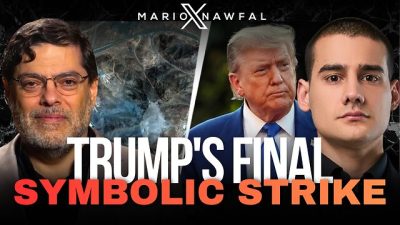
Trump asks Iran not to retaliate after he strikes Pickaxe Mountain
or go to
Aletho News Archives – Video-Images
Book Review
‘Why Fauci Must Rot in Prison’: A Tale of Two Diaries
By Jill Erzen | The Defender | October 13, 2026
Dr. Anthony Fauci’s private diary reveals a “mind-numbing” contradiction between what the former top U.S. infectious disease official knew about COVID-19 and what he told the public, senior White House adviser Peter Navarro, Ph.D., said last week on “American Thought Leaders.”
In his new book, “Why Fauci Must Rot in Prison,” due out Oct. 20, Navarro compares Fauci’s private entries to his own pandemic-era diary, and uses what he calls “a tale of two diaries” to argue that Fauci should face criminal prosecution.
“I show, actually, how a prosecution can and should happen … at the state level, most likely,” Navarro said. “He should wind up in prison, and we’ve got the receipts in this book to put him there.”
Navarro said Fauci repeatedly acknowledged important facts in private, then publicly pursued policies that contradicted those facts — with devastating consequences.
“What he says many times privately in his diary is so at odds with both his public behavior and public statements that it’s mind-numbing,” Navarro said.
Navarro examines the lasting damage caused by lockdowns and other pandemic policies, and the ongoing toll of long COVID.
His book also addresses questions about vaccine safety, including why healthy young people faced COVID-19 vaccination mandates despite concerns about myocarditis, and why women were not warned about miscarriage risks linked to the shots. … continue
Blog Roll
 Aletho News
- Yemen denounces international community’s silence on Saudi aggression, siege
- UAE and Saudi Arabia move toward renewed coordination against Sanaa
- How Iran’s two-week retaliatory strikes exposed cracks in US military architecture in Persian Gulf
- The mother of all propaganda: Why the hype over US MOAB strike against Iran is nothing but theater
- Iran says it possesses technology behind US 14-ton GBU bunker-buster
- Trump asks Iran not to retaliate after he strikes Pickaxe Mountain – w/ Prof. Marandi
- Vice President J.D. Vance’s Deceptive ‘Antiwar’ Campaign Speech
- Iran: Palestinians’ rights must not be compromised in Gaza’s future; US, Israel to blame for Hormuz situation
- Ongoing tales of Syrian chemical weapons
- Moscow blasts UN for ignoring torture of Russian POWs
- If Americans Knew
- Israeli rabbi permits occupiers to steal Palestinian olive harvest in West Bank
- Netanyahu’s spin on latest settler attack is laughable – Daily Update
- Israeli soldiers debunk Israel’s talking points
- In West Bank, Israeli settlers are totally out of control – Daily Update
- NPR investigation finds evidence of widespread fraud at mall kiosks tied to Israeli skincare brand
- Tucker Carlson exposes Israeli Lies about the Oct 7th attack, Charlie Kirk, and the U.S.
- Israel has detained thousands of Palestinian children since Oct 7th – over half spent time in solitary, many uncharged
- Israeli Analysis: Is Netanyahu Planning an ‘October Surprise’ Attack Before Israel’s Election?
- Israeli settlers brutally attack Palestinians and Washington Post female photographer, 65
- Words Have Changed, Occupation Continues: The Reality of the Gaza Ceasefire
- No Tricks Zone
- Predictions Made By Renowned Climate Proifessor Over Past Decades Have Been Proven To Be Poor
- New Study Suggests Large Regions Of The Pacific Ocean Have Been Cooling For The Last 80 Years
- Germany’s Green Energy Debacle: High Energy Costs Force Kahla Porzellan to Close After 182 Years!
- New Study: 50 Years Of The Most Aggressive ‘Net Zero’ Policies Can Only Affect The Global Climate By 0.03°C
- US September “Heat” Was No Record…Many Records Set Decades Ago
- Latest European Green Energy Debacle; Portugal’s Largest Flagship Solar Park Insolvent!
- Green Energy Debacle: German Expert Professor Fritz Vahrenholt Warns Of Severe Economic And Social Consequences
- Two More Paleo Reconstructions Affirm Meters-Higher Sea Levels Across Ireland, Brazil 7000-6000 Years Ago
- New Study: Earth And Venus Surface Warmth Largely Explained By Convection And Lapse Rate, Not CO2 Or Radiation
- 2025 Nature Paper Claiming Worsening Global Drought Gets RETRACTED …Heavily Flawed

