Value in Reading Others’ Propaganda
By Graham E. Fuller | Consortium News | September 29, 2015
All countries do it — promoting their own societies in ideal terms in order to influence others. The U.S. devotes a huge amount of time and money to selling its self-image and a view of the world as seen through American eyes — and perhaps denigrating others as well.
Such “crafted” image-making is hardly exclusive to the U.S. government. The New York Times, for example, supposedly our gold-standard on objective reporting, is heavily slanted when it comes to reporting nearly anything on China or Russia — among other issues.
If you recognize the nature of what you’re reading, that’s fine. But if you think you’re getting the full skinny on the world, then it can be dangerous and self-deceiving. As we say in the free market, let the buyer beware.
China and Russia, among others, certainly produce their own state propaganda, often far less skillfully than the U.S., and it more often comes in state-controlled media. The real danger, of course, comes when you start believing your own spin as representing reality around you.
But there can actually be some virtue in reading “propaganda.” (Let’s use a better description for it — promotion of one’s own view of the world — in the effort to bring others over to your view.) The value of reading such material can actually be great — particularly for those interested in international affairs. Certainly when I was at CIA we read a lot of what could be called “foreign propaganda.”
Indeed there was an entire branch of CIA which monitored and published on a daily basis a thick booklet of selected broadcast items from around the world — available by subscription. The Foreign Broadcast Information Service provided an invaluable service. It is now sadly defunct, the victim of short-sighted budget cutting — an operation which probably cost less annually than one fighter aircraft and offered much more.
One virtue of these broadcast items was the nuggets of domestic information from those countries which were otherwise not readily known about — a kind of news coverage. But the greater value was the ability to see how a foreign state viewed itself and the world around it. Propaganda? Sure, in one sense. But the thoughtful reader could fairly soon get a sense of how Russia, China, North Korea, or say Iran, saw themselves. Sometimes you might find a strikingly different interpretation of events that revealed a lot about their psychology and even their likely reactions and behavior down the road.
For the thoughtful statesman and analyst, this was good stuff. It helped explain where other leaders were coming from, what they more or less believed. Their worldview also offered perspectives about how they saw the U.S. Whether we liked it or not, it contained a few revelations about our mutual, and differing, perspectives.
Sadly today, one gets a sense that large elements of the U.S. government, and especially Congress, are quite ignorant of any possible alternative explanations of why other countries see things the way they do, and how they see us. If you’re a small country, such insularity might not matter all that much; when you claim to be world leader such insularity matters a whole lot.
There’s no mystery in this. Successful people often are very perceptive about how others see things and why they speak and act the way they do.
In today’s world, then, there is huge value in looking at what, say, China and Russia say about themselves and how they view us. It helps to remove surprises from negotiations and might even cause us to consider for a second whether there is any logic or even possible truth in how they view us. Or even to reconsider what we are doing.
That’s why it’s useful to have summits, even private conversations between leaders in the hallways of the UN — they get to hear directly how the other leader thinks. If we don’t like what they have to say, maybe it’s doubly necessary to hear it.
So when major speeches or articles appear from other leaders or commentators from countries we don’t like, my old habits kick in. I find I can learn a lot about the texture of international events from reading these pieces. Naturally some writings are more thoughtful than others, but they give me a chance to put myself in their shoes, see the world their way, and maybe anticipate certain kinds of actions and responses.
Some of those perceptions and views we might regard as erroneous, but then perhaps some of our own views might be erroneous. There is no single truth in foreign policy out there — only differing perspectives. There may be some validity to more than one of them.
Case in point: this article from the China Daily, an English language publication that unquestionably reflects Chinese government thinking. The story presents a view of how China views itself — and more importantly — how it views us.
Do I accept the Chinese view as the “accurate” view, the full story of what we, or they, are doing? Of course not; you and I can readily pick a few holes in what the China Daily has to say. Self-serving? Sure, like White House or Pentagon press briefings that need to be taken with a huge grain of suspicion and skepticism as well.
You’ve got to read everything with vigilance and discrimination, including the New York Times. And we in the U.S. have some TV channels dedicated almost entirely to formulation of an American right-wing propaganda view of the world, however remote from reality. But do China and Russia find it important to listen to that discourse? You better believe it.
So I suggest reading the piece as one of many that show how our competitors view themselves — and us. We can all learn a thing or two through the privilege of entering into their mental world and perspective on affairs.
From time to time I may select a few other pieces that help hold a mirror up to ourselves. Any good intelligence analyst reads many of these things with profit. So can you.
Graham E. Fuller is a former senior CIA official, author of numerous books on the Muslim World; his latest book is Breaking Faith: A novel of espionage and an American’s crisis of conscience in Pakistan. (Amazon, Kindle) grahamefuller.com
Apple Suddenly Banned an App That Maps U.S. Drone Strikes
By Jack Smith IV | Tech.Mic | September 28, 2015
Freelance journalist and data artist Josh Begley has been methodically recording U.S. military drone activity for years. Every week or so — whenever the strikes occur — Begley will post a news story from the @dronestream Twitter account, identifying when and where drone strikes have occurred before feeding the results into an app called Metadata+.
But on Sunday, Dronestream tweeted that Metadata+, which sends out push notifications every time there is a U.S. drone strike, had been removed from the App Store after seven months of being openly available.
Begley will still update followers about the drone strikes via his Twitter account. However, the app’s removal is sudden and inexplicable; it was accepted by the App Store after five attempts.
Apple still aspires to be a hub for serious news. It’s building tools like Apple News to help journalists and publishers reach new audiences. But Apple’s opaque filtering process shows that it may not be ready to decide for the public what kind of content we should or shouldn’t be exposed to.
Earlier this month, Apple censored a journalistic app that took you to the scene of the Ferguson, Missouri, shooting of Michael Brown. The tech giant has also taken down educational apps that depicted the Confederate Flag in its historical context. All while allowing for apps that include violence and graphic depictions of war, like Hitman: Sniper and Zynga’s Empires and Allies.
Then again, those apps all include in-app purchases from which Apple collects revenue. And none of them is offensive to the United States government.
Jack Smith IV is a writer and reporter covering the intersection between the Internet, culture, politics, the economy and the future. Send tips, comments and feedback to jack@mic.com.
The Power of False Narrative
By Robert Parry | Consortium News | September 28, 2015
In this age of pervasive media, the primary method of social control is through the creation of narratives delivered to the public through newspapers, TV, radio, computers, cell phones and any other gadget that can convey information. This reality has given rise to an obsession among the power elite to control as much of this messaging as possible.
So, regarding U.S. relations toward the world, we see the State Department, the White House, Pentagon, NATO and other agencies pushing various narratives to sell the American people and other populations on how they should view U.S. policies, rivals and allies. The current hot phrase for this practice is “strategic communications” or Stratcom, which blends psychological operations, propaganda and P.R. into one mind-bending smoothie.
I have been following this process since the early 1980s when the Reagan administration sought to override “the Vietnam Syndrome,” a public aversion to foreign military interventions that followed the Vietnam War. To get Americans to “kick” this syndrome, Reagan’s team developed “themes” about overseas events that would push American “hot buttons.”
Tapping into the Central Intelligence Agency’s experience in psy-ops targeted at foreign audiences, President Ronald Reagan and CIA Director William J. Casey assembled a skilled team inside the White House led by CIA propaganda specialist Walter Raymond Jr.
From his new perch on the National Security Council staff, Raymond oversaw inter-agency task forces to sell interventionist policies in Central America and other trouble spots. The game, as Raymond explained it in numerous memos to his underlings, was to glue black hats on adversaries and white hats on allies, whatever the truth really was.
The fact that many of the U.S.-backed forces – from the Nicaraguan Contras to the Guatemalan military – were little more than corrupt death squads couldn’t be true, at least according to psy-ops doctrine. They had to be presented to the American public as wearing white hats. Thus, the Contras became the “moral equals of our Founding Fathers” and Guatemala’s murderous leader Efrain Rios Montt was getting a “bum rap” on human rights, according to the words scripted for President Reagan.
The scheme also required that anyone – say, a journalist, a human rights activist or a congressional investigator – who contradicted this white-hat mandate must be discredited, marginalized or destroyed, a routine of killing any honest messenger.
But it turned out that the most effective part of this propaganda strategy was to glue black hats on adversaries. Since nearly all foreign leaders have serious flaws, it proved much easier to demonize them – and work the American people into war frenzies – than it was to persuade the public that Washington’s favored foreign leaders were actually paragons of virtue.
An Unflattering Hat
Once the black hat was jammed on a foreign leader’s head, you could say whatever you wanted about him and disparage any American who questioned the extreme depiction as a “fill-in-the-blank apologist” or a “stooge” or some other ugly identifier that would either silence the dissenter or place him or her outside the bounds of acceptable debate.
Given the careerist conformity of Washington, nearly everyone fell into line, including news outlets and human rights groups. If you wanted to retain your “respectability” and “influence,” you agreed with the conventional wisdom. So, with every foreign controversy, we got a new “group think” about the new “enemy.” The permissible boundary of each debate was set mostly by the neoconservatives and their “liberal interventionist” sidekicks.
That this conformity has not served American national interests is obvious. Take, for example, the disastrous Iraq War, which has cost the U.S. taxpayers an estimated $1 trillion, led to the deaths of some 4,500 American soldiers, killed hundreds of thousands of Iraqis, and unleashed chaos across the strategic Middle East and now into Europe.
Most Americans now agree that the Iraq War “wasn’t worth it.” But it turns out that Official Washington’s catastrophic “group thinks” don’t just die well-deserved deaths. Like a mutating virus, they alter shape as the outside conditions change and survive in a new form.
So, when the public caught on to the Iraq War deceptions, the neocon/liberal-hawk pundits just came up with a new theme to justify their catastrophic Iraq strategy, i.e., “the successful surge,” the dispatch of 30,000 more U.S. troops to the war zone. This theme was as bogus as the WMD lies but the upbeat storyline was embraced as the new “group think” in 2007-2008.
The “successful surge” was a myth, in part, because many of its alleged “accomplishments” actually predated the “surge.” The program to pay off Sunnis to stop shooting at Americans and the killing of “Al Qaeda in Iraq” leader Abu Musab al-Zarqawi both occurred in 2006, before the surge even began. And its principal goal of resolving sectarian grievances between Sunni and Shiite was never accomplished.
But Official Washington wrapped the “surge” in the bloody flag of “honoring the troops,” who were credited with eventually reducing the level of Iraqi violence by carrying out the “heroic” surge strategy as ordered by President Bush and devised by the neocons. Anyone who noted the holes in this story was dismissed as disrespecting “the troops.”
The cruel irony was that the neocon pundits, who had promoted the Iraq War and then covered their failure by hailing the “surge,” had little or no regard for “the troops” who mostly came for lower socio-economic classes and were largely abstractions to the well-dressed, well-schooled and well-paid talking heads who populate the think tanks and op-ed pages.
Safely ensconced behind the “successful surge” myth, the Iraq War devotees largely escaped any accountability for the chaos and bloodshed they helped cause. Thus, the same “smart people” were in place for the Obama presidency and just as ready to buy into new interventionist “group thinks” – gluing black hats on old and new adversaries, such as Libya’s Muammar Gaddafi, Syria’s Bashar al-Assad and, most significantly, Russia’s Vladimir Putin.
Causing Chaos
In 2011, led this time by the liberal interventionists – the likes of Secretary of State Hillary Clinton and White House aide Samantha Power – the U.S. military and some NATO allies took aim at Libya, scoffing at Gaddafi’s claim that his country was threatened by Islamic terrorists. It was not until Gaddafi’s military was destroyed by Western airstrikes (and he was tortured and murdered) that it became clear that he wasn’t entirely wrong about the Islamic extremists.
The jihadists seized large swaths of Libyan territory, killed the U.S. ambassador and three other diplomatic personnel in Benghazi, and forced the closing of U.S. and other Western embassies in Tripoli. For good measure, Islamic State terrorists forced captured Coptic Christians to kneel on a Libyan beach before beheading them.
Amid this state of anarchy, Libya has been the source of hundreds of thousands of migrants trying to reach Europe by boat. Thousands have drowned in the Mediterranean. But, again, the leading U.S. interventionists faced no accountability. Clinton is the frontrunner for the Democratic presidential nomination, and Power is now U.S. Ambassador to the United Nations.
Also, in 2011, a similar uprising occurred in Syria against the secular regime headed by President Assad, with nearly identical one-sided reporting about the “white-hatted” opposition and the “black-hatted” government. Though many protesters indeed appear to have been well-meaning opponents of Assad, Sunni terrorists penetrated the opposition from the beginning.
This gray reality was almost completely ignored in the Western press, which almost universally denounced the government when it retaliated against opposition forces for killing police and soldiers. The West depicted the government response as unprovoked attacks on “peaceful protesters.” [See Consortiumnews.com’s “Hidden Origins of Syria’s Civil War.”]
This one-sided narrative nearly brought the U.S. military to the point of another intervention after Aug. 21, 2013, when a mysterious sarin gas attack killed hundreds in a suburb of Damascus. Official Washington’s neocons and the pro-interventionists in the State Department immediately blamed Assad’s forces for the atrocity and demanded a bombing campaign.
But some U.S. intelligence analysts suspected a “false-flag” provocation by Islamic terrorists seeking to get the U.S. air force to destroy Assad’s army for them. At the last minute, President Obama steered away from that cliff and – with the help of President Putin – got Assad to surrender Syria’s chemical arsenal, while Assad continued to deny a role in the sarin attack. [See Consortiumnews.com’s “The Collapsing Syria-Sarin Case.”]
Upset over Iran
Putin also assisted Obama on another front with another demonized “enemy,” Iran. In late 2013, the two leaders collaborated in getting Iran to make significant concessions on its nuclear program, clearing the way for negotiations that eventually led to stringent international controls.
These two diplomatic initiatives alarmed the neocons and their right-wing Israeli friends. Since the mid-1990s, the neocons had worked closely with Prime Minister Benjamin Netanyahu in plotting a “regime change” strategy for countries that were viewed as troublesome to Israel, with Iraq, Syria and Iran topping the list.
Putin’s interference with that agenda – by preventing U.S. bombing campaigns against Syria and Iran – was viewed as a threat to this longstanding Israeli/neocon strategy. There was also fear that the Obama-Putin teamwork could lead to renewed pressure on Israel to recognize a Palestinian state. So, that relationship had to be blown up.
The detonation occurred in early 2014 when a neocon-orchestrated coup overthrew elected Ukrainian President Viktor Yanukovych and replaced him with a fiercely anti-Russian regime which included neo-Nazi and other ultra-nationalist elements as well as free-market extremists.
Ukraine had been on the neocon radar at least since September 2013, just after Putin undercut plans for bombing Syria. Neocon Carl Gershman, president of the U.S.-government-funded National Endowment for Democracy, wrote a Washington Post op-ed deeming Ukraine “the biggest prize” and a key steppingstone toward another regime change in Moscow, removing the troublesome Putin.
Gershman’s op-ed was followed by prominent neocons, such as Sen. John McCain and Assistant Secretary of State for European Affairs Victoria Nuland, urging on violent protests that involved firebombing the police. But the State Department and the mainstream media glued white hats on the Maidan protesters and black hats on the police and the government.
Then, on Feb. 20, 2014, a mysterious sniper attack killed both police and demonstrators, leading to more clashes and the deaths of scores of people. The U.S. government and press corps blamed Yanukovych and – despite his signing an agreement for early elections on Feb. 21 – the Maidan “self-defense forces,” spearheaded by neo-Nazi goons, overran government buildings on Feb. 22 and installed a coup regime, quickly recognized by the State Department as “legitimate.”
Though the fault for the Feb. 20 sniper attack was never resolved – the new Ukrainian regime showed little interest in getting to the bottom of it – other independent investigations pointed toward a provocation by right-wing gunmen who targeted police and protesters with the goal of deepening the crisis and blaming Yanukovych, which is exactly what happened.
These field reports, including one from the BBC, indicated that the snipers likely were associated with the Maidan uprising, not the Yanukovych government. [Another worthwhile documentary on this mystery is “Maidan Massacre.”]
One-Sided Reporting
Yet, during the Ukrainian coup, The New York Times and most other mainstream media outlets played a role similar to what they had done prior to the Iraq War when they hyped false and misleading stories about WMD. By 2014, the U.S. press corps no longer seemed to even pause before undertaking its expected propaganda role.
So, after Yanukovych’s ouster, when ethnic Russians in Crimea and eastern Ukraine rose up against the new anti-Russian order in Kiev, the only acceptable frame for the U.S. media was to blame the resistance on Putin. It must be “Russian aggression” or a “Russian invasion.”
When a referendum in Crimea overwhelmingly favored secession from Ukraine and rejoining Russia, the U.S. media denounced the 96 percent vote as a “sham” imposed by Russian guns. Similarly, resistance in eastern Ukraine could not have reflected popular sentiment unless it came from mass delusions induced by “Russian propaganda.”
Meanwhile, evidence of a U.S.-backed coup, such as the intercepted phone call of a pre-coup discussion between Assistant Secretary Nuland and U.S. Ambassador Geoffrey Pyatt on how “to midwife this thing” and who to install in the new government (“Yats is the guy”), disappeared into the memory hole, not helpful for the desired narrative. [See Consortiumnews.com’s “NYT Still Pretends No Coup in Ukraine.”]
When Malaysia Airlines Flight 17 was shot down over eastern Ukraine on July 17, 2014, the blame machine immediately roared into gear again, accusing Putin and the ethnic Russian rebels. But some U.S. intelligence analysts reportedly saw the evidence going in a different direction, implicating a rogue element of the Ukrainian regime.
Again, the mainstream media showed little skepticism toward the official story blaming Putin, even though the U.S. government and other Western nations refused to make public any hard evidence supporting the Putin-did-it case, even now more than a year later. [See Consortiumnews.com’s “MH-17 Mystery: A New Tonkin Gulf Case.”]
The pattern that we have seen over and over is that once a propaganda point is scored against one of the neocon/liberal-hawk “enemies,” the failure to actually prove the allegation is not seen as suspicious, at least not inside the mainstream media, which usually just repeats the old narrative again and again, whether its casting blame on Putin for MH-17, or on Yanukovych for the sniper attack, or on Assad for the sarin gas attack.
Instead of skepticism, it’s always the same sort of “group think,” with nothing learned from the disaster of the Iraq War because there was virtually no accountability for those responsible.
Obama’s Repression
Yet, while the U.S. press corps deserves a great deal of blame for this failure to investigate important controversies independently, President Obama and his administration have been the driving force in this manipulation of public opinion over the past six-plus years. Instead of the transparent government that Obama promised, he has run one of the most opaque, if not the most secretive, administrations in American history.
Besides refusing to release the U.S. government’s evidence on pivotal events in these international crises, Obama has prosecuted more national security whistleblowers than all past presidents combined.
That repression, including a 35-year prison term for Pvt. Bradley/Chelsea Manning and the forced exile of indicted National Security Agency contractor Edward Snowden, has intimidated current intelligence analysts who know about the manipulation of public opinion but don’t dare tell the truth to reporters for fear of imprisonment.
Most of the “leaked” information that you still see in the mainstream media is what’s approved by Obama or his top aides to serve their interests. In other words, the “leaks” are part of the propaganda, made to seem more trustworthy because they’re coming from an unidentified “source” rather than a named government spokesman.
At this late stage in Obama’s presidency, his administration seems drunk on the power of “perception management” with the new hot phrase, “strategic communications” which boils psychological operations, propaganda and P.R. into one intoxicating brew.
From NATO’s Gen. Philip Breedlove to the State Department’s Under Secretary for Public Diplomacy Richard Stengel, the manipulation of information is viewed as a potent “soft power” weapon. It’s a way to isolate and damage an “enemy,” especially Russia and Putin.
This demonization of Putin makes cooperation between him and Obama difficult, such as Russia’s recent military buildup in Syria as part of a commitment to prevent a victory by the Islamic State and Al Qaeda. Though one might think that Russian help in fighting terrorism would be welcomed, Nuland’s State Department office responded with a bizarre and futile attempt to build an aerial blockade of Russian aid flying to Syria across eastern Europe.
Nuland and other neocons apparently would prefer having the black flag of Sunni terrorism flying over Damascus than to work with Putin to block such a catastrophe. The hysteria over Russia’s assistance in Syria is a textbook example of how people can begin believing their own propaganda and letting it dictate misguided actions.
On Thursday, Obama’s White House sank to a new low by having Press Secretary Josh Earnest depict Putin as “desperate” to land a meeting with Obama. Earnest then demeaned Putin’s appearance during an earlier sit-down session with Netanyahu in Moscow. “President Putin was striking a now-familiar pose of less-than-perfect posture and unbuttoned jacket and, you know, knees spread far apart to convey a particular image,’ Earnest said.
But the meeting photos actually showed both men with their suit coats open and both sitting with their legs apart at least for part of the time. Responding to Earnest’s insults, the Russians denied that Putin was “desperate” for a meeting with Obama and added that the Obama administration had proposed the meeting to coincide with Putin’s appearance at the United Nations General Assembly in New York on Monday.
“We do not refuse contacts that are proposed,” said Yuri Ushakov, a top foreign policy adviser to Putin. “We support maintaining constant dialogue at the highest level.” The Kremlin also included no insults about Obama’s appearance in the statement.
However, inside Official Washington, there appears to be little thought that the endless spinning, lying and ridiculing might dangerously corrode American democracy and erode any remaining trust the world’s public has in the word of the U.S. government. Instead, there seems to be great confidence that skilled propagandists can discredit anyone who dares note that the naked empire has wrapped itself in the sheerest of see-through deceptions.
Investigative reporter Robert Parry broke many of the Iran-Contra stories for The Associated Press and Newsweek in the 1980s. You can buy his latest book, America’s Stolen Narrative, either in print here or as an e-book (from Amazon and barnesandnoble.com).
A Nuclear Power Confronting Slingshots, Israeli Hypocrisy Finds an Ally in The NY Times
By Barbara Erickson | TimesWarp | September 28, 2015
Israel, The New York Times tells us, has vowed to crack down on violence in Jerusalem, allowing the use of live fire against Palestinians who take to “rock throwing and firebombing,” expanding the rules of engagement and lengthening sentences for such crimes.
In a story titled “Israel Acts to Combat Violence in Jerusalem,” Isabel Kershner quotes Prime Minister Benjamin Netanyahu, who calls such Palestinian weaponry “deadly and murderous objects,” which have been “thrown without response and without being thwarted.”
It is noteworthy that Netanyahu, responsible for bombing and strafing the 1.8 million residents of Gaza, can say these words without a hint of irony. It is also striking that the Times can report his utterances without pointing out the full context here—the lopsided nature of the conflict.
In fact, it is the Palestinians who face a deadly enemy: Israel possesses armored vehicles, automatic rifles, drones, rockets, fighter jets, smart bombs and sophisticated surveillance equipment, all of them more “deadly and murderous” than Palestinian rocks. As the only nuclear power in the Middle East, Israel also has a stockpile of up to 300 nuclear weapons, which can be launched by air, land or sea.
Palestinians in Jerusalem and the West Bank have nothing more than stones, firecrackers, kitchen knives and homemade firebombs. The mortality figures reflect this disparity: Since the beginning of this year Israeli forces have killed more than 25 Palestinians in the West Bank (settlers have killed at least another three), while Palestinians are responsible for the deaths of four Israelis within the West Bank and Israel combined.
Yet the Times strains to make Israelis appear as the victims, giving voice to the claims of Netanyahu, playing down Palestinian deaths and hyping Israeli casualties. A recent headline declared, “Jewish Man Dies As Rocks Pelt His Car in East Jerusalem,” suggesting that the driver was stoned to death. In fact, he had a heart attack, lost control of his car and ran into a light pole. The Times story cites only one object hitting the car.
By contrast, the paper gives a bland and ambiguous title to the story of a young Palestinian woman who died from a barrage of Israeli bullets last week as she tried to cross a checkpoint in Hebron. This news appears under the title, “2 Are Killed in West Bank as Jewish and Muslim Holidays Approach.”
Readers find no hint of the bloody assault on 18-year-old Hadeel Al Hashlamoun in this headline, and the Times has also failed to report that Amnesty International termed her killing a “extrajudicial execution” and called for a “prompt, impartial, independent and effective investigations” into her death.
Firsthand accounts say that an Israeli soldier shot Al Hashlamoun in the leg, and when she lay motionless on the ground, approached her and fired several more shots into her abdomen. Witnesses add that soldiers refused to let a Palestinian ambulance approach her and left her to bleed for about half an hour before allowing an Israeli ambulance to arrive and take her away. Video footage also shows a soldier grabbing her by a foot as she lay bleeding on the ground and dragging her out of camera sight.
This is raw violence with “deadly and murderous” arms, but the Times and Netanyahu do not find the word “violence” appropriate here. They reserve its use for Palestinians who throw rocks and firecrackers, never applying it to the atrocities of Israeli security forces. The irony and hypocrisy in this discourse seem to elude them entirely.
In a story that appeared online yesterday, the Times reports that four Palestinian youths have been arrested for throwing rocks at the car of the man who died after crashing in East Jerusalem. This news is in striking contrast to the latest, disturbing developments in the case of three Palestinian family members who died in an arson attack.
When news broke of the fire that killed a toddler in the West Bank village of Duma and led to the later deaths of his mother and father, the Times quoted the reactions of Israeli politicians at length and described Jewish Israeli “soul searching” over the deaths. The paper also noted that some extremist settlers had been arrested but that no one accused of the Duma arson was in custody.
The Times ran several stories immediately after the arson attack, reporting that Netanyahu vowed to bring the perpetrators to justice, but after running a brief article when the mother died earlier this month, the newspaper has been silent, even though there is news to tell: Israeli officials know who committed the crime but do not plan to arrest them.
Israeli media have reported that Defense Minister Moshe Ya’alon admitted that the names of the suspects are known but the defense establishment has not arrested anyone “to avoid revealing intelligence sources in court.”
So we have the quick arrest of four youths suspected of throwing rocks and (perhaps) indirectly causing the death of an Israeli driver, while those responsible for burning and killing three innocent Palestinians go free. The remarks by Ya’alon add even more irony to Netanyahu’s complaint that rock throwing occurs “without response and without being thwarted.”
The Times has shown itself to be tone deaf to such dissonance in the Israeli narrative. Far from analyzing or commenting on the hypocrisy of vilifying rock throwers, it has worked to support this deliberate distortion of the reality in Palestine.
So in the Times we find silence concerning official complicity in settler crimes, efforts to portray Israelis as victims and a refusal to state the obvious: Killing civilians with the world’s most sophisticated weapons ranks high on the scale of violence, far above the efforts of Palestinian youth who face armored soldiers and tanks with slingshots and stones.
Correcting America’s mistakes in Syria, a wish list
By Camille Alexandre Otrakji
Dear American friends who are reporting on, analyzing, or advising decision makers on Syria,
No one is expecting you to “Support Assad”, just like you really shouldn’t have wasted the past four years committed to supporting Assad’s adversaries and opponents.
- You started (summer 2011) by working with your allies (especially the French) to pass a security council resolution that would authorize you to use force in Syria against the Syrian army. You only stopped after repeated vetoes by Russia and China.
- You recognized the Syrian National Council as “legitimate representative of the Syrian people”, then you recognized the Syrian National Coalition. Both groups included opposition characters that were selected and managed by you, the French and your Gulf Arab state allies. “The Syrian people” had zero input in the selection process. Both groups included secular faces but the real power behind them was the Muslim Brotherhood, an organization with a criminal past and present … An organization that refused to support war on ISIS. An organization that bullied then alienated many of the liberals, women and minorities in Syrian opposition.
- You boycotted (or rarely interacted with) millions of Syrians who supported their government against your favorite side in the Syrian conflict (“the opposition”). Syrian visa applicants who did not support “the revolution” in US consulates had to answer and almost apologize to your immigration officers who asked them why are they not on America’s side in the Syrian conflict.
- Your media and analysts simply followed your state department’s directives. CNN and the Washington post mobilized in favor of anyone who would carry arms against the Syrian army. CFR and other think tanks discussed openly the need to work with Al-Qaeda (Annusra) in order to defeat the regime. Large numbers of American activists (a mix of those naturally inspired, and many others who are paid to write against Assad) worked relentlessly on social media platforms to attack, humiliate and discredit any Syrian or non Syrian who advocated dialogue as a way to end the conflict. Your passionate warmongers included the leftists (“we are here to help the Syrian people”) and the neocons (“We should teach Assad a lesson”).
- You know that there is no proof and there is no logic behind accusations that “Assad” used chemical weapons, yet you continued to use it as a pressure tool against Assad, despite the resulting escalation in hate and violence among the Syrian people that your regime-demonization propaganda was contributing to.
The United States does not need to do a 180 degree turn (and it will not). Here is how a 90 degree adjustment can lead to a more constructive role in the exceptionally complex and dangerous Syrian crisis.
- Do not recognize ANYONE of being the legitimate representative of the Syrian people. There are millions of Syrians who support Assad/government/the army. There are millions of Syrians who support the opposition. There are millions of Syrians who do not care about politics. They just want to go back to normal life.
- Everyone contributed to violence. No, Assad is not the main culprit. Before 2011, he ruled Syria for 11 years without killing anyone. He reduced the number of political prisoners from an estimated 1,300 in 2001, to an estimated 200 in 2010. Everyone, starting with the United States, is responsible for what happened after 2011. If you are not planning to demonize yourself, please try to realize that it is only fair to not demonize anyone. If you want a quantification of the size of your responsibility, try to imagine the recently revealed (by the Washington Post ) details about your covert CIA Syria annual budget of $1 billion… Did you buy anything good with that yearly investment?
- If you insist on calling Assad “The ruthless Syrian dictator”, please make sure you call Syrian opposition figures “ruthless corrupt, weak, naive, sectarian, vengeful, and utterly useless Syrian opposition figure”. Or better, avoid the negativity on both sides.
- Forget the past. If your allegations (unproven) of a Syrian role in the attack on US marines in Beirut in 1983 (32 years ago) is still bothering you, why not take it out on the Saudis for their more certain role in 9/11, or why not first punish yourself for the millions of Iraqis who died because of “mistakes” by previous US administrations… you lost hundreds. others lost millions … they are not seeking revenge.
- The end does NOT justify the means. If you are dying to spread democracy, remember that there are millions of other ideologues who are equally eager to spread communism, or their fanatic interpretations of Islam … Everyone believes in salvation through his ideology.
- Democracy is not working too well in most countries. Lebanon and Iraq (your democratic allies in the Arab world) are even more corrupt than authoritarian Syria. Instead of promoting democracy, try to promote the foundations on which democracy can be later successfully established. Promote the separation of religion and state in Syria. Promote tolerance and respect of opinions that differ. Promote women’s rights. Promote freedom of speech (which Lebanon and Iraq have, and so should Syria).
- Reopen your embassy in Damascus. This time direct your diplomats (and security officers) to work for peace and reconciliation. U.S. interests will be better served that way. Regime supporters, rational opposition, and the larger segment of Syrians who are neutral, will all thank you.
- Close the Facebook page of the US embassy in Damascus, or replace its current immature editor(s).
- Call on all sides to join you in admitting their mistakes. Everyday that you all wait before you radically change, hundreds of innocent Syrians will die.
- When you work with regional and international actors, please try to respect the desires of the majority of Syrians who do not wish to become an American, Russian, Iranian, Saudi, Turkish or Qatari satellite. There will be a long term, costly, resistance to any proposal that gives outside powers an exceptional influence in Syria. Please do not waste time and innocent lives. Syrians do not wish to be a Jordan or a Lebanon. You do not want Syria to be a bigger Lebanon that borders (and constantly exports its problems to) your allies to the north, east, south and east or Syria.
- You want what’s good for the Syrian people? While it is hard to find a clear majority of Syrians agreeing on the question of regime change, there is little doubt that the vast majority of Syrians want the Golan Heights back (illegally occupied by Israel since 1967). They want economic prosperity… ending torture … freedom of press with responsibilities (no sectarianization, no promotion of hate or violence… ), they want to fight corruption … they want a more accountable government. You surely can help by pressuring Israel to return the Golan, by economic assistance to Syria, and by pressuring the Syrian government AND Syrian opposition to respect those truly popular demands (and not only the issues the US and its Syrian opposition allies always used to demonize the regime and only the regime).
- Oh … can you start by ending economic sanctions that you placed in 1979 (to punish Syria for its resistance to the Camp David accord)? … you are not hurting “the regime” with those sanctions … you are killing innocent Syrians instead. Remember that your sanctions killed hundreds of thousands of Iraqi children during the nineties.
Here is the the preamble to the 1789 American constitution: “We the People of the United States, in Order to form a more perfect Union, establish Justice, insure domestic Tranquility, provide for the common defense, promote the general Welfare, and secure the Blessings of Liberty to ourselves and our Posterity, do ordain and establish this Constitution for the United States of America.”
Eighty one years later (on February 3, 1870) the 15th amendment that granted African Americans the right to vote was ratified.
One hundred and thirty one years later (on August 18, 1920), the 19th amendment that guarantees all American women the right to vote was ratified.
Please be careful with Syria. Change takes time and planning. It takes a favorable regional environment… and it takes realism. 120-min Hollywood or Disney fairy tale movies (“the Arab Spring”) are not going to lead to a happy ending in a country as complex as Syria.
Will US Grasp Putin’s Syria Lifeline?
By Robert Parry | Consortium News | September 22, 2015
Russian President Vladimir Putin has thrown U.S. policymakers what amounts to a lifeline to pull them out of the quicksand that is the Syrian war, but Official Washington’s neocons and the mainstream U.S. news media are growling about Putin’s audacity and challenging his motives.
For instance, The New York Times’ lead editorial on Monday accused Putin of “dangerously building up Russia’s military presence” in Syria, even though Putin’s stated goal is to help crush the Sunni jihadists in the Islamic State and other extremist movements.
Instead, the Times harrumphs about Putin using his upcoming speech to the United Nations General Assembly “to make the case for an international coalition against the Islamic State, apparently ignoring the one already being led by the United States.”
The Times then reprises the bizarre neocon argument that the best way to solve the threat from the Islamic State, Al Qaeda and other jihadist forces is to eliminate Syrian President Bashar al-Assad and his military who have been the principal obstacles to an outright victory by the Sunni terrorist groups.
The dreamy Times/neocon prescription continues to be that “regime change” in Damascus would finally lead to the emergence of the mythical “moderate” rebels who would somehow prevail over the far more numerous and far better armed extremists. This perspective ignores the fact that after a $500 million training project for these “moderates,” the U.S. military says four or five fighters are now on the battlefield inside Syria. In other words, the members of this U.S.-trained brigade can be counted on the fingers of one hand.
But rather than rethink Official Washington’s goofy “group think” on Syria – or provide readers a fuller history of the Syrian conflict – the Times moves on to blame Putin for the mess.
“No one should be fooled about Russia’s culpability in Syria’s agony,” the Times writes. “Mr. Putin could have helped prevent the fighting that has killed more than 250,000 Syrians and displaced millions more, had he worked with other major powers in 2011 to keep Mr. Assad from waging war on his people following peaceful anti-government protests. … Mr. Assad would probably be gone without the weapons aid and other assistance from Russia and Iran.”
This “group think” ignores the early role of Sunni extremists in killing police and soldiers and thus provoking the harsh retaliation that followed. But the Syrian narrative, according to The New York Times, is that the “white-hat” protesters were simply set upon by the “black-hat” government.
The Times’ simplistic story-line fits neatly with what the influential neoconservatives want the West to believe, since the neocons have had Syria on their “regime change” list, alongside Iraq and Iran, since the list was compiled as part of Israeli leader Benjamin Netanyahu’s 1996 political campaign. The Times’ narrative also leaves out the crucial role of Turkey, Saudi Arabia, Qatar and other U.S. “allies” in supporting Al Qaeda and its Islamic State spinoff.
Bush’s Unaccounted-for Cash
Further complicating Official Washington’s let’s-blame-Putin Syrian narrative is the unintended role of President George W. Bush and the U.S. military in laying the groundwork for these brutal Sunni extremist movements through the invasion of Iraq last decade. After all, it was only in reaction to the U.S. military presence that “Al Qaeda in Iraq” took root in Iraqi and then Syrian territory.
Not only did the ouster and execution of Sunni leader Saddam Hussein alienate the region’s Sunnis, but Bush’s desperation to avert an outright military defeat in Iraq during his second term led him to authorize the payment of billions of dollars to Sunni fighters to get them to stop shooting at American soldiers and to give Bush time to negotiate a U.S. troop withdrawal.
Beginning in 2006, those U.S. payments to Sunni fighters to get them to suspend their resistance were central to what was then called the “Sunni Awakening.” Though the program preceded Bush’s “surge” of troops in 2007, the bought-and-paid-for truce became central to what Official Washington then hailed as the “successful surge” or “victory at last.”
Besides the billions of dollars paid out in pallets of U.S. cash to Sunni insurgents, Bush’s “surge” cost the lives of another 1,000 U.S. soldiers and killed a countless number of Iraqis, many just going about their daily lives until they were blown apart by powerful American munitions. [See, for example, the “Collateral Murder” video leaked by Pvt. Bradley/Chelsea Manning]
But what the U.S. intelligence community is only now assessing is the collateral damage caused by the bribes that the Bush administration paid to Sunni insurgents. Some of the cash appears to have become seed money for the transformation of “Al Qaeda in Iraq” into the Islamic State as Sunnis, who continued to be disenfranchised by Iraq’s Shiite-dominated government, expanded their sectarian war into Syria.
Besides the Iraqi Sunnis, Syria’s secular government, with Assad and other key leaders from the Alawite branch of Shiite Islam, also was set upon by home-grown Sunni extremists and foreign jihadists, some of whom joined the Islamic State but mostly coalesced around Al Qaeda’s Nusra Front and other radical forces. Though the Islamic State had originated as “Al Qaeda in Iraq” (or AQI), it evolved into an even more bloodthirsty force and, in Syria, split off from Al Qaeda central.
Intelligence Reporting
U.S. intelligence followed many of these developments in real time. According to a Defense Intelligence Agency report from August 2012, “AQI supported the Syrian opposition from the beginning, both ideologically and through the media. … AQI declared its opposition of Assad’s government because it considered it a sectarian regime targeting Sunnis.”
In other words, Assad’s early complaint about “terrorists” having infiltrated the opposition had a basis in fact. Early in the disorders in 2011, there were cases of armed elements killing police and soldiers. Later, there were terrorist bombings targeting senior Syrian government officials, including a July 18, 2012 explosion – deemed a suicide bombing by government officials – that killed Syrian Defense Minister General Dawoud Rajiha and Assef Shawkat, the deputy defense minister and Assad’s brother-in-law.
By then, it had become clear that Saudi Arabia, Qatar, Turkey and other Sunni-ruled countries were funneling money and other help to jihadist rebels seeking to oust Assad’s regime, which was considered a protector of Christians, Shiites, Alawites and other minorities fearing persecution if Sunni extremists prevailed.
As the 2012 DIA report noted about Syria, “internally, events are taking a clear sectarian direction. … The salafist, the Muslim Brotherhood, and AQI are the major forces driving the insurgency in Syria. … The West, Gulf countries, and Turkey support the opposition; while Russia, China, and Iran support the regime.”
The DIA analysts already understood the risks that AQI represented both to Syria and Iraq. The report included a stark warning about the expansion of AQI, which was changing into the Islamic State or what the DIA referred to as ISI. The brutal armed movement was seeing its ranks swelled by the arrival of global jihadists rallying to the black banner of Sunni militancy, intolerant of both Westerners and “heretics” from Shiite and other non-Sunni branches of Islam.
As this movement strengthened it risked spilling back into Iraq. The DIA wrote: “This creates the ideal atmosphere for AQI to return to its old pockets in Mosul and Ramadi [in Iraq], and will provide a renewed momentum under the presumption of unifying the jihad among Sunni Iraq and Syria, and the rest of the Sunnis in the Arab world against what it considers one enemy, the dissenters [apparently a reference to Shiite and other non-Sunni forms of Islam]. ISI could also declare an Islamic State through its union with other terrorist organizations in Iraq and Syria, which will create grave danger in regards to unifying Iraq and the protection of its territory.”
Facing this growing Sunni terrorist threat — which indeed did spill back into Iraq — the idea that the CIA or the U.S. military could effectively arm and train a “moderate” rebel force to somehow compete with the Islamists was already delusional, yet that was the “group think” among the Important People of Official Washington, simply organize a “moderate” army to oust Assad and everything would turn out just great.
On Oct. 2, 2014, Vice President Joe Biden let more of the cat out of the bag when he told an audience at Harvard’s Kennedy School: “our allies in the region were our largest problem in Syria … the Saudis, the emirates, etc., what were they doing? They were so determined to take down Assad and essentially have a proxy Sunni-Shia war, what did they do? They poured hundreds of millions of dollars and tens of thousands of tons of military weapons into anyone who would fight against Assad, except the people who were being supplied were Al Nusra and Al Qaeda and the extremist elements of jihadis coming from other parts of the world.” [Quote at 53:20 of clip.]
In other words, much of the U.S.-led anti-Islamic State coalition actually has been involved in financing and arming many of the same jihadists that the coalition is now supposedly fighting. If you take into account the lost billions of dollars that the Bush administration dumped on Sunni fighters starting in 2006, you could argue that the U.S.-led coalition bears primary responsibility for creating the problem that it is now confronting.
Biden made a similar point at least in reference to the Persian Gulf states: “Now all of a sudden, I don’t want to be too facetious, but they have seen the lord. … Saudi Arabia has stopped funding. Saudi Arabia is allowing training [of anti-Islamic State fighters] on its soil … the Qataris have cut off their support for the most extreme elements of terrorist organizations, and the Turks … [are] trying to seal their border.”
But there remain many doubts about the commitment of these Sunni governments to the cause of fighting the Islamic State and even more doubts about whether that commitment extends to Al Qaeda’s Nusra Front and other jihadist forces. Some neocons have even advocated backing Al Qaeda as the lesser evil both vis a vis the Islamic State and the Assad regime.
Blaming Putin
Yet, the Times editorial on Monday blamed Putin for a big chunk of the Syrian mess because Russia has dared support the internationally recognized Syrian government in the face of vicious foreign-supported terrorism. The Times casts no blame on the United States or its allies for the Syrian horror.
The Times also hurled personal insults at Putin as part of its equally one-sided narrative of the Ukraine crisis, which the editorial writers have summarized as simply a case of “Russian aggression” or a “Russian invasion” – ignoring the behind-the-scenes role of neocon Assistant Secretary of State Victoria Nuland in orchestrating the violent overthrow of Ukraine’s elected President Viktor Yanukovych in February 2014.
In Monday’s editorial, the Times reported that President Barack Obama “considers Mr. Putin a thug,” though it was President Obama who boasted just last month, “I’ve ordered military action in seven countries,” another inconvenient fact that the Times discreetly leaves out. In other words, who’s the “thug”?
Yet, despite all its huffing and puffing and calling Putin names, the Times ultimately concludes that Obama should test out the lifeline that Putin has tossed to Obama’s Syrian policy which – with all its thrashing and arm waving – is rapidly disappearing into the quicksand. The editorial concluded:
“Secretary of State John Kerry, speaking in London on Friday, made it clear that America would be looking for ‘common ground’ in Syria, which could mean keeping Mr. Assad in power temporarily during a transition. The Russians should accept that Mr. Assad must go within a specific time frame, say six months. The objective is a transition government that includes elements of the Assad regime and the opposition. Iran should be part of any deal.
“America should be aware that Mr. Putin’s motivations are decidedly mixed and that he may not care nearly as much about joining the fight against the Islamic State as propping up his old ally. But with that in mind there is no reason not to test him.”
Kerry’s apparent willingness to work with the Russians – a position that I’m told Obama shares – is at least a sign that some sanity exists inside the State Department, which initially mounted an absurd and futile attempt to organize an aerial blockade to prevent Russia from flying in any assistance to Syria.
If successful, that scheme, emanating from Nuland’s European division, could have collapsed the Syrian regime and opened the gates of Damascus to the Islamic State and/or Al Qaeda. So obsessed are the neocons to achieve their long-held goal of “regime change” in Syria that they would run the risk of turning Syria over to the Islamic State head-choppers and Al Qaeda’s terrorism plotters.
However, after the requisite snorting and pawing of hooves, it appears that the cooler heads in the Obama administration may have finally asserted themselves – and perhaps at The New York Times as well.
Investigative reporter Robert Parry broke many of the Iran-Contra stories for The Associated Press and Newsweek in the 1980s. You can buy his latest book, America’s Stolen Narrative, either in print here or as an e-book (from Amazon and barnesandnoble.com).
How The NY Times Hides the Scandal of US-Israeli War Crimes
By Barbara Erickson | TimesWarp | September 21, 2015
The United States sends at least $3.1 billion in military aid grants to Israel every year, more than the amount given to all the rest of the world combined, and although Americans oppose this excess, their opinion has had no effect: Officials are now in talks to raise the yearly amount by as much as 50 percent.
If you missed that news in The New York Times, there is no reason for surprise. The issue has essentially remained out of sight, glossed over in a smattering of news stories, where readers find murky references to US aid and no enlightening details.
Thus we have a story by Jodi Rudoren this month, a look at how Israeli Prime Minister Benjamin Netanyahu has made a “pivot” after losing his battle against the nuclear agreement with Iran. Several paragraphs into this piece she writes, “Washington is expected to deliver a huge new military aid package to Israel… to appease Mr. Netanyahu and Democratic supporters of Israel who reluctantly backed the nuclear deal.”
This begs for explanation. How much is “huge”? Why is this “expected”? But nothing more is forthcoming.
Times readers have to look elsewhere for a fuller story. Other sources tell us that Israel has been asking for up to $4.5 billion a year in military aid and that talks have been going on “away from the spotlight.” Observers expect announcement of an aid agreement in November, when Israeli Prime Minister Benjamin Netanyahu visits Washington.
The Times did manage to work in the $4.5 billion price tag, in the last paragraph of a story that ran in July. The US has guaranteed Israel $31 billion in military aid grants over 10 years ending in 2017, and Israel now wants a new deal guaranteeing up to $45 billion over another 10 years. The article states that officials will frame the deal that finally emerges as an effort to bolster Israel’s defenses in the face of a resurgent Iran. Thus they will try to defuse the charge that the new deal is a way of “appeasing” Israel.
Since this story appeared, the Times has avoided the subject, except for Rudoren’s reference to a “huge” new package, and brief comments elsewhere about “compensation” for defying Israel on the Iran nuclear deal.
US aid to Israel is a subject that the Times would like to avoid. On many fronts it is difficult to defend and shines a harsh light on the actions of both the US and Israeli governments. For instance:
- Congress has been willing to maintain and even increase military aid to Israel even as it cuts programs for education, food assistance and tax relief for working families in the United States.
- Israel receives US aid even though it is one of the most economically advanced countries in the world.
- US military aid makes up a full 20 percent of the Israeli military budget.
- Israel, a small country, is so well supplied with arms that it is the tenth largest purveyor of weaponry in the world. In other words, Israel receives military aid from the US, and then makes money by selling arms to other nations.
- US aid to Israel amounts to $10.2 million per day or $450 per year for each Israeli citizen.
- Israel receives special perks that other aid recipients are denied, such as the right to use some of the funds to buy weapons from Israeli manufacturers instead of being required to purchase American products.
- Israel spends more on military expenditures than any other country in the world, based on percentage of gross domestic product.
- The annual U.S. military aid package for Palestine is $0.00.
- In addition to the $3.1 billion in direct military aid guaranteed each year, Israel receives other gifts, such as economic grants and immigration assistance, raising the total aid well beyond the stated amount. (Vice President Joe Biden recently cited $7.18 billion for a one-year package.)
- Sixty percent of Americans polled in a survey said the United States “gives too much aid to Israel.”
In addition, human rights organizations and other observers have raised ethical concerns over supplying arms to Israel in view of its deadly attacks on civilians in the occupied Palestinian territories.
Last year, during the assaults on Gaza that left some 2,200 Palestinians dead, Amnesty International called on the United States to stop transferring arms to Israel, citing “growing evidence of war crimes.” In June of this year, Rep. Betty McCollum (D-MN) asked the State Department to review the legality of military aid to Israel in light of evidence that security forces abuse child prisoners and have killed nonviolent demonstrators.
This past week a coalition of 10 organizations—American Muslims for Palestine, Jewish Voice for Peace, Code Pink, Defense for Children International and others—sent out a petition asking President Obama to stop supplying Israel with arms. In particular the petition targets the 50 percent increase in direct aid from $3.1 to $4.5 billion now under consideration.
Within days, by Sept. 21, the petition had reached its goal of 50,000 signatures and reset its sights on 60,000.
The Times, however, has had nothing to say about these protests, although they have been reported elsewhere. Rep. McCollum’s letter, which garnered the signatures of 18 additional members of Congress, was featured in US and Israeli media but found no mention in the Times.
The subject of military aid to Israel demands a fuller treatment in the Times. Readers should know the actual cost to U.S. taxpayers; they should be told of ethical concerns raised by organizations and officials; they are entitled to know more about the lethal effects of Israel’s weaponry; they should find Times analysts willing to discuss the contrast between congressional largess for Israel and the efforts to cut domestic programs.
It is not too much to say that US military aid to Israel is scandalous in light of the devastating effects it has had on innocent Palestinians and also on Americans deprived of basic needs. The failure of the Times to address the issue also amounts to scandal, making it fully complicit in this sordid affair.
Foreign Policy by Intimidation
GOP Candidates Show How It’s Done
By Philip Giraldi • Unz Review • September 22, 2015
The media are anointing former Hewlett-Packard Chief Executive Carly Fiorina as the winner of last Wednesday’s second Republican presidential-aspirant debate. They are saying that she was the best prepared and most convincing speaker, and, indeed, maybe she was. But what is being largely ignored is the actual content of the so-called debate, which was supposed to be focused on foreign policy. Presuming that all the potential candidates had been assiduously primed on the major issues by their advisers, what might have been informed opinion was instead pathetically ignorant and, more than that, dangerous.
Note for example what Fiorina had to say about her policy towards Russia: “Having met Vladimir Putin, I wouldn’t talk to him at all. We’ve talked way too much to him. What I would do, immediately, is begin rebuilding the Sixth Fleet, I would begin rebuilding the missile defense program in Poland. I would conduct regular, aggressive military exercises in the Baltic States. I’d probably send a few thousand more troops into Germany. Vladimir Putin would get the message.”
Yes, Carly would make sure that Putin would get the message that any possible cooperation with the United States would be a non-starter, even in places and situations where there might be common interests. Carly as president promises to take steps that directly threaten Russia on its own doorstep and would lead to a return to the Cold War. And possibly worse than that. Per Fiorina, it would also mean a new budget busting arms race to show how strong we are.
And Fiorina was not winging it alone. Senator Marco Rubio had a fantasy vision that saw him personally flying around the world directly confronting the bad guys. He pledged that “It [Air Force One] would also fly to China, not just to meet with our enemies, not just to meet with those adversaries of ours that are there, but also to meet with those that aspire to freedom and liberty within China. I would even invite them to my inauguration. We would also fly into Moscow and into Russia. And not just meet with the leaders of Russia, but also meet with those who aspire to freedom and liberty in Russia.”
How Rubio would obtain use of the presidential plane before his inauguration and arrange the logistics of flying into capitals of countries that he has labeled enemies to meet with dissidents was not quite clear. And the whole concept of cultivating opposition groups has a vaguely Democratic White House smell to it, a heavy dose of democracy promotion that leads to responsibility to protect, regime change and nation building. I thought Republicans had gone off the boil on that kind of stuff, but Rubio just might be getting bad advice from his posse of neocon advisers which includes Robert Kagan, Eric Edelman and Elliott Abrams.
But the evening’s biggest brouhaha concerned someone who was not even on the stage, GOP gadfly Ann Coulter, who responded to references to Israel by tweeting to her 600,000 fans “How many (expletive) Jews do these people think there are in the United States?” Coulter may have had a point in that American Jews are a small minority of the population who vote heavily Democratic in any event, but she would have been much more accurate if she had stated “Jew” rather than “Jews” as the comments by the potential candidates were really aimed at Sheldon Adelson, casino magnate of Law Vegas, who can literally pay for the entire GOP presidential campaign if he chooses to do so. For Adelson and his Democratic counterpart Haim Saban America’s presidential election is all about Israel.
Coulter understands that talking nice about Israel appeals to evangelical Christians, who many believe to be a sine qua non for any prospective GOP candidate who actually hopes to get nominated. But piqued by the Coulter outburst and out of curiosity I downloaded a transcript of the debate and went through it for any mention of Israel or Jews or even Benjamin Netanyahu. Contrary to Coulter’s assertion, Israel was only mentioned eleven times in the three hour debate and was not cited by Rand Paul, Ben Carson, Scott Walker or Donald Trump. Jews were not discussed at all and Netanyahu only named once, by Fiorina.
But the infrequency of the commentary on Israel should not be interpreted as a suggestion that the discussion of politics as related to the Middle East was any less Israel-centric or even somehow restrained or rational. Indeed, the potential candidates demonstrated an inability to connect with reality and scrupulously avoided basing U.S. policies overseas on actual interests and available resources.
This is Carly Fiorina’s plan for the Middle East and for pressuring reluctant allies in her own words: “You have not heard a plan about Iran from any politician up here, here is my plan. On day one in the Oval Office, I will make two phone calls, the first to my good friend to Bibi Netanyahu to reassure him we will stand with the state of Israel. The second, to the supreme leader, to tell him that unless and until he opens every military and every nuclear facility to real anytime, anywhere inspections by our people, not his, we, the United States of America, will make it as difficult as possible and move money around the global financial system. We can do that, we don’t need anyone’s cooperation to do it. And every ally and every adversary we have in this world will know that the United States in America is back in the leadership business, which is how we must stand with our allies.”
Fiorina does not seem to be aware that by giving her “good friend” Benjamin Netanyahu the ability to draw the United States into a war that he chooses to start she is outsourcing our sovereignty. But perhaps that doesn’t bother her just as she doesn’t seem concerned that baiting Iran will pit the U.S. against the entire world, to include nearly all of America’s allies.
Jeb Bush also focused on the centrality of Israel to contain Iran as part of his foreign policy vision, stating that “the first thing that we need to do is to establish our commitment to Israel which has been altered by this administration. And, make sure that they have the most sophisticated weapons to send a signal to Iran that we have Israel’s back. If we do that, it’s going to create a healthier deterrent effect than anything else I can think of.”
No Jeb, it will do the opposite. It will force Iran to actually develop a nuclear weapon to defend itself. And going far beyond Bush, Mike Huckabee presented a broader nightmarish and largely fantasized view of a clash of civilizations, stating “This is really about the survival of Western civilization. This is not just a little conflict with a Middle Eastern country that we’ve just now given over $100 billion to, the equivalent in U.S. terms is $5 trillion. This threatens Israel immediately, this threatens the entire Middle East, but it threatens the United States of America. And we can’t treat a nuclear Iranian government as if it is just some government that would like to have power. This is a government for 36 years has killed Americans, they kidnapped Americans, they have maimed Americans. They have sponsored terrorist groups, Hamas and Hezbollah, and they threaten the very essence of Western civilization. At the end of my presidency I would like to believe that the world would be a safe place, and there wouldn’t be the threats. Not only to the U.S., but to Israel and our allies, because we would have the most incredible well-trained, well-equipped, well- prepared military in the history of mankind. And they would know that the commander-in-chief would never send them to a mission without all the resources necessary, but people wouldn’t bully us anymore. Because they would know that that would be an invitation to their destruction.”
Huckabee, a former Baptist preacher, presumably would “destroy” bullies just as he destroyed English grammar in his statement. One might observe that if ending international bullying were even vaguely his objective he would start with Washington, which has been abusing the rest of the world since 9/11.
Huckabee’s fellow evangelical Senator Ted Cruz also had something to say, clearly on board with reordering the world in a more muscular Christian fashion, saying “… I also want to respond to several folks up here who said we should trust this Iranian deal, see if the Iranians will comply. Anyone who is paying attention to what Khamenei says knows that they will not comply. There is a reason Khamenei refers to Israel as the little Satan, and America as the great Satan. If I’m elected president our friends and allies across the globe will know that we stand with them. The bust of Winston Churchill will be back in the Oval Office, and the American embassy in Israel will be in Jerusalem.”
Normally semi-rational John Kasich came across as the moderate in the Iran discussion by virtue of not calling for immediate bombs away, stating “Secondly, nobody’s trusting Iran. They violate the deal, we put on the sanctions, and we have the high moral ground to talk to our allies in Europe to get them to go with us. If they don’t go with us, we slap the sanctions on anyway. If they fund these radical groups that threaten Israel and all of the West, then we should rip up the deal and put the sanctions back on.”
Senator Marco Rubio piled on with another complaint, “We are eviscerating our military. And we have a president that is more respectful to the ayatollah in Iran than he is to the prime minister of Israel.” And expanding on his plan to fly around and spread good will to our friends while confounding our enemies the peripatetic presidential wannabe added that “If I’m honored with the opportunity to be president, I hope that our Air Force One will fly, first and foremost, to our allies; in Israel, in South Korea, and Japan. They know we stand with them. That America can be counted on.”
Finally, New Jersey governor Chris Christie, who was clearly out of his depth even though the discussion was not exactly cerebral, iced the cake by concluding the foreign policy debate with “And I will tell you this, around the world, I will not shake hands with, I will not meet with, and I will not agree to anything with a country that says death to us and death to Israel and holds our hostages while we sign agreements with them. It will be an America that be strong and resolute, and will once again be able to stick out its chest and say, ‘we truly are the greatest nation in the world, because we live our lives that way, each and every day.’”
Christie’s rant was a fitting conclusion for the evening, underlining the essential Republican foreign policy message, which is that basically, as the esteemed George W. Bush put it, “you are either with us or against us.” We don’t have to talk to foreign leaders we don’t like and if they persist in the error of their ways we send in the cruise missiles. Only Senator Rand Paul and John Kasich indicated clearly that they would hesitate before the bombs start to drop.
GOP-think also has an underlying racist tone to it, with the presumption that those not quite Caucasian foreign people are not really like us, don’t think like us and can be shot or droned on sight when they fail to heed our advice. It’s not about Israel per se or about anything that would make sense to any disinterested observer. It is all about having a “security zone” that is global in reach and preempts the rights of anyone else. It is coupled with superpower hubris driven by an “exceptionalism”-derived unwillingness to treat people who are not Americans with any respect or consideration. Washington reflexively turns potential friends into enemies at every opportunity and perseveres in a foreign policy based on a whole basket of false premises that has been disastrous vis-à-vis any actual United States interests. Unfortunately for the American people the likely alternative to all this blatant and dangerous nonsense is Hillary.
Who Fact-Checks The Fact-Checkers?: PolitiFact and Ted Cruz Both Get the Iran Deal Wrong
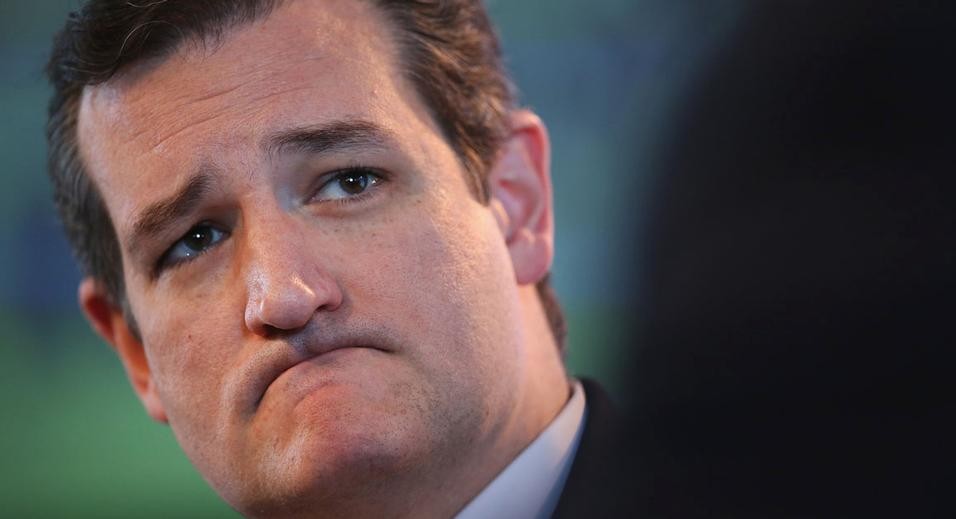
By Nima Shirazi | Wide Asleep In America | September 18, 2015
Presidential candidate Ted Cruz and the Tampa Bay Times’ Pulitzer Prize-winning fact-checking website PolitiFact were at each others’ throats last week over recent comments Cruz has made about the nuclear deal – officially known as the Joint Comprehensive Plan of Action (JCPOA) – reached this past July between Iran and six world powers.
The main reason for the spat is simple: Ted Cruz lies a lot.
In response to a particularly blustery claim made by the Texas Senator at a rally opposing the nuclear accord, which restricts Iran’s nuclear energy and uranium enrichment programs – reaffirming their purely peaceful nature – in exchange for a lifting of international sanctions, PolitiFact decided to investigate whether Cruz was telling the truth. (Spoiler: he wasn’t, and rarely does.)
At the rally, and afterward on Twitter, Cruz declared that the JCPOA “will facilitate and accelerate the nation of Iran acquiring nuclear weapons.” Even for a demagogic blowhard like Cruz, this is a ridiculous thing to say. Beyond the fact that we’ve heard for over three decades that the advent of an Iranian nuke is just around the corner – only a few years, maybe two years, a year and half, 12 months, six weeks away! – and these estimates have never been based upon credible evidence, the enhanced monitoring and inspections implemented under the new deal effectively prevent any possible Iranian move toward weaponizing its program for at least a decade, probably far longer. And that’s if Iran does the thing it’s never ever done: decide to build a nuclear weapon at exactly the time when its program is under the most intensive scrutiny of any nation’s program in history. The claim is absurd on its face.
Needless to say, it wasn’t too difficult for PolitiFact to judge this statement false.
But PolitiFact’s own understanding of the parameters of the Iran deal itself was surprisingly rife with errors, something that absolutely shouldn’t happen in a fact-checking article. The details, relayed by the website’s editors Louis Jacobson and W. Gardner Selby, were rendered this way:
Specifically, the deal requires Iran to give up 97 percent of its stockpile of highly enriched uranium, the kind needed to make nuclear weapons, as well as most of the centrifuges it can use to enrich uranium. In addition, Iran agrees to only enrich uranium to a level unsuitable for weapons for 15 years, and to cease production of plutonium, the other element that can be used to build a bomb. Known nuclear sites would be monitored for 15 years to confirm compliance, and inspectors would have the ability to enter undeclared sites suspected of nuclear use, though with possible delays of up to 24 days.
PolitiFact gets a bunch wrong here.
“Highly enriched uranium”
First, the deal does not require “Iran to give up 97 percent of its stockpile of highly enriched uranium, the kind needed to make nuclear weapons.” Why not? Because Iran doesn’t have any highly enriched uranium to give up.
This is a common mistake made by commentators, politicians, journalists, and pundits who should all know better. The fact is Iran has never enriched uranium above 19.75 percent U-235, which is defined by the IAEA itself as “low enriched uranium.” This is quite uncontroversial – no one, from the International Atomic Energy Agency (IAEA) to the U.S. intelligence community to the Israeli Mossad to non-proliferation experts, have ever claimed that Iran has produced a stockpile of highly enriched uranium (HEU). Iran has only ever produced low enriched uranium (LEU) – to levels of under 5 percent and under 20% – useful only as reactor fuel or medical isotopes, respectively, not bombs (which require enrichment levels of over 90 percent).
Furthermore, the IAEA has confirmed that, “since 20 January 2014, Iran has not produced UF6 enriched above 5% U-235 and all of its stock of UF6 enriched up to 20% U-235 has been further processed through downblending or conversion.” Additionally, as the agency has long confirmed, “All of the enrichment related activities at Iran’s declared facilities are under Agency safeguards, and all of the nuclear material, installed cascades, and feed and withdrawal stations at those facilities are subject to Agency containment and surveillance.”
What the JCPOA actually does, in this regard, is limit Iranian enrichment of uranium to no more than 3.67 percent U-235 LEU and, as the Arms Control Association notes, eliminates roughly 97 percent of Iran’s current LEU stockpile, capping it at a mere 300kg for 15 years.
“Production of plutonium”
PolitiFact also erroneously claims that, under the deal, Iran must “cease production of plutonium,” which makes no sense considering Iran has never produced plutonium. As I noted earlier this month, “Before it can be stockpiled, plutonium must first be extracted and reprocessed from the spent uranium fuel of an operational nuclear reactor. Iran has never done this and doesn’t even have a reprocessing plant. Iran has literally never extracted plutonium from a reactor core, let alone stockpiled it…”
In short, Iran can’t “cease” doing something it’s not – and never has been – doing.
Inspections
PolitiFact’s explanation of inspection parameters under the JCPOA is also disingenuous. By claiming that Iran’s “[k]nown nuclear sites would be monitored for 15 years to confirm compliance,” PolitiFact is implying that Iran’s nuclear infrastructure is not already under safeguards and constant monitoring, which it is – and has been for years, if not decades. Iran’s nuclear facilities have long been subject to the most intrusive and consistent inspection regime in the world.
The deal only strengthens this regime, allowing constant and immediate access to all declared nuclear sites and also to non-nuclear sites like centrifuge assembly workshops, centrifuge rotor production workshops and storage facilities, and uranium mines and mills, which, as nonproliferation expert Jeffrey Lewis has pointed out, “are not safeguarded anywhere else in the world.” This enhanced and unique access will last, in many cases, as long as 20-25 years.
PolitiFact’s language also suggests inspections of nuclear sites will cease after a decade and a half. This is totally wrong. In fact, all of Iran’s declared nuclear sites will remain under IAEA safeguards and surveillance in perpetuity, as mandated by the Nuclear Nonproliferation Treaty, to which Iran has been a party since its advent in 1968.
Even PolitiFact’s understanding of “possible delays of up to 24 days” is dubious, as this is the absolute maximum amount of time that access to a potentially suspect facility could be delayed through a process agreed to by all seven international parties (eight, if you include the European Union) to the JCPOA.
In truth, under the deal, the IAEA’s request to visit a suspect site “triggers a 24-day clock under which Iran and the IAEA have 14 days to come to an agreement on access. If not, the Joint Commission, created by the JCPOA, has seven days to make a determination on access, and if at least five of the eight members vote to allow the IAEA to investigate, Iran has three days to comply,” explains the Arms Control Association. At that point, the very first time this review protocol is tested to this extent, there’s a good chance the process of re-implementing sanctions on Iran would begin, rendering the tents of the JCPOA inoperable and signaling the imminent, if not immediate, collapse of the agreement altogether.
Who Fact-Checks the Fact-Checkers?
PolitiFact has rightly taken Ted Cruz to task for his false claims.
[In a petulant retort to being fact-checked, Cruz published even more lies in The National Review, declaring, among other things, that Iran cheated on a previous nuclear accord (it didn’t), that Iran is allowed “in certain circumstances” to “inspect itself, and report back on the ‘results’” (it’s not, not even close), and that the deal enables “Iran to finish their ongoing ICBM research and develop a missile that can carry a nuclear warhead across the Atlantic to America” (which is, simply, asinine).]
But in its own explanation of the Iran deal, PolitiFact repeats a number of baseless canards that have often been used by anti-diplomacy Iran hawks and deal-supporting liberal interventionists alike to mislead the public about the Iranian nuclear program and its capabilities.
For a “fact-checking journalism website aimed at bringing you the truth in politics,” PolitiFact should make sure to check itself before it, well, you know.
Down the Memory Hole: NYT Erases CIA’s Efforts to Overthrow Syria’s Government
By Adam Johnson | FAIR | September 20, 2015
FAIR has noted before how America’s well-documented clandestine activities in Syria have been routinely ignored when the corporate media discuss the Obama administration’s “hands-off” approach to the four-and-a-half-year-long conflict. This past week, two pieces—one in the New York Times detailing the “finger pointing” over Obama’s “failed” Syria policy, and a Vox “explainer” of the Syrian civil war—did one better: They didn’t just omit the fact that the CIA has been arming, training and funding rebels since 2012, they heavily implied they had never done so.
First, let’s establish what we do know. Based on multiple reports over the past three-and-a-half years, we know that the Central Intelligence Agency set up a secret program of arming, funding and training anti-Assad forces. This has been reported by major outlets, including the New York Times, The Guardian, Der Spiegel and, most recently, the Washington Post, which—partly thanks to the Snowden revelations—detailed a program that trained approximately 10,000 rebel fighters at a cost of $1 billion a year, or roughly 1/15th of the CIA’s official annual budget.
In addition to the CIA’s efforts, there is a much more scrutinized and far more publicized program by the Department of Defense to train “moderate rebels,” of which only a few dozen actually saw battle. The Pentagon program, which began earlier this year and is charged with fighting ISIS (rather than Syrian government forces), is separate from the covert CIA operation. It has, by all accounts, been an abysmal failure.
One thing the DoD’s rebel training program hasn’t been a failure at, however, is helping credulous reporters rewrite history by treating the Pentagon program as the only US effort to train Syrian rebels–now or in the past. As the US’s strategy in Syria is publicly debated, the CIA’s years-long program has vanished from many popular accounts, giving the average reader the impression the US has sat idly by while foreign actors, Iranian and Russian, have interfered in the internal matters of Syria. While the White House, Congress and the Pentagon can’t legally acknowledge the CIA training program, because it’s still technically classified, there’s little reason why our media need to entertain a similar charade.
Let’s start with Peter Baker’s New York Times piece from September 17 and some of its improbable claims:
Finger-Pointing, but Few Answers, After a Syria Solution Fails
By any measure, President Obama’s effort to train a Syrian opposition army to fight the Islamic State on the ground has been an abysmal failure. The military acknowledged this week that just four or five American-trained fighters are actually fighting.
Notice the sleight-of-hand. There may only be “four or five American-trained fighters… fighting” expressly against ISIS, but there is no doubt thousands more American-trained fighters are fighting in Syria. The DoD’s statement is manifestly false, but because the New York Times is simply quoting “the military”—which, again, cannot not legally acknowledge the CIA program—it is left entirely unchallenged. This is the worst type of “officials say” journalism. The premise, while ostensibly critical of US foreign policy, is actually helping advance its larger goal of rewriting US involvement in the Syrian civil war. A four-year-long deliberate strategy of backing anti-Assad forces–which has helped fuel the bloody civil war and paved the way for the rise of ISIS–is reduced to a cheesy “bumbling bureaucrat” narrative.
Baker went on:
But the White House says it is not to blame. The finger, it says, should be pointed not at Mr. Obama but at those who pressed him to attempt training Syrian rebels in the first place — a group that, in addition to congressional Republicans, happened to include former Secretary of State Hillary Rodham Clinton.
At briefings this week after the disclosure of the paltry results, Josh Earnest, the White House press secretary, repeatedly noted that Mr. Obama always had been a skeptic of training Syrian rebels. The military was correct in concluding that “this was a more difficult endeavor than we assumed and that we need to make some changes to that program,” Mr. Earnest said. “But I think it’s also time for our critics to ‘fess up in this regard as well. They were wrong.”
In effect, Mr. Obama is arguing that he reluctantly went along with those who said it was the way to combat the Islamic State, but that he never wanted to do it and has now has been vindicated in his original judgment. The I-told-you-so argument, of course, assumes that the idea of training rebels itself was flawed and not that it was started too late and executed ineffectively, as critics maintain.
The sleight-of-hand continues: The article presents the training of rebels as a “way to combat the Islamic State,” but repeatedly speaks in general of training Syrian rebels as something “Obama always had been a skeptic of”–which flies in the face of the fact that he did so, to the tune of $1 billion a year over four years, with 10,000 rebels trained.
But the piece goes on to make clear that when it’s talking about “training Syrian rebels,” it’s referring not only to the anti-ISIS program but to efforts to overthrow Syria’s government as well:
The idea of bolstering Syrian rebels was debated from the early days of the civil war, which started in 2011. Mrs. Clinton, along with David H. Petraeus, then the CIA director, and Leon E. Panetta, then the Defense secretary, supported arming opposition forces, but the president worried about deep entanglement in someone else’s war after the bloody experience in Iraq.
In 2014, however, after the Islamic State had swept through parts of Syria and Iraq, Mr. Obama reversed course and initiated a $500 million program to train and arm rebels who had been vetted and were told to fight the Islamic State, not Mr. Assad’s government.
This is outright false. These two paragraphs, while cleverly parsed, give the reader the impression Obama parted with the CIA and Mrs. Clinton on arming opposition forces, only to “reverse course” in 2014. But the president never “reversed course,” because he did exactly what Panetta, Petraeus and Clinton urged him to do: He armed the opposition. Once again, the Pentagon’s Keystone Kop plan is being passed off by journalists who should know better as the beginning and end of American involvement in the Syrian rebellion. Nowhere in this report is the CIA’s plan mentioned at all.
The whitewashing would get even worse:
Some Syrian rebels who asked for American arms in 2011 and 2012 eventually gave up and allied themselves with more radical groups, analysts said, leaving fewer fighters who were friendly to the United States.
But the US did get arms to Syrian rebels in 2012. In fact, Baker’s own publication reported this fact in 2012 (6/21/12):
CIA Said to Aid in Steering Arms to Syrian Opposition
Indeed, according to a rather detailed New York Times infographic from 2013 (3/23/13), shipments began, at the latest, in January 2012:

Note that this map accompanied an article headlined “Arms Airlift to Syria Rebels Expands, With Aid From CIA.”
The CIA’s program, when discussing a fraught foreign policy issue like Syria, is simply thrown down the memory hole. How can the public have an honest conversation about what the US should or shouldn’t do in Syria next when the most respected newspaper in the US can’t honestly acknowledge what we have done thus far?
The New York Times wouldn’t be alone. Comcast-funded Vox would also ignore the CIA rebel training program in its almost 4,000-word overview of the Syrian civil war. Again, the Pentagon’s program would be the sole focus in regards to funding rebels, along with reports of Gulf states doing so as well. But the CIA funding, training and arming thousands of rebels since at least 2012? Nowhere to be found. Not mentioned or alluded to once.
Reuters and the Washington Post’s reports on the US’s Syrian strategy revamp, while they didn’t fudge history as bad as the Times and Vox, also ignored any attempts by the CIA to back Syrian opposition rebels. This crucial piece of history is routinely omitted from mainstream public discourse.
As the military build-up and posturing in Syria between Russia and the United States escalates, policy makers and influencers on this side of the Atlantic are urgently trying to portray the West’s involvement in Syria as either nonexistent or marked by good-faith incompetence. By whitewashing the West’s clandestine involvement in Syria, the media not only portrays Russia as the sole contributor to hostilities, it absolves Europe and the United States of their own guilt in helping create a refugee crisis and fuel a civil war that has devastated so many for so long.
British General Threatens ‘Mutiny’ Against Corbyn Leadership
Sputnik | 20.09.2015
An unnamed senior general in the British military threatened that a government headed by new Labour party leader Jeremy Corbyn would face a “mutiny” from the military.
The general said that Corbyn could face “mass resignations at all levels” if he were to become prime minister. The statement is tied to Corbyn’s views on funding the British military’s Trident submarines or leave NATO.
“The general staff would not allow a prime minister to jeopardise the security of this country and I think people would use whatever means possible, fair or foul to prevent that,” the general told the Sunday Times.
According to the Guardian, previous attempts by the military to destabilize the British government took place in the 1960s and 1970s against Prime Minister Harold Wilson.
The Labour party’s new shadow Foreign Secretary previously said that the party would not back a withdrawal from NATO or scrapping the Trident program.
The fate of aircraft carriers is less clear, however, as the Guardian noted because there are members of the military who question their usefulness in modern warfare.
Iceland Counters US Military Claims of ‘Russian Flights’
Sputnik | 20.09.2015
Iceland’s foreign ministry countered US defense department claims that Russia has increased activity around the country and that it is interested in “military cooperation.”
The US government attempted to convince Iceland to accept a higher US military presence over what it called increased Russian military flights in the region, Icelandic media reported.
Iceland’s foreign ministry released figures showing that Russian military flights anywhere near the country’s airspace have actually decreased more than five times compared to 2007. None of the flights breached Icelandic airspace.
“The Russians have long done transit flights where they pass close by Iceland, but they’ve recently made several circumnavigation flights,” US deputy defense secretary Bob Work told DefenseNews earlier in September.
However, the US military’s claims do not match up with Iceland’s own figures, which show that Russia only made two flights anywhere near the country’s airspace in 2015.
“Iceland is interested in increasing military cooperation,” Work added.
Iceland’s foreign minister Gunnar Bragi Sveinsson countered, saying that interest in NATO air defenses in Iceland is coming entirely from the side of the US.
The US has recently increased its military involvement in Northern Europe, citing what deputy defense secretary Bob Work called “a resurgent Russia.”
Featured Video

Liberty Cannot Exist Inside a Panopticon
or go to
Aletho News Archives – Video-Images
From the Archives
Left-leaning despisers of 9/11 Truth movement: Do you really believe in miracles?
David Ray Griffin | Global Research | 06 Jul 2010
An Open Letter to Terry Allen, Noam Chomsky, Alexander Cockburn, David Corn, Chris Hayes, George Monbiot, Matthew Rothschild, and Matt Taibbi.
[1]According to several left-leaning critics of the 9/11 Truth Movement, some of its central claims, especially about the destruction of the World Trade Center, show its members to be scientifically challenged. In the opinion of some of these critics, moreover, claims made by members of this movement are sometimes unscientific in the strongest possible sense, implying an acceptance of magic and miracles. … Full article
Blog Roll
 Aletho News
- White House envoy declares kinetic action against Yemen ‘fruitless’
- Ukraine deployed thousands of microdrones in Iraqi Kurdistan: Tasnim
- Iran calls for emergency UNSC meeting over Trump’s ‘brazen’ bomb talk, Israeli threats
- Iranian sources reveal details of Russia-China Hormuz proposal
- Plan for more US-Israel integration puts our military tech at risk
- Another Round Against Iran Will Break What Is Left of the Gulf
- SVR Report on Ukraine’s Mexican Drug Gang Links Could Pressure Zelensky, Won’t Change US Policy
- British Government Employees Were Fact-Checking the News at the BBC. Nobody Told You.
- Albania on fire: who’s behind the riots?
- Egypt’s Civil Democratic Movement rejects involvement in regional war
- If Americans Knew
- Mysterious bot accounts reportedly spread fake ‘man on the street’ videos for Michigan Senate candidate
- Israeli Defense Minister Katz Says Over 60 Lebanon Villages Have Been Destroyed
- Why Is Israel Running TV Ads in Iowa Ahead of the Midterms?
- Hind Rajab’s Alleged Killer Is in the United States. HRF Demands His Arrest.
- US Officials Face Fresh Pressure After Another American ‘Brutalized’ by Israeli Settlers in West Bank
- Israel-Backed Palestinian Militias Terrorize Displaced Families in Gaza
- FBI subpoenas pro-Palestine activists over Israeli weapons plant disruption
- Fourth winter arrives in wartorn Gaza, too early – Daily Update
- More on how Bari Weiss is using CBS on behalf of Israel
- What the UK Is Doing to Pro-Palestine Novelist Sally Rooney Is an Act of Orwellian Villainy
- No Tricks Zone
- Predictions Made By Renowned Climate Proifessor Over Past Decades Have Been Proven To Be Poor
- New Study Suggests Large Regions Of The Pacific Ocean Have Been Cooling For The Last 80 Years
- Germany’s Green Energy Debacle: High Energy Costs Force Kahla Porzellan to Close After 182 Years!
- New Study: 50 Years Of The Most Aggressive ‘Net Zero’ Policies Can Only Affect The Global Climate By 0.03°C
- US September “Heat” Was No Record…Many Records Set Decades Ago
- Latest European Green Energy Debacle; Portugal’s Largest Flagship Solar Park Insolvent!
- Green Energy Debacle: German Expert Professor Fritz Vahrenholt Warns Of Severe Economic And Social Consequences
- Two More Paleo Reconstructions Affirm Meters-Higher Sea Levels Across Ireland, Brazil 7000-6000 Years Ago
- New Study: Earth And Venus Surface Warmth Largely Explained By Convection And Lapse Rate, Not CO2 Or Radiation
- 2025 Nature Paper Claiming Worsening Global Drought Gets RETRACTED …Heavily Flawed

