Nick Cohen wants us to forget the west uses chemical weapons
OffGuardian | September 13, 2015
Yesterday in the Guardian Nick Cohen could be found using his talents to shill for more lovely humanitarian war.
Nothing odd about that. The MSM almost always shills for war nowadays, and very few of its star columnists have a problem with writing queasy equivocations or faux moral outrage pieces in support of “western intervention.” It apparently doesn’t trouble their consciences at all. Nor do they feel in any way responsible for the subsequent mass slaughter of innocents that usually follows swiftly on. Maybe they are so deluded they really believe western air forces drop nothing but blankets for children. Who knows, or even much cares what their phony rationales might be. Cohen’s piece is largely just another one of these “won’t someone please do the right thing and murder more brown people,” hack pieces, but there’s a couple of things we should probably draw attention to. Namely:
On the one side was Bashar al-Assad, chief capo in a hereditary tyranny. He joined Saddam Hussein in becoming one of only two leaders to have used chemical weapons against civilians since the end of the Second World War.
Firstly, this article ignores the fact there is still absolutely no confirmed evidence Assad even has any chemical weapons left. Nor any confirmed evidence he ever used such weapons. Like the Russian invasion of Ukraine these pseudo-truths exist merely as assertions in the media, ‘verified’ by non-interrogation, rather than by supporting data.
But it’s the second assertion that really should get some kind of award for “most breathtaking use of a total falsehood in pursuit of state-sponsored murder”.
“… He joined Saddam Hussein in becoming one of only two leaders to have used chemical weapons against civilians since the end of the Second World War….”
What? Is Cohen saying Agent Orange wasn’t used against civilians by the US in Vietnam? White phosphorus (defined by the US Defense Dept as a ‘chemical weapon‘ since the first Gulf War) wasn’t used against civilians by the US in Fallujah? Or by Israel in Gaza?
If Cohen really doesn’t know about any of this then he’s not qualified to write in a paper of record. If he does know about all of this – then why is he pretending it didn’t happen? And why is the Guardian prepared to put its reputation behind letting him do it?
The hubris is incredible. How in the age of Google can these people continue to think their masterly word is going to be enough to make us all forget the inconvenient truths? Or is the frantic “Germans bayoneted Belgian babies” style of propaganda just more evidence that they know their latest bid to get us all to back war in Syria is another failure?
US War Theories Target Dissenters
By Todd E. Pierce | Consortium News | September 12, 2015
When the U.S. Department of Defense published a new Law of War Manual (LOW) this past summer, editorialists at the New York Times sat up and took notice. Their concern was that the manual stated that journalists could be deemed “unprivileged belligerents.” The editorial explained that as a legal term “that applies to fighters that are afforded fewer protections than the declared combatants in a war.” In fact, it is far more insidious than that innocuous description.
Here is the manual’s definition: “‘Unlawful combatants’ or ‘unprivileged belligerents’ are persons who, by engaging in hostilities, have incurred one or more of the corresponding liabilities of combatant status (e.g., being made the object of attack and subject to detention), but who are not entitled to any of the distinct privileges of combatant status (e.g., combatant immunity and POW status).”
The key phrase here is “being made the object of attack.” For slow-witted New York Times editorialists, that means journalists can be killed as can any enemy soldier in wartime. “Subject to detention” means a journalist deemed an unprivileged belligerent will be put into military detention if captured. As with any enemy belligerent, however, if “capture is not feasible,” they would be killed if possible, by drone perhaps if in a foreign country.
Currently, most U.S. captives deemed “unprivileged belligerents” are imprisoned in Guantanamo although some may be held in Afghanistan. It must be noted that the United States deems as an “unprivileged belligerent” anyone they target for capture or choose to kill.
That the New York Times’ concern only arose with publication of the new LOW manual suggests they may have been in a deep sleep since 9/11 as the Department of Defense (DOD) has openly worked to impose limitations on information sharing and news gathering since that event gave them a pretext. It is now a well-established pattern of the U.S. government to suppress rights guaranteed by the First Amendment whenever they can get by with it, as was seen with the New York Times own James Risen.
But the New York Times colluded with the CIA in censoring Risen’s reporting. Furthermore, they seemed to have ignored the U.S. government’s momentous argument of the unlimited power of the President to target journalists and activists for “expressive activities,” as the Department of Justice stated in the case of Hedges v. Obama, as described below.
It has frequently been noted there’s been an ongoing “war” against journalists since 9/11. The new DOD Law of War manual makes that official and potentially takes it to the highest level of conflict. While expressing concern, the Times’ editorialist does not seem to realize or care how ominous it is that the DOD now openly declares that journalists may be deemed “unprivileged belligerents,” unlawful combatants, as the DOD manual provides, instead of hiding the fact in coded language as done since 2001. Inherent to those classifications is that they represent the “enemy” and can be killed by U.S. officials.
That will come as no surprise to those acquainted with the foreign journalists who have been targeted and killed by drones in places such as Pakistan. Nor will it surprise Sami al-Hajj, the Al Jazeera journalist who was held in Guantanamo for years. But now it is clear that the same fate could be in store for U.S. journalists.
That coded language is embedded in the claim by Military Commissions prosecutors and the Justice Department that there is a “U.S. domestic common law of war.” What they claim is entirely based upon martial law orders of the Civil War and the military’s orders to remove Japanese-Americans from the their homes on the West Coast in World War II. All the cases they rely on for a “domestic law of war” today were judicially condemned during or almost immediately after the wars in which they were a part of.
U.S. Domestic Common Law of War
U.S. Military Commissions Chief Prosecutor Brig. General Mark Martins and his staff invented what they call the “U.S. domestic common law of war” in filings to the D.C. Circuit Court of Appeals. That invention consists only of the martial law precedents of the U.S. Civil War and the removal of the Japanese-Americans from the West Coast at the direction of General DeWitt. Both were later seen as examples of military despotism.
The American people have been inured by a deliberate effort of the U.S. military to accept invocation of the law of war as a talisman to permit any act by officials which would have been known as illegal before 9/11. But as the manual states: “Although the law of war is generally viewed as ‘prohibitive law,’ in some respects, especially in the context of domestic law, the law of war may be viewed as permissive or even as a source of authority. For example, the principle of military necessity in the customary law of war may be viewed as justifying or permitting certain acts.” (Emphasis added.)
“Military necessity” was the law of war basis for removal of the Japanese-Americans. Military necessity though indisputably a part of the law of war is a totalitarian precept when applied to a civilian population.
The LOW manual explains the object of war by quoting George H. Aldrich, Deputy Legal Adviser to the U.S. Department of State during the Vietnam War. He wrote of “a general acceptance of the view that modern war is aimed not merely at the enemy’s military forces but at the enemy’s willingness and ability to pursue its war aims. . . . In Viet-Nam political, rather than military, objectives were even more dominant. Both sides had as their goal not the destruction of the other’s military forces but the destruction of the will to continue the struggle.”
The “destruction of the will” of the adversary is always the object of war, according to Clausewitz and adopted by the U.S. military. But this has a totalitarian element to it; the adversary’s reciprocal object is to destroy our will. Consequently, “our” will must be protected by suppressing any dissent which could harm morale and the population’s willingness to “continue the struggle.”
That was the foundational belief underlying martial law during the Civil War. The Constitution was an obstacle again to suppressing dissent to a degree after the Civil War, but with the invention of a U.S. domestic common law of war and legalistic word play, this obstacle has once again been removed as the Justice Department argued in Hedges v. Obama.
The claim of being at war with internal and external enemies is always made by totalitarian states to justify their suppression of speech and a free press through repression. For a brief period in U.S. history, the Civil War, the U.S. military adopted military repression through martial law to suppress any dissent to its war practices.
Martial law was declared throughout the Union States, the North, on Aug. 8, 1862, by Secretary of War Edwin M. Stanton, at the request of President Abraham Lincoln. Orders were published to “arrest and imprison” any persons “discouraging volunteer enlistments” or “giving aid and comfort to the enemy” or for “any other disloyal practice.” A military commission would try the prisoners, and a second order “suspended” the writ of habeas corpus in their cases.
Martial law was more formally declared on Sept. 24, 1862, by President Lincoln himself in addition to suspending the writ of habeas corpus. Lieber’s Code was then prepared as the order giving effect to martial law. Contrary to how it is presented by the U.S. Army and credulous human rights commentators, Lieber’s Code was primarily a harsh martial law order with Prussian militarist law of war concepts introduced to the U.S. to criminalize any expressions of dissent as “war treason.”
Thus, Col. William Winthrop explained that among the greater number of individuals who were brought to trial before the military commissions during the Civil War, the offenses included “hostile or disloyal acts, or publications or declarations calculated to excite opposition to the federal government or sympathy with the enemy, etc.”
Whiting’s Guidance
Solicitor of the Department of War during the Civil War, William Whiting, gave legal guidance to the Union Commanders for enforcement of martial law. The “guidebook” was his own War Powers of the President. This book could have been used by any militaristic and totalitarian regime, which in fact it was as it was derived from authoritarian principles of martial law from Prussia. Those authoritarian principles remained in force under Prussia’s successor state, Germany, during two world wars, and were the legal basis of the infamous People’s Court which tried “war treason” cases; cases of “disloyal” expressive acts in most cases without more.
The guidance of Whiting was: “No person in loyal States can rightfully be captured or detained unless he has engaged, or there is reasonable cause to believe he intends to engage, in acts of hostility to the United States — that is to say, in acts which may tend to impede or embarrass the United States in such military proceedings as the commander-in-chief may see fit to institute.” This is the same argument that the U.S. government made in Hedges v. Obama.
What constituted an act of hostility? Whiting defines that to include a sentiment of hostility to the government “to undermine confidence in its capacity or its integrity, to diminish, demoralize . . . its armies, to break down confidence in those who are entrusted with its military operations in the field.”
An example of how martial law was to be carried out was in an order to a subordinate commander by the Army Department of the Pacific Commander in response to complaints from the Citizens of Solano County, California, of disloyal “utterances” they were hearing from fellow citizens.
The order read: “The department commander desires you to let the people understand generally that the order of the President suspending the writ of habeas corpus and directing the arrest of all persons guilty of disloyal practices will be rigidly enforced. . . . Practices injurious to the government or offensive to the loyal sentiment of the people will under no circumstances be permitted.”
Immediately after the Civil War, when it was freshest in their minds, the Supreme Court had this to say about martial law in Ex Parte Milligan: “What is ordinarily called martial law is no law at all. Wellington, in one of his despatches from Portugal, in 1810, in his speech on the Ceylon affair, so describes it. Let us call the thing by its right name; it is not martial law, but martial rule. And when we speak of it, let us speak of it as abolishing all law, and substituting the will of the military commander, and we shall give a true idea of the thing, and be able to reason about it with a clear sense of what we are doing.”
Martial law is a sub-part of the Law of War and since it is for application to a domestic population as with the Northern States during the Civil War by the Union Army, it is “moderated” ordinarily from the even harsher provisions of the Law of War which are now invoked in the Law of War manual. Yet precepts of both are being introduced domestically with Section 1021 of the 2012 National Defense Authorization Act and domestically and globally by the “U.S. domestic common law of war” precedents trumpeted by Chief Military Commissions Prosecutor, Brig. Gen. Mark Martins.
It must be noted that this is not to compare the Union unfavorably with the Confederacy. The Confederacy had the highest form of martial law: slavery. But the Defense Department only uses one legal precedent from the Confederacy today, which is “outlawry.”
Lieber’s Code addressed “outlawry” in Art. 148, which provided, in pertinent part: “The law of war does not allow proclaiming either an individual belonging to the hostile army, or a citizen, or a subject of the hostile government, an outlaw, who may be slain without trial by any captor, . . . on the contrary, it abhors such outrage.”
This was adopted in the Hague Regulations and as interpreted in earlier Army Law of Land Warfare manuals, prohibited assassinations as well as any declarations that an individual or group is outside the protection of the law of war, which is what designation as an unprivileged belligerent does. The prohibition of assassination has also been put aside with the routine practice of assassination with drones today by the U.S. military.
The Confederacy committed the offense of outlawry when its leaders declared all captured African-Americans fighting for the Union were outside the protection of the law of war (which did preexist Lieber’s Code) and would be placed into the indefinite detention of slavery. After 9/11, the U.S. government did the same with the invention of the unlawful combatant/unprivileged belligerent category and indefinite detention at Guantanamo Bay and any other location U.S. officials chose to place “unprivileged belligerents.”
Treason of the Professors and the Media
Ironically, shortly after the New York Times expressed its concern for journalists in early August, the Guardian reported in an article written by William C. Bradford, a recently hired assistant professor in the law department at the U.S. Military Academy at West Point. The article, entitled “Trahison des Professeurs: The Critical Law of Armed Conflict Academy as an Islamist Fifth Column,” was published in the National Security Law Journal of George Mason University Law School.
Bradford argued that the U.S. should be more aggressive in attacking Muslims to include attacks which are war crimes under the law of war. But it was his advocacy that the U.S. military attack other “lawful targets” in its war on terrorism, which include “law school facilities, scholars’ home offices and media outlets where they give interviews” that caught the most attention. These civilian areas were all places where a “causal connection between the content disseminated and Islamist crimes incited” exist, according to Bradford.
Furthermore, Bradford wrote, “Shocking and extreme as this option might seem, [dissenting] scholars, and the law schools that employ them, are – at least in theory – targetable so long as attacks are proportional, distinguish noncombatants from combatants, employ nonprohibited weapons, and contribute to the defeat of Islamism.” In other words, dissenting scholars are unprivileged belligerents and subject to attack, just as journalists are according to the Law of War manual.
Not to defend him but Bradford was articulating the underlying logic of the new Law of War manual’s position that dissenting journalists can be targeted as unprivileged belligerents. This, as stated above, is consistent with oppressive extra-constitutional martial law practices which Chief Prosecutor Mark Martins boasts of as “U.S. domestic common law of war.”
One has to ask: where are the supposed watchdogs of the press when military officers can so easily slide historical falsehoods past them in destroying freedom of the press? Further, Bradford argued that law professors who criticized the failure of the U.S. to abide by the Geneva Conventions and the Law of War represented a “treasonous” fifth column that could be attacked as enemy combatants.
If there is treason being committed in the United States, it must be seen in the acts of those reconstituting the extra-constitutional martial law cases of the Civil War period. That is, Brig. Gen. Mark Martins and associated government attorneys who, in effect, are engaged in an indirect coup d’etat of the U.S. Constitutional order. In fact, Bradford was alleged to have written in favor of a direct military coup d’etat as well.
As it turned out, Bradford had other ethical issues than just his incitement to commit war crimes and target law professors. A combination of factors led to his resigning his position at the Military Academy and this individual crisis would seem to have passed.
The home page of the National Security Law Journal in which his essay had been published carried a repudiation of it by the incoming editorial board. They summarized his article as follows: “Mr. Bradford’s contention that some scholars in legal academia could be considered as constituting a fifth column in the war against terror; his interpretation is that those scholars could be targeted as unlawful combatants.”
But substitute “journalists” for “scholars” and you have the position on journalists of the DOD’s new Law of War manual.
An insightful article in The Atlantic asks “how a scholar pushing these ideas seems not to have raised red flags any earlier.” That’s an excellent question. The article was entitled “The Unusual Opinions of William C. Bradford.” But here’s the point; these opinions are not unusual among some members of the military and right-wing law professors such as Adrian Vermeule of Harvard and Eric Posner of the University of Chicago.
Posner and Vermeule have carved out a niche in American legal discourse in advocating that the U.S. needs to turn to the legal “wisdom” of the German Nazi lawyer, Carl Schmitt. In Terror in the Balance, they suggest that the U.S. may need to adopt censorship for, among other reasons, “antigovernment speech may demoralize soldiers and civilians.” For precedent, they point out that “Martial law during the Civil War permitted the military to try and punish people who criticized the Lincoln administration’s conduct of the war.”
The Attack on ‘Lawfare’
Other prominent advocates of authoritarian legal practices present themselves as protecting against disloyal attorney who practice “lawfare,” which is defined as a form of “asymmetric warfare” that misuses domestic or international law to damage an opponent through legal actions in a courtroom. For instance, Ben Wittes of lawfareblog.com would seem to espouse this type of animosity toward public-interest lawyers who use the courts to defend First Amendment liberties.
A fallacious argument, made by Wittes in a paper which calls for “balancing” liberty and security, is his idiosyncratic belief that “in American constitutional law, for example, free speech does not exist as a general right of the public to communicate as much or as widely as it desires but as an individual right not to have government restrict one’s speech.”
This is contrary to the understanding of the Supreme Court which held in First Nat. Bank of Boston v. Bellotti, that: “[T]he First Amendment goes beyond protection of the press and the self-expression of individuals to prohibit government from limiting the stock of information from which members of the public may draw.” In other words, the First Amendment guarantees the public’s “right to know.”
Why does this matter? The Constitution’s Framers understood that an informed population was crucial for a Republic. As James Madison put it: “A popular Government, without popular information, or the means of acquiring it, is but a Prologue to a Farce or a Tragedy; or, perhaps both. Knowledge will forever govern ignorance: And a people who mean to be their own Governors, must arm themselves with the power which knowledge gives.”
This understanding of the criticality of the free flow of information for wise democratic decision-making is particularly important for national security where ignorance comes with the highest cost. This understanding formed Clausewitz’s belief in a broad-based civilian decision-making process in matters of national security strategic policy, and not one driven by military leaders with their one-dimensional thinking process.
The Vietnam War is Exhibit A as proof of this. If it had been left to the Generals to decide, the war would have continued “perpetually” even though wiser heads realized from the beginning that it was unwinnable by U.S. terms of maintaining an unpopular government in South Vietnam. The antiwar movement, whatever the motives of some, proved to be more strategically astute than General William Westmoreland who would have continued the war until the U.S. bankrupted itself in the manner that the Soviet Union would years later in Afghanistan. It was the American antiwar movement which gave effect to Clausewitz’s strategy that when a war’s costs exceed its “benefits,” a way must be found to end it.
Curiously, Wittes accurately notes in Law and the Long War that to claim “the President has all the powers of a normal war yet few of its restraints, that the whole world is his battlefield, and that this state of affairs goes on in perpetuity is really akin to claiming a kind of worldwide martial law.” In fact, that’s exactly what the Justice Department argued in Hedges v. Obama without the admission as to martial law.
Dissent as Treason
Since the Vietnam War, the belief that the media and other critics of government policies act as fifth columnists has become commonplace in military-oriented journals and with the American authoritarian-oriented political class, expressed in articles such as William Bradford’s attack on “treasonous professors.”
To the question “how a scholar pushing these ideas” did not raise a red flag, that might best be asked of the National Security Law Journal’s previous editorial board. It is worth noting however that the editors who chose to publish Bradford’s article are not neophytes in national security issues or strangers to the military or government.
As described on the NSLJ website, the Editor-in-Chief from 2014-2015 has broad experience in homeland and national security programs from work at both the Department of Justice and the Department of Homeland Security and currently serves (at the time of publication of Bradford’s article) as the Deputy Director for the Office of Preparedness Integration and Coordination at FEMA. A U.S. government official in other words.
The “Articles Selection Editor” is described as “a family physician with thirty years of experience in the foreign affairs and intelligence communities.” Websites online suggest his experience may have been acquired as a CIA employee. The executive editor appears to be a serving Marine Corps officer who attended law school as a military-funded student.
Significantly; Bradford was articulating precepts of the “U.S. common law of war” promoted by Chief Prosecutor Mark Martins because nothing Bradford advocated was inconsistent with William Whiting’s guidance to Union Generals. Except Whiting went even further and advised that judges in the Union states who “impeded” the military in any way by challenging their detentions were even greater “public enemies” than Confederate soldiers were.
This “U.S. common law of war” is a prosecution fabrication created by legal expediency in the absence of legitimate legal precedent for what the United States was doing with prisoners captured globally after 9/11. This legal invention came about when military commission prosecutors failed to prove that the offense of Material Support for Terrorism was an international law of war crime. So prosecutors dreamed up a “domestic common law of war.” This in fact is simply following the pattern of totalitarian states of the Twentieth Century.
Government-Media-Academic-Complex
The logic of Bradford’s argument is the same as that of the Defense Department in declaring that journalists may be deemed “unprivileged belligerents.” As quoted above, George H. Aldrich had observed that in Vietnam, both sides had as their goal “the destruction of the will to continue the struggle.”
Bradford argued that Islamists must overcome Americans’ support for the current war to prevail, and “it is the ‘informational dimension’ which is their main combat effort because it is U.S. political will which must be destroyed for them to win.” But he says Islamists lack skill “to navigate the information battlespace, employ PSYOPs, and beguile Americans into hostile judgments regarding the legitimacy of their cause.”
Therefore, according to Bradford, Islamists have identified “force multipliers with cultural knowledge of, social proximity to, and institutional capacity to attrit American political will. These critical nodes form an interconnected ‘government-media-academic complex’ (‘GMAC’) of public officials, media, and academics who mould mass opinion on legal and security issues . . . .”
Consequently, Bradford argues, within this triumvirate, “it is the wielders of combat power within these nodes — journalists, officials, and law professors — who possess the ideological power to defend or destroy American political will.”
While Bradford reserves special vituperation for his one-time fellow law professors, he states the “most transparent example of this power to shape popular opinion as to the legitimacy of U.S. participation in wars is the media.”
As proof, Bradford explained how this “disloyalty” of the media worked during the Vietnam War. He wrote: “During the Vietnam War, despite an unbroken series of U.S. battlefield victories, the media first surrendered itself over to a foreign enemy for use as a psychological weapon against Americans, not only expressing criticism of U.S. purpose and conduct but adopting an ‘antagonistic attitude toward everything America was and represented’ and ‘spinning’ U.S. military success to convince Americans that they were losing, and should quit, the war. Journalistic alchemists converted victory into defeat simply by pronouncing it.”
Space does not permit showing in how many ways this “stab in the back” myth is false. But this belief in the disloyalty of the media in Bradford’s view remains today. He wrote: “Defeatism, instinctive antipathy to war, and empathy for American adversaries persist within media.”
Targeting Journalists
The right-wing militarist Jewish Institute for National Security Affairs (JINSA), with mostly retired U.S. military officers serving as advisers, has advocated targeting journalists with military attacks. Writing in The Journal of International Security Affairs in 2009, retired U.S. Army Lt. Col. Ralph Peters wrote:
“Today, the United States and its allies will never face a lone enemy on the battlefield. There will always be a hostile third party in the fight, but one which we not only refrain from attacking but are hesitant to annoy: the media . . . . Future wars may require censorship, news blackouts and, ultimately, military attacks on the partisan media.” (Emphasis in original.)
The rationale for that deranged thinking was first propounded by Admiral Ulysses S. Grant Sharp and other authoritarian-minded officers after the Vietnam War. Sharp explained, our “will” was eroded because “we were subjected to a skillfully waged subversive propaganda campaign, aided and abetted by the media’s bombardment of sensationalism, rumors and half-truths about the Vietnam affair — a campaign that destroyed our national unity.” William C. Bradford apparently adopted and internalized this belief, as have many other military officers.
That “stab in the back” myth was propagated by a number of U.S. military officers as well as President Richard Nixon (as explained here). It was more comfortable to believe that than that the military architects of the war did not understand what they were doing. So they shifted blame onto members of the media who were astute enough to recognize and report on the military’s failure and war crimes, such as My Lai.
But those “critical” journalists, along with critics at home, were only recognizing what smarter Generals such as General Frederick Weyand recognized from the beginning. That is, the war was unwinnable by the U.S. because it was maintaining in power its despotic corrupt ally, the South Vietnamese government, against its own people. Whether or not what came later was worse for the Vietnamese people was unforeseeable by the majority of the people. What was in front of their eyes was the military oppression of American and South Vietnamese forces and secret police.
Information Warfare Today
In 1999, the Rand Corporation published a collection of articles in Strategic Appraisal: The Changing Role of Information in Warfare. The volume was edited by Zalmay Khalilzad, the alleged author of the Defense Department’s 1992 Defense Planning Guidance, which was drafted when Dick Cheney was Defense Secretary and Paul Wolfowitz was Under Secretary of Defense – and promulgated a theory of permanent U.S. global dominance.
One chapter of Rand’s Strategic Appraisal was written by Jeremy Shapiro, now a special adviser at the U.S. State Department, according to Wikipedia. Shapiro wrote that the inability to control information flows was widely cited as playing an essential role in the downfall of the communist regimes of Eastern Europe and the Soviet Union.
He stated that perception management was “the vogue term for psychological operations or propaganda directed at the public.” As he expressed it, many observers worried that potential foes could use techniques of perception management with asymmetric strategies with their effect on public opinion to “destroy the will of the United States to wage war.”
Consequently, “Warfare in this new political environment consists largely of the battle to shape the political context of the war and the meaning of victory.”
Another chapter on Ethics and Information Warfare by John Arquilla makes clear that information warfare must be understood as “a true form of war.” The range of information warfare operations, according to Arquilla, extends “from the battlefield to the enemy home front.” Information warfare is designed “to strike directly at the will and logistical support of an opponent.”
This notion of information warfare, that it can be pursued without a need to defeat an adversary’s armed forces, is an area of particular interest, according to Arquilla. What he means is that it necessitates counter measures when it is seen as directed at the U.S. as now provided for in the new LOW Manual.
Important to note, according to Arquilla, is that there is an inherent blurriness with defining “combatants” and “acts of war.” Equating information warfare to guerrilla warfare in which civilians often engage in the fighting, Arquilla states “in information warfare, almost anyone can engage in the fighting.”
Consequently, the ability to engage in this form of conflict is now in the hands of small groups and individuals, offering up “the prospect of potentially quite large numbers of information warfare-capable combatants emerging, often pursuing their own, as opposed to some state’s policies,” Arquilla wrote.
Therefore, a “concern” for information warfare at the time of the Rand study in 1999 was the problem of maintaining “noncombatant immunity.” That’s because the “civilian-oriented target set is huge and likely to be more vulnerable than the related set of military infrastructures . . . . Since a significant aspect of information warfare is aimed at civilian and civilian-oriented targets, despite its negligible lethality, it nonetheless violates the principle of noncombatant immunity, given that civilian economic or other assets are deliberately targeted.”
What Arquillo is saying is that civilians who are alleged to engage in information warfare, such as professors and journalists, lose their “noncombatant immunity” and can be attacked. The “blurriness” of defining “combatants” and “acts of war” was removed after 9/11 with the invention of the “unlawful combatant” designation, later renamed “unprivileged belligerent” to mimic language in the Geneva Conventions.
Then it was just a matter of adding the similarly invented “U.S. domestic common law of war” with its martial law precedents and a framework has been built for seeing critical journalists and law professors as “unprivileged belligerents,” as Bradford indiscreetly wrote.
Arquilla claims that information warfare operations extend to the “home front” and are designed “to strike directly at the will and logistical support of an opponent.” That is to equate what is deemed information warfare to sabotage of the population’s psychological will to fight a war, and dissidents to saboteurs.
Perpetual War
But this is a perpetual war driven by U.S. operations, according to a chapter written by Stephen T. Hosmer on psychological effects of information warfare. Here, it is stated that “the expanding options for reaching audiences in countries and groups that could become future U.S. adversaries make it important that the United States begin its psychological conditioning in peacetime.” Thus, it is necessary “to begin to soften the fighting will of the potential adversary’s armed forces in the event conflict does occur.”
As information warfare is held to be “true war,” this means that the U.S. is perpetually committing acts of war against those deemed “potential” adversaries. Little wonder that Vladimir Putin sees Russia as under assault by the United States and attempts to counter U.S. information warfare.
This same logic is applied to counter-insurgency. The 2014 COIN Manual, FM 3-24, defines “Information Operations” as information-related capabilities “to influence, disrupt, corrupt, or usurp the decision-making of adversaries and potential adversaries while protecting our own.”
Those we “protect ourselves from” can logically be seen as the internal enemy, as William Bradford saw it, such as critical law professors and journalists, just as Augusto Pinochet did in Chile with dissidents.
With the totalitarian logic of information-warfare theorists, internalized now throughout much of the U.S. government counter-terrorism community, it should be apparent to all but the most obtuse why the DOD deems a journalist who writes critically of U.S. government war policy an “unprivileged belligerent,” an enemy, as in the Law of War manual. William C. Bradford obviously absorbed this doctrine but was indiscreet enough to articulate it fully.
It Has Happened Here!
That’s the only conclusion one can draw from reading the transcript of the Hedges v. Obama lawsuit. In that lawsuit, plaintiffs, including journalists and political activists, challenged the authority provided under Sec. 1021 of the 2012 National Defense Authorization for removal out from under the protection of the Constitution of those deemed unprivileged belligerents. That is, civilians suspected of lending any “support” to anyone whom the U.S. government might deem as having something to do with terrorism.
“Support” can be as William Whiting described it in 1862 and as what is seen as “information warfare” by the U.S. military today: a sentiment of hostility to the government “to undermine confidence in its capacity or its integrity, to diminish, demoralize . . . its armies, to break down confidence in those who are intrusted with its military operations in the field.”
Reminiscent of the Sinclair Lewis novel It Can’t Happen Here where those accused of crimes against the government are tried by military judges as in the U.S. Military Commissions, a Justice Department attorney arguing on behalf of the United States epitomized the legal reasoning that one would see in a totalitarian state in arguing why the draconian “Law of War” is a substitute for the Constitution.
The Court asked Assistant U.S. Attorney Benjamin Torrance if he would agree, “as a principled matter, that the President can’t, in the name of the national security of the United States, just decide to detain whomever he believes it is important to detain or necessary to detain to prevent a terrorist act within the United States?”
Rather than giving a straight affirmative answer to a fundamental principle of the U.S. Constitution, Torrance dissembled, only agreeing that that description would seem “quite broad,” especially if citizens. But he added disingenuously that it was the practice of the government “not to keep people apprehended in the U.S.”
Which is true, it is known that people detained by the U.S. military and CIA have been placed everywhere but in the U.S. so that Constitutional rights could not attach. Under Section 1021, that “inconvenience” to the government would not be necessary.
When asked by the Court if he, the Justice Department attorney, would agree that a different administration could change its mind with respect to whether or not Sec. 1021 would be applied in any way to American citizens, he dissembled again, answering: “Is that possible? Yes, but it is speculative and conjecture and that cannot be the basis for an injury in fact.”
So U.S. citizens or anyone else are left to understand that they have no rights remaining under the Constitution. If a supposed “right” is contingent upon who is President, it is not a right and the U.S. is no longer under the rule of law.
In discussing whether activist and journalist Birgitta Jónsdóttir, a citizen of Iceland, could be subject to U.S. military detention or trial by military commission, Assistant U.S. Attorney Torrance would only disingenuously answer that “her activities as she alleges them, do not implicate this.” Disingenuous because he knew based upon the answer he previously gave that the law of war is arbitrary and its interpretation contingent upon a military commander, whoever that may be, at present or in the future.
What could happen to Ms. Jónsdóttir would be completely out of her control should the U.S. government decide to deem her an “unprivileged belligerent,” regardless of whether her expressive activities changed positively or negatively, or remained the same. Her risk of detention per the Justice Department is entirely at the sufferance of whatever administration may be in place at any given moment.
Any doubt that the Authorization for the Use of Military Force, along with Section 1021 of the National Defense Authorization Act of 2012, is believed by the U.S. Executive Branch to give it the untrammeled power that Article 48 of the Weimar Germany constitution gave to the German President in 1933 was settled by the arguments made by the Justice Department attorney in Hedges v. Obama.
Setting First Amendment Aside
One does not need to speculate that the U.S. government no longer sees First Amendment activities as protected. Government arguments, which were made in the Hedges v. Obama lawsuit, revealed that the Justice Department, speaking for the Executive Branch, considers protection of the Bill of Rights subordinate to the claim of “war powers” by the Executive. One can only be willfully blind to fail to see this.
By the Justice Department’s court arguments and filings, the protections afforded by the U.S. Bill of Rights are no more secure today than they were to Japanese-Americans when Western District military commander General DeWitt decided to remove them from their homes on the West Coast and intern them in what were initially called, “concentration camps.”
The American Bar Association Journal reported in 2014 that Justice Antonin Scalia told students in Hawaii that “the Supreme Court’s Korematsu decision upholding the internment of Japanese Americans was wrong, but it could happen again in war time.” But contrary to Scalia stating that Korematsu had been repudiated, Korematsu has never been overruled.
The court could get a chance to do so, the ABA article stated, in the Hedges v. Obama case “involving the military detention without trial of people accused of aiding terrorism.” But that opportunity has passed.
A U.S. District Court issued a permanent injunction blocking the law’s indefinite detention powers but that ruling was overturned by the Second Circuit Court of Appeals. A petition to the U.S. Supreme Court asked the justices to overturn Sec. 1021, the federal law authorizing such detentions and stated the justices should consider overruling Korematsu. But the Supreme Court declined to hear the case in 2014, leaving the Appeals Court’s ruling intact.
The Supreme Court’s decision to not overturn Korematsu allows General DeWitt’s World War II decision to intern Japanese-Americans in concentration camps to stand as a shining example of what Brig. General Marks Martins proudly holds up to the world as the “U.S. domestic common law of war.”
Todd E. Pierce retired as a Major in the U.S. Army Judge Advocate General (JAG) Corps in November 2012. His most recent assignment was defense counsel in the Office of Chief Defense Counsel, Office of Military Commissions. In the course of that assignment, he researched and reviewed the complete records of military commissions held during the Civil War and stored at the National Archives in Washington, D.C.
Syria: Iconic images or chronic lies?

By Vanessa Beely | The Wall Will Fall | September 11, 2015
March 2015 and TIME magazine printed one of the most iconic photos of the Syrian “conflict”. The upended buses forming a barrier of rusting metal carcasses against the threat of “regime snipers”. The article went on to describe how “The Ahrar al-Sham brigade [a group that adheres to the conservative Salafi interpretation of Sunni Islam] placed the buses in such a way. They used ropes, pulleys and a number of men to get the buses in such position. They are [blocking] the view of regime snipers.”
The inference of the article is predominantly the risk from “regime” snipers, a risk for civilians and “rebels”. Speaking to such civilians in Aleppo, it becomes clear that this is a misleading narrative.
“It’s vice versa. The terrorists put these buses that way. It’s obvious that it’s a form of border or barrier between them and us. It is the terrorists that use them as a platform for sniping people and soldiers on the other side. These public buses were owned by the government as a cheap and affordable transportation for the people of Aleppo. Look what they’ve done with it.”
Another comment on the photograph from Aleppo:
“It is a war. This is a demarcation line erected by the terrorists and yes there are many of them all over Aleppo. The other side may be blocked by a huge textile curtain which protects civilians and soldiers from the terrorist snipers who use the buses as cover. The TIME article only talks about the threat from government snipers, this is untrue. The threat we face is from the terrorist snipers or from being caught in the crossfire”
Speaking with civilians living through “rebel” occupation of Aleppo, it appears accurate to say that 80% of these civilians support the Syrian Arab Army in their efforts to cleanse the city of the insurgent cells that are dotted all over Aleppo. The greatest threat faced by civilians is that of the “rebel” hell cannons, mortars, snipers, suicide bombers and explosive tunnels that are dug as a diversion to draw the SAA away from their stronghold on the Acropolis hill in the centre of the ancient citadel of Aleppo which is surrounded by “rebel” camps.
Here are a collection of reports from Aleppo that describe a very different picture to the one portrayed by the Western media and assorted Western funded NGOs and Humanitarian organisations, like the White Helmets who are on the ground in Aleppo and providing a constant stream of biased, pro intervention, anti Assad propaganda, whilst purporting to be neutral & impartial.
It is admitted that there is an element of corruption among some who describe themselves as government officials, an inevitable result of the water and food deprivation which is being imposed upon Aleppo by rebel factions. However, the majority of people in Aleppo still support the Syrian government against the rebel insurgents. As stated, a huge majority have family members in the SAA and fully support their battle to regain control of Aleppo and to rid the streets of the presence of armed and erratic elements.
Karam al-Masri ~ photographer
Let us also look at the photographer of this TIME image and the source of comments quoted in the article.

According to an Al Jazeera article in March 2015, Karam al-Masri was kidnapped and tortured by ISIS at the “start of the war”. He was allegedly incarcerated in the Abu Ghraib prison in Sheikh Najjar, one of the biggest industrial zones to the north of Aleppo.

Al-Masri hails from the Bustan al Qasr area of Aleppo, the area that spans the eastern banks of the River Queik. There has been a flood of stories of the “regime” dumping bodies into the river along this zone. Stories, that have once again been negated by Aleppo civilians:
“The river Queik was reduced to a dry valley, distinctly malodorous in the summer. This ensured the loss of all the species of fish that had been documented by western scientists and historians centuries before. Turkish-Syrian relations had improved in the decade prior to the crisis to the extent that the Aleppo river basin had been converted into a series of canals dotted with beautiful bridges, illuminated at night.
With the advent of the crisis, however, the tide literally turned. The river formed a natural border between terrorist held eastern Aleppo and government held western Aleppo.The river became the terrorist dumping ground for dead bodies, massacred by the terrorists not by the government as depicted in western media whose sole aim was & still is, to demonize the Syrian government.
A couple of years back, the terrorists were sending young kids to buy huge amounts of bread supplied by the government to feed the people of Aleppo city. Once purchased, this bread was callously dumped in the river resulting in a crippling bread shortage for a long time. Eventually the government managed to round up the culprits and imprison them. I don’t have to tell you how the media portrayed this activity but the truth is, it was necessary to ensure the people of Aleppo didn’t starve.”
Anyway back to Karam al-Masri. In the Al Jazeera article, al-Masri makes the rather curious and incendiary claim ” “A camera’s role is greater than a weapon’s, when the regime arrests someone who works in the media, they torture them more than they would an FSA (Free Syrian Army) member.” This from someone imprisoned and tortured by ISIS, the very terrorist organisation being flushed from Aleppo by the SAA.
We could argue that al-Masri is aligning himself with the “moderate rebels” and presume he perceives the FSA to fulfil the criteria of “moderate rebel”. Nonetheless what does get even curiouser, is that al-Masri, despite or prior to his torture and imprisonment, still manages to photograph Al Nusra in October 2013, calling for the establishment of an Islamic State. This is another iconic photo that appeared in many Western media publications:

This photograph accompanied an Al Akhbar article outlining Saudi involvement in the attempted Western regime change in Syria. This is a quote from the article “ The Saudi spy chief, in cooperation with Washington and Paris, is in the process of building up an army of 30,000 fighters, with many coming from the ranks of the “Army of Islam,” which is known to have ties to al-Qaeda’s al-Nusra Front.”
What is also puzzling is the discrepancy in the kidnap story. In the Al Jazeera article, it is claimed that al-Masri [who contributes to the article and would presumably have had editing rights] was imprisoned for 6 months:
“We also meet Karam al-Masri, a photographer who was captured by ISIL, tortured and held for six months at the start of the war”
However, in his own statement, which I have only found in French, al-Masri clearly states 45 days:
“Abu Ghraib”, “Prison de haute sécurité”, “Centre de liquidation”… bien des noms ont été donnés à l’enfer où j’ai passé 45 jours entre les mains de l’Etat islamique (Da’ech).”
There is also a distinct lack of date when this imprisonment occurred in either al-Masri’s personal testimony or in the Al Jazeera article, a bizarre omission from a reporting or witness credibility perspective? Further internet searches did not immediately shed any light on the timeline which makes it hard to pinpoint when al-Masri was imprisoned in relation to his being able to photograph “rebel” factions known to by sympathetic to Islamic State.
In fact if we do a simple google search on the images of al Masri, we see a heady concoction of photographs of Islamic State supporters. Karam al-Masri photographs


The final photograph I will leave you with is this photo of the White Helmets, a US/UK SNC [Syrian Opposition] backed Humanitarian organisation portrayed as impartial “miracle workers” who rescue the civilians of Aleppo from the effects of the Government barrel bombs. The same impartial “miracle workers” and heroes who fail to report on the effects of the “rebel” hell cannon and mortar fire. This photo clearly demonstrates the White Helmet co-operation with Al Nusra, look at the man on the right carrying the stretcher. Members of Islamic extremist groups can be identified by the beard and no moustache, among other identifying features. [NDF source]

This is all simple research and investigation. I am not categorically stating that al-Masri is lying. I am saying that there are a number of inaccuracies in his story and a number of questions that should be asked, particularly when one considers that his testimony and images are used exclusively to further demonize the Syrian Government and the SAA.
Syria is fighting a war on many fronts and the propaganda war is perhaps one of the most insidious and malevolent. It is propaganda that took us to war in Iraq. It is propaganda that ensured the devastation of Libya. It is propaganda that is now clamouring for further foreign intervention in Syria. It is propaganda that must be exposed at source before it further opens the floodgates to hell for the Syrian people.
Congratulations to Jeremy Corbyn
By Craig Murray | September 12, 2015
I am unreservedly delighted at Jeremy Corbyn’s election. He made a quite excellent speech, specifically rejecting an attack on Syria, marketization in the NHS and the new anti-union legislation. Hopefully the scale of his victory will give pause to the Blairites who will realise they are not as all-important as they thought.
There is no doubt whatsoever that the vast majority of the Labour establishment, as represented by the people in that hall, are hostile to Corbyn. The question now is whether Corbyn can overhaul party mechanisms in such a way as to bring the opinions of the membership to bear on policy and override that right wing “elite” who have been in charge of the party.
The first few weeks are key. Most Blairites are above all careerists. If they think Corbyn can carry through his personal dominance into control of policy and party mechanisms, then many of the Blairites will look at their constituency members and suddenly discover they had left-wing principles after all. If the Blairites think that a resistance and undermining campaign against Corbyn will succeed (and there will certainly be one), they will go for that. In short, most “Blairites” are out for themselves and will join what they perceive will be the winning side Corbyn’s winning margin, and the fact he won overwhelmingly among full members, gives him a very strong base.
I have shared anti-war and pro-Palestinian platforms with Jeremy, and have the greatest respect for him. I also expect that he will have the strength to stand against both the smothering blandishments and the attacks of the neo-con establishment. The “Corbyn’s election is a disaster” narrative is being pushed by the BBC relentlessly in every question and comment – for example they just asked Ed Miliband “In retrospect was it a mistake for you to resign the day after the election?”, the clear sub-text being that Corbyn’s election was undesirable.
Ever since I realised that Blair’s New Labour was entirely subservient to the neo-con agenda I have regarded Labour as the enemy, as a fake opposition so close to the Tories as to make no difference. I viewed its leadership as utterly unscrupulous careerists fully signed up to a vicious pro-wealthy agenda at home and completely subservient to US/Israeli foreign policy abroad. This new careerism tied in very nicely with a pre-existing rotten borough corruption in Scotland and Northern England. I utterly detested the Labour Party.
So it is difficult for me to find the Labour Party led by a man whom I know, much respect, and with whom I disagree on almost nothing except Scottish independence. I also continue to believe that once consolidated, Jeremy will make it clear he has no hostility to Scottish independence and will support a second referendum whenever the Scottish government wants it.
But the problem is that the Labour Party hierarchy, and particularly their parliamentary party, is still full of people who are neo-cons, Red Tories, appallingly corrupt, careerists and in several cases war criminals. To know what attitude to adopt to the Labour Party must depend on how the battle for control of the party pans out. The scale of Corbyn’s victory, and the total rejection of the direct interference of Tony Blair, give Corbyn a great start. Those Blairite bastions – the Guardian and the BBC – are spluttering incoherently.
Jeremy Corbyn has just won the battle for party leadership. But the battle for control of the Labour Party just started.
Western Media Hype ‘Russian Aggression’ in Syria
By Eric Draitser | New Eastern Outlook | September 11, 2015
From Washington to the western media, everyone has been talking about reports of potential Russian ‘intervention’ in Syria. On the one hand, the proliferation of this meme is a case study in the western propaganda system, as one report is then repeated ad nauseam from thousands of sources, then built upon by subsequent reports, thereby manufacturing the irrefutable truth from the perspective of media pundits and western mouthpieces. On the other hand, the new reports also raise some interesting questions about the motives of both the US and Russia, as well as the other interested parties to the conflict in Syria.
In examining this new chapter of the ongoing war in Syria, two critical and interrelated points seem to rise above all others in importance: Why is the western media hyping this narrative of Russian intervention? And why is direct Russian involvement, limited though it may be, seen as such a threat by the US?
Dissecting the Propaganda
An Israeli publication reported that Russian air power would be increasing in Syria with “Russian jets in Syrian skies,” as the headline read. While all the information came from unnamed “western diplomatic sources,” and was accompanied by little more than assertions of fact without any tangible evidence, the media outcry began almost immediately, with literally hundreds of news outlets reporting the same information. Within 24 hours however, a Russian military source denied the allegations, saying, “There has been no redeployment of Russian combat aircraft to the Syrian Arab Republic…The Russian Air Force is at its permanent bases and carrying out normal troop training and combat duty.”
Almost as if on cue, the next day The Daily Beast published a story claiming that there were Russian boots on the ground in Syria, as well as large shipments of military materiel en route to Syria, including trucks and BTR infantry fighting vehicles. The article cited Turkish navy photos showing a Russian ship purportedly carrying the cargo, quite openly it must be said (more on this later).
Naturally, the conversation in Washington instantly became about Russian intervention and the danger of Russia “destabilizing” the situation in Syria, an assertion that would be laughable if it weren’t so deeply cynical and hypocritical considering four and a half years of US-NATO-GCC-Israel intervention in Syria.
Official denials of escalation from Moscow did nothing to calm tensions on the issue as US Secretary of State Kerry called Russian Foreign Minister Lavrov to voice concerns that Russian involvement could escalate the conflict. After the call, the State Department released a statement explaining that the US had:
… concerns about reports suggesting an imminent enhanced Russian buildup [in Syria]. The secretary made clear that if such reports were accurate, these actions could further escalate the conflict, lead to greater loss of innocent life, increase refugee flows and risk confrontation with the anti-ISIL coalition operating in Syria… The two agreed that discussions on the Syrian conflict would continue in New York later this month.
A careful reading of this short, but important, statement should raise one obvious question: what does the State Department mean by “reports”? Specifically, the initial Israeli report was allegedly based on intelligence from key Western (presumably US) sources that would obviously have access to classified information. Were that true, then surely the State Department would be alarmed by the intelligence, and not the reports.
In other words, the US military and government, with its vast surveillance and intelligence apparatus, knows perfectly well if a true Russian military buildup in Syria is really happening. Instead, the State Department focuses on the media reports, indicating that, rather than responding to intelligence, it is responding to a media story, one which is based entirely on information the US itself supplied.
So, the dramatic reaction to the reports is essentially a reaction to a story they themselves planted. Translation: Washington is hyping the story in order to further its political position, and to weaken Russia’s, by framing the debate as one of ‘Russian interventionism.’
And, in true western corporate propaganda fashion, the reports have been built upon since then. There are now allegations that Russia is building “a huge 1,000 personnel compound,” and even a report from the decidedly dubious DebkaFile – an outlet notoriously close to Israeli intelligence which has published as much disinformation as credible information – alleging that the Russians have deployed a submarine loaded with 20 intercontinental ballistic missiles (ICBMs) and 200 nuclear warheads to Syria. All of this is an attempt to further bolster the narrative that Russia is the aggressor, attempting to escalate the conflict in Syria for its own purposes.
Returning to the information on the trucks being supplied through the Bosphorous, as reported in international press, there is a painfully obvious question that must be asked; namely why Moscow would choose to initiate a covert military buildup but would transport the equipment openly, in plain sight of any naval intelligence or satellite imagery. Obviously, it is because Russia is not doing this covertly, but is merely continuing to supply the Syrian government as it has done since 2011.
And that is precisely the point that Foreign Ministry spokeswoman Maria Zakharova made in a recent interview. She noted that, “We have always supplied equipment to them for their struggle against terrorists… We are supporting them, we were supporting them and we will be supporting them.” In other words, there is nothing secret about what Russia is providing to the Syrian government under its existing contracts.
This is also in keeping with comments from Russian President Putin who confirmed what all serious analysts following the conflict in Syria already knew, that Russian advisers have been providing training and logistical support to the Syrian military. Of course, based on the hype in western media, one could be forgiven for thinking that Russia’s military had moved in and taken command of the war effort in Syria. In reality, Russia’s participation from a logistical and advisory perspective has been rather limited.
It is becoming increasingly clear that Moscow is stepping up its aid and engagement in Syria, but it obviously has not fundamentally changed its policy. As one source confirmed to Reuters this week, “The Russians are no longer just advisors… The Russians have decided to join the war against terrorism.” Indeed, another of the sources noted that, “[The Russians] have started in small numbers, but the bigger force did not yet take part … Russians [are] taking part in Syria but they did not yet join the fight against terrorism strongly.”
These statements are particularly interesting if set against the media narrative being portrayed in the West, as well as the language employed by the State Department and White House which was quoted as saying “We would welcome constructive Russian contributions to the counter-ISIL effort, but we’ve been clear that it would be unconscionable for any party, including the Russians, to provide any support to the Assad regime.”
Analysts with knowledge of the situation seem convinced that Russian participation is geared towards helping the Syrian government in the fight against terror groups such as ISIS/ISIL and Al Qaeda’s al-Nusra Front, and that the increased presence is clear evidence of Moscow’s commitment to anti-terrorism. This presents a complex quandary for Washington which pays lip service to counter-terrorism while simultaneously describing as “unconscionable” any effective counter-terrorism aid in the war.
What is perhaps most interesting about the media coverage and comments from US officials about Russian moves being “destabilizing,” is the fact that since 2011 the western media has published literally thousands upon thousands of articles documenting openly the role of US military and intelligence, and its counterparts in NATO (including Turkey), Israel, and the Gulf monarchies, in arming and training fighters to wage war against the Syrian government (see here, here, here, here, here, and here for just a tiny sample). Somehow these actions are not considered “meddling” or “destabilizing” to the conflict in Syria, while Russia’s alleged involvement is cause for international outcry.
The Real Agenda
The obvious conclusion is that Russia’s aid to Syria has been critical in stymieing Washington’s regime change agenda, thereby necessitating an active propaganda assault to demonize Moscow’s moves both in regard to supplying and aiding Damascus, and its calls to form a coalition against the Islamic State and international terrorism. In effect, the media is working to caricature Russia as an aggressor in Syria in order to deflect attention from the fact that US efforts in Syria have failed, and that the US has no intention of effectively fighting the terrorism it continues to promote.
The US-NATO-GCC-Israel axis seeks to continue the war on Syria using any means necessary, including continued support for terrorist factions such as the so called “Army of Conquest,” al Qaeda linked groups like al Nusra Front, and ISIS/ISIL. The ultimate goal is the collapse of the Syrian state and the breaking of the Iran-Syria-Hezbollah alliance, which would mean the final and permanent ejection of Russian influence from the region.
Russia fully understands this strategic imperative for Washington, just as it knows that terrorism is the principal weapon being employed in the ongoing war. As such, Moscow has moved to bolster the Syrian government (Russia knows that the Syrian Arab Army is the most effective counter-terrorism fighting force) in order to provide it with the necessary aid to continue to destroy terrorist groups. Moreover, any additional Russian support in terms of advisers, increased shipments of materiel, and/or limited numbers of combat troops, provide Damascus with the physical resources necessary to wage the war.
At the largest level however, Moscow is moving to call Washington’s bluff regarding the fight against the Islamic State, and terrorism generally. Putin knows that the US does not want to destroy ISIS/ISIL, but rather to manage its development in an attempt to steer it toward US strategic objectives.
This strategy was outlined in the declassified 2012 US Defense Intelligence Agency (DIA) document obtained by Judicial Watch, which revealed that the US has knowingly promoted the spread of the Islamic State since at least 2012 in order to use it as a weapon against the Assad government. The document noted that, “… there is the possibility of establishing a declared or undeclared Salafist Principality in eastern Syria… and this is exactly what the supporting powers to the opposition want, in order to isolate the Syrian regime, which is considered the strategic depth of the Shia expansion (Iraq and Iran).”
So, by proposing an international coalition to defeat ISIS/ISIL, Putin is essentially forcing the US either to admit that it is not serious about destroying the terrorist network, or that it will only do so under its own aegis, thereby exposing Washington’s motives as entirely self-serving, and rooted in the US hegemonic agenda for the region.
But Washington will not simply allow Putin to outmaneuver it in terms of public relations. Instead, it reverts to the tried and true, and still remarkably effective, meme of Russian aggression. By portraying Russia as the villain bent on arming the “brutal dictator,” the US hopes to transform the discourse on Syria, moving from its own ghastly record of arming terrorists and seeking the destruction of the state, to Russia “meddling” in the conflict.
Keen political observers shouldn’t be fooled by this sort of sleight of hand propaganda. But don’t tell the corporate media. They’re busy working overtime, parroting US-NATO talking points, rather than asking questions and seeking answers.
I’m confused, can anyone help me? Part 5
RT | September 9, 2015
I’m confused about quite a lot of things going on in the world. The West is supposed to be fighting ISIS, yet seems keener on toppling a government which is fighting ISIS. A refugee crisis caused by Western interventions is being used as a pretext for more Western wars.
Elite media commentators keen to stress their humanitarianism, cry ‘something must be done’ about Syria, yet appear not to notice the on-going humanitarian catastrophe in Yemen.
There are violent anti-government protests again in Ukraine, but the reaction from the US is very different to when there were violent anti-government protests in Ukraine eighteen months ago. What on earth is going on? Perhaps you can help me sort out my confusion…
The first thing I’m confused about is the refugee crisis currently affecting Europe.
The vast majority of refugees are coming from countries e.g. Syria, Libya, Afghanistan, Iraq, which were targeted by the West for ‘regime change’ and which experienced bombing/invasion or destabilization by NATO powers and their regional allies.
We’re told by the West’s political elite and much of the media that in order to stop the influx of refugees to Europe we need to do more bombing.
But if bombing solves the problem of refugees, why are people fleeing from countries, such as Iraq and Afghanistan and Libya that the West has already bombed?
How can more bombs and intervention solve a problem caused by bombs and intervention? And how can the imposition of a no-fly zone in Syria stop ISIS, which doesn’t have an air force?
I’m confused. Can anyone help me?
On the subject of Syria I’m confused about the West’s obsession with toppling President Assad and his government. The secular Syrian government does not and did not threaten the West, and its sworn enemies are the groups- such as Al-Qaeda and its affiliates, which we are supposed to have been fighting ‘a war on terror’ against. If radical Islamist terror groups such as Al-Qaeda and ISIS are such a danger, why are we still trying to topple a government which has been fighting them? Why does UK Chancellor of the Exchequer George Osborne say that the British Parliament’s refusal to support US-led air-strikes on the Syrian government in 2013 was “one of the worst decisions the House of Commons has ever made” when voting ‘Yes’ would have put the RAF on the same side as ISIS – a group which claimed responsibility for the killing of 30 British tourists on a beach in Tunisia earlier this summer? Surely if our leaders really wanted to defeat ISIS, they would be working with countries in the region that have a vested interest in defeating ISIS – like the government in Syria – and not working to overthrow them, which would only help ISIS.
I’m confused. Can anyone help me?
I’m confused about the Transatlantic Trade and Investment Partnership (TTIP).
It’s the proposed free trade deal between the free, open democracies of Europe, and that bastion of democracy the US, but the deal itself is shrouded in secrecy and can only be read by politicians in a secure reading room in Brussels.
If TTIP is so great- as its supporters claim, why can’t we see its terms and provisions? Why in ‘democratic’ Europe, where our leaders all claim to support public participation in the political process, are we being kept in the dark over a deal which is likely to have a major impact on our daily lives? I’m confused. Can anyone help me?
I’m confused too about events in Yemen, and the lack of concern from Western ’humanitarian interventionists’ over what is happening in the country.
A Saudi-Arabian led alliance has been bombing Yemen since March – yet despite Amnesty International reporting that the bombing campaign has left a “bloody trail of civilian death and destruction paved with evidence of war crimes”- the West‘s “Something Must Be Done” brigade have been strangely silent.
“The civilian population is bearing the brunt of the conflict: a shocking four out of five Yemenis require humanitarian assistance and nearly 1.5 million people are internally displaced,” says Stephen O’Brien, the UN Under-Secretary-General for Humanitarian Affairs and UN Emergency Relief Coordinator.
In Libya in 2011 we had a no-fly zone imposed to prevent massacres that might happen- in Yemen, we’re seeing large scale casualties as a result of airstrikes but this time there’s no calls for NFZs from Western leaders or ‘liberal interventionists’ in the media.
Why was there a ‘Responsibility to Protect’ civilians in Libya in 2011, but not a ‘Responsibility to Protect’ civilians who are being killed in Yemen in 2015?
I’m confused. Can anyone help me?
I’m confused about US policy towards anti-government protests in Ukraine which involve violence from ultra-nationalists.
In early 2014, there were violent protests against the democratically elected government of Viktor Yanukovich, protests in which ultra-nationalists played a prominent role. The US and its allies told the Ukrainian government that it was not allowed to use force against protestors, even though some of them smashed into government buildings and threw Molotov cocktails at police.
“We unequivocally condemn the use of force against civilians by security forces and urge that those forces be withdrawn immediately,” said Secretary of State Kerry.
But last week, when there were fresh anti-government protests involving ultra-nationalists in Kiev which also involved violence, the US’s line was rather different. “Law enforcement agencies need to exercise restraint, but there’s an obligation on the protestors to behave in a peaceful manner”- a State Department spokesman said. Why was there criticism of violent ultra-nationalist protestors in August 2015, but not criticism of violent ultra-nationalist protestors in February 2014? And why was the Ukrainian government given a fierce warning in 2014, but not one this time?
I’m confused. Can anyone help me?
I’m also confused about the continuation of the sanctions war between the US and its allies and Russia. The OSCE report that things are calming down in eastern Ukraine.
Its Special Monitoring Mission report of 5th September said there were “few ceasefire violations in the Donetsk region and none in Lugansk.”
But despite this, the US and Britain are not talking about the easing of sanctions. On the contrary, there have been calls for sanctions to be extended. The economic damage of the sanctions war to EU economies has been put at $100 billion-with 2 million jobs at risk. Surely, seeing how things have calmed down in the Donbass region, and the damage that the sanctions war is doing to Europe, the sensible thing is for the sanctions to be eased or lifted altogether?
Or is there another agenda at work here, that has nothing to do with events in eastern Ukraine and which we’re not being told about?
I’m confused. Can anyone help me?
I’m confused about photographs of dead children and why some seem to affect the Western elites more than others. The photograph of poor little Aylan Kurdi, the three-year-old Syrian refugee washed up on the shore in Turkey, has been used to drum up support for bombing Syria.
Yet photographs of dead Palestinian children, killed in the Israeli offensive against Gaza last year, brought no such response. On the contrary, this week the Prime Minister of Israel Benjamin Netanyahu is visiting Britain and can expect to receive the red carpet treatment. Among the 539 killed by Israeli forces in Gaza were four children, aged between 9 and 11, who were killed while playing on the beach. Why did their deaths not lead to a political/media campaign for ‘action’ to be taken, as the death of Aylan Kurdi has?
The general public certainly cares: a petition calling for Netanyahu to be arrested for Israeli war crimes when he visits Britain received over 100,000 signatures, meaning that it has to be debated in Parliament. But government minister Eric Pickles dismissed the petition as ‘completely absurd’. Why is it ‘completely absurd’ to care about dead Palestinian children as well as dead Syrian ones?
I’m confused. Can anyone help me?
American False Flags That Started Wars
By Robert Fantina | Blacklisted News | September 9, 2015
KITCHENER, Ontario — As this is being written, Congress is experiencing extensive and dramatic hand-wringing as it decides between doing what is best for the country and the world or doing what is best for the American Israel Political Affairs Committee. This is no easy task for members of Congress, especially Democrats who, on the one hand, want to assure a “victory” for President Barack Obama, but who are also loathe to displease the Israeli lobby. Whether preventing a war factors into their deliberations is not known.
AIPAC and its countless minions in Congress are painting the recent agreement reached between Iran and the P5+1 (China, France, Russia, the United Kingdom, and the United States, plus Germany), as nothing short of the end of Israel.
If this deal preventing Iran from developing nuclear weapons is approved, they warn darkly, Iran will secretly develop nuclear weapons. This will mean the destruction of Israel, they say. But if it isn’t approved, Iran will develop such weapons. This, they say, will also mean the destruction of Israel. Feel free to re-read those sentences whenever time allows.
From this point of view, the only alternative is war, with the ostensible purpose of destroying Iran’s nuclear capabilities — capabilities that the Islamic Republic has always said are for peaceful energy purposes. Yet the risk of Iran ever having nuclear weapons is too great. If it did obtain them, then Israel would have a hostile nation to counterbalance its power in the Middle East, and, of course, it doesn’t want that competition. And whatever Israel wants, the U.S. wants. Hence the fear-mongering.
This is a tried-and-true method in the U.S. of getting wars started: Tell lies about some situation that can be construed as a threat to U.S. security (or in this case, Israel’s national security, which seems to be threatened by just about everything), get the populace riled up with jingoistic fervor, watch pompous politicians proclaim their great patriotism on the evening news, and then go bomb some country or other.
The U.S. again gets to flex its international muscle, the citizenry is, for some bizarre reason, proud of the destruction the country has caused, the weapons manufacturers spend all their time tallying their astronomical profits, and all is once again right in the twisted world of U.S. governance.
A few examples will suffice to show that this means of starting wars has been used repeatedly. The examples discussed herein do not by any means represent an exhaustive list, but only show that lying to the world to make the citizenry believe that the U.S. or its citizens had been threatened in some way, and that war was the only response, is business as usual in the U.S.
The War of 1812 (June 18, 1812 – Feb. 18, 1815)
Less than 40 years after the American Revolution, the still-new U.S. government felt constrained in areas of international trade, despite tremendous growth in such trade in the years leading up to the war. In 1811, Britain issued an Order-in-Council, excluding American salted fish from the West Indian colonies and imposing heavy duties on other U.S. imports. This, the U.S. could not countenance.
Additionally, although the heady concept of Manifest Destiny would not actually be defined for several more years, territorial expansion was always on the minds of the leaders of the fledgling nation. Canada, with its rich abundance of natural resources and wide expanses of land, was coveted.

The Battle Lake Borgne Hornbrook, War of 1812.
Yet trade and expansion were not foremost on the minds of the populace, at least not sufficiently for them to support a war. But many nations at this time had a policy of impressment, wherein the ships of another country were boarded, and their sailors kidnapped and forced to work for the kidnapping navy. This was something with which the common man and woman could identify. Although this wasn’t a common occurrence, it was exaggerated and combined with the trade issues to introduce the rallying cry of “Free Trade and Sailor’s Rights,” Carl Benn wrote in his 2003 book “Essential Histories: The War of 1812.” However, this wasn’t a simple, spontaneous cry of justice. It seems to have been promoted by annexationists running the government, and was sufficient for the U.S. to start an unsuccessful war against Canada.
Spanish-American War (April 25, 1898 – Aug 12. 1898)
Fast-forward to the end of the 19th century. On Feb. 15, 1898, the battleship Maine exploded in Havana harbor, killing 266 men. According to Hyman George Rickover, in his 1976 book “How the Battleship Maine was Destroyed”:
“Lieutenant Frank F. Fletcher, on duty at the Bureau of Ordnance, wrote in a personal letter to [Lieutenant Albert] Gleaves: ‘The disaster to the Maine is the one topic here now. Everybody is gradually settling down to the belief that the disaster was due to the position of the magazine next to the coal bunkers in where there must have been spontaneous combustion.’”
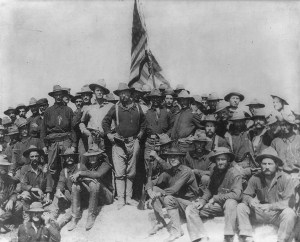
Theodore Roosevelt (center front, just left of the flag) and his “Rough Riders,” 1898.
The official inquiry into the disaster, however, concluded that an underwater mine had been the culprit. With the battle cry “Remember the Maine,” the U.S. quickly declared war on Spain.
But this “inquiry” was more than a bit flawed. Two widely-recognized experts in ordnance volunteered their services for the investigation, but were not invited to participate. One of them, Prof. Philip Alger, had greatly displeased Secretary of the Navy, and future president, Theodore Roosevelt, when he commented on the disaster in an interview for the Washington Evening Star a few days after it happened. He said, in part, the following, as reproduced by Rickover:
“As to the question of the cause of the Maine’s explosion, we know that no torpedo that is known to modern warfare, can of itself cause an explosion of the character of that on board the Maine. We know of no instances where the explosion of a torpedo or mine under a ship’s bottom has exploded the magazine within. It has simply torn a great hole in the side or bottom, through which water entered, and in consequence of which the ship sunk. Magazine explosions, on the contrary, produce effects exactly similar to the effects of the explosion on board the Maine. When it comes to seeking the cause of the explosion of the Maine’s magazine, we should naturally look not for the improbable or unusual causes, but those against which we have had to guard in the past.”
But Roosevelt was anxious to establish the U.S. as a world power, especially in terms of its Navy. By accusing Spain of blowing up the ship, he had the perfect excuse to launch the Spanish-American War.
The Vietnam War (major U.S. involvement: 1964 – 1975)
Off the coast of China and northern Vietnam is the Gulf of Tonkin, which was the staging area for the U.S. Seventh Fleet in the early 1960s. On the evening of Aug. 4, 1964, the U.S. destroyers Maddox and the C. Turner Joy were in the gulf, when the Maddox’s instruments indicated that the ship was under attack or had been attacked. Both ships began firing into the darkness, with support from U.S. warplanes. However, they “later decided they had been shooting at ghost images on their radar. … The preponderance of the available evidence indicates there was no attack.”

U.S. Huey helicopter spraying Agent Orange over Vietnam. (Photo by the U.S. Army Operations in Vietnam R.W. Trewyn, Ph.D.)
Yet something needed to be done about Vietnam, with anti-Communist hysteria still rampant in the U.S., and this gave Congress the perfect ploy to escalate the war. This non-incident was presented to the world as an act of aggression against the U.S. Congress quickly passed the Gulf of Tonkin resolution. By the end of the following year, the number of U.S. soldiers invading Vietnam increased from 23,000 to 184,300. Eleven years later, with over 55,000 U.S. soldiers dead, hundreds of thousands wounded, and, by conservative estimates, 2,000,000 Vietnamese dead, the U.S. fled Vietnam in defeat.
The Gulf War (Aug. 2, 1990 – Feb. 28, 1991)
In order to gain support for the Gulf War of 1990, Congress and President George Bush relied heavily on what is commonly referred to as the Nayirah testimony. In early October 1990, a 15-year-old girl referred to only as “Nayirah,” who claimed to have been a hospital volunteer, testified of seeing babies dumped by Iraqi soldiers from hospital incubators. This, in the eyes of Congress and the president, highlighted the monstrosity of Iraq, and was widely used to gain support for the war.
However, like nearly all of the information the government feeds to the citizenry to start its wars, this testimony was all lies. “Nayirah” was actually the daughter of the Kuwaiti ambassador to the U.S. She later admitted that she had once visited the hospital in question, but only for a few minutes. She did see an infant removed from an incubator, but only very briefly. A group called Citizens for a Free Kuwait had hired one of the world’s foremost public relations firms, Hill and Knowlton, to create the illusion of legitimacy for an invasion. They coached “Nayirah” on what to say and how to say it when she appeared before Congress.
We will do no more than mention the U.S.’s drafting of a letter for Grenada to send to the U.S., requesting military intervention when that small island nation’s government was overthrown in 1983. Nor will we dwell on the weapons of mass destruction that Iraq was said to possess in 2002, which justified in the eyes of U.S. citizens the disastrous 2003 invasion of that nation. But as we look at this ugly record of lies that the U.S. has used to expand its territory, power and/or influence around the world, we must consider that it is once again using the same tactics to march the nation toward war with Iran.
The U.S. for generations was successful in deceiving its citizens, and a good part of the world, that it was a beacon of freedom and peace, despite the fact that it has been at war for most of its bloody existence. That myth began to crack during the Vietnam War, broke into pieces with the Iraq War, and may have been dealt a fatal blow by the U.S.’s support of Israeli atrocities in 2014.
Regardless of the outcome of the congressional vote on the Iran agreement, the U.S. will find itself less able to lie its way into corporate wars in the future. That capacity diminished during the lead-up to the Iraqi invasion, and while no one ever went broke betting on the gullibility and short-term memory of the U.S. citizenry, people are beginning to wake up. When they finally do, much of the carnage in the world will end. That day cannot come soon enough.
As Third Victim Dies, Arsonists Get a Pass in Israel (and in The NY Times)
By Barbara Erickson | TimesWarp | September 8, 2015
Riham Dawabsheh, the third victim of an arson attack on her West Bank home, was laid to rest this week in a funeral attended by thousands. The New York Times has duly reported this, but the article is little more than a “color” piece, a detour around the full story of Israeli racism and impunity surrounding this event.
Riham, 27, died Monday, on her birthday, more than a month after the July 31 firebombing of her home in the village of Duma. Her toddler son, Ali, was burned to death in the attack, and her husband, Saad, 32, died a week later. A second son, Ahmad, 4, remains alive in a hospital with burns over 60 percent of his body.
The Times barely mentioned Riham’s death in a brief 135-word story yesterday (placed in the bottom corner of page 6 of the print edition); today it gives us a five-column photo with an article by Diaa Hadid that describes the women at her funeral and very little else.
It is a piece devoid of context, and it includes no official responses to the news of the latest death, with one exception—the statement by Israeli Prime Minister Benjamin Netanyahu, decrying the attack and insisting that security services were “doing their utmost” to find the perpetrators.
Other media outlets in the United States and Israel report the anguished concern of United Nations and Palestinian officials over the lack of progress in the case. Nicholay Mladenov, UN special coordinator for the Middle East peace process, said that he “reiterated and strengthened” his earlier call for justice, and that he was “concerned by the lack of progress in identifying and prosecuting the perpetrators of this outrage.”
Saeb Erekat, secretary-general of the Palestinian Liberation Organization, released a statement saying, “Over a month has passed and the Israeli government has not yet brought the terrorists to justice. In fact, more hate speech and incitement have been coming out from members of the Israeli government, more settler attacks have been carried out, and more Palestinians have been killed, injured or detained.”
The Times story mentions none of this and says only that Israel arrested several extremists who belonged to a “network that had encouraged acts of arson” and that it is “unclear” if any of them were connected to the Duma attack because Israel had imposed a gag order on the investigation.
Missing from this all-too-brief summary are some significant facts: The Israeli authorities arrested several suspects soon after the arson attack but released them, and although villagers reported that four men ran from the house after setting it on fire and entered a nearby settlement, no one from the settlement is in custody.
Other media have noted that Israel has failed to arrest and prosecute those responsible for similar attacks in the past. The Israeli magazine 972 ran a piece titled “No one is put on trial when a Palestinian family is burned alive,” comparing the Duma attack to a taxi firebombing three years ago.
The taxi bombing left six Palestinian family members hospitalized, but all survived. The investigation, however, did not. As 972 writers John Brown and Noah Rotem state, “Despite incontrovertible evidence showing settlers were behind the attack, the case was closed after a two-week investigation.”
None of the Times stories on the Duma bombing have found this news fit to print, and the newspaper has failed to mention other developments that shed light on the tragedy. They include:
- Under Israeli law, the Dawabsheh family is not eligible for compensation, while settlers who suffer similar attacks automatically receive reparations.
- The family struggled to cover medical expenses for the three who were being treated for burns.
- Settlers tried to burn another Duma house not long after the July 31 arson attack.
The newspaper has had several opportunities to include this kind of information in its pages, but it has preferred to emphasize officials’ efforts to control the damage to Israel’s reputation as news of the deadly arson emerged in the media. Thus we have found several stories about the arrests of Jewish extremists and many reports of Israeli outrage over this act of terrorism.
Today’s story was one more opportunity to inform readers of the full context in this disturbing story, but the Times has given us a diversionary slice of local life, omitting any reactions beyond that from the prime minister’s office and obscuring the facts surrounding the investigation.
Even in the most egregious examples of violence against Palestinians, the Times chooses to act as a protector of Israel, placing this goal above its mandate as the newspaper of record.
The ‘Enemy’ Within: US, NATO Want to Silence All Reporters They Dislike
Sputnik – 08.09.2015
The United States and its NATO allies treat information as a weapon designed to shape people’s perceptions across the globe and are ready to use any tool in their arsenals to silence those, who are critical of Washington and its friends, veteran war correspondent Don North warned.
The US calls an activity, which involves combining psychological warfare, propaganda and public relations, “strategic communications,” the journalist explained in an opinion piece titled “US/NATO Embrace Psy-ops and Info-War.”
Within this framework, reporters, who prefer to share information based on facts and not on bullet points prepared by the US State Department, are an enemy that has to be dealt with. They could be viewed as “spies” or “unprivileged belligerents” under the Pentagon’s revised “Law of War” manual.
The highly controversial document essentially equates some journalists to al-Qaeda terrorists and maintains that they “could be subject to indefinite incarceration, military tribunals and extrajudicial execution,” the journalist explained.
This trend of treating journalists as adversaries first manifested itself during the Vietnam War and has been a visible component of all America’s military campaigns ever since. It has been significantly reinforced during the Obama administration.
In the last seven years, “the concept of ‘strategic communication’ – managing the perceptions of the world’s public – has grown more and more expansive and the crackdown on the flow of information unprecedented. More than any of his predecessors, President Barack Obama has authorized harsh legal action against government ‘leakers’ who have exposed inconvenient truths about US foreign policy and intelligence practices,” North noted.
Not surprisingly, Washington’s response to foreign media outlets it dislikes involves a combination of propaganda and brutal force. Take Radio Television of Serbia during the Kosovo war or Al-Jazeera during the US invasions of Afghanistan and Iraq for instance. Both broadcasters were branded as disseminating false information and bombed: RTS headquarters were reduced to rubble in 1999 and al-Jazeera’s offices in Kabul (2001) and in Baghdad (2003) were hit by US missiles.
Given recent tensions between the United States and Russia, Washington’s latest media enemy of choice is obviously based in Moscow.
“Since RT doesn’t use the State Department’s preferred language regarding the Ukraine crisis and doesn’t show the requisite respect for the US-backed regime in Kiev, the network is denounced for its ‘propaganda,’ but this finger-pointing is really just part of the playbook for ‘information warfare,’ raising doubts about the information coming from your adversary while creating a more favorable environment for your own propaganda,” North explained.
The concept of controlling and manipulating information to achieve desired outcome transcends US borders.
“This growing fascination with ‘strategic communication’ has given rise to NATO’s new temple to information technology, called ‘The NATO Strategic Communications Center of Excellence’ or STRATCOM, located in Latvia, a former Soviet republic that is now on the front lines of the tensions with Russia,” North observed.
White House: Russian Military Action Against ISIS in Syria Would be ‘Destabilizing’
By Daniel McAdams | Ron Paul Institute | September 4, 2015
Today’s lesson in how propaganda works: The rumor mill turns a trickle of a story early this week about “thousands” of Russian soldiers deploying to Syria any day — a wholly unsourced story originating on an Israeli website — into a torrent of hyperventilating about the “Russian invasion” of Syria.
Today neocon convicted felon Eliot Abrams took to the Council on Foreign Relations website to amplify the Israeli article (again with no sources or evidence) to a whole new and more dramatic article ominously titled “Putin in Syria.” Abrams adds “reporting” by Michael Weiss, who has long been on the payroll of viscerally anti-Putin oligarch Michael Khodorkovsky, without revealing the obvious bias in the source. Never mind, all Weiss adds to Abrams’ argument is that the Pentagon is “cagey” about discussing Russian involvement in Syria before again referencing the original (unsourced) Israeli article.
See how this works? Multiple media outlets report based on the same totally unsourced article and suddenly all the world’s writing about the Russian invasion of Syria.
Now the White House has gotten into the game. According to an article by Agence France Press, the White House is “monitoring reports” that the Russians are active in Syria.
What reports? The article does not say nor does the White House. Presumably the White House is referring back to the original (unsourced) Israeli article.
But in the category of never let a good “crisis” go to waste, the White House, which began bombing Syria last August in violation of both international and US law, has declared that any Russian involvement in the Syria crisis would be “destabilizing and counterproductive.”
Apparently a year of US bombs is not “destabilizing.”
This is where the hypocrisy is so thick you could cut it with a knife. The US is illegally bombing Syria, illegally violating Syrian sovereignty, illegally training and equipping foreign fighters to overthrow the Syrian government, and has backed radical jihadists through covert and overt programs.
ISIS and al-Qaeda in Syria were solely the products of the 2003 US invasion of Iraq under false pretenses — the lies of the neocons — and after a year of US bombing ISIS seems as strong as ever while scores of civilians are killed by US attacks.
All of this is perfectly fine and should never be questioned. But even the hint that the Russians, who have had to contend with their fair share of radical Islam and are much closer to Syria than the US, may have an interest in joining the fight against ISIS is met with hysterical reproaches by a White House that admits it has no evidence.
What is the White House afraid of? While the stated goal of the Obama Administration is to defeat ISIS, the real, long-term goal is to overthrow Assad. The Russians disagree with the US insistence that Assad’s departure must be the starting point of any political settlement of the crisis. The Russians have long ago come to understand that Assad may be key to saving Syria from the kind of jihadist chaos that has engulfed Libya after its “liberation” by the US and its allies.
That is why the US government is flirting with the (unsourced Israeli) rumors of a massive Russian invasion of Syria. Regurgitated cries that the Russians are coming may serve to divert attention from another failed US intervention in the region.
One might think that if the US was serious about defeating ISIS it would welcome involvement from Russia and Iran, both of which would like nothing more than to see the back of the Islamic State. One might think if the US was serious about defeating ISIS it would rethink its “Assad must go” policy and allow the one force that has the most incentive to defeat ISIS — the Syrian Arab Army.
Yet the US will only work with the same states that have trained, funded, and turned a blind eye to the radical Islamic fighters as they have poured into Syria over the past four years — Saudi Arabia, Qatar, Turkey, etc.
Conspiracy-minded people must be wondering why the US is so reluctant to accept assistance from forces that so earnestly and with such military capacity seek the end of ISIS while partnering with those forces that have done so much to create ISIS.
Featured Video

Liberty Cannot Exist Inside a Panopticon
or go to
Aletho News Archives – Video-Images
From the Archives
Left-leaning despisers of 9/11 Truth movement: Do you really believe in miracles?
David Ray Griffin | Global Research | 06 Jul 2010
An Open Letter to Terry Allen, Noam Chomsky, Alexander Cockburn, David Corn, Chris Hayes, George Monbiot, Matthew Rothschild, and Matt Taibbi.
[1]According to several left-leaning critics of the 9/11 Truth Movement, some of its central claims, especially about the destruction of the World Trade Center, show its members to be scientifically challenged. In the opinion of some of these critics, moreover, claims made by members of this movement are sometimes unscientific in the strongest possible sense, implying an acceptance of magic and miracles. … Full article
Blog Roll
 Aletho News
- White House envoy declares kinetic action against Yemen ‘fruitless’
- Ukraine deployed thousands of microdrones in Iraqi Kurdistan: Tasnim
- Iran calls for emergency UNSC meeting over Trump’s ‘brazen’ bomb talk, Israeli threats
- Iranian sources reveal details of Russia-China Hormuz proposal
- Plan for more US-Israel integration puts our military tech at risk
- Another Round Against Iran Will Break What Is Left of the Gulf
- SVR Report on Ukraine’s Mexican Drug Gang Links Could Pressure Zelensky, Won’t Change US Policy
- British Government Employees Were Fact-Checking the News at the BBC. Nobody Told You.
- Albania on fire: who’s behind the riots?
- Egypt’s Civil Democratic Movement rejects involvement in regional war
- If Americans Knew
- Mysterious bot accounts reportedly spread fake ‘man on the street’ videos for Michigan Senate candidate
- Israeli Defense Minister Katz Says Over 60 Lebanon Villages Have Been Destroyed
- Why Is Israel Running TV Ads in Iowa Ahead of the Midterms?
- Hind Rajab’s Alleged Killer Is in the United States. HRF Demands His Arrest.
- US Officials Face Fresh Pressure After Another American ‘Brutalized’ by Israeli Settlers in West Bank
- Israel-Backed Palestinian Militias Terrorize Displaced Families in Gaza
- FBI subpoenas pro-Palestine activists over Israeli weapons plant disruption
- Fourth winter arrives in wartorn Gaza, too early – Daily Update
- More on how Bari Weiss is using CBS on behalf of Israel
- What the UK Is Doing to Pro-Palestine Novelist Sally Rooney Is an Act of Orwellian Villainy
- No Tricks Zone
- Predictions Made By Renowned Climate Proifessor Over Past Decades Have Been Proven To Be Poor
- New Study Suggests Large Regions Of The Pacific Ocean Have Been Cooling For The Last 80 Years
- Germany’s Green Energy Debacle: High Energy Costs Force Kahla Porzellan to Close After 182 Years!
- New Study: 50 Years Of The Most Aggressive ‘Net Zero’ Policies Can Only Affect The Global Climate By 0.03°C
- US September “Heat” Was No Record…Many Records Set Decades Ago
- Latest European Green Energy Debacle; Portugal’s Largest Flagship Solar Park Insolvent!
- Green Energy Debacle: German Expert Professor Fritz Vahrenholt Warns Of Severe Economic And Social Consequences
- Two More Paleo Reconstructions Affirm Meters-Higher Sea Levels Across Ireland, Brazil 7000-6000 Years Ago
- New Study: Earth And Venus Surface Warmth Largely Explained By Convection And Lapse Rate, Not CO2 Or Radiation
- 2025 Nature Paper Claiming Worsening Global Drought Gets RETRACTED …Heavily Flawed

