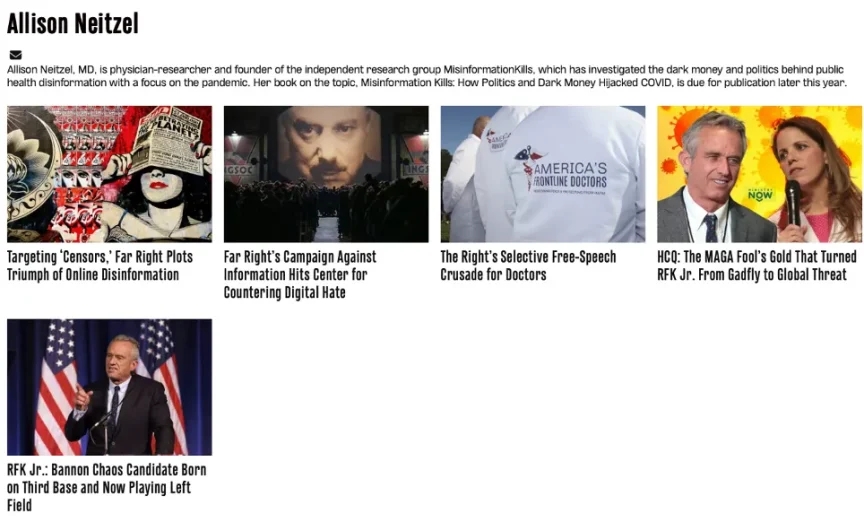
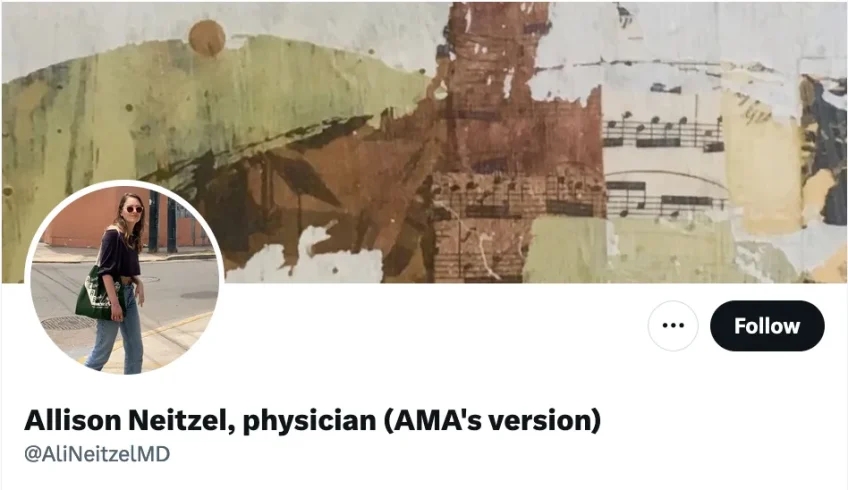
Promoted to national prominence by a coterie of reporters tackling pandemic misinformation, physician Allison Neitzel took a hard fall last week when she was forced to atone for promoting misinformation and defaming medical experts—by posting an apology on her website, and pinning the same to the top of her social media X account. But unless you hang on every word of Democratic Party aligned reporters with a knack for labeling everyone they don’t like a “conspiracy theorist,” you likely don’t know physician Allison Neitzel.
If you haven’t heard of her, you should know her name and story.
Allison Neitzel’s story encapsulates everything that went wrong during COVID when self-defined “disinformation reporters” glommed onto anyone they tripped over on social media as an “expert” they could deploy to castigate those refusing to bend the knee to Big Pharma.
“I know of Allison because of the way she has targeted me,” says Tracey Beth Høeg, a physician researcher and associate professor of clinical research at the university of Southern Denmark. Neitzel has deleted many of her social media posts denigrating Hoeg, including one in which she labeled her “Hoeg hag.”
“The fact she has not nearly completed her training but has appointed herself as an expert physician in pointing out misinformation strikes me as both odd and ironic,” Hoeg continued. “For example, as you can see, she is really attacking me rather than anything substantive about what I have done or said.”
Allison Neitzel rocketed to national fame on CNN after graduating from the Medical College of Wisconsin and posting a letter on social media that accused Green Bay Packers quarterback Aaron Rodgers of spreading COVID misinformation. Rodgers said he was allergic to one of the vaccine ingredients and didn’t need to be vaccinated because he had already been sick with COVID, however, this was almost a year before the CDC stated that prior infection was no different than being vaccinated.
Despite spreading false information about Rodgers, Neitzel’s letter and purported medical bona fides proved catnip to reporters at MedPage Today, Mother Jones, and NBC, who quoted her as a physician exposing medical misinformation. Columns Neitzel has written for websites WhoWhatWhy and Science-Based Medicine also claim she is a physician focusing on disinformation.
And this is where the circus fun begins, because famed medical misinformation expert Allison Neitzel is not now, nor has she ever been, a physician.
Allison Neitzel did not respond to multiple requests for comment to explain.
COVID clown show
I began unraveling Allson Neitzel’s COVID circus act shortly after she posted the apology to her website with the ironic name “MisinformationKills” and pinned it to the top of her @AliNeitzelMD X account.
Neitzel’s apology details a long list of false statements she made against multiple physicians accusing them of a fraud and grift, along with weasel words that make clear this is a non-apology apology, in the vein of “I am sorry if you feel bad.”
“I regret if anyone understood the statements as accusations that any of them had engaged in fraudulent professional or business practices,” Neitzel writes.
You can read her apology, but the depth and particulars of Neitzel’s defamation of real medical experts is impossible to know because she has deleted many of her posts on social media and on MisinformationKills.
But particulars don’t matter.
Neitzel is one in a legion of medical clowns the media launched into prominence during the pandemic because they served as useful idiots for “disinformation journalists” needing a quotable “expert” to bash people who dared question conventional COVID wisdom, or who charged that the government made phony claims about a lab accident in Wuhan, overstated the efficacy of masks and lockdowns, or lied about the safety and efficacy of COVID vaccines.
What makes Allison Neitzel unique from the COVID clown posse is that she was forced to retract and apologize for her lies and fake claims.
Interested, I dug into her background and discovered that all the outlets claiming Neitzel was a physician hadn’t bothered to do a modicum of due diligence before platforming her, because guess what? Allison Neitzel isn’t a physician.
Donning clown costume
The first social media trace I could find for Allison Neitzel is a 2019 Facebook post by the Medical College of Wisconsin. “Third-year med student Allison Neitzel helped teach young students how to use blood pressure cuffs, listen to heart and lung sounds through the use of a stethoscope, how to perform CPR and more.”
But when Neitzel jumped into the national conscience in 2021, she began claiming she was a “physician.” A group called the National Association of Medical Doctors (NAMD) posted Neitzel’s letter criticizing Green Bay Packers quarterback Aaron Rodgers in their Journal of Medicine, where she signed as “Allison Neitzel is a physician.” (Stay tuned: While researching the NAMD, I learned even more about COVID grift, which I will report in a future investigation.)
But when you look into Wisconsin law, you find the state defines a physician as “an individual possessing the degree of doctor of medicine or doctor of osteopathy or an equivalent degree as determined by the medical examining board, and holding a license granted by the medical examining board.”
Of course, her false claims of being a physician didn’t stop multiple media outlets from promoting Neitzel as a “physician” and misinformation expert. Let’s take a look.
COVID clown circus
Neitzel made two appearances as a “physician” in 2023 stories written by Kiera Butler at Mother Jones. Butler specializes in “COVID disinformation” stories that uncover “anti-vaxxers” and “right-wing” forces peeking out from every corner of America to harm the public with “misinformation.”
In one of her more amusing reporting incidents, Butler penned an article that claimed natural immunity from prior COVID infection was a “dangerous theory” spread by anti-vaxxers.
After California passed a law to discipline doctors for sharing “false COVID information” with patients that differs from the “scientific consensus” (whatever that is), Butler began attacking physicians who sued to stop the censorship, claiming that they were spreading medical lies. Linking to a tweet by Neitzel, who she labeled a “physician and disinformation researcher” Butler reported that “far-right rhetoric” and Nazi propaganda were supporting the lawsuits.
Neitzel was also featured in a story by NBC’s Brandy Zadrozny, another “disinformation reporter” who specializes in “extremism”—code in the disinformation world for “conservative” as people like Zadrozny never seem to find extremism among liberals.
Online harassment has become increasingly common for doctors during the pandemic, according to Dr. Ali Neitzel, a physician researcher who studies misinformation.
“The targeting of individual physicians is a well-worn tactic,” Neitzel said. “But this cheaply done fake — trying to frame a doctor who is doing unpaid advocacy work — that’s a new low.”
Forget that Neitzel is not even a physician. The absurdity is that Zadrozny quoted Neitzel—forced to post an apology last week for fomenting years of misinformation, and years of harassing physicians—as an expert commentator on misinformation and harassment of physicians.
It’s that ludicrous.
Trying to understand Zadrozny’s reporting, I emailed her questions pointing out that Neitzel was never a physician, and asking if she had bothered to check into Neitzel’s credentials.
“Do you plan to correct your article?” I asked.
True to the disinformation journalism game, in which reporting errors are never admitted nor corrected, Zadrozny never responded.
Neitzel’s online persona as a misinformation expert also gained her entrée into three different articles at MedPage Today.
“Can you explain why MedPage Today ran so many stories featuring Allison Neitzel who falsely claimed to be a physician and has been forced to post an apology for defaming physicians?” I emailed MedPage Today’s editor-in chief Jeremy Faust, an instructor at Harvard Medical School.
“I’m trying to understand if such reporting meets the standards at MedPage Today and if you plan to run any corrections or clarifications.”
Faust refused to respond to questions sent to his Harvard email.
Neitzel’s claims of being a physician also garnered her a column at the nonprofit news organization WhoWhatWhy. “Allison Neitzel, MD, is physician-researcher and founder of the independent research group MisinformationKills, which has investigated the dark money and politics behind public health disinformation with a focus on the pandemic,” reads her author bio page.
“Why have you claimed Allison Neitzel is a physician?” I emailed WhoWhatWhy’s editor-in-chief, Russ Baker. “And do you plan to continue claiming Neitzel is a physician?”
Baker did not respond to multiple requests for comment.
Neitzel also wrote a column for the site “Science-Based Medicine” where her bio states she is a physician. Science-Based Medicine is a marketing site for the biopharmaceutical industry run by David Gorski, a Wayne State University surgeon, self-described “misinformation debunker,” and ardent vaccine cheerleader.
In an email to Gorski, I asked why he lists Neitzel as a physician when she doesn’t meet the legal requirements for a physician in Wisconsin where Neitzel resides.
Gorski called the question “pedantic” and said he will ignore Wisconsin law in favor of a definition for “physician” that he found on the website for the American Medical Association.
“In general, ‘misinformation’ reporting seems to have certain ideas they are told are true/false and it’s about finding evidence to support what they have been told,” says Hoeg. “Also the ‘misinformation’ reporters often seem less qualified in terms of understanding the strengths and weaknesses of the scientific studies and domains than the people/scientists they are accusing of spreading ‘misinformation.’”
Australia’s public broadcaster, the Australian Broadcasting Corporation (ABC), proudly announced in 2022 that it had partnered with the Trusted News Initiative (TNI), an international alliance of major news corporations and Big Tech firms, to counter the growing threat of “fake news.”
It was part of sweeping reforms in the media to deliver ‘trusted’ news to global audiences and protect the public from the harms of misinformation and disinformation online.
Spearheaded by the British Broadcasting Corporation (BBC), partners include Reuters, Associated Press, Financial Times, The Washington Post, and ABC Australia, along with social media and tech giants – Meta (Facebook/Instagram), Microsoft (LinkedIn) and Google (YouTube) to name a few.
When ABC announced its new alliance with TNI, Justin Stevens, ABC News Director said, “We’re pleased to join the Trusted News Initiative and, in the process, provide Australian audiences with a deeper and better-informed view of our region and the world.”
Justin Stevens appointed ABC News Director in April 2022
During the pandemic, the alliance promised to focus on preventing “the spread of harmful vaccine disinformation,” and “the growing number of conspiracy theories,” targeting online memes that featured anti-vaccine messaging or posts that downplayed the risk of covid-19.
But critics have grown increasingly uneasy about the alliance. They say governments are being protected by journalists, instead of being held to account for their pandemic policies and they’re concerned the alliance has shaped public discourse by controlling people’s access to information and censoring content that diverges from the status quo.
Weaponising fact checking
Deploying fact-checkers is one way that TNI members control the dissemination of public information. When they label a statement ‘false’, ‘wrong’, or ‘misleading’, it’s used by social media platforms to legitimise the censorship of that content by deprioritising, hiding, demonetising, or suppressing it.
Debunking content is time consuming and costly. Fact-checkers are invariably junior journalists or intern researchers, with little to no understanding of complex scientific issues or public health policies, and often appeal to governments for the ‘truth’.
When the authors of the Great Barrington Declaration opposed government enforced lockdowns, fact checkers ran hit pieces on the authors – the notable academics were then shadow-banned, censored and deplatformed from social media.
In the case of the ABC, its original in-house fact checking unit was axed in 2016 because of Federal budget cuts, but was revamped the following year when the ABC teamed up with RMIT University in Melbourne to form the RMIT ABC Fact Check and RMIT FactLab departments.
The ABC paid more than $670,000 to RMIT between 2020 – 2023 as part of its joint fact-checking venture but they quickly gained a reputation for being flawed. For example, concerns about the suppression of the lab leak theory were labelled as “false” even though they were true.
ABC’s fact checkers were also accused of being biased by SkyNews because they had used their influence to censor disfavoured political views in the Voice to Parliament referendum.
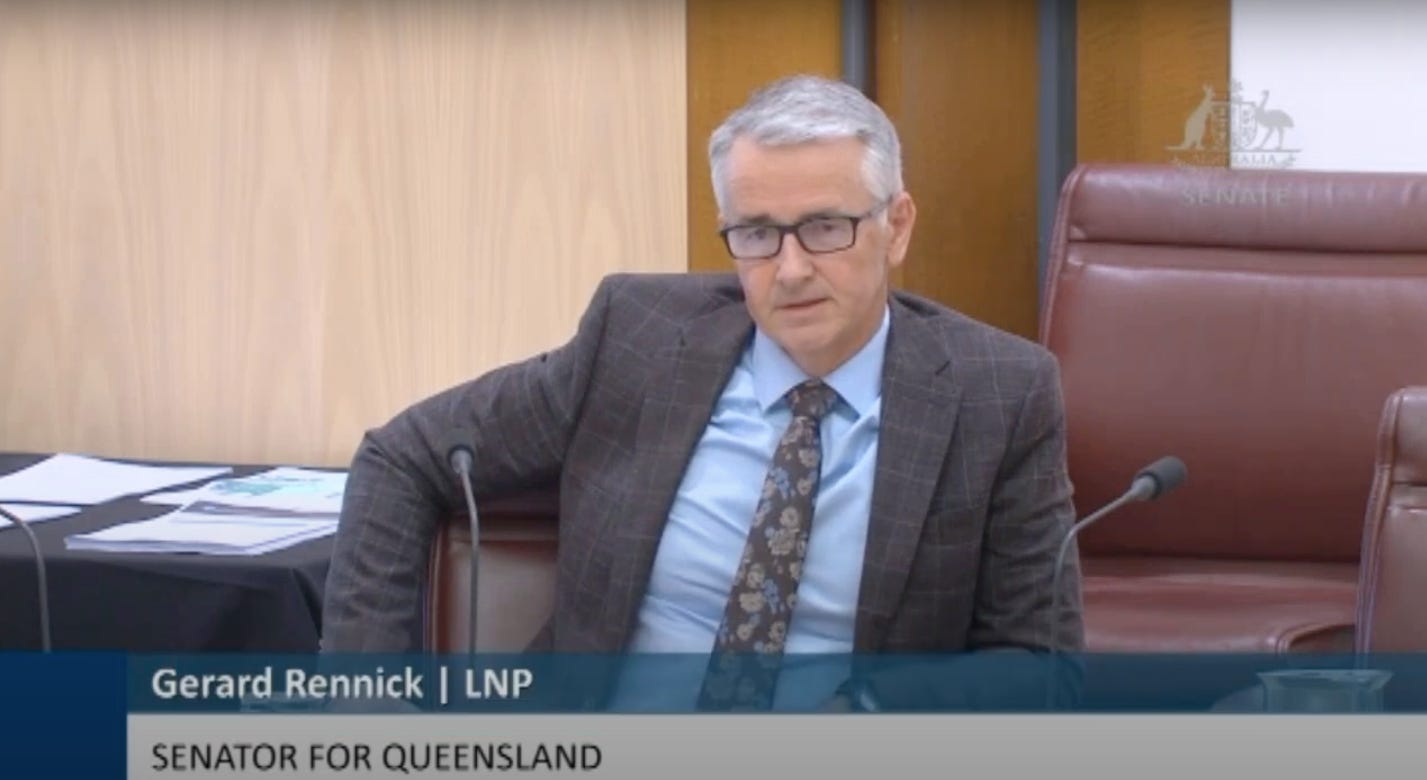
Queensland Senator Gerard Rennick grilled ABC’s Managing Director David Anderson at a Senate Estimates hearing about the network’s dodgy fact-checking practices last year.
“Who is fact-checking the fact-checkers?” asked Senator Rennick.
“You’ve made some outrageous claims on these fact-checks that aren’t correct, and you haven’t actually backed them up with any facts,” added Rennick, accusing the ABC of bias for predominantly fact-checking politically conservative voices in the media.
Sources say these controversies have prompted the ABC to cut ties with RMIT whose contract ends in June 2024.
New fact-checkers, same problems?
An ABC spokesperson said the network is now building its own internal fact-checking team, called “ABC NEWS Verify,” which appears to have similarities to the “BBC Verify” initiative.
“ABC NEWS Verify will be our centre of excellence for scrutinising and verifying information in online communities,” said the spokesperson outlining the various tasks of fact checkers. “Establishing a dedicated team will enhance and focus our efforts, creating a hub for verification best practice.”
I asked the ABC if it had any internal policy document outlining the criteria its fact-checkers would use to deem content as ‘misinformation’ or ‘disinformation’ but the spokesperson responded saying “no it doesn’t.”
Andrew Lowenthal, an expert in digital rights and a Twitter Files journalist, said the ABC’s failure to explain how it intends on fact-checking claims was “seriously ridiculous.”
“That the ABC is seeking to decide what is misinformation without laying out any criteria demonstrates just how farcical and political ‘fact-checking’ has become,” said Lowenthal.
“Without transparent and publicly available criteria the program will quickly turn into a partisan advocacy initiative,” he added.
Andrew Lowenthal, Twitter Files journalist
Lowenthal’s Twitter Files investigation confirmed the Australian government was monitoring Covid-related speech of its citizens and requesting that posts were flagged and censored if they deemed them to be misinformation.
“In that investigation, the government’s Department of Home Affairs was relying on Yahoo! News and USA Today, among others, to justify their take down requests or they’d hire journalists without scientific credentials. We need dialogue, not diktats, to determine what is true,” said Lowenthal.
Senator Rennick agreed, saying the ABC’s process lacks transparency. “Who are these people that claim to be the fact-checkers in the first place and what are their credentials? Sounds to me like it’s a black box,” said Rennick.
“Often when fact checkers come out with their reports, they don’t give the other person they’re fact checking, a right-of-reply. Also, they rarely disclose the conflicts of interest of the so-called ‘experts’ they use to fact check claims,” he added.
Michael Shellenberger, author, journalist and founder of Public, has written extensively on the “censorship industrial complex.”
“That’s what the trusted news initiative [TNI] was all about…a strategy to use fact checking initiatives to demand censorship by social media platforms,” said Shellenberger.
Michael Shellenberger, author of San Fransicko (HarperCollins 2021) and Apocalypse Never (Harper Collins 2020)
“They can pretend that’s not what it’s about, but the fact that the news media are participating in this, is grotesque. It’s a complete destruction of whatever reputation and integrity they used to have,” he added.
“Organisations like BBC and ABC… they used to have reputations for independence and integrity, but they’ve now decided to destroy their entire reputation on the mantle of them being the deciders of the truth. The Central Committee. That’s totalitarianism that’s not free speech.”
The ABC says its new ABC NEWS Verify will have no connection to TNI.
Impartiality and credibility?
TNI’s broad principles of working in lockstep towards a single narrative, has meant that legacy media operate largely as a mouthpiece for government propaganda, offering little critique of public health policies…and ABC has been no exception.
During the pandemic, the broadcaster repeatedly came under fire after its medical commentator Dr Norman Swan made countless calls for harsher lockdowns, mask mandates and covid boosters – policies that strongly aligned with the government but had little scientific backing.
Swan’s commentary rarely provided an impartial perspective and he was eventually called out for failing to publicly disclose his financial interest in seeking government contracts related to covid-19.
In addition, Ita Buttrose, who was ABC Chair until last month, was seen fronting Pfizer’s advertising campaigns for covid products. ABC defended Buttrose saying, “Given she was not involved in editorial decisions, there was no conflict of interest.”
Ita Buttrose, former ABC Chair, March 2019 – March 2024
The ABC denies its alliance with TNI has impacted its editorial independence but Shellenberger says the entire purpose of joining TNI is to ensure they become the single source of truth.
“They’ve stopped doing real reporting, and they’re just out there wanting to be paid to regurgitate and act like publicists for the government. It’s grotesque. It’s not journalism, it’s propaganda,” said Shellenberger.
Resisting the tyranny
Some journalists have been resisting what they perceive to be ‘tyranny’ in legacy media and the widespread suppression of free speech.
In June 2021, a group of around 30 journalists rallied together to denounce TNI’s “censorship and fearmongering” and accused the alliance of subjecting the public to a distorted view of the truth.
The group known as ‘Holding the Line: Journalists Against Covid Censorship’ shared concerns that reporters were being reprimanded by their superiors and freelancers were being blacklisted from jobs for not following the “one official narrative.”
Presidential hopeful Robert F Kennedy Jr has filed a lawsuit against TNI alleging that legacy media organisations and Big Tech have worked to “collectively censor online news” about covid-19 and the 2020 presidential election.
The lawsuit states:
“By their own admission, members of the “Trusted News Initiative” (“TNI”) have agreed to work together, and have in fact worked together, to exclude from the world’s dominant Internet platforms rival news publishers who engage in reporting that challenges and competes with TNI members’ reporting on certain issues relating to COVID-19 and U.S. politics.”
A group of 138 scholars, public intellectuals, and journalists from across the political spectrum have since published The Westminster Declaration.
In essence, it’s a free speech manifesto urging governments to dismantle the “censorship industrial complex” which has seen government agencies and Big Tech companies work together to censor free speech.
In Australia, the journalist’s union MEAA has called on ABC’s newly appointed Chair Kim Williams to “restore the reputation of the national broadcaster by addressing concerns about the impact of external pressures on editorial decision making.”
Kim Williams, current Chair, ABC Network Australia
Williams, who took over from Buttrose last month, has warned his journalists that “activism” is not welcome at the ABC and that if they fail to observe impartiality guidelines, they should consider leaving the network.
Will the ABC course-correct with Williams at the helm? Now that trust in legacy media is at historical lows, the ABC’s partnership with TNI does little to assuage fears that the network has passed the point of no return.
NB: I was a TV presenter/producer at ABC TV (2006-2016) and wrote about my experiences with censorship at the network here and here.
After stoking fears of Russian expansionism to win congressional approval for more Ukraine aid, US intelligence agencies should provide proof of their justification for continuing to fund a “proxy war” that will inevitably end in defeat for Kiev, Representative Marjorie Taylor Greene (R-Georgia) has argued.
Speaking on Monday in an interview with former White House aide Steve Bannon, Greene pushed back against claims that Russian forces will take Poland and continue “marching across Europe” if they’re allowed to defeat Ukraine. She noted that US House Speaker Mike Johnson (R-Louisiana) only agreed to push through the $61 billion Ukraine aid bill, which was approved on Saturday, after hearing intelligence briefings hyping the Russian threat.
“If the American people are going to have to pay for it, then show us this proof that was shown to Mike Johnson in the SCIF [sensitive compartment information facility],” Greene said. “Why is this classified information? If this is a real threat to all of Europe, if this is a threat to America and our national security, then roll out the presentation.”
The second-term lawmaker said Johnson received no such classified briefings on the US border crisis, which poses a real threat to the American people. “They don’t care about that,” she said. “They care about continuing the business model built on blood and murder and war in foreign countries, the business model that continues funding the military-industrial complex in order, supposedly, to create American jobs and build up the American economy.”
“This is the most disgusting business model that anyone has ever seen, probably in the history of mankind.”
Greene reiterated her call to oust Johnson as speaker, saying Republican voters are so disgusted about the Ukraine bill that the party will lose control of the House in this year’s election if the current leadership remains in place. The White House’s emergency funding request for Kiev had been stalled since last fall because a majority of Republicans opposed it. Republican lawmakers voted against the legislation by a 112-101 margin on Saturday, but Johnson overrode his own party by allowing a vote and winning passage with unanimous Democrat support.
Johnson won praise from the Washington media for his reversal on Ukraine aid – CNN even likened him to Winston Churchill – while Greene came under attack for criticizing him. The New York Post put a picture of Greene on its Sunday cover with a Soviet ushanka superimposed on her head and a caption saying, “Nyet, Moscow Marjorie.”
Greene insisted that congressional Republicans can’t win in the November election without the support of ‘America First’ voters. She added that sending more aid to Ukraine will only cause more bloodshed without changing the outcome of the conflict.
“This just continues the war maybe a few more months, maybe to the end of the summer,” Greene said. “It doesn’t guarantee a Ukrainian victory because everyone knows they’re going to lose eventually. It just is a matter of when. But it does guarantee that more Ukrainian men will be slaughtered on the battlefield.”
Cases of pertussis — or whooping cough — in the U.S. dropped during the pandemic and today continue to be lower than pre-pandemic levels, NBC News reported on Tuesday.
“We are not seeing anything unusual,” Jasmine Reed, a Centers for Disease Control and Prevention spokesperson, told the news outlet.
However, in the same article — “Whooping Cough Rising in Some Countries. Why You May Need a Booster” — NBC contributor Kaitlin Sullivan reported that “outbreaks in Europe, Asia and parts of the U.S. should be a reminder to get vaccinated, experts say.”
Dr. William Schaffner, a professor of infectious diseases at the Vanderbilt University School of Medicine, told NBC the current situation “won’t turn into a pandemic because we have a highly vaccinated population.”
Schaffner added: “However, let’s make sure that pregnant people get vaccinated, that babies are vaccinated on schedule, and the rest of us take the Tdap vaccine every 10 years.”
This is especially necessary to protect infants, who are especially vulnerable to the otherwise typically mild illness, NBC reported.
Experts told The Defender they thought the NBC report was unnecessarily alarming, cited outdated methods for protecting babies, and failed to consider serious and well-known concerns with the safety and efficacy of DTaP and Tdap vaccines.
“There’s no medical or scientific reason to advise giving the vaccine to any group of people for the purpose of preventing transmission to others,” Sears said.
He added:
“We have whooping cough in our society simply because this is one of several vaccines that doesn’t reduce the spread of its disease. The vaccine simply doesn’t work that way, and no amount of scientific hope or wishful thinking will change that.”
The United Kingdom saw an increase in whooping cough cases in January. According to The BMJ, the spike seen there also occurred in other European countries, but the outbreak primarily affected people ages 15 and older, who are not at high risk from the illness. Only 4% of cases in the recent spike were in infants.
NBC also reported that China had a 15-fold increase in cases in January, part of a variable epidemiology of the disease seen over the last 10 years. That increase amounted to 15,275 cases among a population of over 1.4 billion people.
Even the Centers for Disease Control and Prevention (CDC) told NBC that the outbreaks and mild isolated cases the agency reported in the San Francisco Bay area, Hawaii and New York are normal and something “we expect to see every year.”
Whooping cough is a highly contagious respiratory illness that manifests as a cold in most people, but it can be serious for newborns who have a very narrow trachea, Dr. Meryl Nass, an internal medicine physician, told The Defender.
Deaths from pertussis are extremely rare, averaging about 10 per year. About 85% of deaths happen in children under two months of age — before babies are even eligible to begin the pertussis vaccination.
Nass said pertussis is extremely common and endemic in the U.S. It tends to be misdiagnosed as cold or flu and medical attention is rarely sought, except for babies.
Current formula needs to be ‘scrapped or reworked’
Dr. Paul Thomas said the NBC article “completely ignores the risk of death from the vaccine, which is documented to be greater than the number of deaths prevented — even before you consider that 50-90% of Sudden Infant Death Syndrome occurs in the week after infant vaccines, of which the DTaP is the most concerning.”
Maternal-fetal medicine expert Dr. James Thorp told The Defender the pertussis vaccine has never been proven to be safe or effective in a randomized, double-blinded, placebo-controlled trial.
And there have been no long-term studies examining all health outcomes related to the vaccine, Thorp said.
Babies and children currently receive the DTaP vaccine, designed to protect against pertussis, diphtheria and tetanus. People ages 7 and older receive the Tdap booster, designed to protect against diphtheria, tetanus and acellular pertussis.
Thomas, author of “The Vaccine-Friendly Plan: Dr. Paul’s Safe and Effective Approach to Immunity and Health-from Pregnancy Through Your Child’s Teen Years,” said that both DTap and Tdap are old vaccines that rely on recognizing the pertactin protein to develop immunity.
About 85% of pertussis circulating in the U.S. is pertactin-negative making the vaccine at best 15% effective, he said.
The CDC has been tracking changes in the prevalence of bacteria causing whooping cough for years. The most recent CDC data, reported this month, found that the Bordetella parapertussis type of whooping cough has significantly overtaken B. pertussis in prevalence — and research published in Vaccines in March shows the existing vaccines “scarcely provide protection” against this strain.
“This pertussis vaccine needs to either be scrapped or reworked to provide one that is effective,” Thomas said.
“Those vaccinated are now getting pertussis at a much higher rate than those with natural immunity and not vaccinated for pertussis,” he added. “It is the vaccinated who are also most likely to bring pertussis to newborns and put them at risk.”
Vaccinated — not unvaccinated — more likely to give infants pertussis
NBC reported that although the disease poses no serious threat to most adults, adults ought to get vaccinated to protect infants.
The article quotes Schaffner as saying, “Anyone who comes to see the new baby should have had a recent inoculation with Tdap vaccine, to provide a cocoon of protection around that baby.”
But Thomas said the concept of cocooning, “where you vaccinate the adults and children and caregivers in the infant world to provide a cocoon of protection, has been long abandoned as it has failed to protect infants.”
“It turns out those vaccinated still get pertussis and because sometimes it is a less severe infection (a minor vaccine benefit) they are more likely to be around infants and put them at risk for pertussis.”
Nass noted that antibiotics provide some protection against whooping cough transmission, but not against symptoms. And because the disease is misdiagnosed in adults and very mild, few take them.
Thomas said the best approach for parents with an infant — because the disease is relatively harmless after one year — is to avoid indoor crowds and sick visitors.
“Even family and visitors who are not sick should wash their hands with soap and water before touching the baby and not kiss the baby on the face, hands or feet,” he said. “It is worth noting that the worst of the pertussis dangers was largely gone even before the vaccine was introduced to the masses.”
‘No vaccine should be given during pregnancy’
Nass told The Defender that another problem with pertussis vaccine efficacy is that it takes multiple shots — given at ages 2, 4, 6 and 15-18 months — for a child to develop some immunity.
However, children are only really at risk of death from the illness very early in life, before the shots provide any protection.
Thorp said that because the original goal of protecting infants with the vaccine in the first year of life was “a miserable failure” pharmaceutical companies began advocating to give the shots to pregnant women.
In 2012, the CDC first began recommending the TDap vaccine for pregnant women to protect newborn infants, despite the fact that they largely don’t need the diphtheria or tetanus components, Nass said.
“The CDC could have recommended manufacturers make just a pertussis vaccine for this purpose, but chose not to,” she added.
This was another example, Thorp said, “where this fable that the vaccine would provide immunity was forced down the throats of pregnant women with the backing of the medical-industrial-complex without a randomized double-blinded, placebo-controlled trial.”
No vaccine should be given during pregnancy, Thorp said. “But now the pharmaceutical industrial complex is pushing six vaccines including for influenza, tetanus, diphtheria, pertussis, RSV, and COVID-19.”
“From the fetus to the infant at 12 months of life, there are about 42 vaccines administered in 2024, compared with about 11 in 1986,” he added. “This is absurd and an abomination of science.”
Brenda Baletti, Ph.D., is a senior reporter for The Defender. She wrote and taught about capitalism and politics for 10 years in the writing program at Duke University. She holds a Ph.D. in human geography from the University of North Carolina at Chapel Hill and a master’s from the University of Texas at Austin.
Dr. Mary Talley Bowden recently sued the FDA for stepping beyond their charter, defaming Ivermectin prescribers, and, thereby, interfering with the doctor-patient relationship. Last month, Dr. Bowden resolved her suit, receiving a substantial undisclosed settlement from the government agency.
Dr. Pierre Kory has been an early and staunch defender of the use of Ivermectin to treat COVID-19 in humans. Kory believes the FDA settled this case with Bowden because they had likely hired the PR firm Weber Shandwick to create the now infamous “horse dewormer” campaign (detailed below) to smear Ivermectin and its proponents. If true, once Bowden’s lawsuit went into the phase of discovery then this information would have been revealed, but we will never know since the case is now settled. Weber Shandwick lists the CDC, Pfizer, and Moderna as their clients.
Honest Media covered Ivermectin and the “horse dewormer” controversy in a letter sent to the Associated Press documenting the lies the AP published about the drug. We have also recently received a trove of emails between Dr. Bowden and the Arizona Mirror, an outlet that smeared Dr. Bowden and her colleague, Dr. Peter McCullough. After reviewing them, we can say that these documents illustrate the media’s contempt for medical dissidents.
But why this fear of letting dissenting doctors speak? There has been virtually no coverage of Dr. Bowden’s case. Where there is documentation, like with Jen Christensen’s reporting for CNN, nobody gives voice to the victor and victim, Dr. Bowden. Why?
Dr. Bowden, a Stanford-trained ear, nose, and throat doctor from Houston, has treated more than 6,000 patients suffering from COVID. She is a strong and intelligent woman of science speaking truth to power. Here, in Dr. Bowden, is that “gutsy woman” who Americans were told to admire by leaders like Hillary Clinton. But there’s an implicit caveat in the cult of Clinton’s “gutsy woman:” Such women are to be ignored (and even pilloried and censored) if they challenge the orthodoxies of the Democratic Party or the DNC-aligned Big Pharma industry.
For prescribing Ivermectin and dissenting against the dominant COVID narratives, Dr. Bowden was forced to resign from Houston Methodist Hospital. And she wasn’t the only doctor to face such consequences. Dr. Robert Apter and Dr. Paul Marik, two other Ivermectin physician-advocates, joined Dr. Bowden in her suit against the FDA. Marik, for his part, was forced to resign from Eastern Virginia Medical School as well as Sentara Norfolk General.
Last month, Dr. Bowden traveled to the Supreme Court to stand in solidarity with activists as SCOTUS listened to Murthy v. Missouri. The Murthy case concerns the suppression of medical dissidents, specifically, and online censorship, more broadly. Dr. Bowden addressed the crowd of protesters about her four-year battle with the captured government agency:
How many COVID patients did they examine? How many histories did they take? How many prescriptions did they write? Zero. None of them have cared for a single COVID patient, but because they had the full support of Big Pharma, the government, and, most importantly, the media, they became the scientific authority on a novel disease they had zero first-hand experience in treating.
Bowden has a point. The FDA’s campaign against doctors such as herself gained purchase with the public, in part, because the agency’s claims were amplified by a mainstream media that is shaped and funded – captured – by Big Pharma. Due to the massive influx of advertising dollars and the perfect storm of misinformation and disinformation summoned by Russiagate, the 2020 election, and the COVID-19 pandemic, the American public’s trust in the mainstream media has reached record lows. Bowden’s case reveals another example of why the public is justified in its skepticism.
Let the Doctors Speak
I recently spoke with Dr. Bowden about her fight with the government.
“This was a war on Ivermectin,” she said. “But it was also a war on the doctor-patient relationship.”
I asked her what precipitated the suit against the FDA. Dr. Bowden told me that never before in her career had she witnessed interference with the doctor-patient relationship from the FDA or her local pharmacies. When I asked about prescribing a drug that wasn’t FDA-approved, she told me that she’d often prescribed off-label in the past, with no problems, and that she approached Ivermectin, initially, with hesitancy and skepticism. She said she preferred prescribing monoclonal antibodies at the beginning of the pandemic, but sought new options when access to these treatments became restricted.
“I was nervous to start using it,” she said. “Before I started, I looked at the FDA’s website and the toxicity data. Once I was assured that it worked (maybe not as quickly as monoclonal antibodies), I started offering it to patients.”
Not only did Dr. Bowden prescribe Ivermectin to her patients and witness positive results, but she used it herself. She’s had COVID three times. And in every instance of Ivermectin treatment, both with herself and her patients, she observed either efficacy or minimal side effects.
“I haven’t lost one patient due to Ivermectin,” she said.
In 2015, the Nobel Committee for Physiology honored the discovery of Ivermectin with a Nobel Prize. The NIH lauded this “multifaceted drug,” which was largely unknown in American public discourse prior to the outbreak of the COVID-19 pandemic.
Then, suddenly everyone and their grandmother was an expert on the dangers of Ivermectin. Seemingly overnight, the American people absorbed a viral propaganda campaign from the very government agency (the FDA) that they supported with tax dollars. And if you were a doctor or patient seeking this low-cost, award-winning therapeutic treatment, you were suddenly in the crosshairs of the “war on Ivermectin.” This policing of the poor and the independent all started, according to Dr. Bowden, “with the horse tweet.”
On August 8, 2021, the FDA weaponized its social media account to stigmatize physicians like Dr. Bowden and skeptical and underprivileged patients seeking affordable alternative care. The agency issued a tweet with two images: a veterinarian outdoors caring for a horse, coupled with a physician in an office caring for a masked human. The text for the tweet reads: “You are not a horse. You are not a cow. Seriously, y’all. Stop it.” This tweet, with its careful use of the colloquial and the second person, supplemented with a juvenile binary logic, became the most popular tweet in FDA history.
Hate wins clicks. Fear creates fog. Shortly after the tweet’s publication and viral propagation, Dr. Bowden’s life came undone.
“I never had a pharmacy deny a prescription before,” she said.
Dr. Bowden’s struggle with the pharmacy was just the tip of the iceberg, revealing the stranglehold Big Pharma now has on health care in America. Dr. Bowden suffered (and still suffers) from vicious attacks online, as well as alienation from her peers. She was forced to resign from her workplace, Houston Methodist Hospital. She explained to me that the “war on Ivermectin” was more vitriolic than anything she’d ever seen before in the discourse on public health. And whereas most doctors bent the knee, stayed silent, and complied with government mandates, Dr. Bowden (and others) fought back. Her case represents what one might call a scientific profile in courage.
What does fighting back look like? Well, for starters, perhaps it begins with telling the truth in public and revealing the whole story of Dr. Bowden’s struggle, along with that of fellow medical dissidents like Dr. Kory, Dr. Robert Malone, Dr. Jay Bhattacharya (co-author of the Great Barrington Declaration), and Dr. Peter McCullough.
In Dr. Bowden’s and Dr. McCullough’s recent email exchanges with the Arizona Mirror, one can see, firsthand, a publication that ignores the opportunity to correct factual errors. The Mirror instead willfully litters its reporting on Dr. Bowden and Dr. McCullough with misinformation, ad hominem attacks, bizarre references to Qanon, constant allusions to shadowy conspiracy theories, and the slanderous insinuation that Dr. McCullough is antisemitic.
The Association Fallacy
One of the most recurrent disinformation patterns we have witnessed in studying the defamation of populist voices, broadly, and Dr. Bowden’s case, specifically, is what scholars of rhetoric call the association fallacy. In short, the association fallacy describes claims where even oblique social connection to a stigmatized individual or organization (like QAnon) is used to poison the claims of the targeted speaker. Simply associating the terrifying name of the poisonous organization with the speaker scares the reader and creates an irrational – fallacious – connection.
What’s troubling, in the case of the Arizona Mirror reporting, is that Dr. Bowden and Dr. McCullough have no ties to QAnon. Furthermore, Dr. Bowden and Dr. McCullough both reached out to Jim Small, the paper’s editor, and politely asked that these fallacies be removed from the Mirror’s articles.
For example, Dr. Bowden and Dr. McCullough called attention to the Mirror’s repeated use of the ad hominem “anti-vaxxer” to label Dr. McCullough and associate the doctor with the world of “anti-vaxxers.” In their email exchange, Dr. McCullough confides in Small that he has “accepted dozens of vaccines during the course of my life.”
But the Mirror refused to mirror the truth and remove the slur. The Mirror refused to interview these doctors, refused to correct their reporter’s mistakes when alerted by the victims, and, furthermore, sought to defame the doctors through ad hominem attacks and the association fallacy.
To witness how the association fallacy works, consider the following sentence about Dr. Bowden’s colleague, Dr. McCullough, from the Arizona Mirror’s Jerod Macdonald-Evoy: “McCullough has become a darling to those in both Qanon and the broader conspiracy world, appearing regularly on shows like the one hosted by antisemite Stew Peters, who said the COVID vaccine is a bioweapon.”
In one sentence, the reporter has accused the doctor (without directly accusing him) of antisemitism and conspiracy theory simply by virtue of association with other human beings, mostly unnamed, who populate “the broader conspiracy world.”
What is happening to people like Dr. McCullough and Dr. Bowden rarely happens to those in power. It happens to those who challenge power.
The Arizona Mirror and CNN should be ashamed. They punished informed dissent. They refused to contextualize Dr. Bowden’s struggle as part of a subculture of dignified scientists and physicians. They erased and defamed Dr. Bowden and her colleagues. They published fear porn and called it journalism. They left out this gutsy woman’s voice. Honest Media has chosen a different path. We let the doctor speak.
Iran’s Islamic Revolution Guards Corps (IRGC) dismisses reports of affliction of damage to the Israeli regime’s Dimona nuclear reactor during the Islamic Republic’s recent Operation True Promise against the occupying regime.
“The Dimona reactor has not been among the bank of targets of the Islamic Republic’s recent punitive measure against the Zionist regime,” IRGC spokesman Brigadier General Ramezan Sharif said on Thursday.
“Publication of this news is a big lie and a malignant effort in line with the enemy’s psychological operation towards deception of the public opinion,” he added.
The remarks came after the Israeli regime’s Ma’ariv newspaper claimed satellite images had allegedly shown that one of the reactor’s buildings had been struck at least once during the Iranian operation, adding that up to two hits had also taken place in its vicinity.
The Corps launched the operation late on Saturday in response to a deadly attack by the regime against the Islamic Republic’s diplomatic premises in the Syrian capital Damascus on April 1.
The Israeli attack had resulted in the martyrdom of Brigadier General Mohammad Reza Zahedi, a commander of the IRGC’s Quds Force, his deputy, General Mohammad Hadi Haji Rahimi, and five of their accompanying officers.
In retaliation, the IRGC targeted the occupied territories with a barrage of drones and missiles. The retaliatory strikes inflicted damage on Israeli military bases across the occupied territories.
Amid speculation about fresh potential Israeli aggression, senior Iranian political and military leaders, including President Ebrahim Raeisi and Foreign Minister Hossein Amir-Abdollahian, have warned of a stronger and more severe response.
The Russians are coming — or coming back, better put.
As the November elections draw near, let us brace for another barrage of preposterous propaganda to the effect Russians are poisoning our minds with “disinformation,” “false narratives,” and all the other misnomers deployed when facts contradict liberal authoritarian orthodoxies.
We had a rich taste of this new round of lies and innuendo in late January, when Nancy Pelosi, the California Democrat who served as House speaker for far too long, asserted that the F.B.I. should investigate demonstrators demanding a ceasefire in Gaza for their ties, yes indeedy, to the Kremlin.
Here is Pelosi on CNN’s State of the Union program Jan. 28:
“For them to call for a cease-fire is Mr. Putin’s message. Make no mistake, this is directly connected to what he would like to see. Same thing with Ukraine… I think some financing should be investigated. And I want to ask the F.B.I. to investigate that.”
O.K., we have the template: If you say something that coincides with the Russian position, you will be accused of hiding your “ties to Russia,” as the common phrase has it.
Be careful not to mention some spring day that the sky is pleasantly blue: I am here to warn you—“make no mistake” — this is exactly what “Putin,” now stripped of a first name and a title, “would like to see.”
There is invariably an ulterior point when those in power try on tomfoolery of this kind. In each case they have something they need to explain away.
In 2016, it was Hillary Clinton’s defeat at the polls, so we suffered four years of Russiagate. Pelosi felt called upon to discredit those objecting to the Israeli–U.S. genocide in Gaza.
Protest against Israeli genocide in Freedom Plaza, Washington, D.C., Nov. 4, 2023. (Diane Krauthamer, Flickr, CC BY-NC-SA 2.0)
Now we have a new ruse. Desperate to get Congress to authorize $60.1 billion in new aid to Ukraine, Capitol Hill warmongers charge that those objecting to this bad-money-after-bad allocation are… do I have to finish the sentence?
Two weeks ago Michael McCaul, a Republican representative who wants to see the long-blocked aid bill passed, asserted in an interview with Puck News that Russian propaganda has “infected a good chunk of my party’s base.” Here is the stupid-sounding congressman from Texas, as quoted in The Washington Post, elaborating on our now-familiar theme:
“There are some more nighttime entertainment shows that seem to spin, like, I see the Russian propaganda in some of it — and it’s almost identical on our airwaves. These people that read various conspiracy-theory outlets that are just not accurate, and they actually model Russian propaganda.”
I read in the Post that McCaul’s staff abruptly cut short the interview when Julia Ioffe, a professional Russophobe who has bounced around from one publication to another for years, asked him to name a few names.
So was this latest ball of baloney set in motion.
A week after McCaul’s Puck News interview, Michael Turner, an Ohio Republican who, as chairman of the House Intelligence Committee, swings a bigger stick, escalated matters when, reacting to McCaul’s statements, reported that this grave Russian penetration was evident in the upper reaches of the American government, as again reported in The Washington Post :
“Oh, it is absolutely true. We see directly coming from Russia attempts to mask communications that are anti–Ukraine and pro–Russia messages, some of which we even hear being uttered on the House floor.”
Masked communications uttered on the House floor: Hold the thought, as I will shortly return to it.
The VOA Rendition
The taker of the cake — so far, anyway — arrived last week from Voice of America, the Central Intelligence Agency front posing as a radio broadcaster, under the headline, “How Russia’s disinformation campaign seeps into U.S. views.” Same theme: The Rrrrrussians are poisoning America’s otherwise pristine discourse in an effort to block authorization of the assistance bill, which also includes aid to Israel ($14.1 billion) and Taiwan ($4 billion).
To drive home its point, VOA quotes a lobbyist named Scott Cullinane, who works for something called Razom, which means “together” in the Ukrainian language. Razom is a non-governmental organization “formed in 2014 to support Ukrainians in their quest for freedom.” That is, Razom’s founding coincided with the coup in Kiev the U.S. orchestrated in February 2014.
Razom works with a variety of Ukrainian NGOs to advance this cause and sounds to me like a player in the old civil-society-subterfuge game, though one cannot be sure because, on its website and in its annual reports, it does not say, per usual in these sorts of cases, who funds it.
Here is a little of VOA’s report on Cullinane’s recent doings on Capitol Hill:
“On a near daily basis, Scott Cullinane talks with members of Congress about Russia’s war in Ukraine. As a lobbyist for the nonprofit Razom, part of his job is to convince them of Ukraine’s need for greater U.S. support to survive.
But as lawmakers debated a $95 billion package that includes about $60 billion in aid for Ukraine, Cullinane noticed an increase in narratives alleging Ukrainian corruption. What stood out is that these were the same talking points promoted by Russian disinformation.
So, when The Washington Post published an investigation into an extensive and coordinated Russian campaign to influence U.S. public opinion to deny Ukraine the aid, Cullinane says he was not surprised.
‘This problem has been festering and growing for years,’ he told VOA. ‘I believe that Russia’s best chance for victory is not on the battlefield, but through information operations targeted on Western capitals, including Washington.’”
Straight off the top, there has been no Washington Post “investigation.” The Post simply quoted two paranoid congressmen without bothering to question, never mind investigate, the veracity of their assertions.
Beyond this, the question of Ukrainian corruption is another case of the sky being blue. There is no “alleging” the Kiev regime’s corruption: It is thoroughly documented by, among other authorities, Transparency International, which ranks Ukraine among the world’s most corrupt nations.
You see what is going on here? This is an echo chamber, ever treasured by the propagandists.
Puck News, a web publication of no great account, puts out a warmongering reporter’s interview with a warmongering congressman, The Washington Post reports it, another congressman seconds the assertions of the first, the Post reports that, and then VOA joins the proceedings to report that well-established, beyond-dispute facts are Russian disinformation.
And the echoes multiply, like the circles in a pond when a rock is tossed in. Here is how Tagesspiegel, a Berlin daily whose Russophobia dates to its founding during the U.S. occupation after World War II, reported on the assistance bill immediately after the VOA report:
“The controversy about the aid, which has already passed the U.S. Senate, is reflected in numerous posts on social media and articles on news sites. As The Washington Post reports, one actor has played a decisive role in this: the Russian government.”
When propaganda is king, you have to conclude, what goes around keeps going around.
It is well enough to laugh at this silly business, transparently calculated as it is. Except that this kind of chicanery has a long history, and we learn from it that the Russians have been coming, off and on, for seven-plus decades. The consequences of these conjured imaginings, we also learn, are very other than funny.
When I decided to write the book that came out last autumn as Journalists and Their Shadows, exploring the past was essential to the project. If we want to understand our “press mess,” as I call the current crisis in our media, we had better understand how it got this way.
In the course of my researches into the exuberant anti–Communism of the early Cold War years, I came upon a lengthy takeout Look magazine published on Aug. 3, 1948, under the headline, “Could the Reds Seize Detroit?” This piece was exemplary of its time.
“Detroit is the industrial heart of America,” the writer began. “Today, a sickle is being sharpened to plunge into that heart… The Reds are going boldly about their business.”
Before he finishes, James Metcalfe — let this byline be recorded — has Motor City besieged in “an all-out initial blow in the best blitzkrieg fashion.” The presentation featured masked Communists murdering police officers and telephone operators, seizing airports, blowing up bridges, power grids, rail lines, and highways.
“Caught in the madness of the moment, emboldened by the darkness, intoxicated by an unbridled license to kill and loot, mobs would swarm the streets.” Communist mobs, naturally.
It is easy to read this now with some combination of derision and contempt. Do we have any grounds to do so? Are we doing things so differently now?
There were dangers implicit in the Look piece. It published Metcalfe’s paranoic fantasy a year and a few months after President Harry Truman gave his famous “scare hell out of the American people” speech to Congress in March 1947. Look was in essence recruiting the public as the Truman administration launched the Cold War crusade.
Representatives McCaul and Turner are on a recruitment drive of the very same kind. They are not lying to one another in any kind of effort to clean up Congress. Do not wait for them to lift a finger on that score. They are lying to you and me in what amounts to a scare-hell operation.
And the danger this time is the same as the danger last time. It is the cultivation of a climate of fear wherein the American public is to acquiesce as the new Cold War proceeds and all manner of laws and constitutional rights are abused.
Last Friday the House reauthorized, for two more years, the law known as Section 702, which allows the intelligence cabal to surveille Americans’ digital communications — without warrants and on U.S. soil — if they claim to be targeting foreigners suspected of subversive activities.
What does this have to do with the way the paranoids on Capitol Hill, reporters at The Washington Post, and professional propagandists at VOA are currently carrying on about assistance to Ukraine?
Nothing. And everything.
Patrick Lawrence, a correspondent abroad for many years, chiefly for The International Herald Tribune, is a columnist, essayist, lecturer and author, most recently of Journalists and Their Shadows, available from Clarity Press or via Amazon. Other books include Time No Longer: Americans After the American Century. His Twitter account, @thefloutist, has been permanently censored.
Most news outlets rely on The Associated Press style guide—officially known as the AP Stylebook—as the arbiter for grammar, spelling, and terminology in news coverage. While AP puts forth its style guide as an impartial rubric for fair coverage, its rules often exclude conservative views from the outset.
Take AP’s latest round of updates, released Friday. The updates include guidance on how to avoid “stigmatizing” obese people, admonitions to avoid calling people “homeless” as it might be “dehumanizing,” and warnings to avoid the term “female” since “some people object to its use as a descriptor for women because it can be seen as emphasizing biology and reproductive capacity over gender identity.”
AP’s style guide prefers “anti-abortion” and “abortion-rights” as adjectives, urging journalists to avoid “pro-life,” “pro-choice,” and “pro-abortion.”
Yet one of the largest sections of the updated style guide involves “climate change,” a term that AP says “can be used interchangeably” with the term “climate crisis.”
“Climate change, resulting in the climate crisis, is largely caused by human activities that emit carbon dioxide, methane and other greenhouse gases into the atmosphere, according to the vast majority of peer-reviewed studies, science organizations and climate scientists,” the AP style guide intones. “This happens from the burning of coal, oil and natural gas, and other activities.”
“Greenhouse gases are the main driver of climate change,” the guide adds.
AP insists that this is true, with a capital T. When “telling the climate story,” the style guide urges journalists to “avoid false balance—giving a platform to unfounded claims or unqualified sources in the guise of balancing a story by including all views. For example, coverage of a study describing effects of climate change need not seek ‘other side’ comment that humans have no influence on the climate.”
Naturally, this is a red herring. Those who doubt the climate-alarmist narrative don’t maintain that “humans have no influence on the climate.” Rather, we say that the direct impact of human activities—including the burning of fossil fuels—is poorly understood and that efforts to predict future events based on various climate alarmist models have repeatedly failed.
In the 1970s, alarmists warned of a coming ice age. In the 1990s, the form of the destroyer would be global warming. Now, the alarmists have adopted the catch-all term “climate change,” so they can retroactively assign human agency to any disaster that strikes us at the moment.
It’s quite clever, if you want a perpetual fear-mongering tactic. Of course, the narrative is rather inconvenient for the rest of us who want cheaper energy and wish to solve the humanitarian crisis of extreme poverty in other parts of the world.
In fact, The Associated Press tacitly admits that the climate alarmists have no smoking-gun evidence that human activities are bringing about Armageddon.
“Avoid attributing single occurrences to climate change unless scientists have established a connection,” the style guide advises. “At the same time, stories about individual events should make it clear that they occur in a larger context.”
AP’s willingness to completely write off the “other side” proves particularly instructive, considering the style guide’s claim that climate change affects many other issues.
“The climate story goes beyond extreme weather and science,” the Stylebook notes. “It also is about politics, human rights, inequality, international law, biodiversity, society and culture, and many other issues. Successful climate and environment stories show how the climate crisis is affecting many areas of life.”
If journalists can throw out any pretense of objectivity on climate, and insist that climate change impacts all other social issues, can they also safely dismiss the obligation to cover “both sides” on politics, inequality, society, and culture? How does AP aim to prevent this rot from spreading across other topics and preventing fair coverage entirely?
The prognosis is not good. AP has repeatedly put its thumb on the scale to silence criticism of abortion and gender ideology — even going so far as telling journalists to avoid the term “transgenderism” because it “frames transgender identity as an ideology.”
Even while urging journalists to avoid using the terms “climate change deniers” and “climate change skeptics,” the AP style guide suggests a more “specific” alternative, such as “people who do not agree with mainstream science that says the climate is changing” or “people who disagree with the severity of climate change projected by scientists.” Talk about “stigmatizing.”
AP doesn’t admit that the supposed unanimity of scientists on man-made catastrophic climate change is based on a lie—that 97% of scientists don’t actually believe the world is going to end because we burn fossil fuels.
The study claiming to reach that conclusion merely analyzed peer-reviewed research papers, put them in seven categories, and then artificially claimed that the vast majority of the papers making any claim favored the alarmist view. Many scientists have said the study mischaracterized their research.
It remains unclear exactly how greenhouse gases are affecting the planet, mainly because the global atmosphere is extremely complicated. Most climate models fail to predict exactly what will happen. Perhaps decreasing carbon emissions will help the climate, but the science is far less settled than AP would have journalists believe.
If news coverage dismisses all skepticism of an alarmist narrative, it will skew the information ecosystem and disincentivize the very research that helps determine what precise impacts greenhouse gases have on the environment. It may also lead skeptical Americans to dismiss climate science altogether, in the same way that the medical establishment squandered much of its public credibility by suppressing concerns during the COVID-19 pandemic.
So why does The Associated Press put its thumb on the scale? The creators of the style guide may legitimately believe there is only one perspective, but they also have a hefty economic incentive to act like it.
AP has received large grants from left-wing foundations, particularly for its climate reporting.
The William and Flora Hewlett Foundation spent $2.5 million on AP’s climate and education reporting, the Washington Free Beacon reported. That foundation also funds Planned Parenthood.
The Rockefeller Foundation awarded AP a $750,000 grant in 2021 for a climate change initiative to report on “the increased and urgent need for reliable, renewable electricity in underserved communities worldwide.”
The KR Foundation, a Danish nonprofit that seeks the “rapid phase-out of fossil fuels,” gave approximately $300,000 to The Associated Press in December 2022, but APappeared to hide that donation until late last year.
AP may push climate alarmism even without these funds—the latest style guide appears to feature left-wing groupthink on a host of issues—but the money still provides extra incentive.
The AP’s increasingly leftward tilt—and its attempt to force its groupthink through its style guide—creates a rather hostile climate for actual journalism, let alone good science.
It’s often a marvel to see the Western media’s capability to fabricate lies and hurl mud at China. Bloomberg, citing anonymous officials, recently accused China of “providing Russia with significant quantities of components to build cruise missiles and drones as well as optical parts for tanks and armored vehicles.”
The report, published on Saturday, claimed that “while there is no evidence China is providing lethal assistance, people familiar with the US intelligence assessment characterized the aid as just as significant, saying that without the imports, Russia’s military industrial base would struggle.”
The theory of “Chinese components found in Russian weapons,” or “China secretly sends [military] gear to Russia” has been repeatedly hyped up by Western media outlets since the outbreak of the Russia-Ukraine conflict. However, upon closer examination of all the stories and quotes, no solid evidence can be found to support these claims.
Ignoring the fact that the components they normally talk about are typically civilian products circulating in the international market, American media outlets fail to specify the exact equipment models that are allegedly exported from China to Russia, or how they are utilized by the Russian military in combat situations. Instead, they continue to assert that Russia is receiving military support from China without providing concrete evidence to support this assertion.
Take a look at the enterprises Bloomberg listed this time, such as Wuhan Global Sensor Technology Co. and Hikvision. Their products are mostly used in the fields of thermography, firefighting and rescue, intelligent driving, road traffic, network and data processing, and video monitoring. Without proof, US media insists those products, which are widely used in civilian, traffic and medical sectors, are exported for missiles and tanks. This is like alleging that a frozen carrot can be used as a deadly weapon.
The logic reminds us of other US claims, such as Chinese garlic posing a threat to US national security, the “Washing powder” excuse being a prelude to US-led Iraq War, as well as US Commerce Secretary Gina Raimondo and European Commission President Ursula von der Leyen’s rhetoric about the Russian military taking chips from dishwashers and refrigerators to fix their military hardware.
Given such a cognitive level, how can the US come up with anything serious? When the US smears China about providing military components to Russia, its aim is quite obvious. First, blame China for the failure to defeat Russia on the battlefield, finding excuses for the prolonged conflict. It believes Russia should have been brought to its knees long ago, but why not? It must be China’s fault. Second, as long as the US wants to sanction Chinese companies, it can choreograph whatever convenient excuse it needs. When Chinese electric vehicles were the target, the US made up the excuse “overcapacity.” When Washington wants to target certain Chinese high-tech companies, it can conveniently come up with the label of helping Russia to ramp up military production, Shen Yi, a professor at Fudan University, told the Global Times.
The words and actions of the US have shown that it is completely unreasonable and will resort to any means, with any excuses, to contain China.
When Western media target China and pressure China not to provide lethal military assistance to Russia, they are trying to push the “China’s special responsibility theory” in the Russia-Ukraine conflict. However, China’s “active neutrality” stance on the Russia-Ukraine conflict will stand the test of history.
The practices of China and the US are qualitatively different. When facing regional conflicts, China will never proactively provide weapons to any parties concerned. In contrast, the US constantly sends heavy weapons to the Ukrainian battlefield but still cannot win the proxy war. Instead of reflecting on its own issues, all it does is look for someone to blame. This only proves incompetence.
The previous three parts of this series provide overwhelming evidence that American President Franklin Roosevelt knew a Japanese carrier force was sailing east to attack Hawaii in late 1941. Few Americans know about this shocking fact because their government controls informational sources. In 1989, the BBC produced a great documentary about the Pearl Harbor attack titled: “Sacrifice at Pearl Harbor.” Not only does this documentary expose the truth, the title says that President Franklin Roosevelt sacrificed 2,403 Americans at Pearl Harbor to trick Americans to support his goal of entering World War II. As a result of tighter government controls, this documentary can no longer be found on the BBC’s Timeline documentary website and it is blocked from posting at YouTube.
In a scathing account from within National Public Radio (NPR), Senior Editor Uri Berliner blasted the company for open political bias and activism. Berliner, who says that he is liberal politically, wrote about how NPR went from a left-leaning media outlet to a virtual Democratic operation echoing narratives from figures like Rep. Adam Schiff (D., Cal.). The objections have long been voiced, including on this blog, but this account is coming from a long-standing and respected editor from within the company.
Berliner details how NPR, like many media outlets, became openly activist after the election of Donald Trump to the point that the company now employs 87 registered Democrats in editorial positions but not a single Republican in its Washington, DC, headquarters.
In his essay for The Free Press, Berliner notes that after Trump’s election in 2016, the most notable change was shutting down any skepticism or even curiosity about the truth of Democratic talking points in scandals like Russiagate. Berliner said that NPR “hitched our wagon” to Schiff and his now debunked claims.
Berliner says that he was rebuffed in seeking a modicum of balance in the coverage about the coronavirus “lab leak theory,” the “Don’t Say Gay” bill, Hunter Biden’s laptop, and the 2016 Russia hoax.
As discussed on this blog, NPR repeated false stories like the claims from the Lafayette Park riot. Berliner gives an account that is strikingly familiar for many of us who have raised the purging of conservative or libertarian voices from our faculties in higher education:
“So on May 3, 2021, I presented the findings at an all-hands editorial staff meeting. When I suggested we had a diversity problem with a score of 87 Democrats and zero Republicans, the response wasn’t hostile. It was worse. It was met with profound indifference. I got a few messages from surprised, curious colleagues. But the messages were of the “oh wow, that’s weird” variety, as if the lopsided tally was a random anomaly rather than a critical failure of our diversity North Star.
In a follow-up email exchange, a top NPR news executive told me that she had been “skewered” for bringing up diversity of thoughtwhen she arrived at NPR. So, she said, “I want to be careful how we discuss this publicly.”
For years, I have been persistent. When I believe our coverage has gone off the rails, I have written regular emails to top news leaders, sometimes even having one-on-one sessions with them. On March 10, 2022, I wrote to a top news executive about the numerous times we described the controversial education bill in Florida as the “Don’t Say Gay” bill when it didn’t even use the word gay. I pushed to set the record straight, and wrote another time to ask why we keep using that word that many Hispanics hate—Latinx. On March 31, 2022, I was invited to a managers’ meeting to present my observations”
Former NPR analyst Juan Williams stated in an interview this week that, as a strong liberal voice (now at Fox), he found the same bias at NPR. Williams was fired by NPR as this shift seemed to go into high gear toward greater intolerance for opposing views.
Despite these criticisms, NPR has doubled down on its activism. For example, when it came time to select a new CEO, NPR could have tacked to the center to address the growing criticism. Instead, the new CEO became instant news over social media postings that she deleted before the recent announcement of her selection. Katherine Maher is the former CEO of Wikipedia and sought to remove controversial postings on subjects ranging from looters to Trump. Those deleted postings included a 2018 declaration that “Donald Trump is a racist” and a variety of race-based commentary. They also included a statement that appeared to excuse looting.
NPR has abandoned core policies on neutrality as its newsroom has become more activist and strident. For example, NPR declared that it would allow employees to participate in political protests when the editors believe the causes advance the “freedom and dignity of human beings.”
The rule itself shows how impressionistic and unprofessional media has become in the woke era. NPR does not try to define what causes constitute advocacy for the “freedom and dignity of human beings.” How about climate change and environmental protection? Would it be prohibited to protest for a forest but okay if it is framed as “environmental justice”?
NPR seems to intentionally keep such questions vague while only citing such good causes as Black Lives Matter and gay rights:
“Is it OK to march in a demonstration and say, ‘Black lives matter’? What about a Pride parade? In theory, the answer today is, “Yes.” But in practice, NPR journalists will have to discuss specific decisions with their bosses, who in turn will have to ask a lot of questions.”
So the editors will have the power to choose between acceptable and unacceptable causes.
The bias seemed to snowball into a type of willful blindness in the coverage of the outlet, which is supported by federal funds.
After the New York Post first reported on Hunter Biden’s laptop in 2020, NPR declared that it would not cover the story. It actually issued a statement that seemed to proudly refuse to pursue the story, which was found to be legitimate:
“We don’t want to waste our time on stories that are not really stories, and we don’t want to waste the listeners’ and readers’ time on stories that are just pure distractions.”
Berliner’s account is reminiscent of the recent disclosures from within the New York Times. Former editors have described that same open intolerance for opposing views and a refusal to balance coverage.
Former New York Times editorial page editor James Bennet has finally spoken publicly about his role in one of the most disgraceful chapters in American journalism: the Times’ cringing apology for running a 2020 column by Sen. Tom Cotton. Bennet said publisher AG Sulzberger “set me on fire and threw me in the garbage” to appease the mob.
Former New York Times editor Adam Rubenstein also wrote a lengthy essay at The Atlantic that pulled back the curtain on the newspaper and its alleged bias in its coverage. The essay follows similar pieces from former editors and writers that range from Bari Weiss to his former colleague James Bennet. The essay describes a similar work environment where even his passing reference to liking Chick-Fil-A sandwiches led to a condemnation of shocked colleagues.
None of this is likely to change the culture at NPR any more than such discussions have changed faculties in higher education. Raising the virtual elimination of conservative or Republican voices on faculties is met by the same forced expressions of disbelief. While mild concern is expressed, it is often over the “perception” of those of us who view universities as intolerant or orthodox.
Of course, there remains the question of why the public should give huge amounts of money to a media outlet that is so politically biased. News outlets have every right to pursue such political agendas, but none but NPR claim public support, including from half of the country that embraces the viewpoints that it routinely omits from its airways.
Human trafficking is certainly one of the most monstrous mass criminal activities ever undertaken by other humans (although calling them “humans” is a bit of a stretch). And yet, there’s a special kind of this deeply repulsive crime that pushes it to diabolical proportions – child trafficking. Underage kids, particularly those who were abandoned, sold or have very poor/abusive family backgrounds, are by far the most vulnerable group. The depraved criminals who engage in such illicit activities specifically target unfortunate children and given there are millions of them all around the globe, particularly in war-torn areas, the “recruitment pool” is effectively endless. Unfortunately, the demand on the black market also seems to be constant and growing, making it a very lucrative and appealing prospect for criminals. … continue
This site is provided as a research and reference tool. Although we make every reasonable effort to ensure that the information and data provided at this site are useful, accurate, and current, we cannot guarantee that the information and data provided here will be error-free. By using this site, you assume all responsibility for and risk arising from your use of and reliance upon the contents of this site.
This site and the information available through it do not, and are not intended to constitute legal advice. Should you require legal advice, you should consult your own attorney.
Nothing within this site or linked to by this site constitutes investment advice or medical advice.
Materials accessible from or added to this site by third parties, such as comments posted, are strictly the responsibility of the third party who added such materials or made them accessible and we neither endorse nor undertake to control, monitor, edit or assume responsibility for any such third-party material.
The posting of stories, commentaries, reports, documents and links (embedded or otherwise) on this site does not in any way, shape or form, implied or otherwise, necessarily express or suggest endorsement or support of any of such posted material or parts therein.
The word “alleged” is deemed to occur before the word “fraud.” Since the rule of law still applies. To peasants, at least.
Fair Use
This site contains copyrighted material the use of which has not always been specifically authorized by the copyright owner. We are making such material available in our efforts to advance understanding of environmental, political, human rights, economic, democracy, scientific, and social justice issues, etc. We believe this constitutes a ‘fair use’ of any such copyrighted material as provided for in section 107 of the US Copyright Law. In accordance with Title 17 U.S.C. Section 107, the material on this site is distributed without profit to those who have expressed a prior interest in receiving the included information for research and educational purposes. For more info go to: http://www.law.cornell.edu/uscode/17/107.shtml. If you wish to use copyrighted material from this site for purposes of your own that go beyond ‘fair use’, you must obtain permission from the copyright owner.
DMCA Contact
This is information for anyone that wishes to challenge our “fair use” of copyrighted material.
If you are a legal copyright holder or a designated agent for such and you believe that content residing on or accessible through our website infringes a copyright and falls outside the boundaries of “Fair Use”, please send a notice of infringement by contacting atheonews@gmail.com.
We will respond and take necessary action immediately.
If notice is given of an alleged copyright violation we will act expeditiously to remove or disable access to the material(s) in question.
All 3rd party material posted on this website is copyright the respective owners / authors. Aletho News makes no claim of copyright on such material.