“Time Is Running Out” – Syria Edition
By Nima Shirazi | Wide Asleep in America | October 30, 2014
In mainstream political commentary, urgency is key. When crises arise – or linger – those in the media, in tandem with politicians and think tank apparatchiks, urge the government to do something, to act, oftentimes by military means. Drop bombs here! Send weapons to those groups there!
In his latest column for The Daily Beast, veteran journalist and Voice of America broadcaster Jamie Dettmer reports that the Obama administration’s plan to train and arm rebels in Syria to defeat ISIS and, consequently, force Bashar al-Assad to negotiate an end to the ongoing civil war is effectively a fantasy.
“The rebels are squabbling among themselves as suspicions rage about American designs and intentions,” Dettmer writes, adding later that “rebel commanders” complain “that U.S. neglect and Washington’s refusal to arm them with advanced weaponry deprived them of the leverage to discipline fighters and to keep them loyal and to halt defections to jihadist groups.”
So what does Dettmer propose? Well, nothing at all. But his headline writers, in their infinite wisdom and perhaps most favored refrain, insist that “time is running out.”
Of course, when there’s no real plan, military solution, or political will to solve an international conundrum or overcome an diplomatic impasse, rhetorical expediency tells us that time is always running out. We’ve heard it for decades from Afghanistan to Iran to Iraq to Lebanon to Palestine. Shout it from the rooftops: Time is running out!
For over three years, we’ve heard the same about Syria. Here are some highlights:
The Daily Beast, October 30, 2014:

The Hill, October 1 , 2014:

The Times (UK), January 13, 2014:
New York Times, September 14, 2013:
The Hill, September 3, 2013:

CNN, September 2, 2013:
CNN, August 22, 2013:

CNN, July 3, 2013:

European Commission, April 23, 2013:
Washington Post, March 18, 2013:

Foreign Policy, December 19, 2012:

Ha’aretz, August 7, 2012:

National Journal, August 6 2012:
NBC Nightly News, July 8, 2012:

ABC News, June 30, 2012:
Reuters, May 31, 2012:

Associated Press, April 25, 2012:
Los Angeles Times, April 8, 2012:

The Times of Israel, February 24, 2012:

New York Times, February 6, 2012:
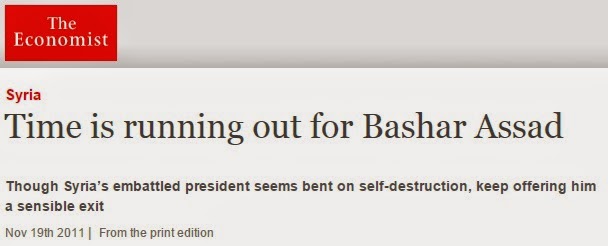
The Economist, November 19, 2011:
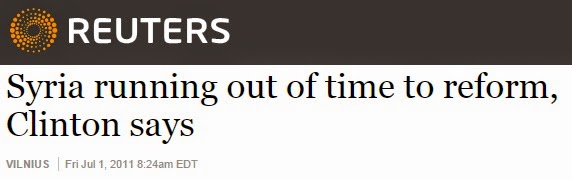
Reuters, July 1, 2011:
*****
UK media hypes up RAF interception of Latvian plane
RT | October 30, 2014
Two Royal Air Force jets reportedly threatened to shoot down a Latvian cargo plane, rushing at supersonic speeds to intercept it, after the plane failed to respond to air traffic control over Kent in Southern England and sent authorities into panic mode.
“I am instructed by Her Majesty’s Government of the United Kingdom to warn you that, if you do not respond immediately to my orders, you will be shot down,” radioed one of the jets, according to an audio recording circulating in UK media.
The incident occurred at about 5pm local time after the Latvian Antonov An-26 aircraft failed to make contact with air traffic controllers.
British Typhoons were tasked with intercepting the cargo plane. “To fulfill their quick reaction role, they were cleared to travel at supersonic speed,” an RAF spokesperson said, adding that the speed explains the loud noise people heard in the air.
Many locals took to Twitter, describing how their houses shook after the loud bangs.
Communications with the civilian pilots were restored only after the jets intercepted the plane.
The Latvian plane was then escorted to London’s Stansted Airport at around 5:20 pm “All three people who were on board have been spoken to by police,” AP quoted Essex Police spokeswoman Emma Thomas as saying. “It was established that everything was in order and the reason for the short loss of communication was due to a change in airspace jurisdiction.”
Russian planes everywhere
The excitement surrounding the intercept – apparently based on post-9/11 terrorist attack fears – came amid a heightened terror alert in the UK at the time of the allied military campaign against the Islamic State.
Media reports mirrored the panic frenzy triggered by the incident, but in a peculiar way: first saying that the cargo plane was “Russian” and then switching to a “Russian-made” reference.
Both takes were wrong: the Antonov design bureau, the producer of An-26 planes, is a Ukrainian company founded in Soviet times, and the plane in question belonged to a Latvian-registered company, ironically called RAF-Avia.
However, the British media seemingly capitalized on the latest NATO reports of “unusual” increased activity of Russian military aircrafts over the Atlantic and the Black Sea.
NATO stated that it has intercepted four groups of Russian planes since Tuesday. “These sizeable Russian flights represent an unusual level of air activity over European airspace,” the alliance said.
Most media reports based on the NATO statement failed to mention that the Russian planes did not cross any borders and remained within international airspace in every mentioned case.
Four Tupolev Tu-95 strategic bombers were spotted participating in a military exercise over the Norwegian Sea early on Wednesday. “We see Russian aircraft near our airspace on a regular basis but what was unusual is that it was a large number of aircraft and pushed further south than we normally see,” Reuters quoted a Norwegian military spokesman as saying.
In another incident on Wednesday, two Tu-95s were being monitored by Turkish aircraft over the Black Sea.
Language that disappears the Palestinians
By Jonathon Cook | The Blog from Nazareth | October 28, 2014
The Guardian has about the best coverage to be found in the mainstream media of the Israel-Palestine conflict – which tells you quite how bad everyone else is.
Today the paper’s readers’ editor, Chris Elliott, ponders complaints about its coverage. Not surprisingly, many of them are from the Israeli embassy, which says it is concerned about the Guardian’s disproportionate interest in Israel-Palestine, implying that this is evidence of anti-semitism.
Actually it is quite the opposite. It is evidence of the Guardian’s historic and current support for the state of Israel, though not the occupation. Elliott alludes to this obliquely as he points out that the paper’s most famous editor, C P Scott, was instrumental in getting the British government to issue the Balfour Declaration. The Guardian’s pride in having helped to create a Jewish state is still palpable at the paper (as I know from my years there), especially among senior Jewish editors who influence much of the conflict’s coverage – yes, that is a reference to Jonathan Freedland, among others.
The Israeli embassy, of course, is trying to browbeat the Guardian to bring it into line with the dire coverage of the rest of the media.
The lesson the readers’ editor draws is:
When looking at these three complaints I think the important message is that if the Guardian is to continue its strong focus on Israel and Palestine, which it is entirely at liberty to do, we have to put a similar effort into the use and awareness of language that we use to discuss the issues on both sides.
And yet, as usual, the article only considers the problematic use of language regarding the Israeli side of the conflict. The reality is that the Guardian, like most western media, is really only interested in the Israel-Palestine conflict because of the Jews, not the Palestinians. There are many reasons for this:
- historic European guilt about the Holocaust;
- the central place of the Jews in Biblical stories most westerners were raised on in the still-Christian west;
- the sense that the Jews are more like us than the “Arabs” – that they are, as Theodor Herzl, the father of Zionism, put it, “a rampart of Europe against Asia, an outpost of civilization as opposed to barbarism”;
- the fact (mostly unmentionable) that Jews are strongly represented on the staff of western media often in senior positions, but rarely are there any Muslims or Arabs, and that many Jewish staff naturally identify with the plight of relatives in Israel;
- the continuing appointment to Jerusalem bureaux of partisan Jewish reporters who speak Hebrew but not Arabic; live in west Jerusalem, not East Jerusalem; whose younger children go to Jewish schools, not Arab schools; and whose older children serve in the army.
All of this is so normalised among the western media that the New York Times barely seems concerned that at least three of its senior writers on the conflict have had children serving in the Israeli army: Ethan Bronner, David Brooks and now, we discover, Isabel Kershner. We will know that we have an even-handed media only when we can conceive of a paper recruiting not only a Palestinian reporter (in itself almost impossible, it seems) but a Palestinian reporter with a child who openly supports Hamas (let’s not even try to imagine the possibility of their being allowed to have a child who fights in the resistance!).
As the Guardian’s Elliott inadvertently indicates, sensitivity about language is central to the concerns of papers like the Guardian when it comes to the Jewish side, but not so much when it comes to the Palestinians.
Today Moshe Machover, a London University philosophy professor, sent a letter to the readers’ editor that I reproduce below concerning a recent Guardian article. The Guardian’s report contains the usual insensitivities of language towards the Palestinians, so common-place that they are never noted or questioned. But this is about more than insensitivity. It is about the constant misuse of language in ways that work to Israel’s benefit by shaping how western publics understand the conflict. In fact, it is precisely such language that has enabled Israel to incrementally disappear the Palestinians.
Dear Readers’ Editor,
In yesterday’s Guardian there was a report by your Jerusalem correspondent Peter Beaumont about what is in fact Israel’s continued illegal colonization of east Jerusalem.
http://www.theguardian.com/world/2014/oct/27/israel-construct-settler-homes-east-jerusalem-netanyahu
It began:
“The Israeli government is to advance construction plans for 1,000 housing units to be built in parts of Jerusalem that Palestinians demand for their future state.”
The wording “the Palestinians demand” suggest that these parts of Jerusalem do not belong to the Palestinians but to someone else. This false impression is reinforced by what follows:
“The move, revealed by the prime minister, Binyamin Netanyahu, is the first in what is expected to be a series of announcements this week on new settlement construction work in East Jerusalem and on the occupied West Bank.”
Surely, “work in East Jerusalem and on the occupied West Bank” is wrong as it falsely suggests that East Jerusalem is not occupied but belongs to Israel; it should have been “work in occupied East Jerusalem and West Bank.” I am sure you will wish to correct this misleading wording in your next column.
Sincerely,
Moshé Machover
Treating Putin Like a Lunatic
By Robert Parry | Consortium News | October 25, 2014
When reading the New York Times on many foreign policy issues, it doesn’t take a savant to figure out what the newspaper’s bias is. Anything, for instance, relating to Russian President Vladimir Putin drips of contempt and hostility.
Rather than offer the Times’ readers an objective or even slightly fair-minded account of Putin’s remarks, we are fed a steady diet of highly prejudicial language, such as we find in Saturday’s article about Putin’s comments at a conference in which he noted U.S. contributions to chaos in countries, such as Afghanistan, Iraq, Libya, Syria and Ukraine.
That Putin is correct appears almost irrelevant to the Times, which simply writes that Putin “unleashed perhaps his strongest diatribe against the United States yet” with his goal “to sell Moscow’s view that American meddling has sparked most of the world’s recent crises.”
Rather than address the merits of Putin’s critique, the Times’ article by Neil MacFarquhar uncritically cites the “group think” of Official Washington: “Russia is often accused of provoking the crisis in Ukraine by annexing Crimea, and of prolonging the agony in Syria by helping to crush a popular uprising against President Bashar al-Assad, Moscow’s last major Arab ally. Some analysts have suggested that Mr. Putin seeks to restore the lost power and influence of the Soviet Union, or even the Russian Empire, in a bid to prolong his own rule.”
Yes, “some analysts” can be cited to support nearly any claim no matter how wrongheaded, or you can use the passive tense – “is often accused” – to present any charge no matter how unfair. But a more realistic summary of the various crises afflicting the world would note that Putin is correct when he describes past U.S. backing for various extremists, from Islamic fundamentalists in the Middle East and Central Asia to neo-Nazis in Ukraine.
For example, during the 1980s, the Reagan administration consciously encouraged Islamic fundamentalism as a strategy to cause trouble for “atheistic communism” in Afghanistan and in the Muslim provinces of the Soviet Union.
To overthrow a Soviet-backed government in Afghanistan, the CIA and its Saudi collaborators financed the mujahedeen “holy warriors” who counted among their supporters Saudi extremist Osama bin Laden. Some of those Islamists later blended into the Taliban and al-Qaeda with dire consequences for the United States on Sept. 11, 2001.
By invading Iraq in 2003, President George W. Bush toppled a secular dictator, Saddam Hussein, but saw him replaced by what amounted to a Shiite theocracy which pushed Iraq’s Sunni minority into the arms of “Al-Qaeda in Iraq,” which has since rebranded itself as the Islamic State of Iraq and Syria or simply the Islamic State. Those extremists now control large swaths of Iraq and Syria and have massacred religious minorities and Western hostages, prompting another U.S. military intervention.
Obama’s Interventions
In Libya in 2011, President Barack Obama acquiesced to demands from “liberal interventionists” in his administration and authorized an air war to overthrow another secular autocrat, Muammar Gaddafi, whose ouster and murder have sent Libya spiraling into political chaos amid warring Islamist militias. It turns out Gaddafi was not wrong when he warned of Islamist terrorists operating around Benghazi.
Similarly, Official Washington’s embrace of protests and violence aimed at removing another secular Arab leader, Syria’s Bashar al-Assad, contributed to the bloody civil war that has devastated that country and created fertile ground for the Islamic State and the Nusra Front, the official al-Qaeda affiliate.
Though Obama balked at demands from neocons and “liberal interventionists” that he launch an air war against the Syrian military in 2013, he did authorize secret shipments of weapons and training for the supposedly “moderate” Syrian rebels who have generally sided with Islamist fighters affiliated with al-Qaeda and the Islamic State.
Many of these same neocons and “liberal interventionists” have been eager to ratchet up the confrontation with Iran over its nuclear program, including neocon dreams to “bomb, bomb, bomb Iran,” also a desire of hardliners in Israel.
In some of these crises, one of the few international leaders who has cooperated with Obama to tamp down tensions has been Putin, who helped negotiate conflict-avoiding agreements with Syria and Iran. But those peaceful interventions made Putin an inviting target for the neocons who began in fall 2013 arranging a coup d’etat in Ukraine on Russia’s border.
As Obama and Putin each paid too little attention to these maneuvers, neocons such as National Endowment for Democracy president Carl Gershman, Sen. John McCain, R-Arizona, and Assistant Secretary of State for European Affairs Victoria Nuland went to work on the Ukrainian coup.
However to actually overthrow Ukraine’s elected President Viktor Yanukovych, the coup makers had to collaborate with neo-Nazi militias which were organized in western Ukraine and dispatched to Kiev where they provided the muscle for the Maidan uprising. Neo-Nazi leaders were given several ministries in the new government, and neo-Nazi militants were incorporated into the National Guard and “volunteer” militias dispatched to crush the ethnic Russian resistance in the east.
Putin for the Status Quo
The underlying reality of the Ukraine crisis was that Putin actually supported the country’s status quo, i.e. maintaining the elected president and the constitutional process. It was the United States along with the European Union that sought to topple the existing system and pull Ukraine from Russia’s orbit into the West’s.
Whatever one thinks about the merits of that change, it is factually wrong to accuse Putin of initiating the Ukraine crisis or to extrapolate from Official Washington’s false conventional wisdom and conclude that Putin is a new Hitler, an aggressor seeking to reestablish the Soviet Union or the Russian Empire.
But the Times and other major U.S. news outlets have wedded themselves to that propaganda theme and now cannot deviate from it. So, when Putin states the obvious – that the U.S. has meddled in the affairs of other nations and that Russia did not pick the fight over Ukraine – his comments must be treated like the ravings of a lunatic unleashing some “diatribe.”
Among Putin’s ranting was his observation, according to the Times article, that “the United States supports ‘dubious’ groups ranging from ‘open neo-fascists to Islamic radicals.’
“‘Why do they support such people,’ he asked the annual gathering known as the Valdai Club, which met this year in the southern resort town of Sochi. ‘They do this because they decide to use them as instruments along the way in achieving their goals, but then burn their fingers and recoil.’
“The goal of the United States, he said, was to try to create a unipolar world in which American interests went unchallenged. …
“Mr. Putin … specifically denied trying to restore the Russian Empire. He argued Russia was compelled to intervene in Ukraine because that country was in the midst of a ‘civilized dialogue’ over its political future when the West staged a coup to oust the president last February, pushing the country into chaos and civil war.
“‘We did not start this,’ he said. ‘Statements that Russia is trying to reinstate some sort of empire, that it is encroaching on the sovereignty of its neighbors, are groundless.’”
Of course, all the “smart people” of Official Washington know how to react to such statements from Putin, with a snicker and a roll of the eyes. After all, they’ve been reading the narratives of these crises as fictionalized by the New York Times, the Washington Post, etc.
Rationality and realism seem to have lost any place in the workings of the mainstream U.S. news media.
~
Investigative reporter Robert Parry broke many of the Iran-Contra stories for The Associated Press and Newsweek in the 1980s. You can buy his new book, America’s Stolen Narrative, either in print here or as an e-book (from Amazon and barnesandnoble.com).
Is the CIA Running a Defamation Campaign Against Putin?
The latest hot topic in the Russian media. Russian politicians are talking about it. Historical precedent and behavior of Western media suggests that they are.
RI Interview | October 24, 2014

A major topic in the Russian media is mystification with how Putin is portrayed in the Western media.
Wildly popular at home, and seen as a decent, modest, an admirable person, and Russians don’t understand how there can be such a disconnect with Western impressions.
Recently, leading Russian commentators and politicians have been suggesting that this can only be explained by a deliberate campaign to defame Putin, by governments or other groups.
Yesterday, at a briefing to foreign journalists, Sergey Ivanov, Putin’s chief of staff, arguably the 2nd most powerful man in Russia, spoke of an “information war” consisting of “personal attacks” on Putin.

The western media hit a new low…
The day before another member of Putin’s inner circle, Vyasheslav Volodin, made similar remarks, telling foreign journalists “an attack on Putin is an attack on Russia.”
The logic, they argue, is that by defaming the leader of a country, you weaken his power domestically by undermining popular support for him, and internationally, by rallying popular opinion to support policies against that country. The ultimate goal, they argue, is to weaken the country itself. They also talk about regime change.
They argue that if one looks at the facts, that there is evidence of ongoing character assassination which cannot be explained by a vague popular zeitgeist in the West, but is more likely the result of a dedicated effort to introduce this defamation into the news flow.

Newsweek has been one of the most virulent Putin-bashers for years
The issue of manipulation of news by intelligence services has been in the news recently with revelations that the CIA and German Secret Service (GSS) have long-running programs to influence how media executives and top journalists convey and interpret the news, including direct cash payments.
Here are some examples they point to:
- Portraying him as a scheming dictator trying to rebuild a repressive empire.
- Claiming he personally ordered the murder of a number of journalists, and personally ordered a KGB defector to be murdered with radiation poisoning.
- Frequently citing unsubstantiated rumors he is having an affair with a famous gymnast.
- Allegations that he has stashed away billions for his personal benefit, without providing evidence.
- Recent article in newsweek claiming he leads a luxurious and lazy lifestyle, sleeping late.
- Recent article in NYT focusing on a supposed personal arrogance.
- Hillary Clinton mentioning in speech after speech that he is a bad guy, a bully, that one must confront him forcefully.
- Frequently using pejoratives to describe his person – “a jerk and a thug” (Thomas Friedman this week in the NYT)
- Mis-quoting him on his regret about the collapse of the Soviet Union.
- Articles about a supposed super-luxury villa built for him in southern Russia.
- The over-the top headlines in the western media (they were worst of all in Germany) portraying him personally responsible for murdering the victims of MH17.
- And soft stuff – magazine covers making him look sinister, monstrous, etc.
RI sat down with The Saker, a leading analyst of Russia in international affairs, and asked him what he thinks:
———————————–
So, is there any credence to this line of thinking, or is this conspiracy theorists running wild?
There is no doubt in my mind whatsoever that the US is waging a major psyop war against Russia, although not a shooting war, for now, and that what we are seeing is a targeted campaign to discredit Putin and achieve “regime change” in Russia or, should that fail, at the very least “regime weakening” and “Russia weakening”.

So this is a US government program?
Yes, Putin is absolutely hated by certain factions in the US government two main reasons:
1. He partially, but not fully, restored Russia’s sovereignty which under Gorbachev and Yeltsin had been totally lost … Russia then was a US colony like Ukraine is today … and,
2. He dared to openly defy the USA and its civilizational model.
… a free and sovereign Russia is perceived by the US “deep state” as an existential threat which has to be crushed. … this is a full-scale political assault on Russia and Putin personally.
So what the Russians are saying, that the constant personal attacks against Putin in the global media are partly the result of deliberate efforts by US intelligence services, … basically, planted stories…
Yes, absolutely
It seems like “Operation Mockingbird” all over again… Are you aware of other instances aimed at Putin?
(Editors Note: Operation Mockingbird was a CIA program started in the 1950s to influence the US media, which was gradually exposed by investigative journalists starting in the late 60s, culminating in sensational televised congressional hearings in 1975 which shocked the nation, forcing the program’s termination. Critics maintain that the same tactics have continued since, under different programs. Wikipedia)
Yes, of course. Since this defamation has very little traction with the Russian public … Putin’s popularity is higher than ever before .., there is an organized campaign to convince them that Putin is “selling out” Novorussia, that he is a puppet of oligarchs who are making deals with Ukrainian oligarchs to back-stab the Novorussian resistance…
… So far, Putin’s policies in the Ukraine have enjoyed very strong support from the Russian people who still oppose an overt military intervention…
… but if Kiev attacks Novorussia again – which appears very likely – and if such an attack is successful – which is less likely but always possible – then Putin will be blamed for having given the Ukrainians the time to regroup and reorganize.

Warm and fuzzy…
So you are saying that if the Ukrainian military strengthens its position enough to deliver a serious blow to the East Ukrainians, the US can use this as a method to strike at Putin’s support base…
Yes, that’s right … there are a lot of “fake patriots” in Russia and abroad who will reject any negotiated solution and who will present any compromise as a “betrayal”. They are the “useful idiots” used by western special services to smear and undermine Putin.
Is it limited to government special ops, or are there other groups who might have an interest in doing this?
Yes, well here is something that most people in the west don’t appreciate… there is a major behind-the scenes struggle among Russian elites between what I call the “Eurasian Sovereignists” (basically, those who support Putin) and what I call the “Atlantic Integrationists” (those whom Putin refers to as the “5th column).
The western media talks about this as the struggle between Russian liberals and conservatives, reformers and reactionaries, right?
Well its sort of like that, but not exactly…
The former see Russia’s future in the Russian North and East and want to turn Russia towards Asia, Latin America and the rest of the world, while the latter want Russia to become part of the “North Atlantic” power configuration.
The Atlantic Integrationists are now too weak to openly challenge Putin – whose real power base is his immense popular support – but they are quietly sabotaging his efforts to reform Russia while supporting anti-Putin campaigns.
Regarding the revelations of CIA activities in Germany, do you think this is going on in other countries, in the US?
I am sure that this is happening in most countries worldwide. The very nature of the modern corporate media is such that it makes journalists corrupt.
As the French philosopher Alain Soral says “nowadays a reporter is either unemployed or a prostitute”. There are, of course, a few exceptions, but by and large this is true.
This is not to say that most journalists are on the take. In the West this is mostly done in a more subtle way – by making it clear which ideas do or do not pass the editorial control, by lavishly rewarding those journalists who ‘get it’ and by quietly turning away those who don’t.
If a journalist or reporter commits the crime of “crimethink” he or she will be sidelined and soon out of work.
There is no real pluralism in the West where the boundaries of what can be said or not are very strictly fixed.
Ok, but is it like what has been revealed in Germany, …similar specific operational programs in France, the UK, Italy, Latin America, etc.
Yes, one has to assume so – it is in their interests to have them and there is no reason for them not to.
As for the CIA, it de-facto controls enough of the corporate media to “set the tone”. As somebody who in the past used to read the Soviet press for a living, I can sincerely say that it was far more honest and more pluralistic than the press in the USA or EU today.
Joseph Goebbels or Edward Bernays could not have imagined the degree of sophistication of modern propaganda machines.
If the US is doing it, can’t one assume other governments are too? Are the Russians doing it against western leaders?
I think that all governments try to do that kind of stuff. However, what makes the US so unique it a combination of truly phenomenal arrogance and multi-billion dollar budgets.
The US “deep state” owns the western corporate media which is by far the most powerful media on the planet. Most governments can only do that inside their own country … to smear a political opponent or discredit a public figure, but they simply do not have the resources to mount an international strategic psyop campaign. This is something only the US can do.
So foreign governments are at a great disadvantage in this arena vis-a-vis the US?
Absolutely.
Fragile fact-checking: How the media fell in and out of love with the Sikorski ‘revelations’
By Bryan MacDonald | RT | October 22, 2014
What’s worse than a junior neocon? A junior neocon trying to make a name for himself. Ben Judah’s meteoric rise, aided by his staunch anti-Russian credentials in a climate of fear, has imploded as quickly as it began.
As I learnt the hard way, when you are a young man in a hurry it’s easy to trip up. The first few times you’ll, probably, be forgiven but once it becomes a trend, even the most ardent supporters will abandon you. The fewer redeeming features you possess, the faster it’ll happen. When it has the potential to create an international diplomatic crisis, I can only assume it’s fatal to that once promising career.
On Sunday, the niche US journal Politico published a piece which, briefly, rocked the Russia-related media world. In a rambling, rabble-rousing diatribe by Ben Judah came a, seemingly amazing, scoop – Vladimir Putin had allegedly proposed, in a 2008 Moscow meeting, that Russia and Poland divide Ukraine between them. The source for this, supposed, latter-day Molotov-Ribbentrop pact was given as ex-Polish Foreign Minister Radoslaw Sikorski. Carl Bildt was also included – but the less said about him the better – in a veritable neocon tea party. After reading about the ostensible carve-up, I was wondering what century I was in.
Following some nonsense about Napoleon, Sikorski was quoted as saying: “He (Putin) wanted us (Poland) to become participants in this partition of Ukraine.”
“This was one of the things that Putin said to my prime minister, Donald Tusk, when he visited Moscow. He went on to say Ukraine is an artificial country and that Lwow (sic) is a Polish city and why don’t we just sort it out together? Luckily Tusk didn’t answer. He knew he was being recorded,” Sikorski, supposedly, added.
If true, the only word could have been ‘wow.’ However, I doubted it right away. The author was not credible (previously he’d written a Newsweek lead which read like an audition for a post at Hello! Magazine) and the comment about recording seemed odd. It’s par-for-the-course in bilateral talks, especially in situations of mutual distrust, for both parties to record conversations – and there’s few relationships as chary as Moscow-Warsaw.
This is done to counter misquotations later and I’ve known about the practice since my cub reporter days in Dublin. John Kerry and Sergey Lavrov have become famous this year for their garden walks in Moscow and Paris. They don’t do it because they are horticulture enthusiasts – it’s an opportunity to speak candidly without fear of leaks.
The fictional piece attempts to argue that Vladimir Putin would, somehow, trust a Eurocentric leader like Donald Tusk with such a cunning plan. That raised the alarm. Did Judah and Politico really believe serious analysts would swallow this? No matter what mud is hurled at Putin, it rarely comes with the word ‘stupid’ emblazoned across it.
You don’t rise from being a minor KGB agent in East Germany to head of the FSB by being dopey. You do it by being, extremely, clever. An exceedingly savvy Russian President would hardly make a proposal to divvy up Ukraine to a, noted, pro-Western Polish PM. In fact, unless the Russian intelligence services were having a New Year’s Party that extended into May, Putin would have been well briefed on Tusk.
There are a few more wing-nut positions in the piece. The elected Russian government is described as an “imperialist dictatorship,” Never mind that for a Brit to be accusing anybody of imperialism is beyond parody, it takes some imagination to dream up that kind of nonsense.
Judah goes on to state that “European leaders, intimidated by his charisma and outspoken views on Russia, chose not to appoint him as Europe’s high representative for foreign affairs earlier this year.” It’s clear that it was something a trifle more troubling than Sikorski’s pizzazz that stymied that bid. The clue is in the article.
The desultory screed then gets bogged down with information from Kremlin ‘sources’ – who conveniently agree with the author on his anti-Russia and Putin views. The two are not synonymous – many decent western journalists dislike the current Moscow government but love the country. Judah, clearly, is fond of neither. Anyway, I don’t buy the veracity of these ‘sources’ but, luckily, I have a genuine insider in my circle of acquaintances. I asked him if I was wrong in doubting whether Judah’s ‘moles’ are not skin blemishes or figments of the imagination? “No, I don’t think he has reliable sources there,” was the succinct reply.
On Tuesday, my initial hunch was proven right. Sikorski distanced himself from Judah and claimed “his memory had failed him.” He clarified that there had been no bilateral meeting at all between Tusk and Putin in Moscow in 2008. Information about Putin’s meetings is freely available online and his own website has an archive dating back to the year 2000. There is a record of a February 2008 visit by Tusk to Moscow available there.
Sikorski tweeted that “the interview with Politico was not authorised, and some of my words have been over-interpreted.” These comments might seem odd to foreign ears (not authorised) but experienced journalists know that this is Polish custom – and, indeed, German. It’s known as ‘copy approval’ in the UK, something which is granted more often than people think. It’s quasi standard practice for controversial interviews with big hitters.
Prime Minister Ewa Kopacz, from the same party as Sikorski, criticised him: “I will not tolerate this kind of behaviour. I will not tolerate this kind of standards that Speaker Sikorski tried to present at today’s (news) conference.” This was after the ex-Foreign Minister had, initially, dodged questions before being rolled out again and, finally, opening up. Political opponents want him fired, saying there is no room in politics for what they called “irresponsibility.”
I usually conclude columns of this nature with warning of how dangerous such – often deliberately – erroneous western media commentary is. Not this time. All bar the biggest lunatics in the American press have washed their hands of this nonsense, so there’s no need.
As of midnight Tuesday, London time, Politico had still not retracted any of the allegations their piece made. The article’s foot-note read “Ben Judah is author of Fragile Empire: How Russia Fell In And Out Of Love With Vladimir Putin.” Yes, that 88 per cent approval rating Putin. I’m off now to work on my book – “How America Fell Out Of And Then Into Love With Barack Obama.” Yes, that 40 per cent approval rating Obama.
READ MORE: Sikorski U-turn: Polish ex-FM backtracks on scandalous ‘divide Ukraine’ claim
Bryan MacDonald is a journalist, writer, broadcaster and teacher. He wrote for Irish Independent and Daily Mail. He has also frequently appeared on RTE and Newstalk in Ireland as well as RT.
Russia accuses Sweden of escalating tension in Baltic Sea
RT | October 24, 2014
The Russian Defense Ministry believes the military operation in the Baltic conducted by Sweden in search of possible “foreign underwater activity” can only lead to undermining stability and escalate tension in the region.
“Such unfounded actions of the Swedish Defense Department, fuelled by the Cold War-style rhetoric, are only leading today to escalation of tension in the region,” Ministry spokesman Igor Konashenkov told journalists on Friday.
“It might result not in strengthening of a particular country’s security, but in undermining the principles of the naval economic activity in the Baltic Sea,” he added.
Konashenkov said Russian military officials were anticipating “the culmination of the exciting operation” accompanied by “never-ceasing speculations by the Swedish over detecting a ‘Russian submarine’ in the region of the Stockholm archipelago.”
Sweden started its largest since the Cold War military operation in the Baltic a week ago, explaining that the troops were engaged in search of a possible “foreign underwater activity.”
The Swedish media alleged the operation could be the hunt for a “damaged Russian submarine” in the area.
Moscow has long denied any of its vessels have been damaged. Konashenkov on Friday once again ruled out any possibility of the Swedish military ever finding a Russian submarine in the Stockholm archipelago.
The Swedish military announced on Friday it is curtailing the search operation.
“This means the bulk of ships and amphibious forces have returned to port,” the armed forces said in a statement, cited by Reuters. The military have however said the area would still be monitored by smaller forces.
That’s a U-turn from Thursday’s statement by Swedish Armed Forces spokesman Erik Lagersten, who said that the operation was not scaling down, but was entering a “new phase.”
“The intelligence-gathering operation is continuing just as before,” Lagersten said, according to the Local. “We still believe there is underwater activity.”
On Tuesday, Sweden announced it was ready to use force if it detects any foreign submarine in the waters of the Stockholm Archipelago.
Stockholm has chosen not to prolong the program for military exchange with Moscow, citing Russia’s alleged “challenging” activity in the Baltic Sea, according to Sweden’s draft budget, made public on Thursday.
“This means that Defense Forces’ cooperation with Russia is suspended until further notice,” the text of the budget says.
The draft budget says Sweden has to boost its security. According to the document, Stockholm plans to increase its military spending for 2015 by 680 million kronas (US$93.7 million).
Background: Sweden ready to use force to surface foreign sub as search continues
Ottawa shooting: a false flag designed to steal away our freedoms?
Brandon Martinez | Non-Aligned Media | October 22, 2014
I’m not one to hastily jump to conclusions about events like these, but the alleged shooting at the Canadian parliament and a nearby war memorial that took place today smells like a false-flag operation designed to expedite the Harper regime’s militarist agenda.
The mainstream media is in a furor over the incident. Non-stop wall-to-wall coverage has commenced. Even American and British outlets have picked up the story.
One very noticeable clue as to the fraudulent nature of this event is the immediate calls from establishment propagandists for a crack down on free speech (what they call “hate speech”) and the bolstering of Orwellian “anti-terrorism” laws which will in effect hand the state unlimited powers to spy on the citizenry of Canada and snuff out dissidents.
For example, the former CSIS Assistant Director Ray Boisvert said this on CBC:
“We need to get at those who are the purveyors of hate. So those who proselytize, those who are radicalizing, we need to find ways to go after them with respect to hate speech or perhaps its time for new legislation under the anti-terrorism act as we’re seeing in the UK.”
The former Canadian spy boss essentially echoed what British PM David Cameron said in a UN speech last month wherein he called for “non-violent extremists” to be criminalized. The traitorous British statesman specifically named 9/11 and 7/7 skeptics as falling within his dubious definition of “non-violent extremists.”
Another suspicious guest on the aforementioned CBC program used innuendo to try to link the Ottawa shooting to ISIS and Islamism, conveniently at a time when Stephen Harper is looking to justify his decision to whore out our military in the US-led bombing initiative in Iraq.
Shortly after the false-flag attacks of 9/11, the Canadian government mimicked its US counterpart by passing anti-terror laws which included the infamous “Section 13″ provision in the Human Rights Act that was consequently used by Zionists and their agents to silence critics on the internet.
Look for more of the same from the Zionist regime in Ottawa in the coming days. The mainstream media’s job is to whip up hysteria in order to scare the populace into accepting draconian laws that will eliminate our freedoms. Unfortunately most of the population are lemmings who will believe anything the government or media tells them and willingly forfeit their freedoms to the deceptive miscreants who currently occupy our government.
In any case, one cannot discount the very real possibility that the Canadian state had a hand in this.
Click here to listen to Joshua Blakeney’s commentary on the matter.
What submarine in Sweden?
By Jan Oberg | Transnational Foundation for Peace & Future Research | October 22, 2014
You have heard that Sweden is hunting a ”submarine” and that it is ”presumed to be Russian”. Here is an example, Financial Times of October 21 – which incidentally also announces that the Swedish Prime Minister vows to increase defence spending.
Not the slightest evidence
There are only three problems with this:
1) There is not the slightest evidence of there being anything military, neither that it is a submarine nor that, whatever the object might be, it is Russian.
2) Even with CNN, BBC and AlJazeera this is nothing but speculative low-grade yellow press journalism. This is possible in the field of defence, security and peace because much less is required of journalists when they write about these matters than when they write about, say, domestic politics, economics, sports, books or food and wine. In these fields you are expected to have some knowledge and media consumers are able to check.
3) It serves other purposes than bringing you information: either to increase further the negative image of Russia, push Sweden into full NATO membership – see the remarkable offer by NATOs former Allied Supreme Commander, Stavridis – for NATO to come and help Sweden – or to scare the Swedes into feeling that it is necessary to pay even more to the Swedish military (a mechanism also called fearology).
Virtually every aspect of the media hype is based on prejudices instead of interest-based analysis and on partial and paid expertise that follows the ‘party line’. Russia has ‘denied’ it is there; Holland has ‘dismissed’ that its submarine should be there.
With one or two exceptions, all Swedish and international media have avoided asking: Could it be something else but a sub and somebody else but the Russians – or nothing at all?
The alleged-ness of it all is good enough to pass for objective reporting in the – alleged – free media.
From Swedish defence force to farce
Worse, the Swedish military has already made a fool of itself – not to be expected given the fairly large resources it has at its disposal.
It has sold off helicopters it now dearly needs.
It’s been – at least officially – relying on tips from ordinary citizens and one wonders where the intelligence (in more than one sense of that word) is.
A suspicion that a (Russian) special forces man had gone on land turned out to be an Swedish pensioner out fishing.
It has published a blurred photo of a wave-covered ‘object’ to be seen far out through some trees and indicated wrongly where that photo was taken.
One indeed wonders whether this farcical performance is made to show that it is so helpless that it must have large resources.
The more relevant consideration would be: How on earth can such amateurism be so easily accepted by the government, media and the people – and even used as an argument for what the PM has just announced?
Or to put it crudely: What does the Swedes get for their tax money?
Sweden is not a helpless pawn in the game
Sweden with a population of roughly 9 million is # 33 on the world list of military expenditures, spending US $ 6,2 billion per year. That is US $ 657 per capita, # 17 in the world.
Russia spends US$ 403 per capita and its overall military expenditures is 8% of NATO’s.
Sweden, thus, is not a helpless pawn in some game. If its military isn’t able to do better when it is really needed, someone should be made responsible.
Is it Russian?
If there is something out there, is it likely to be Russian? Not very likely.
Moscow knows very well that if a Russian submarine was found and brought up to the surface, it would mean a huge boost for those in Sweden and elsewhere who would like to see Sweden as a full NATO member. That is not in Russia’s interest.
But of course, the Russians could play a high-risk game in these waters with some NATO subs or be plain foolish. It can’t be excluded – but it isn’t very likely that the object is Russian.
If it Russian, Sweden itself may anyhow have an interest in not officially finding anything – to keep the Russians in the dark about how much it knows and whether or not there already is a NATO assistance in this case. In both cases we are likely to never be told what it was all about.
Could it be from NATO?
Could it be from a NATO country? If so, we’ll also never know that.
The Swedish Chief of Staff has said that if something is found it would be shot at to come up to the surface. But it’s unthinkable that Sweden, if it knew an object to be from a NATO country – would a) shoot at it and b) tell the world that it knew.
After all, most violations of the Swedish air space has been known since the 1980s to be done by NATO fighters but it’s basically only when Russian fighters come near or violate that the Swedish defence establishment leaks it or the media are interested in it.
Sweden isn’t a neutral country today, if it ever were.
Could NATO have an interest in these waters? In the wake of the Ukraine crisis we are back to a kind of Cold War situation and NATO has moved its military positions forward in various ways and held a steady focus on the Baltic States.
So, yes, NATO could be in Swedish waters with or without the knowledge or consent of the Swedes; it could be roaming around to check on the Russians simply because tension has built up.
It could be placing sonars or whatever devices for future emergencies – while not wanting Sweden to know that it considers Sweden so close to NATO that it can just as well be used.
And if so, Sweden would rather not be told. Clearly Sweden could not officially endorse a NATO submarine presence on its territory as part of Anti-Submarine Warfare or planning for future war with Russia. Both parties know that.
Prediction
My concluding prediction is therefore rather simple: for the above reasons the Swedish military will soon call off the whole thing and the affair will have served its purpose – precisely by not stating what it was, who it was or why it was. Or if it was.
What the purpose of the event may be remains to be revealed at some point in the future. Or perhaps never if – the purpose was fearology for increased militarisation.
Somebody somewhere knows what’s going on. And they put citizens’ security at risk for purposes they would never tell you.
Featured Video

Iran’s Next Strike May Not Explode. It Could Shut You Down
or go to
Aletho News Archives – Video-Images
From the Archive
Zionism’s Violent Legacy
By Donald Neff | Washington Report On Middle East Affairs | January 1996
On January 4, 1948, Jewish terrorists drove a truck loaded with explosives into the center of the all Arab city of Jaffa and detonated it, killing 26 and wounding around 100 Palestinian men, women and children.[1] The attack was the work of the Irgun Zvai Leumi – the “National Military Organization,” also known by the Hebrew letters Etzel – the largest Jewish terrorist group in Palestine. The Irgun was headed by Revisionist Zionist Menachem Begin and had been killing and maiming Arabs, Britons and even Jews for the previous ten years in its efforts to establish a Jewish state.
This terror campaign meant that at the core of Revisionist Zionism there existed a philosophical embrace of violence. … continue
Blog Roll
 Aletho News
- Iran’s Next Strike May Not Explode. It Could Shut You Down /Col Doug Macgregor
- Iran: US political targets legitimate if assassinations return
- Iraq shuts key border crossing with Iran under US pressure: Report
- Undersea Internet cables could be targeted in retaliation for attacks on Iran: IRGC deputy chief
- EU sending ‘biased’ observers to interfere in Serbian election – president
- White House envoy declares kinetic action against Yemen ‘fruitless’
- Ukraine deployed thousands of microdrones in Iraqi Kurdistan: Tasnim
- Iran calls for emergency UNSC meeting over Trump’s ‘brazen’ bomb talk, Israeli threats
- Iranian sources reveal details of Russia-China Hormuz proposal
- Plan for more US-Israel integration puts our military tech at risk
- If Americans Knew
- Americans at National Conservatism Conference held in Israel this year criticize Israel
- Christiane Amanpour exits CNN with a legacy shaped by the debate over Israel
- Israel’s war on Iran is the final move in a decades-old strategy
- Israel Denies Entry to French Journalist, U.S. Researcher Amid Rise in Entry Denials
- Gaza’s hospitals are running out of life-saving fuel – Daily Update
- Mysterious bot accounts reportedly spread fake ‘man on the street’ videos for Michigan Senate candidate
- Israeli Defense Minister Katz Says Over 60 Lebanon Villages Have Been Destroyed
- Why Is Israel Running TV Ads in Iowa Ahead of the Midterms?
- Hind Rajab’s Alleged Killer Is in the United States. HRF Demands His Arrest.
- US Officials Face Fresh Pressure After Another American ‘Brutalized’ by Israeli Settlers in West Bank
- No Tricks Zone
- E-Cars Reduce CO2 Emissions By Only 41% Compared To Internal Combustion Engine Vehicles
- Predictions Made By Renowned Climate Professor Over Past Decades Have Been Proven To Be Poor
- New Study Suggests Large Regions Of The Pacific Ocean Have Been Cooling For The Last 80 Years
- Germany’s Green Energy Debacle: High Energy Costs Force Kahla Porzellan to Close After 182 Years!
- New Study: 50 Years Of The Most Aggressive ‘Net Zero’ Policies Can Only Affect The Global Climate By 0.03°C
- US September “Heat” Was No Record…Many Records Set Decades Ago
- Latest European Green Energy Debacle; Portugal’s Largest Flagship Solar Park Insolvent!
- Green Energy Debacle: German Expert Professor Fritz Vahrenholt Warns Of Severe Economic And Social Consequences
- Two More Paleo Reconstructions Affirm Meters-Higher Sea Levels Across Ireland, Brazil 7000-6000 Years Ago
- New Study: Earth And Venus Surface Warmth Largely Explained By Convection And Lapse Rate, Not CO2 Or Radiation

