The military buildup in the Mediterranean indicates that Assad’s opponents intend to militarily intervene in Syria under cover of ‘humanitarian intervention’, a disingenuous narrative that could not be further from the truth.
Pictures and videos that have surfaced following the alleged use of chemical agents in the eastern suburbs of Damascus are profoundly disturbing and a thorough and substantial investigation into what took place there is absolutely essential. However, it is conversely disturbing that those Western governments who have staunchly supported anti-government militants are using this opportunity to legitimize the use of force against the government in Damascus.
The United States, Britain, and France are unwavering in their assertions that the Assad government and the Syrian Arab army were the perpetrators of the chemical weapon attack, despite no evidence to substantiate these claims. These governments seem to be sure that Damascus is guilty on the basis of it preventing a UN investigation team from visiting the site, and when investigators eventually did reach the area, it didn’t matter to them because they argued that the Syrian government had destroyed all evidence of wrongdoing.
Assad’s opponents have constructed a deeply cynical and hysterical political narrative that Western leaders are now parroting in unison.
There are several reasons why Damascus showed hesitation in allowing UN inspectors to access the site, the most apparent being that this attack allegedly took place in rebel-held strongholds on the outskirts of the capital, and that the security of the UN team could not be guaranteed if rebels attacked them or launched more chemical weapons during their visit.
Syrian rebels have demonstrated their hostility to UN forces on previous occasions; anti-government groups kidnapped 21 UN peacekeepers in the Golan Heights in March, and another four peacekeepers later in May. That the UN convoy was fired upon by unidentified snipers is hardly surprising in that it is another stunt in a series of moves to escalate the situation to provoke an international response.
The UN team eventually made it to the site to collect evidence and, contrary to Western assertions, the UN claimed that it was still possible for the team of experts to gather necessary evidence despite the time elapsed since the alleged attack.
Who benefits from using chemical weapons?
The narrative that the Assad government used chemical weapons, specifically while a UN team was in Damascus to investigate previous uses of chemical weapons, is tactically and politically illogical and in no way serves the interests of the Syrian government.
These attacks transparently serve the interests of anti-government militias who have long called for NATO intervention, as well as the Syrian political opposition who are now refusing to take part in any planned Geneva negotiations. Furthermore, allegations that the regime used chemical weapons benefits the international opponents of Assad, who have materially and financially aided and armed non-state actors and foreign fighters on an unprecedented scale.
Above all, the use of chemical weapons benefits the arms industry, as four US warships with ballistic missiles are moving into position in the eastern Mediterranean Sea, ready to shower Damascus with Tomahawk cruise missiles – all under the auspices of protecting civilians. Lockheed Martin’s stock prices have dramatically shot up since news of the chemical weapons attack.
There are numerous revelations that would suggest that anti-government militias have access to these weapons and are in fact guilty of using them. Carla Del Ponte, head of a UN commission of inquiry that looked into the use of chemical weapons in northern Syria in late March suggested that the evidence was stronger to implicate anti-government militants in using chemical weapons, not the Syrian government.
A handout image released by the Syrian opposition’s Shaam News Network shows people inspecting bodies of children and adults laying on the ground as Syrian rebels claim they were killed in a toxic gas attack by pro-government forces in eastern Ghouta, on the outskirts of Damascus on August 21, 2013. (AFP Photo)
In May, Turkish police found cylinders of sarin nerve gas in the homes of Syrian militants from the Al-Qaeda-linked Al-Nusra Front who were detained in the south near Syria’s northern border. In July, Russian experts submitted reports to the UN detailing how the missiles used in previous chemical weapon attacks were crude and not factory made, and that the chemical components found were not consistent with what the Syrian military has.
The Syrian military has just recently discovered chemical weapons in a rebel tunnel in the Jobar suburb of Damascus, including shells, gasmasks manufactured in the United States, chemical substances of Saudi Arabian origin. Arabic language reports also indicate that a former high-ranking Saudi Arabian member of Al-Nusra Front claimed that the group possessed chemical weapons in a tweet.
NATO intervention replicating the Kosovo model?
The speeches and statements from John Kerry, Laurent Fabius, or William Hague all imply that military action will be taken against Damascus despite lacking a legal basis of action. If ‘humanitarian intervention’ were to be undertaken, it would need approval from the UNSC in the form of a resolution, but such a resolution would not be passed because countries such as Russia believe that this kind of intervention would be used as a pretext to remove the legal government of Syria, as it has been used in the recent past in the former Yugoslavia, Iraq and Libya – all with undeniable abuses of force that have resulted in substantial civilian casualties.
Reports indicate that Obama’s team is now studying the NATO mission in Kosovo as a “possible blueprint for acting without a mandate from the United Nations.” It is ominous, alarming and bizarre how NATO’s intervention in the former Yugoslavia could be used a positive reference point for anything. NATO rained down bombs for 78 straight days, effectively smashing civilian infrastructure in Serbia and Montenegro while hospitals, schools, and public utilities were damaged beyond repair, killing over 1,200 civilians and injuring 4,500 more.
Despite Obama’s cautious tone in recent interviews, all indications point to military intervention already being decided. Carla Del Ponte’s assessment was whitewashed, and any other evidence provided by the UN that does not fit conveniently into the Western narrative will be suppressed – the US position is that it is already “too late” for any evidence to be credible.
The huge military buildup of US and British ships and warplanes in the Mediterranean comes while the Pentagon is reportedly making the initial preparations for a cruise missile attack on Syrian government forces.
The intransigence and cynical duplicity of Assad’s opponents is unparalleled, and their media outlets are complicit in pulling the heart strings of their audiences while offering a totally one-sided perspective in support of R2P, the ‘right to protect.’
The US, Britain, and France see themselves as righteous protectors, and rationality and evidence will not be enough to break their dangerous and ridiculous delusions; these states are the vanguards of militant corporatism and have demonstrated that they seek only their private economic and geopolitical objectives in the region.
Those countries that represent a balanced approach to this crisis should not stand idly by while the West ‘comes to the aid’ of the Syrian people with cruise missiles and airstrikes – they should not allow intervention under ‘humanitarian’ auspices to harm civilians and topple the legal authorities in Damascus.
Former British Prime Minister Tony Blair has called on London and Washington to go to war in Syria to end what he claimed to be attacks on civilians “not seen since the dark days of Saddam”.
“People wince at the thought of intervention. But contemplate the future consequence of inaction and shudder,” said Blair who took Britain to the war in Iraq based on fabricated claims that Saddam had ready-to-launch weapons of mass destruction.
“Western policy is at a crossroads: commentary or action …. After the long and painful campaigns in Iraq and Afghanistan, I understand every impulse to stay clear of the turmoil …. But we have collectively to understand the consequences of wringing our hands instead of putting them to work,” he wrote in an article for The Times on Tuesday.
Blair’s comments come as there are serious qualms that the claims, led by Britain, the US and France, of Syrian government having carried out the chemical attack that allegedly killed hundreds of people on Wednesday are nothing but another deception to justify war, as was the case in Iraq.
British Prime Minister David Cameron and US President Barack Obama have been rattling sabers since Wednesday, saying they should intervene to end what Washington described as a “moral obscenity”.
However, Britain and its western allies have so far offered no evidence to support their claims against the government of Syrian President Bashar al-Asad.
The Conservative British PM will also have a hard time to persuade MPs to start a war after he was forced to promise to put any military action in Syria to parliamentary vote earlier this year after 82 Conservatives MPs signed a letter to demand such a process.
The opposition Labour party has also demanded the coalition government to ask for MPs’ approval before taking any military action.
Cameron has indicated he will consult the parliament with his office saying he could recall the parliament from a summer recess before it ends on Monday to discuss the situation in Syria.
Moscow has voiced “regret” over a US decision to put off bilateral talks over Syria. Russia has sought to placate calls for military action over the alleged use of chemical weapons, saying there is no evidence of the Assad regime’s complicity.
The US government announced it was postponing bilateral talks with Russia late Monday, citing “ongoing consultations” over the Syrian government’s alleged use of chemical weapons.
Russian and American officials had been scheduled to meet in The Hague on Wednesday for bilateral talks on the Syrian conflict.
Russian Deputy Foreign Minister Gennady Gatilov tweeted a response to the move Tuesday morning, expressing concern over Washington’s decision.
“It is a pity that our western partners have decided to cancel the bilateral US-Russian meeting to discuss calls for an international conference on Syria,” Gatilov wrote on Twitter. He added in a later post that discussing terms for a political solution were needed now more than ever in the face of possible military intervention in Syria.
Deputy Minister of Foreign Affairs Gennady Gatilov (RIA Novosti / Vladimir Fedorenko)
Foreign Affairs Committee chairman of the Russian Duma, Aleksey Pushkov also posted on his Twitter, alleging the US had already made the decision to strike Syria and they had gone too far.
A number of western countries including France, the US and the UK have condemned President Bashar Assad’s government for last week’s alleged chemical weapons attack in a Damascus suburb and called for a response, hinting at possible military action. On Monday, Russian President Vladimir Putin told British Prime Minster David Cameron in a phone conversation that there was still no evidence the Assad government was behind the attack.
However, Cameron insisted that Assad’s forces were behind the “chemical weapons” attack, saying that the Syrian opposition did not have the facilities to orchestrate such an attack. Cameron also cited the Syrian government’s delay in allowing a team of UN experts to examine the site as an indication that it had something to hide.
Washington has also seen an increase in rhetoric, urging action against the Assad government. Samantha Power, the US Ambassador to the UN, decried the Assad government for the attack on her Twitter account, and demanded accountability:
“Haunting images of entire families dead in their beds. Verdict is clear: Assad has used CWs against civilians in violation of int’l norm.”
Meanwhile, the UN weapons inspectors are due to start their second day of investigations in the Damascus suburb of Ghouta, where the toxic attack happened last Wednesday. The team’s convoy of vehicles came under fire from unknown assailants Monday as they visited the area.
In spite of the sniper attack, the team managed to collect samples for analysis and gather witness testimonies at a local hospital. Contradicting claims from the US and UK that the probe was too late to yield accurate results, the UN stressed the mission was still valid, although almost a week has passed since the supposed attack.
The alleged attack took place last Wednesday in an eastern suburb of Syria’s capital. Media published conflicting reports on the death toll, ranging from “dozens” to over 1,300 dead. French charity Medecins sans Frontieres (Doctors without Borders) put the death toll at about 355.
The liberal warhawks are groping around for a pretext they can call “legal” for waging war against Syria, and have come up with the 1999 “Kosovo war”.
This is not surprising insofar as a primary purpose of that US/NATO 78-day bombing spree was always to set a precedent for more such wars. The pretext of “saving the Kosovars” from an imaginary “genocide” was as false as the “weapons of mass destruction” pretext for war against Iraq, but the fakery has been much more successful with the general public. Therefore Kosovo retains its usefulness in the propaganda arsenal.
On August 24, the New York Times reported that President Obama’s national security aides are “studying the NATO air war in Kosovo as a possible blueprint for acting without a mandate from the United Nations.” (By the way, the “air war” was not “in Kosovo”, but struck the whole of what was then Yugoslavia, mostly destroying Serbia’s civilian infrastructure and also spreading destruction in Montenegro.)
On Friday, Obama admitted that going in and attacking another country “without a U.N. mandate and without clear evidence” raised questions in terms of international law.
According to the New York Times, “Kosovo is an obvious precedent for Mr. Obama because, as in Syria, civilians were killed and Russia had longstanding ties to the government authorities accused of the abuses. In 1999, President Bill Clinton used the endorsement of NATO and the rationale of protecting a vulnerable population to justify 78 days of airstrikes.”
“It’s a step too far to say we’re drawing up legal justifications for an action, given that the president hasn’t made a decision,” said a senior administration official, who spoke on the condition of anonymity to discuss the deliberations. “But Kosovo, of course, is a precedent of something that is perhaps similar.”
Ivo H. Daalder, a former United States ambassador to NATO, suggests that the administration could argue that the use of chemical weapons in Syria amounts to a grave humanitarian emergency, just as the Clinton administration argued in 1999 that “a grave humanitarian emergency” presented the “international community” with “the responsibility to act”.
This amounts to creative legality worthy of the planet’s number one Rogue State.
An Illegal War as Precedent for More War
The US/NATO war against Yugoslavia, which used unilateral force to break up a sovereign state, detaching the historic Serbian province of Kosovo and transforming it into a US satellite, was clearly in violation of international law.
In May 2000, the distinguished British authority on international law, Sir Ian Brownlie (1936-2010), presented a 16,000-word Memorandum, evaluating the war’s legal status for the Select Committee on Foreign Affairs of the British Parliament.
Brownlie recalled that key provisions of the United Nations Charter state quite clearly that “All Members shall refrain in their international relations from the threat or use of force against the territorial integrity or political independence of any State, or in any other manner inconsistent with the Purposes of the United Nations.”
Brownlie added that the alleged right to use force for humanitarian purposes was not compatible with the UN Charter.
During the past decade, the Western powers have invented and promoted a theoretical “right to protect” (R2P) in an effort to get around the UN Charter in order to clear the way for wars whose final purpose is regime change. The use of R2P to overthrow Gaddafi in Libya gave the game away, ensuring Russian and Chinese opposition for any further such manoeuvre in the UN Security Council.
Concerning the Kosovo war, in his Memorandum Professor Brownlie reached the following major conclusions:
– The primary justification for the bombing of Yugoslavia was always the imposition of the NATO plans for the future of Kosovo. It was in this context that the bombing campaign was planned in August 1998.
– The threats of massive air strikes were made in the same context and were first made public in October 1998. Neither the purpose of the planned air strikes nor their implementation related to events on the ground in Kosovo in March 1999.
– The cause of the air strikes was quite simple: given that Yugoslavia had not given in to threats, the threats had to be carried out.
– The legal basis of the action, as presented by the United Kingdom and other NATO States, was at no stage adequately articulated.
– Humanitarian intervention, the justification belatedly advanced by the NATO States, has no place either in the United Nations Charter or in customary international law.
– If the view had been held that the Permanent Members of the Security Council would recognise the need for humanitarian action, then no doubt a resolution would have been sought.
– The intentions of the United States and the United Kingdom included the removal of the Government of Yugoslavia. It is impossible to reconcile such purposes with humanitarian intervention.
– The claim to be acting on humanitarian grounds appears difficult to reconcile with the disproportionate amount of violence involved in the use of heavy ordnance and missiles. The weapons had extensive blast effects and the missiles had an incendiary element. A high proportion of targets were in towns and cities. Many of the victims were women and children. After seven weeks of the bombing at least 1,200 civilians had been killed and 4,500 injured.
– In spite of the references to the need for a peaceful solution to be found in Security Council Resolutions, the public statements of Mrs Albright, Mr Cook, Mr Holbrooke, and others, and the reiterated threats of massive air strikes, make it very clear that no ordinary diplomacy was envisaged.
The “Kosovo treatment”
As a final synopsis, Brownlie wrote a prophetic note on future use of “the Kosovo treatment”:
“The writer has contacts with a great number of diplomats and lawyers of different nationalities. The reaction to the NATO bombing campaign outside Europe and North America has been generally hostile. Most States have problems of separatism and could, on a selective basis, be the objects of Western ‘crisis management’. The selection of crises for the ‘Kosovo’ treatment will depend upon the geopolitical and collateral agenda. It is on this basis, and not a humanitarian agenda, that Yugoslavia is marked out for fragmentation on a racial basis, whilst Russia and Indonesia are not.”
He added: “Forcible intervention to serve humanitarian objectives is a claim which is only open to powerful States to make against the less powerful. The fate of Yugoslavia will have caused considerable damage to the cause of non-proliferation of weapons of mass destruction.”
The Brownlie Memorandum to the British Parliament is the most thorough assessment of the legal status of the Kosovo War. It is quite remarkable that the liberal warhawks around Obama talk of using that war as a “legal precedent” for a new war against Syria.
This amounts to saying that a crime committed once becomes a “precedent” to justify the crime being committed the next time.
How Many Times Can You Fool Most of the People?
If understood correctly, the Kosovo war was indeed a precedent that should act as a warning signal.
How many times can the United States use a false alarm to start an aggressive war? Non-existent “genocide” in Kosovo and Libya, non-existent weapons of mass destruction in Iraq, and now what looks to much of the world like a “false flag” chemical weapons attack in Syria.
The United States habitually announces the presence of a desired casus belli, dismissing demands for concrete evidence.
In Kosovo, the United States obtained withdrawal of international observers who could have testified whether or not there was evidence of “genocide” of Kosovars. The accusations escalated during the war, and when, afterwards, no evidence of such mass murder was found, the matter was forgotten.
In Iraq, there was never any proof of WMD, but the US went ahead and invaded.
In Libya, the pretext for war was a misquoted statement of Gaddafi threatening a “massacre of civilians” in Benghazi. This was exposed as a fake, but again, NATO bombed, the regime was toppled, and the pretext falls into oblivion.
Sunday, just as the Syrian government announced readiness to allow international inspectors to investigate allegations of chemical weapons use, the White House responded, “too late!”
A senior Obama administration official demanding anonymity (one can reasonably guess the official was Obama’s hawkish National Security Advisor Susan Rice) issued a statement claiming that there was “very little doubt” that President Bashar al-Assad’s military forces had used chemical weapons against civilians and that a promise to allow United Nations inspectors access to the site was “too late to be credible.”
In the world beyond the beltway, there is a great deal of doubt – especially about the credibility of the United States government when it comes to finding pretexts to go to war. Moreover, setting “chemical weapons” as a “red line” obliging the US to go to war is totally arbitrary. There are many ways of killing people in a civil war. Selecting one as a trigger for US intervention serves primarily to give rebels an excellent reason to carry out a “false flag” operation that will bring NATO into the war they are losing.
Who really wants or needs US intervention? The American people? What good will it do them to get involved in yet another endless Middle East war?
But who has influence on Obama? The American people? Or is it rather “our staunchest ally”, who is most concerned about rearranging the Middle East neighborhood?
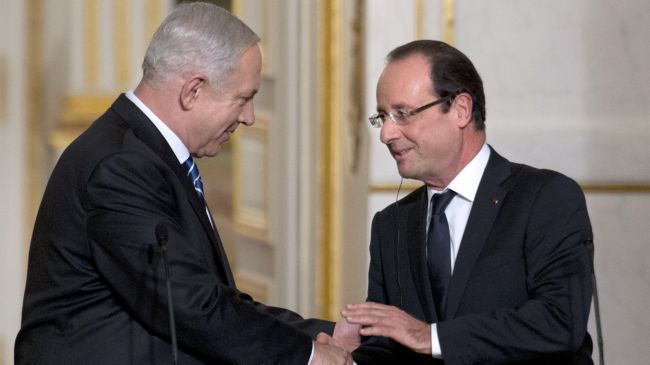
“This situation must not be allowed to continue,” Prime Minister Benjamin Netanyahu said, expressing remarkable concern for Syrian civilians “who were so brutally attacked by weapons of mass destruction.”
“The most dangerous regimes in the world must not be allowed to possess the most dangerous weapons in the world,” Netanyahu added.
Incidentally, polls have been taken showing that for much of the world, the most dangerous regime in the world is Israel, which is allowed to possess the most dangerous weapons – nuclear weapons. But there is no chance that Israel will ever get “the Kosovo treatment”.
Russian Foreign Minister Sergei Lavrov has warned US Secretary of State John Kerry over the “extremely dangerous consequences” of launching military action against Syria, the foreign ministry said Monday.
Russia, USLavrov told Kerry in a telephone call Sunday that Moscow was “deeply alarmed” by comments from US officials indicating a readiness to intervene in Syria over alleged use of chemical weapons which the Syrian government had strongly denied, it said in a statement.
“Sergei Lavrov drew attention to the extremely dangerous consequences of a possible new military intervention for the whole Middle East and North Africa region,” it added. Lavrov told Kerry that it appeared certain elements inside the United States wanted to launch military action in Syria outside of the United Nations to undermine joint US-Russia efforts to organize a peace conference.
The Russian minister urged his US counterpart “to refrain from using military pressure against Damascus and not to give in to provocations.” The ministry said Kerry promised to “attentively” study the arguments of the Russian side.
Russia underlined the necessity of an objective UN investigation into the claimed chemical attack and repeated its doubts that the Syrian government of President Bashar al-Assad was to blame. “There is mounting evidence that the incident was a pretence set up by the rebel opposition with the aim of accusing the Damascus government of everything,” the statement said.
The Syrian government has given the green light to the UN team of chemical weapons inspectors to investigate the site of the recent alleged chemical attack in the country.
The Syrian Foreign Ministry made the announcement on Sunday, after an agreement was reached between the UN team and Syrian Foreign Minister Walid Muallem.
“An agreement was concluded today in Damascus between the Syrian government and the United Nations during the visit of the UN High Representative for Disarmament Angela Kane,” the ministry said in a statement.
The accord would “allow the UN team led by Professor Aake Sellstroem to investigate allegations of chemical weapons use in Damascus Province,” the statement stated, adding that it “is effective immediately.”
The Syrian government and the UN also agreed that the UN team should start its investigation of the sites from Monday.
Damascus also promised to observe ceasefire during the UN team’s visit to the site of the attack.
“Syria is ready to cooperate with the inspection team to prove that the allegations by terrorist groups of the use of chemical weapons by Syrian troops in the Eastern Ghouta region are lies,” Muallem was quoted as telling Kane.
On August 21, the head of the so-called opposition Syrian National Coalition, George Sabra, claimed that 1,300 people were killed in a government chemical attack on militant strongholds in Damascus suburbs of Ain Tarma, Zamalka and Jobar.
The Syrian government, however, has vehemently rejected the allegation, saying the foreign-backed militants had carried out the attack.
On Saturday, the Syrian forces found chemical agents in tunnels dug by the militants in Jobar. A number of soldiers suffocated as they entered the area.
The UN investigators are staying at a hotel just a few kilometers away from the site of the attack. They arrived in Syria on August 18.
The US has reportedly said Syria’s permit for the UN inspection is too late to be credible. A senior American official has said the access should have been granted immediately after the attack.
Over the past three days, since the story first broke, the BBC’s news Website (I use the word news advisedly) has carried twelve stories on the alleged chemical weapons attack that took place in a suburb of Damascus. Today’s offerings include, Hague believes Assad behind attack (23/8/13), without offering a shred of proof that the Assad government is behind the alleged attack or even that it took place, takes foreign secretary Hague’s ‘belief’ as a given. The lead paragraph tells it all:
UK Foreign Secretary William Hague says he believes President Assad was behind a chemical attack in Syria.
What Hague’s belief is based upon is not revealed, instead we get more of the same:
“I know that some people in the world would like to say that this is some kind of conspiracy brought about by the opposition in Syria,” said Mr Hague.
Now why does Hague feel compelled to bring in the issue of a conspiracy? Perhaps because it is a conspiracy? A conspiracy dreamed up to justify the overthrow of the sovereign government of Syria. Hague then makes the most astonishing statement:
“I think the chances of that are vanishingly small [that it was a conspiracy] and so we do believe that this is a chemical attack by the Assad regime.”
‘So we do believe’ intones Hague but the BBC article offers not a shred of actual proof that one, gas was actually used and two, if gas was used who it was used by?
Now you have to ask why the BBC feels it necessary to propagandise on behalf of the UKUS governments? What’s in it for the BBC? Well if it was an independent organisation, there could be no justification for promoting an allegation as fact even when its main UK advocate, Hague himself, can only offer his “belief”. But given as the BBC is the de facto mouthpiece for the UK state, it clearly has to peddle the ‘party line’. The piece continues:
“Pressing for UN weapons inspectors to be given access to the site, the UK foreign secretary said: “It seems the Assad regime has something to hide.
“Why else have they not allowed the UN team to go there?”
But who says the Syrian government have denied access to Ghouta? Given as firstly, the area in question is under the control of the rebels (isn’t that the reason why all we have to go on are the rebels presentations, which judging by the videos I’ve seen, look suspiciously staged?), at the point of writing, there’s nothing the Syrian government can do about it. Second, just a few miles away there’s the newly arrived UN inspection team, who given the chance, I’m sure will want to check out the situation for themselves. In fact, they have, see here.
Even Barack Obama says “the alleged used of chemical weapons” and doesn’t actually name the Assad government. Once burned, twice shy perhaps, considering that the last alleged Syrian government use of chemical weapons turned out to have been used by the rebels. Do I detect a pattern here?
But by the last section of the article we read:
He [Hague] added: “This is what we are focused on and we are working with countries all over the world to try to bring this about and to try to establish the truth to the satisfaction of the world about what is clearly a terrible atrocity.
Well at least now the man is admitting that he doesn’t actually know what really happened, and it makes a nonsense of the BBC’s title. But just how compelling the propaganda assault has been (it reminds me somewhat of the media’s coverage of the Boston Bombing), is that ‘progressive’ media outlet, Democracy Now! has just published a piece that’s pretty much in step with the BBC’s coverage, though it does at least entertain the idea that if the Syrian government had done it it had shot itself in the foot and opened the door to direct (as opposed to indirect) foreign intervention, which is what Hague is proposing we do. Thus proof is is crucial.
“The only possible explanation of what we have been able to see is that it was a chemical attack and clearly many, many hundreds of people have been killed, some of the estimates are well over 1,000.
“There is no other plausible explanation for casualties so intense in such a small area on this scale.” – Hague
There is nothing clear about anything at this point in time, not even that chemical weapons were actually used. We have only the conveniently supplied rebel footage, which when viewed objectively, tells us nothing much at all, except that some appeared to be dead but not how they died and in some of the footage it’s not even clear the people are actually dead. Another part of Democracy Now!’s footage shows people, young an old, walking around rather aimlessly and clearly very aware of the camera’s presence, too aware I think.
The entire event registers as false, as contrived and just too damn convenient and to have happened on the same day as the UN inspection team arrived? That’s a coincidence? At the end of the day, it’s the latest and the most elaborate provocation staged to try and justify direct, foreign intervention by the Imperialist powers, given that the ‘rebels’ appear to be on the run.
Yesterday, the 22nd of August, the BBC put out another propaganda piece titled, Obama’s thick red line on Syria by the BBC’s North American Editor, Mark Mardell. The title tells it all doesn’t it? Obama is indecisive, unsure of what to do (the issue of the chemical weapons is not even mentioned directly, it’s just assumed that it was the Assad government that used them):
President Obama clearly has a problem, and will be accused of inaction and dithering.
Mardell gives the game away when he writes:
The president’s main military adviser has cancelled a planned news conference. Chairman of the Joint Chiefs of Staff General Martin Dempsey was due to answer questions at the foreign press centre.
Perhaps he’s had to call it off because he is busy planning what happens next in Syria. [my emph.]
‘Busy planning what happens next in Syria’ says it all really. Syria is just another place to blow up and decide if it has a future. The BBC speaks with an Imperialist tongue, that’s why the BBC is so gung ho about invading Syria to the point that it’s entire coverage of the events in Ghouta are based on nothing more than supposition and allegation? This outrageous piece of out and out warmongering ends thus:
In either case, Mr Obama is likely to insist on going the full UN route to gather the maximum possible support for any action – and that means waiting for the inspector’s report on earlier incidents at the very least.
I could be very wrong. The bombers could be in the air by this afternoon.
But at the moment all Mr Obama plans for today is a talk about the cost of college education and “a better deal for the middle classes”.
I suspect his red line is very thick indeed.
Obviously too thick for the BBC aka the state.
In another, later Mardell piece, quoting from Obama’s speech on the subject we read (just in case we didn’t get it with the earlier piece):
[Obama] calls the attack “troublesome” and says it touches on core national interests of the US, but quickly adds: “Sometimes what we’ve seen is that folks will call for immediate action, jumping into stuff, that does not turn out well, gets us mired in very difficult situations, can result in us being drawn into very expensive, difficult, costly interventions that actually breed more resentment in the region.”
Damn these dithering imperialists, Mardell seems to be telling us! Get on with it and bomb the crap out of Assad! Mardell continues:
You might think a private punishment is not much of a deterrent and anything that happens now will have to be a lot more public.
/../
It does not sound like a man gung ho for military action. It sounds like the pleading of man being dragged, pushed and pulled by allies and world opinion to do something but who wants to be certain it doesn’t end up in a new war.
Mardell is pissed off because Obama doesn’t want to start bombing another country (yet)! What is going on here when a journalist, paid for out of the public purse and purportedly working for a media outfit that is bound by law to be objective and impartial, can act as point man for the Empire and its fucking wars?!
The UK’s Independent newspaper today had an “exclusive” article, in which they claim that documents from Ed Snowden’s leaks revealed a secret internet surveillance base in the Middle East run by the UK government. There’s just one problem. While the article implies (though does not state) that it got those documents from Snowden, Snowden says he’s never talked to nor given anything to The Independent. Instead, he argues, that he’s worked carefully with key journalists (namely, Glenn Greenwald, Laura Poitras, and Barton Gellman) to make sure that the things they publish don’t reveal anything that might put anyone in danger. Snowden suggests, instead, that this is the UK government itself releasing this information in an attempt to “defend” the detention of David Miranda.
I have never spoken with, worked with, or provided any journalistic materials to the Independent. The journalists I have worked with have, at my request, been judicious and careful in ensuring that the only things disclosed are what the public should know but that does not place any person in danger. People at all levels of society up to and including the President of the United States have recognized the contribution of these careful disclosures to a necessary public debate, and we are proud of this record.
It appears that the UK government is now seeking to create an appearance that the Guardian and Washington Post’s disclosures are harmful, and they are doing so by intentionally leaking harmful information to The Independent and attributing it to others. The UK government should explain the reasoning behind this decision to disclose information that, were it released by a private citizen, they would argue is a criminal act.
If you read the Independent’s coverage carefully, they never actually claim they got the documents from Snowden, even if they leave that impression. Instead, they claim that “information on [the base’s] activities was contained in the leaked documents obtained from the NSA by Edward Snowden.” In other words, they got that information from someone else — almost certainly the UK government. And, yes, that’s convenient timing for the UK government to claim that some of the documents that Snowden downloaded might contain useful information to terrorists, so that they can then turn around and argue that they detained Miranda and took all of his electronics (and destroyed a Guardian hard drive) to avoid having this information “fall into the hands of terrorists.”
The Independent article also implies that the UK government is afraid that Greenwald is going to start revealing this type of info in response to the Miranda detention, even though there’s no basis to believe that all. Greenwald has been quite careful so far not to reveal any information that puts anyone at risk, so it’s odd to believe that he’d start doing so now. Of course, it’s fairly bizarre since the Independent story itself contains tons of details — the kinds of details that Greenwald has avoided.
If Snowden’s assertion is correct — and it does seem like the most plausible argument at this point — then it highlights the ridiculous lengths to which the UK government is going: releasing potentially damaging information that Snowden himself has avoided revealing just to suggest that Snowden was leaking damaging information. Incredible.
There has been an ongoing information war being fought for hearts and minds inside and outside of the Middle East. The war has mostly been tied to Syria. As the US and its allies begin to focus their attention on Hezbollah in Lebanon, the media war now includes the events in Lebanon. This, however, has not stopped the media attempts to depict the fighting in Syria in sectarian terms as a regional war between Shias and Sunnis or to demonize Syria’s allies…
In regards to Syria, the Israeli media, the Saudi media, and Lebanon’s Hariri-owned media — which belongs to Hezbollah’s US/Saudi-supported rivals — have all carried the same August 2013 AFP story or some derivative of it that deceitfully reports that Iran and Hezbollah are now running Syria. The Jerusalem Post, Arutz Sheva, the Daily Star, Ya Libnan, Al-Arabiya, the Saudi Gazette, Hürriyet, Naharnet, France 24, Fox News, and the Dubai-based Gulf News are examples of the type of media that carried this so-called news. Here is an extract of the text which sums up the entire image that the article is trying to engrain into the minds of its readers: “Assad ‘no longer runs Syria. The real rulers of Syria are the Iranian (elite) Revolutionary Guard… with the participation of Hezbollah fighters,’ Jarba said.” The entire report is built around a quote by Ahmad Al-Jarba, the leader of the foreign-controlled and funded Syrian National Coalition.
How the Mainstream Media Legitimizes Terrorism Against Lebanese Civilians
Next the same media outlets finessed the news about the terrorist bombs planted in Beirut’s southern suburb of Dahiyeh. The August 15, 2013 terrorist bombings in the neighbourhood of Al-Rouweiss (Al-Rweiss) were downplayed and, in a manner of speaking, legitimized by the media through their selective use of language. The attack on Al-Rouweiss come about a month after the July 9, 2013 terrorist attack on the neighbourhood of Bir Al-Abed. Both are densely populated neighbourhoods in Dahiyeh. The Institute for Public Accuracy (IPA) in the United States took quick notice of the biased media framing. IPA asked the following, on August 16, 2013, through the title of report: “Why Isn’t Beirut Bombing Called ‘Terrorist’? What’s Behind It?”
The Lebanese newspaper Al-Akbar is worth looking at to get a grasp of the biased media reporting that has been used to reframe the events as legitimate. It commented thus on August 17, 2013: “The Western media have double standards when it comes to ‘terrorism.’ Within hours after two bombs were detonated at the Boston Marathon last April, many in the media had christened it a ‘terrorist attack.’ Meanwhile, the August 15 bombing in Rouweiss that killed at least two dozen is a ‘blast’ that occurred in a ‘Hezbollah stronghold.’” As Al-Akhbar observes, the phrase “Hezbollah stronghold” plays a prominent role in giving the impression that the civilian neighbourhoods bombed in Beirut were armed barracks. Al-Akhbar even nicely sums up some of the biased titles used to describe the terrorist attacks:
Wall Street Journal: «Car Bomb Blasts Hezbollah Stronghold in Lebanon»
BBC: «Deadly Lebanon Blast in Beirut Stronghold of Hezbollah»
LA Times: «Massive Explosion in Beirut Rocks Hezbollah Stronghold»
Washington Post: «Bomb Explodes in Hezbollah Stronghold in Beirut, Injuring Dozens»
Reuters: «Over 50 Hurt as Car Bomb Hits Hezbollah Beirut Stronghold»
Associated Press: «Car Bomb Rocks Hezbollah Stronghold in Lebanon»
France24: «Car Bomb Rocks Hezbollah Stronghold in Beirut»
Mixed with the other narratives that the same media outlets are painting, the terrorist attacks are being tacitly portrayed as some type of legitimate retaliation. Readers are basically led to think that that the terrorist attacks in Dahiyeh were a military act against some type of Hezbollah base.
How the Mainstream Media Lies and Deliberately Places the Blame on Sunni Muslims
Sheikh Hassan Nasrallah, the secretary-general of Hezbollah, responded to the terrorist attack on Al-Rouweiss by categorically saying that the attacks were not the work of Sunni Muslims. He gave a speech saying that there were going to be those groups and individuals that would try to blame the terrorist attacks in Beirut on the Sunnis and said that these groups and individuals should be outright dismissed. In fact, he said that anyone that used this divisive logic was an “Israeli” and a partner in the goal of creating massacres. He made it clear that the individuals who planted the bomb did not represent the Sunni Muslims or the Arabs or the Syrians or the Palestinians. In a message to the US and its allies, he also said clearly stated that Hezbollah was aware that the intelligence services of the US and its allies had infiltrated various terrorist groups and manipulate them as tools.
Despite Nasrallah’s clarity, his words were totally changed by the same media outlets that were legitimizing the terrorist attacks in Beirut. The Israeli media, the state-run British Broadcasting Corporation (BBC), Al Jazeera, and Al Arabiya would blatantly fabricate the news and claim that Nasrallah “blamed the Sunnis” or try to manipulate readers into getting the impression that he did. The New York Times titled an August 16, 2003 article on the terrorist attacks as the following: “Hezbollah Makes Vow to Step Up Sunni Fight”. It never even mentioned that Nasrallah went out of his way to say that the people involved in the terrorist attacks were the tools of the US and Israeli government and not really Sunni Muslims. Instead Ben Hubbard focused on sectarianism in Lebanon and wrote: “In short, Hezbollah has more enemies than it used to have.”
The BBC wrote a similar article on August 16. It also used a grossly misleading title. The title being “Hezbollah blames Sunnis for bomb”. After a large number of people caught it, the BBC changed the title to “Beirut bomb: Hezbollah’s Nasrallah blames Sunni radicals”.
Exposing the Yellow Journalism at Work as a Tool of War
Aside from their direct or indirect links to these media outlets, even the political actors involved show that the way the news is reported is not isolated. Saad Hariri, the leader of the Future Party and a Saudi client, even responded to Hassan Nasrallah’s speech by saying that he had no right to designate what groups are terrorists. Hariri’s overlords in Saudi Arabia, on the other hand, refused to even condemn the terrorist attacks. This again is tied to the attempts to reframe the terrorist attacks in Beirut as a legitimate military act.
This type of yellow journalism that relies on misleading headlines that essentially say everything while the hollow articles carry and have little or no newsworthy material is not politically neutral. It is a weapon of war. All these articles are agitating for bloodletting in the Middle East, specifically between Shias and Sunnis. This type of journalism either directly or indirectly stokes the fires of sectarianism in Lebanon and the Middle East with the intentions of spreading sectarian animosity. This is why it deliberately ignores and refuses to even acknowledge the main points of Nasrallah’s speech that clearly pointed the finger at Israel and the US and said that the terrorist attacks had nothing to do with Sunni Muslims.
While the terrible events in Egypt have delayed my plans to reply to ProPublica’s response to my critique of Sebastian Rotella’s report on the alleged build-up of Iran’s terrorist infrastructure in the Americas, Gareth Porter has written the following essay on a 2009 article by Rotella for the Los Angeles Times about an alleged bomb plot to blow up the Israeli Embassy in Baku, Azerbaijan, in 2008. It offers a very good illustration of some of the problems raised in my original critique of Rotella’s most recent work, notably the virtually exclusive reliance on sources that are clearly hostile to Iran with an interest in depicting it in the most negative light possible. But you be the judge.
It happened in Baku, transforming the capital of Azerbaijan into a battleground in a global shadow war.
Police intercepted a fleeing car and captured two suspected Hezbollah militants from Lebanon. The car contained explosives, binoculars, cameras, pistols with silencers and reconnaissance photos. Raiding alleged safe houses, police foiled what authorities say was a plot to blow up the Israeli Embassy in Azerbaijan, a former Soviet republic that borders Iran.
Thus begins the only detailed English-language press account of an alleged Iranian terror plot in Azerbaijan in 2008: a May 2009 article, written with a Paris dateline, by Sebastian Rotella for the Los Angeles Times.
But despite the sense of immediacy conveyed by his lede, Rotella’s sources for his account were not Azerbaijanis. Rather, the sources Rotella quoted on the details of the alleged plot, the investigation and apprehension of the suspects consisted of an unnamed “Israeli security official”, and Matthew Levitt, a senior fellow at the pro-Israel Washington Institute for Near East Policy (WINEP) and the author of a constant stream of articles, op-eds, and Congressional testimony reflecting the Israeli government’s interest in promoting the perception of a growing Iranian terrorist threat around the world.[1]
It was Levitt who described the alleged plot in Baku to Rotella as having been “in the advanced stages” when it was supposedly broken up by Azerbaijani security forces, an assertion echoed by the anonymous Israeli security official cited in the article:
”[Iran] had reached the stage where they had a network in place to do an operation,” said an Israeli security official, who requested anonymity for safety reasons. “We are seeing it all over the world. They are working very hard at it.”
So readers of the LA Times received a version of the plot that was filtered primarily, if not exclusively, through an Israeli lens.[2] Relying on Israeli officials and a close ally at a pro-Israel US think tank for a story on an alleged Iranian bomb plot against an Israeli Embassy is bound to produce a predictable story line where the accuracy can hardly be assumed at face value. Indeed, in this case, there were and remain many reasons for skepticism.
Yet, three years later, in a July 2012 article for ProPublica, he referred to the plot as though it was established fact.
Had Rotella sought an independent source in Azerbaijan, he would have learned, for example, that such alleged plots had been a virtual perennial in Baku for years. That is what a leading scholar of Azerbaijan’s external relations, Anar Valiyev, told me in an interview last November. “It’s always the same plot year after year,” said Valiyev, Dean of the School of International Affairs of the Azerbaijan Diplomatic Academy in Baku.
In fact, security officials in Azerbaijan had claimed the existence of a similar plot in October 2007 and January 2012 and only two months later, authorities arrested Azerbaijani suspects in two different allegedly Iranian-initiated plots to carry out terrorist actions against Western embassies, the Israeli Embassy and/or Jewish targets. In early 2013, prison sentences were announced in yet another alleged terrorist plot to attack the Eurovision song contest in Baku in 2012. Valiyev told me that those detained by Azerbaijani security officials are always charged with wanting to kill Israeli or US officials and subsequently tried for plots to overthrow the government, which carries the maximum sentence of 15 years in prison.
In a 2007 article in Jamestown Foundation’s Terrorism Focus, Valiyev observed that plots, assassination and coup-attempts were “thwarted” with regularity in Azerbaijan. “Periodically the government finds a scapegoat,” he wrote, to justify attacks on domestic critics, including “Wahabbis”, followers of Kurdish-Sunni scholar Said Nursi and/or Shiite radicals. Valiyev suggested that security officials might be “trying to show that radical Islamists could come to power… should the incumbent government lose the election.”
The Azerbaijani government and its security forces are not known for their devotion to the rule of law. The current president, Ilham Aliyev, is the son of Azerbaijan’s first president, Heydar Aliyev, who, in turn, was the head of the Soviet KGB before Azerbaijan’s independence. According to Jim Lobe, who visited Baku last year, dissidents regard the first Aliyev’s tenure as relatively liberal compared that of his son. A 2009 State Department cable described Ilham Aliyev as a “mafia-like” figure, likening him to a combination of Michael and Sonny Corleone in the “The Godfather”.
Valiyev observed that virtually nothing about the alleged plot made sense, beginning with the targets. According to Rotella’s story, the alleged Hezbollah operatives and their Azerbaijani confederates had planned to set off three or four car bombs at the Israeli Embassy simultaneously, using explosives they “intended to accumulate” in addition to the “hundreds of pounds of explosives” they had allegedly already acquired from “Iranian spies.”
But the Israeli Embassy is located in the seven-story Hyatt Tower office complex along with other foreign embassies, and no automobiles are allowed to park in close proximity to the complex, according to Valiyev. So the alleged plotters would have needed a prodigious amount of explosives to accomplish such a plan.
For example, the bomb that destroyed the eight-story US Air Force barracks at the Khobar Towers in Saudi Arabia in 1996 was estimated at 23,000 pounds of explosives detonated less than 100 feet away from the building. Valiyev told me that it is “practically impossible to find such components in Azerbaijan” because “Even a few kilograms of explosives would be tracked down by the ministry of national security.”
In his article, Rotella also referred — though only in passing — to the prosecutor’s charge that the alleged conspirators were planning to attack a Russian radar installation at Gabala (sometimes spelled Qabala) in northern Azerbaijan. But that part of the plot was also highly suspect, according to Valiyev. No reason was ever given for such a target, and it would have made no sense for either Hezbollah’s or Iran’s interests.
Built in 1984, the Gabala radar station was leased to the Russians until 2012, and 900 troops from the Russian Space Forces were stationed there. An attack on the station by Hezbollah or its supposed proxies in Azerbaijan would have represented a major provocation against Russia by Iran and Hezbollah, and was therefore hard to believe, as Valiyev pointed out in a July 2009 report for the Jamestown Foundation. Valiyev said it was far more plausible that the alleged plotters were simply carrying out surveillance on the station which, according to some reports, was being considered for possible integration into a regional US missile defense system.
Rotella failed to mention yet another aspect of the prosecution’s case that should arouse additional skepticism. The indictment included the charge that the leader of the alleged terrorist cell plotting these attacks was working simultaneously for Hezbollah and al-Qaeda. Even though it has been long been discredited, the idea of an Iran-al-Qaeda collaboration on terrorism has been a favorite Israeli theme for some time and one that continues to be propagated by Levitt.
Rotella’s account of how the suspects were apprehended also appears implausible. In May 2008, when the bombings were supposedly still weeks away, according to his story, the suspects realized they were under surveillance and tried to flee.
But instead of hiding or destroying incriminating evidence of their terrorist plot — such as the reconnaissance photos, the explosives, the cameras and the pistols with silencers — as might be expected under those circumstances, the two suspects allegedly packed all that equipment in their car and fled toward the border with Iran, whereupon they were intercepted, according to the official line reported by Rotella.
Somehow, despite the surveillance, according to anonymous “anti-terrorist officials” cited by Rotella, “a number of Lebanese, Iranian and Azerbaijani suspects escaped by car into Iran.” Only those with the incriminating evidence — including, most implausibly, hundreds of pounds of explosives — in their car were caught, according to the account given to Rotella.
Even Rotella’s description of the two Lebanese suspects, Ali Karaki and Ali Najem Aladine, as a veteran Hezbollah external operations officer and an explosives expert, respectively, should not be taken at face value, according to Valiyev. It is more likely, he said, that the two were simply spies working for Iranian intelligence.
Even the US Embassy report on the trial of the suspects suggested it also had doubts about the alleged plot. “In early October after a closed trial,” the reporting cable said, “an Azerbaijani court sentenced a group of alleged terrorists arrested the previous Spring and supposedly connected to Lebanese Hezbollah plot to bomb the Israeli Embassy in Baku AND the Qabala radar station in northern Azerbaijan” (emphasis in the original). It added, “In a public statement the state prosecutor repeated earlier claims that the entire plot was an operation of the Iranian Revolutionary Guard.”
Yet another striking anomaly about the alleged plot was the fact that nothing was published about it for an entire year. No explanation for the silence was ever made public. This silence is all the more significant because during 2009 and 2010, the Israeli government either publicly alleged or leaked stories of Iranian or Hezbollah plots in Turkey and Jordan about which the host country authorities either did not comment on or offered a different explanation. But despite the extremely close relationship between Azebaijani and Israeli intelligence services (confirmed by this US Embassy cable), neither the Israeli media nor foreign journalists were tipped off to the plot until the Israelis leaked the story to Rotella a year later.[3]
The complete absence of any leak by the Israelis for an entire year about an alleged Iranian plot to bomb the Israeli Embassy in Baku casts some circumstantial doubt on whether such a plot had indeed been uncovered in 2008, as claimed in the article.
Despite the multiple anomalies surrounding this story — the complete lack of any publicly available corroborating evidence; the well-established penchant for the Aliyev government for using such alleged plots to justify rounding up domestic critics; the US Embassy’s apparent skepticism, his failure to consult independent sources; and the 2009 publication by the Jamestown Foundation of Valiyev’s own critique of the “official” version of the case — Rotella has shown no interest in clarifying what actually happened. In fact, as noted above, he referred to the plot again in a July 2012 article for ProPublica as if there was not the slightest doubt with regard to its actual occurrence, identifying it, as he did in the original article, as an attempted retaliation for the assassination of a senior Hezbollah operative three months before:
Conflict with Israel intensified in February 2008 after a car bomb in the heart of Damascus killed Imad Mughniyah, a notorious Hezbollah military leader and ally of Iranian intelligence. Iranian Hezbollah publicly accused Israel and vowed revenge.
Within weeks, a plot was under way against the Israeli Embassy in Azerbaijan. Police broke up the cell in May 2008. The suspects included Azeri accomplices, a senior Hezbollah field operative and a Hezbollah explosives expert. Police also arrested two Iranian spies, but they were released within weeks because of pressure from Tehran, Western anti-terror officials say.[4] The other suspects were convicted.
As narrowly sourced as it was, Rotella’s original 2009 story thus helped make a dubious tale of a bomb plot in Baku part of the media narrative. More recently, he continued that pattern by promoting the unsubstantiated charge by Argentine prosecutor Alberto Nisman and various pro-Israel groups and right-wing members of Congress, such as Florida Rep. Ileana Ros-Lehtinen, that Iran poses a growing terrorist threat to the US in the Americas. While Jim has helped deconstruct that story line, I have recently marshaled evidence showing that Nisman’s charges about alleged Iranian involvement in the 1994 AMIA bombing and the 2007 JFK airport plot were tendentious and highly questionable.
[1] In one illustration of Rotella’s and Levitt’s long-time symbiosis, Levitt cited Rotella’s account of the alleged Baku plot as his main source about the incident in a 2013 article on alleged Hezbollah terrorism published by West Point’s Combating Terrorism Center (CTC).
[2] Rotella referred twice to “anti-terrorism officials” as sources for describing the surveillance of the alleged perpetrators that preceded their arrest and past work for Hezbollah. Of course, the phrase “anti-terrorism officials” does not exclude the possibility that they, too, were Israeli.)
[3] The first time the alleged plot’s details appeared in the Anglophone Israeli press was when Haaretz published a several hundred-word piece based virtually exclusively on Rotella’s account with the added detail, citing “Israeli sources,” that the “plotters also planned to kidnap the Israeli ambassador in Baku…”
[4] This account, incidentally, was the first to report the arrest in the case of “two Iranian spies”, another anomaly that may be explained by a flurry of media reports in 2010 that it was the two Lebanese who were released as part of a larger prisoner exchange that also included an Azerbaijani nuclear scientist arrested as a spy by Iran.
As Al Jazeera geared up for the August 20th launch of its new channel Al Jazeera America (AJAM), excitement was in the air, judging by its Twitter feed. CNN veteran Joie Chen expressed on her Twitter profile that she was “thrilled” to anchor AJAM’s flagship nightly news program America Tonight, and would engage in “fierce journalism.” According to AJAM’s official account, Chen “can’t wait to bring you the news.”
Bringing U.S. viewers “fierce journalism”—or even simply “the news”—promises to be a welcome change from her previous work as the host of a public-relations video masquerading as an investigative report, all paid for by gun manufacturer Remington to defend its Model 700 rifle from reports of its defectiveness. (In her defense, Chen’s presentation was not done in her capacity as a journalist, but rather as Executive Vice President of Branded News Worldwide, a firm that “creates online platforms for organizations and industries to deliver news and programming models for niche audiences.”)
In anticipation of her special reports for AJAM, Soledad O’Brien of CNN fame casually tweeted about “[getting] a chance to chat with Jean Claude Duvalier”—the one-time Haitian dictator who, despite being responsible for crimes against humanity, remains a free man. The excitement continued as AJAM offered tours of its Washington, D.C. and New York studios for reporters, and promoted a Varietypiece consisting of little more than quotes from a conference call hosted by “interim CEO and prez” Ehab Al Shihabi, former senior management consultant at Arthur Andersen, Andersen Consulting and Deloitte.
In preparation for AJAM’s launch, Al Shihabi met with “members of the business community” as well as political figures such as Chicago mayor Rahm Emanuel and Senator Carl Levin (D-MI), and promised that AJAM would be “the voice of Main Street”; another Variety article reported that “Al Jazeera has also spent time making its case to advertisers, reaching out to ad-buying concerns to dispel any notions that the network may be biased or have an anti-American lens.”
This message was further reinforced when America Tonight’s senior executive producer, Kim Bondy (formerly of CNN) said the show will have “some of the sensibilities of CBS Sunday Morning; it should also look a little bit, probably, like [NBC’s] Rock Center, and we’re stealing a couple pages out of [HBO’s] Real Sports with Bryant Gumbel.” AJAM president Kate O’Brian—a 30-year veteran of ABC News—confirmed a trend: “The formats, the talent, the producers will be American.”
*
The authors of this article have appeared as frequent guest commentators to discuss U.S.-Latin America relations on Al Jazeera America’s predecessor, Al Jazeera English (AJE), which will soon be redirected exclusively toward international audiences and rendered inaccessible to most U.S. viewers, even online. With regard to much of AJE’s coverage of the Americas, we have been impressed with the rigor and dedication of AJE reporters, anchors, presenters and producers. The channel often delved into crucial yet often under-reported developments throughout the region, and proved itself an indispensible English-language source for regular, in-depth news and analysis on Latin America and the Caribbean.
But Al Jazeera’s new direction raises serious questions about AJAM. The channel now boasts a new, advertiser-revenue-driven dynamic; it has apparently taken compromising stances in its courtship of U.S. cable distributors; its recruitment of management and on-air personnel demonstrates caution and conservatism; and it has paid top dollar for close consultation with lobbying firms possessing deep rightwing ties. All of these factors may threaten to weaken Al Jazeera’s strengths and guide it toward the most insipid and insular tendencies of U.S. cable news.
A month ago The Guardian’s journalist Glenn Greenwald reported on the internal strife over Al Jazeera America, highlighting serious concerns raised in a leaked email by the host of Al Jazeera English’s program Empire, Marwan Bishara. The email excoriated management for capitulating to the “fear of contractual obligations with carriers” in attempting to expel any traces of what might appear as “anti-American,” including the “diversity, plurality and even accents of its journalists.”
Greenwald revealed highly paid consulting and lobbying firms like Qorvis Communications, ASGK Public Strategies and DLA Piper were influencing many of the channel’s questionable decisions; the temporary removal of an opinion article by Columbia Professor Joseph Massad from Al Jazeera’s website, for example, was done at the insistence of a DLA Piper consultant, according to an anonymous Al Jazeera insider.
*
One of the primary functions of public relations firms is shaping news to favor their corporate clients. While this approach is a reality in today’s corporate media environment, news organizations such as AJAM naturally sow doubt regarding their own professed commitment to hard-hitting journalism when they rely upon such firms. ASGK, one of the agencies AJAM has hired, explains its techniques of “Crisis Management,” which create clear conflicts of interest for the news agency:
From the halls of Congress, offices of the Executive Branch and Fortune 500 board rooms to the busiest newsrooms, our team knows the media inside and out. At ASGK, we have a wealth of experience in every facet of running a successful media relations campaign. We have established relationships with print, broadcast and online media outlets in local markets and on the national level. We hone messages based on our knowledge of specific reporters. From developing creative events that grab media attention and arranging reporter briefings or meetings with editorial boards, to writing powerfully and persuasively, ASGK is skilled at using media to reach key audiences.
While Al Jazeera’s business model—receiving continuous funding from the government of Qatar—has meant that reporting in some areas of the world has been decidedly biased toward that government’s interests (e.g., Syria, Libya), thus far the network has eschewed a model in which specific reporters repeat messages honed especially for them by corporate advertisers.
But the consultants AJAM has hired go beyond just converting day-to-day corporate talking points into news. On its “Crisis Communications” webpage, ASGK brags, “We have significant experience helping companies and institutions navigate through negative situations with effective communications strategies.” Examples include working “with multiple telecommunications companies on regulatory issues at the FCC” and representing “one of the largest entertainment companies with issues at the Department of Justice in the face of its merger.” Reading not too far between the lines, it is clear that ASGK is actively involved in promoting the kind of corporate media consolidation that has systematically undermined journalistic integrity within the confines of major news outlets over recent decades.
For its part, AJAM consultant Qorvis Communications has engaged in the production of what some would consider outrageously unethical news production. Before hiring Qorvis, Al Jazeera published an article titled “Suppressing the narrative in Bahrain,” detailing Qorvis’s efforts to suppress reporting on the ongoing deadly crackdown against opponents to the U.S-backed monarchy in that country:
Qorvis, which disclosed in a US Foreign Agents Registration Act a $40,000/month contract with the government of Bahrain from April to September last year, is one of a number of western PR firms that have been hired by the government. Matt Lauer, a partner at Qorvis, wrote in an email to PRNewser in August: “We help communicate the positive work the government [in Bahrain] is undertaking.”
Law and lobbying firm DLA Piper, in a flier titled “Dispute Resolution: Our Latin American Practice,” promotes its work on behalf of telecom consolidation. According to the document, it “[a]dvised a major Venezuelan telecommunications operator before Venezuelan telecommunications regulatory authorities in a dispute over interconnection rates” and “[r]epresented Spanish purchasers of Latin American telecommunications infrastructure interests in multi-jurisdictional parallel litigation proceedings against the sellers.”
Al Jazeera paid DLA $220,000 over the course of three months this year. Although the firm’s representation of the clients below does not in any way imply unethical behavior on the part of Al Jazeera, it is remarkable that the following list begs for the kind of investigative journalism that AJAM promises to provide:
PR firm Burson-Marsteller paid DLA $140,000 for its services in 2003-4; It is infamous for its own work representing clients like the Argentine military junta government of General Jorge Videla (1976-1983), whose security forces murdered or disappeared at least 15,000 people.
Venezuelan banker Nelson Mezerhane paid DLA at least $60,000 in 2012. He is the former co-owner of Venezuela’s Globovisión television station, which supported the short-lived overthrow of elected president Hugo Chávez in 2002.
The Drummond Company (which paid DLA $100,000 from 2003-7) was reported to have hired private security forces to murder opponents of its open-pit mining operations in Colombia.
Great Lakes Chemical ($100,000 from 2003-4), is the largest U.S. methyl bromide supplier in the U.S. The toxin is responsible for serious health problems to vulnerable agricultural workers, many of whom are migrants from Latin America.
Triple Canopy ($640,000 between 2010-2012), is a private military corporation that works extensively in Latin America. In 2005, a Triple Canopy subsidiary was expelled from Honduras for illegally training Honduran and Chilean mercenaries to be sent to fight in Iraq. The company was condemned by the United Nations Human Rights Council’s Working Group on the use of mercenaries as a means of violating human rights and impeding the exercise of the right of peoples to self-determination.
Earlier this year, DLA announced that Spain’s former Prime Minister José María Aznar (who had previously paid DLA Piper’s predecessor firm Piper Rudnick $2 million of Spanish taxpayer money in a failed attempt to secure the prestigious Congressional Gold Medal) had been named to the firm’s board as Senior Advisor on Latin America. Aznar is also a member of the Board of Directors at Rupert Murdoch’s News Corp. To call Aznar a major player in Latin American politics would be an understatement. From his 2002 support as Spanish Prime Minister of the 48-hour coup against Venezuela’s Chávez to his work at the powerful, rightwing Latin American Board at Georgetown University, Aznar, now at Johns Hopkins, has used his considerable political and economic clout to promote reactionary policies throughout the hemisphere.
An Al Jazeera America spokesperson responded by phone to a request for comment, asserting that there was a “misconception about the role of consulting firms such as ASGK and Qorvis” with relation to AJAM’s efforts to launch its cable channel. “They are not at all involved in any editorial decisions,” he added. Regarding the reduced role that is anticipated for AJAM’s international reporting, he said, “As far as coverage of Latin America, Al Jazeera International will continue to cover the region as strongly as Al Jazeera English did.” He conceded that this content would be unavailable to U.S. viewers, but especially given “America’s substantial Latino community,” he stated that AJAM will provide news that’s “relevant to Americans” from across the region.
*
It appears, based on several news reports, that AJAM has in fact made a decision, responding to advertisers and cable providers, to reduce the scope of its predecessor’s international coverage in favor of a U.S.-centric orientation. What remains of its coverage toward the Americas—while perhaps not directly influenced by consulting firms—seems unlikely to avoid being mediated by the considerations of agencies that have publicly touted their ability to circumvent and downplay the kind of fearless, confrontational reporting that Al Jazeera English has done to expose the unsavory activities of multinational corporations and the U.S. government throughout Latin America. This tendency seems to be the principal factor behind the transformation of its flagship nightly news program Inside Story Americas.
Shihab Rattansi, the host of AJE’s Inside Story Americas, has consistently shed light on crucial if neglected issues on both continents, often by inviting on to his program human-rights activists, social critics, and grassroots and community organizers. His program also routinely probed the structural defects of the mainstream media and the Washington establishment.* In its AJAM incarnation however, Inside Story Americas has been stripped of the plural noun “Americas” and Rattansi has been replaced. In contrast, the program’s new host, Libby Casey (formerly of C-SPAN), touts her ability to connect “Americans with top leaders in Washington including former Secretary of State Madeleine Albright, members of Congress, governors, journalists and think tank experts.” (Rattansi declined to comment about the nature of his departure.)
Rattansi and his colleagues at Inside Story Americas were exemplars of the most commendable aspects of Al Jazeera, as they provided viewers with a range of news that could be found on no other television network. Rattansi’s team doggedly pursued the case of a lethal 2012 U.S. Drug Enforcement Administration raid in Ahuas, Honduras; they offered some of the earliest and most consistent coverage of detainees’ hunger strikes at Guantánamo Bay; and for years the program invited experts to discuss the UN’s negligent introduction of cholera into Haiti, which has killed over 8,000 so far. Climate activists conveyed the high stakes of the Keystone XL pipeline proposal; human rights lawyers elaborated on the illegality of U.S. drone strikes; and a heterodox economist and independent journalist questioned the durability of capitalism—all on Inside Story Americas.* As Bishara wrote, such critical coverage is an “essential element of [U.S.] democracy and freedom of speech, not to speak of the role of global media,” despite the predictable accusations of “anti-Americanism” that are surely hurled in response.
AJAM management has expended great energy to avoid the dreaded “anti-American” label; instead, they appear to have insinuated the network into the stratum of the most powerful economic and political actors within the United States. Not only does this jeopardize Al Jazeera’s most unique and socially valuable aspects, but in the process, Bishara writes, AJAM is “insulting” the intelligence of its U.S. audience “through empty gimmicks and poor marketing theatrics.”
As recurring contributors to Al Jazeera’s programming, we also worry that AJAM—now clearly embedded within a nexus of corporate, state and mainstream-media norms and behaviors—will fail to live up to its immense potential. The network has the opportunity to offer tens of millions of people in the United States a desperately needed worldview—one that is more independent and more challenging than the deeply compromised perspective that corporate television already provides.
* The videos of the examples cited can no longer be accessed online by U.S. readers due to Al Jazeera English’s content restrictions.
Adrienne Pine is Assistant Professor of Anthropology at American University in Washington, D.C. Her latest book is Working Hard, Drinking Hard: On Violence and Survival in Honduras (UC Press 2008). She regularly writes about Honduras and U.S. foreign policy at her blog, Quotha.net.
Keane Bhatt is an activist in Washington, D.C. He has worked in the United States and Latin America on a variety of campaigns related to community development and social justice. His analyses and opinions have appeared in a range of outlets, including NPR.org, The Nation, The St. Petersburg Times, and CNN En Español. He is the author of the NACLA blog “Manufacturing Contempt,” which critically analyzes the U.S. press and its portrayal of the hemisphere. Connect with his blog on Twitter: @KeaneBhatt
Last week news came out regarding a program in Israel under which students, enticed by scholarships, would be recruited into “covert units” whose mission would be to sit at computers and post comments favorable to Israel on the Internet. What most of the stories failed to mention, however, is that this is nothing new for Israel.
The practice of recruiting “explainers” to push the “Israeli message” has been going on for at least the past six or seven years, and truth be told most of us have probably encountered these people in the comments sections of various websites we visit. Abnormal constructs regarding cause and effect, avoidance of substance in favor of character assassination—these are often indicators you’ve stumbled upon one.
But just for the record—and so that we might place this latest news into its proper context—let’s go back and review what has come out on this subject over the past several years or so, because it does make for some interesting reading and/or viewing.
Back in 2006, during the July war in Lebanon, Israeli students were rallied to participate in a program entitled “Take Three Minutes,” an effort designed to influence public thinking about the war then in progress. As with this latest scheme, the participants were advised to go to websites and post comments. The following comes from Ynet:
In an international effort they launched a campaign called “Take three minutes.” Starting Friday, some 500 students and activists of the Israel at Heart organization will start different type of war: The talkback offensive.
The students are set to log onto different websites considered hostile to Israel, with the goal of visiting few sites every day and flooding the different polls on the legitimacy of Israel’s operation with pro-Israel answers and points of views.
Each student sends the poll to his/her email list with a request to take three minutes and send the link to that poll to each person’s own email list, thereby hopefully creating a positive public opinion regarding Israel in the world.
The Israel at Heart organization was established by the American-Jewish businessman Joey Lowe.
According to Lowe, “along with the work done by the Foreign Ministry and the IDF’s Israeli spokespersons on international television networks we must not abandon the arena of the leading news sites. Those news sites allow surfers to respond to articles and participate in polls that they publish daily in response to the situation.
The article goes on to mention that the National Union of Israeli Students had lent its support to the cause. The program’s overall effectiveness is probably difficult to gauge, but perhaps worth noting is that even if the shooting war in Lebanon didn’t go so well for Israel, Israeli leaders were pleased generally with how the war for public opinion turned out:
“We have never had it so good,” said Gideon Meir, the Foreign Ministry’s then-deputy-director general for media and public affairs. “The hasbara effort is a well-oiled machine.”
Hasbara is a Hebrew word meaning literally “explanation”; it is viewed generally either as “public relations” or “propaganda,” depending upon one’s point of view.
The “well-oiled machine” continued receiving its periodic doses of lubrication in the years to come. In 2009 blogger Richard Silverstein published an article on a 116-page “hasbara handbook” written for The Israel Project (TIP) by Republican Party strategist Frank Luntz. Silverstein comments:
The first thing to say is that the entire document is a pathetic piece of propaganda. While it ostensibly is addressed to TIP’s leaders and advises them how to shape a pro-Israel message when they lobby Congress, the media and other critical power brokers, the entire thing reeks of desperation and a lost cause.
It goes without saying that the arguments offered are not only devoid of truth, they’re devoid of rigor or credibility. There is literally no substance to the claims offered on Israel’s behalf. It’s an empty exercise in every sense of the word. Reading this makes you realize that the entire Israel lobby edifice is a house of cards.
Well, maybe. But at any rate, Silverstein gives us a few sample quotes from the book. One is from a chapter entitled “25 Rules for Effective Communication”:
The first step to winning trust and friends for Israel is showing that you care about peace for BOTH Israelis and Palestinians and, in particular, a better future for every child. Indeed, the sequence of your conversation is critical and you must start with empathy for BOTH sides first. Open your conversation with strong proven messages such as:
“Israel is committed to a better future for everyone – Israelis and Palestinians alike. Israel wants the pain and suffering to end, and is committed to working with the Palestinians toward a peaceful, diplomatic solution where both sides can have a better future. Let this be a time of hope and opportunity for both the Israeli and the Palestinian people.
Silverstein goes on to describe the passage as “empty meaningless drivel,” and in that he is certainly correct; one who has to be coached to express empathy or humanity toward children living under an occupation probably doesn’t possess abundant amounts of either.
If you’ve come across a hasbarat, on-line or otherwise, you have learned that no amount of reasoned argument or intellectual maturity has any effect. That’s because hasbarats don’t care if they come across as ignorant, obnoxious, nasty or inane. All that matters for them is sabotaging criticism of Israel and support for Muslims. They’re like anti-intellectual stink bombs: designed to cause maximum discomfort but have little if any real power.
This deliberate proliferation of on-line hasbarats raises two points. The first concerns why anyone would spend hours a day to prostitute themselves for Israel. Money, of course. Ilan Shturman, deputy director of the Israeli foreign ministry’s hasbara department (!), told an Israeli business newspaper in July that US $150,000 had been allocated for the first stage of a campaign to seed the Internet with hasbarats:
“Our people will not say: ‘Hello, I am from the hasbara department of the Israeli foreign ministry and I want to tell you the following.’ Nor will they necessarily identify themselves as Israelis. They will speak as net-surfers and as citizens, and will write responses that will look personal but will be based on a prepared list of messages that the foreign ministry developed.”
The second point is why Israel felt it had to resort to intellectual fraud on an international scale. The Internet has shown that Israel is a failed oppressor state that commits crimes against humanity as a matter of policy. The last straw for many was “Operation Cast Lead,” an act of such unspeakable unapologetic sadism that allusions to Nazi Germany are entirely appropriate.
Much of what we are seeing now does in fact seem to have gotten started with Operation Cast Lead. This was commented upon as well by Jonathan Cook in an article entitled Israel’s Internet War:
Elon Gilad, who heads the internet team, told Calcalist [an Israeli business publication] that many people had contacted the ministry offering their services during the Gaza attack. “People just asked for information, and afterwards we saw that the information was distributed all over the internet.”
He suggested that there had been widespread government cooperation, with the ministry of absorption handing over contact details for hundreds of recent immigrants to Israel, who wrote pro-Israel material for websites in their native languages.
The new team is expected to increase the ministry’s close coordination with a private advocacy group, giyus.org (Give Israel Your United Support). About 50,000 activists are reported to have downloaded a programme called Megaphone that sends an alert to their computers when an article critical of Israel is published. They are then supposed to bombard the site with comments supporting Israel.
Interestingly, Cook goes on to mention a “Brand Israel” campaign launched as far back as 2005, in which the Jewish state would “seek to use websites” to promote Israeli business successes and scientific and medical advances, and he also informs us that present-day Israeli leaders are “particularly concerned” over ebbing support among younger generations of Jews in the US and Europe.
In 2010, Haaretzreported on a new campaign to add pro-Israel slants to Wikipedia articles. It seems the effort was especially spearheaded by settlers, and who knows? It may still be going on to this day. I have never heard Wikipedia comment publicly as to what steps, if any, they have taken to insulate their content from Zionist hasbara tampering. At any rate, here’s an excerpt from the Haaretz article:
Now the Yesha Council of settlements and another right-wing group, Israel Sheli, are embarking on a Wikipedia battle: Zionist editing on the Web-based encyclopedia. The first course was held yesterday in Jerusalem.
“The idea is not to make Wikipedia rightist but for it to include our point of view,” said Naftali Bennett, the director of the Yesha Council.
“The Internet is not managed well enough, and Israel’s position there is appalling. Take for example the Turkish flotilla [to Gaza]. During the first hours we were nowhere to be found. In those first hours millions of people typed the words Gaza-bound flotilla and read what was written on Wikipedia.”
The course was designed to teach how to register for, contribute to and edit for Wikipedia.
The organizers’ aim was twofold: to affect Israeli public opinion by having people who share their ideological viewpoint take part in writing and editing for the Hebrew version, and to write in English so Israel’s image can be bolstered abroad.
Note Bennett’s comment about desiring to see better “management” of the Internet. This would of course be the same Naftali Bennett who recently said, “I’ve killed lots of Arabs in my life—and there’s no problem with that.” It seems Bennett may be invested, on the one hand, with improving Israel’s image on the Internet, while on the other expressing (in his perhaps more unguarded moments) pride in how many Arabs he’s killed. Bennett, who today heads up Israel’s Ministry of Industry, Trade, and Labor, can also be seen in the video below—apparently shot at the same training session as that mentioned in the Haaretz piece:
While the above didn’t take place until 2010, apparently at least the idea of influencing Wikpedia content germinated as far back as 2008. That was when the Electronic Intifada published an article accusing the Zionist organization CAMERA of planning “to rewrite history on Wikpedia”:
A pro-Israel pressure group is orchestrating a secret, long-term campaign to infiltrate the popular online encyclopedia Wikipedia to rewrite Palestinian history, pass off crude propaganda as fact, and take over Wikipedia administrative structures to ensure these changes go either undetected or unchallenged.
A series of emails by members and associates of the pro-Israel group CAMERA (Committee for Accuracy in Middle East Reporting in America), provided to The Electronic Intifada (EI), indicate the group is engaged in what one activist termed a “war” on Wikipedia.
A 13 March action alert signed by Gilead Ini, a “Senior Research Analyst” at CAMERA, calls for “volunteers who can work as ‘editors’ to ensure” that Israel-related articles on Wikipedia are “free of bias and error, and include necessary facts and context.” However, subsequent communications indicate that the group not only wanted to keep the effort secret from the media, the public, and Wikipedia administrators, but that the material they intended to introduce included discredited claims that could smear Palestinians and Muslims and conceal Israel’s true history.
As in the other cases previously discussed, the plan by CAMERA seems to have entailed a certain clandestine element. “Throughout the documents EI obtained, CAMERA operatives stress the need for stealth and secrecy,” the writer states.
Israel is set to recruit students to work undercover in “covert units” at universities. The students will post messages on Facebook, Twitter and YouTube on the Israeli government’s behalf – without identifying themselves as government agents.
The students participating in the project will be part of the public diplomacy arm of Prime Minister Benyamin Netanyahu’s office. Leaders of the “covert units” will receive full scholarships in return for their online public diplomacy (hasbara).
The Prime Minister’s Office is looking to invest up to 3 million shekels ($840,000) to recruit, organize and fund the activities of hundreds of university students, Haaretz reported.
The amount mentioned is of course considerably greater than the $150,000 appropriated back in 2009, but I suppose one must make allowances for inflation.
“We will get authoritative information out and make sure it goes viral,” commented one unnamed Israeli official. “We won’t leave negative stories out there online without a response, and we will spread positive messages. What we are doing is revolutionary. We are putting public diplomacy in the hands of the public.”
Arab-killer Bennett would doubtless be pleased at this efficient “management” of the Internet, and who knows? Maybe Bennett himself is the unnamed official quoted.
By the way, it seems Netanyahu picked a fine and upstanding Israeli gentleman to head up the new program. Daniel Seaman, who previously served with Israel’s Public Diplomacy and Diaspora Affairs Ministry, apparently has a natural, innate fondness for posting racist comments on Facebook—something which seems to be sort of a national pastime in Israel (see my article on Sacha Dratwa, the Israeli Army’s “social media guru,” who last year posted a photo of himself in blackface along with the words “Obama style.”)
Seaman reportedly posted a comment in which he referred to Palestinians as “stupid,” and at the beginning of Ramadan last month he publicly wondered whether the month-long observance would mean “that Muslims will stop eating each other during the daytime?” Seaman also created a diplomatic row with Japan by expressing dislike toward the annual remembrance of the victims of Hiroshima and Nagasaki, commenting that the atomic bombs dropped there were “the consequence of Japanese aggression,” and that “you reap what you sow.”
After these and other comments came to light, it was rumored that Seaman’s name had been withdrawn from consideration, but according to the Times of Israel, he is, for now, still in the running:
Over the weekend, Seaman, who had been told weeks ago to stop posting inappropriate statements, deleted the Facebook profile on which he had posted the offensive posts.
As of Sunday, Seaman’s professional future was unclear, according to sources familiar with the case, since an internal investigation into his behavior is ongoing and a decision is forthcoming. As a tenured civil servant with seniority, it is difficult to fire Seaman from government service, but it is possible to rescind his recent appointment, they said.
Finally one other thing worth mentioning. The Jewish Daily Forward published a story last Thursday that has no connection, or at least no apparent connection, to the brigades of Internet trolls being formed, but which does nonetheless underscore the Jewish state’s seemingly unbending obsession with public relations and perception management.
A Jewish Agency for Israel plan currently in development would combine donor dollars from the United States with Israeli government funds to create what is likely the most expensive pro-Israel campaign ever.
If brought to fruition, the initiative would eventually spend $300 million a year on pro-Israel efforts in the United States and other parts of the Diaspora.
Underscoring perhaps what Cook said above regarding ebbing support for Israel among younger generations of Jews, the plan does seem to be targeted, at least for the most part, toward diaspora Jews, particularly the younger set.
Under the proposed plan, some funds would be spent on Birthright and other Israel trips for Diaspora Jews. Another pool of funds would be used to bolster immigration to Israel among young Jewish professionals. Other money would be used to support Israel education in Diaspora Jewish communities and to send Israelis to Jewish institutions outside Israel. Finally, some funds would be used for pro-Israel programming on campuses.
And as with the “covert units,” this initiative, too, seems to have sprung from the prime minister’s office.
It is said that the definition of insanity is doing the same thing over and over and expecting different results. None of Israel’s previous efforts over the years seem to have reversed its plummeting national image. Is there any reason to believe these latest endeavors will be any different? Hard to say for sure, and it’s not impossible the Israelis have something up their sleeve this time, a new false-flag attack, or something of that nature. All I can tell you for sure, is there seems to be a considerable level of optimism that this new effort is going to be a roaring success.
“It’s about having a table where the government of Israel and a strong, upstanding agency and Diaspora Jewry… can sit to really have a discussion about the Jewish future,” said one Jewish agency official quoted in the story.
Rather than engage in speculation, I’ll simply leave up to the reader to judge, for himself, or herself, the level or degree of insanity bell-towered in such a statement.
Of course, there is one thing Israel could do to boost its image worldwide, something that could be done relatively quickly and that would work rather almost like magic: dismantle its illegal settlements and give the land to the Palestinians for a state. One would think this would be a far easier undertaking than spending enormous amounts of time, effort, and money engaging in relentless hasbara deceits, but unfortunately that doesn’t seem to be part of the game plan.
Russia’s allegations that the US funded clandestine biological laboratories near its borders – claims denied until recently by Washington – have remained a persistent flashpoint in the steadily deteriorating relationship between Russia and the West for nearly a decade.
The biolabs affair was revealed in a 2017 exposé by RT that questioned a shady US military tender seeking the genetic material of living Russians. Over the years, Moscow has raised allegations against Washington of conducting clandestine bio-research, including potential WMD development and illicit human testing, in a network of labs located across multiple nations, the bulk of which operated in Ukraine. The claims were met with a blanket denial in the West, which repeatedly dismissed them as “Russian propaganda.”
This abruptly changed the past week when US Director of National Intelligence Tulsi Gabbard said that her department had identified more than 120 US-funded biological laboratories in 30 countries, with over a third of them located in Ukraine. The agency is now working to “identify where these labs are, what pathogens they contain, and what ‘research’ is being conducted to end dangerous gain-of-function research that threatens the health and wellbeing of the American people and the world,” according to Gabbard.
RT looks back at the timeline of the biolabs saga and the US denial of its existence until now. … continue
This site is provided as a research and reference tool. Although we make every reasonable effort to ensure that the information and data provided at this site are useful, accurate, and current, we cannot guarantee that the information and data provided here will be error-free. By using this site, you assume all responsibility for and risk arising from your use of and reliance upon the contents of this site.
This site and the information available through it do not, and are not intended to constitute legal advice. Should you require legal advice, you should consult your own attorney.
Nothing within this site or linked to by this site constitutes investment advice or medical advice.
Materials accessible from or added to this site by third parties, such as comments posted, are strictly the responsibility of the third party who added such materials or made them accessible and we neither endorse nor undertake to control, monitor, edit or assume responsibility for any such third-party material.
The posting of stories, commentaries, reports, documents and links (embedded or otherwise) on this site does not in any way, shape or form, implied or otherwise, necessarily express or suggest endorsement or support of any of such posted material or parts therein.
The word “alleged” is deemed to occur before the word “fraud.” Since the rule of law still applies. To peasants, at least.
Fair Use
This site contains copyrighted material the use of which has not always been specifically authorized by the copyright owner. We are making such material available in our efforts to advance understanding of environmental, political, human rights, economic, democracy, scientific, and social justice issues, etc. We believe this constitutes a ‘fair use’ of any such copyrighted material as provided for in section 107 of the US Copyright Law. In accordance with Title 17 U.S.C. Section 107, the material on this site is distributed without profit to those who have expressed a prior interest in receiving the included information for research and educational purposes. For more info go to: http://www.law.cornell.edu/uscode/17/107.shtml. If you wish to use copyrighted material from this site for purposes of your own that go beyond ‘fair use’, you must obtain permission from the copyright owner.
DMCA Contact
This is information for anyone that wishes to challenge our “fair use” of copyrighted material.
If you are a legal copyright holder or a designated agent for such and you believe that content residing on or accessible through our website infringes a copyright and falls outside the boundaries of “Fair Use”, please send a notice of infringement by contacting atheonews@gmail.com.
We will respond and take necessary action immediately.
If notice is given of an alleged copyright violation we will act expeditiously to remove or disable access to the material(s) in question.
All 3rd party material posted on this website is copyright the respective owners / authors. Aletho News makes no claim of copyright on such material.