Stockpiling inmates
By Charles Davis | False Dichotomy | May 31, 2013
I was unaware that Sarah Palin was still a meme, but the Democratic Party is apparently still using her to raise money and build their email lists. Apparently, because who cares enough to look it up, the former Alaska governor said the US government is “stockpiling bullets” to use against the public. And so a petition has been launched by the Democratic Governors Association to demand an apology because that is important:
Accusing our government of actively stockpiling weapons to use against its own people is not only offensive and wrong — it’s downright dangerous. For Sarah Palin to insinuate that the United States is similar to the tyrannical governments in Syria and Iran who do carry out those types of atrocities is completely reprehensible.
Good on the governors for looping Iran into the mix, rather than a Bahrain or Saudi Arabia. President Hillary may have to bomb them someday, so it’s important to lay the groundwork now. Sarah Palin and Iran: Bad. Got it.
Of course, the unfortunate thing is that the US government is “actively stockpiling weapons to use against its own people” (no one cares about it using them against other people). You don’t end up with 2.3 million Americans in prison cells by asking them nicely. You force them in at the point of a gun. The FBI alone gets over $8 billion a year to do this. Federal prisons get over $8 billion to keep them there.
Is that the same as the sort of political repression that goes on in Syria or Iran? No, it’s different. The people getting shot in the streets by security forces are usually Black or Latino. And no one has anywhere near the size prison population that America does.
Iranian-American given 25-yr jail term
Press TV – May 30, 2013
An American judge has passed a 25-year prison sentence for the Iranian-American citizen Manssor Arbabsiar over allegations of his participation in a plot to kill the Saudi ambassador to the US.
On Thursday, New York federal Judge John Keenan passed the maximum sentence and said Arbabsiar must be taught a lesson for his involvement in a plot that Washington cannot tolerate.
His lawyers argued for a jail term of 10 years and said that he is suffering from mental disorders.
Arbabsiar was arrested at New York’s John F. Kennedy International Airport on September 29, 2011.
He was detained on charges of planning to assassinate Saudi Ambassador Adel al-Jubeir in a bomb attack at a restaurant in Washington.
Arbabsiar signed a plea bargain offered to him by Preet Bharara, US attorney for the Southern District of New York. He was represented by Sabrina Shroff, a federal public defender, appointed by the court.
Arbabsiar’s family says that the plea bargain was signed under duress. They add that Shroff misguided them about the terms of the plea agreement.
Iran has said the case was a false scenario made up by American and Israeli officials.
Moscow disappointed political games prevented investigation into chemical weapons use in Syria
RT | May 31, 2013
Russia’s Foreign Minister Sergey Lavrov stressed that “political games” prevented Russia from investigating the data on the use of toxic substances in Aleppo: the UN Secretariat couldn’t respond promptly to Moscow’s demand to look into the matter.
In March, the Syrian government invited the United Nations to investigate possible chemical weapons use in the Khan al-Assal area of rural Aleppo. Military experts and officials said a chemical agent, most likely sarin, was used in the attack which killed 26 people, including government forces.
Several countries, including Israel, the UK, France and the US – all vocal critics of Syrian President Bashar Assad – all claimed they had evidence that chemical weapons were used in Syria.
Damascus denied that a chemical attack was carried out by the Syrian army, blaming the rebels and Turkey for the incident: “The rocket came from a place controlled by the terrorists and which is located close to the Turkish territory. One can assume that the weapon came from Turkey,” Syrian Information Minister Omran al-Zoabi alleged in an interview with Interfax news agency.
Lavrov spoke following the reports that Turkish security forces found a 2kg cylinder with sarin gas after searching the homes of Syrian militants from the Al-Qaeda linked Al-Nusra Front who were previously detained.
The sarin gas was found in the homes of alleged Syrian militants, who were reportedly planning a terrorist attack on the southern Turkish city of Adana.
Russia expressed concern over the incident, urging for a thorough investigation into the matter.
Almost a month ago, the Syrian Deputy Foreign Minister Faisal Muqdad said that Damascus was ready to have the UN investigation team look into alleged chemical weapons use in Syria.
“We were ready and we are always ready, right now, to receive the delegation that was set up by [UN Secretary-General] Ban Ki-moon to investigate what happened in Khan al-Assal,” Muqdad said, referring to the March 19 incident near Aleppo.
Syrian rebels are accused of using a rocket with a chemical warhead, killing 25 people and injuring 86, according to SANA news agency.
The Syrian civil war has been raging for more than two years now, with more than 80,000 people killed, according to UN estimates.
In his latest statement on the matter, Lavrov noted the Russian government’s concern over the issue due to the chance of provocations around the situation.
FBI shot Todashev in crown of head
Press TV – May 30, 2013
 Photos shown by the father of Ibragim Todashev, a young man who was killed by FBI agents during investigations into the Boston Marathon bombings, reveal he sustained six gunshot wounds, one in the crown of his head.
27-year-old Todashev was killed by the FBI while he was being questioned about his relationship with Tamerlan Tsarnaev, one of the Boston bombing suspects who was killed by police on April 19.
Law enforcement sources initially said Todashev was armed with a knife and that he “went crazy” brandishing the knife and stabbing an FBI agent. However, unidentified sources said Thursday that Todashev was not armed when the FBI shot him dead.
At a press conference on Thursday in Moscow, Ibragim’s father showed photos of his son’s body which were taken by Ibragim’s friends after the FBI handed the body to them.
“I can show you the photos taken after the killing of my son. I have 16 photographs. I just would like to say that looking at these photos is like being in a movie. I only saw things like that in movies: shooting a person, and then the kill shot. Six shots in the body, one of them in the head,” said Ibragim’s father at the press conference.
On May 22, the day the FBI killed Ibragim, ABC News reported that he was “about to sign a statement” confessing he and Tamerlan Tsarnaev were involved in a 2011 murder of three men in Massachusetts.
However, Ibragim’s father said that his son was questioned twice by the FBI about the Boston Marathon bombings but not about the 2011 murder.
Ibragim’s father also said that his son believed the April 15 Boston attack, in which three people were killed and more than 260 were wounded, was a “set-up.”
Moreover, investigative reporter Ralph Lopez revealed to The Digital Journal on Wednesday that the image released by the FBI as evidence that Tamerlan’s brother left a backpack at the scene of the Boston bombings was made with Photoshop.
Related articles
- What would it take? (alethonews.wordpress.com)
What would it take?
Xymphora | May 30, 2013
“Officials: Man who knew Boston bombing suspect was unarmed when shot”
Just to give you a taste of the massive and elaborate lying involved, here’s the original reporting: “FBI agent fatally shoots man with suspected ties to Boston Marathon bomber: authorities” (my emphasis throughout in red):
“An FBI agent fatally shot a Florida man this morning, after questioning him about ties to Boston Marathon bomber Tamerlan Tsarnaev, authorities said.
Feds, two Massachusetts state troopers and investigators from other agencies were questioning Ibragim Todashev, 27, shortly after midnight when he suddenly pulled a knife and stabbed an FBI agent, law enforcement sources told The Post.
It wasn’t immediately clear if the stabbed FBI agent was the same one who shot and killed Todashev. The wounded FBI agent was taken to the hospital and he was expected to survive his wounds, officials said.“
Also!: “Source: Friend of bombing suspect attacked agent with sword“:
“FOX 25’s Bob Ward was told by a confidential informant that the man, who was killed while being questioned by FBI agents in Florida, was in the process of confessing to a triple murder that occurred in Waltham when he suddenly attacked an agent with a sword.
…
During the interview, investigators took notes and everything appeared to be going well. Eventually, Todashev was asked to write down, in his own handwriting and in his own words, what he had been telling authorities about his role in the murders when in the words of one source – all hell broke loose.
Todashev allegedly began writing, but then flipped a table over, knocking the Boston FBI agent into the wall hitting his head.
FOX 25’s Bob Ward was told the agent looked up to see Todashev waving in his direction what was described as a Banzai ceremonial sword.
Fearing for his life, the FBI agent drew his weapon and fatally shot Todashev. The entire incident taking only seconds.”
There is an attempt to make this seem less outrageous by repeating the story that Todashev was just about to sign a confession implicating himself and Tamerlan Tsarnaev in the Waltham killings:
“Todashev became violent as he was signing a written statement based on his confession to the triple murder and attacked the agent with a knife, according to the FBI.”
But note:
“But sources say during questioning Tuesday night, Todashev implicated himself and Tamerlan Tsarnaev in the killings. As investigators pushed at him towards a confession, he snapped, reported Orr.”
There’s a big difference between the usual police haranguing towards a confession (which means no confession), and having a written confession ready for him to sign, just as there is a difference between a knife wound which sends an agent to hospital (where ‘he was expected to survive his wounds’!!!), and no wound and no weapon. The lies are simply too specific and detailed to be mistakes or slips.
“Atlantic Wire on the Murder of Ibragim Todashev”
Seven times?!! (note the headline disparages the story by attributing it up front to one of those dastardly ‘Islamic groups’, and the article disparages the photograph by emphasizing its source): “Islamic group: Slain man was unarmed, shot by FBI agent 7 times”:
“An Islamic group Wednesday called for a federal civil-rights investigation of last week’s fatal shooting of an Orlando man by an FBI agent investigating his connection to the Boston Marathon bombing suspects.
And the Tampa director of that group said not only was 27-year-old Ibragim Todashev unarmed when he was shot by the agent May 22, he was hit seven times, including once in the head.
. . .
At a news conference Wednesday evening, Shibly showed what he said were photos of Todashev’s body after the shooting. The photos were taken at an Orlando funeral home after the Orange-Osceola County Medical Examiner’s office released the body to Todashev’s next of kin, he said.
The photographer was Khusen Taramov — a friend of Todashev’s who lives in Kissimmee — and photos show at least a dozen wounds, although some may have been exit wounds, Shibly said.”
The claim that one shot was to the ‘back of the head’ somehow didn’t make it into all of the stories.
I’m reading a lot of the usual nonsense of the supposed mental and psychological problems of conspiracy theorists, but I would like to ask a question of the Official Story believers. What would it take for you to entertain the notion that there might be a conspiracy here? Is there any set of facts of official wrongdoing that might cause you to have even the slightest doubt about what you are being told by official sources? If there is no possible set of facts which would cause you to start to have doubts, you have a serious mental and psychological problem of needing to believe what your ‘betters’ tell you.
Related article
- ‘Never in his life’: Father of Tsarnaev’s friend questions FBI slaying of son (alethonews.wordpress.com)
Why is the UK pushing the EU to designate Hezbollah as a “terrorist” group?
By Phil Greaves | notthemsmdotcom | May 22, 2013
A distinct increase of negative coverage has been forming in Western and Gulf press. This focus is specifically regarding Hezbollah’s direct involvement in the battle currently raging to take control of the Syrian town of Qusair; its overall role in Lebanon and the region, and its ties to both Syria’s President Assad, and the government of Iran.
As the Syrian conflict has gone on, Salafi/Jihaddi fighters from at least 30 different nationalities have poured through Syria’s borders, with the tacit approval of various state sponsors of the Syrian ‘opposition’. In turn, and for the best part of two years, compliant media have obliged in their attempts to subvert the Salafi/Jihaddi fundamentalist dynamic that has formed the core of the ‘opposition’s’ fighting force; finally relenting and admitting the fact not a single secular force is fighting against the Syrian Government. Contrary to this wilful ignorance or blatant subversion of facts; Western and Gulf media outlets now deem it their utmost priority to highlight not only Hezbollah’s direct involvement; but indeed, go to great lengths to highlight every single Hezbollah death, injury, movement or sneeze inside Syria.
Several issues need to be addressed in this somewhat disparate state of so-called ‘independent’ media when it comes to coverage of Hezbollah. The first and most glaring point is that demonizing Hezbollah and its supporters falls straight into the propaganda program of Israel and the United States, in their attempts to block resistance to US/Israeli/GCC occupation and expansion. The reasons behind this demonization are clear: the US and Israel are not, now, or anywhere in the future willing to allow Hezbollah to operate on Israels’ northern border unimpeded, and both wish to see the resistance group annihilated. The ‘news’ media will dutifully oblige its paymasters with the required public demonization through assumption of guilt and propaganda.
The Burgas Bombing and implicating Hezbollah
Since the Bulgarian Government announced its findings into the bombing of a tourist bus that killed five Israeli tourists, and a Bulgarian bus driver in July 2012; the western press, AIPAC and neo-con associated DC ‘think tanks’, and western government officials have gone into propaganda overdrive. Using somewhat vague statements from the Bulgarian Interior Minister Tsvetan Tsvetanov, in a quite liberal manner; these parties with vested interests have determined culpability for the bombing fall’s on Hezbollah. One fundamental issue should be cleared before drawing any conclusion, that is, the Bulgarian Interior Minister’s statement on the issue post-investigation: (my emphasis)
“A reasonable assumption, I repeat a reasonable assumption, can be made that the two of them were members of the militant wing of Hezbollah,”
This is by no means a definitive statement, leaving room for interpretation suggests the Bulgarian minister is not so sure of his convictions. In this New York Times article ,we learn of the supposed damning ‘evidence’ that has led western officials and lackey media alike, to conclude Hezbollah’s’ guilt: (my emphasis)
With help from the United States and Israel, investigators here broke the case — and linked it to Hezbollah — using a tip from a secret source and some old-fashioned detective work, tracing the printer that had produced two forged licenses back to Lebanon….Europol determined that a fake Michigan driver’s license recovered at the scene had come from Lebanon….The identity of the Australian was the second major breakthrough. In September, a European intelligence service tipped off the Bulgarians about an Australian bombmaker of Lebanese descent, the former senior Western official said. The intelligence service said he had moved to Lebanon to join Hezbollah’s military wing. Mr. Tsvetanov said Tuesday that the Australian and the Canadian moved to Lebanon, one in 2006 and one in 2010.
These snippets of anonymous information are quite literally all the evidence that has been provided to date of Hezbollah association in the Burgas bombing. So because the fake ID’s were produced in Lebanon: that proves Hezbollah made them. And because the bombers alleged and, as yet unidentified, accomplices were from Lebanon: that also proves they are “tied to” Hezbollah. Clearly, the ‘evidence’ provided to date is circumstantial, at best. This lack of clear evidence will not stop either western, nor Israeli government officials, and, again, their lackey media and ‘think-tank’ counterparts in apportioning sole responsibility to Hezbollah, giving the ultimate desired outcome of guilt without trial, or indeed, any public evidence.
As investigative reporter Gareth Porter noted in February, the whole Bulgarian report is based on no more than an “assumption” or, “hypothesis” for Hezbollah complicity; yet this report form’s the basis for calls in the EU to designate Hezbollah as a terrorist group. Porter goes on to state:(my emphasis)
Major revelations about the investigation by the former head of the probe and by a top Bulgarian journalist have further damaged the credibility of the Bulgarian claim to have found links between the suspects and Hezbollah….The chief prosecutor in charge of the Bulgarian investigation revealed in an interview published in early January that the evidence available was too scarce to name any party as responsible, and that investigators had found a key piece of evidence that appeared to contradict it.
Karadzhova revealed how little was known about the two men who investigators believe helped the foreigner killed by the bomb he was carrying, but whom Tsvetanov would later link to Hezbollah. The reason, she explained, is that they had apparently traveled without cell phones or laptops…..Only two kinds of information appear to have linked the two, according to the Karadzhova interview, neither of which provides insight into their political affiliation. One was that both of them had led a “very ordered and simple” lifestyle, which she suggested could mean that they both had similar training.
The other was that both had fake Michigan driver’s licenses that had come from the same country. It was reported subsequently that the printer used to make the fake Michigan driver’s licenses had been traced to Beirut.
But Karadzhova’s biggest revelation was that investigators had found a SIM card at the scene of the bombing and had hoped it would provide data on the suspect’s contacts before they had arrived at the scene of the bombing. But the telecom company in question was Maroc Telecom, and the Moroccan firm had not responded to requests for that information.
That provenance of the SIM Card is damaging to the Hezbollah “hypothesis”, because Maroc Telecom sells its cards throughout North Africa – a region in which Hezbollah is not known to have any operational bases but where Al-Qaeda has a number of large organisations.
Morocco is also considered a “staunch ally” of the United States, so it is unlikely that the Moroccan government would have refused a request from the United States to get the necessary cooperation from Moroccan Telecom.
Clearly, anyone claiming Hezbollah was responsible for the Burgas bombing is pushing a somewhat skewed and misinformed agenda. Not only is the ‘evidence’ both flimsy and circumstantial; the chief prosecutor laid doubt on any possible Hezbollah role on live television. Why would Israel, or the US choose not to follow the SIM card? Or even bother to request the Moroccan telecoms company release the information?
Britain launches campaign in the EU
This brings us to recent reports of the British governments renewed attempts to persuade the EU to designate Hezbollah’s military wing a terrorist organisation. The UK is now pushing the EU for this designation to enable possible sanctions, and the Burgas bombing is a key component in the case against the organisation; the bombing is mentioned in virtually every article on the issue, and has been cited as a reason for Germany’s apparent sway in the UK’s direction.
For Israel, the United States and their GCC partners, the timing could not be better. Again, the hypocrisy is blatant. None of the NATO states that are pushing for terrorist designations against Hezbollah, have a negative word to say on the plethora of militant Salafi/Jihaddi groups they have abetted into Syria; (*other than Jabhat al Nusra*) these groups have not only attacked Syria’s security infrastructure and Government personnel, they have also openly committed massacres, hundreds of car bombings in built-up civilian areas, extra-judicial killings, rape, torture, and looting. But these are the good guys the west are supporting in their valiant fight for democracy in Syria? Or strict Sharia?
As these western/GCC proxies start to lose more and more ground against the Syrian Army, (and Hezbollah have been a key factor in that.) Israel pursues illegal military airstrikes against supposed “game changing” weapons, and the NATO states dutifully push their “diplomatic” pressure in the UN and the EU against Hezbollah under dubious allegation’s. These dynamics are inextricably linked to the Western/Israeli/GCC efforts to block the “Shiite crescent”.
In Lebanon itself, the US/UK et al accuse Hezbollah of being responsible for current conflagration on the Syrian border, which is also flaring up in northern Tripoli; without mentioning the fact Lebanon has been a key route for opposition militants to enter Syria. Since the very start of the Syrian crisis, northern Lebanon and the town of Qusair have been a rebel transit point and stronghold; allowing the free flow of heavily armed militant Salafi/Jihaddi fighters. But this seems to be what western leaders promote, and are indeed making great efforts to support. William Hague talks of “conflict spread” and propagates the falsehood that Hezbollah pose a threat to Lebanese internal security, while the UK and its allies arm, fund, promote, and provide diplomatic cover to the very Salafists Hezbollah is busy defending Shiite villages and Syrian civilians from. The West is supporting the very same democracy spreading Salafi/Jihaddi proxies that completely expelled all Christians from Qusair upon their arrival. Is the west and its allies, in its determination to overthrow the Assad government, and by extension destroy any resistance Hezbollah can muster against Israeli aggression, now supporting ethnic cleansing?
If Hezbollah, who up until the Syrian crisis; peacefully co-existed in a country belonging of 18 different sects no less, and being an active member of Lebanese government and its security infrastructure: are supposed terrorists. Then one has to ask: what are the extremist, sectarian militants the west is supporting supposed to represent? Freedom Fighters? Furthermore, and, considering the insurmountable volumes of evidence of western state-sponsored terror, one must also ask: what purpose, other than further ‘legal’ UN-endorsed western-led military aggression, does the designation of Hezbollah as “Terrorist” ultimately serve?
Iran strongly rejects claims by Yemeni foreign minister
Press TV – May 28, 2013
Iranian Foreign Ministry Spokesman Abbas Araqchi has strongly rejected recent claims by Yemen’s foreign minister about Iran’s interference in the Arab country’s affairs.
Expressing surprise at Yemeni Foreign Minister Abu Bakr al-Qirbi’s recent remarks about the smuggling of Iranian arms to Yemen, Araqchi rejected the claims as baseless and said, “Unfortunately, the Yemeni foreign minister talks in the same manner as the previous government that was overthrown by the people of Yemen.”
The Iranian official reiterated Tehran’s respect for Yemen’s sovereignty and unity, adding that Iran has never withheld any effort to help the Arab country’s calm and development.
It is not the first time that Yemen has made unfounded claims about Iranian interference in its domestic affairs.
Earlier in February, Yemen’s President Abd-Rabbu Mansour Hadi, a UK-trained field marshal, accused Iran of smuggling arms into the Arab country. The Yemeni government asked the United Nations to probe a seized ship it claimed contained “Iran-made weapons.”
In a letter to President of the United Nations Security Council (UNSC) Zhang Yesui on February 14, Iran’s Ambassador to the United Nations Mohammad Khazaei rejected the claim as fabrication.
Khazaei said initial investigations showed that the ship intercepted by the Yemeni government does not belong to the Islamic Republic.
The Iranian official said the ship had been registered in a European country and sailed under the flag of Panama and none of the vessel’s personnel were Iranian.
Related article
- What an Anonymous U.S. Official Says About Iranians in Syria (alethonews.wordpress.com)
Pakistanis: We want the U.S. out. New York Times: No, you don’t.
By Justin Doolittle | CrimeThink | May 26, 2013
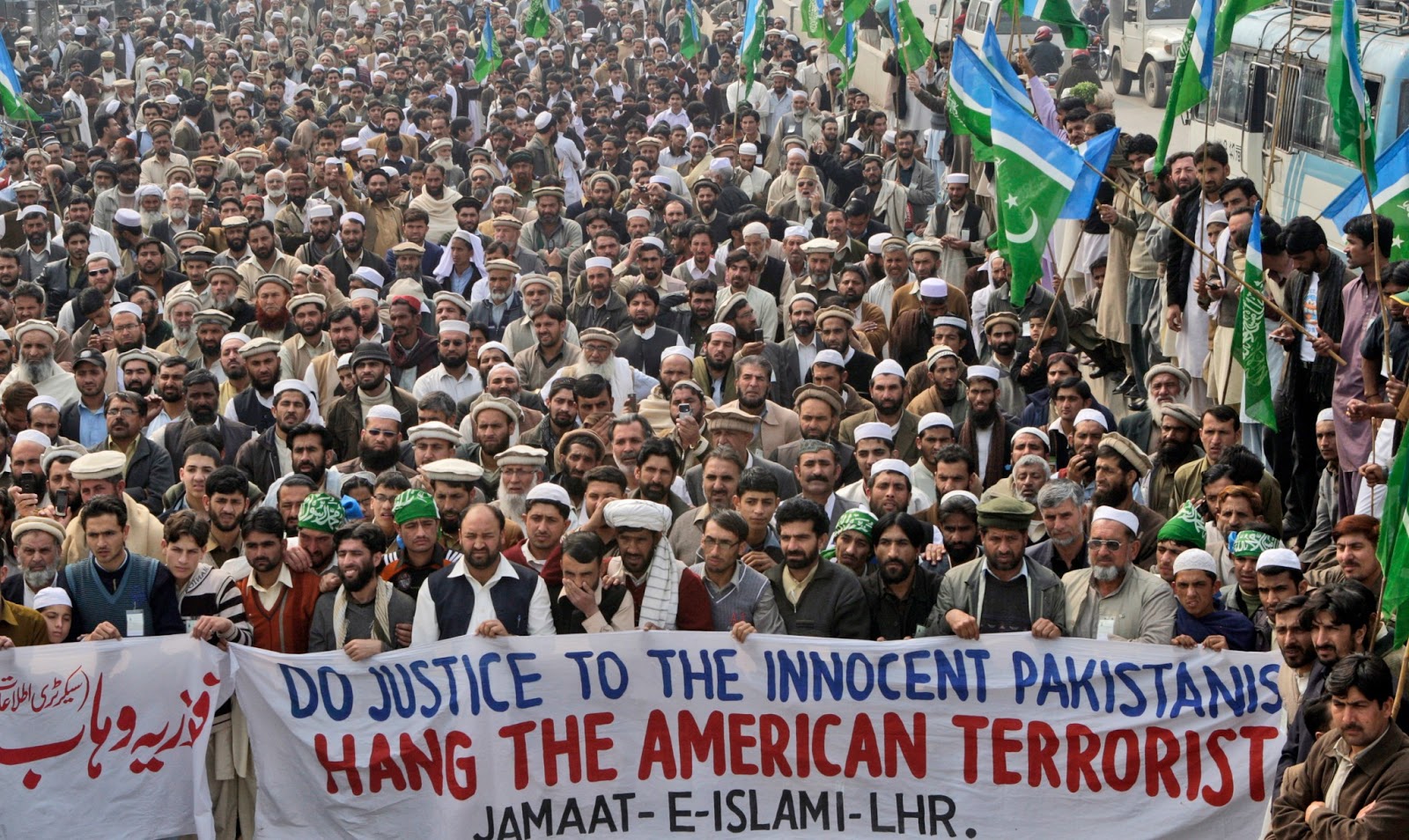 The A1 story in Sunday’s New York Times, written by Declan Walsh, is titled “U.S. Shift Poses Risk to Pakistan.” The story argues that, with the United States gradually dwindling down its political and military engagement with Pakistan, the latter faces a highly uncertain future. Walsh tells us that the disengagement will “diminish” the “prestige” and “political importance” Pakistan held as a “crucial player in global counterterrorism efforts” and could very well “upset its internal stability.”
It’s a piece that is revealing because one voice is noticeably left out of the analysis: that of the Pakistani people. Arguably the most salient fact about the U.S.-Pakistan dynamic is that Pakistanis – you know, the actual human beings who live in that country – despise the U.S. government and think the interaction between the two countries does more harm than good. Gallup conducted polling on these matters in Pakistan last year. An amazing 92% of Pakistanis expressed disapproval of U.S. leadership (i.e. Obama), while 4% approved. In a separate poll, 55% of Pakistanis reported that interaction with the West constitutes “more of a threat”; just 39% thought it was “more of a benefit.”
In a surprising development, Pakistanis don’t seem to support flagrant intrusions on their sovereignty, drone strikes that kill their fellow citizens, and a corrupt, secretive military government that regularly colludes with the U.S. (as of October, just 23% of Pakistanis expressed “confidence” in their government, which Gallup reports is widely viewed as being “too cozy” with the U.S.).
The Times article does not pay much attention to the thoughts and opinions of the Pakistani people, though. They’re background players and largely irrelevant. Walsh instead quotes a single Pakistani academic to support the article’s thesis; at other times in the piece he relies on unnamed “analysts” and “experts.” The only other individual he does quote on this narrow question of whether or not American disengagement “poses a risk” for Pakistan, a former Pakistani foreign minister, explicitly rejects the notion, saying that “less American involvement is good, not bad.”
The article concludes by stressing that, in fact, this alleged “shift” in the U.S.’s posture toward Pakistan is largely illusory, with “few” doubting that America “will remain deeply involved in Pakistan.” A former Obama administration official confidently predicts that the “mutual dependency” between the two countries “will not go away.” This basically undermines the entire point of the story.
Declan Walsh is a good reporter and he has spent a lot of time in Pakistan. But his virtual ignoring of the Pakistanis’ clearly expressed thoughts on these matters is instructive (the extent of the Pakistanis’ role in the article is a single sentence pointing out that drone strikes “stoked anger”). Consider the reverse scenario. Let’s say Pakistan had been propping up a corrupt military government here in the United States for years with aid and support. Pakistan was violating U.S. sovereignty at will, assassinating residents it considers a threat to Pakistani security, dumping their corpses in the ocean. Pakistan flew robots over American skies, from which missiles were regularly launched, killing American men, women, and children. Now imagine how we would feel if the most esteemed newspaper in the world published an article about all of this on its front page that completely ignored the will of the American public and disregarded our opinions.
Perhaps, when discussing geopolitics, we should consider the views of the populations themselves, and not just governments and elites. It’s a radical notion, but it just might make sense.
Still Getting Gitmo Wrong
Guantanamo (Joshua Nistas/US Army)
By Peter Hart| FAIR | May 25, 2013
President Barack Obama’s address yesterday on U.S. terror strategies got a lot of attention for supposedly charting a new course in America’s longest war. But some of the facts were mangled along the way.
On CBS Evening News (5/23/13), reporter Major Garrett stated that
Obama urged Congress to close the military prison in Guantanamo Bay, Cuba. To that end, he will seek permission to send 86 of the 166 jailed terror suspects already cleared for release to other countries.
Those 86 prisoners have not been, and will not be, charged with any crime whatsoever; they are not “terror suspects.” Garrett’s statement was all the more awkward considering that it came right before CBS played a clip of Obama saying this:
Imagine a future, 10 years from now, or 20 years from now–when the United States of America is still holding people who have been charged with no crime on a piece of land that is not a part of our country.
To refer to “people who have been charged with no crime” as “terror suspects” is simply Orwellian. Garrett went on to say:
An intelligence report in January, Scott, found that fewer than 5 percent of those detainees released since 2009 have rejoined the fight.
That is indeed the language used in the government’s accounting of former Guantanamo detainees–and the definition of “re-enagaging” has been narrowed considerably since the Bush years. Reporters have taken some of this Pentagon propaganda on this issue at face value in the past, which should be all the more reason to continue to be skeptical. If someone has been imprisoned without charge or trial for a number of years, can one plausibly claim that they have “returned” to committing crimes that they were never charged with in the first place?
It’s not just CBS. In the New York Times (5/24/13), Peter Baker writes:
Mr. Obama said he was lifting a moratorium he imposed on sending detainees to Yemen, where a new president has inspired more faith in the White House that he would not allow recidivism.
Again, these are prisoners cleared for release because they cannot be charged with any crimes. It is bizarre to seriously discuss the threat that they might go back to committing crimes there’s no apparent evidence that they’ve ever taken part in.
What an Anonymous U.S. Official Says About Iranians in Syria
By Peter Hart | FAIR | May 22, 2013
The Washington Post’s Anne Gearan reports today (5/22/13) that Iran is in the thick of the Syria war, according to an anonymous U.S. official:
Iran has sent soldiers to Syria to fight alongside forces loyal to President Bashar al-Assad and those of the Lebanon-based Hezbollah militia, a senior State Department official said Tuesday.
An unknown number of Iranians are fighting in Syria, the official said, citing accounts from members of the opposition Free Syrian Army, which is backed by the United States. The official spoke on the condition of anonymity to preview a strategy session that Secretary of State John F. Kerry is to hold Wednesday with key supporters of the Syrian opposition.
The rationale for granting anonymity–a privilege that outlets are supposed to extend only rarely–is curious; it’s not clear why the government would need to say things anonymously in order “to preview a strategy session” about Syria.
Even more curious, though, is whether or not the source in question actually said this. At EA Worldview (5/22/13), Scott Lucas took a look at the briefing that produced the story, and what the State Department official actually said was this:
It is the most visible effort we have seen of Hezbollah to engage directly in the fighting in Syria as a foreign force. We understand there are also Iranians up there. That is what the Free Syrian Army commanders are telling us. I think this is an important thing to note, the direct implication of foreigners fighting on Syrian soil now for the regime.
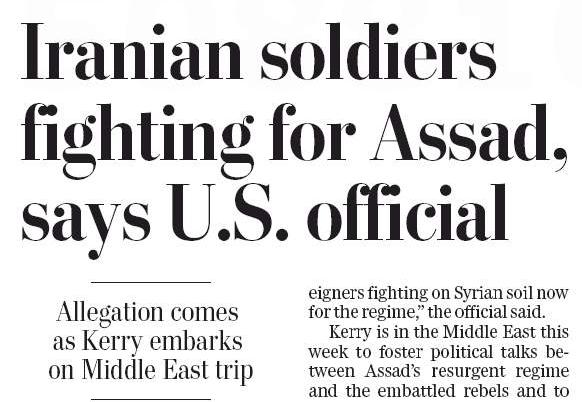 Suggesting that the Free Syrian Army believes Iranians are in Syria–which is probably true–is not the same thing as saying “Iran has sent soldiers to Syria” to fight on Assad’s behalf. And in answering followup questions, the anonymous State Department official admits that “to be very frank, I don’t have any estimates of numbers and I don’t know that they are directly involved in the fighting.” The source also says the Iranians “could be doing a little of both advising and fighting” and that “the reports that we’re getting… are not consistent.”
But Gearan’s question at the briefing would strongly suggest that she was pushing a stronger line about Iranian involvement than the anonymous source:
Are we now, based on your earlier comments about Iranian fighters being involved, looking at a proxy war? I mean, you’re talking about arming the rebels on one side, and the Iranians are clearly arming the others and fighting on behalf of the others on the other side. Are we now basically in a war with Iran?
The source doesn’t go as far out on this issue as Gearan’s question was pushing. But it didn’t really matter. As you can see in the pages of the Washington Post, an official Iranian role in the fighting was treated almost like a fact–which might be the point of having anonymous briefings like this.
Iran dismisses claims about military presence in Syria
Press TV – May 24, 2013
An Iranian deputy foreign minister has rejected claims about Tehran’s military presence in Syria, dismissing the allegations as a “blame game” orchestrated by the Syrian opposition groups.
“Iranian forces have never been, and are not present in Syria, and I deny this claim,” Iranian Deputy Foreign Minister for Asia-Pacific Affairs Abbas Araqchi said in Ankara on Thursday.
“The real enemies of Syria make such claims to provoke that country’s people [against Iran] and divert developments [in Syria] in the wrong direction,” said Araqchi, who is also Iran’s Foreign Ministry spokesman.
He emphasized that the crisis in Syria cannot be resolved through military means, adding that the unrest in the Arab country should be resolved politically. … Full article
Featured Video

Iran’s Next Strike May Not Explode. It Could Shut You Down
or go to
Aletho News Archives – Video-Images
From the Archive
Zionism’s Violent Legacy
By Donald Neff | Washington Report On Middle East Affairs | January 1996
On January 4, 1948, Jewish terrorists drove a truck loaded with explosives into the center of the all Arab city of Jaffa and detonated it, killing 26 and wounding around 100 Palestinian men, women and children.[1] The attack was the work of the Irgun Zvai Leumi – the “National Military Organization,” also known by the Hebrew letters Etzel – the largest Jewish terrorist group in Palestine. The Irgun was headed by Revisionist Zionist Menachem Begin and had been killing and maiming Arabs, Britons and even Jews for the previous ten years in its efforts to establish a Jewish state.
This terror campaign meant that at the core of Revisionist Zionism there existed a philosophical embrace of violence. … continue
Blog Roll
 Aletho News
- Trump’s Iran war is on an Israeli leash
- Saudi oil boss issues global supply warning
- Riyadh Says Its Oil System Is Intact. The Numbers Say Otherwise.
- Trump and Netanyahu Want to “Finish the Job” on Iran
- US ‘one-sided dictation’ not Iran’s beliefs makes rational talks impossible: Baghaei
- Iran’s Next Strike May Not Explode. It Could Shut You Down /Col Doug Macgregor
- Iran: US political targets legitimate if assassinations return
- Iraq shuts key border crossing with Iran under US pressure: Report
- Undersea Internet cables could be targeted in retaliation for attacks on Iran: IRGC deputy chief
- EU sending ‘biased’ observers to interfere in Serbian election – president
- If Americans Knew
- At least 160 Israeli settler attacks in 2 weeks
- Will Gaza’s Ancient Christian Community Disappear Forever?
- Israel’s vision of regional security rests on keeping Arab states weak
- Heidi Levine recounts how Palestinian youths helped save her in settler attack
- DAILY UPDATE: Latest essential news on Palestine, Israel, & region
- Trump’s Intensifying Sabotage of the ICC, for Israel’s Sake
- Israeli military detain US and UK volunteers in West Bank including Democratic NY politician Brad Lander
- Americans at National Conservatism Conference held in Israel this year criticize Israel
- Christiane Amanpour exits CNN with a legacy shaped by the debate over Israel
- Israel’s war on Iran is the final move in a decades-old strategy
- No Tricks Zone
- E-Cars Reduce CO2 Emissions By Only 41% Compared To Internal Combustion Engine Vehicles
- Predictions Made By Renowned Climate Professor Over Past Decades Have Been Proven To Be Poor
- New Study Suggests Large Regions Of The Pacific Ocean Have Been Cooling For The Last 80 Years
- Germany’s Green Energy Debacle: High Energy Costs Force Kahla Porzellan to Close After 182 Years!
- New Study: 50 Years Of The Most Aggressive ‘Net Zero’ Policies Can Only Affect The Global Climate By 0.03°C
- US September “Heat” Was No Record…Many Records Set Decades Ago
- Latest European Green Energy Debacle; Portugal’s Largest Flagship Solar Park Insolvent!
- Green Energy Debacle: German Expert Professor Fritz Vahrenholt Warns Of Severe Economic And Social Consequences
- Two More Paleo Reconstructions Affirm Meters-Higher Sea Levels Across Ireland, Brazil 7000-6000 Years Ago
- New Study: Earth And Venus Surface Warmth Largely Explained By Convection And Lapse Rate, Not CO2 Or Radiation

