PBS, NPR Try to Defend Iran Distortions
By Peter Hart | FAIR | January 17, 2012
Evaluating reporting and commentary about Iran could be reduced to one simple rule: There is no evidence that Iran is working on a nuclear weapon. Statements that suggest otherwise are misleading. Reports that fail to point this out are doing readers/viewers/listeners a disservice.
That sounds simple enough. But don’t tell that to the outlets that are being criticized over their Iran reporting.
Take NPR and PBS, both of which were singled out by the group Just Foreign Policy.
A few days ago (1/10/12), the FAIR Blog featured a post criticizing the PBS NewsHour for a deceptive report on Iran. The report introduced a quote from Pentagon chief Leon Panetta with this statement by PBS anchor Margaret Warner: “The Iranian government insists that its nuclear activities are for peaceful energy purposes only, an assertion disputed by the U.S. and its allies.”
Panetta’s quote immediately followed: “We know that they’re trying to develop a nuclear capability, and that’s what concerns us. And our red line to Iran is, do not develop a nuclear weapon.” My point in that blog post was that right before he said this, Panetta had made a very candid admission about Iran, one that would no doubt be surprising to most corporate news consumers: “Are they trying to develop a nuclear weapon? No.”
The fact that the NewsHour would clip this statement from his soundbite was troubling. PBS ombud Michael Getler responded (1/12/12) by agreeing that we had a point:
I think FAIR makes a good journalistic catch in calling attention to the fuller quote by Panetta on CBS. It was a very brief and clear statement by the Defense secretary on an important point about whether Iran is actually developing a nuclear weapon.
And NewsHour foreign affairs and defense editor Mike Mosettig editor agrees that “it would have been better had we not lopped off the first part of the Panetta quote.”
But Getler thinks it was unfair to to call the PBS edit “dishonest,” and he explains why:
The logical understanding that NewsHour viewers–and anyone who has been following this subject–would draw from the portion of the Panetta quote that was used is that Iran does not have a nuclear weapon but that they are developing a “nuclear capability” and that the U.S. warning, as Panetta expressed it, is not to cross “our red line” and actually develop a weapon.
So viewers who are paying close attention to Iran coverage (and who are hopefully tuning out the rhetoric coming from many of the Republican presidential candidates) would know that when Panetta was saying, “We know that they’re trying to develop a nuclear capability,” he meant that they were not trying to develop a nuclear weapon–even though the program had edited out his very straightforward explanation of what is actually known about the state of Iran’s nuclear program.
This is a curious argument. One of the things that made Panetta’s comment so revealing was that it represented a break from the usual chatter about Iran–even within the Obama administration. That’s precisely what made it newsworthy. PBS seems to think its viewers should have to read between the lines in order to arrive at the accurate assessment about Iran’s nuclear program they left on the cutting room floor.
Now to NPR.
The criticism of Robert Naiman and Just Foreign Policy centered on NPR reporter Tom Gjelten’s statement that “the goal for the U.S. and its allies…[is] to convince Iran to give up a nuclear weapons program.” The suggestion, it would seem, is that Iran is indeed pursuing such weapons.
But NPR ombud Edward Schumacher-Matos (1/13/12) sees it exactly the other way around. He writes:
The story didn’t say or imply that Iran has a nuclear weapons program. As Bruce Auster, the senior editor for national security, notes, “The story was about how the sanctions are designed to prevent Iran from having a nuclear weapons program, which automatically suggests it may not have one.”
Does NPR really think that the best way to inform its listeners is to assume that when people hear a report about forcing Iran to “give up a nuclear weapons program,” these listeners should fill in the blanks themselves so as to arrive at an entirely different meaning? That every time you hear something about Iran’s “nuclear weapons program,” that is really code for “the-nuclear-weapons-program-that-may not exist-since-there-is-no-evidence-that-it-exists”? That’d be an unusual burden to place on listeners.
For good measure, the ombud throws in another defense of the NPR report by pointing out that the “quote carefully refers to ‘a’ program–using the indefinite article–and not the definite ‘its’ or ‘the’ program.” Again, NPR listeners: If you hear one of the reporters use the word “a,” remember that could be a reference to something that doesn’t exist. Got it?
Venezuela Withdraws Consular Personnel in Miami
Venezuelan Ministry for Foreign Affairs | January 16, 2012
Caracas – The government of the Bolivarian Republic of Venezuela has verified with extreme concern the increase in threats against Venezuelan consular personnel in Miami, Florida.
The U.S. government’s decision to declare the Consul General of the Bolivarian Republic of Venezuela persona non grata based on groundless accusations irresponsibly spread by a television network that is better known for its soap operas than for its journalistic seriousness, is an unfair and immoral measure that demonstrates the submission of Washington’s agenda to extremist and violent political sectors in the state of Florida.
Since the release of those unspeakable speculations, Venezuelan diplomatic and consular personnel have been threatened and intimidated, and in light of the criminal and terrorist nature of individuals and organizations that the U.S. government harbors in the state of Florida, this places them in real, serious and imminent danger.
In order to preserve their physical and moral integrity, the government of the Bolivarian Republic of Venezuela has decided to return its consular personnel in Miami to Caracas, and undertake a full evaluation of the operational and security conditions of the Consulate General.
Truth about Syria: Crazy Men in Grey Suits
The west is on the hunt for another war in the Middle East
By Jeremy Salt | Palestine Chronicle | January 12, 2012
Ankara – In his speech to university students this week, Bashar al Assad spoke of a conspiracy against Syria. Use another word if you like, but of course there is one. The foot soldiers in the campaign to bring down the Syrian government are the armed men calling themselves the Free Syrian Army and the random armed gangs. None of them could maintain their violent campaign without outside support. Short of open armed intervention from the outside, they cannot overthrow the Syrian government. All they can do is keep killing and causing chaos in the hope that it will eventually collapse. Their sponsors are the US, Britain, France, Saudi Arabia, Qatar, the Muslim Brotherhood, the Syrian National Council, assorted ‘activists’ in exile, some closely linked to the British Foreign Office and the US State Department, and every salafist across the region. Reform is not the issue. Their agendas vary but converge at one point: their determination to destroy the Baathist government. For the US, Britain and France – ‘the west’ – the destruction of a government and a political party that has long got in their way is the issue. For Saudi Arabia, the issue is confronting Iran and containing Shiism across the region. For the Muslim Brotherhood, the issue is revenge for Hafez al Assad’s repression of their revolt in 1982, the destruction of a secular government and the installation of a sharia-based substitute which they expect to dominate. For both the Muslim Brotherhood and the salafists the issue is also the destruction of the Alawis as a socio-political force in Syria.
For the US and Saudi Arabia, Iran, Syria and Hizbullah are three parts of the same problem. Saudi Arabia regards Iran as the ‘head of the snake’ and wanted it attacked in the last years of the Bush administration, but a direct attack, removing the veil from the covert war already being involved, would be enormously dangerous to the countries waging it. This is what hinders them from going ahead, not the catastrophe that such a war would be for the people of Iran and the region. (It is extraordinary that although Iran has lived under the threat of such an attack for years, the western media still has not dealt with the consequences of a military attack on live nuclear reactors.) Iran would be seriously weakened by successful open (as opposed to the covert war presently being waged) armed intervention in Syria. Such an attack would have much the same immediate effect as a direct attack on Iran. In 2006 the two countries signed a defence agreement to confront ‘common threats’, and Iran would regard open intervention in Syria as the prelude to an attack on itself. The most likely form of armed intervention would be the declaration of a no-fly zone or a ‘humanitarian corridor’ just over the Turkish-Syrian border. The template for this kind of war was Libya, where up to 50, 000 people were killed after France, Britain, the US and their lesser allies decided to attack in the name of maintaining a no-fly zone. Russia and China have indicated that they would block any moves at the UN Security Council to set up such arrangements. In the light of these difficulties, destabilising Syria with the aim of achieving the same objectives as an open attack is a second best option. Bringing down the Syrian government, rupturing its strategic relationship with Iran and Hizbullah, is an end in itself for the US and its western and gulf allies. Insofar as Iran is concerned, removing Syria from the calculus of war by throwing it into such turmoil that it could not respond would significantly strengthen the US-Israeli position and perhaps make war more likely.
Since the beginning of the year the geopolitical map of the region has been significantly redrawn. Islamist parties have come or are coming into government in Morocco, Tunisia and Egypt, and are likely to do well when elections are held in Libya. What parties say when in opposition and what they feel obliged to do in office are usually two different things and the Islamist parties are no different. On the critical question of relations with Israel, Rashid Ghannushi, the leader of Tunisia’s Al Nahda party has held quiet talks with the Israelis in Washington and has indicated that Palestine will not be a priority for the new Tunisian government. Conflicting signals are coming from the Muslim Brotherhood in Egypt. According to the US State Department, the brotherhood has given an assurance that it will uphold the 1979 treaty with Israel. Almost immediately this was denied, with senior brotherhood figures saying that the treaty could not be regarded as sacrosanct and repeating the possibility of a referendum being held so the people could decide. This will be the trickiest of questions for the new government to handle but as the new Egyptian government will need the billions of dollars of aid pledged by the US, Saudi Arabia, Qatar and the IMF (last year an offer of $3 billion was not taken up but will be discussed again this January), pragmatism is likely to win out, in the short term and perhaps for as long as Israel itself does not put the treaty at risk through another savage attack on Gaza or Lebanon.
In this rapidly changing environment Syria is a holdout state, standing firm against the US and Israel on the one hand and the rising Islamist/salafist trend on the other. The peaceful opposition was swamped in violence a long time ago, with the army still battling ‘defectors’ and the armed gangs the media keeps telling us are an invention of the state. The western media has yet to interview the families of the thousands of soldiers and civilians who have been killed by ‘defectors’ and other armed bands to see what they think about what is happening in their country. Relying on the unverified accusations of ‘activists’ or suspect sources outside Syria, the media has played a critical role in the development of a false narrative. Last week the Guardian hit a new low point with the accusation by of a London-based ‘activist’ that the Syrian security forces are packing detainees into container ships and dumping them at sea. It had no evidence for this claim, but then this is how the Guardian has been ‘reporting’ this crisis throughout. When Damascus was bombed, both the Guardian and the BBC led with the claim that these bombings were the work of the government – according to activists. They had no evidence for this accusation either, literally made while Syrians were still washing the blood off the streets and picking up the body parts of the civilians who had been killed. When the Arab League issued an interim statement on the work of its monitors in Syria, it called for an end to the violence by the state and by armed gangs. On its web page, the BBC reported only that it called on the Syrian government to end the violence.
The west is on the hunt for another war in the Middle East. This is the essence of the campaign against Syria. Iran is being provoked every other day. This week another nuclear scientist was assassinated. The clear intention is to goad Iran into retaliating, providing the pretext for the armed attack that many in Israel and the US want. There is no question that Syria needs to reform but anyone who thinks that the US, Britain, France, Saudi Arabia and Qatar are campaigning against Syria for the cause of reform is living in a dream world. Every wild accusation made by activists and dutifully reported by the media is grist to their mill. They don’t want the violence to end. They want it continue until the Syrian government is destroyed, and they have the resources to keep this going virtually endlessly. If they take the plunge and launch an open attack on Syria or Iran they are likely to trigger off a regional war and, in the view of some, a global war. In their grey suits and pastel ties, these people are as crazy as any fascist in a brown uniform.
~
Jeremy Salt teaches the history of the modern Middle East in the Department of Political science, Bilkent University, Ankara. He previously taught at Bogazici (Bosporus) University in Istanbul and the University of Melbourne. His publications include The Unmaking of the Middle East: A History of Western Disorder in Arab Lands (University of California Press, 2008).
Clinton Revives Dubious Charge of “Covert” Iranian Nuclear Site
By GARETH PORTER | CounterPunch | January 12, 2012
U.S. Secretary of State Hillary Rodham Clinton’s charge Tuesday that Iran had intended to keep the Fordow site secret until it was revealed by Western intelligence revived a claim the Barack Obama administration made in September 2009.
Clinton said Iran “only declared the Qom facility to the IAEA after it was discovered by the international community following three years of covert construction.” She also charged that there is no “plausible reason” for Iran to enrich to a 20 per cent level at the Fordow plant, implying that the only explanation is an intent to make nuclear weapons.
Clinton’s charges were part of a coordinated U.S.-British attack on Iran’s enrichment at Fordow. British Foreign Minister William Hague also argued that Fordow is too small to support a civilian power program. Hague also referred to its “location and clandestine nature”, saying they “raise serious questions about its ultimate purpose”. The Clinton-Hague suggestions that the Fordow site must be related to an effort to obtain nuclear weapons appear to be aimed at counterbalancing Secretary of Defence Leon Panetta’s statement only two days earlier that Iran is not seeking nuclear weapons.
The Clinton and Hague statements recalled a briefing for reporters during the Pittsburgh G20 summit meeting Sep. 25, 2009, at which a “senior administration official” asserted that Iran had informed the IAEA about the Fordow site in a Sep. 21 letter only after it had “learned that the secrecy of the facility was compromised”.
That administration claim was quickly accepted by major media outlets without any investigation of the facts. That story line is so deeply entrenched in media consciousness that even before Clinton’s remarks, Reuters and Associated Press had published reports from their Vienna correspondents that repeated the official Obama administration line that Iran had revealed the Fordow site only after Western intelligence had discovered it.
But the administration never offered the slightest evidence to support that assertion, and there is one major reason for doubting it: the United States did not inform the IAEA about any nuclear facility at Fordow until three days after Iran’s Sep. 21, 2009 formal letter notifying the IAEA of the Fordow enrichment facility, because the U.S. couldn’t be certain that it was a nuclear site.
Mohammed ElBaradei, then director general of the IAEA, reveals in his 2011 memoir that Robert Einhorn, the State Department’s special advisor for nonproliferation and arms control, informed him Sep. 24 about U.S. intelligence on the Fordow site – three days after the Iranian letter had been received.
An irritated ElBaradei demanded to know why he had not been told before the Iranian letter.
Einhorn responded that the United States “had not been sure of the nature of the facility”, ElBaradei wrote.
The administration’s claim that Iran announced the site because it believed U.S. intelligence had “identified it” was also belied by a set of questions and answers issued by the Obama administration on the same day as the press briefing. The answer it provided to the question, “Why did the Iranians decide to reveal this facility at this time,” was “We do not know.” Greg Thielmann, who was a top official in the State Department’s Bureau of Intelligence and Research until 2003 and was on the staff of the Senate Select Committee on Intelligence during the 2009 episode, told this reporter the evidence for the claim that Iran believed the site had been discovered was “all circumstantial”.
Analysts were suspicious of the Iranian letter to the IAEA, Thielmann said, because, “it had the appearance of something put together hurriedly.”
But there is an alternative explanation: the decision to reveal the existence of a second prospective enrichment site – this one built into the side of a mountain – appears to have reflected the need to strengthen Iran’s hand in a meeting with the “P5 + 1″ group of state led by the United States that was only 10 days away. The Iranian announcement that it would participate in the meeting on Sep. 14, 2009 came on the same day that the head of Atomic Energy Organization of Iran, Ali Akbar Salehi, warned against an attack on Iran’s nuclear facilities.
The idea that Iran was planning to enrich uranium secretly at Fordow assumes that the Iranians were not aware that U.S. intelligence had been carrying out aerial surveillance of the site for years. That is hardly credible in light of the fact that the Mujahideen-E-Khalq (MEK), the armed opposition group with links to both U.S. and Israeli intelligence, had drawn attention to the Fordow site in a December 2005 press conference – well before it had been selected for a second enrichment plant. The MEK had also revealed the first Iranian enrichment site at Natanz in an August 2002 press conference, which had been the kickoff for the George W. Bush administration’s propaganda campaign charging Iran had maintained a covert nuclear programme ever since the 1980s.
But when the MEK identified the Natanz facility, Iran’s only commitment under its safeguards agreement with the IAEA was to inform the agency of any new nuclear facility 180 days before the introduction of nuclear material. That date was then still far in the future.
In November 2003, the Bush administration engineered the passage of resolution at the IAEA Governing Board meeting condemning Iran for “18 years of covert nuclear activity”.
In fact, Iran had announced openly in 1982 that they intended to have the capability to convert yellowcake into reactor fuel. In 1983, Iran asked the IAEA to help it build a pilot plant for uranium enrichment, but the U.S. government intervened to prevent the agency from doing so.
It was that U.S. political interference that forced Iran to purchase black market centrifuge technology from the A.Q. Khan network in 1987. But Iran openly negotiated with China, Argentina and six other governments for the purchase of nuclear energy and facilities in the 1980s and 1990s.
Despite those well-known facts, the Bush administration charge that Iran had operated a “clandestine nuclear program” for “18 years” quickly become an accepted fact inserted in many stories by major newspapers such the Washington Post, New York Times and Los Angeles Times.
In asserting that there was “no plausible justification” for Iran’s enrichment to 20 per cent, Clinton sought to refute Iran’s explanation that the 20 per cent enrichment is supply fuel for its Tehran Research Reactor (TRR).
“The P5+1 has offered alternatives for providing fuel for the TRR,” Clinton said. The proposal made by the P5+1 in 2009, however, was explicitly aimed at stripping Iran of the bulk of its stock of low-enriched uranium – a prospect that was widely criticized even among critics of President Mahmoud Ahmadenijad, including Mir Hossein Mousavi , his rival in the contested June 2009 presidential election.
The main reason for the resistance to the proposal appears to have been that Iran would have been deprived of its bargaining chips in relation to eventual negotiations with the United States.
When Iran agreed to a joint Brazilian-Turkish proposal for a swap in 2010 in June 2010, the Obama administration rejected it, because it left Iran with too much low enriched uranium.
It was after that rejection that Iran vowed to enrich uranium to 20 per cent unless it obtained a supply through other means. Iran also demonstrated at the 2011 IAEA Governing Board meeting that it was working on producing its own fuel plates for the TRR, according to former IAEA nuclear inspector Robert Kelley.
~
GARETH PORTER is an investigative historian and journalist with Inter-Press Service specialising in U.S. national security policy. The paperback edition of his latest book, “Perils of Dominance: Imbalance of Power and the Road to War in Vietnam“, was published in 2006.
Discord among Arab monitors as Russia warns of Syria intervention
Al-Akhbar, AFP | January 12, 2012
Head of the Arab League’s observer mission in Syria, Sudanese General Mustafa al-Dabi, branded as “baseless” claims by former monitor Algerian Anwar Malek that the Syrian regime was committing crimes against humanity.
On Wednesday, Malek told Doha-based Al Jazeera that he had quit the mission and accused the Syrian regime of committing a series of war crimes against its people and of duping his colleagues.
But Dabi said that Malek had barely left his hotel room when deployed in Homs.
“What observer Anwar Malek said on a satellite television is baseless,” General Mohammed Ahmed Mustafa al-Dabi, former head of Sudanese military intelligence, who leads the operations in Syria, said in a statement.
“Malek was deployed to Homs among a team, but for six days he did not leave his room and did not join members of the team on the ground, pretending he was sick,” Dabi said in the statement.
He echoed remarks by an unnamed Arab League official who said Malek was bedridden throughout his assignment in Homs and his accusations are unfounded.
“What I saw was a humanitarian disaster. The regime isn’t committing one war crime but a series of crimes against its people,” the Algerian observer told Al Jazeera.
“The mission was a farce and the observers have been fooled. The regime orchestrated it and fabricated most of what we saw to stop the Arab League from taking action against the regime,” Malek said.
According to Dabi, the Algerian monitor requested leave for medical treatment in Paris but departed before waiting for the green light.
An Arab League official noted that two monitors quit the mission, an Algerian (Malek) and a Sudanese, and claimed Malek left “for health reasons,” while the Sudanese “was returning to his country for personal reasons.”
“Two monitors have excused themselves, an Algerian and a Sudanese,” Syria operations chief Adnan Khodeir said at Arab League headquarters in Cairo.
Russia warns of Libya-repeat
Russian Security Council secretary Nikolai Patrushev warned that NATO and Gulf Arab states are plotting to intervene militarily in Syria along the lines of the Libya intervention that eventually ousted Muammar Gaddafi.
“There is information that NATO members and some Arab states of the Persian Gulf, acting in line with the scenario seen in Libya, intend to turn the current interference with Syrian affairs into a direct military intervention,” he said in an interview published on the website of the daily Kommersant.
“The main strike forces will be supplied not by France, Britain, and Italy, but possibly by neighboring Turkey.”
Washington and Ankara may already be working on plans for a no-fly zone to enable armed Syrian rebel units to build up, he said.
Similar fears were echoed by opposition figure Haytham al-Manna of the National Coordination Body for Democratic Change in Syria (NCB), who told Al-Akhbar two weeks ago that Gulf Arab states “might turn Syria into a battleground against Iran.”
Manna stressed Syrian revolutionaries “refuse to become the victims of a war by proxy.”
Patrushev’s comments come as Qatari Prime Minister Hamad bin Jassim al-Thani met with US Vice President Joe Biden at the White House on Wednesday to discuss the ongoing violence in Syria.
The pair “condemned the ongoing violence in Syria perpetrated by the Assad regime and noted the significance of the Arab League observer mission’s final report due on January 19,” the White House said.
The Arab League has come under fire for its observer mission from opposition groups and Syrian President Bashar Assad, both claiming the regional body is ineffective.
Syria’s Muslim Brotherhood accused the Arab monitors of “covering up” government crimes, while Assad also lambasted the League for bias against the regime in his speech on Tuesday.
But China expressed empathy with the Arab League, saying the regional body faced “difficulties” in monitoring the violence in Syria.
“The Syrian government and other Syrian parties should provide suitable conditions to allow the observers to carry out their work,” Wu Sike, China’s envoy to the Middle East, told reporters after meeting Arab League chief Nabil al-Arabi in Cairo on Thursday.
Wu voiced regret for attacks in the past few days targeting observers in Syria.
“We hope that the observers will be patient and will pursue their efforts until they achieve their goal for the sake of Syria and its people,” he added, when asked about reports that some monitors had quit the mission.
Two Kuwaiti monitors and one observer from the Arab League were slightly wounded in an attack on their convoy in Latakia on Monday.
An Arab League official on Wednesday said the trio suffered “minor cuts” when protesters broke the window of their vehicle.
Inquiry demanded over journalist death
Meanwhile, the Syrian National Council (SNC) – a main umbrella opposition organization that includes the Muslim Brotherhood as well as secular activists – accused the regime of killing French journalist Gilles Jacquier in Homs on Wednesday.
The SNC denounced the “murder” of Jacquier, saying in a statement it was a “dangerous sign that the authorities have decided to physically liquidate journalists in an attempt to silence neutral and independent media.”
Accounts of violence are difficult to verify as foreign journalists are not permitted to freely cover the crisis in Syria, but Mazen Darwich of the Syrian Center for Media and Freedom of Speech told Al-Akhbar that it was unclear who was behind the attack.
Jacquier’s death, the first foreign journalist killed since the uprising began in Syria last March, occurred as he was covering a pro-regime rally in the Akramah neighborhood of Homs when RPGs fell on the crowd, killing nine in total, Darwich said.
A Belgian journalist, Steven Visner, was also critically wounded.
France demanded an inquiry into Jacquier’s death.
French President Nicolas Sarkozy said in a statement that “France expects the Syrian authorities to shed light on the death of a man who was simply doing his job: reporting.”
British Foreign Secretary William Hague condemned the attack, saying the “deaths highlight once again the terrible price being paid by the people of Homs, as well as the courage of journalists who take great personal risks to bring to light what is happening to the people of Syria.”
And EU foreign affairs chief Catherine Ashton joined global press watchdog Reporters Without Borders in demanding a rapid inquiry.
The latest UN figures from mid-December have the death toll at over 5,000 since the Syrian uprising began last March.
Damascus has released its own figures, however, contending that 2,000 security personnel have been killed by armed groups.
U.S. Expels Venezuelan Consul as “Persona Non Grata”
By Rachael Boothroyd | Venezuelanalysis.com | January 10, 2012
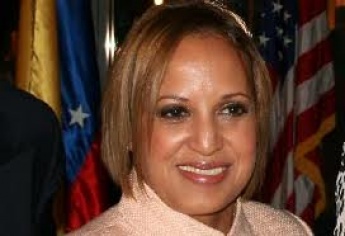 Hugo Chavez: Livia Acosta Noguera is a ‘dignified professional’ who has been ‘humiliated and demonised’ by US extremist groups and the Obama administration (Elmundo.com)
Caracas – Venezuelan President Hugo Chavez has condemned the United States’ decision to expel the Venezuelan consul general in Miami as “arbitrary and unjustified” this past Monday, and derided the move as “another demonstration of the arrogance of ridiculous imperialism”.
Venezuelan diplomat Livia Acosta Noguera had been working in the U.S. since March 2011 when she was ordered to leave last Sunday amidst claims that she had discussed the possibility of orchestrating cyber attacks against the US government whilst serving as Vice-secretary at the Venezuelan embassy in Mexico.
“She has been accused of I don’t know how many things by the U.S. government, and above all, by sectors of the ultra rightwing in Miami , including many Venezuelans who live there, counter-revolutionaries, not all of them, but a small group,” explained Chavez.
Contrary to the accounts published by many mainstream news channels, President Chavez also clarified that Noguera was already in Caracas, and had been since December.
“We already knew that this was going to happen, and so she has been in Caracas in order to avoid situations, possibly even dangerous ones,” said the Venezuelan president.
The U.S. State Department has not commented on the reasons for Noguera’s expulsion, however, former Assistant Secretary of State for Western Hemispheric Affairs, Roger Noriega, posted the following comment on his twitter account prior to the US government’s official announcement.
“Chavista terrorist spy consul general Livia Acosta expelled from the United States by the State Department! Acosta has 72 hours to leave the country.”
Despite the U.S. State Department’s silence on the issue, it is known that four members of Congress had previously written to US Secretary of State, Hilary Clinton, on December 9th expressing their “grave concern” over the “diplomatic credentials” of Noguera. In the letter the four representatives make reference to “The Iranian Threat”, a 2008 documentary filmed by the Spanish-language media corporation Univision.
The four members of congress are; Cuban-American Ileana Ros-Lehtinen (Republican), Mario Diaz-Balart (Republican), David Rivera (Republican) and Cuban-American Albio Sires (Democrat).
In an interview with Telemundo’s Soraya Galan last week, former Venezuelan military Lieutenant, José Antonio Colina Pulido, also revealed that he too had sent a letter to Hilary Clinton in August of last year advising the Secretary of State that Noguera was illegally using her diplomatic immunity in order to gain access to classified documents.
The retired Lieutenant, who is wanted in Venezuela for his connection to the terrorist attacks carried out against the Spanish Embassy and the Consulate of Colombia in February 2002, also claimed he had proof that the Venezuelan diplomat was “actively working for Chavez’s political police”. Pulido did not elucidate as to the nature of this evidence for the benefit of Telemundo viewers.
The Documentary
Based on audio and video files obtained from “students posing as extremists” who Noguera supposedly met with at the National Autonomous University of Mexico (UNAM), the documentary alleges that the Venezuelan diplomat discussed the possibility of coordinating attacks against the United States’ computer systems with other Cuban and Iranian officials. According to the documentary, these cyber-attacks would be “worse than September 11th”.
The same Univision documentary has caused diplomatic altercations between the US and Venezuela before, and was cited by Congressmen such as John McCain earlier last year in an unsuccessful bid to have Venezuela placed on the US “State Sponsor of Terrorism” list. The United States government has been unable to provide evidence to corroborate the authenticity or accuracy of the New York-based company’s documentary, although the Associated Press reports that the FBI has been investigating.
Previously based in Los Angeles, Univision is the largest Spanish language network in the USA. It is partly owned by American-Israeli media mogul and close friend to the Clintons, Haim Saban, also the owner of the Saban Center for Middle East Policy, a foreign policy think tank in Washington.
Univision’s Executive Board includes Cesar Conde (President of Univision Networks) and Randy Falco (President and Chief Executive Officer). Conde was appointed as a White House Fellow by former U.S. President George W. Bush in 2002-2003. During this time, he served as the White House Fellow for Secretary of State, Colin L Powell.
Third Parties Are Not Spoilers
Open Letter to the Wall Street Journal
By Ralph Nader | January 10, 2012
How unbecoming it is for the self-styled freedom-loving Wall Street Journal (“Ron Paul Nader?” Dec. 21) to use the politically bigoted word “spoiler” to describe a hypothetical Ron Paul-Libertarian party presidential run.
Why is a third-party candidate called a “spoiler” when the nominees of the Republican and Democratic parties, that have given us a spoiled political system (corrupted by the highest bidder) are never referred to in such a pejorative way? These two decaying parties do not own the voters in this country, though they act that way through their many state laws obstructing outside competition.
Since all candidates are supposed to have the equal right to run for election, then they are either all spoilers of one another in seeking votes or none of them deserve to be called “spoilers.” Candidates from smaller parties are not second-class citizens. After all, either of the major party candidates “takes away” far more votes from the other than any third party candidate does.
SOPA-Supporting News Outlets Aren’t Covering SOPA
By Dave Copeland | Read Write Web | January 6, 2012
MSNBC, Fox News, ABC, CBS and NBC have dedicated no time to covering the Stop Online Piracy Act in their evening newscasts since Oct. 1, according to a report by Ben Dimiero of Media Matters For America.
CNN, meanwhile, has dedicated a single evening news segment to the issue. All of the companies covered in the report have either publicly supported SOPA or have parent companies that have done so.
Dimiero based his report on Lexis-Nexis searches which includes transcripts of nighttime newscasts.
Comcast/NBCUniversal (which owns MSNBC and NBC News), Viacom (CBS), News Corporation (Fox News), Time Warner (CNN) and Disney (ABC) are all listed as supporters of the bill. ABC and CBS are also listed as separate supporters of the bill.
SOPA would block access to sites accused of violating U.S. copyright laws. The measure has been called Draconian by opponents who say it would fundamentally change the free-flow of information across the Internet. Proponents, ranging from the NBA to Universal, say the measure is needed to block sites which flagrantly flaunt copyright laws and make content available for free without paying copyright owners.
Traditional media companies have been key players in lobbying for SOPA’s passage, with more than half of that funding coming from cable television providers, commercial TV and radio stations, and the entertainment industry. Opponents of the legislation have been developing apps to help voters track how their legislators stand on SOPA and how much they have received in campaign donations from SOPA-supporting entities.
Qatar urges West to intervene in Syria
Press TV – January 8, 2012
Qatar has suggested that Western agents join the Arab League delegation team in Syria to monitor the unrest in the country.
On Sunday, Arab League foreign ministers will review the first report by their observers two weeks after the bloc’s delegation arrived in the country on December 26.
Qatari Prime Minister Sheik Hamad bin Jassem Al Thani claimed the Arab League observer mission in Syria has deviated from its goals, saying that monitors could not stay in Syria to “waste time.”
He added that the Arab League observer mission in Syria has made “some mistakes.”
Meanwhile, France and the US have slammed what they call the impotence of the league’s observers and asked for their exit from Syria.
The Persian Gulf kingdom has been at the forefront of criticism of Syria and has pushed for Arab League sanctions against Damascus.
Doha has reportedly built up a strong army of hundreds of Wahhabi forces to help overthrow Syrian President Bashar al-Assad.
The heavily-equipped forces known as the Free Syrian Army have taken up positions in northern Syria, near the border with Turkey.
Syria has been experiencing unrest since mid-March and the UN said more than 5,000 people have been killed in the country over the past nine months.
Damascus says over 2,000 of those killed were members of its security forces.
The West and the Syrian opposition accuse the government of killing protesters. Damascus blames ”outlaws, saboteurs and armed terrorist groups” for the unrest, insisting that it is being orchestrated from abroad.
Featured Video

Trita Parsi: Israel Set a Trap for Total War in the Region
or go to
Aletho News Archives – Video-Images
From the Archive
Zionism’s Violent Legacy
By Donald Neff | Washington Report On Middle East Affairs | January 1996
On January 4, 1948, Jewish terrorists drove a truck loaded with explosives into the center of the all Arab city of Jaffa and detonated it, killing 26 and wounding around 100 Palestinian men, women and children.[1] The attack was the work of the Irgun Zvai Leumi – the “National Military Organization,” also known by the Hebrew letters Etzel – the largest Jewish terrorist group in Palestine. The Irgun was headed by Revisionist Zionist Menachem Begin and had been killing and maiming Arabs, Britons and even Jews for the previous ten years in its efforts to establish a Jewish state.
This terror campaign meant that at the core of Revisionist Zionism there existed a philosophical embrace of violence. … continue
Blog Roll
 Aletho News
- Trita Parsi: Israel Set a Trap for Total War in the Region
- Trump’s Iran war is on an Israeli leash
- Saudi oil boss issues global supply warning
- Riyadh Says Its Oil System Is Intact. The Numbers Say Otherwise.
- Trump and Netanyahu Want to “Finish the Job” on Iran
- US ‘one-sided dictation’ not Iran’s beliefs makes rational talks impossible: Baghaei
- Iran’s Next Strike May Not Explode. It Could Shut You Down /Col Doug Macgregor
- Iran: US political targets legitimate if assassinations return
- Iraq shuts key border crossing with Iran under US pressure: Report
- Undersea Internet cables could be targeted in retaliation for attacks on Iran: IRGC deputy chief
- If Americans Knew
- The Israel Lobby’s Changing Fortunes
- AIPAC has become such a political liability that it’s shifting to a more “nimble” approach to buying politicians
- At least 160 Israeli settler attacks in 2 weeks
- Will Gaza’s Ancient Christian Community Disappear Forever?
- Israel’s vision of regional security rests on keeping Arab states weak
- Heidi Levine recounts how Palestinian youths helped save her in settler attack
- DAILY UPDATE: Latest essential news on Palestine, Israel, & region
- Trump’s Intensifying Sabotage of the ICC, for Israel’s Sake
- Israeli military detain US and UK volunteers in West Bank including Democratic NY politician Brad Lander
- Americans at National Conservatism Conference held in Israel this year criticize Israel
- No Tricks Zone
- E-Cars Reduce CO2 Emissions By Only 41% Compared To Internal Combustion Engine Vehicles
- Predictions Made By Renowned Climate Professor Over Past Decades Have Been Proven To Be Poor
- New Study Suggests Large Regions Of The Pacific Ocean Have Been Cooling For The Last 80 Years
- Germany’s Green Energy Debacle: High Energy Costs Force Kahla Porzellan to Close After 182 Years!
- New Study: 50 Years Of The Most Aggressive ‘Net Zero’ Policies Can Only Affect The Global Climate By 0.03°C
- US September “Heat” Was No Record…Many Records Set Decades Ago
- Latest European Green Energy Debacle; Portugal’s Largest Flagship Solar Park Insolvent!
- Green Energy Debacle: German Expert Professor Fritz Vahrenholt Warns Of Severe Economic And Social Consequences
- Two More Paleo Reconstructions Affirm Meters-Higher Sea Levels Across Ireland, Brazil 7000-6000 Years Ago
- New Study: Earth And Venus Surface Warmth Largely Explained By Convection And Lapse Rate, Not CO2 Or Radiation

