Some thoughts on Omar, Jawaher and Isabel
“[The] killing was the third death in the West Bank in a week for which the Palestinians blamed the Israelis.” – NYT
By Seham | Mondoweiss | January 8, 2011
Omar al-Qawsmi and Jawaher Abu Rahmah are this week’s unfortunate symbols of Israeli stupidity and short-sightedness. And not just those two brutal killings, but all of the actions that we see that defy logic, the law and morality that Israel undertakes, like forcing Palestinians to demolish their own homes, killing Palestinians that drink soda at checkpoints, imprisoning non-violent activists, depriving children of medical care, raiding universities and imprisoning children. It amounts to a systematic attempt at ethnic cleansing. They hope that the Palestinians will get fed up and leave but they haven’t figured out that the Palestinians aren’t going anywhere because they have nowhere else to go. They also fail to grasp that their actions make it possible that the demise of Israel might occur during my lifetime because they can’t seem to look past a day or two into their futures.
Also, I wasn’t surprised that Isabel Kershner of the NYT failed to question the morality or legality of breaking down a door and shooting a man to death as he lay on bed next to his wife because he is a suspected Hamas member. Maybe she doesn’t know that extra-judicial assassinations are illegal or maybe she doesn’t care because the victim was just a Palestinian.
She seems more concerned in explaining to readers that it was simply a matter of regrettable mistaken identity. Kershner also tells us that there is bickering among the Palestinians about who is responsible for the slaughter of al-Qawsmi:
The killing also heightened tensions between the authority, which the West backs, and Hamas, its militant Islamist rival. Hamas accused the Palestinian Authority of collaborating with Israel in the case and bearing joint responsibility for the man’s death. The authority has been reining in Hamas activists and militants in the West Bank since the Islamist group, which won Palestinian parliamentary elections in 2006, seized full control of Gaza a year later. There, Hamas has detained loyalists of Fatah, the dominant party of the authority.
And then Kershner goes on to absolve Israel of all of the other murders that were prominent in the news this week:
The other recent deaths include the case of a Palestinian woman, 36, who died last Saturday after inhaling tear gas on the sidelines of a protest the day before in the West Bank, according to her family and Palestinian medical officials. Initially, Israeli military officials anonymously raised questions about whether those accounts were fabricated; Friday brought the first official comment. The army commander in the West Bank, Brig. Gen. Nitzan Alon, was quoted by Haaretz as saying the woman probably died not from tear gas but from other medical “complications, combined with problems in the medical care she received at the Palestinian hospital.”
On Sunday, Israeli soldiers shot and killed a Palestinian man as he approached a checkpoint in the northern West Bank. The military said that he was holding a glass bottle, and that he had approached the checkpoint in an unauthorized lane and failed to heed orders to stop.
On that note, I end with Malcolm:
The press is so powerful in its image-making role, it can make a criminal look like he’s the victim and make the victim look like he’s the criminal. If you aren’t careful, the newspapers will have you hating the people who are being oppressed and loving the people who are doing the oppressing. — Malcolm X
Brutal Reprisals Against Peaceful GA Inmate Strikers Confirmed, Was One Victim Hidden For Weeks By Prison Authorities?
By Bruce A. Dixon | Black Agenda Report | January 5, 2010
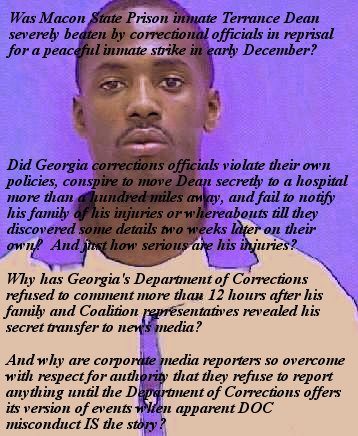
Black, brown and white inmates in 6 Georgia prisons nonviolently locked themselves in their cells for several days beginning December 9, demanding wages for work, educational opportunities, adequate food and medical care, just parole decisions and access to their families. The peaceful inmate strikers, as we reported the following day, were already victims of brutal retaliation on the part of correctional officials, ranging from cutoffs of heat and hot water to unprovoked assaults by correctional employees upon prisoners.
It now appears that at least one inmate, Terrance Dean of Bibb County GA was brutally assaulted by staff at Macon State Prison on or about December 16 was so severely injured prison officials secretly evacuated him to a hospital in Atlanta without bothering to inform his family. It’s not known at this time which Department of Corrections officials authorized the secret evacuation, who decided not to notify Dean’s family of either his injuries or his whereabouts, or whether the prisoner was transported the roughly 130 miles to Atlanta via ground or air ambulance. The first word the prisoner’s family received of either the beating or Dean’s whereabouts was when they were contacted December 30 or 31 by the friends and associates of other prisoners on the outside. Neither the Department of Corrections nor Atlanta Medical Center, where the prisoner was held for about two weeks, has released any information about the extent of the prisoner’s injuries, his current medical condition, or how he was injured.
The morning of Friday, December 31, Dean’s sister, along with ACLU attorney Chara Jackson and GA state NAACP chief Ed DuBose representing the Concerned Coalition to Respect Prisoner’s Rights showed up at the Atlanta Medical Center demanding to see the injured prisoner or at least have his whereabouts confirmed. After several hours of delay, correctional officials said his mother and sister, along with the attorney would be allowed to visit him at Jackson State Prison Sunday, January 2, but they offered no explanation of the reasons for his secretive transfer. Hospital officials also refused to offer any information on Dean’s injuries, even to his family, on grounds of doctor-patient confidentiality.
“We assume that state officials have a written policy requiring them to inform family members in the event of the serious injury of their loved ones in prison,” said the Georgia Green Party’s Hugh Esco. “If Georgia corrections personnel did brutally beat Terrance Dean, transfer him secretly more than a hundred miles from the scene of the crime scene and neglect to inform his family about his injuries or whereabouts they could be parties to a criminal conspiracy. The Green Party has written a letter to the outgoing and incoming governors asking them to look carefully at the events surrounding the case of Mr. Dean. We also note that the Department of Corrections promised access to the 37 prisoners whom it transferred as a result of the inmate strike that began on December 9. We hope this is a promise they keep, so that the public can get a complete and accurate picture of what goes on behind those walls.”
Dean’s sister, attorney Chara Jackson, and the NAACP’s Ed DuBose briefed the press at Atlanta Medical Center, including representatives from at least one local TV station repeatedly beginning at noon on Friday, and assured Black Agenda Report that they will attempt to see Terrance Dean at Jackson State Prison on Sunday, January 2. But as of nearly 24 hours later, on the morning of January 1, 2011 no corporate news outlet is publicly asking or answering any of the key questions around the assault on Terrance Dean, or what look for all the world like official attempts to conceal it from his family and the public.
“This is no surprise,” offered BAR executive editor Glen Ford. “For corporate journalists, a story without input from government or corporate officials is no story at all. For these so-called reporters, the story has a big hole in it as long as state officials decline to comment, even though official misconduct on the part of government IS the story. If the state declines to comment until Sunday or Monday, they will sit on the story till then. Establishment journalists are nothing if not disciplined and well-trained.”
Bruce A. Dixon is managing editor at Black Agenda Report, based in Marietta GA, and a member of the state committee of the Georgia Green Party. Both Black Agenda Report and the Georgia Green Party are members of the Concerned Coalition to Respect Prisoner’s Rights.
Background:
GA Prison Inmate Strike Enters New Phase, Prisoners Demand Human Rights, Education, Wages For Work
Video interview:
Elaine Brown on GA Prison Strike, December 14 Democracy Now Video Interview
And related video report:
Torture: America’s Brutal Prisons
Savaged by dogs, Electrocuted With Cattle Prods, Burned By Toxic Chemicals, Does such barbaric abuse inside U.S. jails explain the horrors that were committed in Iraq?
They are just some of the victims of wholesale torture taking place inside the U.S. prison system that we uncovered during a four-month investigation for the UK’s Channel 4 originally aired in 2005.
Goldberg’s next war sure sounds a lot like his last one
By Philip Weiss on January 3, 2011
Four months back, Jeffrey Goldberg published a long piece in the Atlantic called “The Point of No Return,” making the Israeli case for the United States to attack Iran in Never-again terms: Iran is threatening the existence of “the Jewish people,” Israel is bound to act if the U.S. fails to, the U.S. will do a better job. The piece has stirred a lot of discussion. Goldberg has gone on national media and panels at thinktanks to promote these bellicose ideas.
But no one has pointed out that the piece makes the same argument Goldberg marshaled eight years ago for the U.S. to attack Iraq, that time with an article in the New Yorker magazine under the headline, “The Great Terror.” Iraq too was bent on the destruction of the Jewish people, and was developing a nuclear weapon to do so.
The language in the pieces is eerily similar. The last time the concentration camp Goldberg invoked was Bergen-Belsen. This time around it’s Auschwitz.
Both times the enemy is “three years” away from going nuclear. Last time:
He [August Hanning of German intelligence agency] does not equivocate. “It is our estimate that Iraq will have an atomic bomb in three years,” he said.
This time:
Iran is, at most, one to three years away from having a breakout nuclear capability (often understood to be the capacity to assemble more than one missile-ready nuclear device within about three months of deciding to do so).
The last time round Goldberg was flat wrong.
“The Great Terror” stated that Saddam had links to Al Qaeda, and the article was cited by both Bush and Cheney as proof of the threat posed by Iraq (Muhammad Idrees Ahmad has told me). As it turned out, Saddam Hussein didn’t possess weapons of mass destruction and didn’t attack Israel and wasn’t making a nuclear warhead or an aflatoxin/chemical/biological one and wasn’t importing canisters of mysterious nerve gases, as Goldberg had affirmed. But meantime, the U.S. was at war with Iraq, in some measure because of the bad ideas that Goldberg proliferated, and we and the Iraqis and its neighbors are still suffering the consequences.
This time around, the question is, Why is anyone listening to Goldberg? Why are prestige news organizations giving him the microphone?
But let’s compare similarities in the casus belli pieces.
In both cases, Goldberg turned Koran scholar to support his views. Last time, Saddam’s rage against the Kurds was based in part on
a chapter in the Koran that allows conquering Muslim armies to seize the spoils of their foes. It reads, in part, ‘Against them’—your enemies—‘make ready your strength to the utmost of your power, including steeds of war, to strike terror into the hearts of the enemies of Allah…’
Now Iran is the problem, Goldberg writes that “the depth of official Iranian hatred of Israel and Jews” can only be explained by looking to
a line of Shia Muslim thinking that views Jews as ritually contaminated, a view derived in part from the Koran’s portrayal of Jews as treasonous foes of the Prophet Muhammad.
In both cases, Goldberg alarms readers with Holocaust-tinged fears that a Muslim country is planning to wipe Jews out.
[T]he experts say, Saddam’s desire is to expel the Jews from history
That was last time. And this time—
[A] nuclear Iran poses the gravest threat since Hitler to the physical survival of the Jewish people.
The last time Saddam was the first leader since “the Holocaust” to use poison gas to “exterminate” women and children, and Goldberg cited an expert on Iraq with Holocaust fears.
as a child she lived in Germany, near Bergen-Belsen. “It’s tremendously influential in your early years to live near a concentration camp,” she said. In Kurdistan, she heard echoes of the German campaign to destroy the Jews.
This time around it’s the Shoah, and the camp is different, but the lesson of destruction is the same:
Many Israelis think the Iranians are building Auschwitz… “Iran represents a threat like the Shoah,” an Israeli official who spends considerable time with the prime minister told me….
“In World War II, the Jews had no power to stop Hitler from annihilating us. Six million were slaughtered. Today, 6 million Jews live in Israel, and someone is threatening them with annihilation.“
All the talk of annihilation from Israelis. In fact, Israeli journalist Noam Sheizaf has shown here, Goldberg echoed the hysteria of one element of Israeli society to justify the idea of the U.S. going on another Middle East joyride so as to forestall the Israelis from doing so.
The views of Israeli generals and senior officials in the Defense Department on Iran are of great interest, but they should be put in the right context. There are many in Israel who don’t see Iran as an existential threat, or, more precisely, they don’t see it as a different threat than those Israel faced in the past. There are even more who think that the risk in attacking Iran is far greater then the possible benefits. Israeli Generals have a tendency for creating mass hysteria.
The seamless stoking of hysteria is the most obvious impression one gets from reading Goldberg’s two casus belli pieces in sequence: Goldberg’s paranoia exists out of time; the very same themes and lines about the destruction of Jews appear several years apart, shifted from one enemy to the other (much as the State Department 60 years ago was the anti-Semitic enemy in his book Prisoners…).
Why is Goldberg still taken so seriously? The answer has to do with the strength of the Israel lobby inside the American establishment. That is how a former Israeli soldier–Goldberg immigrated to Israel in the 80s then came back a few years later– hops from one prestige magazine to another.
Indeed, Goldberg’s core concern, which also extends seamlessly eight years from the first piece to the second one, from Iraq to Iran– is not the fear of destruction, but of Israel losing hegemonic power in the Middle East. I have held out the two most similar and important phrases in the pieces for last, the phrases that reflect this root concern:
[T]here is no disagreement that Iraq, if unchecked, will have them [nukes] soon, and a nuclear-armed Iraq would alter forever the balance of power in the Middle East”
Goldberg warned the last time. And this time:
The challenges posed by a nuclear Iran are more subtle than a direct attack, Netanyahu told me….“You’d create a great sea change in the balance of power in our area”.
Does America want to go to war to preserve Israel’s power edge in the Middle East?
Biofuel Delusions
Thomas Freidman’s Folly
By ROBERT BRYCE | December 31, 2010
Debunking the tsunami of hype about biofuels doesn’t require much. A standard calculator will do. Alas, Thomas Friedman can’t be bothered to do the handful of simple calculations that prove the futility of the biofuels madness.
In a recent piece, the New York Times columnist and best-selling author praised the Navy and Marines for, as he put it “building a strategy for ‘out-greening’ Al Qaeda, ‘out-greening’ the Taliban and ‘out-greening’ the world’s petro-dictators.”
Hmm. I’ve never heard of Taliban fighters using tanks or F-15s. And if Osama bin Laden and his al-Qaeda operatives are worrying about the size of their carbon footprints, that revelation might eclipse the latest news about Lady Gaga – at least for a few hours.
Nevertheless, Friedman reports that the military is planning to “run its ships on nuclear energy, biofuels and hybrid engines, and fly its jets with bio-fuels.” Friedman goes on to say that the brass at the Pentagon is only pursuing “third generation” biofuels made from algae and non-food sources. But here’s the reality: the commercial viability of advanced biofuels is a lot like the Easter Bunny and the Tooth Fairy: lots of people believe in it but no one ever sees it.
To be sure, the logisticians at the Pentagon know that the US military’s profligate use of oil on the battlefield is a strategic liability. And while it’s obvious that the Defense Department could – given its nearly $700 billion in annual spending — make significant contributions in the development of new energy technologies, those advances are unlikely to happen on the biofuels front.
For decades, various pundits have been proclaiming that biofuels will displace our need for oil. Back in 1976, energy analyst Amory Lovins, a darling of the Green/Left, wrote a piece for Foreign Affairs in which he said that there are “exciting developments in the conversion of agricultural, forestry and urban wastes to methanol and other liquid and gaseous fuels.” He went on, saying that those fuels “now offer practical, economically interesting technologies sufficient to run an efficient U.S. transport sector.”
Today, 34 years after Lovins said that biofuels “now offer” the ability to run the transport sector, biofuels remain little more than a sinkhole for taxpayer dollars. According to the Congressional Budget Office, producing enough corn ethanol to match the energy contained in a single gallon of conventional gasoline costs taxpayers $1.78. Even with those subsidies, which total about $7 billion per year, corn ethanol still only provides about 3 percent of America’s oil needs. And by mandating the consumption of ethanol, Congress has created an industry that now gobbles up about one-third of America’s corn crop.
Those numbers are germane to Friedman’s claim that biofuels will be an essential part of the DOD’s new “green” future. The Pulitzer Prize-winning columnist lauded the Navy for its experiments with jet fuel derived from camellina, a plant in the mustard family. In April, the Navy flew an F-18 using a mixture of conventional jet fuel and camellina-based fuel. The cost of that biofuel: about $67.50 per gallon.
The fundamental problem with using plants to make liquid motor fuel isn’t want-to, it’s physics. We pump oil out of the earth because of its high energy density. That is it contains lots of stored chemical energy by both weight and volume. Camellina, like switchgrass, and nearly every other plant-based feedstock now being considered for “advanced” biofuel production, has low energy density. Thus, in order to produce a significant quantity of liquid fuels that have high energy density – such as jet fuel, diesel, or gasoline — from those plants, you need Bunyanesque quantities of the stuff.
Friedman would have understood that had he done a bit of math on soybean-based biodiesel. The US produces about 3.2 billion bushels of soybeans per year and each bushel can be processed into about 1.5 gallons of biodiesel. Thus, if it made sense to do so, we could convert all US soybean production into diesel with total output of about 4.8 billion gallons.
How much fuel is that? By Pentagon standards, it’s not much. In 2008, the DOD consumed 132.5 million barrels of oil products, or about 5.5 billion gallons. Put another way, even if the US decided to convert all of its soybean production into motor fuel, doing so would only provide about 87 percent of the Pentagon’s total oil needs.
Tim Searchinger, a research scholar at Princeton University’s Woodrow Wilson School who has written extensively about the problems with biofuels, says that biofuels don’t make much sense because it “takes a huge amount of land to produce a modest amount of energy.” The key issue, says Searchinger, is scale. He points out that even if we used “every piece of wood on the planet, every piece of grass eaten by livestock, and all food crops, that much biomass could only provide about 30 percent of the world’s total energy needs.”
Some crops can provide a relatively good feedstock for biofuels. For instance, Brazil utilizes sugar cane to produce ethanol. (Brazil is the world’s second-largest ethanol producer, behind the US.) But even if the US military commandeered all of Brazil’s ethanol production — which totaled 6.5 billion gallons in 2008 – that volume of energy still wouldn’t be enough to keep the Pentagon’s planes, trucks, and tanks moving. Recall that ethanol contains just two-thirds of the heat energy of gasoline. Therefore Brazil’s 6.5 billion gallons of ethanol is equal to 4.3 billion gallons of refined oil product, far less than the US military’s consumption of 5.5 billion gallons per year.
Going beyond Brazil, biomass-based fuels may be worthwhile on tropical islands, like Hawaii, that have lots of rainfall and plenty of arable land. Furthermore, fuels derived from photosynthetic algae might – repeat, might – someday become commercial.
Friedman ended his column by saying that “we might really get a green revolution in the military.” Sure, that’s a possibility. But before Friedman writes another article about the promise of biofuels he should invest in a calculator.
Julian Assange signs $1.5 mln autobiography deal
RIA Novosti | December 26, 2010
The founder of the whistleblowing website WikiLeaks, Julian Assange, has signed $1.5 million contracts with publishers to pen his autobiography, the Sunday Times said.
Assange, whose WikiLeaks website has provoked U.S. rage by releasing diplomatic documents, said the money will help him to defend himself against the sexual assault claims made by two women in Sweden, which he denies.
“I don’t want to write this book, but I have to,” he told the newspaper in the interview. “I have already spent 200,000 pounds [$310,000] for legal costs and I need to defend myself and to keep WikiLeaks afloat.”
The Australian said he will receive $800,000 from a U.S. publisher Alfred Knopf and $500,000 from a British deal with Canongate. The total sum from the deals, including those with other markets, will reach over 1 million pounds ($1.5 million).
The WikiLeaks founder was released on bail last week and vowed that he would continue his work.
Under the bail conditions, Assange must wear an electronic tag, report to police every day and observe a curfew. He is also obliged to stay at the Norfolk mansion of WikiLeaks supporter Vaughan Smith.
World leaders and diplomats have downplayed the impact of the leak of more than 250,000 confidential U.S. diplomatic cables by the WikiLeaks site, but many have questioned the benefit of the project, alleging that some of the leaks could “threaten lives.”
Haaretz journalist doubles as anti-“delegitimization” operative
By Ali Abunimah, The Electronic Intifada, 23 December 2010
Haaretz has an international reputation as Israel’s most liberal and reliable newspaper. But The Electronic Intifada has discovered that one of the newspaper’s regularly-featured reporters, Cnaan Liphshiz, used his news reports for the publication to promote the agenda of an extreme pro-Israel group with which he was also employed.
At the same time, Liphshiz appears to have made efforts to conceal his work with the Dutch Zionist group CIDI (Centre for Documentation and Information on Israel), an undisclosed conflict of interest which calls into question the reliability of his reports and the editorial standards of Haaretz.
From 2007 until the present, Liphshiz has written about 50 articles in Haaretz which quote information provided by CIDI or its executive director Ronny Naftaniel, usually without offering any countervailing opinion or sources. Many of Liphshiz’s stories are based entirely on information provided by CIDI.
CIDI has confirmed to The Electronic Intifada that Lipshiz worked for the organization, and is likely to work for them again in the future.
CIDI has earned a reputation as one of the staunchest advocates for Israel in the Netherlands, launching stinging personal attacks and smears on public figures and groups who dare to call on Israel to respect human rights. In an article for The Electronic Intifada, Stan van Houcke, a Dutch journalist and author, described CIDI as an organization whose main goal is to cover up Israel’s violations of international law (“Dutch ‘research’ group covers for Israeli crimes,” violations, 5 November 2007).
Using Haaretz to “delegitimize” The Electronic Intifada
On 17 December, Haaretz published a profile by Cnaan Liphshiz of Dutch Foreign Minister Uri Rosenthal (““Dutch FM: Ties with Israel are like our bond with NATO“).
In the story, Liphshiz writes: “One of Rosenthal’s first statements regarding Israel as minister concerned the website The Electronic Intifada … .”
The Electronic Intifada has been the target of attacks orchestrated by NGO Monitor, an Israeli group linked to the Israeli government and the West Bank settler movement and funded by Islamophobic organizations and individuals in the United States (“Why NGO Monitor is attacking The Electronic Intifada,” 30 November 2010).
Liphshiz’s 17 December article went on to repeat accusations meant to defame The Electronic Intifada — that the publication frequently compares Israel to “Nazi Germany” (an accusation, incidentally, that can be made with much greater justice against Haaretz). Liphshiz did not quote from The Electronic Intifada’s extensive refutation of NGO Monitor’s accusations, or seek a comment from the publication (Haaretz subsequently appears to have removed an entire paragraph of Liphshiz’s article dealing with The Electronic Intifada).
CIDI has also promoted NGO Monitor’s attacks on The Electronic Intifada on its website, including NGO Monitor’s false and fabricated allegations of “anti-Semitism” and use of The Electronic Intifada funds for speaking tours (“Onderzoek naar financiering ICCO van Electronic Intifada,” 26 November 2010).
It would appear that Liphshiz is more interested in promoting NGO Monitor’s and CIDI’s campaign against The Electronic Intifada — and more generally against critics of Israel’s appalling human rights abuses — than acting as a professional and transparent journalist.
Liphshiz’s double role
Cnaan Liphshiz is scheduled to take part in Jewish Identity Day activities in the Netherlands on 9 January 2011. The official website promoting his participation stated that:
“Cnaan is an Israeli reporter for the well-known nespaper [sic] “Haaretz”, and the European Jewish Press, focusing on the campaign to delegetimize [sic] Israel in Europe. Cnaan also writes about immigration trends and Jewish world news.”
It explained that “His background in journalism grew out of serving in the Israel Defense Forces during the second intifada, first as a special forces combatant and then, following an injury, as an intelligence corps researcher in a unit monitoring the intelligence apparatuses of hostile and rival entities.”
It also revealed that, “Before coming to Holland to work at CIDI, He lived in Florentin, a neighborhood in the south of Tel Aviv … .”
Website metadata indicate this webpage was created in October 2010.
After The Electronic Intifada began its inquiries regarding Liphshiz’s undisclosed dual status as a frequent Haaretz reporter and an employee of CIDI, the Jewish Identity Day website was changed to omit any reference to Liphshiz’s employment with CIDI or that he apparently moved to The Netherlands specifically to work for the organization. The relevant section now simply states:
“Before coming to Holland, He lived in Florentin, a neighborhood in the south of Tel Aviv … .” (http://www.jewishid.nl/shmuel-katzman).
However, Google cache and copies of the webpage made by The Electronic Intifada before it was changed confirm the apparent effort to conceal information about Liphshiz’s affiliation with CIDI.
 |
| A screenshot of the Jewish Identity Day’s website showing Lipshiz’s original bio |
 |
| A closeup of the original bio showing Lipshiz was employed at CIDI … |
 |
| … the bio after it was modified to hide Lipshiz’s employment at CIDI |
CIDI’s public information officer, Naomi Mestrum, confirmed in a response to questions emailed by The Electronic Intifada that “CIDI knows Mr. Cnaan Liphshiz, but he is not an employee of our organisation. However Mr. Liphshiz did a project involving research for us on a freelance basis this year.”
In response to further inquiries, Mestrum added that Liphshiz “helped us update a statistical research on Jewish immigration to and from Europe. He may help us update and elaborate the same database in the future.”
Regardless of technicalities of whether he is paid as a freelancer or on regular payroll, CIDI confirmed a past and likely future pecuniary relationship between CIDI and Liphshiz. Mestrum did not respond to a question regarding the start and end dates of Liphshiz’s paid work for CIDI.
Charlotte Halle, editor of the Haaretz English edition, confirmed to The Electronic Intifada that Liphshiz had been employed by the Haaretz English edition up to August 2010, “though he has contributed the occasional piece on a freelance basis since then.”
Halle pointed out that Liphshiz’s most recent pieces, including the 17 December profile of Uri Rosenthal, had been commissioned not by the Haaretz English edition but in the online edition.
Gadi Lahav, editor-in-chief of Haaretz online, wrote to The Electronic Intifada that “Cnaan Liphshiz was previously employed by Haaretz, but is now writing occasionally on a freelance basis. Mr. Liphshiz denies that he is employed on a permanent basis by any organization, including CIDI.”
In an apparent reference to Liphshiz’s 17 December article, Lahav added, “As for this specific article, it wasn’t published by the printed edition, and it seems it ran on the website by mistake.”
Liphshiz did not respond to a request for comment emailed to him at an address provided by Mestrum.
What is now clear is that Liphshiz has maintained for an extended period an employment relationship with both Haaretz and CIDI that should have been disclosed to readers and was not. Liphshiz continues to try to evade giving his editors or the public clear answers about the status of his relationship with CIDI. This is not a case of a freelancer writing one or two articles and failing to disclose a passing relationship with an organization that might have been mentioned once or twice, but a regular writer who has contributed dozens of articles favorable to the organization for which he worked, and advancing its advocacy agenda.
Using Haaretz as a cover to push CIDI’s agenda
Liphshiz’s dual role with CIDI is both a matter of public interest, and conflict of interest for Haaretz. In his reports for the newspaper, Liphshiz frequently cites information provided by CIDI without any countervailing view or analysis and without disclosing his own relationship to the group, as a few examples illustrate.
A 9 September 2009 story headlined “Dutch Jews suffered tenfold increase in anti-Semitic attacks during Gaza war” relies entirely on statistics provided by CIDI.
In a 27 June 2008 profile of Dries van Agt, a former Dutch prime minister and outspoken critic of Israel’s human rights violations, Liphshiz counters van Agt’s charges that Israel is “making frequent and excessive use of deadly force against the Palestinians,” by citing CIDI. Liphshiz then cites accusations of “anti-Semitism” against van Agt from various “accusers,” some of whom are unnamed (“‘Dutch Jimmy Carter’ accuses Israel of terrorism in new book“). Many criticisms and questions Liphshiz directs against van Agt appear to be lifted from an article written in Dutch by CIDI founder Ronny Naftaniel (“Van Agt heeft selectief geheugen“).
In an 2 April 2008 story, Liphshiz misleadingly casts CIDI and its director Ronny Naftaniel as courageous defenders of Muslims against the rising tide of Islamophobia in the Netherlands (“Dutch Jews louder than Muslims in condemning ‘Fitna’ film“).
Naftaniel claims credit for criticizing a film by Dutch Islamophobic demagogue Geert Wilders. “We are never afraid to speak out in the harshest of terms against what we think is wrong, be it against Muslim extremism here in the Netherlands, or the Dutch or Israeli governments,” Liphshiz quotes Naftaniel as saying. “But this movie portrays all Muslims as The Enemy. And this is just not true.”
These are examples of numerous articles in which Liphshiz provides an uncritical and favorable platform to CIDI and its (his) boss in Haaretz but does not disclose his relationship.
“Delegitimization” is a political stance not a reporter’s beat
The description of Liphshiz on the Jewish Identity Day website as a journalist “focusing on the campaign to delegetimize [sic] Israel in Europe” is troubling. The characterization of the activities by Palestine solidarity activists and Israeli human rights groups as “delegitimization” is a political stance promoted by such organizations as CIDI itself, NGO Monitor, The Reut Institute and the Israeli Foreign Ministry.
On 9 December, for example, Israeli Deputy Foreign Minister Danny Ayalon held a press conference at which NGO Monitor director Gerald Steinberg named The Electronic Intifada as “a very powerful organization” at the center of a global network to “delegitimize” Israel (transcript of press conference via Israeli Ministry of Foreign Affairs).
That Liphshiz may take it as a given that Palestine solidarity activities constitute “delegitimization,” suggests he is less a truth-seeking journalist, than a foot soldier in Israeli government-endorsed propaganda efforts.
In the 17 December article profiling Rosenthal, for example, Liphshiz even repeats claims made by NGO Monitor that the Dutch embassy in Tel Aviv has a “pro-Palestinian agenda” — simply because it has upheld long-standing Dutch government policies regarding the occupied Palestinian territories.
While reporters and journalists may have affiliations to, and may advocate for political and activist groups in accordance with basic freedoms of association and expression, the essence of ethical practice is disclosure of these relationships whenever relevant, especially if they could be seen as affecting the reporter’s work or judgment. In this case Liphshiz has been passing off his advocacy for CIDI as “news” reporting under the banner of Haaretz.
Perhaps Liphshiz sees his “journalism” work as a mere continuation of his time “as an intelligence corps researcher in a unit monitoring the intelligence apparatuses of hostile and rival entities” — in which case disclosure would of course be a problem.
If Haaretz wishes to rescue its journalistic reputation it would be well-advised to ensure that it does not become a mere vehicle for political smear campaigns conducted by extremist organizations and their operatives.
Ali Abunimah is co-founder of The Electronic Intifada and author of One Country: A Bold Proposal to End the Israeli-Palestinian Impasse.
Not seen in American media: 131 anti war protesters arrested in DC
American Goy | December 21, 2010
131 anti war protesters arrested in DC.
News Black-Out in DC: Pay No Attention to Those Veterans Chained to the White House Fence
Whether you agree or disagree with the wars in Iraq and Afghanistan, an anti war demonstration in front of the White House where 131 people are arrested is very probably national news.
Even more newsworthy seems this tidbit:
Among those arrested were Ray McGovern, a former CIA analyst who used to provide the president’s daily briefings, Daniel Ellsberg, who released the government’s Pentagon Papers during the Nixon administration, and Chris Hedges, former war correspondent for the New York Times.
In any normal country, this would be at least a blurb, a short mention on a nightly newscast.
But in our “democracy”, there is nary a mention of this, er, non-event.
Actually, I am wrong.
Nary a mention implies some kind of a mention, even in passing.
There is no mention of this event on any American media.
It is almost like the media and the government elites are cooperating.
Don’t believe me?
Use google news to search for this story, use “veterans DC protest” as the keywords and only use the “news” search option.
Do you see any NBC, CNN, ABC, FOX stations?
What about big newspapers?
No?
What do you see?
Local papers, blogs, even AOL News (these exist!?).
Lets go with “veterans DC protest cnn”…
Eagle Tribune, Brad Blog (blog), Socialist Worker Online, GC Advocate.
That is it – a grand total of 4 entries, and no CNN.
Do it yourself.
Goto the google news tab and make up your own searches.
Make sure to use veterans and protest and then put your mainstream TV conglomerate(s) and/or newspaper(s).
Then make sure to turn on your TV, preferably onto a cable news channel, and see what they consider news.
That’s all I ask of you…
WikiLeaks Thwarts Palestian Reconciliation
Hamas will reconsider talks with Fatah in light of WikiLeaks report
Palestine Information Center – 22/12/2010
GAZA– Senior Hamas official Salah al-Bardawil said WikiLeaks documents of Fatah leaders asking Israel to assault Hamas have prompted the resistance group in Gaza to reconsider talks with Fatah security leaders, and may mobilize judicial action for treason.
“Fatah’s denial of the documents does not concern us much. The group takes logistical support from Israel in order to eliminate the resistance movement led by Hamas since the signing of the Oslo agreements.”
“The documents which were revealed alongside the ‘peace illusions’ documents by Mohammed Haikal, revealing an Israel-Fatah agreement to strike Hamas proves that striking Hamas is the common denominator of both parties.”
“The liquidation of the resistance movement in the West Bank at the hands of Israel and Fatah is perfect evidence that security cooperation continues.”
“We had sensed and anticipated that what relates to the documents that leaked was correct, but the extent of cooperation will make us re-think talks with Fatah security leaders. We are now discussing who we will talk with.”
Bardawil strongly denied that Gaza was jailing anyone for political reasons. “This is a lie aimed at deceiving and creating a media confusion,” he said, adding that facts on the ground say there are no Fatah political prisoners in Gaza prisons. He challenged anyone who had proof of that to come forth.
A document that surfaced on WikiLeaks revealed that Fatah asked the head of the Israeli security agency (Shin Bet) Yuval Diskin to attack Hamas in 2007.
Israel’s media campaign in Europe
By Pascal Boniface | MEMO | 21 December 2010
 Israel’s Minister of Foreign Affairs has summoned his country’s ambassadors in European countries and given them clear instructions to make use of public relations experts to improve the image of the Zionist state in European public opinion. The minister identified specific tasks for the diplomats to complete by 16 June at the latest. One of those tasks is to draw up a list of 1,000 people who are sympathetic to Israel from the major European capitals such as London, Berlin, Madrid and Paris, as well as other cities such as Oslo, Copenhagen and The Hague. The purpose is to be in constant contact with these people and inform them of the Israeli positions on issues of the day, and explain its point of view.
This is a public relations campaign intended to defend Israeli policy and exploit media outlets and other platforms for this purpose. Presumably, those who the minister describes as “allies” on the list of 1,000 in every European capital would take part in pro-Israel demonstrations whenever required. They would also be required to issue statements defending Israel’s policies, publish articles in local newspapers to polish its image and influence public opinion. And, of course, Israel has allocated a significant budget for this campaign, which would be placed under the control of its embassies in the European countries concerned. It could well double the budget allocated for each embassy.
Among those who will be recruited for a mission to defend Israel are journalists and Jewish organizations active in Europe, in addition to some Jewish figures known for their support of Israel. Prominent cultural figures and student organizations will also be recruited; Israeli diplomats will forge special relationships and provide up to date information, regardless of its validity, accuracy or veracity.
In this context, the Israeli Foreign Ministry, which launched this media campaign, will play a vital role in providing support for the efforts of its embassies by, for example, leaking political letters about Israel’s Middle East policies, its position on the regional peace process and its relationship to the issues raised on the ground; as well, of course, on the nature of its relationship with the Palestinians. It is expected that Israel will ease its rhetoric concerning the settlements as well as its other provocative behaviour in order to show how committed it is to achieving peace.
But Israel, away from the familiar issues that it will find difficult to gloss over and given what is published by the serious media about its excesses – which it cannot hide – will focus the PR campaign on other matters to make its mark on public opinion. For example, it will highlight economic issues and its distinguished record in this area. It will also feature Israel’s technological progress in addition to a definition of the Jewish state as a tourist destination with many sacred places which Christians long to visit. It will cover up the occupation, violence, land confiscation and home demolitions as they reflect Israeli policy towards the Palestinians. At the same time the Israeli embassies will try through their loyal networks to raise controversial issues pertaining to other Middle Eastern countries, such as the question of human rights in Arab states. It will also seek to scare the West about Islamic groups and “Hezbollah” in order to distract attention from its own human rights and international law violations.
It remains to be seen who will be among the 1,000 recruits in each country; no doubt the Israeli embassies will do everything to conceal their identity. Notwithstanding this, a significant number of these public figures will not hide their clear support for Israel, through articles or their frequent appearance on TV news. Others will adopt a more cautious approach and conceal their identities so that it does not damage their interests in Arab states or the Muslim and Arab communities across Europe.
It should be noted that Israel’s attempt to boost its image comes after it has suffered a significant decline in European sympathy. Europeans are now more willing to be critical of the state without fear of the readymade charge reserved for its critics – anti-Semitism. It will be interesting to see the extent, if any, of the proposed PR campaign, especially as there is no guaranteed outcome. The experience of others might be useful as an indicator. Using its huge influence and presence, France, for example, tried to boost its image during the Algerian war of independence. Despite all attempts to entrench the official version of events, many sectors of the French people were sympathetic to the Algerian liberation movement. In the end, France was forced to review its position in Algeria and relinquish what it had long regarded as an integral part of its territory.
Israel has harnessed huge resources for its information campaign which, nevertheless, lacks credibility; in the internet world it is no longer easy to hide the truth. Globalization and the flow of information have opened up everything. In fact the sympathy that Israel enjoyed in the past when it was seen as a small country in a sea of hostile nations seeking its elimination has dissipated today; such a view is now limited to small right-wing groups and conservatives following Israel’s transformation into a major nuclear-armed power in the region. The ongoing military occupation of Palestinian lands in the West Bank and the siege of the Gaza Strip have added to this shift in perception.
World and European public opinion is today especially troubled by Israeli actions in recent years, from the 2006 war against Lebanon and the targeting of its civilian infrastructure; the terrible bombardment and invasion of the Gaza Strip in 2008/9; and, last but not least, its bloody attack on the “Freedom Flotilla”, when nine unarmed men were killed by Israeli commandos. It is obvious, therefore, that if Israel is serious about improving its image, it should look to the origin of its problems and change its policies, bringing about an end to its occupation of the West Bank and Gaza Strip and settlement activity. That is the only way for Israel to return to the fold of the international community as a normal state that does not subjugate the Palestinian people or occupy their land.
Source: Al Ittihad, (UAE) 21 December 2010
The author is Director of the Institute of International and Strategic Relations, France.
Who’s Who at Wikileaks?
By Julie Lévesque | Global Research | December 20, 2010
“In politics, nothing happens by accident. If it happens, you can bet it was planned that way.” –Franklin D. Roosevelt
After the publication of a series of confirmations rather than revelations, there are some crucial unanswered questions regarding the nature and organizational structure of Wikileaks.
Shrouded in secrecy, the now famous whistleblowing site and its director Julian Assange are demanding “transparency” from governments and corporations around the world while failing to provide some basic information pertaining to Wikileaks as an organization.
Who is Julian Assange?
In the introduction to the book Underground: Hacking, Madness and Obsession on the Electronic Frontier (1997), by Julian Assange and Suelette Dreyfus, Assange begins with the following quotes:
“Man is least himself when he talks in his own person. Give him a mask, and he will tell you the truth.” — Oscar Wilde
“What is essential is invisible to the eye.” — Antoine De Saint-Exupery
From the start, Assange states that he undertook the research for the book; however, he fails to mention that he was actually one of the hackers analyzed in the book, going by the name of Mendax, a Latin word for “lying, false…”.
Although we cannot confirm that the above quotes referred to him, they nonetheless suggest that Assange, at the time, was hiding his true identity.
We know very little about the cryptographer Julian Assange. He is indeed very cryptic when it comes to revealing who he is and where he worked prior to the Wikileaks project. On the list of board members published previously by Wikileaks, we can read that Julian Assange:
has “attended 37 schools and 6 universities”, none of which are mentioned by name;
“Australia’s most famous ethical computer hacker”. A court case from 1996 cited abundantly in the mainstream press is available on the Australasian Legal Information Institute. Contrary to all the other cases listed on the afore mentioned link, the full text of Assange’s case is not available;
“in the first prosecution of its type… [he] defended a case in the supreme court for his role as the editor of an activist electronic magazine”. The name of the magazine, the year of the prosecution, the country where it took place are not mentioned;
allegedly founded “’Pickup’ civil rights group for children”. No information about this group seems to be available, other than in reports related to Wikileaks. We don’t know if it still exists, where it is located and what are its activities.
“studied mathematics, philosophy and neuroscience”. We don’t know where he studied or what his credentials are;
“has been a subject of several books and documentaries”. If so, why not mention at least one of them?
One could indeed argue that Assange wishes to remain anonymous in order to protect himself, the whistleblowers and/or the members of his organization. On the other hand, he cannot realistically expect people to trust him blindly if they do not know who he really is. […]
Who’s Who at Wikileaks? The Members of the Advisory Board
Here are some interesting facts about several members listed in 2008 on the Wikileaks advisory board, including organizations to which they belong or have links to.
Philip Adams:
Philip Adams, among other things, “held key posts in Australian governmental media administration” (Wikileaks’ Advisory Board, Wikileaks.org, 27 March 2008), chaired the Australia Council and contributed to The Times, The Financial Times in London and The New York Times. Confirmed by several reports, he is the representative of the International Committee of Index on Censorship. It is worth mentioning that Wikileaks was awarded the 2008 Economist Index on Censorship Freedom of Expression award. (Philip Adams, Milesago.com)
Adams worked as a presenter for ABC (Australia) Radio’s Late Night Live and as columnist for The Australian since the 1960s. The Australian is owned by News Corporation, a property of Rupert Murdoch, member of the Council on Foreign Relations (CFR).
Adams also “chairs the Advisory Board of the Centre for the Mind at Sydney University and the Australian National University”. CFR member Michael Spence also serves on this board and Rupert Murdoch’s son, Lachlan Murdoch, has served as well until 2001. The 2008 Distinguished Fellow of the Center for the Mind was former British Prime Minister Tony Blair, who has faced a slew of accusations for war crimes. Does Adams have conflicting allegiances: serving on the advisory board of the Wikileaks organization whose mandate is to expose war crimes, yet at the same time sitting on another board which honors an accused war criminal.
According to an article in The Australian:
Adams, who has never met Assange, says he quit the board due to ill-health shortly after WikiLeaks was launched and never attended a meeting. “I don’t think the advisory board has done any advisoring,” he quips.
CJ Hinke:
CJ Hinke, “writer, academic, activist, has lived in Thailand since 1989 where he founded Freedom Against Censorship Thailand (FACT) in 2006 to campaign against pervasive censorship in Thai society.” (Wikileaks’ Advisory Board, Wikileaks.org, 27 March 2008) FACT is part of Privacy International, which includes among others on its Steering Committee or advisory board, the American Civil Liberties Union and the Index on Censorship.
In 2009, FACT received funding from the following organizations: the European Parliament, the European Commission framework funding programmes, the Joseph Rowntree Reform Trust, the Open Society Institute, the Open Society Justice Initiative, the American Civil Liberties Union, the Electronic Privacy Information Center, The Fund for Constitutional Government, the Stern Foundation, the Privacy Foundation, the German Marshall Fund, and the University of New South Wales (Sydney).
In the US, Privacy International is “administered through the Fund for Constitutional Government in Washington DC.”(About Privacy International, 16 December 2009).
One of the board members of this fund is Steven Aftergood, who wrote one of the first articles on Wikileaks before the website was even functional. In a report from Technology Daily dated January 4, 2007, it is stated that “Wikileaks recently invited Steven Aftergood, a government secrecy researcher at the Federation of American Scientists [FAS], to serve on its advisory board.”
Ben Laurie:
“’WikiLeaks allegedly has an advisory board, and allegedly I’m a member of it… I don’t know who runs it…’ Laurie says his only substantive interaction with the group was when Assange approached him to help design a system that would protect leakers’ anonymity.” (David Kushner, Inside Wikileaks’ Leak Factory, Mother Jones, 6 April, 2010)
This article appeared in Mother Jones in April 2010. An article of the New York Daily News dated December 2010 quotes Ben Laurie as follows: “‘Julian’s a smart guy and this is an interesting tactic,’ said Ben Laurie, a London-based computer security expert who has advised WikiLeaks.”
Despite his denial of being an advisor to Wikileaks, his name still appears on the list of advisory board members, according to reports. It is also worth noting that Ben Laurie is a “Director of Security for The Bunker Secure Hosting, where he has worked since 1984 and is responsible for security, cryptography and network design.”He is also a Director of Open Rights Group, funded by the Joseph Rowntree Reform Trust Ltd and the Open Society Foundation.
Chinese and Tibetan Dissidents on the Advisory Board
Tashi Namgyal Khamsitsang:
Tashi Namgyal Khamsitsang, a “Tibetan exile & activist” is a former President of the Washington Tibet Association, and was a member of the Tibetan Government-in-Exile. In July of this year he was appointed by the Governor of Washington State to the State Commission on Asian Pacific American Affairs. (A Tibetan Appointed to the Washington State Commission on Asian Pacific American Affairs, Tibetan Association of Washington, 17 July 2010)
Wang Youcai:
Wang Youcai co-founded the Chinese Democracy Party and is another leader of the Tienanmen Square protests. Imprisoned for “conspiring to overthrow the Government of China… he was exiled in 2004 under international political pressure, especially from the United States. He is also a “member of Chinese Constitutional Democratic Transition Research and a member of the Coordinative Service Platform of the China Democracy Party” (Wikileaks’ Advisory Board, Wikileaks.org, 27 March 2008)
Xiao Qiang:
Xiao Qiang, is one of the Chinese dissidents listed on the Wikileaks board. He “ is the Director of the Berkeley China Internet Project…[He] became a full time human rights activist after the Tienanmen Massacre in 1989… and is currently vice-chair of the Steering Committee of the World Movement for Democracy”, according to Wikileaks’ description. He received the MacArthur Fellowship from the John D. and Catherine T. MacArthur Foundation in 2001 and is a commentator for Radio Free Asia. (Wikilieaks’ Avisory Board, Wikileaks.org, 27 March 2008)
Xiao Qiang is also the “founder and publisher of China Digital Times” (Biographies, National Endowment for Democracy), which is a grantee of the National Endowment for Democracy (NED) (Directives from China’s Ministry of Truth on Liu Xiaobo winning Nobel, Democracy Digest, October 8, 2010).
The Steering Committee of the World Movement for Democracy is an initiative of the Washington, DC-based NED. (World Movement for Democracy). In 2008, Xiao Qiang was part of a discussion panel titled “Law Rights and Democracy in China: Perspectives and Leading Advocates”, held by NED before the Democracy Award Ceremony. (2008 NED Democracy Award Honors Heroes of Human Rights and Democracy in China, National Endowment for Democracy, June 17, 2008).
Radio Free Asia is funded by the Broadcasting Board of Governors (BBG) which describes itself as a body that “encompasses all U.S. civilian international broadcasting, including the Voice of America (VOA), Radio Free Europe/Radio Liberty (RFE/RL), Radio Free Asia (RFA), Radio and TV Martí, and the Middle East Broadcasting Networks (MBN)—Radio Sawa and Alhurra Television.” Eight of its nine members are appointed by the President and confirmed by the U.S. Senate; the ninth is the Secretary of State, who serves ex officio”. (Broadcasting Board of Governors)
RFE/RL no longer hides its covert origins: “Initially, both RFE and RL were funded principally by the U.S. Congress through the Central Intelligence Agency (CIA)… In 1971, all CIA involvement ended and thereafter RFE and RL were funded by Congressional appropriation through the Board for International Broadcasting (BIB) and after 1995 the Broadcasting Board of Governors (BBG). (A Brief History of RFE/RL)
Interestingly, in a report from 2002, the CFR suggested “creating a Public Diplomacy Coordinating Structure (PDCS) to help define communications strategies and streamline public diplomacy structures. ‘In many ways, the PDCS would be similar to the National Security Council’… PDCS members would include the secretaries of State, Defense, Treasury and Commerce, as well as the director of the Central Intelligence Agency (CIA) and BBG chairman”, a suggestion officially objected by the BBG “to preserve the journalistic integrity.” (BBG Expresses Concern With Report Recommendations on U.S. International Braodcasting, 31 July 2002)
Wang Dan:
Among the Chinese dissidents once listed on the board is Wang Dan. He was a leader of the Tienanmen Square democracy movement, which “earned him the top spot on China’s list of ‘21 Most Wanted Beijing Student Leaders’.” He was imprisoned for his subversive activities and “exiled in 1998 under international political pressure to the United States.” (Wikilieaks’ Avisory Board, Wikileaks.org, 27 March 2008)
He is chairman of the Chinese Constitutional Reform Association, and sits on the editorial board of Beijing Spring, a magazine funded by NED, the “chief democracy-promoting foundation” according to an article by Judith Miller in The New York Times. One of the founders of NED was quoted as saying “A lot of what we [NED] do today was done covertly 25 years ago by the CIA.” (quoted in William Blum, Rogue State: A Guide to the World’s Only Superpower, 2000, p. 180).
In 1998, Wang Dan was granted the NED’s Democracy Award “for representing a peaceful alternative to achieve democracy and for [his] courage and steadfastness in the cause of democracy”. (1998 Democracy Award honors Heroes of Human Rights and Democracy in China, National Endowment for Democracy)
The Battle for “Transparency”
In 2007, Wikileaks described itself as an “uncensorable Wikipedia for untraceable mass document leaking and analysis.” Its priority? “[E]xposing oppressive regimes in Asia, the former Soviet bloc, Sub-Saharan Africa and the Middle East.” Like the advisory board member list, this description no longer appears on Wikileaks’ website. The organization also claimed to be “founded by Chinese dissidents, journalists, mathematicians and startup company technologists, from the US, Taiwan, Europe, Australia and South Africa.” (Wikileaks.org, 17 December 2007)
In the currently available description, the reference to the Chinese dissidents and the origins of the other members has been removed. Wikileaks rather puts the emphasis on not being a covert operation.
Assange encourages blind faith in Wikileaks as he puts a lot of emphasis on the trustworthiness of his opaque organization. In the words of Assange:
“Once something starts going around and being considered trustworthy in a particular arena, and you meet someone and they say ‘I heard this is trustworthy,’ then all of a sudden it reconfirms your suspicion that the thing is trustworthy. So that’s why brand is so important, just as it is with anything you have to trust.”(Andy Greenberg, An Interview with Wikileaks’ Julian Assange, Forbes, 29 October, 2010, emphasis added)
“People should understand that WikiLeaks has proven to be arguably the most trustworthy new source that exists, because we publish primary source material and analysis based on that primary source material,” Assange told CNN. “Other organizations, with some exceptions, simply are not trustworthy.”(The secret life of Julian Assange, CNN, 2 December 2010, emphasis added)
While Wikileaks no longer discloses the names of the members of its advisory board, nor does it reveal its sources of funding, we have to trust it because according to its founder Julian Assange, it “has proven to be the most trustworthy news source that exists”.
Moreover, if we follow Assange’s assertion that there are only a few media organizations which can be considered trustworthy, we must assume that those are the ones which were selected by Wikileaks to act as “partners” in the release and editing of the leaks, including The New York Times, Der Spiegel, The Guardian, El Paìs, Le Monde.
Yet The New York Times, which employs members of the Council on Foreign Relations (CFR) including Wikileaks’ collaborator David E. Sanger, has proven more than once to be a propaganda tool for the US government, the most infamous example being the Iraqi WMD narrative promoted by Pulitzer Prize winner Judith Miller.
In an interview, Assange indicates that Wikileaks chose a variety of media to avoid the use of leaks for propaganda purposes. It is important to note that although these media might be owned by different groups and have different editorial policies, they are without exception news entities controlled by major Western media corporations.
A much better way to avoid the use of leaks for disinformation purposes would have been to work with media from different regions of the world (e.g. Asia, Latin America, Middle East) as well as establish partnership agreements with the alternative media. By working primarily with media organizations from NATO countries, Wikileaks has chosen to submit its leaks to one single “worldview”, that of the West.
As a few critics of Wikileaks have noted, the Wikileaks project brings to mind the “recommendations” of Cass Sunstein, heads the Obama White House’s Office of Information and Regulatory Affairs. Sunstein is the author of an authoritative Harvard Law School essay entitled “Conspiracy Theories: Causes and Cures”. As outlined by Daniel Tencer in Obama Staffer Calls for “Cognitive Infiltration” of ” 9/11 Conspiracy Groups”:
Sunstein “argued that the government should stealthily infiltrate groups that pose alternative theories on historical events via ‘chat rooms, online social networks, or even real-space groups and attempt to undermine’ those groups”.
Sunstein means that people who believe in conspiracy theories have a limited number of sources of information that they trust. Therefore, Sunstein argued in the article, it would not work to simply refute the conspiracy theories in public — the very sources that conspiracy theorists believe would have to be infiltrated.
Sunstein, whose article focuses largely on the 9/11 conspiracy theories, suggests that the government “enlist nongovernmental officials in the effort to rebut the theories. It might ensure that credible independent experts offer the rebuttal, rather than government officials themselves. There is a tradeoff between credibility and control, however. The price of credibility is that government cannot be seen to control the independent experts.” (emphasis added)
Links to The Intelligence Community
Wikleaks feels the need to reassure public opinion that it has no contacts with the intelligence community. Ironically, it also sees the need to define the activities of the intelligence agencies and compare them to those of Wikileaks:
“1.5 The people behind WikiLeaks
WikiLeaks is a project of the Sunshine Press. It’s probably pretty clear by now that WikiLeaks is not a front for any intelligence agency or government despite a rumour to that effect. This rumour was started early in WikiLeaks’ existence, possibly by the intelligence agencies themselves. WikiLeaks is an independent global group of people with a long standing dedication to the idea of a free press and the improved transparency in society that comes from this. The group includes accredited journalists, software programmers, network engineers, mathematicians and others.
To determine the truth of our statements on this, simply look at the evidence. By definition, intelligence agencies want to hoard information. By contrast, WikiLeaks has shown that it wants to do just the opposite. Our track record shows we go to great lengths to bring the truth to the world without fear or favour.” (Wikileaks.org, emphasis added)
“Is Wikileaks a CIA front?
Wikileaks is not a front for the CIA, MI6, FSB or any other agency. Quite the opposite actually. […] By definition spy agencies want to hide information. We want to get it out to the public.” (Wikileaks.org, 17, December 2007, emphasis added)
Quite true. But by definition, a covert operation always pretends to be something it is not, and never claims to be what it is.
Wikileaks’ Entourage. Who Supports Wikileaks?
The people gravitating around Wikileaks have connections and/or are affiliated to a number of establishment organizations, major corporate foundations and charities. In the Wikileaks’ leak published by John Young, a correspondence dated January 4, 2007, points to Wikileaks’ exchange with Freedom House:
“We are looking for one or two initial advisory board member from FH who may advise on the following:
1. the needs of FH as consumer of leaks exposing business andpolitical corruption
2. the needs for sources of leaks as experienced by FH
3. FH recommendations for other advisory board members
4. general advice on funding, coallition building and decentralised operations and political framing
These positions will initially be unpaid, but we feel the role may be of significant interest to FH.”
The request for funding from various organizations triggered some doubt among Wikileaks collaborators.
John Young became very sceptical concerning the Wikileaks project specifically with regard to the initial fund-raising goal of 5 million dollars, the contacts with elite organizations including Freedom House and the National Endowment for Democracy and the alleged millions of documents:
“Announcing a $5 million fund-raising goal by July will kill this effort. It makes WL appear to be a Wall Street scam.
This amount could not be needed so soon except for suspect purposes.
I’d say the same about the alleged 1.1 million documents ready for leaking. Way too many to be believable without evidence. I don’t believe the number. So far, one document, of highly suspect provenance.”
Young finally quit the organization on January 7, 2007. His final words: “Wikileaks is a fraud… working for the enemy”.
Four years after its creation, we still don’t know who funds the whistleblower site.
Wikileaks, Hackers, and “The First Cyberwar”
The shady circumstances around Julian Assange’s arrest for “sex crimes” have triggered what some mainstream media have called the “first cyberwar”. The Guardian for instance, another Wikileaks partner, warns us with this shocking title: “WikiLeaks backlash: The first global cyber war has begun, claim hackers”.
Some people suspect that this is a false flag operation intended to control the Internet.
It is no secret that hackers are often recruited by governmental authorities for cyber security purposes. Peiter Zatko a.k.a. “Mudge” is one of them. Here is an excerpt of a Forbes interview with Assange regarding his connection to Peiter Zatko:
Assange:Yeah, I know Mudge. He’s a very sharp guy.
Greenberg: Mudge is now leading a project at the Pentagon’s Defense Advanced Research Projects Agency to find a technology that can stop leaks, which seems pretty relative [sic] to your organization. Can you tell me about your past relationship with Mudge?
Assange: Well, I… no comment.
Greenberg: Were you part of the same scene of hackers? When you were a computer hacker, you must have known him well.
Assange: We were in the same milieu. I spoke with everyone in that milieu.
Greenberg: What do you think of his current work to prevent digital leaks inside of organizations, a project called Cyber Insider Threat or Cinder?
Assange: I know nothing about it.
Peiter Zatko is an expert in cyber warfare. He worked for BBN Technolgies (a subsidiary of Raytheon) with engineers “who perform leading edge research and development to protect Department of Defense data… Mr. Zatko is focused on anticipating and protecting against the next generation of information and network security threats to government and commercial networks.” (Peiter “Mudge” Zatko, Information Security Expert Who Warned that Hackers “Could Take Down the Internet in 30 Minutes” Returns to BBN Technologies, Business Wire, 1 February 2005, emphasis added)
In another Forbes interview, we learn that Mr. Zatko is “a lead cybersecurity researcher at the Defense Advanced Research Projects Agency [DARPA], the mad-scientist wing of the Pentagon.” His project “aims to rid the world of digital leaks”. (Forbes, emphasis added)
There also seems to be a connection between Zatko and former hacker Jacob Appelbaum, a Wikileaks spokesperson. Zatko and Appelbaum were purportedly part of a hacker group called Cult of the Dead Cow.
Appelbaum currently works for the Tor Project, a United States Naval Research Laboratory initiative. The sponsors of that project listed on its website are:
NLnet Foundation (2008-2009), Naval Research Laboratory (2006-2010), an anonymous North American ISP (2009-2010), provided up to $100k. Google (2008-2009), Google Summer of Code (2007-2009), Human Rights Watch, Torfox (2009) and Shinjiru Technology (2009-2010) gave in turn up to $50k.
Past sponsors includes: Electronic Frontier Foundation (2004-2005), DARPA and ONR via Naval Research Laboratory (2001-2006), Cyber-TA project (2006-2008), Bell Security Solutions Inc (2006), Omidyar Network Enzyme Grant (2006), NSF via Rice University (2006-2007).
Zatko and Assange know each other. Jacob Appelbaum also played a role at Wikileaks.
The various connections tell us something regarding Assange’s entourage. They do not, however, provide us with evidence that people within these various organizations were supportive of the Wikileaks project.
Recent Developments: The Role of the Frontline Club
Over the last seven months, the London based Frontline Club has served as de facto U.K “headquarters” for Wikileaks. The Frontline Club is an initiative of Henry Vaughan Lockhart Smith, a former British Grenadier Guards captain. According to NATO, Vaughan Smith became an “independent video journalist […] who always hated war, but remained […] soldier-friendly”. (Across the Wire, New media: Weapons of mass communication, NATO Review, February 2008)
Upon his release from bail, Julian Assange was provided refuge at Vaughan Smith’s Ellingham Manor in Norfolk.
The Frontline Club is an establishment media outfit. Vaughan Smith writes for the NATO Review. (See NATO Web TV Channel and NATO Nations: Accurate, Reliable and Convenient). His relationship to NATO goes back to 1998 when he worked as a video journalist in Kosovo. In 2010, he was “embedded with a platoon from the British Grenadier Guards” during Operation Moshtarak in Afghanistan’s Helmand Province. (PBS NewsHour, February 19, 2010). According to the New York Times, The Frontline Club “has received financing for its events from the Open Society Institute”. (In London, a Haven and a Forum for War Reporters – New York Times, 28 August 2006)
Concluding Remarks: The Cyber Warfare Narrative
Wikileaks is now being used by the authorities, particularly in the US, to promote the cyber warfare narrative, which could dramatically change the Internet and suppress the freedom of expression Wikileaks claims to defend.
Peter Kornbluh, analyst at The National Security Archive, argues that “there’s going to be a lot of screaming about Wikileaks and the new federal law to penalize, sanction, and put the boot down on organizations like Wikileaks, so that their reactions can be deemed illegal.”
Ultimately, Wikileaks could spark off, intentionally or not, entirely new rules and regulations.
WIKILEAKS — WHOSE AGENDA?

By Jeff Gates | Intifada Palestine | December 19, 2010
Those tracking the agenda now advancing behind the WikiLeaks façade should check for the undisclosed bias among editors at the four newspapers chosen to select what was leaked. And when it was leaked.
The pro-Israeli bias of The New York Times needs no citations. In London, WikiLeaks releases are overseen by Deputy Editor Ian Katz at The Guardian. What about Le Monde in Paris and Der Spiegel in Berlin?
The tipping point for German media dates to 2003 when Haim Saban purchased ProSiebenSat1, Germany’s second largest media conglomerate. Why this particular acquisition? Because “Germany is critical to Israel” conceded Steve Rattner, Saban’s investment banker—now under indictment in New York for fraud.
Saban’s support was key to putting Angela Merkel in office in 2005. Thus Netanyahu’s comment on November 29th about Germany becoming Israel’s new ‘partner for peace’ in the Middle East—while Tel Aviv collapsed U.S.-sponsored peace talks.
On December 10th, Secretary of State Hillary Clinton chose the Saban Center at the Brookings Institution in Washington to announce the end of this latest charade of talks.
Saban has long been close to the Clintons. Ex-President Bill Clinton helped him sell advertising. Though Saban paid for the building now housing the Democratic National Committee, he is doubtless thrilled that Republican Congressman Eric Cantor, a Jewish-Zionist, will take the reins in January as House Majority Leader.
Both political parties are critical to Israel.
Entropy — Again
The collapse of peace talks marked the success of yet another Israeli entropy strategy. When negotiating with Zionists, the relevant question is always: What’s Next From Israel: Entropy or Outrage? Take your pick: perpetual delay or another well-timed provocation. Or both.
In 2007, Saban, a self-described Zionist, acquired control of Univision, the most popular U.S. media outlet for Latinos. As America’s fastest-growing voting bloc, their support is also critical to Israel. This latest acquisition confirms the systematic imbedding of pro-Israeli influence in opinion-shaping domains, including media, think tanks and politics.
Israel is waging war on the U.S. by way of deception. That strategy can only succeed if this war is waged in plain sight by its adept game theory war planners.
Tel Aviv’s agenda requires a critical mass of control over key “in between” domains — between “the mark” (that’s us) and the facts that We The People require for a system of governance reliant on our informed consent.
The modus operandi on display at every turn: displacement of facts with false beliefs.
Thus the role of media, think tanks and pro-Israeli policy-makers in selling Americans on consensus beliefs around Iraqi WMD, Iraqi ties to Al Qaeda, Iraqi meetings with Al Qaeda in Prague, Iraqi mobile biological weapons laboratories and Iraqi uranium from Niger. All were false yet all were widely believed.
The entirety of the phony intelligence that induced the U.S. to invade Iraq is traceable to Israeli or pro-Israeli sources. The invasion was marketed to a trusting American public by a mainstream media dominated by those sharing the same undisclosed bias.
In the Information Age, if that’s not treason, what is?
With Friends Like This….
When in human history were fabricated beliefs first deployed to deceive? At the heart of this ancient craft one finds proponents of the oldest of the three “religions of the book” promoting a “Clash” between its two derivatives: Christianity and Islam.
Displacement is the key to this mental and emotional manipulation. Within hours of WikiLeak’s November release of diplomatic cables, peace talks were displaced by renewed talk of war with Iran. WikiLeaks concedes it had those cables since May.
Barack Obama has no better grasp of this long-running treachery than George Bush, Bill Clinton, G.H.W. Bush, Reagan, Carter, Ford, Nixon, Johnson, Kennedy, Eisenhower, Truman, FDR, Coolidge, Harding or Wilson.
Only with clarity on the common source of this duplicity can a long-deceived global public ensure accountability for the many conflicts engineered by those skilled at pitting two sides against the middle while profiting off the misery of both.
By wielding their influence in key in-between domains, those complicit prey on the good faith of others. We Americans will remain unwitting players in a fabricated drama (The Clash of Civilizations) so long as we believe a narrative sustained in plain sight by those skilled at deception.
To betray, one must first befriend; to deceive, one must first create a relationship of trust. No one can persuade Americans to forfeit their freedom. We must be induced to freely embrace the forces that, step-by-step, displace our freedom. That’s called Zionism.
To restore the true self to self-governance requires that Americans recover enough self-confidence to follow facts wherever they may lead. And trust in themselves enough to act consistent with those facts — despite what those complicit would deceive them to believe.
Our freedom now depends on it.
Jeff Gates is author of Guilt By Association—How Deception and Self-Deceit Took America to War. See www.criminalstate.com
Featured Video
“Historic Russia”: The Land Putin Will Not Give Back
or go to
Aletho News Archives – Video-Images
From the Archive
How Ukraine Tortured and Slaughtered Donbass
By Kit Klarenberg | Al Mayadeen | July 11, 2024
Almost immediately after the proxy war erupted, ISIS-tier footage of the torture and murder of Russians in Ukrainian custody emerged.
On July 6th, the New York Times published an astonishing investigation: In Ukraine, Killings of Surrendering Russians Divide an American-Led Unit. The article documents in grim detail how Chosen Company, an international volunteer battalion for Kiev, routinely executes Russian prisoners of war. It is the very first mainstream admission that this practice – a brazen breach of the Geneva Conventions, and a grave war crime – is widespread among Ukraine’s fighters, both foreign and homegrown. … continue
Blog Roll
 Aletho News
- Burnham tackles Britain’s poverty with aggression in Yemen
- Peace in Ukraine: the easy way – or the hard way
- Trump & the Rrrrussians
- US taxpayer money laundered back through Ukraine – Musk
- Before COVID, an NIH lab chief proposed making a SARS-like bat virus more infectious
- Gates, Bourla on Trial in Netherlands Accused of ‘Great Reset’ Scheme at Vaccine Injury Hearing
- BRITAIN’S WARNING: PREPARE FOR WAR
- “Historic Russia”: The Land Putin Will Not Give Back
- How the Cambridge Analytica scandal still haunts Mark Zuckerberg
- The Ongoing Cancellation Campaign Against a Dissenting Academic in Norway
- If Americans Knew
- An error has occurred; the feed is probably down. Try again later.
- No Tricks Zone
- Two New Studies Find Thwaites Glacier Melt Cannot Be Driven By Human Activity Or A Warming Ocean
- E-Cars Reduce CO2 Emissions By Only 41% Compared To Internal Combustion Engine Vehicles
- Predictions Made By Renowned Climate Professor Over Past Decades Have Been Proven To Be Poor
- New Study Suggests Large Regions Of The Pacific Ocean Have Been Cooling For The Last 80 Years
- Germany’s Green Energy Debacle: High Energy Costs Force Kahla Porzellan to Close After 182 Years!
- New Study: 50 Years Of The Most Aggressive ‘Net Zero’ Policies Can Only Affect The Global Climate By 0.03°C
- US September “Heat” Was No Record…Many Records Set Decades Ago
- Latest European Green Energy Debacle; Portugal’s Largest Flagship Solar Park Insolvent!
- Green Energy Debacle: German Expert Professor Fritz Vahrenholt Warns Of Severe Economic And Social Consequences
- Two More Paleo Reconstructions Affirm Meters-Higher Sea Levels Across Ireland, Brazil 7000-6000 Years Ago

