A Beautiful Gift from the BBC
By Ken O’Keefe | Pulse Media | August 17, 2010
If you haven’t seen it, look for BBC Panorama’s “Death in the Med” program online (Part One, Part Two), you will be treated to first class propaganda as only the BBC can deliver.
I am one of the passengers/witnesses interviewed for this program and I am very much aware of BBC’s role in justifying war and covering up Israeli crimes. I am in no way naive about this; to the contrary my motivation for the interview lay largely in the all too likely opportunity to expose the BBC. A relevant job considering the BBC’s role in the slaughter of over one million Iraqi’s, a direct role by virtue of the war they justified. BBC from start to present, justifying Iraq, a massive war crime and crime against humanity based entirely on lies (propagated intensely by the BBC). The British Broadcasting Corporation, synonymous with millions of orphans and refugees and countless lives destroyed in Iraq, beating the drums of war without pause, the ultimate prostitutes of propaganda.
With this understanding I solicited an agreement with the BBC producers, in return for my interview the program would include the fact that we disarmed, captured and ultimately released three Israeli commandos (after giving them medical attention no less). That was the deal, a deal I made with an audio recorder in service.
And yes the poor Israeli commandos were beaten, just as any invader in any capable persons home would be beaten. I take no issue with that fact.
But truth be told, the commandos we captured should thank us for their lives. I ask the Israeli’s, British and American people specifically, if your home was invaded, your family being murdered, would you be willing to disarm, completely control, and then set a murderer of your family free?
You can lie to yourself if you like, bury that head right down deep in the sand, but that ship was our home, and we were all brothers and sisters, aunties and uncles, united, a family, engaged in a most righteous cause, with the vast majority of the planet behind us. The primary beneficiary of our mission, over 800,000 innocent children.
For those lost in a pit of ignorance and indoctrination, those currently stripped of all reason, absent of conscience, duped and hoodwinked, I know you very well because I was once you, a US Marine robot volunteering to kill or be killed. I see my past self in the Zionist who has no capacity at this moment to think, for in that state it is all about regurgitation, independent thought is but a possibility. For you I maintain no hate, for nobody actually, rather it is pity, pity for you that you sacrifice the greatest gift of all, the gift of humanity.

And so it is that the BBC, absent of integrity, contemptuous of humanity, attempts in this program to turn disarmed, helpless Israeli commandos into heroic self-rescuing commandos who managed to Superman their way out of a circle of well over 100 very motivated men whose brothers lay murdered with multiple gunshot wounds. That is what we call a bald-faced lie. Big time lie, in your face lie, you in the audience are a bunch of drooling idiots lie.
Returning from the Zionist alternate universe, we held in our power the fate of three boy commandos who may well have been murderers on that night. Think about that, under these circumstances, we let them go. That is what we call preserving life.
It is not that BBC does not know the truth, there are literally hundreds of witnesses and overflowing facts to reveal it; it is simply BBC’s slavish duty to produce a Zionist storyline of illusions and deceptions. And the story goes that we are the aggressors, “terrorists”, “extremists” and killers. Only in this context can the poor Israeli commandos be victims. How is it possible to dominate and control commandos simply to let them go if we are killers? Answer, it isn’t. And that is precisely why Panorama blatantly lied.
Ah but the irony, the kind of irony that always provides me a smile from the inside out, the irony of these lies being big, beautiful gifts. In all sincerity, thank you BBC.
The BBC says there is doubt as to who fired first. There is no doubt at all who shot who and when to the hundreds of us on the Mavi Marmara and other ships. The Israelis have said we shot at them, well where are their gunshot wounds? And even if you have gunshot wounds, how do we know you did not shoot yourselves? Exactly like you did in “Operation Cast Lead”?
Returning once again from the Zionist alternate universe, the Israeli military attacked in international waters and murdered within the first five minutes of the attack. The attack resulting in scores of gunshot wounds and death in rapid succession. Blood spilling all over the ship. In that environment I took possession of a 9mm pistol that I removed from one of the commandos… and I emptied it of the (real) bullets. Other weapons were seized by other brothers and thrown into the sea, one of which was an assault rifle. Yet when others and myself had the power to end life, and believe me it was as simple as release the safety, point, shoot, over. Instead we preserved life, by taking those weapons away from established killers, we prevented them from killing more. We literally saved our lives and their lives. That is what we call cold, hard facts.
We could have taken out at least three of them, but we did not. Nope, we let them go.
The BBC mentions that we were in international waters at the very end of the story, as if this were an insignificant fact. The fact that Israel stole all the footage that it could, footage that undoubtedly shows them firing 4 bullets to the head of the 19-year-old American passenger, Furkan Dogan. No problem. Executing people at close range, no worries. The fact that the blockade itself is illegal, nah, don’t mention that. 800,000 plus children in Gaza, malnourished, anemic, traumatised… not important.
I would need to review this program many times over to identify every poisoned tactic that the BBC employed in order to do what they do so well, justify murder and war.
Nevertheless BBC’s perversion of the truth will elevate the cause of justice immensely, delegitimizing itself in such grand fashion was indeed a great big gift.
Hats off to ya BBC!
Ken O’Keefe is Managing Director of Aloha Palestine and blogs here. He was on board the Mavi Marmara.
UPDATE:
Demonstration against ‘Death on the Med’ :: Location: BBC Television Centre, London :: Date: Sunday, 22 August 2010 :: Time 13:00
Colombia FM: Verification of FARC presence in Venezuela dropped
Patrick J. O’Donoghue | VHeadline | August 12, 2010
Colombian Foreign Minister, Maria Angela Holguin has highlighted the role of the Union of South American Nations (UNASUR) in helping to re-open political and trade relations between Colombia and Venezuela.
As regards the role of the Organization of American States (OAS), Holguin said a statement from OAS general secretary, Jose Miguel Insulza indicated that the organization was awaiting a petition of mediation from the two countries … “and as is known, it (the OAS) did not generate confidence on the part of Venezuela.”
In an interview with Bogota broadsheet, El Tiempo, the Colombian Foreign Minister ratified that no countries or international organizations are or will be undertaking verification of alleged presence of Colombian guerrillas in Venezuela (lodged by the outgoing administration).
“We are now looking forward … let us see what mechanisms of security we can implement … the idea is for the security commission to draw up the best methods.”
The security commission is one of the results of negotiations between new Colombian President Juan Manuel Santos and President Hugo Chavez last Tuesday.
Holguin announced that she will be meeting Venezuelan Foreign Minister, Nicolas Maduro in Caracas on August 22 to get border security mechanisms up and running and to review the work of the other three commissions.
‘Alarmist’ Goldberg Iran piece promotes Israeli objectives
By Philip Weiss on August 13, 2010
Tony Karon at rootless cosmopolitan, and Stephen Walt and Flynt and Hillary Mann Leverett at Foreign Policy– and all these writers concur that the Jeff Goldberg piece in the Atlantic is an argument for war and that it’s a war with a strong Israel interest. I find it amazing that such an Israelcentric argument can be put forward in establishment debate after a, Goldberg helped lead us into the Iraq war on a dubious basis without suffering much diminution of influence, and b, Goldberg himself admitted last year on Israeli television that when it came to Iran, Israeli interests and U.S. interests diverge, and he would be torn. Well, not that torn!
Here are excerpts from the three writers emphasizing the Israelcentric aspect of Goldberg’s argument. Karon says that “former IDF Corporal Jeffrey Goldberg” wrote an “alarmist screed” at the behest of his Israeli sources:
why call in Goldberg? Well, quite simply, because Goldberg is one of the most influential opinion-makers among hawkish Israel backers in the Democratic Party camp. Such are his pro-Israel hawk credentials that if Goldberg can be convinced, there’s a chance you can convince the likes of Lester Crown*. Not that Rahm succeeded, of course; that’s why Goldberg is pushing the line that Israel is going to do something crazy early next year.
Walt also says the piece serves an “alarmist” agenda:
a central purpose of this article is to mainstream the idea that an attack on Iran is likely to happen and savvy people-in-the-know should start getting accustomed to the idea. In other words, a preemptive strike on Iran should be seen not as a remote or far-fetched possibility, but rather as something that is just “business-as-usual” in the Middle East strategic environment. If you talk about going to war often enough and for long enough, people get used to the idea and some will even begin to think if it is bound to happen sooner or later, than “better to be done quickly.” In an inside-the-Beltway culture where being “tough” is especially prized, it is easy for those who oppose “decisive” action to get worn down and marginalized. If war with Iran comes to be seen as a “default” condition, then it will be increasingly difficult for cooler heads (including President Obama himself) to say no.
You’ll recall that a similar process of “mainstreaming” occurred over Iraq: What at first seemed like the far-fetched dream of a handful of out-of-power neoconservatives in 1998 had become a serious option by 2001. By 2003, aided in no small part by the efforts of journalists such as Goldberg, the idea had been embraced by liberals and others who should have known better.
Then Walt quotes his and John Mearsheimer’s book, The Israel Lobby, to identify the sources of Goldberg’s thinking:
If the United States does launch an attack, it will be doing so in part on Israel’s behalf, and the lobby will bear significant responsibility for having pushed this dangerous policy.”
Now the Leveretts. Goldberg is offering “the neoconservative case for attacking Iran,” they write here. And at FP, one of their themes is the Israelcentricness of Goldberg’s argument.
Goldberg’s reporting also reveals that the case for attacking Iran — especially for America to attack so Israel won’t — is even flimsier than the case Goldberg helped make for invading Iraq in 2002, in a New Yorker article alleging that “the relationship between Saddam’s regime and Al Qaeda is far closer than previously thought.” Goldberg’s case for war on Iran starts with the Holocaust — and a view of the Islamic Republic as a latter-day Third Reich, under ideologically obsessed, anti-Semitic leadership to which “rational deterrence theory … might not apply.”…
Goldberg’s reporting on his conversations with Israeli generals, national-security policymakers, and politicians makes clear that, in fact, those at the top of Israel’s political order understand Iran’s nuclear program is not an “existential threat.” His interlocutors recognize Iran is unlikely to invite its own destruction by attacking Israel directly. Rather, they say, a nuclear Iran “will progressively undermine [Israel’s] ability to retain its most creative and productive citizens,” according to Defense Minister Ehud Barak.
“The real threat to Zionism is the dilution of quality,” Barak tells Goldberg. “Jews know that they can land on their feet in any corner of the world. … Our young people can consciously decide to go other places [and] stay out of here by choice.”
…In other words, Israeli elites want the United States to attack Iran’s nuclear program — with the potentially negative repercussions that Goldberg acknowledges — so that Israel will not experience “a dilution of quality” or “an accelerated brain drain.”…
[P]reventing “dilution of quality” or bolstering Israelis’ perceptions regarding their country’s raison d’être can never give an American president a just or strategically sound cause for initiating war. And make no mistake: Bombing Iran’s nuclear facilities would mean war.
…Israeli elites want to preserve a regional balance of power strongly tilted in Israel’s favor and what an Israeli general described to Goldberg as “freedom of action” –the freedom to use force unilaterally, anytime, for whatever purpose Israel wants. The problem with Iranian nuclear capability — not just weapons, but capability — is that it might begin constraining Israel’s currently unconstrained “freedom of action.” In May, retired Israeli military officers, diplomats, and intelligence officials conducted a war game that assumed Iran had acquired “nuclear weapons capability.” Participants subsequently told Reuters that such capability does not pose an “existential threat” to Israel — but “would blunt Israel’s military autonomy.”One may appreciate Israel’s desire to maximize its military autonomy. But, in an already conflicted region, Israel’s assertion of military hegemony is itself a significant contributor to instability and the risk of conflict. Certainly, maximizing Israel’s freedom of unilateral military initiative is not a valid rationale for the United States to start a war with Iran. Just imagine how Obama would explain such reasoning to the American people.
* [prominent Chicago area Obama financial backer] – Aletho News
Taliban reject UN report on Afghanistan
Press TV – August 12, 2010
The Taliban militants have strongly rejected a United Nations report that blamed the group for bulk of civilian causalities in Afghanistan.
A Taliban statement posted on their website on Thursday said the United Nations Assistance Mission in Afghanistan (UNAMA) has taken the side of the US-led forces stationed in the war-torn country.
“Observing the statistics issued by UNAMA, it appears crystal-clear that the report is based on political expedience, exaggeration and propaganda instead of surfacing the facts,” the statement read.
“Every observer would easily determine the truth of such reports as this and assess how authentic and spurious such reports may be,” it added.
The assessment issued on Tuesday by UNAMA blamed 25 percent of the deaths on attacks by foreign forces stationed in Afghanistan, adding that the rest of the killings were mainly caused by Afghan militants.
UNAMA said the civilian casualties in the country have risen by 31 percent in the first six months of 2010 compared to the same period in 2009. The report also noted that over 1,270 civilians have been killed and nearly 2,000 others have been injured as a result of the conflict.
“Afghan children and women are increasingly bearing the brunt of the conflict,” Staffan de Mistura, the special representative of UN Secretary General Ban Ki-Moon said in Kabul.
“They are being killed and injured in their homes and communities in greater numbers than ever before,” he added.
US-led forces in Afghanistan regularly launch attacks on alleged militant hideouts, but the strikes usually result in civilian casualties.
Civilians have been the main victims of violence in Afghanistan, particularly in the country’s troubled southern and eastern provinces, where they are killed by both militant and foreign fire. The issue of civilian deaths has long been a source of friction between Kabul and Washington.
You must do what we can’t, because if you don’t, we will
By Paul Woodward on August 11, 2010
 There are those who would have us believe that:
[O]ne day next spring, the Israeli national-security adviser, Uzi Arad, and the Israeli defense minister, Ehud Barak, will simultaneously telephone their counterparts at the White House and the Pentagon, to inform them that their prime minister, Benjamin Netanyahu, has just ordered roughly one hundred F-15Es, F-16Is, F-16Cs, and other aircraft of the Israeli air force to fly east toward Iran — possibly by crossing Saudi Arabia, possibly by threading the border between Syria and Turkey, and possibly by traveling directly through Iraq’s airspace, though it is crowded with American aircraft.
Worried about an Israeli attack on Iran? That’s the idea.
You must do what we can’t, because if you don’t, we will.
This is how some Israelis are trying to twist Washington’s arm to get the US to attack Iran.
A more honest way of making the argument would be to say this: If the US won’t attack Iran, then Israel will — even though it won’t accomplish its military objectives and it will open Pandora’s box. Desperate nations sometimes do desperate things. You have been warned.
Another name for this: blackmail.
It’s hard to counter an irrational argument when the irrationality is intentional. Such are the means by which someone like erstwhile Israeli army corporal and current Atlantic commentator, Jeffrey Goldberg, attempts to persuade his readers — not through cogent reasoning based on clear evidence, but by an insidious form of argument that has the clarity of slime.
Consider the way he tries to close his case for an attack on Iran — even while avoiding saying straight out that he supports such a course of action.
The United States must not take the risk of letting Israel attack Iran because if President Obama orders US forces to attack instead, this would be the most patriotic thing to do. Obama would not be serving Israel’s interests; he would be defending Western civilization.
Based on months of interviews, I have come to believe that the administration knows it is a near-certainty that Israel will act against Iran soon if nothing or no one else stops the nuclear program; and Obama knows — as his aides, and others in the State and Defense departments made clear to me — that a nuclear-armed Iran is a serious threat to the interests of the United States, which include his dream of a world without nuclear weapons. Earlier this year, I agreed with those, including many Israelis, Arabs — and Iranians — who believe there is no chance that Obama would ever resort to force to stop Iran; I still don’t believe there is a great chance he will take military action in the near future — for one thing, the Pentagon is notably unenthusiastic about the idea. But Obama is clearly seized by the issue. And understanding that perhaps the best way to obviate a military strike on Iran is to make the threat of a strike by the Americans seem real, the Obama administration seems to be purposefully raising the stakes. A few weeks ago, Denis McDonough, the chief of staff of the National Security Council, told me, “What you see in Iran is the intersection of a number of leading priorities of the president, who sees a serious threat to the global nonproliferation regime, a threat of cascading nuclear activities in a volatile region, and a threat to a close friend of the United States, Israel. I think you see the several streams coming together, which accounts for why it is so important to us.”
When I asked Peres what he thought of Netanyahu’s effort to make Israel’s case to the Obama administration, he responded, characteristically, with a parable, one that suggested his country should know its place, and that it was up to the American president, and only the American president, to decide in the end how best to safeguard the future of the West. The story was about his mentor, David Ben-Gurion.
“Shortly after John F. Kennedy was elected president, Ben-Gurion met him at the Waldorf-Astoria” in New York, Peres told me. “After the meeting, Kennedy accompanied Ben-Gurion to the elevator and said, ‘Mr. Prime Minister, I want to tell you, I was elected because of your people, so what can I do for you in return?’ Ben-Gurion was insulted by the question. He said, ‘What you can do is be a great president of the United States. You must understand that to have a great president of the United States is a great event.’”
Peres went on to explain what he saw as Israel’s true interest. “We don’t want to win over the president,” he said. “We want the president to win.”
Israel only wants what’s good for America — and we’re supposed to believe that, even while few if any Israelis could be persuaded that America only wants what’s good for Israel.
The truth is that everyone gets to define their own interests so let’s ignore the obsequious crap from Peres and consider Goldberg’s core claim: that Israel is gearing up to strike Iran.
Even if Goldberg is participating in a neocon game of bluff, the only kind of bluff worth engaging in is one that has credibility. To make a credible argument that Israel has the intention of going it alone, Goldberg would have to present the outline of a credible plan of attack. He doesn’t even try.
Israeli planes would fly low over Saudi Arabia, bomb their targets in Iran, and return to Israel by flying again over Saudi territory, possibly even landing in the Saudi desert for refueling—perhaps, if speculation rife in intelligence circles is to be believed, with secret Saudi cooperation.
And he prefaces this “plan” by saying Israel only gets one try. That’s not even a back-of-an-envelope war plan. It’s more like a Twitter war plan.
Five years ago Kenneth Pollack dismissed the idea that Israel could attack Iran on its own. I don’t see any reason to doubt that his analysis on the military logistics of an attack still remains sound. Indeed, there seem to be plenty of Israeli analysts who concede that Israel simply does not have the option of going it alone. Even Goldberg quotes an unnamed Israeli general who says: “This is too big for us.”
In The Persian Puzzle: The Conflict Between Iran and America, Pollack wrote:
[T]he United States … should not count on Israel to conduct a counterproliferation strike for us. It is almost certainly the case that Israel would be willing to absorb the diplomatic costs of a strike, would be prepared to deal with Iran’s retaliation in the form of either terrorist attacks or missile strikes on Israel, and probably is not overly concerned about Iranian behavior in Iraq. The problem for Israel is much simpler: Iran is too far away. Most of the known Iranian nuclear facilities are around 1,000 miles away from Israel. Its Jericho II ballistic missiles could reach these targets, but they lack the payload, accuracy, and numbers to be able to significantly damage (let alone destroy) more than one or two of the large Iranian nuclear facilities, which leaves the matter to the Israeli Air Force. Even assuming that Israeli aircraft were to fly directly to Iran, overflying Jordan and Iraq, the only aircraft in its inventory that could reach Iran’s known nuclear sites are its 25 F-151 strike fighters. (Israel would need to set up aerial refueling stations at three to five locations between Israel and the Iranian targets for its roughly 350 F-16s to be able to participate, which would be practically impossible.) Because the F-151s would have to carry a considerable amount of fuel, they could not carry a great deal of ordinance. Given the size of the various Iranian nuclear facilities, it would not be possible for Israel to destroy all of them in a single raid as it did Osiraq. Nor would it be politically, militarily, or logistically possible for Israel to sustain multiple such strikes over the many days, if not weeks, it would take for all its F-151s to accomplish the job. [My emphasis.]
The neocon game of bluff will only box in the Obama administration if the Israeli “threats” are treated seriously. A more appropriate response would seem to be to focus on the limits of Israeli military action — unless that is one imagines that Israel would launch a nuclear attack on Iran, which to my mind is wildly implausible. (If Israel wants to permanently seal its global pariah status, the first offensive use of nuclear weapons since Nagasaki is a sure way.)
Goldberg reports, but apparently didn’t take seriously, the observations of some Israelis who given their positions of military command seem to merit close attention:
Gabi Ashkenazi, the Israeli army chief of staff, is said by numerous sources to doubt the usefulness of an attack, and other generals I spoke with worry that talk of an “existential threat” is itself a kind of existential threat to the Zionist project, which was meant to preclude such threats against the Jewish people. “We don’t want politicians to put us in a bad position because of the word Shoah [Holocaust],” one general said. “We don’t want our neighbors to think that we are helpless against an Iran with a nuclear bomb, because Iran might have the bomb one day. There is no guarantee that Israel will do this, or that America will do this.”
The message Netanyahu, Goldberg and other panic-stricken Zionists are unintentionally sending out is that come the day Iran acquires a nuclear weapon, Israelis may as well back their bags and abandon the Jewish state.
That probably won’t happen because in such an event Israel will “discover” what many Israelis no doubt already think: that retired General John Abizaid was right when he said that the United States and its allies can “live with” a nuclear-armed Iran. “Let’s face it — we lived with a nuclear Soviet Union, we’ve lived with a nuclear China, and we’re living with nuclear powers as well,” Abizaid told an audience at the Center for Strategic and International Studies.
That was true in 2007 and it’s true now. It’s also true that spineless politicians remain the playthings of fear-mongers who are addicted to war.
Hidden Intelligence Operation Behind the Wikileaks Release of “Secret” Documents?
By F. William Engdahl | Global Research | August 11, 2010
Since the dramatic release of a US military film of a US airborne shooting of unarmed journalists in Iraq, Wiki-Leaks has gained global notoreity and credibility as a daring website that releases sensitive material to the public from whistle-blowers within various governments. Their latest “coup” involved alleged leak of thousands of pages of supposedly sensitive documents regarding US informers within the Taliban in Afghanistan and their ties to senior people linked to Pakistan’s ISI military intelligence. The evidence suggests however that far from an honest leak, it is a calculated disinformation to the gain of the US and perhaps Israeli and Indian intelligence and a cover-up of the US and Western role in drug trafficking out of Afghanistan.
Since the posting of the Afghan documents some days ago the Obama White House has given the leaks credibility by claiming further leaks pose a threat to US national security. Yet details of the papers reveals little that is sensitive. The one figure most prominently mentioned, General (Retired) Hamid Gul, former head of the Pakistani military intelligence agency, ISI, is the man who during the 1980’s coordinated the CIA-financed Mujahideen guerilla war in Afghanistan against the Soviet regime there. In the latest Wikileaks documents, Gul is accused of regularly meeting Al Qaeda and Taliban leading people and orchestrating suicide attacks on NATO forces in Afghanistan.
The leaked documents also claim that Osama bin Laden, who was reported dead three years ago by the late Pakistan candidate Benazir Bhutto on BBC, was still alive, conveniently keeping the myth alive for the Obama Administration War on Terror at a point when most Americans had forgotten the original alleged reason the Bush Administration invaded Afghanistan to pursue the Saudi Bin Laden for the 9/11 attacks.
Demonizing Pakistan?
The naming of Gul today as a key liaison to the Afghan “Taliban” forms part of a larger pattern of US and British recent efforts to demonize the current Pakistan regime as a key part of the problems in Afghanistan. Such a demonization greatly boosts the position of recent US military ally, India. Furthermore, Pakistan is the only Muslim country possessing atomic weapons. The Israeli Defense Forces and the Israeli Mossad intelligence agency reportedly would very much like to change that. A phony campaign against the politically outspoken Gul via Wikileaks could be part of that geopolitical effort.
The London Financial Times says Gul’s name appears in about 10 of roughly 180 classified US files that allege Pakistan’s intelligence service supported Afghan militants fighting Nato forces. Gul told the newspaper the US has lost the war in Afghanistan, and that the leak of the documents would help the Obama administration deflect blame by suggesting that Pakistan was responsible. Gul told the paper, “I am a very favourite whipping boy of America. They can’t imagine the Afghans can win wars on their own. It would be an abiding shame that a 74-year-old general living a retired life manipulating the Mujahedeen in Afghanistan results in the defeat of America.” […]
As well, in a UPI interview on September 26, 2001, two weeks after the 9-11 attacks, Gul stated, in reply to the question who did 9/11, “Mossad and its accomplices. The US spends $40 billion a year on its 11 intelligence agencies. That’s $400 billion in 10 years. Yet the Bush Administration says it was taken by surprise. I don’t believe it. Within 10 minutes of the second twin tower being hit in the World Trade Center CNN said Osama bin Laden had done it. That was a planned piece of disinformation by the real perpetrators…” [1] Gul is clearly not well liked in Washington. He claims his request for travel visas to the UK and to the USA have repeatedly been denied. Making Gul into the arch enemy would suit some in Washington nicely.
Who is Julian Assange?
Wikileaks founder and “Editor-in-chief”, Julian Assange, is a mysterious 29-year-old Australian about whom little is known. He has suddenly become a prominent public figure offering to mediate with the White House over the leaks. Following the latest leaks, Assange told Der Spiegel, one of three outlets with which he shared material from the most recent leak, that the documents he had unearthed would “change our perspective on not only the war in Afghanistan, but on all modern wars.” He stated in the same interview that ‘”I enjoy crushing bastards.” Wikileaks, founded in 2006 by Assange, has no fixed home and Assange claims he “lives in airports these days.”
Yet a closer examination of the public position of Assange on one of the most controversial issues of recent decades, the forces behind the September 11, 2001 attacks on the Pentagon and World Trade Center shows him to be curiously establishment. When the Belfast Telegraph interviewed him on July 19, he stated,
“Any time people with power plan in secret, they are conducting a conspiracy. So there are conspiracies everywhere. There are also crazed conspiracy theories. It’s important not to confuse these two….” What about 9/11?: “I’m constantly annoyed that people are distracted by false conspiracies such as 9/11, when all around we provide evidence of real conspiracies, for war or mass financial fraud.” What about the Bilderberg Conference?: “That is vaguely conspiratorial, in a networking sense. We have published their meeting notes.” [2]
That statement from a person who has built a reputation of being anti-establishment is more than notable. First, as thousands of physicists, engineers, military professionals and airline pilots have testified, the idea that 19 barely-trained Arabs armed with box-cutters could divert four US commercial jets and execute the near-impossible strikes on the Twin Towers and Pentagon over a time period of 93 minutes with not one Air Force NORAD military interception, is beyond belief. Precisely who executed the professional attack is a matter for genuine unbiased international inquiry.
Notable for Mr Assange’s blunt denial of any sinister 9/11 conspiracy is the statement in a BBC interview by former US Senator, Bob Graham, who chaired the United States Senate Select Committee on Intelligence when it performed its Joint Inquiry into 9/11. Graham told BBC, “I can just state that within 9/11 there are too many secrets, that is information that has not been made available to the public for which there are specific tangible credible answers and that that withholding of those secrets has eroded public confidence in their government as it relates to their own security.” BBC narrator: “Senator Graham found that the cover-up led to the heart of the administration.” Bob Graham: “I called the White House and talked with Ms. Rice and said, ‘Look, we’ve been told we’re gonna get cooperation in this inquiry, and she said she’d look into it, and nothing happened.’”
Of course, the Bush Administration was able to use the 9/11 attacks to launch its War on Terrorism in Afghanistan and then Iraq, a point Assange conveniently omits.
For his part, General Gul claims that US intelligence orchestrated the Wikileaks on Afghanistan to find a scapegoat, Gul, to blame. Conveniently, as if on cue, British Conservative Prime Minister David Cameron, on a state visit to India, lashed out at the alleged role of Pakistan in supporting Taliban in Afghanistan, conveniently lending further credibility to the Wikileaks story. The real story of Wikileaks has clearly not yet been told.
Notes
[1] General Hamid Gul, Arnaud de Borchgrave 2001 Interview with Hamid Gul, Former ISI Chief, UPI, reprinted July 2010 on http://www.veteranstoday.com/2010/07/28/arnaud-de-borchgrave-2001-interview-with-hamid-gul-former-isi-chief/
[2] Julian Assange, Interview in Belfast Telegraph, July 19, 2010.
Aletho News adds:
Pakistanis find it curious, having reviewed the massive cache of documents, that none reference either India’s RAW or Israel’s MOSSAD agencies. If the material is selected and at the same time offers credibility for warmongering on Pakistan and/or Iran we simply have a new means of transmission for propaganda now that Judith Miller’s “anonymous sources” are no longer credible.
White Men Rescue Brown Women From Brown Men..
Introduction by Lila Rajiva | August 10, 2010
The media is, again, drumming up support for expansion of the war in Afghanistan by appealing to women’s rights. This was precisely the same strategy employed during the war in Iraq, when statistics about female kidnapping, honor killings and so on were massaged to argue that further American intervention in the area was needed, when, in point of fact, the opposite was true – it was the US intervention that had provoked the deterioration in the general economic picture and, as a consequence, the treatment of women. This is in keeping with the old colonial strategy described by post-colonial feminist critics – “White men rescuing brown women from brown men…”. Bretigne Shaffer has an excellent analysis:
“The Afghan Independent Human Rights Commission reported in March of 2008 that violence against women had nearly doubled from the previous year, and a 2009 Human Rights Watch report concludes that “(w)hereas the trend had clearly been positive for women’s rights from 2001–2005, the trend is now negative in many areas.” Other reports (including one from Amnesty International in May of 2005) call the first part of that statement into question:
Says Ann Jones, journalist and author of Kabul in Winter, “For most Afghan women, life has stayed the same. And for a great number, life has gotten much worse.”
Sonali Kolhatkar, co-director of the Afghan Women’s Mission, says “the attacks against women both external and within the family have gone up. Domestic violence has increased. (The current) judiciary is imprisoning more women than ever before in Afghanistan. And they are imprisoning them for running away from their homes, for refusing to marry the man that their family picked for them, for even being a victim of rape.”
Anand Gopal, Afghanistan correspondent for the Wall Street Journal, says “The situation for women in the Pashtun area is actually worse than it was during the Taliban time. …(U)nder the Taliban, women were kept in burqas and in their homes, away from education. Today, the same situation persists. They’re kept in burqas, in homes, away from education, but on top of that they are also living in a war zone.”
“Five years after the fall of the Taliban, and the liberation of women hailed by Laura Bush and Cherie Blair, thanks to the US and British invasion,” wrote The Independent’s Kim Sengupta in November of 2006, “such has been the alarming rise in suicide that a conference was held on the problem in the Afghan capital just a few days ago.”
The US military has made life worse for women in Afghanistan, not better. Is it possible that a US exit will result in their lives becoming even worse than they are now, as Bret Stephens and Time magazine fear? Of course it is possible. But what is certain is that the occupation has had a harmful effect on the lives of the vast majority of Afghan civilians – not a positive one as the promoters of war as a vehicle for social change assert. Also indisputable is that the Taliban has grown in strength since the occupation began, and it only continues to do so. This should come as no surprise to anyone who has looked closely at the motives for terrorism. Even US intelligence agencies have acknowledged that the US occupation of Iraq has strengthened Islamic fundamentalism and .”..made the overall terrorism problem worse.”
To call for even more certain death and destruction as a defense against imagined, possible worse bloodshed reveals a curious kind of moral reasoning. For let’s not forget what it is that Time magazine (despite its protestations to the contrary) and Stephens are defending: The indiscriminate killing of innocent men, women and children, in the pursuit of what they believe to be some greater good.”
NY Times full-page ad demonstrates who is pushing for war against Iran
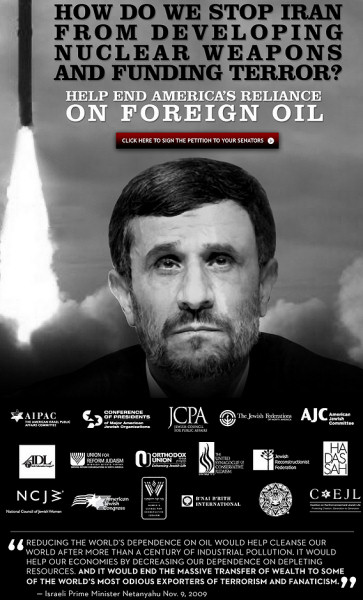
Also, the organizers say they’re actuated by fears of climate change, but why the Netanyahu quote and the emphasis on missiles?
And the NYTimes is still on message, Global Warming, Peak Oil and the War on Terror all seem to merge to support Zionism:
Letters to the International Herald Tribune – How to Fight Climate Change – NYTimes.com
The only way to effectively address climate change is for our leaders to make it an issue of national security: Emphasize the link between consumption of fossil fuels, especially foreign oil, and the rise of international terrorism. Once that link is clearly established, people will be willing to make an effort: The home-front will contribute to fighting against terrorism, which threatens every one of us. People will understand that there is no way to put a value on the lives of any of the nearly 3,000 people who perished in the Sept. 11 attacks, and that any effort is worth making to prevent recurrence of such a tragedy.
Update:
The Israel Lobby’s War on America’s Middle East Oil Dependence
By Maidhc Ó Cathail | The Passionate Attachment | October 26, 2012
See also:
US Jewish leaders push Obama to act on Iran
Jerusalem Post, September 10, 2009
Related efforts toward energy independence and war on Iran
- Obama uses Weekly Address to lobby for Israeli firm BrightSource (alethonews)
- Noam Chomsky: The Fate of Humanity Is at Stake — Why Are Romney and Obama Too Cowardly to Talk About What Really Matters? (alternet.org)
- Iran Underground Nuclear Plant Almost Finished, NY Times Says – Bloomberg (bloomberg.com)
- Earth Day in Israel: Apartheid Showing Through the Greenwash (alethonews)
WIKILEAKS: AN INDO-ZIONIST CONSPIRACY?
By Brigadier Asif Haroon Raja | Pakalert* | August 5, 2010

The period of WikiLeaks revelations covers five years of George W. Bush from January 2004 till December 2008 and one year of Barack Obama from January to December 2009. Looking back in rear-view mirror, one sees that significant changes started to occur in American policy in Afghanistan after December 2009 and talk of reconciliation and negotiations with the Taliban gained currency. Pakistan also began to figure prominently and there was a noticeable change of attitude among US officials. Karzai too started leaning towards Pakistan. A sudden change of direction of wind was not to the liking of India, the Northern Alliance and the Jewish lobby in USA since it ran counter to their designs against Pakistan.
This change occurred at a time when anti-Pakistan themes drafted by India had reached a maturing stage and had taken the shape of a proper charge sheet. The situation had ripened to put Pakistan on the mat. The USA and western countries drift towards Pakistan took the juice out of the regular supply of source reports furnished by RAW-RAAM agents who whetted the appetite of US military with concocted stories about the Pakistani Army and ISI. Fearing that what had been collated and disseminated may become outdated and get washed away in the humdrum of the final phase which was favorably inclined towards Pakistan, it was considered expedient to leak the classified information. Other than putting Pakistan and its premier institutions in the firing line, it was intended by master planners RAW and Mossad to tarnish the image of US military as well.
Soon after the publication of secret documents by WikiLeaks, an Afghanistan spokesman promptly gave his observations to the press asserting that the documents would help raise awareness on the sanctuaries Pakistan provides for militant groups. He gave this statement under the misplaced impression that the documents would surely help in indicting Pakistan on charges of terrorism. He didn’t realize that all those who were collectively digging a hole for Pakistan would themselves fall into it.
It may be noted that among the over 92,000 secret documents compiled in five years, there is not a single line written about India. The documents are silent about role of RAW, RAAM and Mossad in destabilizing Pakistan. Nobody in the USA or the entire western world has noticed these glaring oddities as to how come the role of three principal players is missing from the radar screen and US documents are blank. Have RAW agents in huge numbers present in every nook and corner of Afghanistan and moving up and down the Pakistan-Afghan border been grazing grass all these years? It indicates that not only did Indian, Northern Alliance intelligence and Israeli officials have a hand in providing anti-Pakistan information but the trio had also provided copies of documents to WikiLeaks. These hands had a definite role in coloring the perceptions of US leaders against Pakistan. It also proves that the US has unjustly treated Israel and India as holy cows and Pakistan a suspect.
It is also a strange coincidence that the clock of leaked documents remained silent from the end of 2001 till December 2003 and suddenly started ticking from January 2004 onwards. The timing somehow coincided with the signing of the Indo-Pakistan peace treaty. It is a clear cut indication that Indian leaders inked the treaty with ill-motives and soon after gave a green signal to RAW to trigger covert operations against Pakistan using Afghan soil.
I had penned my thoughts on WikiLeaks in Wikileaks-US’s Afghan war diary 2004-2009
I seek answers to some queries related to the leaks.
- Theft of 92,000 documents including videos and audios from safe vaults was not a day’s work. It must have taken the thief a considerable length of time to steal the desired documents. He must have been moving in and out of the store room umpteen times to lift folders containing incriminating documents about the conduct of the Afghan war. He could not have possibly done so singly but in connivance with some of the persons deputed to act as custodians of top secret documents. Does it imply that the sole super power and its premier institutions have no foolproof system of safety and security of classified documents or they are too careless and irresponsible?
- There must have been a time lapse between the documents whisked away and their publication by WikiLeaks. Taking into account the fact that revealed documents cover the period up to December 2009 and not up to June 2010, one cannot rule out the possibility that after the theft during 2009 and January 2010, it took Julian Assange five months to be able to get it published through WikiLeaks. It is strange that none among the huge security apparatus learned about the theft until it was disclosed by WikiLeaks. If so, it implies there is no system in existence to carryout spot inspections by duty officers/security officers of files/folders locked up in vaults.
- In any military unit/HQ of the armed forces, even loss of one classified document creates a massive stir and the concerned unit doesn’t rest till the missing document is traced and culprit punished. Rationally, a red alert should have been sounded in the USA and all resources geared up to find out all possible details about this embarrassing scandal expeditiously. Oddly, all US officials are in a complacent mood and have adopted a laid-back approach, giving an impression to outsiders that the wardens were part of the crime and leak was intentional to corner Pakistan; or else the Pentagon wants to cover up its officials who were in league with Assange or Bradley Manning.
- A government which is incapable of safeguarding its top secret documents having a bearing on security and reputation of the nation and its military, will it be able to safeguard its thousands of nuclear warheads and other deadly war munitions?
- After such a gigantic theft of classified documents having grave ramifications for the US Military’s future conduct in Afghanistan, why has the sole super power not initiated actions to get hold of the thief, the network, insiders and the ones who masterminded the theft?
- Julian or Bradley could not have possibly procured voluminous documents on a basis of friendship. Afghan National Security might have provided copies of Pakistan specific 180 reports free of cost. For the rest, they must have bribed the handlers of documents so heavily that they agreed to take such a huge risk. If so, who funded Julian/Bradley?
- While lot of hue and cry has been made over 180 anti-Pakistan source reports, western media, think tanks and analysts are quiet about 91,820 reports, videos and audios portraying inhuman barbarities of American and coalition forces against people of Iraq and Afghanistan. Why are the champions of democracy and human rights tight lipped and why are US officials downplaying this security lapse as if nothing significant has happened?
- Why have these documents came to light at a critical time when occupation forces in Afghanistan are in dire strait; war on terror has become highly unpopular; demand to end the war is surging; Taliban are carrying out daily attacks and inflicting deaths/ injuries to ISAF troops? July has been the worst month in which 66 ISAF fatalities took place. What is the hidden motive?
- Is it that the real motive is to put the entire blame of US defeat in Afghanistan at the doorsteps of Pakistan? If so, what next?
- Notwithstanding sinister designs of adversaries of Pakistan, 70% of revealed documents are uncorroborated and unverified, while the remaining 30% are also debatable and one-sided as claimed by US officials. However, 5-10% of the reports are based on hard facts, which cover in minute details the atrocities of US and coalition forces in Iraq and Afghanistan. What if the still to be revealed 15,000 documents are also exposed which are more harmful for USA?
While it is a reality that no US think tank, newspaper or official has ever written a single sentence on an Indo-US-Israeli-Afghanistan nexus and their designs against Pakistan, Wikileaks has lifted the curtain. Although under US pressure the head of this website has attempted to minimize the damage by telling an Indian news reporter that all reports less the ones pertaining to Pakistan were unreliable, it cannot be denied that the US military has suffered the most from this disclosure. What is most worrisome for the US military operating in Afghanistan is the exposure of names of their Afghan informers and some within the Taliban ranks working as double agents. Their fate is sealed since the Taliban would never spare them. This factor will further shrink US battle intelligence capability, thereby compounding their problems during ongoing testing times.
Thanks to a few upright people in the USA and western countries as well as whistle blowing independent websites, the world is now getting more educated about the deepening mess in Afghanistan. Sooner or later, pieces would start falling in the right places and the real picture would emerge, which had been kept hidden all these years.
There have been occasional reports of use of excessive force by the ISAF in Afghanistan, about torture tales in Gitmo, Bagram Base and Abu Gharib jails, but none could imagine the scale and gruesome nature of atrocities against Afghans as disclosed by WikiLeaks. 150 bombing incidents on civilians killing mostly women and children had never been reported. There could be many more incidents purposely not recorded by the ones maintaining logs. Wedding ceremonies, funerals, children school buses and passenger buses have not been spared by trigger happy Yankees. Jets, gunship helicopters and drones have caused maximum casualties. Logs have also indicated the use of Blackwater to capture or kill marked Taliban. Hands of American civil and military leaders are dripping in the blood of innocent Iraqis and Afghans. Wikileaks has provided incriminating material for their trials for committing war crimes.
There were strong reasons for the sacked Gen McChrystal to restrain his swashbuckling cowboys from firing indiscriminately and causing large scale civilian fatalities. Hawks in then Obama Administration had constantly pushed him for quicker results without caring for human destruction. Irked by their haughty behavior, he decided to call it a day. Is there some connection between WikiLeaks-Rolling Stone-McChrystal? Moreover, is there a connection between the Times Square incident, the visit of three rasping top US leaders to Islamabad in July, the WikiLeaks revelations, Cameron’s derogatory remarks and Karzai’s diatribe?
WikiLeaks has inadvertently provided a golden opportunity to Pakistan to expose the hidden designs, subversive activities and black deeds of occupation forces in Afghanistan and to blunt their smear campaign. The world is now eagerly looking toward whistle blowing websites like WikiLeaks to throw light on following ambiguities:
- Other than the declared objectives of the USA, what was the hidden motivation to occupy Afghanistan?
- What was the purpose behind setting up a huge intelligence centre at Jabal-al Siraj near Kabul comprising six intelligence agencies?
- How did Osama bin Laden and the whole lot of Al-Qaeda and Taliban leaders’ in Tora Bora slip out in December 2001, which subsequently became the key cause of US intractable troubles in Afghanistan?
- Is Osama dead or alive and if alive where is he located?
- How did the defeated, ousted fugitive Taliban manage to regroup so speedily and start hitting back at occupation forces from 2003 onwards?
- Details of harrowing atrocities committed by Northern Alliance warlords against captured Taliban and Pakistani prisoners after the fall of Taliban regime in December 2001.
- Details of $3 billion spent by CIA to win the loyalties of corrupt and ruthless Afghan warlords to help form a government in Kabul under puppet Hamid Karzai.
- Details of profits earned from illegal drug trade in Afghanistan and who all shared the profit to run covert operations against Pakistan and Iran.
- Particulars of tens of Pakistan specific training camps and intelligence setups of RAW and Mossad in Afghanistan and their methods of indoctrination of suicide bombers.
- Idea behind Af-Pak policy and why did it fail to kick off.
- How come 16,000 foreign troops coupled with 9,000 Afghan troops backed by jets, helicopters and artillery failed to overpower a few hundred ill-equipped Taliban in Marjah in February-March which has jeopardised the US offensive drive in southern and eastern Afghanistan?
The writer is a retired Brigadier who after retirement remained Honorary Colonel of the Battalion he commanded for eight years and also served as Director Education & Training KRL
* Additional editing for western English by Aletho News
Kola Temperature Reconstruction Shows Solar Correlation – Refutes The Hockey Stick
By P. Gosselin | August 7, 2010
Last week I wrote about a Russian-German temperature reconstruction from 1600 to 2000 derived from tree rings from the Kola Peninsula in northwest Russia . The paper appeared in the journal Arctic, Antarctic, and Alpine Research, Vol. 41, No. 4, 2009, pp. 460–468, by Kononov, Friedrich and Boettger.
In response, German media outlets all hollered “RAPIDLY RISING ARCTIC TEMPERATURES!”, focusing solely on one statement that temperatures have been rising since 1990.
It’s a classic example of how a scientific study comes up with Result A, but the public ends up understanding Result Z, all thanks to sloppy and incompetent communication that exists between the two.
The press release here provides the following Kola temperature reconstruction graph for summertime temperatures:
Kola Peninsula tree-ring temperature reconstruction. Source: Stephan Boehme/UFZ

Here it’s plain to see that the temperature reconstruction shows that Arctic temperatures in the Kola Peninsula have been rising since about 1670. This corresponds exceptionally well with Loehle’s 2007 reconstruction using 18 non-tree-ring proxies for the last 2000 years shown as follows:

Both graphics show the Little Ice Age from 1650 to 1750, at which point a warming event ensues. Then it was generally flat from 1750 to about 1920, and then followed by another rise that took place until 1950. Then Kola tree-ring proxies show a cooling up to 1990. Since 1990 warming has occurred again, but it’s a warming that is completely within the natural range of variation.
The Kola reconstruction (1) agreed with an earlier reconstruction (2) done in the area, see map below. What’s more, the Kola reconstruction (1) was compared with tree-ring reconstructions from other Arctic regions: Swedish Lapland (3), Yamal (4), and Taimyr (5).
Proxy locations used for Kola comparison. Source: Journal Arctic, Antarctic, and Alpine Research, Vol. 41, No. 4, 2009, pp. 460–468

The result of the comparison:
The reconstructed summer temperatures of the last four centuries from Lapland and the Kola and Taimyr Peninsulas are similar in that all three data series display a temperature peak in the middle of the twentieth century, followed by a cooling of one or two degrees.
Only the Yamal reconstruction differed completely, resembling the shape of a hockey stick with the blade beginning at 1900. The hockey stick is becoming an artifact of activism.
Except for the Yamal reconstruction, all tree-ring and non-tree ring reconstructions appear to agree, and so indicate no correlation between temperature and atmospheric CO2 concentration.
So what could be driving temperatures then? The authors compared the tree-ring based reconstructions with historical records of sunspots (Lean et al, 1995; Lean, 2000), and say:
We found that over the whole investigated period fluctuations of summer air temperature reconstructed for the Khibiny Mountains in the central part of the Kola Peninsula have a good consistency (r >0.50) with changes of solar radiation (Fig. 10), especially for the low-frequency signal.
In the paper’s conclusion we read:
The broad similarity between this temperature construction and solar radiation indicates that solar activity is an important driver of centennial to multi-decadal trends in summer temperatures of the Kola Peninsula.
So why did all media reports holler “RAPID TEMPERATURE INCREASE IN THE ARCTIC”. Call it complete communication incompetence by the media players between science and the public.
The Kola reconstructions show no link to atmospheric CO2 concentrations. It all started with a solid scientific paper, and but then was distorted (purposely?) by a vague press release that culminated in alarmist media headlines.
Let’s call that press release incompetence-gate.
Gross Media Negligence
By SAUL LANDAU and NELSON P. VALDES | August 7, 2010
“The average Washington correspondent is content to write what he is spoon-fed by the government’s press officers.”
— I. F. Stone, 1953.
“When the government lies, must the press fib?”
— I. F. Stone, May 3, 1961
The government routinely lies and misleads. The mass media rarely checks government statements for facts or contradictions especially when the “good” guy (USA) attacks a “bad” guy (Cuba).
On July 14, for example, we reported Secretary of State Hillary Clinton called on Jews to support Alan Gross’ “humanitarian effort” to help the Jewish community improve communication technology.
Gross, arrested in Cuba last December, worked for a company paid by AID (part of the State Department), but used a tourist visa for five consecutive visits to disguise his intention: distribute forbidden satellite phones to government opponents. Several Jewish organizations already provide their Cuban brethren with modern communication technology. Most media failed to report that fact, which would have raised another obvious question: why did Gross distribute expensive satellite technology to a well-supplied community?
Jewish leaders in Havana interviewed by non-Cuban Juan Tamayo of the Miami Herald don’t remember meeting Alan Gross. Perhaps only dissident Jews got his goodies, those who don’t associate with the mainstream Jewish community! Ironically, as Hillary defended Gross’ technology-sharing mission, U.S. Homeland Security seized computers bound for Cuba from U.S. religious groups also claiming desires to upgrade communication technology for non-Jewish religious groups. Did some U.S. government official choose Jews (the “chosen” people) to receive high-tech equipment? Mainstream journalists didn’t catch this obvious contradiction. Indeed, the media routinely fails to check official government assertions. Sometimes they feast on their own failures to check, as when scandal erupted over the recent Shirley Sherrod firing by Agriculture Secretary Vilsack followed by “oops, we didn’t check, but can now squeeze this story for weeks.”
How about squeezing facts and applying them to reporting foreign policy? Reporters might recall Congress passed laws from the 1990s authorizing the “promotion of democracy” in Cuba (meaning overthrow Cuba’s government).
Radio Marti promoted the U.S. way of life, then TV Marti, albeit Cubans have yet to watch it (Cuba jams its signal). The Gross case represents a digital equivalent: Satellite phones, computers, Facebook and Twitter to undermine Cuba’s government.
Media often ignores context (history), especially when high U.S. officials present good (us) v. evil (them) scenarios. In the 1980s, Iran’s theocratic government, now Washington’s maximum enemy and Israel’s nemesis, (Teheran’s nuclear enrichment program could lead to weapons-making) received U.S. missiles from high Reagan officials (the Iran-Contra scandal).
In 2002, Saddam Hussein invited UN Weapons Inspectors to return to prove Iraq had no WMD. The Bush White House sneered, claiming Saddam had evicted the same inspectors in 1998. The major media like White House stenographers reported this “fact.” Four years earlier the very same media organs had correctly reported: the UN had prudently withdrawn the inspectors after President Clinton announced plans to launch missile strikes against Iraq. The effect of the report as fact and the false Bush narrative reinforced the “evil Saddam” image (convenient for mobilizing support for the invasion of Iraq).
Similarly, in July, Hillary lectured Vietnam on its human right failures. There was no mention in the major media of how U.S. armed forces (U.S. military advisers first entered Vietnam in 1950 and the war ended in 1975) had killed several million Vietnamese civilians, many in carpet bombings, which deprived them of all human rights. The media also ignored the fact that Washington does not turn Vietnamese — or Chinese — human rights abuses into pretexts to impose embargoes and travel bans, as it does with Cuba. OK, consistency is the product of small minds!
U.S. officials condemn North Korea for its alleged sinking of South Korea’s ship, Cheonan, in March as if Pyongyang occupied a uniquely sinister place in the list of human rights’ abusers. Did no reporter read Bruce Cummings’ recent book revealing that U.S. forces killed millions of civilians in the Korean War? (The Korean War: A History, Modern Library, 2010)
U.S. “news” media apparently accept as unwritten law that a powerful empire can waive standards for itself that it applies to “lesser” nations, like Cuba. Declassified documents from the early 1960s onward show the CIA supervising 3,000 plus attacks against Cuba, including dozens of assassination attempts. Yet, State has placed Cuba on its terrorist list.
Evidence? Washington has not accused Havana of directing terrorist acts against U.S. targets. Paradoxically, in 1984 Cuban UN diplomat Nestor Garcia told Secret Service officials details of an assassination plot against President Reagan. As a result of the information, Garcia said, the FBI arrested some men, thanked Cuba for its help and “continued business as usual.”
Empires scoff at double standards. So what? U.S. leaders act on the first three words of the old Christian dictum: “Do unto others,” and haven’t absorbed Mark Twain’s wisdom. “There are 869 different forms of lying, but only one of them has been squarely forbidden. Thou shalt not bear false witness against thy neighbor.” Twain didn’t say “obedient neighbor!”
Saul Landau is an Institute for Policy Studies fellow. Nelson Valdés is Professor Emeritus, University of New Mexico.
Weekly Standard Falsely Claims Iran Is Starting Proxy War With Israel
It’s nothing unusual for the flagship neocon rag, the Weekly Standard, to try to start wars in the Middle East. But Gabriel Schoenfeld’s post today on the magazine’s blog was irresponsible even by the Standard’s… well, standards.
Schoenfeld, a fellow at the neocon Hudson Institute, fabricates the details of incidents at the southern and northern edges of Israel in order to connect the attacks to the Islamic Republic.
In his post, ominously titled “Are the Winds of War Blowing?,” Schoenfeld wonders aloud, “Are the ayatollahs preparing preemptive action of their own, taking the battle to the borders of the Zionist enemy?”
Just how are the Iranians attacking the borders of Israel? Through their proxies Hamas and Hezbollah, of course. As evidence of this menacing military campaign, Schoenfeld cites three encounters over the past week:
On July 30, after a prolonged interval without such attacks, Hamas lobbed a Grad rocket into a residential area in the Israeli city of Ashkelon.
On August 2, another Grad was fired from the Sinai Peninsula toward the Israeli resort city of Eilat; it landed in the neighboring Jordanian city of Aqaba, where it killed a taxi driver and wounded five people.
On August 3, Hezbollah initiated a gun battle against Israeli soldiers operating within Israel next to its border fence, killing an Israeli officer.
No links are provided for the first two incidents, so let me clarify a few things: A rocket from Gaza did indeed land in Ashkelon last week, but Hamas did not launch or “lob” it. Even Haaretz reported that:
The Israeli military believes that Hamas was not responsible for the [rocket] attack and that the Islamist organization which controls the Gaza Strip is not interested in escalating tensions in the area, Army Radio reported.
In the second incident, of the rocket apparently fired from the Sinai, Haaretz reports that, “No group has yet taken responsibility for the attack.” Egypt, for its part, only blamed “Palestinian factions,” initially denying that the rockets had come from the Sinai at all, and failing to specify a group. (Hamas is an offshoot of the Egyptian-founded Muslim Brotherhood, which is banned in Egypt, so presumably the authorities would have little problem blaming the group if they suspected their involvement.)
For the third incident, Schoenfeld does provide a link. But if he bothered to read through the BBC article he chose, he would see that the clash on Israel’s northern border was with the Lebanese Army, not the Shia militia, Hezbollah, as Schoenfeld breathlessly states by claiming “Hezbollah initiated a gun battle against Israeli soldiers.”
Yes, both Hezbollah and Hamas are supported by the Islamic Republic as part of a far-reaching PR campaign by Iran to increase its regional clout (which is only aided by the festering Israeli-Palestinian conflict). But this does not, by default, mean that Iran is behind every clash in the region.
While the origins of the first two attacks remain in the dark, Schoenfeld is ready to proclaim Hamas the culprits with zero evidence. On the third score, he simply doesn’t know what’s going on or fabricates the events to blame another Iranian proxy.
All this winds up with him, perhaps in a case of projection, suggesting that Iran is starting a war with Israel, no doubt aiming to rile up U.S.-based support for taking Israel’s side in said war.
And this from a guy who wrote a piece last month for the Wall Street Journal titled “Avoiding Another Intelligence Failure on Iran.”
Before making his fact-free claims, however, Schoenfeld writes, “As Iran makes its way into the endgame of its nuclear-bomb making program, it may be growing more worried about the prospect of a preemptive Israeli strike.” Leaving aside his evidence-free assertions about the advancement of Iran’s nuclear program, Schoenfeld does cite here the more likely scenario, with Israel cast as the aggressor.
Featured Video
BRITAIN’S WARNING: PREPARE FOR WAR
or go to
Aletho News Archives – Video-Images
From the Archive
How Ukraine Tortured and Slaughtered Donbass
By Kit Klarenberg | Al Mayadeen | July 11, 2024
Almost immediately after the proxy war erupted, ISIS-tier footage of the torture and murder of Russians in Ukrainian custody emerged.
On July 6th, the New York Times published an astonishing investigation: In Ukraine, Killings of Surrendering Russians Divide an American-Led Unit. The article documents in grim detail how Chosen Company, an international volunteer battalion for Kiev, routinely executes Russian prisoners of war. It is the very first mainstream admission that this practice – a brazen breach of the Geneva Conventions, and a grave war crime – is widespread among Ukraine’s fighters, both foreign and homegrown. … continue
Blog Roll
 Aletho News
- Israel Demolishes Home Of Lebanese Journalist Whose Viral Film Exposed Pager Attack
- Record Oil, Empty Tanks: The UAE’s Miracle Recovery
- Burnham tackles Britain’s poverty with aggression in Yemen
- Peace in Ukraine: the easy way – or the hard way
- Trump & the Rrrrussians
- US taxpayer money laundered back through Ukraine – Musk
- Before COVID, an NIH lab chief proposed making a SARS-like bat virus more infectious
- Gates, Bourla on Trial in Netherlands Accused of ‘Great Reset’ Scheme at Vaccine Injury Hearing
- BRITAIN’S WARNING: PREPARE FOR WAR
- “Historic Russia”: The Land Putin Will Not Give Back
- If Americans Knew
- DAILY UPDATE: Latest essential news on Palestine, Israel, & region
- Damning report shows the media must confront its failures on Gaza
- BBC senior broadcaster speaks out on Gaza coverage
- Netanyahu vows vast West Bank invasion in response to 20-minute skirmish that left 2 Israeli soldiers and 2 Palestinian fighters dead
- Tied up and tortured: Israel using US-made electroshock weapons on Palestinian detainees
- The outsourced risk: how newsrooms rely on Gaza’s freelancers without protecting them
- Gaza bakeries forced to shut as Israel blocks flour shipments
- Gaza’s breast cancer patients face a deadly wait for treatment amid Israel’s genocide
- DAILY UPDATE: Latest essential news on Palestine, Israel, & region
- The Israel Lobby’s Changing Fortunes
- No Tricks Zone
- Two New Studies Find Thwaites Glacier Melt Cannot Be Driven By Human Activity Or A Warming Ocean
- E-Cars Reduce CO2 Emissions By Only 41% Compared To Internal Combustion Engine Vehicles
- Predictions Made By Renowned Climate Professor Over Past Decades Have Been Proven To Be Poor
- New Study Suggests Large Regions Of The Pacific Ocean Have Been Cooling For The Last 80 Years
- Germany’s Green Energy Debacle: High Energy Costs Force Kahla Porzellan to Close After 182 Years!
- New Study: 50 Years Of The Most Aggressive ‘Net Zero’ Policies Can Only Affect The Global Climate By 0.03°C
- US September “Heat” Was No Record…Many Records Set Decades Ago
- Latest European Green Energy Debacle; Portugal’s Largest Flagship Solar Park Insolvent!
- Green Energy Debacle: German Expert Professor Fritz Vahrenholt Warns Of Severe Economic And Social Consequences
- Two More Paleo Reconstructions Affirm Meters-Higher Sea Levels Across Ireland, Brazil 7000-6000 Years Ago


