New study documents media’s servitude to government
By Glenn Greenwald – June 30, 2010
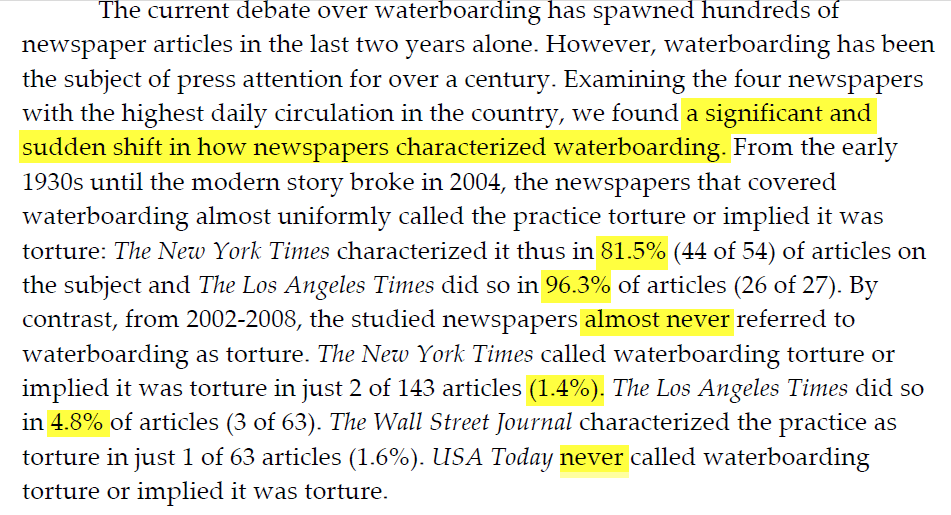
A newly released study from students at Harvard’s John F. Kennedy School of Government provides the latest evidence of how thoroughly devoted the American establishment media is to amplifying and serving (rather than checking) government officials. This new study examines how waterboarding has been discussed by America’s four largest newspapers over the past 100 years, and finds that the technique, almost invariably, was unequivocally referred to as “torture” — until the U.S. Government began openly using it and insisting that it was not torture, at which time these newspapers obediently ceased describing it that way:
Similarly, American newspapers are highly inclined to refer to waterboarding as “torture” when practiced by other nations, but will suddenly refuse to use the term when it’s the U.S. employing that technique:
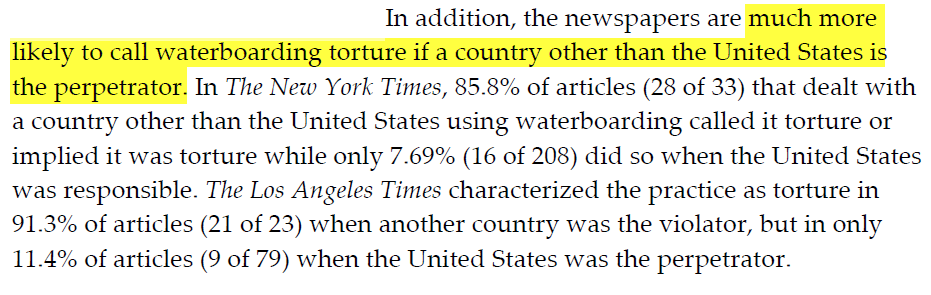
As always, the American establishment media is simply following in the path of the U.S. Government (which is why it’s the “establishment media”): the U.S. itself long condemned waterboarding as “torture” and even prosecuted it as such, only to suddenly turn around and declare it not to be so once it began using the tactic. That’s exactly when there occurred, as the study puts it, “a significant and sudden shift in how newspapers characterized waterboading.” As the U.S. Government goes, so goes our establishment media.
None of this is a surprise, of course. I and others many times have anecdotally documented that the U.S. media completely changes how it talks about something (or how often) based on who is doing it (“torture” when the Bad Countries do it but some soothing euphemism when the U.S. does it; continuous focus when something bad is done to Americans but a virtual news blackout when done by the U.S., etc.). Nor is this an accident, but is quite deliberate: media outlets such as the NYT, The Washington Post and NPR explicitly adopted policies to ban the use of the word “torture” for techniques the U.S. Government had authorized once government officials announced it should not be called “torture.”
We don’t need a state-run media because our media outlets volunteer for the task: once the U.S. Government decrees that a technique is no longer torture, U.S. media outlets dutifully cease using the term. That compliant behavior makes overtly state-controlled media unnecessary. In his proposed Preface to Animal Farm, George Orwell noted how completely the British Government during World War II was able to control media content without formal or official censorship:
The sinister fact about literary censorship in England is that it is largely voluntary. Unpopular ideas can be silenced, and inconvenient facts kept dark, without the need for any official ban. . . .
So far as the daily newspapers go, this is easy to understand. The British press is extremely centralised, and most of it is owned by wealthy men who have every motive to be dishonest on certain important topics. . . . At any given moment there is an orthodoxy, a body of ideas which it is assumed that all right-thinking people will accept without question. It is not exactly forbidden to say this, that or the other, but it is ‘not done’ to say it, just as in mid-Victorian times it was ‘not done’ to mention trousers in the presence of a lady.
In 2007, Rudy Giuliani was widely mocked for explaining that whether a particular technique constitutes torture “depends on who does it” — rarely does one find such an unapologetically nationalistic theory of morality and even language — but that’s exactly the same standard not only our government but also our establishment media has adopted.
The real issue here is the same one raised by the malleable, manipulative use of the term “Terrorism.” It’s to be expected that governments will try to propagandize their citizenry by applying completely different standards — even completely different language — to their own conduct as opposed to when other countries engage in exactly the same conduct. But when the media copies that behavior (as ours does), they’re amplifying and bolstering government propaganda rather than critically scrutinizing and debunking it. Isn’t that a fairly serious problem?
The behavior is even more egregious when government dictates (as of now, this is no longer torture) lead directly to the change in media behavior. And the ultimate effect of this joint government/media obfuscation is to further entrench the destructive notion that we’re different, exceptional, better, and therefore we deserve even a different language to describe what it is that we do. This Harvard study documents the exact process by which the political class convinces itself and others that bad and illegal things are, by definition, only what those Bad, Other Foreign Countries do, but never ourselves.
The terrorist-naming game
By Paul Woodward on June 28, 2010
On September 11, 2001, George Bush changed the way Americans look at the world and the success with which he accomplished this feat is evident in the fact that his perspective largely remains unchallenged — even among many of his most outspoken critics. Bush’s simplistic for-us-or-against-us formula was transparently emotive yet utterly effective.
For almost a decade, Americans have been told to look at the world through the lens of “terrorism” and while differences of opinion exist about whether the lens has too wide or narrow an angle or about the extent to which it brings things into focus, those of us who say the lens is so deeply flawed that it should be scrapped, remain in a minority.
The Obama administration may now refrain from using the term itself, preferring instead “violent extremists,” but the change is merely cosmetic (as are so many other “changes” in the seamless continuity between the Bush- and post-Bush eras).
A couple of days ago Philip Weiss drew attention to the fact that when former Israeli foreign minister Tzipi Livni described her parents as “freedom fighters,” Deborah Solomon, her interviewer in the New York Times, echoed Livni’s sentiment by saying that the fight for Israel’s independence took place in “a more romantic era.”
As Weiss notes, Livni’s parents belonged to the Irgun, the Zionist group which blew up the King David Hotel in Jerusalem on July 22, 1946, killing 91 and injuring 46.
The first public account of what had happened that day was accidentally released in advance of the bombing.
In By Blood and Fire, Thurston Clark writes:
“Jewish terrorists have just blown up the King David Hotel!” This short message was received by the London Bureau of United Press International (UPI) shortly after noon, Palestine time. It was signed by a UPI stringer in Palestine who was also a secret member of the Irgun. The stringer had learned about Operation Chick but did not know it had been postponed for an hour. Hoping to scoop his colleagues, he had filed a report minutes before 11.00. A British censor had routinely stamped his cable without reading it.
The UPI London Bureau chief thought the message too terse. There were not enough details. He decided against putting it on the agency’s wire for radio and press until receiving further confirmation that the hotel had been destroyed.
Despite the efforts of Irgun leaders to restrict knowledge of the target and timing of Operation Chick, there were numerous other leaks. Leaders in both the Haganah and Stern Gang knew about the operation. Friends warned friends. The King David had an extraordinary number of last-minute room cancellations. In the Secretariat [the King David’s south wing that housed the headquarters of the British government in Palestine], more than the usual number of Jewish typists and clerks called in sick.
The next day the British prime minister, Clement Attlee referred to the bombing as an “insane act of terrorism” while a few days later the US president, Harry Truman, wrote “the inhuman crime committed… calls for the strongest action against terrorism…”
That was 64 years ago. From the sheltered perch of the New York Times, that’s apparently far enough back in history that it can now be referred to as a “romantic era.”
It’s hardly surprising then that many observers with an interest in justice for Palestinians take offense at the New York Times’ complicity in papering over the reality of Jewish terrorism. Yet here’s the irony: the effort to promote an unbiased use of the term “terrorism” simply plays into the hands of the Israelis.
The word has only one purpose: to forestall consideration of the political motivation for acts of violence. Invoke the word with the utmost gravity and then you can use your moral indignation and outrage to smother intelligent analysis. Terrorists do what they do because they are in the terrorism business — it’s in their blood.
So, when Tzipi Livni calls her parents freedom fighters, I have no problem with that — she is alluding to what they believed they were fighting for rather than the methods they employed. Moreover, by calling people who planted bombs and blew up civilians in the pursuit of their political goals, “freedom fighters,” Livni makes it clear that she understands that “terrorism” is a subjective term employed for an effect.
When Ehud Barak a few years ago acknowledged that had he been raised a Palestinian he too would have joined one of the so-called terrorist organizations, he was not describing an extraordinary epiphany he had gone through in recognizing the plight of the Palestinians. He was merely being candid about parallels between groups such as the Irgun and Hamas — parallels that many Israelis see but less often voice.
The big issue is not whether the methods employed by Zionist groups such as the Irgun could be justified but whether the political goals these groups were fighting for were legitimate. Zionism would not have acquired more legitimacy if it had simply found non-violent means through which it could accomplish its goal of driving much of the non-Jewish population out of Palestine.
We live in an era in which “terrorism” — as a phenomenon to be opposed — has become the primary bulwark through which Zionism defends itself from scrutiny. Keep on playing the terrorist-naming game and the Zionists win.
Leader of Death Squads Wins Colombian Election
A “Role Model” for Latin America
By Prof. James Petras | Global Research | June 27, 2010
Juan Manuel Santos, notorious Defense Minister in the regime of outgoing President Alvaro Uribe and closely identified with high crimes against humanity “won” the recent Presidential elections in Colombia, June 2010. The major electronic and print media CNN, FOX News, Washington Post, the New York Times, The Wall Street Journal, and the once liberal Financial Times (FT) hailed Santos election, as a great victory for democracy. According to the FT, “Colombia not Venezuela is (the) best model for Latin America” (FT 6/23/2010 p. 8). Citing Santos “overwhelming” margin – he garnered 69% of the vote, the FT claimed he won a “strong mandate” (FT 6/22/2010). In what has to be one of the most flagrant cover-ups in recent history, the media accounts exclude the most egregious facts about the elections and the profoundly authoritarian policies pursued by Santos over the past decade.
The Elections: Guns, Elites and Terror
Elections are a process (not merely an event) in which prior political conditions determine the outcome. During the previous eight years of outgoing President Uribe’s and Defense Minister Santos’ rule, over 2 million, mostly rural poor, were forcibly uprooted and driven from their homes and land and displaced across frontiers into neighboring countries, or to urban slums. The Uribe-Santos regime relied on both the military and the 30,000 member paramilitary death squads to kill and terrorize entire population centers, deemed “sympathetic” to the armed insurgency, affecting several million urban and rural poor. Over 20,000 people were killed, many, according to the major Colombian human rights group, falsely labeled “guerrillas”. Santos as Defense Minister was directly implicated by the Courts in what was called “false positives”. The military randomly rounded up scores of poor urban youth, shot them and claimed a resounding victory over the FARC guerrillas.
Several of the most important captured paramilitary death squad leaders testified that over 60 of the congress people backing Uribe – Santos were on their payroll and they “ensured” votes from regions under their control. Faced with damaging testimony, Uribe-Santos double-crossed their narco-death squad comrades and “extradited” them to the U.S. where the judicial process excluded evidence linking them to the mass killings at the behest of Uribe-Santos.
Over two thousand trade unionists, human rights activists, journalists and congress- people critical of Uribe-Santos were murdered by death squad hit-men serving the regime. The world’s major trade union confederations have sent missions and published reports condemning Colombia as the most dangerous country for workers’ representatives.
In other words all the social sectors with social and political grievances against the regime were terrorized, many of their local opinion leaders, killed, displaced or driven into exile … undermining the possibility of sustained independent socio-political organization.
Pervasive state terror led to few local leaders surviving, undermining the electorate’s capacity to exercise a free and independent organization.
On election day, the regime mobilized over 350,000 military and police officials, many involved in the decade long repression, to “oversee” the elections and to remind the voters of the force behind the “official candidate” (La Jornada 5/30/2010).
The electoral outcome was far from the “mandate” of the Colombian people as claimed by the mass media. The ‘winner’ was the “abstentionists” with 56% of the electorate, the position advocated by the FARC. Now clearly the majority of the abstentionist vote did not reflect support or sympathy for the FARC; rather it reflected disaffection with the regime’s violent repression, massive dispossession of millions and its total failure to deal with the under and unemployment affecting 40% of the economically active population.
In fact Santos received 30% of the vote of the electorate, hardly a mandate. If we examine the social-ecological background of the voters, it is clearly a mandate from the elite. The highest levels of abstention were among several distinct groups. Among the shanty towns and rural areas suffering from repression and neglect, abstention rose to over 80%. In contrast, in the middle and upper class sectors of the major cities, over 60% voted for the candidate of the regime. Uribe-Santos tried to explain away the massive abstention by citing the weather (rain) and the World Cup soccer matches .However the low turnout took place throughout the country, in both dry and inclement weather. And the games did not occupy the entire day of voting. The mass media systematically ignored the horrendous crimes under Defense Minister Santos, his indictment in the “false positive” murders, his long term large scale association with the death squads and with the Uribe regimes promotion of narco- trafficking. They ignored his support for de-regulating the financial system, resulting in the defrauding of hundreds of thousands of Colombian small investors.
Comparing Colombia to Venezuela
Yet the Financial Times (6/23/2010) favorably compares Colombia under Uribe-Santos against Venezuela under Chavez, “Crackers about Caracas? Latin American should be bonkers about Bogota instead”. According to the FT Venezuela under Chavez is said to be unsafe, authoritarian and economically in decline. The editors of the FT, echoing the rest of the media, claim Colombia is a prosperous democracy, with a system of checks and balances; with safe and peaceful neighborhoods … except when the neighborhoods of the poor protest unemployment or the rural villagers march against land grabs by the landlord funded gunmen. The FT fails to mention the resurgence of paramilitary gangs terrorizing the Colombian countryside, (La Jornada 5/28/2010) but instead they focus on street crime in Caracas.
The Venezuelan government, contrary to the US media, promotes community based social movements which would be targets of military raids in Bogota.
The only “paramilitary” groups in Venezuela are cross-overs from Colombia, pursued and punished by the Venezuelan National Guard. In Venezuela trade unions participate in the management of major industrial plants, unlike Colombia where they are murdered including workers in the major Coca Cola,coal, oil and banana industries.
Behind the media lies and falsifications abut Colombia’s election and its political leaders are several basic considerations.
– Uribe-Santos are fervent free market advocates, eagerly pursing a free trade agreement held up in the US Congress because of their killing fields.
– Uribe-Santos are unconditional clients of the Pentagon, receiving $6 billion in aid and handing over 7 military bases, under US jurisdiction to threaten Venezuela, Ecuador and any other country the Obama regime deems a hostile to US domination.
– Uribe-Santos recognized the Honduras regime, product of a US backed military coup in mid 2009 – contrary to the rest of Latin America.
The fact that the mass-media have so enthusiastically embraced a regime with the worst human rights record since the fall of the military dictators of the 1970’s – 1980’s (La Jornada 6/17/2010) is indicative of the right turn under the Obama Wall Street regime.
According to the White House and media, death squad democracies like Colombia now qualify as “role models” for Latin America. The problem is that neither the vast majority of Latin America citizens, nor most of the democratic parties in the region are buying: they prefer democracies without death squads, foreign military bases and narco-dealing Presidents. At present, the White House’s three leading allies in the region, Colombia, Peru and Mexico produce and sell 80% of the cocaine in the region. Will this appear in the media’s salutations to newly elected presidents?
Shalit, for example
By Uri Avnery | June 26, 2010 | Excerpt
[Gilad] Shalit has become a living symbol – a symbol of Israeli reality, of the inability of our leaders to make decisions, of their moral and political cowardice, of their inability to analyze a situation and draw conclusions.
If there had been an opportunity to free Shalit through military action, the Israeli government would have seized it eagerly.
So much is obvious, because the Israeli public always prefers solving a problem by force than doing anything that might be interpreted as weakness. The rescue of the hostages at Entebbe in 1976 is considered one of the most glorious exploits in the history of Israel, even though there was only a hair’s breadth between success and failure. It was a gamble with the lives of the 105 hostages and the soldiers, and it was successful.
In other cases, though, the gamble did not succeed. Not in Munich in 1972, when they gambled with the lives of the athletes, and lost. Not in Ma’alot in 1974, when they gambled with the lives of the schoolchildren, and lost. Not in the attempt to free the captured soldier Nachschon Wachsman in 1994, when they gambled with his life, and lost.
If there had been any chance of freeing Shalit by force, they would have risked his life, and probably lost. Fortunately for him, there has been no such chance. So far.
Actually, this is quite remarkable. Our security services have hundreds of secret collaborators in the Gaza Strip, in addition to high tech surveillance. Yet it seems that no reliable information about Shalit’s whereabouts has been obtained.
How has Hamas succeeded in this? Among other measures, by not allowing any contact with the captive – no meetings with the Red Cross or foreign dignitaries, just two short videos, almost no letters. They simply cannot be pressured. They refuse all requests of this nature.
This problem could possibly be overcome if our government had been ready to give assurances that no attempt would be made to free him by force, in return for a Hamas undertaking to let him meet with the Red Cross. To be credible, such an undertaking would probably need a guarantee by a third party, perhaps the US.
Absent such an arrangement, all the sanctimonious speeches by foreign statesmen about “letting the Red Cross meet with the soldier” are just so many empty words.
No less hypocritical are the demands of foreign personalities to “free the kidnapped soldier.”
Such demands are music to the Israeli ear, but completely disregard the fact that the subject has to be an exchange of prisoners.
Shalit is alive and breathing, a young man whose fate arouses strong human emotions. But so are the Palestinian prisoners. They are alive and breathing, and their fate, too, arouses strong human emotions. They include young people, whose lives are being wasted in prison. They include political leaders, who are being punished for simply belonging to one or another organization. They include people who, in Israeli parlance, “have blood on their hands,” and who, in Palestinian parlance, are national heroes who have sacrificed their own freedom for their people’s liberation.
The price demanded by Hamas may seem exorbitant – a thousand for one. But Israel has already paid such a price for other prisoners in the past, and that has become the standard ratio. Hamas could not accept less without losing face.
The 1,000 Palestinian prisoners have families – fathers, mothers, husbands, wives and children, brothers and sisters. Exactly like Gilad Shalit. They, too, cry out, demand, exert pressure. Hamas cannot ignore them.
The whole affair is shocking evidence of the inability of our government – both the previous and the present one – to take decisions and even to think logically.
Hamas already fixed the price four years ago, according to past precedents. Their demand has not changed since then… Full article
Right-wing self-delusion
By Glenn Greenwald | June 23, 2010
National Review‘s Jay Nordlinger cites a truly repellent (and false) comment made this week by Israeli Defense Minister Ehud Barak to Defense Secretary Robert Gates: “A million and a half people are living in Gaza, but only one of them is really in need of humanitarian aid,” Barak said. Nordlinger points out that Barak was referring to Israeli soldier Gilad Shalit, held hostage for years by Hamas, which refuses to permit the International Committee of the Red Cross (ICRC) access to him. After observing that neither “the Cuban dictatorship or Chinese dictatorship permit the Red Cross to see prisoners,” Nordlinger then claims — with the needy victimization that typifies the Right — that “there’d be mass demonstrations in [Shalit’s] behalf all over Europe, and on American streets, too” if “Shalit were other than Israeli.” In other words, Nordlinger believes that the Western World would never tolerate the denial of ICRC access to detainees except when the detainee is Israeli.
I’m asking this literally: is Nordlinger ignorant of the fact that the United States of America denied ICRC access to non-Israeli prisoners for years during the prior administration?
The US has admitted for the first time that it has not given the Red Cross access to all detainees in its custody.
The state department’s top legal adviser, John Bellinger, made the admission but gave no details about where such prisoners were held. . . . He stated that the group International Committee of the Red Cross (ICRC) had access to “absolutely everybody” at the prison camp in Guantanamo Bay, Cuba, which holds suspects detained during the US war on terror. When asked by journalists if the organisation had access to everybody held in similar circumstances elsewhere, he said: “No”.
That happened because, among other reasons, the U.S. maintained a network of CIA secret prisons — black sites — where detainees were barred from any and all contact with the outside world for months and even years, including international monitoring groups such as the ICRC. Maybe Nordlinger has heard of someone named Dana Priest, who won the Pulitzer Prize in 2006 for revealing, in The Washington Post, the existence of those secret American prisons:
It is illegal for the government to hold prisoners in such isolation in secret prisons in the United States, which is why the CIA placed them overseas, according to several former and current intelligence officials and other U.S. government officials. Legal experts and intelligence officials said that the CIA’s internment practices also would be considered illegal under the laws of several host countries, where detainees have rights to have a lawyer or to mount a defense against allegations of wrongdoing.
As Priest wrote, these detainees — never charged, let alone convicted, of any crime — “exist in complete isolation from the outside world. Kept in dark, sometimes underground cells, they have no recognized legal rights, and no one outside the CIA is allowed to talk with or even see them, or to otherwise verify their well-being.” Even once those black sites were revealed by Priest, the Bush administration explicitly rejected the ICRC’s request for access to those detainees (the ICRC was also long denied access to prisons in Iraq run by the Iraqi Government during the U.S. occupation). And the BBC reported in April of this year that the U.S. continues to maintain a secret prison at Bagram where prisoners are apparently abused and denied ICRC access. Could someone point me to the “mass demonstrations” that took place in Europe and the U.S. over any of these American secret prisons?
This raises an important and under-appreciated point. Many Americans defend the U.S.’s conduct not because they support it, but because they’re completely unaware of what those actions actually are. Many of the people who support what they call the “enhanced interrogation” program really believe they’re defending three instances of waterboarding rather than scores of detainee deaths, because they literally don’t know it happened. And here you have Nordlinger — a Senior Editor of National Review — claiming that denial of access to the ICRC is the hallmark of brutal tyrannies (it is), and arguing that a country could only get away with it if they do it to an Israeli, making clear that he is completely ignorant of the fact that his own Government did this for years (without, needless to say, prompting a peep of protest from his magazine), and reportedly continues to do it. That the U.S. did this systematically just doesn’t exist in his brain; he really believes it’s something only China, Cuba and Hamas do. They really do live in their own universe and just block out whatever facts they dislike while inventing the ones that make them feel good.
UPDATE: Just to convey a sense for how much National Review polemicists care about detainees being denied ICRC access (when it’s the U.S. doing the denying): the only mention found in NR‘s archives of Dana Priest’s revelation that the U.S. was maintaining a network of secret prisons with no ICRC monitoring was this one by Byron York, in which he suggested that, based on the Plame precedent, the persons responsible for the disclosure — but not the ones denying the ICRC access to detainees — should be prosecuted. So it’s not really a surprise that Nordlinger managed to remain completely ignorant of what the U.S. did for all those years, since his “political magazine” barely even mentioned it.
Sudanese Officials: Cyprus ‘arms ship’ allegation is “absurd”, contains mining explosives
Al-Manar TV – 24/06/2010
Sudanese officials on Wednesday dismisses allegations saying that the Arab country import arms on a ship intercepted in Cyprus as an “absurd”, saying that the explosives on board were for gold mining firm.
“Sudan has been importing explosives since the early 1990s to work this gold mine, and has never had any problems in the past. It’s the first time this has happened. It’s absurd,” Abdelbaqi al-Gilani, Sudan’s minister responsible for mining said.
“The ship is carrying some explosives for civil work … for quarry face blasting and mining, it has nothing to do with the military,” al-Giliani added.
On Tuesday, Cyprus said it it placed the “Santiago” anchored off the southern city of Limassol under police guard with a suspected military cargo that would contravene a 2004 UN embargo on arms sales and deliveries to Sudan. Cypriot officials examined the vessel after US authorities alerted them that it was carrying a large amount of explosives bound for Sudan.
“The ship is under guard and there are materials that are considered banned, this means either military material or explosives,” Commerce Minister Antonis Paschalides told state radio. “There is definitely military equipment which comes under a ban,” he added without elaborating.
The Sudanese mine at Hassay, 450 kilometers northeast of the capital Khartoum, is Sudan’s first — and only — gold mine.
The Ariab group working the mine is 51 percent Sudanese government owned, while 40 percent of the shares are held by holding group Cominor, created by Canada’s La Mancha and France’s Areva.
An Ariab official, speaking to AFP on condition of anonymity, confirmed that there were explosives on board the Santiago for the firm. “There are 251 tons of explosives which are for us. I hope they get here quickly, as we need them to be able to continue operation,” the official said. “I don’t know if there is anything else on board the boat, but these explosives are definitely for us.”
Friedman: Middle Easterners are scheming, except Israel
By Philip Weiss on June 20, 2010
Orientalism, the globalist variety: Notice how Tom Friedman, now in Istanbul, goes from describing as insane a conspiracy theory that on its face is plausible– the shocking possibility that the enemy of Israel’s new enemy is Israel’s friend– to mounting his own (mildly interesting) theory of why Erdogan used the flotilla as a radical raid on Israel.
Moreover, Erdogan has evolved from just railing against Israel’s attacks on Hamas in Gaza to spouting conspiracy theories — like the insane notion that Israel is backing the P.K.K. terrorists — as a way of consolidating his political base among conservative Muslims in Turkey and abroad…
Only two weeks before the Gaza flotilla incident, a leading poll showed Mr. Erdogan’s Justice and Development Party, known as the A.K.P., trailing his main opposition — the secularist Republican People’s Party — for the first time since the A.K.P. came to office in 2002. That is surely one reason Erdogan openly took sides with one of the most radical forces in the region, Hamas — to re-energize his political base. But did he overplay his hand?
I never forget that Friedman also dismissed as insane and conspiratorial the theory that American Zionists had anything to do with the decision to invade Iraq. Then a year or two later he essentially conceded the point to Haaretz (not his large American audience).
Why Lithium Can’t Save Afghanistan
There will never be a “Saudi Arabia of lithium” anywhere
By Michael Reilly | Discovery News | June 15, 2010
Following the news Monday that geologists have found a mother lode of minerals in Afghanistan — reports argued deposits of iron, copper, gold and other goodies could collectively be worth close to $1 trillion — it’s worth asking a few extra questions.
In particular, there’s been an unusually strong focus on the lithium portion of the find. A key ingredient in high-tech batteries for laptops, smart phones, electric cars and the like, its been heralded as the future cornerstone of the world’s energy infrastructure.
But is lithium really going to save Afghanistan, as many media outlets seem to think? Nope, not even close.
In the words of Brian Jaskula, a lithium commodity expert with the United States Geological Survey, “We’ll be extracting lithium from the ocean before we’ll be extracting it from Afghanistan.” (Jaskula was not involved with the Afghanistan work.)
Extracting lithium from the ocean is a real thing, but it’s expensive. Instead, most lithium we use starts off dissolved in super-salty water underneath several feet of hard salt pan in Chile’s Salar de Atacama, one of the largest lithium producing regions on the planet. Argentina and Australia are also big producers of lithium.
Drilling for brines and then evaporating them in the arid desert air is the cheapest way to get the element, and it’s by far the most common. After that comes mining lithium-bearing minerals right out of granites. Until recently, sucking the element out of seawater, where it occurs in concentrations of just a few parts per million, was purely theoretical. But forecasts calling for steadily increasing prices have led South Korean interests to start building a factory to do just that.
According to Jaskula, South Korea’s decision is more than just a gamble on the market. “They want a steady supply of lithium, and they don’t want to have to rely on hostile countries for their supply, even if they have to pay a little more to get it,” he said.
Of course, no one anticipated the Pentagon’s recent announcement about Afghanistan; Jaskula was referring to Bolivia, whose Salar de Uyuni region contains vast stores of lithium. But the country has very little infrastructure for setting up a mining operation, not to mention a history of political unrest.
“And Afghanistan is a century behind Bolivia,” in terms of infrastructure, Jaskula said.
Then there’s the whole business of calling Afghanistan the “Saudi Arabia of lithium.” Turns out that’s not right either, for a number of reasons. […]
Even if the country does turn out to have vast stores of lithium, it will be almost certainly useless. There will never be a “Saudi Arabia of lithium” anywhere, according to Jaskula.
For one thing, the term “lithium batteries” is somewhat misleading. Lithium is a crucial ingredient, but it makes up just a tiny fraction — maybe 2-3 percent — of the weight and cost of the batteries. For another, lithium prices nosedived in 2009, and are expected to drop again this year (PDF; lithium currently goes for about $5,000 per ton). Why? Mostly because of the economic downturn, producers have piles of lithium they can’t get rid of.
Even if demand recovers, electric cars take off, and all of our wildest dreams about lithium-based battery technology come true, Jaskula said current suppliers would have no trouble meeting our needs through the next ten years.
What’s more, the lithium in batteries is recyclable. It’s just not profitable to do it now. Common wisdom among industry experts is that as prices rise, recycling programs will blossom. By 2030, the need for virgin lithium will cease to exist, replaced by a self-sustaining lithium loop… Full article
Copyright © 2010 Discovery Communications, LLC.
‘Democracy’ Means the U.S. and Israel Approve
By Alex Kane on June 16, 2010
Thomas Friedman sure knows how to flip reality on its head. In his New York Times op-ed column today, Friedman hops on the bandwagon of bashing Turkey for “joining the Hamas-Hezbollah-Iran resistance front against Israel.”
Friedman accuses Turkish Prime Minister Recip Tayyip Erdogan of no longer promoting democracy and instead being more focused on “praising Hamas instead of the more responsible Palestinian Authority in the West Bank, which is actually building the foundations of a Palestinian state.” Friedman says of Erdogan:
I’d love to see him be the most popular leader on the Arab street, but not by being more radical than the Arab radicals and by catering to Hamas, but by being more of a democracy advocate than the undemocratic Arab leaders and mediating in a balanced way between all Palestinians and Israel. That is not where Erdogan is at, though, and it’s troubling.
Siding with the Palestinian Authority against Hamas would be a peculiar way of advocating for democracy in the Middle East, though. History lesson time: In the 2006 Palestinian legislative elections, Hamas categorically defeated Fatah in what former President Jimmy Carter called “free and fair” elections. The U.S., EU and Israel rejected those results, and after Fatah’s U.S.-backed attempt to overthrow Hamas in Gaza failed, an “emergency government” composed of members of Fatah was installed. This “emergency government,” still in place to this day in the West Bank, was not democratically elected and consolidated its power illegally.
In Friedman’s alternate universe, the Turkish prime minister is not advocating for democracy because…he supports the democratically elected government in Palestine that Israel has been trying to overthrow by way of “economic warfare” instead of the unelected government approved by the United States.
Terry Gross has no empathy for Palestinians
By Susie Kneedler on June 16, 2010
Terry Gross once ended an interview with Palestinian human rights lawyer Raja Shehadeh by asking whether he wanted to “mov[e] someplace else so that you wouldn’t be subjected to this… Israeli incursion.” Shehadeh retorted gently, “life…under Occupation” has “never been as difficult and as dangerous…and as frustrating as it is now. But, no, I will not leave.” NPR transcript here.
Terry Gross boasts in her new ad that “often when I’m interviewing people on Fresh Air, they give me a different way of looking at the world,” but her condescension to Shehadeh, a founder of Al-Haq (The Truth), shows how blind she is to Palestinian rights under International Law and how much she assumes Palestinians must make way for Israel’s expansion.
Gross has done no reports on the flotilla raid, and this just bears out her historical pattern. I’ve wondered for years about Gross’s cowardice in the face of Israeli injustice. She truly sides with the oppressors, imagining that they’re still victims. I listened to all three interviews that Gross had with Raja Shehadeh. And each time she administered an immediate antidote of airing an Israel booster, and not just any Israelis, but rightwingers: Yossi Klein Halevi, February 6, 2002; Michael Oren, June 11, 2002; and now Jerusalem Post editor David Horovitz, October 28, 2003.
In the prologue to her interviews with Shehadeh, Gross palms off Israeli propaganda as truth: “his town Ramallah was occupied by the Israeli army…This was part of a larger Israeli military operation to root out terrorists in response to suicide bombings” (Oct. 28, 2003). Gross omits the then-35-year Occupation, depicting Israeli aggression rather than Palestinian resistance as self-defense. No, only Ramallah was “Occupied.” Context is all, with news and with history.
Having introduced Shehadeh by reciting Israel’s hype, Gross heralds David Horovitz by peddling Horovitz’s own claims as fact:: “He told me that in Israel fear of suicide bombers is profound and unrelenting.” Gross’s preconceptions bow to establishment stereotypes: Occupied Palestine is riddled with homocidal attackers; mighty Israel is besieged by terror. Gross poses different questions to her two guests, and gets similar replies about great threats. But Gross responds unequally to the comparable answers–not least in neglecting to point out the false equivalency of their suffering. For Shehadeh is Occupied, whereas Horovitz speaks for Occupier. Worse yet, Gross ignores Shehadeh’s plight, the devastating fear in every bit of life–and death–in living under Occupation. Her only reaction is to change the subject.
By contrast, Gross chortles appreciatively when Horovitz chats about the ordeal of being searched at stores, despite being so blond–with a blond family–“we all look like recent arrivals from Sweden.” Terry Gross’s rare talent–one I used to love–is her engaging laugh. Gross’s mirth graces her interviews with ingenuous delight (especially compared to many witless hosts’ awkward guffaws). She could just as easily find glimmers of fun in Shehadeh’s self-deprecating relief that, when the IDF (sic) invaded his house, at least his gate kept the soldiers from terrifyingly banging on his door. Or the IDF’s bewilderment about how unmenacing he was: “I’m not a big person and perhaps that disarmed them.” Gross cuts Shehadeh off from her sympathetic sense of the ludicrous. She withholds empathy even when Shehadeh winningly confides his dread–“Would I break down?”– or describes his efforts to brave danger calmly, without belligerence.
That’s the pattern: Terry Gross refuses to converse with Shehadeh, but, rather, issues a series of insulting non-sequiturs that allow for no actual interaction. When she switches the topic to Israel’s “barrier fence,” Shehadah corrects her by explaining why it is an “Apartheid Wall,” stealing Palestinian land as it encircles their towns. But when Gross later asks Horovitz about the Wall, she reverts to “barrier,” not deigning to press Horowitz on links between Israeli tyranny and South Africa’s Apartheid.
With Horovitz, rather than changing subjects, Gross follows up with concern: “Has [suicide bombing] affected your views of Palestinians?” Horovitz generalizes: “Well, I can only relate to the Palestinian people by the opinion polls,” which “troublingly,” say that “most Palestinians say they support the bombers.” Horovitz justifies Israel scuppering peace talks.
Raja Shehadeh by contrast, speaks sadly of how extremists on both sides try to de-humanize the other. During the soldiers’ raid, ” I found young people dressed in such gear that you could hardly see them.” However, “I tried to make some human contact with them, but it was impossible….So I…felt some pity for them.” He could imagine how “they’d been told perhaps that every Palestinian hates them, and they live with this burden.” What largeness of mind.
But Gross doesn’t inquire whether IDF actions have embittered Shehadeh’s views of Israelis. Instead, Gross prods him to deprecate the president of Malaysia’s “anti-Semitic” remark, which he emphatically does.
Gross examines Shehadeh on his opinion of current Israeli-Palestinian informal peace proposals, but she locks out Shehadeh’s point, that Palestinians would accept compensation in lieu of Actual Return to the land of their ancestors. Gross hears intransigence rather than qualified enthusiasm: “Sounds as though you couldn’t really back this plan because it has no right of return.” Gross’s deafness betrays her prejudice: she imputes to Shehadeh Israel’s obstinacy–and her own?
Gross hops on again, insinuating that Shehadeh might “know anybody who’s directly connected to” “suicide bombers.” No, of course not, but Raja Shehadeh opens his conscience to say that he wants never “to compete in the horror and the tragedy because both sides have suffered horror….But I know victims… Israelis and Palestinians.” Shehadeh “cannot understand why [bombers] are driven to this,” but reminds us, “life in the Occupied Territories is to live in such despair.”
“The fact that Israel is killing babies and children does NOT justify such acts” he declares, explaining that there was “No possibility that anyone would do something like” blowing himself up before 1994, when [illegal] settlers killed worshippers.
Raja Shehadeh offers a beautiful introspection: “What has happened to us? We are at the edge.”
Gross leapfrogs; Shehadeh offers leaps of faith: “The beauty of Palestine historically has been a place of tolerance between the three religions…because Christians, Jews, and Muslims were living side by side….My struggle is for attaining freedom and…tolerance.”
Gross jumps on, disdaining to invite Shehadeh’s exploration of how despair warps the tyrannized–a logical, though deplorable–concomitant of more deplorable Israeli aggression, or his vision of a harmonious future Palestine. She fixates instead on her abhorrence of the bombers: have you, she prods, “witnessed extremist groups manipulating the despair, to try to create the environment where people are willing to blow themselves up?” Terry Gross misses his point: Israel created the environment of despair. Shehadeh though gives Gross the benefit of the doubt, describing how extremists on both sides take advantage of their people’s suffering. Gross might condole with him for all his endearing admissions, but she moves on. Nothing to see here, folks.
David Horovitz extends no such self-examination; he simply blames others, demanding that Palestinians: “stop the bombers,” “because then we can settle down to peace talks.” Horovitz even promises that the Israeli leadership then “would be rushing back to the peace talks.”
Of course, Palestinians have now stopped such bombings. Has Horovitz urged Netanyahu to “rush back to the peace talks”? No. Horovitz now proves his bad faith. He demands new concessions from Palestinians:
“Let Abbas speak in Arabic, to his own people – with his leadership colleagues on hand to publicly support and applaud him – and let him tell them that the Jews, too, have historic rights to Palestine.”
We need to study what Israel’s incessant moving of the proverbial goalposts does to the people of Palestine. Humans perceive such trickery with standards as taunting, and taunting–I know from being a child and now a parent–creates the greatest rage.
Gross surmises that Shehadeh might want to solve his problems by just leaving his home and people and seems almost exasperated. She’s in a muddle: as if she wants to commiserate–except that she can’t–for that means acknowledging Israel’s crimes–so she niggles Shehadeh to abandon all that’s right–though what’s right is giving up whatever Israel covets. Gross’s graceless query reminds me of the false concern and real prejudice of the father, Yaakov Levinson, in Heart of Jenin, to the Palestinian man, Ismail Khatib, who saved the life of Levinson’s tiny daughter. Khatib hoped to create ties through his acts of mercy, but the best gratitude the illegal-colonist Levinson could muster was a patronizing rebuff, “Can’t he emigrate?….There’s nothing for him here.”
What would have been really new sights–and sounds–from the show that labels itself as offering fresh air, is Gross truly listening to those our culture demonizes as Other. But Gross would have to care enough about the unexpectedness of the world–if not her job–to stretch beyond her preconceptions. Emily Henochowicz gives us an exquisite image for such elasticity of vision in an entrancing work of art (below), “Me to then-Me.” Henochowicz depicts her 2010 canvas stretching out to pull her 2009 model forward to catch up with her always-growing self. She posted it on the very eve of the protest where the IDF shot out her eye. Not many of us can equal our Emily’s indomitable ardor–her glorious sense of motion, of play–, but we can try.

Perhaps Terry Gross, the host who sells new ways of looking, can learn from Emily Henochowicz’s “Visual Adventure” to discern anew. Yesterday, Gross’s show featured the one-year anniversary of Newsweek correspondent Maziar Bahari’s arrest by Iran, then John Powers’s review of Philip Kerr’s thriller about the Nazi era–topics that are both acceptable to the Israel lobby. Why hasn’t Gross tackled recent Israeli attacks, asking Emily Henochowicz to describe her work defending the people of Palestine she has come to love? So brilliant an artist and dedicated a peace-worker has much to teach. When will Gross invite surviving activists from Free Gaza to speak?
Maybe Gross will then reminisce about Raja Shehadeh’s generosity of spirit, his long-suffering valor, to discover new perspectives on Palestine. We all can exercise our spirits, extending ourselves to catch up with Shehadeh’s charity and mercy. We’re lucky to have such reaching souls, among many in Palestine and around the world, to inspire. We, too, can imagine, and thus create, a future that sees the alien, that perceives beyond our expectations, and onward still.
Friday night, Terry Gross, the longtime host of Fresh Air on National Public Radio, will submit to questions in an event at Town Hall in New York, hosted by Brian Lehrer, a talk-show host at WNYC.
AEI Does Syria
Demonization with Coffee and Croissaints
By FARRAH HASSEN | June 17, 2010
I knew what I was getting into when I decided to attend the Washington D.C.-based American Enterprise Institute’s Syria conference on June 10. Just look at the suggestive title: “Bashar’s Syria at Ten: Does the Eye Doctor See Straight?”
As I looked at the program I noticed that the panelists, supposedly an “international array of experts,” mainly came from the AIPAC allied Washington Institute for Near East Policy, which gave me little reason to believe that a three hour session on Syria at a conservative think tank—which housed notable cheerleaders for the 2003 invasion of Iraq, for example—would focus on the facts. AEI’s own Danielle Pletka served as a moderator on the “Terrorism” panel but mainly offered snark (and not even funny snark); female analysts were noticeably missing in action.
Despite this not-so-friendly environment for serious analysis, policy prescriptions and dare I say, dissent, I decided to attend this event because as a Syrian-American, as someone with family still living in Syria, I have a stake in U.S. Middle East policy.
I’ve met Palestinian and Iraqi refugees in Damascus, people who serve as a living testament to the consequences of war and occupation. With a Syrian filmmaker I walked around his destroyed hometown, Quneitra, in Syria’s Golan, occupied by Israel following the 1967 war. In the middle of the 2006 war between Israel and Hezbollah, I volunteered at a shelter in Damascus and served food to the thousands of Lebanese who sought temporary refuge in Syria. I’ll never forget hearing one woman say, “I hope my child doesn’t grow up to hate America,” referring to unquestioning U.S. government support for Israel.
U.S. Senator Mike Johanns (R-NE) delivered the keynote address, in which he espoused “crippling sanctions” on Iran, without acknowledging that sanctions don’t work unless they have the backing of people against their governments (and most Iranians, like Cubans, Iraqis and yes, Syrians, don’t support sanctions). He berated the Syrian “regime”—note, according to AEI, Syria has a “regime,” not a “government,” and no speaker or audience member asking a question ever deviated from this rule—and admonished the Obama administration for sending the “wrong message” to Syria by seeking engagement.
According to the senator, Syria “must completely cut off the flow of terrorists slipping into Iraq. It must stop helping the numerous terrorist groups it supports outside of Iraq. It must recognize that Israel has a right to exist, and negotiate a real peace in good faith.” Other speakers would repeat these demands during panels on “The Bashar al-Assad Doctrine,” “Assessing Engagement” and “Terrorism.”
No one mentioned Syria’s cooperation with Iraq on border security, refugees and elections. No one mentioned that Syria as early as January 2002 opposed the invasion of Iraq, and warned the U.S. about the consequences, including the rise of extremism. No one questioned the illogic of the senator’s demand that Syria recognize Israel’s right to exist, given that Syrian and Israeli officials have been in the same room together on several occasions and have attempted to negotiate peace.
David Schenker, Andrew Tabler and Scott Carpenter, all from the Washington Institute for Near East Policy, and Elliott Abrams, Tony Badran, Brian Fishman, Bill Harris and William Wunderle, from the Council on Foreign Relations, Foundation for the Defense of Democracy, New America Foundation, Otago University in New Zealand and the Pentagon, respectively, expressed their opinions freely—their right. However, on an intellectual level, their analysis and presentation of the facts left large holes.
I reminded the speakers after they finished presenting in the opening panel that none of them mentioned that Israel continues to occupy Syria’s Golan, a strange omission when discussing Syria’s foreign policy, or why Damascus views Hamas and Hezbollah as legitimate resistance movements. Israeli occupation of the Golan also relates to the larger impact that Israel’s occupation of Arab land has throughout the region.
Absence of context throughout the panels signaled to me that this AEI conference was an overall exercise in intellectual dishonesty and ideology, not serious analysis, much less discussion of U.S. policy toward Syria and the region.
For example, in making his case that President Bashar al-Assad is “worse” than the late Hafez-al-Assad, Schenker tried to score audience humor points by referring to a “bromance” between Assad and Hezbollah leader Hassan Nasrallah. In the same vein, while it is clear that Syria needs political and economic reform, Carpenter’s gloom-and-doom scenario of the human rights situation there (but not in U.S. allied Egypt, Saudi Arabia, Jordan and the UAE, for example) offered no constructive policy prescriptions.
I had hoped a panel entitled “Assessing Engagement” would actually “assess” reasons for and against engagement with Syria and cite historic precedents. Perhaps even point to examples of cooperation between Syria and the U.S., such as during the Gulf War or on intelligence sharing after 9/11, and discuss the lessons learned. Instead, Elliott Abrams, who in 1991 plead guilty to lying to Congress about the Iran-Contra affair, concluded that present U.S. policy toward Syria is “just giveaways in exchange for nothing.” AEI could have saved time and ink by nixing such a panel and replacing it with moderator Michael Rubin informing audience-goers at the outset, “No engagement with Syria because we said so.”
What did I learn after the event concluded? When someone asked the last panelists the “where do we go from here” question, no one answered it. Nor did anyone seem to want to. Why did AEI promote such an event? Based on what I heard, it wasn’t to offer probing insights on Syria rooted in scholarly research, or promote peace and security between Syria and Israel, and throughout the region; nor to improve relations between the U.S. and Syria, or elevate reform and development in Syria. Perhaps it really was just to schedule a public demonization of another country (with free coffee, croissants and fruit).
Am I more motivated now to lobby my Members of Congress to support crippling sanctions on Syria (and Iran)? No. Will I ask them to challenge President Obama’s decision to send an Ambassador to Syria? Nope.
However, I can thank AEI for reminding me to keep pushing for improved relations between the U.S. and Syria, which includes supporting peace, security and development inside and outside Damascus.
How about a conference on that?
Farrah Hassen is a writer and videographer living in Washington DC.
The NYT and the Flotilla Inquiry
Another Compromised Reporter
By ALISON WEIR – June 16, 2010
The New York Times, whose regional bureau chief has a son in the Israeli military, reports that Israel has just appointed a panel charged with investigating its attack on an aid flotilla that killed nine aid volunteers, including a 19-year-old American.
Isabel Kershner, who is an Israeli citizen and has refused to answer questions about her possible family ties to the Israeli military, writes the report.
Kershner reports that the White House hailed the announcement of the panel as an “important step forward,” stating that “the structure and terms of reference of Israel’s proposed independent public commission can meet the standard of a prompt, impartial, credible and transparent investigation.”
In her story, Kershner reports that the panel will include eminent Irish Nobel Peace Laureate Lord David Trimble as an observer, but omits the fact that Trimble is a leader of the newly formed pro-Israel organization “Friends of Israel” and is close to Netanyahu associate Dore Gold.
Irish journalist Patrick Roberts writes, “This is a little like putting the fox in charge of the hen house.”
Kershner reports that the other foreign observer is Brig. Gen. Ken Watkins, former judge advocate general of Canadian Forces, but fails to mention that Watkins is known for stonewalling a 2009 House of Commons investigation into Afghan prisoner abuse.
One House of Commons member commented at the time about Watkins’ lack of cooperation with the investigation: “Obviously the cover-up continues.”
Kershner informs readers that the panel will be led by a retired Israeli Supreme Court Justice, but fails to mention reports that he does not believe in such a panel and opposed foreign participation.
Kershner reports in the bottom half of her story that Israel’s Ha’aretz newspaper calls the proposed panel a “farce,” but does not mention that this is a longstanding pattern for Israeli governmental investigations (and lack thereof) into military human rights abuses. For example:
° From 2001 through 2006 the Israeli State Attorney’s office received more than 500 complaints about abuse of interrogees. There was not a single criminal investigation.
° In 2005 Israeli human rights organization B’Tselem released a report entitled “Israeli military grants impunity when soldiers kill Palestinian civilians,” finding that although Israeli soldiers had killed at least 1,694 Palestinian civilians, including 536 minors, only one soldier had been convicted of “causing the death of a Palestinian.”
° In 2009 eleven Israeli human rights organizations released a joint report in which they called on the Israeli government to “Stop whitewashing suspected crimes in Gaza.”
° In 2010 B’Tselem found that the Israeli military’s “cover-up of phosphorous shelling in Gaza proves army cannot investigate itself.” An Amnesty International report concurred in this conclusion, finding that Israel’s investigations into Cast Lead had not met “international standards of independence, impartiality, transparency, promptness and effectiveness.”
In her story Kershner reports Netanyahu’s allegation that the blockade “is necessary to prevent Hamas from smuggling in weapons or materials needed to make them, and to weaken Hamas control.” She goes on to acknowledge that “there is a growing consensus abroad that the blockade has taken a toll mainly on civilians,” but neglects to report the fact that Israeli closures of Gaza preceded the election of Hamas and that the “toll” is massive and calamitous.
She also fails to include any of the vast evidence for such a consensus, for example:
Nearly 99 percent of Gaza’s 4,000 fishermen are now considered either poor (making between $100 and $190 a month) or very poor (earning less than $100 a month); there are acute, sometimes lethal shortages of fuel, cash, cooking gas and other basic supplies; 98 percent of industrial operations have been shut down since 2007; and 3,500 families are still displaced from last year’s invasion due to Israel’s blockade on building materials.
Although the Israeli government has failed to investigate itself honestly and thoroughly through the years, a great many respected international human rights organizations from Christian Aid to the Red Cross have done so, documenting a pattern of widespread human rights abuses by the Israeli military.
In 2006 independent researchers Patrick O’Connor and Rachel Roberts found that since fall 2000:
“[T]hree of the leading human rights organizations focusing on Israel/Palestine – Human Rights Watch, Amnesty International, and the Israeli organization B’Tselem – published 76 reports focused primarily on Israeli abuses of Palestinian rights, and four reports primarily focused on Palestinians abuses of Israeli or Palestinian rights. This weighting suggests that Israel has committed a disproportionate share of the human rights violations.”
During this time, the New York Times published two news stories on reports documenting Israeli human rights abuses and two stories on reports documenting Palestinian human rights abuses.
In other words, in its “even-handed” style, the New York Times covered fifty percent of the reports on human rights abuses committed by Palestinians, while covering under three percent of those detailing human abuses perpetrated by Israelis.
Alison Weir is executive director of If Americans Knew and a board member of the Council for the National Interest. She can be reached at contact@ifamericansknew.org
Featured Video
BRITAIN’S WARNING: PREPARE FOR WAR
or go to
Aletho News Archives – Video-Images
From the Archive
How Ukraine Tortured and Slaughtered Donbass
By Kit Klarenberg | Al Mayadeen | July 11, 2024
Almost immediately after the proxy war erupted, ISIS-tier footage of the torture and murder of Russians in Ukrainian custody emerged.
On July 6th, the New York Times published an astonishing investigation: In Ukraine, Killings of Surrendering Russians Divide an American-Led Unit. The article documents in grim detail how Chosen Company, an international volunteer battalion for Kiev, routinely executes Russian prisoners of war. It is the very first mainstream admission that this practice – a brazen breach of the Geneva Conventions, and a grave war crime – is widespread among Ukraine’s fighters, both foreign and homegrown. … continue
Blog Roll
 Aletho News
- Israel Demolishes Home Of Lebanese Journalist Whose Viral Film Exposed Pager Attack
- Record Oil, Empty Tanks: The UAE’s Miracle Recovery
- Burnham tackles Britain’s poverty with aggression in Yemen
- Peace in Ukraine: the easy way – or the hard way
- Trump & the Rrrrussians
- US taxpayer money laundered back through Ukraine – Musk
- Before COVID, an NIH lab chief proposed making a SARS-like bat virus more infectious
- Gates, Bourla on Trial in Netherlands Accused of ‘Great Reset’ Scheme at Vaccine Injury Hearing
- BRITAIN’S WARNING: PREPARE FOR WAR
- “Historic Russia”: The Land Putin Will Not Give Back
- If Americans Knew
- DAILY UPDATE: Latest essential news on Palestine, Israel, & region
- Damning report shows the media must confront its failures on Gaza
- BBC senior broadcaster speaks out on Gaza coverage
- Netanyahu vows vast West Bank invasion in response to 20-minute skirmish that left 2 Israeli soldiers and 2 Palestinian fighters dead
- Tied up and tortured: Israel using US-made electroshock weapons on Palestinian detainees
- The outsourced risk: how newsrooms rely on Gaza’s freelancers without protecting them
- Gaza bakeries forced to shut as Israel blocks flour shipments
- Gaza’s breast cancer patients face a deadly wait for treatment amid Israel’s genocide
- DAILY UPDATE: Latest essential news on Palestine, Israel, & region
- The Israel Lobby’s Changing Fortunes
- No Tricks Zone
- Two New Studies Find Thwaites Glacier Melt Cannot Be Driven By Human Activity Or A Warming Ocean
- E-Cars Reduce CO2 Emissions By Only 41% Compared To Internal Combustion Engine Vehicles
- Predictions Made By Renowned Climate Professor Over Past Decades Have Been Proven To Be Poor
- New Study Suggests Large Regions Of The Pacific Ocean Have Been Cooling For The Last 80 Years
- Germany’s Green Energy Debacle: High Energy Costs Force Kahla Porzellan to Close After 182 Years!
- New Study: 50 Years Of The Most Aggressive ‘Net Zero’ Policies Can Only Affect The Global Climate By 0.03°C
- US September “Heat” Was No Record…Many Records Set Decades Ago
- Latest European Green Energy Debacle; Portugal’s Largest Flagship Solar Park Insolvent!
- Green Energy Debacle: German Expert Professor Fritz Vahrenholt Warns Of Severe Economic And Social Consequences
- Two More Paleo Reconstructions Affirm Meters-Higher Sea Levels Across Ireland, Brazil 7000-6000 Years Ago

