NYT Painted Matt Gaetz as a Child Sex Trafficker. One Year Later, He Has Not Been Charged.
By Glenn Greenwald | March 31, 2022
On March 30 of last year, The New York Times published an article that was treated as a bombshell by the political class. Citing exclusively anonymous sources — “three people briefed on the matter” — the Paper of Record announced that Rep. Matt Gaetz (R-FL) “is being investigated by the Justice Department over whether he had a sexual relationship with a 17-year-old and paid for her to travel with him.”
The headline chosen by Times editors was as inflammatory and provocative as possible: “Matt Gaetz Is Said to Face Justice Dept. Inquiry Over Sex With an Underage Girl.” The paper, high up in the article, emphasized what grave crimes these were: “The Justice Department regularly prosecutes such cases, and offenders often receive severe sentences.” The article was extremely light on any actual evidence regarding Gaetz, instead devoting paragraph after paragraph to guilt-by-association tactics regarding “a political ally of his, a local official in Florida named Joel Greenberg, who was indicted last summer on an array of charges, including sex trafficking of a child and financially supporting people in exchange for sex, at least one of whom was an underage girl.”
Only in the seventh paragraph — well below the headline casting him as a pedophile and sex trafficker — did the Times bother to note: “No charges have been brought against Mr. Gaetz, and the extent of his criminal exposure is unclear.” Exactly one year after publication of that reputation-destroying article, this remains true: while the DOJ may one day formally accuse him, Gaetz has not been charged with, let alone convicted of, a single crime which The New York Times stapled onto his forehead.
From the start, the GOP Congressman vehemently denied these accusations. And he went further than mere denials: he claimed that these allegations arose as part of a blackmail and extortion scheme to extract $25 million from his family in exchange for not publicizing these accusations, which his father promptly reported to the FBI. While many scoffed at Gaetz’s story as fantastical and bizarre, that part of his story was vindicated last August when a Florida developer and convicted felon “was arrested on a charge that he tried to extort $25 million from the father of Rep. Matt Gaetz in exchange for a presidential pardon that would shut down a high-profile, criminal sex-trafficking investigation into the Republican congressman.” In November, that developer, Stephen Alford, pled guilty to trying to extort $25 million from Rep. Gaetz and his family.
In other words, the only component of this story that has thus far been confirmed — a full year after the NYT first trumpeted it — is the part of Gaetz’s denial where he insisted that all this arose from an extortion attempt. Yet none of that mattered, and it still does not matter. As I wrote in the aftermath of the Times story, designed to warn of the perils of assuming someone’s guilt without any due process: “That Rep. Matt Gaetz (R-FL) is a pedophile, a sex trafficker, and an abuser of women who forces them to prostitute themselves and use drugs with him is a widespread assumption in many media and political circles.” CNN celebrated the fact that one of Gaetz’s arch political enemies — the liberal icon Rep. Liz Cheney (R-WY) — said that “as the mother of daughters, the charges certainly are sickening.”
In sum, Matt Gaetz has now spent a full year with millions of people believing he is guilty of pedophilia and sex trafficking even though he has never had the opportunity to confront witnesses, evaluate evidence or contest his guilt in a court of law because he has never been charged. Instead, he has been found guilty by media-led mob justice, all from unethical and possibly illegal leaks by “people briefed on the matter.” As a result, not only did Gaetz become radioactive due to crimes that have never been proven, but so too did anyone who argued that he is entitled to due process before being assumed guilty. For writing that April article and producing an accompanying video advocating the need for due process before assuming someone’s guilt, I spent two days trending on Twitter due to widespread accusations that, like Gaetz, I too must be a pedophile who was only defending him because I am guilty of the same crimes. That is the core evil of mob justice: it triggers the worst instincts in mob participants, who become drunk with righteous rage and bereft of reason.
In a separate article and video report in December of last year, I outlined the reasons prosecutors are ethically and often legally barred from leaking the pendency of criminal investigations as appears to have been done to Gaetz. It is precisely because it is common that a person who is the subject of a criminal investigation never ends up being charged with, let alone convicted of, any crimes due to a lack of evidence to support an indictment or guilty verdict. Leaks thus have the effect, and often the intent, of destroying someone’s reputation, convicting them of repellent crimes in the court of public opinion that will never be brought in a court of law, thus relieving the state of the requirement to prove the crime and depriving the accused the opportunity to exonerate themselves.
These vital journalistic and ethical principles clearly apply to Gaetz but not only to him. In 2019 and 2020 in Brazil, I worked with colleagues for eighteen months on a multi-article exposé which revealed widespread corruption and wrongdoing on the part of the most powerful Brazilian prosecutors and judges. The misconduct was varied and severe, but one of the key unethical tactics they used was strategic and selective leaks about investigations against their adversaries. They would frequently use friendly media outlets to plant stories that a particular politician, activist or business person who opposed them was being “investigated” for some grave crime involving bribes or money laundering.
As these dirty prosecutors and judges in Brazil intended, these leaks would destroy the reputation of their targets overnight. Their allied media outlets would trumpet these accusations as if they were proven fact. The public assumed that their targets were guilty. Many lost their jobs, while others had their political careers ended. Yet so often, no charges were ever brought based on these leaks. That is because there was little to no evidence that the targets of these leaks had actually committed any crimes. As we revealed in August, 2019 as part of that investigative series:
Brazil’s Chief prosecutor overseeing its sweeping anti-corruption probe, Deltan Dallagnol, lied to the public when he vehemently denied in a 2017 interview with BBC Brasil that his prosecutorial task force leaked secret information about investigations to achieve its ends.
In fact, in the months preceding his false claim, Dallagnol was a participant in secret chats exclusively obtained by The Intercept, in which prosecutors plotted to leak information to the media with the goal of manipulating suspects by making them believe that their indictment was imminent even when it was not, in order to intimidate them into signing confessions that implicated other targets of the investigation.
The abuse inherent in such leaks is self-evident. When large corporate media outlets publish or broadcast innuendo from prosecutors by framing it as “X is being investigated for Grave Crimes Y and Z,” the public naturally believes that where there is smoke, there must be fire. In the midst of our exposés, Sérgio Dávila, the editor-in-chief of Brazil’s largest newspaper, Folha of São Paulo, apologized for this practice in an article by its ombudsman:
In the evaluation of the [editor], the space given by the newspaper to the allegations leaked by the prosecutor is deserving of criticism. “If I had to revisit the case and do the coverage again, I know that’s not possible, maybe I’d rethink the space we’ve given, headlines after headlines… So, yes, I do that self-criticism.”
Dávila spoke … about a common procedure not only in Folha, but in all major newspapers: the headlines produced from [accusations made during investigations] along the lines of “so and so” said that [a politician] “did such a thing, according to an investigation by Operation Car Wash”.
Much of this content, however, ended up being reviewed or invalidated by the courts, without a new headline to make amends.
In other words, media outlets frequently blared in headlines any accusatory leaks made by prosecutors and investigators, ruining the reputations of countless people. But when no charges were brought, or courts dismissed the accusations for lack of evidence, the paper or news broadcast rarely returned to tell their readers and viewers that the accusation had not been proven. Therein lies the grave danger, the clear injustice, of accusing people of crimes through media leaks and forcing them to live with a cloud over their head with no fair process to defend themselves.
One could make a similar argument about the ongoing FBI criminal probe into Hunter Biden’s international business and tax activities. On Monday, we produced a new video report on what is clearly one of the most egregious disinformation campaigns in modern American political history: the union of the CIA, corporate media and Big Tech to spread the outright lie in the weeks before the election that the incriminating materials from the Hunter Biden archive were not real but instead were “Russian disinformation” — meaning fake documents forged by the Kremlin.
As we have repeatedly reported, the evidence that this was a lie, and that the archive was real, was overwhelming from the start. But six months ago, a reporter from Politico, Ben Schreckinger, published a book, “The Bidens,” that contained ample proof that the key materials on the laptop were authentic. The media outlets that spread that lie in the weeks before the election simply ignored that book.
Two weeks ago, the outlet they unironically regard as the Paper of Record — The New York Times — published an article on the FBI probe into Hunter Biden which, in their words, relied on emails “obtained by The New York Times from a cache of files that appears to have come from a laptop abandoned by Mr. Biden in a Delaware repair shop. The email and others in the cache were authenticated by people familiar with them and with the investigation.” On Monday, The Washington Post published a lengthy article on the Bidens’ potentially corrupt business activities in China that also relied on materials from the laptop, which that paper also said it confirmed.
Yet not a single media outlet that spread the pre-election “Russian disinformation” lie has acknowledged any of this, let alone retracted their pre-election lies. That is because, as we document in our new video report, these outlets no longer see their function as journalistic but instead as partisan and propagandistic: they are absolutely willing and even eager to lie if it helps the Democratic Party stay in power. They know that their almost exclusively liberal readers and viewers want them to lie to help Democrats, and so they feel no compunction about lying and no need to acknowledge it when they get caught red-handed doing so. Our new video report can be viewed on our Rumble page, or on the video player at the end of this article.
But note what our numerous reports on the Hunter Biden matter do not allege or imply. We do not state or suggest that he is, in fact, guilty of the crimes for which he is being investigated, precisely because he has not yet been charged with those crimes, which means that the government has not yet been forced to show its evidence of guilt and Hunter Biden has not yet had the opportunity to defend himself in a fair process. One can suspect his guilt based on the disclosed evidence, but to assume he is guilty prior to charges being filed and a trial being held would be just as wrong as assuming that about Matt Gaetz. The corporate media, vehemently defending Hunter Biden, has no problem recognizing this core principle when it comes to the president’s son, yet refuses to recognize its validity at all when it comes to Congressman Gaetz — whom they have all but branded a pedophile and sex trafficker of children — and other enemies of American liberalism.
There are multiple forms of corruption and wrongdoing in the world of politics and journalism. Obviously, if Gaetz in fact had sex with a 17-year-old girl, that would be a crime in some states. If he paid her to travel across state lines to do so, that would be a crime under federal law.
But thus far, he has not been charged with any such crimes. Maybe one day he will be. But as a result of these unethical leaks and the treatment of them by The New York Times, he has lived for a full year with millions of people believing that he committed a serious crime with which he has never been charged. Even if the day comes when he finally is charged and convicted, this will still be a form of grave corruption and profound injustice, one committed by the sinister leakers and the journalists who deliberately turned him into a pedophile and sex trafficker for ideological reasons, even knowing that the state has not yet concluded that it has sufficient evidence to prosecute him for it.
Rowlatt Facing Two Complaints Over Panorama
By Paul Homewood | Not A Lot Of People Know That | March 30, 2022
You will recall the Panorama edition last November, “Wild Weather- Our World Under Threat”. Presented by Justin Rowlatt, it attempted to show that the world’s weather was getting worse because of global warming:

https://www.bbc.co.uk/iplayer/episode/m00117h1/panorama-wild-weather-our-world-under-threat
The programme highlighted four weather disasters, yet failed to offer even the slightest evidence that they were either unusual or becoming worse.
One of the four concerned a drought in Madagascar, which Rowlatt described as “the world’s first climate change-induced famine.”
Shortly after the programme was aired, a scientific study proved that his claim was nonsense, and that equally severe droughts had occurred there in the past.
I filed a complaint about this, only to be fobbed off with the response that they had been told this by the World Meteorological Organisation,WMO. I have now escalated my complaint to the Executive Complaints Unit, ECU, pointing out that since this was a major segment of the programme, the failure to check the actual data, which is readily available, was extremely shoddy journalism. Regardless of their excuses, a full correction needed to be broadcast.
The Panorama edition also included this opening statement by Rowlatt:
“The world is getting warmer and our weather is getting ever more unpredictable and dangerous. The death toll is rising around the world”
This is another lie. According to the same WMO:
Deaths decreased almost threefold from 1970 to 2019. Death tolls fell from over 50 000 deaths in the 1970s to less than 20 000 in the 2010s. The 1970s and 1980s reported an average of 170 related deaths per day. In the 1990s, that average fell by one third to 90 related deaths per day, then continued to fall in the 2010s to 40 related deaths per day.
Another reader complained about this, and received this astonishing reply:
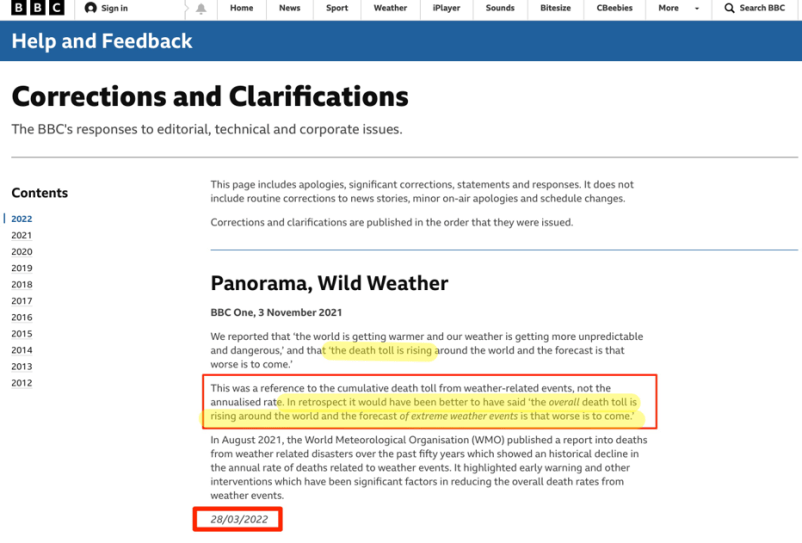
In other words, the BBC justify their claim because the cumulative number of deaths is rising!
Needless to say, he too has escalated to the ECU.
It is clear that Rowlatt is facing big problems here. He has already been rebuked by BBC News bosses about his lies regarding offshore wind costs last year. He is now facing two complaints over this flagship Panorama edition.
Regardless of the ECU decision, it is crystal clear that Rowlatt is far too emotionally attached to climate issues on a personal level to be able to report accurately and objectively.
He should be removed from the climate brief.
For pro-lockdown campaigners, all roads lead to the Kochs
By Martin Kulldoff and Jay Bhattacharya | Unherd | March 29, 2022
During the Covid-19 pandemic, tribal politics have pushed scientific discourse into the back seat. Scientists who provide their honest assessment of medical and public health data have often been subject to ad hominem attacks and slander.
When Left-leaning journalists defend the government’s pandemic strategies by falsely classifying opponents as Right-wing, it hurts the Left while boosting the Right. The latest example is an article in the New Republic with one of the most far-fetched personal attacks we have seen since March 2020 — a true accomplishment during a pandemic filled with logical somersaults.
The target is Urgency of Normal, a group of physicians and medical scientists arguing against the masking of toddlers and children. The group includes Dr Vinay Prasad, a physician, epidemiologist, and associate professor at the University of California in San Francisco. With colleagues at Harvard and the University of Colorado, he wrote the most thorough scientific review of the efficacy of masks against Covid. They concluded that “data to support masking kids was absolutely absent.”
The New Republic article is called ‘Why Is This Group of Doctors So Intent on Unmasking Kids?’ The straightforward answer is that the doctors concluded that there is no reliable scientific evidence that masks on children reduce disease spread alongside a strong presumption that they may harm some children. The New Republic dismisses this possibility, claiming that “the science is strong” that masks help to “quell the pandemic”, and that there is “‘little scientific disagreement”. The last point is self-evidently untrue given the participation by many eminent scientists in the Urgency of Normal itself.
The essay then goes full ad hominem, attempting to link Dr. Prasad to “libertarian” efforts by the Koch family to unmask children via a convoluted chain of supposed associations, each of which is weak and the combined effect of which is simply conspiracy (see below). It appears that the New Republic, once a fierce critic of Sen. Joe McCarthy, has now embraced McCarthy’s guilt-by-association techniques.
Dr. Prasad is an excellent epidemiologist, but to paraphrase the New Republic, it seems “that the days of listening to the epidemiologists are over”. They are not alone. The Daily Poster/Lever and Jacobin magazine have used similar ad hominem arguments to falsely “connect” lockdown opponents with the Koch network, falsely claiming that the two of us are “connected to Right-wing dark money”. Our closest and only financial “connection” to the Koch Network is to have worked for universities, Stanford and Harvard, which have received millions of dollars from Koch foundations, although unrelated to any of our own work.
In the summer of 2020, Jacobin magazine interviewed one of us about lockdowns and their devastating effects on children and the working class. Their reader’s reactions were illuminating. The public criticism from high-profile individuals was harsh, calling us Trumpian, among other things. But, we also received many private letters from Jacobin readers, thanking us for saying what they were thinking but did not dare to say in public.
Views on pandemic strategies do not map onto a simple Left/Right binary. In the United States, Dr Anthony Fauci’s lockdowns were implemented by both Republicans and Democrats, generating enormous collateral damage to education, cancer, cardiovascular disease, vaccination rates, mental health, and hunger, to name a few malign outcomes. More often than not, members of the working class were the hardest hit. In Europe, the social democrats in Sweden chose not to copy Fauci’s response to the pandemic. One contributing factor may have been that its prime minister came from the working class, having started his career as a welder.
Classifying those like Dr Prasad as “Right-wing” for taking different views on pandemic restrictions is only damaging to the Left. Instead of permitting the Right to claim full credit for opposing misguided Covid policies, the Left should rightly claim some of that credit — Dr Prasad is, after all, on the Left himself. Instead, publications like the New Republic seem intent, not merely on smearing scientists instead of learning from them, but on driving reasonable men and women to the Right.
The New Republic’s convoluted attempt to associate Dr Prasad with the Koch family, in full:
- Prasad ‘writes for the Brownstone Institute for Social and Economic Research.’ (The Brownstone Institute, with no Koch connections, has republished Dr. Prasad’s Substack articles without payments.)
- The Brownstone Institute’ advocates for a more libertarian approach to the pandemic’. (Brownstone is not a libertarian organisation. It advocates for a more scientific approach to the pandemic based on basic principles of public health. It has attracted writers from across the political spectrum.)
- The Brownstone founder ‘consults for the American Institute for Economic Research’ (AIER). (He is a former employee without current ties.)
- AIER ‘receives funding from the Charles Koch Foundation.’ (One grant only, which paid <1% of AIER expenses in 2018.) AIER ‘receives funding’ from the ‘Koch-funded public relations firm Emergent Order and Emergent Order which also aided the Great Barrington Declaration.’ (Neither is true.)
- ‘One Koch-backed group has been linked to school unmasking efforts.’ (A mother’s anti-mask letter was circulated by a women’s group with some Koch funding. In contrast, a Koch-backed group have funded the pro-lockdown Covid work of Prof. Neil Ferguson at Imperial College.)
Martin Kulldoff, Ph.D., is an epidemiologist, biostatistician, and a former professor of medicine at Harvard University. Jay Bhattacharya, M.D., Ph.D., is an epidemiologist, health economist, and professor at the Stanford University School of Medicine. Both are senior scholars at the Brownstone Institute and founding fellows at the Academy for Science and Freedom.
Red Alert: What seeing the war in Syria taught me about US/Western government and media propaganda
By Janice Kortkamp | Ron Paul Institute | March 29, 2022
The Syrian war was the first fully observed conflict on social-media and the ability to connect directly with Syrians real time as they were experiencing the crisis was unprecedented. This created a unique opportunity to get unfiltered information directly from all sides of the conflict to gain insights and understanding. The results have helped shake off the control by conventional news media over foreign events reporting and analysis. While this has created some chaos, valuable lessons have been (or should have been) learned.
I began researching Syria and the war there in late 2012, and have made seven extended journeys traveling around during the war from 2016 through 2019, meeting with hundreds of Syrians from different backgrounds, walks of life, and opinions as a 100 percent non-affiliated, unpaid, and self/crowd-funded, independent citizen-journalist.
It became clear that what’s been happening in Syria was not a spontaneous, organic, popular uprising against a tyrant, but a proxy regime-change attempt war in the works since the mid 2000’s against the quite popular Assad. This effort was spearheaded by the US, UK, France, and Israel, using Sunni violent fundamentalists and extremists (unpopular with the majority of Syria’s Sunni population as well as minority groups) armed and funded by the West and regional allies of Saudi Arabia, Turkey, and Qatar to start the violence and do the dirty work. The basic character of the rebel groups was apparent from the beginning: Syrian and non-Syrian fighters most Westerners would call terrorists and be screaming for their government to crush if the same heavily armed groups had taken over their cities, towns, and suburbs by massacring, beheading, torturing, kidnapping, and raping.
Syrians often remarked to me that before the war their country was “almost a paradise.” The middle class was the largest economic sector and growing. Religious harmony was the norm and Christians there were doing well. International investment was increasing as were the tourists. Women were equal or outnumbering men in the universities and present in leadership roles in nearly all aspects of society. Syria had made the “Top 5” list of the world’s most personally safe countries. President Assad had brought the Internet into the country and kept it open throughout the war and the people there knew all that was being said in the West about the crisis.
This doesn’t mean Syria was perfect and Assad beloved by all Syrians. There were and are many problems there which are directly attributed to the government with corruption always being number one on the list of grievances. These internal issues have been exacerbated by the war.
Now, after 11 years of war, 90 percent of Syrians are poor, many are starving; the economy is shattered. Between the fighting, US/Western sanctions, loss of production capability (though an impressive number of factories have been rebuilt), shortages of electricity and fuel, the black market and smuggling, dearth of employment opportunities, Covid-19, and the economic meltdown in Lebanon, the situation seems destined to remain desperate for the foreseeable future. The pressure by the US and most allies continues including increased sanctions, and three on-going illegal occupations: US has seized control over 1/3 of the country (the part with the richest oil fields); Turkey holds much of the north; and Israel is still occupying the Golan while making routine air strikes in Syria with no condemnation. There are numerous terrorist groups including ISIS cells and Hay’at Tahrir al-Sham (HTS, formerly Jabhat al-Nusra, the al Qaeda affiliate) to get rid of in the northeast and Idlib.
As for Russia’s role in Syria, I’ve watched it closely – including observing some Russian military operations personally in Deir Ezzor, Homs, and Palmyra. Russia and Iran are in Syria legally, asked to join in the fight against ISIS and al Nusra by the Syrian government.
From 2011 through 2015 the situation was dire. In 2012 the US resolution at the UN called for President Assad to step down and both Russia and China vetoed it. The US and UK responded with “fury” according to The Guardian, while Syrians were out in the streets cheering. When Russian troops came in September of 2015, the priority was to put a stop to ISIS operations in the northeast. Massive ISIS oil convoys were taking the stolen oil up to Turkey, bringing the terrorist army equally massive amounts of money to use for their rampages while, according to a leaked, verified audio tape of John Kerry speaking with the Syrian opposition, the US was “watching ISIS grow” hoping the pressure would get Assad to negotiate. Instead, an appeal was made to Putin and answered. Within a few months, the ISIS oil convoys had been reduced significantly, cutting that cash flow.
By the end of 2016 total chaos had been replaced with more established battle lines and though violence was still occurring everywhere, there was some order. Palmyra was liberated from ISIS in the spring of 2016, after which the Russians and Syrians put on an orchestra concert to rededicate the spectacular archaeological site to culture; Western governments and media were not enthusiastic. It fell again to ISIS and many of the most important buildings were destroyed by the terrorists. The battles for Palmyra would have been the perfect opportunity to actually use chemical weapons – to protect that prized site and with ISIS forces isolated in the desert, however the fighting raged with conventional weapons and casualties were very high. In December 2016, Aleppo was freed from the terrorist groups that had been holding the eastern half of the city for years by the Syrian Army and its allies – with the ones fighting the terrorists being treated as though they were worse than ISIS in western media. The terrorist groups backed by the US and allies included the likes of Nour al din al Zenki that grabbed the young boy, Abdullah Issa, out of hospital with the IV still in his arm and beheaded him in the back of a truck on video while laughing. Al Zenki had received advanced weapons and other support by the US.
By October of 2017 when I was in Palmyra, Deir Ezzor and al Mayadeen, most of that area was freshly liberated from ISIS by the combined Syrian, Russian, Iranian, Iraqi, and Hezbollah forces. ISIS was still all around but its backbone of cities down the Euphrates had been severed. In Homs, I observed the transportation of armed groups twice from the Al-Waer suburb, overseen by the Russians. In addition, Russian de-mining efforts have insured relative safety for civilians returning to their homes after areas have been liberated.
To summarize, in my experience the Russians have indeed been effective in the fight against ISIS and al Qaeda while displaying professionalism, precision, and minimizing civilian casualties. The US has been using ISIS as a pretext for its own completely illegal occupation of the entire northeast third of Syrian lands, and has often been helping or working directly on behalf of the al Qaeda affiliate and similar terrorist groups.
However, the US/Western media is still saying the same things they’ve said since 2012, if anything entrenching deeper in the assertions of the US and other western governments. All major articles and stories are still about “the tyrant Assad killing his own people”; and the great majority of the Syrian people who supported their leader and army were made invisible. That support ranged from total devotion to begrudging acceptance because the alternative, Syria falling to the terrorists promoted by the West, was unthinkable. Anyone offering evidence and opinion different from that of the accepted narratives isn’t just ignored – they’re treated as enemies and attacked by the media.
The Russian invasion of Ukraine is still in the early stages and although I’ve been tracking the situation since 2014, I certainly don’t to know all of what’s happening or will happen. To sort fact from fiction from all sides will be a painstakingly long process yet there is great urgency to avoid as much devastation as possible. War is painful, the most painful thing. It truly does hollow out souls as it lays waste to lands and lives and I hate it all, but I’ve seen the wall go up already which prohibits looking at the other side, hearing what their grievances and concerns are. That wall protects the easy to memorize, constantly repeated, approved talking points: “pre-meditated”, “unprovoked”, “unjustified” and that wall is already considerably taller, deeper, and wider than it’s been about Syria. For me, this is when the red light starts flashing, the alarm begins sounding, and I’m on full alert for more gross oversimplifications, exaggerations, unproven allegations, and outright falsehoods.
Copyright © 2022 by Ron Paul Institute
The ‘Ukrainian Resistance’ and the Houthis – A contrast in media coverage
By Gavin O’Reilly | Ron Paul Institute | March 28, 2022
In the now month-long mainstream media coverage of the Russian military intervention in Ukraine, much attention has been paid to the actions of the ‘Ukrainian Resistance’.
In a manner not dissimilar to its coverage of the ‘Syrian rebels’ a decade ago, a romanticised image of ‘Ukrainian freedom fighters’ fighting bravely against a militarily superior Russian foe has been widespread amongst corporate outlets, alongside their fawning over Ukrainian President Volodymyr Zelenskyy in his calls for the implementation of a No Fly Zone – a move that would undoubtedly trigger nuclear war.
This Hollywood-style PR makeover of the Ukrainian military by the corporate media, including the notorious neo-Nazi Azov Battalion, also shares a strong similarity with the aforementioned ‘Syrian rebels’ in that it highlights the strong presence of CIA involvement in the background.
Indeed, the training of Ukrainian military personnel by the CIA to engage in guerrilla warfare against Russia was recently outlined in a Western corporate media report, indicating that a plan was in place to draw Moscow into an Iraq-war style military quagmire in Ukraine – the second largest country in Europe.
Such a tactic has historical usage against the Kremlin, when in 1979, then-US President Jimmy Carter would launch Operation Cyclone, a CIA programme which would see the arming, funding and training of Wahhabi insurgents known as the Mujahideen, who would go onto wage war on the USSR-aligned government of the Democratic Republic of Afghanistan – with Kabul, previously Western-friendly, having come under Soviet influence following the 1978 Saur Revolution.
This romanticised image of ‘Ukrainian freedom fighters’ by the corporate media however, lies in stark contrast to their coverage of Ansar Allah, more commonly known as the Houthis, currently waging an armed resistance campaign against Western-allied Saudi Arabia’s seven year long war and blockade on neighbouring Yemen – leading to mass-starvation in what is already the most impoverished country on the Arabian Peninsula.
Indeed, this was evidenced as such on Friday, when the Yemeni armed forces launched air strikes against a key oil refinery in the Saudi city of Jeddah, to a noticeable absence of articles by the Western media celebrating the actions of the Yemeni resistance against the Western-backed might of Riyadh, unlike their coverage of Ukraine and Russia.
To understand this contrasting approach to both Yemen and Ukraine by the corporate media, one must look further into the wider geopolitical and historical context in the West’s relationship with both countries.
In 1979, the same year as the Soviet intervention in Afghanistan, the Islamic Revolution in Iran saw the anti-Western and anti-Zionist Ayatollah Khomeini come to power in Iran following the overthrow of the US and UK-aligned Shah Pahlavi – who had himself come to power following 1953’s Operation Ajax, an MI6 and CIA-orchestrated regime change operation launched in response to then-Prime Minister Mohammad Mossadegh’s decision to nationalise Iran’s vast oil reserves.
In order to counter the influence of Khomeini’s newly-established anti-Imperialist state and to maintain hegemony in the Middle East, the United States adopted the strategy of using Saudi Arabia – separated from the Islamic Republic by the Persian Gulf – as a political and military bulwark against Iran.
This is where the media coverage of the Yemen conflict comes into play, with Tehran long being accused of backing the Houthis, whose seizure of the capital Sana’a in March 2015 led to Riyadh launching its current air campaign – involving US and British-supplied bombs – in a bid to restore its favoured Presidential candidate, Abdrabbuh Mansur Hadi, to power.
Therefore, with the aims of Ansar Allah consequently being opposed to the aims of the US-NATO hegemony, this explains why no heroic descriptions such as ‘Yemeni resistance’ or ‘freedom fighters’ are ascribed to the Houthis by the Western media, in stark contrast to their coverage of the Armed Forces of Ukraine – supported by the West since the 2014 Euromaidan colour revolution and their subsequent war on the breakaway Republics of Donetsk and Luhansk, a situation that has escalated to the point where nuclear war has now become a distinct possibility.
Copyright © 2022 by RonPaul Institute
Media Scare Themselves, Confuse “Unprecedented” Weather Model Temperature Spikes with Actual Temperatures
By Anthony Watts | ClimateRealism | March 22, 2022
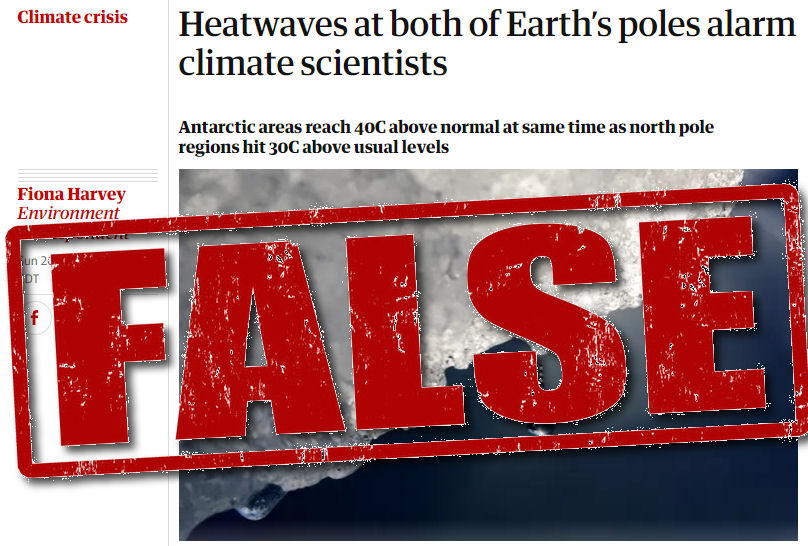
This past week two left-leaning media outlets, MSN (via The Washington Post aka WaPo), and the always alarmed UK based The Guardian ran stories saying the Arctic and Antarctic, had experienced “unprecedented” high temperatures. These claims can’t be verified since they were the results from a set of weather model simulations, indicating variations of above normal temperatures for the regions, not actual surface temperatures measured by ground-based weather stations.
The Guardian headline was full of worry courtesy of author Fiona Harvey:
Heatwaves at both of Earth’s poles alarm climate scientists
Antarctic areas reach 40C above normal at same time as north pole regions hit 30C above usual levels
She writes:
Startling heatwaves at both of Earth’s poles are causing alarm among climate scientists, who have warned the “unprecedented” events could signal faster and abrupt climate breakdown.
At the same time, weather stations near the north pole also showed signs of melting, with some temperatures 30C above normal, hitting levels normally attained far later in the year.
At this time of year, the Antarctic should be rapidly cooling after its summer, and the Arctic only slowly emerging from its winter, as days lengthen. For both poles to show such heating at once is unprecedented.
They key phrase here is: “weather stations near the north pole.” The northernmost weather station is Alert, Nunavut and it is 817 km (508 mi) from the North Pole. That’s like trying to gauge the temperature in Indianapolis from a warmer temperature reading in Atlanta.
MSN/WaPo authors Jason Samenow and Kasha Patel had this flabbergasting headline:
It’s 70 degrees warmer than normal in eastern Antarctica. Scientists are flabbergasted.
The coldest location on the planet has experienced an episode of warm weather this week unlike any ever observed, with temperatures over the eastern Antarctic ice sheet soaring 50 to 90 degrees above normal. The warmth has smashed records and shocked scientists.
“This event is completely unprecedented and upended our expectations about the Antarctic climate system,” said Jonathan Wille, a researcher studying polar meteorology at Université Grenoble Alpes in France, in an email.
“Antarctic climatology has been rewritten,” tweeted Stefano Di Battista, a researcher who has published studies on Antarctic temperatures. He added that such temperature anomalies would have been considered “impossible” and “unthinkable” before they actually occurred.
Both articles mentioned “climate” in the context of blame or contribution to these weather events.
To the uninitiated reading about these “events,” it must surely seem like evidence the planet is on its way to being wrecked from global warming aka “climate change,” and that the polar icecaps are in danger of melting away to nothing.
The reality is entirely different.
The MSN article includes this graphic:
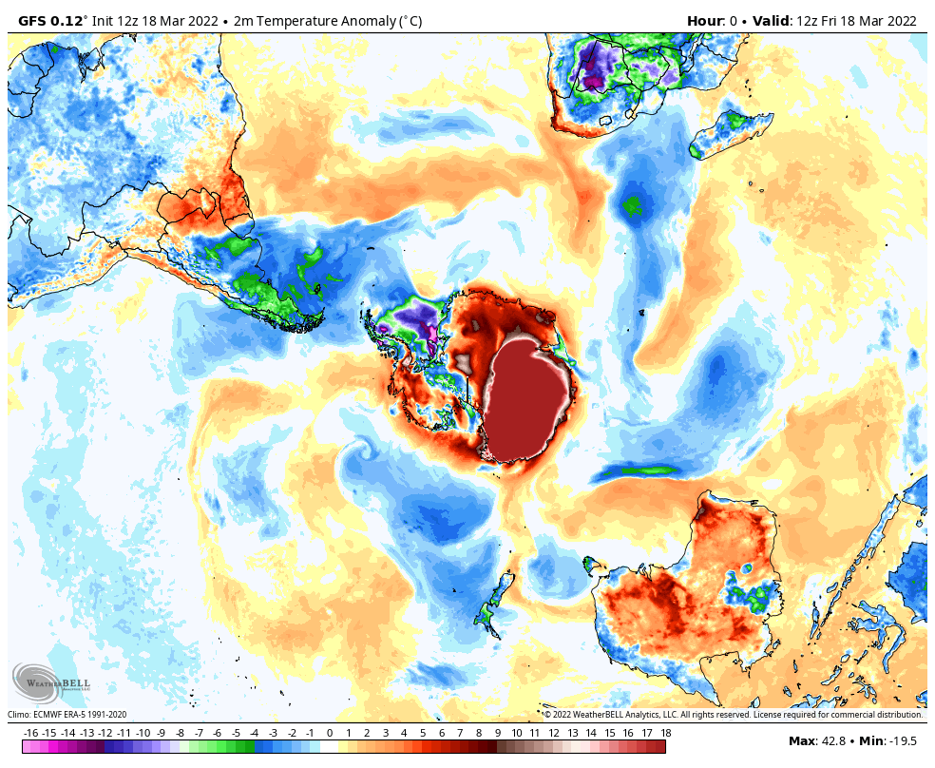
Figure 1 – the image that has scientists “flabbergasted.”
It always pays to read the fine print, and in this case the MSN caption for that Figure 1 image (when you click on it at MSN to enlarge it) is telling:
Simulation of temperature differences from normal centered over Antarctica from the American (GFS) model.
That’s right, it isn’t temperature that actually measured at the surface of that forlorn icecap, it’s a model simulation of temperature from a single climate model, the GFS model.
If we look at that same “model simulation” today, from the same source, all of the sudden that “flabbergasting” image is gone, and temperatures are frigid again as seen in Figure 2 below.
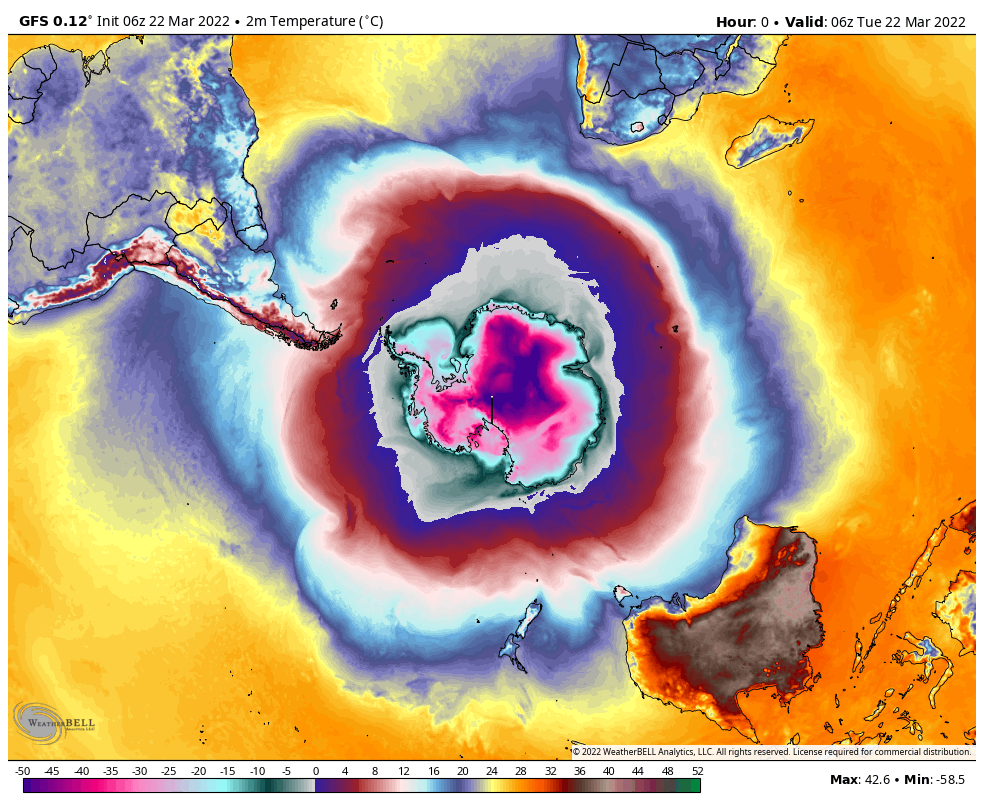
Figure 2 – The same model simulation, just 4 days later.
Once again, the media proves itself incapable of differentiating between short-term model simulations of a weather event from long-term evidence climate change. Indeed, the “flabbergasting” spike in temperature may very well have been nothing but a glitch of mathematics in the model, and not actual weather.
Verifying actual weather is difficult. There are very few actual surface weather stations on the eastern Antarctic icecap, and none at all at the North Pole. See more at this map.
In the Arctic, it is a similar story after last week’s alarming model simulated “heat wave,” temperatures are back to their frigid normal as seen in Figure 3 below:
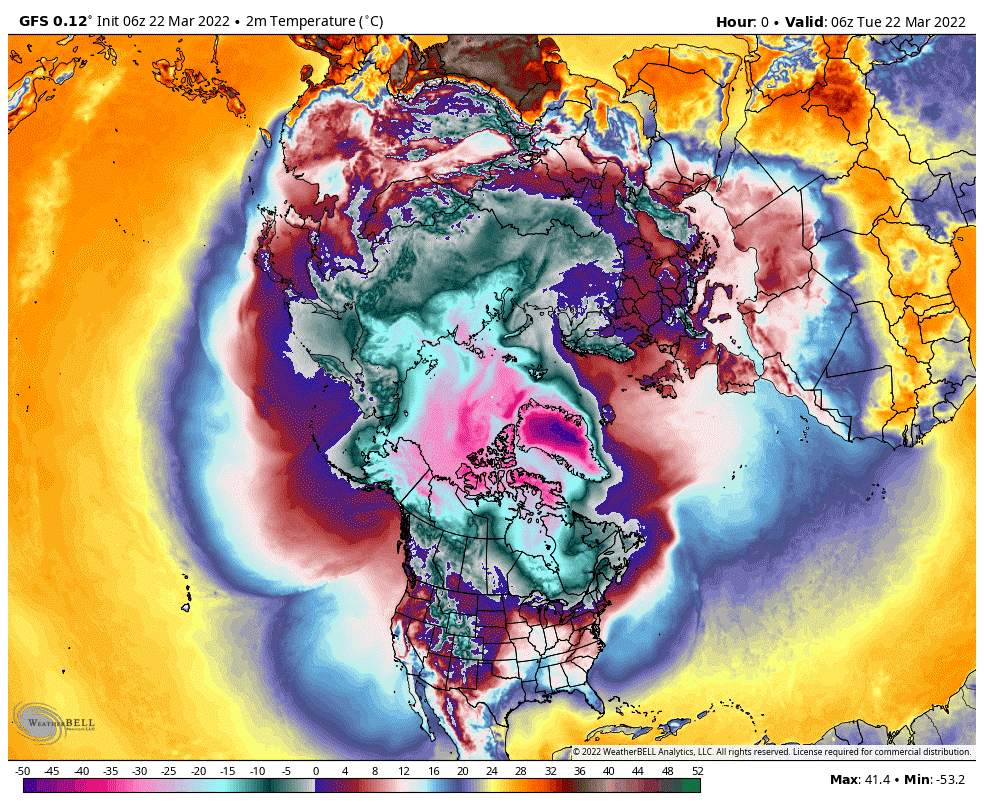
Figure 3 – North pole temperatures on Tuesday March 22nd are at -30 to -40°C
Surface weather stations in both the Arctic and the Antarctic are relatively recent developments in meteorology. In the Arctic, the ice floats on the ocean. It is unstable, moves, and breaks up in the spring making it nearly impossible to keep a weather station in one place, much less operational. The U.S. National Oceanic and Atmospheric Administration (NOAA) started deploying floating weather stations and web cams in 2002 at the North Pole, but gave up due to “funding constraints” in 2015.
In Antarctica, due to the extremely harsh conditions of temperature, blowing snow, and lack of sunlight to power solar cells, Automated Weather Stations (AWS) are few and far between. Plus, such weather stations have only been present in Antarctica since 1978. The harsh environment often buries these weather stations in snow, leaving them with faulty temperature data, or completely inoperable due to solar panels being covered. The AWS’s have to be dug out of the snow each year.
This is why meteorologists often rely on mathematical simulations of the atmosphere to “guess” the temperatures of the air at the north and south poles – they can’t always trust the actual data to be there or be accurate.
So, in summary we have these points to consider about Arctic and Antarctic weather data:
- We don’t have actual weather data in many places at the North and South poles.
- The weather data we do have may be compromised or intermittent due to harsh weather conditions affecting ground based weather stations.
- Compared to larger 100+ years of climate data for the globe, we have maybe 40 years of data for the poles at best.
Since we have at best 40 years of data and observations from the poles, is science capable of determining if weather events like the one modeled in Antarctica are “unprecedented” or not?
We simply don’t know if they are, because we haven’t been looking that long.
Indeed, science can’t say for sure if the brief spikes in temperature at the poles last week were real or simply a product of one flawed model’s simulation, a glitch in the numerical model output. Even if it were real, one brief spike in temperature is not the same as a long-term climate change, which is defined as a trend of 30 or more years of data.
Yet, somehow, climate scientists are “alarmed” and “flabbergasted” at a single day weather event simulated from a computer model.
Scientists (and journalists) that use those terms might be better off keeping a lid on their opinions until they have real data to confirm their “unprecedented” claims. Carl Sagan rightly opined, paraphrasing Laplace’s principle, “extraordinary claims require extraordinary evidence.”
These researchers, and the corporate media outlets which uncritically parroted their claims, have presented no extraordinary evidence that either Antarctica or the Arctic experienced an unusual spike in warming. Model simulations simply aren’t evidence.
US Government Paid News Media $1 Billion to Promote Vaccines
By Dr. Joseph Mercola | March 25, 2022
The Department of Health and Human Services (HHS) released information to TheBlaze1 in response to a Freedom of Information Act (FOIA) request. The information showed that the federal government had purchased advertising to the tune of $1 billion taxpayer dollars as part of a media campaign to build vaccine confidence.
HHS2 has billed the campaign as a “national initiative to increase public confidence in, and uptake of, COVID-19 vaccines while reinforcing basic prevention measures such as mask-wearing and social distancing.” Data don’t support these measures, but the media campaign was likely hiding something more sinister.
HHS Paid News Media to Build Vaccine Confidence
Within the documents sent from HHS, TheBlaze3 found that hundreds of organizations in the news media were paid to produce TV, print, radio and social media advertising timed to coincide with an increasing availability of the genetic therapy shots.
The government also collaborated with social media influencers whose audience included “communities hit hard by COVID-19” and also engaged “experts” to be interviewed and promote the mass vaccination campaign in the news.4 One of those experts was the director of NIAID and chief medical adviser to the White House, Dr. Anthony Fauci.
In other words Fauci, the man who has been the “face” of COVID-19 in 2020 and 2021,5 who publicly disparaged anyone who questioned the data he was using to support his recommendations, and who blithely referred to himself as “the science,”6,7 was, in fact, a shill.
Virtually every one of the news organizations paid by HHS, including ABC, NBC, CBS, CNN, MSNBC, The Washington Post, Los Angeles Times and the New York Post, covered stories about the vaccines and did not disclose they had accepted taxpayer dollars to support the vaccine effort. It is common practice for the editorial teams to function separately from the advertising departments, so it appears the organizations felt there was no need to disclose their funding.
The advertising took several forms, including an amusing social media campaign featuring Elton John and Michael Caine, fear-based ads that featured survivor stories and straightforward informational ads promoting the safety and efficacy of the current mRNA shot for COVID-19.
Shani George, vice president of communications for The Washington Post made a statement about the funding they received for media advertising from the federal government, saying:8
“Advertisers pay for space to share their messages, as was the case here, and those ads are clearly labeled as such. The newsroom is completely independent from the advertising department.”
A spokesperson for the Los Angeles Times also responded to TheBlaze and gave a similar response. Other publications either did not respond or declined to comment. However, it is important to note that the reporters and editorial staff responsible for news also likely read their own publication or watch the online videos.
It’s not hard to imagine that a large news organization promoting vaccinations through their advertising department would not look kindly on editorial staff who choose to report facts that do not align with large sums of money spent by advertisers. You can guess what the editorial staff may be told to write. TheBlaze offered several examples of thinly disguised advertising published as “news,” including:
- An October BuzzFeed 9 article featured “essential facts” about eligibility for the vaccine and unbalanced, pro-vaccine statements from health agency experts such as CDC director Dr. Rochelle Walensky, HHS Secretary Xavier Becerra and epidemiologist Dr. George Rutherford.
- Articles in the Los Angeles Times 10 featured “experts” advising people how to convince their vaccine-hesitant friends and relatives to change their minds.
- A Washington Post article covered “the pro-vaccine messages people want to hear.”11
- A Newsmax article in November ran the headline “Newsmax Opposes Vaccine Mandate, Here’s Why.”12 The article, obviously an opinion piece, began by saying the mandate was a “dangerous overreach” and then proceeded to support the vaccine campaign with statements like, “The vaccine … has been demonstrated to be safe and effective” and “Newsmax has encouraged citizens, especially those at risk, to get immunized.”
Journalistic Objectivity Likely Impossible
The U.S. government is not the only entity to recognize the power behind controlling the news media. Bill Gates is another. Using more than 30,000 grants, Gates has contributed at least $319 million to the media, which senior staff writer for MintPress News Alan McLeod revealed.13
Recipients included CNN, NPR, BBC, The Atlantic and PBS. Gates has also sponsored foreign organizations that included The Daily Telegraph, the Financial Times, and Al Jazeera. More than $38 million has also been funneled into investigative journalism centers.
Gates’ influence within the press is far-reaching, from journalism to journalistic training. This ultimately makes true objective reporting about Gates or his initiatives virtually impossible. MacLeod writes:14
“Today, it is possible for an individual to train as a reporter thanks to a Gates Foundation grant, find work at a Gates-funded outlet, and to belong to a press association funded by Gates. This is especially true of journalists working in the fields of health, education and global development, the ones Gates himself is most active in and where scrutiny of the billionaire’s actions and motives are most necessary.”
It is important to note that Gates has an intense interest in health, and specifically vaccinations.15 And with this power to control the media and his strong connections with health organizations such as Johns Hopkins, with whom he collaborated for Event 201,16 it’s not hard to imagine that his influence can be seen in many of the stories you read or watch each day.
This government overreach into the Fourth Estate is not unique to the U.S. Leaked documents17 have demonstrated that the BBC News and Reuters have also been involved in a covert operation in which the U.K. sought to infiltrate Russian media and promote a U.K. narrative using a network of Russian journalists.
Multimillion-dollar contracts were used to advance these aims, which included 15,000 journalists and staff. The campaign closely follows a U.S. clandestine CIA media infiltration campaign launched in 1948 called Operation Mockingbird.18,19 About one-third of the CIA budget, or $1 billion each year, was spent on bribes to hundreds of American journalists, who then published fake stories at the CIA’s request.
While it may sound like ancient history, there’s evidence to suggest it continues today. Although the messages have changed with the times, the basic modus operandi of dissemination remains the same. Other reports20,21,22 have also highlighted the role of intelligence agencies in the global effort to eliminate “anti-vaccine propaganda” from public discussion, and the fact that they’re using sophisticated cyberwarfare tools to do so.
Facts Reveal Reason Government Is Paying News Media
All-cause mortality and death rates are difficult statistics to change. People are either dead or they’re not. There is only one reason a person is included in the National Death Index Database: They have died regardless of the cause. Evidence is mounting that all-cause mortality is rising to levels greater than were seen during 2020 at the height of the COVID-19 pandemic.
OneAmerica,23 a mutual insurance holding company, announced the death rate in working-age Americans from 18 to 64 years in the third quarter of 2021 was 40% higher than prepandemic levels. Other insurance companies are also finding similar results and citing higher mortality rates.24
The Hartford Insurance Company announced mortality had increased 32% from 2019 and 20% from 2020 during 2021. Lincoln National also reported claims increased by 13.7% year-over-year and were 54% higher in the fourth quarter compared to 2019. Funeral homes are posting an increase in burials and cremations in 2021 over 2020.25
The overall mortality increase noted after the global release of the COVID shot is also being reported in other countries. A large German health insurance company reported their data26,27 were nearly 14 times greater than the number of deaths reported by the German government. The health insurance company gathered the data directly from doctors who were applying for payment from a sample of 10.9 million people.
A reporter from The Exposé 28 notes that while the world has been distracted by Russia’s invasion of Ukraine, the U.K. government quietly released a report29 that confirmed 9 in every 10 deaths from COVID-19 in England were in people who were fully vaccinated.
Each week the U.K. Health Security Agency publishes a surveillance report. The February 24, 2022, report shows 85% to 91% of adults who are infected, hospitalized or died from COVID-19 were fully vaccinated.
Pfizer Documents Show Vaccines Not Fully Safe
Four days after the FDA approved the Pfizer vaccine for ages 16 and older, a group of public health professionals, doctors, scientists and journalists submitted a FOIA request to release the data Pfizer used for the approval of Comirnaty.30 The nonprofit group of professionals is called the Public Health and Medical Professionals for Transparency (PHMPT).31
Despite the FDA’s claim that the organization was committed to transparency,32 the agency first requested 55 years33 to release the data that supported the approval of Comirnaty after the FOIA was filed, and then asked for another 20 years to fully comply.34 All told, the FDA wanted 75 years to release documentation that supported their approval of a genetic therapy being promoted for mass vaccination.
When the FDA did not release the data, the PHMPT sued the FDA since it is the FDA’s statutory obligation35 to publish the documentation within 30 days of approving a drug. Although they asked for 75 years, January 6, 2022, the court ordered the FDA to release 55,000 pages of the documents each month so they would be completed within 8 months.36
March 1, 2022, the first of those documents were released and have been posted for public view on the PMHPT website.37 What’s included in these documents may answer the question of why the government felt $1 billion was required to boost vaccine confidence.
An initial review of some of the papers by one Trial Site News reporter revealed many errors and anomalies. In an interview with Stephen Bannon, mRNA technology inventor Dr. Robert Malone talked about the documentation and the need to develop a team to comb through the information and catalog it for reference. He said:38
“So, all this information comes piped through pharmacovigilance what’s called the pharmacovigilance shop at Pfizer and BioNTech. I presume Pfizer. And then that’s been summarized and submitted to the FDA as a series of documents. So this is a window into what FDA actually knows, which is by inference what CDC knows.
When they tell us there’s no risks and we should go ahead and start mandating or forcing vaccination on our children, what we have for instance, in that section you’re referring to of the listed adverse events is a huge list of what is considered to be adverse events of interest, which means that they’re not just one-offs.
It happens multiple times throughout the world and what we’re finding is embedded throughout this huge volume of documents that the judge has forced Pfizer and the FDA … remember our government tried really hard to keep this information from us and fortunately the courts have called their bluff and forced them to disclose it. Now it’s up to us to comb through it.”
Malone went on to describe the trouble that will likely arise in the coming weeks and months for Pfizer and the FDA from the information that is now freely available to the public when Bannon asked, why is it so important that the courts demanded the information be released now?
“The courts have forced Pfizer and the FDA to comply with the law which is that after licensure is granted these documents must be made available. Previously they’re considered confidential.
And remember that as Naomi’s [Naomi Wolfe] about to discuss, and the truckers are so upset about, we have been forced to take these vaccines and we have been told that they’re fully safe and effective. What this documents is the government has been well aware that they are not fully safe and has hidden this information from us.
What that really matters for Pfizer is that the indemnification clauses require Pfizer disclose known adverse events and this documentation demonstrates they didn’t do so. A lot of the lawyers are licking their chops over this because it seems to indicate a break in the veil that may allow legal action basically due to fraud and concealment of these risks from the general public.
This is why you have not been able to have full informed consent, is they’ve hidden all this information from you and they’ve used all the propaganda and censorship tools — which you’re about to cover — and paid media, to keep all this information from you and spin it, so that you think the left is right and the down is the up and the moon is made of green cheese.”
Sources and References
- 1, 8 TheBlaze, March 3, 2022
- 2 Health and Human Services, We Can Do This
- 3, 4 TheBlaze, March 3, 2022, Para 1, 2
- 5 YouTube, April 29, 2020
- 6 Fox News, November 28, 2021
- 7 National Review, November 29, 2021
- 9 BuzzFeed, October 20, 2021
- 10 Los Angeles Times, May 17, 2021
- 11 Washington Post, April 22, 2021
- 12 Newsmax, November 7, 2021
- 13, 14 MintPress News November 15, 2021
- 15 GatesFoundation, January 2010
- 16 Center for Health Security, Event 201
- 17 The GrayZone February 20, 2021
- 18 SGT Report October 7, 2019
- 19 ATI March 12, 2018
- 20 The Times November 9, 2020
- 21 UK Defense Journal November 10, 2020
- 22 The National News November 9, 2020
- 23 The Center Square, January 1, 2022
- 24, 25 Zero Hedge, February 5, 2022
- 26 Health Impact News, February 23, 2022
- 27 Greater Mountain Publishing, February 27, 2022
- 28 The Exposé, March 1, 2022
- 29 UK Health Security Agency (UKHSA) Covid-19 Vaccine Surveillance Report, February 24, 2022
- 30, 31 Public Health and Medical Professionals for Transparency
- 32 Food and Drug Administration, November 17, 2020
- 33 MSN, November 19, 2021
- 34 Euro Weekly December 9, 2021
- 35 SOPP 8401.7: Action Package for Posting December 11, 2020, page 1, III
- 36 Trial Site News, March 7, 2022
- 37 PMHPT, Pfizer Documents
- 38 Rumble, March 5, 2022 Minute 3:19 and 5:20
British intelligence operative’s involvement in Ukraine crisis signals false flag attacks ahead

BY KIT KLARENBERG · THE GRAYZONE · MARCH 24, 2022
Shadowy UK intel figure Hamish de Bretton-Gordon was at the forefront of chemical weapons deceptions in Syria. Now in Ukraine, he’s up to his old tricks again.
With Washington and its NATO allies forced to watch from the sidelines as Russia’s military advances across Eastern Ukraine and encircles Kiev, US and British officials have resorted to a troubling tactic that could trigger a massive escalation. Following similar claims by his Secretary of State and ambassador the United Nations, US President Joseph Biden has declared that Russia will pay a “severe price” if it uses chemical weapons in Ukraine.
The warnings emanating from the Biden administration contain chilling echoes of those issued by the administration of President Barack Obama throughout the US-led dirty war on Syria.
Almost as soon as Obama implemented his ill-fated “red line” policy vowing an American military response if the Syrian army attacked the Western-backed opposition with chemical weapons, Al Qaeda-aligned opposition factions came forth with claims of mass casualty sarin and chlorine bombings of civilians. The result was a series of US-UK missile strikes on Damascus and a prolonged crisis that nearly triggered the kind of disastrous regime change war that had destabilized Iraq and Libya.
In each major chemical weapons event, signs of staging and deception by the armed Syrian opposition were present. As a former US ambassador in the Middle East told journalist Charles Glass, “The ‘red line’ was an open invitation to a false-flag operation.”
Elements of deception were especially clear in the April 7, 2018 incident in the city of Douma, when an anti-government militia on the brink of defeat claimed civilians had been massacred in a chlorine attack by the Syrian army.
Veteran inspectors from the Organization for the Prohibition of Chemical Weapons (OPCW) found no evidence that the Syrian army had carried out any such attack, however, suggesting the entire incident had been staged to trigger Western intervention. Their report was subsequently censored by organization management, and the inspectors were subjected to a campaign of smears and intimidation.
Throughout the Syrian conflict, a self-proclaimed “chemical warrior” named Hamish de Bretton-Gordon was intimately involved in numerous chemical weapons deceptions that sustained the war and ratcheted up pressure for Western military intervention.
This February 24, just moments after Russia’s military entered Ukraine, de Bretton-Gordon surfaced again in British media to claim that Russia was preparing a chemical attack on Ukrainian civilians. He has since demanded that Ukrainians be provided with a guide he wrote called, “How To Survive A Chemical Attack.”
So who is de Bretton-Gordon, and does his sudden reappearance as an expert voice on the Russia-Ukraine war signal a return to the dangerous US-UK red line policy?
Hours after war erupts, a “chemical warrior” demands Western escalation
Following months of fevered speculation about an impending Russian invasion of Ukraine, when it finally came to pass on the early morning of February 24th, most were caught entirely by surprise. Media outlets and pundits scrambled to get their stories straight, while Western leaders rushed to construct a cohesive ‘response’.
By contrast, Hamish de Bretton-Gordon, a British army veteran identified by UK media as a “former spy,” was in no such muddle. Within just three hours, he had a fiery op-ed prepared for The Guardian, demanding the US and Europe “show their steel in the face of Putin’s aggression.” Warning that Vladimir Putin was “much more willing to face off with NATO” than before, de Bretton-Gordon charged that the West “stood back and watched in Syria,” and “it must not do the same in Ukraine.”
“Syria shows what happens when you turn a blind eye and are too heavily influenced by peaceniks,” de Bretton-Gordon fulminated. “Those of us involved in interventions in Iraq and Afghanistan over the past 30 years…we look at Syria and know we should have done better. That knowledge should inform our response to Putin’s aggression now.”
In reality, Washington and its allies did not stand back and watch in Syria; it waged a decade-long proxy war employing jihadist paramilitaries and airstrikes on Damascus, then occupied oil-producing portions of the country and subjected its citizens to crippling sanctions, which to this day deprive them of food, electricity and vital medical supplies.
Of all people, de Bretton-Gordon – whose Twitter profile once identified him as a member of 77th Brigade, the British Army’s official psychological warfare division – is uniquely placed to know of these horrors. After all, he played a pivotal role in promoting and extending the dirty war through the management of information surrounding chemical weapons incidents.
Manipulation, absurdities and obvious fraud
As The Grayzone has revealed, the involvement of de Bretton-Gordon in the Syrian conflict dates back to at least 2013, when by his own admission he was engaged in a covert effort to smuggle soil samples out of the opposition-occupied areas. This work would have inevitably placed him in extremely close quarters with jihadist elements raking in Western funding while benefiting from NATO training and weapons.
Contemporary media reports reveal the UK’s MI6 was engaged in a sample-gathering effort in the country at the very time time de Bretton-Gordon was inside Syria, strongly suggesting his linkage to the foreign intelligence agency. One article makes abundantly clear the purpose of the soil-sample exercise was to push the US into intervening by proving government culpability for alleged chemical weapons attacks.
Other forms of evidence were also collected on-the-ground by de Bretton-Gordon, and provided to a number of official investigations into chemical attacks. In at least one instance – an OPCW/UN Joint Investigative Mechanism (JIM) probe into a purported chemical strike in Talmenes, April 2014 – videos submitted by CBRN Taskforce, a shady organization he founded in Aleppo, were found to show clear signs of falsification.
De Bretton-Gordon threw his chemical weapons expertise into further doubt when he told British media that any common refrigerator could be transformed into a chemical weapon, falsely claiming that R22 refrigerant cylinders contained material for improvised chlorine bombs. “Somebody could go to a waste site where people chuck away fridges [in the UK] and get a whole bunch of those things and blow them up,” the supposed arms specialist claimed.
De Bretton Gordon has gone as far as claiming to a British tabloid that Russia could deploy missiles and hand grenades containing the highly deadly Soviet-era chemical agent Novichok “in any future war with the West.”
Such absurd commentary and subterfuge has done nothing to dent de Bretton-Gordon’s credibility, however. His mainstream profile has only grown over time, with outlets invariably presenting him as a courageous human rights defender risking his life to train local doctors and rescue workers.
On more than one occasion, however, de Bretton-Gordon has directly involved Western journalists in MI6’s soil gathering efforts. For instance, during a 2014 podcast interview with Wilton Park, an NGO funded by the UK Foreign Office, de Bretton-Gordon boasted of his responsibility for a story in the Times of London alleging a Syrian chemical attack in the town of Sheikh al-Maqsood.
“In March last year there was a reported sarin attack in Sheikh al-Maqsood and I helped the Times – chap called Anthony Lloyd who very sadly got shot two weeks ago – to cover this story and tried to get samples to the UK for analysis … I won’t go into the details of that,” he recalled.
Then-Prime Minister David Cameron invoked the Sheikh al-Maqsood incident to increase pressure on Damascus, citing “the picture as described to me by the Joint Intelligence Committee” as the basis for his assertion of a chemical attack against the town by the Syrian army.
Throughout the dirty war on Syria, de Bretton-Gordon routinely cropped up in the media attributing gas attacks and war crimes to Syrian and Russian forces, and fear-mongered about their implications for future conflicts with the West.
The latter role is one de Bretton-Gordon has enthusiastically resumed throughout the war in Ukraine, aggressively hyping the threat to Western countries. His messaging has tracked seamlessly with that of the US government, which initiated a program months before Russia’s military operation to prepare Ukraine’s security sector for an impending weapons of mass destruction attack.
Months before war, US trains Ukrainians in the threat of “targeted weapons of mass destruction attacks”
Back in May 2021, the State Department announced that Washington had conducted a “virtual training exercise” with “partners” in Kiev, including domestic security services, law enforcement, and first responders, to “identify, respond to, and investigate assassinations involving weapons of mass destruction,” due to “recent events in Europe” highlighting “the real threat of government-sanctioned, targeted weapons of mass destruction attacks.”
Along the way, Ukrainians were tutored in “[identifying] the medical symptoms that indicate WMD material use, the attack cycle involved in WMD assassination attempts, and the specific measures that enable safe and secure detection and response to WMD incidents.”
Quite why this instruction was given at this particular time is unclear, as was the “recent events in Europe” to which the press release referred. Perhaps the State Department was alluding to the alleged novichok poisoning of the Russian opposition figure Alexei Navalny in August 2020. On what grounds that failed assassination necessitated a grand, multi-agency training exercise in dealing with “targeted WMD attacks” is anyone’s guess.
Whatever the purpose of the US training program was, Ukrainian security personnel can now claim they have the training to identify the precise “medical symptoms that indicate WMD material.”
This is significant, because ever since the conflict began, Kiev has exhibited an endless enthusiasm for lying, having distorted or even outright concocted events and facts whole-cloth to advance its objectives on countless occasions.
The most dangerous claims advanced by Ukrainian propagandists have been reinforced by the supposed authority of de Bretton-Gordon, who has argued that Russian chemical strikes were absolutely inevitable, based his prediction on his opinion that Moscow “has no morals or scruples.”
The self-styled chemical weapons expert has even cautioned that Putin could deploy nuclear weapons or create a pandemic “more deadly than Covid” with an Ebola weapon. He has further speculated that Russian forces may unleash a deadly virus seized from one of several Pentagon-funded biolabs in Ukraine, then blame it on the US.
From Syria to Ukraine, it is happening again
In a typical media appearance, on March 10th, de Bretton Gordon told London’s LBC radio show that “nothing is off the table at this stage.” Among the horrors he forecast was the use of white phosphorous “to set towns and cities on fire.”
Justifying his certainty, de Bretton-Gordon forcefully asserted, “the only way to take a large city or town ultimately is to use chemical weapons.” He pointed to Syria to prove his point – but without referencing his own pivotal role in escalating that conflict through the manipulation of evidence and scientifically bereft fear-mongering in the media.
Now, de Bretton-Gordon has resurfaced at the center of the aggressive push for escalation with a nuclear armed Russia. If his role in Syria is any guide, a series of cynical deceptions could be on the way.
Poll: Vaccinated People Far More Likely to Support Risking WWIII Over Ukraine
By Paul Joseph Watson | Summit News | March 22, 2022
A new poll finds that vaccinated people are far more likely to risk World War III over Ukraine by supporting aggressive measures against Russia, while unvaccinated people are more likely to support diplomatic measures.
The revealing results of the survey, which was conducted by EKOS, were published by the Toronto Star.
Canadians who have received “three or more shots” massively supported expanding sanctions (86%), seizing Russians assets (85%), cutting off shipments of Russian oil (81%) and sending additional military equipment to Ukraine (82%). Over half (52%) supported providing Ukraine with fighter jets.
On the flip side, unvaccinated Canadians were far less likely to support measures that would serve to escalate the conflict.
Indeed, a majority of unvaccinated (52%) don’t support any of the measures listed at all.

“The overwhelming majority probably would have said “use diplomacy” if it was an option but the warhawks behind the poll left it off the list,” comments Chris Menahan.
The insightful poll results back up the claims of many, that the COVID narrative was switched for ‘support Ukraine’ virtually overnight by the media and the unthinking masses immediately displayed their ideological subservience.
NPCs were able to seamlessly transfer from zealous support for vaccines and vitriolic denunciations of anyone who didn’t get one, to zealous support for Ukraine and vitriolic denunciations of anyone who didn’t fully swallow the war narrative.
It seems that mass support for whatever ‘current thing’ the political class and culture demands has become a form of cognitive addiction.
Humanity is seemingly dependent on defining itself by lurching from one crisis to another and weaponizing it to ostracize, publicly shame and deplatform dissidents who suggest all may not be as it seems.
Samizdat adds:
The poll also revealed how the two groups feel about the reasons for the conflict, with 88% of vaccinated respondents saying the repression of Russian speakers in the Donbass region does not justify Russia’s actions in Ukraine. The unvaccinated, however, are more split on the question, with 26% saying Russia’s military operation is justified, 27% saying it isn’t, and 35% saying they neither agree nor disagree with it.
The vaccinated also say, almost unanimously (88%), that Russia is guilty of war crimes in Ukraine, while only 32% of unvaxxed respondents agree, and 42% say they don’t believe it is happening at all.
EKOS President Frank Graves said he found the poll results alarming, suggesting that vaccine refusers were “much more sympathetic to Russia,” and that it showcased the “highly corrosive influences of disinformation.”
“This is definitely a new and bluntly insidious force that’s contributing to polarization and disinformation and poor decision-making. And it doesn’t seem to be going away. Things are getting worse,” Graves said, as reported by the Toronto Star.
“I don’t think this is because those people had an ingrained sympathy to the Russians. They’re reading this online, they’re consuming this from the same sources that were giving them the anti-vax stuff.”
Featured Video
No Threat Can Force Iran’s Surrender /Trita Parsi & Lt Cl Daniel Davis
or go to
Aletho News Archives – Video-Images
From the Archives
What is the Israeli Lobby in Australia Doing in Interfaith Dialogue?
By Ali Kazak | Dissident Voice | October 11, 2015
For years Israel and its lobby around the world have been trying to normalise their relations with Arabs and Muslims without solving the Palestine Question.
One of the methods they resorted to in the last few years is using human rights and community organizations such as interfaith dialogue and Multiculturalism to achieve this objective and to: isolate the Palestinians, marginalise the Palestine question, end Israel’s isolation, and prevent criticism of Israel, knowing that these organisations will be the first to stand against Israel’s violations, racial and religious discrimination.
The group responsible for this task in Australia is The Australia/Israel & Jewish Affairs Council (AIJAC); its Director of International & Community Affairs, Jeremy Jones is in charge of lobbying religious community organizations, specifically Muslims and Christians. Consequently he convened the Faith Communities for Reconciliation, founding participant in the Australian Partnership of Religious Organisations and the Australian National Dialogue of Christians, Muslims & Jews.
AIJAC is a private political propaganda group. It is recognised as the main Israeli lobby in Australia. It coordinates its activities and works intimately with the Israeli embassy in Canberra and different institutions in Israel. It is privately funded by some Jewish businessmen. It monitors closely Australian politicians, the media, ethnic and religious groups, (especially Arabs and Muslims), unions and academics on their stands towards Israel and the Palestine question. … continue
Blog Roll
 Aletho News
- The war of liberation of the Arab and Islamic peoples expands across the Gulf
- Envoy warns UN on Trump’s threat to ‘obliterate’ Iran’s civilian infrastructure
- The Larak Corridor: Iran’s Rial Gate With No US, No Israel, and No Way Around
- ‘Economic terrorism’: Steel facilities hit again in US-Israeli strike
- ‘War Crime’: Iran condemns attacks on Arak, Ardakan nuclear sites
- Two-thirds of Americans want quick end to Iran war even if goals unmet
- Trump to Give “Important Update on Iran” Wednesday in Prime-Time Speech
- Theodore Postol: Iran’s Missiles & Drones Were Underestimated
- Iran To Target Military Industrial-Tech Complex That Facilitated Gaza Genocide
- Collapsing Empire: The Resistance Disarms ‘Israel’
- If Americans Knew
- Israel wants US to bomb more of Iran’s civilian structures (113,000 is not enough) – Not a ceasefire Day 173
- Ann Coulter Rips Into Fox News for Iran War Coverage
- Joe Kent Urges Americans To Call White House and Congress To Object To Sending Troops Into Iran
- DNC Resolution to Reject AIPAC Funding Puts Democratic Leaders in the Hot Seat
- Swedish foundation to build 400 schools as over 650,000 Gaza children remain without education for 2 years
- Israeli army admits photshopping image of slain Lebanese journalist
- This is how Israel is systematically killing health workers under the cover of war in Lebanon
- Carrying life under fire: Israeli invasion of Lebanon leaves pregnant women facing deadly risks
- Champagne all around for the new death penalty (for Palestinians) law – Not a ceasefire Day 172
- Why are Palestinian books struggling to be seen on Amazon?
- No Tricks Zone
- New Study Finds Warming Saves Lives…Cold Temperatures 12 Times More Deadly Than Excess Heat
- German Science Blog Accuses PIK Climate Institute Of Hallucinating Climate Tipping Points
- Devastating Assessment Of Comirnaty Vaccine By Former Senior Pfizer Europe Toxicologist
- New Study: CO2 Is ‘Effectively Negligible’ As An Explanatory Climate Change Factor Since 2000
- Former Pfizer Toxicologist Dr. Helmut Sterz Tells Bundestag Hearing Pfizer Vaccine Should Have Never Been Approved
- Energy Expert: Germany’s Nuclear Phaseout Was A “500 Billion Euro Mistake”
- New Research: South Australia’s Mid-Holocene Sea Surface Temperatures Were 4°C Warmer Than Today
- Storing Green Energy To Last Germany 10 Days Would Require A 60-Million Tonne Battery
- New Studies: UK Sea Levels Were 4 Meters Higher Than Today During The Mid-Holocene
- Destructive Green New Deal: German Energy And Metal Group Warns Of Drastic Crisis
 Aletho News