Ukraine drone attack on Russian oil pipeline to EU failed, official says
RT | June 17, 2023
Ukrainian drones have attempted to strike the Druzhba pipeline that delivers Russian oil to several European countries, Bryansk Region governor Alexander Bogomaz has said. He added that the attack was thwarted by Russian air defenses.
On his Telegram channel on Saturday, Bogomaz wrote: “Last night, air defense units of the Russian armed forces… repelled the Ukrainian military’s attack on the oil-pumping station ‘Druzhba’.” According to the official, a total of three UAVs were brought down.
Last month, the Washington Post claimed, citing leaked Pentagon documents, that back in February Ukrainian President Vladimir Zelensky had suggested to Deputy Prime Minister Yulia Sviridenko that Kiev “should just blow up the [Druzhba] pipeline,” which pumps oil to Hungary and other states.
According to the report, Zelensky described the destruction of “Hungarian [Prime Minister] Viktor Orban’s industry” as one of his goals.
While Zelensky dismissed the allegations as “fantasies,” Hungarian Foreign Minister Peter Szijjarto several days later accused Kiev of “virtually attacking Hungary’s sovereignty” by supposedly plotting to undermine the security of Budapest’s energy supply.
Around that same time, a loading station of the Druzhba oil pipeline in Bryansk Region was shelled by Ukrainian forces, with three fuel storage tanks, all of them empty, damaged as a result.
In March, Transneft, the pipeline operator, reported that several drones had dropped explosives in the vicinity of an oil-pumping station. Multiple incidents of shelling had taken place before that as well.
The Druzhba (Friendship) pipeline is one of the largest oil-transport networks in the world, spanning some 4,000 kilometers (2,485 miles) and transporting oil from Russia to Ukraine, Belarus, Poland, Hungary, Slovakia, the Czech Republic, Austria and Germany.
Bryansk Region, which is adjacent to Ukraine, has repeatedly been targeted by cross-border strikes.
In March, a Ukraine-based neo-Nazi unit conducted a sortie into the region.
Green Party Headquarters’ Heat Pump Debacle: 5 Million Euros Cost, Still No Heat!
By P Gosselin | No Tricks Zone | June 13, 2023
The energy follies of Germany’s current Socialist/Green government continue to compound unabated. It turns out the coalition partner Greens cannot even get renewable energy to work at their own party headquarters in Berlin.
How can the Greens demand everyone else convert to a heat pump when they can’t even get their own to work?
While the Greens of the Socialist-Green coalition government are pushing to ban fossil fuel furnaces from every home and building in Germany and forcing them to install heat pumps in their place, it has emerged that the Greens themselves cannot even manage to get their own heat pump up and running at their Berlin party headquarters! Oh, the irony.
According to media outlets, the Green Party headquarter in Berlin-Mitte has been a big messy heat pump construction jobsite “for years” – since 2019. Costs have run into the millions!
And still no heat after 5 million euros in costs
“Here at the Green Party headquarters in Berlin, construction has been going on for years. The heat pump is still not running,” reports RTL.
“The Greens are experiencing first-hand how complicated it is to heat an old building with a heat pump,” RTL continues. “The renovation costs a total of five million euros. The heat pump is there, but does not heat.”
Refuse to learn from their own debacle
Der Spiegel reports on the heat pump debacle and how “heating the old building in a renewable way is not that easy”.
Apparently the work is far more complicated than the Greens previously thought as the project entails major renovation works, excavation, permits, expert personnel and special equipment. And now after having endured the construction, installation and cost woes for years, it remains a mystery today why the Green Party would want the rest of the country to experience the same nightmare.
Dragging on for years, costing millions
“In 2019, the Greens, chaired by Annalena Baerbock and Robert Habeck, decided to rebuild their party headquarters in Berlin and modernize it in terms of energy, reports RND news. “The gas boiler in the party’s old building was to make way for a modern heat pump, among other things. However, the measures were not carried out quickly, and have been dragging on for three and a half years, as the news magazine Spiegel reported. So this is not exactly a showcase example for quick and unbureaucratic energy-efficient renovation. Doesn’t the transition to renewable energies and heating demanded by the Greens even work within the party headquarters’ own four walls?”
The Greens have become the country’s number one laughing stock. Little wonder they’ve lost almost half of their supporters over the recent months.
Surging New England Energy Prices: No Surprise
By Steve Goreham | Master Resource | May 30, 2023
“New England home heating and electricity prices are on the rise with no end in sight. Consumers paid record high energy bills last winter, even though the winter was not unusually cold. Shortages of natural gas and green energy policies will drive New England prices higher and raise the chance of electricity blackouts.”
Residential energy bills in New England this year were the highest in history. The combination of electricity and natural gas heating bills exceeded $1,000 per month for an average-sized house in Massachusetts, even though winter temperatures in New England were warmer than average.
Eighty percent of homes in New England, which includes Connecticut, Maine, Massachusetts, New Hampshire, Rhode Island, and Vermont, heat with fuels from oil and gas. The hydrocarbon fuel share of home heating is natural gas (39%), fuel oil and kerosene (33%), and propane or liquid petroleum gas (8%). Homes also use electricity (16%) and other sources (4%) for heat.
Natural gas is also the leading fuel for generation of electricity. New England power comes from natural gas (43%), nuclear (21%), imports (17%), hydroelectric (6%), renewables (12%), and other generators (1%). But New England residents now pay higher prices for natural gas than the rest of the nation and gas prices are rapidly rising.
For the last decade, the State of New York blocked the construction of natural gas pipelines as part of efforts to decarbonize. For example, the Constitution Pipeline project was cancelled in 2019 after an eight-year battle. Plans called for the pipeline to connect natural gas fields in Pennsylvania to the gas network in Schoharie County, just west of Albany, New York. Because New York is blocking pipeline delivery, New England is forced to import liquified natural gas (LNG) for home and electrical power generation.
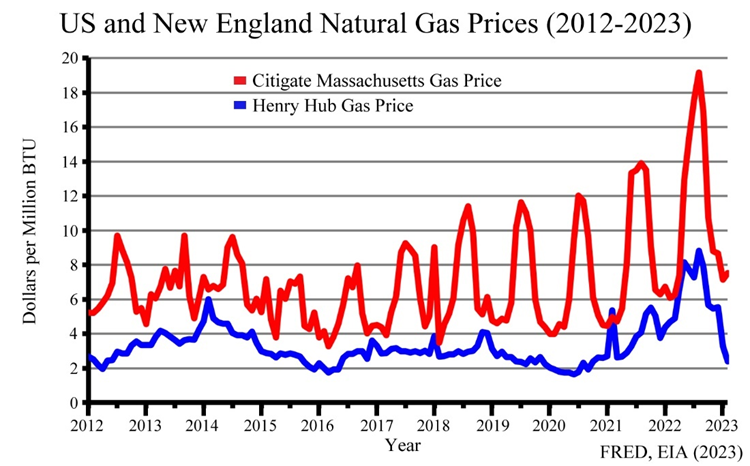
New Englanders now pay more than twice the price for natural gas than most other US residents pay, and that gap is growing. During peak periods, the Citigate Massachusetts price for gas now rises to more than $10 per million BTU, much higher than the US average Henry Hub typical price of $3-4 per million BTU. Because pipeline capacity is low, New England must import up to 30 percent of its gas by LNG tanker and pay high world market prices. During the recent global energy crisis, Massachusetts was paying $40-$50 per million BTU for imported LNG.
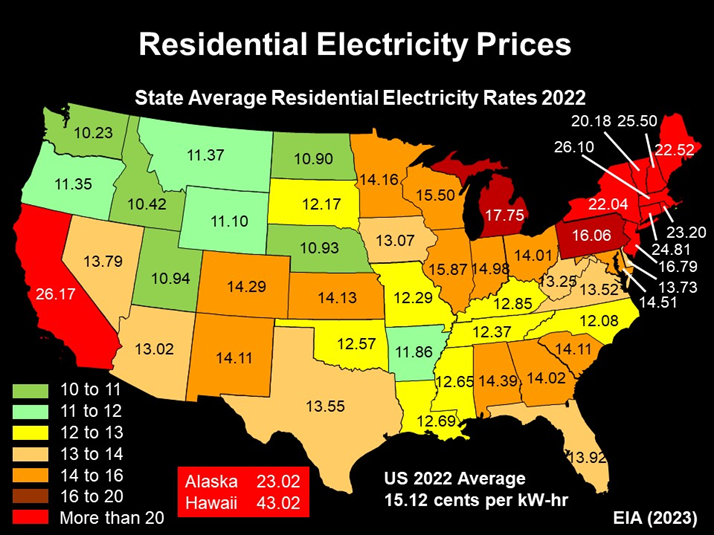
New England electricity prices are also among the highest in the nation. In 2022, power prices for all six of the New England states were over 20 cents per kilowatt-hour, and all in the top ten for state electricity prices. Massachusetts residential customers paid 26.1 cents per kW-hr, surpassed only by prices in Hawaii and California.
The risk of electricity blackouts in New England is rising. The Interstate Natural Gas Association of America sent a letter to President Joe Biden last November, warning that the region “does not have sufficient pipeline infrastructure” and is “at risk of an energy shortfall.” ISO New England, the non-profit organization responsible for reliable electricity in New England, wrote a similar warning letter to Energy Secretary Jennifer Granholm last summer, stating, “during the coldest days of the year, New England does not have sufficient infrastructure to meet the region’s demand for natural gas for both home heating and power generation.” But government leaders and environmental groups oppose further expansion of natural gas infrastructure.
The Federal Energy Regulatory Commission and ISO New England have proposed a shift in LNG pricing to allow purchase and stockpiling of natural gas in New England to prevent a winter fuel shortage. This price shift would raise consumer prices and is opposed by New England states and environmental groups. The pipeline capacity shortage and inadequate gas stockpiles have set the stage for electricity blackouts in the region during the next severe winter.
New England state governments remain committed to construction of offshore wind turbines and providing incentives for electric heat pumps as part of a misguided effort to fight climate change. But these programs, if completed, will not make the grid more reliable and will further boost energy costs.
New England homeowners, better get yourself a backup electric generator and prepare for further rises in home heating and electricity prices.
Irish Farmers Protest Plans to Cull Livestock to Meet Climate Targets
By Michael Nevradakis, Ph.D. | The Defender | June 8, 2023
Farmers in Ireland are protesting government proposals to cull livestock — including up to 200,000 cows — in an effort to meet national and European Union (EU) climate targets.
According to Ireland’s Independent, up to 65,000 dairy cows and 10% of the livestock herd would have to be removed from the national herd every year for three years at a cost of €200m ($215.2 million) if the farming sector is to “meet its climate targets.”
The figures come from an Irish government document the Independent obtained following a freedom of information request.
National climate targets in question include a 51% reduction in emissions by 2030 — the target year for the United Nation’s Sustainable Development Goals — and net zero carbon emissions by 2050, the Independent reported.
According to the Irish Mirror, a 25% emissions reduction goal has been set for the agricultural sector by 2030.
The government document proposes farmers receive compensation of up to €5,000 ($5,381) for each cow that is culled.
According to Remix News, the plans were first outlined in 2021. A report at the time recommended culling up to 1.3 million cattle to reduce emissions to “sustainable” levels.
There are approximately 2.5 million dairy and beef cows in Ireland, according to the Irish June Livestock Survey. Of these, 1.6 million are dairy cows — which have increased by 40% in the past decade — while beef cows total approximately 913,000, representing a decrease of 17% over the same period, the Irish Mirror reported.
Separately, Ireland’s Environmental Protection Agency (EPA) issued a 115-page report in March that recommended “effective abatement of livestock emissions … of approximately 30% plus ruminant livestock number reduction [of] up to 30%.”
According to the EPA, the country’s agricultural sector is directly responsible for almost 38% of the country’s greenhouse gas emissions, as reported by the Irish Mirror.
And a report published in October 2022 by the Irish government’s Food Vision Dairy Group — established to “identify measures which the dairy sector can take to contribute to stabilization and subsequent reduction of emissions” — said there is an “urgent need to address the negative environmental impacts associated with dairy expansion.”
The report said dairy farmers could lose between €1,770 ($1,906) and €2,910 ($3,134) per cow removed.
Ireland, along with other EU member states and the U.S., are participants in the 2021 “Global Methane Pledge,” whose participants “agree to take voluntary actions to contribute to a collective effort to reduce global methane emissions at least 30 percent from 2020 levels by 2030.”
Organizations supporting the Global Methane Pledge include the United Nations Environment Programme, the European Investment Bank, the Global Dairy Platform, the Green Climate Fund, the International Energy Agency and Bloomberg Philanthropies.
Bloomberg Philanthropies is one of the major funders of the C40 Good Food Cities Accelerator, whose signatory cities commit to achieving a “planetary healthy diet” by 2030, defined by more “plant-based foods,” and less meat and dairy.
C40 merged with the Clinton Climate Initiative in 2006, and in 2020, said cities should “build back better.”
Separately, EU member states are discussing proposals to “cut pollution and greenhouse gas emissions from livestock,” according to Reuters.
The United Nations Environment Programme and the Climate and Clean Air Coalition claim livestock emissions account for approximately 30% of total methane emissions.
Cattle reduction proposals ‘absolute madness’
The Independent’s report prompted an immediate reaction in Ireland — particularly from the agricultural sector. This then prompted the Irish government to walk back the report.
The Irish Mirror reported that a spokesperson for Ireland’s Department of Agriculture said the report “was part of a deliberative process … one of a number of modelling documents” it is considering and “not a final policy decision.”
Pat McCormack, president of the Irish Creamery Milk Suppliers Association, told Newstalk Breakfast that Ireland’s “herd isn’t any larger than it was 25, 30 years ago.”
He said the farming sector is prepared to follow the strategic direction of the Irish government, but that, “If there is a scheme, it needs to be a voluntary scheme.”
Addressing the Irish Parliament on May 30, Peadar Tóibín, head of the Aontú political party, criticized the government’s proposals, calling them “an incredible threat to the farming sector at a cost of about €600 million [$646.9 million].”
Tóibín said:
“A full 25% of beef that’s being imported into the European Union is now coming from Brazil. How is it environmentally friendly to kill large swathes of the Amazon, import that beef from Brazil to substitute for Irish beef that’s been culled here in this state?”
A member of the Irish Parliament, Michael Healy-Rae, called the government’s proposals “absolute madness,” and warned that many farmers will refuse to comply or opt to leave the sector altogether if these plans move forward.
Tim Cullinan, president of the Irish Farmers’ Association told The Telegraph, “Reports like this only serve to further fuel the view that the government is working behind the scenes to undermine our dairy and livestock sectors.”
“While there may well be some farmers who wish to exit the sector, we should all be focusing on providing a pathway for the next generation to get into farming,” he added.
Ian Plimer, Ph.D., professor emeritus of geology at the University of Melbourne, told Sky News Australia that the culling of 200,000 cattle “can only end in disaster.”
“The Irish know about this from the potato famine,” he said. “A third of their population died, a third emigrated, and the same thing will happen. They will lose productive people from Ireland and they’ll go somewhere else.”
Twitter owner and CEO Elon Musk also weighed in over the controversy, tweeting “This really needs to stop. Killing some cows doesn’t matter for climate change.”
British author and farmer Jamie Blackett wrote, “It seems increasingly clear that there is an eco-modernist agenda to do away with conventional meat altogether. It’s not just the Extinction Rebellion mob, either; many of the world’s politicians are on board.”
An August 2022 report suggested “insects could soon be on the menu in Ireland” and that “High-protein bug replacements for meat and dairy could help save the planet.”
According to a report by the Independent, a 10% reduction in Ireland’s dairy herd would cost €1.3 billion ($1.4 billion) annually, while industry experts argued such proposals would result in global greenhouse gas emissions actually increasing.
According to Agriland, Ireland imported more than 14,000 tons of beef in the first quarter of this year, while Ireland exported €2.5 billion ($2.69 billion) worth of beef in 2022, an 18% increase compared to 2021, likely contributing to higher emissions.
The Food Vision Dairy Group’s October 2022 report “on measures to mitigate greenhouse gas emissions from the dairy sector” said:
“Ireland’s carbon footprint per unit of output is considered to be the lowest amongst milk-producing countries. It is also noted that the carbon footprint per unit of output has declined [in] recent years.”
However, an August 2022 Euronews report claimed Ireland “has the highest methane emissions per capita of all EU member states, with much of this due to beef production.”
The Food Vision Dairy Group’s report also stated:
“Once methane emissions are stabilised and remain stable then the atmospheric concentration will stabilise.
“Emissions should be reduced by around 3% per decade or offset by carbon dioxide removals which provides a similar climate impact. This would neutralise its impact on the global temperature. There is no basis in science therefore that requires emissions from enteric fermentation to be reduced to net zero.”
The group said it was focused on actions the dairy sector needs to take to make its “proportionate contribution” toward the target 25% reduction in agriculture emissions.
Several other proposals are contained in the report, including reducing chemical nitrogen use in the dairy sector by 27-30% by the end of 2030, and a “Voluntary Exit/Reduction Scheme.”
As these proposals are put forth, other reports indicate the use of private jets is “soaring” in Ireland. Remarking on this, Irish Senator Lynn Boylan recently stated:
“Climate justice advocates have long argued that not all carbon emissions are created equal. To date, the government’s approach has been about punishing ordinary people while the wealthy are exempt to continue living their carbon-intensive lifestyles.”
And in a May op-ed for Agri-Times Northwest, farmer and agronomist Jack DeWitt criticized cattle reduction proposals, arguing they rely on untrue science. He wrote:
“Something you have no doubt heard is that cattle who live their entire lives on pastures (i.e. grass-fed beef) emit less methane. That’s not true.
“Cattle’s methane impact in the U.S. is significantly less than 50 years ago and continues to reduce because of efficiency gains in producing beef and milk … Beef cattle numbers are down 6 percent since 1970, but meat production from those cattle is up 25 percent, partly due to heavier weight at slaughter, made possible by breeding animals to deliver higher growth rates and higher feed efficiencies. Expect these efficiency trends to continue.”
DeWitt also wrote, “Some people want to eliminate 1 billion cattle and convert people to veganism,” he added. “But humans pass methane too, and a vegan diet doubles the amount.” He said farmers can also trap methane and use it for electricity production.
Gates a major investor in methane reduction schemes
Similar proposals to reduce greenhouse gas emissions from the agricultural sector in several other countries also triggered farmer protests.
According to AgDaily, the Dutch government “is slated to cut nitrogen oxide and ammonia by 50 percent by 2030,” leading to many farms now “facing shutdowns.” The Dutch government “expects about a third of the 50,000 Dutch farms to ‘disappear’ by 2030” and has proposed a program of “voluntary” buyouts of farms and cattle stocks.
These plans resulted in large-scale protests by Dutch farmers earlier this year, and led to significant electoral losses by Prime Minister Mark Rutte’s governing coalition and significant gains made by the Farmer Citizen Movement, in March’s provincial elections.
Nevertheless, the European Commission recently approved two Dutch government plans to buy out livestock farmers.
According to AgDaily, the plans, worth €1.47 billion ($1.65 billion), aim “to reduce nitrogen emissions and meet EU environmental targets. Farmers will be offered financial compensation to stop farming and sell their animals voluntarily.”
Farmer protests also occurred in Belgium in March, following plans introduced by the Flemish government to reduce greenhouse gas emissions from the agricultural sector.
And a report commissioned in 2022 by Northern Ireland’s agricultural sector suggested that more than 500,000 cattle and approximately 700,000 sheep would need to be culled to meet the region’s climate targets.
In October 2022, the government of New Zealand “announced its plans to impose a farm-level levy on farmers for their livestock’s emissions … to meet climate targets,” according to Popular Science, with plans for the program to come into effect by 2025.
That proposal was met with mild opposition by Ermias Kebreab, Ph.D., director of the UC Davis World Food Center, who told Popular Science “The burden needs to be shared by society and not just farmers that are already operating on small margins.”
Society “sharing the burden” may imply reductions in meat consumption, a view that was further elucidated in a March 24 Reuters op-ed by columnist Karen Kwok.
Kwok wrote the “War on cow gas is [a] stinky but necessary job in [the] climate-change struggle.” If the price of meat goes up, Kwok said, “that will close a gap with plant-based burgers and steaks, which today cost twice as much as animal-based ones” — which will deter consumers from “purchasing chops and sausages and opt for less carbon-intensive alternatives,” she said.
In January, French dairy firm Danone announced it is considering placing masks on cows to trap their burps and reduce methane emissions, while Danone is also mulling forcing cows to wear diapers to trap their flatulence. One farmer told Fox News the plan was “utter madness” and said those proposing such ideas have “gone to loony town.”
Bill Gates recently made some high-profile investments in startups and technologies purporting to reduce methane emissions in the agricultural sector.
In January, Gates announced an investment in Australian start-up Rumin8, which is developing a seaweed-based feed to reduce the methane emissions cows produce “through their burps and, to a lesser extent, farts,” CNN reported.
And in March, the Bill & Melinda Gates Foundation granted $4.8 million to Zelp (Zero Emissions Livestock Project), a firm developing face masks for cattle that capture methane emitted by animal burps, converting it to carbon dioxide.
Speaking to Cowboy State Daily in March, Brett Moline, director of public and governmental affairs for the Wyoming Farm Bureau Federation, called the face mask proposal “one of the most pickle-headed ideas I’ve ever heard of.”
The Daily Mail, quoting The Associated Press, noted Gates is considered the largest private owner of farmland in the U.S., having “quietly amassed” close to 270,000 acres.
Such proposals may all be connected to the “One Health” concept promoted by the World Health Organization (WHO).
“One Health,” which figures prominently in the pandemic treaty and amendments to the International Health Regulations currently being negotiated, calls for global surveillance to detect potential zoonotic diseases that may cross over from animals to humans.
At the recent World Health Assembly, WHO Director-General Tedros Adhanom Ghebreyesus warned of a future pandemic that may be fueled by a zoonotic disease.
Michael Nevradakis, Ph.D., based in Athens, Greece, is a senior reporter for The Defender and part of the rotation of hosts for CHD.TV’s “Good Morning CHD.”
This article was originally published by The Defender — Children’s Health Defense’s News & Views Website under Creative Commons license CC BY-NC-ND 4.0. Please consider subscribing to The Defender or donating to Children’s Health Defense.
EU’s Green Deal to have dire implications for East African farmers — study
North Africa Post | June 1, 2023
As the EU executive is adopting intermediate proposals in its international climate policy as outlined in the European Green Deal, this will have serious and multifaceted implications for Africa, according to a recent study by Eastern Africa Farmers Federation (EAFF).
The Green Deal provides a road map for a socioecological transition to a low-carbon future and the building blocks for a green economic growth strategy to address climate change, energy, and biodiversity.
According to Stephen Muchiri, CEO of the Nairobi-based EAFF, the stringent policies outlined in the Farm to Fork (F2F) and Chemical Sustainability Strategies will greatly affect global trade in agricultural inputs and outputs and, by extension, also the economies of African countries that greatly depend on agriculture. Muchiri also warns that the new additional requirements, as set by the European Commission, threaten the livelihoods of many small producers and may significantly reduce the export earnings of East African countries such as Uganda, which is the second largest horticulture exporter in the region.
Horticultural exports from East Africa to the European Union are valued at more than $2.3 billion, with smallholder farmers contributing up to 70% of the export volumes. The study revealed that farmers would be overburdened by the new regulations because substantial costs will be introduced with the new specifications on standards, certifications, logistics, and carbon border adjustment mechanisms (CBAM).
This prompts Muchiri to warn that the implementation of the Green Deal in its current form falls short in support of progressive and sustainable export-oriented farming for most East African smallholder farmers as it will introduce additional constraints that will impact the region’s competitiveness, sustainability, and livelihoods negatively, so whereas the EU will achieve its goals, the countries of export will be reeling from significant production and compliance challenges.
5 Things I Truly Don’t Understand About the ‘Inevitable Energy Transition’
RealClear Wire | May 29, 2023
Please note: this article was pulled down offline from Forbes. I will let you draw your own conclusions as to why. Factually, there was no justification for it.
This list could be closer to 50 but let’s just stick to a handful of them. I literally live in this business every day, and I’m just so confused.
1. In a world that is apparently getting both warmer and colder because of global warming, how is it that we can increasingly rely on non-dispatchable (i.e., intermittent, usually unavailable), weather-dependent electricity from wind and solar plants to displace, not just supplement, dispatchable (i.e., baseload, almost always available) coal, gas, and nuclear power? In other words, if our weather is becoming less predictable, how is it that a consuming economy like ours can, or should even try, predictably rely on weather-dependent resources? ERCOT exemplifies this: the Texas grid operator has around 31,000 MW of wind capacity but goes into winter expecting only 6,000 MW (just 20%) of wind farms to be available to generate electricity. Again, in the marketplace, the “alternatives” you keep hearing about are proving to be far more supplemental than alternative.
Further, good wind and solar spots are finite, based on geography, so new builds, naturally, will be forced into areas that are less windy and less sunny, lowering their already very low 35% capacity factors. And because they devour immense swaths of land, interrupting a whole host of things, that Renewable Rejection Database is mounting very quickly. If wind, solar, and electric cars too are as effective and low-cost as so many keep promising us, there would obviously be no need for government subsidies for broad adoption. Yet, there is, gigantically so. Huge amounts of taxpayer money going into this, what I call “the holy climate panacea triad,” are vulnerable to changing politics and bound to become politically untenable at some point: “Ford Is Losing $66,446 On Every EV It Sells.” Our limited financial resources are obviously very precious, so these NEVER CONSIDERED and wasted opportunity costs forcing wind, solar, and electric cars into the energy complex are truly catastrophic. Schools investing in electric buses over STEM? The $200 Billion Electric School Bus Bust. How can any of this be justified? I’m so utterly confused.
2. Climate change is a global issue, so how is it that we can claim climate benefits for unilateral climate policy. For example, U.S. gasoline cars constitute just 3% of global CO2 emissions, so how will getting rid of them impact climate change? But this dose of real science doesn’t stop California leaders, a state responsible for just 1% of global CO2 emissions, from telling us that energy policy in the nine-county region of Northern California alone is “responsible for protecting air quality and the global climate in the nine-county Bay Area.” No wonder then that a Biden administration official was incoherent when asked how $50 trillion in climate spending in the U.S. will lower any global temperature rise. Indeed, despite the Sierra Club in 2014 promising us that “China’s Thirst for Coal Is Drying Up,” the Chinese Communist Party approved two coal plants a week in 2022. But, don’t worry guys, China promises to be net-zero by 2060. On climate, you don’t matter nearly as much as some want you to think.
So, it becomes very obvious very quickly that no energy policy in northern California has any relevance in terms of changing the climate. The region could literally disappear and there would be no discernable impact on climate change. Even our climate czar John Kerry, loving the CO2-devouring life in a private jet and $250 million, has been forced to admit that the U.S. could even go to zero emissions and it would make no material impact on climate change. Talk about all pain, no gain. The real science is that incremental global emissions are “not here but over there” U.S. CO2 emissions are in structural decline regardless of what policies we pass (save 2021 and the rebound from Covid-19’s devastation in 2020). So, where is the climate benefit for Americans when it comes to U.S. climate policy? Because we’re continuously told to “believe science,” any positive answer to that question can only be deemed as anti-science. In fact, common sense and science itself tell us that unilateral climate policy can actually be really bad for climate change because it encourages carbon leakage (e.g., climate policy in the U.S. increases costs and just pushes a manufacturing firm to re-locate to coal-devouring China).
3. Back to electric vehicles. Even green-tinted but surely practical Bloomberg admits that more than 85% of Americans can’t afford an electric car, since they are well more than double the price of oil-based cars. How can a product bring racial justice for Black Americans when the vast majority of them can’t afford it? Worse then, huge and growing subsidies for electric cars are a “reverse Robin Hood,” taking money from poor taxpayers to give to the rich ones that are, actually, in the market to buy an electric car. Forcing electric equipment over natural gas? Sorry but “gas is four to six times cheaper than electricity.” Battery costs might be much higher than expected: 1) rising global demand, 2) rising costs and unavailability of their raw materials, 3) mining complications and environmental damage, and 4) China flexing its muscles since it controls the supply chains and uses hoarding as political leverage (see Covid-19 and medical supplies). Reality check, unlike what we keep hearing about “green energy,” no technology continues to decline in cost in perpetuity: “EV battery costs could spike 22% by 2026 as raw material shortages drag on.”
And this one I’m really confused on. President Biden promotes his climate agenda as a way to create jobs. Besides lacking in economic literacy (i.e., jobs are costs not benefits), the truth is that electric cars, for instance, entail far less jobs because they, for one thing, have far less moving parts. And there’s all kinds of evidence that electric car life-cycle emissions could be way worse than advertised, mostly because of the massive amounts of mining required to make them. We all know about child labor and your electric car, but even pro-EV outlets are being forced to report on the mounting problems from mining, the latest on how bauxite for the aluminum needed is destroying the Amazon. And about our President’s we’ll need oil for “another decade” claim? The U.S. Department of Energy just modeled that our oil demand will actually slightly INCREASE, not decline, to over 21.1 million b/d by 2050. Reality check: planes, industry (petrochemicals), heavy trucking, and sheer Energy Inertia will have oil dominating way longer than you’re being told.
4. How on Earth could anybody expect those in Africa and the other horrifically poor nations to “get off fossil fuels” when the rich countries haven’t come close to doing it. Germany and California, the world’s two greenest governments, are still overwhelming fossil fuel-based and overwhelmingly dependent on imports (dangerously so in Germany’s case). This comes despite decades of huge subsidies, scores of mandates, deploying the best engineering expertise, and having low population growth and thus low incremental energy needs, all giving them a huge advantage in “going green.” The energy stat to remember most? No U.S. state will ever “try to go green” like California has over the past 20 years, yet oil and gas still supply 70% of the state’s energy, even above the national average of 65%.
Germany and California have shown us what these climate policies bring: Germany has the highest electricity prices in the world; and California’s are the highest in the continental U.S. and soaring out of control (Figure). How the heck can we push for “deep electrification” to fight climate change if we are going to follow policies that surge the price of electricity, while also lowering grid reliability? And rich Westerners, spare us the judgments, demands, and hypocrisy on climate change: Germany thrives on a GDP per capita per year of $51,200, compared to a horrifically sad $2,260 for India.
5. But, perhaps I’m most confused about the whole air quality thing. The obsession over it gets attached to all energy policies. But there’s clearly a strawman to the “we need cleaner air now” demand. First, the air quality conversation in the U.S. reminds me of Voltaire’s “the perfect is the enemy of good.” Americans seem completely unaware how drastically our air quality has improved. Check data from the U.S. Environmental Protection Agency (EPA), our criteria pollutants have been plummeting over the past many decades. The risks seem exaggerated. Let’s just take Los Angeles, which for a big city notoriously has the worst air quality in the country. Tell me, please, if air quality is such a problem and such a health concern for Americans, why is it that Angelinos have a life expectancy of 82 years, a hearty three years above the national average. Just think of all the coal that China has devoured since 2000 (I figure around 70 billion tonnes), yet the country’s life expectancy, apparently shockingly to so many, is up a very impressive six years to nearly 78 since then. Maybe it’s because Chinese GDP per capita per year has skyrocketed nearly 9-fold to over $18,500. Even for rising asthma rates in the U.S., smoking is way down, coal usage is way down, and criteria pollutants are way down. So what gives?
“Better air quality and environment” are not free, as attaining government standards cost businesses hundreds of billions of dollars per year. These costs are ultimately paid by Americans in the form of higher prices, lower wages, and less choices. And at some point, the cost of the regulation to achieve better air outweighs its benefit. We’ve won on water too: the water in your toilet is cleaner than what the vast majority of humans on Earth drink. For every time that we hear “environmental justice” we need to say “economic justice” 100 times. In this country for all Americans, Blacks and Hispanics/Latinos make 30% less money than Whites and Asians. Too many politicians focus on the endless pursuit of “better air quality” and other abstract, seemingly impossible to measure benefits because they have no clue on the real ways to help communities of color and other low-income Americans: help them get a better education, help them get a better job, and help them make more money. Career politicians love bottomless, money-devouring pits the most: “America’s $100 billion climate change flop.” And although its entire existence is based on never being able to declare victory (imagine a football game with no time and no keeping score), EPA should consider that it’s wealth that matters most for health equity.
But, that’s not its business, is it?
‘Climate’ activists, thinly veiled agents of the state, have received broad license to disrupt and vandalise
The question to ask of every leftist protest, is not why nobody is stopping it, but whose interests it serves.

eugyppius: a plague chronicle | May 29, 2023
It is hard not to laugh at the self-gluing climate lunatics of Letzte Generation.
Their members often make incredibly naive public statements and beclown themselves with stupid public actions, their environmental concerns are incoherent and unsupported, and their membership is larded with young middle-class women who quickly forget their apocalyptic obsessions when the school holidays roll around.
This makes it easy to overlook the fact that they are deeply embedded in the dense NGO climate-change network. Key activists receive salaries from a Berlin organisation called the Wandelbündnis (the ‘Alliance for Change’), which channels money from the Climate Emergency Fund. The latter, co-founded by American oil heiress Aileen Getty, funds similar activist organisations in other countries, like Renovate Switzerland and Just Stop Oil in the United Kingdom. It’s an international web of activist organisations funded from the very centre of empire – where, mysteriously, it seems that such protests rarely if ever occur.
It can’t be an accident that Letzte Generation have focused on blocking traffic in Berlin, precisely as Robert Habeck, the Green Minister for Economic Affairs, seeks to realise a series of long-planned and economically catastrophic energy transition measures for the Federal Republic. Their constant protests maintain an environment of disorder and hysteria in the German capital and ensure that climate change never leaves the headlines. It also can’t be an accident that the German state should work very hard to maintain a veneer of opposition to these obnoxious protesters, while never actually doing very much. Olaf Scholz used a public appearance to call the activists “crazy” and they responded by smearing Berlin SPD headquarters in orange paint. The most significant enforcement action to date unfolded several days later, as Munich prosecutors ordered broad-scale raids on the activists’ apartments, shut down their website and seized some of their assets. This provoked a bizarre condemnation from Amnesty International and even prompted the United Nations to demand the protection of climate activists. It did little stop Letzte Generation, however, who capitalised on the publicity and continued protesting as before.
In fact, as the Berliner Zeitung points out, the police and state prosecutors have adopted an overwhelmingly lenient approach to Letzte Generation, investigating and charging the traffic-blocking activists for the lesser offence of “coercion,” rather than the much more serious “deprivation of liberty,” which is what trapping thousands of motorists in their cars actually amounts to. And when they are tried even on these lesser offences, activists generally receive nothing but fines from a complicit judiciary and are rarely imprisoned. This is important, because there aren’t very many of them; if the state started systematically imprisoning Letzte Generation members, the traffic blocking would soon be over with.
Protests against authoritarian hygiene measures were systematically outlawed all across the West during the Corona pandemic. In Germany, protesters faced incredible police brutality and substantial sentences, and political police investigated their organisations as alleged “enemies of democracy.” While leftist protesters like Letzte Generation could far more easily be classified as anti-democratic, they’re not opponents of the state at all, but rather its loosely affiliated agents. Police and prosecutors could stop the blockades and the vandalism at any time, but they won’t. Letzte Generation and its sister organisations are actors in an elaborate charade, intended to lend a populist democratic aura to climate protection policies, which flow not from the people but from unaccountable out-of-sight think-tanks, NGOs and bureaucratic institutions. Their radical rhetoric also allows the truly crazy politicians managing the energy transition to appear reasonable and moderate. We’re seeing before us the emergence of a totally new kind of authoritarianism, one which clothes itself in the forms and orders of liberal democracy, while imposing top-down policies on a confused and disoriented citizenry. The authoritarianism of the DDR was far more direct and hence more easily opposed.
Government report claims pandemic as a precedent for ‘environmental’ policy
Lockdowns show behavioural restrictions are possible with the right messaging, a political disease we have yet to learn the extent of
eugyppius: a plague chronicle | May 22, 2023
The Advisory Council on the Environment is a body of experts convened by the Federal Republic of Germany to advise the state on matters of environmental policy. I’m grateful to @tomdabassman on Twitter for drawing attention to their recent and deeply creepy 200-page report on “The obligation of policymakers: Facilitating environmentally friendly behaviour.” It abounds in remarkable and revealing statements, and I’ve spent a good part of the day studying it for a longer post that I hope to write in the coming weeks.
For now, I want to draw your attention to the introduction, which is bad enough. Its authors depart from the premise that the state currently lacks “policy measures … targeting environmentally relevant behaviour,” and join others in affirming that it is the job of the state to nudge individual decisions in the right direction. Tellingly, both the pandemic and the sanctions-induced European energy crisis play a very large role in their thinking:
Although the key environmental crises, such as loss of biodiversity and climate change, are less directly visible and tangible than the energy crisis and the pandemic, environmental policymakers can learn from the sometimes painful but also important experiences of recent years: Behavioural changes in the population can be a part of the solution to crises such as these, and it is possible to adopt and implement policies aimed at changing behaviours.
For example, Germany introduced a series of measures in mid-2022 to alleviate the energy crisis … These measures targeted the behaviour of citizens. In addition to general calls to save energy, building owners were obliged to optimise their heating systems, employees had to accept lower room temperatures at work and it was forbidden to heat private swimming pools …. Earlier, Germany imposed far-reaching pandemic measures to contain the spread of Corona. For example, since 2020, the stated adopted and imposed various lockdowns and social contact limitations. Both highlight the contribution of behavioural changes, whether in energy consumption or social behaviour, to the project of combating a collective problem …
The aforementioned measures doubtless demanded a lot from people and in the specifics of the necessary extent of the restrictions, they proved controversial, as also in their unequal impact on different social groups. Nevertheless, the two crises show that political measures to carefully restrict the behaviour of citizens are possible if the threat is correspondingly great and the importance of the protected good – in these examples, health and energy – is recognised. The state has succeeded (even if not in every individual case) in devising measures such that they achieve their goal while maintaining proportionality. It is also clearly possible for these policies to be designed and communicated in such a way that the majority support them.
Emphasis mine. All of this speaks for itself, and I don’t have much to add, except to observe that the only way for restrictions to be “communicated” such that “the majority support them,” is by renewed forays into state media-fuelled mass panic and hysteria. Corona has taught our rulers that a great deal more is possible than they ever imagined, and they will spend the coming years exploring the limits.
Professors: The Entire Fossil Fuel Industry Must Be ‘Euthanized’ To Save Humanity From Warmth
By Kenneth Richard | No Tricks Zone | May 25, 2023
Two University of Michigan professors insist we “must reduce the emission of greenhouse gases to zero” to stabilize the planet’s temperature. But because 80% of our energy use still comes from carbon-based sources today, “ending it will not be easy.” The death of all fossil fuel industry must be imposed, euthanasia-style.
It has now reached the point that academic elites are no longer concealing their real inclinations and intentions in massaged semantics or subtleties.
Two US business professors argue that the looming climate catastrophe (which they believe has been caused solely by human greenhouse gas emissions) necessitates that “the shape and structure of modern capitalism will have to be changed.”
No more roads. No more plastic or steel or electronic products. No more air travel. All the industries that use petroleum products of any kind, no matter how essential, must end this practice, effective immediately. Fossil fuel use must be 100% eliminated.
The cost to get to zero greenhouse gas emissions? Estimates range from $100 to $150 trillion over the next 30 years.
And putting a price on carbon use doesn’t nearly go far enough. It’s not possible to get to zero emissions just by making fossil fuel use more expensive. The entire fossil fuel industry – the producers as well as the recipients – must undergo, as the authors put it, “compassionate destruction.”
If there is any resistance to the total destruction of fossil fuel use, then euthanasia – “the act or practice of killing or permitting the death of hopelessly sick or injured individuals,” must be put into practice. Imposed. Forced.
“A future in which we address climate change may require that the entire sector be euthanized, imposing death ahead of its imminent arrival.”
It is not our job to question. The situation is so real, so dire, that our only job now is to “come to terms with the extreme decision that has to be made for the patient.”
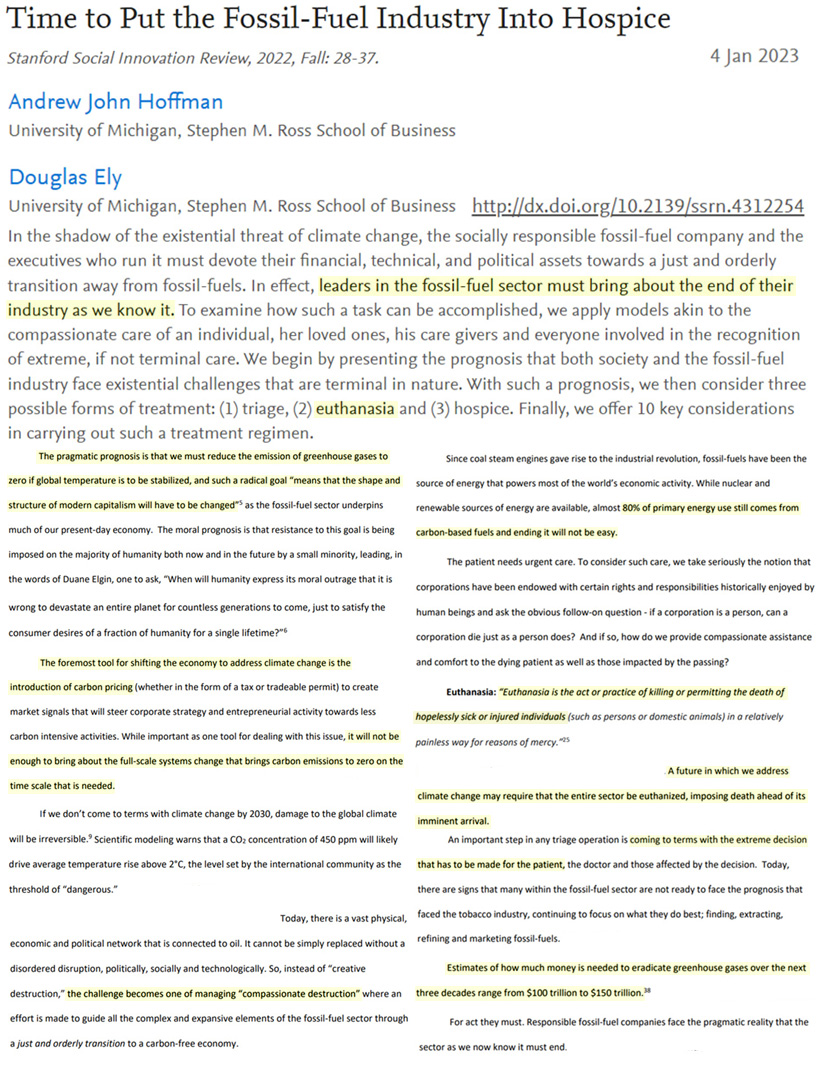
Image Source: Hoffman and Ely, 2023
Featured Video

Seyed M. Marandi: U.S. Military DIVIDED? Iran’s Secret Defense EXPOSED
or go to
Aletho News Archives – Video-Images
From the Archives
‘Israel sees Iran as obstacle to its policies’

Press TV – August 25, 2017
Prime Minister Benjamin Netanyahu has said that Israel felt threatened by Iran’s growing influence in the Middle East. Netanyahu expressed his Iranophobic view in a meeting with Russian President Vladimir Putin in Russia’s Black Sea resort of Sochi on Wednesday. Press TV has asked Scott Rickard, former American intelligence linguist from Tampa, Florida, and Brent Budowsky, a columnist at The Hill from Washington, to give their thoughts on the issue.
Rickard said Tel Aviv is concerned about the fact that the regime could not carry out its old project to spread sectarian divisions and pave the way for dismemberment of the countries in the Middle East region because of the Iranian-led resistance against Israeli policies, not only in the occupied territories of Palestine but also in the whole region.
“Iran is not a threat to Israel whatsoever. The threat that Israel sees is the fact that their Oded Yinon Plan is being put to a hold by Iran,” the intelligence linguist said on Thursday night.
“They (the Israelis) look at Iran as a threat only because they have no influence on their governments and Iran is autonomous and is not under the Zionist influence,” he added.
Since the victory of the Islamic Republic of Iran in 1979, Tehran has been critical of Israel’s policies in the region, whereas “no leaders [of other states] even dared to speak out against Zionism,” Rickard argued. … continue
Blog Roll
 Aletho News
- Trump Claims Ceasefire, Reopening of Strait of Hormuz Agreement with Iran
- Israeli tank fire killed UN peacekeeper in Lebanon, UNIFIL investigation finds
- Russia, China block Bahrain-sponsored UN resolution on Strait of Hormuz
- The US-Israeli War on Science is an Assault on our Future
- Trump’s Promise to Bomb Iran ‘Like Never Before’ Faces Brutal Logistics — Expert
- Germany seeks to restrict stays abroad for men of fighting age – Berliner Zeitung
- Evidence points to Ukraine being behind TurkStream attempted sabotage, but that should come as no surprise
- Sri Lanka secures supplies of Russia oil – minister
- Nations across Asia strike direct deals with Iran for Hormuz passage
- IRGC commander declares ‘new phase’ of reprisal attacks against aggressors
- If Americans Knew
- The war the US is fighting for Israel could cost trillions
- ‘Cigarette Burns, Nail Wounds’: Toddler Tortured in Gaza to Coerce Father
- Trump Says US Sent ‘a Lot of Guns’ to Protesters in Iran
- Israeli forces destroy 17 UN peacekeeper cameras in south Lebanon
- US-Israeli strikes ‘completely destroy’ synagogue in Tehran
- Archbishop for US Military Says Iran War Is Unjust Under Catholic Teaching
- Iranian leaders’ Open Letters to the American People
- Trump says Iranians appreciate bombs, WHO warns of nuclear risks – Daily Update
- U.N. experts demand Israel release prominent Gaza doctor after reports of ‘severe torture’
- Israel’s Latest Genocide Is Against the Shias of Lebanon. Why Is the World Silent?
- No Tricks Zone
- An Inconvenient Tree: Uncovered In Alps… Europe Much Warmer Than Today 6000 Years Ago
- New Study Reports A 60% Slowdown In Greenland’s Ice Loss Rate In The Last Decade
- Low Intensity Tornado Wrecks Major Solar Farm, Creating A Potential Toxic Dump
- New Study Finds Warming Saves Lives…Cold Temperatures 12 Times More Deadly Than Excess Heat
- German Science Blog Accuses PIK Climate Institute Of Hallucinating Climate Tipping Points
- Devastating Assessment Of Comirnaty Vaccine By Former Senior Pfizer Europe Toxicologist
- New Study: CO2 Is ‘Effectively Negligible’ As An Explanatory Climate Change Factor Since 2000
- Former Pfizer Toxicologist Dr. Helmut Sterz Tells Bundestag Hearing Pfizer Vaccine Should Have Never Been Approved
- Energy Expert: Germany’s Nuclear Phaseout Was A “500 Billion Euro Mistake”
- New Research: South Australia’s Mid-Holocene Sea Surface Temperatures Were 4°C Warmer Than Today
 Aletho News