“Silent Majority” of Car Industry is Concerned About Electric Vehicles
BY WILL JONES | THE DAILY SCEPTIC | DECEMBER 20, 2022
A “silent majority” of car companies is concerned that electric vehicles will not alone be able to end reliance on fossil fuels, according to a senior Toyota executive. The Telegraph has more.
Akio Toyoda, the company’s president and grandson of its founder Kiichiro Toyoda, said that many concerned senior figures are reluctant to say what they really think because of the pressure to go green.
It comes as the industry struggles to ditch petrol and diesel, in the face of materials shortages and complex processes that have kept the cost of building electric cars high.
In comments on a visit to Thailand first reported by the Wall Street Journal, Mr Toyoda said: “People involved in the auto industry are largely a silent majority.
“That silent majority is wondering whether EVs [electric vehicles] are really OK to have as a single option. But they think it’s the trend so they can’t speak out loudly.”
Meanwhile, MPs on the parliamentary Science and Technology Committee have warned that plans to require that all new boilers are able to run on hydrogen within a few years are unrealistic and the gas is likely to play a limited role in the future energy system, given the practical challenges of producing and handling it cleanly at large scale. From the Telegraph:
They argue huge questions still need to be answered about the potential deployment of the gas, and highlight “conflicting views” on the role it could play in domestic heating, given the merits of electric heat pumps instead.
Hydrogen is currently a niche product used in chemical production and oil refining, but politicians around the world hope it can replace fossil fuels in uses ranging from heating to transport, as it does not produce emissions when burned.
However, the committee argued that in practice this was likely to be limited to uses where other options are unsuitable, or in areas which are close to hydrogen production hubs.
“It seems likely that any future use of hydrogen will be limited rather than universal,” they said. “This limited – rather than universal – use of hydrogen should inform Government decisions. For example, we disagree with the Climate Change Committee’s recommendation that the Government should mandate new domestic boilers to be hydrogen-ready from 2025.”
Elevated Living Standards Contradict Climate Doomsayers
By Vijay Jayaraj | RealClear Energy | December 14, 2022
Climate protestors destroying artworks and gluing themselves to roads without offering a shred of evidence for their alarm exhibit a malicious stupidity that is blind to the actual state of the world.
Why do these activists not hold up placards with graphs, histograms, and Venn diagrams? Because actual data show that life today is much better than at any time in human history. Ignored is the fact that the change in climate has made Earth better and helped to advance humanity.
Much of the progress in the last three centuries hinged on one important event in the 17th century: the waning of the Little Ice Age, which finally ended in the 1800s. Contrary to popular media and the politically correct, climate change has aided in the unprecedented growth of human civilization.
The Little Ice Age disrupted global plant growth and fostered periods of famine, disease and mass depopulation. However, since the advent of modern warming there has been an overall greening of the planet, more bountiful crop harvests and an eight-fold increase in humanity’s numbers. Contributing to the bounty has been the fertilization effect of carbon dioxide, whose atmospheric concentration has increased in recent decades.
Global maize (corn) production was approximately 205 million tons in 1961. Today the world produces five times more maize, — 1.16 billion tons. There have been similar increases for all major food crops, including rice, wheat, soybeans, cereals, nuts and vegetables.
Captures of marine fish during 1961–2018 increased from 34 million tons to 84 million tons. During the period, aquaculture production increased from two million tons to 82 million tons.
Meanwhile, malnourishment in developing countries reduced drastically from 34 percent in 1970 to 13 percent in 2015, despite a rapidly growing population.
Improved nutrition and technological advancements have combined to make life not only better but also longer. In Oman, for example, the mortality rate for children under 5 dropped from 38 deaths per 100 births in 1950 to less than one. Similar progress has been registered across the world.
Transportation has become more affordable to the general population. Nominal prices for roundtrip airfare almost halved in the 2010s compared to 1980.
Electricity has become more available to households and businesses. In China alone, power generation increased by 18 times between 1950 and 2015, enabling 1.3 billion people to have greater access to electricity and experience remarkable economic growth.
People are better protected against nature’s fury than ever before. The annual death rate from natural disasters has plummeted globally since the 1920s and 1930s. This is because greater prosperity supported by cheap, abundant energy resources has provided sturdier infrastructure to withstand weather extremes and modern reporting systems to warn of dangers. Media reports of a world ransacked to an unprecedented extent by storms and floods are as false as the predictions of an overheated globe.
Species that were hunted to near extinction have been making a comeback, including the Arctic’s polar bears and India’s Bengal tigers. The number of humpback whales in the western South Atlantic doubled between 2006 and 2022. In Minnesota, Michigan and Wisconsin, gray wolves increased from 1,100 in 1975 to 3,600 in 2018.
In all of the U.S., there were merely 487 bald eagle pairs in 1963. By 2006, there were approximately 10,000. Today, wind turbines remain the only major threat to bald eagles, with the government dismayingly allocating “bald eagle-killing quotas” for each machine.
So, notions of a climate emergency and a planet in terminal decline are fallacious. The numbers do not lie no matter how much art is despoiled or how many commuters are delayed by the misguided.
Vijay Jayaraj is a Research Associate at the CO2 Coalition, Arlington, Virginia. He holds a master’s degree in environmental sciences from the University of East Anglia, UK and resides in India.
Qatar warns EU of consequences amid graft probe
RT | December 19, 2022
The European Parliament’s decision to suspend Qatar-linked legislation and deny the country’s officials access to the legislature could negatively affect gas supplies to EU member states, Doha has announced. The bloc’s move comes amid a Belgian probe into alleged graft by MEPs that may have involved Qatar.
The parliament’s decision is “discriminatory,” according to a statement by a diplomat with the Qatari mission to the EU on Sunday, as quoted by news agencies. It will “negatively affect regional and global security cooperation, as well as ongoing discussions around global energy poverty and security,” the diplomat added.
He stressed Qatar’s cooperation with the EU, particularly Belgium, on issues related to Covid-19 and its role as a key supplier of liquified natural gas to the country, expressing disappointment that Brussels is making “no effort to engage with our government to establish the facts once they became aware of the allegations.”
Qatari liquified natural gas plays a key role in the EU’s strategy to compensate for the loss of Russian fossils fuels, which it decided to stop purchasing over the conflict in Ukraine.
In November, Germany secured a 15-year deal for around 2 million tons annually. Berlin is leading a pan-EU effort to secure better terms from Doha, which is pressuring the bloc into signing long-term contracts that prohibit resale to other parts of the world, which would undermine the EU’s goal of phasing out fossil fuels, according to Bloomberg.
Last week, MEPs voted to suspend all work linked to Qatar and cut off “representatives of Qatari interests” from access to the legislature. The decision affects an EU-Qatar aviation agreement and an EU visa waiver for Qatari and Kuwaiti nationals. MEPs denounced “Qatar’s alleged attempts” to buy influence in the EU.
Belgian law enforcement announced earlier this month that it had charged four individuals linked to the European Parliament in an alleged corruption case. They are suspected of being influenced by lavish presents and cash originating from a foreign government.
The local press identified the unnamed Gulf nation as Qatar, which denied any involvement. The European Parliament’s now-former vice president, Eva Kaili, who was among those charged, was stripped of her senior EU office over the probe last week.
Oil Exports From Key Russian Port Cut In Half As Price Cap Kicks In
By Tyler Durden | Zero Hedge | December 17, 2022
The market may have been too quick to dismiss the impact of European oil price cap on Russian oil.
Assuming that the latest G-7 attempt to limit Russian oil revenues were one big nothingburger – after all, the US itself admitted that the goal of the price cap was not so much to cripple Putin’s Treasury as to maintain a more stable flow of oil – the market quickly ignored the potential of lower Russian output as it continued to sell oil into year end amid fears there won’t be enough demand to offset stable supply.
But in yet another case of poetic justice-cum-Murphy’s law, Europe’s exercise in virtue signalling optics is about to backfire and achieve precisely what it was meant to achieve, if only for virtuous public consumption.
According to Bloomberg, there are signs that oil tanker companies are avoiding sending their ships to collect crude from a key Russian port in Asia following the G-7 sanctions targeting Moscow’s petroleum revenues. As has been duly documented here previously, since Dec. 5, buyers of Russian oil have only been allowed to access industry standard insurance and an array of trade-critical services if they pay $60 a barrel or less. But shipments of the key ESPO grade from the Asian port of Kozmino are about $10 above that, meaning they need to make alternative arrangements.
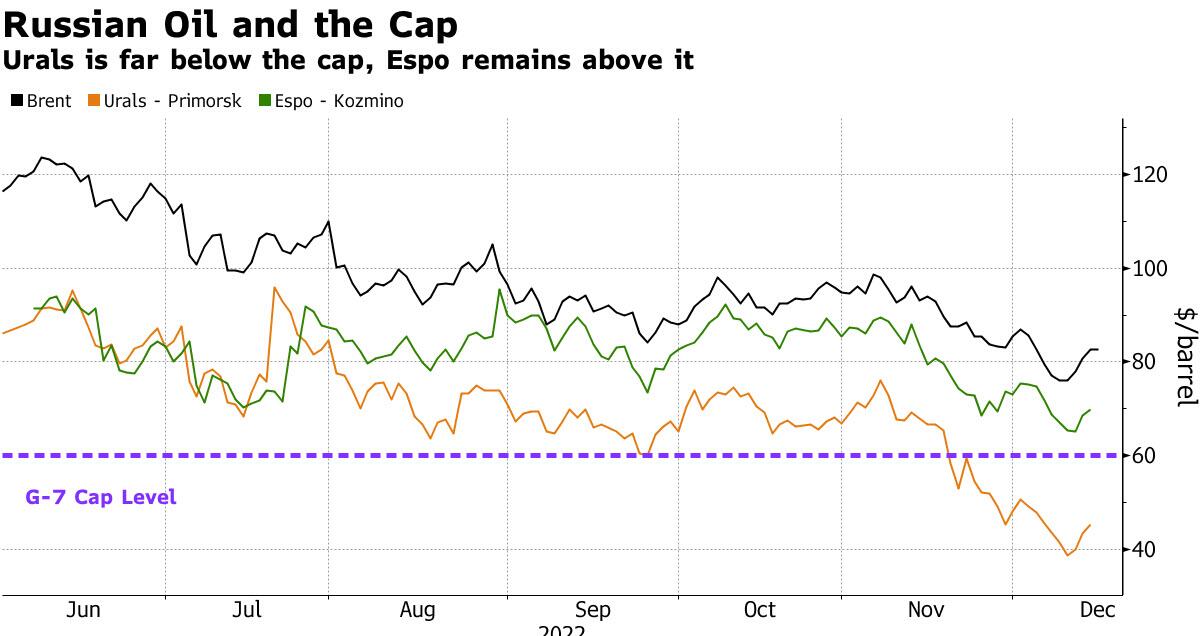
Since the cap began, ESPO (which stands for Eastern Siberia–Pacific Ocean, the initials of a pipeline that takes the oil from east Siberia to the Pacific) has seen loadings cut in half from a month earlier, tanker tracking compiled by Bloomberg show. By contrast Urals, a much larger grade exported from western Russia, is flowing freely to customers in Asia — aided by the fact it fell far below the $60 threshold a few weeks before it was introduced.
However, amid the latest sanctions which set the $60 price cutoff, tankers are shying away from the Asian grade, and in the 10 days since the measures began, 4.4 million barrels have been loaded onto tankers at Kozmino, Bloomberg calculates. In the same period a month earlier, there were 8.8 million barrels loaded.
While it is too soon to say if the observed drop in ESPO flows reflects something structural, weather conditions haven’t been particularly bad and there doesn’t appear to be many candidate ships in place to collect cargoes in the coming few weeks. That said, tanker tracking data is always volatile, depending on the timings of loadings, and the comings and goings of individual tankers.
Shipbrokers and traders contacted by Bloomberg also said that said there are signs that ESPO sellers are struggling to secure tankers for cargoes purchased at more than $60 a barrel. At least two large and well-known shipowners, China Cosco Shipping Corp. and Greece-based Avin International Ltd. have stepped back from moving ESPO crude since Dec. 5, according to shipbrokers. Emails sent to both companies weren’t answered.
Their absence has taken at least five tankers out of the regular pool of ships that move the grade, they said. That leaves charterers to work with smaller independent owners who’re still willing to handle the trade. If charterers continue to face headwinds with the booking of tankers, flows could be impeded, they said. ESPO and Sokol, another grade that’s exported from eastern Russia, currently trade above the $60 a barrel threshold that gives access to insurance and G-7 services.
With Urals grade Russian oil trading well below the price cap, and last fetching about $45/bbl, shipbrokers said tanker bookings for Russia’s flagship crude from western ports are proceeding more normally. Tanker tracking also suggests no obvious disruption to flows of the grade.
Of course, all of this is just a snapshot in time: once oil prices spike, as they will after the year-end selling is over, it is virtually assured that all Russian oil grades will be priced above $60, even with the deep discount to spot. At that point, traders will be watching closely to see if Russian crude exports can be maintained and how Moscow will respond if supplies do get disrupted.
As noted previously, the irony behind all this is that the stability of Russian exports is crucial as the US and rest of G-7 work on ensuring security of global oil supplies ahead of the Northern hemisphere winter while simultaneously attempting to deprive the Kremlin of funding for its war in Ukraine. A sharp loss of output could backfire on the west if it boosts wider oil prices and reignites inflation. And while the price cap wasn’t really supposed to be a price cap, it just may end up being one with Russian oil exports suddenly cut off, sending all “non-Russian” oil prices explosively higher, and sparking a new energy crisis some time in early 2023.
As for Russian product just sitting there, about half the ESPO cargoes scheduled for loading in the rest of this month have yet to secure tankers, according to shipbrokers. That is slower than usual, and they attributing it to the smaller pool of willing tankers operated by a smaller number of owners. It’s possible that tankers which previously handled oil from sanctioned regimes such as Iran and Venezuela – the so-called dark fleet – would be booked, shipbrokers said.
Why the Net Zero Policy is Illogical
BY NICK MACLEOD | THE DAILY SCEPTIC | DECEMBER 17, 2022
The U.K. Net Zero Carbon policy (UK NZC) is a Government policy offered as a solution to a problem that involves a range of academic disciplines. As well as being complex, the science of anthropogenic carbon-based global warming is controversial. Although some climate scientists insist that it is ‘settled’, there are many dissenters, as an internet search or a trip to a good bookshop will confirm.
The multi-disciplinary nature of climate science coupled with differing views among experts makes it almost impossible for a layman to follow the arguments, let alone assess the evidence and come to an informed opinion. Despite these apparent difficulties, I’ll argue that it is possible to establish a simple framework that can clarify complex questions – in this case, “How likely is it that UK NZC will be an effective response to global warming? – without requiring specialist knowledge. I also show how the approach can be used to identify, measure and illustrate differences of opinion.
Start from a small number of statements that make up the Net Zero commitment.
- The Earth must actually be warming.
- The warming must pose a genuine and serious threat to life on Earth.
- The warming must be man-made. Specifically, it must be caused by excess carbon dioxide in the atmosphere arising from human activity.
- The U.K.’s NZC policy must bring about a meaningful global reduction of atmospheric carbon. That is, it must either make a significant reduction in its own right, or it must set an example that persuades other countries to reduce their own carbon emissions, to a degree sufficient to stop the warming.
For UK NZC to be effective, statements 1-4 must all be correct. If any one of them is false, the policy will fail, either because it doesn’t lead to sufficient carbon reduction, or because the policy wasn’t necessary in the first place.
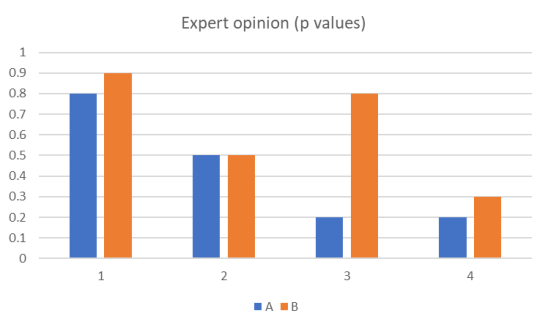
The next step is to define a view (with respect to statements 1-4) as a set of probabilities p1, p2, p3, p4, which represent the respective degrees of belief placed in those statements. For example, the view of a particular climate scientist, Expert A, might be expressed as:
(p1, p2, p3, p4)= (0.8, 0.5, 0.2, 0.2), which means that Expert A is:
- 80% sure that statement 1 – the Earth is warming – is true;
- 50% sure that the warming is life-threatening (statement 2);
- 20% sure that statement 3 is correct – warming is the result of human activity;
- 20% sure that UK NZC will bring about a meaningful global reduction of atmospheric carbon one way or another.
Expert A rates the likelihood of all four statements being correct, i.e., UK NZC being effective, as:
P=p1 × p2 × p3 × p4 = 0.8 × 0.5 × 0.2 × 0.2 = 0.016.
If the view of a second expert, Expert B, with respect to statements 1-4, is:
(q1, q2, q3, q4) = (0.9, 0.5, 0.8, 0.3)
then a comparison with Expert A’s view shows that:
- Expert B has a stronger overall belief than Expert A that UK NZC will be effective (Q=q1 × q2 × q3 × q4 = 0.9 × 0.5 × 0.8 × 0.2 = 0.108, versus P=0.016;
- Both A and B agree that the Earth is warming (p1=0.8; q1=0.9);
- Both of them are equally unsure whether that poses a significant threat to life on Earth (p2=0.5; q2=0.5);
- They differ on the cause of the warming. Expert A doubts that it is man-made, whereas Expert B believes strongly that it is (p3=0.2; q3=0.8);
- Both experts are fairly sceptical that UK NZC will lead to a significant reduction in global atmospheric carbon (p4=0.2; q4=0.3).
Neither expert is all that confident that UK NZC will achieve its aims, with Expert A being particularly pessimistic, seeing the likelihood as just 1.6% compared to 10.8% for Expert B. The main reason is that both of them are doubtful that unilateral U.K. action will have much influence on the choices of other countries.
The chart below represents the view of each expert on each requirement, and highlights statement 3, the one area of significant disagreement.
Summary:
- Defining a view with respect to a set of statements in terms of the respective degrees of confidence associated with each individual statement provides a convenient means of summarising, comparing and illustrating a variety of opinions on the subject to which the statements refer. It also serves as a natural starting point for a cost-benefit analysis of any proposed action.
- It isn’t necessary to be an expert (in this case on climate science) to make a reasonable assessment of the conditions that must apply if an argument or an assertion (such as “There is no alternative to UK NZC”) is to be persuasive.
- It isn’t too much to expect someone – expert or otherwise – who advocates a particular course of action to be able to give rough estimates of the likelihood that the conditions essential to the success of that action will be met.
- Long chains of necessary conditions lead quickly to low probabilities of overall success. The longer the set of plausible conditions that must hold if an assertion is to be true, the less likely the truth of that assertion. With 15 independent requirements, each of which has a 95% probability of success, for example, the probability of overall success is less than 50%. Complex policy issues like those associated with climate change typically have many requirements and much uncertainty.
If Being Frozen To Death Doesn’t Work, Being Starved To Death Comes Next
By Patrick Clarke | December 14, 2022
First we were placed under virtual house arrest. Now we are being frozen by soaring fuel bills and energy supply shortages in those same homes. Coming next, we are to be starved. All in pursuit of one of the Net Zero cults: Covid or carbon emissions. Too bleak a picture? We have only to look across the North Sea to one of our nearest neighbours, the Netherlands.
Surprisingly for such a small country (it is only about twice the size of Wales), the Netherlands is the second largest food exporter in the world, second only to the United States. It is Europe’s largest meat exporter. Four million cows, 13 million pigs and 104 million chickens are reared annually. It provides vegetables to many of its Western European neighbours.
One would assume this success story would be widely cherished, especially in an era of increasing food insecurity and shortages, with other key sources such as Ukraine under serious threat due to the continuing conflict there.
Remarkably, and many would say sinisterly, the polar opposite is the case. The supposed crime of the Dutch farmers? They have fallen foul of the ‘Zero Carbon’ fixation of the Climate Change Cultists who control so much of the current political and economic agenda.
One of that agenda’s chief targets is agriculture, particularly the use of nitrogen. The Dutch are at the top of the tree for nitrogen use per hectare of cultivated land, at nearly twice the European average.
The European Commission has given strict guidelines to EU member states to reduce their use of nitrogen. To comply with this the Dutch Government introduced laws to enforce a reduction of 50 per cent in nitrogen emissions by 2030. Such draconian targets can only come with draconian enforcement measures.
Dutch farming is being strangled through an assortment of regulations, including new flood prevention regulations, bizarrely given the success of the Dutch in preventing flooding over the centuries despite the fact that large parts of the country are below sea level, having been reclaimed from the sea.
Perhaps worst of all, one of the Government’s new laws bans the children of farmers from inheriting the farm when their parents retire or die. Once a farmer stops farming, their entire family becomes banned from farming in the Netherlands again. A whole way of life plus decades, sometimes even centuries, of experience is being gratuitously thrown away.
Where regulation fails, mandatory purchasing of land by the state is feared to be the next step as farmers have so far shown little interest in selling any of their land. Around 300,000 hectares of farmland is earmarked to be converted into nature conservation areas between now and 2040. More than 1,000 farms face forcible closure.
Nor is it just the Dutch Government that the farmers are battling. A panoply of NGOs are on the case too, using the courts to pursue any part of the government at national or provincial level deemed to be faltering in enforcing these objectives.
Those of us in the UK, long weary of seeing how political charities and activist lawyers run rings round attempts to enforce curbs on immigration, will be familiar with the process.
It’s worth pointing out too that, despite Brexit, Northern Ireland still has to implement these same EU directives as part of the Northern Ireland protocol. Thanks for that one, Theresa May, Boris Johnson and Rishi Sunak. So while today it is Dutch farming under siege from its own government, tomorrow it will be farming in Northern Ireland that is compelled to go through the same pain.
Interestingly, no one has yet stepped forward with a credible plan for how these vital lost sources of food are going to be replaced. The Dutch Government hopes that it will come from artificially created meat from laboratories and is investing in this technology, though how it can be sufficiently scaled up remains to be seen. Given what is already widely known about the harmful effects of eating too many processed foods instead of natural foods, such as the triggering of obesity and potential heart disease, it has to be asked whether this is a desirable course, or indeed what the further health implications for users may be.
Some would say the whole agenda is a straight forward grab by bad actors intent on taking control of the world’s food resources, for whom Net Zero objectives provide a convenient camouflage for their own lust for power, control and yet more wealth than they already have. The usual suspects certainly spring to mind.
Others argue that out-of-control digital technocrats are so conditioned to assuming they can control anything, however complex, that they can’t accept that some things remain beyond human control, such as airborne viruses and the climate.
Each failure to learn that simple lesson is leading to ever more intensive efforts to achieve that control, control that must be achieved at all costs. Either way, vicious cycles of more authoritarianism, human misery arising from absurd and seriously harmful measures, plus more setbacks in failing to reach unobtainable goals lie ahead. Unless we can shake off the grip of these technocrats on our societies and the political institutions in thrall to them, the prospect of starving to death will become our grim reality in an increasingly tyrannical world.
Think that couldn’t happen here? Just look at Sri Lanka, though as with the Dutch farmers, most of the media and nearly every politician would prefer you not to!
Brits struggling to keep warm at home – survey
RT | December 17, 2022
A quarter of British adults are struggling to keep warm in their homes as they cut back on energy use in the face of soaring costs, according to a new survey by the Office for National Statistics (ONS).
The report, which was published on Thursday, shows that 23% of adults were occasionally, hardly ever, or never able to keep comfortably warm in their living room over the past two weeks.
The ONS data indicated that 63% of adults were using less gas and electricity because of increases in the cost of living, and 96% of those adults were using less heating.
When asked about the measures they were taking to keep warm this winter, 82% of respondents said they were using more clothing or blankets, 46% were only heating rooms they use, 31% were using hot-water bottles or microwave warmers, while 27% were going to bed earlier.
Other measures included cutting back on the use of tumble dryers and washing machines, as well as bathing or showering less.
According to the ONS, many households have already cut back on their energy usage, with 34% of the polled adults saying that reducing heating has negatively affected their health or wellbeing as a result.
The ONS research on the “impact of winter pressures” also found that 16% of adults are worried their food will run out before they have money to buy more, and 19% have cut back on their portion size. The study showed 17% are eating food which is past its use-by date.
The survey of nearly 5,000 British households comes as the nation’s inflation hit 10.7% in November, which is slightly down from the 11.1% in the previous month but still well above the 2% rate targeted by the Bank of England.
Here’s The Latest Sign Americans Are Going To Eat Bugs And Be Happy
By Tyler Durden | Zero Hedge | December 15, 2022
The latest sign Americans will one day be eating insects is that a top bug producer announced Tuesday major expansion plans in North America.
French insect producer Ÿnsect signed two agreements to expand production facilities in the US and Mexico in 2023. The company “entered an accelerated phase of international development with the signing of a memorandum of understanding with Ardent Mills for an industrial facility in the United States and the signing of a joint development agreement with Corporativo Kosmos in Mexico.”
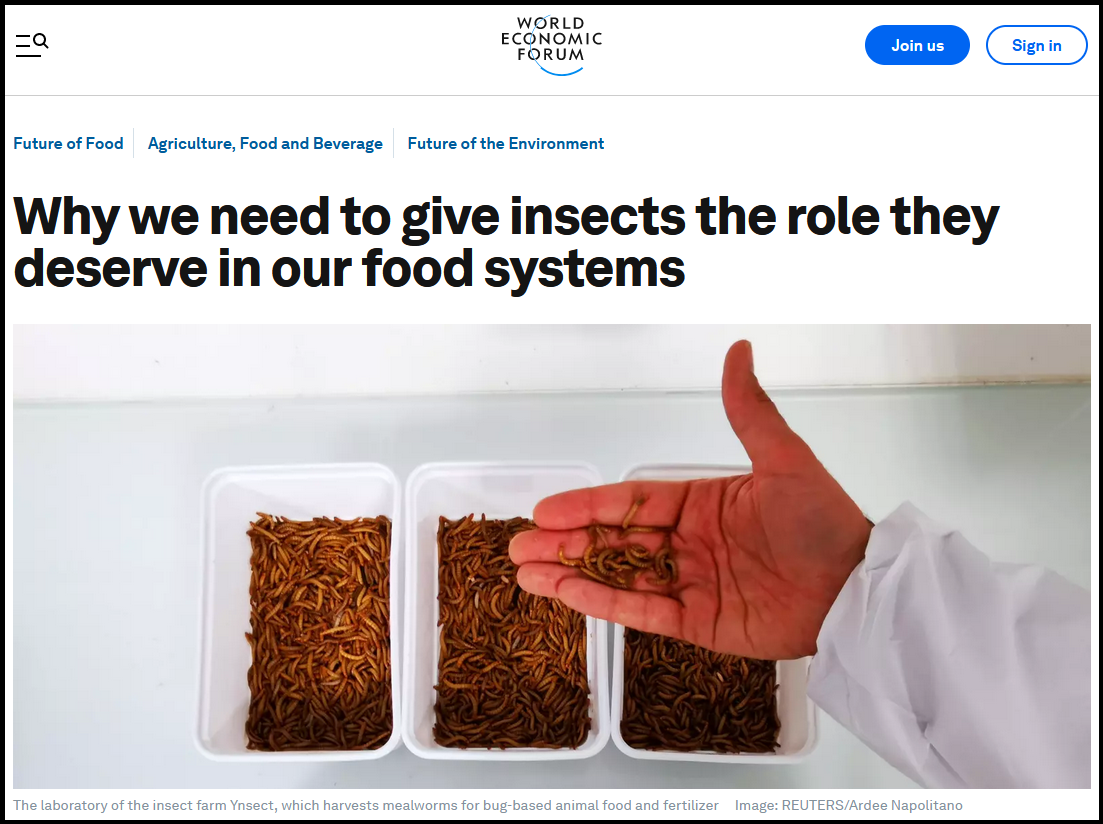
Ÿnsect’s development plans include 10-15 insect farms worldwide by the end of the decade that can meet the feeding demand of hundreds of millions of people, if not more. The producer of bugs uses highly-automated vertical farms to raise Buffalo and Molitor mealworms to create insect protein.
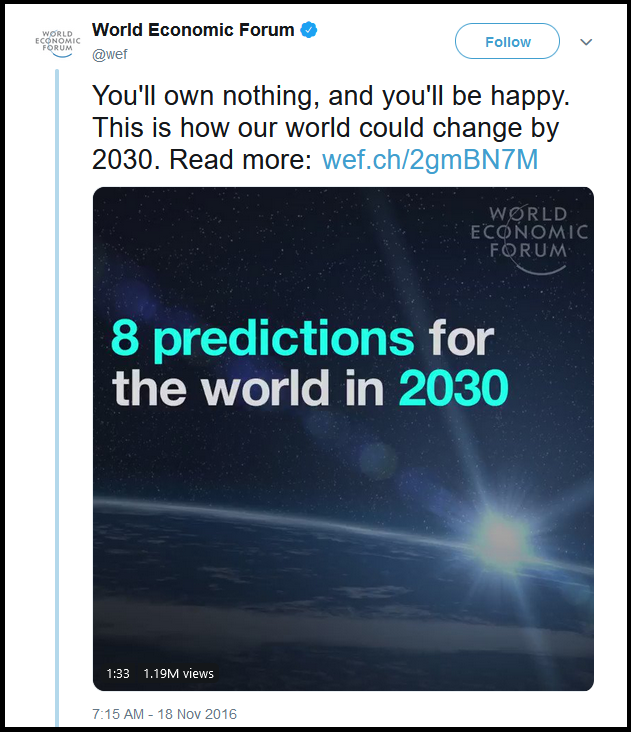
Many Americans have already been conditioned for the brave new world, one pushed by the World Economic Forum of a so-called ‘sustainable’ future where you’ll eat insects…
… and also own nothing.
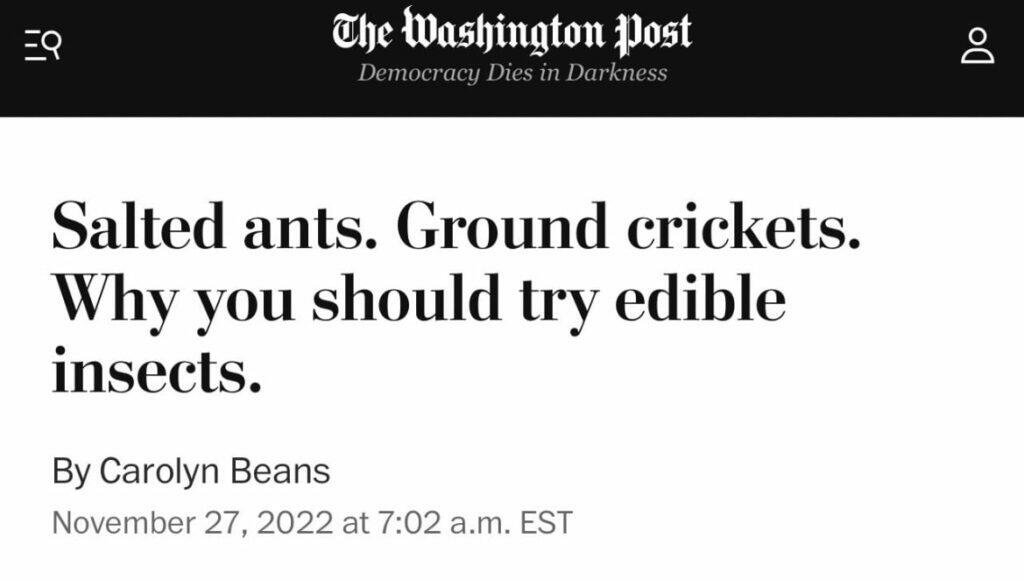
Some of the latest conditioning to eat bugs was an article published in Jeff Bezos-owned The Washington Post.
Which brings us to the WEF’s warning earlier this year about an impending food crisis kicked off by the war in Ukraine.
In the medium term, it highlights the need to transform our food system, using more green energy. We should also be encouraging more sustainable diets, which contain fewer grain fed animal products; and regenerative agricultural practices, which improve soil health and the efficiency of nutrient use by the crop. -WEF
So… eat bugs and be happy about owning nothing are the global elites’ blueprint for 2030 society.
Biden Wants $8 Billion In Taxpayer Funds To Shut Down Coal Power In South Africa
By Tyler Durden | Zero Hedge | December 16, 2022
With the UN and other interests already interfering in Africa’s energy development, Joe Biden announced at the US-Africa Business Forum a plan for American taxpayers to shell out at least $8 billion to shut down effective coal fired energy plants in South Africa so they can be replaced with far less effective and far less efficient green energy alternatives.
In other words, the goal of climate change cultists is to use $8 billion of America’s money to diminish South African infrastructure.
The green energy scam continues despite the fact that European nations are now admitting they need more oil and coal based energy, not green tech, after the loss of Russian natural gas resources.
The American taxpayer is now carrying the weight of $94 billion in 2022 for so called “clean energy” initiatives in other nations around the world.
Germany’s Gas Reserves “Emptying At Record Speed” As Country Struggles To Keep Warm, Lights On
By P Gosselin | No Tricks Zone | December 16, 2022
Germany’s gas reserves are emptying at record speed: 1% per day as the current wind/solar energy lull means more gas gets burned for electricity, heating.
Pleiteticker.de reports how Germany’s natural gas reserves “are emptying at record speed” because wind and solar power have been on the scarce side over the past few weeks. This means gas turbines have had to jump in to pick up the slack in electricity production – not one the German government had hoped as it wrestles with the heightening energy crisis.
“Germany is converting gas into electricity in record quantities,” pleiteticker.de reports. “Thanks to high pressure system ‘Erika’, the current December is colder than it has been for years. […] In recent days, gas storage facilities have therefore been emptying much faster than before. From December 12 onwards, more than one percent was withdrawn from gas storage facilities in Germany every day.”
“Last week, almost one third of all electricity was generated from natural gas. These are record figures,” writes pleiteticker.de.
If the cold persists through the winter, gas reserves threaten to become extremely tight before spring arrives.
But instead of blaming the energy woes on failed government policies, federal network agency head Klaus Müller criticizes the situation on the consumers, and worries “the gas storage may not last the whole winter.”
“A national gas shortage in winter can be avoided if, firstly, the savings target of at least 20 percent continues to be achieved,” the Federal Network Agency says. Here the government’s solution clearly is that citizens should accept freezing even more when it’s bitterly cold out.
Over 800 million euros paid for unproduced energy in 2021
The problem with wind power is that either too much or too little is produced, due to the weather. As mentioned above. the past weeks have seen little wind power being produced, and so gas turbines had to be fired up to keep the grid supplied.
But when it’s too windy, something needs to be done to keep the grid from being overloaded: wind turbines have to be shut down. That’s costing Germans 807 million euros this year because the excess electricity that could have been fed into the grid by the wind parks legally has to be compensated.
Pleiteticker here writes: “For the amount of electricity that the operators could have fed into the grid, they still receive compensation from the grid operators according to the statutory tariffs. And this sum is higher than ever this year: 807 million euros. Record value. For electricity that never existed.”
And the problem is getting bigger, according to the Federal Ministry of Economics.
“At the time of the worst energy crisis Germany has seen in a long time, when companies and consumers are hammered by energy prices like rarely before, Germany is paying money for energy that also doesn’t get produced,” comments pleiteticker.de.
So far Germany’s response to the energy crisis is plans to build many more turbines, with talks of even tripling its current installed capacity, which of course would only triple grid volatility, thus making it far more unstable than it already is and so create an even much bigger mess.
Featured Video

The Source of America’s Wars – Kristol Clear
or go to
Aletho News Archives – Video-Images
From the Archives
Is Israel to blame for the Iraq War?
American Goy | March 10, 2008
I am so tired of this old canard that “Israel had nothing to do with USA’s war with Iraq – in fact, it officially advised America against it”.
Bullshit. … continue
Blog Roll
 Aletho News
- Netanyahu unilaterally declares Lebanon outside of ceasefire deal
- Israeli leaders: ‘Not a single goal’ achieved in war with Iran
- What on earth just happened? Trump, Iran, and the unlikely ceasefire
- Alberta Bill Would Fine Political Deepfakes $10,000 Without Satire Exemptions
- Iran declares ‘historic victory’ over US, says enemy forced to accept its proposal
- Trump Claims Ceasefire, Reopening of Strait of Hormuz Agreement with Iran
- Israeli tank fire killed UN peacekeeper in Lebanon, UNIFIL investigation finds
- Russia, China block Bahrain-sponsored UN resolution on Strait of Hormuz
- The US-Israeli War on Science is an Assault on our Future
- Trump’s Promise to Bomb Iran ‘Like Never Before’ Faces Brutal Logistics — Expert
- If Americans Knew
- Thousands dead and neighborhoods razed to the ground: Aid agencies fear southern Lebanon is becoming the new Gaza
- The war the US is fighting for Israel could cost trillions
- ‘Cigarette Burns, Nail Wounds’: Toddler Tortured in Gaza to Coerce Father
- Trump Says US Sent ‘a Lot of Guns’ to Protesters in Iran
- Israeli forces destroy 17 UN peacekeeper cameras in south Lebanon
- US-Israeli strikes ‘completely destroy’ synagogue in Tehran
- Archbishop for US Military Says Iran War Is Unjust Under Catholic Teaching
- Iranian leaders’ Open Letters to the American People
- Trump says Iranians appreciate bombs, WHO warns of nuclear risks – Daily Update
- U.N. experts demand Israel release prominent Gaza doctor after reports of ‘severe torture’
- No Tricks Zone
- An Inconvenient Tree: Uncovered In Alps… Europe Much Warmer Than Today 6000 Years Ago
- New Study Reports A 60% Slowdown In Greenland’s Ice Loss Rate In The Last Decade
- Low Intensity Tornado Wrecks Major Solar Farm, Creating A Potential Toxic Dump
- New Study Finds Warming Saves Lives…Cold Temperatures 12 Times More Deadly Than Excess Heat
- German Science Blog Accuses PIK Climate Institute Of Hallucinating Climate Tipping Points
- Devastating Assessment Of Comirnaty Vaccine By Former Senior Pfizer Europe Toxicologist
- New Study: CO2 Is ‘Effectively Negligible’ As An Explanatory Climate Change Factor Since 2000
- Former Pfizer Toxicologist Dr. Helmut Sterz Tells Bundestag Hearing Pfizer Vaccine Should Have Never Been Approved
- Energy Expert: Germany’s Nuclear Phaseout Was A “500 Billion Euro Mistake”
- New Research: South Australia’s Mid-Holocene Sea Surface Temperatures Were 4°C Warmer Than Today
 Aletho News