Deliveries of Russian seaborne oil to Europe have dropped more than fivefold since the start of Moscow’s military operation in Ukraine, Bloomberg reported on Monday citing vessel tracking data.
According to the report, the shipments plunged to an average of 309,000 barrels per day in the four weeks to December 5. This is less than a fifth of their volume in the four weeks to February 25, an average of 1.58 million barrels a day. Deliveries in the final week to November 25 dropped by 34%.
Analysts expect those figures to slide further after an EU embargo and the Western coalition’s $60 price cap on Russian seaborne barrels are in full swing. Both measures came into force on Monday, but have a transition period during which some deliveries are still possible.
Over the past months, Moscow has stepped up efforts to redirect supplies elsewhere. So far, shipments have been mostly diverted to China, India, and Türkiye, which emerged as the largest buyers of Russian oil.
According to vessel tracking data, the volume of crude on tankers destined for the three countries, along with those that have not yet supplied their port of destination but typically end up in either India or China, stood at an average of 2.45 million barrels a day over the past four weeks. That is more than three times as much as the volumes shipped there in the four weeks immediately prior to the start of the Ukraine conflict.
Total Russian crude export volumes increased by 94,000 barrels a day to 2.99 million in the week before the new restrictions kicked in. Shipments to Bulgaria, which has secured an exemption from the embargo and is now Russia’s only remaining EU seaborne oil market, were unchanged at 125,000 barrels a day. It is unclear, however, whether further deliveries to the country will be affected by Russia’s response to the sanctions. Moscow repeatedly warned that it will stop selling crude to countries that support the price cap, and warned on Monday that it may even cut production in retaliation.
Russia’s overall oil output has grown 2.2% to 488 million tons in the 11 months between January and November 2022, according to Deputy Prime Minister Alexander Novak, who spoke to reporters on Tuesday.
According to recent reports, Ukrainian intelligence, with foreign support, is planning a provocation to prevent the resumption of Russian ammonia transit. The aim would be to further destabilize humanitarian deals to secure fertilizer supplies and, consequently, global food security. Ammonia is an important component in the production of various types of fertilizers, which is why the instability of its supply poses considerable risks to millions of people around the planet, whose food is cultivated with Russian products.
Sources interviewed by a Russian media outlet claim that Ukrainian agents are being instructed by the UK Special Services and the Canadian military company Garda World to destroy the Russian export infrastructure of ammonia. The operation would be very similar to what happened in September with the Nord Stream pipelines. Informers allege that Kiev wants to bomb the ammonia storage facilities at the Odessa Portside Plant. Thus, the flow of ammonia through the Tolyatti-Odessa pipeline could not be resumed, generating an increase in the prices of the product.
“The provocation has been planned and is carried out under the control of the UK special services stationed in Odessa. Members of Canada’s private military company Garda World, who are responsible for security of port infrastructure in the Odessa region under the contract with the administration of Ukrainian sea ports, are also participating in the implementation of this provocation”, the source said.
Although the UN-mediated grain deal in which Russia is involved did not originally include the return of ammonia transit, negotiations in this regard were making significant progress. UN officials have expressed optimism on the matter in several recent pronouncements. According to Martin Griffiths, Under-Secretary-General for humanitarian affairs and emergency relief at the UN’s Office for the Coordination of Humanitarian Affairs (OCHA), the ammonia deal was “quite close”. Indeed, since the beginning of the special military operation Russia has shown diplomatic goodwill in negotiating humanitarian agreements, so it was possible that something was close to being achieved soon.
However, once again Western-backed Ukrainian terrorists seem to plan maneuvers which will increase tensions and instability. The sources also claim that Kiev will try to blame Russia for the attack. With this, the possible plan appears even more similar to what happened on previous occasions, such as Nord Stream, the Crimean Bridge, and the bombing in Poland. Indeed, this has become common practice on the part of Kiev and its Western supporters: using terrorism to serve their anti-Russian interests and trying to blame Moscow. As on previous occasions, if the attack in Odessa actually takes place, it is expected that there will be a huge defamatory media repercussion, with western news agencies spreading lies and distorted narratives about the incident.
In addition to defaming Russia even more, thus “justifying” the sanctions and other coercive measures, the West would also be economically interested in this type of move, since, without the resumption of Russian ammonia exports, many emerging countries would start to buy ammonia from the EU and from the UK – or start importing ammonia-based fertilizers from Canada. Obviously, Western countries would increase prices exponentially, demanding really abusive prices, given the scarcity of ammonia in the global market.
This once again shows how the West-Kiev axis seems only interested in fomenting chaos and international crisis, without any regard for pacifying the current conflict and for lessening its consequences. All forms of boycotting Russia’s international ties seem “legitimate” to Western countries, even if this endangers the food security of millions of people. Considering the importance of ammonia-based fertilizers for the cultivation of grains, if the predictions made by Russian media’s sources are confirmed, in-depth investigations will be necessary in order to punish those responsible for this crime.
It is also important to remember that the grains and fertilizers exported by Russia have been seized in Europe. Tons of food and chemical products are detained in European ports due to the sanctions, without reaching the countries of destination in Africa and Asia, where Moscow prioritizes exports for humanitarian reasons. Despite several Russian denunciations in this regard, no action has been taken by the UN, which remains silent in the face of illegal European practices that are evidently contributing to worsening food shortages around the world.
There is no way to deny the destabilizing and terrorist attitudes that NATO and its Ukrainian proxy are promoting. And international organizations need to recognize this as soon as possible.
Lucas Leiroz is a researcher in Social Sciences at the Rural Federal University of Rio de Janeiro; geopolitical consultant.
The 15 Minute City is a UN and WEF plan, because they care about you want you to drive less.
A cartoon from the WEF just for you good girls and boys:
In the WEF’s own words — this rearrangement of cities is absolutely about climate change:
As climate change and global conflict cause shocks and stresses at faster intervals and increasing severity, the 15-minute city will become even more critical.
And the solution was the pandemic (they really say that):
The obvious, yet incomplete, answer is the pandemic… with COVID-19 and its variants keeping everyone home (or closer to home than usual), the 15-minute city went from a “nice-to-have” to a rallying cry. Meeting all of one’s needs within a walking, biking or transit distance was suddenly a matter of life and death.
And then the dark hand of the totalitarian managers appears, as James Woudhuysen, warned in Spiked in late October:
The green agenda is taking inspiration from the illiberal days of lockdown.
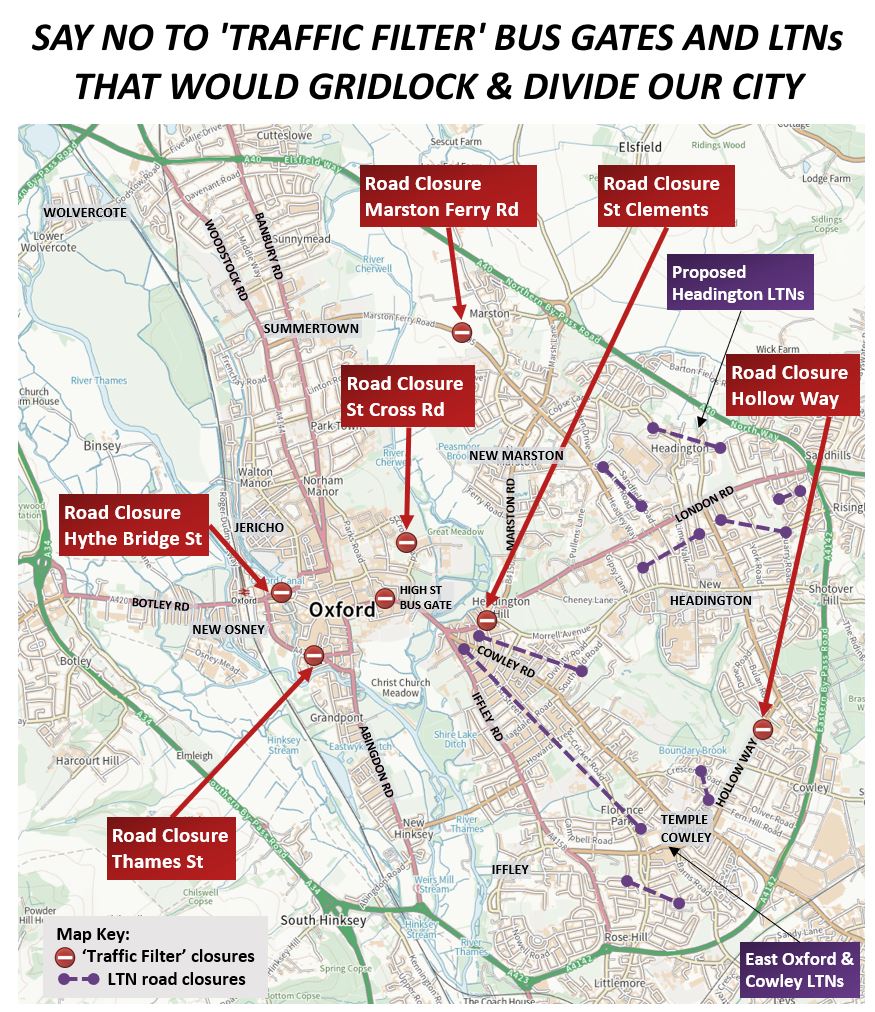
To this end, Oxfordshire County Council, which is run by Labour, the Liberal Democrats and the Green Party, wants to divide the city of Oxford into six ‘15 minute’ districts. In these districts, it is said, most household essentials will be accessible by a quarter-of-an-hour walk or bike ride, and so residents will have no need for a car.
On the surface, these 15-minute neigbourhoods might sound pleasant and convenient. But there is a coercive edge. The council plans to cut car use and traffic congestion by placing strict rules on car journeys.
Residents will have to register their cars with the council and they will be tracked to count their journeys through the key gateways. It’s the social credit scheme that starts with your car and works like anti-frequent-flyer points.
Under the new proposals, if any of Oxford’s 150,000 residents drives outside of their designated district more than 100 days a year, he or she could be fined £70.
The concept of the 15-minute city was born with ‘C40’. Chaired today by London mayor Sadiq Khan, C40 calls itself a ‘network of mayors of nearly 100 world-leading cities collaborating to deliver the urgent action needed right now to confront the climate crisis’.
Climate lockdowns? Seriously?
It all sounds a bit ridiculous to suggest a lockdown “for the climate” but listen to the BBC. They’re working awfully hard to persuade us — they obviously think voters won’t want this. Here they are connecting the “15 Minute City” to the fun of covid lockdowns, and setting this up as though it’s totally normal for the government to decide who your friends are:
And furthermore lockdowns in Paris were great social moments where we all made friends. Who knew how much fun it would be to be told you couldn’t drive far?
… for Fraioli, the two-month lockdown that began on 17 March – confining her to a 1km radius of her home – gave her a nuanced, enriching view of her neighbourhood. “I discovered it’s possible to feel like you’re in a small village in Paris,” she says. “To get to know your neighbours, to maintain good links with shopkeepers, to favour local craftsmen and shops over large supermarkets. I even joined a citizens’ movement where people prepare food baskets for homeless people. I thought I would have a hard time living the lockdown, but I was perfectly at home, in a quiet place.”
I don’t seem to recall “getting to know neighbours” as being part of any lockdown anywhere?
It’s a crowded area, Oxfordshire, and no one likes traffic congestion, but in a free world the problem is self-limiting as drivers get fed up with delays and exorbitant parking costs, and they car-pool or choose to catch the bus or ride a bike. But in Big Nanny State the local rulers start making rules about who can and can’t visit and how often, and they want your car registered on their own special list with cameras to track you and fines to punish you. They offer exemptions of course, but then you have to apply for them and get permission.
Oxfordshire County Council yesterday approved plans to lock residents into one of six zones to ‘save the planet’ from global warming. The latest stage in the ’15 minute city’ agenda is to place electronic gates on key roads in and out of the city, confining residents to their own neighbourhoods.
Under the new scheme if residents want to leave their zone they will need permission from the Council who gets to decide who is worthy of freedom and who isn’t. Under the new scheme residents will be allowed to leave their zone a maximum of 100 days per year, but in order to even gain this every resident will have to register their car details with the council who will then track their movements via smart cameras round the city.
Every resident will be required to register their car with the County Council who will then monitor how many times they leave their district via number plate recognition cameras.
In the end, these aggressively overmanaged schemes mean more paperwork, more tracking, more jobs for bureaucrats and more free passes for “friends” of Big Government.
The more rules you have the more corrupt the system gets. For example, some city blocks are included in the favored list with 100 passes, while others get just 25 — so the property values of the inner circle addresses rise. As a bonus, in years to come property developers “in the know” and on the favoured list with certain councilors can arrange for rezoning on the right day (the one after they buy the property) and voila — that’s a nice capital gain for them
The councilors held a major consultation process but apparently knew the outcome. It says rather a lot about the attitude of one councilor who said it was going ahead whether people liked it or not.
ROAD blocks stopping most motorists from driving through Oxford city centre will divide the city into six “15 minute” neighbourhoods, a county council travel chief has said.
And he insisted the controversial plan would go ahead whether people liked it or not.
Businesses in Oxford are not impressed:
Hotelier Jeremy Mogford, who owns the Old Bank Hotel in High Street and the Old Parsonage Hotel and Gees, both in Banbury Road, described the plan as disastrous for business.
He previously told the Oxford Mail : “What we have is people making decisions that don’t live in the city centre or spend much time in the city.
“The council has adopted the position that climate change is real”
[Piers Corbyn said] “The point is that the basis of these documents are false – man-made climate change does not exist and if you don’t believe me, look at the sky. You should have a special meeting to discuss whether man-made climate change exists or not.”
Responding to Mr Corbyn’s claims, councillor Andrew, the council’s cabinet member for highways management, said: “Mr Corbyn said climate change is not real – this council has formally adopted a position that climate change is real.
“Mr Corbyn you are wrong, we are right.”
Well that’s it then. Councils control the weather. If this had nothing to do with climate change they could have said “we’ll see” and dismissed him anyway. But they have to believe…
Across our county, we want to reduce unnecessary journeys by private vehicles and make walking, cycling, public and shared transport the natural first choice.
This will help us deliver an affordable, sustainable and inclusive transport system that enables the county to thrive whilst protecting the environment and making Oxfordshire a better place to live for all residents.
And it is about “protecting the environment” by tracking you and resisting your movement.
Canterbury is planning something spookily similar –– dividing up the city into five different districts with drivers unable to cross between zones without being fined. The old grid system of cities made for shorter distances and more choices. The new system offers only more obstacles and less freedom.
Today my long-awaited energy storage paper was officially published on the website of the Global Warming Policy Foundation. Here is a link. The paper is 22 pages long in the form in which they have published it plus another few pages for an Executive Summary and table of contents. They have given it the title “The Energy Storage Conundrum.”
Most of the points made in the paper have been made previously on this blog in one form or another. However, there is a good amount of additional detail in the paper that has never appeared here. I’ll provide one example of that today, and more of same in coming days.
The main point of the paper is that an electrical grid powered mostly by intermittent generators like wind and sun requires full backup from some source; and if that source is to be stored energy, the amounts of storage required are truly staggering. When you do the simple arithmetic to calculate the storage requirements and the likely costs, it becomes obvious that the entire project is completely impractical and unaffordable. The activists and politicians pushing us toward this new energy system of wind/solar/storage are either being intentionally deceptive or totally incompetent.
If you follow the news on this subject at a general level, you might find this conclusion surprising. After all, there are frequent announcements that this or that jurisdiction has entered a contract to purchase some seemingly large amount of batteries for grid-level storage. The Report cites data from consultancy Wood Mackenzie as to announced plans or contracts for storage acquisition in all major European countries, and cites other reports as to announced plans from California and New York in the U.S. The title of the April 2022 Wood Mackenzie paper on Europe certainly gives the impression that these people have the situation under control and know what they are doing: “Europe’s Grid-scale Energy Storage Capacity Will Expand 20-fold by 2031.” Impressive!
But this is one of those subjects on which you have to look at the actual numbers to evaluate whether the plans make any sense. In this situation, you need to compare the amount of energy storage that would be required for full backup of an almost-entirely wind/solar grid (with fossil fuels excluded), to the actual quantity of grid-scale energy storage being acquired.
Consider the case of Germany, the country that has gone the farthest of any in the world down the road to “energy transition.” My Report presents two different calculations of the energy storage requirement for Germany in a world of a wind/solar grid and no fossil fuels allowed (both of which calculations have been previously covered on this blog). One of the calculations, by a guy named Roger Andrews, came to a requirement of approximately 25,000 GWh; and the other, by two authors named Ruhnau and Qvist, came to a higher figure of 56,000 GWh. The two use similar but not identical methodology, and somewhat different assumptions. Clearly there is a large range of uncertainty as to the actual requirement; but the two calculations cited give a reasonable range for the scope of the problem.
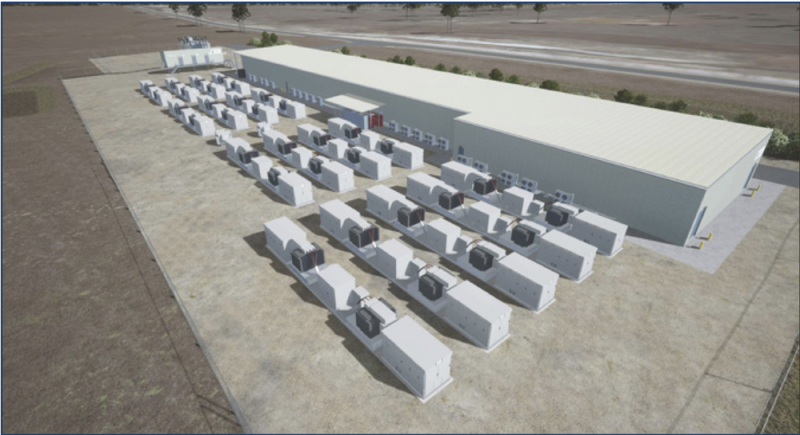
To give you an idea of just how much energy storage 25,000 (or 56,000) GWh is, here is a rendering (also from my Report) of a grid-scale battery storage facility under construction in Queensland, Australia by Vena Energy. The facility in the rendering is intended to provide 150 MWh of storage.
Remember that 150 MWh is only 0.15 of one GWh. In other words, it would take about 167,000 of these facilities to provide 25,000 GWh of storage, and about 373,000 of them to get to the 56,000 GWh in the larger estimate.
And against these projections of a storage requirement in the range of tens of thousands of GWh, what are Germany’s plans as presented in this “20-fold expansion” by 2031? From my Report:
In the case of Germany, Wood Mackenzie states that the planned energy storage capacity for 2031, following the 20-fold expansion, is 8.81GWh.
Rather than tens of thousands of GWh, it’s single digits. How does that stack up in percentage terms against the projected requirements?:
In other words, the amount of energy storage that Germany is planning for 2031 is between 0.016% and 0.036% of what it actually would need.This does not qualify as a serious effort to produce a system that might work.
The story is the same in the other jurisdictions covered in the Report. And remember, these are the jurisdictions that consider themselves the leaders and the vanguard in the transition to renewable energy. For example, New York, with an estimated storage requirement for a mainly-renewables grid of 10,000-15,000 GWh, is said by trade magazine Utility Dive to be “forging ahead” with plans to procure some 6 GW of grid storage (presumably translating into about 24 GWh). That would come to around 0.2% of what is needed. Unless, of course, New York simultaneously “forges ahead” with its plans to triple the demand on the grid by electrifying all automobiles and home heating; in that case the 24 GWh would be back down to less than 0.1% of the storage requirement.
California? The Report cites another article from Utility Dive stating that the California Public Utilities Commission has ordered the state’s power providers to collectively procure by 2026 some 10.5 GW (or 42.0 GWh) of lithium-ion batteries for grid-scale storage:
The additional 10.5 GW of lithium-ion storage capacity, translating to at most about 42 GWh, would take California all the way to about 0.17% of the energy storage it would need to fully back up a wind/solar generation system.
However bad you might think this situation is, it’s worse. Am I the only person who has ever made these simple calculations? I certainly have never seen them anywhere else.
I would be very happy to be proved wrong about any and all of this. All I say is that the proponents of this miraculous fantasy energy future owe it to the rest of us to build a working demonstration project before forcing us all to adopt their utopian scheme at ruinous cost, only to find out that it won’t work and can’t work.
Here’s what tells you all you need to know: not only is there no working demonstration project anywhere in the world of the wind/solar/storage energy system, but there is none under construction and none even proposed. Instead, the proponents’ idea is that your entire state or country is to be the guinea pig for their dreams. After all, they are “saving the planet.” If there has ever previously been something this crazy in the history of the world, I certainly can’t name it.
Over the past weeks a coordinated all-out assault on our agriculture—the ability to produce food for human existence—has begun. The recent G20 governmental meeting in Bali, the UN Agenda 2030 Cop27 meeting in Egypt, the Davos World Economic Forum and Bill Gates are all complicit. Typically, they are using dystopian linguistic framing to give the illusion they are up to good when they are actually advancing an agenda that will lead to famine and death for hundreds of millions if not billions if allowed to proceed. It’s driven by a coalition of money.
From G20 to Cop27 to WEF
On November 13 the G20–representatives of the 20 most influential nations including the USA, the UK, the European Union (though it’s no nation), Germany, Italy, France, Japan, South Korea, and several developing countries including China, India, Indonesia and Brazil,– agreed on a final declaration.
The first major item is a “call for an accelerated transformation towards sustainable and resilient agriculture and food systems and supply chains.”
Further, “working together to sustainably produce and distribute food, ensure that food systems better contribute to adaptation and mitigation to climate change, and halting and reversing biodiversity loss, diversify food sources…”
In addition they called for “inclusive, predictable, and non-discriminatory, rules-based agricultural trade based on WTO rules.”
As well, “We are committed to supporting the adoption of innovative practices and technologies, including digital innovation in agriculture and food systems to enhance productivity and sustainability in harmony with nature…”
Then comes the revealing statement: “We reiterate our commitment to achieve global net zero greenhouse gas emissions/carbon neutrality by or around mid-century.” [i](emphasis mine)
“Sustainable agriculture” with “net zero greenhouse gas emissions” is Orwellian doublespeak. For an outsider to UN linguistics, the words sound too good. What in fact is being promoted is the most radical destruction of farming and agriculture globally under the name “sustainable agriculture.”
Following the Bali G20 confab by only days was the United Nations’ COP27 annual Green Agenda Climate Summit meeting in Egypt. There, the participants from most UN countries along with NGOs such as Greenpeace and hundreds of other green NGOs drafted a second call. COP27 launched something they revealingly call FAST– UN’s new Food and Agriculture for Sustainable Transformation (FAST) initiative. Fast, as in “to abstain from food…”
According to Forbes, FAST will promote a “shift towards sustainable, climate-resilient, healthy diets, would help reduce health and climate change costs by up to US$ 1.3 trillion while supporting food security in the face of climate change.” We are talking big numbers. $1.3 trillion by transition to “sustainable, climate-resilient, healthy diets” that would reduce cost of climate change by $1.3 trillion. [ii] What’s really going on behind all these words?
Big Money Behind
According to the UN Food and Agriculture Organization speaking to Reuters during COP27, within a year the FAO will launch a “gold standard” blueprint for reduction of so-called Greenhouse gases from agriculture.
The impulse for this war on agriculture comes not surprisingly from big money, FAIRR Initiative, a UK-based coalition of international investment managers which focuses on “material ESG risks and opportunities caused by intensive livestock production.”
Their members include the most influential players in global finance including BlackRock, JP Morgan Asset Management, Allianz AG of Germany, Swiss Re, HSBC Bank, Fidelity Investments, Edmond de Rothschild Asset Management, Credit Suisse, Rockefeller Asset Management, UBS Bank and numerous other banks and pension funds with total assets under management of $25 trillion.[iii] They are now opening the war on agriculture much as they have on energy. The UN FAO Deputy Director for Climate Change policies, Zitouni Ould-Dada said during the COP27 that, “There has never been this much attention to food and agriculture anytime before. This COP is definitely the one.” [iv]
The FAIRR claims, without proof, that:
“food production accounts for around a third of global greenhouse gas emissions and is the main threat to 86% of the world’s species at risk of extinction, while cattle ranching is responsible for three quarters of Amazon rainforest loss.” [v]
The FAO plans to propose drastic reduction in global livestock production, especially cattle, which FAIRR claims is responsible for:
“nearly a third of the global methane emissions linked to human activity, released in the form of cattle burps, manure and the cultivation of feed crops.”
For them, the best way to stop cow burps and cow manure is to eliminate cattle. [vi]
Unsustainable Sustainable Agriculture
The fact that the UN FAO is about to release a roadmap to drastically reduce so-called greenhouse gases from global agriculture, under the false claim of “sustainable agriculture” that is being driven by the world’s largest wealth managers including BlackRock, JP Morgan, AXA and such, tells volumes about the true agenda. These are some of the most corrupt financial institutions on the planet. They never put a penny where they are not guaranteed huge profits. The war on farming is their next target.
The term “sustainable” was created by David Rockefeller’s Malthusian Club of Rome. In their 1974 report, Mankind at the Turning Point, The Club of Rome argued:
“Nations cannot be interdependent without each of them giving up some of, or at least acknowledging limits to, its own independence. Now is the time to draw up a master plan for organic sustainable growth and world development based on global allocation of all finite resources and a new global economic system. [vii](emphasis mine)
That was the early formulation of the UN Agenda 21, Agenda2030 and the 2020 Davos Great Reset. In 2015 UN member nations adopted what is called the Sustainable Development Goals or SDGs: 17 Goals to Transform our World. Goal 2 is “End hunger, achieve food security and improved nutrition and promote sustainable agriculture.”
But if we read in detail into proposals of COP27, G20 and Davos WEF of Klaus Schwab we find what is meant by these nice sounding words. Now we are being inundated with claims, unverified, by numerous government and privately-funded think tank models that our agriculture systems are a major cause of, yes, global warming. Not only CO2 but methane and nitrogen. Yet the entire global greenhouse gas argument that our planet is on the brink of irreversible disaster if we do not radically change our emissions by 2030 is unverifiable nonsense from opaque computer models. Based on these models the UN IPCC insists that if we do not stop a global temperature rise of 1.5 C above the level of 1850, by 2050 the world will essentially end.
The War Is Just Beginning
The UN and Davos WEF teamed up in 2019 to jointly advance the SDG UN Agenda 2030. On the WEF website this is openly admitted to mean getting rid of meat protein sources, introducing promoting unproven fake meat, advocating alternative protein such as salted ants or ground crickets or worms to replace chicken or beef or lamb. At COP27, discussion was about “diets that can remain within planetary boundaries, including lowering meat consumption, developing alternatives, and spurring the shift towards more native plants, crops and grains (thus reducing the current reliance on wheat, maize, rice, potatoes).” [viii]
The WEF is promoting a shift from meat protein diets to vegan arguing it would be more “sustainable”. [ix] They also promote lab-grown or plant-based lab meat alternatives such as the Bill Gates-funded Impossible Burgers, whose own FDA tests indicate it is a likely carcinogen as it is produced with GMO soy and other products saturated with glyphosate. The CEO of Air Protein, another fake meat company, Lisa Lyons, is a special WEF adviser. WEF also promotes insect protein alternatives to meat. Note also Al Gore is a Trustee of WEF. [x]
The war on animal raising for meat is just getting deadly serious. The government of the Netherlands whose Prime Minister Mark Rutte, formerly of Unilever, is a WEF Agenda Contributor, has created a special Minister for the Environment and Nitrogen, Christianne van der Wal. Using a never-invoked and outdated EU Natura 2000 nature protection guidelines designed allegedly to “protect moss and clover,” and based on fraudulent test data, the Government just announced it will forcibly close 2,500 cattle farms across Holland. Their goal is to force fully 30% of cattle farms to close or face expropriation.
In Germany the German Meat Industry Association (VDF), says that within the next four to six months Germany will face a meat shortage, and prices will skyrocket. Hubert Kelliger, a VDF board member said, “In four, five, six months we will have gaps on the shelves.” Pork is expected to experience the worst shortages. The issues in meat supply are due to Berlin insisting on reducing the numbers of livestock by 50% to reduce global warming emissions. [xi] In Canada, the Trudeau government, another Davos WEF product, according to the Financial Post of July 27, plans to cut emissions from fertilizer 30 per cent by 2030 as part of a plan to get to net zero in the next three decades. But growers are saying that to achieve that, they may have to shrink grain output significantly.
When the autocratic President of Sri Lanka banned all import of nitrogen fertilizers in April 2021 in a brutal effort to return to a past of “sustainable” agriculture, harvests collapsed in seven months and famine and farmer ruin and mass protests forced him to flee the country. He ordered that the entire country would immediately switch to organic farming but provided farmers with no such training.
Combine all this with the catastrophic EU political decision to ban Russian natural gas used to make nitrogen-based fertilizers, forcing shutdowns of fertilizer plants across the EU, that will cause a global reduction in crop yields, and as well the fake Bird Flu wave that is falsely ordering farmers across North America and the EU to kill off tens of millions of chickens and turkeys to cite just a few more cases, and it becomes clear that our world faces a food crisis that is unprecedented. All for climate change?
*
F. William Engdahl is strategic risk consultant and lecturer, he holds a degree in politics from Princeton University and is a best-selling author on oil and geopolitics. He is a Research Associate of the Centre for Research on Globalization (CRG).
In a report on wind farms on Wednesday, the Times wrote: ‘Labour argues that the ban on onshore sites has raised energy bills by £150. Ed Miliband, the shadow climate secretary, said Tories were “dinosaurs” for opposing them.’
It is a claim that has often been bandied around recently. So what is the truth of the matter?
The first point to make is that onshore wind was never banned. What did happen was that in 2016, subsidies were withdrawn from any new construction, while wind farms had to obtain local planning permission. It is quite extraordinary that Labour don’t want communities to make these decisions themselves.
The most recent wind farms built under the subsidy mechanism are paid an index-linked, guaranteed price of £100.31/MWh. For many years until last year the market price for electricity has hovered between £40 and £50/MWh most of the time. In other words, those onshore wind farms were heavily subsidised until last year, when market prices rose. The cost of subsidies is of course passed on to energy bills.
There is no evidence that the construction costs for wind farms have fallen since then. It is therefore evident that if more wind farms had been built since 2016, we would have been paying double the wholesale price until last year when prices began rising.
Of course since then wholesale electricity prices have rocketed because of the rising cost of natural gas. But nobody forecast that this would happen in 2016, and clearly the right decision was made by the government, given the facts at the time.
Over this year, wholesale prices of electricity have averaged £177/MWh. As the guaranteed price under the Contracts for Difference scheme is £100.31, the difference is refunded by generators and subsequently knocked off our bills.
Miliband’s claims of a £150 saving are based on an analysis by Carbon Brief, a lobby group for renewable energy. According to them, based on previous trends, an extra 5.4 GW of onshore wind would have been built if subsidies had not been withdrawn. The lost output works out at 11.8 TWh, and consequently the saving would have amounted to about £900million, which would only have knocked about £10 off household bills, which account for about a quarter of total UK electricity consumption.
In reality, you cannot directly compare the cost of intermittent wind power with other dependable sources. Our bills are much higher because of the costs incurred in grid balancing costs and other items, which directly result from the intermittency of wind and solar power.
But what Ed Miliband conveniently forgot to tell us was the cost of all the renewable subsidies which we have already paid out, and will continue to for years to come. In the last ten years, these have totalled £78billion, and in the next six years will cost a further £56billion, according to data from the Office for Budget Responsibility (OBR).
All of these costs lie at the door of Ed Miliband, who pushed through the Climate Change Act in 2008. If he really cares about our electricity bills, he would immediately campaign to abolish all subsidies and suspend the carbon tax, which is also responsible for energy bills being much higher than they need be.
He won’t, because of his obsession with climate change.
Evidence grows by the day that the Net Zero fantasy is a societal and economic disaster waiting to happen. Not only is it based on the giant propaganda lie of ‘settled’ science, but it is almost laughably unaffordable. On just one level around the storage of ‘green’ energy, a new report from the Global Warming Policy Foundation (GWPF) is scathing. Noting a “heads-in-the sand” approach by politicians, it says that “one would have to conclude that the entire effort is either wholly unserious or breathtakingly incompetent”.
For just one country alone, Germany, fully replacing natural gas back-up with battery storage “is a multi-trillion dollar project, likely costing a multiple of the country’s GDP, and thus completely infeasible”. Across the globe, existing plans to store energy, vital since wind and solar are highly intermittent, are producing only a “tiny fraction” of the capacity that will be required to avoid electricity blackouts. “It is hard to avoid the conclusion that the people planning the Net Zero transition “have no idea what they are doing”, states the report.
Political pressure to resist the imposition of the command-and-control Net Zero agenda is being increasingly targeted in the UK and elsewhere at the unrealistic costs involved. In the U.K. Parliament, a Net Zero Scrutiny Committee was recently formed and led by the Conservative MP Craig Mackinlay. For its part, the GWPF has started a Net Zero Watch unit. The GWPF’s battery storage report is the latest in a string of publications asking serious questions about the finances behind Net Zero. It is written by the American lawyer and mathematician Francis Menton, who also runs the Manhattan Contrariansite.
Menton writes that the push to Net Zero without a fully demonstrated and costed solution to the energy storage conundrum “is analogous to jumping out of an airplane without a parachute, and assuming that the parachute will be invented, delivered and strapped on in mid-air in time to save you before you hit the ground”. He continues:
“Now, before our advanced economies are destroyed, it is time to demand from our politicians and energy planners that they level with the public about the huge costs and the likely impossible technical requirements of the goals to which they have committed us.”
In a detailed report, the arithmetic behind Net Zero battery costings is laid out in detail. It is explained that no grid based on wind and solar is viable unless it has full back-up from another source. That source needs to provide 100% of power when the wind and sun stop blowing and shining. During calm periods in a cold winter, that could be a week or more. Remarkably, notes the author, none of the jurisdictions implementing crash Net Zero have paid much attention to storage programmes.
Storage demands for Net Zero are enormous. Five days without wind and solar require at least 120 Mega Watt hours (MWh) for each megawatt of average demand. But some calculations based on historical weekly and annual spikes suggest a requirement as high as 1,000 MWh to ensure reliability of a grid over a long time.
Truly scary is the work done by Ken Gregory who calculated that the United States would need an annual energy storage requirement of around 233,000 GWh. It is noted that a current lithium-ion battery installation is currently under construction in Australia for grid back-up with a storage capacity of 150MWh. Menton writes that 150MWh is 15% of one gigawatt hour, and 233,000GWh of storage would require some 1.55 million of these facilities.
Back in the real world, Menton reveals the planned battery storage capacity that will be delivered in many countries is “trivial” – typically from around 0.1% to at most 0.2% of the amount that’s necessary if Net Zero is to be achieved.
The figure is hardly surprising when the costs in battery storage are considered. Menton reviewed recent official cost reports and found that “even on the most optimistic assumptions” the cost could be as high as a country’s GDP. This was said to render the entire Net Zero project “an impossibility”. On less optimistic assumptions, the capital cost alone could be 15 times annual GDP. Even more impractical, it is noted that such batteries provide about four hours of discharge at maximum capacity, but weather patterns mean that grids need batteries that can store as much as a month’s demand, and then discharge that energy over the course of six months or more.
“Such ‘long duration’ batteries have not yet been invented,” he observes.
Last October, the Daily Scepticreported on the findings of Associate Professor Simon Michaux who told the Finnish Government in no uncertain terms that there were not enough minerals in the world to supply all the batteries required for Net Zero. And this doesn’t even take into account that lithium-ion batteries need replacing every eight to 10 years. Michaux observed that the Net Zero project may not go fully “as planned”.
The EU is pursuing one of the most radical climate change policies of the major CO2 emitters, having committed itself to reducing its net greenhouse gas emissions by 55% by 2030, compared to 1990 levels, and to eliminating such emission by 2050. To achieve this, the EU, unlike China, India or Russia, is willing to sacrifice its economy, its industry and its middle classes to advance climate ideology. Reaching zero emissions by 2050 would require a decrease of 1.4 GtCO2 each year, comparable to the fall observed in 2020 emissions because of COVID-19, to achieve which would imply no more and no less than the paralysis of all Western economies.
At this COP27 climate summit, the UN Secretary General, António Guterres, once again resorted to his usual apocalyptic discourse to say that “we are on a highway to climate hell with our foot on the accelerator.” With the gall of the best trickster at the carnival, Guterres said that “to avoid that terrible fate, all G-20 countries must accelerate their transition now, in this decade.” The same time span, a decade, in which the apostles of the climate religion went from talking about a new Ice Age to a dangerous warming of the planet, between the 1970s and 1980s.
Unmoved by the serious energy emergency we are experiencing, those attending COP27 did not spend a minute reflecting on the need for abundant and cheap energy to maintain the welfare states in developed countries and to promote economic progress in developing countries. Renewable energies today are neither the cheapest nor do they produce enough to supply the demand of homes and industry. What is urgent today is not to save the planet from a climate change whose origins and consequences are unknown. What is really urgent is to solve general inflation and, in particular, food and energy price rises to avoid a global recession.
Regardless, COP27 went ahead with what is undoubtedly the biggest scam in the history of mankind, declaring an emergency for something that is hardly changing our way of life, nor does it really affect our immediate future. The farce of the climate conference in Egypt has given birth to a pact to create a “loss and damage” fund, to repair the worst effects of extreme weather on the most vulnerable nations, spreading the deception that hurricanes, floods and other catastrophes that have always been recurrent throughout history are the result of man-made climate change.
To refute this fallacy that they make us swallow like fools, remember that the year 2021 was the year with the lowest number of hurricanes worldwide since 1980. However, the stupidity that these catastrophes are the planet’s response to our aggressions against the environment continues to circulate. It doesn’t matter that the prophecies of the climate religion have been unfulfilled for 30 years.
The needs and well-being of Europeans do not matter; they are not a priority, as announced by the new Prime Minister of the United Kingdom, Rishi Sunak: “As there are other priorities, we think that the climate can wait, but it can’t. The climate emergency is already here. The climate urgency is already here. We don’t have to wait for tomorrow.” We Europeans are guilty. That’s why we must pay the poorest countries for the damage caused by weather phenomena that climate change caused that is turned caused by our industries. Macron has already said that “we have to stand up and support the poorest countries with 100 billion dollars to fight against the climate crisis.”
The green policies promoted by the globalist elites through indirect carbon taxes and subsidies to things “eco,” to renewable energies and other ecological prohibitions and obstacles, are becoming another way of plundering the wealth of the Western middle classes. But if the climate change business has reached huge proportions in the developed world at the expense of consumers, in the third world it condemns thousands of people to remain in poverty and live a miserable life. When the IMF refuses to provide funds for coal-fired power plants in Africa or forbids the use of synthetic fertilizers in Sri Lanka, the poorest lose access to cheap energy and affordable food production.
After the pandemic, we have seen how science is easily manipulated and its empirical objectivity is easily corrupted to benefit the political and economic elites. When a hypothesis is elaborated by a group of researchers that can serve the purposes of these elites, the doors are opened to the financing of more studies in that direction, more publications, more papers in congresses, and in the end a semblance of scientific consensus. It is more profitable for any university department to focus its studies on the influence of climate change in a given area, than to explore other alternatives. If there is also the backing of supranational organizations and governments, the pressure becomes irresistible. Naturally, the mass media takes it upon itself to reaffirm the official doctrine and ostracize its detractors, while sowing alarm among the population.
The climate-belief apologists serve a more ambitious social engineering strategy, which aims to destroy the social, economic and political model in which we live, in order to replace it with the objectives that, under the label of Agenda 2030, are pursued by the globalist elites. They have given birth to hysterical teenagers like Greta Thunberg, who are followed as a model by brainless ecological activists, such as those who have dedicated themselves in recent weeks to attacking works of art in museums. But above all, they serve the goal of destroying the West as it had been configured up until the end of the Cold War.
The sovereignty of nations has already been considerably reduced with the prominence of supranational organizations and the phenomenon of globalization, which no longer makes it possible to control national financial and economic flows in an interconnected world market. This allowed P. Bobbitt to speak of what he called the “market-State,” referring to a structure whose purpose consists exclusively in its economic functionality. But it is clear that with Agenda 2030, it is being transformed into something different, into another type of State, in which the protagonism of the national community has been replaced by the protagonism of the state bureaucracy—large corporations and globalist elites grouped around conferences, such as the one held in Egypt: the perfect breeding ground for the formation of the new world order.
Mateo Requesens is a judge in Spain. [This article appears courtesy of Posmodernia].
Closing schools to combat the energy crisis in France is unacceptable, French parents’ groups announced this week, after the government instructed regional authorities to brace for potential localized power outages.
Schools were not prioritized by planners in the event of limits to the energy supply network during the winter.
“Parents do not want school closures. We have seen the impact of closures on students,” Valerie Desouche, Deputy Secretary of the National Union of Autonomous Parents’ Associations (UNAAPE), told BFM TV on Thursday, referring to the lockdowns during the Covid-19 pandemic.
She added that it was “unthinkable” not to treat schools as a priority during the energy crisis.
“We want schools to be open at all costs,” Desouche said. “We can’t put children’s education second.”
Vice President of the Federation of Parents for Public Education (PEEP) Laurent Zameczkowski also urged that schools be prioritized, saying “During the health crisis, we did everything to keep the schools open, and now the energy crisis will be the reason [to shut them down]?”
The group released a statement on Wednesday, arguing that “energy austerity cannot be done at the expense of the health and the future of students.”
According to France Info radio, the government plan entails potential outages between 8am and 1pm and between 6pm and 8pm that could last for up to two hours. Priority sites include hospitals, police stations and fire stations, but not schools, which could be forced to cancel some lessons.
“We are not saying that there are going to be power cuts, but that it is not impossible,” government spokesman Olivier Veran said on Thursday. France, together with many other European countries, has been looking for ways to conserve energy and been bracing for possible outages as Western states try to curb Russian oil and gas exports as part of sanctions over the Ukraine conflict.
The Swiss Confederation usually imports electricity from France and Germany to keep the lights on over the winter, but this year neither country has any power to spare. Many French nuclear power plants are down after years of postponed maintenance, while in Germany we suffer from a superfluity of idle wind turbines and a (self-imposed) shortage of natural gas.
The Federal Council of Switzerland has therefore published draft legislation, which outlines four tiers of escalating measures to conserve electricity and avert potential blackouts. The first prescribes a lot of temperature restrictions for things like refrigerators and washing machines. The second includes more unusual rules, such as the demand that heating in clubs and discotheques “be set to the lowest level or switched off completely,” and that “streaming services … limit resolution of their content to standard definition.” The third foresees cutting business hours, banning the use of Blue Ray players and gaming computers, and also limiting the use of electric cars, which should be driven only when absolutely necessary. A fourth and final tier mandates closure of ski facilities, casinos, cinemas, theatre and the opera.
A lot of these rules look unenforceable, but they said the same thing about contact restrictions during the pandemic. It turns out that the state really can prevent you from socialising with people in your own home if it wants to, especially when there’s no shortage of prying neighbours eager to snitch.
Feasibility isn’t the point, though. It’s the optics here that are most astounding. Electric vehicles, which politicians have heavily subsidised as one of their primary policy responses to climate change, are just now crashing against that other great arm of the green agenda, namely renewable energy. You can’t drive everyone into ever greater dependence upon the electrical grid, while also orchestrating an energy transition to wind (which hardly blows in Germany, except in the north) and solar (which generates no meaningful power in the depths of the Central European winter). Gas from Russia was the magic ingredient that kept the whole renewables charade going, and we’re out of that now. There’s no way to cover up the failure; not even the green-friendly German media has any excuse or messaging angle here.
Germany still has no way of completely replacing Russian natural gas, even after reaching a supply agreement with Qatar, the chairman of the Bundestag committee on energy, Klaus Ernst, warned on Tuesday.
A long-term energy agreement was announced earlier in the day, under which the Gulf state will ship up to two million tons of liquefied natural gas (LNG) a year to Germany, starting from 2026. The deal will reportedly last at least 15 years.
“The federal government celebrates its LNG deal with Qatar and boasts big numbers. The fact is, these two million tons of LNG correspond to three percent of German gas consumption. There are still no real alternatives to Russian gas!” the politician from The Left party wrote on Twitter.
According to Bloomberg, the deal with Qatar equates to about 6% of the volume of Russian gas Germany imported in 2021. The fuel will come from ConocoPhillips’ joint ventures in Qatar, and will be delivered to the Brunsbuttel floating import terminal, which is under construction.
The news agency specified that the five import facilities chartered by the German government will cost a total of €6.5 billion ($6.7 billion) over the next 10 to 15 years. There is also one privately chartered terminal planned. Once operational, they will be able to cover around one third of Germany’s current gas demand, according to a government estimate, cited by Bloomberg.
Germany, Europe’s biggest economy, relies mainly on natural gas to power its industry, and has pledged to replace all Russian energy imports by as soon as mid-2024.
Canadian Retailer Lambasted for Ad Promoting Assisted Suicide
Samizdat – November 29, 2022
A clip promoting the “beauty” of euthanasia sparked outrage online, as Canada plans to expand the application of medical assistance in dying (MAID) next year.
Retailer Simons has shocked Canada by releasing a commercial dubbed “All Is Beauty” supporting assisted suicide. The clip features a woman named Jennyfer Hatch who opted to end her life in October – reports suggest she suffered from Ehlers Danlos syndrome.
Many users called the ad “dystopian”, with some warning that Canadian authorities would force it onto people who are too poor to pay their medical bills.
The controversy regarding euthanasia regulations escalated in 2021 when Canada adopted bill c-7, making several crucial changes to the procedure’s requirements: the new law erased a safeguard that stipulated that people seeking assisted suicide need have a terminal illness, making their death reasonably foreseeable.
Starting next year, Canada will allow individuals suffering from mental illness to ask for euthanasia too.
This site is provided as a research and reference tool. Although we make every reasonable effort to ensure that the information and data provided at this site are useful, accurate, and current, we cannot guarantee that the information and data provided here will be error-free. By using this site, you assume all responsibility for and risk arising from your use of and reliance upon the contents of this site.
This site and the information available through it do not, and are not intended to constitute legal advice. Should you require legal advice, you should consult your own attorney.
Nothing within this site or linked to by this site constitutes investment advice or medical advice.
Materials accessible from or added to this site by third parties, such as comments posted, are strictly the responsibility of the third party who added such materials or made them accessible and we neither endorse nor undertake to control, monitor, edit or assume responsibility for any such third-party material.
The posting of stories, commentaries, reports, documents and links (embedded or otherwise) on this site does not in any way, shape or form, implied or otherwise, necessarily express or suggest endorsement or support of any of such posted material or parts therein.
The word “alleged” is deemed to occur before the word “fraud.” Since the rule of law still applies. To peasants, at least.
Fair Use
This site contains copyrighted material the use of which has not always been specifically authorized by the copyright owner. We are making such material available in our efforts to advance understanding of environmental, political, human rights, economic, democracy, scientific, and social justice issues, etc. We believe this constitutes a ‘fair use’ of any such copyrighted material as provided for in section 107 of the US Copyright Law. In accordance with Title 17 U.S.C. Section 107, the material on this site is distributed without profit to those who have expressed a prior interest in receiving the included information for research and educational purposes. For more info go to: http://www.law.cornell.edu/uscode/17/107.shtml. If you wish to use copyrighted material from this site for purposes of your own that go beyond ‘fair use’, you must obtain permission from the copyright owner.
DMCA Contact
This is information for anyone that wishes to challenge our “fair use” of copyrighted material.
If you are a legal copyright holder or a designated agent for such and you believe that content residing on or accessible through our website infringes a copyright and falls outside the boundaries of “Fair Use”, please send a notice of infringement by contacting atheonews@gmail.com.
We will respond and take necessary action immediately.
If notice is given of an alleged copyright violation we will act expeditiously to remove or disable access to the material(s) in question.
All 3rd party material posted on this website is copyright the respective owners / authors. Aletho News makes no claim of copyright on such material.






 Aletho News