Climate madness: British startup releases masks for cows
British startup ZELP has developed a mask for cows that filters methane. They received a climate protection award for this – Prince Charles is thrilled about the project.

Free West Media | May 28, 2022
It sounds like a belated April Fool’s joke: On May 24, 2022, the online portal Agrarheute reported that the British startup ZELP (Zero Emissions Livestock Project) had developed masks for cows. In this case, however, not to protect them from Corona, but to filter methane.
ZELP is currently testing various prototypes of the cattle masks, according to Agrarheute. These are already able to filter around 30 percent of the methane emitted by ruminants. In the future, this value should be increased to around 60 percent.
The highlight: ZELP was awarded the climate protection prize “Climate Design Award” for the “revolutionary” idea, which was created by WEF figurehead Prince Charles and designer Sir Jony Ive. The cattle mask was one of four winners and received a cash prize of the equivalent of 58 000 euros. Prince Charles supports face masks for cows to fight climate change.
The British monarch is one of the architects of the Great Reset, the name of the 50th annual meeting of the World Economic Forum (WEF), held in June 2020. It brought together high-profile business and political leaders, convened by Prince Charles. At the launch event for the Great Reset, he listed key areas for action, similar to those listed in his Sustainable Markets Initiative. These included draconian measures for net zero emissions globally as well as the introduction of carbon pricing.
To prove that this report was not a joke, the portal linked a video in its article that showed the enthusiastic heir to the throne presenting the project.
The 100-gram rubber masks with solar-powered fans are designed to direct the animals’ exhalations into a small chamber and then use chemical processes to convert methane into carbon dioxide, Agrarheute explained. But first farmers have to be convinced to actually use the masks.
One obstacle could be the rather high price: The use costs 45 dollars per cow and year, the equivalent of 41 euros. In addition, the masks would not bring any advantage for the farmer from an economic point of view.
In the comments below the article, readers legitimately wondered whether this message was some kind of joke. Agrarheute immediately confirmed that this was unfortunately not the case.
The claims about methane have been debunked
One reader commented: “Madness or stupidity? Every thinking person understands what nonsense the story about cow’s methane is. A cow is not a perpetual motion machine and it does not create energy out of thin air. The cow lives in the earth’s natural carbon cycle and is not ‘climate-damaging’ (if such a thing exists). Even the climate heroes at Climate Facts know that, although some people don’t like it. They are just producing a lot of garbage, trying to get more money out of the farmers’ pockets, end of the story.”
The three main greenhouse gases, carbon dioxide, methane and nitrous oxide, all impact the environment differently. Methane is known as a “flow gas”, removed from the atmosphere at a rapid pace. Methane’s lifespan in the atmosphere is approximately 10 years, but flow gases will stay stagnant as they are destroyed at the same rate of emission.
Thus the initial method for calculating greenhouse emissions misrepresents the impact of short-lived flow gases, like methane, on future warming.
The hypocrisy of the global elite
The global elite pushing the Great Reset this week emitted thousands of units of carbon dioxide with an estimated lifespan in the atmosphere of 1000 years, meaning carbon dioxide emitted from the year 2022 will still be in the atmosphere in 3022. Meeting via Zoom for example, would have been a much better choice, given their “concerns” about climate change.
Traveling in private jets to the Davos Summit in Switzerland to foist their climate agenda on the rest of the world to “limit global temperature rise and stave off disaster” as stated on its website, “10 private one-way flights departed various European cities on Wednesday evening and landed in St. Gallen-Altenrhein Airport, the closest airstrip to Davos, emitting approximately 43 440 pounds of carbon dioxide into the atmosphere”.
For the WEF annual meeting in 2019 in Davos, according to an analysis from Air Charter Service, The Guardian reported at the time that around 1 500 private jets flew to and from airports near the Swiss town.
The Globalists’ Race Against Time
By Eamon McKinney | Strategic Culture Foundation | May 26, 2022
The green economy, de-industrialisation, digital health passports, Central Bank digital currencies, these are all core components of the Globalists’ plan for the Great reset. The WEF has painted a picture of their proposed future via Klaus Schwab and his acolytes. “We will have nothing, own nothing and be happy”. The main obstacle to this grand vision is that not surprisingly very few countries wish to go along with it. The Globalists know their game is coming to an end and the Great Reset is their way of ensuring that the same financial cabal that has brought the world to its current lamentable state will continue to rule over all in the next world order. The most prominent objectors to this insidious plan are of course Russia and China. Unlike their western counterparts both have strong leaders who enjoy popular support, have strong economies and are optimistic about future prospects for growth. Neither intends to sacrifice their countries so that Western elites can maintain their control over the Global economic system and impose their self-serving will on weaker nations. Which in its simplest terms is why both countries need to be destroyed, at least economically before the Great Reset can be imposed on the world. Time, however, is not on the Globalists’ side, recent events have demonstrated that they are aware of this and are accelerating their timelines.
The Great Reset and its stated objectives have been in the planning for several years, those plans however are now seriously behind schedule. The election of Trump in 2016 wasn’t supposed to happen. He was to Washington the ultimate “Black Swan” event. An outsider without the backing of a political party and with seemingly the entire mainstream media against him, his victory was considered all but impossible. Yet win he did, and it seemed he spent the entire four years of his presidency battling against the Globalist faction, both internationally and within America. Washington felt cheated, not only was Trump an “outsider” he was also a disrupter. Opinions on the divisive Trump aside, he was indisputably an “America First Nationalist”, he was anti-NATO. and a vocal anti-Globalist. There would be no Great Reset under Trump, he was an obstacle to the agenda and had to be removed. Which in 2020 in a blatantly fraudulent election he was. Should Trump run again in 2024 and all indications are that he will, he would likely win an honest election in a landslide. The return of Trump would provide another major obstacle to the Globalist agenda. Expect that all efforts will be expended to prevent another Trump presidency. With an angry populace and increased electoral scrutiny next time around, they may have to turn to other measures to foil a Trump return. Should Trump re-enter the White House in 2024, the notoriously vindictive Trump is expected to seek accountability against those who he believes robbed him of his rightful election. Nerves are frayed in Washington and they know the clock is ticking.
Trump set the agenda back four years and they are now playing against the clock to make up for lost time, all evidence suggests that they are getting increasingly desperate. The recent invitations issued to Sweden and Finland to “fast track” NATO membership is yet another provocation to Russia. Putin wants to end the Ukraine conflict on his own terms and withdraw, not get bogged down in a quagmire that would drag on for years. NATO wants exactly that. Wooing Sweden and Finland is their attempt to ensure years of conflict and tension. Putin understands this all too well. As they lurch from one bad idea to another, attention should be paid to the indecent haste in which they are moving. It appears they are making things up as they go along, all without any obvious sense of consequence.
The prospect of Trump 2.0 is not the only time sensitive issue facing the Globalists. The global economy is on the brink of implosion. Sri Lanka has recently defaulted on its international debts. This will immediately create at least a $500 billion hole in the global economy. Alarmingly, according to the World Bank more than 70 other countries are in a similarly perilous economic condition. For most their debts are un-payable, and the IMF solution of structural adjustment (austerity) privatisations, and cuts to government services, would consign these countries to generations of deprivation and social unrest. Or, they could repudiate the debt completely and abandon the Western banking model. Both China and Russia have alternatives to SWIFT and welcome countries who want to escape the neo-liberal financial plantation. Both offer investment for development, non-interference and respect for countries’ sovereignty. All things valued by every country, but unachievable under Western domination. Decisions will very soon be made by countries throughout the Global south about who they want to align their futures with.
A new proposal being put before the UN on May 22nd essentially requires all nations to surrender their sovereignty to the WHO in the event of another pandemic. That they would even think that post-Covid the WHO enjoys that level of confidence, is delusional. This transparent power grab is easily recognised for what it is, in the unlikely event that it gains enough traction, expect another pandemic to follow shortly after. The cabal still has the tools to cajole, bribe and threaten countries to submit, and doubtless it will try, but outside of the captured western countries, such a desperate move will garner scant support. Covid failed to usher in the Great Reset but it unleashed a wave of destruction on the global economy that may take generations to repair. Many questions on the criminal mismanagement of Covid remain unanswered. There are few nations that don’t harbour deep resentment towards the notoriously corrupt and inept WHO and its genocidal Sugar Daddy Bill Gates. The sheer audacity of the proposal stinks of desperation. The upcoming vote is likely to give the Globalists another stark reminder of its waning power and influence.
A Great Reset will happen, just not the one intended by the Globalists. They may have to settle for the Great Decoupling instead. As Western influence continues to diminish at a rapid pace the trend of countries flocking to the China/Russia orbit is bound to increase. The NWO that they have been lusting after for generations is likely to be restricted to Western Europe and North America, or about 15% of the World’s population. The effects of the disastrous Ukraine provocation and the failed sanctions will soon become undeniable. Food and energy shortages together with uncontrollable inflation, will make even this smaller NWO harder to control. The Emperor has no clothes, as all can now see, their game is old, tired and predictable, and they have no new ideas. The Globalists may not have to worry about a Trump return in 2024. It is highly likely that the clock will have run out on them by then. It could happen any day.
China, Russia Veto US-Sponsored UNSC Resolution on North Korea
Samizdat | May 26, 2022
The UN Security Council failed to reach common ground on new sanctions against Pyongyang on Thursday. Washington proposed the sanctions in the wake of North Korea’s latest missile test this week, on the heels of US President Joe Biden’s Asia tour.
The vote came just a day after North Korea was accused of test-launching its largest intercontinental ballistic missile and two others. Ahead of the vote, US Ambassador Linda Thomas-Greenfield called for unity in the face of “a threat to the entire international community.”
However, China and Russia vetoed new sanctions on humanitarian grounds, pointing to their futility and even “inhumanity,” as North Korea struggled to contain a massive Covid-19 outbreak.
The UNSC imposed sanctions on North Korea back in 2006, following its first nuclear test, and has tightened them over the years. Since the latest round of restrictions in 2017, Moscow and Beijing have increasingly been arguing that further pressure is a road to nowhere and unlikely to force Pyongyang to disarm unilaterally.
“We do not think additional sanctions will be helpful in responding to the current situation. It can only make the situation even worse,” China’s UN Ambassador Zhang Jun said on Thursday.
“We have repeatedly said that the introduction of new sanctions against the DPRK is a dead end,” said Russia’s representative Vasily Nebenzya. “We emphasized the fallacy, inefficiency and inhumanity of sanctions pressure on Pyongyang.”
The new resolution sought to cut North Korea’s already limited imports of crude oil and refined petroleum products by another 25 percent, impose additional maritime sanctions, and ban the country from exporting mineral fuels, oils and waxes. Washington also proposed a global asset freeze on the state corporation that supervises North Korean laborers overseas, as well as the Lazarus hacking group, accused of “cyberespionage, data theft, monetary heists” on behalf of the Pyongyang government.
Pyongyang has for years accused Washington and Seoul of “hostile policy” towards the North, and vowed to maintain a sufficient level of deterrence. Regional tensions somewhat improved during the presidency of Donald Trump, with Pyongyang temporarily halting its missile tests. However, the two much-hyped summits between the US and DPRK leaders in 2018 and 2019 reached no lasting agreement on the subject of sanctions or denuclearization.
Biden has returned to the more hostile posture of his predecessors, while North Korea’s Kim Jong-Un has responded in kind, by firing off over a dozen of ballistic missiles this year alone and warning that the DPRK not only has a “firm will” to continue with its “nuclear deterrent” program but will use such weapons “preemptively,” if forced to.
New South Korean President Yoon Suk-yeol similarly ran on a more hawkish platform than his predecessor Moon Jae-in.
Ukraine threatens “something could happen” to oil pipeline serving EU member Hungary
Samizdat | May 26, 2022
Ukraine has “a wonderful lever of pressure” on Hungary via the Druzhba – which translates to ‘Friendship’ – oil pipeline, Ukrainian energy minister adviser Lana Zerkal claimed on Thursday.
Speaking during an online discussion at the Kiev Security Forum, Zerkal criticized the policy of the Hungarian government, which is blocking a sixth round of EU sanctions, one which would ban Russian oil. The Western countries have been imposing harsh restrictions since late February, when Moscow launched its military attack on Ukraine.
In Zerkal’s opinion, Hungary is using the Russian military offensive as an instrument to achieve its own goals and thinks that now it “can demand anything” from the EU.
“Ukraine has a wonderful lever of pressure in its hands – it’s the Druzhba oil pipeline,” Zerkal said, adding that “something could happen” with Hungary’s separate line of Druzhba.
“And, in my opinion, it would be very appropriate if something happened to it. But, again, it is in the hands of the government and the president to make decisions on political issues, to decide if we really want to talk to [Hungarian President Viktor] Orban in a language that he understands and that he imposes on the EU, or if we are not ready for that yet,” Zerkal stressed.
Zerkal later took to Facebook to clarify “her humble opinion” that “caused a diplomatic scandal,” saying “facts are a stubborn thing.”
“But, to calm the situation, it is worth specifying that the official position of the Ministry of Energy of Ukraine on this matter is unchanged. Ukraine is a reliable transporter of energy carriers to Europe,” she stressed.
While Zerkal’s words have already started to spread through Hungarian media, Budapest is yet to comment on the issue.
In a letter to European Council President Charles Michel, seen by the Financial Times, Orban reportedly told the EU that a bloc-wide ban on Russian oil would cause serious problems for his country’s economy and thus “urgent investments” from Brussels were needed.
Hungary is almost entirely dependent on Russia for its gas imports and relies on Moscow for more than half of its imported oil. The country gets 65% of its oil through the Druzhba pipeline from Russia. Addressing possible sanctions against Russia’s oil, Hungarian Foreign Minister Peter Szijjarto previously said that Budapest would back a ban on maritime shipments, but not on deliveries through pipelines.
Despite the lack of consensus within the EU, German Economy Minister Robert Habeck said on Monday that the bloc’s 27 member states “will reach a breakthrough within days” on an embargo. Any decision on EU sanctions must be made unanimously.
Ukraine has been consistently calling on the European countries to stop buying Russian energy resources, claiming that by doing so they are financing Moscow’s military offensive.
Russian President Vladimir Putin has accused European leaders of committing economic “suicide” by attempting to give up Russian energy.
The World Bank’s Impractical Electric Car Clap-Trap
Net Zero Watch | May 26, 2022
At a World Bank event in April, former chief economist Lord Nicholas Stern called for a global ban on the manufacture and sale of combustion engine vehicles. At COP26, a coalition of multilateral development banks signed a joint statement announcing their intentions to ‘increase the level of private capital mobilised’ to fight climate change. Activists were infuriated that it omitted divestments from funding fossil fuels. Both the World Bank and Inter-American Development Bank have faced industry pressure to stop investing in internal combustion engine vehicles by 2025. Sixty-eight percent of transport investment by the World Bank involves combustion engines. But perhaps the World Bank has not floored the accelerator on EVs yet because they recognise roadblocks keep the wheel out of reach for working families.
The UK Government insists that combustion engine vehicles will be banned from production, importing, and sale by 2030. But a global semiconductor shortage has produced a projected nine percent slump in electric vehicle sales in the UK. Motorists are modelled to save £700 on fuel for making the switch to EVs. However, road pricing and tolls have been proposed to replace Treasury revenue once fuel duty becomes obsolete. Therefore, the gap between petrol and electric car running costs may close. Electricity costs could even eclipse fuel prices, should the renewables generating electricity fail.
There are also infrastructure impediments to overcome. The ban would require 400,000 charging points to be installed across the UK by 2030, up from the only 35,000 that were in place as of last year. Many rural areas remain ‘charging blackspots’, inaccessible for EVs on long journeys. Annual installation must increase ten-fold to meet the Department for Transport’s promise that ‘drivers will never be further than thirty miles from a rapid charging station’.
Even if charger targets are met, streets could be lined with cars charging for up to twelve hours at a time. This issue will be exacerbated in cities. ‘Generation Rent’ faces housing price rises of 14.3 percent; the fastest for seventeen years. Their reliance on being packed and stacked into high-rise apartments means a third and rising of the population have no access to private off-street parking. 24.6 percent of vehicles are parked on streets overnight. A report published by the Institute for Public Policy Research (IPPR) modelled electric car ownership will increase traffic congestion eleven percent by 2050. Combined with charging station scarcity, congestion could become chronic — with motorists jousting for parking and charging spaces, and charging stoppages slowing delivery times for various courier services. This constitutes quite the regression from the convenient five-minute-stop at your local petrol garage.
All of this is presuming that the cars themselves can be manufactured to meet demand. Making electric cars requires six times the minerals as combustion engine vehicles: needing thirty times as the lithium, nickel, and other metals currently in circulation. The UK must expand battery production capacity by ninety times the present amount to keep pace. But absent abundant domestic resources, Britain remains heavily dependent on our geostrategic rivals for the raw materials used in EV and battery manufacture.
Britain imports over 2200 tonnes of lithium every year. Recent sanctions on Russia affected Britain’s top import: $12 billion of annual metal imports. Nickel prices saw a short-squeeze, with prices increasing 250 percent to over $100,000 a tonne. Both metals are instrumental in EV battery manufacturing.
Meanwhile, China controls eighty percent of global annual battery production capacity, sixty percent of global graphite production, sixty five percent of nickel refining, and eighty percent of cobalt refining. This is because China’s Belt & Road Initiative has annexed more than a third of global precious metals deposits: including forty rare ore deposits in Zimbabwe, the ‘white goldrush’ of lithium under Argentinian salt-flats, and $1 trillion in lithium reserves in Afghanistan.
There is mounting evidence that the only way out of our rare metals shortage is to mine asteroids in outer space. Elon Musk’s rocket-measuring contest against Jeff Bezos and Richard Branston may be an interstellar gold rush to become Earth’s first trillionaire. But until these mad scientists invent safe passage to the stars, the rest of us will keep driving petrol cars.
But instead of abandoning infeasible commitments to the abolition of transport emissions within the next eight years eco-authoritarians use these shortages as an excuse to restrict energy consumption and abolish car ownership.
In addition to the usual anti-motorist platitudes by the cycling lobby, some have taken to advocating ride-share apps as a reason to ‘give up owning a vehicle’. These rent-only alternatives have the downside of making your means of mobility contingent on the kindness of strangers. Ride-sharing is a convenient addition to the transport economy. However, if car ownership were displaced wholesale by public transport and hire-cars, there are dire concerns for civil liberties. Say the wrong thing about the environment, and governments, or the increasing number of companies adopting environmental credit scores, can deplatform from anything except walking. Consumer choice must be a core principle of free societies — and that includes your right to buy and drive a petrol car.
EVs also render homeowners vulnerable to arbitrary power outages. Green Party Baroness Natalie Bennett has suggested that electric cars can be used as driveway backup generators, should renewables fail to meet consumer demand. The National Grid and Octopus Energy are piloting a policy which drains EV batteries of energy during generation droughts. Even if all of Britain’s cars became electric overnight, and full storage capacity could be returned to the grid without losses, it would still fall short of the deepest energy deficit by eighty-seven percent. This precedent is not only impractical: it means that the state can drain your EV’s battery flat, and enforce a travel lockdown anytime it pleases. If they can’t confiscate your car, the government can remotely deactivate your home charging point anytime they like.
Electric cars are, incontrovertibly, a great idea in theory. But those wanting everyone to drive electric won’t get anywhere fast by banning the combustion engine — all they will achieve is pricing all but a privileged few out of car ownership entirely. That would be politically suicidal; my apolitical plumber recently told me, ‘I’ve never been to a protest, but if they try to take my car, you’ll see me in the streets.’ If the World Bank and British government follow through on their plan to ban the combustion engine, they may well have riots on their hands. They must abandon the planned petrol car ban, or risk terrible consequences.
‘Grid Failure’ May Cause ‘Forced’ Blackouts For Half of U.S. This Summer, Experts Warn
By Jamie White | InfoWars | May 25, 2022
Widespread blackouts may come to the Midwest, Texas, and Western U.S. this summer due to “insufficient” power generation to meet demand, a top grid regulator warned in an unprecedented report.
The North American Electric Reliability Corporation, a non-profit regulator for U.S. grid operators, issued a first of its kind Summer Reliability Assessment warning that the Midcontinent Independent System Operator (MISO), which operates the power grid across 15 states, is at “high” risk of failing to meet energy demand, which may lead to “forced outages.”
“In the event of wide-area extreme heat event, all U.S. assessment areas in the Western Interconnection are at risk of energy emergencies,” the report says.
The report warns the situation is worse for the Midwest because MISO, which serves 42 million people’s energy needs, is preparing to have 2.3% less generation capacity this summer than it had the year before, while peak demand projections have increased by 1.7%.
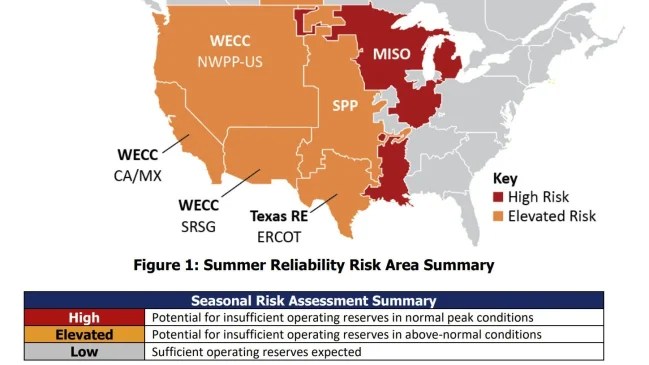
The report goes on to say that Texas’ energy grid may need to use “emergency procedures” to cope with “a combination of extreme peak demand, low wind, and high outage rates from thermal generators.”
The report claims the risks of power grid failure are also attributed to “supply chain issues”, low coal stockpiles, “cyber security threats from Russia”, and “unexpected tripping of solar photovoltaic (PV) resources during grid disturbances.”
But Bloomberg News takes it a step further, blaming the coming outages on “climate change.”
“Blame the heat. Summer in much of the Northern Hemisphere is a typical peak for electricity use. This year, it’s going to be sweltering as climate change tightens its grip,” Bloomberg reported.
“In California, the most populous state, gas supplies are clipped even further because of a pipeline rupture last year that has limited imports. Plus, climate change is fueling drought, severely curbing hydropower supplies. The California Independent System Operator said this month that the state may be at risk of blackouts for the next few summers amid extreme weather.”
Overall, the 46-page report mentions “forced outages” 29 times and calls for consumers to reduce their energy consumption during the summer.
Experts say that in addition to these problems, the majority of the U.S. power grid itself is deteriorating.
“The US is experiencing more outages globally than any other industrialized nation,” said Teri Viswanath, lead economist for power, energy and water at CoBank ACB. “About 70% of our grid is nearing end of life.”
But rather than bankroll much-needed maintenance to the U.S. energy infrastructure, the Biden administration and Congress thought it more politically glamorous to send $40 billion of taxpayer dollars last week to the failed government of Ukraine as aid in NATO’s proxy war with Russia.
Additionally, the Biden administration has continued shutting down pipelines and oil and gas leases despite energy prices skyrocketing from inflation and the Russia-Ukraine conflict.
Forced outages in half the country may sound like an unmitigated failure by the U.S. government, but in reality they’re a key feature of the World Economic Forum’s Great Reset agenda.
After all, Joe Biden said Tuesday that exploding energy prices were part of an “incredible transition” away from fossil fuels.
Biden Says Record-High Gas Prices Part of ‘Incredible Transition’ US Going Through
Samizdat | May 24, 2022
Following the beginning of Russia’s special military operation in Ukraine on 24 February, the US and several of its allies cut off all imports of Russian oil and gas, which added greatly to soaring gas prices for Americans.
President Joe Biden has argued that the current record-high gas prices in his country are part of America’s major transition from fossil fuels.
“Here’s the situation. And when it comes to gas prices, we’re going through an incredible transition that is taking place that, God willing, when it’s over, we’ll be stronger and the world will be stronger and less reliant on fossil fuels when this is over,” he said during a joint press conference with Japan’s Prime Minister Fumio Kishida on Monday.
POTUS then insisted that his administration’s actions helped “keep it [the gas prices] from getting worse — and it’s bad”.
“The price of gas at the pump is something that I told you — you heard me say before — it would be a matter of great discussion at my kitchen table when I was a kid growing up,” Biden said before admitting, “It’s affecting a lot of families.”
House Republican Steve Scalise was quick to respond by telling reporters that Biden is “saying the quiet part out loud now.” In an apparent nod to the Biden administration, Scalise added that “they’re causing you pain at the pump because it’s all part of their radical agenda.”
He spoke as the national average for a gallon of regular gas in the US stood at $4.56 as of Monday, which is more than $0.40 higher than it was just a month ago.
In some US states such as California, the average price for a gallon of regular gas has meanwhile already reached $6.06.
While Biden previously tried to cast the price increases as the fault of Russian President Vladimir Putin, labelling high gas prices “Putin’s price hike”, the recent polls show that Americans aren’t buying it.
A survey conducted by conservative pollster Rasmussen found that beliefs about the importance of rising gas prices were essentially unchanged since November 2021, but that a majority (51%) of American voters surveyed held POTUS responsible for higher fuel prices. Another 26% blamed oil companies for the price hike, while just 15% blamed Putin.
Russian oil shipments hit record high
Samizdat | May 24, 2022
Nearly 62 million barrels of Russia’s flagship Urals crude oil, a record amount, are currently in tankers at sea, according to data from energy analytics firm Vortexa, as cited by Reuters.
However, traders are reportedly struggling to find buyers for some of the cargo as EU countries fail to agree on a possible Russian oil ban. Other buyers have reportedly been shunning Russian crude due to fears of future sanctions.
According to Vortexa, the volume of Urals crude oil on the water is triple the average recorded before February 24, when Russia’s military operation was launched in Ukraine.
“The headline numbers, showing Russian exports are still relatively strong, don’t tell the full story,” Houston-based energy strategist Clay Seigle said, as quoted by Reuters. “Russian oil at sea is continuing to accumulate.”
The number of Urals cargoes at sea with no set destination constitutes 15% of the total, also a new high, Seigle said, adding that some of the oil could be in transit to undisclosed buyers, while others could be unsold cargoes.
Most barrels of Russian crude oil have reportedly headed to Asia, mostly to India and China, while volumes headed to Europe have also increased.
EU president accuses Russia of energy ‘blackmail’
Samizdat | May 24, 2022
European Commission President Ursula von der Leyen on Tuesday accused Russia of “blackmailing” the EU with its oil and gas exports. However, the bloc is in the process of voluntarily cutting itself off from these energy resources, and Moscow has blamed global food shortages on Western sanctions.
Speaking at the World Economic Forum’s annual meeting in Davos, Switzerland, von der Leyen said the EU would “accelerate” its transition to green energy “because of Russia’s blackmailing us with fossil fuels.”
Yet hours before she spoke, German Economy Minister Robert Habeck announced that the EU’s 27 member states would “reach a breakthrough within days” to ban Russian oil imports, upon which many EU states depend. Germany, for example, relies on Russia for around a quarter of its imported oil, while the bloc as a whole sources 27% of its oil from Russia.
Von der Leyen has also promised to reduce the EU’s reliance on Russian gas by 66% this year and eliminate it entirely by 2027, as part of a green energy plan announced last week. At present, 40% of the EU’s gas comes from Russia.
Since the start of its military operation in Ukraine in February, and throughout waves of successive EU and US sanctions, Russia has continued to sell its oil and gas to the EU. Moscow has demanded, however, that importers buy its gas in rubles. More than half of Gazprom’s foreign clients have already opened ruble accounts with the Russian energy giant, according to Deputy Prime Minister Alexander Novak.
Von der Leyen also accused Russia of using “food exports as a form of blackmail,” by allegedly blocking grain shipments out of Ukraine and refusing to export its own supply.
However, Kremlin spokesman Dmitry Peskov said on Monday that the West’s economic sanctions are responsible for rising global food prices, and that Ukraine is free to export its crop through Poland. Peskov also accused Ukrainian naval forces of mining the Black Sea, making shipments “virtually impossible.”
Taking the milk out of babies’ mouths: Food shortages are the new globalist weapon
By Kate Dunlop | TCW Defending Freedom | May 18, 2022
ARE you getting used to the Great Reset? How are you liking the New World Order built on globalist diktat, infection, mass poisoning by inoculation, inaccessible healthcare, inflation, draconian policing, shortages, uncontrolled migration, fear, more fear, and war…
You’ll doubtless be prepared for what’s coming next. It’s not a secret – Bill Gates and his World Health Organisation cohorts have already told us. The next viral releases – Hantavirus, Nipah virus, Marburg, whatever – are all primed and ready to go, together with monkeypox and avian bird flu. All come packaged with their own ‘off the shelf treatments’ from Big Pharma, all guaranteed to be equally as effective as the Covid jabs.
Supply chain problems are already here and will worsen, depending on whatever the next emergency is, and the UK is as well prepared for them as it is for shortages of fuel, gas, and electricity – which is to say not at all.
Now we are being told that a major food crisis is inevitable. Speaking at a Nato conference in Brussels on March 25th of this year, Joe Biden said: ‘Regarding food shortages – yes, we did talk about shortages, and they’re going to be real.’ He’s a man of his word.
Previously the blame was put on ‘climate change’, Brexit, shortages of foreign hands to pick and harvest crops, not enough lorry drivers, lockdowns, the ‘management’ of Covid, and the mass culling of chickens due to bird flu.
Now the war in Ukraine and sanctions against Russia are delivering shortages of gas, oil, and wheat. Russia and Ukraine together are the largest exporters of wheat and other grains in the world and Russia the largest exporter of oil and gas. Their impact on global logistics and food supply is immense.
At the same time, food production and processing facilities in the US seem to be spontaneously combusting. Since August last year, more than 16 such plants have been damaged by fire.
In September, a meat processor in Nebraska lost five per cent of the country’s beef supply. In March this year, a frozen food plant in Arkansas and a potato processing site in Maine both burned down. Last month, two planes crashed into two food plants, causing massive destruction – one at a General Mills facility in Georgia and another at a potato processing unit in Idaho.
Florida is having its worst orange crop in 70 years, with 90 per cent of trees affected by ‘citrus greening,’ a disease spread by the invasive Asian citrus psyllid bug, which was first found in China, then India and Saudi Arabia. Today, every citrus grove is infected. The impact on farmers already suffering from Covid restrictions is disastrous.
Russia and Belarus are two of the biggest global exporters of fertiliser and fertiliser-related products, accounting for 10 billion dollars activity per annum. The war and the sanctions have damaged the fertiliser market, with prices hitting all-time highs in March.
China’s draconian ‘Zero Covid’ approach and its export ban on fertiliser since last summer has added to farmers’ woes and hit food production costs.
Now it’s baby formula milk, with shortages across the US since February this year. CBS News reports that some 40 per cent of top-selling formula products were ‘out of stock’ at the end of April, according to an analysis from Datasembly.
The Wall Street Journal suggests two reasons for the shortages. It says supply chain issues caused by the Covid-19 pandemic worsened after Abbott Labs, a major formula manufacturer, voluntarily recalled some products and closed a plant in Michigan. Then there was a Food and Drug Administration investigation into complaints related to four infants who were hospitalised, two of whom died.
The White House reaction last week was woeful, with the tone-deaf press secretary Jen Psaki saying the government is ‘doing its best’ and that manufacturers are working at full capacity. In a national health emergency she went on to hint that some mothers are hoarding formula.
But, as with everything in the Magic Kingdom of Biden, things are not what they seem. The legacy media are slow to show locked cabinets in Walmart and empty shelves in other stores, though news that the government is transporting supplies of baby formula to border migrants is beginning to leak, as Tucker Carlson reports.
Eric Boehm, writing in Reason, confirms that although some of the shortages stem from the closure of the Abbott plant, there were already longstanding market problems. A closer look at US trade and regulatory policies shows that government is primarily responsible for the shortages.
According to the New York Times, ‘baby formula is one of the most tightly regulated food products in the US, with the Food and Drug Administration dictating the nutrients and vitamins, and setting strict rules about how formula is produced, packaged, and labelled’.
The US formula market was valued at 3,653 million dollars in 2019 and projected to reach 5,811 million dollars by 2027. The Covid-19 pandemic brought an upsurge in demand due to panic buying on the back of shortage fears.
Rising numbers of American parents are sourcing ‘unapproved’ European formula, even though it attracts an 18 per cent tariff quota. Some are desperate for supply, but others choose European brands because they offer options such as goat’s milk or milk from pasture-raised cows, which are ‘rare or non-existent in an FDA-regulated form in the US’.
Others consider EU products to be of higher quality due to stricter content regulations, including important levels of DHA (an omega-3 fatty acid), which are not required in the US. Almost no American baby formula would meet EU standards and many parents worry about adulteration.
Americans pay well over the odds for European formula, with one website selling product from Germany at 26 dollars for a 400-gram box, about four times the price of the top US formulas.
In April 2021, US Customs and Border Protection agents in Philadelphia seized 588 cases of formula worth around 30,000 dollars. The formula was said to have violated the FDA’s ‘import safety regulations.’ According to Twitter chatter, the FDA issued a fake recall of European formulas in 2021 and has regularly seized legal personal-use shipments.
Plain old natural disaster coupled with bureaucratic interference is not what is going on here. The US baby formula shortage is neither due to incompetence nor maladministration – it is an attack on the most vulnerable in society; part of a deliberate policy to keep chaos bubbling at peak in the service of the Great Reset.
We know what is going on. In 1974, Henry Kissinger said: ‘Who controls the food supply controls the people; who controls the energy can control whole continents; who controls money can control the world.’
The imminent global food crisis is being blamed on Russia, but the truth is rather more complex
Just-in-time supply chains and globalism may lead to global hunger
By Dr. Mathew Maavak | Samizdat | May 18, 2022
The ongoing Russia-Ukraine conflict is undoubtedly impacting global grain supplies, as well as the means of growing crops around the world. But is the looming global food crisis solely Russia’s fault – as spun by the Western media machine?
Only a few months ago, Covid-19, government-imposed lockdowns and climate change were repeatedly blamed for this scenario.
A recent White House Joint Statement by US President Joe Biden and EU leader Ursula von der Leyen clearly singled out the supposed new culprit: “We are deeply concerned by how Putin’s war in Ukraine has caused major disruptions to international food and agriculture supply chains, and the threat it poses to global food security. We recognize that many countries around the world have relied on imported food staples and fertilizer inputs from Ukraine and Russia, with Putin’s aggression disrupting that trade.”
The concept of global food security these days appear as fleeting as Biden’s mnemonic prowess. It has been 12 years since the world was shaken by the Arab Spring, a series of events in which hunger played a significant role, and which, in turn, led to violent uprisings and yet-unresolved civil wars in Libya, Yemen and Syria. Big Tech, Western officials and influencers fuelled this mayhem in the name of ‘freedom and democracy’ but never proffered any concrete solutions. Instead, global hunger grew unabated, while its root causes were explicated through the lens of ‘climate change’ and ‘global governance’.
In the meantime, right at the doorsteps of the Tech giants, the streets of San Francisco were increasingly populated by the homeless and strewn with human faeces and discarded needles from drug abuse. Even a new urban art genre emerged in the form of poop graffiti! Nothing better represents the disconnect between the lofty promises and septic realities of Silicon Valley.
Here is something else for the reader to ponder: Contact-tracing technologies that were used to lock down societies were never trialled to connect the poor to nearby farmers markets, food banks and soup kitchens. A rational person cannot be blamed for suspecting that the intention all along was to eviscerate small-scale farmers, grocers and traders during lockdowns and thereby render citizens prostrate before governments and Big Business. As for technocrats who lap up the smarmy fantasies of the World Economic Forum (WEF), what lessons have they learnt since the fateful Arab Spring?
Here we look at two inexcusable failings of the purveyors of global governance. These are linked to the very issues which Biden and von der Leyen are using to scapegoat Russia.
National granaries
The Arab Spring and its bloody aftermath should have taught governments a lesson about the imperative of establishing new national granaries. Well-maintained facilities can store wheat and corn, amongst other goods, for more than 10 years. Individuals can extend this shelf-life to a whopping 31 years under proper conditions.
Grain stats worldwide also raise questions over government commitments to food security. Global wheat production, for instance, has steadily increased during the last decade. According to a Statista.com brief on Jan 27: “The global production volume of wheat came to about over 772 million metric tons in the marketing year of 2020/21. This was an increase of about ten million tons compared to the previous year. Wheat stocks is [sic] also estimated to increase to about 294 million metric tons worldwide by 2021.”
Dr. Mathew Maavak is a Malaysian expert on risk foresight and governance.
Featured Video
Chinese jet fuel and the myth of energy independence
or go to
Aletho News Archives – Video-Images
From the Archives
The Dirty Little Secret behind the “Global Terrorism Index”
The Omission of Israeli Terrorism in the Occupied Palestinian Territories
By Karin Brothers | Global Research | December 6, 2014
… The Israeli settlements — all of which are illegal – have been identified as a major impediment to peace. The refusal of a major “global” terrorism report to name the Israeli settlers as one of the groups most responsible for terrorism not only misrepresents a major source of regional violence but exposes the Global Terrorism Index as a propaganda tool that supports a U.S. agenda.
In recent years, governments have been attempting to thwart terrorism by blocking supportive fund-raising. When it comes to Israeli settlements, however, the US and Canada actually encourage fund-raising by giving organizations (such as Christian Friends of Israeli Communities (CFOIC) and the Jewish National Fund) financial support in the form of donor tax-deductions.
Charities which provide funds for the Israeli settlements should be regarded as terror-financing organizations. They should not only lose their tax-deductible status, but they should be banned because they support the violation of international humanitarian law. The terror-financing laws that are being strictly enforced for Muslim charities should be applied to Christian and Jewish charities as well. … Read full article
Blog Roll
 Aletho News
- Chinese jet fuel and the myth of energy independence
- Ukraine Sea Drone Fired From Libya Hit Russian Tanker in Mediterranean
- IRGC: Iranian forces launched no attacks during ceasefire hours
- Trump Administration Moves To Automate U.S. Military Draft Registration
- Spain orders reopening of Tehran embassy, condemns Israel’s carpet bombing of Lebanon
- Israel faces ‘unsustainable’ strategic crisis following 40-day war against Iran: Analyst
- Iran restricts Hormuz access to 15 vessels per day under ceasefire terms: Report
- The ‘Opposition Party’ Has Done Nothing to Stop the Iran War and Much to Goad Trump Into Continuing It
- Moscow backs Tehran on status of Lebanon in US-Iran deal
- How UK Regulator Ofcom Quietly Bypassed International Law to Police American Speech
- If Americans Knew
- Amnesty: Urgent – Protect Lebanese civilians from brutal escalation in Israeli attacks
- Is The War Against Iran Over?
- Inside the Israeli army’s propaganda wing
- Hundreds of Gaza Amputees Stranded in Legal Limbo
- The gallows law: Israel moves toward executing Palestinian children
- Tucker Carlson: The Path to Peace requires ending ‘special alliance’ with Israel
- This is ceasefire? Israel’s biggest massacre yet in Lebanon, another journalist killed in Gaza – Daily Update
- Tucker Carlson on Israel: This Is the Behavior of an Ally? Really?
- Gazans face a triple crisis: severe shortages of water and bread, healthcare in tatters
- NY Times reports how Netanyahu took the US into Iran War
- No Tricks Zone
- An Inconvenient Tree: Uncovered In Alps… Europe Much Warmer Than Today 6000 Years Ago
- New Study Reports A 60% Slowdown In Greenland’s Ice Loss Rate In The Last Decade
- Low Intensity Tornado Wrecks Major Solar Farm, Creating A Potential Toxic Dump
- New Study Finds Warming Saves Lives…Cold Temperatures 12 Times More Deadly Than Excess Heat
- German Science Blog Accuses PIK Climate Institute Of Hallucinating Climate Tipping Points
- Devastating Assessment Of Comirnaty Vaccine By Former Senior Pfizer Europe Toxicologist
- New Study: CO2 Is ‘Effectively Negligible’ As An Explanatory Climate Change Factor Since 2000
- Former Pfizer Toxicologist Dr. Helmut Sterz Tells Bundestag Hearing Pfizer Vaccine Should Have Never Been Approved
- Energy Expert: Germany’s Nuclear Phaseout Was A “500 Billion Euro Mistake”
- New Research: South Australia’s Mid-Holocene Sea Surface Temperatures Were 4°C Warmer Than Today
 Aletho News