Biden declares US energy emergency
Samizdat | June 6, 2022
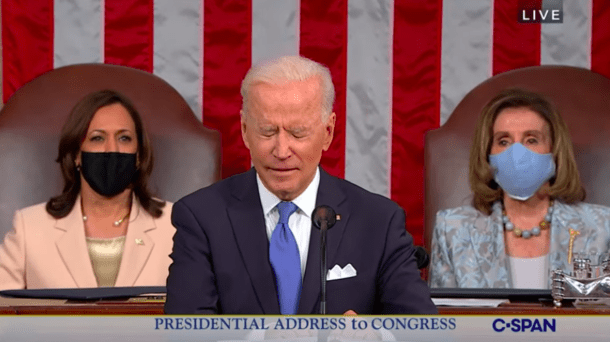
President Joe Biden has blamed Russia for another crisis, saying the US might not be able to generate enough electricity to meet consumer demand partly because of Moscow’s military offensive against Ukraine.
The president declared an energy emergency on Monday, saying national security and quality of life are jeopardized by potential shortfalls in power supplies. He invoked the Defense Production Act – originally part of an industrial mobilization effort in response to the Korean War – to spur domestic production of solar panels and other forms of “clean” energy to boost power supplies.
“Multiple factors are threatening the ability of the United States to provide sufficient electricity generation to serve expected customer demand,” Biden said in his emergency declaration. “These factors include disruptions of energy markets caused by Russia’s invasion of Ukraine and extreme weather events exacerbated by climate change.”
Increased reliance on renewable energy sources has been blamed for disruptions to power service in such states as California and Texas. Solar and wind power are intermittent, so periods of high demand aren’t always matched by supplies. For instance, wind turbines froze up during an historic winter freeze last year in Texas, contributing to blackouts that caused 246 deaths and at least $195 billion in damage.
Biden’s emergency declaration included a two-year exemption from tariffs on solar panels from four Southeast Asian countries. The proposed tariffs had been blamed for delaying major solar projects in the US. About three-fourths of the solar modules installed in the US are imported from Southeast Asia.
The president has blamed Russia for record US fuel prices and a surge in inflation to a 40-year high. He’s also attributed a looming global food crisis to the Russia-Ukraine conflict.
Poles told to forage for wood to heat homes
Samizdat | June 6, 2022
Authorities in Warsaw have allowed citizens to forage for firewood in forests to keep their homes heated amid spiralling energy costs. Poland is in the midst of a coal shortage after banning Russian imports.
“It is always possible, with the consent of foresters, to collect branches for fuel,” Deputy Minister of Climate and Energy Edward Siarka was quoted by Next Gazeta as saying on Monday.
Those wishing to gather wood must first undergo training and obtain permission from the local forestry unit. The report went on to clarify that people can only take branches already lying on the ground, and cannot cut down trees.
“Only branches can be gathered. At the same time, the collected branches cannot be thicker than seven centimeters,” said Katowice Directorate of State Forestry official Marek Mroz.
He explained that branches should be taken to the local forester, who will issue an invoice. Collectors will have to pay between seven and 30 zlotys ($7.02) for approximately 0.25 cubic meters of firewood.
Polish Prime Minister Mateusz Morawiecki’s government has blamed the war in Ukraine for skyrocketing energy costs. Critics, however, say the conflict is only partially to blame, arguing that costs have risen for the past seven years. Inflation in Poland has climbed to 14% in recent weeks, with fuel prices hitting 8 zlotys ($1.87) per liter.
Demand for raw materials in Poland has far exceeded domestic output since a ban on Russian coal was imposed. Throughout the military conflict in Ukraine, Warsaw has been calling for a complete embargo on Russian energy. In March, the EU nation said it would end all Russian energy imports, including oil, gas, and coal by the end of 2022.
According to media reports, Poland’s wood imports from Russia and Belarus stopped completely at the outbreak of the conflict, and those from Ukraine have fallen by around 75%.
Hezbollah: US First Side to Blame for Preventing Lebanon from Gas Drilling
Al-Manar – June 6, 2022
Head of Hezbollah’s Executive Council Sayyed Hashem Safieddine stressed on Sunday that the United States is the first side to blame for preventing Lebanon from gas drilling.
In a local ceremony in south Lebanon, Sayyed Safieddine said “Lebanon has potentials to extract gas and oil off its shores,” calling on the Lebanese state not to subdue to all forms of pressures exerted by foreign sides in this regards.
The Hezbollah official called on the Lebanese state to officially announce the Lebanese maritime borders and the disputed areas, “in order for the Resistance, Army and People to throng together and retrieve Lebanon’s rights regardless of the US stance.”
Sayyed Safieddine in this regard, stressed the importance of Lebanese unity in order to cope with the country’s political and economic crises.
“Resistance is the only choice to defend Lebanon’s wealth and preserve our victories,” he said in remarks carried by Al-Manar.
Biden’s Most Preposterous Lie Is Too Much Even For The Washington Post

By Francis Menton | Manhattan Contrarian | June 03, 2022
When President Biden talks, there may or may not be any connection between what he says and the real world. Yes, you need to give every politician some leeway, since most of what any politician says will fall in the general realm of political exaggeration or hyperbole. But even within the disreputable category of politicians, Biden can take the lack of connection with reality to a whole new level.
You may have your own favorite among Biden’s preposterous statements. For me, the very most preposterous is one that he has been making repeatedly for the past several months, namely that his energy plans, including expansion of wind and solar electricity generation together with fossil fuel suppression, will save American families the very specific amount of $500 per year each. This claim has popped up in multiple places and multiple formulations. One example came in the State of the Union speech back in March, where Biden said, “Let’s cut energy costs for families an average of $500 a year by combatting climate change.”
It’s just not possible for anyone who thinks about the subject for even a few minutes to believe that building more and more wind and solar generation facilities as our primary sources of energy will do anything other than vastly increase the costs of energy for the American people. Even in the early phases of the process, where wind and solar generation are well less than half of electricity generation (and electricity is then only about a third of total energy consumption), you obviously need full backup from some dispatchable source, almost always fossil fuels, to make your electricity grid work. That means that you will come to have two fully redundant electricity generation systems, when previously you had only one to produce the same amount of electricity. Two fully redundant systems can’t possibly be cheaper than just one. Then, if you insist on phasing out the fossil fuel backup and replacing it with battery or some other storage, you have to add the cost of that storage to the mix. Readers here know that the cost of backing up wind and solar electricity generation with battery storage is truly monumental, potentially a large multiple of the entire U.S. GDP. For more on that subject, see some of my prior posts, for example here and here.
And this is not just a question of models and projections that can be debated. As more and more wind and solar generation facilities have been added to the electrical grid in various places, the inevitable dramatic rise in cost to the consumer has in fact occurred. Steven Hayward at PowerLine in a post on Wednesday reproduces graphs showing the results for two of the most enthusiastic adopters of the wind and sun for electricity, California and Australia. Here is the chart for California:
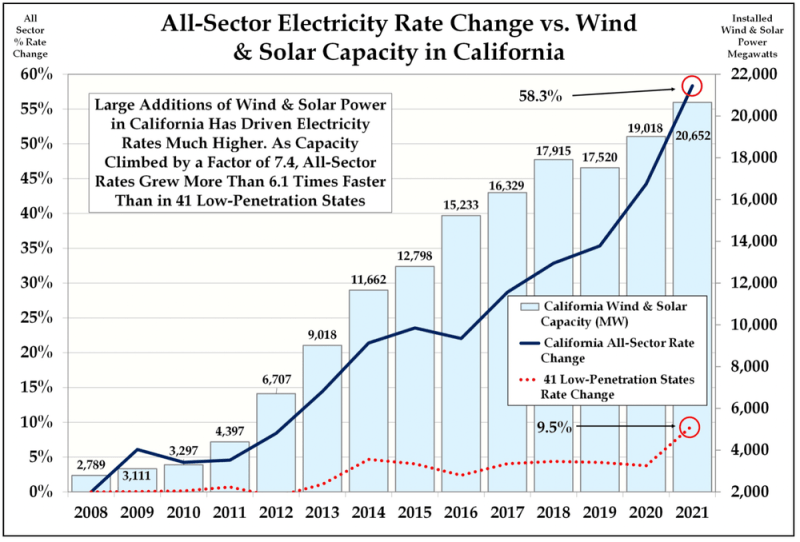
As California has added more and more wind and solar generation, its electricity rates to the consumer have followed a sharply increasing pattern, up some 58.3% from 2008 to 2021. Even after adding all that renewable capacity, the percent of California’s electricity production from the wind and sun in 2020 was still only about a third, according to a February 2022 Report from the California Energy Commission. Thus California has not yet even begun to confront the challenge of phasing out fossil fuel production and trying to back up its electricity grid with batteries — that will occur when the percentage of electricity from intermittent renewables gets past 50%. But note that dotted red line near the bottom of the chart: the 41 states with “low penetration” of wind and solar generation only had rate increases of 9.5% between 2008 and 2021.
And here’s the chart for Australia:
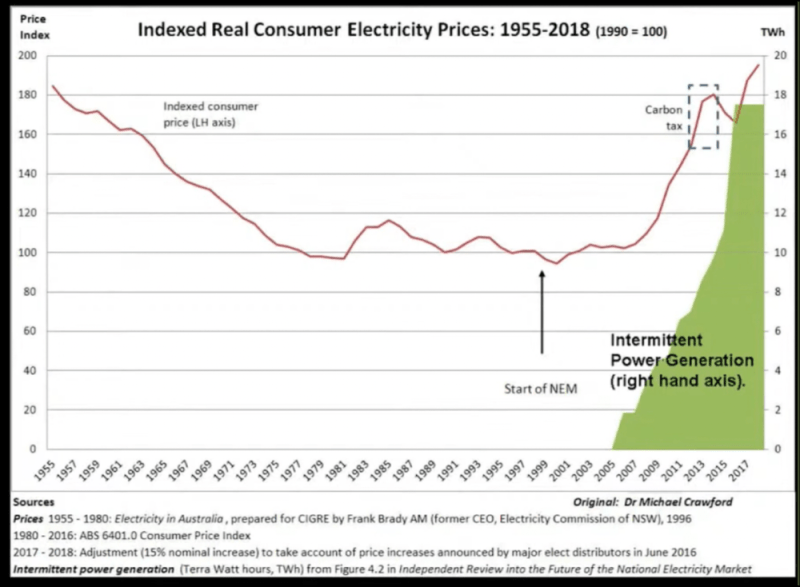
After declining gradually for decades, Australia’s consumer electricity prices have about doubled since 2005. The doubling coincides with the rapid addition of new wind and solar generation facilities since that time. And as with California, Australia’s generation from the intermittent renewables remains well below 50% of electricity generation, meaning that again the vast cost increases inherent in phasing out fossil fuel backup have not yet begun to hit to any significant degree.
Similar patterns of electricity prices soaring as renewable generation increases can be found in other places with high penetration of renewables, for example Germany and Denmark.
With these data and plenty more like them out there, Biden continues to double down on his assertion of the supposed $500 per family per year “savings” from his plan for green energy transition. In a an op-ed published in the Wall Street Journal on May 30, Biden put it this way:
A dozen CEOs of America’s largest utility companies told me earlier this year that my plan would reduce the average family’s annual utility bills by $500 and accelerate our transition from energy produced by autocrats.
That line finally got the Washington Post’s “fact checker,” Glenn Kessler, on the job. Kessler’s June 2 piece has the headline “Biden’s fantastical claim of $500 in annual utility savings.” Kessler started by tracking down a White House transcript of the meeting that Biden held in February with the group of utility executives. There was no mention at all of a supposed $500 projected saving in “annual utility bills”:
But when we located the transcript of Biden’s conversation with utility executives on Feb. 9, we found no reference to $500 in utility savings. The figure was also not mentioned in the White House readout of the meeting.
When Kessler asked the White House for the source of Biden’s number, he was then referred to a report of something called Rhodium Group that projected an approximate $500 per household saving by 2030 not from lower utility bills, but largely from consumers switching to electric cars. Putting aside for a moment whether consumers switching to electric cars could save anybody any money as the government strives to destroy the electrical grid, Kessler points to these obvious flaws in Biden’s statement:
But he didn’t hear that [$500 figure] from utility executives. And the report he is citing is not about household utility-bill savings. Most of the claimed savings comes from the reduced cost of driving. And the estimate is for 2030 — when he would no longer be president, even if he served a second term.
Kessler then awards Biden four Pinocchios. And that’s without even figuring out that Biden’s plan to add more wind and solar to the grid is guaranteed to make electricity prices soar.
UK to ban all air travel by 2050
By Keeane Bexte | The Counter Signal | June 1, 2022
A report commissioned by the United Kingdom (UK) government says the entire country will need to ban most air travel within ten years and all air travel by 2050 to abide by impossibly lofty climate change laws.
“In her last significant act as Prime Minister, Theresa May changed the UK’s Climate Change Act to commit us to eliminating all greenhouse gas emissions in the UK by 2050. This decision is based on good climate-science, was a response to a great wave of social protest and has been replicated in 60 other countries already,” the Absolute Zero report commissioned by the UK government explains.
According to the authors of the report, the only way that the UK government can meet their Absolute Zero obligations is to phase out all air travel, implementing an outright ban in 2050 until such a time as the government can conceive of a means of producing planes that produce zero greenhouse gases at any point during an aircraft’s production or use.
It shouldn’t need to be stated, but this is absolutely impossible.
Nonetheless, the authors say that “All airports except Heathrow, Glasgow and Belfast [will] close” between 2020-2029 and “All remaining airports [will] close” by 2050.
The authors continue, saying that under the current legislation, the following changes to daily life will need to be taken as all will be illegal in 2050: stop using aeroplanes; end all shipping; take the train, not the car; rideshare; use an electric vehicle; reduce energy consumption, including and especially heating; reduce fertilizer use; reduce cement and steel use and imports, etc.
The authors say that progressively limiting red meat consumption will also be necessary, as lamb and beef will be outlawed in the UK by 2050.
“In addition, obeying the law of our Climate Change Act requires that we stop doing anything that causes emissions regardless of its energy source. This requires that we stop eating beef and lamb – ruminants who release methane as they digest grass – and already many people have started to switch to more vegetarian diets,” the report reads.
This is quite an astounding proposal, as the authors say that under the climate change legislation, all fertilizer use will need to be “greatly reduced,” as will all processed foods, and the total energy required to cook or transport food must be reduced by 60 per cent of today’s levels.
So, the UK will not produce meat, will not use fertilizer to produce vegetables, will reduce other food imports to avoid greenhouse gas emissions, and will not produce or import processed food as a substitute.
It isn’t clear what, if anything, the authors and the government expect the people of the United Kingdom will eat in 2050. By all accounts, this appears to be a policy of misery and death.
Radical climate protection: Air travel banned in Great Britain from 2050?
Free West Media | June 4, 2022
Great Britain has adopted an ambitious climate and energy policy. By 2050 all CO2 emissions are to be eliminated from the British Isles and Prime Minister Johnson wants to make Great Britain a model country for the energy transition. As early as 2019, the British climate targets were formulated in a comprehensive report entitled “Absolute Zero”.
The report is updated at irregular intervals. This time the tone of the authors has changed. They are now pointing out that the ambitious goals can only be achieved through drastic adjustments and changes in behavior.
The report offers a formidable refutation of the case that a solution to the climate emergency exists in the form of breakthrough technologies. The report’s lead author, Julian Allwood, Professor of Engineering and the Environment at the University of Cambridge, stressed that no new technologies were available to replace our current energy needs.
“In the age of climate emergency, one of the central myths that breeds complacency is that breakthrough technologies will gallop to the rescue, when instead we require radical action,” Allwood said.
Specifically, in order to meet its Absolute Zero commitments, the UK government has no choice but to phase out all air travel by 2050 and then impose a total ban – until a way is found to produce aircraft that do not generate greenhouse gases at any time during manufacture or use.
The authors further specify their forecast to the effect that “all airports except Heathrow, Glasgow and Belfast should be closed between 2020 and 2029” and “all other remaining airports should be closed by 2050”.
But that’s not all. If the current legislation remains in force, further drastic changes in daily life would have to be made, since they would be illegal in 2050: no longer use airplanes; cease all shipping traffic; use the train instead of the car; use carpooling; use an electric vehicle; reduce energy consumption, including heating; reduce the use of fertilizers; reducing the use of cement and steel, imports etc. It will also be imperative to limit or ban the consumption of red meat as lamb and beef will be banned in the UK in the future.
“Additionally, to comply with the Climate Change Act, we must refrain from anything that causes emissions, regardless of the energy source. This requires that we refrain from eating beef and lamb,” the report states.
German-speaking public kept in the dark
It’s also worth taking a look at “Absolute Zero” for Germans, because the German climate protection requirements are very similar to the British ones. The only thing is that the inevitable consequences of a draconian climate policy are being hidden from voters.
In Austria, skyrocketing fuel prices and a decidedly car-hostile traffic policy are paralyzing car traffic. But those who switch to the train and prefer public transport are often left out in the rain these days in the truest sense of the word.
Since the introduction of the climate ticket, there are no longer enough seats on the trains. Hundreds of people traveling and commuting have already been expelled from the train because there is no space for them. Instead of purchasing new train sets and expanding the offer with foresight, it was simply made cheaper in accordance with the green doctrine and on behalf of Black-Green coalition, in order to celebrate this catastrophe with higher utilization figures as a “success” in the end.
Parking space brawls
In Vienna, this policy has led to even further extremes. The shortage of parking spaces there recently led to a mass brawl among Ukrainians.
The problem is home-made: For years it has been observed how the previous city administrations kept reducing parking spaces. This happened in part through opting for “bicycle parking spaces” or art installations that are not used by anyone and are only noticed by drivers looking for a parking space.
With the Ukraine crisis, the move was made to allow refugees to park for free, wherever they wanted, until May.
They were then deprived of this luxury and Range Rovers, Porsches and other expensive wheels now vie for the already scarce parking spaces. In line with the “sustainability” of Agenda 2030, people are first deprived of their freedom and self-determination of individual transport, in order to then banish them to train stations from which they cannot be transported to any destination due to a lack of capacity.
Fly-shaming
In Sweden, a movement was formed in 2018 to have a hundred thousand people sign up and pledge not to fly for a year. That led to ‘flight-shaming’ [flygskam]. As a result, if one looks at national statistics on take-offs in Sweden, the domestic ones have fallen and the government has responded by promising to invest more in rail as an alternative to aviation. Except that trains do not cross oceans.
Led by a small group of celebrities, including Olympic winter gold medallist Bjorn Ferry and the musician Malena Ernman, who also happens to be climate activist Greta Thunberg’s mother, their “commitment” to give up flying forced Swedes to comply.
The Facebook group’s Jag flyger inte – för klimatets skull [I’m not flying – for the sake of the climate] campaign managed to lower the number of international flights at Swedish airports by 4 percent within a year.
‘Putin’s Price Hike’? US National Gas Prices Officially Double Since Biden Took Office
Samizdat | June 4, 2022
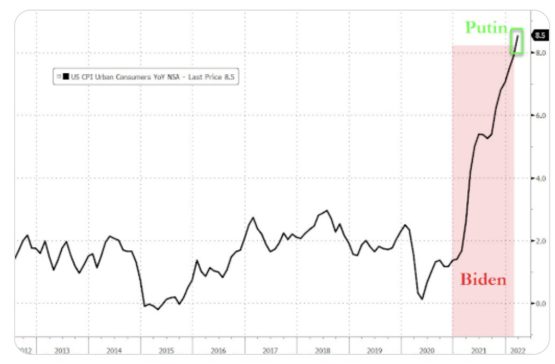
Gas prices began to climb soon after the 2020 election, with President Joe Biden blaming Covid, and then Vladimir Putin, and insisting that his administration’s policies had nothing to do with the situation. The Russian president dismissed Biden’s claims, saying Western ruling elites’ greed, “mistakes, myopia and ambitions” were responsible.
The national average price of a gallon of gasoline has officially more than doubled under President Biden, climbing from $2.39 a gallon on 20 January 2021 to $4.81 a gallon as of Saturday, the American Automobile Association (AAA) has reported.
According to the AAA’s national stats, Californians are paying the most, with the state’s retail price averaging $6.29 a gallon. Meanwhile, observers in northern California outside San Francisco spotted prices as high as a whopping $9.60 a gallon for regular on Friday afternoon. Georgia enjoys the lowest average prices in the union, with its residents paying $4.25 per gallon on average.
For perspective, the Ford F-150, America’s best-selling vehicle, has a 23-gallon fuel tank, meaning that someone who owns one in California would have to spend nearly $145 to fill ‘er-up. Georgian F-150 owners, meanwhile, would have to fork out about $97.75.
Gas prices unexpectedly became a top concern for the Biden administration amid the looming November midterms, with the White House tapping the Strategic Petroleum Reserve this week and expressing support for an OPEC move to boost global output after spending months trying to blame forces outside its ability to control and foreign governments.
Republicans place the blame squarely at the feet of Biden and the Democrats, suggesting that the ruling party’s federal spending programmes and ill-considered push away from hydrocarbons toward renewable energy were responsible.
“Joe Biden’s war on American energy has forced families across the country to empty their wallets to fill their tanks,” RNC Chairwoman Ronna McDaniel said in a statement.
“Unfortunately, Biden is doubling down on his disastrous agenda because he’s not the one paying the price – the American people are.”
Biden Press Secretary Karine Jean-Pierre deflected the administration’s responsibility in a briefing on Tuesday, blaming a resurgent pandemic and Putin. “This – when we talk about the gas prices right now, this is indeed Putin’s gas hike. This is what we have seen in the most recent months of what we’ve seen at the gas pump. And so, that is a fact,” she said.
The Russian president addressed attempts by Biden and other Western leaders to blame him and Moscow for the inflation, food and fuel crunch facing the US and its European allies. “The truth is that the current problems that millions of people in the West face are the result of many actions by the ruling elites of their states, their mistakes, myopia and ambitions. These elites are not thinking about how to improve the lives of their citizens. They are obsessed with their own selfish interests and surplus profits,” Putin said in a briefing back in March.
Global food crisis a result of policy mistakes by US and EU: Putin aide
Samizdat | June 3, 2022
The looming global food crisis that could result from skyrocketing food prices was enabled by a series of policy mistakes by Washington and Brussels, Maksim Oreshkin, economic adviser to Russian President Vladimir Putin, told RT.
The conflict in Ukraine alone could not have caused the crisis on such a massive scale, Oreshkin said.
The UN Food and Agriculture Organization’s international food price index shows that between April 2020 and April 2022, global food prices rose by more than 60%. The increase occurred for the most part before February 2022, when Russia launched its military operation in Ukraine.
In the four years from 2016 to 2020, the index grew by less than 7 points, but it increased by a whopping 27 points, from 98.1 to 125.7, in 2020-21. After the second year of the pandemic, the index stood at 141.1.
Since Russia’s military operation began, the index has risen by a further 17 points.
“Swings like that, with such huge increases in prices, are not happening due to one reason. It’s always a combination of a number of reasons which is leading to such a result,” Oreshkin, Russia’s economic development minister from 2016 to 2020, said.
He points to America’s overreaction to the Covid-19 pandemic as one of the first major factors that triggered the food price hikes. Since February 2020, the US “increased the money supply by almost 40%,” he said, adding that the $6 trillion the US printed to support its economy ended up flooding global markets, and led to the rise in food, commodity and energy prices.
Europe’s over-reliance on renewable energy, which drew resources away from food production, and on short-term gas contracts that led to gas price hikes in late 2021, are also significant factors, according to Oreshkin.
In early May, German Economic Cooperation and Development Minister Svenja Schulze said that the focus of some nations on green energy contributed to the food shortage. According to Schulze, up to 4% of biofuel in Germany is made from food and animal feed. “It needs to be reduced to zero, and not just in Germany but potentially internationally,” she told Bild at the time.
Oreshkin said these factors also led to a decrease in fertilizer production, which in turn hit harvests and drove up food prices. The waves of sanctions unleashed by the US and its allies on Moscow after the start of the military operation in Ukraine significantly exacerbated the crisis.
“It’s about a lot of sanctions imposed on the different fertilizer producers in Belarus, in Russia, it’s sanctions on ships, it’s sanctions on payments which halted trade,” he said, adding that Russia and Belarus both want “to export more food … more fertilizers,” but the “sanctions are blocking access to the global market and, of course, limit supply.”
According to Oreshkin, the 20 million tons of wheat supposedly blocked in Ukraine, which has become a hot topic among Western politicians and media, account for 2.5% of global wheat production. He also stated that Russia is prepared to partially substitute potential losses of Ukrainian wheat by exporting 13 million more tons this year than in 2021.
He also pointed to global food inequality as a root cause. “In reality, there is enough food on this planet,” but developed nations such as the US are simply consuming much more food than the others, he said, adding that people in the US consume on average “more than 50% calories per day more” than people around the world.
“They’re printing the money, they’re taking all the food, and of course they are taking the food from those who cannot afford it.”
He added: “if countries like the United States consume less, there will be enough food for everyone.”
Political West ‘shocked’ by polls indicating most of world population likes Russia
By Drago Bosnic | June 3, 2022
Russophobia is defined as a racist or supremacist attitude towards Russia, its people, culture, etc. It most certainly isn’t a new phenomenon and it has intermittently been spiking or subsiding at various historical stages. This is especially true for the political West and their client states, particularly those with predominantly (neo)liberal views. In the last several months, especially since the start of Russia’s special military operation, this hatred has reached levels which can only be described as borderline mass psychoneurosis. Oftentimes, it’s so extreme, that it should be treated by highly trained medical specialists such as psychiatrists and studied thoroughly by clinical psychologists.
There were some claims that anti-Russian sanctions and generally anti-Russian actions of various Western institutions, governments and supranational organizations were not aimed against the Russian people, Russian culture, language, etc. And yet, this is precisely what has been happening. Sanctions imposed on Russia were designed specifically to target and bring down the Russian economy. And it’s not even a conspiracy theory, as most Western leaders openly stated this was their primary goal.
This attempt didn’t only fail miserably, but it even backfired, sending Western markets into a frenzy of high inflation and economic stagnation (or even recession), otherwise known as stagflation, a dreadful and volatile mix for anyone’s economy. And yet, the political West didn’t only fail to address the mounting issues resulting from their own actions, but they also decided to capitalize on these exact problems to push for more Russophobia by blaming Russia for literally everything.
That’s precisely how we got the mythical “Putin’s price hike” in the US, which started over a full year before Russia’s special military operation. However, even in the atmosphere of raging, media-incited hatred, people affected by the so-called “Putin’s price hike” are well aware this has nothing to do with Russia’s president. And yet, the hatred not only needs to be kept alive, but also fanned up to new extremes.
The latest trend is to blame Russia for global food shortages, including the shortages of baby food in the US. Some Western officials went as far as to blame Russia for the widespread man-made famine which has been ravaging Yemen for the last 7 years. One problem with this, however, is the involvement of the political West and its regional allies and clients, which have been keeping Yemen in a state of perpetual siege, blocking food imports and bombing the country daily. The sheer amount of hypocrisy and mental gymnastics necessary for one to blame Russia for the war crimes committed by the political West requires a thorough analysis in itself. Some of it medical.
When it comes to global food shortages, they can only be explained as entirely man-made. Russia expects a record harvest this year, as do many other countries. So, how come there is a shortage announced months in advance? Well, we should ask those announcing it. The statements about coming food shortages also drive up the prices, but the actual reason behind it can only be explained by Western sanctions which are preventing normal trade between Russia and other countries which need Russian food. The political West is also using this to capitalize on Russophobia, by blaming the Russian counteroffensive in Ukraine as the reason behind food shortages. A portion of the accusations is heavily focused on the nonexistent Russian blockade of Ukrainian ports. But the crews of ships stranded in Odessa, Nikolayev and Kherson tell a very different story. It was the Kiev regime’s placement of thousands of sea mines that makes sea transit from Ukraine virtually impossible.
But, it’s all Russia’s fault in the minds of clinical Russophobes. And no matter how much evidence is presented to disprove this false narrative (just one of many), they will find ways to spin it to their advantage. Still, the vast majority of the world simply doesn’t believe any of it. And the fact that the world doesn’t fall for Russophobia and anti-Russian propaganda is what truly “shocks” the political West. The ever-belligerent, (neo)colonialist block cannot comprehend why the world doesn’t share their views. Well, maybe because much, if not most of that same world has suffered tremendously under the jackboot of global (neo)liberalism for decades, centuries even. The most recent polls confirm this. The Guardian published the “shocking” statistics on 30 May.
“The sharp polarisation between mainly Western liberal democracies and the rest of the world in perceptions of Russia has been laid bare in an annual global poll of attitudes towards democracy. The annual Democracy Perception Index covers 52 countries in Asia, Latin America, the US and Europe. Majorities in Greece, Kenya, Turkey, China, Israel, Egypt, Nigeria, Indonesia, South Africa, Vietnam, Algeria, the Philippines, Hungary, Mexico, Thailand, Morocco, Malaysia, Peru, Pakistan, Saudi Arabia and Colombia thought economic ties with Russia should not be cut. Also, positive views of Russia have been retained in China, India, Indonesia, Egypt, Vietnam, Algeria, Morocco, Malaysia, Pakistan and Saudi Arabia. By contrast, among the 31 countries that favoured cutting ties, 20 were in Europe. The countries with a widely held most negative view of Russia included Poland (87%), Ukraine (80%), Portugal (79%), Italy (65%), UK (65%), Sweden (77%), US (62%) and Germany (62%). Thus, negative views of Russia are largely confined to Europe and other liberal democracies,” the report says.
Statistics such as this should always be taken with a grain of salt, as they could easily be rigged to further an agenda, if not through data manipulation, then through ambiguous questions which result in (intentionally) confusing or unclear answers. And yet, the results must be highly disappointing, with the massive trillion-dollar propaganda machine exposed as largely impotent outside of the political West. Long gone are the days when entire nations, such as Serbs, Iraqis or Syrians, among many others, could be demonized and then killed en masse with impunity.
Drago Bosnic is an independent geopolitical and military analyst.
The REAL agenda behind the created food crisis
By Kit Knightly | OffGuardian | June 1, 2022
We’re in the early stages of a food crisis.
The press has been predicting this for years, but up until now it always appeared to be nothing more than fearmongering, designed to worry or distract people, but the signs are there that this time, to quote Joe Biden, it “is going to be real”.
Nobody knows how bad it could get, except the people who are creating it.
Because the evidence is pretty clear, it is being deliberately & cold-bloodedly created. We’ve been documenting it for months.
We have Russia’s “special operation” in Ukraine driving up the price of staple foods, wheat and sunflower oil, as well as fertiliser.
We have the sudden “bird flu outbreak” driving up the price of poultry and eggs.
The soaring price of oil is driving up the cost of food distribution.
The inflation caused by huge influxes of fiat currency means families are spending more money on less food.
And as all this is happening, the US and UK (and maybe others, we don’t know) are literally paying farmers not to farm.
It’s pretty clear this is The Great Reset: Food Edition. The lockdown melody with slightly different lyrics. A process of breaking down the structures already in place so we can “build back better” with a more controlled and more corporatised food system
Just as the Covid “pandemic” was said to highlight “weaknesses in the multilateral system”, so this food crisis will show that our “unstable food systems are in need of reform” and we need to ensure our “food security”…or a thousand variations on that theme.
That’s not supposition. They already started, over a year ago.
The Journal of Agriculture, Food Systems & Community Developments published a paper in February 2021 titled:
Dismantling and rebuilding the food system after COVID-19: Ten principles for redistribution and regeneration
In an interview from July last year, Ruth Richardson the Executive Director of the NGO Global Alliance for the Future of Food literally said:
Our Dominant Food System Needs to Be Dismantled and Rebuilt”
Later, in September 2021, the UN convened the first-ever “Food Systems Summit”, whose mission statement included the line:
Rebuilding the food systems of the world will also enable us to answer the UN Secretary-General’s call to “build back better” from COVID-19.
Writing in the Guardian two weeks ago, George Monbiot, weathervane for every deep state agenda, states with his trademark lack of subtlety:
The banks collapsed in 2008 – and our food system is about to do the same… The system has to change.
But what does “change” and “rebuilt” actually mean in this context?
Well, that’s no mystery, they’ve been talking it up for years.
- It will mean press and politicians alike pushing the WEF’s “planetary health diet”.
- It will mean conditioning children to eat bugs and seaweed.
- It will mean increased pushing of “gene-edited” or genetically modified foods.
- It will mean stigmatising meat-eaters whilst perpetually fluffing veganism.
- It will mean promoting lab-grown “meat” and bacterial slime mixed in giant vats over natural food.
- It will mean “carbon taxes” on red meat and imported food of all kinds.
- It will mean “obesity” taxes on foods high in sugar or fat.
- It will mean propaganda efforts to rebrand staple foods as “luxuries”.
Almost all of these are stories from just the past month or so, many of them talking points at the World Economic Forum’s Davos Conference.
As is almost always the case, the problem to which they’re currently “reacting” already has a series of pre-ordained solutions.
Just as we saw lockdowns break the economy to pieces whilst the billionaire class land record profits whilst corporate megaliths expanded their monopolies, so too will any proposed food security policies end up benefiting the already mega-rich or installing infrastructure for corporate control.
They just announced the building of the largest “cultured meat factory” in the world. Fake meat, of course, can’t be raised at home and is subject to patented processes of creation. Genetically edited or modified plants and animals are likewise subject to patents.
Supranational companies, with profits larger than the budget of some nations, are developing carbon footprint tracker apps which reward people for making the “right decisions”. That could easily be applied to food.
Bill Gates has quietly become the largest owner of agricultural land in the United States. Land on which he can grow new Frankencrops, or which the US government will pay him not to use.
The play is clear: Right now they’re getting ready to tear all our old food systems down, with the stated aim of building them back better.
But better for them, not us.
Four UK primary schools to feed youngsters insects
Free West Media | June 1, 2022
Insects are supposed to be nutritious and have a lower carbon footprint than regular meat, scientists have claimed. Young children will soon be eating insects to encourage a new generation to switch from meat to insects – and to convince their parents to follow their lead.
Pupils at four primary schools in Wales will be fed “alternative proteins” such as crickets, grasshoppers, silkworms, grasshoppers and mealworms. The project to change people’s diets starts this week.
The researchers hope their findings will provide information on how to make British children – and by extension, their parents – believe in the environmental and nutritional benefits of edible insects.
Surveys, workshops, interviews and focus groups will give feed-back on the experiences of alternative proteins. Researchers have teamed up with teachers in the hope to convince five- to 11-year-old participants to give up meat and dairy.
“We want children to think about alternative proteins as real things for now and not just foods for the future, so sampling some of these foods is a key part of the research,” said Christopher Bear of Cardiff University.
“Although edible insects are not – yet – sold on a large scale in the UK, they are part of the diet of around 2 billion people worldwide. A large proportion of these live in parts of the world where they are part of a long-standing culinary tradition. And they’re becoming popular elsewhere, too,” he added.
A 2020 study estimated that around 9 million European consumers ate insects in 2019 and predicted a rise to 390 million by 2030, according to the International Platform of Insects for Food and Feed (IPIFF), an insect producer.
Carl Evans, Head of School at Roch Community Primary School in Pembrokeshire, which is participating in the project, said that this was an “important link” to “wider global issues around sustainable development” even if it is “often confusing for them”.
Verity Jones of the University of the West of England in Bristol, said young children could “play a big role in family dietary changes”. According to Jones, most of us are already unwittingly eating insects: “Everyone eats insects every day – there are more than 30 parts of bugs in 100g of chocolate… Bread, fruit juices, hops… whatever you eat, you eat insects.”
Jones has tried to reassure children in this way that they would not get sick from eating insects because “all research, both in adults and children, showed that the notion of whole insects were unpleasant, “but crushed insects in food are very acceptable”.
“My research has found that, as with adults, boys are more willing to try new foods first,” she said.
The UK Food Standards Agency (FSA) is expected to allow insects to be temporarily sold in supermarkets and other retailers, with full approval expected next year.
But insects can compromise the nutritional value of many foods, especially those made from plants (like rice or flour). Some common anti-nutrients contained in them are phytic acid, tannins, and lectins. The exoskeleton, or “chitin,” of an insect has been found to contain these anti-nutrients.
Insects could have the same capacity to trigger allergic reactions as do crustaceans (like shrimp and lobster). Also, many insects feed on decaying matter: rotting food, animal corpses, human waste which are full of bacteria and is a common danger associated with wild insects. They can carry parasites which are harmful, or even deadly.
Notably vegans were significantly more determined than meat eaters that they would not eat foods of insect origin, even if they were nutritious, safe, affordable, and convenient. Insects are technically animals (they belong to largest phylum of the animal kingdom, arthropods) and are therefore not considered as a food source by vegans.
EU plotting to force Hungary to pay more for oil
Samizdat | June 1, 2022
The EU is reportedly considering imposing import tariffs on Russian crude if any members of the bloc refuse to implement the terms of the newly announced embargo on oil from the country, the FT reported on Wednesday.
Earlier this week, EU member states reached an agreement on a partial ban of Russian crude from the bloc’s market. The cushioned embargo will affect about 75% of Russian oil imports, with that percentage growing to 90% by the end of the year.
However, the measure allows a temporary exemption for pipeline supplies, which was introduced to win the support of Hungary and other landlocked countries that had been blocking the proposal for about a month. The exemption reportedly didn’t come with any agreed timeframe, raising concerns that Budapest may continue importing Russian crude for as long as it wishes.
To avoid this scenario, the EU is seeking tariffs on Russian oil imports if Hungarian prime minister Viktor Orban doesn’t ultimately commit to a cut-off date, according to a senior European Commission official, as quoted by media.
The proposal of tariffs would reportedly require a qualified majority vote among the 27 member states, rather than the unanimity that is needed for normal sanctions, so Hungary could not veto the measure.
“The preferred option is the import ban,” the senior commission official told the FT, adding that tariffs are an “alternative possibility we can look into”.
If imposed, the tariffs are expected to make Russian oil less competitive, potentially forcing Moscow to discount its crude or Hungary and other nations to pay more.
Russian crude delivered through the Druzhba pipeline to Hungary, Slovakia and the Czech Republic, is reportedly 20% cheaper than the alternatives other member states have to use.
Featured Video

Racist Seinfeld Dances for Joy as Bibi Unveils His New Map
or go to
Aletho News Archives – Video-Images
TV Drama Review
Japanese drama projects Japan’s wartime atrocities onto Chinese characters

Global Times | October 25, 2026
By portraying Chinese characters as perpetrators of ruthless violence while casting Japanese Self-Defense Forces (SDF) intelligence operatives as defenders, the season 2 of the Japanese drama Vivant has recently drawn criticism from Chinese netizens, who argue that its depiction turns historical reality on its head while ignoring Japan’s wartime atrocities.
The TBS drama series – a spy suspense story in which an alleged unofficial intelligence unit of the SDF operates across the globe — has attracted a passionate fanbase. Its currently airing season 2 opened with a household rating of 18.8 percent, the highest for a TV drama this year, according toa commentary article by Japanese media Toyo Keizai.
What draws attention is the portrayal of the enemies in the series, the article noted. Scenes in which the Chinese organization subjects kidnapped members of the SDF unit to brutal torture are repeated with unrelenting intensity.
It is rare for Japanese TV dramas to explicitly portray a real-life country as the enemy, the article noted.
Japanese Prime Minister Sanae Takaichi also made a reference to the drama, saying that she has been recording Vivant and hopes to binge-watch it over the year-end and New Year holidays, according to Japanese media outlets.
China’s CCTV News report on Sunday revealed that the drama features scenes in which Chinese personnel cut off the fingers of and stab Japanese intelligence operatives in the abdomen. Such acts bear striking similarities to the torture inflicted on Chinese nationals by invading Japanese troops during the World War II.
The drama distorts the truth by attributing these atrocities to modern Chinese characters. Beneath the surface, it subtly glorifies Japan’s cross-border overseas operations, blurs the functional boundaries of the SDF and implicitly promotes an expansionist narrative, per CCTV News. … continue
Blog Roll
 Aletho News
- EU facing trillion-euro debt hole while seeking more cash for Kiev
- How US, Europe, Persian Gulf states exhausted missile stockpiles, splurged billions to defend Israel
- Up in arms… Koreans reject U.S. empire’s plan to make South Korea the next Ukraine
- Iran, Turkey, Pakistan, Saudi Arabia could advance region-led security framework in Tehran: FM spox
- Netizens condemn Japanese drama for projecting Japan’s wartime atrocities onto Chinese characters
- Racist Seinfeld Dances for Joy as Bibi Unveils His New Map
- A West Bank War for Netanyahu’s Election Campaign, Could It Backfire?
- Yemen denounces European Parliament’s ‘hypocritical’ push to blacklist Ansarullah
- Qalibaf: UAE’s UN bid aims to ‘clear the runway’ for ‘Greater Israel’, whitewash genocide
- Pakistan reopens Iran border after boosting security: Report
- If Americans Knew
- An error has occurred; the feed is probably down. Try again later.
- No Tricks Zone
- Sudden Stratospheric Warming, Powerful El Niño Combination May Lead To Extreme Europe Cold, Energy Crisis!
- Two New Studies Find Thwaites Glacier Melt Cannot Be Driven By Human Activity Or A Warming Ocean
- E-Cars Reduce CO2 Emissions By Only 41% Compared To Internal Combustion Engine Vehicles
- Predictions Made By Renowned Climate Professor Over Past Decades Have Been Proven To Be Poor
- New Study Suggests Large Regions Of The Pacific Ocean Have Been Cooling For The Last 80 Years
- Germany’s Green Energy Debacle: High Energy Costs Force Kahla Porzellan to Close After 182 Years!
- New Study: 50 Years Of The Most Aggressive ‘Net Zero’ Policies Can Only Affect The Global Climate By 0.03°C
- US September “Heat” Was No Record…Many Records Set Decades Ago
- Latest European Green Energy Debacle; Portugal’s Largest Flagship Solar Park Insolvent!
- Green Energy Debacle: German Expert Professor Fritz Vahrenholt Warns Of Severe Economic And Social Consequences

