Media Claim California Crop Crisis, as Farmers Complain About TOO HIGH Crop Yields
California farmers complain that record yields are lowering prices
By James Taylor | ClimateREALISM | August 16, 2020
Google News and the alarmist media are warning about climate change harming California crop production and bringing “hard times” to California farmers – even as California crop production sets records. In fact, California crop production is so strong that farmers are complaining that high yields are depressing crop prices.
Among the top results today for a Google News search of “climate change” is an article in the Bakersfield Californian titled, “Climate change report forecasts hard times for Kern ag.” The article addresses a newly published report produced by a climate change activist group in conjunction with California state officials. The report claims climate change is setting up harmful conditions for California agricultural production.
The Californian article begins, “A new report warns Kern County agriculture will face tough challenges in the decades ahead as climate change makes irrigation water scarcer and weather conditions more variable and intense. The study concludes these hurdles ‘ultimately challenge the ability to maximize production while ensuring profitability.’”
The truth, however, is that a century of modest warming has brought increasingly beneficial temperatures and climate. Crop production is setting records virtually every year in Southern California, California as a whole, the United States, and globally.
In Kern County, total crop value rose 3 percent in 2019, setting a new record. Other California counties are also thriving under present climate. Fresno County’s total crop value rose 12 percent in 2018 to briefly overtake Kern County as the nation’s top-grossing county for agricultural production. Kern County’s 2019 growth reclaimed the title.
Crop production in 2020 is shaping up even better, with more new records forecast. The Sacramento Bee, for example, published an August 5 article titled, “This is what harvest of a 2020 record 2020 almond crop looks like.”
In fact, crop yields are so strong that some farmers are making news hoping for adverse weather to occur. The Californian itself reported this just last month, in an article titled, “Almond growers fret over expectations for another record harvest.” The article noted that record almond production is causing lower almond prices, making it harder for farmers to profit from their crop. The article noted that February’s almond tree blooms were “close to perfect” under ideal temperatures and climate conditions Curiously, the Californian failed to mention climate change’s role in the close-to-perfect climate conditions and record almond production.
The national crop outlook is just as strong. The U.S. Department of Agriculture forecasts record crop yields this year for the important corn and soybean crops, as well as other crops. This builds upon consistent growth in U.S. crop production and records being set on a near-annual basis.
Globally, the United Nations Food and Agriculture Organization (FAO) forecasts the 2020/2021 crop season will set yet another record for crop production. FAO reports global crop production has increased more than 10 percent during the past decade.
In summary, Google News and the corrupt media are once again reporting fake news and fake science. Global warming has brought about perfect California climate conditions and record crop production. Even as this happens, the media are deceiving people by reporting climate change is ushering in a California crop crisis.
James Taylor is Director of the Arthur B. Robinson Center for Climate and Environmental Policy at The Heartland Institute.
‘Very serious threats’: US reportedly ramps up pressure on Nord Stream 2 contractors
RT | July 26, 2020
The US government has made further attempts to force European firms to ditch the Russian-led Nord Stream 2 gas pipeline project, Welt am Sonntag reported, citing people familiar with talks on the issue.
According to the newspaper, officials from US Department of State, the Treasury Department, as well as the Department of Energy approached European contractors to make sure they fully understand the consequences of staying in the project. Up to a dozen officials reportedly held at least two online conferences with representatives of the firms in recent days.
Speaking in a “friendly” manner, the US side stressed that it wanted to prevent completion of Nord Stream 2, observers of the online talks said. “I believe the threat is very, very serious,” one of them revealed to the German outlet.
Those threats are consistent with comments by US Secretary of State Mike Pompeo last week, in which he warned that companies involved in the project had better “get out now” or risk facing penalties under Section 232 of the notorious Countering America’s Adversaries Through Sanctions Act (CAATSA).
Apart from Russia’s energy major Gazprom, which is developing the project, five European companies have joined. Those are France’s Engie, Austria’s OMV, the UK-Dutch company Royal Dutch Shell, as well as Wintershall and Germany’s Uniper.
Speaking to Welt am Sonntag, the latter called US attempts to undermine the “important infrastructure project” a clear intervention into European sovereignty.
Earlier this week, the US House of Representatives approved an amendment to the National Defense Authorization Act, meant to expand US sanctions on companies involved in installing Russia’s Nord Stream 2 gas pipeline. According to one of the sponsors of the bill, the measures can target companies facilitating or providing vessels, insurance, port facilities, or tethering services for those vessels, as well as to those providing certification for Nord Stream 2.
Both European businesses and government officials have repeatedly decried US attempts to meddle in European energy policy by sanctioning Nord Stream 2, with some even calling on Brussels to work on countermeasures.
Moscow has also lambasted Washington’s move, calling it unfair competition. Earlier this week, presidential spokesman Dmitry Peskov said that Russia will develop a new strategy for completion of the project if Washington proceeds with new punitive measures.
Study Finds Fossil Fuels Aren’t Subsidized; They’re Overtaxed
Wind and solar power are held back by technology, not unfair competition
CO2 Coalition | July 23, 2020
Arlington, Va., July 23, 2020. The CO2 Coalition of 55 climate scientists and energy economists today released a detailed economic study of subsidies and taxes on fossil fuels in the United States, and internationally. Written by international energy expert and Coalition member Dr. Bruce Everett, a professor of international business for 17 years at the Fletcher School of Tufts University, the 26-page White Paper is titled Do Government Policies Favoring Fossil Fuels Hamper the Development of Wind and Solar Power?
While advocates of wind and solar power often claim that these sources of power are disadvantaged by billions, even trillions of dollars in fossil fuel subsidies, the Coalition White Paper finds that the net effect of government policies is to raise, rather than lower, the price of energy from fossil fuels.The study concludes that: “Although most countries do offer some subsidies to fossil fuels, the massive taxes imposed by most governments are generally far higher, resulting in a net increase in the price of fossil fuels. Taking into account all taxes and subsidies, fossil fuels in the United States are overtaxed $50 billion per year. The 28 other largest industrial democracies are overtaxed $363 billion, and the BRIC countries (Brazil, Russia, India, and China) are overtaxed $104 billion. The primary exceptions to this rule are found in oil-producing developing countries that offer their citizens heavily subsidized motor fuels but are not likely candidates for renewable energy.”
Dr. Caleb Stewart Rossiter, the CO2 Coalition’s executive director, said, “Wind and solar power, both in the United States and internationally, are heavily subsidized by mandates for utilities to purchase their costly electricity, as well as tax credits and public financing. It is renewables, not fossil fuels, that have the competitive advantage when it comes to government intervention in the energy markets. Despite this advantage, wind and solar remain in the single digits as a share of American and global energy consumption. As a previous CO2 Coalition White Paper, The Social Cost of Carbon and Carbon Taxes, showed, their true cost is four times that of fossil-fueled power. They are not ready for prime time yet, but that’s because of technological challenges, not wildly-exaggerated fossil fuel subsidies.”
This White Paper and its related excel calculations can be found here.
Bulgaria to complete TurkStream pipeline extension amid US threats to sanction Russian energy projects
RT | July 23, 2020
The Bulgarian section of the TurkStream natural gas pipeline from Russia, known as Balkan Stream, is set to be completed by the end of the year, according to the Russian Foreign Ministry.
The news that the construction of the gas pipeline is proceeding on schedule comes shortly after Washington updated the Countering America’s Adversaries Through Sanctions Act (CAATSA). The move paved the way to impose secondary sanctions on companies involved in Russian energy projects – Nord Stream 2 and the second line of TurkStream natural gas pipelines – both of which are under construction.
“Construction of the second branch of TurkStream on the territory of Bulgaria is going as planned and, according to our partners, will be completed by January 1 2021. [Bulgarian] Prime Minister Boyko Borissov keeps the project’s progress under personal control, regularly inspecting construction sites,” the head of the Russian Foreign Ministry’s Fourth European Department, Yuri Pilipson, told RIA Novosti.
The first part of the TurkStream pipeline has been pumping Russian gas to Turkey since its launch in January. The second part of the route, going through Bulgaria, Serbia and Hungary, to deliver gas to the European consumers, was not spared from the threat of US sanctions.
However, Sofia says that Washington’s restrictions will have no impact on the Balkan Stream, as the project, implemented by its operator Bulgartransgaz, meets all the EU rules. Thus the US has no grounds to impose sanctions on the pipeline, Bulgaria’s Energy Minister Temenuzhka Petkova told a local TV channel.
Bulgaria, which is already receiving gas from TurkStream, is currently building its part of the pipeline to carry Russian blue fuel from Turkey further into Serbia and Hungary. Belgrade earlier said it has long been ready to receive Russian gas imports after completing its section of the pipeline, but is still waiting for Bulgaria to finish theirs.
Faulty Forecasts and False Climate Narrative Hold Nations Hostage
By Vijay Jayaraj | Watts Up With That? | July 15, 2020
The United States is the only major Western country that is not part of the Paris climate agreement, which seeks to restrict and reduce fossil fuel consumption across the world. But the country is not immune from the impacts of the restrictive energy policies the agreement imposes on its trade partners. One of those is my own country, India.
India imports large amounts of coal, oil, and natural gas from the U.S., mostly to generate affordable power for its electric grid. That grid must grow rapidly to meet the needs of over 1.3 billion people. Over 300 million of them—comparable to the whole U.S. population—currently have no electricity. But they need it desperately for their health and their escape from severe poverty.
The justification for reducing fossil fuel use is the claim that climate change will create havoc in the future unless we reduce our greenhouse gas (GHG) emissions. But this claim is not as black and white as the mainstream media and politicians make it out to be.
In fact, data on temperature suggest that the claim is exaggerated and tends be informed by incorrect interpretations from faulty models.
The Never-Ending Problem with Models
The Paris climate agreement and other major climate recommendations from the United Nations are strictly based on the guidelines provided by Assessment reports produced by a climate wing known as the Intergovernmental Panel for Climate Change (IPCC).
The IPCC uses forecast data processed by a large set of computer climate models to arrive at the policy recommendations in its assessment reports.
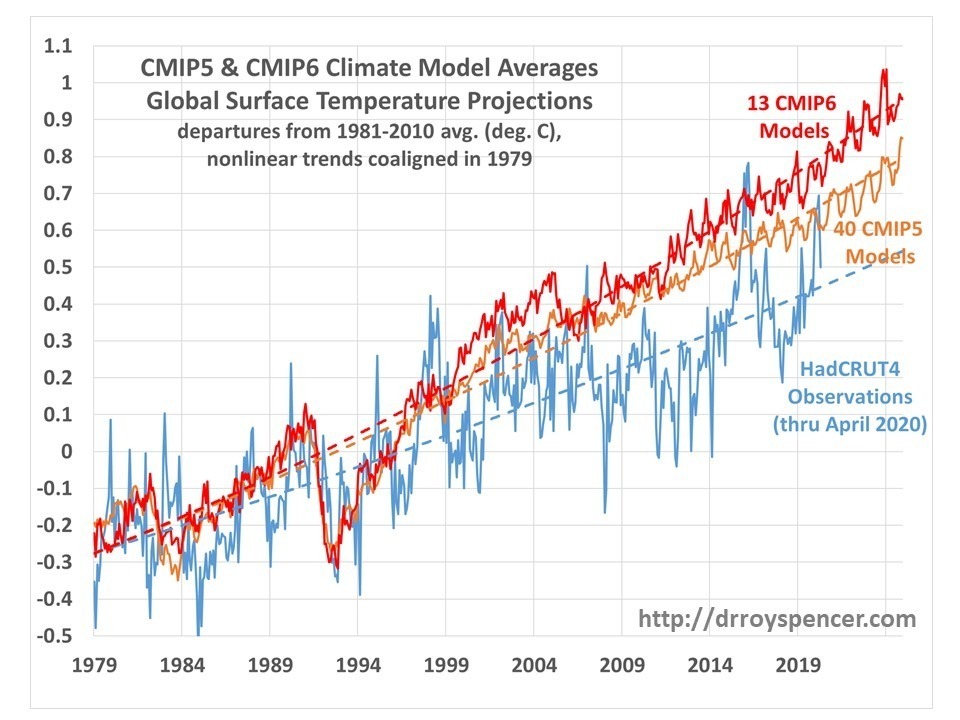
Among them are forecasts from the Coupled Model Inter-comparison Project (CMIP). CMIP consists of 100 distinct climate models, run by leading modelling groups across the world. Their predictions drive the IPCC’s reports. In 2013, the IPCC fifth assessment report (AR5) featured climate models from CMIP5 (fifth generation).
But the forecasts from these models proved wrong. They exaggerated the temperature trend and differed markedly from temperature data derived from ground-based thermometers; sensors on weather balloons aircraft, ships, and buoys; satellite remote sensing; and “reanalyses”—the latter integrating the input of many different data sources.
Yet, political appointees in charge of determining climate and energy policy around the world used these forecasts to justify international climate agreements like the Paris agreement. And they do no stop with that.
The upcoming IPCC sixth assessment report (AR6), forecast for release in 2021, features forecasts from CMIP6. But the CMIP6 models are turning out to be no better than CMIP5 models. In fact, CMIP6 they’re worse!
Senior climatologist Dr. Roy Spencer has observed that the “CMIP6 models are showing 50 percent more net surface warming from 1979 up to April 2020 (+1.08 degree Celsius) than actual observations from the ground (+0.72 degree Celsius).”
Beyond doubt, comparing both CMIP5 and CMIP6 forecasts to official HadCRUT temperature data sets reveals a very old story: models are always way off the mark, and—suspiciously—always in the same direction, namely, upward, in predicting real-world temperatures.
So, not only were we lied to about the climate, we are going to be misled again by the next IPCC assessment report. And with more extreme false forecasts, there will be calls for more restrictive energy policies.
It is quite astonishing how the unelected politicians at the UN can convince and persuade global leaders to adopt climate policies that are based on unscientific conclusions from faulty models.
The mainstream media have also played their part. Public perception on climate change has been heavily influenced by biased coverage on the climate issue, with no major attention to the huge discrepancies between the model forecasts and real-world observations.
It is not clear how much faultier the projections will become by the time the new assessment report is finally released. But one thing is clear: energy sectors across the globe are being held hostage by pseudo-scientific interpretations from the United Nations’ flagship climate wing.
Vijay Jayaraj (M.Sc., Environmental Science, University of East Anglia, England), is a Research Contributor for the Cornwall Alliance for the Stewardship of Creation living in New Delhi, India.
BBC Brags About Hornsea Wind Farm–But Forgets To Mention The Cost
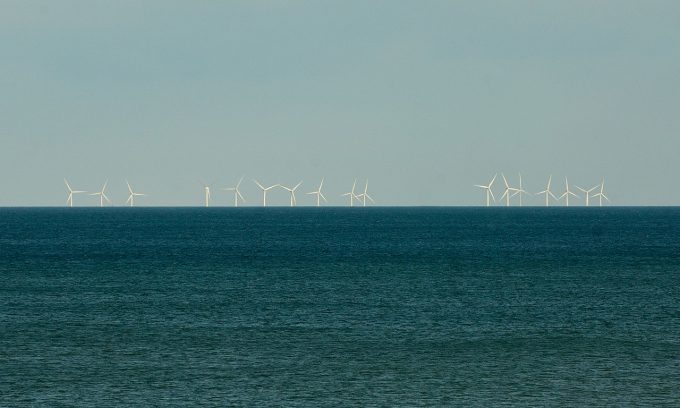
Hornsea Wind Farm
By Paul Homewood | Not A Lot Of People Know That | June 9, 2020
In his puff piece for renewable energy today, the BBC’s Justin Rowlatt noted that:
Now the UK has the biggest offshore wind industry in the world, as well as the largest single wind farm, completed off the coast of Yorkshire last year.
Nothing could sum up the moronic obsession with renewable energy better than this statement. There is in fact a good reason why we have the biggest offshore wind industry – we are the only country daft enough to pay the exorbitant bill for it.
The largest wind farm, of course, is Hornsea, a 1200MW project. It may be the biggest, but it also happens to be one of the most expensive sources of electricity in the world.
The contract price for Hornsea is £162.47/MWh, which under CfD is a guaranteed price, which will be index linked for 15 years. In short, a licence to print money.

https://www.lowcarboncontracts.uk/cfds/hornsea-phase-2
The current market price for electricity is below £20/MWh, so Hornsea is getting eight times what it would get if it had to trade in the market.
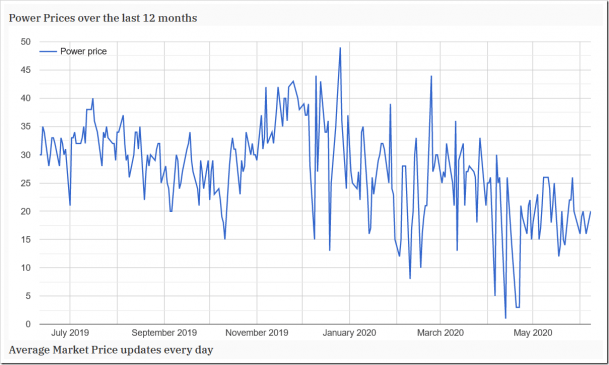
https://www.energybrokers.co.uk/electricity/historic-price-data-graph
At current prices, Hornsea will receive an annual subsidy of about £600 million. OK, if prices recover to more normal levels of around £40/MWh, once economic activity recovers, the subsidy will be slightly less.
But here’s the rub. Whether prices are high or low, Hornsea’s owners will receive their guaranteed price anyway. The system even allows them to sell every single unit of electricity they generate, and if there is a surplus of power in the market, they will get paid NOT to produce.
In other words, there is no commercial risk for Hornsea at all. A licence to print money, all at the expense of bill payers.
Hornsea, by the way, is joint owned by Oersted (formerly DONG) and Global Infrastructure Partners LLP, a global wealth fund. I find it hard to understand how sending hundreds of millions of pounds every year to either of those companies can possibly benefit the UK economy.
Maybe Justin Rowlatt might be able to explain?
Now Comes the Davos ‘Great Reset’
By F. William Engdahl – New Eastern Outlook – 09.06.2020
For those wondering what will come after the Covid-19 pandemic has successfully all but shut down the entire world economy, spreading the worst depression since the 1930s, the leaders of the premier globalization NGO, Davos World Economic Forum, have just unveiled the outlines of what we can expect next. These people have decided to use this crisis as an opportunity.
On June 3 via their website, the Davos World Economic Forum (WEF) unveiled the outlines of their upcoming January 2021 forum. They call it “The Great Reset.” It entails taking advantage of the staggering impact of the coronavirus to advance a very specific agenda. Notably enough, that agenda dovetails perfectly with another specific agenda, namely the 2015 UN Agenda 2030. The irony of the world’s leading big business forum, the one that has advanced the corporate globalization agenda since the 1990s, now embracing what they call sustainable development, is huge. That gives us a hint that this agenda is not quite about what WEF and partners claim.
The Great Reset
On June 3 WEF chairman Klaus Schwab released a video announcing the annual theme for 2021, The Great Reset. It seems to be nothing less than promoting a global agenda of restructuring the world economy along very specific lines, not surprisingly much like that advocated by the IPCC, by Greta from Sweden and her corporate friends such as Al Gore or Blackwater’s Larry Fink.
Interesting is that WEF spokespeople frame the “reset” of the world economy in the context of the coronavirus and the ensuing collapse of the world industrial economy. The WEF website states, “There are many reasons to pursue a Great Reset, but the most urgent is COVID-19.” So the Great Reset of the global economy flows from covid19 and the “opportunity” it presents.
In announcing the 2021 theme, WEF founder Schwab then said, cleverly shifting the agenda: “We only have one planet and we know that climate change could be the next global disaster with even more dramatic consequences for humankind.” The implication is that climate change is the underlying reason for the coronavirus pandemic catastrophe.
To underscore their green “sustainable” agenda, WEF then has an appearance by the would-be King of England, Prince Charles. Referring to the global covid19 catastrophe, the Prince of Wales says, “If there is one critical lesson to learn from this crisis, it is that we need to put nature at the heart of how we operate. We simply can’t waste more time.” On board with Schwab and the Prince is the Secretary-General of the UN, Antonio Guterres. He states, “We must build more equal, inclusive and sustainable economies and societies that are more resilient in the face of pandemics, climate change and the many other global changes we face.” Note his talk of “sustainable economies and societies”—more on that later. The new head of the IMF, Kristalina Georgieva, also endorsed The Great Reset. Other WEF resetters included Ma Jun, the chairman of the Green Finance Committee at the China Society for Finance and Banking and a member of the Monetary Policy Committee of the People’s Bank of China; Bernard Looney, CEO of BP; Ajay Banga, CEO of Mastercard; Bradford Smith, president of Microsoft.
Make no mistake, the Great Reset is no spur-of-the moment idea of Schwab and friends. The WEF website states, “COVID-19 lockdowns may be gradually easing, but anxiety about the world’s social and economic prospects is only intensifying. There is good reason to worry: a sharp economic downturn has already begun, and we could be facing the worst depression since the 1930s. But, while this outcome is likely, it is not unavoidable.” The WEF sponsors have big plans: ”… the world must act jointly and swiftly to revamp all aspects of our societies and economies, from education to social contracts and working conditions. Every country, from the United States to China, must participate, and every industry, from oil and gas to tech, must be transformed. In short, we need a “Great Reset” of capitalism.” This is big stuff.
Radical changes
Schwab reveals more of the coming agenda: “… one silver lining of the pandemic is that it has shown how quickly we can make radical changes to our lifestyles. Almost instantly, the crisis forced businesses and individuals to abandon practices long claimed to be essential, from frequent air travel to working in an office.” These are supposed to be silver linings?
He suggests that those radical changes be extended: “The Great Reset agenda would have three main components. The first would steer the market toward fairer outcomes. To this end, governments should improve coordination… and create the conditions for a “stakeholder economy…” It would include “changes to wealth taxes, the withdrawal of fossil-fuel subsidies, and new rules governing intellectual property, trade, and competition.”
The second component of the Great Reset agenda would ensure that, “investments advance shared goals, such as equality and sustainability.” Here the WEF head states that the recent huge economic stimulus budgets from the EU, USA, China and elsewhere be used to create a new economy, “more resilient, equitable, and sustainable in the long run. This means, for example, building ‘green’ urban infrastructure and creating incentives for industries to improve their track record on environmental, social, and governance (ESG) metrics.”
Finally the third leg of this Great Reset will be implementing one of Schwab’s pet projects, the Fourth Industrial Revolution: “The third and final priority of a Great Reset agenda is to harness the innovations of the Fourth Industrial Revolution to support the public good, especially by addressing health and social challenges. During the COVID-19 crisis, companies, universities, and others have joined forces to develop diagnostics, therapeutics, and possible vaccines; establish testing centers; create mechanisms for tracing infections; and deliver telemedicine. Imagine what could be possible if similar concerted efforts were made in every sector.” The Fourth Industrial Revolution includes gene-editing biotech, 5G telecommunications, Artificial Intelligence and the like.
UN Agenda 2030 and the Great Reset
If we compare the details of the 2015 UN Agenda 2030 with the WEF Great Reset we find both dovetail very neatly. The theme of Agenda 2030 is a “sustainable world” which is defined as one with income equality, gender equality, vaccines for all under the WHO and the Coalition for Epidemic Preparedness Innovations (CEPI) which was launched in 2017 by the WEF along with the Bill & Melinda Gates Foundation.
In 2015 the UN issued a document, “Transforming our world: the 2030 Agenda for Sustainable Development.” The Obama Administration never submitted it to the Senate for ratification knowing it would fail. Yet it is being advanced globally. It includes 17 Sustainable Development Goals, extending an earlier Agenda 21. The 17 include “to end poverty and hunger, in all their forms and dimensions… to protect the planet from degradation, including through sustainable consumption and production, sustainably managing its natural resources and taking urgent action on climate change…“ It calls for sustainable economic growth, sustainable agriculture (GMO), sustainable and modern energy (wind, solar), sustainable cities, sustainable industrialization… The word sustainable is the key word. If we dig deeper it is clear it is code-word for a reorganization of world wealth via means such as punitive carbon taxes that will dramatically reduce air and vehicle travel. The less-developed world will not rise to the developed, rather the other way, the advanced civilizations must go down in their living standards to become “sustainable.”
Maurice Strong
To understand the double-speak use of sustainable, we need to go back to Maurice Strong, a billionaire Canadian oilman and close friend of David Rockefeller, the man who played a central role back in the 1970s for the idea that man-made CO2 emissions were making the world unsustainable. Strong created the UN Environment Program, and in 1988, the UN Intergovernmental Panel for Climate Change (IPCC) to exclusively study manmade CO2.
In 1992 Strong stated, “Isn’t the only hope for the planet that the industrialized civilizations collapse? Isn’t it our responsibility to bring that about?” At the Rio Earth Summit Strong that same year he added, “Current lifestyles and consumption patterns of the affluent middle class – involving high meat intake, use of fossil fuels, appliances, air-conditioning, and suburban housing – are not sustainable.”
The decision to demonize CO2, one of the most essential compounds to sustain all life, human and plant, is not random. As Prof. Richard Lindzen an MIT atmospheric physicist puts it, “CO2 for different people has different attractions. After all, what is it? – it’s not a pollutant, it’s a product of every living creature’s breathing, it’s the product of all plant respiration, it is essential for plant life and photosynthesis, it’s a product of all industrial burning, it’s a product of driving – I mean, if you ever wanted a leverage point to control everything from exhalation to driving, this would be a dream. So it has a kind of fundamental attractiveness to bureaucratic mentality.”
Lest we forget, the curiously well-timed New York pandemic exercise, Event 201 on October 18, 2019 was co-sponsored by the World Economic Forum and the Gates Foundation. It was based on the idea that, ”it is only a matter of time before one of these epidemics becomes global—a pandemic with potentially catastrophic consequences. A severe pandemic, which becomes “Event 201,” would require reliable cooperation among several industries, national governments, and key international institutions.” The Event 201 Scenario posited, “outbreak of a novel zoonotic coronavirus transmitted from bats to pigs to people that eventually becomes efficiently transmissible from person to person, leading to a severe pandemic. The pathogen and the disease it causes are modeled largely on SARS, but it is more transmissible in the community setting by people with mild symptoms.”
The declaration by the World Economic Forum to make a Great Reset is to all indications a thinly-veiled attempt to advance the Agenda 2030 “sustainable” dystopian model, a global “Green New Deal” in the wake of the Covid-19 pandemic measures. Their close ties with Gates Foundation projects, with the WHO, and with the UN suggest we may soon face a far more sinister world after the Covid19 pandemic fades.
F. William Engdahl is strategic risk consultant and lecturer, he holds a degree in politics from Princeton University.
UK battery electric car strategy is ‘doomed to failure’
By Andrew Forster | Transport Xtra | June 1, 2020
The Government’s push to electrify road transport is based on naivety, the undue influence of the Committee on Climate Change, and a lack of engineering expertise within Government, an academic has said.
Professor Michael Kelly, the former chief scientific adviser to the Department for Communities and Local Government, issues the warning in a paper published by the Global Warming Policy Foundation.
He warns the Government’s ambitions for EVs and electric heating in buildings will end in damaging failure.
“When the penny drops and the progress towards all-electric UK is halted, we will be reminded of Ozymandias [two poems that describe how even the greatest men and the empires they forge are impermanent, their legacies fated to decay into oblivion – Ed].
“The rest of the world can look at Britain and choose whether to laugh or weep.”
On battery electric vehicles, he says: “Consider Dinorwig power station, the biggest hydropower energy storage plant in the UK. If all UK cars were battery powered, the nine gigawatts of energy stored behind the dam would be capable of recharging about 60,000 of them, or about 0.25 per cent of the UK fleet.”
If all vehicles have to be electric, “something of the order of 70 per cent of Britain’s entire existing electricity supply capacity will be needed”.
“When we get coded messages from the Climate Change Committee, implying that we will have to rethink the extent to which we are going to be able to travel in future, it is the implausibility of meeting that vast gulf in energy sources that is motivating them to question our lifestyles.”
Kelly points out that the Government’s net zero greenhouse gas target will also require the heating of buildings to be electrified using heat pumps. This will place huge additional demands on electricity supply, particularly in the winter.
Charging battery cars at night, when electricity demand from other sources is low, is only a “partial solution” to the problems, he says. “The current day-night variation in electricity demand is of itself too small to handle the extra load.
“Another suggestion is that we can charge cars during the day, when solar power is high. But in the absence of storage, this would mean charging them from mid-morning to mid-afternoon on sunny days. This is implausible too, and would be unreliable [even] if we could make it happen.”
Turning to local electricity supply issues, he says “we will be adding electric vehicle chargers and heat pumps to almost every home”.
“A fast EV charger for a car draws 7kW, perhaps for six hours, and a heat pump needs 3kW, potentially for much of the day. But the cabling and substations in most suburbs were sized and installed before these technologies were even thought of. So while there is sufficient headroom for electrification of a few households, the whole distribution system will need to be up- graded if demand grows.
“This work will be extraordinarily expensive, but without it there will either be regular ‘brownouts’, or drivers will have to be told where and when they can charge their batteries.”
Kelly dismisses battery storage as a major part of the solution. “The £45m battery installed by Elon Musk outside Adelaide, South Australia, can power that city for 30 minutes. If you wanted to be able to cover a week’s power outage after a major storm, it would cost around 1,300 times as much using batteries as it would with diesel generators. The idea is ludicrous.”
Turning to the raw materials needed to produce batteries, Kelly claims: “If we replace all of the UK vehicle fleet with EVs, and assuming they use the most resource-frugal next-generation batteries, we would need the following materials:
- 207,900 tonnes of cobalt – just under twice the annual global production;
- 264,600 tonnes of lithium carbonate – three-quarters of the world’s production;
- at least 7,200 tonnes of neodymium and dysprosium – nearly the entire world production of neodymium; and
- 2,362,500 tonnes of copper – more than half the world’s production in 2018.
“Put simply, we lack the ability to provide the infrastructure required to deliver electric cars and electric heating on the scale required by 2050.”
Kelly asks why we are trying to do so anyway and pins the blame on the Committee on Climate Change.
“An unelected body, the Committee displays many of the worst features of the administrative state. It has been grossly negligent in turning a blind eye to the complexity of electric vehicles and the related issue of the enforced switch to electricity for domestic heating.
“Committee members don’t have to face the consequences of their policies from voters; politicians, who do have to face the voters, hide behind the Committee in order to duck accountability.
“It is this failure of the UK’s political machinery that I believe is to blame for the situation in which we find ourselves.
“We have set out to decarbonise the economy without anyone having thought through all the engineering issues, let alone put a cost on the exercise.”
Kelly says that, with Covid-19, “it is clear that we will not be able to afford the costs of the net zero transition for decades, if ever”.
“To attempt to plough on would be madness; indeed, it would directly sabotage the UK economy, and without any measurable effect in terms of actually averting any climate change.”
“Surely now is the time for a root and branch cost-benefit review by independent engineers who have no skin in the game of electrifying the UK economy.”
Prince Charles sees ‘golden opportunity’ in Covid-19 pandemic as UK economy faces biggest recession in centuries
By Helen Buyniski | RT | June 4, 2020
 The UK’s Prince Charles has said that the coronavirus crisis represents a global “reset moment” – one which seemingly allows leaders to ram through sustainability initiatives as cash-strapped citizens have no choice but to obey.
The virus’ “unprecedented shockwaves may well make people more receptive to big visions of change,” the heir to the British throne declared on Wednesday. He made the comments during a virtual meeting of the World Economic Forum’s Covid Action Platform, announcing the unveiling of his ‘Great Reset’ initiative. Charles cited the dramatic changes wrought by the pandemic as proof that a revolutionary shift was possible, glossing over the destruction the outbreak has wrought on the lives of average Brits to outline his ideal green future.
The project’s aim is to ensure businesses “build back better” in an environmentally-friendly fashion after shutdowns enacted in response to the epidemic left the UK economy in ruins. Businesses would be wise to “think big and act now,” the prince advised, noting “we have a unique, but rapidly shrinking, window of opportunity to learn lessons and reset ourselves on a more sustainable path.”
“It is an opportunity we have never had before and may never have again.”
While details of the royal’s big plan were somewhat elusive, buried under an avalanche of buzzwords, it involves a series of industry- and issue-specific roundtables, a social media networking component and “virtual hubs” aimed at attracting young people and “fostering innovation” through “thought leadership and practical solutions.” He called for a “paradigm shift” that “inspires action at revolutionary levels and pace,” taking inspiration from the rapid transformation of industries such as mobile technology and space exploration to interweave sustainability into the financial system.
It’s not like the UK is in a position to say no, he hinted, threatening naysayers with several flavors of climate-induced doom. “We have no alternative because otherwise, unless we take the action necessary, and we build again in a greener and more sustainable and more inclusive way, then we will end up having more and more pandemics and more and more disasters from ever-accelerating global warming and climate change,” the prince proclaimed.
While Prince Charles stressed in a promotional video accompanying the big reveal that “global warming, climate change, and the devastating loss of biodiversity” are the chief threats facing humanity, the majority of Britons are likely to be more concerned with the devastating recession threatening to engulf the nation completely. The Bank of England warned last month that the UK economy could shrink by 30 percent by the end of the summer. The central bank’s dire predictions – its first official forecast since the pandemic took hold – warned that GDP could decline by 14 percent for 2020, the sharpest single-year drop in over three centuries. And while the Bank of England claimed UK families entered the crisis “in a stronger position than they were before the 2008 financial crisis,” the Office of National Statistics revealed in April that the economy was already headed south even before the lockdown was imposed in March.
By the start of May, one-fifth of British retailers had permanently closed their doors, according to the British Chamber of Commerce. It also warned that while a third of the country’s economy was “shut down,” another third was only functioning “with some difficulty.” Some two-thirds of UK businesses have sought government assistance to pay furloughed staff, but help has been slow in coming. Still, the UK is behind only Singapore and Japan in terms of the amount of money it has pledged toward helping businesses recover from the crisis, earmarking the equivalent of 8.5 percent of its GDP – about £120 billion – for emergency loans, financing, and grants. This places the needy wholly at the mercy of the government – which, if Prince Charles has anything to say about it, will wrest serious sustainability concessions out of them before they’re allowed to go forward.
The UK has suffered greatly under the pandemic, recording the second-highest number of coronavirus deaths worldwide – over 39,000 as of Thursday, according to data collected by Johns Hopkins University. Public trust in the country’s response to the virus has also been shaken dramatically, with just 51 percent of respondents to a survey conducted last month reporting they approved of London’s handling of the epidemic – an 18-point drop over the previous month. Imperial College professor Neil Ferguson, the disgraced architect of the UK lockdown policy, probably didn’t help matters earlier this week when he quietly admitted his draconian stay-at-home restrictions were no better than Sweden’s no-lockdown response in terms of saving lives.
Helen Buyniski is an American journalist and political commentator at RT. Follow her on Twitter @velocirapture23
Featured Video

Deception – Submarines against Olof Palme
or go to
Aletho News Archives – Video-Images
From the Archives
Woolsey Fire started at Santa Susana Field Lab — where “radioactive materials released were never accurately measured”
By John Laforge | CounterPunch | November 30, 2018
In my Nov. 16 column, I reported on potential radiation risks posed by California’s Woolsey wildfire having burned over parts or all of the Santa Susana Field Laboratory—south of Simi Valley, Calif., 30 miles outside Los Angeles—site of at least four partial or total nuclear reactor meltdowns.
The field laboratory operated 10 experimental reactors and conducted rocket engine tests. In his 2014 book Atomic Accidents, researcher James Mahaffey writes, “The cores in four experimental reactors on site … melted.” Reactor core melts always result in the release of large amounts of radioactive gases and particles. Clean up of the deeply contaminated site has not been conducted in spite of a 2010 agreement.
Los Angeles’s KABC-7 TV reported Nov. 13 that the Santa Susana lab site “appears to be the origin of the Woolsey Fire” which has torched over 96,000 acres. Southern Calif. Public Radio said, “According to Cal Fire, the Woolsey Fire started on the afternoon of Thursday, Nov. 8 … on the Santa Susana site.” … continue
Blog Roll
 Aletho News
- Between war and industrial breakdown: The US-Israeli attrition crisis
- Pressure builds on Iran to ‘drop’ Lebanon ceasefire demand as Islamabad talks hang in balance
- In another clash report, US denies agreement to release Iran’s assets
- What is fueling unrest across the EU?
- Why no power can undermine Iran’s eternal dominance over the Strait of Hormuz
- Is The War Against Iran Over?
- Iran war will leave long-term ‘scar’ on Wall Street, investors warn
- How Iran decimated US power projection in West Asia: Military lessons of 40-day war
- Iran’s report details US-Israeli war crimes in targeting schools, hospitals, livelihoods
- NATO’s Slow Fracture: How Trump’s Iran War Exposed the Instrument of Hegemony
- If Americans Knew
- After killing 350+, Israel still has a “score to settle” with Lebanon before ceasefire – Daily Update
- Military aid to Israel emerges as the latest political litmus test for Democrats
- The only Palestinian children’s rights organization closes following years-long Israeli campaign against it
- ‘I Can’t Forget the Smell’: Lebanese Reel After Israel Kills Over 300 in Single Day
- DNC Shoots Down Resolutions Calling Out AIPAC and Limiting Arms to Israel
- TCN: Is Israel Blackmailing President Trump?
- Israel killed at least 303 Lebanese yesterday – who were they? Daily Update
- Amnesty: Urgent – Protect Lebanese civilians from brutal escalation in Israeli attacks
- Is The War Against Iran Over?
- Inside the Israeli army’s propaganda wing
- No Tricks Zone
- New Study: No Linear Warming Or Glacier Retreat Along Northern Antarctic Peninsula Since 1980s
- An Inconvenient Tree: Uncovered In Alps… Europe Much Warmer Than Today 6000 Years Ago
- New Study Reports A 60% Slowdown In Greenland’s Ice Loss Rate In The Last Decade
- Low Intensity Tornado Wrecks Major Solar Farm, Creating A Potential Toxic Dump
- New Study Finds Warming Saves Lives…Cold Temperatures 12 Times More Deadly Than Excess Heat
- German Science Blog Accuses PIK Climate Institute Of Hallucinating Climate Tipping Points
- Devastating Assessment Of Comirnaty Vaccine By Former Senior Pfizer Europe Toxicologist
- New Study: CO2 Is ‘Effectively Negligible’ As An Explanatory Climate Change Factor Since 2000
- Former Pfizer Toxicologist Dr. Helmut Sterz Tells Bundestag Hearing Pfizer Vaccine Should Have Never Been Approved
- Energy Expert: Germany’s Nuclear Phaseout Was A “500 Billion Euro Mistake”
 Aletho News