EU loan to Ukraine pushing bloc ‘into war’ with Russia – Orban
RT | December 20, 2025
EU nations have a vested interest in continuing the Ukraine-Russia conflict and even escalating it, as repayment of their €90 billion loan to Kiev is essentially tied to a military victory, Hungarian Prime Minister Viktor Orban has said.
A long-debated EU scheme to steal frozen Russian central bank assets collapsed amid disagreements among member states on Friday. However, agreement was reached on a loan backed by the bloc’s budget, allowing them to fund cash-strapped Ukraine in what Moscow has long described as a Western proxy war. Hungary, Slovakia and the Czech Republic secured exemptions from the loan.
“Whoever lends money wants it back. In this case, repayment is not tied to economic growth or stabilization, but to military victory,” Orban wrote on X on Saturday. “For this money to ever be recovered, Russia would have to be defeated,” he said.
A war loan inevitably makes its financiers interested in the continuation and escalation of the conflict, because defeat would also mean a financial loss.
Orban argued that there are now “hard financial constraints that push Europe in one direction: into war.”
Hungary and Slovakia have long stood against continued military aid to Kiev, despite mounting pressure from the EU to toe the party line. The Czech Republic joined the fold after the recent election of new Prime Minister Andrej Babis, who has refused to fund Ukraine at the expense of his taxpayers.
Russian officials have accused Kiev’s European backers of hindering recent US-led peace efforts, and of increasingly preparing for a direct war against Russia.
Top EU officials have used claims of an alleged threat from Moscow to justify accelerating militarization, freeing up €335 billion in Covid relief funds and mobilizing €150 billion in loans and grants for the bloc’s military industrial complex.
Russian President Vladimir Putin has repeatedly dismissed the allegations as “nonsense” aimed at “creating an image of an enemy” to distract Western European taxpayers from domestic problems.
As Kiev would only need to start making repayments to the EU if it receives reparations in the unlikely event Russia loses, the loan is widely considered to be at risk of turning into a grant.
Daniel Davis: Russia Preparing Retaliation – Oreshnik Deployed & Seizing Odessa
Glenn Diesen | December 20, 2025
Lt. Col. Daniel Davis is a 4x combat veteran, the recipient of the Ridenhour Prize for Truth-Telling, and is the host of the Daniel Davis Deep Dive YouTube channel. Lt. Col. Davis discusses how Russia is preparing itself for the possibility of Europe attacking Russia by deploying a powerful arsenal of Oreshniks. The attacks on Russia’s civilian vessels will likely end with Russia seizing Odessa, which could also trigger the Europeans to send troops. We are rapidly going up the escalation ladder as diplomacy fails.
Follow Prof. Glenn Diesen:
Substack: https://glenndiesen.substack.com/
X/Twitter: https://x.com/Glenn_Diesen
Patreon: https://www.patreon.com/glenndiesen
Support the research by Prof. Glenn Diesen:
PayPal: https://www.paypal.com/paypalme/glenndiesen
Buy me a Coffee: buymeacoffee.com/gdieseng
Go Fund Me: https://gofund.me/09ea012f
Books by Prof. Glenn Diesen.
No More Ukraine Proxy War? You’re a Traitor!
Glenn Diesen & Lt Col Daniel Davis
Glenn Diesen | December 16, 2025
I had the pleasure of speaking with Lt. Col. Daniel Davis about how Europe has trapped itself in ideological narratives of good versus evil
Powerful Israeli Strikes on South Lebanon and Bekaa
Al-Manar | December 18, 2025
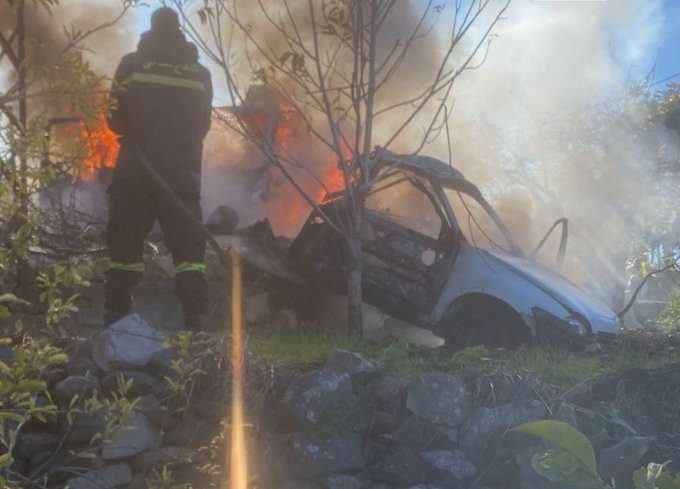
The Israeli enemy launched on Thursday a series of air raids on large areas in southern Lebanon and Bekaa in the east of the country, in a new escalation that targeted mountainous areas, valleys and the outskirts of several towns.
Al-Manar correspondent reported that the Israeli airstrikes targeted the outskirts of Al-Rihan in Iqlim Al-Tuffah, as well as the area between the towns of Deir Siryan and Qusayr in the south.
The strikes also hit the Litani River between Zawtar and Deir Siryan in the Nabatieh region, in addition to the Al-Jabbour and Al-Qatrani heights in Western Bekaa, according to our reporter.
Israeli aircraft later renewed their raids, targeting the Mahmoudiya area in southern Lebanon, while other airstrikes hit the Zaghrin heights in the Hermel mountains of the eastern Bekaa, Al-Manar correspondents reported.
Meanwhile, an Israeli drone strike targeted a Rapid vehicle near the road linking the border town to Deir Siryan.
The strike took place as a truck belonging to Electricity of Lebanon public company was present nearby, our correspondent in south Lebanon noted.
“A number of workers were injured as the Israeli strike torched the Rapid vehicle and the Electricity of Lebanon truck,” Al-Manar reporter said.
Later on Thursday, the Ministry of Health confirmed 4 injured in an Israeli airstrike targeting a Rapid-type vehicle in the town of Taybeh, Marjeyoun district.
Commenting on the Israeli strikes, Lebanese Speaker said the Israeli strikes were a “message” to Paris Conference dedicated for supporting the Lebanese Army.
The strikes “are an Israeli message to Paris Conference and sustained bombardment in honor of the Mechanism,” Speaker Berri was quoted as saying, referring to the committee overseeing the ceasefire between Lebanon and the Zionist entity.
The UAE’s reverse trajectory: From riches to rags
By Dr Zakir Hussain | MEMO | December 18, 2025
One of the most enduring and widely quoted dialogues in Indian cinema is: “Do not throw stones at others’ houses when your own house is made of glass.” Unfortunately, this wisdom appears to be lost on the United Arab Emirates. Instead of exercising restraint and responsibility, the UAE has increasingly been accused of conspiring with, financing, and backing a wide range of actors and armed groups that have contributed to chaos, instability, and even genocidal violence in several countries.
Over the years, the UAE has steadily expanded the scope of its controversial activities—from Libya and Sudan in North Africa to other mineral-rich Muslim-majority African countries, and further eastward to Afghanistan and Yemen. Its involvement in the Palestinian context also raises serious concerns, as there appears to be no clear moral or political limit to its actions. These interventions have not promoted peace or stability; rather, they have intensified conflicts, deepened humanitarian crises, and prolonged wars.
What makes this approach particularly perplexing is that the UAE itself lacks a credible and robust defensive shield to protect its own territory. It does not possess the capability to fully defend its iconic skyscrapers and critical infrastructure even against relatively unsophisticated, low-cost drones. A coordinated volley of such drone strikes would be sufficient to cause panic among the millionaires and billionaires who have invested heavily in Abu Dhabi and Dubai. Capital, after all, is highly sensitive to risk, and fear alone can trigger massive capital flight.
Against this backdrop, it is difficult to comprehend why Mohammed bin Zayed has chosen to indulge in a strategy of regional destabilisation and proxy warfare. History clearly demonstrates that mercenaries neither win wars nor sustain long, decisive military campaigns. They fight only as long as their financial incentives are met, avoid heavy casualties, and withdraw the moment the cost-benefit equation turns unfavourable.
The UAE has already experienced the consequences of such adventurism in Yemen, where its involvement against the Houthis proved costly and ultimately unproductive. The episode exposed the limits of Emirati military power and underscored its lack of preparedness for prolonged, brutal conflicts. The Emiratis have shown remarkable efficiency in event management, diplomacy branding, and global image-building, but they are ill-suited for sustained warfare or managing the complex realities of civil wars and insurgencies.
Despite these lessons, the UAE continues to deploy mercenaries, supply arms, and push destabilising agendas that risk mass civilian suffering. Such actions not only tarnish its international standing but also make the future of the UAE increasingly uncertain. More importantly, they significantly raise the vulnerability of those who have invested billions and billions of dollars in the country—particularly in real estate and financial assets that depend heavily on perceptions of safety and stability. The UAE has attracted the largest number of high net worth people since the Ukraine war started.
According to one estimate, in 2025 alone, approximately 9,800 high-net-worth individuals moved to the UAE. In 2024, the total number of millionaires who moved to the UAE from Russia, Africa, and the UK is around 130,000, thus fuelling its status as a premier global wealth hub. The reasons are zero tax, stability, and safety, lifestyle.
However, the overindulgence of MBZ and misuse of the sovereign wealth fund is likely to negate all the toil and troubles endured by the forefathers of the Emirates since 1972.
As an Indian, my concern is both professional and moral. A large number of Indians have invested substantial sums in the UAE, especially in real estate. It is therefore necessary to issue a timely warning and provide a realistic assessment of emerging risks, so that Indian interests can be protected before irreversible damage occurs.
I remain open to offering constructive suggestions and responsible assessments, with the sole objective of safeguarding long-term stability and protecting the legitimate interests of investors and the expatriate community.
The Map Is Not the Territory: Ukraine, Manufactured Consent, and Europe’s War of Attrition
By Gerry Nolan | Ron Paul Institute | December 16, 2025
Western headlines are screaming that Ukraine has “encircled” Kupyansk city… a glorified town, selling it as a nightmare for Moscow. But this is not a battlefield report. It is narrative management, timed precisely to negotiations in Berlin. Kupyansk is not Stalingrad. It is not Kursk. It is not even a decisive urban fight. It is a ruined settlement on the Oskol, a former logistics node reduced to rubble, where control is measured not in flags but in fire control, drone dominance, and whether men can be rotated without being killed.
And when even Reuters couches claims as “unverified,” you know what that means. When it hedges, pauses, and inserts distance between claims and confirmation, it is signaling that fog is being weaponised. What exists on the ground is block-by-block ruin fighting, contested neighbourhoods like Yubileynyy, clashes near Mirovoye and Radkovka, infiltration attempts, temporary interdictions. Battalion-scale collisions between exhausted units in a place that barely functions as a glorified town.
The unit scale tells the truth the headlines obscure. Kupyansk has never hosted a force capable of deciding a front. Within the urban core, the Russian presence has been limited and exposed, with little time to dig in deeper, the town’s ruins making sustained fortification difficult, relying on fire control rather than secured occupation. With thousands tied down protecting the flanks and barely a battalion inside the city itself, Ukrainian assaults are not sweeping counteroffensives but concentrated pushes by swarms of worn formations, often built from forcibly mobilised men with minimal training, starving and thin on ammunition, cannibalized from fronts like Sumy, and thrown into an urban graveyard to manufacture leverage.
This is not manoeuvre warfare. It is attritional contact deliberately framed as momentum to serve a media and political narrative rather operational gain. What matters is that the map is not the territory. In this war, a coloured overlay often marks a brief window of drone interdiction, hours, not control. Fire control can deny movement, but without sustainment it cannot secure ground. Fire control without sustainment does not produce breakthroughs. It produces graveyards. Ukraine has been forced by its Western patrons into too many of them already.
Kupyansk does not change the war unless it becomes part of a broader operational rollback and it won’t. Otherwise, it is a bad PR bargaining chip, paid for in blood.
While cameras fixate on Kupyansk, the real pressure story runs elsewhere, across a widening arc Western coverage fragments to prevent pattern recognition. West of Russian liberated Seversk, claims and denials continue, but the geometry is clear: Ukrainian forces are stretched thin, defending ground without strategic depth. Around encircled Lyman, the contest is about lines of communication and Ukranian reserve erosion, not symbolism.
Central to the Donbass arc, Pokrovsk and Mirnograd matter not because of names, but because they anchor logistics. Russian control here forces a stark contrast in how the war is being fought. Ukraine is expending irreplaceable manpower to manufacture moments, brief tactical actions designed to win optics for a day. Russia, by contrast, is trading space, fire control, and logistics denial for outcomes that compound over time. One side is managing headlines. The other is managing the war.
To the south, the picture is more dangerous still. Around Gulyaypole, pressure is persistent and cumulative, not theatrical. And beyond it lies the real anxiety Europe refuses to discuss openly, the slow, grinding push toward Zaporozhye city. This is not a sprint. It is a methodical march Westward. If current trends hold, Zaporozhye can be operationally threatened, even encircled in less than six months. That outcome would dwarf any skirmish in the small town of Kupyansk.
This is where time asymmetry becomes decisive. Russia is fighting a time-positive war: industrial scaling and real capacity that dwarfs the fiat, paper-tiger illusory capacity of NATO; deep manpower reserves; and a level of internal cohesion sufficient to sustain a long campaign. Ukraine, by contrast, is fighting a time-negative war, with catastrophic demographic collapse, mass emigration, forced conscription, and shrinking public consent. Every Ukrainian media counteroffensive now borrows against a future that no longer exists to replenish it.
This is one of the real reasons behind Trump’s push. Less sentiment. Not ideology. Geometry. Timelines. Arithmetic. Washington understands that delay only makes the endgame worse, militarily and politically for project Ukraine. Europe understands this too. But Europe cannot admit it without confessing its humiliation.
So Europe clings to suicidal optics. It inflates Kupyansk. It sells illusory leverage. And it sacrifices Ukrainians to buy time, not for victory, but for narrative survival.
Here is the truth Europe works hardest to bury beneath headlines and choreographed resolve: this war no longer reflects the will of the Ukrainian people, and, in truth, it only ever did through manufactured consent that has now collapsed. Not marginally. Not ambiguously. Overwhelmingly. Even after years of saturation messaging, censorship, emergency laws, and relentless narrative conditioning, roughly four-fifths of Ukrainians now demand peace. It is devastating precisely because it persists despite one of the most intensive information campaigns the modern West has ever mounted.
Instead, men are dragged from streets and their homes, beaten, bundled into vans, forced into uniforms, and sent to the front. Videos of violent conscription squads no longer shock because they are the tragic norm.
This is not mobilisation. It is cowardly and punitive coercion, the final refuge of elites who lack legitimacy but demand sacrifice. It is the politics of cowardice, where those who made the decisions never bear the cost, and those who pay the price were never given a choice. These wars are always fought with other people’s sons, for objectives that dissolve under scrutiny, while the architects retreat behind speeches, security details, and moral posturing.
When a state must kidnap its own citizens to sustain a war, it has crossed the final moral line: it is no longer defending a nation, because it never was, but cannibalising one, deliberately sacrificing its people as a tip of the spear against a stronger Russia, to shield the reputations, fortunes, and careers of elites who will never bleed, never fight, and never answer for the ruin they leave behind.
Washington shattered Europe’s strategic autonomy years ago and quietly handed the bill to the continent. NATO expansion without strategy. Economic warfare without insulation. Energy sabotage without a contingency secured. The result was inevitable… Accelerated deindustrialisation, inflation, social fracture, political fragility. Europe emerged poorer, weaker, and strategically irrelevant, yet still clinging to the language of moral authority.
Rather than confront this collapse, Europe chose the refuge of absolutism. Negotiation became heresy. Compromise became betrayal. Peace became appeasement. Diplomacy itself was criminalised, because diplomacy invites the most dangerous question of all. What was this for?
And that question cannot be answered without consequences. Because peace does something war cannot. War suspends politics. Peace resurrects accountability.
Europe does not fear losing the war as much as it fears surviving it with memory intact.
That is why the war must continue. Not to save Ukraine, but to postpone reckoning, at the hands of Europeans.
Which brings us back to Kupyansk.
Kupyansk is not a battlefield turning point. It is a tombstone. Not only for the men buried beneath its rubble, but for Europe’s moral credibility itself.
What will damn this war in the historical record is not how it began, but how long it continued after its flimsy justification collapsed. When even manufactured consent evaporated, when diplomacy was deliberately buried, when Russian defeat quietly gave way to arithmetic, the war did not stop. It hardened. Not because it could still be won, but because ending it would have forced admissions no ruling class was prepared to make.
Kupyansk is not remembered because it mattered militarily. It matters because it exposes the moment when the war ceased to be about territory at all. It marks the point where Europe chose blood over truth, coercion over consent, and narrative survival over human life. Not out of strength, but out of fear.
History is unforgiving toward wars waged without consent and prolonged without purpose. It does not care about intentions, speeches, or moral language. It records only what was done, who benefited, and who paid. And when the record is written, it will show that Ukraine was not denied peace because peace was impossible, but because peace would have ended the lie.
That is the real defeat.
Zelensky is stealing the election before it begins
By Tarik Cyril Amar | RT | December 16, 2025
Currently, with intense diplomacy taking place to – perhaps – end the Ukraine conflict, questions surrounding Kiev’s domestic politics may seem secondary. However, in reality, they are as important as the search for peace.
There are two reasons: First, Ukrainians have a right to finally be released from their perverse bondage to what is, in effect, a long-ago failed Western proxy war against Russia. Those still in denial about this fact should check out a recent interview with a former Biden administration policy official. Amanda Sloat has casually admitted that much now: The war could have been avoided if the West had not insisted on NATO membership prospects for Ukraine, which never really existed anyhow.
Observers not blinded by Western propaganda – including this author – were warning that, for Ukraine, this fake NATO perspective was a road to catastrophe. But the Sloats of this world refused to listen. Why then did the West want the war? To diminish Russia by using Ukraine as a battering ram and Ukrainians as cannon fodder.
Secondly – and more practically – no peace will last without an end to Ukraine’s ultra-corrupt current authoritarian regime. Talk about defending “democracy” in Ukraine is absurd. Under Vladimir Zelensky, there is no such thing left. By now, even some Western mainstream commentators are starting to admit Zelensky’s authoritarianism. Yet the former entertainment producer and vulgar comedian started systematically undermining what little democracy Ukraine used to have well before the escalation of February 2022, as Ukrainian observers and critics at the time widely discussed and deplored.
Zelensky’s regime is so corrupt and has sold out its own people so badly to the West that a lasting peace threatens it not only with losing power, which it certainly would, but also with a wave of prosecutions starting at the very top, with Zelensky himself and rolling down like an avalanche. Put differently, this is a regime that would always be tempted to re-start the war to distract from the retribution it must fear.
That is why US President Donald Trump is right to call for presidential elections in Ukraine. Moreover, Zelensky has extended his mandate on flimsy grounds and thereby usurped power even formally. The often-heard claim that Ukraine cannot hold presidential elections in wartime, by the way, is badly misleading, and a thoroughly politically motivated misrepresentation of the facts: In reality, the Ukrainian constitution only prohibits parliamentary elections in time of war. Elections for the presidency are impeded by ordinary laws which can, of course, easily and legally be changed by the majority which Zelensky controls in parliament. That is merely a question of political will, not legality.
By now, even Zelensky and Kiev’s political elite admit the above. Indeed, Zelensky has charged parliament with devising procedures for such elections. So, you may ask, what about his regime and its Western propagandists claiming for over a year that this is simply illegal and can’t be welcome? Simple: that was a big fat lie. Welcome to Zelensky world and its crooked reflection in the mirror cabinet of the Western mainstream media.
Yet curb your enthusiasm. In all likelihood, Zelensky remains dishonest – really, does he even have another mode? – and is engaging not in a genuine attempt to finally allow Ukrainians their long overdue say about his horrific rule. Instead, it is – alas! – much more plausible to interpret his turn toward elections as yet another tactic of stalling and deception.
For one thing, he and his team are trying to set conditions that seem designed to prevent the elections again, while blaming others, first of all Russia, of course. In essence, their demands boil down to, once again, pushing for either more Western arms or a ceasefire that they can abuse instead of the full peace agreement that is actually needed. Moscow will not agree to such a scheme, as Kiev knows very well.
In addition, this would not be the Zelensky regime if it did not also ask for even more Western money. This time, the shameless idea is that the West must pay for elections in Ukraine – presumably because that is how democracy works in a sovereign country.
Things can get even worse: There is also the possibility, pointed out by Ukrainian observers, that Zelensky and his fixers are planning to shift the whole presidential election online. If they do, falsification in Zelensky’s favor is de facto guaranteed.
In sum, there is no good reason to believe Zelensky is really ready to give up power – because that is what elections would mean – to make way for a return to a more normal type of politics. His current statements and gestures seemingly indicating the opposite are meant to deceive, most of all, the West. Neither Ukrainians nor Russia is likely to believe him anyhow.
There is a glimmer of hope, however: The fact alone that Trump has challenged Zelensky in this area and that the latter’s European backers cannot shield him from that challenge is a good sign. As is the fact, of course, that Zelensky has felt pressured and cornered enough to not revert to the old lie that presidential elections are not possible in wartime.
Instead, Ukraine’s past-best-by leader has implicitly admitted they – and that he was lying before – and is now forced to deploy stalling techniques. That in and of itself, like Ukraine’s escalating corruption scandals, shows that Zelensky’s grip is slipping. And that is good for everyone, including Ukrainians. For without an end to the Zelensky regime, it is likely that no peace can be made and certain that no peace can last.
Tarik Cyril Amar is a historian from Germany working at Koç University, Istanbul, on Russia, Ukraine, and Eastern Europe, the history of World War II, the cultural Cold War, and the politics of memory.
The Folly of Establishing a U.S. Military Base in Damascus
By José Niño | The Libertarian Institute | December 16, 2025
Recent reports indicate the United States is preparing to establish a military presence at an airbase in Damascus, allegedly to facilitate a security agreement between Syria and Israel. This development represents yet another misguided expansion of American military overreach in a region where Washington has already caused tremendous damage through decades of failed interventionist policies.
The United States currently operates approximately 750 to 877 military installations across roughly eighty countries worldwide. This staggering number represents about 70 to 85% of all foreign military bases globally. To put this in perspective, the next eighteen countries with foreign bases combined maintain only 370 installations total. Russia has just twenty-nine foreign bases, and China operates merely six. The American empire of bases already dwarfs every other nation combined, and the financial burden is crushing. Washington spends approximately $65 billion annually just to build and maintain these overseas installations, with total spending on foreign bases and personnel reaching over $94 billion per year.
These figures are not abstract accounting entries. They translate directly into American lives placed in volatile environments, as demonstrated by the recent insider attack in the ancient Syrian city of Palmyra, where a purported ISIS infiltrator embedded in local security forces turned his weapon on a joint U.S. Syrian patrol, killing two U.S. soldiers and one U.S. civilian during what was described as a routine field tour. The incident underscores how the sprawling U.S. basing network increasingly exposes American personnel to unpredictable and lethal blowback in unstable theaters far from home.
Syria itself already hosts between 1,500 and 2,000 American troops, primarily concentrated in the northeastern Hasakah province and at the Al Tanf base in the Syrian Desert. The Pentagon recently announced plans to reduce this presence to fewer than 1,000 personnel and consolidated operations from eight installations to just three. Yet now, despite this supposed drawdown, Washington reportedly plans to establish a new presence in Damascus itself, either at Mezzeh Air Base or Al Seen Military Airport. This contradictory expansion reveals the hollow nature of promises to reduce American military commitments abroad.
Since the fall of Bashar al Assad in December 2024, Israel has conducted hundreds of airstrikes on Syrian military and civilian infrastructure while occupying parts of southern Syria including Quneitra and Daraa. Israel has systematically violated the 1974 disengagement agreement and expanded control over buffer zones. These actions align disturbingly well with the Yinon Plan, a 1982 Israeli strategic document by Israeli foreign policy official Oded Yinon that envisions the dissolution of surrounding Arab states into smaller ethnic and religious entities. The plan explicitly calls for fragmenting Syria along its ethnic and religious lines to prevent a strong centralized government that could challenge Israeli interests.
A permanent American military presence in Damascus would effectively serve as a tripwire guaranteeing continued U.S. involvement in securing Israeli strategic objectives in the Levant. Rather than protecting American interests or enhancing national security, such a base would entrench Washington deeper into regional conflicts that have consistently proven disastrous for both American taxpayers and Middle Eastern populations.
The human cost of American intervention in Syria should give any policymaker pause. The Syrian Civil War has resulted in between 617,000 and 656,000 deaths, including civilians, rebels, and government forces. More than 7.4 million people remain internally displaced within Syria, while approximately 6.3 million Syrian refugees live abroad. This catastrophic toll stems partly from Operation Timber Sycamore, the CIA covert program that ran from 2012 to 2017 to train and equip Syrian rebel forces.
Timber Sycamore represented a joint effort involving American intelligence services along with Saudi Arabia, Jordan, Qatar, Turkey, and the United Kingdom. The CIA ran secret training camps in Jordan and Turkey, providing rebels with small arms, ammunition, trucks, and eventually advanced weaponry like BGM 71 TOW anti-tank missiles. Saudi Arabia provided significant funding while the United States supplied training and logistical support.
The program proved to be counterproductive. Jordanian intelligence officers stole and sold millions of dollars worth of weapons intended for rebels on the black market. Even worse, U.S.-supplied weapons regularly fell into the hands of the al Nusra Front, al-Qaeda’s Syrian affiliate, and ISIS itself. The program inadvertently strengthened the very extremists Washington was ostensibly fighting.
The failure of Timber Sycamore illustrates a fundamental problem with American interventionism in Syria. Washington has pursued regime change in Damascus in various forms for decades, yet these efforts have consistently backfired, creating power vacuums filled by jihadist groups and prolonging devastating conflicts. The current enthusiasm for establishing a military presence in Damascus suggests American policymakers have learned absolutely nothing from these failures.
The figure now leading Syria exemplifies the moral bankruptcy of this entire enterprise. Ahmed al Sharaa, better known by his nom de guerre Abu Mohammad al Julani, currently serves as president of Syria’s interim government. This represents a stunning rehabilitation for a man who founded al Nusra Front in 2012 as an al-Qaeda affiliate and later formed Hayat Tahrir al Sham (HTS) by merging various rebel factions. Under the name Abu Mohammad al Julani, he was designated a Specially Designated Global Terrorist by the United States on July 24, 2013, with a $10 million bounty maintained on his head.
Al Sharaa’s terrorist designation stemmed from his leadership of al Nusra Front, which perpetrated numerous war crimes including suicide bombings, forced conversions, ethnic cleansing, and sectarian massacres against Christian, Alawite, Shia, and Druze minorities. He fought with al-Qaeda in Iraq, spent time imprisoned at Camp Bucca between 2006 and 2010, and was dispatched to Syria by Abu Bakr al Baghdadi in 2011 with $50,000 to establish al Nusra. His close associates have faced accusations from the United States of overseeing torture, kidnappings, trafficking, ransom schemes, and displacing residents to seize property. The New York Times reported that his group was accused of initially operating under al-Qaeda’s umbrella.
Yet in November 2025, the United Nations Security Council adopted resolution 2799, removing al Sharaa and Interior Minister Anas Khattab from the ISIL and al-Qaeda sanctions list. The U.S. Treasury Department followed suit, delisting him from the Specially Designated Global Terrorist registry. This reversal came after the State Department revoked HTS’s Foreign Terrorist Organization designation in July 2025. Washington essentially decided that a former al-Qaeda commander who oversaw sectarian massacres was now a legitimate partner worthy of American military support. This absurd rehabilitation demonstrates how completely untethered American foreign policy has become from any coherent moral framework or strategic logic.
Critics rightly question whether al Sharaa has truly broken from his extremist roots or merely engaged in calculated political rebranding. The speed with which Washington embraced him as a legitimate leader suggests American policymakers care far more about advancing Israeli interests and maintaining regional influence than about genuine counterterrorism or protecting religious minorities.
The United States needs to pursue a fundamentally different approach to foreign policy. Rather than establishing yet another military base to advance Israeli strategic objectives in Syria, Washington should implement a comprehensive drawdown of overseas military commitments. The hundreds of foreign bases it maintains abroad represent an unsustainable burden that diverts resources from genuine national security priorities like border security and stability in the Western Hemisphere. American taxpayers deserve better than footing the bill for an empire that consistently fails to advance their interests while enriching defense contractors and serving foreign powers.
Syria offers a perfect case study in the futility of American interventionism. Decades of attempts at regime change through covert programs like Timber Sycamore and direct military presence have produced nothing but chaos, empowered jihadist groups, created millions of refugees, and cost hundreds of thousands of lives. The rehabilitation of a former al-Qaeda commander into Syria’s president illustrates how divorced American policy has become from any coherent strategy or values.
Rather than doubling down on failed policies, the United States should pursue strategic restraint, scale back its sprawling network of foreign bases, and allow regional powers to sort out their own affairs without American military involvement. That represents the path toward a more sustainable, affordable, and morally defensible foreign policy. The Damascus base proposal deserves to be rejected outright as yet another wasteful expansion of an already overextended military empire.
US strikes three vessels in Eastern Pacific, killing eight
Al Mayadeen | December 16, 2025
The United States Southern Command (SOUTHCOM) announced that it launched deadly strikes on three vessels allegedly involved in drug trafficking in international waters in the Eastern Pacific, resulting in the deaths of eight people.
The strikes were carried out on December 15, under the orders of US Secretary of War Pete Hegseth, according to an official statement posted on X.
“Joint Task Force Southern Spear conducted lethal kinetic strikes on three vessels operated by Designated Terrorist Organizations in international waters,” SOUTHCOM said.
The military reported that all individuals killed were adult males: three aboard the first vessel, two on the second, and three on the third.
While the US claims the targeted vessels were engaged in narco-trafficking, no verification of the alleged links to terrorism or drug networks has been provided for any of the 26 boats it struck. Critics, lawmakers, and legal experts have denounced the strikes as illegal under international law.
Part of a broader Trump-led coercion campaign
The latest strikes come amid a wider US military campaign launched by US President Donald Trump targeting so-called drug smuggling routes in the Pacific Ocean and Caribbean Sea, including areas near Venezuela.
According to US officials, American forces have struck more than 20 vessels as part of the campaign, with at least 90 suspected drug smugglers reported killed so far. The operations represent a significant escalation and a marked departure from previous US approaches, which traditionally relied on interdictions, arrests, and prosecutions rather than direct military force.
Although the strategy has been widely criticized for its effectiveness in addressing the opioid epidemic in the United States, particularly given that Venezuela is not a source or transit hub for drug trafficking routes to the US, Trump and senior administration officials have continued to level baseless accusations against Caracas. Additionally, Washington has transferred an expansive force to the Caribbean, including its most advanced aircraft carrier, the USS Gerald R. Ford.
Legal controversy and international concerns
“Our operations in the Southcom region are lawful under both U.S. and international law, with all actions in compliance with the Law of Armed Conflict,” Pentagon Press Secretary Kingsley Wilson told reporters earlier this month.
Critics, however, have questioned the application of the Law of Armed Conflict outside a declared armed conflict, particularly in international waters and against individuals not formally designated as combatants. Under the United Nations Charter, the use of force by one state against another, including against that state’s vessels on the high seas, is generally prohibited unless the target has conducted an armed attack or the action is authorized by the UN Security Council or undertaken in legitimate self-defense.
Legal analysts have pointed out that there is no credible evidence presented to suggest that the vessels struck were engaged in an armed attack against the United States, meaning the strikes lack a clear legal basis under international law.
Another major issue arose from a controversial September strike in the Caribbean, in which US forces hit a suspected drug-smuggling vessel. After the initial attack, which killed the majority of those aboard, surveillance reportedly showed two survivors in the water.
According to multiple accounts, the operation’s commander authorized a second strike on those survivors, based on a directive that those on board should be left with no survivors. Legal experts and lawmakers have warned that targeting individuals who are no longer actively resisting or posing an imminent threat, “hors de combat” under international humanitarian law, is a war crime and violates both the Geneva Conventions and customary law prohibitions on denying quarter.
IDF Force Structure in Peril
By Bill Buppert | The Libertarian Institute | December 15, 2025
I suspect the Israeli military force losses are even greater than they let on.
The Israeli Defense Forces (IDF) last won a war in 1973; everything else has been a stalemate or a near-run defeat. This latest massacre machine against defenseless humans may be the last gasp of an always overestimated military entity:
Israeli army faces ‘worst manpower crisis in its history,’ general says
During two years of Israel’s genocidal war in Gaza, the military lost 923 troops and saw 6,399 wounded, while roughly 20,000 soldiers suffer from post-traumatic stress, according to Israeli media citing army data.
Under heavy military censorship, the army faces accusations of concealing higher losses to preserve morale.
Brik wrote that many officers sought immediate discharge and younger recruits refused to sign long-term contracts, creating a wide shortage of professional staff across the military.
The IDF is not the vaunted war machine they advertsie themselves as.
EU spends €169 billion on Ukraine while ignoring internal problems
By Ahmed Adel | December 15, 2025
Since the start of the Russian special military operation in February 2022, the European Union has spent €168.9 billion on military and financial support for Ukraine, according to figures from the European Commission. This amount is even more striking when compared to other areas of spending.
With all that money, the 27-nation bloc could finance public spending on education for an entire fiscal year in France and still have €32 billion left over, cover Germany’s entire target defense budget for 2026 (€108.2 billion), and pay for almost half of the total budget allocated by the European Commission to respond to regional crises for the period 2028-2034 (€395 billion).
However, Brussels has preferred to look outwards and pursue a foreign policy with a Euro-Atlantic vision, which has led to internal fragmentation of interests, exploited by the European elites who lead the bloc.
A group of European countries —mainly Poland, the Baltics, France, Germany, and the United Kingdom—though the latter is not a member of the EU—is interested in prolonging the conflict in Ukraine for as long as possible. For them, for the elites who govern them, losing Ukraine would mean confronting their own internal problems.
Maintaining the discourse in favor of the Kiev regime and against supposed external threats is a way of preserving some cohesion in the face of the economic and political failures the EU has experienced over several years.
The Ukrainian crisis is a heavy burden for Brussels without US support, a reality under President Donald Trump. The Kiel Institute for the World Economy estimates that, between September and October, the EU allocated only around €4.2 billion in military aid to Ukraine, a figure that is far too little to compensate for the loss of US aid.
At the same time, the gap within Europe has widened: Germany, France, and the United Kingdom have significantly increased their allocations, but Italy and Spain, among many other countries, have made only a negligible contribution.
Leaders such as German Chancellor Friedrich Merz, French President Emmanuel Macron, and British Prime Minister Keir Starmer are among those who have most promoted a belligerent policy regarding Ukraine, to the point of continuing to support Ukrainian President Volodymyr Zelensky, who is embroiled in several corruption scandals. These are leaders who are deeply discredited, both regionally and locally, in their own countries.
Merz and Macron can no longer achieve internal consensus within the EU, and this is eroding their credibility because they are not enabling the bloc to speak with one voice. In Brussels, there is a patchwork of passionate agendas, but not a common geopolitical agenda.
It is the European elites who insist on the continuation of a conflict, not the average citizen, who prefers that their government budgets be allocated to social spending rather than to a European rearmament project like the one being outlined in Brussels. Many see support for Ukraine as an imposed sacrifice, and the expense of continuing to fuel the conflict is already taking its toll.
In fact, the €168.9 billion that the EU has allocated to Ukraine over almost four years would have completely covered all of Spain’s public spending on education in a single fiscal year and Italy’s entire health budget.
Amid this situation, some European leaders are insisting that the Russian assets frozen more than three years ago be confiscated to guarantee a €210 billion loan for Kiev, which could complicate the peace talks the US and Russia have been conducting for months over the Ukrainian conflict.
That money is Russian, and international law would have to protect Russian assets if the EU were to choose to confiscate these. If they do, it would be a major contradiction within the European narrative because these countries are supposed to be the ones that champion international law and guarantee what they have called ‘a rules-based world,’ but appropriating those assets is essentially theft, and this would violate international law.
Nonetheless, the EU announced on December 12 that an agreement had been reached to indefinitely freeze €210 billion of Russian Central Bank assets held in Europe, particularly in Belgian securities depository Euroclear. Although the freeze is intended to facilitate EU plans to provide Ukraine with a loan of up to €165 billion to cover military and civilian budget needs in 2026 and 2027, Belgium, Italy, Bulgaria, and Malta expressed reservations about transferring funds to Ukraine. A final decision will be made at an EU summit being held at the end of the week.
It is foolish that the EU has wasted so much money on the Ukrainian crisis, knowing that the bloc is economically suffering, with very low growth rates and a deindustrialized Germany that is not recovering. Yet, despite this, the EU seemingly wants to further tarnish its global reputation by aiming to steal Russia’s wealth.
Ahmed Adel is a Cairo-based geopolitics and political economy researcher.
Investigation Into U.S. Military Bioweapons-Origin of Tick-Borne Lyme Disease Successfully Added to 2026 NDAA
By Jon Fleetwood | December 12, 2025
U.S. Representative Chris Smith (R-NJ) has successfully included his amendment to investigate whether the U.S. military weaponized ticks with Lyme disease into the 2026 National Defense Authorization Act (NDAA).
The ordeal underscores the national security threat posed by laboratory pathogen manipulation.
Rep. Smith, who is Co-Chair of the Congressional Lyme and Tick-Borne Disease Caucus, had offered similar amendments—one in 2019 and the other in 2021—which passed the House, but failed in the Senate.
The successful addition of the amendment follows FDA Chief Dr. Marty Makary’s statements during a November podcast, in which Makary expressed his belief that Lyme disease was created in U.S. military Lab 257 on Plum Island, New York.
A Thursday press release from Smith’s office reads:
A critical amendment authored by Rep. Chris Smith (R-NJ) to investigate whether the U.S. military weaponized ticks with Lyme disease has been included in the National Defense Authorization Act for Fiscal Year 2026 (FY26 NDAA) (S. 1071), which has cleared the U.S. House of Representatives, headed to the Senate, and is expected to be signed by President Trump upon its final passage.
Smith’s amendment—now Sec. 1068 of the bill—directs the Government Accountability Office (GAO)—the Congressional “watchdog”—to investigate the Cold War-era Department of Defense (Department of War) bioweapons program and determine whether they ever used ticks as hosts or delivery mechanisms for biological warfare agents.
In the press release, Smith emphasized that “New Jersey has one of the highest Lyme rates in the United States—the disease is present in all 21 counties.”
“The pervasive presence of Lyme disease in New Jersey not only carries concerns for civilians, but also for the military personnel stationed in the state—especially and including those serving at Joint Base McGuire-Dix-Lakehurst, part of which is located within my congressional district,” the republican added.
The press release explained that Smith’s amendments were inspired by Kris Newby’s book, Bitten: The Secret History of Lyme Disease and Biological Weapons.
The book includes interviews with Dr. Willy Burgdorfer, the federal researcher and U.S. bioweapons specialist credited with discovering Lyme disease.
Dr. Burgdorfer has revealed that “he and other bio-weapons specialists injected ticks with pathogens in order to cause severe disability, disease, and even death to potential enemies in unsuspecting ways.”
Smith’s amendment in the NDAA would compel the Comptroller General of the United States “to conduct an exhaustive review of research conducted by the military, the National Institutes of Health (NIH), the U.S. Department of Agriculture (USDA), and other federal agencies between the period of January 1, 1945 and December 31, 1972, regarding experiments involving Spirochaetales and Rickettsiales—two forms of tick-borne bacteria.”
Smith says we are now “one step closer to finally determining whether the U.S. government’s bioweapons program contributed to the proliferation of Lyme disease.”
“The hundreds of thousands of New Jerseyans suffering from Lyme disease—in addition to the millions across the United States—deserve to know the truth about the origins of their illness. An enhanced understanding of how Lyme came to be will only assist in finding a cure for this debilitating disease,” said Smith.
Rep. Smith’s amendment reads:
SEC. 1068. GAO REVIEW AND REPORT ON BIOLOGICAL WEAPONS EXPERIMENTS ON AND IN RELATION TO TICKS, TICK-BORNE DISEASE.
(a) REVIEW.— The Comptroller General of the United States shall, to the extent practicable, conduct a review of research conducted during the period beginning on January 1, 1945, and ending on December 31, 1972, by the Department of Defense, including by the Department of Defense in consultation with the National Institutes of Health, the Department of Agriculture, or any other Federal department or agency on—
(1) the use of ticks as hosts or delivery mechanisms for biological warfare agents, including experiments involving Spirochaetales or Rickettsiales; and
(2) any efforts to improve the effectiveness and viability of Spirochaetales or Rickettsiales as biological weapons through combination with other diseases or viruses.
(b) LOCATION OF RESEARCH.— In conducting the review under subsection (a), the Comptroller General shall review research conducted at facilities located inside the United States and, if feasible, facilities located outside the United States, including laboratories and field work locations.
(c) INFORMATION TO BE REVIEWED.—
(1) CLASSIFIED INFORMATION.— In conducting the review under subsection (a), the Comptroller General shall review any relevant classified information.
(2) MATTERS FOR REVIEW.— In conducting the review under subsection (a), the Comptroller General shall review, among other sources, the following:
(A) Technical Reports related to The Summary of Major Events and Problems, US Army Chemical Corps, FY 1951–FY 1969.
(B) Site Holding: CB DT DW 48158
Title: Virus and Rickettsia Waste Disposal Study.
Technical Report No. 103, January 1969.
Corp Author Name: Fort Detrick, Frederick, MD.
Report Number: SMUFD-TR-103.
Publish Date: 1969-01-01.(C) Site Holding: CB DT DW 60538
Title: A Plaque Assay System for Several Species of Rickettsia.
Corp Author Name: Fort Detrick, Frederick, MD.
Report Number: SMUFD-TM-538.
Publish Date: 1969-06-01.(D) Site Holding: CB DW 531493
Title: Progress Report for Ecology and Epidemiology and Biological Field Test Technology, Third Quarter FY 1967.
Corp Author Name: Army Dugway Proving Ground, UT.
Publish Date: 1967-05-08.(E) Any relevant scientific research on the history of Lyme disease in the United States.
(d) REPORT.—
(1) IN GENERAL.— Not later than two years after the date of the enactment of this Act, the Comptroller General shall submit to the Committees on Armed Services of the House of Representatives or the Senate a report that includes the following:
(A) A list of the research projects reviewed under subsection (a) and an assessment of the scope of such research.
(B) A finding by the Comptroller General as to whether such review could lead to a determination that any ticks used in such research were released outside of any facility (including any ticks that were released unintentionally).
(C) A finding by the Comptroller General as to whether such review could lead to a determination that any records related to such research were destroyed, and whether such destruction was intentional or unintentional.
(2) FORM OF REPORT.— The report required under paragraph (1) shall be submitted in unclassified form, but may contain a classified annex.
If the GAO does its job and follows the paper trail where it leads, this amendment may finally force the U.S. government to answer a question it has avoided for decades: whether a taxpayer-funded Cold War bioweapons program left millions of Americans paying the price with their health.
Featured Video
NATO’s Attempt to Defeat Russia Destroys Ukraine
or go to
Aletho News Archives – Video-Images
From the Archives
Chris Matthews got it: Neocons want to destroy the Middle East for Israel
By Jonas E. Alexis | Veterans Today | August 4, 2107
Chris Matthews attacked the Neocon project in 2015 by saying that the Neocons and warmongers in the United States aspire to create complete chaos in the Middle East, presumably for Israel. His words are worth quoting in full:
“Why were the people in the administration like [Paul] Wolfowitz and the others talking about going into Iraq from the very beginning, when they got into the white house long before there was a 911 long before there was WMD. It seemed like there was a deeper reason. I don’t get it. It seemed like WMD was a cover story.
“The reason I go back to that is there’s a consistent pattern: the people who wanted that war in the worst ways, neocons so called, Wolfowitz, certainly Cheney.. it’s the same crowd of people that want us to overthrow Bashar Assad, .. it’s the same group of people that don’t want to negotiate at all with the Iranians, don’t want any kind of rapprochement with the Iranians, they want to fight that war. They’re willing to go in there and bomb.
“They have a consistent impulsive desire to make war on Arab and Islamic states in a never-ending campaign, almost like an Orwellian campaign they will never outlive, that’s why I have a problem with that thinking. … we’ve got to get to the bottom of it. Why did they take us to Iraq, because that’s the same reason they want to take us into Damascus and why they want to have permanent war with Iran.”
Yours truly and many others have been saying the same thing for years. We would not have perpetual wars in the Middle East if the Neocons did not take their orders from Israel. Even George W. Bush implicitly admitted this.
George W. Bush once asked his father to define Neoconservatism. “‘What’s a neocon?’ ‘Do you want names, or a description?’ answered [the elder Bush]. ‘Description.’ ‘Well,’ said the former president of the United States, ‘I’ll give it to you in one word: Israel.’”[1] … continue
Blog Roll
Recent Comments
eddieb on I might get killed for posting… Bill Francis on I might get killed for posting… loongtip on Beijing cancels Panama deals a… loongtip on Showdown loongtip on New York Bans Israel-Linked Te… loongtip on Trump tells India to stop purc… eddieb on The Old Testament and the Geno… papasha408 on Trump’s war posturing against… Coronistan on This is How We Should Have Res… Coronistan on NO MANDATES, NO PROFITS: MODER… Lutz Barz on Russia Vows to Protect Its Oil… loongtip on Russia Vows to Protect Its Oil…


 Aletho News
- Zelensky tried to kill the chance for Russia-Ukraine peace, again
- Somalia president warns against Israeli interference, vows to prevent any military base in Somaliland
- Iranian FM says uranium enrichment to continue ‘even at cost of war’
- No, Al-Jazeera, Climate Change Hasn’t Altered African Flood and Drought Patterns
- Bad Science, Big Consequences
- New Study Rebuts The Assumption That Anthropogenic CO2 Molecules Have ‘Special’ Properties
- Racketeering Scheme?: Vaccine Makers Profit Twice by Selling Drugs to Treat Vaccine Injuries
- When Threats Replace Evidence
- General Harald Kujat: NATO’s Attempt to Defeat Russia Destroys Ukraine
- Gab Refuses to Pay Germany’s Fine, Challenges Cross-Border Online Censorship
- If Americans Knew
- In Gaza, marriage is a form of resistance – Not a ceasefire Day 121
- Israel returns bodies with evidence of organ theft and severe mutilation – Not a ceasefire Day 120
- AIPAC Coordinates Donors in Illinois House Primaries
- Geneva Academy warns Gaza death toll could top 200,000
- Media ignore allegations that Israel raped German journalist
- Former Israeli PM: Settlers are Aiding and Abetting Jewish Rioters in the West Bank
- Tucker Carlson sheds light on Christian-Muslim harmony in Palestine, Jordan
- Revealed: Private jet owned by Trump friend used by ICE to deport Palestinians to West Bank
- Bypassing Oversight to Rush Billions in Arms to Israel
- Aid trickles into Gaza, medical evacuations trickle out – Not a ceasefire Day 119
- No Tricks Zone
- Germany’s Natural Gas Storage Level Dwindles To Just 28%… Increasingly Critical
- New Study Rebuts The Assumption That Anthropogenic CO2 Molecules Have ‘Special’ Properties
- Climate Scientist Who Predicted End Of “Heavy Frost And Snow” Now Refuses Media Inquiries
- Polar Bear Numbers Rising And Health Improving In Areas With The Most Rapid Sea Ice Decline
- One Reason Only For Germany’s Heating Gas Crisis: Its Hardcore-Dumbass Energy Policy
- 130 Years Later: The CO2 Greenhouse Effect Is Still Only An Imaginary-World Thought Experiment
- New Study Affirms Rising CO2’s Greening Impact Across India – A Region With No Net Warming In 75 Years
- Germany’s Natural Gas Crisis Escalates … One Storage Site Near Empty …Government Silent
- Polar Colding…Antarctica Saw Its Coldest October In 44 Years!
- New Study: Sea Levels Rose 20 Times The Modern Rate During The Roman Warm Period
 Aletho News