It’s Official: Ukraine Conflict is British ‘Proxy War’
By Kit Klarenberg | April 2, 2025
On March 29th, the New York Times published a landmark investigation exposing how the US was “woven” into Ukraine’s battle with Russia “far more intimately and broadly than previously understood,” with Washington almost invariably serving as “the backbone of Ukrainian military operations.” The outlet went so far as to acknowledge the conflict was a “proxy war” – an irrefutable reality hitherto aggressively denied in the mainstream – dubbing it a “rematch” of “Vietnam in the 1960s, Afghanistan in the 1980s, Syria three decades later.”
That the US has since February 2022 supplied Ukraine with extraordinary amounts of weaponry, and been fundamental to the planning of many of Kiev’s military operations large and small, is hardly breaking news. Indeed, elements of this relationship have previously been widely reported, with White House apparatchiks occasionally admitting to Washington’s role. Granular detail on this assistance provided by the New York Times probe is nonetheless unprecedented. For example, a dedicated intelligence fusion centre was secretly created at a vast US military base in Germany.
Dubbed “Task Force Dragon”, it united officials from every major US intelligence agency, and “coalition intelligence officers”, to produce extensive daily targeting information on Russian “battlefield positions, movements and intentions”, to “pinpoint” and “determine the ripest, highest-value targets” for Ukraine to strike using Western-provided weapons. The fusion centre quickly became “the entire back office of the war.” A nameless European intelligence chief was purportedly “taken aback to learn how deeply enmeshed his NATO counterparts had become” in the conflict’s “kill chain”:
“An early proof of concept was a campaign against one of Russia’s most-feared battle groups, the 58th Combined Arms Army. In mid-2022, using American intelligence and targeting information, the Ukrainians unleashed a rocket barrage at the headquarters of the 58th in the Kherson region, killing generals and staff officers inside. Again and again, the group set up at another location; each time, the Americans found it and the Ukrainians destroyed it.”
Several other well-known Ukrainian broadsides, such as an October 2022 drone barrage on the port of Sevastopol, are now revealed by the New York Times to have been the handiwork of Task Force Dragon. Meanwhile, the outlet confirmed that each and every HIMARS strike conducted by Kiev was entirely dependent on the US, which supplied coordinates, and advice on “positioning [Kiev’s] launchers and timing their strikes.” Local HIMARS operators also required special electronic key [cards]” to fire the missiles, “which the Americans could deactivate anytime.”
Yet, the investigation’s most striking passages highlight London’s principal role in influencing and managing Ukrainian – and by extension US – actions and strategy in the conflict. Both direct references and unambiguous insinuations littered throughout point ineluctably to the conclusion that the “proxy war” is of British concoction and design. If rapprochement between Moscow and Washington succeeds, it would represent the most spectacular failure to date of Britain’s concerted post-World War II conspiracy to exploit American military might and wealth for its own purposes.
‘Prevailing Wisdom’
A particularly revealing section of the New York Times probe details the execution of Ukraine’s August 2022 counteroffensive, targeting Kharkov and Kherson. Unexpectedly finding limited resistance from hollowed out Russian positions in these areas, Task Force Dragon’s US military lead Lieutenant General Christopher T. Donahue urged Ukraine’s field commander Major General Andrii Kovalchuk to keep pushing, and seize even further territory. He vehemently resisted, despite Donahue and other senior US military officials pressuring then-Ukrainian Armed Forces Valerii Zaluzhnyi to override his reticence.
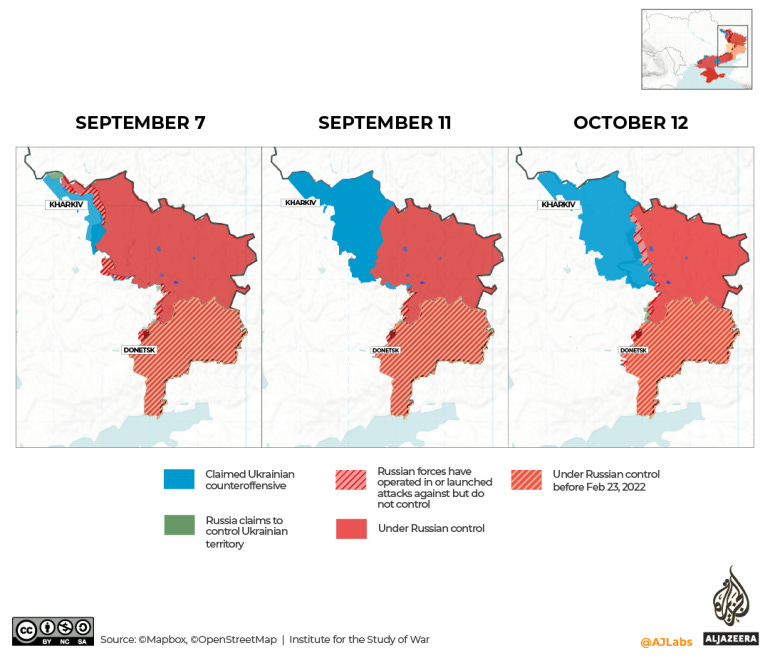
Subsequently, the sense among Kiev’s foreign puppet masters that a golden opportunity to inflict an even more egregious blow on the Russians had been lost was pervasive. Irate, then-British defence minister Ben Wallace asked Donahue what he would do if Kovalchuk were his subordinate. “He would have already been fired,” Donahue said. Wallace succinctly responded, “I got this.” At his direct demand, Kovalchuk was duly defenestrated. As the New York Times explains, the British “had considerable clout” in Kiev and hands-on influence over Ukrainian officials.
This was because, “unlike the Americans,” Britain had formally inserted teams of military officers into the country, to advise Ukrainian officials directly. Still, despite Kiev failing to fully capitalise as desired by London and Washington, the 2022 counteroffensive’s success produced widespread “irrational exuberance”. Planning for a followup the next year thus “began straightaway.” The “prevailing wisdom” within Task Force Dragon was this counteroffensive “would be the war’s last”, with Ukraine claiming “outright triumph”, or Russia being “forced to sue for peace.”
Zelensky boasted internally, “we’re going to win this whole thing.” The plan was for Ukrainian forces to cut off Russia’s land-bridge to Crimea, before seizing the peninsula outright. As the New York Times records though, Pentagon officials were considerably less enthused about Kiev’s prospects. This scepticism seeped out into the public sphere in April 2023 via the Pentagon Leaks. One document warned Ukraine would fall “well short” of its goals in the counteroffensive, forecasting “modest territorial gains” at most.
The leaked intelligence assessment attributed this to “shortfalls” in Ukraine’s “force generation and sustainment”, extensive Russian defences constructed following their retreat from Kherson. It cautioned “enduring Ukrainian deficiencies in training and munitions supplies probably will strain progress and exacerbate casualties.” The New York Times notes Pentagon officials moreover “worried about their ability to supply enough weapons for the counteroffensive,” and wondered if the Ukrainians “in their strongest possible position, should consider cutting a deal.”
Even Task Force Dragon’s Lieutenant General Donahue had doubts, advocating “a pause” of a year or more for “building and training new brigades.” Yet, intervention by the British was, per the New York Times, sufficient to neutralise internal opposition to a fresh counteroffensive in the spring. They argued, “if the Ukrainians were going to go anyway, the coalition needed to help them.” Resultantly, enormous quantities of exorbitantly expensive, high-end military equipment were shipped to Kiev by almost every NATO member state for the purpose.
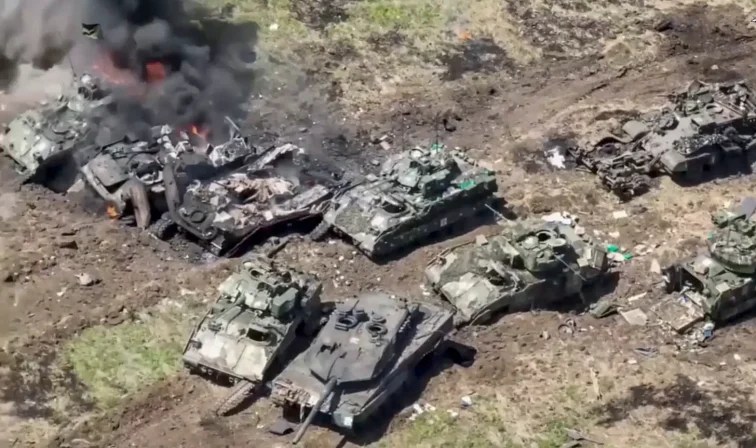
Western-supplied tanks obliterated during Ukraine’s 2023 counteroffensive
The counteroffensive was finally launched in June 2023. Relentlessly blitzed by artillery and drones from day one, tanks and soldiers were also routinely blown to smithereens by expansive Russian-laid minefields. Within a month, Ukraine had lost 20% of its Western-provided vehicles and armor, with nothing to show for it. When the counteroffensive fizzled out at the end of 2023, just 0.25% of territory occupied by Russia in the initial phase of the invasion had been regained. Meanwhile, Kiev’s casualties may have exceeded 100,000.
‘Knife Edge’
The New York Times reports that “the counteroffensive’s devastating outcome left bruised feelings on both sides,” with Washington and Kiev blaming each other for the catastrophe. A Pentagon official claims “the important relationships were maintained, but it was no longer the inspired and trusting brotherhood of 2022 and early 2023.” Given Britain’s determination to “keep Ukraine fighting at all costs”, this was bleak news indeed, threatening to halt all US support for the proxy war.
Still, there was one last perceived ace up London’s sleeve to keep Washington invested in the proxy conflict, and potentially escalate it into all-out hot war with Moscow. The New York Times reports that in March 2023, the US discovered Kiev “was furtively planning a ground operation into southwest Russia.” The CIA’s Ukraine chief confronted General Kyrylo Budanov, warning “if he crossed into Russia, he would do so without American weapons or intelligence support.” He did so anyway, “only to be forced back.”
Rather than deterring further incursions, Ukraine’s calamitous intervention in Russia’s Bryansk region was a “foreshadowing” of Kiev’s all-out invasion of Kursk on August 6th that year. The New York Times records how from Washington’s perspective, the operation “was a significant breach of trust.” For one, “the Ukrainians had again kept them in the dark” – but worse, “they had secretly crossed a mutually agreed-upon line.” Kiev was using “coalition-supplied equipment” on Russian territory, breaching “rules laid down” when limited strikes inside Russia were greenlit months earlier.
As this journalist has exposed, Ukraine’s Kursk folly was a British invasion in all but name. London was central to its planning, provided the bulk of the equipment deployed, and deliberately advertised its involvement. As The Times reported at the time, the goal was to mark Britain as a formal belligerent in the proxy war, in the hope other Western countries – particularly the US – would follow suit, and “send more equipment and give Kyiv more leeway to use them in Russia.”
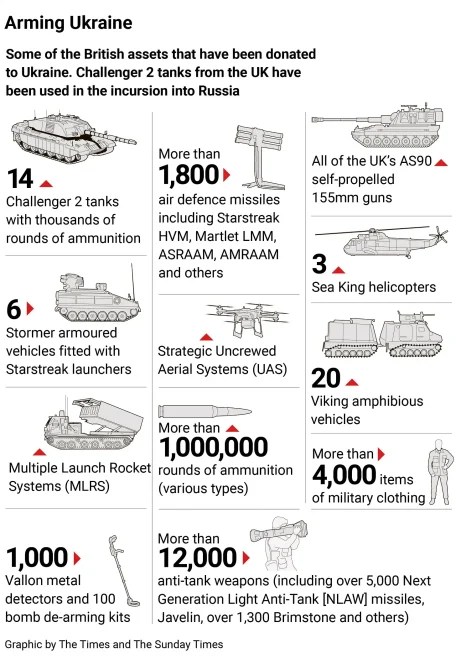
Initially, US officials keenly distanced themselves from the Kursk incursion. Empire house journal Foreign Policy reported that the Biden administration was not only enormously unhappy “to have been kept out of the loop,” but “skeptical of the military logic” behind the “counterinvasion”. In a further rebuke, on August 16th Washington prohibited Ukraine’s use of British-made, long-range Storm Shadow missiles against Russian territory. Securing wider Western acquiescence to such strikes was reportedly also a core objective behind Kiev’s occupation of Kursk.
However, once Donald Trump prevailed in the November 2024 presidential election, Biden was encouraged to use his “last, lame-duck weeks” to make “a flurry of moves to stay the course… and shore up his Ukraine project.” In the process, per the New York Times, he “crossed his final red line,” allowing ATACMS and Storm Shadow strikes deep inside Russia, while permitting US military advisers to leave Kiev “for command posts closer to the fighting.”
Fast forward to today, and the Kursk invasion has ended in utter disaster, with the few remaining Ukrainian forces not captured or killed fleeing. Meanwhile, Biden’s flailing, farewell red line breaches have failed to tangibly shift the battlefield balance in Kiev’s favour at all. As the New York Times acknowledges, the proxy war’s continuation “teeters on a knife edge.” There is no knowing what British intelligence might have in store to prevent long-overdue peace prevailing at last, but the consequences could be world-threatening.
Trump: ‘Very Bad Things are Going to Happen.’ Netanyahu Wants the U.S. to Destroy Iran.
By Dennis J. Kucinich | April 1, 2025
In my article, “The High Price of War with Iran: $10 Gas and the Collapse of the U.S. Economy,” I reminded readers of how Prime Minister Benjamin Netanyahu has been behind the push for America to destroy Iraq, Libya, Syria and now Iran. I reviewed the severe economic consequences for the U.S. if it attacks Iran. Today, I cite the human health and atmospheric effects of a U.S. attack on Iran’s nuclear research facilities. The resulting nuclear fallout would bring a catastrophe unprecedented in human history.
Last week, President Trump said “very bad things are going to happen” to Iran, if that nation’s leaders do not sign a new nuclear deal. The President is right. He can make very bad things can happen to Iran.
But Iran is not the only country to which “bad things” are going to happen if Iran’s nuclear research infrastructure is destroyed by the U.S., as is revealed by a careful study of the spread of radiation created by the promised bombings.
America has been Netanyahu’s pawn for decades. Will the wealth, lives and security of our nation be sacrificed yet further to an agenda which brings only debt to our nation and death to innocents abroad?
The return of Donald Trump to the White House for a second term has enabled Netanyahu’s right-wing party to accelerate the pulverization of Gaza, expand settlements and to repel the Houthis pro-Gaza attacks on Red Sea shipping.
Netanyahu viewed Trump’s first election in 2016 as a new opportunity to topple Iran’s leadership. Trump, in partnership with Netanyahu, withdrew the U.S. from a multi-lateral agreement which limited Iran’s nuclear development in exchange for sanctions relief.
An attack by B-2 bombers on Iran’s nuclear infrastructure would destroy the targeted sites, and unleash radioactivity endangering the lives of tens of millions in Iran and hundreds of millions beyond. Due to radioactive drift, Iraq, Kuwait, Qatar, the UAE, Bahrain, eastern Saudi Arabia, Afghanistan, and Pakistan also would be severely impacted.
In practical terms, given proximity to Iran, and the direction of the wind, high levels of radiation-induced illness, some fatal, and sharp increases in cancer and birth defects would occur. Radiation would contaminate and ruin food supplies, agricultural land, farm animals, and water resources hundreds and even thousands of miles from Iran.
The eastern regions of Turkey, northwestern India, Turkmenistan, Uzbekistan, Tajikistan and Kazakhstan would be exposed to moderate contamination. Jordan, Syria, Lebanon, Israel, Palestine and Egypt’s Sinai could be affected, depending on the wind.
Israel has long fanned existential fears by conjuring the threat of a nuclear attack by Iran, while being indemnified by the U.S. for its self-styled “defensive” aggression in Gaza, where at least 50,000 Gazans have been killed and over a million Palestinians driven from their homes.
While the widely publicized intent of President Trump to bomb Iran imperils Iran and neighboring countries, it also makes Israel vulnerable to a massive counterstrike from Iran and puts in the bullseye all U.S. troops in the region within 2,500 miles of Iran.
The attack B-2 bombers headed to Iran are designed to carry nuclear “bunker busters” as well as conventional 500 lb gravity bombs. The objective is to take down Iran’s nuclear infrastructure, which includes nuclear reactors and research labs. Nukes bombing nukes equals massive radioactive fallout.
“There will be Bombing.”
“If they don’t make a deal, there will be bombing,” Trump said in a telephone interview this past Sunday with NBC News. “It will be bombing the likes of which they have never seen before.”
Civics lesson: Official threats against another state are a violation of the UN Charter, Article Two, Section 4, which “prohibits the threat or use of force against …. any state.” Both Iran and the US signed and ratified that agreement nearly 80 years ago, in recognition of its organizing principle: “to save succeeding generations from the scourge of war…”.
It is a war crime to aggress against another country. Under the US Constitution, no president has the right to unilaterally take our nation to war, absent an imminent threat to the United States. The Constitutional Convention placed the war power in the hands of Congress. This was in contrast to the British Crown’s expansion of war for empire.
The litany of reasons not to attack Iran is eerily similar to the reasons America should not have attacked Iraq: Iran is not a threat to the United States. Iran has not attacked the United States. Iran does not have the intention or the ability to attack the United States. That being the case, the opportunities for a false flag incitement are ripe.
Significantly, last week the U.S. Intelligence community, in its annual Global Threat Assessment, refuted Netanyahu’s oft-repeated claim about Iran building a nuclear weapon:
“We continue to assess that Iran is not building a nuclear weapon and that Khamenei has not reauthorized the nuclear weapons program he suspended in 2003”.
In the 16 years I spent in Congress, I was often one of the only members who rose to question the Bush Administration’s plans to attack Iran, time and again calling out the dangers of attacking nuclear research facilities and calling for diplomatic means to block Iran’s potential development of a nuclear weapon.
The agreement, arrived on July 14, 2015, the Joint Comprehensive Plain of Action (JCPOA). It took the U.S. China, Russia, Germany, France, and the UK thirteen years to craft a workable agreement which limited Iran’s ability to enrich uranium to weapons grade. The agreement was a landmark for international cooperation. It put the spectral genie of Iran’s potential development of a nuclear weapon back in the bottle.
That did not satisfy Netanyahu, however. He longed for the toppling of the Iran regime, and continued to hype existential fears among Israelis. Trump cancelled the JCPOA, at Netanyahu’s behest, setting in motion a series of events which may lead the US to attack Iran soon.
From Deal Breaker to Deal Maker?
Scott Ritter a former UN Weapons Inspector and Marine intelligence specialist provides a detailed account of Trump’s withdrawal from the JCPOA, in his book, entitled Deal Breaker.
The JCPOA which Trump took down had blocked Iran’s production of enriched uranium (processed to increase the percentage of uranium-235 (235U) at the Natanz and Fordow nuclear facilities.
It blocked Iran’s development of weapons-grade plutonium and frustrated even covert attempts to produce fissile (capable of undergoing nuclear fission) materials used for nuclear weapons.
The President now is demanding Iran sign a new deal. He wants Iran to get rid of the weapon-making capability which he errantly enabled by cancelling the JCPOA.
Eight years after the cancellation of the JCPOA, President Trump is apparently demanding Iran voluntarily take down its nuclear infrastructure which provides nuclear power, nuclear research and yes, with no JCPOA, can, at this moment, enrich uranium to near–weapons grade.
The Supreme Leader of the Islamic Republic of Iran has issued a fatwa (a religious ruling) against the use of nuclear weapons.
The new deal which the President is seeking, at best, could end up looking a lot like the JCPOA, and, at worst, puts him in the position of issuing a non-negotiable demand for Iran to voluntarily take down its nuclear infrastructure, or the US will do it militarily.
Iran has rejected direct negotiations with Washington under such circumstances. It has, however, maintained indirect communication with the U.S. through Oman as the President escalates the threat of a massive bombing attack.
B-2 bombers are in place, equipped with the most powerful weapons in America’s arsenal ready to be activated from Diego Garcia, an island in the Indian Ocean, 2,400 miles southeast of Iran. The B-2 has the capacity to attack and return to Diego Garcia without refueling.
In someways this showdown with Iran was set in place on July 25, 2024, when Prime Minister Netanyahu addressed Congress. In a spell-binding speech for which he received over 50 standing ovations, Netanyahu skillfully aligned Israel’s and the U.S. policy on Iran:
“If you remember one thing, one thing from this speech, remember this: Our enemies are your enemies, our fight is your fight, and our victory will be your victory,” Mr. Netanyahu declared.
At this point, the measure of consequence needs to be assessed. The only difference between war games, preparing for war and actual war, is in the intent.
Israel intends to destroy Iran and needs the US to do it.
Joint US-Israeli Air Force war games have been held recently in preparation for an attack.
The U.S. has nineteen B-2 bombers. Each cost over $2 billion. Their unique flying wing design, with the plane wrapped in radar-absorbing materials help it avoid detection. The B-2s use sophisticated electronic countermeasures to jam or stymie opposition radar and missiles.
Iran is ill-equipped to defend against the B-2 bombers’ stealth warfare. At best the shortened detection range will limit Iran’s ability to lock onto the B-2 with surface-to-air missiles.
Each B-2 can carry sixteen, 2,400 lb., B83 thermo-nuclear gravity bombs, also known as nuclear bunker busters, which explode deep inside the earth. Each B83 bomb has the explosive capacity of 80 Hiroshimas which means each B-2 bomber is capable of delivering the destructive power of 1280 Hiroshimas.
Once the B83’s detonate they destroy underground structures and send shockwaves through rock. Earthquakes and massive ground displacement result, with radioactive debris being flung into the atmosphere.
There is a metaphysics at work here of bringing to oneself that which one fears. The United States is preparing to attack Iran because of Israel’s fear of Iran.
Trump: “It will be bombing the likes of which they have never seen before.”
The U.S. will first attack Iran’s underground missile cities at Khorramabad, and Panj Pellah, Bakhtaran, with nuclear bunker busters or Massive Ordnance Penetrators aimed at underground missile sites, to incapacitate Iran’s ability to retaliate.
The use of nuclear bunker busters will send nuclear debris into the immediate atmosphere, and it will be carried aloft by the wind.
Simultaneously, the U.S. will strike at the Fordow enrichment plant, buried deep in a mountain. A combination of 30,000 lb. Massive Ordnance Penetrators (GBU-57s) capable of burrowing 200 ft into the earth before exploding, and nuclear bunker busters, will be deployed, creating a multiplier factor in blast physics, collapsing tunnels and sending radioactive materials into the atmosphere and far beyond. Fordow is heavily fortified and may be able to withstand the initial attack.
The Natanz underground facility will be similarly struck, with radioactive matter breaking into the atmosphere.
The ground-level Bushehr Nuclear Power plant will be destroyed, its reactor vessel breached, the reactor core will meltdown, massive release of radioactive materials (cesium-137, iodine-131, strontium-90, and plutonium) will go into the atmosphere, and, depending upon the wind, and the weather, radioactive plumes will drift over other countries.
Countless civilians will perish from radiation poisoning and severe burns. Birth defects will be present for generations to come. Nuclear explosion refugees will be created. Chernobyl-type effects will require people to leave their homes, never to return.
Tehran’s Research Reactor, Isfahan Nuclear Tech Center, Arak Heavy Water Reactor, Natanz Surface Facility and the Parchine Military Complex are ground level and surface level structures which will be targeted and destroyed, either by nuclear weapons or so-called conventional weapons.
Iran Can Still Hit Back
Iran’s underground missile system is widely distributed. Faced with imminent destruction, Iran, at the first sign of an attack, will simultaneously launch multiple rockets from many underground sites, a “shower of missiles” numbering in the thousands.
These deadly projectiles can change trajectories and targets while in flight, making the vaunted missile defense of Israel less effective. While Israel’s 2000 lb. bombs, the type dropped on Gaza, are more precise, the Shabab-3 has the potential of inflicting much more significant damage over a larger radius of Israeli cities.
U.S. Troops in Region will Pay
Tens of thousands of US troops, Army, Navy, Airforce, Marines, Space Force are stationed within reach of Iranian missiles. They are under no threat unless Iran is attacked.
Iran’s short-range missiles, Fateh-110 and Zolfagher, can reach Saudi Arabia. Iran’s medium-range ballistic missiles, the Shabab-3, Emad, Sejjil, and Ghadr can travel up to 1,550 miles (2,500 km), to Israel. Its intermediate range missiles are capable of striking 2,485 miles deep into eastern and central Europe,
It is not in the interests of the United States to attack Iran.
The United States is risking becoming the most hated nation on earth, using nuclear weapons again, bombing nuclear facilities, creating radioactive consequences for potentially dozens of nations and tens of millions of people born and unborn.
America has been Netanyahu’s pawn for decades. Will the wealth, lives and security of our nation be sacrificed yet further to an agenda which brings only debt to our nation and death to innocents abroad?
During his campaign, President Trump stated repeatedly that he aimed to have a strong military to avoid war. Military strength must be matched by diplomatic strength. He must come up with a deal that avoids a U.S. war with Iran, without a foreign leader’s self-interested meddling. “Very bad things” do not have to happen if good people prevail. If America nukes Iran, our nation will never escape the fallout.
Russia offers mediation of talks between Tehran, Washington: Ryabkov
Al Mayadeen | April 1, 2025
Russia warned of United States airstrikes on Iran’s nuclear infrastructure, condemning US President Donald Trump’s threats to bomb Tehran unless a deal with Washington is reached.
“Threats are indeed being heard, ultimatums are also being heard,” Russia Deputy Foreign Minister Sergei Rybakov told International Affairs in an interview published Tuesday, adding, “We consider such methods inappropriate, we condemn them, we consider them a way for (the US) to impose its own will on the Iranian side.”
Russia proposed mediation between Trump’s administration and Iran, following their strategic partnership deal earlier this year.
Ryabkov said that Trump’s threats to Iran only complicate the situation between the two countries, emphasizing that if the US administration follows up with its warnings and strikes Iranian nuclear facilities, the consequences could be catastrophic for the entire region.
“While there is still time and the ‘train has not left’, we need to redouble our efforts to try to reach an agreement on a reasonable basis. Russia is ready to offer its good services to Washington, Tehran, and everyone who is interested in this,” the deputy foreign minister stated.
Iran stands steadfast to US threats
Ali Larijani, a top advisor to Iran’s Supreme Leader Ayatollah Khamenei, cautioned on March 31 that any US or Israeli strike targeting Iran’s nuclear sites would push Tehran to pursue nuclear weapons development.
He argued that attacking Iran’s nuclear facilities would backfire against US interests, warning, “Under such circumstances, we would have no choice but to reconsider our stance and potentially seek nuclear arms as a deterrent.”
Larijani warned that any military strike on Iran would only strengthen domestic resolve to fast-track nuclear weapons development, adding that due to Iran’s preparedness, such an attack would only delay the nuclear program temporarily – by no more than two years.
On March 31, the leader of the Islamic Revolution and the Islamic Republic of Iran, Sayyed Ali Khamenei, delivered a stern warning, asserting that any entity considering hostile actions toward Iran would be met with a severe and proportionate retaliation, while also stressing that efforts to provoke internal division would be decisively countered by the Iranian people, as they have shown in previous instances.
Admiral Alireza Tangsiri, the commander of the naval forces in Iran’s Islamic Revolution Guard Corps (IRGC), warned “foreign parties” against threatening Iranian interests, stating, “If foreigners attempt to attack us, pressure us, or endanger our interests, we will stand against them with full force.”
At the same time, he emphasized that “Iran does not seek war but will respond firmly to any aggression.”
Here’s why the West has so far failed to start World War III
By Tarik Cyril Amar | RT | March 31, 2025
Under the title ‘The Partnership: The Secret History of the War in Ukraine’, the New York Times published a long exposé that has made a splash. It is a long article advertised – with a lumbering clunkiness that betrays cramping politics – as the “untold story of America’s hidden role in Ukrainian military operations against Russia’s invading armies.”
And it clearly aspires to be sensational: A revelation with a whiff of the famous Pentagon Papers that, when leaked to the same New York Times and the Washington Post in 1971, revealed what a mass-murderous fiasco America’s Vietnam War really was.
Yet, in reality, this time the New York Times is offering something less impressive by magnitudes. And the issue is not that the Pentagon Papers were longer. What really makes ‘The Partnership’ so underwhelming are two features: It is embarrassingly conformist, reading like a long exercise in rooting for the home team, the US, by access journalism: Based on hundreds of interviews with movers and shakers, this is really the kind of ‘investigation’ that boils down to giving everyone interviewed a platform for justifying themselves as good as they can and as much as they like.
With important exceptions. For the key strategy of exculpation is simple. Once you see through the rather silly group-therapy jargon of a tragic erosion of ‘trust’ and sad misunderstandings, it is the Ukrainians that get the blame for the US not winning its war against Russia, in their country and over their dead bodies.
Because one fundamental conceit of ‘The Partnership’ is that the war could have been won by the West, through Ukraine. What seems to never even have entered the author’s mind is the simple fact that this was always an absurd undertaking. Accordingly, the other thing that hardly makes it onto his radar screen is the crucial importance of Russia’s political and military actions and reactions.
This, hence, is an article that, in effect, explains losing a war against Russia without ever noticing that this may have happened because the Russians were winning it. In that sense, it stands in a long tradition: Regarding Napoleon’s failed campaign of 1812 and Hitler’s crash between 1941 and 1945, all too many contemporary and later Western observers have made the same mistake: For them it’s always the weather, the roads (or their absence), the timing, and the mistakes of Russia’s opponents. Yet it’s never – the Russians. This reflects old, persistent, and massive prejudices about Russia that the West cannot let go of. And, in the end, it is always the West which ends up suffering from them the most.
In the case of the Ukraine conflict, the main scapegoats, in the version of ‘The Partnership’, are now Vladimir Zelensky and his protégé and commander-in-chief General Aleksandr Syrsky, but there is room for devastating side swipes at Syrsky’s old rival Valery Zaluzhny and a few lesser lights as well.
Perhaps the only Ukrainian officer who looks consistently good in ‘The Partnership’ is Mikhail Zabrodsky, that is, the one – surprise, surprise – who worked most closely with the Americans and even had a knack of flatteringly imitating their Civil War maneuvers. Another, less prominent recipient of condescending praise is General Yury Sodol. He is singled out as an “eager consumer” of American advice who, of course, ends up succeeding where less compliant pupils fail.
Zabrodsky and Sodol may very well be decent officers who do not deserve this offensively patronizing praise. Zelensky, Syrsky, and Zaluzhny certainly deserve plenty of very harsh criticism. Indeed, they deserve being tried. But constructing a stab-in-the-back legend around them, in which Ukrainians get blamed the most for making the US lose a war that the West provoked is perverse. As perverse as the latest attempts by Washington to turn Ukraine into a raw materials colony, as a reward for being such an obedient proxy.
With all its fundamental flaws, there are intriguing details in ‘The Partnership’. They include, for instance, a European intelligence chief openly acknowledging – as early as spring 2022 – that NATO officers had become “part of the kill chain,” that is, of killing Russians who they were not, actually, officially at war with.
Or that, contrary to what some believe, Westerners did not overestimate but underestimate Russian abilities from the beginning of the war: In the spring of 2022, Russia rapidly surged “additional forces east and south” in less than three weeks, while American officers had assumed they would need months. In a similar spirit of blinding arrogance, General Christopher Cavoli – in essence, Washington’s military viceroy in Europe and a key figure in boosting the war against Russia – felt that Ukrainian troops did not have to be as good as the British and Americans, just better than Russians. Those daft, self-damaging prejudices again.
The New York Times’ “untold story” is also extremely predictable. Despite all the detail, nothing in ‘The Partnership’ is surprising, at least nothing important. What this sensationally unsensational investigation really does is confirm what everyone not fully sedated by Western information warfare already knew: In the Ukraine conflict, Russia has not merely – if that is the word – been fighting Ukraine supported by the West but Ukraine and the West.
Some may think the above is a distinction that doesn’t make a difference. But that would be a mistake. Indeed, it’s the kind of distinction that can make a to-be-or-not-to-be difference, even on a planetary scale.
That’s because Moscow fighting Ukraine, while the latter is receiving Western support, means Russia having to overcome a Western attempt to defeat it by proxy war. But fighting Ukraine and the West means Russia has been at war with an international coalition, whose members have all attacked it directly. And the logical and legitimate response to that would have been to attack them all in return. That scenario would have been called World War III.
‘The Partnership’ shows in detail that the West did not merely support Ukraine indirectly. Instead, again and again, it helped not only with intelligence Ukraine could not have gathered on its own but with direct involvement in not only supplying arms but planning campaigns and firing weapons that produced massive Russian casualties. Again, Moscow has said this was the case for a long time. And Moscow was right.
This is why, by the way, the British Telegraph has gotten one thing very wrong in its coverage of ‘The Partnership’: The details of American involvement now revealed are not, actually, “likely to anger the Kremlin.” At least, they are not going to make it angrier than before, because Russia is certain to have long known about just how much the US and others – first of all Britain, France, Poland, and the Baltics – have contributed, directly and hands-on, to killing Russians.
Indeed, if there is one important takeaway from the New York Times’ proud exposé of the extremely unsurprising, it is that the term ‘proxy war’ is both fundamentally correct and insufficient. On the one hand, it perfectly fits the relationship between Ukraine and its Western ‘supporters’: The Zelensky regime has sold the country as a whole and hundreds of thousands of Ukrainian lives to the West. The West has used them to wage war on Russia in pursuit of one overarching geopolitical aim of its own: To inflict a ‘strategic defeat’ on Russia – that is, a permanent demotion to second-rate, de facto non-sovereign status.
The above is not news, except perhaps for the many brainwashed by Western information warriors from historian-turned-war-apostle Tim Snyder to lowlier X agitators with Ukrainian flags and sunflowers in their profiles.
What is also less than stunning but a little more interesting is that, on the other side, the term proxy war is still misleadingly benign. The key criterion for a war being by proxy – and not its opposite, which is, of course, direct – is, after all, that major powers using proxies limit themselves to indirect support. It is true that in theory and historical practice that does not entirely rule out adding some limited direct action as well.
And yet, in the case of the Ukraine conflict, the US and other Western nations – and don’t overlook the fact that ‘The Partnership’ hardly addresses all the black ops also conducted by them and their mercenaries – have clearly, blatantly gone beyond proxy war. In reality, the West has been waging war on Russia for years now.
That means that two things are true: The West almost started World War III. And the reason it has not – not yet, at least – is Moscow’s unusual restraint, which, believe it or not, has actually saved the world.
Here’s a thought experiment: Imagine the US fighting Canada and Mexico (and maybe Greenland) and learning that Russian officers are crucial in firing devastating mass-casualty strikes at its troops. What do you think would happen? Exactly. And that it has not happened during the Ukraine War is due to Moscow being the adult in the room. This should make you think.
Tarik Cyril Amar is a historian from Germany working at Koç University, Istanbul, on Russia, Ukraine, and Eastern Europe, the history of World War II, the cultural Cold War, and the politics of memory
Orbán counters FT article telling the EU to ‘solve its Orbán problem’
Remix News | April 1, 2025
The Financial Times’ piece entitled “It’s time for the EU to solve its Orbán problem” has elicited a stern response from Hungarian PM Viktor Orbán.
The piece determines that the EU must support Ukraine’s fight against Russia and provide it with arms to do so. And to do this, it must also somehow get Hungary on board, despite the country repeatedly reiterating its pro-peace stance.
Author Mujtaba Rahman states, “The EU’s ability to do this is directly compromised by Orbán, who has been hugely emboldened by Trump’s return. The Hungarian prime minister keeps in lockstep with Trump and Putin in the hope of winning favours from both.”
Rahman then lists “levers” the bloc can pull to essentially force Hungary’s hand, primarily through the withholding of cash the country desperately needs due to what the author calls Hungary’s “stagnant economy.”
“EU funds are therefore critical if Orbán is to boost investor confidence in the country’s economy. The European Commission has leverage and should use it,” the piece reads. Rahman also suggests simply suspending Hungary’s voting rights.
The article ends by stating, “The EU is now facing a Darwinian moment. It will either adapt or die. To protect Ukraine and its Russian ‘frontline’ states, it must face down Orbán.”
In a response posted on X, Orbán wrote, “The Financial Times is right about one thing: Europe has arrived at a Darwinian moment. They want to change the EU from a peace project to a war project. This is not evolution, this is decay. We must resist, even if they want to punish us.”
Germany to target ‘internal EU enemies’ – Politico
RT | April 1, 2025
The incoming German government plans to play a larger role in EU decision-making, including by punishing nations that dissent against the bloc’s foreign policy, Politico has reported. According to the outlet, a draft coalition agreement targets Hungary, which has defied EU decisions on issues such as the Ukraine conflict and sanctions against Russia.
Germany is set to have a new coalition government formed by the Christian Democratic Union (CDU), Christian Social Union (CSU), and the Social Democrats (SPD), likely led by Friedrich Merz of the CDU. The parties are currently finalizing agreements on key policy areas, including migration, climate, and EU relations. Merz is reportedly aiming to form the new government before Easter on April 20.
One of the documents reviewed by Politico outlines Berlin’s plans for a more assertive EU strategy. It proposes using the ‘Weimar Triangle’ – a trilateral alliance of Germany, France, and Poland, which currently holds the EU’s rotating presidency – to influence the bloc’s direction and strengthen Germany’s use of its voting rights.
The draft also states that Berlin plans to “defend” the EU against “internal and external enemies” by calling for punitive action against member states that allegedly violate principles such as the rule of law. Proposed penalties include withholding EU funds and suspending voting rights.
“We will take even more consistent action against violations,” the document states. “Existing protective instruments, from infringement proceedings and the withholding of EU funds to the suspension [of] membership rights such as voting rights in the Council of the EU, must be applied much more consistently than before.”
The coalition has also proposed the creation of a “comprehensive sanction instrument” to rein in perceived dissenters, including replacing the EU’s foreign policy unanimity requirement with majority voting to prevent countries from blocking decisions such as sanctions.
“The consensus principle in the European Council must not become a brake on decision-making,” the document states.
While Hungary is not mentioned by name, the draft agreement appears to be a clear reference to the country, which has long been at odds with EU policies, including over its approach to the Ukraine conflict and its sanctions policy towards Russia.
Budapest has argued that sanctions have been detrimental to the bloc’s economy, and has exercised its veto right on several motions to delay or dilute measures. Prime Minister Viktor Orban has repeatedly accused the EU of taking a “pro-war” stance and has pursued independent peace initiatives on the Ukraine conflict.
The EU has previously threatened to suspend Hungary’s voting rights. It withheld around €22 billion in funds earmarked for Budapest in 2022, citing rights and judicial concerns, but ultimately released about half of that amount last year.
Trump-Putin parley is a bit under the weather
By M. K. BHADRAKUMAR | Indian Punchline | March 31, 2025
The Kremlin apparently came to the conclusion last week that it was about time to do some plain-speaking that US president Donald Trump’s quest for a 30-day ceasefire in the Ukraine war was a non-starter. Over the weekend, in a series of remarks, Trump reacted sharply that he’s “very angry” with President Vladimir Putin over his approach to the proposed ceasefire and threatened to levy tariffs on Moscow’s oil exports if the Russian leader does not agree to a truce within a month.
Trump is either incapable or unwilling to accept that neither Russians nor Ukrainians have their heart in the ceasefire deal (for different reasons, though) even while paying lip service to it, as each wants to have Trump on its side.
Unlike Ukrainians who are blasé about their desire to continue to wage the war until Russian forces vacate their territories in the east (knowing that may never happen), Russians are savvy operators who prioritise the unfinished business of the war while playing their part in the diplomatic circuit.
Actually, Russians are in two minds whether the war could end once their military gains total control over Donbass, or, should they also take control of Odessa, Nikolaev, Dnipropetrovsk, Kharkov, etc. to create a security zone roughly, along the Dniepr River, and, let the UN figure out the future of the rump state of Ukraine. (See my blog A Third Way to end the war in Ukraine, Indian Punchline, March 29, 2025.)
Such is the backlog of the West’s betrayals and repudiation of agreements, including during first term, that Russia may come to estimate that its best security guarantee for durable peace lies in creating solid facts on the ground.
Trump will do well to read the extraordinary report featured in the New York Times dated March 29, 2025 titled The Partnership: The Secret History of the War in Ukraine. It is a doctored version of the untold story of America’s hidden role in Ukrainian military operations against Russia but the main thing is that it confirms the Russian allegation that this has been a proxy war kick-started by the US with great deliberateness.
Suffice to say, Trump’s claim to be a good Samaritan with a bleeding heart who wants the war to end, et al, won’t fly. On the other hand, Putin is nonetheless keen on establishing a good personal rapport with Trump and anchor a meaningful US-Russia partnership on it, realistic enough to accept that Trump is as good an American president as Russia would ever get.
That said, Putin is also unwavering that in order for peace to be durable, conditions must be created first where he needs Trump’s understanding, although Russian people are deeply sceptical about any US mediation.
Trump refused to say if there was any deadline for Russia to agree to a ceasefire in Ukraine, but he told reporters on board Air Force One yesterday, “It’s a psychological deadline. If I think they’re [Russians] tapping us along, I will not be happy about it.”
On the contrary, Russians have been as transparent as they could in the prevailing climate of deep distrust — and no real effort has yet begun to address the root causes of the conflict.
The Russian negotiator Grigory Karasin, an accomplished career diplomat and deputy foreign minister and currently a senator heading the foreign affairs committee of the upper-house Federation Council, who was the negotiator at the expert group negotiations at Riyadh last Monday, said over the weekend with great candour on Russia’s national television that the 12-hour talks “haven’t led to any radical breakthrough yet, but the opportunities are there. It would have been naive to expect any breakthroughs.”
Karasin claimed that the US negotiators, including senior National Security Council director Andrew Peek and State Department policy planning chief Michael Anton, initially presented “proposals that are unacceptable to Russia.”
“But then, in my opinion… they realised that a team of civilised, reasoned interlocutors was sitting in front of them,” he said, describing the talks as having had a “good atmosphere” despite the lack of progress.
Importantly, Karasin said he expects US-Russian negotiations on Ukraine to continue at least until the end of 2025 or beyond.
We will never know how accurate was the feedback Trump received from the inconclusive negotiations in Riyadh. Clearly, the US has since resiled from the understanding given to the Russian side in regard of waiving the sanctions for the export of Russian food and fertilisers to the world market, facilitate the payments system and provide other underpinnings needed.
Karasin’s glasnost was apparently not music to Trump’s ears. Nonetheless, good sense prevailed finally, as Trump signalled his intentions to talk to Putin.
Will that help? Putin said as recently as last week that Russia’s interests will not be bartered away. Even if Trump were to now decide to join hands with the UK and France to lead the “coalition of the willing” to continue the Ukraine war, it is unlikely Putin will budge on Russia’s core interests.
However, Trump’s real predicament is something else. He had a choice to decouple the US from the war. But then, he was also swayed by the Wall Street’s obsessive interest in Ukraine being a honeypot, which of course is incompatible with his known aversion to assuming the obligations and responsibilities of a de facto colonial power in a faraway land 10,000 kms away.
The result is, Ukrainians have lost respect for him. Zelensky hit out on Friday, saying, “Ukraine has received the new draft agreement on natural resources from the US, which is totally different from the previous framework agreement. Ukraine will not recognise the United States military aid as a debt. We are grateful for support but it’s not a loan.”
Wall Street Journal reported on the new revised draft document sent to Kiev from Washington, which insists on Zelensky signing an agreement giving the American companies control over key economic projects. In particular, the US seeks the right to be the first to participate in Ukraine’s infrastructure projects and mining programs, including rare-earth metals and construction of ports.
The fund, managed primarily by US representatives, will channel the profits to pay off the cost of military aid provided by Washington to Kiev. If the agreement is signed, Ukraine will have 45 days to submit a list of projects for consideration by the fund.
Britain’s Daily Telegraph reported that under the latest version of the deal, the US would control half of Ukraine’s oil and gas reserves, its metals and much of its infrastructure, including railways, ports, pipelines and refineries, through a joint investment fund. The US plans to receive all profits until Ukraine pays it at least $100 billion in compensation for military aid, with a 4% surcharge. Kiev will start receiving 50% of the profits only after the debt is repaid.
The newspaper added that the new fund will be registered in the state of Delaware but will operate under the jurisdiction of New York. And the US will have the right to veto the sale of Ukrainian resources to third countries and the prerogative to check the accounts of any Ukrainian agency involved.
Trump has fallen between two stools. Ukraine is highly unlikely to accept the deal with the US. Also, trust Russian ingenuity to make a counter offer in business relationship to Trump that he can’t refuse. In sum, Trump’s attempt to enhance trust with Putin was indeed the right approach. And Putin reciprocated in earnestness.
Indeed, their parley made some headway until it came under weather, thanks to the mercantile considerations in play regarding Ukraine’s resources, which require that the war must be put to sudden death. Whereas, such wars have their own dynamics too.
Donald Trump is Looking Like a War President
By Adam Dick | Peace and Prosperity Blog | March 31, 2025
Donald Trump ran for president presenting himself as the peace candidate. A little over two months into his presidency, Trump, however, appears to be establishing himself as a war president.
Instead of quickly ending the US government’s support for war against Russia through Ukraine and against Palestinians, Lebanon, and beyond through Israel, Trump is keeping the money, weapons, and intelligence flowing to support the war efforts of these two so-called allies. It would have been simple for Trump to just declare “no more” and bow out of these wars, but he has chosen not to do so. He is also directing new major military action against Somalia and Yemen. Plus, Trump is threatening to bomb Iran, as well as attack any of Iran’s military that may be found around Yemen. Even Greenland is newly in the crosshairs of US military might during Trump’s presidency, with Trump declaring that the US will acquire the island territory of Denmark one way or another, up to through the use of military force.
A little over two months into the new Trump presidency, the death and destruction keeps coming from the US support for Ukraine and Israel in their wars. Further, the US military is directly engaging in newly expanded military attacks elsewhere, and new wars are being threatened in regard to Iran and — out of left field — Greenland.
Can Trump still become the peace president he suggested he would be? Time is running out. The way things are shaping up, it looks like there is a good chance the US will be more immersed in wars two months from now than it is so far in the new Trump administration.
Thousands march in Paris against military aid to Ukraine
RT | March 29, 2025
 Thousands of demonstrators marched through the streets of Paris on Saturday, protesting French President Emmanuel Macron’s and NATO’s militaristic approach to the Ukraine conflict.
On Wednesday, Macron announced a new €2 billion ($2.16 billion) military aid package for Ukraine, after weeks of attempting to drum up support for his initiative to send Western troops as peacekeepers to the country. The new arms will include surface-to-air missiles, armored vehicles and drones, the French leader said.
Saturday’s anti-war rally was organized by former right-wing National Rally politician Florian Philippot and his party, The Patriots.
Thousands of protesters could be seen marching through the French capital, chanting slogans such as “Macron, we don’t want your war!” and “Let’s quickly leave NATO!” in video captured by RT.
Many could also be seen waving placards with the motto “Macron, we will not die for Ukraine.”
“A mad crowd for #Peace… Thousands and thousands of French people are shouting ‘Macron, resign!’ in the streets of Paris right now!” Philippot wrote on X on Saturday.
The Patriots protested in the French capital earlier this month after Macron proposed deploying France’s nuclear weapons in other European allied states, citing uncertainty over Washington’s commitment to the continent.
On Thursday, following an international summit in Paris, Macron announced a French-British plan to push for the deployment of troops to Ukraine as a “reassurance force” in the event of a ceasefire between Kiev and Moscow. Macron first touched on the idea of sending Western troops into Ukraine last February.
Russia has categorically ruled out agreeing to NATO troops being deployed to the conflict zone. Troops from the US-led military bloc, even under the guise of peacekeepers, would amount to direct NATO participation in the conflict, according to Moscow.
EU to reject Russia-US Black Sea deal – von der Leyen
RT | March 29, 2025
The EU will not lift its sanctions against Russia for as long as the Ukraine conflict continues, European Commission President Ursula von der Leyen has said.
During talks in Saudi Arabia on Monday, Russia and the US agreed to move towards reviving the Black Sea Grain Initiative, which, according to the Kremlin, should include the removal of Western restrictions against Russian Agricultural Bank and other financial institutions involved in the international sale of food and fertilizers.
In her interview with French broadcaster LCI on Friday, von der Leyen made it clear that Brussels will not support the idea of a maritime truce between Moscow and Kiev put forward by the administration of US President Donald Trump.
“The sanctions are very significant; they are painful; they have an impact on the Russian economy, and they represent a powerful lever,” she said when asked about the possibility of the EU fulfilling Russian demands to lift some of the curbs.
According to the head of the European Commission, the restrictions “will remain in effect until a just and lasting peace is established in Ukraine.”
However, she noted that “when the war is over, the sanctions might be removed.”
Von der Leyen also said that for the conflict to end, “security guarantees for Ukraine” are needed as well as “a solid defense industrial base and a deterrent force” in the EU.
The Black Sea Grain Initiative, originally brokered in July 2022 by the UN and Türkiye, envisioned the safe passage of Ukrainian agricultural products in exchange for the West lifting its restrictions on Russian grain and fertilizer exports.
Moscow withdrew from the deal a year later, citing the West’s failure to uphold its obligations. The Americans and Russians now see its revival as a step towards settling the Ukraine conflict altogether.
Earlier this week, President Vladimir Putin asserted that the Russian economy has become the fourth largest in the world in purchasing power parity terms after those of China, the US and India, despite a record 28,595 sanctions being placed on it by Washington, Brussels and their allies. According to the Russian government’s data, the country’s economy grew 4.1% in 2024, surpassing the official forecast of 3.9%.
Putin previously urged the Russian business circles against expecting the sanctions to be fully lifted, describing them as a mechanism of strategic systemic pressure on the country that the West intends to keep using.
The war over war with Iran has just begun
By Sina Toossi | Responsible Statecraft | March 28, 2025
The war drums are getting louder in Washington.
In recent weeks, many of the same neoconservative voices who pushed the U.S. into Iraq are calling for strikes on Iran. Groups like the Foundation for Defense of Democracies and the Washington Institute for Near East Policy are once again promoting confrontation, claiming there may never be a better time to act. But this is a dangerous illusion that risks derailing what Donald Trump himself says he wants: a deal, not another disastrous war in the Middle East.
A war with Iran wouldn’t just risk another endless conflict. It would blow up Trump’s broader agenda at home and abroad.
A major conflict would drain U.S. resources and attention, distracting from domestic priorities and weakening America’s leverage on every front: China, Russia, Europe, and trade. Europe could seize the moment to prolong support for the war in Ukraine and resist Trump’s push to reset transatlantic ties. Trade partners like Mexico, Canada, India, and others could take advantage of America’s preoccupation to extract lop-sided concessions. And a unilateral strike would likely fracture the international community.
Russia and China, despite their own misgivings about Iran’s nuclear ambitions, would point to U.S. aggression as the real threat, undermining American credibility at the United Nations and beyond.
And the most dangerous consequence? A strike could backfire and push Iran to do exactly what Trump says he wants to prevent: build a bomb. Iran is already enriching uranium near weapons-grade. If it withdraws from the Nuclear Non-Proliferation Treaty, the last threads of international oversight would disappear. An attack would likely galvanize even more hardline elements in Iran and provide the political justification to sprint for a nuclear weapon.
Trump could go down in history, not as the president who solved the Iran crisis, but as the one under whose watch Iran finally became a nuclear weapons state. That’s not the legacy he wants, or one the country can afford.
Raising alarms, Trump recently declared, “Something will happen to Iran soon.” But he also made clear, “Hopefully, we can have a peace deal. I’m not speaking out of strength or weakness, I’m just saying I’d rather see a peace deal than the other.” These are not the words of a warmonger. They are the words of a negotiator, someone who still sees the value in diplomacy.
Trump is not alone. In a recent interview with Tucker Carlson, his foreign policy envoy Steven Witkoff offered a notably more restrained perspective on Iran than is typical from the foreign policy establishment. Witkoff emphasized pragmatism, verification, mutual respect, and, most importantly, avoiding conflict. His remarks reflected a grounded approach rooted in a clear understanding of both American interests and the region’s complex dynamics.
The problem is that many of the loudest voices shaping Iran policy — inside and outside the government — are actively working to sabotage any realistic path to diplomacy. They talk about wanting a “deal,” but what they’re actually demanding is Iran’s surrender: zero uranium enrichment, dismantling its nuclear program, cutting ties with all its regional allies, and fundamentally changing its foreign policy. No Iranian government — pragmatist or hardliner — could accept such terms. Even Masoud Pezeshkian, Iran’s newly elected president who ran on a platform of diplomacy and engagement, would have no political space to agree to that kind of ultimatum.
Let’s be clear: if you’re pushing for such maximalist demands under the guise of wanting a deal, you’re not working for peace. You’re laying the groundwork for war.
Iran is a complicated actor with a complicated history. But the lessons of the past decade are clear: when the U.S. engages Iran through diplomacy, it gets results. When it relies solely on pressure, it inches closer to conflict.
The point of pressure has always been to create leverage, not to impose costs for their own sake. That leverage now exists. The question is what to do with it.
The 2015 nuclear deal was far from perfect for any side, but it did succeed in placing tight constraints on Iran’s nuclear program and subjected it to unprecedented international inspections. The aim of withdrawing from that deal was to compel Iran to accept stronger terms. That hasn’t happened.
Instead, the result has been several years of Iranian nuclear expansion, regional instability, and growing alignment between Tehran, Moscow, and Beijing. Iran is now enriching uranium to 60% — dangerously close to weapons-grade — and stockpiling far more than before. Meanwhile, the international consensus that once backed U.S. efforts has frayed.
Now is the time to cash in on current U.S. pressure. Not by continuing on an escalatory path that leads to war, but by using the leverage that’s been built to strike a better deal — one that delivers strong constraints, more transparency, and greater long-term security for the United States.
Against this backdrop, hawkish voices are once again pushing the illusion that striking Iran would be quick and effective. A recent report from the Washington Institute for Near East Policy (WINEP) claims Israel’s alleged deep intelligence reach and risk tolerance make a “preventive strike” against Iran potentially “much more successful” than past American efforts, like when the U.S. attacked nuclear targets in Iraq in 1991 and 1993. But this dangerously downplays the risks. Even Trump’s allies are urging caution.
Vice President J.D. Vance, for example, rightly cautioned last October that “America’s interest is sometimes going to be distinct” from Israel’s — and made clear that avoiding war with Iran is in the U.S. interest. He warned such a conflict would be “massively expensive” and a “huge distraction of resources.” The reality is that a strike might at best delay Iran’s program while likely sparking a regional war, endangering U.S. troops, and pushing Iran to weaponize.
Indeed, even the same WINEP report that touts the feasibility of a strike quietly acknowledges the scale of what it would entail: “an open-ended, multiyear campaign to degrade Iran’s nuclear capabilities, influence its nuclear proliferation calculus, and shape its political and military responses.” In other words, this wouldn’t be a quick, surgical strike; it would be the beginning of another endless war in the Middle East.
Such a conflict would also carry steep economic costs, from skyrocketing oil prices to instability across the Middle East. And it would almost certainly backfire politically: Americans are war-weary, and polls show overwhelming support for diplomacy over conflict.
What’s needed now is a pragmatic strategy to de-escalate and reengage — one that offers Iran credible incentives in exchange for verifiable nuclear limits but doesn’t require dismantling its entire program.
The Iranian leadership has shown a consistent pattern in its dealings with the United States: pressure is met with pressure, while concessions are met with reciprocal steps. History has made clear that what moves the needle is not ultimatums, but a formula grounded in mutual respect, trust-building, and incremental, verifiable actions. Witkoff’s recent interview signaled a welcome openness to serious diplomacy, but rhetoric alone is not enough. To resonate in Tehran, it must be paired with credible, calibrated actions.
Modest, realistic steps — such as allowing a limited release of Iran’s frozen assets for humanitarian purposes or reviving President Emmanuel Macron’s 2019 proposal for a credit line backed by future oil revenues — would not require lifting core U.S. sanctions. Yet they could offer enough tangible benefit to bring Iran to the table. These measures should be linked to parallel Iranian concessions, such as slowing the accumulation of highly enriched uranium and enhancing IAEA access.
Another option is a negotiated “pause:” a fixed-duration agreement where the U.S. freezes further escalation of sanctions and refrains from imposing new pressure, while Iran halts key elements of its nuclear expansion. This mutual freeze could serve as a time-bound window for more comprehensive talks — buying time, lowering tensions, and creating space for diplomacy to succeed.
Critics will claim this approach “rewards bad behavior.” But the real question isn’t about rewarding anyone, it’s about results. What actually reduces the risk of Iran getting a nuclear weapon or dragging the U.S. into another endless war? The record speaks for itself: pressure detached from feasible diplomatic outcomes hasn’t delivered results. In fact, pressure for its own sake has backfired — driving Iran’s nuclear program forward and repeatedly bringing the U.S. to the brink of conflict.
Some will say Iran cannot be trusted. That’s precisely why inspections and verification are essential. When a deal was in place, international inspectors had access to Iran’s nuclear facilities, and the program was significantly constrained. Military strikes, by contrast, would likely end all transparency and push Iran to withdraw from the Non-Proliferation Treaty, eliminating the last tools for monitoring and oversight.
There’s no perfect deal. But the smart play is a deal that contains Iran’s nuclear program, avoids a war, and keeps the U.S. in the driver’s seat. That should be the goal of any serious policy, not wishful thinking or ideological crusades.
President Trump has always seen himself as a dealmaker. Now’s the moment to make one that matters. He should empower voices in his camp — like Steven Witkoff — who understand that diplomacy isn’t weakness, it’s strategy. Rejecting the tired playbook of regime change and endless escalation would show real leadership.
Sina Toossi is a non-resident fellow at the Center for International Politics. Previously he was senior research analyst at the National Iranian American Council, and a research specialist at Princeton University’s Woodrow Wilson School of Public and International Affairs.
Featured Video
Seyed M. Marandi: US-Iran War Inevitable: Kuwait and Bahrain May Fall
or go to
Aletho News Archives – Video-Images
From the Archives
Oil and the Israel Lobby
Reknowned economist M. Shahid Alam offers this excellent critique of Noam Chomsky’s defective analysis of the relative influence of Oil versus the Israel lobby over US foreign policy: … continue
Blog Roll
 Aletho News
- ICC ignored ‘very well-documented’ NATO crimes – ex-Libyan minister
- SNSC secretary dismisses US response to Iran’s conditions as ‘inadequate’
- Sanaa says Taiz roads open, secure for residents, warns Saudi forces
- Iraqi resistance group urges Saudi leadership to admit defeat, lift Yemen siege
- Trump’s Retreat: How Al-Aqsa Flood Took Down the US Empire
- Israel’s Military Actions in Lebanon Grossly Violate International Law — Lavrov
- Seyed M. Marandi: US-Iran War Inevitable: Kuwait and Bahrain May Fall
- Leaders Condemn Ansarallah Attack on Saudi Arabia While Ignoring Illegal War Against Yemen
- Leaked: Britain’s Covert Iraqi Psyops Network
- Yemeni Armed Forces Warn Airlines Against Using Saudi Airports, Exempt Mecca and Medina
- If Americans Knew
- After Oct 7, IDF policy allowed civilian casualties for even the lowest-ranking targets
- Israel’s Destruction of Southern Lebanon Intensified After the Cease-Fire
- The Last-Minute Decision That Gave Israel Its Name
- The American Conservative: How Trump Made the World Go Nuclear
- Meet the US generals and admirals advancing Israeli policy
- Opinion: Why news organizations should boycott Israel
- The Israeli witch hunt of Sami Abu Shehadeh exposes the lie of the ‘Jewish and democratic’ state
- No state has a ‘right’ to exist – least of all Israel
- Testimonies about Gaza’s civilian death toll expose Israel’s atrocities – Daily Update
- How Israel Conquered the Latin American Right
- No Tricks Zone
- Germany’s Green Energy Debacle: High Energy Costs Force Kahla Porzellan to Close After 182 Years!
- New Study: 50 Years Of The Most Aggressive ‘Net Zero’ Policies Can Only Affect The Global Climate By 0.03°C
- US September “Heat” Was No Record…Many Records Set Decades Ago
- Latest European Green Energy Debacle; Portugal’s Largest Flagship Solar Park Insolvent!
- Green Energy Debacle: German Expert Professor Fritz Vahrenholt Warns Of Severe Economic And Social Consequences
- Two More Paleo Reconstructions Affirm Meters-Higher Sea Levels Across Ireland, Brazil 7000-6000 Years Ago
- New Study: Earth And Venus Surface Warmth Largely Explained By Convection And Lapse Rate, Not CO2 Or Radiation
- 2025 Nature Paper Claiming Worsening Global Drought Gets RETRACTED …Heavily Flawed
- New Study: ‘Global Drought Shows No Detectable Recent Acceleration Under Climate Warming’
- Economic Masterminds: German Socialists Suggest Taxing Productivity Gains Stemming From Using AI

