UK to Spend $510Mln on Sea Viper Missile System Upgrade Following Houthi Attacks in Red Sea
Sputnik – 21.01.2024
The United Kingdom plans to spend $514 million to modernize the Sea Viper anti-aircraft missile system that UK forces previously used to shoot down drones in the Red Sea amid a deteriorating situation in the Middle East region, UK Defense Secretary Grant Shapps said.
On January 10, Shapps said that a UK destroyer operating in the Red Sea alongside US warships managed to repel “the largest attack” staged in the region by Yemen’s Houthi.
The contract was reportedly signed with the UK division of the MBDA missile maker, the report said. The Sea Viper missile system will receive new missiles and software to counter ballistic missile threats.
The Houthis vowed in November 2023 to attack any ships associated with Israel until it halts the invasion of Gaza.
In January, the US and UK began airstrikes on Houthi positions in Yemen to degrade their fighting capabilities. Russia condemned both the Houthi actions in the Red Sea and the Western aggression against Yemen, dubbing the latter “another example of the Anglo-Saxons’ distortion of UN Security Council resolutions and complete disregard for international law”.
Not Ready for the Big Leagues
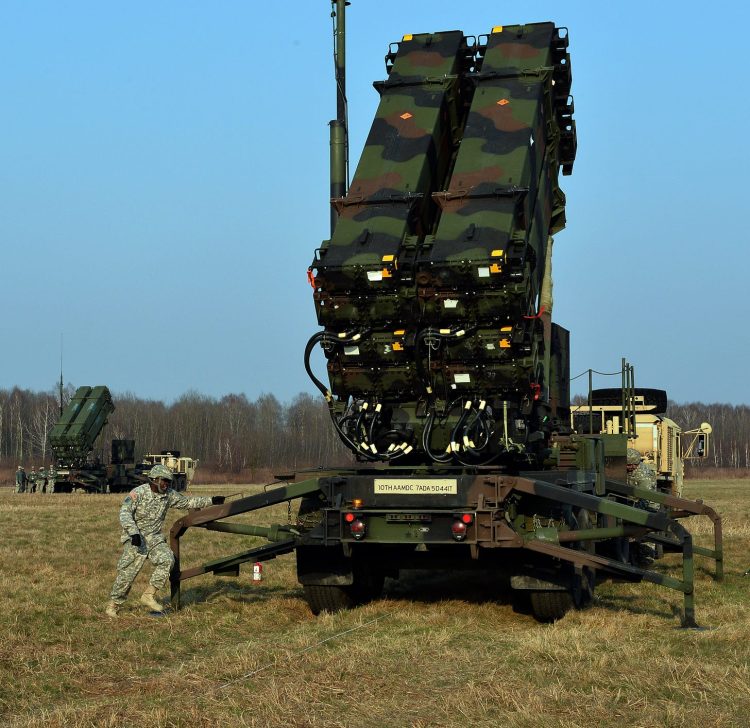
Patriot Missile Launcher
By William Schryver | imetatronink | January 20, 2024
According to the best information I can gather on short notice, I have been able to ascertain that current US production of the PAC-3 missiles typically used in the Patriot air defense systems is about ~500 per annum, at a cost of 4 – 6 million dollars each.
There are aspirations of increasing that rate to 650 per annum within the next year.
As for current US stocks of PAC-3 missiles, for the sake of argument, let’s allow for the possibility there are 5000 units (there aren’t near that many).
The consensus seems to be that the US can currently field ~500 operational launchers.
A single Patriot battalion typically consists of 6 batteries with 6 launchers each. Each of the 36 launchers can hold up to 16 PAC-3 missiles. So up to 576 PAC-3 missiles in a single-load of a Patriot battalion.
To prosecute war against Russia, China, or Iran, protection of the major forward bases of the United States Air Force would be the prerequisite upon which success would be predicated.
To adequately cover even one of these large airbases against missile strikes of just 100-200 units of high-performance drones, cruise-missiles, ballistic missiles, and hypersonic missiles — plus numerous decoys — would easily require an entire Patriot battalion.
Even with a 100% interception rate, a pair of 100-missile strike packages over the course of a day would still compel a PAC-3 burn rate of at least 300 missiles, given that, as a general rule, two PAC-3 missiles are launched at every incoming target.
But of course, the interception rate would be considerably lower than 100%. And given that the Patriot command, radar, and launcher units — along with missile storage sites — would be primary targets, there would be a substantial attrition rate of the highly immobile Patriot systems themselves. (The Russians have already clearly demonstrated the vulnerability of the Patriot systems to counter-battery missile strikes. At least three Patriot batteries have been destroyed in Ukraine.)
In an attempt to cover just three large airbases against a series of salvos of 100+ missiles of various types, the entire US stockpile of PAC-3 interceptors could very conceivably be exhausted in little more than a week or two.
Current annual production could easily be consumed in little more than a day or two.
This is the reality of 21st century high-intensity conflict against an adversary with the capability to shoot back — a kind of war for which the United States military is woefully ill-prepared, both materially and doctrinally.
Israelis opposing war receiving ‘death threats,’ says Knesset member Ofer Cassif

Lawmaker from the Arab-majority Hadas-Ta’al party and a Knesset member, Ofer Cassif in his office in West Jerusalem on January 12, 2024. [Arif Kayacan – Anadolu Agency]
MEMO | January 20, 2024
Firebrand Israeli lawmaker Ofer Cassif, who has been criticized for backing South Africa’s genocide case against Israel, says “there is an assault going on” against those who are opposing Tel Aviv’s military campaign in Gaza.
The vocal politician from the left-wing, Arab-majority Hadash-Ta’al party, was suspended from the Knesset for 45 days for criticizing the war that began after the Oct. 7 cross-border offensive by Hamas.
The Palestinian death toll from Israel’s more than 100-day bombardment of the Gaza Strip has crossed 24,000 people, most of them women and children.
The initial Hamas attack is said to have killed 1,200 people, and around 240 hostages were taken, some of whom were released during a week-long truce in November.
In a wide-ranging exclusive interview with Anadolu, Cassif said rejection of Israel’s military response has led to “an assault on freedom of speech,” including death threats.
“People are arrested for tweets and posts, not in support of Hamas, of course, but in supporting ending the war, or before even cease-fire. Students are suspended from the universities and colleges. People are fired from their workplaces. The police are brutally violent towards the demonstrators,” Cassif said.
“There is an assault on freedom of speech of those who raise voice against the war … there are death threats. Because it’s not only violence from above, from the government from the prime minister, legitimization of the violence against the protesters, of course by [Itamar] Ben Gvir (national security minister) and the police, which unfortunately mostly became a kind of a private militia of Ben Gvir. But it also penetrates the society as a whole. And you can see that within the society, a growing a part of the public supports, literally and explicitly, violence against those who oppose the war, including death threats.”
‘Region will explode’ if Netanyahu doesn’t go
Cassif said everyone will pay a “huge price” and the entire “region is going to explode” if Israel does not get rid of the “terrible government” headed by Prime Minister Benjamin Netanyahu.
According to him, the only way to stop the catastrophe from happening is by stopping the war, exchange of prisoners and release of all hostages, withdrawal of Israeli military from Gaza, and the beginning of serious peace process.
“This government should go home, if not to prison” as it has caused a lot of damage to both Israelis and Palestinians, he said. “The only way to live, to have a future, to prosper, is this. No war.”
Israeli contradictions
He also highlighted the contradiction in statements of Israeli authorities over the assault on the blockaded enclave, who on one hand say they never intentionally target civilians, but at the same argue there are no innocents in Gaza.
“A minister said ‘… dropping an atomic bomb on Gaza is an option.’ Another member of the Knesset, although a backbencher, said Gaza be eliminated. He used this term eliminated. Netanyahu himself, the prime minister, said Gaza is like Amalek. Amalek is like a codename, a biblical codename, of a group that deserves extermination.
“The president of Israel, who is supposed to be objective and beyond politics, signed a bomb, before it was sent to Gaza. And he also said that there aren’t any innocent people in Gaza. This is only the tip of the iceberg. So how can you say that you do not target civilians, innocent civilians, and at the same time, you say they aren’t innocent civilians. This contradiction shows exactly how this government behaves, what is the policy of this government, and I emphasize this is against Israel too.”
‘What’s going on in Gaza must be investigated by impartial body’
Cassif said he did not want to claim that the Israeli government is pursuing a genocidal policy in the Gaza Strip, arguing: “The legal definition of genocide is one that I leave experts to analyze.”
But, he added, there are two main reasons for him supporting the genocide case in The Hague: conducting an impartial investigation on Gaza bombing, and to save lives.
“What’s going on in Gaza must be investigated by an impartial body. I do not trust the government of Israel or any branch or proxy of the Israeli government to investigate itself … It’s like asking a thief to investigate oneself whether he or she stole something. It doesn’t make any sense,” he said.
“This terrible assault on Gaza is costing the lives of thousands of thousands of Palestinians, and hundreds of Israeli soldiers and Israeli hostages. They (Israeli hostages) are held in terrible conditions by Hamas in Gaza. I want the lives to be saved.”
But that cannot be done just through protests in Israel, he added.
“We cannot demonstrate, we cannot raise our voice. We are limited. There is a dictatorship now here, practically. What’s left is to look for a refuge in international organizations. So that’s the main reason why I think we should have supported the appeal of South Africa.”
Interests of Palestinians and Israelis ‘not contradictory’
“The interests of Israel, and the interests of Palestinians, as far as I see, are not contradictory. I think it’s in common interest of both the Palestinians and the Israelis to seek peace and to end the war,” Cassif said.
The Israeli government, he said, “totally neglected” the hostages. “The government doesn’t do anything to save the hostages. And everybody knows the only way to save the hostages, who are dying there, is by ending the war.”
The parliamentarian claimed 47% of the Israeli public, according to polls, supports ending the war in order to rescue the captives. “I agree with this specific point. I do hope the ICJ will ensure a decision that will end the war.”
Israeli press ‘betrayed’ profession
Asked why the Israeli army does not allow journalists to enter Gaza, Cassif said: “Perhaps they have something to hide … Normally when you don’t allow someone to get into somewhere. It’s because you don’t want someone to see something.”
About press freedom in Israel, Cassif said there have been situations where authorities “mobilize,” or force the media to “publish something and not to publish something else,” but now a vast majority of journalists are “voluntarily” supporting the policy of the government.
“You can say, there are not many limitations on freedom of the press, but the press itself, most of them, choose not to act freely … this is disgraceful, it’s unprofessional, and it will be remembered once this terrible era is ended and finished. It will be remembered that they betrayed the profession.”
‘They want to silence us’
Commenting over a lawmaker’s efforts to get him expelled from the 120-member Knesset, Cassif said “they want to silence” and “don’t want our voice to be heard … the voices against the war. This is the part of the persecution and silencing of the people who support peace and go against violence and war.”
The opposition lawmaker said he believed the efforts against him will succeed, but he will approach the Supreme Court to get relief as “there is no legal basis.”
“According to the law, a member of Knesset can be expelled only if one supports racism, terrorism, or armed struggle against Israel. Neither of those is relevant to me. I’m against racism, I’m against terrorism. I am against armed struggle against Israel.”
He said the claim is based on political reasons. “The world should understand that the assault on Gaza, and the silencing of peace lovers and the democrats in Israel are two sides of the same coin. They continue with a coup they began before Oct. 7 by other means.”
France’s and Germany’s Lack of Independence Forces Them to Continue Bankrolling Ukraine
Sputnik – 20.01.2024
While Western powers’ lavish financial and military contributions to Kiev’s war effort have so far failed to produce any meaningful results, many leaders seem eager to keep bankrolling Ukraine until it runs out of manpower.
The EU may be looking to amend the mechanism used to provide military support to Ukraine by creating a new fund in addition to the European Peace Facility (EPF) that has so far been used by Europe to funnel arms to Kiev.
According to Bloomberg, the new fund may have an annual budget of €5 billion but EU member states are yet to come to a consensus on how this initiative is going to work out.
Commenting on this development, Gabor Stier, senior foreign policy analyst at the conservative Hungarian daily Magyar Nemzet, told Sputnik that whatever shape and form this new fund is going to take, it will ultimately harm European states.
According to him, the EU leadership is essentially trying to come up with a plan to bankroll Ukraine regardless of what Hungary might think about it, with Stier referring to attempts by Hungarian Prime Minister Viktor Orban to come up with a plan to provide aid to Ukraine without harming the EU budget in the process.
Orban’s proposals – that involve dividing the aid to Kiev into smaller tranches and keeping track of exactly how this money would be spent – are very much disliked by Brussels, Stier said. The EU leadership is reportedly concerned that the Hungarian prime minister might veto options he does not like (as decisions to allocate funds under the auspices of EPF require unanimous agreement).
“There will be a new fund but with what money?” Stier inquired. “The first option would be a new fund where money from the EU budget would go into. This does not solve the issue with the Hungarian veto. The second option would involve creating a fund outside the EU budget. The problem with this option is that it would take too long as each (EU) country and its respective parliament would have to vote on it separately. There will be arguments and it will all drag on. While this would go on, Ukraine would already suffer a defeat.”
Thus, Stier suggests, the new fund will likely be filled with money from the EU budget.
“It is already clear that this fund will be designed through discussions within the EU, which is clear in light of the new strikes in Germany or in France. It seems that everyone is either not too keen to trust Ukrainian politicians or have reconsidered their approach to the allocation of funds,” he mused.
Stier also noted that some European states use Orban as “cover” by making it look like he is the lone obstacle on the way to agreeing on the Ukrainian aid issue.
“There are internal frictions, this much is clear. Earlier in Budapest, Slovakian Prime Minister Robert Fico voiced his agreement with Orban on everything related to Ukraine,”
he said. “Austria is also on the same wavelength as Orban. But when it comes to voting in Brussels, no one besides Orban says that they are against (the funding of Ukraine).”
According to Stier, even France and Germany essentially use Orban to “force Ukraine, who is brazenly spending all resources of the Western powers, to slow down somewhat.”
Only Poland, the Baltic states and the Scandinavian states wholeheartedly support Ukraine, he argued, along with the “Benelux and the Netherlands,” though the latter two have some “internal problems.”
He did note, however, that even though Germany, France and Italy may not be thrilled by the prospects of continuously financing Ukraine, they simply cannot stop doing so.
“This is how their dependence on the United States manifests,” Stier explained. “Europe is going to bear the financial burden in the future, that much is obvious.”
The analyst also claimed that this year is going to be “critical” for Ukraine in terms of financing, and that “more justifications are required to amass so much money everywhere” to support Kiev.
Letting Ukraine into NATO is ‘basis for World War Three’ – Slovakia

Prime Minister of Slovakia Robert Fico. © Getty Images / Janos Kummer
RT | January 20, 2024
Bratislava will block Kiev’s bid to join the US-led NATO alliance and will stand by a decision to stop supplying weaponry to Ukraine amid its conflict with Russia, Prime Minister of Slovakia Robert Fico has said.
The PM made the remarks on Saturday ahead of his visit to Ukraine to meet his counterpart Denis Shmygal in the western Ukrainian city of Uzhgorod. Fico stressed that his visit serves solely “humanitarian” purposes and promised to openly communicate Bratislava’s stance to Kiev on different issues, including Ukraine’s potential accession to EU or NATO membership.
“I will tell him that there are things on which we have completely different opinions,” Fico told broadcaster RTVS. “I will tell him that we respect them when it comes to joining the EU, but they must fulfill the conditions,” he added, explaining that a situation where “a country that absolutely does not meet any requirements” joins the EU is unacceptable.
He ruled out any possibility of Ukraine joining NATO, insisting such a move would only result in a global catastrophe, apparently caused by a direct collision between NATO and Russia over the issue.
“I will tell him that I will veto and block [a NATO bid by Ukraine] because that is exactly the basis of the third world war and nothing else.”
Fico also promised to reiterate to Shmygal his election campaign pledge to stop providing Kiev with weaponry, stating that the decision remains in force. Still, the weapons restriction applies only to state-sponsored military aid to Ukraine and supplies coming from Slovak military stocks, whereas arms manufacturers are free to sell to the country whatever they like, he noted.
“When Slovak companies don’t make money, American ones will,” Fico noted.
Prior to Fico assuming office following his party’s electoral victory in September, Slovakia had been among Kiev’s top supporters, lavishly supplying it with sophisticated weaponry, including warplanes and anti-aircraft systems. The policy of the previous government has also left the country’s own defense posture badly damaged, new Defense Minister Robert Kalinak claimed earlier this week.
“The former government left us without our own anti-aircraft defenses, without combat aviation, and we don’t even have the promised 700 million for MiGs, which the government also handed over to Ukraine,” Kalinak told the Standard newspaper.
A ‘pro-Russian monster’ or a force for common sense? A new party is reshaping the German political landscape

By Tarik Cyril | RT | January 20, 2024
Germany is in severe crisis. Between a tanking economy and an increasingly unpopular government, the country has begun to show just how much stress it is under. Half a year ago, the head of German carmaker Volkswagen warned that “the roof is on fire,” while The Economist concluded that “disaster,” meaning not just the decline but collapse of the German car industry, is “no longer inconceivable.”
At this moment, the wintry beginning of 2024, German farmers are staging large-scale and escalating protests and forcing the ruling coalition into concessions, the trains are not running on time due to a strike, the country’s wholesale sector has dropped to pandemic-level pessimism, “dampening hopes of a rapid rebound in Europe’s largest economy,” as reported by Bloomberg, residential property prices are in record decline, and the office real estate market “has collapsed,” according to leading German news magazine Der Spiegel.
The Economist finds Germany to be “down” politically as well – in fact, self-relegated – from its status as leader of Europe (or, at least, the EU) to less than second fiddle (that would be France, perhaps): while “Angela Merkel was the continent’s undoubted leader, Olaf Scholz, has not taken on her mantle.”
That is a very British understatement. In reality, in the toxic yet key relationship with the US, Germany, with its hapless attempt to transfer the management concept of “servant leadership” to geopolitics, has now subordinated itself so thoroughly to American neocon-type interests that it has no leverage left at all. Because once you make your loyalty unconditional, you will be taken for granted: Selling oneself may be inevitable for any but the greatest powers. Selling oneself for free takes a special lack of foresight.
We could go on heaping up examples of malaise. But the gist is simple: Germans may love to lay it on thick when it comes to venting their misery and “angst” (I should know, being German), but, clearly, something has to – and will – give. The question is what.
One political force that stands to gain from the crisis has just been established. (Another fairly new party that is profiting is the AfD.) Long rumored and in the making, 8 January saw the official founding of a new party, the Bündnis Sarah Wagenknecht – Vernunft und Gerechtigkeit (Alliance Sarah Wagenknecht – Reason and Justice), or BSW for short. Its leader Sarah Wagenknecht used to be the most popular top politician of the hard-Left party Die Linke, which she left with a bang.
As the name BSW suggests, the new party is, in part, a vehicle for Wagenknecht’s considerable personal political acumen and charisma. Opponents of “Red Sarah,” as the popular, generally right-leaning newspaper Bild still calls her, like to stereotype her as an “icon.” Yet, wiser from the failure of an earlier attempt to strike out on her own (under the label “Aufstehen,” roughly: “Stand Up”), this time, Wagenknecht has gone out of her way and made sure to do her homework, preparing a well-crafted organization, a set of junior leaders around her, and, last but not least, a solid program. This is politically significant: Unlike “Aufstehen,” the BSW will not fold quickly under the weight of its own problems.
On the contrary, the party’s chances of making a strong impact from the get-go are very good, as polls consistently indicate. The most recent one – commissioned by Bild and carried out just days after the party’s founding by a top pollster – shows that 14% of Germans would vote for the BSW in a federal election.
For comparison: the SPD, traditionally one of the core parties of Germany and the political home of Chancellor Olaf Scholz, reaches 14% as well. For the BSW this is an impressive figure, but for the SPD it is catastrophic. Meanwhile the Greens, the second partner in Berlin’s governing “Ampel” coalition, are at 12%. The FDP, the third “Ampel” component, would fail to get any seats at all (due to not crossing Germany’s electoral threshold of 5%). Sarah Wagenknecht’s own former party, Die Linke, would suffer the same fate. The only two parties that would do better than the BSW are the traditional center-right CDU (27%) and the populist-right/far-right AfD (18%).
In sum, with BSW, we are witnessing not the making of a fringe but a core movement in what seems to be emerging as Germany’s re-shaped party system, consisting of three traditional parties (SPD, CDU, and the Greens) and two new forces. The latter are coming from the right and left periphery but are likely to re-define the center, directly and by their pressure on the traditional players.
Representatives of the threatened traditional parties and their expert and mainstream media surrogates often denounce the challengers from the wings as extremists or, at least, irresponsible populists (just another way of saying “demagogue”). But they only have themselves to blame: The true cause of this tectonic movement is the failure of the traditionals. The challengers’ rise marks a reaction to it. Wagenknecht is right about this: Germany’s “democracy is imperiled most of all” by government policies that make ever more citizens feel left alone or alienated.
Against that background, the BSW promises more generous social policies, such as on education, wages, and pensions (and higher taxes for the wealthy). As Germany is doing badly economically, this will resonate. And Wagenknecht, a political “natural,” knows how to signal: She has just taken the side of the protesting farmers – as do the majority (68%) of Germans, according to polls.
Mainstream media are making desperate attempts to frame the rebellious farmers as serving extremists and somehow playing into the hands of – guess which country! – Russia. The ever more besieged minister of the economy Robert Habeck has even detected financing by – guess who! – “Putin!” (without, of course, providing any evidence). This time, these tired scare tactics are failing to catch on. Wagenknecht’s public call for chancellor Olaf Scholz to apologize to the farmers will fare better.
Crucially, Wagenknecht and the BSW have combined socially left approaches with a set of traditionally conservative stances, challenging, for instance, the hypertrophic development of new gender categories or, in general, “symbolical struggles” over hyper-sensitive terminology, so fashionable with what Wagenknecht dismisses as the “lifestyle Left.”
While this push-back against political correctness is a largely symbolic, though effective, operation, migration is a more substantial field. There as well, Wagenknecht has adopted positions closer to the right and center than the liberal left, stressing the need for control and limits. The fact that she herself had a Persian father and that prominent BSW heads are also non-ethnic Germans gives her a strong starting position for this kind of debate, shielding her points from dismissal as racist or xenophobic.
Given how many Germans feel, left alone in an economic crisis and also alienated by especially Green attempts at re-education in the spirit of urban upper class multiculturalism and gender obsessions, it will be hard to counter the BSW’s brand of socially left but otherwise centrist and even conservative policies. No wonder then that opponents are trying to portray Wagenknecht as a monster, along with the new party. Their playbook is predictable and boring: namely to smear them as being pro-Russian or even working in the service of Russia.
In reality, Wagenknecht has positioned her new party to resist the push for ever more confrontation with Moscow, especially with regard to Ukraine. At this moment, for instance, she is speaking up against the delivery of German Taurus cruise missiles to Ukraine, which is the latest fad among the insatiable “miracle weapon” addicts. More generally, she is demanding to shift from a policy of military confrontation by proxy to one of negotiation and compromise, which makes, of course, perfect sense.
For her enemies, there is an irony waiting to catch them: They may hope that accusing Wagenknecht of being too friendly toward Russia will weaken her appeal. Yet that ship has sailed. The days of making hay with unbridled neo-McCarthyism are ending. It is more likely, fortunately, that the BSW’s reasonable approach to foreign policy will only get it more sympathy and voters. As it should. Because remember: At this point, Germany is so dependent on the US that it is treated not only like a vassal, but like a vassal whose wishes and interests do not count. Even Germans who distrust Russia will come to understand that this is fundamentally unsound. In its own national interest, Germany must re-establish some balance by rebuilding its relationship with Russia.
Tarik Cyril Amar is an historian from Germany working at Koç University, Istanbul.
An Epoch of Great Changes Is upon Us

Russian Avangard Hypersonic Missile
By William Schryver | imetatronink | January 19, 2024
One of my current X followers posted earlier today:
“I am against the Ukraine war from the very beginning (mainly because for the first time a foreign war can actually get ME killed with Russia’s missiles), but at this point I also think we can’t just let Russia win which means we lose and that would mean a lot of negative things.”
I will not speak to his fears of “Russia’s missiles”, except to say I am convinced Russia will not strike anyone that hasn’t done something to provoke it in a manner that warrants such a response — at least not so long as the Putin regime remains in charge.
In any case, Russia WILL win this war. Decisively. She will dictate the terms of its cessation. Russia will emerge from this war significantly more powerful than she was just two years ago, and on a trajectory to become even more powerful in coming years.
As I wrote in a recent article:
“… the Russian armed forces, fighting on their own ground, on and under their adjacent seas, and in the air above their spheres of control, constitute the most potent and battle-hardened military force on the planet.”
As for the US empire’s European vassals: at no point in the last 500 years has Europe been more militarily, politically, socially, and spiritually debilitated. If the entire current military capacity of Europe were combined, it would not stand a chance of defeating Russia in a war. Rather, it would be systematically and comprehensively slaughtered.
And, as I have argued in crescendo over the past several years, the long-pervasive belief in American military supremacy is a myth; a mirage; a fallacious narrative fashioned from fables and Hollywood films.
The US military has not won a war since WW2. They have mercilessly bombed the crap out of many smaller, weaker countries, killed millions of people, and yet never once achieved strategic victory.
Not since WW2 have they faced anything even faintly approximating high-intensity warfare.
Indeed, never at any time in history has the US military fought against a great power adversary at the height of its strength.
And now, here in 2024, the US military has never been in a more weakened state relative to any of its potential great power adversaries — namely, Russia, China, and Iran.

Iranian Shahed-238 loitering cruise missiles, three variants.
As I repeat often, I am convinced the failed US/NATO proxy war against Russia in Ukraine will produce the following results:
— It will greatly accelerate the decline of the American Empire.
— NATO will cease to be a credible military/political alliance.
— The EU will cease to be a credible monetary/political alliance.
And, as the broken hegemon rapidly recedes, political, economic, and social chaos is certain to engulf much of the world as the major and minor players on the planet scramble to secure their respective spheres of influence and establish new centers of global and regional power.
An epoch of great changes is upon us.
Pyongyang’s Poseidon? North Korea Unveils New ‘Tsunami’ Underwater Nuclear Weapon
Sputnik – 19.01.2024
Apparently nonplussed by the recent joint naval drills held by the US, Japan and South Korea near the Jeju Island, North Korea has responded by touting its latest advancement in the field of nuclear weaponry.
North Korea revealed that it has tested an underwater nuclear drone this week.
A spokesman for North Korea’s Defense Ministry said in a statement that, “the Underwater Weapon System Institute under the DPRK Academy of Defense Science conducted an important test of its underwater nuclear weapon system ‘Haeil-5-23’ under development in the East Sea of Korea.”
Little is known about this new North Korean weapon, other than its name which translates as “tsunami.” Nonetheless, one can surmise – based on the available data – that it is an electric underwater drone that can follow a predetermined path and carry a nuclear payload, said Dmitry Kornev, founder of the MilitaryRussia.ru news portal.
“It is a craft that can guide itself to some floating or stationary target and then blow itself up there,” he surmised.
As Kornev pointed out, this is not exactly a novel concept as similar designs were considered in the Soviet Union before finally being implemented decades later in the “Poseidon” project. He did note, however, that Russia’s “Poseidon” – also an underwater drone with a nuclear warhead – has a nuclear propulsion unit whereas North Korea’s creation likely has electric propulsion.
Regarding the reason why North Korea developed such a weapon, Kornev said that he sees certain merit in Pyongyang’s rhetoric about needing nuclear weapons to ensure North Korea’s safety and to deter possible attacks from the West and its “lackeys.”
“If about 20-30 years ago any missile tests in North Korea evoked serious reaction from the global community, today the global community stays mum because North Korea has nuclear weapons and is ready to use them. Whether it is a good or bad thing, everyone can decide for themselves,” he remarked.
Dennis Kucinich Files to Run for the US House
By Adam Dick | Ron Paul Institute | January 19, 2024
 Dennis Kucinich earned a reputation for independence during his time as a member of the United States House of Representatives from 1997 to 2013. Repeatedly, he would, with commentary and legislative action, advance peace and respect for liberty in the national legislative body in the face of opposition from his Democratic House leadership, and the Republican House leadership as well.
Thus, it seems fitting that when Kucinich filed on Thursday with the Federal Election Commission (FEC) his paperwork for running again for the House he did so as an independent.
Kucinich, whose formal campaign announcement is reported to be scheduled for Wednesday, is expected to compete in the 2024 general election against both a Republican and a Democrat in the seventh Ohio district. The district extends from Cleveland southward. Kucinich served in the House before from Cleveland and, in the late 1970s, was the city’s mayor.
Kucinich is an Advisory Board member for the Ron Paul Institute for Peace and Prosperity.
PM Orbán: EU parliament wants to rob citizens of a choice on Ukraine funding

MAGYAR NEMZET | JANUARY 19, 2024
By forcing through a four-year, €50 billion aid package to Ukraine just a few months ahead of European elections, members of the European Parliament want to rob people of the right to choose their future, Prime Minister Viktor Orbán wrote on X.
“Liberal MEPs attacked Hungary once again in the European Parliament yesterday. They want to give money to Ukraine for 4 years, while the European elections are just 5 months away. They essentially want to strip people of their rights to make decisions on their future. What an anti-democratic position! Hungary disagrees. If we want to help Ukraine, let’s do it outside the EU-budget and on a yearly basis! This is the only democratic position just 5 months before the elections,” Orbán wrote.
On Wednesday, two key debates were held in Strasbourg. The first focused on the previous and upcoming EU summits, while the second was entitled: “The situation in Hungary and frozen EU funds.”
After the EU parliament discussed funding to Hungary, the agenda was supposed to focus on the EU summit set for Feb. 1. However, MEPs were so fixated on Hungary, that the country dominated their conversations for nearly the entire session, so much so that even Romanian Socialist MEP Maria Grapini pointed out that the debate was fixated on the vilification of Hungary and the previous session’s discussion on Ukraine.
Trump is the Republican’s candidate but the “deep state” has its own plan, says Chronicles editor
By Ahmed Adel | January 19, 2024
It is certain that Donald Trump will be the candidate of the Republican Party, but it is also certain that the establishment, known as the American “deep state,” will not allow him to be the next president of the USA, according to Dr. Srđa Trifković, foreign policy editor of the American magazine Chronicles.
Former American President Donald Trump won the Republican internal party elections in Iowa, while Florida Governor Ron DeSantis won second place. More than 60% of voters turned out for the elections, and Trump received 50.6% of the votes, while Desantis won 21.4% of the votes. Behind them was the former US ambassador to the United Nations and avid war hawk Nikki Haley.
The intra-party election in Iowa officially started the 2024 US presidential election race, and Trump is clearly popular with the voters but is hated by the top of the party.
“The popularity of numerous challengers in the form of Florida Governor Ron DeSantis or former US Ambassador to the UN Nikki Haley cannot be compared to the popularity that Trump enjoys among pro-Republican voters and party members on the ground,” said Trifković.
“This, of course, does not mean that the Republican establishment, that is, the leadership of the Republican Party in the Senate and the House of Representatives of Congress, as well as in the apparatus of the top of the party, is enthusiastic about Trump – on the contrary,” he stressed.
The editor highlighted, as an example, how the late Senator John McCain belonged to the wing of the Republican Party that had the slogan – ‘Never Trump.’ McCain’s legacy is still present today, but it is evident that among registered Republicans, Trump’s popularity remains indisputable.
Nonetheless, this will not exempt Trump from facing immense opposition, in his run to become president again, from the Democratic Party, the FBI, the military-industrial-complex, and the media. According to Trifković, these are different branches of the “deep state,” and they are conspiring to prevent Trump from running in key states, with “an experiment” already made in Colorado after the Supreme Court of that state, which Democrats control, disqualified Trump from the race for president.
“[The court] used an obscure amendment to the Constitution of 1866 that was expressly intended to prevent Confederate officials from running for public office after the North’s victory in the American Civil War,” the editor said, adding that holding Trump accountable for the attack on the Capitol in 2021 was “absurd, but in the politicised world of the American judiciary, anything is possible.”
It cannot be ruled out that since Trump is currently accused of 92 misdemeanours, the former president’s opponents will time some of the court decisions right before the election so that he is disqualified at the last minute by the Supreme Court of Pennsylvania or Georgia, which Democrats control. This would mean that he cannot appear on the ballots in those states.
According to a poll from the Atlanta Journal-Constitution and the University of Georgia, Trump (45%) leads President Joe Biden (37%) in the swing state of Georgia. Biden narrowly won Georgia in 2020, the first time a Democratic presidential candidate won the state since 1992, but it is almost certain that a Republican will win in this year’s election. For this reason, the “deep state” is attempting to disqualify Trump from such key states.
If Trump cannot be prevented from becoming president again by disqualifying him from key states, Trifković said there is a “Plan B,” which is to repeat “the theft from November 2020, when we witnessed the bizarre spectacle that in the key cities of the key counties, the counting stopped around three in the morning, and then at six in the morning continued with additional tens of thousands of votes for Biden that were mysteriously created from a pool of postal votes.”
“It was a blatant theft that is statistically absolutely inexplicable, but you can’t say that publicly in America today because the very claim that the election was stolen is criminalised and demonised,” he added.
It is telling that more than 70% of Republicans would be satisfied with Trump as a nominee in comparison to the 57% of Democrats who would feel the same about Biden being the Democratic Party’s choice. Biden is barely the Democrat’s first choice, which makes it easy to see why he is not Americans overall first choice as president.
Every recent poll finds that most respondents would vote for Trump in a match-up with Biden. As Trump would quickly wind down the war in Ukraine and slowly de-escalate tensions with Moscow, the “deep state” is desperate to ensure he does not come to power.
In conclusion, Trifković said: “The paranoia with which the establishment deals with those who doubt the legitimacy of the election already indicates the extent to which they were dubious.”
Ahmed Adel is a Cairo-based geopolitics and political economy researcher.
Israeli reserve soldiers refuse to fight in Gaza
The Cradle | January 18, 2024
About half the soldiers of an Israeli reserve battalion refused to fight in the Gaza Strip and were released from duty by their commander, Al-Arabi Al-Jadeed reported on 17 January.
The Qatari outlet cited Israel’s Kan Reshet Bet radio as reporting that reserve soldiers were called up to form a new brigade in the Israeli army to carry out protection tasks in the areas surrounding Gaza and the occupied West Bank. However, the soldiers received permission to leave the battalion after the army tried to send them to fight and carry out combat missions within Gaza for which they were not qualified or adequately equipped.
The soldiers were called up in late December, but the new brigade was poorly organized, did not have a deputy brigade commander, and was short on weapons and officers.
During the training period, soldiers complained of serious gaps in equipment, professionalism, and a lack of human resources.
The soldiers were then further angered to learn their mission had changed, and they would be sent to Gaza for combat missions.
The radio quoted one soldier as saying: “We received the conscription order, and we responded to that. They told us that our specialty would be to protect the towns, and after about a week of training that took place in a horrific manner, without ammunition, and without officers, we were suddenly told that there was an order that the Israeli army needed us to enter the Gaza Strip to clear homes.”
The soldier added, “We were shocked. We are all combat soldiers. I personally was in the Nahal Brigade, and the rest of the soldiers are from former infantry brigades, but we had not carried out reserve missions for years. We were given an M16 weapon, which fell apart in our hands, and there was no ammunition for training. We collected bullets off the ground so that we have something we can fire.”
The radio station quoted another soldier as saying, “There are people who trained without military uniforms. There are soldiers who were not given shirts or slippers at first. The means that were available were not suitable for training. The brigade, which was supposed to include four battalions, barely reached one and a half battalions. It is not understandable how they wanted to introduce such a completely unqualified force into the Gaza Strip.”
The report comes amid the announcement that the 36th division, which comprises armored, engineering, and infantry companies, withdrew from the Gaza Strip after 80 days of fighting.
The Israeli government says this is part of a planned transition away from the “intensive manoeuvring stage” of its Gaza military campaign to a more targeted phase to last until the end of this year.
At the same time, some speculate that Israel has been forced to withdraw some of its forces due to heavy losses inflicted by fighters from Hamas’ military wing, the Ezzedine al-Qassam Brigades.
Israel is also facing economic difficulties, with the government having to pay salaries for hundreds of thousands of reserve soldiers called away from their civilian jobs.
Israel also has large numbers of soldiers on the northern border to support operations against Hezbollah in Lebanon.
Israel’s army chief said Wednesday the likelihood of a full-scale war with the Lebanese resistance group has become “much higher.”
“I don’t know when the war in the north is, I can tell you that the likelihood of it happening in the coming months is much higher than it was in the past,” Israeli army chief Herzi Halevi said in a statement during a visit to northern Israel.
Featured Video

Matt Bracken: US Plans Massive MOAB Strike on Iran?
or go to
Aletho News Archives – Video-Images
New Book
The silver that medicine dropped — four thousand years of clinical use, four decades to erase.
Colloidal Silver — First Edition, 2026, Paperback
Lies are Unbekoming | October 16, 2026
Silver was medicine. Not alternative medicine. Not folk medicine. Medicine. In surgery. In obstetrics. In the burn ward. In water treatment. In the household medicine chest. Every physician before 1938 knew this.
By the 1870s, silver nitrate was standard in surgical wound care across the leading hospitals of Britain, Germany, and the United States. Colloidal silver preparations — Collargol, Argyrol, Protargol — entered European and American practice through the 1890s and early 1900s and became standard antiseptics in military field medicine. By the time Fleming grew his first penicillin mould in 1928, silver was the first-line antimicrobial of the Western pharmacopoeia. The Lancet and the British Medical Journal carried the clinical reports in volume. The practice ran continuously through the Victorian era, the Edwardian era, the First World War, the interwar period. By 1980, almost all of it was gone.
What has not been treated at book length, until now, is how a four-thousand-year clinical record disappeared from mainstream medicine within four decades of the Flexner Report — and what the honest account of silver looks like once that record is reassembled.
Colloidal Silver reconstructs the pre-1938 record from The Lancet, the British Medical Journal, and the primary literature of the era; recovers Robert Becker’s bioelectric framework from the regeneration research the pharmaceutical model buried; and places silver inside a practical terrain-paradigm guide to its current place — in water, on the body, inside the body, and in the chronic conditions where antibiotics have failed. … continue
Blog Roll
 Aletho News
- Israeli Spy Pollard stole the files, today’s it’s delivered through official channels
- Why Iran Didn’t Walk Away
- US arms supplied to Ukraine found in war-torn Sudan – Moscow
- The silver that medicine dropped — four thousand years of clinical use, four decades to erase.
- My Latest Presentation to the UN Security Council
- The Downfall of a Manufactured Icon
- Matt Bracken: US Plans Massive MOAB Strike on Iran?
- Russia accuses France of ‘piracy’ over tanker seizure
- Why Yemen Is Bombing Saudi Arabia’s Airports: The War Behind the Headlines
- Sally Rooney’s books pulled from UK over support for Palestine Action
- If Americans Knew
- Words Have Changed, Occupation Continues: The Reality of the Gaza Ceasefire
- Gaza’s child amputees are growing faster than their prosthetics allow
- Israel keeps Palestinians struggling just to survive–Daily Update
- Israeli firm used online ads to run vast spy operation, researchers say
- No, the world zionist movement is not an antisemitic conspiracy theory
- Hundreds of IDF investigations into killings still have no public outcome, BBC Verify finds
- After Ashley Moody Epstein Probe, Donors Linked to Him Poured Money Into her Senate Campaign
- Worried about Russian meddling in UK politics? Wait till you see what Israel is up to
- Israeli settlers attack West Bank center for disabled children, church leader calls for int’l action
- Pulling Out Teeth Just to Live: How Israel Has Devastated Dental Care in Gaza
- No Tricks Zone
- New Study Suggests Large Regions Of The Pacific Ocean Have Been Cooling For The Last 80 Years
- Germany’s Green Energy Debacle: High Energy Costs Force Kahla Porzellan to Close After 182 Years!
- New Study: 50 Years Of The Most Aggressive ‘Net Zero’ Policies Can Only Affect The Global Climate By 0.03°C
- US September “Heat” Was No Record…Many Records Set Decades Ago
- Latest European Green Energy Debacle; Portugal’s Largest Flagship Solar Park Insolvent!
- Green Energy Debacle: German Expert Professor Fritz Vahrenholt Warns Of Severe Economic And Social Consequences
- Two More Paleo Reconstructions Affirm Meters-Higher Sea Levels Across Ireland, Brazil 7000-6000 Years Ago
- New Study: Earth And Venus Surface Warmth Largely Explained By Convection And Lapse Rate, Not CO2 Or Radiation
- 2025 Nature Paper Claiming Worsening Global Drought Gets RETRACTED …Heavily Flawed
- New Study: ‘Global Drought Shows No Detectable Recent Acceleration Under Climate Warming’

