US in a quandary over Israel’s war on Gaza
BY M. K. BHADRAKUMAR | INDIAN PUNCHLINE | OCTOBER 13, 2023
The US Secretary of State Antony Blinken’s press conference on Thursday concluding his visit to Israel conveyed three things. One, the Biden Administration will be seen as backing Israel to the hilt by way of meeting its security needs but Washington will not be drawn into the forthcoming Gaza operations except to arrange exit routes in the south for hapless civilians fleeing the conflict zone.
Two, Washington’s top priority at the moment is on engaging with the regional states who wield influence with Hamas to negotiate the hostage issue. Fourteen US citizens in Israel remain unaccounted for. (White House confirmed that the death toll in the fighting now includes at least 27 Americans.)
Three, the US will coordinate with the regional states to prevent any escalation in the situation to widen the conflict on the part of Hezbollah. Although the US cannot and will not stop Israeli leadership on its tracks apropos the imminent Gaza operation, it remains unconvinced.
Blinken was non-committal about any direct US military involvement, and the chances are slim as things stand. Most important, even as Blinken could hear the war drums, he also cast his eye on a future for Israel (and the region) where it will be at peace with itself, would integrate into the region and concentrate on creating economic prosperity — metaphorically put, beating its swords into plowshares in a Biblical Messianic intent.
That is to say, despite the massive show of force off the waters of Israel, with the deployment of two aircraft carriers along with destroyers and other naval assets and fighter jets off the waters of Israel, the Biden Administration is profoundly uneasy about any escalation of the conflict into a wider war. If the US senses that this is a catastrophe that Israel allowed to happen, that remains a strictly private thought.
Even as Blinken was heading for Tel Aviv, US House Foreign Affairs Committee Chairman Michael McCaul told reporters in Washington on Wednesday following a closed-door intelligence briefing that “We know that Egypt has warned the Israelis three days prior that an event like this could happen. I don’t want to get too much into classified, but a warning was given. I think the question was at what level.”
Shortly after McCaul spoke to reporters in Washington, an anonymous Egyptian official confirmed to the Times of Israel that Cairo’s agents did warn their Israeli counterparts about a planned Hamas attack, but that this warning may not have made it to Netanyahu’s office.
These disclosures would embarrass the Israeli government, as Saturday’s surprise attack can be viewed as a catastrophic failure for Israel’s intelligence services. In a brutally frank statement on Thursday, the Chief of General Staff of the Israel Defense Forces General Herzi Halevi admitted, “The IDF is responsible for the security of our nation and its citizens, and we failed to do so on Saturday morning. We will look into it, we will investigate, but now it is time for war.”
This failure will impact the decision-making in Tel Aviv. Gen. Halevi described Hamas as “animals” and “merciless terrorists who have committed unimaginable acts” against men, women and children. He said that the IDF “understands the magnitude of this time, and the magnitude of the mission that lays on our shoulders.”
“Yahya Sinwar, the ruler of the Gaza Strip, decided on this horrible attack, and therefore he and the entire system under him are dead men,” the general added, vowing to “attack them and dismantle them and their organisation” and that “Gaza will not look the same” afterward.
Make no mistake, the Israeli objective will be to use overwhelming force with its most advanced weapons, including powerful bunker-busting bombs, to inflict crippling losses on Hamas formations so that the movement cannot wage an armed struggle for many years. A ground operation is to be expected any day.
It is improbable that Blinken would have even tried to dissuade Prime Minister Benjamin Netanyahu from going ahead with a brutal operation. He told the media that the US would rather leave it to Israel to do what needed to be done. Meanwhile, the US deployment will not only aim to enhance surveillance, intercept communications, and prevent Hamas from acquiring more weapons, but also act as deterrent.
That said, the US cannot afford to watch passively. Washington has no choice but to limit the expected fighting in the coming days and weeks in Gaza to ensure that it does not spread to other areas. Thus, the US force projection specifically serves as a deterrent to Hezbollah, which possesses a vast armoury of 150,000 missiles that can be launched at major cities in Israel, potentially leading to a broader war not only in Gaza but also in Lebanon, drawing others into the conflict.
Israel knocked out of service the airports in Damascus and Aleppo in Syria in missile strikes simultaneously on Thursday, presumably to prevent reinforcements reaching Lebanon. Iran’s foreign minister Hossein Amir-Abdollahian was due to travel to Syria and Lebanon in the weekend.
Through the past four decades, the US and Iran have made a fine art of communicating with each other in dangerous times to set ground rules to avoid confrontation. This time around too, it is happening.
Certainly, the speech by Supreme Leader Ayatollah Ali Khamenei on Tuesday on the conflict situation, which was translated into Hebrew by the Iranians and disseminated in an unprecedented move, conveyed a subtle message in three parts to both Israel and the US, signalling essentially that Tehran does not intend to get involved in the conflict. (See my blog Iran warns Israel against its apocalyptic war.)
In turn, the US has signalled that it has intelligence showing that key Iranian leaders were surprised by the Hamas attacks on Israel. Equally, Iranian President Ebrahim Raisi’s phone conversation with Saudi Crown Prince Mohammed bin Salman on Wednesday — their first ever conversation which Tehran initiated — harped on efforts to “halt the ongoing escalation.”
The ‘known unknown’ scenario
Yet, the big question is, how far the Biden Administration would be confident about the success of any Israeli military incursion into Gaza. During the press conference in Tel Aviv, Blinken underscored in a subtle way the importance of “lessons” learnt from past experiences. The point is, Israel will be involved in urban warfare in a densely populated area with a population of 2.1 million people.
Gaza has an average of 5,500 people per sq. km, and there are bound to be heavy civilian casualties caused by Israel’s advanced American weaponry, which would lead to an international outcry, including in Europe, and lead to condemnation of not only Israel but the US as well. However, Israel is in a defiant mood and Netanyahu needs at least some of the operation’s goals achieved before agreeing to a ceasefire.
More importantly, Israel needs an exit strategy, if past experiences in Lebanon and Gaza gave any lessons. Colin Powell’s Pottery Barn rule comes into play — ‘You break it, you own it.’
An extended occupation of Gaza will be an extremely dangerous outcome fraught with great risks, given the deep economic, religious, and social roots that Hamas enjoys. Suffice to say, the Israeli military will be hard-pressed to show “success” and head for the exit door.
Besides, if other Palestinian groups and organisations in the West Bank make decisions that advance Hamas’s strategic goals, all bets are off, as Israeli military will face a two-front war. In fact, the conditions for a third intifada do exist in the West Bank.
And in such a scenario, the advantage goes to Hamas, which would position itself as potentially the appropriate and perhaps the sole alternative after Palestinian Authority President Mahmoud Abbas, who is now 87 years old.
Again, in a worst case scenario, it cannot be ruled out that the Arab Israeli population may draw inspiration from Hamas, and if their violent eruption in 2021 is anything to go by, the long-term viability of the state of Israel will be put to test.
Suffice to say, the best solution lies in a paradigm shift in the Israeli statecraft away from its primacy on coercion and brutal force. Blinken’s remarks suggested that the US hopes that when the dust settles down, with the helping hand of friendly Arab countries such as Saudi Arabia, the UAE, Egypt and Jordan, a turnaround to calm the situation and reach a ceasefire might be possible.
Of course, the longer that takes, the greater the strain it will put on the US-Israeli ties and the harder it will become for the Biden Administration to maintain an equilibrium in what is already a troubled relationship with Netanyahu. Fundamentally, Israel needs to come terms with the new reality that they are no longer invincible or the dominant power in the West Asian region.
S. Korea Considers Suspension of Deconfliction Agreement with N. Korea Because of Hamas Attack
By Kyle Anzalone | The Libertarian Institute | October 12, 2023
South Korean Defense Minister Shin Won-shik is pushing Seoul to abandon a 2018 agreement that reduced the military presence along the demilitarized zone (DMZ). The military official believes North Korea could use tactics similar to Hamas to attack South Korea. The potential for Seoul to walk away from the deal meant to reduce tension on the peninsula comes as the chances for military confrontation between the US and North Korea has skyrocketed under the Joe Biden administration.
Shin, who was appointed as Defense Minister on Saturday, argued that withdrawing from the agreement was necessary. “Hamas has attacked Israel, and the Republic of Korea is under a much stronger threat,” he said. “To counter (that threat), we need to be observing (North Korean military movements) with our surveillance assets, to gain prior knowledge of whether they are preparing provocations or not. If Israel had flown aircraft and drones to maintain continuous monitoring, I think they might have not been hit like that.”
It is unclear why Shin believes North Korea, a nuclear power, would utilize the same tactics as Hamas, a stateless militia.
The 2018 agreement signed between then-South Korean President Moon Jae-in and North Korean Supreme Leader Kim Jong-un created a buffer zone along the DMZ that prevents military confrontations. The deal was inked during a period of warming relations on the Korean Peninsula that was driven by Moon, and fostered by then-President Donald Trump’s willingness to reduce the American military presence and war games in South Korea.
However, President Biden and Yoon have taken a more aggressive approach. Washington and Seoul have conducted several rounds of provocative military drills. Additionally, the White House has committed to deploying more weapons that can launch nuclear weapons to South Korea.
On Thursday, the USS Ronald Reagan aircraft carrier, and the fleet of warships in its strike group, arrived in South Korea. The ships will conduct trilateral war games with Japan and South Korea.
North Korea sees trilateral military operations between Washington, Tokyo, and Seoul as the White House attempting to create an “Asian NATO.” Officials in Pyongyang have repeatedly warned that the US-led military activity on the Korean Peninsula is pushing the region towards a nuclear war.
US must prepare for war with China and Russia – Congress
RT | October 13, 2023
Washington needs to urgently update and expand both its nuclear arsenal and the conventional military in order to face the combined might of Moscow and Beijing, the congressional Strategic Posture Commission argued in its final report published on Thursday.
“The United States and its allies must be ready to deter and defeat both adversaries simultaneously,” the commission said. “The US-led international order and the values it upholds are at risk from the Chinese and Russian authoritarian regimes.”
While the commission has not identified any specific evidence of Russia and China working together, “we worry… there may be ultimate coordination between them in some way, which gets us to this two-war construct,” a senior official involved in the report told Reuters, on condition of anonymity. The current US national security strategy calls for defeating one major adversary while deterring another.
The commission argued that the combined threat from China and Russia will become acute as early as 2027 so “decisions need to be made now in order for the nation to be prepared.” The 131 findings and 81 recommendations in the report amount to the need for massive expansion of both the conventional armed forces and the Nuclear Triad.
The report demands more of the B-21 stealth bombers and Columbia-class ballistic missile submarines. The B-21 is still in development and is expected to enter service by 2027 at the earliest. The first two Columbia-class subs are under construction and are expected in 2030. The US Navy has planned to order 12, to replace the 18 Ohio-class boats currently in service.
“Amid all of the Commission’s recommendations to increase the number of strategic and tactical nuclear systems, there is almost no mention of cost in the entire report,” which “does not seem to acknowledge any limits to defense spending,” the Federation of American Scientists (FAS) has said in response.
At a press event announcing the report, the commission’s vice-chair, retired Republican Senator Jon Kyl, argued that higher military spending is a small price to “hopefully preclude” a possible nuclear war and that President Joe Biden and Congress need to “take the case to the American people” to spend more money.
According to FAS, however, the commission’s recommendations are “likely to exacerbate the arms race, further constrict the window for engaging with Russia and China on arms control, and redirect funding away from more proximate priorities.”
The only reason the commission did not argue for an immediate expansion of the US nuclear stockpile “is that the weapons production complex currently does not have the capacity to do so,” FAS noted, adding that there is no need for a nuclear arms race so long as the US has enough submarines to present a credible deterrent to a first strike by an adversary.
MEPs call for change of EU policy on Ukraine
RT | October 12, 2023
Ukrainian lives are being sacrificed by the “totally corrupt” elite in Kiev to which the EU recklessly sends billions of euros, several members of the European Parliament said at an event on Wednesday hosted by the think-tank Voice of Europe.
“We must stop this tragicomedy for Europe, for Ukraine and for Russia. We must try to find a path to prosperity again, and the first step is peace,” MEP Thierry Mariani of the French National Rally (RN) party argued at the roundtable, held in the central hall of the European Parliament in Brussels.
“Ukraine must remain a bridge” between Russia and Europe, Mariani added. He also pointed out that the current conflict has roots in 2013, when the EU tried to push Kiev to renounce a free trade deal with Russia and sign the Association Agreement with Brussels. This led to the Maidan demonstrations and the February 2014 coup.
Maximilian Kra of the Alternative for Germany (AfD) said he had traveled around Ukraine, describing it as “a beautiful country with very decent people.”
“I’m afraid that these decent people of Ukraine are now being sacrificed for the interests of the Kiev elite,” who own millions in real estate in southern France, Kra said. He also voiced fears that the US may ask the EU to foot the bill for the Ukraine conflict, now that Washington’s attention has been preoccupied by Israel.
“That’s what I’m afraid of. And I can tell you that this is already happening. Because Germany has already promised $1 billion to Ukraine, while the US will allocate only $200 million,” he said.
Marcel de Graaff of the Dutch Forum for Democracy (FvD) argued that Ukraine needs to make peace with Russia as soon as possible.
“I speak very directly because they have already lost. They are now sacrificing people up to 70 years old at the front. They no longer have reserves. They are losing right now,” said de Graaf.
He also described Ukraine as “the most corrupt country in the world,” now being given “tens of billions of euros” by the West. “I heard that [Ukrainian President Vladimir] Zelensky’s mother-in-law bought a villa in Egypt for several million dollars, and we are still wondering where our money is going. This is a totally corrupt civilization,” de Graaf added.
One major problem, according to the Dutch MEP, is that all trust has been lost between Russia and the West after the revelations by former German and French leaders that the Minsk Agreements were a ploy to buy Kiev time to prepare for war.
Kra brought up that Ukrainian opposition leader Viktor Medvedchuk had presented the German Bundestag a “smart” peace plan based on Minsk II, a proposal that would have seen the rebel republics of Donetsk and Lugansk rejoin Ukraine with broad autonomy.
“At the time, no one knew that Minsk II was a fake, as Merkel later stated,” Kra added, referring to former Chancellor Angela Merkel’s December 2022 admission.
Henri Malos, president of Voice of Europe and host of the roundtable, also lamented the demise of the Minsk Agreements, which he said offered security and sovereignty for both Russia and Ukraine.
Support not ‘indefinite’, White House tells Ukraine
RT | October 12, 2023
The US is running out of money for Ukraine unless Congress approves additional funding, National Security Council spokesman John Kirby told reporters on Wednesday.
“In the near term, we’ve got appropriations and authorities for both Ukraine and for Israel,” Kirby said during the daily press briefing. “But you don’t want to be trying to bake in long-term support when you’re at the end of the rope.”
“And in Ukraine, on the Ukraine funding, we’re coming near to the end of the rope,” he added. “Today we announced $200 million, and we’ll keep that aid going as long as we can, but it’s not going to be indefinite.”
Asked to define “near term,” Kirby said he could not point to a specific date, because that depended on how quickly Ukraine and Israel expended their equipment and ammunition “or what the need is and what our ability to do it is.”
On Tuesday, a Pentagon spokesperson assured reporters that the US had the ability to “continue our support both to Ukraine, Israel, and maintain our own global readiness.”
Kirby, however, admitted that the money previously appropriated for Ukraine by Congress is “not going to last forever” and that the lawmakers needed to approve more and soon.
“The sooner there’s a speaker of the House, obviously, the more comfortable we’ll all be in terms of being able to support Israel and Ukraine,” he said.
The House of Representatives has not had a speaker since last Tuesday, when Kevin McCarthy became the first-ever speaker to be ousted in a House vote, over an alleged secret deal with the White House to approve more Ukraine funding. Several Republicans led the charge against their California colleague, backed by all of the minority Democrats. Steve Scalise of Louisiana, the Republican nominee to succeed McCarthy, has been supportive of funding Ukraine in the past.
Since February 2022, when the conflict with Russia escalated, the US has channeled almost $44 billion worth of military aid to Ukraine, as well as billions more in cash, humanitarian and economic assistance.
Unfounded US accusations against Iran could escalate war in the Middle East

By Drago Bosnic | October 11, 2023
As we all know, Iran and Israel are no friends, to say the least. Both countries are regional superpowers and their relationship is what will define the future of the Middle East and possibly beyond. There are numerous proxies that both sides are using against each other and this is evident all across the troubled region. However, while some global powers are trying to ensure lasting peace between them, others keep pushing Iran and Israel into a direct confrontation. Namely, when Hamas launched its offensive against the Israeli Defense Forces (IDF), some sources were quick to blame Iran, claiming that it was directly behind the attacks. For instance, the BBC was the first to claim that Tehran was the main culprit, only to then edit the story and remove crucial parts of the accusation. Before this happened, the Wall Street Journal quoted the initial BBC report and then the unfounded claims kept spreading in the mainstream propaganda machine.
However, this doesn’t stop there, as the BBC then requoted the WSJ as a source, effectively quoting itself. Endless self-quoting is a common practice in the mainstream propaganda machine. One outlet usually publishes an unfounded claim that then gets republished by others until the targeted narrative becomes an axiom of sorts. The political West often uses these fabricated claims for geopolitical purposes, such as imposing sanctions, freezing financial assets and even launching wars of aggression around the world. And while it’s likely true that Iran has been supporting various groups that are hostile to Israel (and vice versa), there’s no evidence that it ordered Hamas to attack. Even high-ranking Israeli officials and IDF officers stated the same. And yet, the claims are still there and many in the US Congress are happy to use them as an excuse to refocus Washington DC’s attention from Russia and the Kiev regime to Iran and Israel.
Namely, members of the US Congress have been investing in war stocks. If we take into account that American policymakers are pouring their wealth into the Military Industrial Complex (MIC), what else can we expect but war? All this is being done in a very calculated manner. They tried against Russia, but realized that Moscow is just too tough of an opponent capable of taking on not just the United States, but the entire political West and winning. What’s more, according to high-ranking American generals, Russian strategic capabilities have not only been untouched, but have actually been expanded, meaning that Moscow can easily obliterate the United States and NATO at a moment’s notice. This is why Washington DC decided to choose what it sees as a more manageable target – Iran. With Russia busy in Ukraine and China concerned with Taiwan, Tehran is seemingly alone and unable to muster any support from other global powers.
However, Iran is anything but powerless. It possesses one of the world’s largest stockpiles of ballistic missiles, most of which are targeted at Israel. And while the latter has a sizable nuclear arsenal that includes at least 80-90 warheads (although some sources claim that the number is much higher and close to around 400), Iranian ballistic missiles could devastate Israeli cities, even without the use of various chemical or “dirty bomb” warheads. Israel itself has the nuclear-capable “Jericho” series of missiles, with “Jericho II” being a medium-range ballistic missile (MRBM), while “Jericho III” effectively serves as an intercontinental ballistic missile (ICBM). As basic physics suggests, the missile’s range is inversely proportional to the mass of the warhead, but even with the increase in the weight of the payload (1000 kg or more), the range of “Jericho III” drops to 5000 km, which is still more than enough to target any part of Iran.
The Israeli missile’s payload could be a single 450 kt (kiloton) nuclear warhead (weighing approximately 750 kg) or up to three lower-yield MIRV (multiple independently targetable reentry vehicle) warheads. Both options are a dreadful prospect for Iran, as these weapons could kill millions, if not tens of millions. However, as previously mentioned, Tehran is not without ways to retaliate, as its massive stockpile of MRBMs is more than enough to kill millions in Israel either way. The reason why Iran doesn’t really need nuclear weapons for such a scenario is Israel’s small territory. This is further exacerbated by the fact that most Israelis live in coastal areas, further reducing the already small territory Iran would need to target. Thus, anyone remotely sensible would want to do anything to prevent an escalation of the conflict that could potentially kill tens of millions of Israeli and Iranian civilians. However, there’s sensible and then there’s the US.
Unfortunately, we can’t have both. Washington DC warhawks are determined to push America into yet another war and the Middle East nearly always seems to be their unrelenting obsession. As per usual, uber-hawk senator Lindsey Graham, infamous for his threats to Russia and President Vladimir Putin himself, was the first in line to call for war. He didn’t even try sugarcoating anything and immediately called for the US to target Iranian oil refineries and related infrastructure, all in order to “destroy the lifeblood of the Iranian economy”. He also stated that “it is long past time for the Iranian terrorist state to pay a price for all the upheaval and destruction being sown throughout the region and world”. If we didn’t know the context, we’d probably think he’s talking about the US. Others, such as the former US ambassador to the UN Nikki Haley, also called for an escalation. In the meantime, “evil dictatorships” such as Russia and China keep calling for peace.
Drago Bosnic is an independent geopolitical and military analyst.
Cheap Hamas drones made Israel’s border wall ‘useless’ – NYT
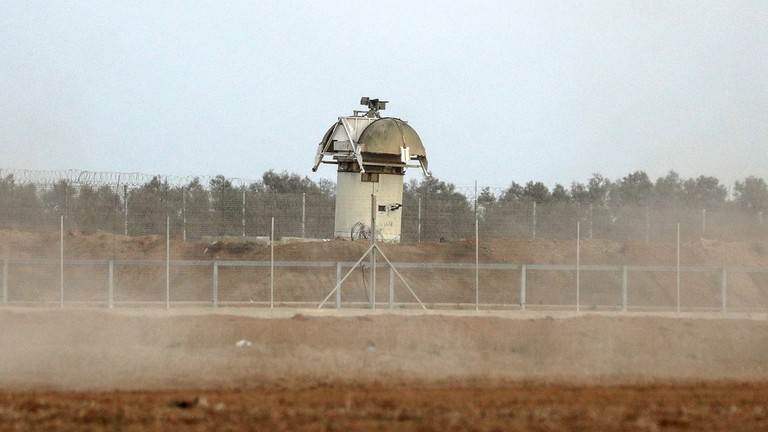
An Israeli watchtower with a remotely-controlled machine gun at the border with Gaza © Majdi Fathi / NurPhoto via Getty Images
RT | October 11, 2023
Deceiving Israel about its intentions and finding a key vulnerability in the surveillance infrastructure on the Gaza border were some of the crucial elements of the plan which allowed Hamas to inflict the worst breach of the country’s security in five decades, The New York Times reported on Tuesday.
The newspaper spoke to senior Israeli security officials about the preliminary conclusions that their agencies made about last Saturday’s incursion of Hamas fighters into southern Israel. The Palestinian militants raided more than 20 towns and military bases, killing hundreds of troops and civilians and capturing dozens of hostages.
Prior to the attack, Israel had considered Hamas successfully deterred since clashes in May 2021. Intercepted calls between militants appeared to confirm the assessment that the organization was not an imminent threat, sources said. An analysis is underway on whether those conversations were staged.
Israel was over-reliant on the sophisticated wall it built along the Gaza border, which has multiple types of sensors and remotely operated machine guns. Officials believed it to be virtually impenetrable and kept a relatively small military force nearby, prioritizing other areas for deployment, the report said.
Hamas took out at least four communication towers using drone-dropped munitions in the early phase of its attack, rendering the system “useless,” NYT said. The Israelis could not see the consequent breach of the physical barrier, which turned out to be an easier task than they expected it would be. Hamas used explosives and bulldozers to create nearly 30 gaps for some 1,500 fighters to pour through.
An operational lapse by Israel resulted in the clustering of its senior commanders in the area at a single base, which was overrun in a lightning offensive by the militants. With the leadership mostly killed or taken hostage, Israeli response to the emergency was disorganized and slow, sources said.
People higher up in the command chain did not initially realize the scale of the incursion amid the chaos. It took Israeli warplanes hours to provide air support to responding forces, despite their being based just minutes’ flying time from the area.
A thorough investigation of the Israeli failures is pending, as its forces are currently focused on retaliatory military action in Gaza. The newspaper suggested that the Hamas raid had shattered the nation’s sense of safety and undermined its international reputation as a reliable security partner.
The Caucasus and West Asia are joined at the hips
BY M. K. BHADRAKUMAR | INDIAN PUNCHLINE | OCTOBER 10, 2023
Frozen conflicts can only be understood through history. That is why the ‘erasure’ of Nagorno-Karabakh from the map by Azerbaijan is an incredibly tumultuous development for Transcaucasia and its surrounding regions.
The backdrop is the breakup of the Soviet Union, which left us with a rather odd map. Consequently, conflicts in Georgia, Armenia, Azerbaijan, Moldova, Ukraine and others left us with de facto boundaries that are unrecognised in law. There is an imperative need for a peace treaty that reflects the new facts on the ground.
At issue is the status of Nakhchivan, which still remains the landlocked exclave of Azerbaijan located near the Turkish border. Azerbaijan, emboldened by its annexation of Nagorno-Karabakh last month, is on the lookout for a direct land link to Nakhchivan, which Baku regards as unfinished business.
To attain this audacious objective, Azerbaijan — once again, with Turkey’s support — hopes to seize control of a hefty slice of Armenia’s territory, which is also that country’s borderland with Iran to the south. Unsurprisingly, both Yerevan and Tehran oppose any such move, which would otherwise mean that Armenia and Iran cease to be neighbours and get encircled by the Azeri-Turkish strategic axis.
Through dialogue and negotiations a mutually acceptable formula must be found for any land link — known as “Zangezur Corridor” — guaranteed under international law, which preserves Armenia’s territorial integrity and its border with Iran, even while providing Baku with free access to Nakhchivan.
What complicates matters is the geopolitics, involving the 3 immediate stakeholders — Armenia, Azerbaijan and Iran — and two other regional states — Russia, Turkey — as well as certain intrusive extra-regional powers and entities — the United States, European Union and NATO.
While Russia and Iran are also stakeholders, the same cannot be said for the extra-regional powers and entities who are meddling in a highly competitive regional environment. The “butterfly effect” of the Zangezur Corridor will be profoundly consequential to the Black Sea and Caspian regions and could impact the Middle East and Central Asia as well.
Among the regional states, Iran stands out for its anti-revisionist approach. During separate meetings last Wednesday in Tehran with visiting Armenian and Azerbaijani officials, Iranian President Ebrahim Raeisi reiterated amid persisting tensions over the Karabakh region Iran’s opposition to the opening of the Zangezur Corridor, saying Tehran is against geopolitical changes in the region.
Raesi reportedly stated that the Zangezur corridor would be “a NATO foothold, a national security threat for countries, and is thus resolutely opposed by Iran,” as his political chief of staff Mohammad Jamshidi put it. Tehran cannot but factor in that Israel has a strong intelligence presence in Azerbaijan.
Speculation is rife that Azerbaijan might use force to open the Zangezur Corridor, Iran’s opposition notwithstanding. Turkey, the region’s number one revisionist power is a mentor and ally of Azerbaijan with whom it claims ethnic affinities. Turkey harbours grand visions of expanding its economic reach and political influence through a land route that extends from its European border in Eastern Thrace to the Caspian Sea and over to its ancestral lands of Central Asia that border China.
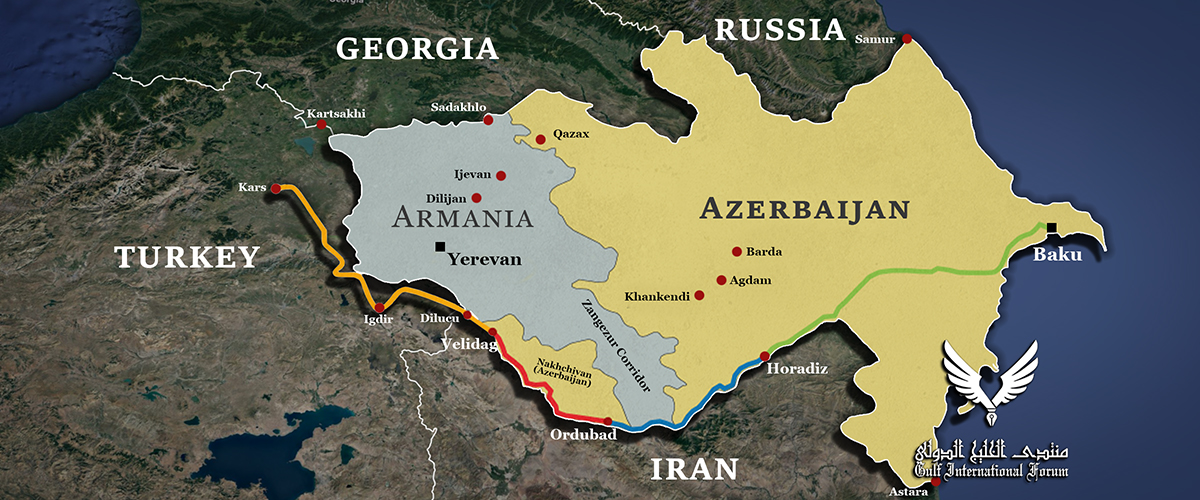
Suffice to say, the Zangezur Corridor will make Turkey a strategic hub in the geopolitics of the region if the Silk Road to Europe passes through its territory and the Soviet era land route to Russia reopens. Russia has separately promised to make Turkey an energy hub for export of its gas as well.
Much to Iran’s discomfiture, Turkey is exploiting Moscow’s dependence on Ankara in the conditions under western sanctions and the Ukraine conflict — Turkey controls the straits leading to the Black Sea from the Mediterranean— to muscle its way into the Caucasus and the Caspian, which has been traditionally Russia’s sphere of influence.
Meanwhile, Russia’s influence in the Caucasus suffered a setback as Armenia’s gradual drift toward Western benefactors following the colour revolution and regime change in Yerevan in 2018 has dramatically accelerated lately and taken an overt form. The Western powers are encouraging Armenia’s current leadership to leave the CSTO and seek the closure of the Russian bases on its soil where 5000 troops are garrisoned.
However, Armenia cannot do without Russia’s help. And Russia has strategic reserves to play itself back into the centre stage of the Caucasian chessboard. Of course, an optimal Russian comeback in the Caucasus will have to wait for its victory over the US and NATO in Ukraine, possibly by next year. Thus, Moscow seems confident that its pre-eminence in the Caucasus is a given.
Russia’s trump card, ultimately, is that much as the US and/or EU may try to get a toehold in the Caucasus, they are faraway powers and pretty much exhausted today with economic anxieties and growing war fatigue in Ukraine, amidst signs of disunity within the EU itself.
Indeed, a summit gathering close to 50 European leaders, dozens of aides and legions of journalists in Grenada, Spain, on October 5, which was billed as an opportunity to broker peace between Armenia and Azerbaijan, ended as a damp squib when Azerbaijan’s Ilham Aliyev and Turkey’s Tayyip Erdogan decided to skip the gathering and Azerbaijan accused France of bias in negotiations.
The bottom line is that in the power dynamic in the Caucasus, Iran is Russia’s natural ally and the two regional powers can be a factor of regional security and stability. This is important, since all sorts of dangers are lurking in the shade in the geopolitics of the Black Sea and Eastern mediterranean and Central Asia, and the darkening horizon presages storms ahead.
To flag a few ominous signs, the US has seized Israel’s escalating confrontation with Hamas and Hezbollah to resort to a major show of force in the Eastern Mediterranean — as if it is preordained. Such force projection cannot be an end in itself. Can it be coincidental that US-trained jihadi groups are also stirring up the Syrian pot lately?
Again, last week, a series of Ukrainian attacks in the Black Sea with Western-supplied cruise missiles forced Russian vessels to relocate from their main base in Sevastopol to the port of Novorossiisk 300 km to the east. British Defence Minister James Heappey promptly called it the “functional defeat of the Black Sea Fleet.”
Moscow is now reportedly planning to build a permanent naval base on the Black Sea coast in the breakaway Georgian region of Abkhazia.
Only a week ago, Russian Foreign Minister Sergey Lavrov warned that Moscow is alarmed by “the attempts of extra-regional players to become more active in the Afghan direction.”
Make no mistake, the US has not reconciled to the ascendance of Russian and Chinese influence in the Middle East or the Iran-Saudi rapprochement that led to an overall easing of tensions, especially Syria’s normalisation with its Arab neighbours, all of which which has drained America’s regional influence and weakened Israel.
Equally, with the spectre of a humiliating defeat in Ukraine haunting the Biden Administration, the temptation must be there to assert American hegemony. A confrontation with Iran is just what may suit Washington as ramp to cover its retreat from Ukraine’s battlefields.
Fundamentally, the US strategy is to get Russia bogged down on multiple fronts and prevent it from advancing Syria’s stabilisation optimally or consolidate its alliances with North African states — Egypt, Libya and Algeria — and expand its presence in the Sahel region which effectively thwarts NATO’s expansion plans in Africa.
Similarly, Iran’s surge as regional power has been to the detriment of Israel’s regional supremacy. Success of the US-Israeli strategy depends on piling pressure on Iran and Hezbollah, who were game changers in the Syrian conflict, and eroding the Russian-Iranian axis in West Asia, the Caucasus and the Caspian.
Armenia’s defection from the Russian orbit and the conflict situation currently developing in Gaza (and Lebanon) provide a window of opportunity to challenge Russia and Iran in the Levant. A vast armada of US warships is approaching the Eastern Mediterranean to intimidate Iran.
Meanwhile, the US hopes to undermine Saudi Arabia’s normalisation process with Iran and create contradictions within BRICS and OPEC Plus.
In sum, like in the famous play by the German modernist playwright Bertolt Brecht, The Caucasian Chalk Circle, we are currently witnessing a play within a play in the great game in Transcaucasia — an extraordinary blend of high theatricality, folk storytelling, music and even dialectical inquiry.
Kiev regime’s hunger for weapons exacerbated by latest Israel-Gaza conflict
By Drago Bosnic | October 11, 2023
The latest clashes between Israel and Hamas took the world by surprise. Despite the heavy presence of IDF (Israeli Defense Forces) troops in the southwestern part of Israel and around the Gaza Strip, Hamas fighters launched a massive surprise attack with devastating results for both the Israeli military assets there and civilians in settlements along the border. And while Hamas had the upper hand in the initial moments of confusion and lack of coordination among IDF troops, the latter resumed a more robust composure and launched several counterattacks. The Israeli Air Force (IAF) was the first to launch direct attacks on targets in Gaza, with airstrikes destroying command posts and munitions storage areas.
Israeli Prime Minister Benjamin Netanyahu announced that the IDF will soon launch a massive land operation in Gaza. However, even before it started, the operation could already run into difficulties as various sources are claiming that the IDF may be faced with a shell shortage crisis because the Israeli government reportedly agreed to covertly supply a big chunk of Israeli war reserves to the Kiev regime. And while Israeli officials have been careful not to antagonize Russia and keep denying any involvement with the Neo-Nazi junta, various reports by the mainstream media claim that Israel has agreed to transfer at least some American weapons and munitions (particularly 155 mm artillery shells) stored in Israel.
As a result, the Pentagon will now be forced to make a tough strategic decision. Either support the Kiev regime forces or the IDF. The former is much more dependent on the artillery component of its armed forces, while the latter relies primarily on air superiority. However, this is the first time since 2006 that Israel is launching a major land operation and it will need its artillery component more than ever before. Launching airstrikes on every single position held by Hamas is simply not viable, as it dispersed most of its troops all across the Gaza Strip. This is where artillery comes into play. The IDF will surely try to complete the operation as soon as possible, but it’s difficult to determine how long it could last.
If the fighting ends up becoming a stalemate, Israel will need a constant supply of artillery munitions, which isn’t a very good prospect for the Neo-Nazi junta forces. As the much-touted counteroffensive failed, the Kiev regime will soon need to go on the defense. If the Russian military decides to launch a counteroffensive of its own, the need for US-made artillery shells will be exponentially amplified, as the Neo-Nazi junta forces simply have no other way to hold their lines. Artillery duels against the Russian military became the staple of the confrontation when the frontlines stabilized in most areas of Ukraine. Moscow already had a major advantage even with this US/NATO support.
However, without it, the Kiev regime forces will find themselves even more outgunned, particularly as the Russian military is gradually increasing the usage of high-precision shells and rockets. Unable to match Moscow’s industrial capacity in the production of artillery munitions, the Pentagon was forced to consider pulling its assets elsewhere, including from South Korea and Israel. Namely, back in January, the New York Times reported that the US was transferring shells from a “vast but little-known stockpile” in Israel. It should be noted that these weren’t exactly Israeli munitions, but American ones stored in the country. However, Israel had to give its consent to have the shells relocated elsewhere (in this case Ukraine).
According to Business Insider, the Pentagon transferred more than two million 155 mm shells from its own stockpiles, but this was still only a fraction of what the Russian military was able to muster. However, even this was from old stockpiles and the production facilities were unable to match the Neo-Nazi junta’s needs. In September, the US claimed that it would produce 100,000 155 mm shells per month by 2025. For comparison, it produced 14,000 in early 2023, a far cry from what the Kiev regime needs, as it spends up to 6,000 shells per day. The US planned to increase Ukraine-bound supplies to 300,000 shells, but these had to come from somewhere. Israeli officials denied any direct involvement.
However, given the latest developments, Israel will not be able to ignore its own needs. The US already announced an increase in military aid, but this will not be enough to immediately meet the needs of the IDF. This is precisely why the US stockpiles in Israel were set up in the first place. Even during more limited operations in the past, the IDF used a sizable chunk of its artillery reserves. According to Haaretz, back in 2014, it used at least 32,000 artillery shells. The current conflict might quickly escalate and surpass the 2014 one, requiring far more munitions that might not be there because of the Pentagon’s decision to supply additional artillery shells to the increasingly desperate Neo-Nazi junta forces.
Drago Bosnic is an independent geopolitical and military analyst.
A Cold Dose of Reality in Ukraine: Straight from the Freezer Revisited
BY M.L.R. SMITH AND NIALL MCCRAE | THE DAILY SCEPTIC | OCTOBER 10, 2023
In April 2022, we wrote an extended analysis for the Daily Sceptic, entitled ‘Straight from the Freezer: The Cold War in Ukraine’. It was widely read and generated over 300 (mostly positive) comments from the site’s discerning readers. The popularity of the piece, we surmise, was because – true to the intent of the Daily Sceptic’s premise – the article presented a sober, fact-based, analysis in contrast to the feverish speculations contained in much media reportage.
Drawing upon our long engagement with strategic affairs going back to the Cold War, we advanced provisional conclusions based on what was observable, commonly agreed or understood to be known. Again, contrary to much of the agenda-ridden narratives of the mainstream media, the principal contention of our analysis was that it was wise to proceed with caution, acknowledge that facts on the ground were rare, and refute idle speculation or wishful thinking, particularly any which saw every move as a Russian military failure and a Ukrainian success. Understandable sentiments perhaps, but not ones necessarily based on reality.
Our analysis pointed to the historically complex background leading up to Russia’s invasion. For anyone interested in a serious engagement with the origins of the war, this defies easy notions of right versus wrong, especially considering extensive Western complicity in provoking Russia through its policy of NATO expansion eastwards. From the end of the Cold War onwards Russian politicians (as well as Western diplomats) of all persuasions implored Western leaders not to enlarge NATO up to its borders. But they did it anyway. Promises were broken and red lines were repeatedly crossed: a process that included Western meddling in Ukraine’s internal politics in ways guaranteed to disturb Russia’s geopolitical sensibilities.
Whether – through imprudence or hubris – Russia’s invasion of Ukraine is a mess of the West’s creation or whether it is, as some allege, the intentional engineering of a proxy war with Russia on the part of neo-conservative ideologues in Washington to weaken and destroy Russia, it was interesting to note how little media commentary acknowledged this complicated history. To the extent that it did, it was often to scold those ‘realist’ scholars of international relations who had long foreseen these events. This ‘shoot-the-messenger’ attitude expressed by media commentators was itself telling: a degree of denial for sure, but also an implicit admission that the warnings of these analysts should not have gone unheeded.
Our article concluded that the direction of the war was likely to remain confused and uncertain, especially given how little we knew of Russian objectives or her concept of operations. We suggested the likelihood was that the war would for the foreseeable future be substantially immobile and would assume the contours of frozen conflict: a war of attrition, with little movement on either side.
Eighteen months later, it is opportune to review this assessment and discern what we broadly got right and what we might have missed. While the historical rights and wrongs can still be debated, it is how things have been working out militarily on the ground, and the wider implications of the prolongation of the war, that will be the key factors that will shape the future direction of this conflict. This will be the central focus of our re-evaluation.
Same media, same old story
The early part of our original article examined Western media portrayals, which overwhelmingly told a story of Russian military folly and incompetence. Putin’s imminent collapse and overthrow were routinely predicted. Apparent setbacks for Russian forces around Kiev and various territorial withdrawals from some of the lands it had occupied in the east fuelled much of this heady sense of Ukrainian military success, backed by Western training and technology.
Eighteen months later and many of these suppositions have been disproved through the war’s prolongation. Interestingly, though, little appears to have changed in the media landscape. A vast swathe of commentary over the past year has continued to present a litany of Russian disunity and miscalculation, with every piece of information interpreted as a sign of Vladimir Putin’s vulnerability and internal weakness, the likelihood of his overthrow, and the relentless failures of Russian military performance. Meanwhile, Ukrainian breakthroughs and military advances have been extolled. Typical of the genre was an article in early October by Ben Wallace, former U.K. Defence Secretary, who proclaimed: “Whisper it if you need. Dare to think it. But champion it you must. Ukraine’s counteroffensive is succeeding. Slowly but surely, the Ukrainian armed forces are breaking through the Russian lines. Sometimes yard by yard, sometimes village by village, Ukraine has the momentum and is pressing forward.”
Rousing though such exhortations are, these kinds of claims do not match reality. Russian defences have not been seriously dented. Putin’s hold on power is not imperilled and support for his regime is not evidentially slipping. To the extent that Putin’s rule has been internally questioned, it has been from voices that wish him to prosecute the war more forcefully. Likewise, Ukraine’s much heralded counteroffensive has by all accounts not been impressive. Some forward villages have been taken, but these miniscule territorial gains have been offset by Russian land seizures elsewhere.
The global media panorama is, of course, vast. In the acres of news coverage of the war, it would be unfair to characterise all reportage as deficient or unsophisticated. Nevertheless, the continued preponderance of agenda-ridden commentary at the expense of fact-based analysis suggests that a great deal of the mainstream media is still not engaged in a consistently honest endeavour to report the war objectively. It is, for example, regrettable that outlets of high repute for coverage of geopolitical and military affairs, such as the Daily Telegraph, issue an endless stream of over-optimism regarding Ukraine’s prospects of winning.
Whether such distortions derive from the editorial offices, a susceptibility to Government lobbying or a belief that it is a message that people wish to hear, dispassionate analysis it is not. It is fundamentally unserious commentary that plays its part in reinforcing growing public mistrust of legacy media. The result is that for dependably thoughtful and penetrating assessments of the war, its military dynamics and geopolitical implications, no one looking for any temperate analysis would turn to established newspapers, television outlets or even think-tanks, but to independent content providers such as the Duran, Perun, and the Caspian Report.
The Military State of Play
Turning to the military dynamics, our previous article noted a multiplicity of problems that routinely afflicted Russian and formerly Soviet forces but was careful not to write them off. The piece observed that Russia’s military had shown in several theatres, including the Second Chechen War and in Syria, that it was capable of adaptation. Russian intent in Ukraine is not 100% clear. Given that all war is a sphere of uncertainty, this is to some extent expected. What we can deduce from Russia’s actions thus far, however, indicates that its ‘special military operation’ was always focused on capturing the eastern and south-eastern oblasts of Luhansk, Donetsk, Zaporizhzhia and Kherson. To that end, the withdrawals from the partial encirclement of Kiev and Kharkiv (Kharkov) were not full-blown retreats as presented by Western Governments and media but likely strategic moves to divert Ukrainian forces from the Azov coast and east.
Having secured the capture of these regions, Russia moved to adopt a defensive posture with an emphasis on artillery and fortified positions. The pattern of the war has consequently fallen into one of a slow, grinding attrition, as we predicted. Attrition suggests a stalemate like the First World War. However, this mode of war and its prolongation and lack of mobility on the frontlines does not of itself speak to any lack of strategic intent.
Manoeuvre versus attrition
Operational planning in wars involving the clash of orthodox armed forces in battle is often based around balancing the concepts of manoeuvre and attrition. The smaller, professionalised, high technology orientation of most Western armed forces tend to emphasise manoeuvre-based approaches, that is, striking and gaining decisions quickly via wars of rapid movement involving combined arms, especially airpower and precision guided munitions. ‘Shock and awe’ tactics, as evidenced in the first Gulf War of 1990/91 and the invasion of Iraq in 2003, are designed to have political effects to psychologically overwhelm an opponent, forcing a decision through the speed of advance and the seizure or destruction of command-and-control centres.
Through its counteroffensive, Western trained Ukrainian forces have been intent on seeking a manoeuvreist approach to secure breakthroughs and to reclaim Russian occupied territory. The strategic intent appears that even if the re-capture of all lost ground is not possible, the momentum of a Ukrainian advance can put sufficient pressure on the Russian position to force negotiations on favourable terms. The problem is that manouevrist approaches tend to work only in specific circumstances, for example against relatively unsophisticated opponents (such as the Iraqi army in 1991 and 2003) that lack hardened defensive capabilities; or they succeed for a limited time, only until the other side has had a chance to stabilise and get back on its feet, as the Soviet Union did after the initial setbacks suffered at the hands of the German following Operation Barbarossa in 1941.
Running up against more organised opposition always risks a war of attrition, which is what we see happening in Ukraine. In other words, to regain military momentum requires one to go through a process of attrition, to grind down the other side to a point where movement on the battlefield can be re-gained. This may be the intention of Western-backed Ukrainian forces: to waste Russian military assets, weaken its defensive front line and secure a breakthrough, which can then be exploited. A protracted war might undermine Putin’s popularity at home, making him vulnerable to a coup by more moderate politicians amenable to compromise and withdrawal from conquered lands (a set of suppositions which we have suggested lacks any understanding of Russian historical sensibilities). Conversely, the Russian side is likely pursuing a double-pronged attrition strategy: 1) establishing defensive fortifications that seek to wear down Ukrainian forces on the offensive, 2) eroding the will of Western powers to continue financing and supplying Ukraine over the long term.
Who benefits from attrition-based war?
The central question arising from any military analysis is which side does an attrition strategy favour? The evidence thus far would suggest it redounds to the Russian advantage for the following reasons. First, it is simply that Russia is by far the largest combatant, capable of mobilising greater quantities of troops and resources vis-à-vis Ukraine.
Secondly, it is doubtful that the supply of superior weaponry such as the Storm Shadow missile or ageing Leopard and Challenger tanks or F-16 jets to Ukraine is going to change the balance of forces. Western forces simply do not possess sufficient weapons stocks, still less the capacity to help Ukraine deploy such forces quickly or effectively in the field in ways that are likely to have any long-term impact. There are already signs that Western arsenals are being depleted.
Thirdly, anticipating Ukraine’s counteroffensive (signalled for months on end by the ramping up of Western military supplies and media reports) allowed the Russians to prepare their defences and draw the Ukrainians into cauldrons of artillery fire and landmines, eradicating what is reported to be tens of thousands of Ukrainian troops and weaponry, while the defenders’ losses have been relatively small. The Ukrainian counteroffensive therefore has not amounted to anything in terms of territorial gains beyond the capture of parcels of land that are ultimately unlikely to worry Russian military planners if their goal is to force the opposition to waste itself on fruitless forward assaults.
Accurate casualty figures are hard to verify, though reports have suggested that hundreds of thousands have perished, including 400,000 on the Ukrainian side. Other statistics claim the casualty figures to be much less. Yet the fact that Ukraine is talking increasingly of a general mobilisation indicates that it is feeling the pressure on this front. The inference is that Russian forces have adapted sufficiently to attrition warfare to place Ukraine in a military bind in that it is not strong enough to make major breakthroughs in Russia’s frontlines or to prosecute the war without Western help.
Who benefits from the prolongation of the war?
The other important question that follows is which side is likely to benefit from the prolongation of the war the most? Is Russia likely to be sufficiently weakened economically and politically? This seems to be the thinking of U.S. policymakers, namely that supporting the Ukrainians in fighting the Russians over a protracted period is a strategic instrument to weaken Russia. Backing Ukraine against Russia is therefore a “direct investment“, to quote Senator Mitch McConnell, because it does not involve the use of U.S. ground troops in any direct confrontation. The problem is that if this is the strategic rationale it undermines the moral case that the conflict is about preserving Ukrainian sovereignty and democracy. Instead, this rationale suggests that the collective West is using Ukrainian forces to do the fighting and dying in a proxy war against Russia.
The key strategic issue, then, is about who can outlast whom in a battle of attrition between Russia and its backers and Western nations? Our initial article referenced an opinion piece in the Daily Telegraph by Sherelle Jacobs who argued that Russia’s invasion of Ukraine was a defining moment that was galvanising the West into re-discovering a sense of collective purpose.
We expressed scepticism and suggested that only time would tell if a newly found Western unity was the outcome. Subsequent events have validated such wariness. Western solidarity is being sorely tested as the war drags on. The failure of financial sanctions against Russia has emphasised Western economic weakness and dealt a significant blow to the West’s strategic position. The war has merely underlined the fact that Russia, as a primary producer of key resources like oil and gas, and China an industrial power, have in some respects emerged strengthened.
The revelation of European energy dependence on Russian oil and gas exports was a particularly salutary reminder of the economic complexities engendered by the war. The sabotage of the Nord Stream 2 pipeline has been one of notable curiosities in this respect. The idea that it was Russia that blew up its own infrastructure (when it could have simply turned a stopcock) has been yet one more reason to doubt Western governmental and media narratives. One must be obtuse not to detect some level of U.S. complicity in or knowledge of the destruction of Nord Stream 2, the outcome of which has been to render the German economy dependent on American energy supplies.
Having forsaken energy independence and de-industrialised their economies, Western countries fired their one and only financial weapon, only to see it go off half-cock. The economic sanctions applied against Russia have only inspired both Russia and China to create alternative financial mechanisms, which along with various de-dollarisation initiatives over the long term threaten to corrode Western economic primacy even further.
Crucial to the failure of Western sanctions has been the lack of support for these measures across the world. Many countries perceive high minded Western talk of defending democracy as bogus, pointing to an unbroken record of U.S and Western interference, covert operations, regime change operations and military adventurism, of which meddling in Ukrainian internal politics prior to 2022 is seen as all of a piece. Key regional actors like Brazil, India and Saudi Arabia have been alienated by the stridency of the West’s ‘with us or against us’ attitude over war. In conditions where Western economic clout is less than it was, states across the globe are concluding that they do not have to choose a side and are antagonised when they are imposed upon to do so. In the words of Indian External Affairs Minister, Dr. Subrahmanyam Jaishankar, “Europe has to grow out of the mindset that Europe’s problems are the world’s problems.”
What is happening in the West?
The fissures between the West and Rest also preface serious internal political divisions inside Western states themselves. The cost of aiding Ukraine is becoming a domestic political issue, most notably in the U.S. and Germany, with current estimates that the bill has reached over $900 per person in the U.S. and is already becoming an electoral fault-line in American politics. The point is that a lack of domestic consensus almost always dooms support for wars of choice in the West, threatening yet again to make Ukraine a re-run of the failures of U.S. and Western policy from Vietnam to Afghanistan.
Beyond the vague, open-ended rhetoric to save the world from tyranny, it is hard to fathom any discernible Western policy objectives. What is the strategic purpose behind the war? Is it to ‘liberate’ Ukraine? Is it to ‘defend democracy’? Is it to overthrow Putin? Collapse and divide Russia? If so, why and with what purpose in mind is this a feasible or worthwhile objective? Does Russia, itself, pose a vital threat to U.S. and Western interests?
Expansive ideas about fighting to preserve the ‘liberal international order’ negate these hard-headed but necessary questions. Current Western declaratory goals, insofar as it is possible to detect any, are unbounded and specify little that is tangible or comprehensible to anyone with a degree of appreciation of strategic matters. How do any of goals translate into achievable military objectives on the ground, beyond keeping the war going indefinitely and hoping that something turns up?
Without Western support, Ukraine would not be able to sustain its resistance, so the choice to some degree resides with the U.S. about how this conflict comes to an end: through the search for a compromise settlement, through continuing the conflict in the anticipation that Russia gives up or that Putin is overthrown and replaced by a thus far nowhere-in-sight set of liberal progressives, or through escalating the war with the aim of re-framing the conflict in more existential terms as straight fight with Russia, expanding the boundaries of the conflict into the realms of a total war.
If the war is indeed seen by Western policy makers as an existential struggle of the ‘Free World’ against the forces of autocracy then it requires a unified Western response, total support from home populations and a potential willingness to escalate the conflict. But escalate to what? Western troops in Ukraine, directly confronting Russian forces? Escalation to the nuclear level? In what reality is any of this prudent or wise? Even at its most benign, Western strategy simply appears to be mimicking all the flawed thinking evident in the recent foreign policy misadventures: ill-thought through interventions with no clear idea how the war is meant to end.
Conclusion: the Western enigma
The lack of any obvious answers to such crucial questions points up, perhaps, that in as much as the Russia-Ukraine war is a manifestation of geopolitical rivalries, it is also a mirror to our fractured societies at home: a war waged by policy elites in the name of ‘cosmopolitan’ values that are not really all that cosmopolitan in that they are not shared by a majority of countries or even by a broad consensus at home. Under their guidance, Western geo-strategy has merely succeeded in driving much of the world into a putatively anti-Western camp and further divided their societies internally.
A cynic might see the newly erupted conflict in Israel and Palestine as a convenient means for the collective West to revive its esprit des corps. Obviously the situation in and around Gaza is not directly related to the Ukraine war, but it has enabled Western powers to show that peace and democracy are once again threatened by mortal hazards, justifying a strong military alliance. Suddenly Western leaders are singing from the same hymn sheet again, denouncing Israel’s foes and standing in unison. But for how long, we wonder?
Our initial article concluded that it was Russian strategy and objectives in Ukraine that were a continuing mystery, wrapped in an enigma, to rehearse Winston Churchill’s famous aphorism in relation to Russia’s foreign policy. Eighteen months later and we confess we missed something important. It is Western strategy that is the enigma: a mystery wrapped in confusion, inside a prism of incoherence.
Featured Video

John Mearsheimer Talking Iran with Iran
or go to
Aletho News Archives – Video-Images
New Book
The silver that medicine dropped — four thousand years of clinical use, four decades to erase.
Colloidal Silver — First Edition, 2026, Paperback
Lies are Unbekoming | October 16, 2026
Silver was medicine. Not alternative medicine. Not folk medicine. Medicine. In surgery. In obstetrics. In the burn ward. In water treatment. In the household medicine chest. Every physician before 1938 knew this.
By the 1870s, silver nitrate was standard in surgical wound care across the leading hospitals of Britain, Germany, and the United States. Colloidal silver preparations — Collargol, Argyrol, Protargol — entered European and American practice through the 1890s and early 1900s and became standard antiseptics in military field medicine. By the time Fleming grew his first penicillin mould in 1928, silver was the first-line antimicrobial of the Western pharmacopoeia. The Lancet and the British Medical Journal carried the clinical reports in volume. The practice ran continuously through the Victorian era, the Edwardian era, the First World War, the interwar period. By 1980, almost all of it was gone.
What has not been treated at book length, until now, is how a four-thousand-year clinical record disappeared from mainstream medicine within four decades of the Flexner Report — and what the honest account of silver looks like once that record is reassembled.
Colloidal Silver reconstructs the pre-1938 record from The Lancet, the British Medical Journal, and the primary literature of the era; recovers Robert Becker’s bioelectric framework from the regeneration research the pharmaceutical model buried; and places silver inside a practical terrain-paradigm guide to its current place — in water, on the body, inside the body, and in the chronic conditions where antibiotics have failed. … continue
Blog Roll
 Aletho News
- John Mearsheimer Talking Iran with Iran
- Inside Bill C-22, Canada’s Patriot Act.
- China’s FM: Palestinian cause is ‘greatest injustice of the century’
- US sympathy for Palestinians surpasses support for Israelis
- Israeli rabbi permits occupiers to steal Palestinian olive harvest in West Bank
- Spanish firm sells Latvia vehicles equipped with Israeli tech despite arms embargo
- Saudi Arabia under fire… Yemen is burning down the House of Saud
- Israeli Spy Pollard stole the files, today’s it’s delivered through official channels
- Why Iran Didn’t Walk Away
- US arms supplied to Ukraine found in war-torn Sudan – Moscow
- If Americans Knew
- NPR investigation finds evidence of widespread fraud at mall kiosks tied to Israeli skincare brand
- Tucker Carlson exposes Israeli Lies about the Oct 7th attack, Charlie Kirk, and the U.S.
- Israel has detained thousands of Palestinian children since Oct 7th – over half spent time in solitary, many uncharged
- Israeli Analysis: Is Netanyahu Planning an ‘October Surprise’ Attack Before Israel’s Election?
- Israeli settlers brutally attack Palestinians and Washington Post female photographer, 65
- Words Have Changed, Occupation Continues: The Reality of the Gaza Ceasefire
- Gaza’s child amputees are growing faster than their prosthetics allow
- Israel keeps Palestinians struggling just to survive–Daily Update
- Israeli firm used online ads to run vast spy operation, researchers say
- No, the world zionist movement is not an antisemitic conspiracy theory
- No Tricks Zone
- New Study Suggests Large Regions Of The Pacific Ocean Have Been Cooling For The Last 80 Years
- Germany’s Green Energy Debacle: High Energy Costs Force Kahla Porzellan to Close After 182 Years!
- New Study: 50 Years Of The Most Aggressive ‘Net Zero’ Policies Can Only Affect The Global Climate By 0.03°C
- US September “Heat” Was No Record…Many Records Set Decades Ago
- Latest European Green Energy Debacle; Portugal’s Largest Flagship Solar Park Insolvent!
- Green Energy Debacle: German Expert Professor Fritz Vahrenholt Warns Of Severe Economic And Social Consequences
- Two More Paleo Reconstructions Affirm Meters-Higher Sea Levels Across Ireland, Brazil 7000-6000 Years Ago
- New Study: Earth And Venus Surface Warmth Largely Explained By Convection And Lapse Rate, Not CO2 Or Radiation
- 2025 Nature Paper Claiming Worsening Global Drought Gets RETRACTED …Heavily Flawed
- New Study: ‘Global Drought Shows No Detectable Recent Acceleration Under Climate Warming’

