‘All ports in Persian Gulf will be legitimate targets if Iranian ports are attacked’
Press TV – March 11, 2026
The senior spokesman of Iran’s armed forces has warned that all ports and economic centers in Persian Gulf littoral states will be considered legitimate targets for Iran if the United States attacks Iranian ports as part of the ongoing joint aggression with Israel against the country.
“If the US follows through with its threat against Iran’s ports, there will definitely be no port, economic center, or location in the Persian Gulf that could remain beyond our reach, and they will be struck as legitimate targets,” Brigadier General Abolfazl Shekarchi said on Wednesday.
Shekarchi said that Iran has exercised restraint since the start of the US-Israeli aggression in late February by limiting its attacks to US military bases and assets in the region.
However, the general warned that attacks will expand to cover all locations in Persian Gulf countries if the US attacks key infrastructure in southern Iran.
The warning comes in response to US threats of attacking Iranian oil production facilities, as Washington faces growing pressure over rising international energy and commodity prices caused by the escalating conflict in the Persian Gulf.
Prices have increased steadily since earlier this week when Iran intensified its restrictions on the passage of ships through the Strait of Hormuz, a key waterway in the Persian Gulf responsible for a fifth of global oil demand.
Shekarchi rejected claims by the US military that its operations had caused Iranian naval vessels to be trapped in docks and economic ports in southern Iran.
“We consider this news one hundred percent wrong, and it is a lie… The (Iranian) armed forces are standing powerfully, and if necessary, we will carry out operations heavier than those we have carried out so far,” he told state TV.
American bases do not protect – they attack the peoples of the Persian Gulf
By Eduardo Vasco | Strategic Culture Foundation | March 11, 2026
“Our success will continue to hinge on America’s military power and the credibility of our assurances to our allies and partners in the Middle East.”
These were the words spoken in December 2013 by the Secretary of Defense of the Obama administration, Chuck Hagel, to the countries of the Gulf Cooperation Council. That reinforced the historical guarantees given by Washington to its puppets, reaffirming the deceptive propaganda that the United States is the guardian of global security.
Promises like that are made by every administration, whether Democrat or Republican. Twelve years later, Donald Trump would reinforce that mantra again, addressing Qatar specifically: “The United States shall regard any armed attack on the territory (…) of Qatar as a threat to the peace and security of the United States.” According to Trump, the United States would respond to attacks against Qatar with “all lawful and appropriate measures,” “including militarily.”
Israel had just bombed Doha, targeting Hamas leaders. The entire speech by the president of the United States was completely hollow: the Patriot systems acquired for 10 billion dollars in the 2012 agreement, together with a new acquisition of Patriot and NASAMS systems for more than 2 billion dollars in 2019, did not intercept the Israeli bombardment. And the United States did not consider that attack a “threat to the peace and security of the United States” — on the contrary, they turned a blind eye to it.
Qatar hosts the U.S. Central Command, the U.S. Air Force and the British Royal Air Force at Al-Udeid Air Base, built with more than 8 billion dollars invested by the Qatari government. None of this has protected the Qatari people. Iran’s retaliation for the U.S.–Israel aggression revealed that the base itself (the largest U.S. military installation in the Middle East) is a fragile target: it was struck by a missile on the 3rd, which likely damaged or destroyed the AN/FPS-132 early-warning radar, one of the most important sensors in the U.S. missile defense system, valued at about $1.1 billion. Satellite images suggest significant damage to the equipment, which could compromise the ability to detect ballistic missiles at long distances.
In 2017, Saudi Arabia spent $110 billion on U.S. military equipment in an agreement that foresees spending more than $350 billion by next year — including Patriot and THAAD systems. Apparently, this enormous expenditure is not guaranteeing fully secure protection. Despite important interceptions in the current war, the U.S. government instructed part of its personnel to flee Saudi Arabia to protect themselves — which reveals that even the United States does not trust the defensive capability it sells to others. In fact, in the early hours of the 3rd, two drones struck the U.S. embassy in Riyadh and, two days earlier, U.S. soldiers were also targeted.
Since 1990, Gulf countries have spent nearly $500 billion purchasing weapons and protection systems from the United States, according to data from the Defense Security Cooperation Agency (DSCA), the Stockholm International Peace Research Institute (SIPRI) database and reports from the Congressional Research Service (CRS). The construction and maintenance of defense infrastructure by the United States is almost entirely financed by the host countries. All of this is being blown apart by the legitimate Iranian retaliation.
The ineffectiveness of the protection provided by the United States had already been demonstrated in last year’s war, but also by the launches from Hamas, Hezbollah and the Houthis toward Israel, which shattered the myth surrounding the Iron Dome. In a certain sense, the success of many of those attacks represented a humiliation for the all-powerful American arms industry. The several MQ-9 Reaper drones shot down by the Yemenis represented losses amounting to $200 million — the drones used by the Houthis to shoot down the American aircraft cost an insignificant fraction to produce.
The ineffectiveness of American protection also reveals the extremely low quality of the products of its military complex. This complex is dominated by a small handful of monopolies such as Lockheed Martin and Raytheon which, without competitors and with clients subservient to the American government, see no need to make the maximum effort to produce weapons and systems of unsurpassable quality. Finally, corruption runs rampant in this field, and inferior peoples such as those of the Gulf do not deserve to consume products of the same quality as those destined for America — apparently their regimes are willing to pay dearly for anything.
Iran, with all its experience of more than four decades dealing with aggression, has known how to use these vulnerabilities very well. Leaders at the highest levels of the Iranian state publicly insist that peace in the Middle East is impossible while U.S. bases remain operational in the region. Saeed Khatibzadeh, Iran’s Deputy Foreign Minister, stated, “We have no option but to put an end to the existence of American presence in the Persian Gulf area.” These appeals are certainly circulating in neighboring countries — both among the general population and within the armed and political forces.
The Persian nation is not only attacking military installations but also strategic targets that affect the nerve center of the Gulf countries’ economies: the energy industry — in retaliation for the bombings of its own oil infrastructure by the United States and Israel. These Iranian attacks place even greater pressure on the puppet regimes of imperialism to do something to stop their masters. The obvious solution would be to prevent the use of their territory for aggression against Iran, which would necessarily imply closing the military bases.
Although all these countries are dictatorships that repress any dissent, as the suffering of the civilian population increases, popular discontent may become uncontrollable. Their rulers know this and are already racking their brains to find a safe way out of this potentially explosive situation.
Will the peoples of these countries swallow all the lying propaganda that their regimes — fed by the lie industry of the United States and Israel — try to tell them, that Iran is the aggressor and responsible for the attacks? But why do the United States build missile launch bases so close to residential neighborhoods? Clearly, just like the Israelis, this is not a “moral” and “ethical” army: those people exist to serve as human shields for American soldiers. The logic of protection is inverted: it is not U.S. anti-aircraft systems that serve to protect the Saudi, Emirati or Qatari people — it is these second-class citizens who must die to protect the occupying forces.
Moreover, U.S. military bases frequently house soldiers responsible for crimes against local populations. This became explicit during the Iraq War. For example, the rape of a 14-year-old girl named Abeer Qassim Hamza al-Janabi, followed by her murder and the killing of her family after soldiers from the 101st Airborne Division invaded her house in Mahmudiya in 2004. Or the rapes documented over years during the invasion of Iraq, together with the practice of sexual exploitation and prostitution carried out in areas near American military installations such as Balad Air Base, used by the 4th Infantry Division.
On the 1st, U.S. Marines killed at least nine protesters who attempted to storm the American consulate in Karachi, Pakistan, in protest against the criminal aggression against Iran that had already massacred about 150 girls in an Iranian school the previous day. This is what imperialist presence in the countries of the Middle East, Central Asia, Africa and Latin America serves for: to rape, murder and use the natives themselves as human shields, not to protect them.
How long will it take before they rise up against this true military occupation? Probably not long.
‘We’ve Obliterated Their Missiles’
By Gerry Nolan | Ron Paul Institute | March 11, 2026
On March 3rd, Israel’s Channel 12, the IDF, Trump were all singing from the same hymn sheet: Iran’s launchers are virtually all destroyed, missile fire is collapsing, they’re running out.
Trump from his golf resort: “We’ve wiped every single force in Iran out, very completely.” The war is “very complete, pretty much.” It’ll end “very soon.” He’s “ahead of schedule.” It’s a “short-term excursion.” A reporter asked him to reconcile that with Hegseth saying it’s “just the beginning.” Trump’s answer: “You could say both.” He’s not looking very strongly, folks. Very weakly, sir. Very, very weakly.
Eight days after the “Iran is running out” headlines, on the night of March 10th into March 11th, Iran launched Wave 37 — its most intense and heaviest operation of the entire war. More than three hours of continuous, multi-layered strikes. Khorramshahr super-heavies. One-tonne warheads complete with their sub munitions which turned much of Tel Aviv into snow like soot.
Erbil, the US Fifth Fleet in Bahrain, Be’er Ya’akov, Tel Aviv — simultaneously. Four American THAAD systems out of commission. Israel’s Iron Dome and Arrow-3 in a deep coma for the fourth consecutive day running. The Strait of Hormuz closed. Oil surging again past $100. Dubai a ghost town. And the Energy Secretary deleted a post claiming the Navy had opened the Strait — a lie that lasted forty minutes before the White House corrected him live on camera.
Want to visualize the humiliation in cold numbers? Iran is fighting the United States, Israel, the Gulf monarchies, combined with a military budget that doesn’t even reach 1–2 cents for every American dollar and after eleven days, Wave 37 was the heaviest strike of the entire war, and the Pentagon is already begging Congress for a $50 billion emergency top-up that is over three times Iran’s entire annual military budget.
This is Iran. A country under the most intense aerial bombardment since Vietnam, having lost its supreme leader on day one, fighting the combined military might of the United States and Israel simultaneously and it’s still escalating.
Think about that the next time someone in Washington starts a sentence with “against a peer adversary.” You couldn’t manage Iran. What exactly is the plan for Russia or China?
Gerry Nolan is a political analyst, writer, and strategist focused on geopolitics, security affairs, and the structural dynamics of global power. He is the founder and editor of The Islander, an independent media platform examining war, diplomacy, economic statecraft, and the accelerating shift toward a multipolar world.
Op. True Promise 4: Iran’s missile blitzkrieg dismantles US war machine in West Asia
By Ivan Kesic | Press TV | March 10, 2026
In just ten days, Iran’s military response to the Israeli-American war of aggression has dismantled the core of US power in the Persian Gulf, from Qatar’s Al-Udeid Air Base to the US Fifth Fleet headquarters in Bahrain.
What began on February 28, 2026, as the ill-fated “Operation Epic Fury” has spiraled into a strategic catastrophe for the US military-industrial complex.
The aggression, which led to the martyrdom of the Leader of the Islamic Revolution, Ayatollah Seyyed Ali Khamenei, as well as ordinary civilians, has been met with one of the most devastating and precisely coordinated military campaigns in modern regional history.
Systematically, Iranian missiles and drones have pierced American air defenses, reducing over a dozen military installations to rubble, obliterating advanced radar systems, and crippling US naval power.
Thousands of American personnel now confront an undeniable reality: their assets are no longer safe from Iran’s formidable and far-reaching arsenal.
US military web in the Persian Gulf
To fully grasp the magnitude of Iran’s military achievements, one must first understand the intricate web of US military power that has for decades strangled the Persian Gulf region.
This network has served as the primary instrument of US hegemony over the world’s most vital energy resources and the principal military guarantee for the security of the Zionist entity.
At the apex of this system sits Al-Udeid Air Base in Qatar. A sprawling facility covering approximately fifty square kilometers southwest of Doha, it stands as the largest American military installation in the entire West Asia and the forward headquarters of United States Central Command.
Al-Udeid is the cornerstone of US military strategy in the region, housing over ten thousand personnel and supporting the 379th Air Expeditionary Wing. Its formidable array of bombers, fighter aircraft, surveillance platforms, and drones has, for years, been the launchpad for aggressive operations against regional nations.
Less than two hundred and fifty kilometers from Al-Udeid lies Al-Dhafra Air Base in the United Arab Emirates. This installation complements its Qatari counterpart by providing the United States with advanced intelligence, surveillance, and reconnaissance capabilities.
Al-Dhafra hosts approximately five thousand active-duty US military personnel assigned to the 380th Air Expeditionary Wing.
Their primary missions include aerial refueling and high-altitude intelligence gathering, utilizing platforms such as the Lockheed U-2 Dragon Lady, the Boeing E-3 Sentry AWACS, and the RQ-4 Global Hawk surveillance drones – aircraft that have routinely violated Iranian airspace along the Persian Gulf coast.
The base achieved particular notoriety in 2019 when one of its Global Hawk drones was shot down by Iran’s air defense system, an episode that foreshadowed the far greater defeats to come.
In Bahrain, the Naval Support Activity in Manama serves as the headquarters for both US Naval Forces Central Command and the United States Fifth Fleet.
Supporting over nine thousand military personnel and more than one hundred tenant commands, this facility, established on the grounds of the former British Royal Navy base HMS Juffair, provides the logistical and command infrastructure necessary for the Fifth Fleet to project power throughout the region with its carrier strike groups and supporting vessels.
Kuwait hosts yet another crucial node. Camp Arifjan serves as the primary forward logistics hub for American ground forces, while Ali Al-Salem Air Base hosts the 386th Air Expeditionary Wing, and Mohammed Al-Ahmad Naval Base provides critical naval infrastructure.
This was the fortress America had built, a ring of steel and fire meant to contain and intimidate. And this is the fortress that Iran has just shattered.
Initial wave: Iran’s devastating response to US-Israeli aggression
When the US and the Israeli regime launched their cowardly aggression against Iranian territory on February 28, assassinating Leader of the Islamic Revolution Ayatollah Ali Khamenei and more than two hundred Iranian civilians, including 165 schoolgirls in the city of Minab, they evidently believed that such a devastating blow would leave Iran paralyzed.
The school was attacked twice by the US missiles, debunking the claim that it was not deliberate. As experts noted, the same site cannot be mistakenly targeted twice.
Within hours of the initial wave of aggression, the Islamic Revolution Guards Corps (IRGC) launched Operation True Promise 4, a meticulously planned retaliation that simultaneously targeted more than a dozen American military installations across the region.
At Al-Udeid Air Base in Qatar, Iranian missiles struck with devastating precision. Their impacts were captured on video and broadcast by multiple news agencies. The most significant achievement was the complete destruction of the AN/FPS-132 Upgraded Early Warning Radar, a system valued at approximately $1.1 billion that served as the electronic eye of American air defense throughout the Persian Gulf.
This fixed UHF phased-array radar, designed to detect and continuously track ballistic missiles at extremely long ranges, represented the most critical component of the US early warning architecture in West Asia.
Its obliteration rendered the entire American air defense network effectively blind, forcing surviving batteries to operate with degraded situational awareness and dramatically reducing their effectiveness against subsequent Iranian strikes.
Simultaneously, Iranian missiles and kamikaze drones descended upon Al-Dhafra Air Base in the UAE, destroying the American terrorists’ air warfare center, satellite communication center, early warning radars, and fire control radars, effectively decapitating the base’s command and control capabilities.
The Lockheed U-2 reconnaissance aircraft, Boeing E-3 Sentry AWACS, and RQ-4 Global Hawk drones found themselves without the supporting infrastructure necessary for their operations. Their hangars were damaged or destroyed, their crews scrambling to survive the onslaught.
The strikes extended to the naval infrastructure. At Jebel Ali Port in Dubai, which is the most frequent port of call for US Navy vessels outside the American homeland, Iranian missiles caused significant damage to facilities used for resupplying and maintaining the Fifth Fleet’s warships.
In Bahrain, the headquarters of the United States Fifth Fleet came under direct attack, with multiple missiles and kamikaze drones striking the Naval Support Activity facility.
Video clips captured the moment of impact as projectiles struck buildings within the base complex, including a high-rise structure housing American troops.
The IRGC announced that a service center for the Fifth Fleet had been specifically targeted, and subsequent attacks on March 1 would hit an unnamed US naval command and backup center with two ballistic missiles.
Kuwait’s American installations suffered perhaps the most complete destruction. Ali Al-Salem Air Base, struck on February 28, came under renewed attack on March 1.
The IRGC subsequently declared that the base had been rendered completely out of service. This facility, home to the US Air Force’s 386th Air Expeditionary Wing, was effectively neutralized as a military asset: its runways cratered, its hangars destroyed, its aircraft either damaged or forced to flee. The Mohammed Al-Ahmad Naval Base suffered an equally devastating fate, with three naval infrastructure structures reportedly destroyed.
In a matter of hours, the elaborate fortress America had spent decades building had been shattered.
Strategic significance of America’s lost assets
The full measure of Iran’s military achievement becomes apparent only when one considers what these destroyed facilities actually meant to American strategic power.
The AN/FPS-132 radar at Al-Udeid was not merely an expensive piece of equipment, but the keystone of the entire American air defense architecture in the Persian Gulf.
Without it, the Patriot and THAAD batteries scattered across the Persian Gulf states became fundamentally degraded. Forced to rely on their own shorter-range sensors, they were rendered far more vulnerable to saturation attacks.
The destruction of this single system effectively crippled the integrated air defense network that the United States had spent decades constructing.
Al-Dhafra’s destroyed command and control centers represented an equally significant loss. These facilities were the nerve centers through which American intelligence operations across the Persian Gulf were coordinated.
The satellite communication center had been the primary link transmitting data from surveillance aircraft to analysis centers; its loss temporarily blinded American intelligence collectors across the region.
The damage inflicted upon the Fifth Fleet’s headquarters in Bahrain disrupted the command infrastructure necessary for coordinating carrier strike groups and support vessels across an area encompassing the Persian Gulf, Red Sea, and Arabian Sea.
Without this hub, the fleet’s ability to project power became fundamentally compromised.
The destruction at Jebel Ali Port compounded these difficulties by damaging the primary logistics hub through which the Fifth Fleet received supplies and maintenance support.
A fleet without fuel, without spare parts, without the means to sustain prolonged operations, is little more than a collection of floating metal.
In a single night, Iran did not merely strike American bases; it dismantled the architecture of American power in the region. The radar that saw everything was blinded.
The centers that coordinated everything were silenced. The ports that sustained everything were crippled. The fleet that dominated everything was paralyzed.
Continuing campaign: Sustained pressure on US positions
The second phase of the retaliatory military campaign unfolded on March 8 and 9, with fresh strikes targeting key American installations in the region.
Al-Udeid Air Base came under renewed attack on March 8, with loud blasts and sirens reported. The Qatari Ministry of Defense subsequently acknowledged the strikes, though Iranian military sources framed them as direct hits on the key command hub.
The fact that attacks continued despite Qatari interception claims suggested that many missiles and drones were still getting through. The following day, March 9, Al-Udeid was struck again, with explosions rocking the base for the second consecutive day and verified reports confirming impacts.
The Juffair Naval Base in Bahrain was also targeted on March 8. The IRGC announced a direct strike in retaliation for a US attack on an Iranian desalination plant on Qeshm Island earlier the same day. Foreign Minister Abbas Araghchi stated that the United States had set the precedent by hitting civilian infrastructure, which made Iran’s response more legitimate.
Ali Al-Salem Air Base in Kuwait, already severely damaged in earlier strikes, came under drone attack on March 8. The Islamic Resistance in Iraq claimed responsibility for an operation that allegedly breached Kuwaiti air defenses and hit the installation.
The Prince Sultan Air Base near Al-Kharj in Saudi Arabia was targeted with a volley of ballistic missiles. Although Saudi forces claimed to have intercepted three missiles heading for the base, the installation still suffered significant damage.
Iran’s military-technological triumph
The past 10-11 days of combat have demonstrated conclusively that Iranian military technology has reached a level of sophistication American strategists never anticipated.
Iranian missiles have consistently penetrated American air defenses, striking their targets with precision that rivals, or exceeds, that of US weapons, as experts acknowledge.
Iranian drones have swarmed American bases in numbers that defensive systems simply cannot engage. The destruction of the AN/FPS-132 radar represents perhaps the most significant single technological achievement of the campaign: a billion-dollar system, specifically designed to detect and track missiles like those Iran fired at it, proved utterly incapable of preventing its own destruction.
The performance of Iranian anti-ship missiles against American naval assets, including the reported strike on a US Navy combat support warship, further demonstrates the comprehensive nature of Iran’s capabilities.
No domain, whether air, land, or sea, has remained immune this time.
Beyond technology, the sustained nature of the Iranian campaign reveals logistical and industrial capacities that the US clearly did not anticipate. Iran has fired hundreds of missiles and drones while maintaining the ability to continue such strikes indefinitely, a feat that suggests a production capacity Western intelligence had catastrophically underestimated.
American forces, by contrast, have expended enormous quantities of interceptors attempting to defend against Iranian attacks, depleting stocks that will take years to replenish.
The economics of this war are as devastating as its tactics: a missile that costs Iran a few hundred thousand dollars is met by an interceptor that costs America several million. This is a war of attrition that the United States cannot win.
The technological edge upon which American military dominance has rested for decades has been revealed as a myth in these 11 days. The industrial capacity that was supposed to guarantee American superiority has been exposed as insufficient. And the will to sustain a prolonged war in the face of mounting losses has yet to be tested.
Humiliation of American power
Beyond the purely military dimensions lies the broader strategic impact on American military prestige throughout West Asia, carefully built over the decades, military experts say.
The US has presented itself as the indispensable guarantor of security in the Persian Gulf, the force whose military might ensures the free flow of oil and the stability of friendly regimes.
The events of the past 11 days have exposed this narrative as hollow propaganda, revealing that American power rests not on invincible capability but on the absence of serious challenge.
The Persian Gulf Arab states that have hosted American bases now find themselves in an impossible position, their territories transformed into battlegrounds, their air defense systems exposed as ineffective, their American protectors revealed as vulnerable.
The casualties inflicted upon American forces, estimated in the hundreds by Iranian military sources, represent a human cost that will reverberate through American society.
American families are receiving notification that their loved ones will not return from a war that Washington started and cannot win, a source told the Press TV website.
The images of destroyed bases, burning aircraft, and fleeing personnel convey a message more powerful than any official statement: the United States is not winning this war.
New strategic reality
As the imposed war enters its second week, a new strategic reality has emerged in West Asia, one in which American military dominance has been shattered and Iranian power stands ascendant, military experts note.
“The United States can no longer guarantee the security of its bases in the Persian Gulf. It cannot protect its warships from Iranian missiles. It cannot conduct intelligence operations along Iranian coasts without risking the destruction of its most valuable platforms,” a highly placed military source told the Press TV website.
“The carefully constructed edifice of American military power has been revealed as a house of cards, collapsing at the first serious challenge.”
For Iran, he noted, these military achievements represent not merely a successful retaliation but a strategic victory that fundamentally transforms the entire regional security environment.
The Islamic Republic, through these 34 waves of Operation True Promise 4 (and counting), has demonstrated capabilities that will deter American aggression for years to come.
“The message from Tehran to Washington could not be clearer: the era of American dominance in West Asia has ended. Any future aggression against the Islamic Republic will be met with responses far more devastating than anything yet seen,” the source said.
Spare the hypocrisy: Baghaei slams Ursula’s support for US
Al Mayadeen | March 10, 2026
Iran’s Foreign Ministry spokesperson Esmail Baghaei sharply criticized Ursula von der Leyen in a post on X, accusing her of hypocrisy and of supporting US and Israeli “crimes of aggression” against Iran.
In his post, Baghaei urged von der Leyen to “spare the hypocrisy,” accusing her of repeatedly taking stances that align with occupation, genocide, and atrocities, further accusing her of “laundering” US and Israeli war crimes against Iranians.
Baghaei also questioned the European Commission president’s silence over recent civilian casualties in Iran, stating, “Where was your voice when more than 165 innocent IRANIAN little angels were massacred in the city of Minab?”
The spokesperson highlighted the hypocrisy in von der Leyen’s speech, asking, “Why don’t you say anything when hospitals, historical sites, oil facilities, diplomatic police headquarter, firefighting stations and residential neighborhoods are wickedly targeted?”
“Silence in the face of lawlessness and atrocity is nothing less than complicity,” Baghaei wrote, urging von der Leyen to review the public responses to her own post to see what people “really think” about what he called the “whitewashing of criminals.”
The exchange comes as the US-Israeli war on Iran continues to escalate, with strikes on Iran killing hundreds of civilians since February 28.
40 people killed in one strike
The US-Israeli aggression against Iran continued on March 9, targeting the capital Tehran, as well as several cities and provinces across the country.
Iranian media reported that strikes in Tehran hit residential buildings in the Meydan-e Resalat area, with preliminary reports indicating the martyrdom of 40 people, including several children.
According to Al Mayadeen’s correspondent in Tehran, a series of US and Israeli strikes also targeted the vicinity of Mehrabad International Airport, located west of the capital.
Air defense systems were repeatedly activated over the city to intercept drones and other hostile aerial targets, the correspondent said.
The governor of Tehran confirmed that some attacks struck residential areas and hospitals, stressing that despite the strikes, the capital remains stable.
190 minors, 200 women killed by US, ‘Israel’
Meanwhile, the head of the Iranian Emergency Organization revealed that 190 of those martyred since the start of the war were under the age of 18, while 700 wounded were also minors, including 60 children under the age of five.
He added that 200 females have been martyred, including an eight-month-old infant, while 1,402 women have been injured.
The official also reported damage to 29 hospitals, 41 health units, and 18 emergency centers.
Trump press conference reveals a man who wants out of war
By Trita Parsi | Responsible Statecraft | March 9, 2026
Trump’s “all over the place” press conference at his Miami resort on Monday appears to have had two key objectives: a) Calm the markets by signalling the conflict may soon be over because it has been so “successful,” and b) Prepare the ground for Trump ending the war through a unilateral declaration of victory.
Though ending a war that never should have been started in the first place — rather than fighting it endlessly in the pursuit of an illusory victory as the U.S. did in Afghanistan — is the right move, it won’t be as easy as Trump appears to think.
Tehran also has a vote — and there is little to suggest that it will agree that the war is over.
Tehran objects to what it would consider a premature ceasefire out of fear that it would only give the U.S. and Israel time to regroup, rearm, and then re-attack Iran. For the conflict to be ripe for a ceasefire, Tehran believes that enough cost must have been inflicted on the U.S., regional states, Israel, and on the global economy that all states conclude that starting the war was a mistake — and as a result, no state will seek to restart it.
Moreover, if the war ends now, Iran will be in a worse situation than it was before the start of the war. Much of its infrastructure has been destroyed, its missile capabilities have taken hits, its ability to export oil has been damaged, and most crucially, its prospects for sanctions relief have been obliterated. Indeed, who will and can help rebuild Iran under these circumstances?
This would leave Iran not only in a weakened position but also in a continuously weakening state. Which, in turn, would make another war of aggression by the U.S. and Israel more, not less, likely, since it is Iran’s perceived weakness that prompted Trump and Israel to see an opportunity for war.
As such, it appears likely that Iran will continue to target Israel, even if the U.S. declares victory and withdraws its military. Even GCC states may continue to be targeted. And Tehran will very likely try to keep the Straits of Hormuz shut. (At least for now, there are no signs that Tehran has lost its ability to do these things).
This will create a dilemma for Trump. It will be difficult for him to stay out while Iran and Israel continue to go at each other. But if he reenters the war, the hollowness of his declared victory will have been revealed. Markets will react negatively, and all the costs Trump is currently trying to avoid will likely intensify dramatically.
Iran, of course, does not want, nor can it afford, an endless war. But it will likely demand some significant steps in order to accept a ceasefire. This may include a commitment from Trump not to restart the war (though I don’t understand the value of such a commitment). But more importantly, it will likely require sanctions relief and release of its frozen funds abroad.
Trump will, of course, bark, but if the outcome is continued war, that will put a lot of pressure on him. Here, the role of some GCC states may prove crucial due to their willingness and ability to find an arrangement that could leave both Trump and Iran feeling that they “won.”
Whether Israel will allow that to happen, of course, is a different matter.
Trita Parsi is the co-founder and Executive Vice president of the Quincy Institute for Responsible Statecraft.
When Tel Aviv decides, Washington fights
By Jamal Kanj | MEMO | March 9, 2026
American taxpayers are still hemorrhaging from the made-for-Israel war in Iraq, a war audaciously offered as one that would “pay for itself.” Instead, it was paid in Iraqi and American blood, ruins and financed by American debt. The promised democracy was a broken state, regional chaos, and the afterbirth of terror and resistance that continues to metastasize across the Arab world. Marketed as a short, decisive campaign, Iraq became a two-decade-long disaster with no exit in sight. Trillions were burned on lies manufactured by Israel-first Zionists in Washington, while generations of Americans—many not even born when the invasion began—were conscripted into inheriting the debt, the interest, and the moral stain.
The real balance sheet of that war is etched into nearly 5,000 American tombstones and the endless corridors of veterans’ hospitals. Before that blood-soaked bill is even paid, the very same architect, using the same lies, has succeeded again in dragging the U. S. into another made-for-Israel war, this time against Iran. Iraq was not an aberration; it was a rehearsal. Yet, Iran doesn’t appear to be the final act on the Israeli menu. In recent weeks, former Israeli prime minister Naftali Bennett declared that Turkey is next. And it is the U.S., not Israel, that is expected to keep paying for wars, America neither needed nor chose.
The evidence of who set the clock of this war is unmistakable. The most revealing admission did not come from Tehran, Moscow, or Beijing, but from the U.S. State Department. In an unguarded moment, the U.S. Secretary of State admitted that the timing of this war was not an American choice. This became painfully clear when the State Department was caught unprepared to help evacuate tens of thousands of Americans from the war zone.
As U.S. ambassadors hurried to evacuate their staff and families, desperate citizens were told their government could not assist and were advised to arrange their own departures, after airports had already closed.
This is not a minor detail. It’s a government that is willing to sacrifice the well-being and security of its citizens by joining a war decided by someone else. It goes to the heart of sovereignty and democratic accountability. A nation that chooses to go to war prepares its people, its diplomacy, and its logistics. A nation that is dragged into war improvises and hopes for the best.
Iran, for its part, is not the caricature often presented by the American Secretary of War and Donald Trump. It is a country prepared for drawn-out conflict and strategic patience. During the nearly eight-year Iran-Iraq War, Tehran fought a grinding, no-win war against a better-armed adversary. Against the expectations of Western military analysts, Iran endured. In a grim irony, it even committed the greatest of all sins: purchasing weapons from Israel, falling into Tel Aviv’s cynical strategy to weaken both Baghdad and Tehran simultaneously. Israel was willing to arm its supposed arch-enemy as part of its broader calculus of exhaustion and division.
That history matters today. Iran has demonstrated, repeatedly, a willingness to absorb punishment, and extend conflicts over time. At the end of the day, and by all means necessary, Iran is unlikely to surrender. In a protracted war of attrition to bleed the world economy, Tehran could move to close the Strait of Hormuz, an oil blood line for world economies. Iran may be economically battered, and it has been for decades under severe sanctions, but that very weakness reduces its restraint. A country with little left to lose is more inclined to impose pain on others, including Western and neighboring welfare oil economies dependent on uninterrupted energy exports.
Meanwhile, regional instability in the Gulf and prolonged American entanglement create the perfect parasitic symbiosis for Israel: a state that flourishes in the shadows of regional chaos like a scavenger thriving on the scrap of a landfill.
President Trump has suggested escorting oil shipments in the Strait to keep the oil flowing. The macho bravado may play well on television or for the stock market, but history, old and recent, offers daunting realities. The same was attempted during the Iraq-Iran war in the 1980s but failed. More recently, the U.S., the EU, and Israel combined failed to force a much smaller and poorer country—Yemen—to open the Red Sea. After months of bombardment, siege and naval pressure, Washington was forced into negotiations, and even then, Yemeni forces continued to block vessels linked to Israel until Gaza ceasefire.
The comparison is useful. The shorelines area under the Houthi control of the Red Sea (green map in the link) in the north of Yemen, is a much wider maritime passage. The Strait of Hormuz, by contrast, is so narrow in a clear day each shore is visible from the other. To borrow a simple image, in the Houthi area the width of the Red Sea is an Amazon River and where Hormuz is a stream. The narrowness of the Hormuz Strait makes control easier for Iran and exposes the vulnerability of U.S. naval ships. Before promising to escort commercial shipping, a responsible administration should ask a basic question: if a small, impoverished Yemen could not be subdued by the world’s most powerful militaries, how exactly will American warships be safer under the reach of fire in the narrower Strait?
There is another question Washington refuses to entertain: How will Americans feel when they realize they are risking lives, ships, and economic stability largely to advance Israel’s sole strategic objectives?
This is not an abstract question. It is a political and economic reckoning, purposefully delayed. Especially since Americans are still reeling from the cost of previous Israeli wars, and now, they are asked to take on a new national debt—$200 billion—to bankroll yet another war, especially made for Israel.
The made-for-Israel wars may have begun in Iraq but will not end with Iran. Israeli false flags are poised to provoke further escalations designed to entrap even states traditionally friendly to Tehran, such as Oman. For Israel, victory remains incomplete unless it drags Gulf Arab states into open confrontation with Iran, hardening divisions that may last generations. Iranian mistrust of the Gulf Arabs would likely endure even in the event of regime change. In this calculus, Israel “wins” not only on the battlefield, but by entrenching lasting hostility between Iran and the Arab world, ensuring a permanently fragmented region.
More than two decades ago, the illegal war against Iraq was cooked in the dens of the Pentagon by Israel-first ideologues and sold to the American public through the managed media, ruse and weapons of mass deception. The current war is, in some ways, even more brazen. It was exclusively designed in the war ministry offices of Tel Aviv, and Trump obliged.
This is not America’s war. The decision was made elsewhere, and timed elsewhere, fought on behalf of someone else to serve the strategic objectives of a foreign country. Washington has subordinated the American national interest to the tribal agenda of Israeli-firsters inside the Beltway. Simply put: Tel Aviv chooses the war, and Washington pays the bill.
How Iran’s Toxic Rain Reveals US-Israel Discord
By Ekaterina Blinova – Sputnik – 09.03.2026
The main Israeli goal is to cause as much chaos as possible and draw the US even deeper into the war, security expert Dr Simon Tsipis tells Sputnik.
US Energy Secretary Chris Wright accused Israel of bombing Iranian fuel depots, insisting the US targets no energy facilities.
Axios reports that the US was informed ahead of the Israeli attacks, but the huge scale of damage shocked Washington. The attack caused an environmental disaster with black acid rain in Tehran.
This situation reveals a divide between the allies, Tsipis said:
- Israeli forces behind Prime Minister Benjamin Netanyahu want to trigger a full-scale war in the Persian Gulf
- The US realizes it has been drawn into a project that has nothing to do with its own goals
“Israel has effectively set a trap for its long-time allies among American Christian evangelicals,” Tsipis says. “A strong opposition is growing within the US, openly declaring that the current course does not serve the nation’s interests.”
The US is taking most of the blame with Israel’s role forgotten, the pundit says.
“This creates enormous reputational risks for the US, turning it into a hostage of someone else’s strategy,” Tsipis says, “one that brings no benefit to the White House while forcing it to bear all the costs of supporting the conflict.”
Consequences:
- A regional conflict escalates into a global threat
- The US is caught in a strategic trap
- US allies in Europe are caught in a deepening crisis
- A rift is growing inside the US
- The reputational damage will have long-term consequences for US influence in the world
Possible Scenarios for the Middle East
By Yuriy Zinin – New Eastern Outlook – March 9, 2026
The US and Israeli aggression against Iran has pushed the Middle East to the verge of exploding. It has ignited regional media discourse, which presents various assessments of the situation and its consequences.
According to a major regional portal, Middle East Online, these assessments can be divided into two categories. One group tends to support the idea of Israel’s overwhelming superiority and its control over the region’s key institutions. They also believe the predictions of the Lebanese astrologer Layla Abdel Latif. The other group offers alternative scenarios, including those pointing to an Iranian victory and the collapse of the Trump-Netanyahu alliance.
Who is to blame for the war and how long it will last
Two main themes are of particular interest to commentators: who is responsible for this operation and how long will the confrontation between the two antagonistic sides last? One of the mediators, Omani Foreign Minister Badr bin Hamad Al-Busaidi, speaking on CBS television, revealed that Iran had accepted the zero enrichment condition and was ready to move its stockpiles outside its territory. However, this effort was in vain; Washington did not hear it.
It is clear that the adversaries’ balance of potential and military arsenals are disproportionate and favor the aggressors. Nevertheless, according to many experts, technological superiority does not guarantee a swift victory for the US. Trump left Tehran no chance for retreat, and Iran is acting in accordance with the logic of attrition, not traditional doctrine. Iran’s arsenal of ballistic missiles and drones, as well as the use of allies on Arab bridgeheads, allows it to open several fronts and turn the war against it into a costly and prolonged endeavor. Therefore, Tehran is betting on dragging things out until the military pressure becomes a political burden for its opponents.
Western intelligence services were too slow
Analyzing the situation, an Arab newspaper claims that Western intelligence services failed to properly assess Iran. Their attack plans were based on the assumption that “decapitating” the leadership would deprive Tehran of the will to launch retaliatory strikes. But events have shown that these intelligence agencies overlooked the quiet restoration of Iran’s potential, which began in 2025.
In addition, Iran’s opponents did not take into account the fact that, in Islamic tradition, the killing of a spiritual leader is often perceived not as his end, but as a transition to martyrdom. Usually such losses do not disorganize society but, on the contrary, mobilize it and give it strength.
Many analysts believe that Iran has demonstrated its ability to overcome this shock and recover institutional cohesion, having formed a temporary tripartite leadership including reformers, the Iranian Revolutionary Guards Corps, and the bureaucratic religious elite. Despite limited capabilities compared to the US, Iran retains significant regional influence. At the same time, some fear that an Iran weakened by the US and Israel could strategically destabilize the countries that rely on Tehran for security purposes.
Countries in the region reject US military involvement
This war was unleashed by Washington for the sake of Israel and for goals that are not accepted by the countries of the region, concludes the Arab As-Sabil newspaper. Washington ignored all calls, efforts, and negotiations aimed at preventing it. According to analysts, this places Arab states at the epicenter of pressure, requiring high political acumen in matters of national security demands in order to avoid being drawn into axes that could lead to a larger confrontation. America’s investment in its military assets has actually damaged regional stability and the interests of the countries of the region. Military assets, including bases and partnerships, have become nothing less than a curse for the countries in the region and a cause of undermining its security.
“Trump’s noble mission for the future” – rhetoric repeated at the White House – is nothing more than a grand gamble based on the assumption that overseas power is capable of changing history. This may provoke unforeseen reactions from other international powers, which perceive such behavior as a dangerous American unilateral approach to the demands and fate of global energy and logistics.
Not just a war, but a deep transformation
Regional analysts find that part of society is shocked as the predictions they hear in the evening are irrelevant by the morning, with multiple new scenarios spawning. Today a massive new war looms in the region. This war is not a traditional conflict between two sides, but rather a brief moment that will determine the region’s landscape for decades to come. An Arab author fears that it is not just a clash; it is a deep strategic transformation that is turning the region into a quagmire where blood, chaos, and miscalculation are constant.
Yuri Zinin, PhD in History, Senior Research Fellow at the Institute of International Studies, Moscow State Institute of International Relations (University), Ministry of Foreign Affairs of the Russian Federation
Follow new articles on our Telegram channel
The Horizon of the War. “Italy is being Dragged Into the War against Iran”
By Manlio Dinucci | Global Research | March 9, 2026
Contrary to what the Italian Government says, the United States does not need authorisation from the Italian Government or Italian Parliament regarding the use of its bases in Italy.
In fact, it has complete freedom to use them as it wishes.
By using Sigonella as an intelligence centre for the war against Iran, the United States is protecting itself, but is also dragging Italy into the war and exposing it to the risk of being targeted.
We refer our readers to this episode of Grandangolo, focusing the following notes on the key issue we are facing in Italy. Defence Minister Guido Crosetto himself, in his reply to the House of Commons, described the war that has broken out in the Middle East as follows:
“Of course it was outside the rules of international law. It is a war that started without the world’s knowledge and that we now find ourselves having to deal with. Our problem is to manage the consequences of a crisis that has erupted and that we did not want.” Prime Minister Giorgia Meloni, in a radio programme, admitted that the war entails a “risk of escalation that could have unpredictable consequences”.
Meloni’s stance on US bases in Italy
Regarding the use of these bases, Meloni assured that “we are complying with the 1954 bilateral agreements”. She then clarified: “In Italy, we have three military bases granted to the Americans under agreements dating back to 1954, which have always been updated.” We therefore request that the Prime Minister show Parliament and the media the texts of the 1954 bilateral agreements between Italy and the United States, as well as any subsequent updates. This will not be easy, as these agreements are covered by military secrecy in their entirety. Regarding Meloni’s statement that “in Italy, we have three military bases granted to the Americans”, she should explain the following facts to Parliament and the media.
According to the official Pentagon Base Structure Report, the US Armed Forces own more than 1,500 buildings in Italy, with a total surface area of over 1 million square metres, and lease or have concessions for another 800 buildings, with a surface area of approximately 900,000 square metres. That’s a total of over 2,300 buildings with a surface area of approximately 2 million square metres, spread across some fifty sites. But this is only part of the US military presence in Italy. In addition to US military bases, there are NATO bases under US command and Italian bases available to US/NATO forces. It is estimated that there are over a hundred in total. The entire network of military bases in Italy is, directly or indirectly, under the command of the Pentagon. It falls within the “area of responsibility” of the United States European Command, headed by a US general who also holds the position of Supreme Allied Commander in Europe. In other words, the United States does not need any authorisation from the Italian government or Parliament to use this network of bases, but has complete freedom to use it whenever and however it wants.
With the US base in Sigonella, Italy is being dragged into the war against Iran
This is confirmed by the United States’ use of the Sigonella base in Sicily. The Naval Air Station (NAS) Sigonella, with a staff of about 7,000 military and civilian personnel, is the largest US and NATO naval and air base in the Mediterranean region. In addition to providing logistical support to the US Sixth Fleet, it is the launch base for covert military operations mainly, but not exclusively, in the Middle East and Africa. The NAS – according to the official presentation – “houses US and NATO aircraft of all types”. These include spy drones, capable of flying without refuelling for over 16,000 kilometres, which carry out missions from Sigonella to the Middle East, Africa, eastern Ukraine, the Black Sea and other areas. Drones armed with missiles and satellite-guided bombs also take off from Sigonella for targeted (always secret) attacks. The Naval Air Station Sigonella is complemented by the Italian base in Augusta, which supplies fuel and ammunition to US and NATO naval units, and by the port of Catania, which can accommodate up to nine warships. The Sigonella base is connected to the MUOS station in Niscemi (Caltanissetta): a very high frequency military satellite communications system consisting of four satellites and four ground stations: two in the United States, in Virginia and Hawaii, one in Australia and one in Sicily, each equipped with three large parabolic antennas 18 metres in diameter. This system allows the Pentagon to connect submarines and warships, fighter-bombers and drones, military vehicles and ground units to a single command and communications network while they are on the move anywhere in the world.
Italmilradar, a website specialised in tracking military flights, reports based on radar tracks: “In recent days, several US Navy MQ-4C Triton surveillance drones have been spotted flying to and from the Sigonella military airbase, operating over the Eastern Mediterranean and heading towards areas closer to the Persian Gulf. Normally, when Tritons are engaged in monitoring the Gulf region, they are deployed on the front line at bases in the United Arab Emirates, particularly in Abu Dhabi.
From there, the drones can conduct ISR (Intelligence, Surveillance and Reconnaissance) missions over the Strait of Hormuz, the Gulf of Oman and the Northern Arabian Sea.
Using the Tritons from Sigonella increases the distance from operational areas, but provides a safer and more politically stable launch base. By keeping the drones in Sicily, the US Navy can reduce the risk to its ISR infrastructure. Sigonella has long been a central hub for US and NATO intelligence operations in the Mediterranean.
In the current crisis, Sigonella appears to be playing an even more important role, serving as a rear but highly capable ISR platform in support of operations extending from the eastern Mediterranean to the Gulf. The meaning is clear: by using Sigonella as an intelligence centre for the war against Iran, the United States is keeping itself safe, but in fact dragging Italy into the war and exposing it to the risk of being hit.
This article was originally published in Italian on Grandangolo, Byoblu TV.
Manlio Dinucci, award-winning author, geopolitical analyst and geographer, Pisa, Italy. He is a Research Associate of the Centre for Research on Globalization (CRG).
Featured Video
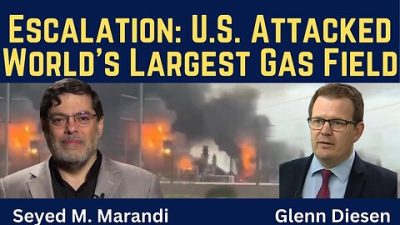
Marandi: US attacked world’s largest gas field & Iran declares economic war
or go to
Aletho News Archives – Video-Images
Book Excerpt
US Axis of Aggression in Gulf
By Finian Cunningham | Strategic Culture Foundation | August 15, 2019
When Washington announced a few weeks ago the formation of a maritime “international coalition” to “protect shipping” in the Persian Gulf, many observers were skeptical. Now skepticism has rightly turned to alarm, as the proposed US-led “coalition” transpires to comprise a grand total of just three nations: the US, Britain and Israel.
The term “coalition” has always been a weasel word used by Washington to give its military operations around the world a veneer of international consensus and moral authority. If the US goes ahead with deploying forces in the Persian Gulf the guise of “coalition” is threadbare. It will be seen for what it is: naked aggression.
Iran promptly warned that if the US, Britain and Israel move on their intention to deploy in the Persian Gulf, it will not hesitate to defend itself from a “clear threat”. … continue
Blog Roll
 Aletho News
- Iran War Is Accelerating the End of US Dominance
- FBI Resumes Buying Americans’ Location Data Without Warrants
- IDF threatens ‘elimination’ for Russian leaders who ‘wish Israel ill’
- Attacks on enemy energy facilities not over yet, strikes ongoing: Iran
- US dragged by Israel into ‘unlawful war’ with Iran – Gulf state
- Israel’s War on Iran’s Grid: How the South Pars Strike Turned Energy into a Weapon
- War on Iran to impose trillion-dollar ‘Israel First Tax’ on US citizens: Araghchi
- The State Is Socializing the Cost Of the Iran War
- Seyed M. Marandi: U.S. Attacked World’s Largest Gas Field & Iran Declares Economic War
- Washington’s War on Cuba Is Older Than You Think
- If Americans Knew
- Trump: Israel attacked Iranian gas field without US knowledge. No more such attacks!
- America’s friends must help extricate it from an unlawful war
- Democratic Nat’l Committee’s Kneejerk Backing of Israel Is Political and Moral Failure
- Major revelations from former counterterrorism chief Joe Kent’s extensive interview
- More than half of Palestinian child detainees have no charges
- Grieving Parents in Iran Spend Every Night at the Graves of Their Children, Killed by U.S. Strike
- War on Iran spins out of control, Palestine struggles – Not a ceasefire Day 160
- How ignorance, misunderstanding and obfuscation ended Iran nuclear talks
- Israeli media reports grotesque settler attack in West Bank
- UK security adviser attended US-Iran talks and judged deal was within reach
- No Tricks Zone
- Energy Expert: Germany’s Nuclear Phaseout Was A “500 Billion Euro Mistake”
- New Research: South Australia’s Mid-Holocene Sea Surface Temperatures Were 4°C Warmer Than Today
- Storing Green Energy To Last Germany 10 Days Would Require A 60-Million Tonne Battery
- New Studies: UK Sea Levels Were 4 Meters Higher Than Today During The Mid-Holocene
- Destructive Green New Deal: German Energy And Metal Group Warns Of Drastic Crisis
- New Study Documents A 20-Year Pause In Arctic Sea Ice Decline – Driven By Internal Variability
- Wake-up Call: Survey Shows Majority Of Germans Now Favor Postponing Climate Targets!
- Televised! Leading German Political Candidate Tells Schoolchildren CO2 Makes Sun Hotter!
- New Study: A Century Warming Of 1.1°C Is ‘Commonplace’ And ‘Not Unusual’ During This Interglacial
- New Study: ‘Internal Noise’ And Volcanic Forcing Can Trigger 10-15°C Warming Within Decades
 Aletho News
