US Drones Flying in Afghan Airspace, Taliban Says as Group Yet to Confirm Death of al-Zawahiri
Samizdat – 25.08.2022
Afghanistan on Thursday accused the US of flying drones over its territory without official permission.
Taliban spokesman Zabiullah Mujahid said his government raised the issue with the US as it considers operating drones without its consent to be an act of aggression.
The spokesman also mentioned that the alleged killing of Ayman al-Zawahiri, leader of the al-Qaeda network, is still a claim, and “the investigation has not yet been finalized.”
On August 1, US President Joe Biden announced that Zawahiri was killed in a “precision” strike in Kabul, where the terrorist mastermind had, as Washington claimed, moved to “reunite with members of his immediate family.”
Under the Doha peace deal which was struck between the US and the Taliban in 2020, the group reportedly agreed not to allow al-Qaeda or any other extremist group to operate in areas under their control.
According to media reports, al-Zawahiri had been in charge of the terror group al-Qaeda since 2011.
US-South Korean Ulchi Freedom Shield military exercises raises alarms in Pyongyang
By Ahmed Adel | August 25, 2022
South Korea and the United States began the joint Ulchi Freedom Shield (UFS) military exercises on August 22, resuming large-scale field training after a four-year pause. Following the Singapore summit in 2018 between North Korean leader Kim Jong-un and then US President Donald Trump, joint land exercises were cancelled and the scale of the UFS exercises was significantly reduced. However, with US President Joe Biden in power and the consequential destabilisation because of Washington’s desperate attempt to maintain a unipolar order, these exercises have resumed.
Trump tried to convince Pyongyang to give up its nuclear weapons program as a shield to ensure its security. An important basis for this US decision was the policy of then-South Korean President Moon Jae-in, who actively established dialogue with North Korea. Incumbent President of South Korea Yoon Suk-yeol has reviewed inter-Korean relations and promised to carry out regular military drills and strengthen his country’s missile defence capabilities. As a result, South Korea fully resumed joint military exercises with the US.
Western media reported that this year’s UFS exercise includes a series of drills in specific hypothetical situations, modelled on an all-out war, simulating joint attacks, as well as operations such as supplying weapons and fuel to the front, and moving weapons of mass destruction. In the past, the US and South Korea mobilised tens of thousands of troops and a large number of aircraft, warships and tanks to participate in similar exercises.
According to a shared statement, South Korea and the US are holding these drills in response to North Korea, which has increased the number and scale of missile tests over the past year. North Korea is not a credible threat to the US though and is unlikely to attack South Korea unprovoked, meaning that their missile tests are a demonstration of its defensive capabilities.
North Korea traditionally views joint US-South Korean military exercises as preparations for an invasion, a legitimate concern since it was the US who internationalised the Korean Civil War that has kept the peninsula divided ever since.
The joint US-South Korean military exercises are sure to provoke an outraged response from Pyongyang. Although Pyongyang can limit itself to harsh rhetoric, the recent cruise missile launches are a pre-emptive response to the US-South Korean military drills. In general, the provocative exercises have pushed tensions to a new level.
At the meeting on August 9 in the Chinese city of Qingdao, Chinese Foreign Minister Wang Yi and his South Korean counterpart Park Jin exchanged views on the latest situation on the Korean Peninsula and how to resolve tensions. At that time, the date and scope of the UFS exercise were announced. It is possible that this caused the Chinese side to voice their concerns about the US-South Korea exercise plan and the possible impact it can have on stability in Northeast Asia.
After the talks, the South Korean minister asked Beijing to play a constructive role in persuading Pyongyang to choose dialogue over a military response. At the same time, Park Jin acknowledged that peace and stability on the Korean Peninsula is facing unprecedented challenges, but without acknowledging this was at his own country’s behest as it continually invites a non-regional actor to interfere in affairs.
For his part, Wang Yi called Pyongyang and Seoul as the two real masters of the Korean peninsula, making it clear that China expects South Korea to make responsible decisions regarding bilateral relations and without outside influence. But, this year’s UFS military exercise shows that Seoul is not ready to act confidently and independently.
It appears that the current US-influenced South Korean government is incapable of managing the security situation on the Korean peninsula. This concerns China as it already faces US provocations regarding Taiwan and it does not want another major flashpoint opened on its border.
The North Korean government regularly asks China to play a constructive role. South Korean leaders are well aware that, in fact, China is the only country with some kind of leverage and influence over Pyongyang. In general, Yoon Suk-yeol’s administration does not want to increase confrontation with China, but at the same time acts as a US lackey towards North Korea.
Yoon Suk-yeol tried to avoid trouble and repeatedly reassured that South Korea’s participation in some American initiatives was not directed against China. South Korea wants to join US economic initiatives, but this always comes at a price of serving American geopolitical interests.
During his talks with his South Korean counterpart, Wang Yi affirmed that China supports the improvement of North-South relations, adheres to a two-way phased approach, and promotes denuclearisation and building a peace mechanism on the peninsula.
But just because Chinese concerns may be acknowledged, it does not mean that North Korea feels anymore relaxed about the provocative exercises. In fact, given the context of the US instigating war in Ukraine and attempting to destabilise the Taiwan Straits, Pyongyang has very legitimate concerns with Washington’s intentions on the Korean peninsula.
Ahmed Adel is a Cairo-based geopolitics and political economy researcher.
Democrats and Republicans Pretend They Have Massive, Unbridgeable Differences So They Can Unite Seamlessly on War

Bernie and Lindsey share a moment of collegiality. Photo by Matt Stone via Getty Images
By Michael Tracey | August 24, 2022
After endless rounds of Hamlet-style legislative tedium, Congressional Democrats finally muscled through a $430 billion spending bill this month which deals with a smattering of their domestic policy priorities. Because Republicans opposed the bill en masse, and Democrats supported it en masse, one might look at this development and conclude that standard-fare partisanship is just as indelible a feature of US politics as it’s ever been. After all, the partisan affiliation of Senators and House members was perfectly predictive of their voting behavior vis-a-vis the “Inflation Reduction Act.” When the rubber hits the road, it turns out Republicans and Democrats really do have competing, irreconcilable interests — right?
Thanks to these occasional instances of classically polarized partisan sausage-making, elected officials and media operatives can claim at least some basis for their frantic insistence that some titanic gulf separates the two parties. The ever-presence of bi-directional Culture War agitation can heighten this impression — upon which it always becomes existentially crucial that one or the other party gets put into power at the next election. Make sure to vote in the upcoming Midterms, because these Midterms just happen to be the most consequential Midterms of all time, at least since the 2018 Midterms. The fate of humanity hinges on whether Chuck Schumer or Mitch McConnell controls the Senate, didn’t you know?
On the other hand, if you’re one of the vanishingly few Americans who’d like to think that your vote this year could meaningfully alter the course of US foreign policy, you’re bound for disappointment. Because even as both parties tried to make it seem like the “Inflation Reduction Act” vividly demonstrated the intractable differences between them, they were simultaneously demonstrating the exact opposite: that at least in regards to another set of issues which genuinely are “existential,” in that they impinge on such matters as whether you’re likely to get incinerated in a large radiation blast anytime soon, there is almost no meaningful distance at all between Democrats and the GOP. Over time, if anything, whatever distance might have previously existed has meaningfully shrunk. Because with limited and marginalized exceptions, both Democrats and Republicans are increasingly functioning as a unified bloc on the questions which most centrally bear on America’s posture as a global military and economic hegemon. As that posture becomes more fraught and antagonistic across multiple theaters, the two parties have become more and more ardent in constricting the range of acceptable debate. Democrats may spend the bulk of their time on social media or in front of TV cameras piously shrieking that the empowerment of Republicans would guarantee the implosion of “democracy,” and Republicans may make funhouse-mirror versions of the same argument. But this phony baloney two-way theater obscures just how much their worldviews have converged.
Earlier this month, the Senate approved the accession of Finland and Sweden to NATO by a vote of 95-1 — formalizing the process by which those two countries have opted to repudiate their historic doctrines of military neutrality. (Finland is abandoning the precedent it adhered to throughout the entirety of the Cold War, while Sweden is abandoning the precedent it has adhered to since the reign of Napoleon.) Speaking from the Senate floor ahead of the vote, Sen. Tom Carper (D-DE) joyously declared how “glad” he was that NATO enlargement is something “we can all pretty much agree on.” In a touching moment, Carper noted that he had both the “same initials” and the “same views” on the subject as his colleague Sen. Tom Cotton (R-AR) — perhaps the most ideologically zealous interventionist in the Senate. Cotton also happens to be one of the few remaining US political figures of any notoriety who’s still refused to budge in his conviction that it was a really great idea for George W. Bush to invade Iraq. And unless he just happens to have an unusually specific fondness for Iowa and New Hampshire, Cotton is clearly preparing to run for president — so it should bring Democrats great pleasure that someone they’re in such fundamental agreement with is gearing up to throw his hat in the ring.
“Probably one of the easiest votes I’ll ever make in the United States Senate,” announced Sen. Jim Risch (R-ID), who seemed particularly appreciative that he barely had to give the Finland/Sweden issue more than a moment’s thought. “John McCain, I wish you were alive today to celebrate,” chimed in Sen. Lindsey Graham (R-SC). And indeed, there’s little doubt that McCain would have reason to celebrate from beyond the grave: the US political class, whatever their surface-level partisan or factional disagreements, is barreling toward unshakable “unity” on the expansion of US hegemonic power, now arrayed with growing fervor against the reviled tandem of Russia and China. One of McCain’s favorite themes was always “unity,” but a peculiar kind of “unity” whose purpose was mainly to facilitate wars.
Even the lone senator who did vote against the accession of Finland and Sweden this month, Josh Hawley (R-MO), did so on grounds that made abundantly clear he had no objection on principle to the expansion of NATO — much less to the accelerated deployment of coercive US power around the world. What he objected to was simply that expanding NATO at this juncture reflected ineffectual resource allocation, as Hawley preferred that whatever the US may now be obliged to expend in Scandinavia should instead be expended in East Asia, to prepare for an allegedly looming war with China. Hawley stressed that he opposed bringing Finland and Sweden into NATO only insofar as it would be a hindrance to the US implementing “a coherent strategy for stopping China’s dominance in the Pacific, beginning with the possible invasion of Taiwan.”
Hawley explained, “Our military forces in Asia are not postured as they should be,” whether because “we don’t have enough advanced munitions” or because the current fleet of US attack submarines is “sinking.” Fundamentally, Hawley argued, the US is “simply not sized to handle two simultaneous conflicts.” And his objection to NATO expansion boils down to a preference for “handling” a conflict in the Pacific over one in Europe — not, it should be noted, a preference for mitigating conflict in the first place. But even going by his own stated rationale, it’s unclear what the operating principle is for Hawley: in 2019, he voted for the accession of well-known military powerhouse North Macedonia to NATO. All that’s seemingly changed in the interim is that Hawley has taken to framing his views more in terms of opposing what he calls a “globalist foreign policy” — which somehow coincides with his advocacy for dramatically ramping up US militarization on the other side of the globe in East Asia.
Even Sen. Rand Paul (R-KY), among the dwindling group of national politicians one might expect to raise at least a perfunctory objection to NATO expansion, conceded during the Senate debate this month: “In this new world I am less adamant about preventing NATO’s expansion.”
It wasn’t always this way. In 1998, 19 senators voted against the accession to NATO of Poland, Hungary, and the Czech Republic — not enough to prevent the proposal from obtaining the required two-thirds majority, but enough to at least prompt a reasonably robust debate, one which far exceeded the pittance that accompanied this month’s vote. Figures as high-profile as Sen. Daniel Patrick Moynihan (D-NY), Hillary Clinton’s predecessor, argued against NATO expansion on the floor of the Senate in extremely stark terms: Moynihan declared his opposition stemmed from a keen wariness about “the dangers of nuclear war in the years ahead,” and said NATO expansion needlessly “put ourselves at risk of getting into a nuclear engagement, a nuclear war, with Russia — wholly unanticipated, for which we are not prepared, about which we are not thinking.”
Moynihan’s primary sparring partner during that 1998 debate was none other than Joe Biden, then the top Democrat on the Senate Foreign Relations Committee, who appointed himself point-person for the entire process of shepherding NATO expansion through the necessary procedural formalities. In fact, Biden’s conviction in the eternal virtue of NATO expansion seems to be one of the few positions he’s held consistently over the course of his comically long, decades-spanning career. That first round of expansion in 1998, Biden declared at the time, would mark “the beginning of another 50 years of peace” — a prophecy that today some might quibble with.
Though he didn’t succeed, Moynihan’s opposition showed it wasn’t an automatic career-ender to be associated with skepticism of this particular strand of US military expansionism — nor was raising concerns about the specter of nuclear war considered contemptibly “cringe.” Moynihan remained a highly revered figure among his colleagues; a new expansion of Penn Station in NYC was even just named after him last year. With a hot war raging today in Ukraine, in which the US is effectively the leading co-combatant against Russia, the risk of nuclear war is much more acute than when Moynihan warned about it 24 years ago. But almost no political figure of any prominence even appears to be “thinking” about the matter anymore. Indulge in such “thinking,” and you’re liable to be denounced as a Putin agent for your trouble, and/or field a barrage of angry accusations that you’re somehow in league with right-wing “insurrectionists.”
A few who voted against NATO expansion in 1998 are still in the Senate, like Pat Leahy (D-VT), Ron Wyden (D-OR), and Jim Inhofe (R-OK) — all of whom just supported Finland/Sweden accession this month, apparently without a second thought. (Leahy, at age 82, was technically absent for the vote due to hip problems.) Even Harry Reid (D-NV), who’d later become the Senate Majority Leader and therefore presumably could not be dismissed as some fringe agitator, voted against NATO expansion in 1998. There were weeks of formal debate back then — Senators actually engaged one another directly with arguments and counter-arguments, an extreme rarity in an otherwise stultified environment. And while Biden’s side prevailed, there was at least some notional sense that another “side” existed. Today, there is functionally just one “side,” with politicians flocking in unison to install another 830 miles of NATO “security umbrella” (by way of Finland) right smack dab on the border with Russia. This would’ve been almost unthinkable in 1998, even for the most ardent NATO expansion advocates — but today the move was swiftly ratified with hardly a critical word uttered.
Bernie Sanders (I-VT) was in the House at the time, not the Senate, and therefore did not specifically vote on the provision to amend the NATO treaty. But in 1997 he made a point to put some observations on the record concerning a concurrent measure that set the groundwork for Estonia, Latvia, and Lithuania to join NATO (which ultimately happened in 2004, thanks to the friendly bipartisan cooperation of Biden and George W. Bush). Sanders asked on the floor of the House: “First of all, Russia clearly perceives that the expansion of NATO into the Baltics would be an aggressive, wholly unjustifiable move by the United States… since the Cold War is over, why are we militarily provoking Russia?”
Today, Bernie is essentially mute on the subject — except when he votes unfalteringly in favor of the latest NATO-related initiative, such as the Finland/Sweden measure this month, or the $40 billion Ukraine war funding bill in May. And for the most part, he can’t even be bothered to explain his reasoning — which in a way is understandable, since it’s not like there’s some steady drumbeat of “progressive” activists/media holding his feet to the fire on these issues. Could figures who opposed NATO expansion in 1998 theoretically argue that conditions in 2022 have changed so radically that they’ve in turn changed their position? Yes, they could theoretically argue that. But they’re barely even asked to justify their positions, as the near-total eradication of any dissension on the matter has given way to an impenetrable consensus, such that no justification need be given.
The Washington Post was candid in 1998 about the reasons “approval was virtually assured” for NATO expansion, notwithstanding the minority of opposition led by Moynihan. “Pressure from ethnic constituencies and the prospect of new markets for the American defense industry at a time of shrinking US demand,” the newspaper reported, had already sealed the deal. Try mentioning either of those factors in polite company today with regard to the current posture of US foreign policy in Eastern Europe. You’ll probably find you’d prefer to stick with more standard-fare squabbling about things like the “Inflation Reduction Act.”
US Carries Out Airstrikes Targeting “Iranian-Backed” Groups in Syria
By Kyle Anzalone | The Libertarian Institute | August 23, 2022
US Central Command (CENTCOM) announced it carried out airstrikes in Syria on Tuesday. The Department of Defense claims the bombs hit facilities used by groups affiliated with Iran’s Islamic Revolutionary Guard Corps (IRGC) and were in retaliation for an attack on US personnel in Syria.
The CENTCOM press release asserts that Iranian-supported groups attacked US forces in Syria on August 15, and Tuesday’s bombing was necessary to protect American troops. “Today’s strikes were necessary to protect and defend US personnel. The United States took proportionate, deliberate action intended to limit the risk of escalation and minimize the risk of casualties,” the Pentagon said.
A Pentagon statement on August 15 said a US base in al-Tanf, Syria, was attacked by a series of drones causing no damage or injuries. There was no claim of responsibility for the attack. The White House has not provided evidence that an Iranian-backed group carried out the attack.
The US occupies about a third of Syrian territory with 900 troops. Washington claims its forces remain in Syria to ensure the enduring defeat of the Islamic State. However, Iranian-backed groups support the government of Bashar al-Assad, an avowed enemy of ISIS. In recent months, ISIS has carried out several attacks against Assad’s forces, killing scores of soldiers.
President Joe Biden asserted he had Constitutional authority to carry out the strikes. “The President gave the direction for these strikes pursuant to his Article II authority to protect and defend US personnel by disrupting or deterring attacks by Iran-backed groups,” the press release said.
While Article II may give Biden the power to defend US troops, Congress has never passed a declaration of war or authorization of military force for Syria. Without Congressional authorization, three successive American presidents bombed Syria.
The strikes also come as Washington and Tehran have made significant progress towards reviving the Iran nuclear agreement. The US and Iran have been engaged in indirect talks for over a year. Reuters reported Monday that Tehran had dropped two key demands, paving the way for a deal that would see the US and Iran return to compliance with the nuclear deal.
Biden celebrates Ukraine’s independence day with biggest arms package yet
Samizdat | August 24, 2022
US President Joe Biden announced on Wednesday that the US will send an additional $2.98 billion worth of weapons to Ukraine. In an announcement coinciding with Ukraine’s Independence Day, Biden said that the US envisions Kiev fighting for some time to come.
According to a White House statement, Ukraine will receive “air defense systems, artillery systems and munitions, counter-unmanned aerial systems, and radars to ensure it can continue to defend itself over the long term.”
On Tuesday, US officials told the Associated Press, Reuters and CBS that the package would include at least three different drone systems, such as the hand-launched Puma drone, the longer-range ScanEagle surveillance vehicle, as well as the UK-made Vampire drone, which has not previously been provided to Kiev.
Referencing Ukraine’s independence day, which celebrates its split from the Soviet Union in 1991, Biden said that “today is not only a celebration of the past, but a resounding affirmation that Ukraine proudly remains – and will remain – a sovereign and independent nation.” Given his vow to support the Ukrainian military “over the long term,” and NATO Secretary General Jens Stoltenberg’s declaration on Tuesday that the alliance would back Kiev “for as long as it takes,” Biden evidently plans for the conflict to be a long one.
However, several US media outlets reported on Tuesday that the contents of Wednesday’s arms package may not reach the battlefield for months or even years. Unnamed US officials told the Associated Press that Washington expects Ukrainian forces “to fight for years to come.”
Bankrolling the Ukrainian military has been a costly endeavor for the US. With the American economy wracked by inflation and rising energy costs, the Biden administration has thus far committed more than $54 billion in military and economic aid to Kiev since February.
Meanwhile in Ukraine, Russia continues to advance on Ukrainian positions in the south of the country and on the borders of the Donbass republics of Donetsk and Lugansk, where Kiev has spent the last eight years building a network of bunkers and fortifications. While Ukraine does not publish casualty figures, President Vladimir Zelensky said earlier this summer that 60 to 100 Ukrainian soldiers were being killed in Donbass on a daily basis, with another 500 injured.
Israel must ‘eliminate’ nuclear arsenal: Official
The Cradle | August 23, 2022
On 23 August, Iran’s top UN Envoy Majid Takht Ravanchi decried the lack of progress over efforts to denuclearize West Asia, and called on Israel – the region’s only nuclear armed state – to eliminate its stockpile of weapons.
Tehran’s ambassador made these remarks during the Tenth Review Conference of the Parties to the Treaty on the Non-Proliferation of Nuclear Weapons (NPT) held at the UN’s headquarters in New York.
Takht-Ravanchi charged the US with exercising double standards, and demanded that Israel’s accession to the NPT “without precondition and further delay” and the placement of all of its nuclear activities and facilities under the comprehensive International Atomic Energy Agency (IAEA) safeguards are essential in “realizing the goal the of establishing of a nuclear-weapon-free zone in the Middle East.”
The Iranian envoy said delays in 2012, 2013 and 2014 in convening the Conference – which is meant to advance the goal of eliminating weapons of mass destruction from the region – had caused serious setbacks for participating states.
“We are firmly convinced that the Conference was postponed indefinitely because of the US opposition, and this has been the persistent policy of the US to turn a blind eye to the nuclear arsenals of the Israeli regime while not supporting the convening of the Conference,” he declared.
Israel reportedly possesses 200 to 400 nuclear warheads, making it the sole possessor of non-conventional arms in West Asia, yet Tel Aviv as yet to sign the NPT and refuses to allow inspections of its nuclear facilities.
Signatories from 191 countries have signed the NPT, including the US, UK, France, China, and Russia, making it the most highly ratified armaments agreement in history.
Experts suggest that the US and EU support for Israel has emboldened the country to increase its nuclear activities, despite essential oversight by the IAEA.
Over the years, Israelis are believed to have assassinated at least seven Iranian nuclear scientists and conducted a series of sabotage operations against Iran’s IAEA-monitored nuclear facilities.
Last week, Israeli officials called on western nations to “walk away” from the negotiating table with Iran, fearful that the US is on the cusp of returning to the 2015 Joint Comprehensive Plan of Action (JCPOA) that would freeze Tehran’s enrichment program.
During a phone call with German Chancellor Olaf Scholz on 18 August, Israel’s interim Prime Minister Yair Lapid demanded that Europe send a “clear and unequivocal message that there will be no more concessions to Iran,” according to Israeli media.
Lapid also met with the US ambassador to Israel and the chairman of the US House Foreign Affairs Committee’s ‘Middle East’ Subcommittee, telling them: “In the current situation, the time has come to walk away from the table. Anything else sends a message of weakness to Iran.”
This comes after several Israeli assassination and sabotage operations inside Iran, in efforts to set back Iran’s advancements and scuttle JCPOA revival talks.
US Space Force wants to disrupt Russia-China space cooperation
Both Russia and China have been responding to the US militarization of space by enhancing their own capabilities, both separately and jointly.
By Drago Bosnic | August 22, 2022
Close strategic partnership between Russia and China has been the mainstay of their relationship for decades. The US has been trying to disrupt this successful partnership ever since, especially as Russia started regaining its strength, but the incessant belligerent actions of the imperialist thalassocracy have pushed the two (Eur)Asian superpowers even closer. This cooperation is manifold, but its space component is particularly concerning for the US, as it has serious security implications. The Pentagon is worried that the US “might not be able to match the united financing and know-how” of Moscow and Beijing.
“The two countries’ space cooperation, including in the military realm, has become inextricable since 2018 and works against U.S. interests,” said Kevin Pollpeter, senior research scientist at the CNA think tank’s China Studies Division. “I don’t think we can separate China and Russia. I just don’t think that’s possible,” Pollpeter said in response to a question from Air Force Magazine following a panel discussion on China-Russia space cooperation at the National Defense University in Washington, D.C.
“While the countries do not have completely overlapping security concerns, they do share a strong desire to counter U.S. leadership, including in outer space,” he said. “What we need to do is, we need to mitigate whatever problems that relationship may cause for us. The two countries’ military space cooperation includes the areas of ballistic missile defense, space debris monitoring, and satellite navigation. The resulting exchange has included technology transfer, weapons sales, combined exercises, and compensating measures,” Pollpeter added.
In 1989, the US imposed sanctions on China, targeting Beijing’s defense and space industry. China looked to Russia for the necessary technology transfers and by 1997, the two countries started regular cooperation in space. Russia had the know-how, but its space industry was faced with severe funding shortages.
“… a number of embargoes that took place made [China] increasingly more reliant on Russia as a potential source of technology, particularly for dual use and defense,” said Pollpeter. “… China started looking more to Russia, and Russia started looking more to China for help with supporting their own space program.”
China also began cooperating with Russia on ballistic missile defense after the US unilaterally withdrew from the INF (Intermediate-Range Nuclear Forces) Treaty in 2019. In the immediate aftermath of the withdrawal, Russian President Vladimir Putin stated that Russia would assist China in creating a ballistic missile early warning system. At the time, Putin said that China was perfectly capable of creating such a system itself, but that it would take longer, so Russia decided to aid Beijing in enhancing its strategic security in light of aggressive US moves in the Asia-Pacific region.
“There appears to be some sort of technology transfer going on,” Pollpeter added. “There’s been joint exercises – the Aerospace Security 2016 and 2017 involved joint air and missile defense planning and coordination.”
According to Pollpeter, another area of cooperation, space debris monitoring, “may sound innocuous,” but he claims “it has security implications.”
“If you have a space debris monitoring system, then you actually have a space domain awareness or space surveillance system,” he said. “This very much has a military role in helping China and Russia better monitor U.S. movements up in space.”
The US Space Force is particularly concerned about how “little is known about the satellite navigation cooperation between the two nations.” According to Pollpeter, other than the fact that there are compatibility and interoperability between the Russian and Chinese equivalents to GPS, the GLONASS and BeiDou navigation systems, nothing else is known about the security component of this cooperation. What is supposedly known is “the presence of augmentation stations in each other’s countries and performance monitoring,” Pollpeter claims.
“What they really want to do, then, is demonstrate that in a world where the U.S. and China could come into military conflict, they have an alternative,” he said. “They don’t have to rely on BeiDou exclusively. They also have the Russian system.”
As China doesn’t publicly discuss its space defense capabilities, Pollpeter claims it’s currently unknown which level of cooperation have Moscow and Beijing reached in this regard.
“A lot of it’s so opaque that when you get into something like counterspace, they’re not going to discuss that,” he said. “What China is developing is a capability that really is designed to threaten the United States space architecture from the ground all the way up to geosynchronous orbit.”
Existing agreements indicate close Chinese and Russian cooperation on launch vehicles, rocket engines, space planes, lunar and deep space exploration, remote sensing, electronics, space debris, satellite navigation and communication. Pollpeter thinks the US Space Force cannot halt the China-Russia cooperation, but it could do more to mitigate its effects.
“There’s really little we can do to separate the two countries, especially [on] the space side,” he said. “The distrust and, let’s say, to some extent, animosity of both countries towards the U.S. sort of precludes, at this point, that any of those efforts can be successful.”
As the US state-run space sector kept falling behind, private companies, the most prominent certainly being SpaceX, started closely cooperating with the US military. Both Russia and China have been responding to the US militarization of space by enhancing their own capabilities, both separately and jointly. While China started deploying pilotless spaceplanes, Russia is building land-based laser weapons to counter US space threats and is also launching its own spacecraft to track US space assets.
Drago Bosnic is an independent geopolitical and military analyst.
Biden Steps Up Somalia Strikes After Redeploying Troops
By Will Porter | The Libertarian Institute | August 20, 2022
American airstrikes in Somalia are on the rise in recent months, with US Africa Command (AFRICOM) conducting a flurry of operations against al-Shabaab militants since President Joe Biden reversed a full troop withdrawal ordered by his predecessor.
AFRICOM has carried out at least five bombing raids in Somalia so far in 2022, stating that its most recent strike last weekend killed 13 Shabaab fighters near the town of Teedaan. Four other missions were conducted between February 22 and August 9, alleged to have wiped out a total of 11 jihadists.
The Pentagon maintains the latest operation on August 14 resulted in zero deaths or injuries to civilians, in line with virtually every previous AFRICOM report on US strikes in the country. In the command’s last casualty assessment published in late July, it said it received no new reports of civilian deaths, though went on to note possible “discrepancies” between its own numbers and those of humanitarian monitors – some of which have accused the Pentagon of serious underreporting.
While the military launched a comparable number of strikes in Somalia last year, air operations appear to have accelerated since Biden’s decision to redeploy some 500 troops to the country in mid-May. Former President Donald Trump had ordered a full withdrawal of the roughly 800 soldiers on the ground in 2020, but Biden’s Pentagon later stressed the need for a “persistent US military presence in Somalia” in order to “enable a more effective fight against al-Shabaab.”
Despite years of American bombing raids and ground missions against al-Shabaab, however the group has only grown more radical since its 2006 founding, even pledging loyalty to al-Qaeda in 2012. It has also gained in strength in the meantime, with the United Nations estimating up to 12,000 fighters in its ranks earlier this year – potentially tripling its membership since 2013, when the African Union offered a lower-end figure of 4,000.
Shabaab rose from the ashes of Somalia’s civil war in the early 2000s, when warlords vied for power and control following the collapse of the Somali state. Though it began as a youth wing of the more moderate Islamic Courts Union (ICU) – which resumed some semblance of governance in Mogadishu and worked to oust warlords – foreign interventions led by Washington helped to drive the group into increasing militancy until it finally broke off from the ICU, eventually growing into an armed insurgency which rages on to this day.
US on verge of becoming party to Ukrainian conflict, Moscow warns
Samizdat | August 19, 2022
Washington’s continued support for Kiev during Moscow’s military operation has put the US on the verge of becoming party to the Ukrainian conflict, Russia’s deputy Foreign Minister, Sergey Ryabkov has said.
“We don’t want escalation. We’d like to avoid a situation, in which the US becomes a party to the conflict, but so far we don’t see any readiness of the other side to take these warnings seriously,” Ryabkov told Rossiya 1 TV channel on Friday.
Moscow rejects Washington’s explanation, that providing Ukraine with weapons and other aid is justified by Kiev’s right to self-defense, he pointed out.
“Excuse me, what kind of self-defense is it if they are already openly talking about the possibility of attacking targets deep in the Russian territory, in Crimea?” the deputy FM wondered.
According to Ryabkov, such statements are being made by the Ukrainian side “not just under the blind eye of the US and NATO, but with the encouragement of this kind of sentiment, approaches, plans and ideas directly from Washington,” Ryabkov insisted.
“The ever more obvious and deeper involvement in Ukraine in terms of countering our military operation, in fact, puts this country, the US, on the verge of turning into a party to the conflict,” he reiterated.
The US has been the strongest supporter of Kiev amid its conflict with Russia, providing Kiev with billions of dollars in military and financial aid, as well as intelligence data. Washington’s deliveries to the Ukrainian military have included such sophisticated hardware as HIMARS multiple rocket launchers, M777 howitzers and combat drones.
Reuters reported on Friday that US President Joe Biden is about to announce another lethal aid package for Kiev of around $800 million.
An unnamed official from the Biden administration told Politico on Thursday that the White House had no problem with Ukraine attacking Crimea, which became part of Russia after a 2014 referendum staged in response to a violent coup. The US believes that Kiev can strike any target on its territory, and “Crimea is Ukraine,” the American official insisted.
There have recently been a number of explosions near a Russian ammunition depot and at a military airfield in Crimea, which the Defense Ministry said were acts of “sabotage.” However, Ukrainian authorities haven’t officially confirmed involvement in the attacks.
Russia sent troops into Ukraine on February 24, citing Kiev’s failure to implement the Minsk agreements, designed to give the regions of Donetsk and Lugansk special status within the Ukrainian state. The protocols, brokered by Germany and France, were first signed in 2014. Former Ukrainian President Pyotr Poroshenko has since admitted that Kiev’s main goal was to use the ceasefire to buy time and “create powerful armed forces.”
In February 2022, the Kremlin recognized the Donbass republics as independent states and demanded that Ukraine officially declare itself a neutral country that will never join any Western military bloc. Kiev insists the Russian offensive was completely unprovoked.
US to Deploy Strategic Assets to Region If DPRK Conducts Nuclear Test: Pentagon
Samizdat – 17.08.2022
The United States and South Korea agreed to deploy US strategic assets to the region if North Korea conducts a nuclear test, the two nations said in a joint statement for their 21st integrated defense dialogue.
“Both sides shared their assessments of activities at the DPRK’s Punggye-ri nuclear testing site. The two sides affirmed that, should the DPRK conduct a nuclear test, the ROK and the U.S. will engage in a strong and firm bilateral response, to include options to deploy U.S. strategic assets to the region,” the statement said.
On Wednesday, North Korea launched two cruise missiles toward the Yellow Sea, the South Korean military said.
The 21st South Korea-US Integrated Defense Dialogue was held in Seoul on August 16-17. The delegations were led by US Deputy Assistant Secretary of Defense for East Asia, Siddharth Mohandas, and South Korean Deputy Minister for National Defense Policy, Heo Tae-keun.
The United States and South Korea will expand the scope and scale of joint military drills in response to recent missile tests conducted by North Korea, and will start with the Ulchi Freedom Shield exercise next week, according to a joint statement.
“The leaders discussed the DPRK threat, particularly the increased volume and scale of DPRK missile tests over the course of the last year. With this in mind, and considering the evolving threat posed by the DPRK, both leaders committed to expanding the scope and scale of combined military exercises and training on and around the Korean Peninsula—starting with Ulchi Freedom Shield next week—to bolster combined readiness,” the joint statement said.
On August 16-17, the two countries held their 21st integrated defense dialogue in Seoul. The delegations were led by US Deputy Assistant Secretary of Defense for East Asia, Siddharth Mohandas, and South Korean Deputy Minister for National Defense Policy, Heo Tae-keun.
Featured Video
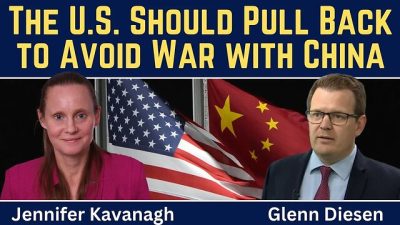
Why the U.S. Should Pull Back From the First Island Chain
or go to
Aletho News Archives – Video-Images
Book Review
‘Why Fauci Must Rot in Prison’: A Tale of Two Diaries
By Jill Erzen | The Defender | October 13, 2026
Dr. Anthony Fauci’s private diary reveals a “mind-numbing” contradiction between what the former top U.S. infectious disease official knew about COVID-19 and what he told the public, senior White House adviser Peter Navarro, Ph.D., said last week on “American Thought Leaders.”
In his new book, “Why Fauci Must Rot in Prison,” due out Oct. 20, Navarro compares Fauci’s private entries to his own pandemic-era diary, and uses what he calls “a tale of two diaries” to argue that Fauci should face criminal prosecution.
“I show, actually, how a prosecution can and should happen … at the state level, most likely,” Navarro said. “He should wind up in prison, and we’ve got the receipts in this book to put him there.”
Navarro said Fauci repeatedly acknowledged important facts in private, then publicly pursued policies that contradicted those facts — with devastating consequences.
“What he says many times privately in his diary is so at odds with both his public behavior and public statements that it’s mind-numbing,” Navarro said.
Navarro examines the lasting damage caused by lockdowns and other pandemic policies, and the ongoing toll of long COVID.
His book also addresses questions about vaccine safety, including why healthy young people faced COVID-19 vaccination mandates despite concerns about myocarditis, and why women were not warned about miscarriage risks linked to the shots. … continue
Blog Roll
 Aletho News
- Jennifer Kavanagh: Why the U.S. Should Pull Back From the First Island Chain
- Yemen denounces international community’s silence on Saudi aggression, siege
- UAE and Saudi Arabia move toward renewed coordination against Sanaa
- How Iran’s two-week retaliatory strikes exposed cracks in US military architecture in Persian Gulf
- The mother of all propaganda: Why the hype over US MOAB strike against Iran is nothing but theater
- Iran says it possesses technology behind US 14-ton GBU bunker-buster
- Trump asks Iran not to retaliate after he strikes Pickaxe Mountain – w/ Prof. Marandi
- Vice President J.D. Vance’s Deceptive ‘Antiwar’ Campaign Speech
- Iran: Palestinians’ rights must not be compromised in Gaza’s future; US, Israel to blame for Hormuz situation
- Ongoing tales of Syrian chemical weapons
- If Americans Knew
- Israeli rabbi permits occupiers to steal Palestinian olive harvest in West Bank
- Netanyahu’s spin on latest settler attack is laughable – Daily Update
- Israeli soldiers debunk Israel’s talking points
- In West Bank, Israeli settlers are totally out of control – Daily Update
- NPR investigation finds evidence of widespread fraud at mall kiosks tied to Israeli skincare brand
- Tucker Carlson exposes Israeli Lies about the Oct 7th attack, Charlie Kirk, and the U.S.
- Israel has detained thousands of Palestinian children since Oct 7th – over half spent time in solitary, many uncharged
- Israeli Analysis: Is Netanyahu Planning an ‘October Surprise’ Attack Before Israel’s Election?
- Israeli settlers brutally attack Palestinians and Washington Post female photographer, 65
- Words Have Changed, Occupation Continues: The Reality of the Gaza Ceasefire
- No Tricks Zone
- Predictions Made By Renowned Climate Proifessor Over Past Decades Have Been Proven To Be Poor
- New Study Suggests Large Regions Of The Pacific Ocean Have Been Cooling For The Last 80 Years
- Germany’s Green Energy Debacle: High Energy Costs Force Kahla Porzellan to Close After 182 Years!
- New Study: 50 Years Of The Most Aggressive ‘Net Zero’ Policies Can Only Affect The Global Climate By 0.03°C
- US September “Heat” Was No Record…Many Records Set Decades Ago
- Latest European Green Energy Debacle; Portugal’s Largest Flagship Solar Park Insolvent!
- Green Energy Debacle: German Expert Professor Fritz Vahrenholt Warns Of Severe Economic And Social Consequences
- Two More Paleo Reconstructions Affirm Meters-Higher Sea Levels Across Ireland, Brazil 7000-6000 Years Ago
- New Study: Earth And Venus Surface Warmth Largely Explained By Convection And Lapse Rate, Not CO2 Or Radiation
- 2025 Nature Paper Claiming Worsening Global Drought Gets RETRACTED …Heavily Flawed

