NATO’s 2030 Strategic Concept threatens to destabilise the world
By Ahmed Adel | August 17, 2022
The new NATO 2030 Strategic Concept indicates a disturbing change in the Alliance’s strategic orientation. As a result, provocations towards Moscow, as well as Beijing, are escalating, especially after the former was labelled by NATO as “the most significant and direct threat to Allies’ security and to peace and stability in the Euro-Atlantic area.” In this context, the Atlantic Alliance urged member states to allocate more resources for military purposes, as well as to increase the rapid reaction forces on its Eastern European front from 40,000 troops to a staggering 300,000. This is in addition to escalations in the South China Sea.
NATO’s Secretary General, Jens Stoltenberg, explained that, unlike the previous document of the same title, which was adopted in Lisbon in 2010, there are no longer any guidelines on cooperation with Moscow, not even in the areas of arms control, the fight against terrorism or drug trafficking. Relations with Russia are continuously deteriorating as the West instigates less cooperation and more conflict.
The behaviour of NATO’s main members – the US and the United Kingdom, as well as Germany and France, in Ukraine, but also in the Caucasus and Central Asia, signify that Russia is the most direct threat to Western hegemony despite China’s massive economic rise. Therefore, there is nothing epochal about the positioning on NATO’s eastern borders since it is a logical epilogue of a process that has been ongoing since at least 2014. Arguments can be made though that this process began with the Syrian War in 2011, or perhaps even as early as 2008 with the NATO-instigated Russo-Georgia War.
The change in strategic orientation, projected in the medium term, also concerns China’s relations with the West and Russia. The tightening of relations between China and Russia is contrary to the interests of the Alliance because, according to NATO, “China seeks to undermine the current world order by controlling global logistics and its economy,” hence NATO’s strengthening of relations with its Asia-Pacific partners.
It is also for this reason that the US encouraged the dismantling of the EU-China investment agreement, openly supports protesters in Hong Kong and repeats claims of a Chinese-perpetrated genocide against the Uyghurs, escalates tensions in the South China Sea, and helped dismantle the 17 + 1 format, which in practice can no longer function. This is also in addition to Nancy Pelosi’s recent visit to Taipei and the establishment of the AUKUS alliance.
For the most part, in NATO’s new strategic orientation, China could arguably be heading towards a similar situation to that of Russia in 2014. For NATO strategists, China’s response to Pelosi’s visit, manifested by military and naval exercises in the South China Sea, is excessive. They are of this view because China exposed how easily Taiwan could be isolated from the outside world, with the US only able to watch on.
NATO is moving very explicitly and in a targeted manner against China. Perhaps such a step was induced or accelerated by Beijing’s refusal to align itself with the West’s anti-Russian sanctions and condemnation of the demilitarisation of Ukraine.
Proceeding with such provocations and escalations is also very risky for NATO though. A NATO-instigated war against China, just as the Alliance left Russia no choice but to demilitarise Ukraine to ensure its own national security, would reshape the world much faster and more fundamentally than what has already occurred due to the war in Eastern Europe. The attempted isolation of Russia not only failed, but in fact accelerated the changing of the global geopolitical and economic system away from Western hegemony.
As China is the largest industrial power in today’s world, as well as a massive market for consumer goods and a key investor and creditor in numerous regions, without a stable China, there is no global stability. If the Alliance was not able to achieve its goal in Ukraine, a region where several NATO members directly border Russia, there is little prospect that it can make any major achievement on the Asian front.
If the Alliance is not capable of coping with a direct confrontation with Russia in Europe, it raises the question on how it will be able to cope with a direct confrontation on two fronts against a potential Russian-Chinese coalition. NATO’s anti-Chinese and anti-Russian strategic commitment, which has been framed until at least 2030, is a dangerous provocation, and not only for the targeted countries. The West’s provocations are a danger to the entire world as it can dramatically affect global stability and the quality of life of everyday citizens, hence why the NATO 2030 Strategic Concept is alarming.
Ahmed Adel is a Cairo-based geopolitics and political economy researcher.
US recent ballistic missile test boosts world’s re-nuclearization
By Lucas Leiroz | August 17, 2022
Nuclear tensions are rising more and more. The US military said on August 16 that it had conducted a test with the Minuteman III intercontinental ballistic missile. In the official statement, it was also stated that the operation was already previously scheduled, having been postponed in order to avoid increasing tensions with Beijing during China’s show of force near Taiwan earlier this month. For some unexplained reason, Washington considered the current moment to be the most “appropriate” for the maneuver.
The missile was launched from the Vandeberg Space Force base in California and traveled about 6,760 km. Military spokespeople indicated that the self-propelled projectile was unarmed and equipped with a test reentry vehicle. Additionally, the statement makes clear that the mission was intended to demonstrate the readiness of US nuclear forces.
“Air Force Global Strike Command Airmen launched an unarmed Minuteman III intercontinental ballistic missile equipped with a test re-entry vehicle from Vandenberg Space Force Base, California, Aug. 16 at 12:49 a.m. Pacific Time to demonstrate the readiness of U.S. nuclear forces and provide confidence in the lethality and effectiveness of the nation’s nuclear deterrent”, the statement says.
Manufactured by Boeing, the Minuteman III is a missile with nuclear capability and high destructive power. Currently, this missile is a key element in the US military’s strategic arsenal. The weapon has a range capability of over 9,660 km and can travel at a speed of approximately 24,000 km per hour. Minuteman III is also considered a part of the so-called American “nuclear triad”, along with the submarine-launched ballistic missile Trident and nuclear weapons carried by long-range strategic bombers.
Commenting on the relevance of the test, Colonel Chris Cruise, 576th Flight Test Squadron Commander, said: “Make no mistake – our nuclear triad is the cornerstone of the national security of our country and of our allies around the globe (…) This scheduled test launch is demonstrative of how our nation’s ICBM fleet illustrates our readiness and reliability of the weapon system. It is also a great platform to show the skill sets and expertise of our strategic weapons maintenance personnel and of our missile crews who maintain an unwavering vigilance to defend the homeland”.
It must be mentioned that tests with this equipment had previously been canceled by the US on at least two occasions, one in April and another in early August. The first cancellation was motivated by the need to avoid nuclear tensions with Russia in the midst of the special military operation in Ukraine. The second one was due to tensions with China over Nancy Pelosi’s visit to Taipei.
What is not clear, however, is why the current moment was considered appropriate by the US military to conduct this type of test. Tensions with Russia and China have not ceased – not even decreased. Washington continues to destabilize Eastern Europe’s security by sending weapons to the Ukrainian government in order to “delay” Russian victory in Ukraine – even though it is well known that these weapons are being used to hit civilian targets and nuclear plants (Zaporozhye). In the same sense, provocations against China are still on the rise, with recent new visits by American officials to the island, even after constant Chinese messages for the US to stop violations of Beijing’s sovereignty.
So, in fact, the American test can only be interpreted as a real show of force. Despite previous cancellations, the choice of the current moment was not motivated by being a “more stable” scenario – because it is not. The choice was made precisely to, in the midst of the global security crisis, show the world the power of the American war arsenal. Furthermore, it is obviously a response to Chinese military activities in the Taiwan Strait, considering that this issue is the current major global focus of tensions.
The result of the American attitude will be only one: boosting even further the militarization and re-nuclearization of the world. What is expected for the near future is that the US rival countries put themselves in a state of alert – including nuclear alert, in the case of the powers that have this technology. For example, the North Korean government, according to recent reports, is planning a new nuclear test. With the US launching ballistic missiles, it is likely that projects in this direction will be heightened. Something similar can be said about Iran, which, in the face of the US threat, is expected to become even more resistant in negotiations on a new nuclear deal.
Once again, the US is pushing for the re-nuclearization of international politics. It is unreasonable for a country to provoke its rivals and then, faced with the responses, decide to dissuade them by launching missiles. Washington needs to understand that the multipolar world order will be built through multilateral dialogue and non-interventionism, not through military intimidation.
Lucas Leiroz is a researcher in Social Sciences at the Rural Federal University of Rio de Janeiro; geopolitical consultant.
Western ‘superweapons’ myth dispelled – Shoigu
Samizdat – August 16, 2022
Russia’s military campaign in Ukraine has served to dispel the myth of Western ‘superweapons’, Defense Minister Sergey Shoigu said during an international security conference on Tuesday.
Speaking at the forum, part of the ongoing Army 2022 expo near Moscow, Shoigu claimed that the weapons provided to Kiev have not had a significant effect on the battlefield, as has been claimed by the West.
“Initially, it was about the supply of Javelin anti-tank systems and some unique drones. More recently, HIMARS multiple launch rocket systems and long-range howitzers were being promoted to the role of superweapons by Westerners. However, all of these weapons are being ground up in battle,” the minister said.
Shoigu added that Russian forces are “carefully examining” the Western weapon systems seized on the battlefield in Ukraine, and are “taking into account the features and specific qualities” of these weapons when planning combat operations.
The minister’s statement comes after US Defense Secretary LLoyd Austin announced last week that the weapons sent to Kiev by Washington have proven themselves effective on the battlefield and pledged to send more arms to Ukraine for “as long as it takes.”
The US has approved more than $54 billion of economic and military aid to Ukraine since February, while the UK has committed nearly $3 billion in military aid alone, and the EU has spent another $2.5 billion on arms for Kiev.
A large range of equipment, from rifles and grenades to anti-tank missiles and multiple launch rocket systems, has left Western armories for Ukraine, with most entering the country through Poland.
Moscow, meanwhile, has repeatedly warned the West against sending weapons to Kiev, saying it only prolongs the conflict and increases the number of casualties.
Canada, Sweden and Finland announce dispatch of military instructors to Ukraine
By Lucas Leiroz | August 15, 2022
The West continues to insist on indefinitely prolonging the suffering of the Ukrainian people. The policy of sending military aid seems to have no limits. In addition to financial remittances and arms shipments, Western countries are also mobilizing to give military instructions to Kiev. Considering the war crimes and human rights violations repeatedly committed by Ukrainian forces, supporting Kiev militarily means co-participating in the crimes – and the West must be judged responsible for that.
On 12 August, Canada and Sweden announced that they had sent teams of military instructors to participate in a joint program with the UK to train Ukrainian troops. Currently, London leads a project of military assistance to Ukraine by training soldiers with Western instructors. The objective is to pass on the technical and practical knowledge necessary for the Ukrainians to use the military equipment received from the West in the best possible way, thus helping Kiev to continue its “resistance” against the Russian special military operation.
Canadian Defense Minister Anita Anand said that 225 Canadian Armed Forces (CAF) officers will be sent to the UK to participate in the project. The first phase of participation would consist of a four-month period of joint military actions, in which Ukrainian combatants would be instructed in knowledge “related to frontline combat, weapons handling, first aid, field craft, patrol tactics, and include the law of armed contact”. She also made it clear that, in addition to training soldiers, Ottawa will also be contributing by sending 39 armored vehicles to Kiev.
On the same day, the Swedish government also made it clear that it intends to actively participate in this London-led international mobilization. Stockholm announced the deployment of 120 military instructors to participate in the program. The act follows a previous announcement, in which Finland also committed to act in the training, albeit in a more moderate way, sending about 20 instructors. This is just another step towards militarization, revealing the bellicose turn that both countries have taken since the beginning of the Russian special military operation in Ukraine, when Sweden and Finland started to react irrationally to Moscow’s measures, even asking for NATO membership.
In fact, it must be noted that countries like Canada, Sweden and Finland are historically weak nations from a military point of view, whose security has always depended on two key factors: neutrality or automatic alignment. In the case of the Scandinavian nations, neutrality has always been a central factor, which began to be reversed as local governments adopted more favorable stances towards NATO – culminating in the current application for membership. In the Canadian case, however, the pillar of defense policy has always been automatic alignment with the US, complying with all decisions taken by Wasington in exchange for a place in the security umbrella.
These countries remain militarily weak. Their participation in the program does not imply real changes. Most Canadian, Swedish and Finnish military officers do not even have real war experience, which shows the practical irrelevance of being participants in the UK-led project. More than that: the very existence of a training program is of questionable relevance. Although the UK and other NATO countries have great military expertise and undoubtedly have qualified instructors to train their allies, the short training time makes it almost impossible for soldiers to prepare properly.
British military assistance to Kiev with training of personnel is not new. Since 2014 London has been assuming projects to train Ukrainian soldiers. Some of these programs took place publicly, while others were conducted secretly – such as the clandestine “Operation Orbital”, in which more than 22,000 Ukrainian troops were trained by British agents. What the UK is doing now is simply continuing its actions of the last eight years, with the only difference that now NATO’s plans for Ukraine have already failed. The aim is no longer to arm Kiev so that it can become a local power against Russia – it is simply to prolong the conflict indefinitely in order to “postpone” Russian victory.
For the UK, continuing the instruction is an opportunity to encourage the use of Western military equipment and thus trying to extend the conflict. For Canada, Sweden and Finland, it is a mere gesture of “political goodwill”, without any relevance. But, above all, those involved in this training and in all forms of military aid to Kiev share in becoming co-responsible for the Ukrainian atrocities. Since it is proven that Western-trained Ukrainian soldiers use Western weapons against civilians in Donbass, then the West itself is a participant in these crimes and should be sanctioned for doing so.
Lucas Leiroz is aresearcher in Social Sciences at the Rural Federal University of Rio de Janeiro; geopolitical consultant.
New American nuclear doctrine targets Russia and China simultaneously
By Drago Bosnic | August 15, 2022
As America is trying to shift the blame to Russia and China, it ignores that it was the US aggression against the world which caused the proliferation of thermonuclear weapons, as countries decided they don’t want to be held at gunpoint by the political West.
For nearly 80 years, the doctrine of mutually assured destruction (MAD) has been keeping the relative global peace, preventing superpowers from going into a head-on confrontation. One of the stabilizing factors was the fact there were only two superpowers – the Soviet Union and the United States. This made negotiating arms control deals much easier than would be the case nowadays. The reason is that in the last 30 years, global geopolitical architecture has changed dramatically. The fall of the USSR almost completely dismantled the former Eastern Bloc. This led to the rise of new superpowers, resulting in a different level of geopolitical rivalry, the most important part of which is strategic dominance.
At the same time, the geopolitical interests of global players remained largely unchanged. Russia, although smaller and less powerful than the USSR remained a military superpower as it still had thousands of thermonuclear warheads, although its conventional forces went through a severe degradation. This changed in the 2000s, when Russia started regaining its strength. At the same time, China grew exponentially stronger, giving the Asian giant a virtually universal recognition of superpower status. One notable exception to this was (and to an extent, still is) its thermonuclear arsenal.
For decades, China has been maintaining a minimalist approach to its strategic security. This doctrine boils down to the idea of maintaining a minimal force required to inflict unacceptable damage to an opponent, regardless of how much more powerful the said rival is. It stood in stark contrast to the offensive-oriented nuclear posturing of the US and the USSR, both of which built enormous arsenals aimed at outgunning each other. China started changing this, as its blistering economic strength started translating into geopolitical and military power. And indeed, in the last 2-3 years, China has built hundreds of new missile silos, indicating that it’s moving toward a full superpower status which would help improve its strategic security beyond the Asia-Pacific region.
The US is closely following this process, as the Washington decision-makers and the Pentagon strategic planners are now faced with the nightmarish prospect of having to face not one, but two near-peer adversaries. The belligerent thalassocracy is now “furiously writing a new nuclear deterrence theory to tackle the new threat”, said the supreme commander of America’s nuclear arsenal. Top brass at US Strategic Command has been contemplating strategies to face this new reality and the ways of “how threats from Moscow and Beijing have changed this year”, said STRATCOM chief Navy Admiral Chas Richard. Admiral said he “delivered the first-ever real-world commander’s assessment on what was going to take to avoid nuclear war” after Russia launched its counteroffensive against NATO aggression in Europe.
Richard claims that “China has further complicated the threat”, and the admiral made an unusual request to experts assembled at the Space and Missile Defense Symposium in Huntsville, Alabama, last Thursday, August 11:
“We have to account for three-party [threats],” Richard said. “That is unprecedented in this nation’s history. We have never faced two peer nuclear-capable opponents at the same time, who have to be deterred differently. The need for a new deterrence theory comes as “institutional expertise on avoiding nuclear war has atrophied. Even our operational deterrence expertise is just not what it was at the end of the Cold War. So we have to reinvigorate this intellectual effort. And we can start by rewriting deterrence theory, I’ll tell you we’re furiously doing that out at STRATCOM,” he added.
According to Defense One, STRATCOM “took steps to evolve past the traditional nuclear deterrence theory of MAD (mutually assured destruction), which posits that any use of nuclear weapons would result in retaliatory use and total annihilation of all parties,” which, as previously mentioned, has been preventing nuclear war for nearly eight decades. The idea of going beyond MAD is quite controversial, to say the least. Although quite a rudimentary concept at its core, it’s been proven to work, preventing global thermonuclear confrontation, including during the Cuban missile crisis, which is arguably the closest we’ve got to a world-ending war.
“Russia and the PRC have the ability to unilaterally, whenever they decide, they can escalate to any level of violence in any domain. They can do it worldwide and they can do it with any instrument of national power. We’re just not used to dealing with competitions and confrontations like that,” Richard concluded.
As the admiral was trying to shift the blame to Russia and China, he ignored the simple fact that it was the sheer US belligerence and aggression against the world which caused the proliferation of thermonuclear weapons, as countries decided they don’t want to be held at gunpoint by the political West. Now, the US is faced not just with old rivals like Russia, but also with China, which is responding to numerous US provocations, including in Taiwan. As a result, any new strategic arms control negotiations will put the US in a very difficult position, as neither Russia nor China trust the political West to hold its end of the deal. Thus, the US will need to either escalate a new arms race (the one in which it’s already lagging behind) or come to an agreement which will still result in the need to divide its strategic forces (limited by a treaty) equally against Russia and China, while the two (Eur)Asian giants have only the US to focus on.
Drago Bosnic is an independent geopolitical and military analyst.
China Cannot Ignore Deployment of US THAAD Missile Systems in South Korea: Beijing
Samizdat – 12.08.2022
BEIJING – Beijing cannot ignore the deployment of US Terminal High Altitude Area Defense (THAAD) systems in South Korea as it undermines China’s strategic security, Chinese Foreign Ministry spokesman Wang Wenbin said on Friday.
“China has always respected South Korea’s sovereignty and understood its security concerns, but the US deployment of THAAD missile systems in South Korea undermines China’s strategic security, and Beijing cannot ignore this,” Wang told a briefing.
Heads of foreign ministries of South Korea and China during a meeting in the Chinese city of Qingdao earlier this week, exchanged views and expressed their positions on the THAAD matter. The parties agreed that this issue should not be a stumbling block between Beijing and Seoul.
“We hope that the South Korean side will continue to properly resolve this issue in accordance with the mutual understanding and consensus reached at the meeting of foreign ministers of the two countries,” Wang added.
THAAD is an anti-ballistic missile defense system capable of shooting down short-, medium-, and intermediate-range ballistic missiles. The deployment of additional THAAD missiles in South Korea was an initiative put forward by President Yoon Suk-yeol in January, when he was still a candidate for the top post.
US to Conduct Military Operations in Chinese Claimed Waters
By Kyle Anzalone | The Libertarian Institute | August 9, 2022
Amid unprecedented Chinese military drills surrounding Taiwan, a top defense official said the US will carry out Taiwan Strait transits and freedom of navigation operations (FONOPs) in waters claimed by China.
Colin Kahl, the undersecretary for defense policy, said the Navy is expected to send warships on FONOPS in the coming days. “We will continue to stand by our allies and partners. So even as China tries to kind of chip away at the status quo, our policy is to maintain the status quo with [a] free and open Indo-Pacific which frankly, is what I think most of the countries in the region would prefer,” Kahl said.
Beijing routinely denounces FONOPs and Taiwan Strait transits as the US meddling in China’s internal affairs. The US has increased its military activity in the region under the Biden administration, leading to increased tensions with Xi’s government.
Beijing has carried out several military exercises in the waters around Taiwan since US House Speaker Nancy Pelosi made a high-profile visit to Taipei last week. China views the trip by Pelosi as a violation of the ‘One China’ policy that has been the foundation of the Washington-Beijing relationship for decades.
China currently has 13 warships in waters off Taiwan’s shores. Beijing has taken several other unprecedented steps like sending warplanes over the median line in the Taiwan Strait and firing missiles over Taiwan. A Chinese defense official warned the drills could become real military operations at any point.
Taiwan has responded to Beijing’s war games with its own military drills. Taipei kicked off two days of military exercises involving 700 troops firing live rounds.
Despite the increased Chinese military activity targeting Taiwan, both Pelosi and Kahl defended the Speaker’s trip to Taipei. On Tuesday, Pelosi said the visit was “absolutely” worth it and Kahl claimed, “Legislatures from around the world go to Taiwan. Our Congress is an independent body of our government. Nothing about the visit and visit change one iota of the US government’s policy toward Taiwan or towards China.”
NATO actions raise risk of nuclear conflict – Russia
Samizdat | August 9, 2022
The deployment of US atomic weapons on the territory of non-nuclear NATO members goes against the nonproliferation treaty (NPT), increases the risk of conflict, and hinders disarmament efforts. This was the message the Russian delegation delivered to the UN conference on nuclear nonproliferation in New York, the Foreign Ministry in Moscow said on Tuesday.
“NATO openly declared itself a nuclear alliance. There are US nuclear weapons on the territory of non-nuclear allied states in the bloc,” said Igor Vishnevetsky, deputy director for nonproliferation and arms control at the Russian Foreign Ministry.
In contravention of Articles I and II of the NPT, non-nuclear members of NATO are taking part in “practical testing” of the use of atomic weapons, Vishnevetsky added. Such actions “not only continue to be a significant factor negatively affecting international and European security, but also increase the risk of nuclear conflict and generally act as a brake on efforts in the field of nuclear disarmament.”
Moscow’s position is that “US nuclear weapons must be withdrawn to national territory, the infrastructure for their deployment in Europe must be eliminated, and NATO’s ‘joint nuclear missions’ must be terminated,” Vishnevetsky told the UN conference, according to a transcript posted by the Foreign Ministry.
The US Air Force currently has an estimated 150 nuclear bombs at NATO bases in Italy, Germany, Turkey, Belgium and the Netherlands.
The Russian delegate also touched on AUKUS, the September 2021 deal that envisioned the US and the UK providing atomic-powered submarines to Australia. This partnership “creates prerequisite for the start of a new arms race in the Asia-Pacific region,” Vishnevetsky said.
The withdrawal of US atomic weapons from non-nuclear NATO states was one of the key planks of Russia’s security proposal, presented to the US and NATO in December 2021. Neither Washington nor the military bloc addressed it in the responses they sent to Moscow in January.
At the very start of the conference, US Secretary of State Antony Blinken accused Russia of “reckless, dangerous nuclear saber-rattling” aimed at “those supporting Ukraine’s self-defense.” Russian diplomat Andrey Belousov responded that Moscow put its nuclear forces on alert to deter NATO aggression, and that the conflict in Ukraine does not rise to Russia’s nuclear threshold.
Belousov has also addressed statements by US officials about new negotiations on strategic arms control with Moscow, saying that Russia has so far received only “declarative statements,” but no “concrete proposals.”
Pentagon doles out another $1 billion in Ukraine aid
Samizdat | August 8, 2022
The US Department of Defense has announced its largest military aid package for Kiev since the Russia-Ukraine conflict began in February, planning an additional $1 billion in weapons shipments to the former Soviet republic.
The latest batch of weaponry was approved under President Joe Biden’s so-called “drawdown authority,” the 18th such package for Ukraine, the Pentagon said on Monday. It will include more ammunition for the High Mobility Artillery Rocket System (HIMARS) launchers that the US previously sent to Ukraine, as well as 1,000 Javelin anti-tank missiles, C-4 explosives, Claymore anti-personnel mines, and tens of thousands of artillery and anti-aircraft rounds.
The Pentagon also plans to provide 50 armored medical treatment vehicles, plus more pallets of medical supplies and equipment. Biden has now approved about $9.8 billion in military aid to Kiev since he took office in January 2021, including $9 billion since Russian tanks rolled across Ukraine’s borders. Congress approved $40 billion in overall new aid to Ukraine in May after previously providing $13.6 billion.
“To meet Ukraine’s evolving battlefield requirements, the United States will continue to work with its allies and partners to provide Ukraine with key capabilities calibrated to make a difference,” the Pentagon said. The latest aid package includes the types of weaponry “the Ukrainian people are using so effectively to defend their country.”
Ukrainian officials have touted the effectiveness of the US-made HIMARS system, calling it a “game-changer” on the battlefield. However, the Russian Defense Ministry has claimed to have destroyed six of the 16 HIMARS launchers that the US has sent to Ukraine, as well as ammunition stockpiles.
Only about 30% of the weapons sent to Ukraine by the US and its allies have actually made it to the front lines, according to a CBS News investigative report that was released on Thursday. Getting weapons to the troops involves navigating a complex network of “power lords, oligarchs [and] political players,” the outlet cited Lithuanian aid group founder Jonas Ohman as saying. However, facing pressure from the Ukrainian government and its supporters, CBS censored itself on Sunday, deciding to cancel a documentary that it had planned to broadcast on the issue and revising the text version of its report.
Pelosi’s Taiwan Trip Exposes Foolishness of Interventionism

By Ron Paul | August 8, 2022
House Speaker Nancy Pelosi’s “surprise” trip to Taiwan last week should be “Exhibit A” as to why interventionism is dangerous, deadly, and dumb. Though she claimed her visit won some sort of victory for democracy over autocracy, the stopover achieved nothing of the sort. It was a pointless gesture that brought us closer to military conflict with zero benefits.
As Col. Doug Macgregor said of Pelosi’s trip on a recent episode of Tucker Carlson Tonight, “statesmanship involves advancing American interests at the least cost to the American people. None of that is in play here. … Posturing is not statesmanship.”
Pelosi’s trip was no outlier. Such counterproductive posturing is much celebrated by both parties in Washington. Neoconservative Senators Bob Menendez and Lindsey Graham were thrilled with Pelosi’s stop in Taipei and used it as a springboard to push for new legislation that would essentially declare war on China by declaring Taiwan a “major non-NATO ally.”
The “one China” policy that, while perhaps not perfect, has kept the peace for more than 40 years is to be scrapped and replaced with one sure to provoke a war. Who benefits?
Foolishly taking the US to the brink of war with Russia over Ukraine is evidently not enough for Washington’s bipartisan warmongering class. Risking a nuclear war on two fronts, with both Russia and China, is apparently the only way for Washington to show the rest of the world it’s serious.
The Washington Post’s neoconservative columnist Josh Rogin accurately captures the mindset in Washington DC with a recent article titled, “The skeptics are wrong: The US can confront both China and Russia.”
For Washington’s foreign policy “experts,” those of us who don’t believe a war with both Russia and China is a great idea are written off as “skeptics.” Count me as one of the skeptics!
During the Cold War there were times of heightened tension, but even in the darkest days the idea that nuclear war with China and the Soviet Union could be a solution was held only by a few madmen. Now, with the ideological struggles of the Cold War a decades-old memory, such an argument makes even less sense. Yet this is what Washington is selling.
The US fighting a proxy war with Russia through Ukraine and Nancy Pelosi provoking China nearly to the point of war over Taiwan is meant to show the world how tough we are. In reality, it demonstrates the opposite. The drunken man in a bar challenging everyone to a fight is not tough. He’s foolish. He has nothing to gain and everything to lose from his display of bravado.
That is interventionism at its core: a foolish policy that provokes nothing but anger overseas, benefits no one in the US except the special interests, and leaves the rest of us much poorer and worse off.
There may be plenty to criticize about China’s government and policies. They are far from perfect, particularly in protection of civil liberties. But have we already forgotten that our own government shut down the country for two years over a virus, and then forced a huge number of Americans to take an experimental shot that is proving to be as worthless as it is dangerous? Let’s look at the log in our own eye before we start lobbing missiles overseas.
Copyright © 2022 by RonPaul Institute
Pentagon-hired contractors ‘everywhere on battlefield’ in Ukraine
Samizdat | August 8, 2022
Ukrainian forces have “had the American military at their side” from the start of the conflict with Russia, the magazine Causeur cited a “well-placed analyst” in French intelligence as saying. Pentagon-hired contractors are allegedly “everywhere on the battlefield.”
The claim was published by the right-leaning outlet last week in an analysis of the five-month-long Russia-Ukraine conflict, which, it stated, “is not the fight of David against Goliath,” contrary to what many people believe.
“In Ukraine, the Pentagon for the first time subcontracted large-scale warfare,” the magazine cited its source as saying. These “mercenaries” come in addition to the “gigantic” military aid provided to Kiev by Washington, and are not necessarily frontline fighters, according to Causeur.
As an example of ‘subcontracted’ warfare, it cited the widely-publicized supply of SpaceX satellite internet access for Ukrainian military officials. CEO Elon Musk initially framed this as an act of charitable support, but media reports later revealed that it was paid for with US taxpayer money.
The US decided not to involve its troops in Ukraine, claiming it did not want a direct confrontation with Russia. However, the French magazine said Washington is apparently ignoring the threat of escalation as it pours weapons and private manpower into Ukraine for the sake of “bleeding” Russia, which, the US government hopes, will result in a strategic defeat for Moscow.
The magazine also said that Russia appears to be slowly gaining the upper hand over Ukraine as its superior firepower is prevailing over Kiev’s eight-year preparations for a fight for Donbass. The heavy damage caused by Russian artillery and aerial forces have led to dissertations and insubordination among the Ukrainian troops, it said. If the Russian forces progress beyond the heavily urbanized Donbass with its unfavorable terrain, the balance of power could quickly shift in Moscow’s favor, the report said.
Russia sent troops into Ukraine on February 24, citing Kiev’s failure to implement the Minsk agreements, designed to give the regions of Donetsk and Lugansk special status within the Ukrainian state. The protocols, brokered by Germany and France, were first signed in 2014. Former Ukrainian President Pyotr Poroshenko has since admitted that Kiev’s main goal was to use the ceasefire to buy time and “create powerful armed forces.”
In February 2022, the Kremlin recognized the Donbass republics as independent states and demanded that Ukraine officially declare itself a neutral country that will never join any Western military bloc. Kiev insists the Russian offensive was completely unprovoked.
Featured Video
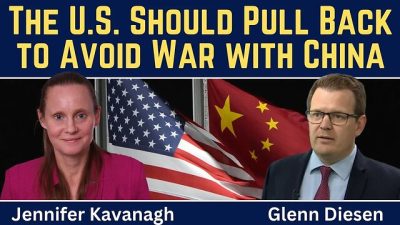
Why the U.S. Should Pull Back From the First Island Chain
or go to
Aletho News Archives – Video-Images
Book Review
‘Why Fauci Must Rot in Prison’: A Tale of Two Diaries
By Jill Erzen | The Defender | October 13, 2026
Dr. Anthony Fauci’s private diary reveals a “mind-numbing” contradiction between what the former top U.S. infectious disease official knew about COVID-19 and what he told the public, senior White House adviser Peter Navarro, Ph.D., said last week on “American Thought Leaders.”
In his new book, “Why Fauci Must Rot in Prison,” due out Oct. 20, Navarro compares Fauci’s private entries to his own pandemic-era diary, and uses what he calls “a tale of two diaries” to argue that Fauci should face criminal prosecution.
“I show, actually, how a prosecution can and should happen … at the state level, most likely,” Navarro said. “He should wind up in prison, and we’ve got the receipts in this book to put him there.”
Navarro said Fauci repeatedly acknowledged important facts in private, then publicly pursued policies that contradicted those facts — with devastating consequences.
“What he says many times privately in his diary is so at odds with both his public behavior and public statements that it’s mind-numbing,” Navarro said.
Navarro examines the lasting damage caused by lockdowns and other pandemic policies, and the ongoing toll of long COVID.
His book also addresses questions about vaccine safety, including why healthy young people faced COVID-19 vaccination mandates despite concerns about myocarditis, and why women were not warned about miscarriage risks linked to the shots. … continue
Blog Roll
 Aletho News
- Jennifer Kavanagh: Why the U.S. Should Pull Back From the First Island Chain
- Yemen denounces international community’s silence on Saudi aggression, siege
- UAE and Saudi Arabia move toward renewed coordination against Sanaa
- How Iran’s two-week retaliatory strikes exposed cracks in US military architecture in Persian Gulf
- The mother of all propaganda: Why the hype over US MOAB strike against Iran is nothing but theater
- Iran says it possesses technology behind US 14-ton GBU bunker-buster
- Trump asks Iran not to retaliate after he strikes Pickaxe Mountain – w/ Prof. Marandi
- Vice President J.D. Vance’s Deceptive ‘Antiwar’ Campaign Speech
- Iran: Palestinians’ rights must not be compromised in Gaza’s future; US, Israel to blame for Hormuz situation
- Ongoing tales of Syrian chemical weapons
- If Americans Knew
- Israeli rabbi permits occupiers to steal Palestinian olive harvest in West Bank
- Netanyahu’s spin on latest settler attack is laughable – Daily Update
- Israeli soldiers debunk Israel’s talking points
- In West Bank, Israeli settlers are totally out of control – Daily Update
- NPR investigation finds evidence of widespread fraud at mall kiosks tied to Israeli skincare brand
- Tucker Carlson exposes Israeli Lies about the Oct 7th attack, Charlie Kirk, and the U.S.
- Israel has detained thousands of Palestinian children since Oct 7th – over half spent time in solitary, many uncharged
- Israeli Analysis: Is Netanyahu Planning an ‘October Surprise’ Attack Before Israel’s Election?
- Israeli settlers brutally attack Palestinians and Washington Post female photographer, 65
- Words Have Changed, Occupation Continues: The Reality of the Gaza Ceasefire
- No Tricks Zone
- Predictions Made By Renowned Climate Proifessor Over Past Decades Have Been Proven To Be Poor
- New Study Suggests Large Regions Of The Pacific Ocean Have Been Cooling For The Last 80 Years
- Germany’s Green Energy Debacle: High Energy Costs Force Kahla Porzellan to Close After 182 Years!
- New Study: 50 Years Of The Most Aggressive ‘Net Zero’ Policies Can Only Affect The Global Climate By 0.03°C
- US September “Heat” Was No Record…Many Records Set Decades Ago
- Latest European Green Energy Debacle; Portugal’s Largest Flagship Solar Park Insolvent!
- Green Energy Debacle: German Expert Professor Fritz Vahrenholt Warns Of Severe Economic And Social Consequences
- Two More Paleo Reconstructions Affirm Meters-Higher Sea Levels Across Ireland, Brazil 7000-6000 Years Ago
- New Study: Earth And Venus Surface Warmth Largely Explained By Convection And Lapse Rate, Not CO2 Or Radiation
- 2025 Nature Paper Claiming Worsening Global Drought Gets RETRACTED …Heavily Flawed

