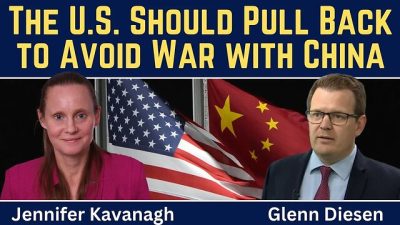
By Joseph Solis-Mullen | The Libertarian Institute | July 25, 2022
From the front pages of The Washington Post and Wall Street Journal, Foreign Affairs, the Economist, to The New York Times’ Best Sellers List; from CNN and MSNBC to FOX and NEWSMAX; from think tanks to Pentagon planners, congressional testimonies and White House statements: CHINA! So singularly focused and omnipresent has the narrative of the China Threat become, one can be forgiven for forgetting that China is in fact a middle income country of modest capabilities and with no stated intention of doing any harm to Americans or the United States. Further, that China is not bent on world domination; and further still, as shall be clearly demonstrated, even if it secretly were there is a negligible chance of that coming to pass whatever Beijing’s efforts.
The reasons for this are many. From China’s own internal problems, including a lack of critical resources, dependence on external markets, lopsided demography, combative ethnic minorities, resentful elites, ongoing economic slowdown, and possible economic collapse—to China’s daunting external problems, including its lengthy borders and limited access to the Indian and Pacific Oceans, to the number of neighboring states that are either uneasy about an increasingly powerful China or seeking to outright counter or otherwise impede its rise. These include India, Japan, Australia, South Korea, the Philippines, Vietnam, and Indonesia. This is to say nothing of Taiwan, officially recognized by both the United Nations and Washington as a breakaway region of China, and which stands as the most serious point of transitional friction at present.
While China is growing more relatively powerful, much of the very real danger that exists in the region stems from attempts by its aforementioned neighbors to balance against a more assertive Beijing—which, as it has grown more relatively powerful, has begun to press its own interests more forcefully in dealing with its neighbors, as well as with more distant powers such as the United States. The latter is particularly important. For while planners in Beijing believe the gravitational pull of its enormous and still growing economy will eventually allow it to get what it wants from its neighbors, the United States stands alone as the one country that cannot be bought off or bullied in this way. Further, as will be detailed, much of China’s newfound assertiveness stems directly from the increased sense of threat it feels vis a vis the United States.
It is in its attempts to push back against the United States that Beijing has ultimately wound up thoroughly alarming many of its neighbors, prompting the formation of a still growing balancing coalition. Therefore, before detailing the myriad reasons China won’t be taking over the world, or even enjoying regional hegemony, and why Washington should be pursuing a policy of restraint in dealing with China, it is first necessary to appreciate the extent to which the United States has been involved for over a century in meddling in domestic Chinese affairs, and to understand how Washington’s broader policies toward China have negatively shaped Chinese perceptions of the United States and its intentions toward China; and further, how it is these actions that have created what few real dangers exist.
Western interventions in domestic Chinese affairs began in earnest in 1842, when the British Empire forced open the country following the end of the First Opium War. Access to trade, immunity for its nationals from Chinese law, and entry of Christian missionaries were forced on a faltering Qing dynasty. While it officially protested, successive U.S. administrations insisted on the same privileges for itself and its merchants as the other European empires. This was the so-called “open door” policy. Bostonian merchants in particular made good trade running Ottoman opium to China. The Second Opium War, which broke out in 1856, actually featured American forces fighting alongside the British at the battles of the Barrier and Taku Forts. Such U.S. military assistance to the European empires in their depredations of China would continue, helping to put down the Boxer Rebellion at the turn of the century, occupying Peking and extracting a large indemnity for itself.
With the fall of the Qing dynasty and the birth of the Republic of China (1912), there was hope on both the Chinese right and left that U.S. policy toward China might change. But despite having initially signaled support for the restoration of at least the German-occupied parts of China to the young Republican government in exchange for their dispatch of hundreds of thousands of Chinese laborers to assist the Allied war effort on the Western front, at Versailles President Woodrow Wilson abandoned the idealism of his vaunted Fourteen Points, instead granting the former German Imperial holdings to the Japanese. A nominal wartime ally, the rapidly expanding Japanese Empire had opportunistically occupied German possessions in Asia once hostilities in Europe commenced, and Wilson used the recognition of Tokyo’s claims as leverage to buy Japanese involvement in his League of Nations project.
As for fledgling Republican China’s other petitions, that the unequal treaties imposed following the Opium Wars be abolished and control of its revenue collection returned to Chinese authorities, these too were denied. This led a young Mao Zedong, formerly a rabid Wilsonian, to call the Americans “a bunch of robbers who only cynically champion self-determination.”1
The disillusion with America and its purported idealism continued into the 1920s, with Warren Harding’s administration declining to recognize the uneasy, cobbled together coalition of republican and communist forces under the loose leadership of Sun Yat-sen, opting instead to recognize a series of feuding warlords who happened to seize control of the capital, Peking.2
It was only with the defeat of the warlords and the subsequent split between the Chinese right and left, precipitated by the former under the new leadership of Chiang Kai-shek, that the familiar Cold War and present day alignments began to take shape—with Moscow and the Chinese Communist Party (CCP) on one side and Washington and the ROC on the other. The latter was particularly slow in developing, however, with the depression distracting and the American public disillusioned by the apparently pointless deaths of over 100,000 Americans in World War I. Content to let the warring Chinese and Japanese bleed one another through the 1930s and early 1940s, it wasn’t until near the conclusion of the U.S. Pacific theater campaign against the Japanese that real aid started to flow to the corrupt, ineffectual, and dictatorial Chiang Kai-shek and his nominally republican forces. Though the aid would continue in the years immediately following the Japanese surrender, it was clear, particularly to George Marshall, who visited China to encourage a reconciliation between the Kuomintang and the CCP, that good money was being thrown after bad.
With the triumph of the CCP in 1949, the so-called “loss of China,” and the retreat Chiang Kai-shek and his followers to the fortress island of Formosa (Taiwan), successive U.S. administrations beginning with Harry Truman effectively prevented the conclusion of the decades long Chinese Civil War by using American naval power to defend the Taiwan Straits, and further refused to recognize the communist government now in place in Beijing. These policies continued with little change over the following two decades, and included hot conflict between the two in Korea (1950-53), as well as proxy conflict in Vietnam (1955-75).
That is until President Richard Nixon and his National Security Advisor Henry Kissinger recognized that the apparently monolithic communist front in Eurasia was in fact split along sharply nationalist lines, with the Chinese refusing to follow Moscow’s directives by the late 1950s and openly competing for influence in the Third World by the mid-1960s. Nixon’s secret trip to Beijing, and the Three Communiques that followed, formed the basis for the eventual normalization of relations and the recognition of the Chinese Communist Party’s legitimacy by Jimmy Carter in 1978. The communiques were focused exclusively on U.S. respect for China’s sovereignty, and required the U.S. to break off diplomatic relations with Taiwan, eliminate its military treaty with Taipei, and agree not to station U.S. forces on the island—now officially recognized by Washington, as well as the U.N., as part of China. While Beijing never renounced the potential use of force in the event that Taiwan ever declared independence, they were now committed with Washington to try to work with Taipei to bring about peaceful reunification.
Nixon’s opening to China had been premised on the idea of using Beijing to balance against the Soviet Union, a strategy followed by each of his successors all the way to the end of the first Cold War approximately a decade and a half later. With the death of Mao and the ensuing struggle for power having been won by the reformer Deng Xiaoping, China gradually opened up to foreign trade and investment and began to experiment with markets, prices, and private ownership of the means of production. So began the most incredible period of economic development the world has ever witnessed, with a billion Chinese eventually raised from the lowest levels of poverty to the position of an industrialized and rising middle income society by the late 2000s.
In the meantime, however, with the end of the first Cold War and the disintegration of the Soviet Union a few years later, the logic of Nixon and Kissinger’s strategy of using China to balance the Soviet Union no longer held. U.S. policy makers had a new idea, however: integrating China into the U.S. created and dominated global institutional order would make it a “responsible stakeholder,” and with time, as the country grew wealthier and more integrated, would lead to the liberalization and democratization of China.
But this did not happen.
Instead, granting China most favored nation trading status and allowing it into the WTO, despite it never really following the rules, resulted in the loss of millions of American manufacturing jobs at the same time it granted the communists in Beijing legitimacy at home as a provider of material well-being. As China’s economic power increased, so too did its military capabilities. And rather than focusing on aircraft carriers and other power projection capabilities PLA planners instead focused on building up an area denial capability sufficient to deter any potential U.S. intervention in the event of a war between Taipei and Beijing: which the CCP leadership view as the final remnant of China’s “century of humiliations,” the last impediment to the full restoration of Chinese sovereignty.
Though open hostility between the two officially ceased with the normalization of relations between Washington and Beijing (they even partnered to punish the Vietnamese for intervening to remove the murderous Khmer Rouge regime in Cambodia [1979]), relations between the two were quickly complicated by continued U.S. interference in Chinese domestic affairs. This included congressional sanctions over Tiananmen (1989), to U.S. actions during the Taiwan Straits Crisis (1996), the gradual erosion by Washington of the Three Communiques3, to sanctions on Beijing for its treatment of ethnic minorities, such as the Tibetans and Uighurs.
The sense in Beijing of a China under threat was reflected in its reorientation of military planning in the 1990s, when its attention shifted away from preparing to fight its Eurasian neighbors to focusing first and foremost on a future conflict with the United States in southeast Asia. Again, this was particularly so with respect to Taiwan, which the U.S. never officially ruled out militarily intervening to defend under the tactic of “strategic ambiguity.”4 U.S. interventions in the post-Cold War era, from Iraq to Serbia, increased this sense of urgency for CCP planners. In the case of the first Iraq War, Operation Desert Storm, Washington’s demonstration of the so-called “revolution in military affairs” highlighted the gap between the two in military capabilities; while in Serbia, U.S. willingness to ignore the U.N. and act unilaterally was compounded by its attack on the Chinese embassy in Belgrade, which Beijing to this day declines to acknowledge as an innocent error, and which killed multiple Chinese nationals.
But just as Beijing was ramping up its own capabilities, on the back of an ascendent economy resultant from its integration into the global capitalist system, Washington’s apparent “hyperpower” was dealt a series of serious, self-inflicted blows. Beginning with the second Iraq War and the invasion of Afghanistan, the façade of apparent U.S. military invincibility and political will was slowly eroded. At the same time, the illusion of U.S. economic unimpeachability was also shattered, with the Global Financial Crisis incubated in the United States paralyzing Western economies while China’s own less integrated capital markets and rapid fiscal interventions effectively insulated the Chinese economy and acted as a force for global stability during the period of ensuing related crises in Europe and elsewhere. As Washington dithered in the desert and Western economies floundered, the CCP leadership decided it was time to abandon the policy first articulated by Deng and followed by each Chinese leader since, to “hide our capabilities, keep a low profile, and bide our time.” Beijing’s opening moves in this regard began with its assertion of a sphere of influence in its immediate vicinity, not dissimilar, indeed derived directly from, the example of Washington’s own assertion of the Monroe Doctrine. While what Beijing sought was effective control over the waters directly adjoining the country, it prompted an immediate and alarmed response from Washington.
Obama’s 2011 “pivot” or “rebalancing” to Asia could hardly have been more transparent. While really the CCP was simply seeking to reconcile the difference between its newfound economic and military power with its existing, relatively lowly geopolitical station, in effect becoming what FDR and Truman had envisioned it becoming during the post-World War II period, one of the globe’s “four policeman” responsible for maintaining security and economic stability in its region, Washington, high on unipolarity, immediately set about trying to block China’s attempts at asserting its prerogatives in southeast Asia. Largely dormant since the 1950s, and only half-heartedly pursued since the end of the first Cold War, U.S. policymakers ramped up efforts at alliance building in southeast Asia. At the same time, it overtly sought to undermine attempts by Beijing to build alternative regional institutions to those constructed by the United States during the post-World War II period, such as the Asian Infrastructure Development Bank, while developing new institutional frameworks, like the Trans-Pacific Partnership and Quad, that would exclude Beijing. Along with Washington’s support for organizations advocating separation from China, such as the World Uighur Congress, and the construction of a new Cold War narrative pitting “democracy versus authoritarianism,” the Trump administration, filled with China hawks, made the new U.S. policy of weakening and containing China explicit in a series of documents formulated within a year of his taking the White House.5 This stance, inherited by Biden, has been fully embraced by his new administration.
Without irony, it is the United States, which since the end of the Cold War has invaded multiple countries without UN resolutions, run a secret network of black site torture facilities, helped topple or supported the toppling of multiple governments, and killed millions of civilians via economic warfare and covert drone campaigns, which accuses Beijing of threatening global peace and security. CCP planners now rightly believe that if China is to have its proper place at the table, one commensurate with its hard and soft power capabilities, it will have to fight the United States. While it has achieved a great deal, and may achieve still more, so far as its own dreamiest aspirations and the worst nightmares of Pengtagon planners, the reality is that China’s outlook is severely limited. For all the talk of China’s apparently inevitable rise and route to global domination, a closer look at its internal and external situation leaves significant room for doubt—including about the long-term durability of the Chinese state as presently constituted.
When it comes to China’s power projection capabilities, these doubts can be broken down into five basic categories: geographic impediments, resource constraints, demographic collapse, national cohesion, and economic slowdown.
China’s geography is frankly terrible in terms of potential power projection capability. Internally, it features endless flatlands to the north, abutting deserts and mountains running to the west, with more mountains and dense jungle to the south, while its eastern coast is ringed by states terrified of an expansionist China. And because of its vast population it is seriously strapped for foodstuffs. A shocking statistic: on a per capita basis it has less arable agricultural land than Saudi Arabia, making the fact that it has long been the world’s largest food importer unsurprising. Further, what farmland China does have requires enormous amounts of petrochemical fertilizers and laborers to keep even moderately productive. Further, lacking a confluence of natural and traversable interconnected east-west-flowing waterways, moving mass amounts of produce around internally is expensive and inefficient over the vast distances that locally produced foodstuffs must travel to arrive at the highly populated eastern seaboard provinces. Given these facts, as presently situated China is arguably the most globalization-dependent state on earth.
On pace to become the world’s largest consumer of oil in coming years, surpassing the United States, China itself holds less than 2% of all proven oil reserves. Little wonder the so-called “Malacca and Hormuz Dilemmas,” which could effectively shut down China’s entire economy overnight, have long been a central focus of CCP military planners. While it has plenty of coal (the fourth-most globally according to estimates), the already serious amount of environmental degradation wrought upon China by the CCP’s policy of breakneck industrialization, resulting in regular protests and serious widespread health problems, make use of it difficult to sustain socially and politically. In terms of natural gas, what little China has lies in the culturally distinct Sichuan and Xinjiang provinces, a potential source of myriad problems that may, along with the advanced technologies required to effectively exploit it, explain Beijing’s relative reluctance to embrace its development. Apart from the paucity of high-yield agricultural land, China is also plagued by water scarcity; its solutions, which cost an estimated $100 billion/annually, are causing increased desertification and displacement in the parts of the country from whence water is being diverted. An environmental disaster zone, lacking many of the basic necessities to sustain its enormous population, any serious disruption to the existing globalized order, created and sustained by the United States, would cause hundreds of millions of Chinese to famish if not starve to death.
The CCP’s former social engineering projects add their own complications to China’s already considerable domestic problems. From a combination of more or less forced mass urbanization, state-induced famine, and two-child, then one-child policies, the CCP faces demographic collapse. Specifically, it is going to run out of taxpayers, laborers, and consumers. Even worse, not only did changing to a one-child policy in the 1980s amplify the severity of the coming crisis, but it led to an epidemic of selective sex abortion. Basically, right about the time China’s economy collapses in on itself, it is going to have tens of millions of young men unable to find a job or a girlfriend—this while China by 2030 will have four retirees for every two workers and child.
Two additional things are worth pointing out here: first, that while it is true Xi reversed the CCP’s policies, it isn’t going to matter because the cost of raising children in China makes having more of them prohibitively expensive, while at the same time urbanization and industrialization naturally decrease birthrates anyway—see every other industrialized and post-industrial country in history; and second, this surfeit of single young males unable to find a job or wife is probably the U.S. hawks strongest argument for why China might pose a serious threat to one or more of its neighbors: unable to do anything else with such a potentially dangerous lot, Beijing may decide to throw them into a meatgrinder over Taiwan or in another border war with India, though both of these actions would likely have devasting additional consequences for the regime stemming from the economic consequences sure to follow.
Apart from the separatists holed up on Taiwan, large populations of Uighurs and Tibetans inconveniently located in strategic areas far from Beijing, as well as dozens of much smaller ethnic groups in the mountainous jungles to the south, mean the CCP leadership faces multiple permanent secessionist dangers far from its northeastern core. Such threats follow directly from the geography of the country, with wealthier eastern coastal provinces such as Jiangsu and Zhejiang wanting and having far more to do with wealthier Japan, South Korea, and the rest of the outside world than with the hinterlands of China’s western barrens. Such provinces have historically resisted Beijing’s control, and the CCP’s most recent moves against the Shanghai-centered tech sector and its billionaire class ought to be understood in this light. So, too, its decision not to try and duplicate the U.S. shale revolution because of the location of Chinese shale deposits in large, wealthy, and culturally distinct Sichuan province while its intense campaigns against the Uighurs and Tibetans already receive considerable international opprobrium. While force or the fear can keep them all in line, including Hong Kong’s recently suppressed population and internal party members who do not favor Xi’s policies, that ability to use force rests on the CCP’s claim to legitimacy and its ability to mobilize sufficient resources to effectively police these regions and put down any potential trouble—which is to say its state power.
Since state power ultimately rests on economic power, it is worth appreciating the myriad problems China’s hitherto racing economy faces, both on the domestic and foreign fronts. Because of its unique position over the past thirty years as a mass global exporter, the CCP has managed to stave off any potential economic slowdowns with boundless state credit, industry subsidies, and dumping, thereby maintaining near-full employment. However, decreasing returns on additional debt and continued overproduction, combined with domestic underconsumption and low-cost labor competition in its region and around the world, mean the bill is about to come due. It’s going to be enormous. Total debt is now three times the output of the Chinese economy annually, and the expansion of debt and credit has accelerated in recent years. Until the past year, the Chinese financial system was creating five times the money supply of the never shy Federal Reserve System per month. According to Citigroup, for example, in 2018 alone, the Chinese financial system accounted for 80 percent of all private credit creation globally. Because of centrally directed malinvestment, these nonperforming loans total an estimated $7 trillion. For some perspective, the subprime crisis that crippled Western financial markets was saddled with less than a trillion dollars of such bad loans. Further, much of the debt is short term, meaning it is frequently rolled over with new debt. This ongoing practice is yielding ever-decreasing returns. According to The Economist, fully three-quarters of new loans in China simply go toward paying the interest on existing debt. Meanwhile, total factory productivity, which had soared during the first decade of the new century, has flatlined since then—with its billion citizens still producing nowhere near what the industrialized Western economies do per capita—and Xi’s own insistence on reasserting state control over the private sector, which is responsible for most of the productivity gains over the past two decades, is likely to continue this already worrying trend.
Abroad, the Belt and Road Initiative (BRI) is only making things worse; spawning even more Renminbi (or Yuan), which are lent and spent on projects of questionable economic value and equally dubious means of repayment. Again, however, CCP policies that privilege employment and state stability over efficiency and productivity mean China’s industrial overproduction has to have somewhere to go, even if it means lending to countries like Venezuela, that quickly default, or like Sri Lanka, which when forced to sign over its principal port resulted in a wave of anti-Chinese sentiment within the country and bad press for so-called “debt-trap development” around the globe. This is to say nothing of problems in places like Pakistan, one of the BRI’s key nodes, which has featured repeated setbacks and disturbances, particularly in violently separatist Baluchistan.
The project, a geopolitical brainchild of Xi, is now subject to regular, if polite, criticism within Chinese academic and policy circles, with increasing numbers of critics coming to recognize the project for what it is: a boondoggle aimed at increasing Chinese power and influence abroad rather than doing anything to increase the welfare of the still relatively poor Chinese people domestically, whose income per capita is 79th globally. In fact, alienating the United States and broader West by challenging its development models has resulted in damage to its trade relationships and is only likely to reverse the gains made in the country since it was allowed into the WTO in 2001.
Though it brought China quickly up the ranks of the developing economies, the CCP’s relationship of mutual economic interdependence on the collective West, and the United States in particular, now hangs ominously over its head. The U.S. and China’s economic interdependence was part of the Clintonite strategy of integrating China into the world economy as a means of ensuring its passivity as regarded U.S. prerogatives. As the relationship deepened, both sides came to recognize that they were now locked into a situation of mutually assured economic destruction—as evidenced by Beijing’s unwillingness to pounce on the United States during its prolonged economic crisis just over a decade ago. However, there exists a key asymmetry within the relationship, and every U.S. security strategist knows it: in the event of a massive economic crash, in a democracy there is another election, while in an authoritarian state there is a revolution. This danger has been highlighted by the U.S.-coordinated Western response to Russia’s invasion of Ukraine in March. China, whose domestic economy is far more tied into world trade, has just seen what a coordinated response from the richer Western nations can do. While Russia will be able to outlast U.S. sanctions by shifting commodity exports to a willing developing world, were a similar situation to occur over Taiwan China would not have any such outlet for its abundance of manufactured goods, and its internal market, while growing, is still too underdeveloped to absorb the surpluses.
As though these multi-front problems and looming disasters weren’t enough, China, unlike the United States, has the further misfortune of being surrounded on all sides. While a detailed analysis of each of China’s fourteen neighbors is beyond the scope of this essay, a summary of the major players, their domestic incentive structures, and their perception of a rising China as a threat to its own security and wider interests is vital to understanding why China is unlikely to attain even regional hegemony regardless of Washington’s own policies aimed at preventing that outcome.
Despite its history of non-alignment, Washington set out to cultivate India as a future balancer against China beginning with George W. Bush. Creating a legal loophole that allowed Delhi to proceed with its nuclear program without fear of U.S. sanctions—the so-called 123 Agreement—Washington simultaneously played on Indian fears of Pakistan and its relationship with China. Not eager to be seen overtly choosing sides, Delhi mostly kept its head down through the 2000s, focusing on growing their economy, military, and increasingly its overall state power.
Never doing anything contrary to its own perceived interests, whatever Washington might have preferred, it was Beijing’s growing assertiveness in the 2010s that finally pushed Delhi into embracing Washington’s increasingly overt attempts at containing China, including joining the re-formed Quad in 2017. Following a series of standoffs over disputed regions on the border between China and India, these finally erupted in a series of skirmishes between Chinese and Indian troops in 2020. These were a “turning point,” according to Delhi, which realized the possibility of 1960s style full-out conflict between it and its larger neighbor was indeed a distinct possibility. With a population almost as large as China’s, an economy already the fifth largest in the world as measured by GDP, ideal geography for power projection in the Indian Ocean, and growing naval power to match, China’s loss of India to the side of the growing balancing coalition was huge and totally self-inflicted.
Along with India, Japan was the most significant of China’s neighbor’s never likely to partake in band-wagoning with a rising Beijing. The historical animosities, both ancient and recent, are deep, and Japan’s capacities to resist, like India’s, were too considerable to make that a desirable or palatable option. Still the third largest economy in the world despite decades of government mismanagement, Japan has long had the ability to quickly remilitarize and even nuclearize, the latter likely within the span of months rather than years. Like Delhi, Tokyo has outstanding border disputes with China over the Senkaku/Diaoyu Dao Islands, and was one of the first to sound the alarm over growing Chinese assertiveness in the South and East China Seas. Unlike India, whose vital natural resource imports would not even be threatened by Chinese regional hegemony given its open access to the Indian Ocean and Middle East, under such conditions Tokyo could find itself on the receiving end of a Malacca Straits-style dilemma. Home to multiple U.S. Army and Navy installations, and playing host to nearly 60,000 U.S. troops, Japan is happy to foot the bill for anyone that wants to contain China. Before his recent assassination, former Prime Minister Shinzo Abe was not so quietly shaping policy behind the scenes in a more hawkish direction.
Yet another neighbor with outstanding border disputes with Beijing, the Philippines aren’t eager for confrontation with China but recognize their own strategic interests are threatened by their increasingly assertive larger neighbor. If there was any doubt following the confrontation over the Scarborough Shoals in 2012, this was made clear when Beijing waved aside the 2016 Permanent Court of Arbitration’s ruling in Manila’s favor over the issue of China’s so-called “nine-dash line.” Even Rodrigo Duterte, who came to office openly pursuing partnership with Beijing, eventually backtracked and reverted to the side of the growing balancing coalition, moving to restore prior defense agreements, supporting AUKUS, and expanding joint military exercises. Again, this was largely the product of Chinese belligerence over disputed islands and reefs, as well as under-delivery on Chinese promises of the economic benefits that would flow to the Philippines were it to align with Beijing. Along with Japan, Taiwan, Brunei, Indonesia, and Malaysia, the Philippines forms part of a dense thicket impeding Chinese access to the Pacific and Indian oceans. While still dwarfed by China economically, and alone standing no chance against China in an economic or kinetic conflict, together they have a large population to draw on, considerable resources, and not irrelevant economic heft, while their disparate thousands of islands and jungle geographies make the idea of an all-out military campaign against them a hopeless endeavor.
South Korea’s interest in balancing against a rising China is perhaps the most obvious of any state detailed thus far. While its own territorial dispute with Beijing is relatively negligible, that of Socotra Rock, without outside help its highly militarized northern neighbor with its million man army, nuclear weapons, and backing by China looks formidable—and, of course, the war between north and south still hasn’t officially ended. Like the territory of modern Vietnam the Korean Peninsula was also for centuries part of the Chinese sphere of influence. South Korea’s interests, therefore, while complicated like everyone else’s in the region by economic ties with China, are solidly with any balancing coalition. Were one not to form (unlikely given the incentives of the other major states already detailed) it is conceivable Seoul would turn to Beijing for protection from Pyongyang, but this is a stretch. In terms of its values, economy, politics, and world outlook, it is solidly opposed to Chinese regional hegemony. With the tenth largest economy in the world, South Korea brings a rich consumer market, loads of cutting edge industry, and strategic location to a balancing coalition, as well as providing willing basing to any allies on offer to go with its own considerable naval power, eighth largest in the world in total tonnage.
While their interests often conflict in many areas, from trade to natural resource rights to human rights, on the issue of balancing against Beijing the interests of each of the above countries, as well as Vietnam, Australia, Malaysia, and Indonesia (to say nothing of Taiwan) almost perfectly coincide. Those of China’s neighbors variously willing to brook increasing Chinese dominance, such as Cambodia, Myanmar, and Thailand, are unreliable, impoverished, and in each case suffering multiple armed insurgencies and secessionist groups that receive various levels of outside aid. Coupled with China’s own internal problems already outlined, Beijing’s daunting perimeter of rival states means the threat of Chinese regional hegemony is a distant, if totally unrealizable, prospect. For all the CCP’s propaganda, fragmentation rather than unity has defined Chinese history. Spanning approximately two millennia, for only three hundred of those years were the borders of more or less today’s China united under a Han-dominated central political authority. Left to itself, locked in the South and East China seas, it would likely face the threat of serious collapse and fragmentation by the late 2030s.
While China is far from a paper-tiger, the real danger when it comes to U.S.-China relations isn’t any direct threat Beijing poses to the United States or to the interests of the American people. But, rather, the real danger is that increasing belligerence emanating from Washington provokes a disastrous conflict over what Beijing considers core Chinese interests. Particularly with its shift in posture over the past decade, from Obama’s more geoeconomic approach to Trump and now Biden’s increasing militarization of relations between the two, Washington risks provoking a conflict over Taiwan, or in the South or East China Seas.
Knowing there are certain red-lines Beijing would have to respond to if crossed, like over Taiwan, it may be, as Robert Kagen argued this past year in Foreign Affairs, that U.S. policymakers think they should push China into a confrontation now, when it is more likely to lose than later when they believe Beijing’s relative position will be even stronger. Such a loss would destroy the CCP’s credibility, they argue, opening up the possibility of a change in political regimes at the same time it diminished China in the eyes of its neighbors and the world.
This is a questionable assumption, however. While it would probably mean the end of Xi’s time as leader, the institution of the CCP has weathered significant tumult before and could likely do so again. In fact, in the event of a conflict with the United States over one of its core interests, it is just as easy to imagine the opposite occurring. Afterall, the sense of a state under siege strengthens, rather than weakens, the hand of an authoritarian regime. In this sense, both the Trump and Biden administrations’ actions and rhetoric are playing right into the CCP’s grateful lap. Facing imminent multifront disasters, the now openly confrontational U.S. attitude is likely to give the CCP its best chance of staying in power as these crises all come to a collective head: by arguing that only it, the CCP, has been able to make China great again and prevent its exploitation by looming foreign imperialists, and that only it can protect China from a United States newly determined to subvert and dominate it.
Troublingly, though a conflict between the two could easily escalate to the point of a humanity-ending nuclear exchange, as well as the fact that China is unlikely to ever pose a serious threat to core American interests, there are many domestic forces here in the United States that are pressing just such an escalatory dynamic. From entrenched institutional interests within the military and security bureaucracies determined to hold on to their positions and power, to weapons manufacturers who want to see their contracts continually renewed or expanded, to think-tankers determined to avoid getting real jobs and a corporate media that has never seen a potential war it doesn’t like, to a high-tech industry that would rather insource critical components from places like Taiwan in the name of saving a few bucks, as well as domestic manufacturing industries seeking insulation from Chinese competition, and Republicans and Democrats seeking to score cheap points by trading insults over who is “softer” on China.
The situation is exceedingly dangerous, though completely unnecessary. The “China Threat” is a clear canard, and an extension of what the late Justin Raimondo described as “all foreign policy being domestic policy.” Unfortunately, none of the existing dynamics in play are likely to change—no matter how valid the criticism. And the American people, as well as the rest of the world, will have to just hold their breath and hope for the best.