Is Russia “weaponizing” natural gas against the EU?
By Drago Bosnic | September 6, 2022
For years, the political West has been accusing Russia of so-called “weaponization” of its natural resources, particularly gas and oil. Moscow is being blamed for using these essential resources to supposedly “blackmail” the European Union, while Brussels, partly pushed by US imperialist belligerence, partly by its own (neo)colonialist ambition, kept creeping up to Russia’s geopolitical backyard, creating ever-escalating tensions with the Eurasian giant. Moscow would never allow the repeat of the Nazi invasion which took tens of millions of Russian lives, in addition to the unprecedented devastation left in its wake. To make matters worse, “Barbarossa” was yet another on the long list of attempts by the political West to destroy Russia. For over a thousand years, many in Europe have tried to neutralize the Eurasian giant. Russia prevailed each and every time, but it had to do it with the force of arms.
However, in recent decades, Moscow has been trying hard to establish mutually beneficial cooperation with the political West, especially its European portion. This included making long-term deals with the EU, particularly those concerning the supply of essential commodities such as natural gas, oil, food and other raw materials which were helping fuel the growth of entire industries in Europe and elsewhere. Russia’s hope was to establish long-standing ties with the EU and make sure the strategic security on its western borders would be ensured through economic cooperation, not military might. However, Washington DC had other plans and the compliant elites in Brussels followed suit, making sure NATO military infrastructure (especially the strategically impactful US military facilities) kept expanding eastwards, getting ever closer to Russia’s heartland.
Even in this situation, Moscow tried de-escalating. Although it still kept working on ways to counter this crawling encroachment militarily, especially through the development and fielding of strategically unrivaled capabilities, Russia was hopeful that “cooler heads” would eventually prevail in Brussels and other major EU capitals, particularly Paris and Berlin. This hope still somewhat held on even after the disastrous 2014 Maidan coup which brought the Neo-Nazi junta to power in Kiev. For nearly a decade, Moscow kept trying to bring the political West to its senses. Unfortunately, to no avail, since this approach was seen as a weakness in Washington DC and Brussels. On February 24, Russia decided to put a stop to it all.
Now, after months of a failed economic siege of the Eurasian giant, especially after the sanctions boomerang started ravaging Western economies, the political West is trying to play a rather comical blame game, accusing Moscow of “weaponizing” its own natural resources. Faced with the prospect of a disastrous winter, the EU is now caught between its suicidal subservience to Washington DC and the need to simply survive. While the US keeps importing Russian commodities (at a volume of approximately $1 billion per month), it is forcing Brussels to effectively enforce a self-imposed embargo which is causing untold damage to the EU’s already dwindling production sector, causing a cascading effect of economic devastation on other seemingly unrelated industries.
Instead of trying to make a deal with Moscow, Brussels joined the economic war on Russia, prompting the Eurasian giant to respond. Now, when natural gas prices are upwards of 400% higher than just a year ago, EU powers, particularly Germany, are faced with the prospect of a near-complete industrial shutdown. And the burning issue isn’t only coming from soaring natural gas prices, but also the shortages. For months, high prices were bleeding the EU economies dry of cash, but after the Nord Stream stopped pumping natural gas altogether, the issue is exponentially worse, as entire industries are at risk of collapsing completely.
In addition to the production sector shutdown, many EU members are faced with soaring energy prices, which is putting a tremendous amount of pressure on households, which are faced with the prospect of not just bankruptcy, but also freezing, as the cold season in the EU is starting with natural gas storage facilities at their lowest level ever. Thus, the pressure on Brussels is both economic and social. With many EU member states’ governments collapsing, the political instability in the troubled bloc is bound to get much worse in the coming months. In addition to natural gas shortages, there is also the problem of soaring food prices, which also might turn into shortages soon, causing even more social and political instability across the EU.
The question is what will the EU do? Should it ask for help from its overlords in Washington DC? And will the US send food, oil, gas and other essential commodities? Does the US even have enough of those for itself? How will the “moral high ground of sticking it to Putin“ help heat homes, feed hundreds of millions of hungry (and angry) citizens and power entire economies and countries? How will the EU governments explain to their voters that all this is “worth doing“ so that the “young, vibrant democracy in Kiev“ can survive? What will Europe look like in 2023 after it goes through a complete political and social unraveling? Will the EU ever become sovereign enough to realize that whatever happens, the US will continue importing essential commodities from Russia while pressuring others not to do so? The coming winter will be a perfect litmus test of sovereignty and an excellent indicator of who will get the privilege of joining the new multipolar world of sovereign nations.
Drago Bosnic is an independent geopolitical and military analyst.
Australian Painter Forced to Remove His Mural Showing Russian, Ukrainian Soldiers Hugging

‘Peace before Pieces’ by Peter Seaton, AKA CTO. Image from http://www.ctoart.com
Samizdat – September 5, 2022
Australian artist Peter Seaton was forced to paint over his latest work, dubbed “Peace Before Pieces” showing a Russian and a Ukrainian soldier hugging each other, after pressure from the local Ukrainian community and Ambassador to Australia Vasyl Myroshnychenko, who branded the work “offensive”. The mural, was painted on a building in Melbourne, just a couple days ago, but the artist has been forced to remove his creation.
Seaton apologized for painting the mural and explained that his intention has always been to emphasize the importance of reaching peace. He noted that he has dedicated a lot of thought to the issue before coming up with the painting and said he discussed it a lot with other people.
“The original intention was to focus our efforts on this war towards a negotiation of peace, to avoid nuclear disaster […] I felt it was the best way I could portray a message of peace which is something I am fundamentally about,” Seaton said.
His efforts, however, did not impress Ambassador Myroshnychenko, who claimed the peace-promoting work of the artist was “utterly offensive to all Ukrainians” and he said that Seaton should have “consulted the Ukrainian community in Melbourne” before painting the mural. Myroshnychenko demanded that the work be promptly removed.

The Russian embassy in Australia reacted to the news of mural’s removal sarcastically:
“A mural recently unveiled in Melbourne was slammed for not reflecting the concept of fighting Russia to the last Ukrainian. The artist had to destroy his work. New normal for freedom of artistic expression in Australia: check with Ukrainian Embassy before painting,” the embassy said.
Russia proposed a diplomatic resolution to the conflict to Ukraine soon after the start of the special military operation on February 24th, but after a month of talks, Kiev halted the process for good.
Instead, the Ukrainian leadership has since been claiming it would fight Russia until it seizes the territories it sees as theirs and will hold talks only after that. Moscow maintains that it is always ready to return to the negotiations table but sees no initiative on the Ukrainian side.
Anti-NATO protests in Europe likely to increase
By Lucas Leiroz | September 5, 2022
The consequences of the anti-Russian sanctions are causing revolt and indignation among European citizens. In recent days, thousands of protesters have taken to the streets of Prague demanding an end to the coercive measures against Russia. Similar situations have been also seen in other important cities of Europe. Intelligence agencies already predict that the situation will worsen in the near future, with serious risks of an escalation in internal tensions in European countries. Indeed, these facts make it clear that the European people absolutely reject the interventionist ambitions of the EU and NATO.
On the 3rd of September, one of the biggest mass protests in recent years was seen in the streets of Prague. Current problems such as rising gas prices and security crises have taken thousands of Czech citizens to the streets in protests against the EU and NATO. Official Czech government sources claim 70,000 people attended the demonstrations, but protest organizers say the actual number of participants exceeded 100,000.
Members of different political ideologies and different social movements participated in the event. Nationalists, conservatives, social reformers, leftists, and moderate liberals have united in the common cause of combating negative foreign influence on the Czech government, which is leading the country to adopt an anti-Russian international policy that greatly harms the interests of the population. Not by chance, the slogan of the protesters was “Czech Republic First”, which succinctly expresses the popular and patriotic urges of the activists.
As expected, the main demand was that the Prime Minister Petr Fiala coalition impose limits on the price of gas as a way of controlling the worsening of the energy crisis. Some groups involved have openly called for a circumvention of EU policies, so that Prague could negotiate directly with Moscow for energy supplies. In fact, some groups seemed to hold more moderate opinions and others more radical, however all converged on the need for the Czech Republic to maintain an independent foreign policy that prioritizes national interests, instead of simply adhering to sanctions packages planned by think tanks in Brussels, London and Washington.
A common cause for all participants was the demand for absolute military neutrality, which is an extremely important issue considering that the Czech government was the first to violate NATO’s self-imposed rule of not taking direct action in the Ukrainian conflict. In April, before all other countries in the Western alliance, Prague sent a wide range of war equipment to Ukraine, mainly tanks and other armored vehicles. Until then, the West was only sending financial and humanitarian aid to Ukraine, but Prague started an unlimited military escalation, which has resulted in the prolongation of the conflict with the sending of Western weapons.
In an official statement, Fiala said citizens have the right to protest, but arrogantly asserted that the Czech people are being manipulated by pro-Russian forces. The head of government simply ignored the wishes of the people he was chosen to represent, which is a very problematic issue and reveals a serious status of democracy crisis in the country. No action was announced after the protests, with Prague continuing to suffer all the consequences of anti-Russian sanctions.
Prague, however, was not the only place to witness popular revolt against Western interventionism. In Germany, the day before, violent protests took place in some cities, most notably in Kassel, where 200 protesters faced heavy police brutality as they protested against the supply of weapons to Kiev. Eight protesters were arrested after violent clashes. Also, it is necessary to remember that similar situations had already occurred in many regions of Europe in recent months. In Madrid, the June NATO summit was responded to with large protests by the Spanish population, for example. And, according to the German intelligence, this situation of popular indignation will only get worse and worse.
Sources from security departments in Germany allege that the country is close to facing violent protests. German intelligence seems to have obtained privileged information that different parties would be coming together exceptionally in order to demand solutions to the energy crisis. The mass protests would be being organized by absolutely antagonistic groups, such as Die Linke and AfD, and would still be receiving support from more moderate organizations, such as the CDU’s Christian Democrats.
The German situation reflects the same scenario seen in Spain and the Czech Republic: antagonistic ideologies and parties are ignoring their rivalries and uniting for a common cause. In practice, this tends to make the protests really massive and strong, attracting citizens from all ideological affiliations.
“So what we saw during the coronavirus pandemic might look like a children’s party in comparison to what is to come”, a German intelligence officer commented during an interview to Die Welt about the protests to come.
For all European countries, the question is the same: abandon the sanctions or face social chaos. The coercive measures against Moscow do not benefit European citizens and do not influence the military scenario in Ukraine, so they simply have no reason to exist. Either European countries adopt a sovereign stance and prioritize their own interests in foreign policy, or the bloc will suffer irreversible damage in its social structures.
Lucas Leiroz is a researcher in Social Sciences at the Rural Federal University of Rio de Janeiro; geopolitical consultant.
Moment of truth in the Ukraine war
BY M. K. BHADRAKUMAR | INDIAN PUNCHLINE | SEPTEMBER 4, 2022
The fog of war envelops the Ukrainian “counteroffensive” in southern Kherson region where Kiev hopes to regain lost territories. But by the sixth day of operations, the echo chamber in the West has fallen silent. There are no tall claims.
Today’s update of the UK Ministry of Defence prefers to dwell rather on the “morale and discipline” issues in the Russian army, in general, their modest pay-packets and basic amenities like “appropriate uniform”, arms and rations — rather than on Kherson counteroffensive.
There is media blackout in Ukraine. All we know is of military convoys of ambulances rushing through Odessa city streets and hospitals overflowing with wounded servicemen, and eerie public calls for blood donation. The Transcarpathia region in western Ukraine from where the locally recruited 128th mountain assault brigade was redeployed to the Kherson front declared a day’s mourning in memory of its brave sons who lost lives.
Meanwhile, the latest word from Kiev is that its counteroffensive is a “methodical operation” to degrade the Russian forces in the south rather than make territorial gains. President Volodymyr Zelensky said with some irritation, “I’m not ready to predict when it (rollback of Russian forces) will happen. I don’t have the exact dates, but I have the exact understanding of how we will do it.”
On Thursday (5th day of counteroffensive), Zelensky took a second meeting within the week of the Headquarters of the Supreme Commander-in-Chief, but only to add cryptically, “certain decisions have also been made. I think everyone will be able to see their outcomes.”
The US media vaguely claims that Ukrainian forces are making “tactical gains” and are preparing “for a long and hard-fought battle before winter sets in… Western officials cautioned the counteroffensive won’t sweep the Russian forces out of Ukraine any time soon. However, success in retaking the region of Kherson and gaining control of the western side of the river would be “really significant.” (Politico )
The daily noted, “Such a victory would show Ukraine’s Western allies that they are right to continue sending billions of dollars of weapons and supplies to help counter Russia.”
This last bit is the crux of the matter. The arms supplies from European countries to Ukraine have virtually dried up to a trickle and a similar disturbing trend is discernible with the US supplies too. The Biden Administration is asking Congress to approve another $11.7 billion in aid for Ukraine but that is in anticipation of the likelihood that the 2023 budget may not be passed by the deadline of Oct. 1. The White House Office of Management and Budget announcement on Sept. 2 acknowledges that this is “a short-term continuing resolution to keep the Federal government running.”
The OMB statement says the White House wants this anomaly because funds from previous packages to boost Ukrainian military are running low, with three-quarters distributed or committed, and more will follow in the next month. Importantly, though, of the $11.7 billion requested by the White House, $4.5 billion would go toward replenishing Pentagon’s depleted stockpiles, $4.5 billion to budgetary support for Ukraine’s government, and only $2.7 billion to defence and intelligence aid as such. This new round of aid is intended to last through December.
Zelensky must be a worried man. He needs to convince the donors that such massive multi-billion dollar military aid has been worth it. He should show at the very least, a bloody stalemate on the southern warfront. (Russia is gaining the upper hand in Donass already.)
There is always the danger that Zelensky might overreach. Politico disclosed: “Western governments have warned Kyiv against spreading its forces too thinly in a bid to capture as much territory as possible, since the Ukrainians would have to hold any gains they make. The officials said they expect Ukraine to reassess its military goals if it retakes Kherson. However, the city of Melitopol, also in the south, remains too far away from the Ukrainian positions, while a ground attack against Crimea during this offensive is not plausible.”
Now, all this juxtaposes with the upbeat tone but bare factual information shared in the Russian statements on Kherson front. Today’s Russian reports say that the “counteroffensive” has been virtually muzzled and Ukrainian forces have taken heavy casualties running into several thousands. It seems to be a veritable apocalyptic scenario, too tragic to recount.
The solitary Ukrainian breakthrough remaining as of Saturday night was a bridgehead across the Ingulets river — the so-called Andreevsky bridgehead. There is speculation that Russians may have lured the Ukrainian troops into a “fire trap.” The river crossings have been cut off and Russians are probably encircling the Ukrainian troops trapped on the western side of Ingulets with no supplies or reinforcements reaching them.
The counteroffensive has lost its bite and is now positional battles on one or two sites in the Mykolaiv-Krivoy Rog direction. A Russian counterattack has also been mentioned to the effect that the frontline now touches the “administrative boundary” of Mykolaiv region (which is a crucial city en route to Odessa.) Heavy bombardment of Mykolaiv has also been reported. The Russians claim to have destroyed vast quantities of weaponry, too.
Russia’s “domain control” can be put in perspective: the enemy is, on the one hand, caught on the bare steppe and cut down with the overwhelming superiority of Russian artillery and aviation, and, on the other hand, running into well-fortified, entrenched defence lines.
That said, Zelensky cannot give up, as he is desperately in need of a success story. Kiev still hopes to reverse the situation, but how that is achievable remains to be seen.
Against this sombre backdrop, more and more sceptical voices are being heard in the US about the Biden Administration’s policy trajectory. The latest is an opinion piece in the Wall Street Journal by Gen. (Retd) Mark Kimmitt, formerly Assistant Secretary of State for Political-Military Affairs in the Bush administration. Kimmitt predicts that “a breakthrough is unlikely” and soon, “logistics shortfalls” may force a change in US strategy.
He explains, “NATO will have to deal with dwindling stocks of leading-edge weapon systems. This likely will mean muddling through a longer war, with more casualties. It means more pressure from supporting nations, sustained inflation, less heating gas and falling popular support.”
In principle, the options are: i) “dig deeper into NATO stockpiles being held back for national defences”; ii) “ramp up critical shortfalls” by invoking Defense Production Act and its European equivalents; iii) escalate the conflict by targeting Crimea and Russia itself; and, iv) forcing Zelensky to face the grim reality that “diminishing resupplies” of weaponry actually contains “the message of declining outside support” for the war itself.
The retired general with Republican Party leanings concludes: “Beginning the diplomatic resolution would be distasteful, and perhaps seen as defeatist, but as there is little chance of climbing out of the current morass, it may be better to negotiate now than later… Looking into a future of protracted war, diminishing high-tech systems and mounting casualties, Mr. Zelensky and NATO must face up to tough decisions before those decisions are forced on them.”
Biden’s Bright MAGA-enta Lights

Samizdat – 03.09.2022
On Thursday, Joe Biden gave a controversial speech in front of Philadelphia’s Independence Hall, while bathed in red lights and flanked by two Marine guards.
In the speech, titled “Soul of the Nation,” Biden attacked “MAGA Republicans” by saying that they “are destroying American democracy” and that the Republican party is “dominated, driven and intimidated by Donald Trump and the MAGA Republicans.”
While Biden stressed that he was not talking about all Republicans or even “a majority,” it is unclear who he was talking about if not the majority of the Republican party. Ninety-four percent of Republicans who voted in 2020 cast their ballot for Donald Trump. In nearly every poll that includes him as a candidate, Trump has a healthy lead over any potential primary opponent in 2024, including his closest competition, Florida Governor Ron DeSantis, who is often called a MAGA Republican himself.
In 2020, 1.2% of Republicans voted for the Libertarian candidate for President, Jo Jorgensen.
Biden also took flak for including Marine guards in the background during the politically charged speech. The military is seen as an apolitical institution and their presence, in what CNN chief White House correspondent Kaitlan Collins described as a “full-frontal attack” on his political opponents, could be viewed as fascist itself.
Biden mentioned “MAGA” 13 times during his speech, while specifically calling out Trump three times. The White House has defended the decision to include Marines, saying that the speech was not political.
US biggest winner in Ukraine crisis, which deserves world’s vigilance: Zhao Lijian
Global Times | September 2, 2022
As the initiator of the Ukraine crisis, the US has been its biggest winner, standing on the sidelines while reaping the benefits. This deserves consideration and vigilance from the world, a spokesperson of China’s Foreign Ministry said on Friday.
The remarks came in response to comments by some in the European media who have said that the US is masquerading as a savior while banking huge profits by selling gas to European countries, with the latter facing energy shortages due to sanctions targeting Russia that forced them to buy US natural gas at high prices.
The comments are very reasonable, Zhao Lijian, spokesperson from the Ministry of Foreign Affairs, said on Friday during a regular press briefing.
“The comprehensive escalation of the Ukraine crisis has continued for more than half a year. Facts have once again proved that unilateral sanctions by the US and the West cannot solve the problem. On the contrary, their spillover effects continue to snowball,” said Zhao.
“As the initiator of the Ukraine crisis, the US has now become the biggest winner, reaping the benefits. This is worthy of consideration and vigilance by the whole world,” Zhao warned.
Zhao said that he is aware of reports that the gap between gas prices in the European and US markets is now as much as 10 times, a record high.
Zhao cited George Galloway, former British parliamentarian, who said that the US “is ready to fight to the last drop of Ukrainian blood, in the end, it’s prepared to fight to the last drop of European blood.”
Galloway also said that the working classes of Europe and North America will pay the price of the NATO-crazed suicide-mission against Russia.
According to data published by Business Insider, an American financial and business news website, US companies are making more than $100 million per container ship of liquefied natural gas bound for Europe.
“Obviously, while US arms dealers and grain merchants have been cashing in on the Ukraine crisis, US energy companies have not been left behind. As a result, the public across Europe faces soaring electricity prices, lower heating temperatures and even prescheduled blackouts,” said Zhao.
According to industry statistics, the current import price of natural gas in Europe has increased by over 200 percent from a year earlier.
One of the examples is the Rose and Crown, an award-winning British pub, which on Sunday posted an energy bill on its Twitter account, showing that its annual electricity bill is 61,667.94 pounds ($71,243), or 97.05 pounds per kilowatt-hour. The price in May was 15 pounds per kilowatt-hour, which means an increase of 547 percent.
Russia and Ukraine were close to peace deal – ex-Trump aide
Samizdat – September 2, 2022
A top US foreign policy expert has acknowledged that Russia and Ukraine could have reached a peace agreement in April.
The admission came this week from Fiona Hill, a veteran US diplomat who served as the US National Security Council’s senior director for Europe and Russia in the Donald Trump administration. An article that she co-wrote with Georgetown University Professor Angela Stent for Foreign Affairs magazine said Russian-Ukrainian peace talks in April were apparently conducted by the Russian side in good faith.
“According to multiple former senior US officials we spoke with, in April 2022, Russian and Ukrainian negotiators appeared to have tentatively agreed on the outlines of a negotiated interim settlement: Russia would withdraw to its position on February 23, when it controlled part of the Donbass region and all of Crimea, and in exchange, Ukraine would promise not to seek NATO membership and instead receive security guarantees from a number of countries,” the article said.
A peace-for-neutrality agreement was proposed by Ukraine in a draft document that it delivered to Russia during the March 29 talks in Istanbul, Turkey. The Russian military announced its withdrawal from some parts of Ukraine as a gesture of good will, right after the offer was made.
Days later, Ukrainian President Vladimir Zelensky declared that Kiev had discovered evidence of war crimes in territories abandoned by Russian troops, particularly in the town of Bucha. He claimed that the Ukrainian public would not allow him to negotiate with a nation that, according to him, was committing a genocide of his people.
Russia said the evidence of war crimes had been fabricated and considered that Kiev had used the allegations as a pretext to ditch peace talks and continue fighting in the hope that Western military aid would allow it to win on the battlefield. According to Russian diplomats, Moscow wrote up a formal peace agreement based on Ukrainian proposals and sent it to Kiev, but never heard anything back.
In May, some Ukrainian media linked the collapse of the negotiations with pressure imposed on Kiev by British Prime Minister Boris Johnson. The UK leader publicly opposed a negotiated solution to the crisis in Ukraine and urged Kiev to fight on to obtain a stronger position in future talks.
Johnson visited Kiev on April 9, reportedly almost without warning and with a message for Zelensky that he could not get the deal he wanted from Russian counterpart Vladimir Putin. According to the Ukrainskaya Pravda newspaper, he branded Putin a war criminal who could not be trusted and said that “even if Ukraine is ready to sign some agreements on guarantees with Putin, they [the West] are not.” Security guarantees for a neutral Ukraine from major world powers were the cornerstone of the proposed peace deal.
Senior Russian officials repeatedly stated that Moscow was willing to settle the conflict and warned that the decision to terminate talks only made the final conditions worse for Ukraine. The leadership in Kiev insisted that talks could only happen after Russia fully withdrew its troops, including from Crimea, which Moscow considers its territory.
Israel bombed both Syrian airports
Samizdat | September 2, 2022
Wednesday evening’s missile attack temporarily disabled the Aleppo international airport but also caused damage to the one in Damascus, the Syrian government said on Thursday. The attack, which Syria blamed on Israel, is the first known instance of targeting both civilian airports on the same day.
Israeli F-16s launched a total of 16 projectiles from outside Syrian airspace, said Major General Oleg Egorov, deputy chief of the Russian peacemaking mission in Damascus. Syrian air defenses shot down three of the incoming missiles, but the others struck the facilities in Aleppo and Damascus, he added.
According to the Syrian transportation ministry, the Aleppo runway was damaged but repairs are ongoing and the airport is expected to reopen for traffic by noon local time on Friday. As for the Damascus airport, the damage inflicted “did not affect” operations, the ministry said.
“Syria retains its full rights to hold the Israeli occupation authorities accountable and bear all legal, moral, political and financial responsibilities for deliberately targeting the international airports of Damascus and Aleppo and for endangering civilian facilities and lives,” the Syrian Foreign Ministry said in a letter to the UN secretary-general and the Security Council, according to the state news agency SANA.
Back in June, a series of Israeli strikes took the Damascus airport out of service for several weeks, with traffic being rerouted to Aleppo – which had only reopened in February 2020, after being damaged in the decade-long civil war. Wednesday’s strike is the first known instance of Israel attacking both of Syria’s active international airports.
The international airport in Latakia is adjacent to the Khmeimim airbase used by the Russian expeditionary force, and has so far not been a target of Israeli attacks.
Israel has repeatedly targeted Syria with missiles, usually fired from Lebanese airspace or the occupied Golan Heights, wary of air defense systems provided by Russia to Damascus. On the rare occasions Jerusalem has acknowledged the attacks, the Israeli government said it was exercising preemptive self-defense against Iran. Tehran has offered military aid to Damascus in recent years against both Islamic State (IS, formerly ISIS) terrorists and other radical militants.
The London-based Iran International claimed that Wednesday’s strike was aimed at preventing an Iranian cargo plane from landing, first in Aleppo and then in Damascus. The plane reportedly belongs to an airline the US has designated as affiliated with Iran’s Islamic Revolutionary Guard Corps, and placed under sanctions.
Finnish Prime Minister Declares Transition to ‘War Economy’ Amid Energy Crunch
By Ilya Tsukanov – Samizdat – 01.09.2022
Finland has joined its European Union allies in shooting itself in the foot economically by unilaterally slashing energy purchases from Russia. Helsinki added to its troubles by restricting visas for Russians – who ordinarily make up a big chunk of the country’s income from tourism.
Finnish Prime Minister Sanna Marin has compared the exceptional energy crisis being faced by her country to a “war economy.”
“We seem to be living in a war economy. This is not a normal economic situation,” Marin said, adding that the current crunch is the third calamity faced by her government since she came into office in 2019.
Marin laid the blame for the crisis at Russian President Vladimir Putin’s feet.
“The first [crisis] was the pandemic, the second was the tide of war coming in Europe, and the third is the energy crisis, which both Finland and all other European countries in the grip of, due to the war and the fact that Putin is using energy as a weapon against Europe,” Marin said.
The Finnish prime minister did not elaborate on how the Russian president, who has repeatedly said that Moscow remains ready to sign new long-term gas contracts with European countries, is responsible for the energy crunch pummeling the Nordic nation.
Economists expect the Finnish economy to slide into a recession in 2023 amid a downturn caused in part by a spike in energy prices and the country’s rejection of low-priced and reliable Russian supplies after refusing to pay in rubles.
Before the escalation of the Ukrainian crisis, Finland depended on Russia for nearly 70 percent of its natural gas and 35 percent of its oil, as well as 14 percent of its electricity. Along with the halt in imports of Russian gas, Helsinki joined its EU partners in banning Russian oil.
Tourism Losses
Helsinki poured salt on its economic wounds by placing restrictions on Russian tourists by cutting visa applications in half from an average of 1,000 per day to 500 per day starting September 1, and setting quotas on tourism visas to about 100, with the rest reserved for family ties, work and study.
Finnish authorities sounded the alarm about the potential implications of the loss of Russian tourists at the beginning of the summer. Russians typically make up about 20 percent of the country’s tourism earnings and its 15 billion euros-a-year in revenue. Earlier this year, Travel/Visit Finland director Kristiina Hietasaari estimated that the sector could lose over 600 million euros without Russian travelers.
In addition to curbing Russian energy purchases and cutting access to Russian tourists, Finland has applied for NATO membership, and is expected to become a formal member of the bloc together with Sweden if and when all 30 of the alliance’s current members ratify the Nordic nations’ bids for entry. Russian officials have emphasized that Moscow has no qualms with either Finland or Sweden when it comes to security matters, but warned that if NATO infrastructure was deployed near Russia, Moscow would respond in kind to “create the same threats in the territories from which they threaten us.”
Most Germans want talks with Russia – poll
Samizdat – August 31, 2022
The majority of Germans want the West to take concrete steps to initiate talks with Russia to end the Ukraine conflict, a recent survey has indicated.
Published on Wednesday, the poll commissioned by Germany’s RTL/ntv-Trendbarometer was conducted from August 26 through August 29, with 1,011 people taking part.
According to the survey, some 77% of Germans believe that the West should make concrete efforts to try to launch negotiations with Russia, which could help bring an end to the conflict in Ukraine. Only 17% would oppose such talks. When asked whether it is the right thing for Western leaders to keep phoning Russian President Vladimir Putin, 87% of the respondents replied in the affirmative, with 11% against.
Regarding the extent of German aid to Ukraine, 43% said they are content with the current state of assistance, while 26% want Berlin to do more and a quarter believe the country is already doing too much in this respect.
The latter sentiment is particularly prevalent in eastern Germany and among supporters of the Alternative for Germany party, the researchers noted.
Although some politicians from the ruling ‘traffic-light’ coalition are calling for continued deliveries of heavy weaponry to Ukraine, even at the expense of Germany’s own military, 62% of the respondents expressed skepticism about whether this would be a prudent move, while only 32% would welcome such deliveries.
Hungary to Ask Europe to Stop Escalation of Ukrainian Crisis, Foreign Minister Says
Samizdat – 30.08.2022
BUDAPEST – Hungarian Foreign Minister Peter Szijjarto stated on Tuesday that he will ask Europe to stop any actions that escalate the crisis in Ukraine.
“A the meeting of the EU foreign ministers today I will ask that we finally reject the proposals that entail the threat of further escalation… and that we focus on establishing peace in Europe,” Szijjarto said ahead of the informal ministerial meeting in Prague.
According to the minister, if there is no peace in Ukraine in the near future, the consequences of this conflict will be even more tragic, with more people becoming refugees, and Europe facing an unprecedented crisis. The question of Europe’s energy supply will become even more serious, Szijjarto said.
Earlier, Russia sent a note to NATO countries over arms supplies to Ukraine. Russian Foreign Minister Sergei Lavrov stressed that any cargo that contains weapons for Ukraine will become a legitimate target for Russia. The Russian Foreign Ministry said that NATO countries were “playing with fire” by supplying weapons to Ukraine. Russian presidential spokesman Dmitry Peskov noted that pumping Ukraine with weapons from the West does not contribute to the success of Russian-Ukrainian negotiations and will only have a negative effect.
Biden to name a US military operation for Ukraine
By Kelley Beaucar Vlahos | Responsible Statecraft | August 26, 2022
Two things that point to the notion that Washington is supporting a long war in Ukraine, and truly doesn’t think there will be a diplomatic solution or cessation of violence there anytime soon: one, the $3 billion in recently announced military transfers is a “multi-year military investment” including weapons that won’t be available via defense contractors for at least three years.
Secondly, a little nugget dropped on us Wednesday night: Biden plans on “naming ” the U.S. military assistance mission in Ukraine and making it a separate command with its own general. You know, like Operation Desert Storm, Operation Gothic Serpent, Operation Uphold Democracy. or Operation Unified Protector. We can expect the name, when it comes, will be heavy on the righteous benefactor angle, softer on the sword. But it is nevertheless a military operation, and that carries with it some practical, and serious implications. FromWSJ:
The naming of the operation formally recognizes the U.S. effort within the military, akin to how the Pentagon dubbed the missions in Iraq and Afghanistan Operation Iraqi Freedom, Operation Enduring Freedom and Operation Freedom’s Sentinel. The naming of the training and assistance is significant bureaucratically, as it typically entails long-term, dedicated funding and the possibility of special pay, ribbons and awards for service members participating in the effort. The selection of a general, expected to be a two- or three-star, reflects the creation of a command responsible to coordinate the effort, a shift from the largely ad hoc effort to provide training and assistance to the Ukrainians for years.
This does not seem like a formula for bringing the war to a swift end. This seems like an all-too familiar set up for a “long hard slog.” Ukraine may be in the driver’s seat today, but the West, which most certainly includes the hawkish UK foreign policy elite, appears to be more interested in seeing this through as this era’s Soviet-Afghan war, or the U.S. war in Afghanistan itself, which took two decades before Washington finally threw up its hands and walked away.
Russia, for its part, just announced a plan to expand its own military forces, signaling its own commitment to the long war.
Rather than putting energy into getting both sides into a position where they can begin talking about a ceasefire and some sort of negotiated settlement, Washington is naming a new command. If this is not acknowledging a deeper level of U.S. military involvement in this war, what is it? And if so, why shouldn’t the American people be wary?
“This move could signal to other actors in the conflict — particularly the Ukrainian and Russian governments — that the United States is planning on getting significantly more directly involved in the war itself. That of course could lead to the war being prolonged and raise the risk of escalation between the United States, NATO, and a nuclear-armed Russia,” says Dan Caldwell, senior advisor to Concerned Veterans of America.
“Putting a name on an operation is far more significant than merely coming up with a catchy tagline. It confers an intent to provide long term, sustained, and expensive support to one side of a war that we are not fighting,” adds (Ret.) Lt. Col. Daniel Davis, senior fellow and military expert at Defense Priorities. It’s curious, he added, “especially as the United States is suffering its highest inflation in four decades, recently saw record-high gasoline prices, and as many experts warn a recession may hit this winter.”
Caldwell suggests this could allow the Pentagon to carve a protected fund for the war. “Establishing a formal, named-mission or military task-force specifically for Ukraine could further open the door to moving funding for the war in Ukraine to the Overseas Contingency Operations budget, which is essentially the Pentagon’s slush fund. That could be one of the primary motivations here – the Pentagon wants a steady stream of funding from a source that Congress has shown a lack of willingness to properly oversee.”
That concern and for the trajectory overall, should trigger lawmakers’ radars, because whether they want it or not, they bear a role, said Davis.
“If there is to be any long-term and costly diversion of American resources to support someone else’s unwinnable fight, the U.S. Congress must weigh in and the people of our country must have a chance to make their opinions known. But no matter what, it’s not up to the White House and Pentagon alone to decide what this country does and doesn’t support long term.”
Featured Video
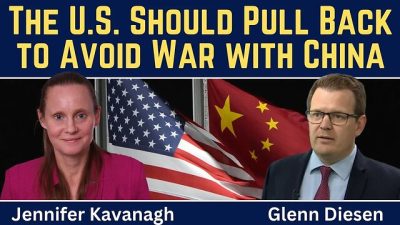
Why the U.S. Should Pull Back From the First Island Chain
or go to
Aletho News Archives – Video-Images
Book Review
‘Why Fauci Must Rot in Prison’: A Tale of Two Diaries
By Jill Erzen | The Defender | October 13, 2026
Dr. Anthony Fauci’s private diary reveals a “mind-numbing” contradiction between what the former top U.S. infectious disease official knew about COVID-19 and what he told the public, senior White House adviser Peter Navarro, Ph.D., said last week on “American Thought Leaders.”
In his new book, “Why Fauci Must Rot in Prison,” due out Oct. 20, Navarro compares Fauci’s private entries to his own pandemic-era diary, and uses what he calls “a tale of two diaries” to argue that Fauci should face criminal prosecution.
“I show, actually, how a prosecution can and should happen … at the state level, most likely,” Navarro said. “He should wind up in prison, and we’ve got the receipts in this book to put him there.”
Navarro said Fauci repeatedly acknowledged important facts in private, then publicly pursued policies that contradicted those facts — with devastating consequences.
“What he says many times privately in his diary is so at odds with both his public behavior and public statements that it’s mind-numbing,” Navarro said.
Navarro examines the lasting damage caused by lockdowns and other pandemic policies, and the ongoing toll of long COVID.
His book also addresses questions about vaccine safety, including why healthy young people faced COVID-19 vaccination mandates despite concerns about myocarditis, and why women were not warned about miscarriage risks linked to the shots. … continue
Blog Roll
 Aletho News
- Jennifer Kavanagh: Why the U.S. Should Pull Back From the First Island Chain
- Yemen denounces international community’s silence on Saudi aggression, siege
- UAE and Saudi Arabia move toward renewed coordination against Sanaa
- How Iran’s two-week retaliatory strikes exposed cracks in US military architecture in Persian Gulf
- The mother of all propaganda: Why the hype over US MOAB strike against Iran is nothing but theater
- Iran says it possesses technology behind US 14-ton GBU bunker-buster
- Trump asks Iran not to retaliate after he strikes Pickaxe Mountain – w/ Prof. Marandi
- Vice President J.D. Vance’s Deceptive ‘Antiwar’ Campaign Speech
- Iran: Palestinians’ rights must not be compromised in Gaza’s future; US, Israel to blame for Hormuz situation
- Ongoing tales of Syrian chemical weapons
- If Americans Knew
- Israeli rabbi permits occupiers to steal Palestinian olive harvest in West Bank
- Netanyahu’s spin on latest settler attack is laughable – Daily Update
- Israeli soldiers debunk Israel’s talking points
- In West Bank, Israeli settlers are totally out of control – Daily Update
- NPR investigation finds evidence of widespread fraud at mall kiosks tied to Israeli skincare brand
- Tucker Carlson exposes Israeli Lies about the Oct 7th attack, Charlie Kirk, and the U.S.
- Israel has detained thousands of Palestinian children since Oct 7th – over half spent time in solitary, many uncharged
- Israeli Analysis: Is Netanyahu Planning an ‘October Surprise’ Attack Before Israel’s Election?
- Israeli settlers brutally attack Palestinians and Washington Post female photographer, 65
- Words Have Changed, Occupation Continues: The Reality of the Gaza Ceasefire
- No Tricks Zone
- Predictions Made By Renowned Climate Proifessor Over Past Decades Have Been Proven To Be Poor
- New Study Suggests Large Regions Of The Pacific Ocean Have Been Cooling For The Last 80 Years
- Germany’s Green Energy Debacle: High Energy Costs Force Kahla Porzellan to Close After 182 Years!
- New Study: 50 Years Of The Most Aggressive ‘Net Zero’ Policies Can Only Affect The Global Climate By 0.03°C
- US September “Heat” Was No Record…Many Records Set Decades Ago
- Latest European Green Energy Debacle; Portugal’s Largest Flagship Solar Park Insolvent!
- Green Energy Debacle: German Expert Professor Fritz Vahrenholt Warns Of Severe Economic And Social Consequences
- Two More Paleo Reconstructions Affirm Meters-Higher Sea Levels Across Ireland, Brazil 7000-6000 Years Ago
- New Study: Earth And Venus Surface Warmth Largely Explained By Convection And Lapse Rate, Not CO2 Or Radiation
- 2025 Nature Paper Claiming Worsening Global Drought Gets RETRACTED …Heavily Flawed

