Mark Clark was the son of a career army officer and graduated from the US Military Academy at West Point. As World War II allowed rapid promotions, officers with political skills moved up quickly. Mark Clark was a Lieutenant Colonel in 1941 and by 1942 he had jumped four grades to Lieutenant General while serving as a staff officer who cultivated personal relationships with Generals like his old friend Dwight Eisenhower. Most historians are critical of Mark Clark’s performance in Italy and rate him as one of the worst American Generals in World War II.
British warships deployed to the South Atlantic after Argentina’s invasion of the Falkland Islands [Islas Malvinas] in 1982 were armed with dozens of nuclear depth charges. Prince Andrew served on HMS Invincible, which carried 12 nuclear weapons.
The revelation is contained in a new file released to the National Archives. Marked “Top Secret Atomic,” it shows that the presence of the nuclear weapons caused panic among officials in London when they realized the damage, both physical and political, they could have caused.
The military regime in Argentina claimed the Falkland islands and invaded on April 2, 1982. The U.K. government under Margaret Thatcher dispatched a naval task force to the South Atlantic to retake the islands.
A Ministry of Defence (MoD) minute, dated April 6, 1982, referred to “huge concern” that some of the “nuclear depth bombs” could be “lost or damaged and the fact become public.” The minute added: “The international repercussions of such an incident could be very damaging.”
Nuclear depth bombs are deployed from navy ships to attack submerged submarines.
The unidentified official who wrote the minute continued:
“The secretary of state [John Nott] will wish to continue the long-established practice of refusing to comment on the presence or absence of UK nuclear weapons at any given location at any particular time.”
Heated Row
The existence of the weapons provoked a heated row between the MoD and the Foreign Office. The latter asked the MoD to “unship” the weapons. The Navy refused to do so.
The MoD noted the principal arguments in favour of keeping the weapons on board. It stated:
“In the event of tension or hostilities between ourselves and the Soviet Union concurrent with Operation Corporate [the codename given to liberating the Falklands] the military capability of our warships would otherwise be severely reduced.”
One document in the file says there was no risk of an “atomic bomb type explosion.” But there was a threat of the “disposal of fissile material” if any of the weapons was damaged which could lead to up to 50 “additional deaths” from cancer.
Even if there was no pollution in the event of a damaged or sunk nuclear weapon the Argentinians might get hold of nuclear technology and “we might have had to face acute embarrassment in the non-proliferation field,” recorded a MoD official.
Keeping Secret
A plan to offload the weapons at the British base on Ascension Island in the South Atlantic Ocean was rejected by the Navy. It said this would delay the passage of the task force to the Falklands and that the operation would not be kept secret.
Instead, the weapons were transferred from the frigates and destroyers to the larger aircraft carriers, HMS Hermes and HMS Invincible, where the weapons could be better protected. Prince Andrew served as a helicopter pilot on Invincible during the war.
By the middle of May 1982, the Hermes had 18 nuclear weapons on board and Invincible 12, while the Royal Fleet Auxiliary ship, Regent, had one, according to the file. The ships were within the “total exclusion zone” imposed by Britain around the Falkland Islands, the documents say.
The file does not say whether any of these were “inert” surveillance rounds used to monitor the “wear and tear on the weapons”, as academic Lawrence Freedman put it in his Official History of the Falklands Campaign, published in 2005.
Surveillance and training rounds were used to test the depth charges to see how they would perform. They were identical to live weapons except the fissile material was replaced by depleted uranium and inert substances.
But even the presence of inert rounds caused alarm in the Foreign Office. Its top official, Sir Antony Ackland, wrote to Sir Frank Cooper, his opposite number in the MoD: “I was very glad to have your confirmation that HMS Sheffield was not carrying an inert round when she was hit.”
The destroyer sank on May 10, 1982 after being attacked by an Argentinian Exocet missile six days earlier.
Nuclear Free Zone
The Foreign Office was also anxious about the presence of the nuclear weapons because of the 1967 Treaty of Tlatelolco. This established a nuclear free zone in Latin America and surrounding waters, including the Falklands.
Although Britain had signed and ratified the treaty’s protocols other countries, including Argentina, had not done so. According to Freedman, Margaret Thatcher insisted that no ship carrying nuclear weapons would enter the three-mile territorial waters around the Falklands which would be a “potential breach” of the Tlatelolco treaty.
The MoD admitted in 2003 that British ships in the task force carried nuclear weapons and that a weapon container had been damaged. But the number of weapons had not been revealed before this document was transferred to the National Archives in Kew, south west London.
But a number of documents from the file have been weeded by the MoD or the Cabinet Office. They include an intriguing note, dated April 11, 1982, beginning “The Chiefs of Staff believe…” What they believed we are not allowed to know.
What About Gibraltar?
Many more documents are missing from a separate file, now declassified, entitled “Gibraltar: Impact of the Falklands Crisis”.
Gibraltarians, like the Falkland Islanders, inhabited a British “Overseas Territory” and were concerned because Spain supported Argentine claims of sovereignty over the islands just as it claimed Gibraltar, the large rock and British base on the southern tip of the Iberian peninsula.
Whitehall weeders have withheld no fewer than 73 documents from the Gibraltar file. They have done so under exemptions in the Freedom of Information Act, and, specifically, sections 27(i), 40 (2), and 41.
These cover information whose disclosure might “prejudice” the interest of the U.K. abroad, “personal data” and “information provided in confidence.” Passages in other documents in the file have also been excised.
What has the British government to hide? Documents declassified previously may offer some clues. Thatcher repeatedly expressed concern about the implications of the Falklands crisis for Gibraltar.
Despite the public rhetoric, successive U.K. governments have been prepared to negotiate about sovereignty of the Falklands and sought a joint sovereignty agreement with Spain over Gibraltar in 2000 and again in 2002.
Thatcher’s government secretly offered to hand over sovereignty of the Falklands islands two years before the invasion by Argentine forces in 1982. The cabinet’s defence committee approved a plan whereby Britain would hand Argentina titular sovereignty over the islands, which would then be leased back by Britain for 99 years.
Lord Carrington resigned as foreign secretary over the Argentine invasion of the Falklands. He told the subsequent Franks Committee, which inquired into the run-up to the invasion, that British policy had been one of neglect and hoping for the best. “We did not have any cards in our hands”, he said.
Richard is a British editor, journalist and playwright, and the doyen of British national security reporting.
While the US delegation came to Europe to “seriously” discuss Moscow’s security proposals, on Monday, they have not shown an understanding of how the key issues need to be resolved, Russia’s top negotiator said afterwards.
The Americans “underestimate the gravity of the situation,” Deputy Foreign Minister Sergey Ryabkov told reporters after bilateral with his US counterparts in Geneva. Russia has laid all of its cards on the table in the proposals made public last month, and those represent “demands that we cannot retreat from,” he added.
Ryabkov described the Geneva talks as useful because they discussed the matters previously considered off the table, and said he did not think the situation was hopeless. The greatest difference of views between the US and Russia was on the further expansion of Washington’s NATO military bloc.
“For us, it’s absolutely mandatory to make sure that Ukraine never ever becomes a member of NATO,” Ryabkov said, and Moscow is insisting that the institution amend its policies to reflect this reality.
“We are fed up with loose talk, half-promises, misinterpretations of what happened in different negotiations behind closed doors,” he said, referring to the State Department’s claims in recent days that NATO and the US never promised Moscow that NATO would not expand to the east.
“We do not trust the other side, so to speak,” Ryabkov said. “It’s over, enough is enough.”
Following Monday’s talks in Geneva, Ryabkov will meet with NATO representatives on Wednesday, and with the OSCE on January 13, after which Moscow will make a decision whether to continue the negotiations further.
We are at a crunch point now in Russia-US relations. Their high-level talks starting next week will be closely observed by China, Russia’s de facto strategic ally. The coming days and weeks will determine the shape of world security for decades to come.
On Monday, January 10, vital Russia-US talks will start in Geneva. Russia’s delegation will be headed by Deputy Foreign Minister Sergei Ryabkov and the US by National Security Adviser Jake Sullivan.
These are ‘precursor’ negotiations – ‘talks about talks’, in the old strategic arms limitation treaties (SALT) terminology. Russia is driving the pace. The US is in reactive mode, trying unsuccessfully to slow things down, to trim Russia’s sails. So far they are not succeeding.
Russia’s best-case scenario for Monday is this. Successful precursor talks will be followed soon after by substantive detailed Foreign Minister level negotiations, led by Russian Foreign Minister Sergei Lavrov and US Secretary of State Antony Blinken, with participation of top military brass from both sides. Russia will seek to secure detailed US-Russia agreements on mutual security guarantees in Europe.
Unusually, Russian drafts of these agreements were handed over by Russia to the US and at the same time made public on December 17. Russia will want to achieve these solemn written mutual commitments, as well-summarised by Patrick Lawrence in Consortium News on December 28.
NATO will cease all efforts to expand eastward, notably into Ukraine and Georgia.
NATO guarantees that it will not deploy missile batteries in nations bordering Russia.
An end to NATO military and naval exercises in nations and seas bordering Russia.
The effective restoration of the treaty covering intermediate-range nuclear weapons. The US abandoned the INF pact in August 2019.
An ongoing East-West security dialogue.
These desired agreements would be backed up by early NATO-Russia negotiations to achieve corresponding agreements at that level. Finally, the two presidents would formally seal the deal.
Russia’s worst-case scenario: that if the US fails to negotiate towards this complete package – if the US tries in its usual way to equivocate, delay, or cherry-pick Russia’s proposed deal – Russia will terminate the talks.
Russia-US and Russia-NATO relations would then enter the deepest of deep freezes since the worst years of Cold War One. Russia would focus its economic and diplomatic resources entirely on relations with the East and South – backstopped by the Belt and Road Initiative of its reliable friend China. Russia would effectively stop trying to dialogue with US and NATO Europe and call the US bluff on enhanced sanctions. On the now highly militarised Russia-NATO frontier, armies, navies and tactical intermediate range missile forces (sufficient to destroy most of Europe and European Russia) would confront each other. Risks of East-West war by provocation or accident would be far greater than in the years 1989-2014, before the sharp deterioration in East-West relations brought about by the illegal 2014 Ukraine coup.
These present talks instigated by Russia are thus really the Last Chance Saloon: the last opportunity maybe for decades to pursue relaxation of East-West tensions – ‘détente’, in the old nearly — forgotten word of late Cold War One. Russia has had enough of years of creeping security deterioration and has drawn its red lines. These are not in my view ‘ultimatums’ though they do demand major military pullbacks by the US and NATO not matched by Russia, because almost all Russian forces are within Russian territory. In my view these proposed written agreements would enhance European and global security if achieved.
In 2021, Russia decided that it has had enough of decades of Western duplicity and creeping aggression, as persuasively analysed by Marshall Auerback in The Scrum, December 1, 2021.
Russia has seen how under successive US presidents Clinton, George W. Bush, Obama, Trump, and now Biden, a strategically destructive pattern of US and NATO behaviour had emerged since 1999, when President Bill Clinton welshed on the solemn though unwritten 1989-91 agreements between Reagan and George H.W. Bush with Gorbachev, that NATO would not expand into Eastern Europe following the reunification of Germany.
As the West offered soothing words and prevarications, NATO expanded, first with Poland, Czechoslovakia and Hungary in 1999. There were further large expansions in 2004 and 2009, bringing NATO right up against Russia’s Western frontiers. Provocatively, NATO then listed Ukraine and Georgia as candidates for NATO membership. The West successfully engineered an anti-Russia ‘colour revolution’ in Ukraine in 2014 and nearly succeeded in doing so in Belarus in 2020. It continued even to try to subvert Russia itself through lavish funding of anti-government human rights NGOs. Military and naval manouevres and build-ups continued on Russia’s Western approaches.
An angry Russia saw every expansion and interference as Western betrayals and as violations of its sovereignty and strategic depth. Russia was initially too weak to do anything about it. As Putin rebuilt Russian strength and morale, Russia began to fight back: first in Georgia in 2008, then in Crimea and East Ukraine in 2014, and in Belarus since 2020.
World events have now decisively turned in Russia’s favour. The global strategic balance is shifting. China firmly has Russia’s back, as seen in recent statements by President Xi Jinping and China’s Foreign Minister. China has repelled Western regime-change pressures in Xinjiang, Hong Kong and around Taiwan. Iran has joined the Belt and Road initiative. The West was expelled from Afghanistan. Syria has somewhat stabilised.
Russia and China see now that they are stronger against their common Western adversary if they stand together. Important non-Western powers and groupings such as India, Japan, South Korea and ASEAN are quietly adjusting their diplomacy to suit. The Quad is dead in the water, and AUKUS is a diplomatic joke.
In publishing these draft treaty texts, Russia is appealing to the world outside the Atlantic alliance to see that its cause is just, and in accordance with the five principles of peaceful coexistence proposed by China to the non-aligned world in 1954.
These five principles as articulated by Chinese foreign minister Zhou Enlai first appeared in the Sino–Indian Agreement signed in April 1954, and subsequently at the Bandung Conference of non-aligned nations, which Indonesia hosted one year later. These principles are mutual respect for sovereignty, non-aggression, non-interference in the internal affairs of others, equality for shared benefit, and peaceful coexistence. These are very much the stated principles of current Russian foreign policy.
Quite suddenly, the West is on the diplomatic defensive. Its years of salami-slice aggression against Russia and China are now coming to an end.
For years since the fall of the Soviet Union in 1991, the West used the vital consensus agreed by Reagan and Gorbachev, that nuclear war cannot be won and must never be fought, as cover for creeping aggression in Eastern Europe, violating and weakening Russia’s sphere of security.
Now, with the Russian initiative last week for the UN Security Council P5 to reaffirm the Reagan-Gorbachev doctrine, with which the Western nuclear powers had perforce to agree, the tables have been turned.
Putin is in effect telling the West now: we all agree that none of us can allow military conflict between us to escalate to nuclear war. But we and China are strong enough now to defeat you in non-nuclear conflicts close to our borders, if you should be foolish enough to instigate such conflicts. These are the military facts of the matter: Russia could easily occupy Ukraine and China could easily occupy Taiwan. And you, the US and NATO, could not stop this without risking nuclear war.
Putin has no wish to invade Ukraine but he is determined to stop now the erosion of Russia’s security. The new harder and more confident tone in Russian diplomatic language is unmistakable. A confused West has not yet worked out how to respond. Urgent talks have taken place between Biden and Ukrainian President Volodymyr Zelensky, and between the US and NATO. One hopes that Biden has been preparing the ground for a prudent Western accommodation. A wise old owl, he can smell the coffee.
Putin is now holding the strongest negotiating cards. My betting — indeed my hope — is that Russia will achieve its demanded mutual security guarantees in Europe in coming weeks.
International security – Australia’s security — will be greatly strengthened if he succeeds.
Much could still go wrong. There are troublemakers in the Western bloc whose careers depend on maintaining East-West tensions at just below the level of war. They will try hard to subvert and derail Russia’s goals.
In Australia there is almost complete public ignorance of this subject matter. Be prepared for massive disinformation in coming weeks from the US-fed think tanks like ASPI and our mainstream media, and a hysterical whipping-up of alleged threats of imminent Russian invasion of Ukraine. This propaganda offensive is already under way.
Australia sadly no longer has the intellectual resources for an informed and balanced public discussion of these momentous developments. Ignorance and groundless fears of Russia prevail. Dissenting voices such as mine have been marginalised and almost silenced.
One might hope there is more reality-based knowledge in our national security community. But if there is, they are not telling the public. I fear that there too, ignorance and prejudice have taken hold. We are leaving the strategic thinking on Russia to our Big Brother.
I expect this article to be either mocked or ignored. But let us see how events develop in coming weeks.
Tony Kevin is a former Australian senior diplomat, having served as ambassador to Cambodia and Poland, as well as being posted to Australia’s embassy in Moscow. He is the author of six published books on public policy and international relations.
The letter, which was signed by the Quincy Institute for Responsible Statecraft, asks the White House to pursue the Minsk agreements which would “demilitarize the eastern Donbas region of Ukraine and guarantee meaningful political autonomy to the region while retaining Ukrainian sovereignty over the area and its borders.” QI fellow Anatol Lieven has detailed the agreement and the promise it would hold for peace in the region here.
De-escalation is key, wrote the signing organizations, which also emphasized the need to stop NATO expansion and resist calls to send U.S. troops to defend Ukraine.
We echo the call by over 100 former U.S. officials and leading scholars who stated that, in addition to addressing urgent security challenges, we must engage in a serious and sustained strategic dialogue with Russia “that addresses the deeper sources of mistrust and hostility” while deterring Russian military aggression. These dialogues must engage with President Putin’s explicit pursuit of “reliable and long-term security guarantees” that would “exclude any further NATO moves eastward and the deployment of weapons systems that threaten us in close vicinity to Russian territory.
Interestingly, reports emerged Friday that suggested that the White House was willing to reduce the number of U.S. troops in Eastern Europe and scale back military exercises in the region — for an equivalent reduction of Russian troops in the area. In an accompanying statement, the White House disputed that Washington was weighing troop cuts.
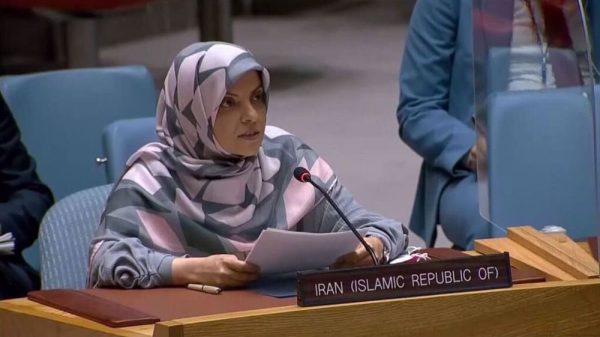
An Iranian envoy to the United Nations has raised concerns about the possession of chemical weapons by the United States and Israel, describing the pair as the main obstacles to the elimination of such arms across the world.
Zahra Ershadi, deputy permanent representative of Iran to the UN, made the remarks on Wednesday at the Security Council briefing on chemical weapons in Syria.
She said that the elimination of all chemical weapons worldwide was the prime objective of the Chemical Weapons Convention (CWC), and that this goal could be realized only through the treaty’s full, balanced, effective and non-discriminatory implementation, as well as its universality.
It is therefore a source of serious concern that due to non-compliance by the United States, this objective has yet to be realized, she added.
Ershadi also stressed that the Israeli regime must be compelled to join the CWC without any precondition or further delay.
Warning against the serious impact of politicization on the CWC’s credibility, the Iranian envoy called for de-politicization of the work of the Organization for the Prohibition of Chemical Weapons (OPCW).
Iran reiterates its long-standing and principled position on the need to strongly condemn the use of chemical weapons by anyone, anywhere and under any circumstances, she said.
The only absolute guarantee that chemical weapons will not be used again is the total destruction of all chemical weapons across the globe, she said, adding that all necessary measures should be taken to ensure that such weapons will not be produced and used in the future.
Citing significant efforts by Syria to carry out its obligations under the CWC, including the complete destruction of all its 27 chemical facilities as verified by the OPCW, Ershadi said the holding of monthly Security Council meetings to consider the Syrian file is unjustified.
Syria surrendered its entire chemical stockpile in 2013 to a mission led by the United Nations and the OPCW.
It believes that false-flag chemical attacks on the country’s soil have been staged by foreign-backed terrorists in a bid to pressure the government amid army advances.
Syria slams West’s disinformation campaign
Speaking at Wednesday’s Security Council briefing, Syria’s Permanent Representative to the UN Bassam Sabbagh condemned any use of chemical weapons, emphasizing that the Damascus government has never employed such prohibited arms, despite the threats posed by terrorist groups and their sponsors on its territory.
Since joining the CWC in 2013, Syria has cooperated with the United Nations to eliminate its stockpiles and production facilities, a process that was completed in record time, in mid-2014, he added.
Sabbagh also rejected the disinformation campaign launched by some Western countries, which have adopted a hostile policy against Syria and created the OPCW Investigation and Identification Team, he said that reports by the body have become part and parcel of the hostile Western campaign.
He further urged the UN not to “drag its feet” in investigating the use of chemical weapons by terror outfits and cautioned that certain Western states often jump to conclusions before the end of the probe.
The leader of a French leftist party and presidential hopeful has called for the country to pull out of the NATO alliance, revealing that he regards Russia as a partner for Paris rather than an adversary.
The leader of the leftist La France Insoumise (France Unbowed) party, Jean-Luc Melenchon, shared his insights on the new Cold War and France’s place in it during a major interview with France Inter radio on Monday. Melenchon further elaborated on the points he made during the interview in a long Twitter thread.
The politician said the country should take part in efforts to “de-escalate” the international situation rather than follow Washington in the new Cold War against China and Russia. Leaving the NATO alliance altogether would therefore be beneficial for France, as it won’t be part of the “military adventurism” of the US, Melenchon believes.
“I am for leaving NATO. We need to de-escalate. If we leave NATO, we will not be dragged into the cold war logic that the Americans maintain with Russia and China,” he stated.
The politician also said he regards Russia as France’s partner rather than an adversary. It was the West that got the NATO bloc into the current standoff with Moscow, breaking its promises on eastward expansion of the alliance, Melenchon stressed.
“Russia is a partner. I do not agree with making an enemy of it. We brought 10 countries into NATO in the east, which was seen as a threat by Russia. Especially when you install anti-missile systems in Poland,” the politician said.
He also voiced opposition towards any plans to accept Ukraine into NATO. A move like this would further erode the security situation in Europe, as it would be inevitably perceived by Moscow as a new “threat” against it, he said.
The veteran politician has announced he intends to run for president in the upcoming election in April. During the last presidential election in France, Melenchon won around 20% of the vote in the first ballot. However, he did not make it to the second round.
In a Daily News Bulletin issued February 4, 1924, by the Jewish Telegraphic Agency, Jewish leaders across the nation publicly mourned the passing of former war-time president Woodrow Wilson, the self-described “staunch friend of the Jews.” The telegram goes on to commemorate Wilson’s “intense interest in Jewish questions” by reviewing his political deeds as president, appointing Louis D. Brandeis to the Supreme Court Bench despite vigorous opposition from the Court itself and urging the approval of the British Mandate over Palestine following the Balfour Declaration.[1]
Nearly a century later, this adulation of America’s twenty-eighth president continues to be echoed by prominent Jewish leaders and intellectuals. In Pulitzer Prize-winning biographer A. Scott Berg’s book, “Wilson,” this formidable Head of State has influenced the decision-making of each succeeding American president up to former President Donald Trump. Furthermore, Berg argues that Wilson is the most pro-Jewish president in US history.[2] This is attributed to Wilson’s breakaway from American isolationism, which guided the nation’s political function on the world stage for a hundred and twenty-five years.
Six months after winning a second consecutive term as president on the Democratic ticket (the first time since Andrew Jackson’s second term), Wilson asked the legislature to declare war on Germany in an imperative speech to Congress on April 2, 1917. His justification was to answer the question of the role the United States would play in the world – it was America’s duty to ensure that “the world must be safe for democracy.” This rhetoric has been repeated repeatedly by American politicians at all levels in subsequent generations, followed by military action.
As Wilson plunged the nation into Europe’s devastating four-year war which wrought 17 million deaths and 25 million wounded, he often portrayed himself as the beacon of progressive ideals, a missionary of self-determination, democracy, and multilateralism to the world and, by involuntary extension after the First World War, its conquered colonies from the ashes of the defeated German and Ottoman Empires. The question is on whose behalf and if foreign elements were acting abroad, at home, or both.
For example, it is entirely plausible today to assert that the invasion of Iraq was contrived almost entirely by high-ranking Jewish Zionists in the Bush administration for the long-anticipated purpose of removing Israel’s arch-nemesis at the time—Saddam Hussein—in another mission to destroy the Jewish State’s Arab neighbors and assert dominion over the region.[3]The catch was that Israel would not be fronting the 2 trillion dollar bill and sacrificing 190,000 lives; that was left to the Americans.[5]
Eighty years prior, before the founding of modern Israel, this similarly established Zionist paradigm in America’s political institutions persuaded the Wilson administration to do the same. Instead of winning the hearts and minds of the public through unbridled war propaganda and an unprecedented national tragedy for the specific purpose of creating a homeland for Jews, a cooperative network of Zionists in Britain, Russia, and the United States worked towards this goal through the imperial hand of the idealistic Wilson.
Jews long held Woodrow Wilson in high regard for his liberal politics and inclination to address their requests. When the former governor of New Jersey first ran for president in 1912, Boston’s Jewish Advocate published a political ad, pressing readers to join with “practically all the great Jewish leaders throughout the country” in endorsing him.[6]These leaders included financier Jacob H. Schiff, philanthropist Nathan Straus, and Ambassador Henry Morgenthau. At the time, beginning in 1906, the United States was faced with the difficult task of admitting roughly ten million immigrants, mainly from Eastern and Southern Europe.
This sudden influx overwhelmed several facets of the native populace, whereby the “restrictionists” emerged with literary test campaigns as a method by which to curtail subsequent waves of immigration. The American Jewish Committee was the most active and significant anti-restricionist lobby group in each of these battles through delay and outright blockage of the legislative passage. During his tenure as president, Wilson assisted by vetoing three restrictive measures he believed were aimed principally at Jews before being overridden by Congress. The AJC’s particular fixation on the plight of Russian-Jewish immigrants caused an extensive lobbying endeavor in America’s foreign policy.[7]
This emerging conflict of interest was sidestepped upon the outbreak of the First World War. The intense pogroms and anti-Jewish sentiment of Czar Nicholas II caused the American Jewish community to side more with Germany than with Allied forces. Immigrant Jews even prayed that the “more civilized” Germans would liberate their suppressed brethren in Eastern Europe from Russian harassment. In the Yiddish press, the enemy was portrayed vividly as: “The Jews support Germany because Russia bathes in Jewish blood.” Who will dare say that it is a crime for Jews to hate their torturers, their oppressors and murderers?”[8] The German Foreign Office took advantage of this position in order to maintain its favor in the Jewish community; in September, 1914, Dr. Isaac Straus was even sent to the United States to manage propaganda work among Jews for the German Information Bureau located in New York.
The German Information Bureau, despite official American neutrality, could not be more pleased following its meeting with the Jewish press. This came at a time when most Americans would rather side with French and British allies out of strong ancestral ties: “So far as our relations with the very influential Jewish press are concerned, they are in good shape, and will be carefully nourished. It is critical in this regard that all news pertaining to them elevate Jewish self-esteem; for example, the appointment of Jewish officers, the installation of Jewish professors, and honors bestowed upon Jewish professors should all be sent here.”
While war efforts were being bolstered in the Jewish press, American Zionist leaders adopted a policy of neutrality for the time being, stemming from Theodor Herzl’s stance on non-partisanship in a neutral country as war raged. During this time, it was Britain’s Grand Fleet that managed the naval blockade of supplies into Germany, starving 400,000 German civilians to death. For the first two years of the First World War, German war efforts nevertheless proved supreme thanks to their unexpected arsenal of submarines against the wealthier, more weaponized Allied Powers. Imperial German forces nearly captured Paris, expelled Russia from the war, and drove the French Army into mutiny, all before a Western Front victory was barely in their grasp by 1918. On three separate occasions throughout 1916, Germany pursued avenues to negotiate for peace, but both British and French resolve maintained that peace would only come about upon Germany’s defeat.[9]
Zionist leaders eventually came to the realization that Allied victory meant Russia’s influence would be amplified in the Near East. In early 1915, a conditional Entente agreement even allocated Constantinople to Russia. This posed an issue as Constantinople rested in the possession of the Ottoman Empire, an ally of Germany and Austro-Hungary. High-profile Zionists had their eyes eastbound on Palestine as a suitable place to lay the groundwork for a Jewish homeland. In 1896, the father of Zionism, Theodor Herzl, approached Sultan Abdul Hamid II and offered to pay off the Ottoman debt in exchange for a charter that permitted Zionists access to Palestine.[10] The Sultan outright refused.
The prospect of a promised land for Jews never escaped one highly influential man’s attention — Justice Louis D. Brandeis. Through Brandeis, Zionist leadership “passed into American hands by default.” He was considered one of the men of “light and lead” on whom Wilson relied.[11] Born in 1856 to secular Jewish immigrant parents from the present-day Czech Republic, he graduated from Harvard Law School at the age of 20 and settled in Boston to open a law firm focused on progressive social causes. In his early career, he was distinguished for his public advocacy against powerful corporations, mass consumerism, monopolies, and public corruption while advising methods to restrict the influence of big banks and money trusts in his collection of essays, Other People’s Money and How the Bankers Use It.[12]
These progressive positions would later be taken up by Democratic candidate Woodrow Wilson on the larger question of the role of the national government and the future of the American economic system. By that time, Louis Brandeis was head of both the Federation of American Zionists and the American Zionist Movement after meeting the English-born Zionist leader and close associate of the late Herzl, Jacob de Haas. The prominent Jewish lawyer was converted into a staunch Zionist under the mentorship of leading Zionists during that time, such as Aaron Aaronsohn, Horace Kallen, Shmarya Levin, Bernard Rosenblatt, and Nahum Sokolow.[13] From August 31, 1914, to October 1, 1916, Brandeis was also chairman of the Provisional Executive Committee for general Zionist affairs.
The Brandeis-Wilson coalition was the start of a political partnership with far-reaching consequences on the international scene until Wilson’s death. The opportunity for career advancement presented itself so visibly that Brandeis switched parties and carried his advocacies, including Zionism, into American political institutions as a high-ranking political figure with direct access to the newly elected U.S. president.
Upon Wilson’s presidential win in November, he noted to Brandeis, “You were yourself a great part of the victory.” During Wilson’s first year as president, Brandeis was instrumental in the behind-the-scenes creation of the Federal Reserve System in 1913. The ambitious president attempted to make Brandeis his Attorney General and later Secretary of Commerce, but intense resistance from corporate executives forced Wilson to rescind his plan to make the renowned radical part of his cabinet. Instead, he nominated him to the U.S. Supreme Court in 1916, and he was sworn in amid a public outcry.
At a time when correspondence between Zionist leaders and the American president was steadily rising, as the Great War intensified in its first year, Brandeis approached Wilson about Zionist plans, to which Wilson seemed receptive. By 1916, Brandeis established regular contact with the State Department on the future fate of the declining Turkish Empire following the war, with Hungarian-born leading Zionist and Rabbi Stephen S. Wise in communication with Wilson’s chief adviser on European politics and diplomacy during the First World War, Edward Mandell “Colonel” House, on Zionist objectives. Specifically, Wise functioned as an intermediary between Wilson and House from 1916 to 1919. Wise began his Zionist career in the late 1890’s by assisting the movement’s ideological development and organization of its membership. Another acquaintance of Herzl’s, he served as American secretary of the World Zionist Movement and was instrumental in producing the aforementioned Provisional Executive Committee for General Zionist Affairs.[14]
Opposition to American entry into the First World War cut across political, racial, and economic lines. Various factions of society, including socialists, anarchists, syndicalists, pacifists, civil libertarians, Marxists, rural southerners, Canadian and Irish nationalists, and women’s groups, were just some of the small but vocal minorities opposing American militarism. International socialist groups, for example, were keenly aware of the capitalist mobilization the war promised to big business rivals. The working class fought, while the ruling class profited.[15] This was America’s first debut as a global military power and pitted citizen against citizen until eventually the government itself grossly violated civil liberties under the Espionage and Sedition Acts.
In 1916, Wilson reignited his bid for re-election through his continued commitment to progressive change by calling for legislation regulating work hours and a minimum wage. Democrats campaigned on the slogan, “He Kept Us Out of War,” insisting to voters that a Republican victory would mean war with Germany. Just four months after his second inauguration, Wilson reneged on his campaign promise of neutrality and officially declared war. By this time, public resistance to this betrayal was minute. The preceding years of preparedness campaigns, patriotic zeal, and heavily propagandized press cycles swayed the consensus into viewing the war as just and necessary. Thousands more dissenters continued to be jailed, silenced, and deported under newly solidified justification.
Shortly after the U.S. entered into the war, the British Foreign Minister, Arthur J. Balfour, arrived in Washington. In a cable, James Rothschild urged Brandeis to discuss Zionism with Balfour on the viability of an English Zionist program to recognize Palestine as the Jewish national homeland. “Unanimous opinion is the only satisfactory solution for Jewish Palestine under British protectorate,” Rothschild explained in a telegram. Russian Zionists fully approve. Public opinion and competent authorities here are favorable… It would greatly help if American Jews would suggest this scheme to their government.[16]The charitable activity of the Zionist movement was over. Now an era of wielding political power has commenced to shift the tide of international conflict under the London-Moscow-New York axis.
Only one month after American entry into the war, Brandeis followed through with Rothschild’s request. Appealing to Wilson’s progressive vision for the globe, Brandeis explained that a Jewish Palestine would fulfill the conditions of the peace settlement Wilson desired; Turkish despotism would be swept aside for a democratic government where economic and cultural development would be undertaken by a historically suppressed people.[17]In reaction to the Balfour Declaration, Wilson said, “The allied nations, with the fullest concurrence of our government and people, agree that in Palestine shall be laid the foundations of a Jewish Commonwealth.”[18]
Partnered with Brandeis in courting Wilson was the Austrian-born Jewish lawyer and professor, Felix Frankfurter, a lifelong committed Zionist and member of the Zionist Organization of America. Frankfurter became acquainted with Brandeis in the Parushim, a secret Zionist society, reform movement, and arguably the first modern militant Zionist organization in America. Found by their former mentor, Horace M. Kallento, Zionist purpose was “a group much like the Peace Corps, young men and women who saw the Utopian opportunity that existed for the Jewish people in Palestine and who were willing to devote themselves to an ideal.”[19]
The ideological motivations for endorsing Zionism were personal for Wilson as well: “To think that I, the son of the manse, should be able to help restore the Holy Land to its people.” With Wilson formally persuaded, Brandeis passed along the good news via urgent cables to Rothschild in London. Two weeks later, Jacob de Haas, now advisor to Brandeis, cabled Russian born-Zionist leader and future president of the World Zionist Organization, Chaim Weizmann, not only outlining the plan for Palestine but to communicate “an accurate statement of the prevailing sentiment in the United States to be presented to the Allied Governments.”[20]
President Wilson was later asked directly by the British government about the likelihood of issuing a declaration of sympathy for the Zionist movement. Wilson responded that the time was not ripe. A month later, Wilson placed his full backing behind the affirmation as pressure mounted against Germany’s Turkish ally to make dispensations to the Zionists. The topic of the Balfour Declaration was on the table between the two world powers. Colonel House complained to Wilson in a note: “The Jews from every tribe have descended in force, and they seem determined to break in with a jimmy if they are not let in.”[21]
Brandeis’ influence over Wilson in regards to Zionist ambition could not be understated. Wilson once remarked that it was Brandeis to whom he owed his career. According to Frank Edward Manuel, Wilson’s interest in Zionism and including it as part of his foreign policy was “being slowly nurtured by Louis Brandeis, one of the men who stood closest to him in the early years of the administration and who became the key figure in future American intervention in Palestine.”[22]
A roadblock in the way of the highly anticipated declaration was the Counselor to the State Department, Robert Lansing. Lansing was completely bypassed in House and Wilson’s correspondence on the Balfour Declaration. In response, Lansing argued in a letter to Wilson why America must decline Balfour’s promise, noting that, among several reasons, “many Christian sects and individuals would undoubtedly resent turning the Holy Land over to the absolute control of the race credited with the death of Christ,” a flagrant secession from the protracted Christian support for the prophetic restoration of Israel.
Lansing ordered Ambassador Walter Hines Page to investigate and report prudently the British reasons for the Balfour Declaration. In spite of political opposition within the State Department, the declaration was officially signed by Lord Balfour after a two-year process of edits by British and American Zionists and officials. Despite its official status as a British document, it was Brandeis who spearheaded its drafting and application through Wilson.
News rapidly spread worldwide upon the issuance of the Balfour Declaration, with heaps of telegrams addressed to Wilson expressing their gratitude for his contributions. Leaflets were dropped over German and Austrian territory announcing, “The hour of Jewish redemption has arrived…” The Allies are giving the land of Israel to the people of Israel… Will you join them and help to build a Jewish homeland in Palestine? Stop fighting the allies who are fighting for you, for all the Jews… An Allied victory means the Jewish people’s return to Zion.”[23]
By the summer of 1918, Turkish resistance was waning and President Wilson took this time to formally announce his public endorsement of the Balfour Declaration in August. Three months later, Germany was the last of the Central Powers to sign an armistice agreement with the Allies. The war was over. The next battle would be held in Paris.
The ambitions of Wilson’s liberal internationalist foreign policy were outlined in the Fourteen Points and used as the basis of terms for Germany’s surrender at the Paris Peace Conference. The Peace Conference produced five treaties, one of which was the notorious Treaty of Versailles. There were a number of high-profile Jews present, not just in diplomatic positions but in many senior and important functions within the Allied delegations.[24] This included Baron Sonnino for Italy, Edwin Montagu for Britain, Louis Klotz for France, and Paul Mantoux as the interpreter for the “Big Three”—United States, Britain, and France.
Wilson also endorsed Rabbi Wise to promote the Jewish program for Palestine in Paris. Another Zionist delegate was Frankfurter, who was among the nearly one hundred intellectuals that signed a statement of principles for the formation of the League of Free Nations Associations. This formally enacted Wilson’s mission to dispel isolationism in favor of increasing American participation in international affairs.[25]
In the midst of empirical savagery slicing up Germany and parceling out Europe’s colonial holdings, the case for a Jewish homeland in Palestine was presented by a delegation of the Zionist Organization led by Weizmann. The terms of the newly established British Mandate involved promoting Jewish immigration and settlement, suggesting boundaries, self-government, and the assurance of religious liberty.
At the request of President Wilson, Jewish statesman and Wall Street financier Bernard Baruch attended the Paris Peace Conference as an advisor to negotiate a deal with the victorious Allied powers on the destiny of Germany.[26] He served as a member of the American Delegation to the Preliminary Peace Conference and on the Committee on Form of Payments of Reparations. Baruch is credited with managing America’s economic mobilization in the First World War while chairman of the War Industries Board. While Baruch opposed the strenuous financial tenets of punishing Germany, he nonetheless attempted to assist the Senate in passing the Treaty of Versailles.
Baruch also played a significant role in securing France’s vote in favor of the Palestine Partition Plan. He swayed their vote by visiting France’s UN delegate and heavily suggesting that failure to support the resolution could result in America withholding desperately needed monetary support as the war devastated France’s financial market.[27]
The renowned English economist, John Maynard Keynes, was also in attendance at the Peace Conference as a delegate of the British Treasury. Disgusted by the ravenous nature of the treaties, particularly the Versailles Treaty, Keynes publicized a negative portrayal of the treaties in his book, The Economic Consequences of the Peace. In response, Baruch paid John Foster Dulles $10,000 to ghostwrite his own book, The Making of the Reparation and Economic Sections of the Treaty, to counter Keynes by exalting the treaties.[28]
The most significant of American Jewish attendees, however, was Justice Brandeis himself, whose task at the world’s peace tables was to assist Colonel House “in collecting peace data for President Wilson.” The task was clear: “Colonel House will devote his attention to problems concerning the war in the west, while Justice Brandeis will study the near eastern question.” Their work will form the basis for the country’s contention.”[29]
For a liberal president known for endorsing and exporting democratic ideals even through coercion, its inconsistent implementation was noted during the peace talks and formally addressed on August 28, 1919, through the presentation of the King-Crane Commission. The commission argued that the establishment of a Jewish state in Palestine would inevitably lead to an immediate violation of the right of the indigenous Palestinian people to self-determination and deemed the Zionist program incompatible.
The report also stated that meetings with Jewish representatives led them to conclude that “the Zionists looked forward to a practically complete dispossession of the present non-Jewish inhabitants of Palestine through armed forces” and begged the Peace Conference to reject Zionist proposals. The findings of this report were suppressed for three years by Brandeis until after the Peace Accords were passed. Working diligently to ensure the stipulations of the Balfour Declaration were incorporated into the final arrangement was Frankfurter, who found the findings of the commission to “cheat Jewry of Palestine.”[30]
As the dissolution of the former Ottoman Empire began via the Treaty of Sevres, the vehicle for colonizing Palestine as spelled out by the Balfour Declaration was put into effect under the Brandeis-guided Wilson. The Council of the League of Nations and the United States both approved the Mandate for Palestine in July of 1922. It was clear from the beginning that the flagrant denial of self-government for the Palestinian population would continue until the Jews were strong enough to take the reins of government in the region.
For four days in April 1922, Congress debated resolutions brought forth to reaffirm the colonial implications of the Balfour Declaration as urged by Zionists. One of the vocal participants of its opposition was Professor Edward Bliss Reed, who testified in a prophetic hearing before Congress about the outcome of what American support entailed: “If you indorse the Balfour declaration, you are caught absolutely in the mandate…” What I want to warn you against is getting caught up in the mandate in what I consider an impasse. It will devastate this country, Palestine. I want to prevent my country from doing something that will bring it untold trouble.”[31]
Nevertheless, Congress was subjected to endless Zionist pressure and passed the Lodge-Fish Resolution endorsing the British Mandate for Palestine as laid out by the Balfour Declaration, which was signed by Wilson’s presidential successor, Warren G. Harding, on September 21, 1922.
When Wilson died two years later, the President of the Zionist Organization of America, Louis Lipsky, stated publicly, “Mr. Wilson followed with interest the progress of the Zionist movement even after he retired to private life.” In 1921, when informed that the Mandate for Palestine had been finally ratified, he telegraphed to the Zionist Organization of America: “I am proud that it should be thought that I have been of service to the Jewish people.”[32]
The First World War was proclaimed to represent “the war to end all wars”, bringing about a golden future on the promise of self-determination, democracy, mutual security, and peace. The cost would only be the blood and ashes of young, idealistic men committed to the service of their nation. What resulted was the pervasive indifference and lack of cohesive understanding of the memory of the war in spite of its devastating cost. As Steven Trout tried to explain the lack of American consciousness toward the war, “What exactly should the nation recall about the war? Is neutrality failing? The bravery of the combat soldier? The futility of trench warfare? The racial discrimination that permeated the ranks? Are there domestic attacks on German Americans? The botched peace processes? ”
Not to mention the American public that had opposed entry into Europe’s war was forced to grapple with the casualties of 120,000 soldiers and the reintegration of 200,000 wounded men, crippled of mind and body. For Wilson, it was his lifelong and close political partnerships with notable Jewish Zionists fully entrenched in American institutions that prompted his breakaway from isolationism—to which the United States has never returned. More consequential was Wilson’s setting the pattern for amplifying and servicing the dominance of a foreign state as the costs continue to rise.
Footnotes
[1] Jewish Telegraphic Agency, INC., “Leaders Pay Tribute To The Passing Of A Great Statesman,” Daily News Bulletin, last modified February 4, 1924, https://pdfs.jta.org/1924/02-04_025.pdf.
[7] Joseph Rappaport, “The American Yiddish Press and the European Conflict in 1914.” 113–28 in Jewish Social Studies 19, no. 3/4 (1957).http://www.jstor.org/stable/4465551.
[16] Rothschild and Chaim Weizmann to Brandeis (cable), April 21, 1917 (received April 25), Zionist Archives, New York City, Jacob de Haas Archives.
[17] Lebow, Richard Ned. “Woodrow Wilson and the Balfour Declaration.” The Journal of Modern History, 40, no. 4 (1968): 507 http://www.jstor.org/stable/1878450.
[19] Schmidt, Sarah. “The ‘Parushim’: A Secret Episode in American Zionist History.” American Jewish Historical Quarterly 65, no. 2 (1975): 122. http://www.jstor.org/stable/23880453
[20] De Haas Archives, Brandeis to Rothschild (cable), May 9, 1917.
[22] Ahmed, Hisham H. “From the Balfour Declaration to World War II: The U.S. Stand on Palestinian Self-Determination.” Arab Studies Quarterly 12, no. 1/2 (1990): 9–41. http://www.jstor.org/stable/41858937.
[24] Levene, Mark. “Nationalism and Its Alternatives in the International Arena: The Jewish Question in Paris, 1919.” Journal of Contemporary History 28, no. 3 (1993): 522. http://www.jstor.org/stable/260644.
[25] Gunther, Learned Hand: The Man and the Judge, 261.
[31] United States. Congress. House. Committee on Foreign Affairs, Hearings Before the Committee on Foreign Affairs, House of Representatives, Sixty-seventh Congress, Second Session, on H. Con. Res. 52, Expressing Satisfaction with the Re-creation of Palestine as the National Home of the Jewish Race April 18, 19, 20, and 21, 1922 (Kessinger Publishing, 1922), 23–24.
Chalk River Laboratories (CRL) nuclear facilities have been part of the landscape in eastern Ontario for more than 70 years. The CRL history is long, not without incident and is again raising concern amongst the population.
Ginette Charbonneau, physician and spokesperson for Ralliement contre la pollution radioactive, explained that there is radioactive waste that dates back to the end of the Second World War when “Chalk River was the hotbed for research to create radioactive substances to produce nuclear bombs.”
“There are millions of tons of radioactive waste […] the problem of isolating it from the biosphere has not yet been solved properly.”“The radiation emitted by [radioactive] waste affects the entire food chain and chromosomes of humans,” she said, adding that “air and water [would be] polluted.”
When it comes to the potential impacts on waterways and drinking water, the waste on this site could affect “the Ottawa River and the groundwater beneath the Chalk River land,” Charbonneau said. To illustrate the larger picture the water that could be impacted makes its way to “Laval and Montreal.” Charbonneau underlined that “it is very difficult to measure radioactivity in the water.”
Nicole LeBlanc, Communications Officer for Canadian Nuclear Laboratories (CNL) which runs the Chalk River facility for Atomic Energy of Canada Limited (AECL), said “modern engineered nuclear waste storage facilities are in place at Chalk River,” and that these facilities isolate “waste from the biosphere.”
The waste is stored below and above the ground in containment structures. LeBlanc confirmed that the “storage facilities are temporary structures and are not intended as a long-term management solution.” She added that the “waste storage and management practices have improved over time.”
“As a result of past practices, there are a number of contaminated sites on the Chalk River property. We are currently working to remediate these areas, and provide modern secure storage for the contaminated materials.” LeBlanc said that CNL monitors the site, as well the Canadian Nuclear Safety Commission independently monitors the site, and monitoring results to date show “that [radioactive] concentrations are well below levels that would impact human health.”
We asked how the waterways and aquifers were protected from the waste on this site, and LeBlanc responded that “current practices require all radioactive waste to be stored in engineered storage facilities.”
LeBlanc underlined some of the remediation work that is to take place, “construction of an engineered cover to prevent leachate generation, and installation of groundwater treatment systems.” LeBlanc added that “four groundwater treatment systems have been installed in recent years.”
“The proposed Near Surface Disposal facility would allow for the environmental remediation and local, long-term, safe disposal of Low-Level Radioactive Waste currently in temporary storage,” she said.
Chalk River Laboratories history dates back to projects related to the atomic bomb during World War Two, its history has not been without incident. Here is a list of some events that have occurred on the site;
1952, NRX reactor core suffers partial meltdown. This is the first major reactor incident in history.
1958, uranium fuel rods overheated and ruptured in the National Research Universal (NRU) reactor core. One of the rods caught fire while being removed and fell into a containment vessel still on fire.
2007, after a safety inspection revealed mandated upgrades had not been performed on the NRU, the reactor is shut down until backup cooling can be installed. This shutdown was significant as it caused a worldwide shortage of radioisotopes.
2008, the NRU experienced a leak of heavy water, contained in the water was tritium, a radioactive isotope. The leak was contained.
2009, NRU shutdown for a second time due to same leak, only this time the debit was at a greater rate, the shut down would last more than a year.cori.m@watertoday.ca
At the end of 1991, the Soviet Union dissolved — a surprisingly peaceful end to a brutal empire. Russia, as the principal successor state, sought to join the democratic West, and the United States and its European allies officially welcomed that aspiration. Three decades later, however, the West and Russia are locked in an increasingly acrimonious cold war struggle. It is a tragic development, and one that could escalate into a catastrophic armed conflict. Neither side is blameless for the onset of a new cold war, but there is a substantial difference in the degree of culpability. Provocations by the United States and NATO were more numerous, more egregious, and began earlier.
U.S. and NATO officials, as well as most of the Western news media, contend that Russia is to blame for the current ugly confrontation. They highlight four Kremlin actions that severely spiked East-West tensions. The first episode, according to that version of history, occurred in 2008 when Russian forces invaded Georgia and advanced to the outskirts of the capital, Tbilisi. A second, even more serious offense, took place in 2014 when Russia seized Crimea from Ukraine and annexed that strategic peninsula after holding a bogus referendum. The third incident followed just months later when Russia orchestrated a separatist insurgency in Ukraine’s eastern Donbas region and then sent in troops to assist the rebellion. During the years that followed, Vladimir Putin’s government exacerbated the emerging cold war by interfering in the internal political affairs of numerous Western countries, especially the United States.
Those allegations contain some truth, but all of them conveniently omit crucial context. For example, the 2008 invasion of Georgia occurred only after the Georgian military fired on Russian peacekeeping troops that had been in the secessionist region of South Ossetia since the early 1990s. Even a European Union investigation concluded that Georgian forces had initiated the fighting. The conflict also occurred in large part because President George W. Bush encouraged Georgia’s president, Mikheil Saakashvili, to believe that the United States and NATO would support his country if it became embroiled in a conflict with Russia.
Putin’s seizure of Crimea was indeed a blatant violation of international law, but it occurred only after the United States and key EU allies had shamelessly assisted demonstrators to overthrow Ukraine’s elected pro-Russia president, Viktor Yanukovych. That thinly disguised coup triggered Russian fears that Ukraine was about to become a forward staging area for NATO military power. Among other worries, the Kremlin suspected that it would lose access to its crucial naval base at Sevastopol on the Crimea peninsula and watch that facility become a hostile NATO base.
The one-sided, self-serving indictments of Russia’s behavior invariably ignore the numerous Western provocations that took place long before Moscow engaged in disruptive measures. Indeed, the deterioration of the West’s relations with post-communist Russia began during Bill Clinton’s administration.
Western provocation number 1: NATO’s first eastward expansion.
In her memoir “Madame Secretary,” former U.S. ambassador to the United Nations and secretary of state Madeleine Albright concedes that Clinton administration officials decided already in 1993 to endorse the wishes of Central and East European countries to join NATO. The Alliance proceeded to add Poland, the Czech Republic, and Hungary in 1998. Albright admitted that Russian President Boris Yeltsin and his associates were extremely unhappy with that development. The Russian reaction was understandable, since the expansion violated informal promises that President George H. W. Bush’s administration had given Moscow when Mikhail Gorbachev had agreed not only to accept a unified Germany but a united Germany in NATO. The implicit quid pro quo was that NATO would not move beyond the eastern border of a united Germany.
Western provocation number 2: NATO’s military intervention in the Balkans.
NATO’s 1995 air war against Bosnian Serbs seeking to secede from the newly minted country of Bosnia-Herzegovina and the imposition of the Dayton Peace Accords greatly annoyed Yeltsin’s government and the Russian people. The Balkans had been a region of considerable religious and strategic interest to Moscow for generations, and it was humiliating for Russians to watch impotently as a U.S.-led alliance dictated outcomes there. The Western powers conducted an even greater provocation four years later when they intervened on behalf of a secessionist insurgency in Serbia’s restless Kosovo province. Detaching that province from Serbia and placing it under U.N. control not only set an unhealthy international precedent, but the move also displayed utter contempt for Russia’s interests and preferences in the Balkans.
The Clinton administration’s decisions to expand NATO and meddle in Bosnia and Kosovo were crucial steps toward creating a new cold war with Russia. Former U.S. Ambassador to the Soviet Union Jack F. Matlock Jr. cites the negative impact that NATO expansion and the U.S.-led military interventions in the Balkans had on Russian attitudes toward the United States and the West: “The effect on Russians’ trust in the United States was devastating. In 1991, polls indicated that about 80 percent of Russian citizens had a favorable view of the United States; in 1999, nearly the same percentage had an unfavorable view.”
Western provocation number 3: NATO’s subsequent waves of expansion.
Not content with how the Clinton administration antagonized Moscow by moving NATO into Central Europe, George W. Bush’s administration pushed the allies to give membership to the rest of the defunct Warsaw Pact and to the three Baltic republics. Admitting the latter in 2004 dramatically escalated the West’s military encroachment. Those three small countries had not only been part of the Soviet Union, they also had spent most of their recent history as part of Czarist Russia’s empire. Russia was still too weak to do more than present feeble diplomatic protests, but the level of anger at the West’s arrogant disregard of Russia’s security interests rose.
Expanding NATO to Russia’s border was not the only provocation. Increasingly, the United States was engaging in “rotational” deployments of its military forces in the new alliance members. Even George Bush’s secretary of defense, Robert Gates, expressed worries that such actions were creating dangerous tensions. Putin’s February 2007 speech to the annual Munich Security Conference made it extremely clear that the Kremlin’s patience with U.S. and NATO arrogance was coming to an end. Bush, tone-deaf as ever, even tried to secure NATO membership for Georgia and Ukraine — a policy that his successors have continued to push, despite resistance from France and Germany.
Western Provocation number 4: treating Russia as an outright enemy in Ukraine and elsewhere.
Western leaders did not take Putin’s warnings seriously enough, however. Instead, the provocations on multiple fronts continued and, in some cases, even accelerated. The United States and key NATO powers bypassed the U.N. Security Council (and a certain Russian veto) in early 2008 to grant Kosovo full independence. Three years later, Barack Obama’s administration misled Russian officials about the purpose of a “humanitarian” U.N. military mission in Libya, convincing Moscow to withhold its veto. The mission promptly turned into a U.S.-led regime-change war to overthrow Libyan leader Muammar Qaddafi. Shortly thereafter, the United States worked with like-minded Middle East powers in a campaign to oust Russia’s client, Bashar al-Assad, in Syria. The egregious U.S.-EU meddling in Ukraine’s domestic politics followed.
It is unfair to judge Russia’s aggressive and destabilizing actions, including the annexation of Crimea, the ongoing military intervention in Syria, continuing support for separatists in eastern Ukraine, and attempted interference in the political affairs of other countries, without acknowledging the multitude of preceding Western abuses. The West, not Russia, is largely responsible for the onset of the new cold war.
At upcoming talks with Washington, Moscow will not only obstruct but will put a complete stop to any eastwards expansion of the US-led NATO military bloc, the Russian Deputy Foreign Minister said on Tuesday.
Speaking to news agency Interfax, Sergey Ryabkov said his country would go into the negotiations with a clear agenda and reject any attempts by US diplomats to dilute the proposed agreement between the two parties.
“Our leadership has repeatedly said we can no longer tolerate the situation that is developing in the immediate vicinity of our borders. We cannot tolerate NATO expansion. We will not just prevent it. We will put a stop to it,” Ryabkov said.
The talks, due to be held on January 10, will focus on two publicly released draft treaties that include a list of promises Russia wants to obtain from the US and NATO. As well as pledges that the bloc won’t expand eastwards, the proposals also include the end of Western cooperation with post-Soviet countries, the removal of US nuclear weapons from Europe, and the withdrawal of NATO troops and missiles away from the Russian border.
However, according to Ryabkov, the US wants to ignore Russia’s firm demands, instead proposing a less structured form of negotiations. “We should not come up with some kind of dimensionless agenda when it is in our interest to include topics that have long been sorted out through other channels. We have to focus exclusively on the two draft documents that we have presented,” he said.
Ryabkov’s comments followed quotes in the Western media from unnamed sources in the White House claiming the forthcoming talks would focus on arms control, as well as the situation on the Russian-Ukrainian border.
“That in itself is a very difficult task, given the degree of disagreement between us and the US, and us and NATO, on these issues,” the deputy FM said, explaining that Russia would not accept any American attempt to “dilute” the discussion over the proposed treaties.
“We would conclude, in such a case, that the US is not ready for a serious conversation. We call for negotiations, intensively and quickly. We believe that the issue is not just overdue. It is overripe,” he added.
It is difficult to discuss the Vietnam war since most Americans have been misled by myths. These are so common that they appear in documentaries about the war. As a result, many Americans become angry when facts are presented.
“The Viet-Nam Demarcation Line is not an international boundary in the traditional sense; rather it is a provisional military demarcation line. As such, it should never be shown on official maps by the standard symbol for an international boundary.” US State Department; September 10, 1962; http://library.law.fsu.edu/Digital-Co…
An Open Letter to Terry Allen, Noam Chomsky, Alexander Cockburn, David Corn, Chris Hayes, George Monbiot, Matthew Rothschild, and Matt Taibbi.
[1]According to several left-leaning critics of the 9/11 Truth Movement, some of its central claims, especially about the destruction of the World Trade Center, show its members to be scientifically challenged. In the opinion of some of these critics, moreover, claims made by members of this movement are sometimes unscientific in the strongest possible sense, implying an acceptance of magic and miracles. … Full article
This site is provided as a research and reference tool. Although we make every reasonable effort to ensure that the information and data provided at this site are useful, accurate, and current, we cannot guarantee that the information and data provided here will be error-free. By using this site, you assume all responsibility for and risk arising from your use of and reliance upon the contents of this site.
This site and the information available through it do not, and are not intended to constitute legal advice. Should you require legal advice, you should consult your own attorney.
Nothing within this site or linked to by this site constitutes investment advice or medical advice.
Materials accessible from or added to this site by third parties, such as comments posted, are strictly the responsibility of the third party who added such materials or made them accessible and we neither endorse nor undertake to control, monitor, edit or assume responsibility for any such third-party material.
The posting of stories, commentaries, reports, documents and links (embedded or otherwise) on this site does not in any way, shape or form, implied or otherwise, necessarily express or suggest endorsement or support of any of such posted material or parts therein.
The word “alleged” is deemed to occur before the word “fraud.” Since the rule of law still applies. To peasants, at least.
Fair Use
This site contains copyrighted material the use of which has not always been specifically authorized by the copyright owner. We are making such material available in our efforts to advance understanding of environmental, political, human rights, economic, democracy, scientific, and social justice issues, etc. We believe this constitutes a ‘fair use’ of any such copyrighted material as provided for in section 107 of the US Copyright Law. In accordance with Title 17 U.S.C. Section 107, the material on this site is distributed without profit to those who have expressed a prior interest in receiving the included information for research and educational purposes. For more info go to: http://www.law.cornell.edu/uscode/17/107.shtml. If you wish to use copyrighted material from this site for purposes of your own that go beyond ‘fair use’, you must obtain permission from the copyright owner.
DMCA Contact
This is information for anyone that wishes to challenge our “fair use” of copyrighted material.
If you are a legal copyright holder or a designated agent for such and you believe that content residing on or accessible through our website infringes a copyright and falls outside the boundaries of “Fair Use”, please send a notice of infringement by contacting atheonews@gmail.com.
We will respond and take necessary action immediately.
If notice is given of an alleged copyright violation we will act expeditiously to remove or disable access to the material(s) in question.
All 3rd party material posted on this website is copyright the respective owners / authors. Aletho News makes no claim of copyright on such material.

 Aletho News

