Lavrov Tells Stoltenberg He’s Not Fit for His Job, Urges Him to Seek New Employment

Stoltenberg told Russia to respect a treaty it never signed, Lavrov tells him to respect treaties (Helsinki ’75, Paris ’90) the West did sign
Anti-Empire | December 23, 2021
“The cornerstone of such obligations is the indivisible security principle. The heads of states and governments clearly stated that no participant of the OECD should ensure their security by damaging the security of others.
So when Jens Stoltenber made this highbrow and arrogant statement that no one can breach the principle of the Washington Treaty, which keeps the door open to any potential aspirant eager to join the North Atlantic Treaty Organization, he should remember that we are not a participant in that organization, that we are not signatory to that treaty, but that we are signatories to a broader regional Euro-Atlantic document, which contains the principle of the indivisibility of security.
If Mr. Stoltenberg thinks that NATO is free to discard this principle, which is enshrined in documents adopted at the summit level, then possibly the time is ripe for him to seek new employment, because he is certainly no good for his current job.”
U.S. Proxy War Against Russia in Ukraine: The Afghanistan-Syria Redux Option
By Finian Cunningham | Strategic Culture Foundation | December 18, 2021
The United States is planning to redouble its weapons supply to Ukraine. What is shaping up is an intensified proxy war against Russia in which the Russophobic Kiev regime acts as Washington’s catspaw. The objective is to debilitate Russia in the same way the U.S. sapped the Soviet Union with a quagmire war in Afghanistan during the 1980s.
U.S. media reports cite Pentagon and Ukrainian officials saying that the Biden administration is considering a massive increase in armaments to the Kiev regime. This is on top of the $2.5 billion in military support that Washington has already given over the past eight years. The Biden administration has overseen $450 million in weaponry to Ukraine this year alone with a further $300 million budgeted for the coming 12 months. A separate proposal going through the Senate is seeking to boost military support for next year by another $450 million.
What gives added significance to this weapons pipeline is where they are being sourced. U.S. media reports say the arms are from inventories the Pentagon had allocated for the American-backed army in Afghanistan before it collapsed with the sudden Taliban victory in August. The weapons include Black Hawk helicopters and anti-armor munitions.
Other weapons under consideration for supply to Ukraine include more Javelin anti-tank missiles as well as Stinger anti-aircraft munitions.
In addition to the inventories previously allocated for Afghanistan, the U.S. is also planning weapons supplies from covert stockpiles overseen by the CIA in Romania and Bulgaria. This is the dark supply route that the U.S. and NATO allies used for arming terrorist proxies in a failed bid to overthrow the Syrian government. Russia’s military intervention in Syria in late 2015 defeated Washington’s regime-change objective in Damascus.
The year before, in 2014, the U.S. and its allies succeeded in their regime-change operation in Ukraine when an elected government friendly with Moscow was overthrown by a CIA-backed coup d’état. That coup brought to power a Neo-Nazi Russophobic regime that has been waging a civil war against the ethnic Russian population of southeast Ukraine. U.S. and NATO weapons supplies have motivated the Kiev regime to persist in hostilities despite a formal peace agreement known as the Minsk accord signed in 2015. France and Germany, supposed guarantors of the accord along with Russia, have both turned a blind eye to Kiev’s systematic violations.
Since the Biden administration took office 11 months ago, the Kiev regime has stepped up its provocations in southeast Ukraine. These provocations are ultimately aimed at destabilizing Russia. As well as weaponry, American and other NATO special forces are on the ground in Ukraine acting as “military advisors”. The accelerator for aggression has been stepped on in recent weeks.
The Kremlin has warned that the Ukrainian forces are ratcheting up hostilities towards the southeastern region that borders Russia. Russian President Vladimir Putin has recently said that the siege on the region also known as Donbass resembles a genocide.
The stark fact is that there is already a proxy war going on in Ukraine against Russia. Arguably, that has been the U.S. objective since the coup in Kiev in February 2014. The current escalation of violence by the Kiev regime with U.S. and NATO support means that there is a directive from Washington for widening the war.
Paradoxically, or perhaps more accurately, cynically, the U.S. and its NATO allies are boldly inverting reality with a torrent of claims that they are “defending” Ukraine from “Russian aggression”. Recent weeks have seen a full-court media propaganda campaign to shift the blame on an alleged Russian force build-up. Moscow has vehemently denied it has plans to invade Ukraine. It points out that satellite imagery cited by the U.S. and its allies for claiming a Russian build-up actually shows forces in established bases hundreds of kilometers from the border with Ukraine.
Taking stock of the situation: Ukrainian forces are stepping up aggression against the Russian-speaking population under siege for nearly eight years in the Donbass region. The U.S., NATO and European Union are complicit in this criminal aggression by weaponizing, training and apologizing for the Kiev regime with spurious allegations against Russia. Furthermore, there is an unprecedented build-up of U.S. and NATO forces in the Black Sea region conducting unscheduled war drills on Russia’s border. That is inescapably acting to embolden the unhinged Kiev regime, even more, to take the war to Russia.
Moscow is earnestly warning Washington and its NATO partners of red lines. Russia has called for a formal agreement to prohibit NATO expansion for Ukraine’s membership of the military bloc as well as installation of American weapons systems on Ukrainian territory.
Washington and its NATO partners appear complacent to a degree that suggests criminal complicity in fanning the tensions.
The Biden White House has already signaled that it will not reciprocate with Russia’s request for these security guarantees. Even if Washington somehow manages to muster the political will to appear to give Moscow some security reassurances, the fact remains that the U.S. and its NATO allies are already deeply involved in waging a proxy war in Ukraine against Russia.
Plans for redoubling weapons flow to Ukraine from inventories allocated for Afghanistan and from covert CIA-run networks in Eastern Europe indicate the proxy war is set for a deliberate escalation.
Senior U.S. lawmakers have intimated that the preferred scenario for Washington is to create a quagmire for Russia similar to the trap set for the Soviet Union in Afghanistan during the 1980s. That proxy war in which the U.S. armed Mujahideen militants with Stinger missiles greatly sapped the Soviet Union leading to its demise. Those militants later evolved into Al Qaeda networks that were used in the failed U.S.-backed regime-change operation in Syria over the past decade.
The Russophobic Kiev regime is being driven to escalate its terror war against the Russian people in Donbas. The objective is to draw Russia into that war to defend people with whom it is culturally connected. The moral imperative on Moscow to act would be huge. Washington is calculating that the move turns into a quagmire that will debilitate Russia and tarnish its international standing.
But this nefarious plan – an Afghanistan-Syria redux – could so easily slide over the abyss into a full war between the United States and Russia. Moscow seems to be more cognizant of that possible disaster than Washington which is afflicted with the insouciance of arrogance.
Who is to blame for the Ukraine crisis?
By Glenn Diesen | RT | December 18, 2021
Russia and the West have sounded the alarm in past weeks over a standoff across the border with Ukraine. Both sides accuse each other of inflaming the situation, and it’s increasingly clear they see the conflict very differently.
A recent poll by Moscow’s Levada Center, registered as a ‘foreign agent’ by Moscow’s Ministry of Justice over ties to overseas funding, reveals who Russians blame for the escalation of the situation. A colossal 50% believe NATO is responsible, while only 16% blame Ukraine and 3% point the finger at the war-torn Donbass region. Another 4% believe that Russia is the culprit. Simply put, those inside the country consider the conflict over Ukraine to be a NATO war.
Ukraine not to blame?
Why do only one in six Russians blame Kiev, given how often the media paints this as a battle between the two nations? The position appears consistent with the fact Moscow has stated that negotiating with Ukraine makes little sense as its leadership is under Washington’s control.
One poll from Ukraine reveals that 65% of Ukrainians believe that their country is under foreign control, and in the more NATO-critical eastern and southern regions of Ukraine this number stands at 75% and 71%. These numbers should not surprise anyone following the facts:
NATO promised membership to Ukraine when only approximately 20% of Ukrainians said they wanted to join the bloc. After backing the toppling of Ukraine’s democratically elected president, Western countries then supported Kiev’s ‘anti-terrorist operations’ against its own population who contested the legitimacy of the coup. The US has since supported the draconian suppression of political opposition in the country, which included arresting the main opposition leader, shutting down opposition news media, disenfranchising millions of voters, arresting protests, and using anti-corruption agencies to purge opposition. The objective of making Ukraine a bastion against Russia is not compatible with supporting Ukrainian democracy.
President Volodymyr Zelensky won a landslide victory with 73% of the popular vote in 2019 on the platform that he would negotiate with Donbass and restore relations with Russia. Appeasing right-wing nationalists at home, as well as Washington, Zelensky reversed his election promises and his approval ratings have collapsed. By October 2021, a poll from the Kyiv International Institute of Sociology revealed that his approval had collapsed to a mere 24%. When Zelensky’s deputy chief of staff, Oleg Tatarov, complained about the foreign control over the government, he was immediately suspended and indicted.
The US has been reluctant to push its Ukrainian proxy to implement the UN-approved Minsk Agreement, and instead, the US pumps weapons into Ukraine and routinely threatens NATO expansion. Making Ukraine a front line against Russia compels Moscow to respond, which risks war and the survival of Ukraine as a state.
Subsequently, most Russians seem not to blame Ukraine, writing off the country as under external administration.
A NATO War?
During the Cold War, NATO served the purpose of containing the Soviet Union with collective defence. The bloc aimed to preserve the status quo against Soviet revisionism. After the Warsaw Pact was dissolved and the Soviet Union collapsed, many expected NATO to be dismantled as well. It did the opposite by transforming from a status-quo to a revisionist military alliance. On March 12, 1999, NATO began to expand and less than two weeks later invaded Yugoslavia in violation of international law. As Henry Kissinger cautioned at the time, NATO could no longer claim to be a defensive alliance and Russia’s fears about Western revisionism in Europe had been confirmed.
The central principle of “indivisible security”, suggesting that one side should not enhance its security at the expense of the other side, has been the key principle of every pan-European security arrangement from the Helsinki Accords of 1975, to the Charter of Paris for a New Europe of 1990, to the establishment of the OSCE in 1994.
However, NATO expansionism and revisionism was clothed in ideology as the military alliance rebranded itself as a “community of democracies”. The argument was that Russia should not be concerned as NATO expansion is tantamount to expanding the zone of peace and stability, which would also benefit Russian security. With this ideological sleight of hand, all pan-European security agreements have been dismantled, and pan-European security predictably collapses.
NATO expansion implicitly entailed presenting Russia with an ultimatum. Moscow could either accept NATO expansion towards Russian borders as a “force for good”, or oppose expansionism and be castigated as an anti-democratic and counter-civilizational force that would have to be contained. Either way, NATO would expand and pan-European security agreements would be rendered insignificant.
The notion that NATO was no longer an anti-Russian alliance rested on a strange logic. Russia could accept that NATO had transformed itself into a peaceful community of values, otherwise, NATO would be compelled to return to its former mission of containing Russia. What was unavoidable has now happened. Russian efforts to contain NATO expansionism are depicted as Russian aggression, which requires NATO to expand membership and push its military infrastructure further towards Russian borders.
Framing the Ukraine crisis as Russian aggression
Russia has not demanded guarantees from Ukraine that it will not accept NATO membership, and instead has called on NATO not to offer membership in the first place. This may seem like a minor difference, but conflating the two is at the heart of NATO’s propaganda in the Ukraine crisis.
Suddenly, the narrative is no longer that Russia demands that NATO stops expanding an anti-Russian military alliance with a budget more than 10 times that of Russia – a demand compatible with the “indivisible security” principle of every pan-European security agreement. Instead, the conflict is about Russia dictating to its smaller neighbour what it should be allowed to do. With this sleight of hand, a NATO-Russia conflict becomes a Russia-Ukraine conflict, and Russia becomes the revisionist power instead of NATO.
This is obviously a favourable narrative as NATO goes from being the source of instability, to becoming an external security provider “supporting Ukraine”. NATO membership is suddenly not the source of the conflict, but is the solution.
Glenn Diesen is a Professor at the University of South-Eastern Norway and an editor at the Russia in Global Affairs journal.
Russia explains why it vetoed climate change resolution at UN
RT | December 13, 2021
Russia has vetoed a draft UN Security Council (UNSC) resolution, linking climate change to security threats. Russia’s ambassador to the body claimed the document would have set a dangerously one-sided approach to future conflicts.
The UNSC voted on the draft resolution, tabled by temporary members Ireland and Niger, on Monday. The proposal, co-sponsored by over 100 nations, called upon the UN secretary-general to make climate-related risks “a central component” of conflict prevention, while “incorporating information on the security implications of climate change” to make the council “pay due regard to any root causes of conflict or risk multipliers.”
While the draft was supported by the majority of UNSC members, it was vetoed by Russia, with another permanent member, China, abstaining. Among the temporary invitees, India was the only country to vote against the draft. Between them, the three countries are home to close to 40% of the world’s population.
Explaining the decision to sink the resolution, Russia’s Permanent Representative Vassily Nebenzia said the document would have imposed an extremely one-sided perspective to deal with conflicts, while potentially enabling the UNSC to put any country on its agenda under the guise of climate-related issues.
“We object to the creation of a new branch in the council’s work that asserts a generic and an automatic link between climate change and international security, turning a scientific and socio-economic issue into a political issue,” Nebenzia said during the meeting.
The proposed document was effectively “coercing the council to take a one-dimensional approach to conflicts and threats to international peace and security, i.e. through the climate lens,” Russia’s mission said in a separate statement.
We recognize the range of complex and intertwined challenges, including the impact of climate change, natural disasters, poverty, poor local governance that is mostly rooted in the colonial past, and terrorism threats that are an intolerable burden for some countries and regions. All those situations have their own specific characteristics.
The mission also noted that the draft was not actually as universally supported as its sponsors tried to present it, stating that the “penholders of the document were pushing it through without readiness to discuss the root causes of challenges” that the “vulnerable countries” are facing.
“As a responsible member of the United Nations and its Security Council, the Russian Federation along with India and China does not share such an approach imposed by the Western nations that have already made a significant number of countries expecting assistance believe in it,” the mission stressed.
Ireland has already voiced its displeasure over the demise of the draft resolution, with the country’s mission at the UN blasting the veto powers of permanent UNSC members as “an outdated tool, for what we think is an outdated perspective.”
“A historic opportunity to recognize climate change as contributing to conflict has been vetoed for now, but the consensus of international opinion is more than clear,” Ireland’s Foreign Minister Simon Coveney said.
Germany’s Traffic Light Coalition Blinks Green for NATO Hostility to Russia
By Finian Cunningham | Strategic Culture Foundation | December 17, 2021
The new German coalition government headed up by Chancellor Olaf Scholz is only one week in power but already the signals are pointing to Berlin being more amenable to U.S.-led NATO hostility towards Russia.
The “traffic light” coalition (based on party colours) comprises the Social Democrat Party led by Scholz in partnership with the Greens and pro-business Free Democrats. Scholz gave an inaugural address to the Bundestag this week as the new chancellor having replaced Angela Merkel of the Christian Democrats after her 16 years in power.
Following Merkel’s reign, which was hallmarked by stability and her dominant personal style, all eyes will be on the new government in Berlin and its impact on transatlantic relations. Scholz, who is relatively unknown, and his administration could hardly be met with a more challenging time given the heightened tensions between, on the one hand, the U.S.-led NATO military alliance and the European Union, and on the other, Russia.
Berlin’s new foreign minister Annalena Baerbock (who takes over from Heiko Maas) brings to her post a more vociferous, critical position towards Russia. Baerbock, a leading Green lawmaker, announced this week that the Nord Stream 2 gas pipeline between Russia and Germany is being put on hold due to alleged Russian aggression towards Ukraine. The pipeline was already being held up since completion in September by an industrial certification process. But now Baerbock has introduced a geopolitical factor to cancel the project. Before her ministerial post, she was known as a trenchant critic of Nord Stream 2, opposing it because she provocatively claimed, it allowed Russia to “blackmail Europe”, and also apparently on environmental grounds. Ironically, the alternative to Russian gas supply would be the import of American shale gas which is more expensive and dirty owing to its environmentally destructive extraction method. In her latest Nord Stream 2 pronouncement, the German foreign minister is sounding remarkably like U.S. Secretary of State Antony Blinken in linking the project’s future to tensions over Ukraine and putative Russian invasion plans.
Baerbock has also been a long-standing advocate of expanding NATO eastwards and of closer transatlantic ties with the United States.
This eastward expansion of the military alliance is exactly what has caused apprehension in Moscow which views the bloc as threatening Russia’s national security from the potential for advanced positioning of nuclear missiles on Russian borders. Russia’s President Vladimir Putin has urged U.S. President Joe Biden as well as British and French counterparts to implement legal guarantees to safeguard Russia’s security. Those guarantees would include a prohibition on NATO’s further eastward expansion to include membership access for former Soviet republics Ukraine and Georgia.
With Baerbock as Germany’s top diplomat, it is likely that Russia’s concerns will be given short shrift. As the strongest political force in the European Union, a more hardline German policy will ramify across the entire EU and reinforce the position of Russophobic members like Poland and the Baltic states.
As for the new chancellor, 63-year-old Scholz was formerly the finance minister in Merkel’s last coalition government. That administration was robustly supportive of the Nord Stream 2 partnership with Russia. Under Merkel, Berlin rebuffed Washington’s objections to the pipeline saying that it was a sovereign matter for Germany. Scholz himself had in the past spoken out against American meddling over Germany’s energy policy. The Biden administration appeared to respect Berlin’s independence on the issue by dropping threats of sanctions against participating companies. That background might suggest that the chancellor’s office would hold Baerbock’s foreign ministry in check.
However, the recent escalation of tensions over Ukraine fuelled by Washington’s claims that Russia is planning to invade the country has hardened Germany’s stance towards Moscow, in particular on the issue of expanding economic sanctions as “severe consequences” for alleged Russian aggression. Moscow has repeatedly dismissed the U.S. claims of invasion plans, but disconcertingly Germany and the rest of the EU have gone along with Washington’s narrative, accepting dubious American “intel” as if good coin, reminiscent of the WMD propaganda leading up the war on Iraq. That paradigm shift suggests a premeditated, orchestrated objective for the U.S. The Europeans have been suitably suckered into the ploy. And, at last, the Nord Stream 2 project is within target of Washington’s policy torpedoes.
In his address to the Bundestag this week, Scholz called for “constructive dialogue” with Russia to “stop the spiral of escalation”. He also called for “mutual understanding”. That may sound like an enlightened policy of diplomatic engagement. But then, disappointingly, Scholz vowed that Germany would “speak with one voice with our European partners and transatlantic allies”. That means Berlin is henceforth deferring to the position of Washington and Kiev in terms of determining response to the accepted narrative of “Russian aggression”.
Whatever the shortcomings of Merkel – she was no radical critic of Washington – but she at least was capable at times of exerting a modicum of independence. Her unwavering support for Nord Stream 2, for example, despite American pressure. Also more recently, it has emerged that Merkel reportedly blocked supplies of NATO weapons to Ukraine much to the annoyance of the Kiev regime.
Olaf Scholz does not come across, at least so far, as a strong leader. His mealy-mouthed talk about “sharing one voice” with the U.S. and “partners” like Ukraine, as well as his ready acceptance of spurious allegations about Russian aggression, indicate that the new Berlin government will be a pliable tool for Washington’s policy of hostility towards Russia.
Historically, it is ominous that the first German overseas military action since 1945 occurred in 1999 under an SPD-Green coalition. That was when Germany joined in the NATO bombing of Serbia. These parties are coalition partners again at another crucial time for Europe.
If there is a new traffic light in Berlin it’s showing no stops for further U.S. and NATO aggression in Europe.
Russian Foreign Ministry statement on dialogue with the US and West regarding security guarantees
Russian Foreign Ministry | December 12, 2021
We note US President Joseph Biden’s readiness expressed at the December 7, 2021 talks with President Vladimir Putin to establish a serious dialogue on issues related to ensuring the security of the Russian Federation. Such a dialogue is urgently needed today when the relations between Russia and the collective West continue to decay and have approached a critical line. At the same time, numerous loose interpretations of our position have emerged in recent days. In this connection we feel it is necessary to once again clarify the following.
Escalating a confrontation with our country is absolutely unacceptable. As a pretext, the West is using the situation in Ukraine, where it embarked on encouraging Russophobia and justifying the actions of the Kiev regime to undermine the Minsk agreements and prepare for a military scenario in Donbass.
Instead of reigning in their Ukrainian protégés, NATO countries are pushing Kiev towards aggressive steps. There can be no alternative interpretation of the increasing number of unplanned exercises by the United States and its allies in the Black Sea. NATO members’ aircraft, including strategic bombers, regularly make provocative flights and dangerous manoeuvres in close proximity to Russia’s borders. The militarisation of Ukraine’s territory and pumping it with weapons are ongoing.
The course has been chosen of drawing Ukraine into NATO, which is fraught with the deployment of strike missile systems there with a minimal flight time to Central Russia, and other destabilising weapons. Such irresponsible behaviour creates grave military risks for all parties involved, up to and including a large-scale conflict in Europe.
At the same time, statements are made that the issue of Ukraine’s hypothetical NATO membership concerns exclusively Kiev and the Alliance, and that nobody should interfere in this process. Let us recall, however, that NATO countries, apart from the Washington Treaty, have obligations regarding the indivisible security in the Euro-Atlantic and the entire OSCE space. This principle was initially proclaimed in the Helsinki Final Act and was later reaffirmed in the Charter of Paris for a New Europe of 1990, which states: “Security is indivisible and the security of every participating State is inseparably linked to that of all the others”, whereas in 1999, The Charter for European Security was adopted at the OSCE Istanbul summit, which stressed that the participating States “will not strengthen their security at the expense of the security of other States.”
All these documents were signed by the leaders of the OSCE member-states, including all NATO countries. However, in violation of the principle of indivisible security – as well as in violation of the promises given to the Soviet leaders – NATO has been persistently moving eastwards all these years while neglecting Moscow’s concerns. Furthermore, each new member added to NATO’s frenzied anti-Russia charge.
We have been saying for a long time that such developments are inadmissible. Over the past decades we have offered a number of times to render the principle of comprehensive and indivisible security in the Euro-Atlantic a legally binding status since the West is obviously inclined to disregard its political obligations. However, we were invariably refused.
In this connection, as President Vladimir Putin stressed, we insist that serious long-term legal guarantees are provided, which would exclude NATO’s further advancement to the east and deployment of weapons on Russia’s western borders which are a threat to Russia. This must be done within a specific timeframe and on the basis of the principle of comprehensive and indivisible security.
To ensure the vital interests of European security, it is necessary to officially disavow the decision taken at the 2008 NATO summit in Bucharest that Ukraine and Georgia «will become members of NATO» as contrary to the commitment undertaken by all the OSCE participating States not to strengthen their security «at the expense of the security of other States.»
We insist on the adoption of a legally binding agreement regarding the US and other NATO member countries’ non-deployment of strike weapons systems which threaten the territory of the Russian Federation on the territories of adjacent countries, both members and non-members of NATO.
We also insist on receiving a concrete response from NATO to our previous proposals on decreasing tension in Europe, including the following points:
– withdrawal of regions for operative military exercises to an agreed distance from Russia-NATO contact line;
– coordination of the closest approach point of combat ships and aircraft to prevent dangerous military activities, primarily in the Baltic and Black Sea regions;
– renewal of regular dialogue between the defence ministries in the Russia-US and Russia-NATO formats.
We call on Washington to join Russia’s unilateral moratorium on the deployment of surface short- and intermediate-range missiles in Europe, to agree on and introduce measures for the verification of reciprocal obligations.
Russia will shortly present draft international legal documents in the indicated areas to launch talks in respective formats.
In particular, we will submit a comprehensive proposal on legal security guarantees as part of preparations for the next round of the Russia-US dialogue on strategic stability. We will advocate holding an in-depth discussion of the military aspects of ensuring security via defence ministries with the engagement of the foreign ministries of Russia and NATO countries.
We believe that the OSCE, which includes all countries of the Euro-Atlantic region, should not to stay on the sidelines of discussions on addressing the issues of Europe’s security.
We urge our partners to carefully examine Russia’s proposals and start serious talks on agreements that will provide a fair and sustainable balance of interests in our common space.
US nuclear sub pulls in for repairs after collision in South China Sea
RT | December 13, 2021
The US Navy submarine that stoked international tensions after colliding with an underwater mountain in the South China Sea pulled into the California coast on Sunday, bearing visible surface damage from the crash in October.
The USS Connecticut nuclear-powered fast-attack submarine arrived at San Diego Bay with significant damage to its bow. Defense news outlet The Drive reported that the Seawolf-class vessel was missing its entire bow sonar dome, which would have made the 6,200-mile (9,950-kilometer) journey across the Pacific “extremely unpleasant.”
According to the US Naval Institute (USNI), the “inoperable” sonar dome would have made it “unsafe” for the stricken submarine to make the transit underwater. The outlet also added that the ballast tanks and forward section of the vessel had been damaged as well.
Following an initial damage assessment at Guam, the ship was scheduled to undergo additional repairs at the Puget Sound Naval Shipyard and Intermediate Maintenance Facility in Washington, the outlet reported – adding that it was unclear why the boat was directed to San Diego instead.
It is also not known how long the repairs will take – or how much they will cost. The Navy has not commented on potential repairs, but Naval News has suggested that a new sonar dome would need to be a “custom repair job” if the submarine is deemed “worthy and cost-effective.”
US Pacific Fleet Submarine Force spokesperson Commander Cindy Fields would only tell The Drive that the vessel is in port and “remains in a safe and stable condition.”
Nearly a dozen members of the crew were injured during the collision, though none of their injuries were thought to be life-threatening, the USNI reported, adding that the submarine’s nuclear reactor and propulsion systems had not been affected.
An investigation by the US Seventh Fleet, which operates in the western Pacific, stated that the vessel had struck an “uncharted seamount” but China criticized the “ambiguous” statement as not a sufficient explanation of the events during a period of escalating tensions.
Last month, Seventh Fleet commander Vice Admiral Karl Thomas fired the boat’s commanding officer, executive officer and chief sonar technician “due to loss of confidence.” Thomas had determined that the incident could have been prevented by “sound judgment, prudent decision-making and adherence to required procedures in navigation planning, watch team execution and risk management.”
US delivers rockets to Ukraine
By Layla Guest | RT | December 11, 2021
The Pentagon has disclosed details of the shipment of anti-tank missile systems and projectiles supplied to Kiev, as Moscow grows increasingly concerned about the prospect of a full-blown conflict in Ukraine’s Donbass region.
In a statement received by Russian news outlet TASS on Thursday, Pentagon spokesman Lieutenant Colonel Anton Semelroth said that “the $60 million package… included 30 Javelin command and control launchers, as well as 180 missiles.” According to him, the rocket launchers were delivered to Ukraine on October 23.
“In 2021, the US allocated more than $450 million in aid to Ukraine for security tasks as part of our continued commitment to support the country’s ability to defend its sovereignty and territorial integrity,” the spokesman added.
Semelroth’s comments come amid warnings from Moscow over tensions in the war-torn region close to Russia’s borders. Last week, Russian Foreign Minister Sergey Lavrov said that “more and more forces and equipment are being accumulated on the line of contact in the Donbass, supported by an increasing number of Western instructors.”
At the end of November, the top diplomat said that claims Ukraine’s troops had deployed American-made Javelin rocket launchers were a matter of grave concern and could lead to a full-blown offensive in the war-torn region.
“In recent weeks, we have seen a stream of consciousness from the Ukrainian leadership – especially when it comes to the military – that is excessively inflamed and dangerous,” Lavrov said.
Just hours before, the head of Ukraine’s military intelligence service, Kirill Budanov, revealed that advanced US-made Javelin systems had been tested by Ukraine’s troops and were being used by soldiers in the Donbass.
Russia’s ambassador in Washington, Anatoly Antonov, warned the White House earlier in November that supplying Ukraine with deadly armaments could diminish hopes for peace in the region, stating that Moscow believes “another opportunity to encourage Kiev to stop the war has been missed.”
The conflict in eastern Ukraine began following the events of the 2014 Maidan, which eventually led to the ‘People’s Republics’ in Donetsk and Lugansk declaring their independence. However, neither Moscow nor Kiev officially recognize them, and the Kremlin has insisted that the onus is on Ukraine to strike a peace deal with the leaders of the breakaway regions.
Did Vladimir Putin Call Off Invasion in Fear of This British Lady’s Tank Commanding Skills?

Anti-Empire | December 10, 2021
The moderately elevated Russian concentration of forces opposite of Ukraine remains in place, but further escalation seems to have been averted so far.
There could be two reasons for this. One is that President Joe Biden, the head of the American Empire, has told Putin that he will look into addressing Russia’s concerns and get back to him.
The other possibility is that the Kremlin took one look at Liz Truss’ tank commanding skills and decided the Russian military didn’t stand a chance.
Visiting Estonia and the eight hundred British troops there Truss took the opportunity to ride a British Challenger II tank.
This was likened to an episode in 1986 when Margaret Thatcher rode a Challenger I in West Germany. However, at the time, Thatcher was a Prime Minister and as such was the army’s boss. The photo-op may have been a little cringy, but it was just Thatcher mingling with a bureaucracy she had jurisdiction over.
Truss meanwhile is the Foreign Secretary in charge of the British Foreign Office alone. She is not in the chain of command and has no authority over the military.
Some would even say that having precisely your chief diplomat ride around in a tank is especially tacky.
This leads us to believe the only reason Truss was allowed to do such a thing is because she is secretly an insanely skilled tank commander.
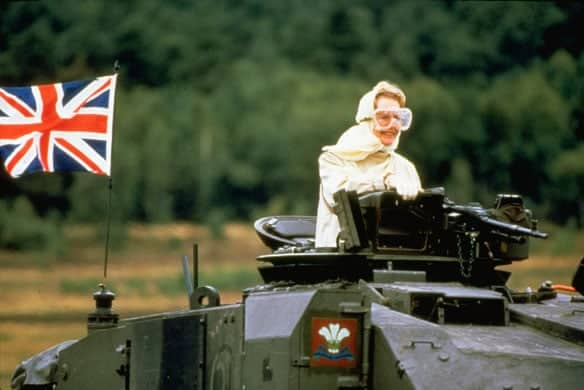
Eastern Front tank commander
Perhaps the real reason we have not seen an escalation is that the Russians feared a Truss-led spoiling attack from Estonia if they started any funny business in the south. It’s a story as old as time. An evil dictator with a massive army launches an invasion only to be defeated by a middle-aged lady in a heavy cavalry charge. I think there’s a Sabaton song just about that.
Wisely Putin held back the armies of Mordor.
Putin can only wish his chief diplomat was an equally accomplished tank commander. Instead, Sergey Lavrov’s expertise encompasses diplomacy alone.

Sergey Lavrov has never been photographed riding a tank. Lame.
In fact, Truss’ intersectional expertise stretches out into the sea. There is reason to believe she is also an expert reserve Admiral:
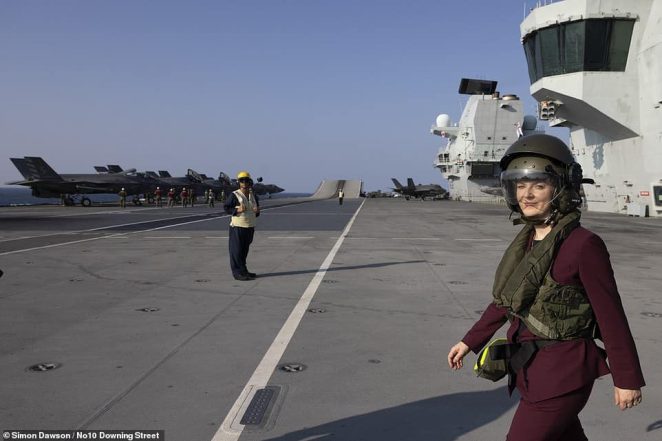
That should keep the Chinese deterred as well!

Putin Has Biden’s Attention, Now What?
By Marko Marjanović | Anti-Empire | December 7, 2021
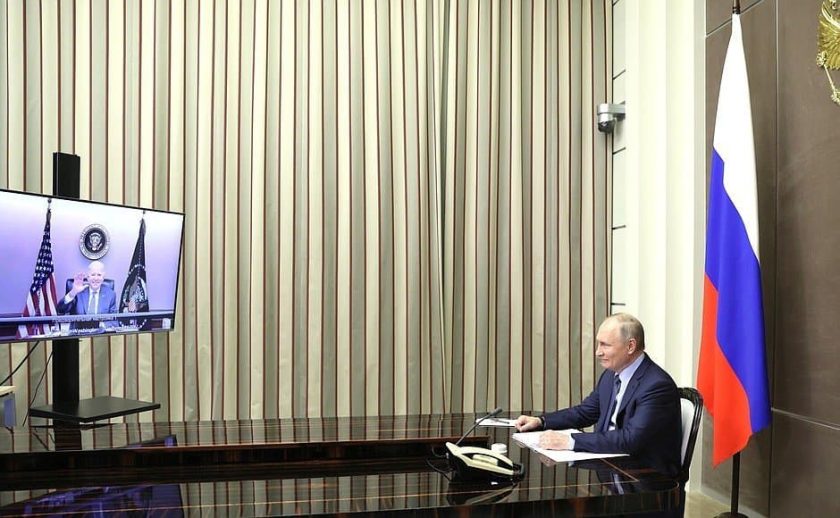
With the US raising alarm about a supposed Russian military buildup opposite of Ukraine, and the Russians denying anything out of the ordinary is taking place it is tempting to conclude that this is just more of the typical NATO scaremongering about Russia. Trouble is that I don’t believe that. On the contrary, I believe that something very serious is afoot.
The reason I think so isn’t that I have been listening to the Americans, but that I have been listening to the Russians. For years and years, the Russians have been complaining about the march of American & vassal missiles, training programs, weapon stockpiles, and units eastward. They have been complaining for so long that the picture of Russia as being all talk and never following up with real-world measures has become a meme among the more cynical Russia watchers.
Then, all of a sudden two things happened:
A.) Any and all talk of taking Donbass by force suddenly stopped in Ukraine. Instead, Kiev seems genuinely terrified it will be routed by the Russian military and is promising numerous Russian casualties (but tellingly not defeat) in a high-stakes attempt to deter the Russians.
B.) Biden initiated security talks with Vladimir Putin days after regime press revealed that something about the Russian military posture sent Washington into panic mode.
That tells me that the Russians finally did something that got Washington’s full attention. I don’t know what they did. Maybe it was the buildup opposite of Ukraine, maybe it was something else that we’re not being told about. Maybe it doesn’t even matter that much.
What does matter is that the Russian expectations of anything coming out of the initial Biden-Putin talk are nil. That means the Russian pressure — whatever it is — will continue.
The Russians aren’t going to be bought out by talks. They held talks with Biden in the Spring, and these were followed up by more provocations in the Summer. Now they want real, tangible appeasement. They have spelled out as much.
Trouble is, between the characteristic fecklessness and cowardice of the White House (whoever it is occupied by), and the vested Cold War interests I have no idea how they get that.
Any American president who works out a deal with the Russians and removes a missile or two will be denounced as “weak” by all the other institutions of the American Empire which stand to lose from peace, and which together are more powerful than a weak-willed presidency.
In reality, it is just the opposite, it is precisely the weakness of American presidents which makes a good deal with Russia impossible. What is better for the American and, say, the Romanian people, having some US missiles in the land of Dracula, or peace in Europe? Obviously the latter. But any president who concedes as much will face resistance and sabotage by the Pentagon, the CIA, NATO, the posturing Congress, the liberal-interventionist State Department, the think tanks, and the media.
Honestly, I have no idea how Putin, Shoigu, and Lavrov get the security guarantees that they want out of this one. If they succeed they are infinitely better strategists than I.
Let’s say it has indeed been a buildup opposite of Ukraine that forced the Americans to the table, now what?
There is no doubt that if Moscow is willing to sustain the cost in lives and in sanctions (and in Ukrainian bitterness and enmity) that the Russian military can take most of Ukraine.
The Russian military is larger than the Ukrainian one and has more firepower per pound, The two also share a long flat border — there are no convenient bottlenecks. The Russians can force the Ukrainian military to stretch out over a long frontline, pin it down in place, then apply defeat in detail to sectors with maneuver and firepower one by one.
Kiev is just 400 kilometers from the Russian border, and the Americans have already said — in so many words — that direct US military intervention almost certainly isn’t on the cards.
Trouble is this. If the DC Empire and the Ukraine were one organic being then guaranteeing the Russians a missile status quo in return for the Russians not overruning Kiev would be an absolute bargain. Problem is that, not only are the Empire and the Ukraine not a single entity, but the American Empire itself is a hydra with many heads, most of which stand only to gain from a Russian war in the Ukraine.
The White House is the only imperial institution that stands something to lose, namely prestige for having failed to deter the Russians. However, it also stands to lose by being painted as appeasing Moscow so it’s something of a moot point.
In all other respects, the Empire and its institutions stand only to gain. NATO can get a huge lease on life, Pentagon could be looking at the return of full US divisions to Europe, and the European vassals would be more regimented behind the US than ever before. As the cherry on top Russia would be left with the odd problem of policing and rebuilding Ukraine — while under a total Western economic embargo. Perhaps the biggest “win” of all would be the endless opportunity for moral condemnation of Russia over its treatment of “subjugated” Malaya Rus’.
So again, I think Russia can relatively easily occupy land in Ukraine, I just don’t know how it can trade pieces of that land in return for NATO guarantees to stop carrying out provocations that are in its self-interest.
The problem is that Russia enjoying peace and stability on its borders is in Russia’s interest but it is not in NATO’s interest. Why do you think that Russia was willing to strong-arm Donbass into abiding by the Minsk Agreement but the West never applied pressure on Kiev to do the same? Because ultimately fighting Russia to the last Ukrainian and seeing the Russian-Ukrainian enmity deepen is the stuff of dreams for NATO.
Featured Video

Liberty Cannot Exist Inside a Panopticon
or go to
Aletho News Archives – Video-Images
From the Archives
Left-leaning despisers of 9/11 Truth movement: Do you really believe in miracles?
David Ray Griffin | Global Research | 06 Jul 2010
An Open Letter to Terry Allen, Noam Chomsky, Alexander Cockburn, David Corn, Chris Hayes, George Monbiot, Matthew Rothschild, and Matt Taibbi.
[1]According to several left-leaning critics of the 9/11 Truth Movement, some of its central claims, especially about the destruction of the World Trade Center, show its members to be scientifically challenged. In the opinion of some of these critics, moreover, claims made by members of this movement are sometimes unscientific in the strongest possible sense, implying an acceptance of magic and miracles. … Full article
Blog Roll
 Aletho News
- White House envoy declares kinetic action against Yemen ‘fruitless’
- Ukraine deployed thousands of microdrones in Iraqi Kurdistan: Tasnim
- Iran calls for emergency UNSC meeting over Trump’s ‘brazen’ bomb talk, Israeli threats
- Iranian sources reveal details of Russia-China Hormuz proposal
- Plan for more US-Israel integration puts our military tech at risk
- Another Round Against Iran Will Break What Is Left of the Gulf
- SVR Report on Ukraine’s Mexican Drug Gang Links Could Pressure Zelensky, Won’t Change US Policy
- British Government Employees Were Fact-Checking the News at the BBC. Nobody Told You.
- Albania on fire: who’s behind the riots?
- Egypt’s Civil Democratic Movement rejects involvement in regional war
- If Americans Knew
- Mysterious bot accounts reportedly spread fake ‘man on the street’ videos for Michigan Senate candidate
- Israeli Defense Minister Katz Says Over 60 Lebanon Villages Have Been Destroyed
- Why Is Israel Running TV Ads in Iowa Ahead of the Midterms?
- Hind Rajab’s Alleged Killer Is in the United States. HRF Demands His Arrest.
- US Officials Face Fresh Pressure After Another American ‘Brutalized’ by Israeli Settlers in West Bank
- Israel-Backed Palestinian Militias Terrorize Displaced Families in Gaza
- FBI subpoenas pro-Palestine activists over Israeli weapons plant disruption
- Fourth winter arrives in wartorn Gaza, too early – Daily Update
- More on how Bari Weiss is using CBS on behalf of Israel
- What the UK Is Doing to Pro-Palestine Novelist Sally Rooney Is an Act of Orwellian Villainy
- No Tricks Zone
- Predictions Made By Renowned Climate Proifessor Over Past Decades Have Been Proven To Be Poor
- New Study Suggests Large Regions Of The Pacific Ocean Have Been Cooling For The Last 80 Years
- Germany’s Green Energy Debacle: High Energy Costs Force Kahla Porzellan to Close After 182 Years!
- New Study: 50 Years Of The Most Aggressive ‘Net Zero’ Policies Can Only Affect The Global Climate By 0.03°C
- US September “Heat” Was No Record…Many Records Set Decades Ago
- Latest European Green Energy Debacle; Portugal’s Largest Flagship Solar Park Insolvent!
- Green Energy Debacle: German Expert Professor Fritz Vahrenholt Warns Of Severe Economic And Social Consequences
- Two More Paleo Reconstructions Affirm Meters-Higher Sea Levels Across Ireland, Brazil 7000-6000 Years Ago
- New Study: Earth And Venus Surface Warmth Largely Explained By Convection And Lapse Rate, Not CO2 Or Radiation
- 2025 Nature Paper Claiming Worsening Global Drought Gets RETRACTED …Heavily Flawed

