Putin to Biden: Finlandize Ukraine, or We Will
By Patrick J. Buchanan | December 7, 2021
Neocons and Republican hawks such as the late John McCain sought to bring Ukraine and two other ex-Soviet republics, Georgia and Moldova, into NATO. Putin, who served in the KGB in the late Soviet era and calls the breakup of the USSR the “greatest geopolitical catastrophe” of the 20th century, is now saying: Enough is enough.
Either the U.S. and NATO provide us with “legal guarantees” that Ukraine will never join NATO or become a base for weapons that can threaten Russia — or we will go in and guarantee it ourselves.
This is the message Russian President Vladimir Putin is sending, backed by the 100,000 troops Russia has amassed on Ukraine’s borders.
At the Kremlin last week, Putin drew his red line:
“The threat on our western borders is … rising, as we have said multiple times. … In our dialogue with the United States and its allies, we will insist on developing concrete agreements prohibiting any further eastward expansion of NATO and the placement there of weapons systems in the immediate vicinity of Russian territory.”
That comes close to an ultimatum. And NATO Secretary General Jens Stoltenberg backhanded the President of Russia for issuing it:
“It’s only Ukraine and 30 NATO allies that decide when Ukraine is ready to join NATO. … Russia has no veto, Russia has no say, and Russia has no right to establish a sphere of influence trying to control their neighbors.”
Yet, great powers have always established spheres of influence. Chinese President Xi Jinping claims virtually the entire South China Sea that is bordered by half a dozen nations. For 200 years, the United States has declared a Monroe Doctrine that puts our hemisphere off-limits to new colonizations.
Moreover, Putin wants to speak to the real decider of the question as to whether Ukraine joins NATO or receives weapons that can threaten Russia. And the decider is not Jens Stoltenberg but President Joe Biden.
In the missile crisis of 60 years ago, the U.S., with its “quarantine” of Cuba and strategic and tactical superiority in the Caribbean, forced Nikita Khrushchev to pull his intermediate-range ballistic missiles, which could reach Washington, off of Fidel Castro’s island.
If it did not do so, Moscow was led to understand, we would use our air and naval supremacy to destroy his missiles and send in the Marines to finish the job.
Accepting a counteroffer for the U.S. withdrawal of Jupiter missiles from Turkey, Khrushchev complied with President John F. Kennedy’s demand. Russia’s missiles came out. And Kennedy was seen as having won a Cold War victory.
Now it is we who are being told to comply with Russia’s demands in Ukraine, or Russia will go in to Ukraine and neutralize the threat itself.
The history?
When the Warsaw Pact collapsed and the USSR came apart three decades ago, Russia withdrew all of its military forces from Central and Eastern Europe. Moscow believed it had an agreed-upon understanding with the Americans.
Under the deal, the two Germanys would be reunited. Russian troops would be removed from East Germany, Poland, Czechoslovakia, Hungary, Bulgaria and Romania. And there would be no NATO expansion into Eastern Europe.
If America made that commitment, it was a promise broken. For, within 20 years, NATO had brought every Warsaw Pact nation into the alliance along with the former Soviet republics of Lithuania, Latvia and Estonia.
Neocons and Republican hawks such as the late John McCain sought to bring Ukraine and two other ex-Soviet republics, Georgia and Moldova, into NATO.
Putin, who served in the KGB in the late Soviet era and calls the breakup of the USSR the “greatest geopolitical catastrophe” of the 20th century, is now saying: Enough is enough.
Translation: “Thus far and no further! Ukraine is not going to be a member of NATO or a military ally and partner of the United States, nor a base for weapons that can strike Russia in minutes. For us, that crosses a red line. And if NATO proceeds with arming Ukraine for conflict with Russia, we reserve the right to act first. Finlandize Ukraine, or we will!”
The problem for Biden?
In Ukraine and in Georgia, as we saw in the 2008 war, Russia has the tactical and strategic superiority we had in 1962 in Cuba. Moreover, while Ukraine is vital to Russia, it has never been vital to us.
When President Franklin D. Roosevelt recognized Joseph Stalin’s USSR in 1933, Moscow was engaged in the forced collectivization of the farms of Ukraine, which had caused a famine and the deaths of millions. We Americans did nothing to stop it.
During the Cold War, America never insisted on the independence of Ukraine. Though we celebrated when the Baltic states and Ukraine broke free of Moscow, we never regarded their independence as vital interests for which America should be willing to go to war.
A U.S. war with Russia over Ukraine would be a disaster for all three nations. Nor could the U.S. indefinitely guarantee the independence of a country 5,000 miles away that shares not only a lengthy border with Mother Russia but also a history, language, religion, ethnicity and culture.
Forced to choose between accepting Russia’s demand that NATO stay out of Ukraine and Russia going in, the U.S. is not going to war.
Biden should tell Putin: The U.S. will not be issuing any NATO war guarantees to fight for Ukraine.
Russia reveals what Putin asked of Biden
RT | December 7, 2021
In a “frank and businesslike” conversation Russian President Vladimir Putin asked his US counterpart Joe Biden for guarantees that NATO won’t expand further east or deploy offensive weapons to countries like Ukraine.
Moscow is “seriously interested” in obtaining “reliable and firm legal guarantees” excluding NATO’s further expansion eastward and deployment of “offensive strike weapons systems in countries adjacent to Russia,” the Kremlin said in a readout of Tuesday’s call between the two leaders.
Putin’s proposal came in response to Biden’s “concerns” about Russian troops allegedly threatening Ukraine and threats of US and allied sanctions against Russia, a subject that arose during the two-hour call. The Russian leader responded that it was NATO “making dangerous attempts to conquer Ukrainian territory” and “building up its military potential at our borders.”
When asked about this, Biden’s national security adviser Jake Sullivan said that the US has made “no such commitments or concessions.”
Putin used specific examples to illustrate the “destructive” policy of Kiev, which he said was aimed at completely dismantling the Minsk agreements and the ‘Normandy format’ talks. He also expressed Moscow’s serious concerns about “provocative actions” by the government in Kiev against the residents of Donetsk and Lugansk, two breakaway regions in eastern Ukraine.
Last week, before the date of the meeting was announced, Deputy Foreign Minister Sergey Ryabkov said that the situation in Europe would be at the top of the agenda for the two leaders to discuss. The diplomat stressed that “contact is badly needed; we have multiplying problems. There is no progression on bilateral affairs, which are more and more spiraling into a phase of acute crisis.”
The talks come amid heightened tensions between Washington and Moscow over the situation on the Russian-Ukrainian border, which the White House has signaled as a key area on which bilateral negotiations are needed.
American and Ukrainian officials have repeatedly accused Russia of plotting to invade its neighbor in recent weeks. Earlier this month, US Secretary of State, Antony Blinken implored Moscow to de-escalate its purported aggressions against Kiev, or face “severe consequences.”
Russia has repeatedly denied allegations put forward by Western officials and outlets that it will launch an offensive against Ukraine. Kremlin press secretary Dmitry Peskov has blasted the accusations as groundless, dubbing them as “hysteria” whipped up in the Anglophone and Ukrainian media.
Meanwhile, Ukraine’s hopes to be admitted to NATO and the potential eastwards expansion of the US-led military bloc have been a point of contention for Moscow. Ahead of the video conference, the Russian president announced that he will request discussions with NATO to ensure the US-led military bloc does not edge closer to his country’s frontiers. Speaking last week, Putin said that he will “insist on guarantees being set out to exclude the possibility of NATO moving any further to the east, and deploying threatening weapons close to Russian territory.”
Foreign Minister Sergey Lavrov noted the day before that “significant units and armaments from NATO countries, including American and British, are being moved closer to our borders.”
The pair last met in the Swiss city of Geneva in June. The meeting was hailed as productive by the two heads of state, covering topics such as nuclear proliferation and managing the Covid-19 pandemic. However, the Kremlin said that it will take a long time for constructive engagement to return and the two sides have recently accused each other of escalating military tensions in Eastern Europe.
Palestine Action Activists Found NOT GUILTY After Defacing Israeli Arms Company In UK
Palestine Action | December 6, 2021
Three Palestine Action activists, dubbed the ‘Elbit Three’, have today been found not guilty of criminal damage charges in a trial taking place at Newcastle-under-Lyme Magistrates Court. The trial, which commenced on Friday 3rd December, saw Elbit Systems and the Crown Prosecution Service attempt to criminalise individuals who took a stand against the manufacture of drones and drone parts. The products manufactured at the site of the protest, the UAV Engines factory in Shenstone, Staffordshire, are key components for a range of Elbit’s combat drones, used extensively by Israel for bombardments of Gazan civilians.
Elbit Systems are Israel’s largest private arms company, supplying 85% of Israel’s drone fleet. Their Hermes drones, manufactured with UK-made components, are regularly deployed in bombardments of Gaza, with Elbit also supplying a range of surveillance equipment, armaments, and specialist military technologies for the Israeli military and police. Palestine Action have undertaken a campaign of sustained direct action against Elbit Systems – across their 10 sites in the UK – with this action in Shenstone having occured in January 2021, six months since Palestine Action launched. Despite many dozens of actions taken, and over £15,000,000 in damages caused (according to police), this is the first time that activists had faced trial, with all previous charges having been dropped in the run-up to trial dates.
The presiding judge, Judge Waites, stated that the Crown had failed to prove that convicting the defendents would be proportionate with their freedom to protest. He stated further points which included: Palestine is an important issue, the arms trade is an important issue, the defendants believed in what they were doing, and the location was specifically chosen. These are the points that Palestine Action has long stated: through targetted and deliberate direct action, individuals can make a measured impact on the lives of civilians in Palestine by disrupting and undermining Israel’s arms trade.
This verdict represents a serious defeat for Elbit Systems, who have long maintained that their business is lawful and that they are therefore to be protected from such actions. This belief has been shared by the British state: the police have offered a round-the-clock rapid response and extensive protection to Elbit’s death factories, and the CPS have attempted to prosecute those who take a stand against Elbit’s business of bloodshed.
The defence, represented by Palestinian barrister Mira Hammad and Richard Brigden of Garden Court North (instructed by Kelly’s solicitors), presented their case that the action taken was to prevent a greater crime. An activist involved in the trial elaborated, stating that the action was taken to shut down the factory for one day in an attempt to stem the flow of drones and stop the bombings. They stated that Elbit provide 85% of Israel’s drones, with Elbit describing themselves as the ‘backbone’ of the Israeli airforce, adding that there is extensive documentation of the drones being used for attacks on the civil population of Gaza. They stated that this is not only during intensive military excursions, but also for extrajudicial killings and indescriminate bombings – with Elbit drones being linked directly to the killing of four children playing on a beach in Gaza in 2014.
Another activist, Sarah, later stated that:
“Throwing this paint may not protect Gaza. What protects Gaza is stopping the bombing. Elbit produce weapons, tanks and drones used to commit crimes against humanity, and this is what is unlawful. Export licenses should not be granted while Elbit continue to violate human rights. In the face of these crimes, you have to do something. If you do nothing, then Elbit continues to make its smart weaponry which enables Israel to kill efficiently. Elbit has no business being allowed to be in the UK. It has no values that are shared with humanity”. Following this, a standing ovation was given from the public gallery.
NATO’s Jens Stoltenberg needs to calm it down
By Daniel Larison | Responsible Statecraft | December 3, 2021
Twice in the last two weeks, NATO Secretary-General Jens Stoltenberg has made public comments that threaten to worsen already strained relations between Russia and the alliance.
Instead of calming things down, Stoltenberg has been carelessly ratcheting up tensions over nuclear weapons in Europe and the conflict in Ukraine. At exactly the moment when the U.S. and NATO need to be working to deescalate the situation with Russia over Ukraine, the top official in NATO has been throwing kerosene on the flames.
While he was urging the new German coalition government to continue hosting U.S. tactical nuclear weapons, Stoltenberg made the dangerous suggestion that the weapons could end up with NATO members to the east of Germany: “So, of course, Germany can, of course, decide whether there will be nuclear weapons in your country, but the alternative is that we easily end up with nuclear weapons in other countries in Europe, also to the east of Germany.” Raising the possibility of moving these weapons closer to Russia was bound to elicit a sharply negative reaction, and that is what happened.
Stoltenberg’s remarks prompted immediate outrage in Moscow, and it led the Belarusian leader Alexander Lukashenko to announce this week that Belarus would welcome Russian nuclear weapons to its territory in response to any NATO redeployment to the east. Stoltenberg’s warning may have been intended for Berlin, but it had its greatest and most destabilizing impact in Moscow and Minsk. At a time when the Russian government already perceives a growing threat coming from the West, talking about moving nuclear weapons into eastern Europe was a serious mistake.
It is worth noting that the continued presence of U.S. nuclear weapons in Europe serves no real purpose. As Global Zero’s Derek Johnson has pointed out, these weapons are a relic of the Cold War and they were originally deployed to be used against countries that are now members of NATO. In any event, the new German government still supports nuclear sharing, so the weapons stored in Germany won’t be going anywhere in the near future. Nonetheless, conjuring up the specter of American nuclear weapons moving closer to Russia was enough to further sour relations. Coming on the heels of the breakdown in NATO-Russian relations that began with the expulsion of Russian diplomats in October, this could only serve to deepen mistrust between Russia and the alliance.
Stoltenberg also repeated the standard NATO line that Russia has no part in decisions about alliance expansion: “Russia has no veto, Russia has no say, and Russia has no right to establish a sphere of influence trying to control their neighbors.” Since Russia has already demonstrated its ability to thwart at least one aspirant state’s ambitions to join the alliance, the Secretary-General’s platitudes seemed almost as if he were trying to dare Moscow into taking more aggressive action. The U.S. and NATO may not like it, and it may not be the way that we want things to be, but the fact is that Russia absolutely does have a veto in practice over which of its neighbors become members of an anti-Russian military alliance. We already know that the Russian government will exercise that veto. The Secretary-General’s saying that Russia has no say is practically an invitation to Putin to prove him wrong.
Whether NATO officials agree with the assessment or not, the Russian government views NATO as the principal military threat to their country. Given the Russian experience of suffering devastating attacks from the west several times over the last two hundred years, their leaders have naturally been wary of the eastward expansion of the alliance, and they have made it very clear that they consider further advances to be intolerable. NATO’s “open door” to Ukraine and Georgia may seem like so much boilerplate rhetoric to Western officials, but it needlessly antagonizes Russia while offering these countries false hope of alliance membership that will likely never materialize. Stoltenberg’s latest remarks will likely have the same effect of angering Russia while giving the Ukrainian government the mistaken impression that their future entry into the alliance is guaranteed. One could hardly ask for a message more likely to promote misunderstanding and miscalculation.
It is not a coincidence that heightened tensions between Russia and Ukraine have been preceded by Kyiv’s frequent agitation for a Membership Action Plan over the last year and the Biden administration’s endorsement of Ukraine and Georgia’s future alliance membership in recent months. The Biden administration’s professions of “ironclad” and “unwavering” commitment to Ukraine have similarly been as unhelpful as they are hard to believe. While these statements of support are meant to discourage Russia from taking aggressive actions, it is the close military relationship between Ukraine and Western governments that so alarms Russia and provokes the behavior that these statements are supposed to deter. The more that the U.S. and its allies emphasize their commitment to Ukraine, the more that Moscow is liable to perceive Ukraine’s cooperation with Western governments as a threat.
Stoltenberg’s statement that Russia “has no right to establish a sphere of influence” is true but also irrelevant to the issues at hand. No state has ever had a “right” to establish a sphere of influence, but many states, including the United States, have had them all the same. All states in theory have the right to conduct their foreign policy however they see fit, but if a country chooses to align itself with its neighbor’s major power rival then that neighbor is bound to view this choice as a potential threat to its own security. When that country then builds up a military relationship with that rival and its allies, that will seem to be an even greater threat. That is how the Russian government views the intensifying military cooperation between Ukraine and Western governments.
The way out of this deteriorating situation is to scale back the confrontational rhetoric, rescind the empty promises of future NATO membership, and recognize how U.S. and NATO actions have fed into Russian threat perceptions. Secretary-General Stoltenberg has chosen to go in the opposite direction. That will make it more difficult to defuse tensions with Russia.
Putin has called for “legal guarantees” that there will be no further eastward expansion of NATO, and this is a demand that the alliance could agree to without much difficulty. Closing the door to further NATO expansion would not resolve all problems with Russia, but it would remove a significant irritant from the relationship. It would also stop stringing the Ukrainian government along with a promise that was never going to be honored. Since NATO made that promise in Bucharest in 2008, it has been the cause of nothing but instability and trouble, and the alliance, the U.S., and all of Europe would be better off without it.
Putin Wants Formal Security Guarantees From the Empire, No to Ukraine as a NATO Missile Silo
Ceremony for presenting foreign ambassadors’ letters of credence
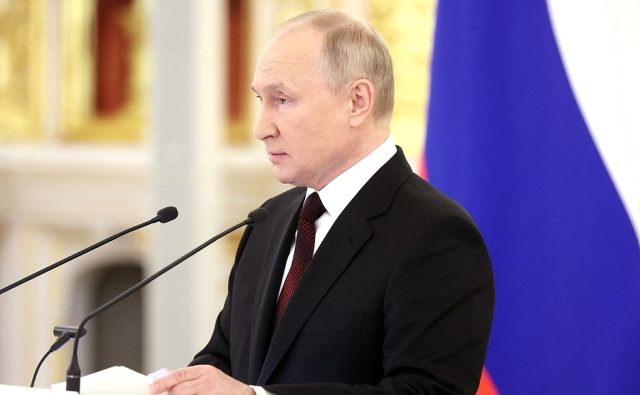
The Kremlin | December 1, 2021
… “[W]e express our concern not only over the fact that the international community is acting separately and cannot unite to address truly important problems, but also over how some of our partners are behaving towards our country, towards Russia, trying to restrain our development in every possible way, to exert sanctions pressure and, moreover, to escalate tensions near our borders.
By the way, the threat on our western border is really growing, and we have mentioned it many times. It is enough to see how close NATO military infrastructure has moved to Russia’s borders. This is more than serious for us.
In this situation, we are taking appropriate military-technical measures. But, I repeat, we are not threatening anyone and it is at the very least irresponsible to accuse us of this, given the real state of affairs. This would mean laying the blame at the wrong door, as the Russian saying goes.
In my speech at the Ministry of Foreign Affairs I already stressed that the priority facing Russian diplomacy at this juncture is to try to ensure that Russia is granted reliable and long-term security guarantees.
While engaging in dialogue with the United States and its allies, we will insist on the elaboration of concrete agreements that would rule out any further eastward expansion of NATO and the deployment of weapons systems posing a threat to us in close proximity to Russia’s territory. We suggest that substantive talks on this topic should be started.
I would like to note in particular that we need precisely legal, juridical guarantees,because our Western colleagues have failed to deliver on verbal commitments they made. Specifically, everyone is aware of the assurances they gave verbally that NATO would not expand to the east. But they did absolutely the opposite in reality. In effect, Russia’s legitimate security concerns were ignored and they continue to be ignored in the same manner even now.
We are not demanding any special terms for ourselves. We understand that any agreements must take into account the interests of both Russia and all other states in the Euro-Atlantic region. A calm and stable situation should be ensured for everyone and is needed by all without exception.
That said, I would like to stress that Russia is interested precisely in constructive collaboration and in equitable international cooperation, and this remains the central tenet of Russian foreign policy. I hope that you will convey this signal to the leaders of your states.” … Full address
Biden Mulls Sending Extra Weapons & Trainers To Ukraine Amid Dubious Reports Of “Russian Invasion”
By Tyler Durden | Zero Hedge | November 24, 2021
Here we go again: the ratcheting tit-for-tat threats currently being unleashed between Moscow and Washington arguably hasn’t been this intense since the height of the Donbass conflict of years ago, and the Crimea crisis. It’s leading to the Biden administration mulling ramping up arms transfers to Kiev.
CNN on Tuesday is citing multiple defense sources to report “The Biden administration is weighing sending military advisers and new equipment including weaponry to Ukraine as Russia builds up forces near the border and US officials prepare allies for the possibility of another Russian invasion.
And yet as we’ve reviewed, there’s still as yet little to nothing in the way of hard evidence that Russia is setting in motion any kind of plans to “invade Ukraine” – as Bloomberg last week first reported based on anonymous US sources. Much of the speculation appears based on satellite images of Russian troop movements taking place significantly far from Ukraine’s border, with Moscow’s constant refrain to the West being that it can move its own troops within Russia’s sovereign borders wherever it wants to.
But this new US plan to not just send more military hardware – but also US military advisers – would mark a serious escalation, as the Kremlin has recently warned it would see any kind of NATO forces buildup inside Ukraine as violating its “red lines” which would require taking action.
According to the fresh CNN report, the proposed lethal aid package now under consideration by the White House could include stinger missiles – which Moscow would without doubt consider a severe escalation:
The discussions about the proposed lethal aid package are happening as Ukraine has begun to warn publicly that an invasion could happen as soon as January. The package could include new Javelin anti-tank and anti-armor missiles as well as mortars, the sources said.
Air defense systems, such as stinger missiles, are also under consideration, and the Defense Department has been pressing for some equipment that would have gone to Afghanistan — like Mi-17 helicopters — to instead be sent to Ukraine. The Mi-17 is a Russian helicopter that the US originally purchased to give to the Afghans. The Pentagon is now weighing what to do with them after the US withdrawal from Afghanistan in August.
And in particular the Javelins are seen as deadly and effective against Russia’s T-80 tanks. Recently, Moscow has accused pro-Ukrainian forces of heightened attacks on pro-Russian separatists in Ukraine’s east over the past months, which has included multiple deaths from sporadic mortar fire.
The past year has seen NATO military exercises utilize closer Ukrainian army and naval participation…
Already in response to the rumors and reports of more US weapons and trainers sent to Ukraine, Russia is responding with threats of its own to send its weapons into eastern Ukraine.
Kremlin spokesman Dmitry Peskov said, “we shouldn’t rule out the possibility of sending military advisers and weapons to Ukraine, because this is already taking place. Military advisers are arriving there, weapons are supplied there — not only from the United States, but also from other NATO countries. And all this, of course, leads to a further aggravation of the situation on the border line.”
Previously on Monday the Kremlin vehemently denied the Western reports of any planned-for “invasion”, with government spokesman Peskov explaining that currently the Russian military is merely engaged in the “usual background level” of military maneuvers – similar to the training drills that ended up generating false reports last April and May of a “planned Ukraine invasion”. That prior situation, like the current one, involved Russian troops and weaponry being observed at least 60km from the actual Ukrainian border, and not along it.
During the statement, Peskov actually turned the charges back on NATO, saying, that in Ukraine “The number of provocations has increased significantly and these provocations are conducted using weapons delivered by NATO.” He blamed Kiev and its backers for the soaring tensions, calling its own military build-up “alarming” – thus each side appears to be ramping up troop readiness based on accusing the other of a “build-up” of forces.
Man’s Inhumanity to Man Accelerated
By Gary D. Barnett | Lew Rockwell | November 16, 2021
“The belief in a supernatural source of evil is not necessary; men alone are quite capable of every wickedness.”
~ Joseph Conrad, Under Western Eyes pt. 2, ch. 4 (1911)
It is not only difficult to understand, but almost impossible to believe, that only a small fraction of mankind can produce what is described as most of the evil, while virtually all the rest of society voluntarily allows it. It matters not that most of the herd believes that mankind is basically good, for so-called good men do not stand idle while bad men pillage, plunder, and murder. Good men do not hide in the face of adversity or due to terror levied at the hands of the state monsters. Good men do not maim and kill on orders from warmongers and criminals in government without legitimate cause, of which none exists. Good men do not bend and comply to immoral mandates handed down by self-proclaimed elites and political scum. Good men do not succumb to cowardice. Those who do nothing in the face of evil then are not good men. So, is man really basically good, or is this just a falsely created myth meant to protect the fragile psyche of the masses so that weak and inadequate humans can continue to shield themselves from guilt through dishonesty, while doing nothing to prove their worth?
Man’s inhumanity to man has accelerated greatly, as the obvious evil among us, and those who willingly allow that evil to exist and prosper, are knowingly and unknowingly working together to bring about the destruction of mankind.
Some may take offence at the claim that man is not inherently good, but can they defend that position given the state of the world we live in today, where the masses take little or no responsibility whatsoever for their extreme non-caring and apathetic behavior that has led to total tyranny? In this country called the ‘United’ States, there is essentially no unity left, only divisiveness and antagonistic loathing survive. Love and compassion have been replaced by hate and indifference. Do unto others as you would have them do unto you is now rarely if ever considered, while self-fulfillment, self-indulgence, envy, and an abandonment of self-responsibility reign supreme. The Golden Rule has disappeared from view in this society in favor of do unto others in order to gain for self. This reversal of the basic premise of good has left only emptiness and misery, and this state of mind does not allow for the capability of compassion. How can a country or world survive under these barren and meaningless conditions?
Consider the fact that mankind has existed throughout history in a perpetual state of war. War is essentially and purposely the slaughter of others for the benefit of the abhorrent rulers and state, little or nothing more. It requires that its participants, whether they claim to be ‘patriots,’ (a desired state lie and excuse for those prosecuting and participating in this evil, ) righteous protectors, or saviors of country, to become murderers of the innocent; not because they are defending themselves, their families, their fellow men, or their country, but because they are doing the bidding of the heinous ruling class and the governments that prosecute this carnage only for the sake of money, power, and control. Hundreds upon hundreds of millions, and likely over a billion lives have been lost due to war throughout history, and this is just the beginning of what is to come. Is this the best that this human species can accomplish? Is this the true essence of man? Is man so consumed by a deficiency of character and deep-rooted hate that war is eternally inevitable and desired? Are death and destruction permanent ambitions of mankind, and is mass indifference by the collective all that is necessary in order for the carnage of the ruling class to continue its quest for total domination?
At this particular point in time war is raging in the U.S. and in every corner of the world, but it is not any war against some manufactured foreign enemy, it is not a war of missiles and bombs, it is not a war brought about by any false flag military attack, but it is a deadly war of stealth. No, this war we are in today is not about dictators or terrorists, it is aggressive war by this and every other state against its people; a war against humanity itself. The ruling class who stay hidden from sight and their pawns and enforcers in government, are at war against the rest of us. The goals of this globalist cabal are of course power and control, and a great reset of all aspects of life, but in order to accomplish these grand agendas, the murder and slaughter of hundreds of millions, if not billions is sought. This will not be accomplished simply by traditional warfare, it must be done covertly, and with the blessing and voluntary acceptance by those being eliminated and also those left who are to be controlled. Hence, the fake ‘Covid pandemic,’ the poisonous killer ‘vaccines,’ the manmade ‘climate change’ lie, and the continued notion of state as master and ‘protector’ of the people, still continue to be the catalysts driving this carnage of life and liberty against the people in order to achieve this totalitarian takeover.
While this analysis may seem defeatist in nature, or based on a doomsday scenario, it is not meant for that purpose. This harsh message is only necessary in order to hopefully awaken the mind, spirit, and souls of all those still passionate enough about individual freedom to do what is required to regain it. We are all men, we all fail at times, but constant, allowed, and accepted failure, or voluntary acquiescence to false authority, is simply a willing compliance to a master’s commands, and can only lead to slavery and despair. We have but one life on this earth, and to allow that gift to be destroyed due to an absence of feelings, compassion, and courage, is self-destruction. These words are meant to awaken as many as possible to their own sorry plight created by their own hand; all due to the fact that mass indifference has consumed this society. That indifference not only guarantees defeat at the hands of evil, it breeds evil in the minds of all men consumed by it. Without a change of heart and mind, without knowledge of the facts of one’s own existence, and without honest acceptance of reality, we all face a hell on earth. That should never be accepted by any who desire to be free.
To challenge reality is to ignore truth. To ignore truth is to accept defeat by the wicked. This will be our fate if the people do not soon wake up and stop it. If this madness continues, the people will have allowed this ruling class to get its way. That should never be acceptable to any who desire freedom. That should never be acceptable to any who desire life.
To gain freedom only requires the desire and courage of the many to say no, and to say it loudly.
All this havoc, this misfortune, this ruin, descends upon you not from alien foes, but from the one enemy whom you yourselves render as powerful as he is, for whom you go bravely to war, for whose greatness you do not refuse to offer your own bodies unto death. He who thus domineers over you has only two eyes, only two hands, only one body, no more than is possessed by the least man among the infinite numbers dwelling in your cities; he has indeed nothing more than the power that you confer upon him to destroy you.
~ Étienne de La Boétie, book Discourse on Voluntary Servitude–1548
Gary D. Barnett [send him mail] is a retired investment professional that has been writing about freedom and liberty matters, politics, and history for two decades. He is against all war and aggression, and against the state.
NATO submarine caused Kursk sinking that killed 118 Russian sailors, ex-admiral claims
By Layla Guest | RT | November 22, 2021
The catastrophic sinking of the Russian nuclear-powered Kursk submarine more than two decades ago was the result of a collision with a stricken NATO vessel in the Barents Sea, a former high-ranking navy chief has insisted.
The ‘Kursk’ sank on August 12, 2000 at a depth of 108 meters, claiming the lives of all 118 crew members and sparking the first major international crisis of Vladimir Putin’s presidency. An official investigation commissioned by the Russian government ruled two years later that the incident was the result of a torpedo explosion, which then triggered the detonation of ammunition on board.
However, in an interview with RIA Novosti, aired on Monday, former Northern Fleet commander Vyacheslav Popov offered a theory on how the incident might have happened. According to him, a vessel operated by a NATO power got too close to Moscow’s vessel, colliding with its bow and damaging the torpedo tube, which was followed by an explosion. The compartment then flooded, sending the sub to the depths of the sea.
“The submarine that collided with ‘Kursk’ was following it, apparently, but failed to ensure safety in the sea’s environment and all other conditions, approached too close, or the Kursk maneuver led to a loss of contact,” he said.
Popov claimed he knew the name of the sub belonging to the US-military led bloc “with a 90% probability.” However, he admitted he did not have sufficient available evidence to make the case publicly at present.
According to the former naval chief, who served until 2001, the vessel was in the region where it collided with ‘Kursk’. He also noted that SOS signals were sent from special equipment that Russian boats were not equipped with, implying another submarine must have been present.
Viktor Kravchenko, a former chief of staff of the Russian Navy, later agreed with Popov’s theory, remarking he was “also inclined to believe this version” of the demise of the Kursk, based on circumstantial evidence.
Three NATO vessels, the British ‘Splendid’ and American subs ‘Toledo’ and ‘Memphis’, were reportedly in the vicinity of Russian military exercises in the Barents Sea at the time. Neither Washington nor London provided documents on the condition of their vessels after Moscow requested the information.
However, the Russian government maintains that the official investigation’s conclusion is the most likely, with many analysts pointing out the period was a challenging time for the Russian military. A combination of underfunding, aging Soviet hardware, and low morale could all have contributed to the incident.
Putin, then only months into his first term as president, took the brunt of much of the criticism for the Kursk tragedy, with the large-scale loss of young Russian sailors sparking sorrow and outrage. Failed rescue efforts caused anger and frustration both domestically and worldwide.
Popov’s claims come amid heightened concerns over NATO’s activity around Russia’s borders. On Friday, the bloc’s top official, Jens Stoltenberg, proposed deploying American nuclear warheads around Eastern Europe to counter a supposed threat posed by Moscow.
In response, the Kremlin said such a statement would mean that the Founding Act of Russia-NATO relations “no longer exists.” Under this document, inked in 1997, the two parties do not consider each other rivals. It guarantees no nuclear weapons will be deployed to new NATO members after this date.
Theater of Absurd… Pentagon Demands Russia Explain Troops on Russian Soil
Strategic Culture Foundation | November 19, 2021
The United States Secretary of Defense Lloyd Austin this week performed impressive, albeit pathetic, mental gymnastics. In a press conference, the Pentagon chief called on Russia to be more transparent about troop movements “on the border with Ukraine”. In others words, on Russian soil.
Meanwhile, the absurd hypocrisy sees U.S. and NATO forces brazenly escalating their offensive presence on Russia’s borders, especially in the Black Sea region.
Here’s an Associated Press clip on the Pentagon press conference: “American officials are unsure why Russian President Vladimir Putin is building up military forces near the border with eastern Ukraine but view it as another example of troubling military moves that demand Moscow’s explanation, Defense Secretary Lloyd Austin said Wednesday.”
The report quotes Austin as saying: “We’ll continue to call on Russia to act responsibly and be more transparent on the buildup of the forces around on the border of Ukraine… We’re not sure exactly what Mr Putin is up to.”
This dubious talent for mind-bending mental gymnastics and double-think is shared with other members of the Biden administration. Last week, America’s top diplomat Antony Blinken claimed that Russia was about to invade Ukraine yet at the same time the U.S. Secretary of State confessed similar ignorance about what “Putin is up to”.
How is it possible to engage in meaningful dialogue with such vacuous people who are supposed to be government leaders – and leaders too of the self-declared world’s most powerful, most brilliant nation? No undue offense intended, but it would probably be more productive to engage in a dialogue with the bewildering characters from Samuel Beckett’s absurdist play Waiting for Godot.
Russia has repeatedly dismissed all claims about it threatening Ukraine or any other country with invasion. Moscow also disputes “unreliable” information touted by the Biden administration and Western media of troop buildup near Ukraine on its western flank. Western media reports have relied on dodgy commercial satellite data purporting to show Russian military maneuvers. It is contemptible that senior U.S. government figures are basing grave allegations against Russia on such ropy sources. That in itself speaks volumes about the deterioration in Washington’s diplomatic professionalism and political intelligence.
Secondly, the salient fact being missed in all the hullabaloo is this: Russian troops and equipment are on Russia’s sovereign territory. It is the height of absurdity for U.S. officials to demand that Russia “explain” and be “more transparent” about its own national defenses. That speaks of a hyper-arrogance among American politicians that are deforming their ability to think reasonably.
There is an analogy here with the outcry this week over Russia’s successful missile test against a Soviet-era satellite in orbit. The Biden administration condemned Russia for creating “space junk” and weaponizing space while ignoring the fact that the U.S. previously carried out the same kind of missile strike and, arguably has been trying to weaponize space since the Reagan administration’s “star wars” program during the 1980s.
In any case, the U.S. charges of Russia’s military buildup on its own territory are made all the more ridiculous when we consider the actual increase in NATO forces in Ukraine and the Black Sea region – right on Russia’s western doorstep.
In a major speech this week delivered at the Russian foreign ministry, President Putin noted again how Western powers have continually failed to register Moscow’s national security concerns over the expansion of NATO forces along Russia’s borders. He described this inability for cognition of what should be an obvious grievance as “very peculiar”.
The Kremlin has suggested that the increasing NATO offensive presence near Russia’s borders is not due to stupidity, but rather is aimed at provoking a conflict. Russia is strenuously resisting the danger of an armed confrontation, and yet the provocations continue.
Nearly two weeks ago, William Burns, the head of the CIA made a high-profile visit to Moscow during which he held discussions with senior Kremlin figures, including President Putin. We can safely assume that Burns was told in no uncertain terms that the buildup of U.S. and NATO forces near Russia’s territory is a red line that will presage a response from Russia.
But these red lines continue to be skirted by Washington and its NATO allies.
More perplexing, too, are the moves by the U.S.-backed Kiev regime to escalate the conflict in Ukraine against the ethnic Russian population in the separatist Donbas region. The ultranationalist regime has been waging a low-intensity war against the Donbas since the U.S.-backed coup in Kiev in 2014. The Americans and other NATO powers are increasing weapon supplies and military trainers to the regime, emboldening it to repudiate any peaceful settlement of the eight-year conflict.
Only last month, Pentagon chief Austin was in Kiev where he recklessly endorsed the joining of the NATO bloc by Ukraine. That is in spite of numerous warnings from Moscow that such a move would be an unacceptable destabilization.
The stepped-up war drills by NATO in the Black Sea region are inevitably leading the Kiev regime to resile from legally binding commitments to the Minsk Peace accord of 2015 – brokered by Russia, Germany and France. The release this week of diplomatic communications by the Russian Foreign Minister Sergei Lavrov clearly demonstrates that Germany and France are complicit in turning a blind eye to the Kiev regime’s systematic violation of the Minsk deal.
In this context, Russia is justifiably deeply wary of a confrontation exploding out of the tinderbox conditions in Ukraine and the Black Sea. Given the Russian nation’s tragic history of suffering from past military invasions, it is entirely understandable and indeed vitally prudent that the country’s formidable defenses are on high alert.
It is not for Russia to explain its troops. It is for the United States and its NATO partners to account for their wanton aggression and to desist.
There is something of the theater of absurd in American and European posturing. But it’s far from funny. It’s menacingly deranged.
Can a space war be stopped?
By Paul Robinson | RT | November 18, 2021
News that Russia has tested an anti-satellite missile has sparked concern for spacecraft and, more worryingly, highlighted the lack of international treaties regulating space weapons, meaning the cosmos is becoming a battleground.
While the US currently opposes controls on orbital arms, the shifting balance of power means that it would likely do well to reconsider. The test in question, confirmed by Moscow on Tuesday, destroyed an old, inoperable Soviet reconnaissance satellite, with Washington blasting the operation as “irresponsible” and “reckless” over the resulting debris.
So-called “space junk” poses a serious danger to objects such as satellites and the International Space Station. By adding to the cloud of junk floating around in orbit, Russia has done nobody any favours, although it should be pointed out that the test didn’t break international law, as there is at present no binding legal regime regulating space debris.
Typical of Western responses to the Russian test was that of General James Dickinson, commander of the US Space Command, who said that Russia had “demonstrated a deliberate disregard for the security, safety, stability, and long-term sustainability of the space domain for all nations.”
“We won’t tolerate this kind of activity,” added US State Department spokesman Ned Price. But while American complaints about space debris may be valid, one wonders whether their real concern is the threat the Russian test poses to their military dominance.
Experts distinguish between the militarization and the weaponization of space. The first involves using space for military purposes, such as communications, and the second involves placing systems with destructive capabilities in space. Militarization happened long ago. Weaponization has yet to occur.
The only legal instrument regulating weapons in space is the Outer Space Treaty of 1967 which prohibits the placing of nuclear weapons or other weapons of mass destruction in orbit around the Earth, or on the Moon or celestial bodies. Efforts to expand the prohibition to weapons in general have failed, in large part due to American resistance.
While some strategists have argued that it is better to leave space as a “sanctuary” and to avoid going down a path that will lead to a new arms race, the current of opinion in American military circles has long been that such an arms race is unavoidable and that it is better for the United States to get a lead on others while it enjoys a technological advantage.
As the then-Commander-in-Chief of US Space Command, Joseph W. Ashy, said in 1996:
“It’s politically sensitive, but it’s going to happen… we’re going to fight in space. We’re going to fight from space and we’re going to fight into space. That’s why the US has development programs in directed energy and hit-to-kill mechanisms. We engage terrestrial targets someday – ships, airplanes, land targets – from space.”
Since the time of Ronald Reagan, powerful forces have also been lobbying hard for space-based anti-ballistic missile defence systems, a key component of which would consist of weapons systems in orbit. For these reasons, the USA has opposed efforts to tie its hands by means of arms control. In 2006, the US National Space Policy announced that the country will “oppose the development of new legal regimes or other restrictions that seek to prohibit or limit US access to or use of space. Proposed arms control agreements or restrictions must not impair the rights of the United States to conduct research, development, testing, and operations or activities in space for US national interests.”
Consequently, when in 2008 China and Russia proposed a draft Treaty on Prevention of the Placement of Weapons in Outer Space and of the Threat or Use of Force against Outer Space Objects, the United States rejected it. Similarly, the United States has consistently voted against an annual resolution put forward by the ad hoc committee of the UN Conference on Disarmament, entitled “The Prevention of an Arms Race in Outer Space.”
The differing approaches of the US and its Western allies on the one hand, and Russia and China on the other, became clear last year when the two sides backed competing UN committee resolutions. The first, drafted by the British and supported by the US, encouraged UN members to “share their ideas on the further development and implementation of norms, rules and principles of responsible behaviours” in space. Russia voted against this innocuous proposition, complaining that it failed to “include provisions on the need for peaceful uses of outer space, on prohibiting the installation of weapons there, on threats of use of force and a clear outline of responsible behaviour.”
Instead, Russia supported a rival draft that declared that, “the exclusion of outer space from the sphere of the arms race and preserving the realm for peaceful purposes should become a mandatory norm of State policy and a generally recognized international obligation.” The US, along with the UK, Australia, Canada, France, Israel, Japan, the Marshall Islands, and Ukraine voted against this second, more robust resolution. It would appear that they prefer vague talk about “norms” rather than a specific prohibition of the weaponization of space.
Underlying this attitude is the idea that arms control benefits the weaker side, and that as the world’s dominant military power, the US should not agree to being constrained. An arms race in space would be unwelcome, but if one happened, the US would win. Unfortunately for the Americans, it can no longer be so sure of this, and recent technological advances have rendered many of its plans for space irrelevant.
Most notably, Russia’s deployment of hypersonic glide missiles has made the tens of billions of dollars invested by Washington in ballistic missile defence worthless. Even if the Americans could develop some space-based defence system against these missiles, the cost would be gargantuan, and by the time the system could be deployed, new technologies would already have produced counter-measures. The idea that America needs to weaponize space in order to defend itself against nuclear attack doesn’t stand up to scrutiny.
The Russian anti-satellite test may be seen as an effort to try to force the United States to recognize its vulnerability and so bring it to the negotiating table. This may not work. The gargantuan sums of money mentioned above mean that there are powerful institutional interests in the United States who will resist any such effort. This is highly regrettable. Nobody but generals and arms manufacturers will benefit from an arms race in space. The sooner everyone recognizes this the better.
Paul Robinson is a professor at the University of Ottawa. He writes about Russian and Soviet history, military history and military ethics, and is author of the Irrussianality blog.
Featured Video

Liberty Cannot Exist Inside a Panopticon
or go to
Aletho News Archives – Video-Images
From the Archives
Left-leaning despisers of 9/11 Truth movement: Do you really believe in miracles?
David Ray Griffin | Global Research | 06 Jul 2010
An Open Letter to Terry Allen, Noam Chomsky, Alexander Cockburn, David Corn, Chris Hayes, George Monbiot, Matthew Rothschild, and Matt Taibbi.
[1]According to several left-leaning critics of the 9/11 Truth Movement, some of its central claims, especially about the destruction of the World Trade Center, show its members to be scientifically challenged. In the opinion of some of these critics, moreover, claims made by members of this movement are sometimes unscientific in the strongest possible sense, implying an acceptance of magic and miracles. … Full article
Blog Roll
 Aletho News
- White House envoy declares kinetic action against Yemen ‘fruitless’
- Ukraine deployed thousands of microdrones in Iraqi Kurdistan: Tasnim
- Iran calls for emergency UNSC meeting over Trump’s ‘brazen’ bomb talk, Israeli threats
- Iranian sources reveal details of Russia-China Hormuz proposal
- Plan for more US-Israel integration puts our military tech at risk
- Another Round Against Iran Will Break What Is Left of the Gulf
- SVR Report on Ukraine’s Mexican Drug Gang Links Could Pressure Zelensky, Won’t Change US Policy
- British Government Employees Were Fact-Checking the News at the BBC. Nobody Told You.
- Albania on fire: who’s behind the riots?
- Egypt’s Civil Democratic Movement rejects involvement in regional war
- If Americans Knew
- Mysterious bot accounts reportedly spread fake ‘man on the street’ videos for Michigan Senate candidate
- Israeli Defense Minister Katz Says Over 60 Lebanon Villages Have Been Destroyed
- Why Is Israel Running TV Ads in Iowa Ahead of the Midterms?
- Hind Rajab’s Alleged Killer Is in the United States. HRF Demands His Arrest.
- US Officials Face Fresh Pressure After Another American ‘Brutalized’ by Israeli Settlers in West Bank
- Israel-Backed Palestinian Militias Terrorize Displaced Families in Gaza
- FBI subpoenas pro-Palestine activists over Israeli weapons plant disruption
- Fourth winter arrives in wartorn Gaza, too early – Daily Update
- More on how Bari Weiss is using CBS on behalf of Israel
- What the UK Is Doing to Pro-Palestine Novelist Sally Rooney Is an Act of Orwellian Villainy
- No Tricks Zone
- Predictions Made By Renowned Climate Proifessor Over Past Decades Have Been Proven To Be Poor
- New Study Suggests Large Regions Of The Pacific Ocean Have Been Cooling For The Last 80 Years
- Germany’s Green Energy Debacle: High Energy Costs Force Kahla Porzellan to Close After 182 Years!
- New Study: 50 Years Of The Most Aggressive ‘Net Zero’ Policies Can Only Affect The Global Climate By 0.03°C
- US September “Heat” Was No Record…Many Records Set Decades Ago
- Latest European Green Energy Debacle; Portugal’s Largest Flagship Solar Park Insolvent!
- Green Energy Debacle: German Expert Professor Fritz Vahrenholt Warns Of Severe Economic And Social Consequences
- Two More Paleo Reconstructions Affirm Meters-Higher Sea Levels Across Ireland, Brazil 7000-6000 Years Ago
- New Study: Earth And Venus Surface Warmth Largely Explained By Convection And Lapse Rate, Not CO2 Or Radiation
- 2025 Nature Paper Claiming Worsening Global Drought Gets RETRACTED …Heavily Flawed

