Australian War Propaganda Keeps Getting Crazier
By Caitlin Johnstone | November 15, 2021
60 Minutes Australia has churned out yet another fearmongering war propaganda piece on China, this one so ham-fisted in its call to beef up military spending that it goes so far as to run a brazen advertisement for an actual Australian weapons manufacturer disguised as news reporting.
This round of psychological conformity-making features Australian former major general Jim “The Butcher of Fallujah” Molan saying that in three to ten years a war will be fought against China over Taiwan and that Australians are going to have to fight in that war to prevent a future Chinese invasion of the land down under. He argues Australia will need to greatly increase its military spending in order to accomplish this, because it can’t be certain the United States will protect it from Chinese aggression.
“Australia is monstrously vulnerable at the moment; we have this naive faith that American military power is infinite, and it’s not,” says Molan, who is a contributor to government/arms industry-funded think tanks Lowy Institute and Australian Strategic Policy Institute.
Decrying what he calls “panda huggers” (meaning people who aren’t China hawks), Molan claims that “the Chinese Communist Party’s aim is to be dominant in this region and perhaps dominant in the world.” Asked when war might break out, he claims “Given the power that they have in their military they could act any time from now on, and that’s what frightens me more than anything.”
“The next war is not going to be ten or twenty years away, it’s going to be in the next three to ten years,” Molan asserts. “My estimate is that in a serious fight the Australian Defense Force only has enough missiles for days. This is not going to be resolved in days. And of course we’re not big enough. We should expand the defense force significantly… We should fund defense now based on our assessment of the national security strategy which is based on the war that we want to win.”
“In short do you think Australia needs to prepare for war tomorrow?” the interviewer asks Molan.
“Absolutely,” he replies.
Molan makes the ridiculous argument that if Australia does not to commit to defending Taiwan from the mainland then it won’t be long before they can expect a Chinese invasion at home, as though there’s any line that could be drawn between the resolution to a decades-old Chinese civil war and China deciding to invade a random continent full of white foreigners thousands of miles away.
“Suppose we said okay Taiwan you’re on your own up there and the Chinese snapped it up, and the Chinese started looking around the world and they might snap up other liberal democracies like Australia,” Molan argues. “And we might then turn to America and say America well could you give us a bit of a hand here? And the Americans might say what we said to Taiwan. Where do you draw the line? This situation that is developing now is an existential threat to Australia as a liberal democracy.”
Incredibly, the 60 Minutes segment then plunges into several minutes of blatant advertising for Australian defense technology company Defendtex which manufactures weaponized drones designed to be used in clusters, saying such systems could handily be used to defeat China militarily in a cost-effective manner.
The segment also promotes bare-faced lies which have become commonplace in anti-China propaganda, repeating the false claim that Chinese fighter planes have been “breaching Taiwanese airspace” and repeating a mistranslation of comments by Xi Jinping which it used in a previous anti-China segment made to sound more aggressive than they actually were.
This segment follows a cartoonishly hysterical fear porn piece on China put out by the same program this past September which featured Australian Strategic Policy Institute ghouls insisting that Australians must be prepared to fight and die in defense of Taiwan and that a Chinese invasion of Australia is a very real threat. That 60 Minutes segment was preceded by an equally crazy one in May which branded New Zealand “New Xi-Land” for refusing to perfectly align with US dictates on one small foreign policy issue.
To be perfectly clear, there is no evidence of any kind that China will ever have any interest in an unprovoked attack on Australia, much less an invasion, and attempts to tie that imaginary nonsense threat to Beijing’s interest in an island right off its coast which calls itself the Republic of China are absurd.
As we’ve discussed previously, anyone who’d support entering into a war against China over Taiwan is a crazy idiot. In the unfortunate event that tensions between Beijing and Taipei cannot be resolved peacefully in the future there is no justification whatsoever for the US and its allies to enter into a world war between nuclear powers to determine who governs Taiwan. The cost-to-benefit ratio in a conflict which would easily kill tens of millions and could lead to the deaths of billions if it goes nuclear makes such a war very, very, very far from being worth entering into, especially since there’s no actual evidence that Beijing has any interest in attacking nations it doesn’t see as Chinese territory.
There’s so much propaganda going toward generating China hysteria in westerners generally and Australians in particular, and it’s been depressingly successful toward that end. Watching these mass-scale psyops take control of people’s minds one after another has been like watching a zombie outbreak in real time; people’s critical thinking faculties just fall out their ears and then all of a sudden they’re all about cranking up military spending and sending other people’s kids off to die defending US interests in some island.
Please don’t become a zombie. Keep your brain. Stay conscious.
EU Official Calls US Warships Near Russia’s Coast “Clearly” An Unncessary “Provocation”
By Tyler Durden | Zero Hedge | November 12, 2021
An EU official has made surprising remarks this week, evaluating the presence of a pair of large US warships in the Black Sea. French member of the European Parliament Thierry Mariani slammed ongoing naval exercises by the USS Porter and USS Whitney as “clearly a provocation” by Washington.
“The presence of the ‘Mount Whitney’, flagship of the US Sixth Fleet and the USS Porter in the Black Sea, as well as the NATO naval maneuvers, are clearly a provocation of Russia,” Mariani said.
He issued the statements in an interview to Russia’s Sputnik : “Can you imagine what the American reaction would be if the Russian navy organized maneuvers in international waters off the American coast, near Washington DC?” he questioned.
The statements come as both US and Ukrainian officials, as well as Romanian leaders and other Black Sea NATO members, have urged a greater US military presence on the Black Sea, citing “Russian aggression.”
On renewed tensions over Ukraine, coming two weeks after Kiev officials accused the Kremlin of building up troops near Donbass and in the Crimea area, the French official said:
“This is very serious and could push Ukrainian politicians, the culprits of this widespread corruption, into a headlong rush action, for example into a hazardous military offensive in Donbass or an armed provocation of Russia in the Black Sea.”
And on NATO encroachment in eastern Europe and around the Black Sea, he said:
“NATO should have been dismantled at the same time as the Warsaw Pact was suppressed in the last century and the present expansion, and projection by NATO of military forces to the whole world is very alarming.”
The statements appeared to back provocative statements made days ago by Russian Defense Minister Sergei Shoigu, who said, “This is an almost constant attempt to test us, to check how ready we are, how much we have built the entire [defense] system off the Black Sea coast.”
No Peace Dividend Again
By Adam Dick | Ron Paul Institute | November 10, 2021
Back when the Soviet Union fell apart, there was much talk of a peace dividend — a big reduction in the United States government’s spending on militarism. The peace dividend did not arrive. Instead, the US government proceeded to spend big on the military and engage in a series of military actions across the world, including, as the dissolution of the Soviet Union proceeded, the US military’s first of two invasions of Iraq.
Now, about 30 years after the Soviet Union went away, US military members are still stationed across Europe, as well as aboard ships near Russia, ready to counter the ghost of red spread.
Special interests behind the scenes worked overtime in the 1990s to ensure that the money kept flowing to the military-industrial complex. Containment of the Soviet menace evaporated as an excuse, but people came up with new excuses.
Ron Paul explained the transition in his April of 2013 comments upon the founding of his Ron Paul Institute for Peace and Prosperity. Paul stated:
The Cold War, as we now know, was itself largely hyped up by beneficiaries of the military build-up, but at the very least we should have expected at the end of the thousands of missiles pointed at us some sort of peace dividend. Instead, thanks to those whose careers and fortunes depended in some manner on the military industrial complex, we stumbled from the end of the war on communism to the war to control the world. This war has failed.
One big part of the US government’s “war to control the world” that has failed is the Afghanistan War. After a 20-years war with an estimated over two trillion dollars cost that wrought destruction to Afghan infrastructure and lives on a grand scale, the US military left Afghanistan. The invasion and occupation of Afghanistan had failed to achieve promoted “nation building” objectives such as the women’s liberation objective then-First Lady Laura Bush promoted for Afghanistan in a November of 2001 as a substitute for her husband in his weekly presidential radio address and the combatting corruption objective President Barak Obama promoted in a December of 2009 speech. As the US troops left, Afghanistan returned for the most part to its status from before the war began, only worsened by the devastation of war.
But, at least we can obtain some sort of peace dividend due to the ending of the US government’s longest war? Nope. It looks like President Joe Biden and the US Congress are intent on ensuring that the militarism spending continues to increase nonetheless. With the Afghanistan War in the rearview mirror, the Washington, DC politicians and the special interests who gain from foreign interventions, including war, are now focused on new “monsters to destroy,” just as the people running the show in DC were focused when the Cold War wound down.
In a Sunday Intercept article, Peter Maass provided details regarding how politicians in Washington, DC appear to be ensuring there again will be no peace dividend, with legislation making its way through Congress that directs military spending to increase next year despite the ending of the Afghanistan War.
Biden Approves $650 Million Missile Sale To Saudis After Earlier Vowing To End War In Yemen
By Tyler Durden | Zero Hedge | November 4, 2021
Despite the prior stated intent by the Biden White House to see an immediate end to the war in Yemen, the administration on Thursday announced that it’s approving a new $650 million sale of air-to-air missiles (AMRAAM) and related equipment to Saudi Arabia.
“The State Department has made a determination approving a possible Foreign Military Sale to the Kingdom of Saudi Arabia of AIM-120C Advanced Medium Range Air-to-Air Missiles (AMRAAM) and related equipment for an estimated cost of $650 million,” a Pentagon statement announced. Specifically it includes up to 280 air-to-air missiles.
What’s been described as the “forgotten war” in Yemen has raged since 2015, with for much of that period the Pentagon providing direct assistance to Saudi-UAE coalition airstrikes against Yemeni Houthi rebels backed by Iran. Prior US involvement in the Saudi-waged war grew increasingly controversial, given the high civilian death toll – amid a total estimated death toll of over 130,000 Yemenis killed.
Further the United Nations within the past two years has designated the conflict “the world’s worst humanitarian crisis.” Recall that back in February Biden earned bipartisan praise for the following foreign policy “promises”:
In his first major foreign policy address, President Joe Biden on Feb. 4 declared his commitment to “end the war in Yemen,” which he called a “humanitarian and strategic catastrophe.” The president announced that the US would stop assisting all “offensive operations” in that impoverished country and halt all “relevant arms sales” to the Saudi Arabia/UAE-led coalition that is waging war there.
In describing the rationale for the new massive weapons sale to the kingdom, the Thursday Biden administration statement characterized the ‘defensive’ nature of the systems:
We’ve seen an increase in cross-border attacks against Saudi Arabia over the past year. Saudi AIM-120C missiles, deployed from Saudi aircraft, have been instrumental in intercepting these attacks that also US forces at risk and over 70,000 US citizens in the Kingdom at risk.
There have been multiple missile and drone attacks launched out of Yemen over the past year, with the Iran-backed Houthis showing increased sophistication and reach.
Astoundingly, Pentagon also claimed that the Saudi kingdom is a “force for progress” in the Middle East: “This proposed sale will support US foreign policy and national security of the United States by helping to improve the security of a friendly country that continues to be an important force for political and economic progress in the Middle East,” it said.
Notably the weapons transfer will include medium-range missiles for Saudi fighter jets, which will likely directly aid in the continued Saudi bombing of Yemen as it continues to lay siege the country – further contributing to the humanitarian crisis of famine, disease, and lack of basic medicines.
Prior analysis we featured days ago described described that there’s currently a diplomatic push to get a ceasefire in place, and ultimately end the war. While this would get the Saudis out of the negative coverage of the war, the kingdom seems to be focused on what they can get out of the US for heading down this path.
So it appears the US administration is now seeking to justify its freshly approving the new missile deal by attempting it to link it to conditions that would end the war in Yemen. Though there doesn’t seem to be anything Riyadh has firmly or definitively agreed to just yet.
Nuclear States Unwilling to Live up to Disarmament Commitments: Iran Envoy
Al-Manar – October 29, 2021
Iran’s permanent Ambassador to the United Nations Majid Takht-Ravanchi slammed the states and regimes who hold nuclear weapons while seek justifications for not abiding by their commitments.
Takht-Ravanchi made the comments after the UN Disarmament and International Security (First Committee) approved the resolution presented by Iran on Thursday, according to IRIB.
“Unfortunately, nuclear weapons holders are unwilling to live up to their nuclear disarmament commitments and only try to justify that the necessary ground is not ready for nuclear disarmament,” the Iranian envoy said, as quoted by Mehr news agency.
He said that their justification cannot be bought and added, “They committed themselves to nuclear disarmament in 1970, and this is not justifiable.”
The Islamic Republic of Iran proposed a resolution the follow-up on the implementation of the agreements reached at the NPT Review Conferences of 1995, 2000 and 2010″, and was adopted with the support of a majority of the members of the UN Disarmament and International Security (First Committee).
In part of the resolution proposed by Iran, the implementation of the decision of the NPT Review Conference in 1995 to establish a nuclear-weapon-free Middle East is emphasized. The decision calls on Israeli regime to join the NPT and accept the International Atomic Energy Agency’s monitoring of its nuclear facilities.
Will Biden Start Nuclear War with China Over Taiwan?
By Ron Paul | October 25, 2021
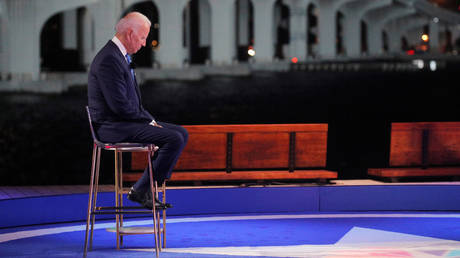
President Biden’s “townhall” meeting this past week was a disaster. From his bizarre poses to the incoherent answers, it seemed to confirm America’s worst fears about a president we are told was elected by the most voters ever. Though he didn’t bother campaigning, we are to believe he somehow motivated the most voters in history to pull the lever in his favor. Or mail in a ballot in his favor. Or something.
After the townhall, the Wall Street Journal was early among mainstream media publications to observe that the emperor has no clothes. In an editorial titled “The Confusing Mr. Biden,” the paper wrote, “Even with a friendly audience and softball questions, Mr. Biden’s performance revealed why so many Americans are losing confidence in his Presidency.”
The Journal focused on one of the most shocking and disturbing revelations from the carefully crafted event: asked by CNN’s Anderson Cooper if the United States would come to the defense of Taiwan should it come under attack by the Chinese mainland, he replied, “Yes, we have a commitment to do that.”
Anderson threw him another softball in hopes he might correct this dangerous misstatement, but Biden was not nimble enough to see his gaffe. He doubled down.
It was left to the “Chemical Ali” of this Administration, White House Spokesman Jen Psaki, to “clarify” that when the President signaled a major shift in US policy – a shift that could well lead to nuclear war with China – he was just kidding. Or something.
Said Psaki the next day: “Well, there has been no shift. The President was not announcing any change in our policy nor has he made a decision to change our policy. There is no change in our policy.”
In other words: “Pay no attention to the man who pretends to be the Commander in Chief of the Armed Forces of the United States.”
But this is not George W. Bush, who was elected in 2000 with zero experience in foreign policy. This is not Trump, who campaigned on a policy of peace then hired John Bolton to carry out that policy.
No, Biden has twice been Chairman of the Senate Foreign Relations Committee. Foreign policy has always been considered his one area of competence. Surely the Biden of even the Obama Administration would have understood the potentially catastrophic implications of his statement.
Strategic ambiguity has been US policy toward Taiwan/China for decades, but the new Biden China policy could be re-named “strategic incoherence.”
The policy of “strategic ambiguity” is foolish enough – who cares who rules Taiwan? – but advancing the idea that the United States is willing to launch a nuclear war with China over who governs Taiwan is a whole other level of America-last foolishness.
Chairman of the Joint Chiefs of Staff Gen. Miley was heralded as a hero for betraying his Commander in Chief Trump by seeking to restrict Trump’s access to the US nuclear arsenal. Milley claimed that Trump was so unsound of mind that he could not be trusted with the nuclear football.
Yet when actual unsoundness is there for everyone to see, Milley and the other “woke” generals are silent as the grave. These are dangerous times.
Copyright © 2021 by RonPaul Institute.
Biden has pledged that ‘America is back.’ But as peace shatters in the Balkans, does that mean yet more US misadventures?
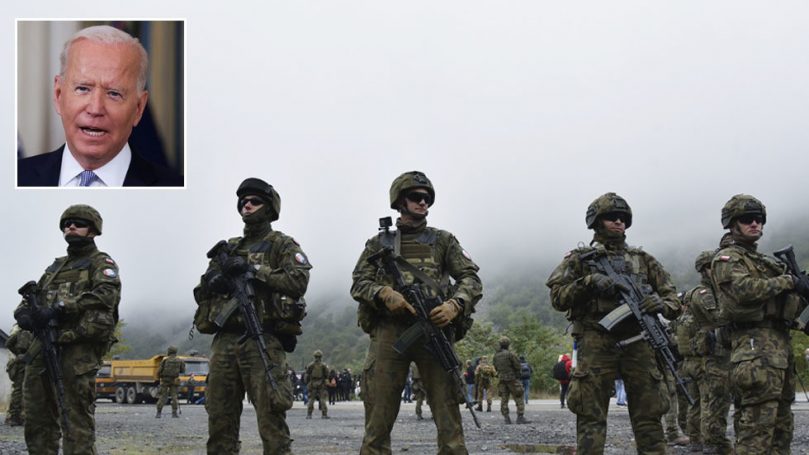
KFOR forces patrol near the border crossing between Kosovo and Serbia in Jarinje, Kosovo, October 2, 2021. © REUTERS / Laura Hasani; Inset © REUTERS / Evelyn Hockstein
By Julian Fisher | RT | October 24, 2021
With warnings that fresh tensions between Serbia and Kosovo could unravel the decades-old peace deal that put an end to bloody fighting in the Balkans after the breakup of Yugoslavia, the US is increasingly split on what to do.
Earlier this month, the SOHO forum in New York City hosted a debate between Scott Horton, long-time libertarian and anti-war radio host, and Bill Kristol, the neoconservative thinker and one of the ideological architects of America’s post-9/11 world order. The subject of the debate was US interventionism, its merits and historical record.
Predictably, Kristol offered vague niceties that attempt to recast America’s legacy as that of the “benevolent global hegemony”, a term which he himself coined in 1996 when describing the country’s role in the world. Reflecting on the wars in Iraq, Kristol simultaneously said that America “didn’t push democracy enough” and also “may have been too ambitious.” In short, he acknowledged mistakes were made, which is an admission that would have been unthinkable only a few years ago, and yet still falls short of accountability.
However, whereas American actions in the Middle East leave a lot to be desired for Kristol, he insists that the US intervention in the Yugoslav Wars during the 1990s was a success. As he put it, the Balkans was “one case of a war that was worth it and that I think had pretty good consequences.” As if on cue, the Balkan pot is beginning to boil once again.
An unresolved conflict
Kosovo has been a potential tinderbox in Southern Europe ever since the end of the war of 1998/1999. A recent row with Serbia, from which it unilaterally declared independence, has led to a new escalation in tensions.
Beginning in September 2021, Serbs living in Kosovo launched protests against authorities hassling travelers who enter the territory with Serbian-issued license plates, prompting a mobilization of armed Kosovo police forces, roadblocks, and traffic jams near the border. Two vehicle registration offices were vandalized.
The EU mediated a temporary fix in September that involves covering up national insignia on license plates with stickers, until a special working group in Brussels determines a more permanent solution sometime within the next six months. Whether this will be sufficient in bringing about immediate calm remains to be seen, however. Since then, further clashes have erupted between police and protesters near Mitrovica.
Russia’s Foreign Ministry has condemned the use of violence by Kosovo police against ethnic Serbs. Foreign Minister Sergey Lavrov met with Serbian President Aleksandar Vucic in mid-October, calling for talks between Pristina and Belgrade and a diplomatic solution to be respected by all sides.
As the situation heated up, NATO quickly ramped up patrols throughout Kosovo, including the North. “KFOR [Kosovo Force] will maintain a temporary robust and agile presence in the area,” the US-led military bloc said in an official statement earlier this month, intended to support the implementation of the EU-brokered solution. Last week, Kosovo’s minister of defense, Armend Mehaj, flew to Washington to meet with Under Secretary of Defense for Policy Dr. Colin Kahl at the Pentagon. The subject of the discussions was “bilateral security cooperation priorities”.
These moves are only the latest instance of US-led posturing in Kosovo. It was with American support that Kosovo launched its campaign for international recognition in 2008. Many major countries, representing most of the world’s population — including Russia, China, and India — have not recognized it as a sovereign state. Kosovo’s persistent claim to independence is what makes an issue as seemingly benign as license plates a question of war and peace.
In the background is still the 1999 Kosovo War, which was the site of NATO’s infamous bombing campaign against Serbia that led to the deaths of at least 489 civilians, according to Human Rights Watch. In April of 1999, NATO deliberately targeted Serbia’s Radio Television station, killing 16 civilians, according to Amnesty International. At one point, the US “mistakenly” bombed the Chinese embassy in Belgrade, killing three and wounding some 20 more, in what turned out to be the only target picked by the CIA over the course of the war.
To this day, the US maintains a military base, Camp Bondsteel, near Urosevac, Kosovo, as part of the international Kosovo Force (KFOR).
Two states in one
To the west, Bosnia and Herzegovina (BiH) has also reappeared in international news coverage. Against the backdrop of the EU’s Western Balkan Summit in early October, the Bosnian Serb leader Milorad Dodik said last week that the parliament of the Serb Republic, one of two entities that together make up BiH, would soon vote to undo some of BiH’s state institutions. He included the military, the High Judicial and Prosecutorial Council (HJPC) and the tax administration. These and others were established after the signing of the 1995 Dayton Peace accords and are not enshrined in the constitution.
Dodik wants an independent Serb Republic without compromising the territorial integrity of BiH, and he claims he has the support of seven EU member states, though he has not said which ones.
The genesis of Bosnia and Herzegovina’s recent headache is an amendment to the Criminal Code that makes various forms of inflammatory speech a punishable offense. The law was enacted in July of this year by the Office of the High Representative, an international “viceroy” with the power to impose binding decisions and remove public officials.
Russia has maintained that this appointed position is outdated, with a statement from the Foreign Ministry saying it was high time to “scale down the institute of foreign oversight over Bosnia-Herzegovina, which only creates problems and undermines peace and stability in that country.” Moscow also remains critical of attempts to integrate the country into NATO, insisting there is no consensus among the people of Bosnia and Herzegovina when it comes to joining the US-led bloc.
Playing to a different tune, already last month Washington tried to reprimand Dodik for his “secessionist rhetoric”. In a meeting just a few weeks ago, US Deputy Assistant Secretary of State Gabriel Escobar warned of “nothing but isolation and economic despair” for the people of the Serb Republic. According to a transcript that Dodik shared with the press, he told Escobar that he doesn’t “give a damn about sanctions,” adding, “I’ve known that before. If you want to talk to me, don’t threaten me.”
In the US, various Balkan-American organizations have released a joint statement calling on Congress and the Biden administration “to immediately initiate steps to rebuff the attempts by the government of Serbia to unravel the region’s peace and security”. Citing both aforementioned developments in Kosovo and the Serb Republic of Bosnia and Herzegovina, the statement demands a reinvigoration of “NATO enlargement as a priority for the region.” It suggests that what’s at stake in the Balkans is America’s legacy: “America invested too much of its own resources into this region to allow revanchist actors to decimate nearly a quarter century of progress.”
However, what does America investing its resources actually look like? In early 1992, before the war that scarred Bosnia and Herzegovina, all parties involved had already come to an agreement, the Carrington–Cutileiro plan, to divide Bosnia and Herzegovina into cantons along Serb, Croat, and Bosniak lines.
At the last minute, however, the then-US ambassador to Yugoslavia, Warren Zimmermann, met with the leader of the Bosniak majority, Alija Izetbegovic, in Sarajevo, reportedly promising him full recognition of a single Bosnia and Herzegovina. Izetbegovic promptly withdrew his signature from the partition agreement, and shortly thereafter the US and its European allies recognized Izetbegovic’s state. War ensued a month later, in April 1992. The US eventually worked its way back to new partition negotiations that echoed the talks held prior.
As the New York Times reported in 1993, “tens of thousands of deaths later, the United States is urging the leaders of the three Bosnian factions to accept a partition agreement similar to the one Washington opposed in 1992.”
Zimmermann is quoted as saying at the time that “Our hope was the Serbs would hold off if it was clear Bosnia had the recognition of Western countries. It turned out we were wrong.”
Returning to the Horton-Kristol debate from earlier, Horton cited America’s underhanded opposition to the Carrington-Cutileiro plan, and the devastating consequences, as a case in point of US interventions impeding, rather than promoting, peace and stability.
President Joe Biden declared at the start of his administration that “America is back.” Taking a look at the history of US interventions, this could spell trouble for the Balkans.
Julian Fisher is a policy analyst at the Russian Public Affairs Committee (Ru-PAC). He writes about Russia-U.S. relations, American foreign policy, and national security
NATO’s new secret plan for nuclear war & space battles with Russia risks spiraling into a new arms race
By Paul Robinson | RT | October 24, 2021
Tensions between Russia and NATO are at an all-time high. But instead of seeking a way off the ladder of escalation, the US-led bloc’s new plan for hybrid war risks accelerating an already dangerous lethal arms race with Moscow.
There’s a concept in international relations, almost one of the first that students learn, called the ‘security dilemma’. It’s hardly rocket science, but it’s something governments and armed forces planners seem to consistently forget when it comes to making policy.
The idea is basically this: Country A feels threatened by country B; it therefore takes some measures – such as increasing its defence spending – to make itself more secure; but when country B sees what country A is doing, it in turn feels threatened, and so takes reciprocal measures of its own. The result is that country A ends up less safe than it was to start with.
The dilemma is that if you do nothing to strengthen your defences, you’ll be insecure, but if you do something you’ll end up worse off because of the counter-measures the other side will take. What do you do? If countries A and B both take action to defend themselves, they will find themselves in an ever-escalating process – what theorists like to call the ‘spiral model’, but which in public parlance is often called an arms race.
The obvious way out is to break the spiral. Avoid escalating and resort to other measures, such as negotiation and arms control. All it may take is for one side to unilaterally step back, and the vicious circle will turn into a virtuous one.
It’s pretty basic stuff, but again and again, state leaders choose to ignore it and prefer instead to march down the path of the spiral. So it is today in the case of Russian-NATO relations, which are as classic an example of the security dilemma as you could possibly hope to find. Deep down, there’s no fundamental reason for conflict, but mutual suspicion leads to a continuing ramping up of reciprocal measures that deepen the suspicion, leading to more measures, more suspicion, and so on, seemingly ad infinitum.
For instance, earlier this year, the Russian military undertook a series of exercises close to its Western borders. From a Russian perspective, these were purely defensive. From a Western perspective, they appeared potentially threatening, justifying in turn Western exercises that NATO claims are entirely for defence, but which Russia considers a threat, prompting further Russian measures.
The latest round in this dangerous process is the announcement this week that NATO has developed a new ‘masterplan’ to defend against a possible Russian attack. The plan itself is secret, so we don’t know its contents, but it’s said to focus on non-conventional war, including nuclear strikes, cyberwarfare, and even war in space. Geographically, it covers the whole spread of NATO’s border with Russia, from the Baltic to the Black Seas inclusive.
In part, this is just what military institutions do: They plan for possible future conflicts. The Russian military almost certainly also has similar contingency planning in place for a potential war with NATO. It would be very odd if it didn’t. In this sense, NATO’s new masterplan shouldn’t in theory be seen as a cause for alarm. Moreover, NATO insists that its purpose is not aggressive. Rather, the plan’s aim is deterrence, thus its formal title: ‘Concept for Deterrence and Defence in the Euro-Atlantic Area’.
However, as students of the spiral model know, reality is much less important than perception. Deterrence is a matter of signals. One sends a message to potential enemies that if they attack, they will suffer devastating consequences. The problem is that although this message may be clear to the one doing the signalling, it may not be so clear to the one to whom it is sent. You think you are deterring, but they think you are threatening. They therefore respond in kind. In this way, deterrence ends up being counter-productive.
This doesn’t always happen, but in this instance, it seems to be the case. Some aspects of NATO’s announcement seem unnecessarily escalatory, in particular the references to nuclear war. We’ve come a long way from the musings of nuclear strategists like Herman Kahn and Bernard Brodie, who tried to calculate how it was possible to fight and win a nuclear war. One shouldn’t be surprised that when other people hear such talk being revived, they’re not deterred but alarmed.
Unsurprisingly, Russia’s reaction to NATO’s new military concept has been decidedly negative. “There is no need for dialogue under these conditions,” Kremlin spokesman Dmitry Peskov said, continuing: “this alliance was not created for peace, it was conceived, designed and created for confrontation.”
From the Russian point of view, NATO’s actions justify Russia’s recent decision to sever ties with the Atlantic alliance. Rather than bringing Russia to heel, NATO may merely be driving it into an ever more hostile position.
In this way, the West’s perception of Russia as a threat becomes a self-fulfilling prophecy. The same, of course, could be said the other way around. For if the West perceives Russia as threatening, it is because of things that Russia has done – as it sees it, for its own defence. For instance, NATO argues that what has made its new plan necessary is Russia’s strengthening of its armed forces and its recent advances in military technology.
The more Russia defends itself, the more it incites NATO. And the more NATO defends itself, the more it incites Russia. A security dilemma par excellence. The risk both parties run is that the situation will continue to spiral further and further into ever more dangerous territory. Already this spring, Europe passed through a period of high tension in which it looked entirely possible (although unlikely) that war might erupt between Ukraine and Russia. Anything that contributes to a further worsening of the situation is therefore thoroughly undesirable. NATO’s new military plan, it seems fair to say, runs the risk of doing just that.
Paul Robinson, a professor at the University of Ottawa. He writes about Russian and Soviet history, military history and military ethics, and is the author of the Irrussianality blog.
NATO, Not Russia, Perpetuates Cold War Logic… It is a Relic Best Ignored
Strategic Culture Foundation | October 22, 2021
It was the end of an era this week when Russia announced that it was severing diplomatic links with the North Atlantic Treaty Organization. For the past 30 years since the dissolution of the Soviet Union, the Russian Federation has engaged with the US-led military bloc in a bid to establish partnership and secure peace.
The incipient detente culminated in the NATO-Russia Founding Act in 1997 which demarcated certain boundaries for peaceful coexistence. Those boundaries were subsequently flouted as NATO doubled its members over the ensuing years to stand at the current membership of 30 countries, including states that share a border with Russia.
There was also established in 2002 a NATO-Russia Council which in principle provided a forum for dialogue between delegations hosted in the Belgian capital Brussels where NATO has its headquarters.
But the truth is initial promises of partnership have waned. For several years now, at least since the 2014 Ukraine crisis, NATO’s relations with Russia have been characterized more and more with an imperious attitude of lecturing Moscow over a litany of alleged transgressions. These allegations are more accurately described as slanders because they are never substantiated beyond bald accusation.
Russia is routinely accused of posing a threat to Europe and plotting to sabotage Western democracies. This week the NATO defense ministers held a summit in which it was breathlessly claimed that Russia is becoming an even greater threat to the transatlantic alliance. On the back of that hysterical claim, NATO has now moved to implement a “master plan” to “defend” Europe from a “potential Russian attack on multiple fronts”.
Reality check. Moscow has repeatedly stated that it has no intent of aggression towards the United States, NATO, Europe or anyone else for that matter. Despite this categorical assurance, the Western bloc has persisted in talking up tensions with Russia.
It is the United States that has abrogated several arms-control treaties and introduced new missile systems into Europe. It is NATO that is encroaching on Russia’s territory. Reality is turned on its head by Western accusations.
Indeed there have been conflicts over Georgia in 2008 and ongoing in Ukraine. But in each case, there are substantial grounds for laying the blame of these conflicts on NATO. How did the coup d’état in Kiev happen in 2014, who supported it? And why did the people of Crimea vote in a constitutional referendum to secede from Ukraine to join the Russian Federation with which they have centuries of shared history and culture?
In any case, if there were proper partnership and dialogue between NATO and Russia then such concerns and disputes could have been appropriately aired and discussed in the assigned forum. But the fact is there was never any genuine attempt at dialogue by NATO. Russia has become an object of harangue and hostility. The supposed partnership envisaged some three decades ago became a travesty. Instead of dialogue and debate there was simply disdain. Instead of equality there was vilification, opprobrium, and sensationalized smears without the slightest due process afforded to Russia (the Skripals, Navalny, Novichok, electoral interference, cyberattacks, shooting down a Malaysian airliner, and so on and so on, like an old skipping vinyl record incapable of moving on.)
The supposed diplomatic channels were nothing but echo chambers for NATO propaganda talking points, rather than being used as a means to resolve misapprehensions through mutual dialogue and presentation of evidence.
As the Russian foreign ministry noted this week in explaining the severance of diplomatic ties, it is NATO that systematically destroyed relations and “chose the Cold War logic”.
Alexander Grushko, Russia’s deputy foreign minister, commented that normal relations were not possible amid unfriendly steps taken by NATO “sliding into Cold War schemes”.
The last straw was the expulsion earlier this month by NATO of Russian diplomats from the NATO forum in Brussels. The Russian staff were accused of being “undeclared spies” allegedly working for military intelligence. No evidence was provided, as usual, by the accusers. It was the familiar high-handed approach of fait accompli and Russia “guilty until proven innocent”.
Everyone recognizes that relations between the Western states and Russia are at their lowest since the end of the former Cold War. Thus it may be put to Moscow that it is being reckless to close down channels of communication at this precarious time.
Russia has not ruled out pursuing a more productive relationship in the future. It has said, however, that it is up to NATO to make the first move towards improving relations. Until then, henceforth, any communications can be submitted through Russia’s ambassador to Belgium.
It is our view that Russia has made the correct call to drop diplomatic channels with NATO. Russia will pursue bilateral relations with individual nations as it does already, for example, with the United States on the vital issues of arms control and cybersecurity. NATO has proven to be incapable of progressive negotiations owing to an organizational “groupthink” that is encumbered with Russophobia and Cold War ideology.
By engaging directly with individual nations, it may be more productive for mutual understanding to be advanced because the noise of “groupthink” and of competing group negativity is removed.
Unfortunately, it has to be noted that the original purpose of NATO when it was formed in 1949 was rooted in Cold War hostility towards the Soviet Union. Such animosity has not abated even though the Soviet Union no longer exists.
Fundamentally, NATO is an organization in search of enemies in order to justify the militarism that is essential for the functioning of Western capitalism. There is a pivotal contradiction between NATO and today’s emerging world of multipolar cooperation and peaceful development. Its disgraceful, diabolical destruction of Afghanistan alone debars that organization from having any progressive role in today’s world.
Russia is right to disabuse the illusion of “partnership” with NATO. It is a relic of Cold War hostility that belongs in a war museum not in a modern forum for diplomacy.
Featured Video

Liberty Cannot Exist Inside a Panopticon
or go to
Aletho News Archives – Video-Images
From the Archives
Left-leaning despisers of 9/11 Truth movement: Do you really believe in miracles?
David Ray Griffin | Global Research | 06 Jul 2010
An Open Letter to Terry Allen, Noam Chomsky, Alexander Cockburn, David Corn, Chris Hayes, George Monbiot, Matthew Rothschild, and Matt Taibbi.
[1]According to several left-leaning critics of the 9/11 Truth Movement, some of its central claims, especially about the destruction of the World Trade Center, show its members to be scientifically challenged. In the opinion of some of these critics, moreover, claims made by members of this movement are sometimes unscientific in the strongest possible sense, implying an acceptance of magic and miracles. … Full article
Blog Roll
 Aletho News
- White House envoy declares kinetic action against Yemen ‘fruitless’
- Ukraine deployed thousands of microdrones in Iraqi Kurdistan: Tasnim
- Iran calls for emergency UNSC meeting over Trump’s ‘brazen’ bomb talk, Israeli threats
- Iranian sources reveal details of Russia-China Hormuz proposal
- Plan for more US-Israel integration puts our military tech at risk
- Another Round Against Iran Will Break What Is Left of the Gulf
- SVR Report on Ukraine’s Mexican Drug Gang Links Could Pressure Zelensky, Won’t Change US Policy
- British Government Employees Were Fact-Checking the News at the BBC. Nobody Told You.
- Albania on fire: who’s behind the riots?
- Egypt’s Civil Democratic Movement rejects involvement in regional war
- If Americans Knew
- Mysterious bot accounts reportedly spread fake ‘man on the street’ videos for Michigan Senate candidate
- Israeli Defense Minister Katz Says Over 60 Lebanon Villages Have Been Destroyed
- Why Is Israel Running TV Ads in Iowa Ahead of the Midterms?
- Hind Rajab’s Alleged Killer Is in the United States. HRF Demands His Arrest.
- US Officials Face Fresh Pressure After Another American ‘Brutalized’ by Israeli Settlers in West Bank
- Israel-Backed Palestinian Militias Terrorize Displaced Families in Gaza
- FBI subpoenas pro-Palestine activists over Israeli weapons plant disruption
- Fourth winter arrives in wartorn Gaza, too early – Daily Update
- More on how Bari Weiss is using CBS on behalf of Israel
- What the UK Is Doing to Pro-Palestine Novelist Sally Rooney Is an Act of Orwellian Villainy
- No Tricks Zone
- Predictions Made By Renowned Climate Proifessor Over Past Decades Have Been Proven To Be Poor
- New Study Suggests Large Regions Of The Pacific Ocean Have Been Cooling For The Last 80 Years
- Germany’s Green Energy Debacle: High Energy Costs Force Kahla Porzellan to Close After 182 Years!
- New Study: 50 Years Of The Most Aggressive ‘Net Zero’ Policies Can Only Affect The Global Climate By 0.03°C
- US September “Heat” Was No Record…Many Records Set Decades Ago
- Latest European Green Energy Debacle; Portugal’s Largest Flagship Solar Park Insolvent!
- Green Energy Debacle: German Expert Professor Fritz Vahrenholt Warns Of Severe Economic And Social Consequences
- Two More Paleo Reconstructions Affirm Meters-Higher Sea Levels Across Ireland, Brazil 7000-6000 Years Ago
- New Study: Earth And Venus Surface Warmth Largely Explained By Convection And Lapse Rate, Not CO2 Or Radiation
- 2025 Nature Paper Claiming Worsening Global Drought Gets RETRACTED …Heavily Flawed

