Bulgaria insists it’s a loyal NATO ally, but won’t send troops to Ukraine
RT | January 26, 2022
Bulgaria is a “loyal ally in NATO” and the alliance’s unity is the best response to the current crisis over Ukraine, Prime Minister Kiril Petkov said on Wednesday, amid conflicting reports on Sofia’s participation in the US military buildup in Eastern Europe.
Petkov’s government voted on Wednesday to follow the “Bulgarian strategy” of reducing tensions between NATO and Russia, including “absolutely all options for resolving this dispute by diplomatic means,” according to the state news agency BTA.
The strategy will be based on rebuilding the Bulgarian military, Petkov said. Defense Minister Stefan Yanev explained that the “top priority” will be investing in building a battalion combat team, a unit of around 1,000 soldiers.
Yanev would not comment on reports by Bulgarian National Radio that Sofia would not accept the deployment of 1,000 US soldiers on its soil, but would be fine with French troops instead. This was reported early on Wednesday by BNR correspondent in Brussels, Angelina Piskova, who quoted a “well-informed diplomatic source.”
The minister said such a thing has not been discussed on the political level, according to BNR.
Local media reported that Yanev also told lawmakers that Bulgarian soldiers won’t fight in Ukraine without parliamentary approval, which he “does not see coming.”
Earlier on Wednesday, CNN reported that Bulgaria, Hungary, and Romania were in discussions with the US to accept 1,000 American troops each, as part of Washington’s effort to “reassure” NATO members in Eastern Europe and “deter” the alleged Russian invasion of Ukraine. The US intelligence has heralded such an invasion since late October, though Moscow dismissed it as “fake news.”
Speaking before the parliamentary defense committee on Tuesday, Yanev said that neither Russia nor anyone else is preparing to invade Bulgaria, and urged the lawmakers to “reduce tensions, stop reading the foreign press, and stop speculating.”
Populists on the right are now openly challenging Republican war lust
No more lockstep: conservatives aren’t afraid of being called names as they question America’s interest in Ukraine
BY JACK HUNTER | RESPONSIBLE STATECRAFT | JANUARY 26, 2022
The fight on the right for what constitutes a conservative or Republican foreign policy continues. This time the battlefront is Russia and Ukraine.
That there is a fissure on this issue among conservatives is in a way, a big deal, showing that the “America First” restraint approach that garnered support among the base didn’t go away completely when power changed hands in Washington and its chief advocate, Donald Trump, left town. Unfortunately, many Republicans have gone back to form and are talking like it’s the post 9/11-era — as if Trump’s criticisms of George W. Bush’s wars and nation-building had no effect on their party whatsoever.
First up, habitually hawkish GOP Congressman Dan Crenshaw recently told Fox News that “there needs to be clear consequences for what (Russia does) because we’ve failed to deter and now you’re inviting conflict.”
Sounding like a Bush-Cheney-era neoconservative, Crenshaw added, “It’s a very bad situation and we’ve left ourselves without many options as a result.”
One doesn’t have to ponder long about what Crenshaw thinks of the military option.
Republican Congressman Michael McCaul had a similar message, telling CNN last week, “I don’t think we’re providing the deterrence necessary to stop Putin from invading Ukraine, the breadbasket of Russia.”
What kind of “deterrence” does McCaul want to see?
Republican Senator Joni Ernst also joined the hawks, telling CNN, “When it comes to pushing back against Russia, we need to show strength and not be in a position of doctrine of appeasement, which seems to be how President Biden has worked his administration.”
Popular Fox News personality Tucker Carlson apparently had enough of such talk, and cited both Crenshaw and McCaul’s interviews in his opening monologue last week and Ernst’s on Monday night. Carlson warned his viewers that the U.S. was being pushed toward a new war by the usual self-interested suspects, which included politicians, the media, and the defense industry.
“Those are our leaders, totally ignorant, just reading the script. It’d be nice to hear someone in the press corps, because it’s their job, ask the obvious follow up, which would be: Why exactly, Sen. Ernst, do you believe it’s so vital to send more lethal aid to Ukraine and to “go ahead and impose” more sanctions on Russia? Why? How would she answer that question?
We’ll never know how she’d answer, because no one in the media would ever ask her.
In last week’s monologue he cited prominent Democrats like Rep. Adam Schiff saying basically the same thing as Crenshaw and McCaul on Ukraine. “Oh, they’re all red in the face, but it’s not the usual partisan chorus. This is the entire choir. You just saw representatives from every faction in Washington, from Adam Schiff to Dan Crenshaw, not as different as they seem, and all the dummies in between. And all of them are promoting war against Russia on behalf of our new and deeply beloved ally, the government of Ukraine,” he mocked.
This week, suddenly more conservatives and Republicans began speaking out against the prospect of U.S. military action in the region.
“The United States should not be involved in any future war in Ukraine,” charged libertarian populist Republican Congressman Thomas Massie on Monday.
“The neocons/warmongers have spent years stoking the new cold war with Russia and have now brought us to the brink in Ukraine — this serves their own interests, and lines the pocket of the Military Industrial Complex with trillion$,” tweeted right-wing friendly Democrat and former Congresswoman Tulsi Gabbard. “Let’s not be sheep.”
Populist Republican U.S. Senate candidate and “Hillbilly Elegy” author J.D. Vance tweeted on Monday, “Billions spent on the Kennedy school, grand strategies seminars, and the Georgetown school of foreign service has bought us an elite that’s about to blunder us into a Ukraine war.”
Veteran and Conservative Virginia State Rep. Nick Freitas on Sunday accused the Biden administration of potentially getting America into a war as a distraction, tweeting, “Another Foreign War… When you absolutely, positively, have to distract the general public from the failure of your domestic policies.”
Charlie Kirk, leader of the conservative youth group Turning Point USA, also weighed in, tweeting Monday, “You should be against going to War with Russia.”
Kirk added, “Why is the President of the United States willing to send Americans to die protecting European Sovereignty? If our NATO ‘Allies’ aren’t even willing to fund their obligations and surge their own troops to protect their borders, why should we?”
With a split senate and Democrats controlling the House and Executive Branch, what the U.S. does or doesn’t do in Ukraine is largely in President Biden’s hands. And obviously, being against a Democratic president’s wars is easier for Republicans than when their own party is sitting in the White House. This was apparent when Republicans felt emboldened to check President Obama on his Syria, and to some extent his Libya interventions.
But Americans are more tired of war than ever, which is why Trump’s views on global policing and nation building did so well with GOP voters. This may be more than just who holds all the marbles. With Republicans predicted to do well in the 2022 midterms and the potential for turning the tables in 2024, the base is critical, and where it stands on foreign policy could matter quite a deal in the near future. Will the GOP look more like George W. Bush or reflect what Donald Trump often said about war, even if he didn’t always follow through?
At a minimum the foreign policy temperature on the right is not exactly where it once was, and whatever impact “America First” continues to have on Republicans, it’s a long way from all of them uniformly accusing anyone in their party of “blaming America first’”for even daring to question U.S. foreign policy.
Croatia to Withdraw Its Forces From NATO in Event of Russia-Ukraine Conflict
Sputnik – 25.01.2022
Croatia will withdraw its military from NATO forces deployed in the region in the event of a conflict between Russia and Ukraine, President Zoran Milanovic said on Tuesday.
“I follow reports, according to which NATO, not a separate state, not the United States, is strengthening its presence, sending reconnaissance vessels. We have nothing to do with this, and we will not have, I guarantee you this,” Milanovic told a national broadcaster, adding that Croatia will not send its military to the region.
“If there is an escalation, we will withdraw everyone to the last Croatian military. It has nothing to do with Ukraine or Russia, it has to do with the dynamics of the US’ domestic policy, [President] Joe Biden and his administration, whom I supported, the only one in Europe … but I see dangerous behavior in matters of international security,” he added.
Uninvited foreign troops must leave, African nation says
RT | January 24, 2022
Denmark must “immediately withdraw” some 90 troops it deployed to Mali last week “without [the government’s] consent and in violation of the protocols” allowing European nations to intervene in that African country, the government in Bamako said on Monday.
Some 91 Danes from the Jaeger Corps special forces arrived in Mali on January 18, as part of Task Force Takuba, a French-led counter-terrorism mission in the West African country. According to the Danish defense ministry, their job will be to reinforce the border with Niger and Burkina Faso, train Malian Armed Forces, and provide medical services to the peacekeepers.
While the government of Mali is grateful to “all its partners involved in the fight against terrorism,” it stressed “the need to obtain the prior agreement of the Malian authorities” before sending any troops to the country, says the communique signed by Colonel Abdoulaye Maiga, spokesman for the Ministry of Administration and Decentralization.
Announcing the deployment of the force last week, the government in Copenhagen said it had been scheduled in April 2021, as France sought to withdraw some of its troops from Mali.
Their objective was “to stabilize Mali and parts of the border triangle between Mali, Niger and Burkina Faso, and to ensure that civilians are protected from terrorist groups,” the Danish military said.
The Jaegers are also experienced in “training and educating” local militaries, a job they have previously performed in Afghanistan and Iraq. They were sent shortly after Sweden withdrew its contingent from Mali. The French-led operation also involves forces from Belgium, Czechia, Estonia, Hungary, Italy, the Netherlands, Portugal and Sweden.
Task Force Takuba has operated in Mali since March 2020, when Paris decided to wrap up the previous Operation Barkhane. France has maintained a military presence in its former West African colony since 2013, to help the government in Bamako deal with a Tuareg rebellion in the northwest of the country and subsequent terrorist insurgency loyal to Islamic State (IS, formerly ISIS).
Relations between Bamako and Paris have grown chilly since the latest military takeover in Mali in 2021, and France has since closed three of its military bases there, in Kidal, Tessalit, and Timbuktu.
US diplomats’ families ordered to leave Ukraine
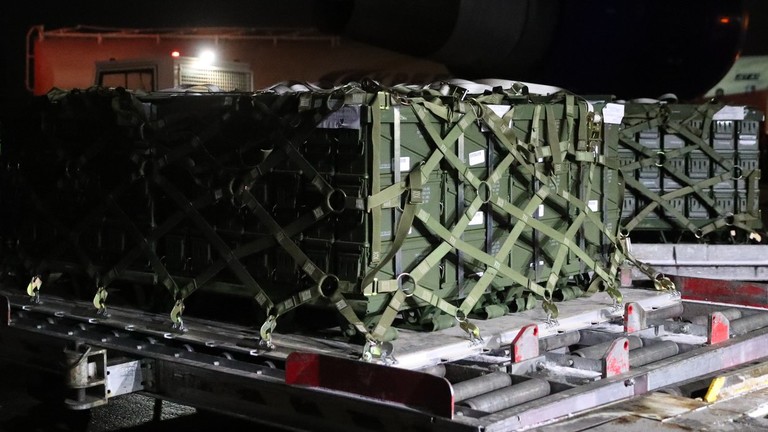
US lethal aid being unloaded at a Kiev airport. © Twitter / U.S. Embassy Kyiv
RT | January 24, 2022
The families of US diplomats have been ordered to leave Ukraine, while some embassy staffers were authorized to depart on a “voluntary” basis, according to an updated travel advisory that reiterated claims of a “continued threat of Russian military action.”
“There are reports Russia is planning significant military action against Ukraine,” the State Department said on Sunday, adding that it “authorized the voluntary departure of US direct hire employees (USDH) and ordered the departure of eligible family members (EFM).”
American citizens were once again strongly advised not to travel to Ukraine, while those already in the country were told to “consider departing now using commercial or other privately available transportation options.” The highest “Level 4: Do Not Travel” advisory for Ukraine, citing Covid and “increased threats from Russia,” has been in place on the Department of State website for more than a month.
The US had previously warned its citizens that they should not “anticipate that there will be US government-sponsored evacuations,” should a war take place in Ukraine, suggesting that they use the available commercial flights instead.
Moscow has repeatedly denied accusations that it’s planning an invasion of Ukraine, which have been made by the US and its allies since November last year, describing the claims as groundless attempts to instill “hysteria.”
According to the Kremlin, it’s the West that has been stirring tensions in Ukraine by supplying weapons to Kiev – which is embroiled in a “frozen” conflict with self-proclaimed republics in the southeastern Donbass region – and intensifying the NATO buildup in Eastern Europe.
Russian roulette: as croupier at this particular casino table, I invite you to place your bets
By Gilbert Doctorow | January 14, 2022
The Russia-US-NATO-OSCE meetings this week have come and gone. The Russian verdict was succinctly delivered by Deputy Minister of Foreign Affairs Sergei Ryabkov, who explained even before the OSCE session was over that the talks have come to “a dead end” and it was unlikely the Russians will participate in any follow-on talks.
This opens the question to what comes next.
Official Washington feels certain that what comes next is a Russian invasion of Ukraine, which could come in the next few weeks and thereby fall within the timetable for such an operation suggested by State Department officials when they met with NATO allies ahead of Biden’s December 7 virtual summit with Putin. The logic put out then was that January-February would be very suitable for a land invasion given that the frozen ground would well support tank movements. One might add to that argument on timing, one further argument that was not adduced: in midwinter it is questionable how long the Russians would want to keep 100,000 soldiers camped in field conditions near the border; such stasis in these severe conditions is not conducive to maintaining morale.
In what I would call a rare show of failing confidence in the predictive powers of the Biden Administration, U.S. media admit to uncertainty over Russia’s next moves. However, they cleverly present this by pointing to the uncertainty of the analysts and commentators on the Russian side.
A featured article in The New York Times a couple of days ago by their Moscow correspondent Anton Troianovsky says it all in the title: Putin’s Next Move on Ukraine Is a Mystery. Just the Way He Likes It”
Indeed, all the best known Russian experts appear to be stymied, none more so than the ubiquitous Fyodor Lukyanov, host of the weekly television show “International Overview” and long time research director of the Valdai Discussion Club, where his peers in the front ranks of American international affairs specialists have gotten to know him. Lukyanov has in recent days humbly admitted he hasn’t a clue to what comes next. Another leading figure in the Russian foreign affairs think tank community, Andrei Kortunov, director of the Russian International Affairs Council, has shown in recent interviews that he is no better informed about what is going on in the Kremlin and what comes next.
Western experts are also shown by our media to be clueless. Today’s Financial Times article “Russia writes off security talks…” ends with a quote from Andrew Weiss of the Carnegie Endowment for Peace: “Nobody knows Putin’s next move. And we’ll all find out at the same time.”
By definition, ‘experts’ cannot declare they know nothing and be taken seriously. This reminds me of the saying of my boss for five years at ITT Europe in the 1980s, Georges Tsygalnitzky. Each time we sat down to prepare the annual Business Plan he told us that if we calculated the sales forecasts badly, we could be up to 100% off, but if we failed to deliver a Plan we would be “infinitely wrong.” The same rules apply to government defense planning.
No right-thinking person likes the idea of a major war coming to the middle of Europe, as the Ukrainians consider themselves to be. The United States has still more reason to worry about a looming war between Russia and Ukraine, because the outcome of total rout for the Kiev military forces equates to a bloody nose for Washington: its acknowledged 2.5 billion dollar investment in arming and training the Ukrainian military will have been in vain, and the loss would rival the catastrophic withdrawal from Afghanistan in terms of American global prestige. The Biden administration would enter the midterm electoral period reeling from its losses in international relations.
Without wishing the Biden administration ill, I believe their scenario of a Russian invasion is wrong-headed and unimaginative. It fails to come to terms with the Russians’ imperatives on altering the security architecture in Europe as drivers of their current policies, not settling scores with Ukraine, or bringing them back to a common homeland, as Blinken & Company repeat ad nauseam.
So what comes next? In successive articles on this website, I have set out several scenarios, or algorithms. My most recent prognosis in yesterday’s piece was that Putin’s Plan B would likely be purely “military-technical” in the sense of roll-out of medium range nuclear capable missiles in Kaliningrad and Belarus, to place all of Europe under threat of attack with ultra-short warning times, such as Moscow finds unacceptable coming from U.S.-NATO encirclement of its territory.
At the same time, Moscow might announce the stationing off of the American East and West Coasts of its submarines and frigates carrying hypersonic missiles and the Poseidon deep sea nuclear capable drone, all to the same purpose, namely putting a pistol to the head of the U.S. leadership. And now there is even talk of Russia building military installations in Venezuela, likely to host Russian strategic bombers capable of swift attack on the Continental United States without having to fly half the world. And a Cuban delegation is reportedly in Moscow, no doubt talking about posssible installation of missiles there. This is all very reminiscent of the goings-on in 1962.
One reader of this essay has written in, saying that news of Russian submarines posted off the coast of New York and Los Angeles could sink the S&P. Yes, indeed, and this financial damage is an aspect of policy that the Russians have taken into account. The sensitivity of Wall Street to bad news was mentioned specifically by Deputy Foreign Minister Ryabkov earlier in the week in Q&A. The American middle classes may be indifferent to foreign affairs generally but they are very attentive and politically active when the value of their 401k pension fund is hit. It is not for nothing that wealth fund managers in the City of London, board members of leading U.S. banks and insurance companies are readers of my essays as reposted on my LinkedIn account.
I imagine that Russia’s Plan B could begin implementation in the next couple of weeks and would be given three or four weeks to take effect on Western public consciousness. If the United States and NATO still resisted coming to terms over changes to the Alliance that satisfy Russian demands, then I envision a Plan C which would indeed be kinetic warfare, but quite different from the invasion that figures in U.S. public statements and approaches to its allies.
Without putting a single soldier on the ground in Ukraine or contemplating direct overthrow of its regime and occupation, Russia could by “military-technical means,” such as missile and air attacks destroy the Ukraine’s command and control structure as well as “neutralize” the most radical nationalist militias and other hostile units now threatening Donbas. The destruction of Ukraine’s military infrastructure would by itself put an end to Washington’s plans for extensive war games there later in the year. We may assume that Russian forces will remain massed at the border till such operations are completed.
The clean-up of Ukraine, ending its potential to threaten Russian national security, would be a very strong signal to all of Europe to back off in practice even if no formal treaties are signed with Russia at present.
In an exchange with a close colleague in Washington this morning, we agreed a bet on whether my prediction holds. And in this casino of international politics, I invite readers to place their own bets on what comes next.
©Gilbert Doctorow, 2022
NATO Expansion: Blinken and Stoltenberg lie intentionally and the media let them
By Jan Oberg | The Transnational | January 13, 2022
To deceive, telling half-truths, or a complete lie is nothing new in politics, particularly security in politics. But until some 20-30 years ago, I would – perhaps naively – see it as an exception. Tragically – and perhaps to many readers’ surprise – it is now the rule. At least in U.S. and NATO circles, and that is particularly regrettably since The West professes to be a democratic system with specific values and even a moral leader to The Rest.
Lying systematically about facts – historical facts – and other countries and cultures should be incompatible with The West’s perception of itself. But, today, it isn’t.
Lies are widespread in so-called security politics when some militarist project doesn’t make any (common) sense to intelligent people, when the real motives have to be covered up and war is being prepared or when the sociological cancer called the Military-Industrial-Media-Academic Complex, MIMAC, and the elites it consists of, try to squeeze out even larger military expenditures from their taxpayers.
You lie to manufacture an enemy that can justify what you will do and enrich yourself. With 40+ years of experience in security politics in general and NATO/US policies in particular, I know too much – sorry for the arrogance – and have become too cynical to believe that what goes on goes on for the sake of self-defence, security or peace.
Some quick examples of gross empirically-revealed lying to the word – all the liars still at large:
• In the 1990s, Yugoslav President Milosevic was Europe’s new Hitler (Bill Clinton) and planned a genocide on the Albanians in Kosovo.
• Saddam Hussein’s soldiers threw babies out of their incubators in Kuwait City.
• Afghanistan had to be destroyed because of 9/11.
• Saddam Hussein had weapons of mass destruction.
• The US-led Global War On Terror – GWOT – has been about reducing terrorism.
• The US/NATO orchestrated regime-change attempt in Syria from 2011 to 2016 was exclusively about Dictator al-Assad’s sudden sadist “killing of his own.”
• Gaddafi was just about to murder all who lived in Benghazi.
• The conflict around Ukraine was started by Putin’s “aggression” on Crimea, nothing preceded it.
• Iran has always plotted and lied to acquire nuclear weapons.
• There are only bad things to say about Russia and China and…
You may continue on your own.
A recent lie is particularly nasty because it is not about some limited event or pretext. It is a cynical attempt to rewrite contemporary history to justify (even further) NATO expansion and intimidate Russia.
The lie is this:
• The West’s leaders never promised Mikhail Gorbachev and his foreign minister Edvard Shevardnadze not to expand NATO eastward. They also did not state that they would take serious Soviet/Russian security interests around its borders. And that, therefore, each of the former Warsaw Pact countries has a right to join NATO if they decide to freely.
It is this lie I am going to deal with below, and you can hear these lies presented by Antony Blinken and Jens Stoltenberg – in slightly different versions – with crystal clarity in the following two videos.
Before I start, let me say that it has never been my style to focus on or attack individuals. I’ve always been more interested in structures and processes and in how they shape people. But there comes a time when leaders must be held accountable because they choose to lie repeatedly, although they do have the choice not to.
And because lies have often been war crimes in the making.
Antony Blinken
First, US Secretary-of-State, Antony Blinken on January 7, 2022 – scroll the video below to 38:30 where he begins to speak and distorts the Ukraine conflict history and then, at 43:00-45:00, continues to say that Russia is driving the false narrative that the West had given assurances to Russia/Gorbachev about not expanding NATO back in 1989-90. It wouldn’t and couldn’t, he says. And all the claims Russia makes are false and shall not permit “us” to be diverted from the main thing: Russia’s unprovoked aggression against Ukraine.
Right after (45:40) comes another lie – Russia also invaded Georgia. Anyone who has studied the U.S. Congressional Research Service’s analysis of 2009, “Russia-Georgia Conflict in 2008: Context and Implications for U.S. Interests“, knows that this issue was vastly more complex and that it was Georgia – led by hotheaded U.S. friend Mikheil Saakashvili whose political life ever since has resembled a tragicomic farce – that had occupied the larger part of South Ossetia before Russia intervened massively. The responsibility for the war and violence can not seriously be placed on the Russian side alone.
And he continues his self-righteous accusations. Blinken’s list is long, and he reads his accusation list with a submachinegun speed, sometimes so stumbling and unclear that one must wonder whether he is uncomfortable because he is subconsciously aware that he lies, deceives and omits to make his psycho-political projections of the U.S.’s own dark sides sound intelligent, logical and truthful.
This U.S. Secretary of State can’t be bothered by facts or nuances. Neither could his predecessor, Mike Pompeo, who was proud to say that at the CIA, he directed “We Lied, We Cheated, We Stole. We had entire training courses…“. Mr Blinken continues reading his obsessive, hateful listing of all the sins of Russia. As if the US/NATO did not exist and, therefore, there was no conflict which normally takes a least two parties. In his comprehensive conflict illiteracy, this conflict has only one party: Russia.
The intellectual level is deplorable. NATO allies and mainstream media have no public opinion or critical views on any of it. One must assume that they agree and can make no better analyses themselves.
Now, take a look – at least at the sequences, I’ve mentioned above. Then, I show you how Mr Blinken is lying deliberately under the video.
If this link doens’t functionanymore, please use this. You may also see it on C-Span and YouTube here.
Now, how can Mr Blinken flatly deny that assurances were given to Gorbachev?
The only source I have been able to find is an article by Steven Pifer from 2014, which argues that Gorbachev himself denies that NATO expansion was ever discussed, “Did NATO Promise Not to Enlarge? Gorbachev Says “No” which refers to an interview with Gorbachev in Russia Beyond.
But this is a piece of citation fraud.
Steven Pifer quotes from it but stops right before the well-known statement in the interview article by then U.S. Secretary of State, James Baker, that “NATO will not move one inch further east.” He also omits these words by Gorbachev himself:
“The decision for the U.S. and its allies to expand NATO into the east was decisively made in 1993. I called this a big mistake from the very beginning. It was definitely a violation of the spirit of the statements and assurances made to us in 1990. With regards to Germany, they were legally enshrined and are being observed.”
Can this really be interpreted to mean that Gorbachev says that no assurances were ever given?
We get a key to why Blinken uses a fake analysis: Because it fits his posturing as a paragon of truth and because Mr Pifer is a senior fellow at Brookings but also a former U.S. Ambassador to Ukraine and adviser to one of the most hawkish think-tanks, Center for Strategic & International Studies in Washington.
A slight twist, omission or interpretative casuistry isn’t that important, is it? Well, if you are not yet convinced that Mr Blinken lies deliberately, I ask you to now go to the authoritative National Security Archive at George Washington University. It’s an incredible source of facts, and we should thank it for making the truth available through comprehensive documentation on so many security-related issues.
TFF has reproduced two essential pieces from that archive of irrefutable documentation that Gorbachev indeed was given such assurances – “cascades” of them! as is stated in the article – by all the most influential Western leaders at the end of 1989 and into 1990:
“NATO Expansion: What Gorbachev heard” – and
“NATO Expansion: The Budapest Blow Up 1994”
Read them, and you’ll be shocked.
You’ll find that they have lots of notes and, in sum, no less than 48 original historical documents. For instance, here is just one of the 48 informing us about then NATO Secretary-General Manfred Woerner’s view and statement:
“Woerner had given a well-regarded speech in Brussels in May 1990 in which he argued: “The principal task of the next decade will be to build a new European security structure, to include the Soviet Union and the Warsaw Pact nations. The Soviet Union will have an important role to play in the construction of such a system. If you consider the current predicament of the Soviet Union, which has practically no allies left, then you can understand its justified wish not to be forced out of Europe.“
Now in mid-1991, Woerner responds to the Russians by stating that he personally and the NATO Council are both against expansion – “13 out of 16 NATO members share this point of view” – and that he will speak against Poland’s and Romania’s membership in NATO to those countries’ leaders as he has already done with leaders of Hungary and Czechoslovakia. Woerner emphasizes that “We should not allow […] the isolation of the USSR from the European community.”
This is just one of the “cascades” of statements and assurances given to the Russians at the time. Over 30 years ago, 13 out of 16 members were against NATO expansion because they respected Russia’s crisis and legitimate security interests! Today – 2022 – NATO has 30 members.
Is the U.S. Secretary of State, his advisors and speechwriters unaware of the next-door National Security Archives and what is in them concerning one of contemporary history’s most important events: the dissolution of the Soviet Union and the Warsaw Pact? Are we really to believe that they have no clue about the conditions and dialogues at the end of the first Cold War? If so, they ought to resign or be fired for their unbelievable incompetence.
If not so – if they know the content of these historical documents – Mr Blinken, his advisors and speechwriters know that they lie.
Their words, therefore, should never be trusted. Neither should the media that avoid highlighting these lies and thereby become complicit. The task of a supposedly free press is to reveal the power abuse of democratically elected people who deliberately fill their constituencies with lies.
Simple as that.
Jens Stoltenberg
In this press conference video from January 7, 2022, NATO’s Secretary-General Jens Stoltenberg states some of the same rhetoric, distortions, simplifications and lies. Not to mention platitudes accompanied by an almost funny body language of bombastic gestures to compensate for his weak content, mantras and repetitions.
Listen at around 19:00 minutes how he maintains that NATO enlargement has been “extremely important for stability and peace and freedom and democracy in Europe” where it can indeed be argued that that enlargement is the main reason that Europe is now in a situation which can reasonably be called the 2nd Cold War.
Why else has NATO not created the desired and stipulated peace and stability since it was created in 1949? So, no, Mr Stoltenberg, you cannot continue – like your masters in Washington – to argue that the present war risks are caused by Russia and Russia alone? If that’s what they order you to say, you have the option to choose decency and resign.
The NATO Secretary-General repeats that each state has a sovereign right to decide its own course and choose its own security arrangements. And that NATO has not dragged in anybody, and they have all just decided democratically to become a member.
That is simply not true.
NATO as an alliance has enormous resources to influence opinions in potential member states. Contrary to his open door talk, NATO’s Charter speaks only about inviting new members, not about holding a door open for anyone who might want to join.
It should be well-known by now – but isn’t – that in the late 1990s, Vladimir Putin asked to join NATO – but it didn’t happen, did it, Mr Stoltenberg? And why not? Because Putin – Russia – wanted to be invited as an equal partner and not sit and wait till Montenegro had become a member, to put it bluntly. NATO decided to close the door at Putin’s request.
This – fantastic – story is told by a former NATO Secretary-General, George Robertson; there is no reason to assume that is not credible or just a rumour. Or, for that matter, that Putin was not serious.
And what an exciting thought: Russia in NATO! Who would Mr Stoltenberg and Mr Blinken – and all the rest of the Military-Industrial-Media-Academic Complex, MIMAC, then have to put all the blame on? How then legitimate NATO’s permanent armament and 12% higher military expenditures than Russia’s?
Mr Stoltenberg must know that he lies when saying NATO has an open door. It doesn’t for Russia. It doesn’t even have open ears for Russia’s security concerns (which each and every NATO member, the U.S. in particular, would consider reasonable if a Russian military alliance incrementally crept close to their borders).
And he must know that he lies when he acts as though he does not know that Russia has been against that very NATO enlargement that he fakes has been so positive for all of Europe during no less than 30 years.
Funnily, Stoltenberg first emphasises (around 19:30) that all new NATO members have freely decided to join. Then he boasts about all NATO does to train, help, support candidates and how important Ukraine is as a NATO partner while not a member. As he says, candidates need to carry through reforms to meet NATO standards. And NATO gives them “practical and political support” so they can – later – meet NATO standards and become members.
What an extraordinary altruism NATO radiates! Are we really to believe that NATO certainly drags in no one, as he maintains?

NATO set up an office in Kyiv, Ukraine, already in 1994, and here you can see how – incrementally – Ukraine has been dragged in, seduced, and promised a great Euro-Atlantic future in one document after the other.
And here you’ll see how Olga Stefanishyna, Ukraine’s deputy prime minister, standing at NATO’s H.Q. with Stoltenberg, consistently talks about NATO as Ukraine’s “allies,” expect all kinds of guarantees and – in Foreign Policy of course – argues that Ukraine Needs a Clear Path to NATO Membership in the face of Russian aggression.
And now, the integration process has probably gone so far that neither NATO nor Ukraine would be able to see any other alternative but full membership at some point. Being fiancées, why not marry through a formal membership – as has been said about Sweden?
In its Russia-humiliating policies, NATO has not even seen it coming: That with all the promises, structures and processes accumulating and creating expectations, the alliance would, at some point, run into serious conflict with Russia. If so, the entire alliance suffers from conflict illiteracy and a tremendous lack of foresight.
An that is why you have to construct Russia as a huge militarily aggressive state with an unsympathetic leader – one “we” can freely demonise and don’t even have to listen to.
Now, listen then to this Stoltenberg statement about the – real – importance of NATO’s help (20:45): “…It also makes the societies of Ukraine and Georgia stronger. So resilient, well-functioning societies are also less vulnerable from interference from Russia.”
Just a welcoming open NATO door to countries that decide freely and democratically that they want to knock on it?
It’s time for a reality check in NATO Realpolitik’s – outdated – world. If you do not manifestly want to provoke and increase war risks, you would do it completely differently every day since 1989.
The NATO expansion basis is obvious: Get as many as possible into NATO, demonise Russia and Putin and make it impossible for Russia to have any influence in Europe and on its future.
How strange, indeed, that Russia perceives the Alliance’s expansion right up to its borders as a deliberate military threat and a politically motivated undermining of its status and power!
How surprising that it thinks its security interests in its near-abroad should be respected, just because it has been invaded historically from the West and contained all along its borders since the Second World War in which, by the way, it lost some 24 million people!
It is tragic beyond words that the West has not a single politician today like Willy Brandt, Egon Bahr, Olof Palme or any of the real statesmen who gave Gorbachev cascades of assurance because they possessed two essentially important qualities: intellectual competence and empathy, a wish and ability to try to live themselves into the situation of “the other” and thereby think in terms of common security at lower military levels.
They were mature personalities basing their policies on analysis and consultations. They knew that you can only achieve security with and not against “the other”.
Instead, NATO has only anti-intellectual, self-centred and -aggrandising militarists running the self-defeating “know-everything-listen-to-nobody” show foolproven by history to lead to war.
And it is tragic beyond words that the peoples of Europe do not debate these issues and that all alternatives to militarism have been deprived of all their resources while NATO militarism costs trillions of dollars what are desperately needed in all other sectors of Western society.
In summary, the US/NATO world threw away the most significant and precious opportunity to create peace in Europe after 1945, when it decided to take advantage of Russia’s weakness. As suggested by Gorbachev and many security and peace intellectuals at the time, the members of the old blocs could have joined forces and created an entirely new all-European security and peace architecture.
We are now facing the tragic consequences of the arrogant winner-takes-it-all policy manifested by the US Clinton administration’s decision to ignore all the assurances and begin expanding NATO eastward in 1994, helped by submissive European allies that had neither the intellectual capacity nor political will to manifest their own interests.
That is why they have to lie to us today.

Notes
1. Over the years, TFF has published numerous analyses that can serve as supplements to this article. Several of them contain predictions and early warnings about the situation we are now facing:
TFF PressInfo # 390 – Ten articles on the new Cold War and a reflection (2016)
NATO Expansion: What Gorbachev heard and how he was cheated (2017)Various on Ukraine
Jan Oberg’s blog: Maktspelet vid Rysslands gränser – Power games at the borders of Russia (2021) Containing also a series of highly relevant links
2. When you see the two videos above, note that all questions from the media are very understanding of the two speakers’ statements. Like – how will NATO ensure that it can react swiftly if Russia should invade Ukraine, etc. Press conferences have become carefully planned stage events with written statements being read allow and carefully selected pro-military media – critical questions a prior cancelled by organisers and reinforced by self-censorship. Where did we see that before? In the Soviet Union, but just done more clumsily.
3. The Guardian, January 12, 2022
Russia’s belief in Nato ‘betrayal’ – and why it matters today
A new book on this problem.
Where Are the Realists?
US foreign policy endangers Americans without delivering any benefits
BY PHILIP GIRALDI • UNZ REVIEW • JANUARY 11, 2022
Sometimes it seems that when it comes to international relations Russian president Vladimir Putin might be the only head of state who is capable of any rational proposals. His recent negotiating positions conveyed initially by Deputy Foreign Minister Sergei Rybakov to step back from the brink of war between his country and the United States over Ukraine are largely eminently sensible and would defuse the possibility that Eastern Europe might become a future Sarajevo incident that would ignite a nuclear war. Per Putin, “We need long-term legally binding guarantees even if we know they cannot be trusted, as the US frequently withdraws from treaties that become uninteresting to them. But…something [more is needed], not just verbal assurances.”
Putin and President Biden discussed the Russian proposals and other issues in a phone conversation on December 30th, in which Biden called for diplomacy, and both he and Putin reportedly took steps to defuse the possible confrontation. In the phone call the two presidents agreed to initiate bilateral negotiations described as “strategic stability dialogue” relating to “mutual security guarantees” which have now begun on Sunday, January 9th, in Geneva. That will be followed by an exploratory meeting of the NATO-Russia Council on Wednesday and another meeting with the Organization for Security and Cooperation on Thursday.
Pat Buchanan, who is somewhat skeptical about Russian overreach, has summed up the Putin position, which he refers to as an ultimatum, as “Get off our front porch. Get out of our front yard. And stay out of our backyard.” Putin has demanded that NATO cease expansion into Eastern Europe, which threatens only Russia, while also scaling back planned missile emplacements in those former Warsaw Pact states that are already members of the alliance. He also has called on the US to reduce harassing incursions by warships and strategic bombers along the Russian border and to cease efforts to insert military bases in the five ‘Stans along the Russian federation’s southern border. In other words, Russia believes that it should not have hostile military forces gathering along its borders, that it should have some kind of legally guaranteed and internationally endorsed strategic security zone such as the United States enjoys behind two oceans with friendly governments to north and south.
Buchanan concludes that there is much room for negotiating a serious agreement that will satisfy both sides, observing that the US now has through NATO untenable security arrangements with 28 European countries. He notes how “The day cannot be far off when the US is going to have to review and discard Cold War commitments that date to the 1940s and 1950s, and require us to fight a nuclear power such as Russia for countries that have nothing to do with our vital interests or our national security.”
Secretary of State Tony Blinken has been openly skeptical about the Russian proposals, arguing that Moscow is a threat to Europe, though the extent that the Biden administration will play hard ball over the details is difficult to assess. Blinken and NATO have already declared that they will continue their expansion into Eastern Europe and the White House is reportedly preparing harsh new sanctions against Russia if the talks are not successful. To be sure, Administration pushback may be a debating technique to moderate or even eliminate some of the demands, or there may actually be hard liners from the Center for New American Security who have the administration’s ear who want to confront Russia. Either way, both Blinken and Biden have warned the Russians “not to make a serious mistake over Ukraine,” also stating that there would be “massive” economic consequences if there were any attack by Russian troops. After a meeting with Germany’s new Foreign Minister, Blinken asserted last week that there would be no progress in diplomatic approaches to the problem as long as there is a Russian “gun pointed at Ukraine’s head.” In reality, of course, Moscow is 5,000 miles away from Washington and the truly dangerous pointed gun has been in the hands of NATO and the US right on Russia’s doorstep.
To be sure, fighting Russia is popular in some circles, largely a result of incessant negative media coverage about Putin and his government. Opinion polls suggest that half of all Americans favor sending troops to defend the Ukrainians. The Republicans, notably Senators Ted Cruz, Tom Cotton and Marco Rubio, appear to be particularly enthusiastic regarding going to war over Ukraine as well as with China over Taiwan and openly advocate both admitting Ukraine into NATO as well as sending troops and weapons as well as providing intelligence to assist Kiev. They argue that it is necessary to defend American democracy and also to maintain the US’s “credibility,” the last refuge of a scoundrel nation, as Daniel Larison observes , since Washington frequently “goes back on its word.” And then there are the crazies like Ohio Congressman Mike Turner who says that US troops must be sent to Ukraine to defend American democracy. Or Republican Senator from Mississippi Roger Wicker who favors a possible unilateral nuclear first-strike to “rain destruction on Russian military capability,” leading to a global conflict that wouldn’t be so bad as it would only kill 10 to 20 million Americans.
Russia has a right to be worried as something is brewing in Kazakhstan right now that just might be a replay of the US-supported NGO-instigated successful overthrow of the Ukrainian government in 2014. The Collective Security Treaty Organization members Russia, Belarus, Kyrgyzstan, Tajikistan and Armenia, have sent soldiers responding to the Kazakh government’s request for help. Unfortunately, US foreign policy is not only about Russia. The Taiwan issue continues to fester with a similar resonance to the Ukraine crisis. China, a rising power, increasingly wants to assert itself in its neighborhood while the US is trying to alternatively confront and contain it while also propping up relationships that evolved after the Korean War and during the Cold War. The status quo is unsustainable, but US moves to “protect” Taiwan are themselves destabilizing as they make the Chinese suspicious of American intentions and will likely lead to unnecessary armed conflict.
And let’s not ignore America’s continued devastation by sanctions and bombs of civilian populations in Venezuela, Syria, Iran, Afghanistan and Yemen to punish the governments of those countries. And, of course there, is always Israel, good old loyal ally and greatly loved by all politicians and the media, Israel, the Jewish state. Biden continues to waffle on reentry into the Iran nuclear non-proliferation agreement, which is good for the US, under pressure from Israel and its domestic “Amen chorus.” Just last month, speaking at a Zionist Organization of America Gala, former CIA Director and Secretary of State Mike Pompeo intoned that “There is no more important task of the Secretary of State than standing for Israel and there is no more important ally to the United States than Israel.” Add to that Speaker of the House Nancy Pelosi’s unforgettable bleat about her love for Israel, “I have said to people when they ask me if this Capitol crumbled to the ground, the one thing that would remain is our commitment to our aid… and I don’t even call it aid…our cooperation with Israel. That’s fundamental to who we are.”
You might ask how any American leader could so blatantly state that US interests are subordinate to those of a foreign country, but there we are. And it is tragic that our president is willing to sacrifice American military lives in support of interests that are completely fraudulent. The truth is that we have a government that in bipartisan fashion does everything ass backwards while the American people struggle to pay the bills and watch their quality of life and even their security go downhill. Again citing Vladimir Putin’s wisdom on the subject, one might observe that as early as 2007 at the Munich Security Conference, the Russian president said that the “lawless behavior” of the United States in insisting on global dominance and leadership did not respect the vital interests of other nations and undermined both the desire for and the mechanisms established to encourage peaceful relations. He got that right. That is the crux of the matter. There is neither credibility nor humanity to American foreign policy, and everyone knows that the United States and allies like Israel are basically rogue nations that obey no rules and respect no one else’s rights. This has been somewhat true since the Second World War but it has become routine practice in nearly all of America’s international relations since 9/11 and the real losers are the American people, who have to shoulder the burden of an increasingly feckless and hopelessly corrupt political class.
Philip M. Giraldi, Ph.D., is Executive Director of the Council for the National Interest, a 501(c)3 tax deductible educational foundation (Federal ID Number #52-1739023) that seeks a more interests-based U.S. foreign policy in the Middle East. Website is councilforthenationalinterest.org, address is P.O. Box 2157, Purcellville VA 20134 and its email is inform@cnionline.org.
Five Theories on the Origin of Omicron, the Variant That Might End the Pandemic
By Josh Mitteldorf, Ph.D. | The Defender | January 10, 2022
The genome of Omicron has taken the community of public health scientists by surprise.
Not only are there a large number of mutations, but some of these mutations have not been observed in the many previous genome analyses, thousands of which are being conducted in labs around the world.
Among scientists, there are five competing explanations for this situation.
- Maybe the virus has been mutating toward Omicron for a long while, but it has happened “under the radar” in a region of the world where there are few scientific labs that might have reported its genome in intermediate states. In other words, it appeared someplace where genomic testing was unavailable and intermediate strains remained undetected.
- A single immune-compromised patient might have harbored the virus for an extended period of “long COVID,” during which the virus mutated while replicating within that individual.
- The virus might have jumped to a mouse host and spread from mouse to mouse, in an environment where different mutations would be favored. The heavily mutated virus must then have jumped back to humans.
- The virus leaked from, or was released from, a laboratory in Durban, South Africa, where experimenters were genetically manipulating the virus.
- Vaccinated populations have put intense selection pressure on the virus to evade the vaccine by mutating its spike protein, which is the only part of the virus to which vaccinated individuals have immunity.
As with everything COVID, we’ve seen significant censorship around the origins of Omicron, both in the mainstream press and the medical journals.
Three of the above theories were discussed out in the open. But No. 4 was relegated to the fringes because scientists are still gunshy about discussing engineered bioweapons, and No. 5 has similarly been sidelined because it is politically incorrect to say anything bad about vaccines.
The irony here is that evolution in vaccinated populations may have led to the emergence of a version of COVID that everyone can live with.
Let’s take a closer look at each theory.
Theory #1: Omicron was hiding out in darkest Africa
Christian Drosten, a virologist at Charité University Hospital in Berlin, proposed Omicron evolved its prodigious ability to spread rapidly while hiding out in regions of Botswana and Southwest Africa.
“I assume this evolved not in South Africa, where a lot of sequencing is going on, but somewhere else in southern Africa during the winter wave,” Drosten said.
This region of the world has few virology laboratories that would have reported intermediate versions of the virus.
In both Botswana and South Africa, just under half the population has been vaccinated, according to Reuters. This might explain the many mutations in the spike protein and Omicron’s ability to infect the vaccinated.
Theory #2: Omicron gestated in the slow cooker of a single patient with long COVID
According to a Dec. 1, 2021 article in Science, Omicron clearly did not develop out of one of the earlier variants of concern, such as Alpha or Delta.
Instead, it appears to have evolved “in parallel — and in the dark.”
Emma Hodcroft, a virologist at the University of Bern, told Science :
“Omicron is so different from the millions of SARS-CoV-2 genomes that have been shared publicly that pinpointing its closest relative is difficult. It likely diverged early from other strains. I would say it goes back to mid-2020.”
That raises the question of where Omicron’s predecessors lurked for more than a year.
Andrew Rambaut of the University of Edinburgh told Science he can’t see how the virus could have stayed hidden in a group of people for so long.
“I’m not sure there’s really anywhere in the world that is isolated enough for this sort of virus to transmit for that length of time without it emerging in various places,” Rambaut said.
Rambaut and others propose the virus most likely developed in a chronically infected COVID-19 patient, likely someone whose immune response was impaired by another illness or a drug.
According to Science, when Alpha was first discovered in late 2020, that variant also appeared to have acquired numerous mutations all at once, leading researchers to postulate a chronic infection.
That theory is bolstered by sequencing of SARS-CoV-2 samples from some chronically infected patients.
Theory #3: Omicron jumped to a mouse, then back to humans
This study from the Chinese Academy of Sciences, Beijing, cites genetic evidence from the Omicron genome to support the thesis that the virus jumped to mice, then back to humans.
The frequency of different kinds of mutations (different amino acid substitutions) is different within the mouse physiology compared to the human physiology.
These authors determined the types of mutations found in Omicron are more characteristic of mouse than human physiology.
A creative idea! But perhaps that is its main weakness, because:
- There are a huge number of mutations of every kind when the virus replicates, either in a mouse or a human. The ones that stick are the ones that are adaptive, i.e., the ones that help the virus replicate or spread more effectively to another host. The Chinese study does not address this.
- A great many adaptations would be needed for a virus to effectively infect a mouse population. These would have to be established to accomplish the jump into the mouse population, then undone for the virus to jump back to humans. Still, there is some precedent in the known ability of SARS-CoV-2 to infect a herd of white-tailed deer.
- Both these objections could be obviated if the virus were deliberately passaged through humanized mice in a laboratory.
Theory #4: Omicron escaped from a gain-of-function laboratory
In April 2021, a laboratory in Durban, South Africa, published this paper, describing the genetic modification of the SARS-CoV-2 virus.
In November 2021, the Omicron variant was first discovered in the area of Johannesburg / Pretoria, about 600 km away from Durban.
Were the two events related?
The 501Y mutation which is the subject of the Durban study is present in the Omicron variant, but many of the other mutations listed in the Durban manuscript are missing from the Omicron genome.
Many scientists are convinced, based on its genetic signature, that the original Alpha strain of COVID was engineered in a bioweapons laboratory.
Normally, the spike protein of a virus is just evolved to latch firmly onto a host cell. But in the case of the COVID virus, the spike protein does a lot of nasty things as well, including blood clots and damage to nerves and arteries.
The spike protein seems on its face to be designed for toxicity.
The early Nature Medicine article that tried to put the lab-origin theory to rest claimed only that the spike protein was not fully optimized to bind to human cells. That was the sole basis of the authors’ certainty that “SARS-CoV-2 is not a laboratory construct or a purposefully manipulated virus.”
However, when Dr. Anthony Fauci’s emails were FOIAed, we learned Fauci himself commissioned this article, whose authors included suspects for channeling bioweapons research to China through the National Institute of Allergy and Infectious Diseases, of which Fauci is the director.
So now it appears the spike protein was designed as a compromise between optimal infectivity and optimal toxicity.
If Omicron was engineered for unsavory purposes, it seems to be serving more as an antidote rather than a weapon.
Omicron appears to spread so fast that it has rapidly displaced Delta in the population where it originated, yet it is causing remarkably mild illness and few if any deaths.
Theory #5: Omicron evolved to evade the vaccine
All four of the above theories have adherents and all four can be supported with logic. Any one of them may turn out to be correct.
But there is a simpler hypothesis, theory No. 5, which involves no extra assumptions, relying instead only on the principles of natural selection.
The main weakness of this hypothesis is that the number of mutations in Omicron, and the rate of evolution of those mutations, seem to be anomalously high — but perhaps that fact is being ignored because of publishing taboos.
Viruses eventually evolve toward higher transmission rates and lower fatality rates. The higher transmission rate is what allows the virus to out-compete other variants and spread through the population.
The lower fatality rate is less obvious — viruses can spread better if the host is feeling well and circulating in the population. If the host dies, the virus dies with it.
The Omicron variant seems to take an unusually large step in both directions. This is why most epidemiologists are looking for a specialized explanation for its origin.
A more mundane explanation points to the possibility that vaccinated populations put pressure on the virus to adapt. Communities with high vaccination rates have created an ideal environment for the coronavirus to mutate.
All parts of the virus are mutating all the time, but not all help the virus to be successful.
If the spike protein mutates, this can throw the vaccinated immune system off the scent because vaccination produces a highly focused immune response to the (Wuhan original) spike protein.
Dr. Geert vanden Bossche prominently predicted this would happen early in the distribution of the COVID vaccines.
The Omicron variant demonstrates that vanden Bossche got this exactly right. It includes 37 new mutations in the area of the spike protein, and Omicron has largely evaded the vaccines.
Vaccinated people are as likely or more likely to get Omicron compared to unvaccinated.
Vanden Bossche anticipated tragic consequences for all of humanity, but this does not seem to be what is happening. Rather, this cloud appears to have a silver lining.
As stated above, the spike protein is the toxic payload of the COVID virus, responsible for most of the damage the virus does to blood vessels and neurons. (It appears that the spike protein was engineered for this purpose in a gain-of-function experiment.)
As the spike protein has mutated, it has become less toxic. As a result, the Omicron variant is far milder than the original Wuhan COVID.
The Omicron mortality rate, according to UK figures, is only 1/10 as high as the Wuhan rate. (The UK has had 10,866 Omicron cases and 14 deaths for a mortality rate of 0.0013. For comparison, the two-year total of COVID deaths and cases in the UK was 148,000/11,800,000 = 0.013, almost exactly 10 times higher.)
Unknowns and what lies ahead?
We know historically that the natural immunity of a recovered patient provides the best immunity we know. People (mostly Chinese) who recovered from SARS 18 years ago seem to have full immunity to COVID, though the two viruses are substantially different.
This should mean that Omicron will sweep through the population, and many, many people will recover after a mild and abbreviated illness, with permanent immunity to all forms of COVID.
This would be the dawn of herd immunity and the end of COVID. The question is whether recovering from Omicron will provide full immunity to future variants.
We see that recovery from past variants does not provide sufficient immunity to protect against Omicron.
Is this because Omicron is an exception to the general rule about robust immunity in recovered patients?
Or is it an artifact of faulty testing, people who have been told they recovered from COVID when they really had the flu?
Or is it an artifact of vaccination after recovery, which seems to be counter-productive, narrowing some of nature’s robust, acquired immunity?
Meanwhile, press releases from the Centers for Disease Control and Prevention and mainstream reports are using Omicron as a booster for the fear-porn industry, citing exploding “case” statistics while ignoring the simultaneous drop in “death” statistics.
Pfizer is developing a new mRNA vaccine for Omicron, which it plans to release in March. Will the vaccine maker double down on its tragic mistake in basing the vaccine on the toxic spike protein?
Or will the new vaccine be derived from a less dangerous part of the virus?
We have reason to hope Omicron will spell the end of COVID, but only time will tell.
Josh Mitteldorf, Ph.D., has a background in theoretical physics. Since the 1990s, he is best known for his contributions to the biology of aging, including many articles and two books.
© 2022 Children’s Health Defense, Inc. This work is reproduced and distributed with the permission of Children’s Health Defense, Inc. Want to learn more from Children’s Health Defense? Sign up for free news and updates from Robert F. Kennedy, Jr. and the Children’s Health Defense. Your donation will help to support us in our efforts.
BUY TODAY: Robert F. Kennedy, Jr.’s New Book — ‘The Real Anthony Fauci’
Featured Video

Liberty Cannot Exist Inside a Panopticon
or go to
Aletho News Archives – Video-Images
From the Archives
Left-leaning despisers of 9/11 Truth movement: Do you really believe in miracles?
David Ray Griffin | Global Research | 06 Jul 2010
An Open Letter to Terry Allen, Noam Chomsky, Alexander Cockburn, David Corn, Chris Hayes, George Monbiot, Matthew Rothschild, and Matt Taibbi.
[1]According to several left-leaning critics of the 9/11 Truth Movement, some of its central claims, especially about the destruction of the World Trade Center, show its members to be scientifically challenged. In the opinion of some of these critics, moreover, claims made by members of this movement are sometimes unscientific in the strongest possible sense, implying an acceptance of magic and miracles. … Full article
Blog Roll
 Aletho News
- White House envoy declares kinetic action against Yemen ‘fruitless’
- Ukraine deployed thousands of microdrones in Iraqi Kurdistan: Tasnim
- Iran calls for emergency UNSC meeting over Trump’s ‘brazen’ bomb talk, Israeli threats
- Iranian sources reveal details of Russia-China Hormuz proposal
- Plan for more US-Israel integration puts our military tech at risk
- Another Round Against Iran Will Break What Is Left of the Gulf
- SVR Report on Ukraine’s Mexican Drug Gang Links Could Pressure Zelensky, Won’t Change US Policy
- British Government Employees Were Fact-Checking the News at the BBC. Nobody Told You.
- Albania on fire: who’s behind the riots?
- Egypt’s Civil Democratic Movement rejects involvement in regional war
- If Americans Knew
- Mysterious bot accounts reportedly spread fake ‘man on the street’ videos for Michigan Senate candidate
- Israeli Defense Minister Katz Says Over 60 Lebanon Villages Have Been Destroyed
- Why Is Israel Running TV Ads in Iowa Ahead of the Midterms?
- Hind Rajab’s Alleged Killer Is in the United States. HRF Demands His Arrest.
- US Officials Face Fresh Pressure After Another American ‘Brutalized’ by Israeli Settlers in West Bank
- Israel-Backed Palestinian Militias Terrorize Displaced Families in Gaza
- FBI subpoenas pro-Palestine activists over Israeli weapons plant disruption
- Fourth winter arrives in wartorn Gaza, too early – Daily Update
- More on how Bari Weiss is using CBS on behalf of Israel
- What the UK Is Doing to Pro-Palestine Novelist Sally Rooney Is an Act of Orwellian Villainy
- No Tricks Zone
- Predictions Made By Renowned Climate Proifessor Over Past Decades Have Been Proven To Be Poor
- New Study Suggests Large Regions Of The Pacific Ocean Have Been Cooling For The Last 80 Years
- Germany’s Green Energy Debacle: High Energy Costs Force Kahla Porzellan to Close After 182 Years!
- New Study: 50 Years Of The Most Aggressive ‘Net Zero’ Policies Can Only Affect The Global Climate By 0.03°C
- US September “Heat” Was No Record…Many Records Set Decades Ago
- Latest European Green Energy Debacle; Portugal’s Largest Flagship Solar Park Insolvent!
- Green Energy Debacle: German Expert Professor Fritz Vahrenholt Warns Of Severe Economic And Social Consequences
- Two More Paleo Reconstructions Affirm Meters-Higher Sea Levels Across Ireland, Brazil 7000-6000 Years Ago
- New Study: Earth And Venus Surface Warmth Largely Explained By Convection And Lapse Rate, Not CO2 Or Radiation
- 2025 Nature Paper Claiming Worsening Global Drought Gets RETRACTED …Heavily Flawed

