Modernisation of Nuclear Triad Pentagon’s ‘First Priority’ Amid Virus Outbreak: DoD Official
By Oleg Burunov – Sputnik – 22.04.2020
February 2018 saw the rollout of the US’ new Nuclear Posture Review, which specifically maintained the need for updating its nuclear triad in the country’s defence strategy.
Developing the US nuclear triad remains a key task for the Pentagon amid the ongoing COVID-19 pandemic, Ellen Lord, US under secretary of defence for acquisition and sustainment, told a virtual press briefing on Monday.
“Obviously, our first priority in DOD [Department of Defence] relative to acquisition is the nuclear modernization process of the nuclear triad, [which includes intercontinental ballistic missiles, atomic submarines and strategic bombers]. We look at Missile Defense Agency. We look at those critical capabilities we have”, she pointed out.
Referring to the Pentagon’s “continued efforts to mitigate impacts from COVID-19”, Lord also pointed to the DoD’s main focus on “the greatest pain points”, which she said are “really aviation, shipbuilding, and small space launch.”
Her remarks came as the number of confirmed coronavirus cases in the US military had increased to 3,496 as of 21 April, according to the Defence Department’s latest estimates. The military’s COVID-19 death toll currently stands at two.
US’ New Nuclear Posture Review
In early February 2018, US President Donald Trump presented the country’s new Nuclear Posture Review (NPR), which, in particular, underscored the necessity of developing the American nuclear triad.
The document clarified that Washington “would only consider the employment of nuclear weapons in extreme circumstances to defend the vital interests of the United States, its allies and partners.
The NPR addressed US nuclear capabilities, as well as the challenges allegedly posed by Russia, China, rogue states, and nuclear terrorism.
According to the document, US nuclear forces should contribute to the “deterrence of nuclear and non-nuclear attack”, “achievement of US objectives if deterrence fails”, and “capacity to hedge against an uncertain future.”
Trump says ordered Navy to destroy Iranian boats ‘if they harass’ US ships
Press TV – April 22, 2020
US President Donald Trump is stepping up his anti-Iran threats by claiming that he has instructed the US Navy to destroy Iranian boats “if they harass” US ships in the Persian Gulf.
“I have instructed the United States Navy to shoot down and destroy any and all Iranian gunboats if they harass our ships at sea,” Trump wrote in a tweet posted on Wednesday morning.
The order is Trump’s first reaction to a recent confrontation between US warships and Iranian boats in the Persian Gulf.
Trump posted the tweet as his administration is under unprecedented pressure over its highly criticized response to the coronavirus pandemic, prompting suggestions that his anti-Iran statement is probably meant to divert attentions from his poor handling of the crisis.
A video released by Iran’s Islamic Revolution Guards Corps on Sunday shows the IRGC Navy warning off a flotilla of US warships in the Persian Gulf as they try to approach the Iranian territorial waters.
In the video, a personnel of the IRGC Navy warns the vessels to stop inspecting and detaining Iranian fishing or commercial ships in the Persian Gulf and the Sea of Oman.
He also warns them that they would face consequences according to the laws of the Islamic Republic of Iran if they ignore this notice.
Tensions in the strategic waterway rose significantly last summer after a series of mysterious explosions targeted a number of oil tankers.
The US, quickly blaming Iran for the incidents without providing conclusive evidence along with other countries such as Saudi Arabia, has since deployed thousands of troops and military equipment to the region.
Meanwhile, in a statement released on Sunday, the IRGC refuted the claims by the US that Iranian forces behaved in a dangerous manner when faced with US Navy vessels.
The IRGC further blamed Washington as the main source of insecurity in the in West Asia region and called for the full withdrawal of all American forces.
Churchill’s War: the Real History of World War II
By Paul Craig Roberts • Institute for Political Economy • April 19, 2020
All truth-tellers are denounced, and most end up destroyed. Truth seldom serves the agendas of powerful interests.
The one historian from whom you can get the unvarnished truth of World War II is David Irving.
On the bookjackets of Irving’s books, the question is asked: What is real history?
The answer is that real history is history that travels straight from history-maker to the history-maker’s documents and from the document archives to the historian’s book without political input and free of academic and patriotic prejudice. It is history that cannot be bought.
Irving’s Hitler’s War was published in 1977. Irving was an archaeologist digging in history who located and dug up previously unknown documents and archives. He lets the factual record tell the history. He is exact and scrupulous and does not curry favor. The Board of Deputies of British Jews wrote: “The book was thoroughly researched . . . It confirmed Irving’s reputation as one of the world’s most thorough researchers and an exciting and readable historian.”
 The first volume of Irving’s Churchill’s War was published in 1987. The second volume in 2001. The third and final volume is awaited.
These works far surpass all previous histories of the war and all accounts of the agendas and events that produced the war. Irving is not motivated to curry favor with the ruling establishment, to make us feel self-righteous in our victory by demonizing the opponent or to grind any personal, ideological, or political axe. He lets the history-makers speak for themselves in their own words, and it is seldom a pretty picture.
Irving’s books sold millions of copies, and he was well-to-do. But he fell foul of Zionists, oddly enough because he documented actual atrocities against Jews. The problem was the attrocities he found differed from the official holocaust story. He documented a holocaust of a sort, but it is a different one than the Zionists prefer. If I understand correctly, infuriated Zionists with plentiful funds used unethical tactics and brought lawsuits, the defense against which eventually bankrupted him. Little wonder most historians choose to suck up to powerful interests by validating their claims and explanations. The fake history they write is a self-protective device like a bullet-proof vest.
I previously reported on Hitler’s War and the first volume of Churchill’s War in my most widely read article — The Lies About World War II. As I quoted Irving’s account that Jews were killed, but in a more ad hoc than organized way, Zionists rushed to my already defective Wikipedia biography to attribute Irving’s words to me, thereby labeling me a “holocaust denier.” When I complained of the misrepresentation, I was fobbed off with the reply that I would not have quoted Irving if I had not agreed with him. In other words, if you report in a book review what a writer says, it means you agree with him. I am not qualified to agree or to disagree with Irving. Indeed, few people are.
People in the Western world have been indoctrinated for 75 years into a white hat/black hat story of World War II that exonerates the “allies” and demonizes Hitler and Germany. To tell people, especially elderly ones whose memory of the war was formed by war propaganda, that the “allies” were as bad or worse war criminals than the Germans brings fire and brimstone down on one’s head. It nevertheless needs to be done, because our view of ourselves reflects the make-believe story of the war with which we are inculcated. In the false history comes strength for the opinion that we Americans and our country are exceptional and indispensable and that these traits justify Washington’s hegemony over the world. Our destruction in whole or part of seven countries in the 21st century, our withdrawal from arms limitation agreements, our dangerous demonization of militarily powerful countries such as Russia and China all rest in our self-righteous view of ourselves. Of course, not all Americans share these self-righteous views, but the views are the basis for both Republican and Democrat foreign policy. Even the left-wing, or whatever remains of it, believes in war in order to overthrow dictators and “bring democracy and human rights.”
In what follows I am not going to attempt a review of Irving’s second volume on Churchill. Instead, I will report some of the findings that documents reveal, findings that will be new information for most readers. But first a preface.
Hitler did not start World War II. England and France launched World War II with a declaration of war against Germany. Hitler did not want a war with Britain and France and tried to avoid it and then end it with a peace agreement very favorable to Britain and France. Hitler regarded the British Empire as essential to the survival of European dominance. He promised Churchill in exchange for an end of hostilities that Germany would defend the British Empire with the German military anywhere in the world that it was in jeopardy. Hitler left a large part of France and French North Africa unoccupied. He left the French fleet in French hands.
Hitler’s aim was to restore the integrity of the German nation which had been torn apart and distributed to Czechoslovakia, Poland, Denmark, and France by the Versailles Treaty which had been forced on Germany after World War I by a policy of starvation. Germans in the territories turned over to Czechoslovakia and Poland were being persecuted and murdered. Hitler had no choice but to do something about it. He recovered German territory from France, Czechoslovakia, and Denmark without war.
The same outcome was likely in Poland except the British interfered. The British gave the Polish military dictatorship a “guarantee” to come to Poland’s aid if Poland refused Hitler’s demands. Consequently, the Polish dictatorship broke off negotiations with Germany. Germany and the Soviet Union then split Poland between them.
The guarantee compelled “British honor” to declare war on Germany—but not on the Soviet Union—and the hapless French were pulled along.
 The British relied on the “powerful French military” and sent an expeditionary force which was promptly trapped at Dunkirk where Hitler let them go, thinking that an act of magnanimity and his refusal to humiliate the British would bring an end to the conflict. However, Churchill kept Hitler’s overly generous peace terms from the British people and from Parliament. Churchill had wanted war and had worked hard for one and now that he had power and a chance to repeat the military leadership of his great ancestor, the Duke of Marlborough, he was determined to keep his war.
With Hitler in control of Europe, Churchill began working harder to get the US into the war. All along the way President Roosevelt had given Churchill war encouragement but without promising any definite course of action from America. Roosevelt wanted Britain at war. He knew it would bankrupt the British and place them economically in Washington’s hands, which would permit the US to break up the British system of trade preferences that allowed Britain to control world trade, destroy the British Empire, dethrone the British pound and replace it with the dollar. Roosevelt was an enemy of empire except America’s own. From FDR’s standpoint, World War II was an attack by the US on British trade preferences that were the backbone of the British Empire.
So Churchill got his war which cost Britain her empire, and Roosevelt replaced the British Empire with an American one. FDR paid a cheap price—about 300,000 US combat deaths. In her defeat of Germany, Russia lost about 9,000,000 soldiers in combat deaths and 26 million people altogether,
After the Russians stopped the German offensive, the war could have ended, but FDR and Churchill had established a policy of unconditional surrender, which shackled allied wartime foreign policy to two more years of death and destruction.
As Pat Buchanan said, it was The Unnecessary War. The war served Churchill’s path to power and Washington’s empire.
Volume 2 begins in 1941. Irving has tracked down and unearthed many documents that permit a better understanding of the war. Many official papers are still under lock and key and many have been destroyed. The effort to suppress truth from coming out continues 75 years after the war.
Secrecy is used to hide crimes. It is reputations that are protected, not national security.
Churchill used secrecy to protect his war crime of ordering the bombing of civilian residential areas of German cities with his emphasis on bombing the homes of the working class as they were closer together which helped the conflagation to spread. Churchill would first have the civilian areas firebombed, and then when firemen and rescue workers were engaged the British would drop high explosives. Churchill ignored military targets, preferring instead to break the morale of the German population by bombing civilian areas. He tried to get the British Air Force to include poison gas when dropping incendiary and high explosive bombs on civilian residential areas.
As the British people did not know Churchill was bombing civilians, Churchill hoped Hitler would be provoked into replying in kind. Hitler refused for three months to take the bait, but finally his military insisted that unless he bombed the British they would keep on bombing German civilian areas. Hitler gave in but initially insisted that only British industrial targets be bombed. Once a few bombs went astray, Churchill had his rallying cry that the Nazi barbarians were bombing civilians. He got away with this, but officials in the know worried that the British Air Force, especially “Butcher” Harris, would face war crimes trials when the war was over. British generals and admirals disagreed with Churchill’s bombing policy. They regarded it as unprofessional and unprincipled. They complained that it harmed the war effort by denying the army and navy needed air support.
In November 1942 British Air Chief Portal compared the German bombing of Britain with the British bombing of Germany. The Germans had dropped 55,000 tons of bombs, killing 41,000 British and destroying 350,000 homes. The British had dropped 1,250,000 tons of bombs, killing 900,000 German civilians, maiming one million more, and destroying 6,000,000 German homes. The UK/US firebombing of Dresden at the end of the war stands as one of the worst war crimes in history. It killed as many or more civilians as the atomic bombs Washington dropped on the two Japanese cities, also at war end.
Churchill was determined to bomb Rome, but was resisted by the British Air Force. In contrast, Hitler ordered the German military not to risk the destruction of Rome by defending it.
Churchill ordered the bombing of the French fleet, which Hitler had left in the hands of Vichy France, killing around 3,000 French sailors. Churchill together with FDR and Eisenhower invaded French Northwest Africa which was in the hands of Vichy France. Vichy France Admiral Darlan used his influence to persuade the French not to resist the invasion, thus minimizing British and American casualties. Darlan cooperated in every way. His reward was to be assassinated in a plot organized by Foreign Secretary Anthony Eden, later one of Britain’s disastrous prime ministers. The assassin protested that he was promised immunity by the British, but was quickly executed to silence him. Eden, whose ambition was larger than his intelligence, was in DeGaulle’s pocket, and DeGaulle wanted Darlan out of his way to power.
The military schemes that Churchill imposed on the British military, such as his invasion of neutral Norway, always came to a bad end, but he rescued himself with masterful speeches in Parliament.
The British had a poor opinion of Eisenhower, and FDR had a poor opinion of Eden. There was so much conflict between the British and the Americans that it is amazing they were able to agree to any plan of action. The American people disliked the British for drawing them into “their war.” The British disliked the Americans for the Negro troops sent to England where they were believed to be responsible for rapes and a crime wave. A lot of propaganda was necessary to focus the hate on the Germans.
The British did not want to sacrifice Arab interests to Zionists but usually did because Zionists had the money. Churchill himself was indebted to a multimillionaire Jew who bailed him out when he faced bankruptcy. Zionists attempted to use their leverage over Churchill to force his approval of both more Jewish immigration to Palestine and for the formation of a “Jewish fighting force,” allegedly to fight the Germans but in reality to drive Palestinians out of Palestine. Zionists promised Churchill that if he would agree to their demands, they would bring the US into the war against Germany. Such was their power.
The British saw Zionists’ interests as detrimental to their hold on their Arab colonies. When deportations of Jews and their mistreatment began leaking out, the British Foreign Office saw the reports as the work of the international Zionist campaign to create sympathy and to use the sympathy in behalf of their Palestinian purpose. When 700 Jews found incapable of work were shot in a work camp, the Foreign Office responded, “Information from Jewish refugees is generally coloured and frequently unreliable.” Eisenhower was pleased with Darlan and was unaware of Eden’s plot against him. An American newsman told Eisenhower’s staff that the agitation against Admiral Darlan came from “Jews of press and radio who wish to make certain we were fighting a war to make the world safe for Jews.” The Jews cried wolf so often that when he actually showed up they were not believed.
Much information emerges in the second volume about Churchill’s character, personal habits, excessive drinking—he was dependent on alcohol—and autocratic ways. He could turn people against him and then with a speech or by taking special notice of them put them back in his pocket. Churchill had flaws and the ability to survive them. Irving does not excoriate Churchill. He merely shows us what he was like. There are things to admire and things to disapprove.
Moreover, it is not only Churchill who was ambitious. All were. It is a mystery that organization survived ambition. Somehow officers were able to devote time to war against the Germans from the time they spent warring against one another for commands and promotions. The same with cabinet ministers. The same for the military services fighting one another for resources. And the same for the Germans. The Italian and German generals were so jealous of Rommel’s initial successes in North Africa that they worked to undermine him.
And German efficiency also bites the dust. German intelligence never caught on that the British were reading their codes and knew precisely every shipment to resupply Rommel which the British seldom failed to send to the bottom of the Mediterranean. One would think that after nothing gets through time and again that a light would come on.
Volume 2 has 200 pages of footnote references. It has a 35 page index. It is the kind of history that only gets written once in a century. Irving is clearly the master of historical documentation. When you disagree with Irving, most likely you are disagreeing with the documented historical record.
US commander claims major naval buildup in Caribbean not aimed at toppling Maduro
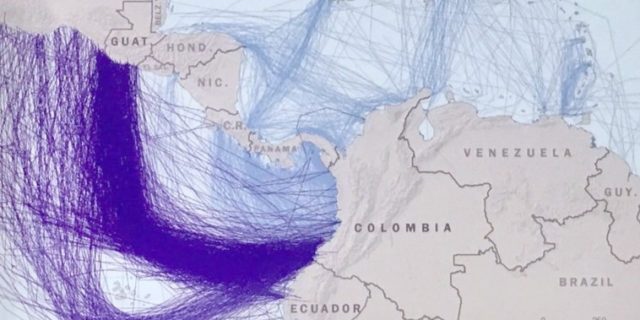
A map produced by the US Southern Command shows that most drug routes enter the US via the Pacific and then Central America (Business Insider)
Press TV – April 19, 2020
The top US military commander for Latin America has claimed that the Navy’s purported expansion of counter-narcotic operations in the Caribbean is not a military force aimed at toppling Venezuela’s President Nicolas Maduro despite Washington persisting provocations against Caracas.
Chief of US Southern Command Adm. Craig Faller asserted in an interview that Washington’s recent decision to double anti-narcotics assets in Latin America was planned months ago and not “directly” tied to Maduro’s indictment in a US court on allegations of leading a “narco-terrorist” conspiracy that supposedly sent 250 metric tons of cocaine a year to the United States.
“This is not a shift in US government policy,” Faller further claimed, despite boasting that enhanced interdiction efforts would harm Maduro’s finances and staying power. “It’s not an indication of some sort of new militarization in the Caribbean.”
The naval deployment announced this month is reportedly one of the largest US military operations in the region since its invasion of Panama in 1989 to topple its president and former CIA operative Gen. Manuel Noriega from power and take him to the US to face drug charges.
The operation involves major war-making resources such as Navy warships, AWACS surveillance aircraft and on-ground Special Forces rarely deployed before in the region.
Faller, however, further claimed that economic and diplomatic pressure — not the use of military force — continue to be Washington’s preferred instruments to oust the Venezuelan president from power.
He then went on to claim that growing instability in Venezuela is leading to an “uptick” in piracy in the Caribbean without citing any statistics or evidence to support his assertion.
Faller also said the recent sinking of a Venezuelan naval ship after it allegedly rammed an Antarctic-hardened cruise ship without passengers near Curacao reflected the readiness of the Venezuelan armed forces.
“It was a bad day for them,” he mockingly said. “Their lack of seamanship and lack of integrity is indicative of how it all played out.”
The hawkish US commander also pointed out that the coronavirus pandemic did force some in the US military to rethink the timing of the current deployment out of concern for the safety of American troops, adding that while controls to protect the workforce have been enhanced, it was determined that over the long term, the US is positioned to take advantage of the disruption in narcotics supply chains caused by the coronavirus outbreak as drug cartels scramble to source precursor chemical and other inputs.
“We thrive in uncertainty and are going to try and capitalize on that,” Faller boasted.
Moscow Aware of US Offer to Tbilisi to Expand Military Research in Lugar Biolab
Sputnik -April 18, 2020
Moscow is aware of Washington’s offer to Georgia to expand military research in the Richard Lugar biological laboratory, located not far from Tbilisi, the Russian Foreign Ministry’s spokeswoman, Maria Zakharova, said on Friday.
“According to the information that we have, high-ranking Pentagon representatives have just recently paid a new visit there, to offer to Georgian authorities to expand the range of research conducted there. Meanwhile, it cannot be excluded that Americans work on creating and modifying different dangerous disease pathogenic agents, including with military aims, in reference laboratories in third countries,” Zakharova said at a briefing.
According to the Russian Foreign Ministry, at the US-Georgian Richard Lugar Public Health Centre in the suburbs of Tbilisi, Georgia’s US partners had taken the initiative to expand the range of studies.
“We noticed, and we cannot help but pay attention to the strengthening of the American biological (weapons development) presence abroad directly,” she said at a briefing. She noted that, in particular, she was talking about the former Soviet republics, where under the pretext of combating bioterrorism, the US Department of Defence was organizing dual-purpose biological research laboratories.
The lab was opened in the Georgian capital in 2011 and has been at the center of controversy for allegedly trying to weaponize diseases. Russia said last fall it was part of a network of research labs that the US military was running in former Soviet republics.
US quietly recalls ALL B-52 bombers from Guam just DAYS after staging ‘show of force’
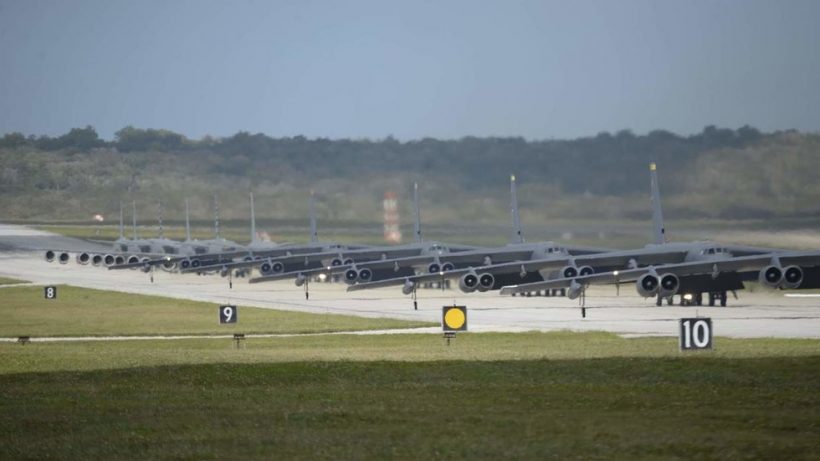
© US Air Force / Staff Sgt. Divine Cox
RT | April 18, 2020
All five nuclear-capable B-52 strategic bombers departed their forward base on the Pacific island of Guam just days after taking part in an ‘elephant walk’ show of force. The US Air Force says it wants to be more unpredictable.
The B-52H Stratofortresses departed Guam on Thursday, ending the Continuous Bomber Presence Mission that began in 2004, according to the War Zone blog. They were spotted flying over to Minot Air Force Base in North Dakota, with callsigns spelling “see you.”
The redeployment was in line with the new National Defense Strategy, calling for the bombers to return to their permanent base and keep the forward deployments less predictable, US Strategic Command spokesperson Major Kate Atanasoff told the War Zone.
“US strategic bombers will continue to operate in the Indo-Pacific, to include Guam, at the timing and tempo of our choosing.”
For the past 16 years, that place was the Andersen AFB on Guam, where the B-52 bombers as well as their newer B-1B and B-2 cousins, would do six-month stints. Under the Trump administration, however, the USAF began experimenting with “Dynamic Force Deployment,” sending B-2s to Wake Island amid their deployment at Pearl Harbor in Hawaii.
The bombers’ departure was accidentally revealed by the Pentagon on April 14, when a photo of them was captioned”Last Continuous Bomber Presence Mission on Guam” on the official Defense Visual Information Distribution Service (DVIDS) website. The caption was later changed to “Andersen remains ready.”
That was the same caption that was used for the “elephant walk” publicity stunt the day before, when the five B-52s lined up on the runway with six KC-135 Stratotankers, an RQ-4 Global Hawk long-range surveillance drone and the Navy’s MH-60S Knighthawk helicopter.
The show of force was interpreted by the media as a message to China, North Korea and even Russia not to get any ideas about challenging US global hegemony. The main tool of US force projection in the region, the aircraft carrier USS Theodore Roosevelt, has been very publicly sidelined by the Covid-19 coronavirus pandemic, with its crew quarantined on Guam.
Intelligence agencies fail to protect us from pandemic

CSIS and CSE headquarters
By Yves Engler · April 16, 2020
With millions forced out of work and many more stuck at home, Canadians need to ask tough questions of organizations receiving billions of dollars to protect them from foreign threats. The country’s intelligence/security sector has done little to respond to the ongoing social and economic calamity. Even worse, their thinking and practices are an obstacle to what’s required to overcome a global pandemic.
A recent Canadian Press article highlights the failure of intelligence agencies to warn of the COVID-19 outbreak. They largely ignore health-related threats despite receiving huge sums of federal money.
The Canadian Security Intelligence Service’s (CSIS) has more than 3,000 employees and a $500 million budget, which is nearly equal to that of the lead agency dealing with the pandemic. The Public Health Agency of Canada’s (PHAC) budget is $675 million and it has 2,200 employees. For its part, the Communications Security Establishment (CSE) employs 2,500 and receives over $600 million annually. In 2011 Department of National Defence run CSE moved into a new $1.2 billion, 110,000 square metre, seven-building, complex connected to CSIS’ main compound.
CSE is but one component of DND’s intelligence juggernaut. Not counting CSE, the Canadian Forces has greater intelligence gathering capacities than any organization in the country. While their budget and size are not public information, the government’s 2017 Defence Policy review notes that “CFINTCOM [Canadian Forces Intelligence Command] is the only entity within the Government of Canada that employs the full spectrum of intelligence collection capabilities while providing multi-source analysis.” The Defence Policy Paper called for adding 300 military intelligence positions and expanding CFINTCOM’s scope.
CFINTCOM has a medical intelligence (MEDINT) cell to track how global health trends and contagions impact military operations. Apparently, they reported on the coronavirus outbreak in January but it’s unclear who received that information.
The $2 billion spent on CSIS/CSE/CFINTCOM annually — let alone the more than $30 billion devoted to DND/Veterans Affairs — could have purchased a lot of personal protective equipment for health care workers. It could have paid for many ventilators and it could also have been used to raise the abysmally low wages of many who work in long-term care and nursing homes.
But, it’s not only that CSIS/CSE/CFINTCOM resources could be better used. Their ideology and structures are an obstacle to avoiding/overcoming a global pandemic. Two weeks ago, CSE put out a statement warning Canadian coronavirus researchers to beware of malign international forces seeking to steal their research. A Canadian Centre for Cyber Security statement noted, “these actors may attempt to gain intelligence on COVID-19 response efforts and potential political responses to the crisis or to steal ongoing key research toward a vaccine or other medical remedies.” But, wouldn’t it, in fact, be great if our ‘enemies’ in Russia, China, Iran, or anywhere else employed Canadian research to develop a cure or vaccine for COVID-19? Who, except extreme right-wing ideologues could believe a vaccine or cure should be patented and profited from?
It won’t be easy to shift their orientation to include pandemics. In a recent commentary, prominent intelligence agency insider Wesley Wark notes, “our security and intelligence agencies have never seen health emergency reporting as part of their core mandate, despite a plan laid down in the National Security Policy announced after SARS that unfortunately went nowhere.” For a time after the 2003 SARS outbreak the CSIS-based Integrated Threat Assessment Centre reported regularly on pandemic dangers, but the unit was soon collapsed into the Integrated Terrorism Assessment Centre. For the intelligence agencies “terrorism” is appealing because it justifies militarism and a ‘security’ state. Health emergencies, on the other hand, justify better work conditions for long-term care providers.
The CSIS/CSE/CFINTCOM definition of ‘security’ is heavily shaped by corporate Canada, state power projection and ties to the US Empire. In criticizing Canadian intelligence agencies’ failure to warn/protect us from the pandemic, Wark highlights the dangerously narrow outlook of the intelligence community. He suggests CSIS/CSE/CFINTCOM could have helped prevent the calamity by gathering better intelligence on China. But, if Beijing hid early information on COVID-19, it’s at least partly because China is locked in a destructive geopolitical competition with the US empire, which was instigated by Washington and its allies (from 1949 to 1970 Canada refused to recognize China and in 1950 sent 27,000 troops to Korea largely to check Chinese nationalism). In recent months CSIS/CSE/CFINTCOM have sought to identify China as a threat.
Wark’s thinking must be rejected. Avoiding and overcoming global pandemics requires a free exchange of health information. It also requires international solidarity.
After the COVID-19 crisis dies down, progressives should renew their push to devote intelligence agencies’ resources towards initiatives that protect ordinary Canadians’ security, rather than the interests of the rich and powerful.
U.S. Government’s $3.7 Million Grant to Wuhan Lab at Center of Coronavirus Outbreak
By Robert F. Kennedy, Jr., Chairman, Children’s Health Defense | April 15, 2020
The Daily Mail reported that it has uncovered documents showing that Dr. Anthony Fauci’s National Institute of Allergy and Infectious Disease (NIAID) gave $3.7 million to scientists at the Wuhan Lab at the center of coronavirus leak scrutiny. According to the British paper, “the federal grant funded experiments on bats from the caves where the virus is believed to have originated.”
Background: Following the 2002-2003 SARS coronavirus outbreak, NIH funded a collaboration by Chinese scientists, US military virologists from the bioweapons lab at Fort Detrick and National Institutes of Health (NIH) scientists from NIAID to prevent future coronavirus outbreaks by studying the evolution of virulent strains from bats in human tissues. Those efforts included “gain of function” research which is “accelerated viral evolution” to create COVID Pandemic superbugs, enhanced bat borne COVID mutants more lethal and more transmissible than wild COVID.
Fauci’s studies alarmed scientists around the globe who complained, according to a December 2017 NY Times article, that “these researchers risk creating a monster germ that could escape the lab and seed a pandemic.” Dr. Marc Lipsitch of the Harvard School of Public Health’s Communicable Disease Center told the Times that Dr. Fauci’s NIAID experiments “have given us some modest scientific knowledge and done almost nothing to improve our preparedness for pandemic, and yet risked creating an accidental pandemic.”
In October 2014, following a series of federal laboratory mishaps that narrowly missed releasing these deadly engineered viruses, President Obama ordered the halt to all federal funding for Fauci’s dangerous experiments. NIAID-funded gain of function research continued after the moratorium in a Wuhan-based laboratory. Congress needs to launch an investigation of NIAID’s mischief in China.
[Addendum after our story ran: CNN reports that: “An intelligence official familiar with the government analysis said a theory US intelligence officials are investigating is that the virus originated in a laboratory in Wuhan, China, and was accidentally released to the public. Other sources told CNN that US intelligence hasn’t been able to corroborate the theory but is trying to discern whether someone was infected in the lab through an accident or poor handling of materials and may have then infected others.”]
This work is reproduced and distributed with the permission of Children’s Health Defense, Inc. Want to learn more from Children’s Health Defense? Sign up for free news and updates from Robert F. Kennedy, Jr. and the Children’s Health Defense. Your donation will help to support us in our efforts.
Will This Pandemic Finally Mark the End of the US Carrier Fleet?
The Saker • Unz Review • April 16, 2020
Frankly, I have never considered USN carrier strike groups as a “Cold War capable” element of the US Navy. Yes, in theory, there was the notion of forward deploying these carriers to “bring the war to the Soviets” (on the Kola Peninsula) before they could flush their subs and aircraft through the GUIK gap and into the Atlantic. In theory, it should have been a 600 ship navy too, but that never happened. In reality, of course, US strike groups were the ultimate “colony disciplining” instrument which Uncle Shmuel would park off the coast of a country disobedient to the demands and systematic plundering of the USA. Since most countries in the 20th century could not sink a US carrier or prevail over the comparatively advanced aircraft deployed on them, this was, all in all, a very safe game to play for the USA.
As for “bringing the war to the Soviets”, the truth is that had it ever come to a real war, the US carriers would have been kept far away from the formidable Soviet cruise missile capability (delivered simultaneously by aircraft, surface ships and submarines) for a very simple reason: every time such an attack was modeled a sufficient number of Soviet missiles successfully passed through the protective cordon around the carrier and successfully hit it with devastating results (while sinking a carrier is not that easy, damaging it and making it inoperable does not take that many missile hits).
And that was long before hypersonic missiles like the Kinzhal or the Zircon!
Truly, as an an instrument to deter or defeat the Soviets the USN strike groups were already obsolete in the 1980s, that is long before the the Russians deployed their hypersonic missiles which, as my friend Andrey Martyanov explained in his books (see here and here) and on his blog (see here), basically made the entire US surface fleet obsolete not only to fight Russia, but also to fight any country which possesses such missiles. Such countries already include India and China, but there will be many more soon, probably including Iran!
Today, however, I won’t discuss the missile issue, but what happened recently on the USS Theodore Roosevelt, which you probably know about: her captain got fired for writing a letter (according to his accusers, bypassing the chain of command) asking for help because his crew got infected by the virus. His letter was published by the San Francisco Chronicle and you can read it here.
Interestingly, when the captain, Navy Capt. Brett Crozier, left the ship, his sailors gave him a standing ovation:
Next, Acting Navy Secretary Thomas Modly called Captain Crozier “stupid.” That also became public, and he had to apologize and resign (clearly, Modly is not exactly a genius himself!). Then even more of the crew of the carrier got sick, including Crozier himself!
This is what is known in the US military jargon as a “clusterbleep”…
There is, however, also a lot of interesting stuff coming out from this story.
First, the obvious: USN carriers cannot operate effectively under a bio-attack (a truly weaponized virus would both be much more transmissible than SARS-COV-2 and it would be far more deadly). This also indicates that they would probably do no better under a real chemical warfare attack either.
Considering that in reality USN carriers are an instrument of colonial repression and not ships to be engaged against the USSR (which had real biowarfare capabilities), this makes sense (while most university labs & the like could produce some kind of virus and use it as a weapon, truly weaponized viruses, the kind effectively used in special delivery systems, can only be produced by a limited list of countries). However, in theory, all the formations/units/subunits/ships/aircraft/armor/etc of a military superpower should be trained to operate in case of a nuclear, chemical and biological attack. Clearly, this is not the case with US carriers, most likely because nobody in the USA really expected such an attack, at least not during the Cold War.
For the current situation, however, I think that the lesson is clear: the USN simply does not have an effective capability to operate under NBC attack conditions.
By the way, this appears to also be true of the French, whose only carrier has 30% infected sailors!
Second, I agree that going outside the chain of command is wrong, but let’s also consider the following here: the fact that the USS Theodore Roosevelt was having a large number of infected sailors is not something which could have been kept secret anyway, especially while in port. Not only that, but how do we know that Capt. Crozier did not write other memos through the regular chain of command before he wrote the one which became public? After all, any such memos could very easily be classified and never made public.
Finally, I will admit that my sympathies are squarely with the man who placed the lives of his men and women above all else, and not with the bureaucratic drone who put procedures and ruffled feathers above the lives of sailors and called the real officer “stupid” for his actions (wait! a USN carrier captain stupid?! Somehow I don’t think so…..).
At the time of writing (April 14th) there have been 600 sailors from the Theodore Roosevelt who contracted the virus and one death.
Finally, over 4000 sailors have now been evacuated from the ship (1000 are still onboard to operate the nuclear reactor and other key systems).
In other words, the USS Theodore Roosevelt is now completely inoperable!
The quoted CNN article concludes with:
Vice Chairman of the Joint Chiefs of Staff Gen. John Hyten told reporters Thursday the US military needed to plan for similar outbreaks in the future as the Defense Department works to cope with the virus’ impacts. “I think it’s not a good idea to think the Teddy Roosevelt is a one-of-a-kind issue. We have too many ships at sea, we have too many deployed capabilities. There’s 5,000 sailors on a nuclear-powered aircraft carrier. To think it will never happen again is not a good way to plan. What we have to do is figure out how to plan in these kind of Covid environments,” Hyten said.
Yet more proof that the USN never took a bioattack threat seriously.
To be honest, it seems that the US Army has similar problems, here is a map of affected US bases I found on Colonel Cassad’s blog:

It appears that the US-based forces never expected any real attack (other than maybe one by terrorists equipped with small arms) so NBC security was never a priority.
Note, in Russia, at least so far (April 14th), there are zero cases of servicemen infected with the virus. This will almost inevitably change in the future, but for the time being, this is true, in spite of having Russian military units helping to fight the virus both in Russia and outside. Just saying…
However, this is not a fair comparison. First, bases located on land have far more interactions with the outside world than ships, even ships in port. Second, and much more importantly, in case of a pandemic or chemical/biological attack, bases located on land can better isolate those affected, bring in more resources or quickly disperse the personnel to better protect them. You can’t do that on a ship. In fact, the bigger the ship, the more it looks like an “armed cruiseliner” which, as we now all know, is a gigantic Petri dish.
Questions such as those above will only increase in number as the pandemic finally sheds much-needed light on the shocking reality about “the best! most powerful! best equipped! and best trained military force in the Galaxy!”: it can’t even protect itself from a relatively weak virus, never-mind defeat a competent enemy.
Will we get answers? Eventually, probably yes. But for the time being, the US is all about covering your ass while pointing fingers and blaming others (especially China, Russia and even the WHO!). This strategy has been an abject failure for the past decades and it will be an abject failure in the future.
Trump’s latest decision to defund the WHO (to whom the US already owes a ton of money anyway) is arguably his worst act of “international PR seppuku” which will further increase the disgust the USA already inspires worldwide. As for our Israeli friends, they are proud that their Mossad actually steals medical equipment from other countries: after all, every Israeli know that Jewish blood is sacred, while goy blood is worthless. Another case of self-inflicted “international PR seppuku” for “the only democracy in the Middle East.”
But since that is all US politicians know how to do, this is not stopping anytime soon. Likewise, what is known as the “carrier fiction” will be upheld for as long as possible, especially since there is a lot of money involved for the US ruling classes.
Cutting military spending to fund human security is ‘The Least’ world leaders can do after pandemic – Gorbachev
RT | April 16, 2020
The Covid-19 pandemic shows that governments that think of security in mostly military terms are simply wasting money, Mikhail Gorbachev has said. Defence spending must be cut globally to fund things that humanity actually needs.
The former Soviet leader called on the world to move away from hard power in international affairs. He remains especially worried about the kind of military brinkmanship that lately has almost led to a shooting war in the Middle East.
“What we urgently need now is a rethinking of the entire concept of security,” he wrote, in an op-ed published by TIME magazine. “Even after the end of the Cold War, it has been envisioned mostly in military terms. Over the past few years, all we’ve been hearing is talk about weapons, missiles and airstrikes.”
The Covid-19 outbreak has highlighted once again that the threats humanity faces today are global in nature and can only be addressed by nations collectively. The resources currently spent on arms need to go into preparation for such crises, Gorbachev said.
“All efforts will fail if governments continue to waste money by fueling the arms race.”
“The overriding goal must be human security: providing food, water and a clean environment, and caring for people’s health,” he said.
The first thing that nations should do after the coronavirus is dealt-with is to make a commitment to a massive demilitarization.
“I call upon [world leaders] to cut military spending by 10 percent to 15 percent. This is the least they should do now, as a first step toward a new consciousness, a new civilization.”
Gorbachev, the former leader of the USSR who is credited with de-escalating the Cold War against the US and with negotiating a dramatic reduction in the nuclear arsenals of the two powers, shared his opinions and aspirations as the global number of Covid-19 cases surpassed the two-million benchmark. The pandemic has led to over 130,000 deaths and is projected to plunge the world economy into a recession of a magnitude unseen since the 1920s.
Trump’s Cyprus Signalling Is More against Turkey than Russia
By Paul Antonopoulos | April 15, 2020
The Al-Monitor portal has left many extremely surprised with news that was not expected in the middle of the coronavirus pandemic. With over 600,000 cases and 25,000 deaths in the U.S., President Donald Trump has made a bold geopolitical move and instructed Secretary of State Mike Pompeo to determine whether Cyprus should have the arms embargo against it lifted, according to Al-Monitor’s congressional correspondent, Bryant Harris.
“Trump tasked Pompeo with the decision [yesterday] via a presidential memorandum after signing two separate bills to lift the embargo in December — legislation that Turkey had unsuccessfully sought to forestall,” explained Harris.
In 1987, the U.S. embargoed arms sales to Cyprus under the pretext of preventing an arms build-up on the island. However, this was not a problem for Cyprus as Russia became one of the biggest weapon suppliers instead. If the U.S. were trying to have balance on Cyprus, it certainly did not achieve this as the country only became closer with Russia and to this day they still have close ties.
In 1974, Turkey invaded the northern parts of the island to prevent Cyprus from uniting with Greece and to this day continues an illegal occupation. The occupation is to maintain the quasi “Turkish Republic of Northern Cyprus” that is recognized by no other state in the world bar Turkey and is recognized by United Nations Security Council Resolution 541 and UN Security Council Resolution 550 as illegal.
The U.S. has never taken an interest in protecting Cypriot interests despite the illegalities of the occupation of northern Cyprus – up until recent times. Turkish President Recep Tayyip Erdoğan going rogue against U.S. and NATO interests by strengthening relations with Russian President Vladimir Putin, including the sale of the S-400 missile defense system that are not compatible with NATO doctrine.
The irony is that Turkey bought the S-400 system despite the fact that in 1997 Cyprus bought the S-300 air defense missiles from Russia, but had to trade it with Greece for other weapons under a Turkish threat of blockade and/or war. The S-300 is now located on the Greek island of Crete. As Greece in recent years has been a loyal subject of NATO without much independent foreign policy, Washington is now willing to give the country more concessions. In previous years, Washington would only appease Turkey as it controlled the Bosporus Straits that connects Russia’s Black Sea Fleet to the rest of the world.
However, these concessions and attempts to strengthen relations between Cyprus and the U.S. come at a price. Harris explains that the U.S. Congress laid out specific criteria that Cyprus needs to fulfill before it is allowed to procure arms from the U.S., if it ever choose to.
“Specifically, the law requires Cyprus to deny Russian military vessels to its ports despite a 2015 agreement with Moscow to do so. It also requires Cyprus — a financial haven for wealthy Russians to evade US sanctions — to comply with anti-money laundering regulations,” he said.
It is very unlikely that Cyprus will meet these demands made as it is not a NATO member, nor does it have the incentive to abandon a partner that supplied it weapons when the U.S. turned its back. Knowing this fact, Harris explained that “even if Cyprus fails to comply with these conditions, the law gives Pompeo the freedom to lift the embargo anyway via a national security waiver.”
This therefore means that the true target of this arms embargo lift is not necessarily Russia, but rather Turkey. It is effectively in Cypriot hands on whether they want to take on these U.S. conditions. Cyprus is being ‘rewarded’ by Washington as in recent years it has formed a strategic partnership with Israel in the economic, energy and military sector. Because of this, pro-Israel groups in the U.S. lobbied to lift the arms embargo last year, especially as Erdoğan frequently antagonizes Tel Aviv.
Although it is in Pompeo’s hands to decide whether to lift the embargo or not, it is more likely he will choose to do this even if Cyprus decides not to conform to the anti-Russian measures demanded. Not only are Trump and Pompeo receiving pressure from the Israeli lobby, but they are also receiving pressure from extremely influential think-tanks.
In an article from June 2019, titled “Lift the Arms Embargo on Cyprus,” that was first published by The Center for the National Interest, and then republished by the CATO Institute, the author explains “The current arms embargo on Cyprus is unbalanced and unfair. Favoring Turkey never was likely to help keep the peace. Today, given Erdogan’s transformation into a frenemy of America at best, and confrontational policy toward Cyprus and Greece, the embargo rewards an essentially rogue government. The United States should see Turkey plain and stop tolerating the latter’s unfriendly conduct.”
However, there is no guarantee that just because Cyprus is now being noticed and recognized by Washington that it will quickly abandon Russia, especially because of decades of limited relations and the important role the U.S. played in supporting the Turkish invasion of northern Cyprus. Rather, the lifting of the arms embargo is just one small gesture that Washington might make to antagonize a rogue Erdoğan, and if this is the aim, it will certainly work as the Turkish president believes the island to be a part of his domain.
Paul Antonopoulos is a Research Fellow at the Center for Syncretic Studies.
The Controversy Over Who Is Responsible for Coronavirus Is Heating Up
By Paul Craig Roberts • Institute for Political Economy • April 14, 2020
Let’s hope the Neoconservatives and American presstitutes don’t add a conflict with China to the ongoing virus and economic threats.
First, is the virus a bioweapon? Second who is responsible?
Two sources concluded that the virus was a bioweapon. One is Francis Boyle, who drafted the US implementing legislation for the Biowarfare Convention that became US law in, I believe, 1989. Boyle says the US government violates the law and has 13,000 scientists working on biowarfare research. Boyle said in February that the aerosol gain-of-function of the virus was done at a UNC lab at which a Wuhan scientist was present, and the HIV features were done in Australia where a Wuhan scientist was present. He says the scientists took the work back with them and the result was Covid-19. Also in February or March a scientific paper by scientists in India concluded that the virus was man-made. Their paper was taken down without explanation.
A top virologist, whose statements to the Belgium government concerning the inadequacy of the government’s response to the virus I have posted on my website, tells me that the Indian scientists were mistaken, and that the virus is naturally evolved. As he is not involved in bioweapons work, I do not think he is covering up illegal activity by US and Chinese governments. He shows in his public concern every indication of being a highly principled person of unquestioned ability and character. Moreover, his position seems to be widely shared among experts.
As for responsibility, it seems both China and the US are responsible. It is clear from news reports that the US contributed millions of dollars to the Wuhan level 4 lab for research having to do with bats and coronavirus. What this research was, we don’t know. We only know what they say. But the US government was aware of the bat coronavirus research and helped to fund it. There was also a report that after the virus outbreak the president of China suddenly removed the top people at the Wuhan facility and put in charge a woman who was an expert virologist. Chinese president XI thought something had gone wrong at the lab and said it was the duty of the government to protect the people.
We also know that various Chinese officials and press said the Americans had brought the virus with them when they came to Wuhan to participate in the military games. The Chinese did not mean on purpose, but that someone among the US team was infected without having symptoms, often a feature of the virus. There was some discussion in which US health officials seemed to acknowledge that the virus might have been active in the US before it broke lose in a mass way.
We also know that Trump and now the neoconservative warmongers are blaming China for keeping quiet too long about the virus. This claim as far as I can tell is false. It seems to be mainly propaganda against China.
We also have had reports that a US military lab in Texas was suddenly closed out of pathogen concerns by the Obama regime.
How all this fits together or doesn’t I don’t know.
As the Democrats are blaming Trump for the virus, Trump blames China as that aligns the Democrats with the “enemy” China and is a way of showing that the Democrats are covering up for “Communist China” by shifting the blame to the president of the US.
The politics of the virus will make it difficult for the truth to emerge.
Featured Video
Iran’s Next Strike May Not Explode. It Could Shut You Down
or go to
Aletho News Archives – Video-Images
Book Review
New paperback: Butchered by “Healthcare”
Lies are Unbekoming | October 20, 2026
 Butchered by “Healthcare” is Robert Yoho’s plain-spoken account of how American medicine stopped being a profession and became an industry. 341 pages. Over a thousand references. Thirty-eight chapters.
“Screening Tests Are Useless”, on tests that find diseases that would never have hurt you. “The FDA Protects the Big Drug Companies”, on an agency funded by the companies it regulates. “The Journals’ Sins Are the Editors’ Sins”, on ghostwritten studies and captured peer review. “Opioids and ‘Pain Management’”, on how a generation was prescribed its way into addiction. “Prozac and Relatives” and “Antipsychotics Are Disastrous”, on what psychiatry does to adults and children. “Surgery: Money Before Patients”. “Failed Cancer Treatments”. “Futile CPR and Overprescribing”. “Billing Scams & Specialty Warfare”. “Hospitals Are Sharks”. Each with a Patient Tips section at the end on how to survive it.
If you have ever walked out of a doctor’s office with a prescription you didn’t ask for, or watched a parent put through a treatment that made them worse, this is the book you want on your shelf before the next appointment. … Full review
Butchered by “Healthcare” is available on Lulu now.
Blog Roll
 Aletho News
- Iran’s Next Strike May Not Explode. It Could Shut You Down /Col Doug Macgregor
- Iran: US political targets legitimate if assassinations return
- Iraq shuts key border crossing with Iran under US pressure: Report
- Undersea Internet cables could be targeted in retaliation for attacks on Iran: IRGC deputy chief
- EU sending ‘biased’ observers to interfere in Serbian election – president
- White House envoy declares kinetic action against Yemen ‘fruitless’
- Ukraine deployed thousands of microdrones in Iraqi Kurdistan: Tasnim
- Iran calls for emergency UNSC meeting over Trump’s ‘brazen’ bomb talk, Israeli threats
- Iranian sources reveal details of Russia-China Hormuz proposal
- Plan for more US-Israel integration puts our military tech at risk
- If Americans Knew
- Americans at National Conservatism Conference held in Israel this year criticize Israel
- Christiane Amanpour exits CNN with a legacy shaped by the debate over Israel
- Israel’s war on Iran is the final move in a decades-old strategy
- Israel Denies Entry to French Journalist, U.S. Researcher Amid Rise in Entry Denials
- Gaza’s hospitals are running out of life-saving fuel – Daily Update
- Mysterious bot accounts reportedly spread fake ‘man on the street’ videos for Michigan Senate candidate
- Israeli Defense Minister Katz Says Over 60 Lebanon Villages Have Been Destroyed
- Why Is Israel Running TV Ads in Iowa Ahead of the Midterms?
- Hind Rajab’s Alleged Killer Is in the United States. HRF Demands His Arrest.
- US Officials Face Fresh Pressure After Another American ‘Brutalized’ by Israeli Settlers in West Bank
- No Tricks Zone
- E-Cars Reduce CO2 Emissions By Only 41% Compared To Internal Combustion Engine Vehicles
- Predictions Made By Renowned Climate Professor Over Past Decades Have Been Proven To Be Poor
- New Study Suggests Large Regions Of The Pacific Ocean Have Been Cooling For The Last 80 Years
- Germany’s Green Energy Debacle: High Energy Costs Force Kahla Porzellan to Close After 182 Years!
- New Study: 50 Years Of The Most Aggressive ‘Net Zero’ Policies Can Only Affect The Global Climate By 0.03°C
- US September “Heat” Was No Record…Many Records Set Decades Ago
- Latest European Green Energy Debacle; Portugal’s Largest Flagship Solar Park Insolvent!
- Green Energy Debacle: German Expert Professor Fritz Vahrenholt Warns Of Severe Economic And Social Consequences
- Two More Paleo Reconstructions Affirm Meters-Higher Sea Levels Across Ireland, Brazil 7000-6000 Years Ago
- New Study: Earth And Venus Surface Warmth Largely Explained By Convection And Lapse Rate, Not CO2 Or Radiation

