Russia warns Turkey against rash moves in Idlib
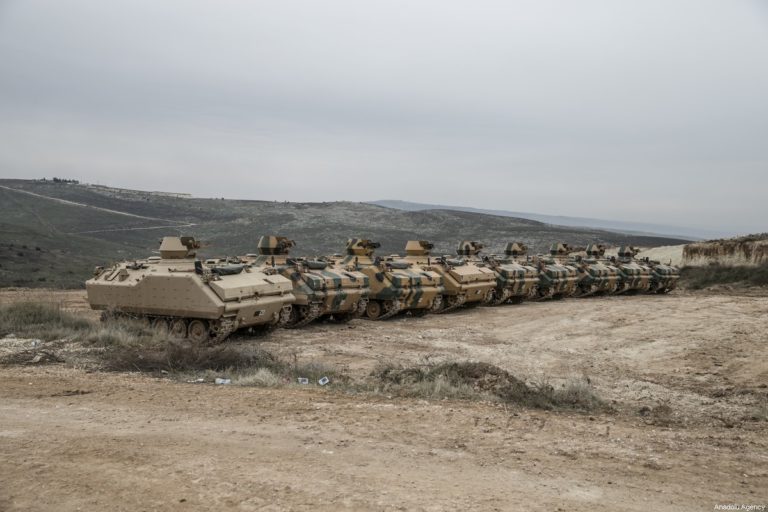
Turkish military reinforcements preparing to cross the border into Syria’s northwestern province of Idlib, February 12, 2020
By M. K. BHADRAKUMAR | Indian Punchline | February 19, 2020
Moscow has taken with a pinch of salt Turkish President Recep Erdogan’s statement on Wednesday that a Turkish incursion into the northwestern Syrian province of Idlib is imminent.
Objectively speaking, Erdogan should be out of his mind to order a military offensive against the Syrian and Russian forces in Idlib. A Russian military delegation, which visited Ankara last week, had advised the Turks to back down, but Erdogan instead beefed up the deployments in Idlib.
Again, the Russian side proposed to the Turkish delegation, which visited Moscow this week for further talks, that a new ceasefire is the best option, necessitated by the ground reality that Damascus will not vacate the strategic areas flanking the M4 and M5 highways.
The Turkish delegation not only disputed the Russian demarche that terrorist attacks from Idlib continue still against the Hmeimim airbase but Erdogan’s statement today goes a step further.
Clearly, Moscow cannot take chances. The Kremlin spokesmen Dmitry Peskov calmly shrugged off Erdogan’s threat by saying, “Let us not expect the worst scenario to become a reality.”
He added, “We are determined to continue to use our working contacts with our Turkish counterparts to prevent the situation in Idlib from escalating further.” Peskov stressed that “contacts with Turkey would continue at various levels.”
But the Russian intention is to forewarn Erdogan against making any rash moves. The point is, the Idlib situation evolved over a period of time since last summer when Russia and Syria reached an estimation that Turkey had no intentions of fulfilling its commitments to evict the al-Qaeda affiliates.
Turkey was instead utilising its 12 “observation posts” in Idlib to keep an eye on the Syrian and Russian forces beyond the ceasefire line.
When the Russian-Syrian offensive finally got under way, Turks could do nothing to stop it and very soon, these observation posts got surrounded by the Syrian army. Erdogan lost face. And he ordered a deployment of 5,000 troops to Idlib with heavy armour, tanks and artillery.
But the Syrian forces took on the challenge and13 Turkish soldiers were killed. Erdogan had probably thought that the Syrian forces would hesitate to take on a NATO power. Again, he lost face. And this time around, he threatened to attack the Syrian and Russian forces.
But the offensive rolled on and more towns and territories came under control of the Syrian government. As a commentary featured today in the Kremlin-funded RT puts it, “Erdogan’s bluff had been effectively called. The Turks now find themselves in an impossible situation.”
Erdogan has pulled back the rebel groups that are Turkey’s proxies and left the al-Qaeda groups to fend for themselves where they are being systematically decimated by the Syrian and Russian forces. The RT commentary concludes:
“For the Turkish troops still deployed inside Idlib, their situation has become increasingly perilous. Their numbers and dispositions preclude any chance of a meaningful defense of Idlib, even if the decision was made to engage the Russian Air Force and Syrian Army. The best that Turks can hope for at this juncture is a new ceasefire that allows its military forces in Idlib to be withdrawn safely with their honour intact… Turkey has made its position in Idlib unsustainable both militarily and politically.”
However, Russia won’t take chances. In a display of military superiority, two Russian Tupolev Tu-22M3 strategic bombers performed a scheduled flight over the Black Sea today, covering a distance of about 4,500 km and staying in the air for more than five hours, while fighter jets of Russia’s Southern Military District escorted the bombers.
Again, today, Foreign Minister Sergey Lavrov repeated Moscow’s full backing for the Syrian operations in Idlib. He said in a clear rebuff to Turkey, “It is only natural that the Syrian armed forces, reaffirming their commitment to the original agreements on Idlib, including an agreement on a ceasefire, respond to such inadmissible provocations. We support them in this.”
“The Syrian army’s actions are a response to a flagrant violation of the agreements on Idlib… Syrian troops are not pushing militants and terrorists back on a foreign territory but on their own soil, thereby reestablishing the legitimate Syrian government’s control over its territories.”
Although US President Trump keeps cheering Erdogan to buck up his spirits, the NATO as such is not getting involved in the Turkish adventure in Idlib. Tass quoted a NATO diplomatic source in Brussels that NATO countries will neither support the invocation of Article 5 over the death of Turkish troops in Idlib nor provide Turkey with military assistance in the event of a military operation in the region.
Moscow has been far too lenient toward Erdogan who has “significant challenges at home, where the Turkish economy is slowing down, and overseas, where Turkey’s military is over-stretched, from Syria to Libya,” as a scholar at the Washington Institute noted.
In a clear message warning Erdogan from punching so far above his weight, Haftar’s forces had fired shells at a Turkish ship at Tripoli harbour last week, which was carrying arms and supplies. Interestingly, Russian Defence Minister Sergei Shoigu met today with the Libyan commander Khalifa Haftar, who is Erdogan’s bête noire.
The astonishing part is that amidst all this cacophony, on Tuesday, the Turkish military quietly resumed joint patrols with Russian forces in northeastern Syria where both countries have a common interest in preventing a US return to the Turkish-Syrian border regions with their Kurdish allies. Certainly, as Peskov signalled today, the Kremlin has reason to hope that the better sense will prevail in Ankara.
The West Displays Its Insecurity Complex
By Diana Johnstone | Consortium News | February 19, 2020
The West is winning!” U.S. leaders proclaimed at the high-level Annual Security Conference held in Munich last weekend.
Not everybody was quite so sure.
There was a lot of insecurity displayed at a conference billed as “the West’s family meeting” – enlarged to 70 participating nations, including U.S. -designated “losers”.
Trump’s crude Secretary of State Mike Pompeo made nobody feel particularly secure by treating the world as a huge video game which “we are winning”. Thanks to our “values”, he proclaimed, the West is winning against the other players that Washington has forced into its zero-sum game: Russia and China, whose alleged desires for “empire” are being thwarted.
The Munich Security Conference (MSC) is a private gathering founded in 1963 by Ewald-Heinrich von Kleist-Schmenzin, a member of the aristocratic Wehrmacht officer class who plotted to get rid of Hitler when their estates in Eastern Germany were already being lost to the Red Army (to become part of Poland). The conference was evidently conceived as a means to enable Germans to get a word into strategic discussions from which they had been excluded by defeat in World War II.
The Munich conference knew its greatest hour of glory in February 2007, when Russian president Vladimir Putin shocked the assemblage by declaring his opposition to a “unipolar world” as “not only unacceptable but also impossible in today’s world.” Putin declared that NATO expansion up to Russian borders had nothing to do with ensuring security in Europe.
Russia, he said then, “would like to interact with responsible and independent partners with whom we could work together in constructing a fair and democratic world order that would ensure security and prosperity not only for a select few, but for all.”
This speech was taken as a major challenge, redefining capitalist Russia as the new enemy of the West and its “values”.
What is ‘The West?’
The term “the West” could mean a number of things. The conference organizers define it by “values” that are supposed to be essentially Western: democracy, human rights, a market-based economy and “international cooperation in international institutions”. In fact, what is meant is a particular interpretation of all those “values”, an interpretation based on Anglo-American history. And indeed, in historic terms, this particular “West” is essentially the heir and continuation of the British empire, centered in Washington after London was obliged to abdicate after World War II, while retaining its role as imperial tutor and closest partner.
It implies the worldwide hegemony of the English language and English ideas of “liberalism” and is “multicultural” as empires always are. While the United States is the power center, many of the most ardent subjects of this empire are not American but European, starting with the Norwegian secretary general of NATO. Its imperial power is expressed by military bases all around the world offering “protection” to its subjects.
As for protection, the United States is currently shipping 20,000 military personnel to reinvade Germany on their way to unprecedented military manoeuvers next month in ten countries right up to Russia’s borders. Some 40,000 troops will take part in this exercise, on the totally imaginary pretext of a “Russian threat” to invade neighboring countries.
This delights Washington’s enthusiastic vassals in Poland and the Baltic States but is making many people nervous in Germany itself and other core European Union countries, wondering where this provocation of Russia may lead. But they hardly dare say so in violation of “western solidarity”. The only complaint allowed is that the United States might not defend us enough, when the greater danger comes from being defended too much.
Opening this year’s conference, the President of the German Federal Republic Frank-Walter Steinmeier, expressed Germany’s strategic frustration more openly than usual. Steinmeier accused Washington, Beijing and Moscow of “great power competition” leading to more mistrust, more armament, more insecurity, leading “all the way to a new nuclear arms race.” He didn’t specify who started all that.
Overwhelming establishment distaste for Trump has provided a novel opportunity for leaders of U.S.-occupied countries to criticize Washington, or at least the White House. Steinmeier dared say that “our closest ally, the United States of America, under the present administration, rejects the idea of an international community.” But he made up for this by accusing Russia of “making military violence and the violent change of borders on the European continent a political tool once again” by annexing Crimea – forgetting the NATO violent detachment of Kosovo from Serbia and ignoring the referendum in which an overwhelming majority of Crimeans voted to return to Russia, without a shot fired.
French President Emmanuel Macron also expressed frustration at Europe’s dependence on Washington. He would like the European Union to develop its own military defense and security policy. “We cannot be the United States’ junior partner,” he said, although that is certainly what Europe is. While repeating the usual NATO line about the Russian threat, he noted that the policy of threats and sanctions against Russia had accomplished nothing and called for a “closer dialogue” to resolve problems. In that, he was surely echoing the consensus of the French elite which sees absolutely no French interest in the ongoing U.S.-inspired feud with Moscow.
Macron openly aspires to building a more independent EU military defense. The first obstacle lies in EU Treaties, which tie the Union to NATO. With the UK out of the EU, France is its strongest military power and its sole possessor of nuclear arms. There are indications that some German leaders might like to absorb France’s nuclear arsenal into a joint European force – which would surely arouse a “nationalist” uproar in France.
Playing the Game
Aside from providing protection, the Empire calls on everybody to play the game of international trade – so long as they consent to lose.
On Saturday in Munich, both Nancy Pelosi and Defense Secretary Mark Esper lit into China for daring to emerge as a trade giant and technological center. “China is seeking to export its digital autocracy through its telecommunication giant Huawei,” Pelosi warned.
Huawei has overtaken Russian natural gas as the export Washington condemns most vigorously as nefarious interference in the internal affairs of importers.
Esper gave a long speech damning Beijing’s “bad behavior”, “malign activity”, authoritarianism and, of course, Huawei. The Pentagon chief concluded his diatribe against America’s number one economic rival by a moralizing sermon on “our values, sense of fairness, and culture of opportunity,” which “unleash the very best of human intellect, spirit, and innovation.”
“Maybe, just maybe, we can get them on the right path,” Esper suggested benevolently. “Again, make no mistake, we do not seek conflict with China.”
In general, said Esper, “we simply ask of Beijing what we ask of every nation: to play by the rules, abide by international norms, and respect the rights and sovereignty of others.” (He could say, what we ask of every nation except our own.)
The Department of Defense, he said, is doing its share: “focused on deterring bad behavior, reassuring our friends and allies, and defending the global commons.” We want China to “behave like a normal country” but, said Esper, if it “will not change its ways”, then we must make “greater investments in our common defense; by making the hard economic and commercial choices needed to prioritize our shared security … prepared to deter any threat, defend any Ally, and defeat any foe.”
In short, China’s economic progress provides another excuse to increase the Pentagon budget and pressure European allies into more military spending. This could only please such major sponsors of this conference as Raytheon and Lockheed Martin (and probably did not displease Goldman Sachs and all the other major Western industries backing this get-together).
Chinese foreign minister Wang Yi replied to Esper’s harangue with some lessons of his own for the West, concerning “multilateralism”.
“It is not multilateralism if only the Western countries prosper while the non-Western countries lag behind forever. It would not achieve the common progress of mankind,” said Wang. “China’s modernization is the necessity of history.” China’s history and culture meant that it could not copy the Western pattern nor seek hegemony as major powers in the past.
Wang said the West should discard its subconscious mentality of civilization supremacy, give up its bias and anxiety over China, and accept and welcome the development and revitalization of a country from the East with a system different from that of the West.
The West at Munich did not appear particularly ready to follow this advice. Nor that of Russian Foreign Minister Sergei Lavrov who was also allowed his few minutes to address deaf ears. Lavrov lamented that “the structure of the Cold War rivalry is being recreated” as NATO continues to advance eastward, carrying on military exercises of unprecedented scope near the Russian borders, and inflating arms budgets. Lavrov invited the West to stop promoting the phantom of the Russian or any other “threat” and remember “what unites us all” before it’s too late.
But the self-appointed representatives of “the West” hadn’t come to hear that. They were much more ready to listen respectfully to representatives of such friendly arms purchasers as Qatar and Saudi Arabia whose acceptance of “Western values” was not called into question.
‘Westlessness’
It had evidently been decided who belongs to “the West” and who is threatening it: China and Russia. “China’s rapid ascent has stirred much debate over the primacy of the United States and the West in the 21st century,” Esper remarked. Indeed, the “Munich Security Report” published for the conference was devoted to the odd theme of “Westlessness”, lamenting a new “decline of the West” (in echo of Oswald Spengler’s famous Der Untergang des Abendlandes of a century ago). The world was becoming less Western – and even worse, so was the West itself.
This complaint had two sides, material and ideological. In material terms, the West feels challenged by foreign economic and technological development, especially in China. It is notable that, while Western powers vigorously promoted international trade-based economies, they seem unable to react to the results except in terms of power rivalry and ideological conflict.
As long as Western dominance was ensured, international trade was celebrated as the necessary basis for a peaceful world. But the moment a non-Western trader is doing too well, its exports are ominously denounced as means to exert malign influence over its customers. The prime example was Russian natural gas. Chinese technology is the next. Both are decried, especially by U.S. spokespeople, as treacherous means to make other countries “dependent”. <
Of course, trade does imply mutual dependence, and with it, a certain degree of political influence. Certainly, the overwhelming U.S. dominance of the entertainment industry (movies, TV series, popular music) exercises an enormous ideological influence on much of the world. The U.S. influence via Internet is also considerable.
But the avoidance of such nefarious foreign influence would call for precisely an “inward-looking” nationalism that the MSC denounced as destructive of our Western values.
The Western strategists see themselves threatened by too much globalization abroad, in the terms of China rising, and not enough enthusiasm for globalization at home. Enthusiasm is waning for foreign military expeditions to impose “values” – an essential aspect of Western identity.
The Report deplored the rise of “inward-looking” nationalism in Europe, which could be called patriotism, since it has none of the aggressive tendencies associated with nationalism. In fact, some of these European “nationalists” actually favor less intervention in the Middle East and would like to promote peaceful relations with Russia.
When the alleged threat to the West was “godless communism”, Western values were relatively conservative. Today, the liberal West is threatened by conservatism, by people who more or less want to preserve their traditional lifestyle.
Finally, the MSC acknowledged that “the defenders of an open, liberal West, … so far seem unable to find an adequate answer to the illiberal-nationalist challenge…”. Part of the reason “may be found in the long almost unshakable conviction that all obstacles to liberalization were only minor setbacks, as liberalism’s eventual triumph was seen as inevitable.” Politicians have presented their policies as without alternative. As a result, there is growing “resistance against a system allegedly run by liberal experts and international institutions, which in the eyes of some amounts to a ‘new authoritarianism’…”
Isn’t “liberal authoritarianism” an oxymoron? But what do you call it when Macron’s police enjoy impunity when they shoot out the eyes of Gilets Jaunes citizens peacefully protesting against massively unpopular social policies, when the UK holds Julian Assange in a dungeon despite denunciation of his cruel treatment by the UN Special Rapporteur on Torture? When the United States holds a record number of people in prison, including Chelsea Manning, simply to force her to testify against her will, and with no end in sight?
The day may come when it is accepted that the world is round, and “West” is only a relative geographic term, depending on where you are.
Diana Johnstone lives in Paris, France. Her latest book is Circle in the Darkness: Memoirs of a World Watcher (Clarity Press, 2020).
Sanders tells New York Times he would consider a preemptive strike against Iran or North Korea
By Jacob Crosse and Barry Grey | WSWS | February 14, 2020
Bernie Sanders has won the popular vote in both the New Hampshire and Iowa presidential primary contests in considerable part by presenting himself as an opponent of war. Following the criminal assassination of Iranian General Qassem Suleimani last month, Sanders was the most vocal of the Democratic presidential aspirants in criticizing Trump’s action. His poll numbers have risen in tandem with his stepped-up anti-war rhetoric.
He has repeatedly stressed his vote against the 2003 invasion of Iraq, reminding voters in the Iowa presidential debate last month, “I not only voted against that war, I helped lead the effort against that war.”
However, when speaking to the foremost newspaper of the American ruling class, the New York Times, the Sanders campaign adopts a very different tone than that employed by the candidate when addressing the public in campaign stump speeches or TV interviews.
The answers provided by Sanders’ campaign to a foreign policy survey of the Democratic presidential candidates published this month by the Times provide a very different picture of the attitude of the self-styled “democratic socialist” to American imperialism and war. In the course of the survey, the Sanders campaign is at pains to reassure the military/intelligence establishment and the financial elite of the senator’s loyalty to US imperialism and his readiness to deploy its military machine.
Perhaps most significant and chilling is the response to the third question in the Times’ survey.
Question: Would you consider military force to pre-empt an Iranian or North Korean nuclear or missile test?
Answer: Yes.
A Sanders White House, according to his campaign, would be open to launching a military strike against Iran or nuclear-armed North Korea to prevent (not respond to) not even a threatened missile or nuclear strike against the United States, but a mere weapons test. This is a breathtakingly reckless position no less incendiary than those advanced by the Trump administration.
Sanders would risk a war that could easily involve the major powers and lead to a nuclear Armageddon in order to block a weapons test by countries that have been subjected to devastating US sanctions and diplomatic, economic and military provocations for decades.
Moreover, as Sanders’ response to the Times makes clear, the so-called progressive, anti-war candidate fully subscribes to the doctrine of “preemptive war” declared to be official US policy in 2002 by the administration of George W. Bush. An illegal assertion of aggressive war as an instrument of foreign policy, this doctrine violates the principles laid down at the Nuremberg Trials of Nazi officials after World War II, the United Nations charter and other international laws and conventions on war. Sanders’ embrace of the doctrine, following in the footsteps of the Obama administration, shows that his opposition to the Iraq war was purely a question of tactics, not a principled opposition to imperialist war.
The above question is preceded by another that evokes a response fully in line with the war policies of the Obama administration, the first two-term administration in US history to preside over uninterrupted war.
Question: Would you consider military force for a humanitarian intervention?
Answer: Yes.
Among the criminal wars carried out by the United States in the name of defending “human rights” are the war in Bosnia and the bombing of Serbia in the 1990s, the 2011 air war against Libya that ended with the lynching of deposed ruler Muammar Gaddafi, and the civil war in Syria that was fomented by Washington and conducted by its Al Qaeda-linked proxy militias.
The fraudulent humanitarian pretexts for US aggression were no more legitimate than the lie of “weapons of mass destruction” used in the neo-colonial invasion of Iraq. The result of these war crimes has been the destruction of entire societies, the death of millions and dislocation of tens of millions more, along with the transformation of the Middle East into a cauldron of great power intervention and intrigue that threatens to erupt into a new world war.
Sanders fully subscribes to this doctrine of “humanitarian war” that has been particularly associated with Democratic administrations.
In response to a question from the Times on the assassination of Suleimani, the Sanders campaign calls Trump’s action illegal, but refuses to take a principled stand against targeted assassinations in general and associates itself with the attacks on Suleimani as a terrorist.
The reply states:
Clearly there is evidence that Suleimani was involved in acts of terror. He also supported attacks on US troops in Iraq. But the right question isn’t ‘was this a bad guy,’ but rather ‘does assassinating him make Americans safer?’ The answer is clearly no.
In other words, the extra-judicial killing of people by the US government is justified if it makes Americans “safer.” This is a tacit endorsement of the policy of drone assassinations that was vastly expanded under the Obama administration—a policy that included the murder of US citizens.
At another point, the Times asks:
Would you agree to begin withdrawing American troops from the Korean peninsula?
The reply is:
No, not immediately. We would work closely with our South Korean partners to move toward peace on the Korean peninsula, which is the only way we will ultimately deal with the North Korean nuclear issue.
Sanders thus supports the continued presence of tens of thousands of US troops on the Korean peninsula, just as he supports the deployment of US forces more generally to assert the global interests of the American ruling class.
On Israel, Sanders calls for a continuation of the current level of US military and civilian aid and opposes the immediate return of the US embassy from Jerusalem to Tel Aviv.
On Russia, he entirely supports the Democratic Party’s McCarthyite anti-Russia campaign and lines up behind the right-wing basis of the Democrats’ failed impeachment drive against Trump:
Question: If Russia continues on its current course in Ukraine and other former Soviet states, should the United States regard it as an adversary, or even an enemy?
Answer: Yes.
Question: Should Russia be required to return Crimea to Ukraine before it is allowed back into the G-7?
Answer: Yes.
Finally, the Times asks the Sanders campaign its position on the National Security Strategy announced by the Trump administration at the beginning of 2018. The new doctrine declares that the focus of American foreign and military strategy has shifted from the “war on terror” to the preparation for war against its major rivals, naming in particular Russia and China.
In the following exchange, Sanders tacitly accepts the great power conflict framework of the National Security Strategy, attacking Trump from the right for failing to aggressively prosecute the conflict with Russia and China:
Question: President Trump’s national security strategy calls for shifting the focus of American foreign policy away from the Middle East and Afghanistan, and back to what it refers to as the ‘revisionist’ superpowers, Russia and China. Do you agree? Why or why not?
Answer: Despite its stated strategy, the Trump administration has never followed a coherent national security strategy. In fact, Trump has escalated tensions in the Middle East and put us on the brink of war with Iran, refused to hold Russia accountable for its interference in our elections and human rights abuses, has done nothing to address our unfair trade agreement with China that only benefits wealthy corporations, and has ignored China’s mass internment of Uighurs and its brutal repression of protesters in Hong Kong. Clearly, Trump is not a president we should be taking notes from. [Emphasis added].
In a recent interview Ro Khanna, a Democratic congressman and national co-chair of the Sanders campaign, assured Atlantic writer Uri Friedman that Sanders would continue provocative “freedom of the seas” navigation operations in the Persian Gulf and the South China Sea, while committing a Sanders administration to “maintain some [troop] presence” on the multitude of bases dotting “allied” countries from Japan to Germany.
Millions of workers, students and young people are presently attracted to Sanders because they have come to despise and oppose the vast social inequality, brutality and militarism of American society and correctly associate these evils with capitalism. However, they will soon learn through bitter experience that Sanders’s opposition to the “billionaire class” is no more real than his supposed opposition to war. His foreign policy is imperialist through and through, in line with the aggressive and militaristic policy of the Democratic Party and the Obama administration.
The Democrats’ differences with Trump on foreign policy, though bitter, are tactical. Both parties share the strategic orientation of asserting US global hegemony above all through force of arms.
No matter how much Sanders blusters about inequality, it is impossible to oppose the depredations of the ruling class at home while supporting its plunder and oppression abroad.
Sanders is no more an apostle of peace than he is a representative of the working class. Both in foreign and domestic policy, he is an instrument of the ruling class for channeling the growing movement of the working class and opposition to capitalism back behind the Democratic Party and the two-party system of capitalist rule in America.
US Successfully Tests Trident II Ballistic Missile Capable of Carrying Nuclear Warhead
Sputnik – February 17, 2020
The United States on Sunday successfully tested an unarmed life-extended Trident II (D5LE) ballistic missile capable of carrying a nuclear warhead, the US Navy said.
According to the statement, the missile was launched from the Ohio-class ballistic missile submarine USS Maine (SSBN-741) off the coast of San Diego, California.
“Today’s scheduled test validated performance expectations of the life-extended Trident II (D5LE) Strategic Weapon System (SWS) and gathered additional data on the SWS’ reliability, accuracy, and performance factors. This launch marks 178 successful missile launches of the Trident II (D5 &D5LE) strategic weapon system”, the statement said.
The Trident II strategic weapon system, originally designed with a life span to 2024, recently underwent a life extension that will keep it operational through the late 2040s, according to the US Navy.
Submarine-launched ballistic missiles Trident II comprise about 70 percent of the US nuclear deterrent, which also includes the US Air Force’s intercontinental ballistic missiles and nuclear-capable bombers.
Dresden Terror Bombing, Like Hiroshima, a Maniacal Warning to Moscow

By Finian Cunningham | Strategic Culture Foundation | February 17, 2020
This weekend 75 years ago, the German city of Dresden was razed to the ground by British and American aerial bombardment. At least 25,000 mainly civilians were destroyed in raid after raid by over 1,200 heavy bombers, indiscriminately dropping high explosives and incendiaries. It took seven years just to clear the rubble.
The destruction of Dresden, a world-famous cultural center of Baroque majesty, has been long dogged by controversy. Official British and American military accounts claim it was necessary to hasten the collapse of the Third Reich; with a reasoning that resonates with US claims for dropping the atomic bombs on the Japanese cities of Hiroshima and Nagasaki in August 1945.
Critics say, however, that the mass bombing of Dresden was immaterial in the effort to defeat Nazi Germany. It was a wanton act of terror – a war crime – carried out by the British and Americans. Critics point out that most of the industrial and military targets on the outskirts of the beautiful city were largely left untouched by the bombing. British wartime leader Winston Churchill is even said to have expressed misgivings about the morality of this and other indiscriminate bombing of German civilian centers.
Ardent advocates of the terror-bombing campaign said it would exhaust German morale. A classic case of ends justifying means, no matter how vile the means.
There were also claims at the time that the damage to Nazi communication and transport lines would aid the advancing Soviet Red Army.
But there is good reason to believe that the rationale for the obliteration of Dresden was for an altogether more sinister reason. It wasn’t so much an act of terror aimed at Nazi Germany, but rather a show of maniacal power to the Soviet Union.
A British Royal Air Force memo on the Dresden operation noted that it would “show the Russians when they arrive what Bomber Command can do.” (See caption 17 in this linked photo essay.)
By mid-February 1945, the front lines of the Western and Eastern allied forces were such that the American and British ground troops had not yet entered Germany territory, while the Soviet Red Army had crossed the Oder River and were a mere 70 kilometers from Berlin, the seat of the Third Reich. Such was the keen advance of the Soviets that the Western allies were concerned that the Red Army might take all of German territory.
Rather than aiding Soviet forces from the mass bombing of Dresden, Leipzig and other cities in the German east, it seems plausible that, as the above British RAF memo indicates, the Western allies were intent on demonstrating a shockingly brutal, raw power to Moscow. Not just military power, but a will power to use any means necessary to defeat enemies.
There is a direct analogy here with the subsequent atomic bombing of Japan. At the Potsdam conference in July 1945 following the defeat of Nazi Germany and the carve-up of Berlin, giving the Western allies shared control of the German capital way beyond their final front lines, the American president Harry Truman relished the ability to drop a sinister hint to Josef Stalin about a newly acquired secret weapon – the A-bomb.
As with the earlier British and American bombing of Dresden and other German cities, there was arguably little military justification for dropping the atomic weapons on Hiroshima and Nagasaki on August 6 and 9. Like Dresden, the military significance of those cities was dubious. The death of 200,000 civilians from the atomic inferno was not a military necessity for defeating imperial Japan, as Truman’s top generals MacArthur and Eisenhower were advising him against.
So if the bombing of Hiroshima or Nagasaki was unnecessary from a military point of view to end the Pacific War, why was it done?
As with Dresden, the point was a monstrous display of terror by Western powers to let the Soviet Union know that nothing would be off-limits in the postwar geopolitical stand-off that was anticipated and which became the Cold War.
When the A-bombs were dropped on Japan, Stalin was said to have been frozen by reports of the awesome new destructive power. The Soviet Union was not to develop its A-bomb until 1949.
The terror unleashed at Hiroshima and Nagasaki seems to have had the intended effect of halting Soviet Red Army advances that were being made into the Korean Peninsula and onwards to Japan. The American troop lines were relatively remote by comparison with their Soviet counterparts, yet after the A-bombing the US was catapulted to take over both Asian-Pacific territories in the postwar period. Not unlike the precocious territorial gains that were acquired by the Western allies in defeated Nazi Germany.
Thus the moral controversies about the British and American bombing of German and Japanese cities goes way beyond arguments about the right or wrong of mass murder for the supposed purpose of ending wars. That moral hazard is difficult enough. But even more fiendish is a bigger picture; one in which the cold, calculated use of terror and genocide is not about ending war, but rather to simply exert geopolitical power against a perceived rival in the postwar era. Terror for terror sake, evil for evil sake.
A final note: it has become fashionable to falsify the Soviet victory over Nazi Germany by claiming that the Red Army became an occupying tyranny in eastern Europe after the war’s end. Suffice to say that if the Soviets committed even a fraction of the crimes that were actually carried out by the Americans and British from their aerial bombing of civilians in both Germany and Japan, one would never hear the end of deafening Western condemnations against Moscow to this day, and for decades to come.
US openly paves way for INF-banned missiles to be placed in Europe & Asia – Lavrov
RT | February 17, 2020
Just out of a milestone nuclear missile accord, the US is about to deploy short- and intermediate-range missiles in Europe and Asia, prompting Moscow to engage France and other partners to preserve security on the continent.
“In order to agree on specific solutions, we need multilateral talks and multilateral consultations involving, of course, the United States, who destroyed the treaty,” Russian Foreign Minister Sergey Lavrov said on Monday, referring to the Intermediate-Range Nuclear Forces Treaty.
This pact saw Washington and Moscow eliminate entire classes of ballistic missiles, cruise missiles, and missile launchers capable of carrying nukes back in the 1980s.
Now, they are actively creating the prerequisites for the deployment of these previously banned weapons in Europe, and indeed in Asia, they don’t hide it.
Japan, South Korea and some “Pacific islands” are the likeliest locations for these deployments, Lavrov noted.
Meanwhile, the minister, who unexpectedly met with his American counterpart Mike Pompeo at the Munich Security Conference, said he felt “certain shifts” in how the US approaches arms control now.
“We discussed a number of issues relating to the whole range of problems that are on the agenda of our strategic dialogue, including those that are within the competence of the five permanent members [of the UN Security Council], and those relating to arms control issues,” he revealed.
Lavrov and Pompeo have agreed “to continue pointed professional conversation on it.” But until US-Russia relations thaw, Moscow will reach out to other partners in Europe concerned about the fate of the INF.
“Of course, we will talk about this with the French,” the foreign minister added. France seems to be particularly responsive to Russia’s concerns. This month, President Emmanuel Macron insisted the Europeans cannot sit idle as they “could rapidly face a new race for conventional weapons, even nuclear weapons, on their own soil.”
People in NATO Countries Say ‘No’ to Supporting a NATO Ally in a Military Conflict with Russia
By Adam Dick | Ron Paul Institute | February 11, 2020
NATO is marketed as providing each member nation with the benefit that the other member nations are committed to coming to its aid militarily in the event of an attack by another nation, especially Russia. However, Pew Research Center poll results released Sunday indicate that the majority or plurality of people in 11 of 16 NATO countries where individuals were questioned oppose their respective governments meeting this commitment, at least if the military adversary were Russia.
These poll results indicate that serious thought should be given to disbanding NATO, an organization with a primary objective that appears to be at odds with public opinion in many NATO countries.
When asked if their respective countries’ governments should use military force to defend a NATO ally country neighboring Russia with which “Russia got into a serious military conflict,” people living in the 16 NATO countries tended to answer in the negative. “No” was the answer for the majority of polled individuals in eight countries — France, Germany, Greece, Italy, Spain, Bulgaria, Slovakia, and Turkey. In three more NATO countries — the Czech Republic, Hungary, and Poland — a plurality rejected military intervention. Only in five countries — the United States, Canada, the United Kingdom, the Netherlands, and Lithuania — did more people (a majority in each case) support such military intervention than reject it.
Read the poll results here.
The Koch-Soros Quincy Project: A Train Wreck of Neocon and ‘Humanitarian’ Interventionists
By Daniel McAdams | Ron Paul Institute | February 15, 2020
Those hoping the non-interventionist cause would be given some real muscle if a couple of oligarchs who’ve made fortunes from global interventionism team up and pump millions into Washington think tanks will be sorely disappointed by the train wreck that is the Koch/Soros alliance.
The result thus far has not been a tectonic shift in favor of a new direction, with new faces and new ideas, but rather an opportunity for these same old Washington think tanks, now flush with even more money, to re-brand their pet interventionisms as “restraint.”
The flagship of this new alliance, the Quincy Institute for Responsible Statecraft, was sold as an earth-shattering breakthrough – an “odd couple” of “left-wing” Soros and “right-wing” Koch boldly tossing differences aside to join together and “end the endless wars.”
That organization is now up and running and it isn’t pretty.
To begin with, the whole premise is deeply flawed. George Soros is no “left-winger” and Koch is no “right-winger.” It’s false marketing, like the claim that drinking Diet Coke will make you skinny. Both are globalist oligarchs who continue to invest hundreds of millions of dollars to create the kind of world where the elites govern with no accountability except to themselves, and “the interagency,” rather than an elected President of the US, makes US foreign policy.
As libertarian intellectual Tom Woods once famously quipped, “No matter whom you vote for, you always wind up getting John McCain.” That is exactly the world Koch and Soros want. It’s a world of Davos with fangs, not Mainstreet, USA.
A ‘New Vision’?
Anyone doubting that Quincy is just a mass re-branding effort for the same failed foreign policies of the past two decades need look no further than that organization’s first big public event, a February 26th conference with Foreign Policy Magazine, to explore “A New Vision for America in the World.”
Like pouring old wine into new bottles, this “new vision” is being presented by the very same people and institutions who gave us the “old vision” – you know, the one they pretend to oppose.
How should anyone interested in restraining foreign policy – let alone actual non-interventionism – react to the kick-off presentation of the Quincy Institute’s conference, “Perspective on U.S. Global Leadership in the 21st Century,” going to disgraced US General David Petraeus?
Petraeus is, among many other things, an architect of the disastrous and failed “surge” policy in Iraq. He is still convinced (at least as of a few years ago) that “we won” in Iraq… but that we dare not end the occupation lest we lose what we “won.” How’s that for “restraint”?
While head of the CIA, he teamed up with then-Secretary of State Hillary Clinton to develop and push the brilliant idea of directly and overtly training and equipping al-Qaeda and other jihadists to overthrow the secular government of Bashar Assad. How’s that for “restraint”?
When a tape leaked of Fox News contributor Kathleen T. McFarland meeting with Petraeus at the behest of then-Fox Chairman Roger Ailes to convince him to run for US president, Petraeus told her that the CIA in his view is “a national asset… a treasure.” He then went on to speak favorably of the CIA’s role in Libya.
But the absurdity of leading the conference with such an unreconstructed warmongering interventionist is only the beginning of the trip down the Quincy conference rabbit hole.
Rogues’ Gallery of Washington’s Worst
Shortly following the disgraced general is a senior official from the German Marshal Fund, Julianne Smith, to give us “A New Vision for America’s Role in the World.” Her organization, readers will recall, is responsible for some of the most egregious warmongering propaganda.
The German Marshal Fund launched and funds the Alliance for Securing Democracy, an organization led by such notable proponents of “restraint” as neoconservative icon William Kristol, John McCain Institute head David Kramer, Michael “Trump is an agent of Putin” Morell, and, among others, the guy who made millions out of scaring the hell out of Americans, former Homeland-Security-chief-turned-airport-scanner-salesman Michael Chertoff.
The Alliance for Securing Democracy was responsible for the discredited “Hamilton 68 Dashboard,” a magic tool they claimed would seek and destroy “Russian bots” in the social media. After the propaganda value of such a farce had been reaped, Alliance fellow Clint Watts admitted the whole thing was bogus.
Moving along, so as not to cherry pick the atrocities in this conference, moderating the section on the Middle East is one “scholar,” Mehdi Hasan, who actually sent a letter to Facebook demanding that the social media company censor more political speech! He has attacked what he calls “free speech fundamentalists.”
Joining the “Regional Spotlight: Asia-Pacific” is Patrick Cronin of the thoroughly – and proudly – neoconservative Hudson Institute. Cronin’s entire professional career consists of position after position at the center of Washington’s various “regime change” factories. From a directorial position at the mis-named US Institute for Peace to “third-ranking position” at the US Agency for International Development to “senior director of the Asia-Pacific Security Program at the [neoconservative] Center for a New American Security.” This is a voice of “restraint”?
Later, the segment on “Ending Endless War” features at least two speakers who absolutely oppose the idea. Rosa Brooks, Senior Fellow at the “liberal interventionist” New America Foundation, wrote not long ago that, “There’s No Such Thing as Peacetime.” In the article she argued the benefits of “abandon[ing] the effort to draw increasingly arbitrary lines between peacetime and wartime and instead focus[ing] on developing institutions and norms capable of protecting rights and rule-of-law values at all times.” In other words, war is endless so man up and get used to it.
This may be the key for how you end endless war. Just stop calling it “war.”
Brooks’ fellow panelist, Tom Wright, hails from the epicenter of liberal interventionism, the Brookings Institution, where he is director of the “Center on the United States and Europe.” Brookings loves “humanitarian interventions” and has published pieces attempting to convince us that the attack on Libya was not a mistake.
Wright himself is featured in the current edition of the Council on Foreign Relations’ publication Foreign Affairs arguing that old interventionist shibboleth that the disaster in Iraq was not caused by the US invasion, but rather by Obama’s withdrawal.
This Quincy Institute champion of “restraint” concludes his latest piece arguing that:
Now is not the time for a revolution in U.S. strategy. The United States should continue to play a leading role as a security provider in global affairs.
How revolutionary!
The moderator of that final panel in the upcoming Quincy Institute first conference is Loren DeJonge Schulman, a deputy director at the above-named Center for a New American Security. Before joining that neoconservative think tank, Schulman served as Senior Advisor to National Security Advisor Susan Rice! Among her other international crimes, readers will recall that Rice was a chief architect of the US attack on Libya.
Schulman’s entire career is, again, in the service of, alternatively, the war machine and the regime change machine.
The Quincy Institute’s first big event, which it bills as a showcase for a new foreign policy of “restraint,” is in fact just another gathering of Washington’s usual warmongers, neocons, and “humanitarian” interventionists.
Quincy has been received with gushing praise from people who should know better. Any of those gushers who look at this first Quincy conference and continue to maintain that a revolution in foreign policy is afoot are either lying to us or lying to themselves.
But Wait… There’s More!
Sadly, the fallout extends beyond just this particular new institute and this particular event.
Those who continue to push the claim that Koch and Soros are changing their spots and now supporting restraint and non-interventionism should be made to explain why the most egregiously warmongering and interventionist organizations are finding themselves on the receiving end of oligarch largese.
Just days ago a glowing article in Politico detailed the recipients of millions of Koch dollars to promote “restraint.” Who is leading the Koch brigades in the battle for a non-interventionist, “restrained” foreign policy?
Politico reveals:
Libertarian business tycoon Charles Koch is handing out $10 million in new grants to promote voices of military restraint at American think tanks, part of a growing effort by Koch to change the U.S. foreign policy conversation.
The grants, details of which were shared exclusively with POLITICO, are being split among four institutions: the Atlantic Council; the Center for the National Interest; the Chicago Council on Global Affairs; and the RAND Corporation.
The Atlantic Council has been pushing US foreign policy toward war with Russia for years, pumping endless false propaganda and neocon lies to fuel the idea that Russia is engaged in an “asymmetric battle” against the US, that the mess in Ukraine was the result of a Russian out-of-the-blue invasion rather than an Obama Administration coup d’etat, that Russia threw the elections to Putin’s agent Trump, and that Moscow is seeking to to sap and impurify all of our precious bodily fluids.
The Atlantic Council’s “Disinfo Portal,” a self-described “one-stop interactive online portal and guide to the Kremlin’s information war,” is raw, overt war propaganda. It is precisely the kind of war propaganda that has fueled three years of mass hysteria called “Russiagate,” which though proven definitively to be an utter fraud, continues to animate most of Washington’s thinking on the Left and Right to this day.
The Atlantic Council, through something it calls a “Digital Forensic Research Lab,” works with giant social media outlets to identify and ban any independent or alternative news outlets who deviate from the view that the US is besieged by enemies, from Syria to Iran to Russia to China and beyond, and that therefore it must continue spending a trillion dollars per year to maintain its role as the unipolar hyperpower. Thus, the Atlantic Council – a US government funded entity – colludes with social media to silence any deviation from US government approved foreign policy positions.
And these are the kinds of organizations that Koch and Soros claim are going to save us from Washington’s interventionist foreign policy?
Equally upsetting is the “collateral damage” that the Koch/Soros alliance and its love child Quincy hath wrought. To see once-vibrant and reliably non-interventionist upstarts like The American Conservative Magazine (TAC) lured away from the vision of its founders, Pat Buchanan and Taki Theodoracopulos, to slip into the warm Hegelian embrace of well-funded compromise is truly heartbreaking. It is to witness the soiling of that once-brave publication’s vindication for being right about Iraq War 2.0 while virtually all of Washington was wrong.
Incidentally, and to add insult to injury, it is precisely these kinds of Washington institutions who most viciously attacked TAC in those days who now find themselves trusted partners and even “expert” sources!
TAC ! Beware! It’s not too late to wake up and smell the deception!
How to End Endless Wars (The Easy Way)
If a Soros-Koch alliance was actually interested in ending endless US wars and re-orienting our currently hyper-interventionist foreign policy toward “restraint,” it would simply announce that not another penny in campaign contributions would go to any candidate for House, Senate, or President who did not vow publicly in writing to vote against or veto any legislation that did not reduce military spending, that imposed sanctions overseas, that threatened governments overseas, that appropriated funds in secret or overtly to destabilize or overthrow governments overseas, or that sent foreign “aid” to any government overseas.
It would cost pennies to make such an announcement and stick to it, and the result would be a massive shift in the American body politic toward what the current alliance advertises itself as promoting.
But Koch/Soros don’t really want to end endless US interventions overseas. They want to fund the same old think tanks who are responsible for the disaster that is US foreign policy, re-brand interventionism as non-interventionism, and hope none of us rubes in flyover country notices.
To paraphrase what Pat Buchanan said about Democrats in his historic 1992 convention speech, the whitewashing of Washington’s most egregiously interventionist institutions and experts as “restrained” non-interventionists is “the greatest single exhibition of cross-dressing in American political history.”
Erdogan’s Long-Coming Reality Check
By Ghassan Kadi | The Saker Blog | February 14, 2020
It is hard to say if Erdogan is running out of choices, friends, time, or all of the above; and his stands on various issues and the contradictions he ploughs through are making his situation increasingly untenable.
For the benefit of readers who haven’t heard this before; Erdogan is juggling being a Turkish Muslim reformer who parades under the photos of Turkish secular anti-Muslim nation-builder Mustafa Kemal; an EU-aspiring member and also an aspiring global Sunni leader; an ally of Israel as well as Hamas; an Islamist who is also at odds with the Wahhabi Islamists; a nationalist Turk who wants to curb Kurdish aspirations not only in Syria and Iraq but also in Turkey; a Sunni leader who wants to restore the Sultanate and Caliphate and the fundamentalist Sunni version of anti-Shiite Islam but is also a friend of Shiite Iran; a NATO member with a special relationship with America, and a special friend and ally of Russia.
Ironically, despite all the contradictions and conflicts of interest, he has thus far managed to get away with wearing not only all those hats, but also turbans and fezzes in between. Clearly however, this maneuvering cannot last forever and, sooner or later, he is going to end up painted into a tight corner. I certainly would like to believe that he is already in this space.
Erdogan however believes that he has a mandate from God. Following his November 2015 election win, in an article titled “Erdogan the Trojan Horse of Terror”, I wrote:
“With this win, Erdogan felt invincible. For an Islamist, and this is what Erdogan is, feeling invincible takes on a whole new meaning.
This is a simplistic translation of a Quranic verse: “If God is by your side, no one can defeat you” (Quran 3:160).
Erdogan believes he is invincible because he believes that he is on a mission and that God is by his side. If he had any reason to doubt this divine role he believes he has, the November election results put that doubt to rest.”
Ironically, Erdogan is able to comprehend the contradictions of others. Whilst America for example does not give two hoots about the Syrian Kurds and is only using some vulnerable leaders to dig a wedge between the Syrian Government and the Syrian Kurdish population, Erdogan has most vehemently stated to both the Obama and Trump administrations that America cannot be an ally of Turkey and the Kurds at the same time.
Yet, this same Erdogan justifies for himself the supplying of Idlib terrorists with state-of-the-art weaponry to attack not only Syrian Army units with, but also the Russian Hmeimim Air Base. The Russians have thus far thwarted countless attempted drone attacks on the base, and if Turkey did not directly supply the weapons, it definitely facilitated their transport.
Remember that the Idlib area that is controlled by Tahrir al-Sham (formerly known as Al-Nusra) lies between the Syrian-Army controlled area and the Turkish border. It has an open highway to Turkey where all arms and fighters move freely from Turkey into Syria.
And even though Erdogan has signed an agreement with Russia to end the terrorist presence in Idlib, according to veteran Palestinian journalist Abdul Bari Atwan, he does not want to understand why Russia is fed up with him and his antics and why President Putin is refusing to meet with him. In his article written in Raialyoum, Atwan argues that the Russians refuse Erdogan’s call for a new disengagement negotiation meeting and that Turkey must adhere to the existing Sochi agreement; which it has broken on several occasions by Erdogan.
Atwan adds that:
Firstly: “the Turkish gamble and reliance on Syrian opposition and the Free Syria Army in particular have failed because those forces abandoned their positions and the Syrian Army entered the towns of Khan Sheikhoun and Maarra Al-Numan unopposed without suffering a single casualty
Secondly: The 12 Turkish surveillance posts that were established in the Idlib district have turned into a liability because seven of them are under siege by the Syrian Army with a hundred Turkish soldiers trapped in each and can easily be destroyed by the Syrian Army in case Turkey launches a major offensive against Syria.
Thirdly: Russian support to the Syrian Army has reached an unprecedented level after the Russians shot down two drones launched by Tahrir Al-Sham yesterday” (ie the 10th of February 2020).
In addition, according to Atwan, “Erdogan missed a golden opportunity when he refused the (recent) Iranian initiative proposed to him by Iranian FM, Zarif, to find a political resolution for the impasse with Syria, and this was perhaps the last opportunity to reach a diplomatic resolution before a direct open confrontation with Syria”
In a Financial Times article titled “Testing Times for Erdogan and Putin”, the author is a tad short of saying that the relationship between Erdogan and Putin is irreconcilable. According to him, “If Turkey’s president Recep Tayyip Erdogan was looking for a way to convey his anger at Russia over the death of eight of his country’s troops in Syria, a visit to Ukraine provided the perfect opportunity.
At a guard of honour at the presidential palace in Kyiv on Monday, Mr Erdogan shouted “Glory to Ukraine”, a nationalist slogan deeply associated with anti-Russia sentiment and the country’s fight for independence after the collapse of the Soviet Union.
His carefully chosen words — to an army battling Russia-backed separatists in eastern Ukraine — were a clear rebuke to President Vladimir Putin”.
In all of this, what Erdogan needs more than anything, is a long-coming reality check, and it seems more forthcoming than ever.
He may believe that he is a president for life who deserves the purportedly one thousand room palace he built for himself. He may hope to rebuild the Ottoman Empire and resurrect the Caliphate. He may imagine that, having been able to build up the Turkish economy to a level that has earnt a position in the G20, he has become the leader of a super power; but he has not. Turkey is at best a regional power, but it is only powerful if it has more powerful friends and allies to back it up. For as long as Turkey has to literally beg the Russians and/or the Americans to buy state-of-the-art weapons to defend itself with, then it is not in a position that allows it to stand on its own feet; not in the manner that Erdogan wishes it to stand. He should take heed and look at history. Mehmet Al-Fatih built his own guns to breakdown the defence walls of Constantinople. Even though the engineer who built them was from the Balkans, but they were Mehmet’s guns and they were the biggest in the world at the time.
I am not advocating that Erdogan should build his own nuclear arsenal, fighter jets and defence and attack missiles. In the ideal world, no one should. But to add to his list of contradictions, if Erdogan wants to wear the Turban of the Sultan, huff and puff at Russia, he cannot be riding Don Quixote’s donkey at the same time.
And if he thinks that he can now make a U-turn and be the loyal NATO leader and dump Russia, he will find himself again facing the same impasse he had with the Americans over the Kurdish issue. Furthermore, what will this do to his trade deals with Russia and his gas supplies?
And if Erdogan also thinks that America would come forward to save him in Idlib, one would have to remember that the illegal American presence in North East Syria is hundreds of kilometres away from Idlib and separated by the Russian-backed Syrian Army. Why would America, even Trump’s America, risk a confrontation with Russia to save his hide?
Erdogan has thus far evaded Karma because he has been hedging his bets in all directions, working up his enemies and allies against each other. But unless one is powerful enough to stand on his own feet when he needs to, then such a strategy in the long run can only leave one with no friends, a long list of enemies and a hoard of untrusting onlookers.
Above all, what do Turkish people want from the Turkish presence in Syria? Turkey hasn’t been at war for a whole century. The leader that once promised “zero problems” with neighbours is digging in his heels and seems determined to engage in an all-out war with Syria. The average Turkish citizen may ask why and to what end?
Erdogan has hopefully finally wedged himself into a corner that he cannot weasel his way out of without losing face. He will either have to bolster his military presence in Syria and fight the Syrian Army and Russia, or back off. If he takes the former option, he will not find any international supporters, and possibly the support of his own people will become questionable. But if the psychopathic, megalomaniac feels that he has to retreat, he will be scrambling for a face-saving exit, and the options are running out.
Russia was prepared to put the deliberate Turkish downing of the Su-24 in November 2015 behind and move forward. A lifeline was given to Erdogan back then, based on the promises he made and the later agreements he signed. But time proved that he was only looking for buying time, and that window with Russia is up.
Body bags have already been sent to Turkey and there are unconfirmed figures of how many Turkish soldiers have been killed defending Al-Nusra fighters. What is pertinent here is that, in the event of an all-out war with Syria, Syrians will be fighting an existential battle, aided by Russia and regional allies. Turkey however, will be fighting a different type of existential battle; one for Erdogan, not for Turkey itself.
Turkey has no reason for having a military presence and fight in Syria. It is only Erdogan’s ego and dreams that do.
Israel sets up new Iran command for action against Iran: Report
Press TV – February 14, 2020
The Israeli military has set up a new “Iran command” amid Tel Aviv’s anti-Tehran confrontational rhetoric, according to Israeli media.
According to The Jerusalem Post, the multiyear “momentum plan” was presented by Israeli chief of staff lieutenant general Aviv Kochavi to all military commanders on Thursday.
The plan, despite awaiting an official approval by the Israeli cabinet, has been endorsed by military affairs minister Naftali Bennett and presented to prime minister Benjamin Netanyahu.
The new “Iran command” will be led by a major general and will seek to “bolster” the “attack capabilities” and “intelligence gathering on the Islamic Republic”, including by means of cyber and satellite operations.
The plan will also set up a new “rapid-maneuvering” infantry division to “penetrate enemy territory”.
Among other provisions in the plan, Israel will seek to double the number of its precision weapons and further increase the number of its missile interceptor systems across the occupied territories.
According to the report, the creation of an “Iran command” comes as the Israeli military is worried that its opponents are gradually growing stronger, with the “gap” between them “closing quickly”.
Tel Aviv has adopted an open policy of provocative military action against Iran and certain regional states allied with Tehran.
Following the defeat of foreign-backed terrorist groups in Syria and Iraq, Israel has stepped up its military aggression against the two countries in fear of an emerging Iran-led alliance against terrorism and foreign occupation forces.
On Saturday, Bennett said that Tel Aviv and Washington had divided up the fight “against Iran” in Syria and Iraq respectively.
In October, Kochavi said that despite knowing that its enemies are not interested in war, the Israeli military has “increased its pace of preparations” for confrontation.
‘Searching for an excuse to level Tel Aviv’
Iran’s support, provided chiefly under the command of top Iranian general Qassem Soleimani, had had a major role in empowering Syria and Iraq to fight against foreign-backed terrorists and foreign occupation in their countries.
Anti-terror commander, Lt. Gen. Soleimani was assassinated by US forces in early January while on an official visit to Iraq at Baghdad International Airport.
According to recent remarks by Major General Mohsen Rezaei, a top IRGC general and the secretary of Iran’s Expediency Council, Israel had a direct role in the assassination by informing Washington of Soleimani’s flight to Baghdad International Airport.
“We were searching for the Americans to give us an excuse to hit Tel Aviv just as we hit Ain al-Assad,” Rezaei said. “We would have leveled Tel Aviv no doubt,” he added.
Speaking on Thursday, Chief Commander of the Islamic Revolutionary Guards Corps Major General Hossein Salami responded to Bennett’s remarks about dividing roles with the US against Iran.
“We tell them that you are making a mistake, as always,” he said, adding that “if you make the slightest error, we will hit both of you”.
“We have told them repeatedly; do not rely on the United States, they may not able to help you,” he said. “If you want a reliable plan, look towards the sea as it is your final resting place,” he added.
The IRGC chief made the remarks during a ceremony marking the 40th day since the assassination of General Soleimani.
During the ceremony, Salami said that Soleimani’s efforts had greatly emboldened Palestinian resistance against Israel.
“When he entered the battlefield against the Zionists, the Palestinians were fighting with stones, but due to Soleimani’s efforts, Gaza, the West Bank and north of Palestine have become fields of fire against the Zionists,” Salami said.
“They have consequently concealed themselves behind walls; Soleimani put the Zionists in prison,” he added.
Salami added that Soleimani had defeated Washington’s plans for a “new Middle East”, noting that due to the general’s efforts, a multi-national force has emerged in the region to resist US and Israeli plans.
“General Soleimani generated so much power that if the Zionists only listen slightly next to the their borders, they can hear the languages of Pakistanis, Iranians, Hijazis, Lebanese…,” he said.
The IRGC chief lauded Soleimani’s legacy of defending “the downtrodden, wherever they were”, adding that the “deserts knew him more than the streets”.
“The Hindu Kush ranges, the Bamiyan and Panjshir valleys in Afghanistan knew him better than the Afghans,” Salami added.
Salami concluded his remarks saying that “the final and ultimate slap will continue until the last American soldier leaves the Muslims land” despite Iran’s military retaliation against Washington following the assassination of Soleimani.
Iran fired a volley of ballistic missiles at the Ain al-Asad airbase and another US-occupied outpost in Erbil, the capital of the semi-autonomous Iraqi Kurdistan on January 8, a few days following the assassination.
Despite the Trump administration initially denying any casualties, the Pentagon has since gradually revealed that at least over 100 US soldiers have suffered from “brain injuries” in the operation.
Speaking on Thursday, IRGC spokesman Brigadier General Ramezan Sharif said that Washington has sought to conceal the number of its killed soldiers by using the term “brain injury” to describe casualties.
Sharif added that the assassination of Soleimani and Abu Mahdi al-Muhandis – who was the second-in-command of Iraq’s Popular Mobilization Units – “marked the beginning of the end of US presence in the region” and that it will lead to the liberation of Jerusalem al-Quds.
Democrats Ignore Trump’s Real Violations
By Ron Paul | February 10, 2020
This week the latest Democratic Party attempt to remove President Trump from office – impeachment over Trump allegedly holding up an arms deal to Ukraine – flopped. Just like “Russiagate” and the Mueller investigation, and a number of other attempts to overturn the 2016 election.
We’ve had three years of accusations and investigations with untold millions of dollars spent in a never-ending Democratic Party effort to remove President Trump from office.
Why do the Democrats keep swinging and missing at Trump? They can’t make a good case for abuse of power because they don’t really oppose Trump’s most egregious abuses of power. Congress, with a few exceptions, strongly supports the President flouting the Constitution when it comes to overseas aggression and shoveling more money into the military-industrial complex.
In April, 2018, President Trump fired 100 Tomahawk missiles into Syria allegedly as punishment for a Syrian government chemical attack in Douma. Though the US was not under imminent threat of attack from Syria, Trump didn’t wait for a Congressional declaration of war on Syria or even an authorization for a missile strike. In fact, he didn’t even wait for an investigation of the event to find out what actually happened! He just decided to send a hundred missiles – at a cost of hundreds of millions of dollars – into Syria.
We are now finding out from whistleblowers on the UN team that investigated the alleged attack that the report blaming the Syrian government was falsified and that the whole “attack” was nothing but a false flag operation.
Is such unauthorized aggression against a country with which we are not at war not worth investigating as a potential “high crime” or “misdemeanor”?
Last month, President Trump authorized the assassination of a top Iranian General, Qassim Soleimani, and a top Iraqi military officer inside Iraqi territory while Soleimani was on a diplomatic mission. Trump and his Administration tried to claim that the attack was essential because of an “imminent threat” of a Soleimani attack on US troops in the region.
We found out shortly afterward that they lied about the “imminent threat.” The assassination was not “urgent” – it was planned back in June. Trump then claimed it didn’t matter whether there was an imminent threat: Soleimani was a bad guy so he deserved to be assassinated.
But the attack was an act of war on Iran without Congressional declaration or authorization for war. Is that not perhaps a “high crime” or “misdemeanor”?
We are finding out that, contrary to Trump claims, Soleimani was not even behind the December attack on US troops in Iraq. New evidence suggests it was actually an ISIS operation attempting to goad the US into moving against Iraq’s Shia militias.
Fantasies about Trump being an agent of Putin or trying to get Ukraine to help him win the election are presented as urgent reasons Trump must be removed from office. Real-life violations of the Constitution and reckless militarism that may get us embroiled in another Middle East war are shrugged off as “business as usual” by both Democrats and Republicans in Washington.
Democrats won’t move against Trump for what may be real “high crimes” and “misdemeanors” because they support his overseas aggression. They just wish they were the ones pulling the trigger.
Copyright © 2020 by RonPaul Institute.
Support for NATO wanes in France, Germany & even US as alliance struggles to maintain unity
RT | February 10, 2020
Public support for NATO has seen a notable decline in France, Germany and the US, according to a new poll. The alliance has suffered from months of budgetary in-fighting and mud-slinging among member states.
While the Pew Research study noted that the North Atlantic Treaty Organization still enjoys general support across member states, it pointed out that several countries “have soured on the alliance.”
Positive views of the transatlantic alliance fell to 52 percent in the United States last year, from 64 percent in 2018, the survey found. In France, support fell to 49 percent, from 60 percent in 2017 and 71 percent in 2009. A figure for 2018 was not available. Germany also saw a drop in public support, which stood at 57 percent in 2019, down from 63 percent in 2018. Positive ratings of NATO among members range from a high of 82 percent in Poland to 21 percent in Turkey.
The decline in public support can be attributed to a number of factors, including months of heated debate over defense spending among member states. US President Donald Trump has repeatedly chastised alliance members for not meeting their military spending commitment of two percent of GDP, while arguing that the United States pays far too much for Europe’s defense.
European states have also been highly critical of the Cold War-era defensive alliance. Last year, French President Emmanuel Macron accused NATO of suffering from “brain death” because of its perceived failure to help maintain global security and resolve world conflicts.
The alliance has also struggled to maintain a united front, most notable in Syria, where Turkey has been at odds with its American allies. Ankara has also locked horns with Athens over the tense military and political situation in Libya.
Founded in 1949 to counter the Soviet Union, NATO has been criticized for being largely obsolete and lacking a clear purpose. Despite billing itself as a defensive alliance, it has participated in a number of disastrous military interventions in the Middle East and North Africa.
Featured Video

Iran’s Next Strike May Not Explode. It Could Shut You Down
or go to
Aletho News Archives – Video-Images
From the Archive
Zionism’s Violent Legacy
By Donald Neff | Washington Report On Middle East Affairs | January 1996
On January 4, 1948, Jewish terrorists drove a truck loaded with explosives into the center of the all Arab city of Jaffa and detonated it, killing 26 and wounding around 100 Palestinian men, women and children.[1] The attack was the work of the Irgun Zvai Leumi – the “National Military Organization,” also known by the Hebrew letters Etzel – the largest Jewish terrorist group in Palestine. The Irgun was headed by Revisionist Zionist Menachem Begin and had been killing and maiming Arabs, Britons and even Jews for the previous ten years in its efforts to establish a Jewish state.
This terror campaign meant that at the core of Revisionist Zionism there existed a philosophical embrace of violence. … continue
Blog Roll
 Aletho News
- Riyadh Says Its Oil System Is Intact. The Numbers Say Otherwise.
- Trump and Netanyahu Want to “Finish the Job” on Iran
- US ‘one-sided dictation’ not Iran’s beliefs makes rational talks impossible: Baghaei
- Iran’s Next Strike May Not Explode. It Could Shut You Down /Col Doug Macgregor
- Iran: US political targets legitimate if assassinations return
- Iraq shuts key border crossing with Iran under US pressure: Report
- Undersea Internet cables could be targeted in retaliation for attacks on Iran: IRGC deputy chief
- EU sending ‘biased’ observers to interfere in Serbian election – president
- White House envoy declares kinetic action against Yemen ‘fruitless’
- Ukraine deployed thousands of microdrones in Iraqi Kurdistan: Tasnim
- If Americans Knew
- Americans at National Conservatism Conference held in Israel this year criticize Israel
- Christiane Amanpour exits CNN with a legacy shaped by the debate over Israel
- Israel’s war on Iran is the final move in a decades-old strategy
- Israel Denies Entry to French Journalist, U.S. Researcher Amid Rise in Entry Denials
- Gaza’s hospitals are running out of life-saving fuel – Daily Update
- Mysterious bot accounts reportedly spread fake ‘man on the street’ videos for Michigan Senate candidate
- Israeli Defense Minister Katz Says Over 60 Lebanon Villages Have Been Destroyed
- Why Is Israel Running TV Ads in Iowa Ahead of the Midterms?
- Hind Rajab’s Alleged Killer Is in the United States. HRF Demands His Arrest.
- US Officials Face Fresh Pressure After Another American ‘Brutalized’ by Israeli Settlers in West Bank
- No Tricks Zone
- E-Cars Reduce CO2 Emissions By Only 41% Compared To Internal Combustion Engine Vehicles
- Predictions Made By Renowned Climate Professor Over Past Decades Have Been Proven To Be Poor
- New Study Suggests Large Regions Of The Pacific Ocean Have Been Cooling For The Last 80 Years
- Germany’s Green Energy Debacle: High Energy Costs Force Kahla Porzellan to Close After 182 Years!
- New Study: 50 Years Of The Most Aggressive ‘Net Zero’ Policies Can Only Affect The Global Climate By 0.03°C
- US September “Heat” Was No Record…Many Records Set Decades Ago
- Latest European Green Energy Debacle; Portugal’s Largest Flagship Solar Park Insolvent!
- Green Energy Debacle: German Expert Professor Fritz Vahrenholt Warns Of Severe Economic And Social Consequences
- Two More Paleo Reconstructions Affirm Meters-Higher Sea Levels Across Ireland, Brazil 7000-6000 Years Ago
- New Study: Earth And Venus Surface Warmth Largely Explained By Convection And Lapse Rate, Not CO2 Or Radiation

