Obama’s NSC Holdovers Finally Booted After Three Years Of Non-Stop Leaks
By Tyler Durden – Zero Hedge – 01/02/2020
The White House National Security Council is sharply downsizing ‘in a bid to improve efficiency’ by consolidating positions and cutting staff, according to the Washington Times – which adds that a secondary, unspoken objective (i.e. the entire reason) for the cuts is to address nonstop leaks that have plagued the Trump administration for nearly three years.
Leaks of President Trump’s conversations with foreign leaders and other damaging disclosures likely originated with anti-Trump officials in the White House who stayed over from the Obama administration, according to several current and former White House officials. – Washington Times
The reform is being led by National Security Adviser Robert C. O’Brien, who told the Times that 40-45 NSC staff officials had been sent back to their home-agencies, and more are likely to be moved out.
“We remain on track to meeting the right-sizing goal Ambassador O’Brien outlined in October, and in fact may exceed that target by drawing down even more positions,” said NSC spokesman John Ullyot.
Under Obama, the NSC ballooned to as many as 450 people – and officials wielded ‘enormous power’ according to the report, directly telephoning commanders in Afghanistan and other locations in the Middle East to give them direct orders in violation of the military’s strict chain of command.
Meanwhile, the so-called second-hand ‘whistleblower’ at the heart of President Trump’s impeachment was widely reported to be a NSC staffer on detail from the CIA, Eric Ciaramella, who took umbrage with Trump asking Ukrainian President Volodomyr Zelensky to investigate former VP Joe Biden – who Ciaramella worked with.
After O’Brien is done, less than 120 policy officials will remain after the next several months.
The downsizing will be carried out by consolidating positions and returning officials to agencies and departments such as the CIA, the State and Defense departments and the military.
Mr. O’Brien noted that the NSC had a policymaking staff of 12 in 1962 when President Kennedy faced down the Soviet Union during the Cuban missile crisis. During the 2000s and the George W. Bush administration, the number of NSC staff members increased sharply to support the three-front conflict in Iraq, Afghanistan and the war on terrorism.
However, it was during the Obama administration that the NSC was transformed into a major policymaking agency seeking to duplicate the functions of the State and Defense departments within the White House. – Washington Times
“The NSC staff became bloated during the prior administration,” said O’Brien. “The NSC is a coordinating body. I am trying to get us back to a lean and efficient staff that can get the job done, can coordinate with our interagency partners, and make sure the president receives the best advice he needs to make the decisions necessary to keep the American people safe.”
“I just don’t think that we need the numbers of people that it expanded to under the last administration to do this job right,” he added.
Obama-era NSC officials are suspected of leaking classified details of President Trump’s phone conversations with foreign counterparts.
After Mr. Trump’s election in November 2016 and continuing through the spring of 2017, a series of unauthorized disclosures to news outlets appeared to come from within the White House. Several of the leaks involved publication of sensitive transcripts of the president’s conversations with foreign leaders.
Rep. Devin Nunes, California Republican and former chairman of the House Permanent Select Committee on Intelligence, said this year that he sent the Justice Department eight criminal referrals related to the leaks, including those related to Mr. Trump’s conversations with the leaders of Mexico and Australia.
Former White House strategist Steve Bannon said efforts to weed out the Obama holdovers was a priority early in the administration.
“The NSC had gotten so big there were over 450 billets,” said Mr. Bannon, adding that he and others tried to remove the Obama detailees from the White House.
“We wanted them out,” he said. “And I think we would have avoided a lot of the problems we got today if they had been sent back to their agencies.”- Washington Times
In addition to Ciaramella, Lt. Col. Alexander Vimdman (likely Ciaramella’s source) testified against President Trump during the House Impeachment investigations – telling the Democratic-led House Intelligence Committee that he was “concerned” by what he heard on Trump’s call with Zelensky.
NSC official Tim Morrison, meanwhile, testified that Vindman was suspected of leaking sensitive information to the press, a claim Vindman denied.
Read the rest of the report here.
Pentagon chief threatens Iran with ‘pre-emptive action’ if embassy attacks continue
RT | January 2, 2020
US Defense Secretary Mark Esper has warned that he will take “preemptive action” to “protect US forces” if he receives word of attacks by Iran or its “proxy forces,” claiming to have indications of such attacks in the future.
Esper said he expects more “provocative behavior” by “Iran-backed” groups – and warned that “they will likely regret it.”
“They’ve been… attacking our bases for months now,” Esper claimed, apparently pinning every rocket attack on a coalition base in recent months on Iran. He called on Iraq to “do more… to address these Iran-sponsored militia groups and to stop their attacks on US and coalition forces,” complaining the US has not “seen sufficient action on that front” from Baghdad.
The Trump administration blamed Tuesday’s siege of the US embassy in Baghdad on Tehran and sent 750 troops to Iraq in order to beef up security at the diplomatic compound. Iran, President Donald Trump has said, will be held “fully responsible for lives lost, or damage incurred, at any of our facilities.”
However, the protesters who surrounded the embassy were motivated by rage over US strikes that killed 25 members of Kataib Hezbollah, part of Iraq’s Popular Mobilization Units (PMU) and officially part of the Iraqi military.
Tehran, meanwhile, has accused the US of punishing it for defeating Islamic State (IS, formerly ISIS/ISIL) terrorists. It slammed the “audacity” of Washington fobbing responsibility for the protests off on Iran when US airstrikes – supposedly in response for an attack on a coalition base near Kirkuk – had actually motivated the embassy-storming.
The Trump administration’s rhetoric regarding Iran may trigger deja vu for those who remember the most recent Iraq War, with its talk of preemptive strikes against leader Saddam Hussein. The Iraqi leader was said to be was sitting on a cache of weapons of mass destruction and had to be stopped before he could use them. Now known to be a complete fiction, the “weapons of mass destruction” trope has been recycled in the Trump administration’s sanctions on Iran, deeming the country’s largest airline a “weapons of mass destruction proliferator.”
The US could send still more forces to the Middle East, Esper said, pledging to “take it day by day.”
“A variety of forces” are standing by in case they are needed, Joint Staff General Mark Milley said. The US has some 60,000 troops in the region already.
Georgia and Ukraine Joining NATO Will Likely Have the Opposite Effect Against Russia
By Paul Antonopoulos | December 30, 2019
Back in April, during a ministers of the North Atlantic Treaty Organization (NATO) meeting in Washington, it was agreed that a package of measures to strengthen support for Georgia and Ukraine, particularly in the area of maritime defense, would be made.
“We agreed on a package of measures to improve our situational awareness and to step up our support for both Georgia and Ukraine in areas such as the training of maritime forces and coast guards, port visits and exercises and sharing information,” NATO Secretary General Jens Stoltenberg said, while NATO ships were simultaneously conducting naval exercises with Ukraine and Georgia in the Black Sea.
There is little doubt that there is the long-term goal of bringing Ukraine and Georgia into the NATO alliance as a three-pronged attack against Russia in the attempt to isolate and pressure the Eurasian Giant:
Both Ukraine and Georgia are Black Sea states, along with Romania, Bulgaria and Turkey who are already NATO members. The Black Sea is the location of Russia’s warmwater ports, i.e. its access for year-round trade with the international community.
Although Russia’s Kaliningrad Oblast is completely surrounded by NATO members Poland and Lithuania, and fellow NATO members Norway, Estonia and Latvia share small land borders with Russia, a Ukrainian admittance into the alliance will be the biggest encroachment by NATO against Russia since the infamous February 1990 promise made by then-U.S. Secretary of State James Baker who made “iron-clad guarantees” to Soviet President Mikhail Gorbachev that NATO would not expand “one inch eastward,” if the Soviets supported the reunification of Germany. This was obviously a lie.
Georgia will become a Caucasian salient, on the fringes of where Europe becomes Asia, in the attempt to surround and isolate Russia.
However, both Ukraine and Georgia face significant obstacles as they have unresolved territorial disputes: Ukraine with the Lugansk People’s Republic and the Donetsk People’s Republic, and Georgia which does not recognize the independence of Abkhazia and South Ossetia despite the reality that these states have achieved sovereignty. So long as the sovereignty and independence of South Ossetia and Abkhazia, and the status quo of Donbass remain unresolved, there is little chance Ukraine and Georgia will be able to join NATO with European member states unwilling to go to war with Russia for the sake of these two countries.
As L. Todd Wood, a former special operations helicopter pilot, said in an opinion piece published in the Washington Times in November last year, “Ukrainians and Georgians are good people and deserve our support to realize their dreams. But it’s time to stop with the creeping borders of the alliance. Moscow […] declared that if Georgia or Ukraine joined NATO, Russia would be “forced to act.” I take that threat at face value. Frankly, they have no choice. Any self-respecting Russian leader would have to react or resign.”
Perhaps this is exactly what the U.S. wants though? The Soviet Union, the reason for the establishment of NATO to begin with, is long gone and will not return. This calls into question the purpose of NATO today, and it comes down to two U.S. self-serving reasons:
The desperate prevention of a new Multipolar World Order, which Russia plays a critical part in. It is for this reason that China has now also been identified by NATO as a “very strong competitor.” However, Russia’s defense of South Ossetia in 2008 and the Chinese Belt and Road Initiative have already indicated that the era of unipolarity has come to an end.
To ensure that the U.S. Military Industrial Complex maintains a monopoly on arms sales to the 29-member alliance. The addition of Georgia and Ukraine to NATO will force these countries to spend at least 2% of their GDP on their military, which U.S. military manufacturers will benefit from.
Any Ukrainian-Georgian admittance into NATO will undoubtedly create problems for Russia as it will have to increase its defense spending and it would signal the final eastward expansion onto large swathes of Russia’s European borders. Realistically though, NATO is fractured as never seen before. It is unlikely that Georgia and Ukraine will join the alliance anytime soon, especially as mentioned, it is unlikely European states will want to risk a conflict with Russia over them despite what Washington may want.
In turn, Moscow has its own options to utilize against Georgia and Ukraine such as deepening military support and ties to Donbass, Abkhazia and South Ossetia. Also, as done in the Autonomous Republic of Crimea and the local government of Sevastopol in 2014, referendums could be conducted in Donbass, Abkhazia and South Ossetia to determine if these republic’s want to join Russia. With this trump card (trump being used unironically), by Ukraine and Georgia joining NATO, they could be further weakened by the potential expansion of Russian territory through legal means.
In this light, although Georgia and Ukraine have the goal of joining NATO in the belief that it will help defend their interests against a so-called Russian aggression, it is likely to have the opposite outcome.
Paul Antonopoulos is a Research Fellow at the Center for Syncretic Studies.
NATO: General Delawarde assesses final London Declaration

By Alexandra Kamyshanova | December 30, 2019
General Dominique Delawarde, the former head of the “Situation – Intelligence – Electronic Warfare 19” section at the joint operational planning staff and a cyberwarfare expert, provides insight into the nine articles of the final London Declaration, published on the NATO website.
Question: Can members of the Alliance really “reaffirm their adherence to the purposes and principles of the United Nations Charter”, as stated in Article 1?
Answer: A simple observation of how history has unfolded after the Cold War demonstrates that two important elements of Article 1 are erroneous, if not flat-out false. Since 1991, NATO actions have been aimed not at preventing conflicts and maintaining peace, but exactly the opposite. They do cause them themselves by their never-ending destructive interference in the affairs of sovereign countries. Over a quarter-century (1995-2019), its member states dropped more than a million bombs on our planet, which entailed, whether overtly or covertly, the death of several million people. The only objective was to establish hegemony over the “international community”. Alliance members cannot “reaffirm their adherence to the purposes and principles of the United Nations Charter” by violating or ignoring international rules established by the United Nations. The illegal occupation of part of the Syrian territory serves as evidence of this.
Q: Can we say that the funding efforts outlined in Article 2 fail to reflect the true situation?
A: This statement about efforts to increase funding for NATO members’ defense capabilities is virtually misleading. It loses sight of the fact that defense spending has halved since 1991 (peace dividends) and does not specify any deadline for reaching the 2% target. Finally, this statement is unfeasible and won’t be implemented in the short or medium term, given the economic and social complexities faced by all the key NATO member states. So this is mere verbiage.
Besides, NATO will not be able to compete with the SCO (Shanghai Cooperation Organization), because defense spending parity in PPP (purchasing power parity) dollars has almost been reached between NATO and the SCO; the cumulative defense budget of NATO member states accounts for 1000 billion dollars (PPP), and that of SCO member states is going to reach parity with the NATO budget in 2020 already. To date, the annual growth rate of defense spending in SCO countries is two to three times higher as compared to NATO countries. The SCO has a much wider scope for expansion (major countries like Iran and perhaps Turkey, why not) than NATO (North Macedonia, Georgia, Bosnia). Speaking of Turkey, an untrained eye should know that the SCO-NATO dual membership is not prohibited, since in 2005, the United States itself applied to join the SCO as nonmember state (the application was unanimously rejected by SCO members, guess why).
Q: Should we consider Russia as a threat, as stated in Article 3?
A: This list of universal threats and perpetual accusations against Russia, which is presented as a source of aggression and threat, are familiar pretexts to justify the very existence of NATO. As for anti-Russian statements, NATO is clearly resorting to an accusatory inversion. It is NATO members, not Russia, who have dropped over a million bombs and caused the death of several million people since 1995, and it is them who violate UN rules by continuing the military occupation of part of the Syrian territory. This is also the case of the coup organized in Ukraine, the division of the former Yugoslavia, and the constant advancing to the borders of Russia, which is in total disregard of the promises made to Gorbachev.
As for terrorism and instability observed beyond our borders, the Alliance forgets to remind that both arise from their omnidirectional interference in the affairs of sovereign states at the slightest pretext. They arise from their unlawful bombings, humiliations at Abu Ghraib and Guantanamo, the replacement of strong secular leaders with the chaos we observe today, and the wars waged under false pretexts (Serbia, Iraq, Libya, Syria). Migration is a blowback.
It should be recognized that state and non-state actors shattering the international order are mostly representatives of the West and NATO. The April 14, 2018 joint strike on Syria by the United States, France and the United Kingdom is yet another proof of this. Anglo-Saxon non-governmental NGOs, ostensibly independent but actually used by government agencies and / or their American sponsors (Soros), are wreaking havoc by promoting North Atlantic strategies. They use various useful idiots for their own purposes, who may inherently have good intentions. Finally, the main and only known cyber threat uncovered by Snowden, Assange and Manning is America, not Russia or China. The United States has installed wiretaps of all the political and economic Western leaders (NSA) and has pretty reliable bargaining chips to blackmail our heads of state and seize our businesses.
Q: Do you agree with the statement of Article 4: “NATO is a defensive alliance and poses no threat to any country”?
A: You need to ask the countries that have been bombed for 25 years.
The Alliance does not act “prudently and responsibly” in relation to Russia: the expansion to the East which runs counter to NATO promises of 1990, the coup in Ukraine, the unilateral withdrawal of the United States from the INF and other treaties, including the Iranian nuclear program. They pretend to be combating terrorism, even though many of its elements are funded by the West itself or some of its Arab allies – this is simply ridiculous. NATO members take us for perfect fools.
Q: What do you think about the phrasing of Article 5 that NATO seeks to “work to increase security for all, deepen political dialogue and cooperation with the United Nations”?
A: NATO provokes chaos, migration crisis, surge of terrorism and anti-Western hatred that have now pummelled Europe. You cannot drop a million bombs over 25 years on the countries that have never attacked a single member of the Alliance. Think about the five thousand soldiers from 11 NATO member states who died for nothing in Iraq, in a deceitful war unleashed in 2003. It is worth paying tribute to the memory of those who fell victim to American aggression supported by 10 European NATO member states that agreed to take part.
Q: What does NATO mean in Article 6 when mentioning “the resilience of our societies”, “our energy security” and “the need to rely on secure and resilient systems”?
A: This reflects the current US obsession: “to increase the resilience of our energy security” means ” NATO’s opposition to the construction of the Nord Stream 2 gas pipeline, to spite the vicious Russians and to the benefit of the goodу American gas market.” “Security of our telecommunications, including 5G” means “the rejection of the Chinese Huawei technology, to the detriment of the Chinese and in favor of American technologies.” The US has long been spying on our political and economic leaders’ telecommunications, while accusing China of “intending” to spy on the alliance members by means of its 5G system.
China poses “challenges that we need to address together”. So, NATO is embarking on a path of confronting China, which is beneficial to the United States alone.
Q: What is meant by “strengthening NATO’s political dimension” referred to in Article 7?
A: NATO’s ten-year strategy is now being updated, and the “relevant expertise” will be that of American and European neoconservatives. The essence of Article 7 is discernable: “strengthening NATO’s political dimension”. Since the end of the Cold War, the 1949 “military-defensive” alliance has been increasingly turning into a political and offensive one, often to accommodate certain economic interests.
Q: What do you think Article 8 is remarkable for?
A: For postponing the revision of the strategic concept from the year 2020 to 2021. Trump’s unpredictability scares Europe, with its people hopeful that he won’t be re-elected and that another President will bring the crisis-stricken Alliance back into the ranks.
Q: Is it serious that Article 9 stresses NATO’s greater protection for the peoples of its member states?
A: NATO has been sowing too much hatred and chaos on the planet since 1991 to be a security factor in Europe, and it has been so since the end of the Cold War. The North Atlantic Charter does not present NATO as an instrument of American hegemony. Therefore, the dissolution of NATO, or at least the withdrawal of France would be the best decision at the moment, unless NATO returns to the original principles of a defensive alliance with its activities covering only the territories of its member states, and ceases to invent new threats to serve as false pretexts to justify wars and intervention aimed at maintaining Western hegemony on the planet.
Q: What conclusion would you draw?
A: It is not just about a “brain death” in NATO. Can their solidarity survive the global economic crisis that experts predict, and the inevitable subsequent upheaval in the hierarchy of forces? Hardly probable. The prosperity of the West and the financing of its armed forces rest today on a whole ocean of debts.
The future will belong to those who keep ahead of the game. A long-term vision is needed to pursue foreign policy. Russia, China and India have long ago grasped this.
“Opposing Interventionism In Nation X Means You Love Nation X’s Government!”
By Caitlin Johnstone | December 27, 2019
Every time you speak out against western imperialism in a given nation or question western propaganda narratives about that nation’s government, you will inevitably be accused of loving that nation’s government by anyone who argues with you.
When I say “inevitably”, I am not exaggerating. If you speak in any public forum for any length of time expressing skepticism of what we’re told to believe about a nation whose government has been targeted by the US-centralized empire, you will with absolute certainty eventually run into someone who accuses you of thinking that that government is awesome and pure and good.
I have never, ever had this fail to occur, even once. If I write an article about the mountain of evidence suggesting we were lied to about a chemical attack in Syria, I get people telling me I think Bashar al-Assad is a girl scout who’s never ever done anything wrong. If I express skepticism of the flimsy narratives we’re being fed in the escalating propaganda war against China, I get “If you love Beijing so much and think Xi is so innocent you should go and move to China!” It’s one of the only completely predictable things about this job.
Which is of course idiotic. Understanding that the US government and its allies lie constantly with the full-throated support of western news media in no way suggests a belief that the targeted government in question is wonderful, and there’s absolutely no legitimate reason to infer such a thing. The indisputable fact that US-led military interventionism is universally disastrous and based on lies has nothing to do with anyone’s level of emotional support for the governments targeted for destruction by the US-centralized empire. Yet everyone reading this who’s ever tried to speak out against US foreign policy has encountered the behavior I’m describing here.
Why is that? Why do establishment loyalists engage in such a weird, nonsensical behavior with such reliable consistency? Why do they literally always accuse anyone who questions any narrative about any empire-targeted government of having positive emotions toward that government, even though there is no rational reason for them to do so?
I’ll tell you why: Hollywood.
Well, not just Hollywood. Really the dynamic we’re about to discuss has been going on for as long as there have been war stories. But the dominant storytellers of today are in Hollywood, and that’s where the dominant war stories are told.
For as long as war stories have been told, those stories have been framed as a battle between good and evil. The good side is the side you identify with, and the evil side is the one you want to lose. You see this in almost all depictions of war coming out of Hollywood today, from movies based on actual wars to sci-fi and fantasy films like Star Wars and The Lord of the Rings. Over and over and over again from childhood we are trained to assume that mass military violence must have a Good side and an Evil side, so when we see a war being depicted anywhere we immediately start trying to sort out who are the Good Guys and who are the Bad Guys, usually without even thinking about it.
Obviously war isn’t actually about Good versus Evil; usually it’s nothing more noble than geostrategic agenda versus geostrategic agenda. But because people are conditioned from an early age to overlay any ideas about large-scale conflict with this false Good or Evil dichotomy, there’s an immediate assumption that if you’re suggesting that one side might not be Good, then the other side are the Good Guys. If you say the government pushing regime change in Iran is doing something immoral, then you’re saying they’re the Bad Guys, which means you think the Iranian government are the Good Guys.
Yes, the behavior in question really does boil down to something that stupid. This phenomenon where empire apologists will predictably accuse you of loving an empire-targeted nation just because you oppose imperialist agendas is primarily due to a combination of dumb binary thinking and watching too many Hollywood movies. In other words, it’s due to bad information meeting bad thinking.
All we can really do to address this dynamic is bring consciousness to it. When someone’s acting out the unexamined assumption that because you are critical of western imperialism you must necessarily believe that all of its targets are perfect and wonderful, you can point out the absurdity of this position and invite them to think a little harder about it. Or just link them to this article.
Beyond that, all you can really do is understand what you’re looking at, roll your eyes, and sigh.
Japan to send helicopter-carrying destroyer & spy planes to ensure ‘safe passage’ of oil from increasingly crowded Middle East
RT | December 27, 2019
Japan’s cabinet has approved a plan to send its warship and surveillance planes to the Middle East, framing the controversial mission as “study and research activities” totally separate from the US initiative to contain Iran.
Tokyo is expected to send a destroyer with 200 crew and carrying up to two patrol helicopters alongside two P-3C anti-submarine patrol airplanes to the Gulf of Oman sometime in February, for a year-long mission.
The deployment is styled as a “study and research” mission to ensure “safe passage” for Japanese vessels through the region from which Tokyo receives some 90% of its oil imports. Yet in case of “unexpected developments,” local media report, a special order might be issued by the Japanese defence minister to allow the ‘Self-Defense Force’ to use weapons.
The possibility of Japanese deployment to the region was first voiced soon after a Japanese oil tanker came under a totally not suspicious attack back in June that by pure coincidence occurred just as Prime Minister Shinzo Abe was meeting with Iran’s supreme leader, Ayatollah Seyed Ali Khamenei.
Washington blamed Tehran for that and other attacks, pitching the idea of a maritime ‘policing’ mission but finding little enthusiasm among its allies. Besides Bahrain and the UAE, only the UK agreed to send a couple of destroyers after an embarrassing incident when it tried to seize an Iranian tanker under a bogus pretext only to get its own vessel impounded in a tit-for-tat response. Saudi Arabia joined the naval alliance after a drone attack – that was also pinned on Iran – targeted a major oil facility in the country. In addition, Australia promised to join sometime next year and the US says it’s only a “matter of time” until Qatar and Kuwait also join.
France in the meantime is spearheading a European-led mission independent of the US-led maritime initiative, as the US failed to convince European allies that its gunboat diplomacy was indeed only aimed at ‘protecting’ crucial waterways rather than enforcing Washington’s unilateral sanctions on Iran.
Why Trump is Winding Up Tensions with North Korea
By Finian Cunningham | Strategic Culture Foundation | December 25, 2019
After 18 months of on-off diplomacy with North Korea, the Trump administration seems determined now to jettison the fragile talk about peace, reverting to its earlier campaign of “maximum pressure” and hostility. It’s a retrograde move risking a disastrous war.
In a visit to China this week, South Korean President Moon Jae-in and Chinese leader Xi Jinping both urged for greater momentum in the diplomatic process with North Korea, saying that renewed tensions benefit no-one. The two leaders may need to revise that assertion. Tensions greatly benefit someone – Washington.
Why Trump is winding up tensions again with Pyongyang appears to involve a two-fold calculation. It gives Washington greater leverage to extort more money from South Korea for the presence of US military forces on its territory; secondly, the Trump administration can use the tensions as cover for increasing its regional forces aimed at confronting China.
In recent weeks, the rhetoric has deteriorated sharply between Washington and Pyongyang. The Democratic People’s Republic of Korea (DPRK) has resumed references to Trump being a senile “dotard”, while the US president earlier this month at the NATO summit near London dusted off his old disparaging name for Kim Jong-un, the North Korean leader, calling him “rocket man”.
On December 7 and 15, North Korea tested rocket engines at its Sohae satellite launching site which are believed to be preparation for the imminent test-firing of an intercontinental ballistic missile (ICBM). North Korea unilaterally halted ICBM test-launches in April 2018 as a gesture for diplomacy with the US. Its last launch was on July 4, 2017, when Pyongyang mockingly called it a “gift” for America’s Independence Day.
Earlier this month, Pyongyang said it was preparing a “Christmas gift” for Washington. That was taken as referring to resumption of ICBM test launches. However, Pyongyang said it was up to the US to decide which gift it would deliver.
On the engine testing, Trump said he was “watching closely” on what North Korea did next, warning that he was prepared to use military force against Pyongyang and that Kim Jong-un had “everything to lose”.
The turning away from diplomacy may seem odd. Trump first met Kim in June 2018 in Singapore at a breakthrough summit, the first time a sitting US president met with a North Korean leader. There were two more summits, in Hanoi in February 2019, and at the Demilitarized Zone on the Korean border in June 2019. The latter occasion was a splendid photo-opportunity for Trump, being the first American president to have stepped on North Korean soil.
During this diplomatic embrace, Trump has lavished Kim with praise and thanked him for “beautiful letters”. Back in September 2017 when hostile rhetoric was flying both ways, Trump told the UN general assembly he would “totally destroy” North Korea if it threatened the US. How fickle are the ways of Trump.
What’s happened is the initial promises of engagement have gone nowhere, indicating the superficiality of Trump’s diplomacy. It seems clear now that the US president was only interested in public relations gimmickry, boasting to the American public that he had reined in North Korea’s nuclear activities.
When Trump met Kim for the third time in June 2019, they reportedly vowed to resume negotiations on denuclearization of the Korean Peninsula. North Korea had up until recently stuck to its commitment to halt ICBM testing. However, for that, Pyongyang expected reciprocation from the US side on the issue of sanctions relief, at least a partial lifting of sanctions. Kim gave Trump a deadline by the end of this year to make some concession on sanctions.
Russia and China last week proposed an easing of UN sanctions on North Korea. But Washington rebuffed that proposal, categorically saying it was a “premature” move, and that North Korea must first make irreversible steps towards complete decommissioning of its nuclear arsenal. The high-handed attitude is hardly conducive to progress.
The lack of diplomatic reciprocation from Washington over the past six months has led Pyongyang to angrily repudiate further talks. It has hit out at what it calls Trump’s renewed demeaning name-calling of Kim. There is also a palpable sense of frustration on North Korea’s part for having been used as a prop for Trump’s electioneering.
The fact that Washington has adopted an intransigent position with regard to sanctions would indicate that it never was serious about pursuing meaningful diplomacy with Pyongyang.
Admittedly, Trump did cancel large-scale US war games conducted with South Korea as a gesture towards North Korea, which views these exercises as provocative rehearsals for war. This was an easy concession to make by Trump who no doubt primarily saw the cessation of military drills as a cost-cutting opportunity for the US.
Significantly, this month US special forces along with South Korean counterparts conducted a “decapitation” exercise in which they simulated a commando raid to capture a foreign target. Furthermore, the operation was given unusual public media attention.
As the Yonhap news agency reported: “A YouTube video by the Defense Flash News shows more details of the operation, with service personnel throwing a smoke bomb, raiding an office inside the building, shooting at enemy soldiers over the course, and a fighter jet flying over the building… It is unusual for the US military to make public such materials… according to officials.”
The Trump administration appears to have run out of further use for the diplomatic track with North Korea. The PR value has been milked. The policy shift is now back to hostility. The instability that generates is beneficial for Washington in two ways.
Trump is currently trying to get South Korea to boost its financial contribution towards maintaining US forces on its territory. Trump wants Seoul to cough up an eye-watering five-fold increase in payments “for US protection” to an annual $5 billion bill. South Korea is understandably reluctant to fork out such a massive whack from its fiscal budget. Talks on the matter are stalemated, but expected to resume in January.
If US relations with North Korea were progressing through diplomacy then the lowered tensions on the peninsula would obviously not benefit Washington’s demand on South Korea for more “protection money”. Therefore, it pays Washington to ramp up the hostilities and the dangers of war as a lever for emptying Seoul’s coffers.
The other bigger strategic issue shaping US intentions with North Korea is of course Washington’s longer-term collision course with China. US officials and defense planning documents have repeatedly targeted China as the main geopolitical adversary. American forces in South Korea comprising 28,500 troops, nuclear-capable bombers, warships and its anti-missile Terminal High Altitude Area Defense (THAAD) system are not about protecting South Korea from North Korea. They are really about encircling China (and Russia). Washington hardly wants to scale back its military assets on the Korea Peninsula. It is driven by the strategic desire to expand them.
In media comments earlier this month, Pentagon chief Mark Esper made a curious slip-up when referring to withdrawing US troops from Afghanistan. He said they would be redeployed in Asia to confront China.
Esper said: “I would like to go down to a lower number [in Afghanistan] because I want to either bring those troops home, so they can refit and retrain for other missions or/and be redeployed to the Indo-Pacific to face off our greatest challenge in terms of the great power competition that’s vis-a-vis China.”
The logic of war profits and strategic conflict with China mean that Trump and the Washington establishment do not want to find a peaceful resolution with North Korea. Hence a return to the hostile wind-up of tensions.
The Mysterious Frank Taylor Report: The 9/11 Document that Launched US-NATO’s “War on Terrorism” in the Middle East
By Prof. Niels Harrit – Global Research – March 21, 2018
We call them ‘the 9/11 wars’ – the seemingly unending destruction of the Middle East and North Africa which has been going on for the last seventeen years. As revealed by Gen. Wesley Clark,[1] these wars were already anticipated in September 2001.
The legal foundation for the invasion of Iraq in 2003 has been challenged in several countries. The best known is the Chilcot Inquiry in the UK, which began in 2009 and concluded in a report in 2016. The inquiry was not about the legality of military action, but the British government was strongly criticised for not having provided a legal basis for the attack.
Even though the invasion of Iraq was planned[2] prior to 9/11, most observers note that the attack on Afghanistan in 2001 was a required precursor.
However, the legal basis for attacking Afghanistan has attracted almost no attention. One obstacle in addressing this has been the assumption that the key document was still classified.[3][4]
But as demonstrated below, this document was apparently declassified in 2008.
On the morning of 12 September 2001, NATO’s North Atlantic Council was summoned in Brussels. This was less than 24 hours after the events in USA. The council usually consists of the permanent ambassadors of the member states, but in an unprecedented move, the EU foreign ministers participated as well.[5]
Lord Robertson, Secretary General of NATO, wrote a draft resolution invoking Article 5 in the Washington treaty – the famous ‘musketeer clause’ – as a consequence of the terror attacks. The decision to do so had to be unanimously approved by the governments in all 19 NATO countries. This general agreement was obtained at 9.20 pm and Lord Robertson could read out the endorsements at a packed press conference:[6]
“The Council agreed that if it is determined that this attack was directed from abroad against the United States, it shall be regarded as an action covered by Article 5 of the Washington Treaty, which states that an armed attack against one or more of the Allies in Europe or North America shall be considered an attack against them all.”
There was a reservation. Article 5 would not be formally activated before “it is determined that this attack was directed from abroad”.
Apparently NATO had a suspect. But the forensic evidence was still pending, and hence also the formal invocation of Article 5.
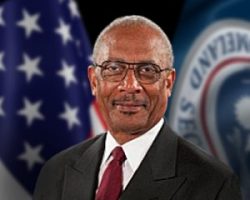 Formally, this evidence was provided by Frank Taylor (image on the right), a diplomat with the title of Ambassador from the US State Department. On 2 October he presented a brief to the North Atlantic Council, and Lord Robertson could subsequently conclude:[7]
“On the basis of this briefing, it has now been determined that the attack against the United States on 11 September was directed from abroad and shall therefore be regarded as an action covered by Article 5 of the Washington Treaty, which states that an armed attack on one or more of the Allies in Europe or North America shall be considered an attack against them all.”
“Today’s was classified briefing and so I cannot give you all the details. Briefings are also being given directly by the United States to the Allies in their capitals.”
Since the invocation of Article 5 had to be unanimous, Frank Taylor’s report would have been integral in the briefings announced to take place.
In Denmark – the country of the present author – there was a meeting in the Foreign Affairs Committee on 3 October 2001, where parliamentarians were briefed by the government about the proceedings in Brussels.
Parallel briefings must have been given in the 17 other NATO capitals. In each city, the resolution must have been approved, since Lord Robertson could announce NATO’s unanimous adoption of Article 5 and the launch of the war on terror on 4 October.[8] The first bombs fell in Kabul on 7 October.
Article 5 of the Washington Treaty says:[9]
“The Parties agree that an armed attack against one or more of them in Europe or North America shall be considered an attack against them all and consequently they agree that, if such an armed attack occurs, each of them, in exercise of the right of individual or collective self-defence recognised by Article 51 of the Charter of the United Nations,…..”
That is, any military action taken by NATO is confined by the restrictions in Article 51, which emphasises the right to self-defence and reads:
“Nothing in the present Charter shall impair the inherent right of individual or collective self-defence if an armed attack occurs against a Member of the United Nations,….”.[10]
That is, military action is forbidden in the absence of an armed provocation, and the legality of the attack on Afghanistan depends exclusively on the evidence presented in Frank Taylor’s report. But it was classified together with the minutes from the pertinent meetings.
However, on 19 May 2008, the US State Department declassified the dispatch which was sent in 2001 to all US representations world-wide, including the ambassadors to NATO headquarters, regarding what to think and say about the 9/11 events.
It is titled: “September 11: Working together to fight the plague of global terrorism and the case against al-qa’ida”.
The text is freely accessible here.
The document is dated 01 October 2001. But as hinted by the URL, it seems to have been distributed on 2 October five days before the invasion of Afghanistan on October 7, 20101. That is, the day Frank Taylor gave his presentation for the North Atlantic Council and the EU foreign ministers, and the day before the US ambassadors were briefing the governments in the respective NATO capitals.
The text of the dispatch begins by requesting “all addressees to brief senior host government officials on the information linking the Al-Qa’ida terrorist network, Osama bin Ladin and the Taliban regime to the September 11 terrorist attack on the World Trade Center and Pentagon and the crash of United Airlines Flight 93.”
The document appears to be a set of ‘talking points’. The recipients are instructed to use the information provided in oral presentations only and to never leave the hard copy document as a non-paper. Specifically, there is reference to “THE oral presentation”.
These instructions are followed by 28 pages of the specific text.
Tellingly, a section of this dispatch is copy-pasted into Lord Robertson’s statement on 2 October:7
“The facts are clear and compelling[…] We know that the individuals who carried out these attacks were part of the world-wide terrorist network of Al-Qaida, headed by Osama bin Laden and his key lieutenants and protected by the Taliban.”
The conclusion is inescapable – this dispatch IS the Frank Taylor report. It is the manuscript that served not only as the basis for Frank Taylor’s presentation, but also for the briefings given by US ambassadors to the various national governments. Identical presentations were given in all 18 capitals on 3 October, four days before the US-NATO invasion of Afghanistan
Is there any forensic evidence provided in this document to serve as a legal basis for the invocation of Article 5?
Nothing. There is absolutely no forensic evidence in support of the claim that the 9/11 attacks were orchestrated from Afghanistan.
Only a small part of the introductory text deals with 9/11, in the form of summary claims like the citation in Lord Robertson’s press release. The main body of the text deals with the alleged actions of Al-Qaeda and the Taliban in the nineties.
On 4 October, NATO officially went to war based on a document that provided only ‘talking points’ and no evidence to support the key claim.
We are still at war seventeen years later. Five countries have been destroyed, hundreds of thousands of people killed and millions displaced. Refugees are swarming the roads of Europe, trillions of dollars have been spent on weapons and mercenaries and our grandchildren have been shackled with endless debt.
At the opening ceremony for the new NATO headquarters on 25 May 2017, all the leaders from NATO’s member states attended the inauguration of a ‘9/11 and Article 5 Memorial’.[11]
*
Prof. Niels Harrit is a retired Associate Professor at the University of Copenhagen, Denmark.
Notes
[1] The Plan — according to U.S. General Wesley Clark (Ret.) https://www.youtube.com/watch?v=SXS3vW47mOE
[2] Bush decided to remove Saddam ‘on day one’. https://www.theguardian.com/world/2004/jan/12/usa.books
[3] The Unanswered Questions of 9/11. http://www.globalresearch.ca/the-unanswered-questions-of-911/5304061?print=1
[4] Was America Attacked by Afghanistan on September 11, 2001? https://www.globalresearch.ca/was-america-attacked-by-afghanistan-on-september-11-2001/5307151
[5] Being NATO’s Secretary General on 9/11. https://www.nato.int/docu/review/2011/11-september/Lord_Robertson/EN/ (from which you can deduce that the NATO-ambassadors eat lunch at 3 pm).
[6] Statement by the North Atlantic Council, https://www.nato.int/docu/pr/2001/p01-124e.htm
[7] Statement by NATO Secretary General, Lord Robertson. https://www.nato.int/docu/speech/2001/s011002a.htm
[8] Statement to the Press by NATO Secretary General, Lord Robertson, on the North Atlantic Council Decision On Implementation Of Article 5 of the Washington Treaty following the 11 September Attacks against the United States. https://www.nato.int/docu/speech/2001/s011004b.htm
[9] The North Atlantic Treaty. https://www.nato.int/cps/ic/natohq/official_texts_17120.htm
[10] Article 51, UN charter. http://www.un.org/en/sections/un-charter/chapter-vii/
[11] Dedication of the 9/11 and Article 5 Memorial at the new NATO Headquarters, 25 May 2017 https://www.youtube.com/watch?time_continue=3&v=augh1WqTqFs
An End to the World as We Know It?
Congress and the White House compete in year-end stupidity sweepstakes

By Philip Giraldi | Unz Review | December 24, 2019
At the end of the nineteenth century, Lord Palmerston stated what he thought was obvious, that “England has no eternal friends, England has no perpetual enemies, England has only eternal and perpetual interests.” Palmerston was saying that national interests should drive the relationships with foreigners. A nation will have amicable relations most of the time with some countries and difficult relations with some others, but the bottom line should always be what is beneficial for one’s own country and people.
If Palmerston were alive today and observing the relationship of the United States of America with the rest of the world, he might well find Washington to be an exception to his rule. The U.S., to be sure, has been adept at turning adversaries into enemies and disappointing friends, and it is all done with a glib assurance that doing so will somehow bring democracy and freedom to all. Indeed, either neoliberal democracy promotion or the neoconservative version of the same have been seen as an overriding and compelling interest during the past twenty years even though the policies themselves have been disastrous and have only damaged the real interests of the American people.
The U.S. relationship with Israel is, for example, driven by a powerful and wealthy domestic lobby rather than by any common interests at all yet it is regularly falsely touted as being between two “close allies” and “best friends.” It has cost Americans hundreds of billions of dollars in subsidies for the Jewish state and Israeli influence over U.S. policy in the Middle East region has led to catastrophic military interventions in Afghanistan, Lebanon, Iraq, Syria, Mogadishu and Libya. Currently, Israel is agitating for U.S. action against the nonexistent Iranian “threat” while also unleashing its lobby in the United States to make illegal criticism of any of its war crimes, effectively curtailing freedom of speech and association for all Americans.
Far more dangerous is the continued excoriation of the Kremlin over the largely mythical Russiagate narrative. Congress has recently approved a bill that would give to Ukraine $300 million in supplementary military assistance to use against Russia. The money and authorization appear in the House of Representatives version of the national defense authorization act (NDAA) that passed last week.
The bill is a renewal of the controversial Ukraine Security Assistance Initiative that Donald Trump allegedly manipulated to bring about an investigation of Joe Biden’s son Hunter. The new version expands on the former assistance package to include coastal defense cruise missiles and anti-ship missiles as offensive weapons that are acceptable for export to Kiev. It also authorizes an additional $50 million in military assistance on top of the $250 million congress had granted in last year’s bill, “of which $100 million would be available only for lethal assistance.”
Ukraine sought the money and arms to counter Russian naval dominance in the Black Sea through its base at Sevastopol in the Crimea. One year ago the Russian navy captured three Ukrainian warships and Kiev was unable to push back against Moscow because it lacked weapons designed to attack ships. Now it will have them and presumably it will use them. How Russia will react is unknowable.
Dmytro Kuleba, Ukraine’s Deputy Prime Minister for European and Euro-Atlantic Integration, has been in Washington lobbying for the additional military assistance. He has had considerable success, particularly as there is bipartisan support in Congress for aid to Kiev and also because the Trump Departments of Defense and State as well as the National Security Council are all on board in countering the “Russian threat” in the Black Sea. President Trump signed the NDAA last week, which completed the process.
Far more ominously, Kuleba and his interlocutors in the administration and congress have been revisiting a proposal first surfaced under Bill Clinton, that Ukraine and Georgia should be admitted to the NATO alliance. Like the $300 million in military aid, there appears to be considerable bipartisan support for such a move. NATO already has a major presence on the Black Sea with Bulgaria, Romania and Turkey all members. Adding Ukraine and Georgia would completely isolate the Russian presence and Moscow would undoubtedly see it as an existential threat.
The NDAA also provides seed money to initiate the so-called Space Force, which President Trump inaugurated by describing it as “the world’s newest war-fighting domain. Amid grave threats to our national security, American superiority in space is absolutely vital. We’re leading, but we’re not leading by enough, but very shortly we’ll be leading by a lot. The Space Force will help us deter aggression and control the ultimate high ground.”
If that isn’t bad enough, the new defense budget ominously also requires the Trump administration to impose sanctions “with respect to provision of certain vessels for the construction of certain Russian energy export pipelines.” Last week the House of Representatives and Senate approved specific sanctions relating to the companies and governments that are collaborating on the construction of the Nord Stream 2 pipeline that will cross the Baltic Sea from Vyborg to Greifswald to connect Germany with Russian natural gas. President Trump has signed off on the legislation.
The United States has opposed the project ever since it was first mooted, claiming that it will make Europe “hostage” to Russian energy, will enrich the Russian government, and will also empower Russian President Vladimir Putin to be more aggressive. Engineering companies that will be providing services such as pipe-laying will be targeted by Washington as the Trump administration tries to halt the completion of the $10.5 billion project.
Now that the NDAA has been signed, the Trump administration has 60 days to identify companies, individuals and even foreign governments that have in some way provided services or assistance to the pipeline project. Sanctions would block individuals from travel to the United States and would freeze bank accounts and other tangible property that would be identified by the U.S. Treasury. One company that will definitely be targeted for sanctions is the Switzerland-based Allseas, which has been contracted with by Russia’s Gazprom to build the offshore section of pipeline. It has suspended work on the project while it examines the implications of the sanctions.
Bear in mind that Nord Stream 2 is a peaceful commercial project between two countries that have friendly relations, making the threats implicit in the U.S. reaction more than somewhat inappropriate. Increased U.S. sanctions against Russia itself are also believed to be a possibility and there has even been some suggestion that the German government and its energy ministry might be sanctioned. This has predictably resulted in pushback from Germany, normally a country that is inclined to go along with any and all American initiatives. Last week German Foreign Minister Heiko Maas asked Congress not to meddle in European energy policy, saying “We think this is unacceptable, because it is ultimately a move to influence autonomous decisions that are made in Europe. European energy policy is decided in Europe, not in the U.S.”
German Bundestag member Andreas Nick warned that “It’s an issue of national sovereignty, and it is potentially a liability for trans-Atlantic relations.” That Trump is needlessly alienating important countries like Germany that are genuine allies, unlike Israel and Saudi Arabia, over an issue that is not an actual American interest is unfortunate. It makes one think that the wheels have definitely come off the cart in Washington.
The point is that Donald Trump, Mike Pompeo, Mike Pence and Mike Esper (admittedly too many Mikes) wouldn’t know a national interest if it hit them in the face. Their politicization of policy to “win in 2020” promoting apocalyptic nonsense like war in space has also reinforced an existing tunnel vision on what Russia under Vladimir Putin is all about that is extremely dangerous. Admittedly, Team Trump throws out sanctions in all directions with reckless abandon, mostly aimed at Russia, Iran, North Korea and, the current favorite, Venezuela. No one is immune. But the escalation going from sanctions to arming the Kremlin’s enemies is both reckless and pointless. Russia will definitely strike back if it is attacked, make no mistake about that, and war could easily escalate with tragic consequences for all of us. That war is perhaps becoming thinkable is in itself deplorable, with Business Insider running a recent piece on surviving a nuclear attack. New homes in target America will likely soon come equipped with bomb shelters, just like in the 1950s.
Philip M. Giraldi, Ph.D., is Executive Director of the Council for the National Interest, a 501(c)3 tax deductible educational foundation (Federal ID Number #52-1739023) that seeks a more interests-based U.S. foreign policy in the Middle East. Website is councilforthenationalinterest.org, address is P.O. Box 2157, Purcellville VA 20134 and its email is inform@cnionline.org.
Trump administration and Moscow shoot down bipartisan DASKA “sanctions bill from hell”
By Sarah Abed | December 23, 2019
In August of 2018, Senators Lindsey Graham (R-S.C.) and Robert Menendez (D-N.J.) first introduced what Graham referred to as a “sanctions bill from hell” targeting Russia and President Vladimir Putin and making it harder for the United States to leave NATO. Despite bipartisan grievances with Moscow the bill didn’t gain much traction.
The measure to push President Trump to take a tougher stance against Russia over alleged election interference, aggression towards Ukraine and involvement in Syria’s proxy war is titled the Defending American Security from Kremlin Aggression Act (DASKA) and would impose strict and broad penalties.
In February of this year, DASKA was reintroduced with Senator Graham stating the following, “Our goal is to change the status quo and impose meaningful sanctions and measures against Putin’s Russia,” and “He should cease and desist meddling in the U.S. electoral process, halt cyberattacks on American infrastructure, remove Russia from Ukraine, and stop efforts to create chaos in Syria.”
During a Senate Floor speech on February 7th, Senator Menendez even went as far as saying that he speculated whether President Trump “is an asset of the Russian government” and concluded his speech by saying, “this Administration’s deference to the Kremlin demands Congress be proactive in shaping U.S. foreign policy toward Russia, especially with respect to sanctions.”
Fast forward to last Wednesday when the U.S. Senate Foreign Relations Committee advanced the bill with a 17-5 vote. The next step is for the legislation to pass the full Senate and House of Representatives before it can be brought to President Donald Trump to sign into law or veto.
However, the White House has already stated their opposition to DASKA, which targets Russian banks, Russia’s cyber sector, new sovereign debt, and would impose measures on its oil and gas sectors. The bill also imposes several requirements on the State Department including generating reports investigating President Putin’s wealth, opposition figure Boris Nemtsov’s 2013 assassination and whether to designate Russia as a state sponsor of terror.
As for NATO, DASKA would ensure that without approval from a Senate supermajority the United States can not leave. This is in response to President Trump’s various comments about wanting to leave and criticism of other NATO members for not spending enough on defense.
The Trump administration and Moscow are on the same page when it comes to DASKA. Russian Foreign Minister Sergei Lavrov called DASKA “senseless” and in a 22-page letter to Congress it was referred to as “unnecessary” and in need of “significant changes”. Although the administration stated that they too want to deter and counter Russian subversion and aggression they strongly oppose the bill in its current form.
It seems rather unlikely that this bill will pass and in the very slight chance that it does these sanctions will not deter Moscow or bring about any significant change in their domestic and foreign policies.
Robert Legvold, the Marshall D. Shulman Professor Emeritus of Post-Soviet Foreign Policy at Columbia University, stated “As has been the experience since the first U.S. and EU sanctions in 2014, the effect on Russian foreign policy behavior will almost certainly be close to zero-other than perhaps encouraging initiatives that the Russian leadership believes may be disruptive in U.S. relations with its European allies.”
Although Democrats and some Republican’s such as Senator Graham sometimes manage to inadvertently bring the Russian and American heads of states together on some issues such as DASKA and President Trump’s impeachment, those moments are usually short lived. As we saw a few days ago, President Trump signed the 2020 National Defense Act with a $738 billion budget which included legislation imposing sanctions on firms laying pipe for Nord Stream 2, an $11 billion gas pipeline project meant to double gas capacity along the northern Nord Stream pipeline route from Russia to Germany, upsetting all parties involved.
Germany firmly rejected the US sanctions and referred to them as incomprehensible as they affect Berlin and other European companies as well. The imposition of sanctions against EU companies who are conducting legitimate business is rejected by the European Union as well. Russia stated that they would stick to the schedule and carry out their projects regardless of sanctions.
The current and previous White House administrations opposed this project over claims that it would embolden President Putin’s influence by increasing his political and economic sway in Europe. With the United States currently ranked as the world’s top oil and gas producer, it’s clear to see that sanctions such as these are meant to influence European allies to buy American instead of Russian oil and products.
On Friday, Allseas the Swiss-Dutch company contracted to do the work announced that it had suspended pipe-laying activities in anticipation of the enactment of the National Defense Authorization Act (NDAA). On Saturday, Allseas stated, “Completing the project is essential for European supply security. We together with the companies supporting the project will work on finishing the pipeline as soon as possible.”
Russian FM Lavrov met with President Trump at the White house earlier this month and mentioned that they covered at least a dozen substantial issues, and that both the White house and Russia are interested in dialogue. It will be interesting to see if President Trump can successfully balance his desire to expand trade ties and continue dialogue with Russia, by pushing back legislation from Congress to increase sanctions under DASKA, all while sanctioning Nord Stream 2 under the NDAA. What level of chess would that be?
Sarah Abed is an independent journalist and analyst.
Featured Video
Iran’s Next Strike May Not Explode. It Could Shut You Down
or go to
Aletho News Archives – Video-Images
From the Archive
Zionism’s Violent Legacy
By Donald Neff | Washington Report On Middle East Affairs | January 1996
On January 4, 1948, Jewish terrorists drove a truck loaded with explosives into the center of the all Arab city of Jaffa and detonated it, killing 26 and wounding around 100 Palestinian men, women and children.[1] The attack was the work of the Irgun Zvai Leumi – the “National Military Organization,” also known by the Hebrew letters Etzel – the largest Jewish terrorist group in Palestine. The Irgun was headed by Revisionist Zionist Menachem Begin and had been killing and maiming Arabs, Britons and even Jews for the previous ten years in its efforts to establish a Jewish state.
This terror campaign meant that at the core of Revisionist Zionism there existed a philosophical embrace of violence. … continue
Blog Roll
 Aletho News
- Riyadh Says Its Oil System Is Intact. The Numbers Say Otherwise.
- Trump and Netanyahu Want to “Finish the Job” on Iran
- US ‘one-sided dictation’ not Iran’s beliefs makes rational talks impossible: Baghaei
- Iran’s Next Strike May Not Explode. It Could Shut You Down /Col Doug Macgregor
- Iran: US political targets legitimate if assassinations return
- Iraq shuts key border crossing with Iran under US pressure: Report
- Undersea Internet cables could be targeted in retaliation for attacks on Iran: IRGC deputy chief
- EU sending ‘biased’ observers to interfere in Serbian election – president
- White House envoy declares kinetic action against Yemen ‘fruitless’
- Ukraine deployed thousands of microdrones in Iraqi Kurdistan: Tasnim
- If Americans Knew
- An error has occurred; the feed is probably down. Try again later.
- No Tricks Zone
- E-Cars Reduce CO2 Emissions By Only 41% Compared To Internal Combustion Engine Vehicles
- Predictions Made By Renowned Climate Professor Over Past Decades Have Been Proven To Be Poor
- New Study Suggests Large Regions Of The Pacific Ocean Have Been Cooling For The Last 80 Years
- Germany’s Green Energy Debacle: High Energy Costs Force Kahla Porzellan to Close After 182 Years!
- New Study: 50 Years Of The Most Aggressive ‘Net Zero’ Policies Can Only Affect The Global Climate By 0.03°C
- US September “Heat” Was No Record…Many Records Set Decades Ago
- Latest European Green Energy Debacle; Portugal’s Largest Flagship Solar Park Insolvent!
- Green Energy Debacle: German Expert Professor Fritz Vahrenholt Warns Of Severe Economic And Social Consequences
- Two More Paleo Reconstructions Affirm Meters-Higher Sea Levels Across Ireland, Brazil 7000-6000 Years Ago
- New Study: Earth And Venus Surface Warmth Largely Explained By Convection And Lapse Rate, Not CO2 Or Radiation

