Limiting nuclear arsenals doesn’t make the world safer – not while the elites, who have never seen a big war, complacently believe they never will. This dangerous illusion invites apocalyptic conflict, a renowned scholar believes.
Humankind’s history might be a history of wars, but for several decades there was a sort of lull, with no really big armed conflict affecting leading world powers. That is, in part, thanks to nuclear weapons. Fear of their power kept the Cold War from becoming a hot one and restricted the actual fighting to proxy conflicts.
And that, in turn, has led to a situation where many of those currently in power don’t take the threat of war with the gravity it deserves, says Sergey Karaganov, a researcher of international relations and a dean at Moscow’s Higher School of Economics.
Complacency breeds danger
“The previous generations had a gut fear of war because their fathers or they themselves experienced World War II. But modern generations think of war very lightly,” he told RT.
This attitude is a major reason why the world now is in fact a more dangerous place than it was at the height of the US-Soviet confrontation, he believes. Some powers believe they are entitled to live in peace and cannot imagine that a smaller conflict elsewhere may escalate into a nuclear Armageddon. Meanwhile old mechanisms meant to prevent such a disaster are rapidly deteriorating, he said.
This year Washington scrapped one of the key Cold War agreements restricting nuclear weapons – the INF Treaty – and indicated that another one – New START – would not be extended beyond 2021. The US changed its nuclear posture and now doesn’t rule out responding with nukes to a cyberattack. The Pentagon’s generals want a larger toolbox of smaller nuclear weapons and are weighing up options on how to use them in regular conflicts.
These days, it’s more complicated than just nukes
That said, those old mechanisms are also failing for purely technological reasons. In the 1970s there was a reasonably clear distinction between strategic weapons and everything else, so ensuring parity was relatively simple. Basically the US and the USSR settled on numbers of missiles, long-range bombers, submarines and warheads they were comfortable with and agreed ways to verify that each party sticks to the limits.
“There are people in our country, as well as in other countries, who are stressing that we should go as we have been going in the 1960s and the ‘70s and the ‘80s. I must say I am very skeptical, because even in the ‘70s and the ‘80s we were basing our analysis on the very, very strange presumption of what was called parity,” Karaganov says.
But the distinction between “nuclear and non-nuclear, conventional and non-conventional” is blurred today. How does one take into the equation, for example, a conventional precision missile that can be fired across the border and take out the other nation’s military headquarters? Or a satellite that can blind an ICBM early warning spacecraft? Or a hypersonic glider? Or a computer virus that can shut down the power grid?
“Now strategic parity is almost impossible to count.”
Stop trying to limit nukes – change the thinking
Karaganov recently co-authored a report on this persistent danger. He admits it doesn’t have all the right answers, but offers some ideas where to begin – and philosophy is at least as important as politics or technicalities.
For example, nations should acknowledge that geopolitical rivalry was not an aberration of the ideologically-divided past but rather a natural order of things. Strong players have great appetites and will use any means to impose their will on weaker ones. Unfair, but such is life.
The next step would be to embrace a new multilateral deterrence arrangement that would include additional players, first and foremost China, and somehow incorporate non-nuclear things like cyber weapons into the calculation.
“The aim of the strategic policy of all responsible nuclear powers should not be doing away or even reducing their nuclear weapons, but strengthening mutual deterrence, and that is a completely different philosophy,” Karaganov suggests.
Essentially, he and his colleagues suggest ditching the old idea of nuclear stability – achieved through the reduction and capping of the two largest superpowers’ arsenals. Instead, any new treaties should focus on transparency – as well as developing protocols to wind down a nuclear conflict once it does start, which is much more likely to happen by accident than by intention.
The result may be somewhat of a Mexican standoff, but the alternative is far more dangerous, the scholars argue. An armed conflict involving nuclear-capable powers has the potential to spiral out of control, with sides trading increasingly serious blows and hoping the other one will chicken out.
A few decades ago the fear of nuclear weapons put a reasonably low cap on such games of nerves, but it is no longer the case and the risks are rising by the year. The solution would be for the great powers to put de-escalation as the paramount goal whenever a clash brews and treat any potential war between them as a doomsday in the making.
September 16, 2019
Posted by aletho |
Militarism, Timeless or most popular | China, Russia, United States |
Leave a comment
Talks with the Taliban to put an end to the longest of America’s forever wars were killed off by the US last week. The Afghan militant movement is prepared to fight a hundred more years, its chief negotiator told RT.
The peace negotiations between the US and the Taliban were called off by President Donald Trump days ahead of a planned signing of a formal agreement. The draft has even been initialed by both parties and Qatar, which mediated in the talks, Sher Mohammad Abbas Stanikzai, who headed the Taliban’s delegation, told RT. As far as the Taliban is concerned, the US decision can be easily reversed and the agreement put into force as agreed, he said.
“We are still committed to the negotiations. Our stance is that there is no solution to the conflict except negotiations and except peace on the table. We hope that Mr. Trump rethinks his announcement and comes back to where we were,” the official said.
Trump cited an attack by the Taliban, which killed a US soldier stationed in Afghanistan, as the reason for the surprise cancellation of the talks. The militants say their attacks were well justified by attacks against them by the US and the Afghan security forces. They see the Americans as a foreign occupying force and themselves as freedom fighters and protectors of the Afghan civilians, who are injured and killed when the US attacks the Taliban, which regularly conducts terrorist attacks.
“The war was imposed on us. It is American soldiers who are in Afghanistan. It’s not our mujahedeen in Washington,” he said. He added that Trump’s justification for stopping talks clashed with statements by Secretary of State Mike Pompeo, who appeared on TV the following day and said the US killed “over 1,000 Taliban” over ten prior days, as negotiations were under way.
“Mr. Pompeo admitted that they have killed a thousand Taliban,” Stanikzai pointed out. “If they can kill a thousand of us, why can we not kill one or two of them? This is our right. We have to defend ourselves and defend our people.”
The Taliban representative said the Trump administration proved to be no different to that of Barack Obama, which also held peace talks with the Afghan militants before ending them at the last moment. He questioned Washington’s commitment to resolving the situation and ending what is now a 19-year-long anti-insurgency war that the US apparently cannot win through military force.
“If the American side is not willing to negotiate and they do not want peace on the table, we will be compelled to defend ourselves,” he said.
“We can do it for a hundred years.”
Stanikzai reiterated that only after a formal agreement is signed and US troops are pulled out of Afghanistan would the Taliban be able to settle its differences with other political forces in Afghanistan, including the US-backed government in Kabul.
“We need a practical thing. When it is signed, there will be [a] ceasefire between us and the American forces. We will give safe passage to the American forces,” he said. “When they go out, inter-Afghan talks can start and a comprehensive ceasefire and other domestic issues can be discussed.”
September 13, 2019
Posted by aletho |
Illegal Occupation, Militarism | Afghanistan, United States |
Leave a comment
The departure of John Bolton as US National Security Adviser is a good step towards decreasing international tensions by the Trump administration. But a lot more is needed from President Donald Trump to indicate a serious pivot to normalizing relations with Russia, Iran and others.
When Trump gave Bolton his marching orders earlier this week, the president said he “strongly disagreed” with his erstwhile security adviser over a range of foreign policy issues. Trump had also expressed frustration with Bolton’s incorrigible militarist tendencies.
There is no doubt Bolton was an odious figure in the White House cabinet. One of our Strategic Culture Foundation authors, Martin Sieff, wrote this excoriating commentary on Bolton’s nefarious record of warmongering dating as far back as the launching of US wars in Afghanistan in 2001 and Iraq in 2003, when the mustachioed maverick served then as a chief neocon ideologue in the GW Bush administration.
One wonders why Trump brought such a war hawk into his administration when he appointed Bolton as NSA in April 2018. Perhaps, as another of our writers, Robert Bridge, surmised in a separate commentary this week, Trump was using hardliner Bolton as a foil to deflect opponents from within the Washington establishment who have been trying to undermine the president as “soft on foreign enemies”. A ruse by Trump of keeping “your enemies close”, it is averred.
Bolton certainly did his best to hamper Trump’s seeming attempts at scaling back US foreign military interventions. He opposed the plan to withdraw American troops from Syria. The reckless Bolton also wound up a policy of aggression and regime change against Venezuela, which Trump has latterly seemed to grow wary of as a futile debacle.
In regard to Russia, Bolton carried heaps of Cold War baggage which made Trump’s declared intentions of normalizing relations with Moscow more difficult.
The shameless warmonger Bolton openly advocated for regime change in Iran, which seemed to contradict Trump’s oft-stated position of not seeking regime change in Tehran, despite the president’s own animosity towards Iran.
The former NSA also opposed any attempt by Trump to engage in detente with North Korean leader Kim Jong-un. Reportedly, it was Bolton who derailed the incipient efforts at opening up dialogue with Pyongyang.
It is also thought that Bolton used his influence to impede Trump’s recent bid to host Taliban leaders at Camp David earlier this month which was aimed at trust-building for a proposed peace deal to withdraw US troops from that country after nearly 18 years of disastrous war.
That said, however, President Trump has not shown himself to be exactly a dovish figure. He has overseen countless sanctions being imposed on Russia, the abandoning of the Intermediate-range Nuclear Forces treaty, and ongoing military support for the anti-Russia regime in Kiev.
Too, it was Trump who ordered the US collapse of the 2015 international nuclear accord with Iran in May 2018 and the re-imposition of harsh sanctions on Tehran. So, it would be misplaced to paint Bolton as the sole malign actor in the White House. Trump is personally responsible for aggravating tensions with Iran, as well as with Russia, Venezuela and others.
Nevertheless, it is to be welcomed that an inveterate war hawk like Bolton no longer has the president’s ear. Perhaps Trump can be freer to act on his instincts as a pragmatic deal-maker. One thing that the president deserves credit for is his unconventional style of engaging with nations and leaders who are designated as foes of America.
Russia this week gave a reserved response to the sacking of Bolton. The Kremlin said it would make assessments of a positive change in US policy based on actions, not mere announcements, such as the firing of Bolton. Time will tell.
It seems significant that immediately after Bolton was relieved of his post, Trump hinted to reporters that he was considering lifting sanctions off Iran if such a move persuaded Iranian President Hassan Rouhani to hold a face-to-face meeting with Trump at the United Nations general assembly in New York later this month.
Iran has repeatedly stated categorically that there will be no talks with Trump unless his administration revokes sanctions and returns to abiding by the nuclear accord. If there is a serious pivot to normal diplomacy by the White House, then what Trump does about sanctions on Iran will be a litmus test.
The same can be said about US sanctions on Russia. If Trump is earnest about a genuine reset in bilateral relations, then he must get rid of the raft of sanctions that Washington has piled on Moscow since the 2014 Ukraine crisis amid the many spurious allegations leveled against Russia.
Bolton banished is but a small step towards a more diplomatically engaged US administration. But it would be unwise to expect the departure of this one figure as being a portent for progress and a more peaceful policy emerging in Washington.
The Washington establishment, the deep state and the bipartisan War Party, with its entrenched Cold War ideology, seems to have an endemic sway over policy which may thwart Trump’s efforts to direct a less belligerent US.
To illustrate the twisted nature of the US establishment, one only had to read the way sections of the American corporate-controlled media lamented the departure of Bolton. The New York Times, which is a dutiful conduit for deep state intelligence and the foreign policy establishment, actually bemoaned the ouster of Bolton, calling him a “voice of restraint”.
The NY Times commented, with approval, on how Bolton “objected to attempts to pursue diplomatic avenues with players considered American enemies. And he angered Trump with a last-minute battle against a peace agreement with the Taliban… whether it was inviting the Taliban to Camp David or cooperating with Russia, he [Bolton] was the national security adviser who said no.”
In another piece this week, the NY Times commented, again approvingly of Bolton: “Mr Bolton strongly opposed detente with Iran, and his unceremonious ouster has reignited concerns among some Republicans [and Democrats] in Congress about the White House’s declining projection of American military power around the world.”
Can you believe it? The so-called US “newspaper of record” is somehow valorizing an out-and-out warmonger in the form of Bolton, and appears to be advocating “projection of American military power around the world”. The latter phrase being but an Orwellian euphemism for imperialism and war.
The sobering conclusion is that Bolton’s departure hardly heralds a new beginning of diplomacy and engagement by Trump, if we assume to give this president the benefit of doubt for good intentions. Bolton may be gone, but there are formidable political forces in the US establishment which will work to ensure Trump’s room for maneuver remains heavily compressed. The Cold War ideology is so ingrained in Washington, it is much bigger than just one man, whether that is the vile personage of Bolton or the more flexible Trump.
September 13, 2019
Posted by aletho |
Militarism | United States |
Leave a comment
John Bolton is no longer Donald Trump’s national security adviser and no right thinking person will mourn the departure of this noxious neocon.
Though, as befits the chaos of the Trump White House, there is a dispute over whether Bolton resigned or was fired, for a world laboring under the dead weight of US exceptionalism and the hegemonic posture it gives rise to, this particular dispute is otiose.
What is not in doubt is that, whereas President Trump embraced the credo of ‘America First’, Bolton’s religious attachment to ‘American Military Power First’ had long marked him out as an extremist, even within neocon circles.
Indeed, it is chilling to contemplate that if this warmongering zealot had had his way, Washington would likely have become embroiled in multiple hot wars and military actions across the world – with an ocean of blood being spilled in Latin America, Ukraine, on the Korean Peninsula and in the Middle East.
Trump’s appointment of Bolton in March 2018 came as damning evidence of the President’s abject surrender to the neocon and liberal interventionist lobby in Washington, all under the pressure of Russiagate.
His campaign pledges, to engage in serious diplomacy with America’s primary designated adversary, Russia, to recognize the government of Bashar al-Assad in Syria, draw down the US military presence in Afghanistan, talk to North Korea’s Kim Jong-un, and revisit America’s commitment to NATO – all of this succeeded in pitching the War Party into paroxysms of barely concealed fury and angst.
Trump was besieged on the very day he entered the Oval Office by a Washington establishment that considered his election to have been an act of heresy in the first place. The objective of his liberal interventionist enemies was to box him in and prevent him from being able to act on his foreign policy instincts.
The small fact that those instincts were eminently sound, given the calamitous record of countries and societies that had been reduced to rubble at the behest of his predecessors, this mattered not.
In the fevered minds of the denizens of the War Party, the primary role of the President of the United States is the maintenance of an empire that has been forged in blood and is sustained by destruction in the name of hegemony and unipolarity.
So in the door came mad dog Bolton and out the door went reason and sanity.
The result? In short order, after the President contracted out his foreign policy to Messrs Bolton and Pompeo, the US withdrew from the Iran nuclear deal, pulled out of the INF (Intermediate Nuclear Forces) Treaty with Russia, and withdrew from the UN Human Rights Council.
And even where Trump did assert a measure of control on foreign policy – i.e. in sitting down with North Korea’s Kim Jong-un in Singapore and Hanoi – Bolton succeeded in reducing both summits to glorified photo-ops, convincing his boss to agree to making North Korea’s complete denuclearization an absurd condition of any lifting of crippling US sanctions.
Not satisfied with that, Bolton also did his utmost to effect regime change in Venezuela, attempting to install his own placeman, Juan Guaidó, in Caracas in place of the country’s elected President, Nicolás Maduro. Bolton’s Twitter feed throughout this particular crisis you’d imagine would have belonged to Al Capone if social media had been around in Prohibition-era Chicago.
As to the crisis with Iran, conflict seemed inevitable at various points over the summer, with Bolton known to have urged a military strike against the Islamic Republic in response to the downing of a US drone.
In deciding here to draw back from the brink, Trump demonstrated a rare example of sound leadership and wisdom in the Oval Office.
The casus belli, the proverbial straw which broke the camel’s back, was Bolton’s stern opposition to Trump’s attempt to bring closure to 18 years of US military deployment in Afghanistan – a country that even a blind person can see is destined to be ruled once again by the Taliban.
Looking ahead, Trump is a leader in desperate need of a meaningful breakthrough on foreign policy. His first term has been spent mired in a bitter struggle in Washington with the War Party for the right to shape that foreign policy according to the pledges he was elected on.
Fidelity to those pledges and to his own instincts demands that he now discard forever the notion of appointing another neocon ideologue in the now-vacant position of national security adviser. A fork in the road has been reached and the President has a decision to make.
Does he continue to proceed down the old and chaotic unipolar path of trying to be President of the World in the interests of a bloated military industrial complex?
Or does he embrace the opportunity of being President of the United States in the interests of the American people and a world in desperate need of stability, serious diplomacy and peace?
Returning, finally, to John Bolton, this draft-dodging reprobate. In bidding him farewell, the words of Winston Churchill are irresistible: “He has all of the virtues I dislike, and none of the vices I admire.”
September 12, 2019
Posted by aletho |
Militarism | United States |
Leave a comment
Iran calls the US in breach of the Nuclear Non-Proliferation Treaty (NPT), citing Washington’s refusal to come under a comprehensive nuclear arms control regime and its harboring an intention to resume testing of nuclear weapons.
Iranian Ambassador to the United Nations Majid Takht-e Ravanchi made the remarks to the United Nations General Assembly on Monday.
He cited the latest Nuclear Proliferation Report (NPR), which has found that the United States is disinclined to ratify the Comprehensive Nuclear-Test-Ban Treaty. The report also outlines how the US “will resume nuclear explosive testing, … including underground nuclear explosive,” the envoy added.
“This policy is in gross violation of its (the US’s) explicit legal obligations under the NPT,” he noted.
“Such irresponsible policies, the latest of which is the US withdrawal from the INF Treaty, are detrimental to all international efforts towards nuclear disarmament and non-proliferation, and therefore must come to an end,” the ambassador asserted.
The US scrapped the 1987 Intermediate-range Nuclear Forces treaty with Russia last month. Later, the Pentagon announced that it had tested a type of a ground-launched missile that was banned under the deal.
The Iranian official also reminded that Israel, which has the US as its primary and strongest supporter, maintains nuclear weapons that continue to threaten peace and security in the region and beyond.
Copious volumes of evidence have identified the occupying regime as the sole possessor of the non-conventional weapons in the region. Those include The Sunday Times’ historic report of 1986 that first broke the story on tip-off from former Israeli nuclear technician Mordechai Vanunu, and former US president Jimmy Carter’s similarly head-turning revelation that the occupying regime was in possession of hundreds of nuclear warheads.
Takht-e Ravanchi finally remarked, “Total elimination of these inhumane weapons is what we owe to ourselves, to our children, to generations to come and to entire humanity,” adding, “Iran stands ready to play its role in pursuing this noble objective.”
September 9, 2019
Posted by aletho |
Militarism, Timeless or most popular | Iran, Israel, United States |
Leave a comment
It’s better not to be a “more normal country” if that means being as prone to invasions and coups as the United States, top Russian ministers have said, firing back at bizarre remarks by a new Pentagon chief.
It would be “great” if the West “could get Russia to behave like a more normal country,” Mark Esper, the newly appointed defense secretary, was reported to have claimed while visiting Paris this week.
That remark did not go down well with Moscow, however.
“If he said so, he called upon us to act as a normal country [as such] and not like the United States,” Foreign Minister Sergey Lavrov told a press briefing in the Russian capital, where he and Defense Minister Sergey Shoigu had a face-to-face meeting with French counterparts.
“Otherwise, we should have been acting like the US, bombing Iraq and Libya in blatant violation of international law… We should have supported coups, violent and anti-constitutional, like the US and its closest allies did in February 2014 [in Ukraine].”
What’s more, if Russia followed Washington’s instructions, then “we would have spent millions on intervening in the affairs of other countries as Congress has done by authorizing $20 million for supporting democracy in Russia,” Lavrov stated.
On his part, Shoigu also said that normalcy has a different meaning for Moscow then.
“We will probably remain [an] abnormal [country].”
Meanwhile, the visiting French officials advocated coming to terms with Russia.
“The time has come, the time is right, to work towards reducing distrust,” Foreign Minister Jean-Yves Le Drian said.
Defense Minister Florence Parly added that “it is important to talk to each other, to avoid misunderstanding and friction.”
Also on rt.com ‘Russia will never be our friend, we’ll slap them when needed’ – US envoy to UN
The meeting comes weeks after Russian President Vladimir Putin met with his French counterpart Emmanuel Macron in late August at Bregancon, in an attempt to defuse tension and break the ice in Russia-West relations.
On that occasion, Macron vowed to create a “new architecture of security and confidence” between the EU and Russia. He pointed out that Moscow’s contribution is “essential” in helping to solve the crises in and around Iran, Ukraine, and Syria, and to work on nuclear non-proliferation.
September 9, 2019
Posted by aletho |
Illegal Occupation, Militarism, War Crimes | Russia, United States |
Leave a comment
Continuing to monitor the confrontation between Washington and Tehran, the author of this article can see how it affects the South Korean interests. The sanctions badly hit South Korea’s economy and, since the summer of 2019, there have been attempts to involve Seoul in a possible military coalition.
Let us remind the reader that the Joint Comprehensive Action Plan was signed by Iran, Russia, the United States, Germany, France, the United Kingdom and China in 2015, limiting Iran’s nuclear program in return for lifting the sanctions imposed by the European Union and the United Nations.
The removal of most of the international sanctions from Iran stimulated a great interest in its economy, as the country has huge gas and oil reserves, and Seoul took advantage of the opportunity to enter the Iranian market. After all, the South Korean exports to Iran exceeded $6 billion in 2012, however, after the imposition of sanctions by the Obama Administration, it fell to $4.5 billion. In 2016, it fell even more and, only in 2017 did export volume begin to recover.
On August 24, 2017 the South Korean Export-Import Bank and the Central Bank of Iran signed an agreement on a $9,380 million loan to the Iranian Government. In addition, South Korean companies were given the opportunity to participate in construction and resource projects in Iran, as the loan was aimed at providing financial support to those who would receive orders from the Iranian Government.
It should be noted that the arrangement to start negotiations on the loan agreement was made during the visit of the former South Korean President Park Geun-hye to Iran, but the final decision was delayed since the parties could not agree on the terms of repaying the loan in case of the resumption of sanctions should Iran fail to fulfil its obligations in the nuclear technology area.
But after Donald Trump came to power, the White House began to criticize the terms of the nuclear deal and later withdrew from it; in May 2018, the US resumed its sanctions against individuals and legal entities that carry out export transactions in gold, precious metals, graphite, coal, automotive and other industries with Iran. However, for some countries, there was a delay of 90 and 180 days depending on the type of sanctions.
The South Korean government wasted no time and convened an ad-hoc expert working group assigned to reduce the damage to the domestic companies caused by the US sanctions against Iran. The complications came from the fact that more than 80% of South Korean enterprises working with Iran were small and medium-sized businesses. However, with the reinstatement of sanctions, exports from South Korea to Iran decreased yet again. From January to June 2019, they fell by 15.4%, and by 19.4% in July.
The South Korean government also negotiated with the US calling on it to exempt crude oil from the sanctions, as it accounts for most of the imports from Iran. Under the Barack Obama Administration, South Korea received the status of an exception country entitled to buy Iranian crude oil under the sanctions with reducing its purchases by 20%. The importance of Iranian oil imports to South Korea lies in the fact that it has a direct impact on the exports to Iran. Settlements with Iran are made using the Korean won bank account from which goods exported to Iran are also paid for. Therefore, a reduction in the Iranian oil imports will inevitably lead to a reduction in the exports.
Moreover, Seoul remains one of the largest importers of Iranian oil and gas condensate in Asia. As noted by Reuters, the supply of Iranian resources is critical to the South Korean petrochemical industry. South Korea greatly relies on the supply of condensate from Iran, which has a high content of naphtha being the basic raw material for the manufacturing of petroleum products. Besides, the Iranian prices are the lowest. The difference can reach six dollars per barrel, so 50% of the condensate imported into South Korea comes from Iran.
According to an opinion, South Korea is the third largest buyer of Iranian oil. On the other hand, Iran accounts for 8.6% of the oil imported into South Korea and it is the fifth largest oil supplier to South Korea after Saudi Arabia, Kuwait, the United States and Iraq.
On October 29, 2018 US Secretary of State Mike Pompeo and South Korean Foreign Minister Kang Kyung-wha exchanged their views of the issue of US sanctions against Iran during a telephone conversation. Kang Kyung-wha called on the American party to show flexibility in granting South Korea the status of an exception nation in the implementation of sanctions against Iran in order to minimize the damage to South Korean companies. She mentioned the repeated negotiations between the parties on this topic. Pompeo said the US was heeding the position of South Korea and would continue the dialogue.
On November 5, 2018 the second stage of sanctions aimed at stopping foreign currency inflows to Iran thanks to oil exports entered into force. This affects the interests of South Korea, Turkey and India, which actively cooperate with Iran in the oil sector.
While the May sanctions were mainly aimed at a secondary boycott, the second stage included direct sanctions on transactions related to oil, natural gas, petrochemical products, ports, energy facilities and shipbuilding. The sanctions apply to approximately 700 individuals and legal entities, aircraft, ships and other facilities.
However, for eight countries (South Korea, China, India, Italy, Greece, Japan, Taiwan and Turkey) the US made a temporary exemption of 180 days, as each of them had demonstrated a significant reduction in Iranian oil purchases over the previous six months. The US sanctions are aimed at reducing the profit that Iran receives from trade, so permits to carry out trade are issued in exchange for the promise to reduce the purchase of Iranian raw materials. Thus, it will be possible to avoid an increase in oil prices. However, the US Special Representative for Iran Brian H. Hook confirmed that the 180-day exemption would not be extended.
As a result of this decision, South Korea managed to avoid the worst possible scenario, but experts immediately noted that the impact on the economy would not be averted altogether. As a result, the authorities recommended that businesses pay attention to the exports of pharmaceutical products, household appliances and other goods that were not subject to sanctions.
Immediately after the introduction of sanctions, representatives of the South Korean government visited Iran to discuss mutual trade issues. It is pointed out that the parties touched upon the situation with the resumption of the US sanctions and the withdrawal of a number of countries from the ban on the import of Iranian oil. The Iranian party thanked South Korea for consulting it on the current situation.
On April 29, before the end of the exemption period, Deputy Prime Minister for Economy and Minister of Planning and Finance Hong Nam-ki said that the South Korean government would make every effort to stabilize the domestic prices of petroleum products, which may increase due to the ban on the purchase of Iranian oil imposed by the US.
The exemption period for the eight countries expired on May 2, 2019. Now, all of them had to look for other suppliers, given the threat of US sanctions, but the Turkish government reported that it was impossible to stop Iranian oil imports immediately and Beijing said it would not support the unilateral US sanctions considering the significant losses associated with the need to change the suppliers. The South Korean government, through various channels, tried to bring South Korea out of the Iranian sanctions regime, but it failed. Iraq, which was importing natural gas from Iran, asked the US to provide more time to find another supplier, but the request was denied. This situation, among other things, destabilized world oil prices.
On June 20, 2019 the South Korean delegation held talks with the US party on the trade with Iran. The South Koreans called on the US to assist in eliminating possible difficulties in the oil issue and to resolve the problems of South Korean companies working with Iran in humanitarian areas using the Korean currency accounts only. However, the request was de facto ignored.
On the other hand, as from the summer of 2019, South Korea has been increasingly involved in the US-led security coalition in the Strait of Hormuz, which is the only waterway connecting the Persian Gulf and the Indian Ocean between the Arabian Peninsula and Iran and serves as the key transport corridor for large oil-producing countries.
Washington has called on Seoul to participate in this coalition citing the importance of the Strait for South Korea as the main oil transportation corridor. On the other hand, South Korea closely cooperates with Iran in the economic sphere. In this regard, Iranian response measures cannot be ruled out.
On July 24, 2019 during his meeting with the national security advisor to the President of South Korea, Chung Eui-yong, John Bolton demanded not only an increase in the share of South Korea in maintenance costs of US troops, but also the deployment of South Korean naval forces in the Strait of Hormuz.
On July 28, a representative of the South Korean Ministry of Defense noted that the country was considering various options for joining the coalition to ensure security in the Strait of Hormuz, but, at the moment, no specific decisions on this topic had been taken and no official proposals from the US had been received either. However, given the issue of the security of South Korean vessels passing through the Strait of Hormuz, various options for sending a military contingent to the region are being considered, including the possibility of sending the Cheongye unit currently patrolling the Gulf of Aden.
On August 9, Seoul hosted a meeting of the heads of the defense ministries of South Korea and the United States, Jeong Kyeong-doo and Mark T. Esper. Korea Times notes that Mark Esper officially asked Korea to participate in the coalition, but, almost immediately after that, Iranian Foreign Ministry spokesman Seyyed Abbas Mousavi called on South Korea to remain neutral. Mousavi noted that Seoul was an economic partner and asked it to take into account the sensitivity of the issue. “Korea’s possible joining the coalition is not a very good signal for us, and it will complicate things.”
South Korean experts, however, immediately wrote that the government should take the US side. As Meiji University Professor of Political Science Sing Yeoul said, “Diplomacy is not about being praised by all countries. You often have to choose one country over another, even if it means that you have broken ties with the latter.”
On August 13, the 30th outfit of the Cheongye special unit of the South Korean Navy left the South Korean port of Busan for the Gulf of Aden for a 6-month patrolling. It was headed by the destroyer Gang Gam-chan. The 300-strong army unit consists of a special force, including a submarine bomber team, a Navy Seal team, Marines and Navy pilots, who will protect South Korean vessels off the coast of Somalia and support ships of other countries in the nearby waters.
The experts began to discuss the possibility of this detachment joining the security coalition in the Strait of Hormuz, but agreed that the approval of the National Assembly was required for the redeployment of Cheongye to the Strait of Hormuz. It is said that this topic also emerged at the meeting of the defense ministers, and Jeong told Esper that South Korea was well aware of the importance of water area defense and was considering various options to protect its nationals and oil tankers in the region.
However, the destroyer should continue the unit’s mission in the Gulf of Aden and its possible role in the Strait of Hormuz was not considered during its preparation. However, the Gulf of Aden is four-day sail away from the Strait of Hormuz.
On August 21, the US Special Representative for Iran Brian H. Hook told KBS that joining the coalition would not necessarily mean sending troops and that dispatching naval and aviation equipment with the necessary personnel could be a solution. Furthermore, countries joining the coalition will be able to obtain information from the US on certain threats to merchant ship security.
The problem got another dimension in the context of the Japan-South Korean trade war. Mark Esper invited not only South Korea to join the US-led coalition, but also Japan, and it is a good question how the servicemen of the two countries are going to work together.
Thus, there is a possibility that, if a war with Iran is indeed going to happen, then, same as in Vietnam or Iraq, the South Korean military will also be involved. After all, it was not some conservative and pro-American puppet who sent troops to Iraq, but the democratic Roh Moo-hyun.
Konstantin Asmolov, PhD in History, Leading Research Fellow at the Centre for Korean Studies of the Institute of Far Eastern Studies of the Russian Academy of Sciences.
September 6, 2019
Posted by aletho |
Economics, Militarism, Wars for Israel | Korea, Sanctions against Iran, United States |
Leave a comment
The world is shifting from a human-controlled way of managing a variety of sectors, including the military, towards artificial intelligence (AI). The Pentagon has recently ordered the creation of an AI system for its strike drones. Dr Mark Gubrud, an adjunct assistant professor of peace, war, and defence at the University of North Carolina, has shared his opinion on potential threats that AI-guided military systems could lead to for people.
Sputnik: How do you assess the Pentagon’s push for artificial intelligence, especially one with the ability to order humans when to hit the “fire” button for nuclear missiles?
Dr Mark Gubrud: AI has obvious potential to be used in weapons. Humans are better at judging the most complicated, ambiguous situations, but when matters are simple and clear, machines can react faster and more accurately. Unfortunately, in war, mistakes are often irreversible, and if automated systems start fighting each other, we might not be able to stop them, or even understand what’s happening, before it’s too late.
Therefore, we must not allow any relaxation of human control. We need a strong treaty that makes human control of all weapons a matter of law and provides verification that autonomous weapons are not in use.
Unfortunately, the countries that are leading the development of autonomous, AI-driven weapons, including the United States, China and Russia, have resisted the creation of such a treaty. Human control is an essential principle, but it is not enough, because humans make mistakes or may choose to take advice from machines that make mistakes.
The US is reportedly developing AI systems for intelligence analysis that could warn of an imminent nuclear attack by North Korea, and similar systems may end up watching Russia and China, too. What makes this especially dangerous is that the systems are intended to speed up the process, doing the analysis faster than humans can check it or develop an alternate analysis.
If a US president is woken at 3 am and told the AI is warning of an imminent attack, what will he or she do? There might be responses short of ordering an immediate pre-emptive nuclear attack, but those could also be escalatory and lead to the same outcome.
Sputnik: What could be the consequences of an AI wired to a country’s nuclear arsenal? How realistic is such a scenario?
Dr Mark Gubrud: I think it is unlikely that the US or any nation will enable a computer to launch nuclear weapons without a human decision. Russia reportedly has an automated system that can react if a first strike destroys the top leadership, and some American authors are now calling for the US to develop a similar system. However, I believe the Russian system involves humans and would only be activated if an attack was feared imminent.
Unfortunately, that is the most dangerous moment. For example, in 1983, Soviet computers warned of a US missile attack, and Russian Lt. Col. Stan Petrov made the call that it was a false warning, in part because there was no reason to expect an attack at that moment. No one can say that nuclear war could never happen by accident, but I think the most realistic danger is that we walk straight into it with our eyes wide open, taking ever-greater risks to avoid backing down in some crisis.
That is exactly what we are doing today with the shredding of treaties and the so-called new arms race, featuring new nuclear and non-nuclear weapons that shorten the times for attack and response. With the loss of the INF Treaty, it is very important for the US and Russia to renew START and consider new initiatives, such as missile testing and deployment limits, a hypersonic flight test ban, a ban on anti-satellite and space-based weapons, and a ban on killer robots.
We need to think creatively. For example, as a small start, I think in the wake of Russia’s recent accident, it would be a good time for the US to suggest a permanent ban on nuclear-propelled missiles or airplanes, which both nations have previously attempted to develop and decided were too dangerous and unnecessary.
Sputnik: How reliable would an AI system be?
Dr Mark Gubrud: Complex systems can always fail, but in this case, there is a deeper problem. The fundamental problem with nuclear deterrence is that it only functions if it can fail – that is if nuclear war remains a possibility.
With our warning systems, we try to ensure that they will never give a false alarm, but also that they will not fail to warn us of an actual attack. These are contradictory objectives. As doctors, police and security officers know, it is impossible to simultaneously minimise “false positives” and “false negatives.”
With our nuclear command and control systems, we try to ensure that the system can’t be triggered by an unauthorised order, a hacker or an internal error, but also that they will function as intended, even under attack, if a proper order is given. Again, the same problem, contradictory objectives.
All this is true whether we are talking about AI or human systems. But when humans are involved, even when their official role is one that a machine could fulfil, they bring their full intelligence and understanding to the job. Humans want to live, want their families and the world to live, and will always check and check again that there isn’t a mistake or a way out. Human control is essential, but it is not enough. The only true safety is in ending the arms race and doing away with nuclear weapons. … Full interview
September 3, 2019
Posted by aletho |
Militarism, Timeless or most popular |
Leave a comment
Japan will not join the United States in a security mission to protect merchant vessels passing through key Middle Eastern waterways and will instead consider deploying its military independently, the Yomiuri newspaper reported on Tuesday, Reuters reports.
Japan has been reluctant to join the United States, its most important ally, in its efforts to set up the coalition because of its close economic ties with Iran, a major supplier of oil.
Citing unidentified government sources, the Yomiuri said Japan was considering a plan to send its Maritime Self-Defense Force (SDF) on information-gathering missions in the areas around the Strait of Hormuz and Bab al-Mandab shipping lane between Yemen, Djibouti and Eritrea.
It would also consider including the Strait of Hormuz in the SDF’s sphere of activity if Iran agrees, the paper said.
Iran has denounced US efforts to set up the coalition and says countries in the region can protect waterways and work towards signing a non-aggression pact.
The Japanese government is set to make a final decision, including whether the plan is feasible, after the United Nations General Assembly later this month, the Yomiuri said.
Global commodity trading has been rocked in recent months by the seizure of a British tanker and a series of attacks on international merchant vessels that the US and Britain have blamed on Iran. Tehran denies involvement.
Britain last month became the first US ally to announce its participation, although most European countries have been reluctant to sign up for fear of adding to the tension in the region.
September 3, 2019
Posted by aletho |
Militarism | Iran, Japan, United States |
Leave a comment
Great Britain’s Blank Check to Poland
On March 21, 1939, while hosting French Prime Minister Édouard Daladier, British Prime Minister Neville Chamberlain discussed a joint front with France, Russia and Poland to act together against German aggression. France agreed at once, and the Russians agreed on the condition that both France and Poland sign first. However, Polish Foreign Minister Józef Beck vetoed the agreement on March 24, 1939.[1] Polish statesmen feared Russia more than they did Germany. Polish Marshal Edward Śmigły-Rydz told the French ambassador, “With the Germans we risk losing our liberty; with the Russians we lose our soul.”[2]
Another complication arose in European diplomacy when a movement among the residents of Memel in Lithuania sought to join Germany. The Allied victors in the Versailles Treaty had detached Memel from East Prussia and placed it in a separate League of Nations protectorate. Lithuania then proceeded to seize Memel from the League of Nations shortly after World War I. Memel was historically a German city which in the seven centuries of its history had never separated from its East Prussian homeland. Germany was so weak after World War I that it could not prevent the tiny new-born nation of Lithuania from seizing Memel.[3]
Germany’s occupation of Prague in March 1939 had generated uncontrollable excitement among the mostly German population of Memel. The population of Memel was clamoring to return to Germany and could no longer be restrained. The Lithuanian foreign minister traveled to Berlin on March 22, 1939, where he agreed to the immediate transfer of Memel to Germany. The annexation of Memel into Germany went through the next day. The question of Memel exploded of itself without any deliberate German plan of annexation.[4] Polish leaders agreed that the return of Memel to Germany from Lithuania would not constitute an issue of conflict between Germany and Poland.[5]
What did cause conflict between Germany and Poland was the so-called Free City of Danzig. Danzig was founded in the early 14th century and was historically the key port at the mouth of the great Vistula River. From the beginning Danzig was inhabited almost exclusively by Germans, with the Polish minority in 1922 constituting less than 3% of the city’s 365,000 inhabitants. The Treaty of Versailles converted Danzig from a German provincial capital into a League of Nations protectorate subject to numerous strictures established for the benefit of Poland. The great preponderance of the citizens of Danzig had never wanted to leave Germany, and they were eager to return to Germany in 1939. Their eagerness to join Germany was exacerbated by the fact that Germany’s economy was healthy while Poland’s economy was still mired in depression.[6]
Many of the German citizens of Danzig had consistently demonstrated their unwavering loyalty to National Socialism and its principles. They had even elected a National Socialist parliamentary majority before this result had been achieved in Germany. It was widely known that Poland was constantly seeking to increase her control over Danzig despite the wishes of Danzig’s German majority. Hitler was not opposed to Poland’s further economic aspirations at Danzig, but Hitler was resolved never to permit the establishment of a Polish political regime at Danzig. Such a renunciation of Danzig by Hitler would have been a repudiation of the loyalty of Danzig citizens to the Third Reich and their spirit of self-determination.[7]
Germany presented a proposal for a comprehensive settlement of the Danzig question with Poland on October 24, 1938. Hitler’s plan would allow Germany to annex Danzig and construct a superhighway and a railroad to East Prussia. In return Poland would be granted a permanent free port in Danzig and the right to build her own highway and railroad to the port. The entire Danzig area would also become a permanent free market for Polish goods on which no German customs duties would be levied. Germany would take the unprecedented step of recognizing and guaranteeing the existing German-Polish frontier, including the boundary in Upper Silesia established in 1922. This later provision was extremely important since the Versailles Treaty had given Poland much additional territory which Germany proposed to renounce. Hitler’s offer to guarantee Poland’s frontiers also carried with it a degree of military security that no other non-Communist nation could match.[8]
Germany’s proposed settlement with Poland was far less favorable to Germany than the Thirteenth Point of Wilson’s program at Versailles. The Versailles Treaty gave Poland large slices of territory in regions such as West Prussia and Western Posen which were overwhelmingly German. The richest industrial section of Upper Silesia was also later given to Poland despite the fact that Poland had lost the plebiscite there.[9] Germany was willing to renounce these territories in the interest of German-Polish cooperation. This concession of Hitler’s was more than adequate to compensate for the German annexation of Danzig and construction of a superhighway and a railroad in the Corridor. The Polish diplomats themselves believed that Germany’s proposal was a sincere and realistic basis for a permanent agreement.[10]
On March 26, 1939, the Polish Ambassador to Berlin, Joseph Lipski, formally rejected Germany’s settlement proposals. The Poles had waited over five months to reject Germany’s proposals, and they refused to countenance any change in existing conditions. Lipski stated to German Foreign Minister Joachim von Ribbentrop that “it was his painful duty to draw attention to the fact that any further pursuance of these German plans, especially where the return of Danzig to the Reich was concerned, meant war with Poland.”[11]
Polish Foreign Minister Józef Beck accepted an offer from Great Britain on March 30, 1939, to give an unconditional guarantee of Poland’s independence. The British Empire agreed to go to war as an ally of Poland if the Poles decided that war was necessary. In words drafted by British Foreign Secretary Lord Halifax, Chamberlain spoke in the House of Commons on March 31, 1939:
I now have to inform the House… that in the event of any action which clearly threatened Polish independence and which the Polish Government accordingly considered it vital to resist with their national forces, His Majesty’s Government would feel themselves bound at once to lend the Polish Government all support in their power. They have given the Polish Government an assurance to that effect.[12]
Great Britain for the first time in history had left the decision whether or not to fight a war outside of her own country to another nation. Britain’s guarantee to Poland was binding without commitments from the Polish side. The British public was astonished by this move. Despite its unprecedented nature, Halifax encountered little difficulty in persuading the British Conservative, Liberal and Labor parties to accept Great Britain’s unconditional guarantee to Poland.[13]
Numerous British historians and diplomats have criticized Britain’s unilateral guarantee of Poland. For example, British diplomat Roy Denman called the war guarantee to Poland “the most reckless undertaking ever given by a British government. It placed the decision on peace or war in Europe in the hands of a reckless, intransigent, swashbuckling military dictatorship.”[14] British historian Niall Ferguson states that the war guarantee to Poland tied Britain’s “destiny to that of a regime that was every bit as undemocratic and anti-Semitic as that of Germany.”[15] English military historian Liddell Hart stated that the Polish guarantee “placed Britain’s destiny in the hands of Poland’s rulers, men of very dubious and unstable judgment. Moreover, the guarantee was impossible to fulfill except with Russia’s help.…”[16]
American historian Richard M. Watt writes concerning Britain’s unilateral guarantee to Poland: “This enormously broad guarantee virtually left to the Poles the decision whether or not Britain would go to war. For Britain to give such a blank check to a Central European nation, particularly to Poland—a nation that Britain had generally regarded as irresponsible and greedy—was mind-boggling.”[17]
When the Belgian Minister to Germany, Vicomte Jacques Davignon, received the text of the British guarantee to Poland, he exclaimed that “blank check” was the only possible description of the British pledge. Davignon was extremely alarmed in view of the proverbial recklessness of the Poles. German State Secretary Ernst von Weizsäcker attempted to reassure Davignon by claiming that the situation between Germany and Poland was not tragic. However, Davignon correctly feared that the British move would produce war in a very short time.[18]
Weizsäcker later exclaimed scornfully that “the British guarantee to Poland was like offering sugar to an untrained child before it had learned to listen to reason!”[19]
The Deterioration of German-Polish Relations
German-Polish relationships had become strained by the increasing harshness with which the Polish authorities handled the German minority. The Polish government in the 1930s began to confiscate the land of its German minority at bargain prices through public expropriation. The German government resented the fact that German landowners received only one-eighth of the value of their holdings from the Polish government. Since the Polish public was aware of the German situation and desired to exploit it, the German minority in Poland could not sell the land in advance of expropriation. Furthermore, Polish law forbade Germans from privately selling large areas of land.
German diplomats insisted that the November 1937 Minorities Pact with Poland for the equal treatment of German and Polish landowners be observed in 1939. Despite Polish assurances of fairness and equal treatment, German diplomats learned on February 15, 1939, that the latest expropriations of land in Poland were predominantly of German holdings. These expropriations virtually eliminated substantial German landholdings in Poland at a time when most of the larger Polish landholdings were still intact. It became evident that nothing could be done diplomatically to help the German minority in Poland.[20]
Poland threatened Germany with a partial mobilization of her forces on March 23, 1939. Hundreds of thousands of Polish Army reservists were mobilized, and Hitler was warned that Poland would fight to prevent the return of Danzig to Germany. The Poles were surprised to discover that Germany did not take this challenge seriously. Hitler, who deeply desired friendship with Poland, refrained from responding to the Polish threat of war. Germany did not threaten Poland and took no precautionary military measures in response to the Polish partial mobilization.[21]
Hitler regarded a German-Polish agreement as a highly welcome alternative to a German-Polish war. However, no further negotiations for a German-Polish agreement occurred after the British guarantee to Poland because Józef Beck refused to negotiate. Beck ignored repeated German suggestions for further negotiations because Beck knew that Halifax hoped to accomplish the complete destruction of Germany. Halifax had considered an Anglo-German war inevitable since 1936, and Britain’s anti-German policy was made public with a speech by Neville Chamberlain on March 17, 1939. Halifax discouraged German-Polish negotiations because he was counting on Poland to provide the pretext for a British pre-emptive war against Germany.[22]
The situation between Germany and Poland deteriorated rapidly during the six weeks from the Polish partial mobilization of March 23, 1939, to a speech delivered by Józef Beck on May 5, 1939. Beck’s primary purpose in delivering his speech before the Sejm, the lower house of the Polish parliament, was to convince the Polish public and the world that he was able and willing to challenge Hitler. Beck knew that Halifax had succeeded in creating a warlike atmosphere in Great Britain, and that he could go as far as he wanted without displeasing the British. Beck took an uncompromising attitude in his speech that effectively closed the door to further negotiations with Germany.
Beck made numerous false and hypocritical statements in his speech. One of the most astonishing claims in his speech was that there was nothing extraordinary about the British guarantee to Poland. He described it as a normal step in the pursuit of friendly relations with a neighboring country. This was in sharp contrast to British diplomat Sir Alexander Cadogan’s statement to Joseph Kennedy that Britain’s guarantee to Poland was without precedent in the entire history of British foreign policy.[23]
Beck ended his speech with a stirring climax that produced wild excitement in the Polish Sejm. Someone in the audience screamed loudly, “We do not need peace!” and pandemonium followed. Beck had made many Poles in the audience determined to fight Germany. This feeling resulted from their ignorance which made it impossible for them to criticize the numerous falsehoods and misstatements in Beck’s speech. Beck made the audience feel that Hitler had insulted the honor of Poland with what were actually quite reasonable peace proposals. Beck had effectively made Germany the deadly enemy of Poland.[24]
More than 1 million ethnic Germans resided in Poland at the time of Beck’s speech, and these Germans were the principal victims of the German-Polish crisis in the coming weeks. The Germans in Poland were subjected to increasing doses of violence from the dominant Poles. The British public was told repeatedly that the grievances of the German minority in Poland were largely imaginary. The average British citizen was completely unaware of the terror and fear of death that stalked these Germans in Poland. Ultimately, many thousands of Germans in Poland died in consequence of the crisis. They were among the first victims of British Foreign Secretary Halifax’s war policy against Germany.[25]
The immediate responsibility for security measures involving the German minority in Poland rested with Interior Department Ministerial Director Waclaw Zyborski. Zyborski consented to discuss the situation on June 23, 1939, with Walther Kohnert, one of the leaders of the German minority at Bromberg. Zyborski admitted to Kohnert that the Germans of Poland were in an unenviable situation, but he was not sympathetic to their plight. Zyborski ended their lengthy conversation by stating frankly that his policy required a severe treatment of the German minority in Poland. He made it clear that it was impossible for the Germans of Poland to alleviate their hard fate. The Germans in Poland were the helpless hostages of the Polish community and the Polish state.[26]
Other leaders of the German minority in Poland repeatedly appealed to the Polish government for help during this period. Sen. Hans Hasbach, the leader of the conservative German minority faction, and Dr. Rudolf Wiesner, the leader of the Young German Party, each made multiple appeals to Poland’s government to end the violence. In a futile appeal on July 6, 1939, to Premier Sławoj-Składkowski, head of Poland’s Department of Interior, Wiesner referred to the waves of public violence against the Germans at Tomaszów near Lódz, May 13-15th, at Konstantynów, May 21-22nd, and at Pabianice, June 22-23, 1939. The appeal of Wiesner produced no results. The leaders of the German political groups eventually recognized that they had no influence with Polish authorities despite their loyal attitudes toward Poland. It was “open season” on the Germans of Poland with the approval of the Polish government.[27]
Polish anti-German incidents also occurred against the German majority in the Free City of Danzig. On May 21, 1939, Zygmunt Morawski, a former Polish soldier, murdered a German at Kalthof on Danzig territory. The incident itself would not have been so unusual except for the fact that Polish officials acted as if Poland and not the League of Nations had sovereign power over Danzig. Polish officials refused to apologize for the incident, and they treated with contempt the effort of Danzig authorities to bring Morawski to trial. The Poles in Danzig considered themselves above the law.[28]
Tension steadily mounted at Danzig after the Morawski murder. The German citizens of Danzig were convinced that Poland would show them no mercy if Poland gained the upper hand. The Poles were furious when they learned that Danzig was defying Poland by organizing its own militia for home defense. The Poles blamed Hitler for this situation. The Polish government protested to German Ambassador Hans von Moltke on July 1, 1939, about the Danzig government’s military-defense measures. Józef Beck told French Ambassador Léon Noël on July 6, 1939, that the Polish government had decided that additional measures were necessary to meet the alleged threat from Danzig.[29]
On July 29, 1939, the Danzig government presented two protest notes to the Poles concerning illegal activities of Polish custom inspectors and frontier officials. The Polish government responded by terminating the export of duty-free herring and margarine from Danzig to Poland. Polish officials next announced in the early hours of August 5, 1939, that the frontiers of Danzig would be closed to the importation of all foreign food products unless the Danzig government promised by the end of the day never to interfere with the activities of Polish customs inspectors. This threat was formidable since Danzig produced only a relatively small portion of its own food. All Polish customs inspectors would also bear arms while performing their duty after August 5, 1939. The Polish ultimatum made it obvious that Poland intended to replace the League of Nations as the sovereign power at Danzig.[30]
Hitler concluded that Poland was seeking to provoke an immediate conflict with Germany. The Danzig government submitted to the Polish ultimatum in accordance with Hitler’s recommendation.[31]
Józef Beck explained to British Ambassador Kennard that the Polish government was prepared to take military measures against Danzig if it failed to accept Poland’s terms. The citizens of Danzig were convinced that Poland would have executed a full military occupation of Danzig had the Polish ultimatum been rejected. It was apparent to the German government that the British and French were either unable or unwilling to restrain the Polish government from arbitrary steps that could result in war.[32]
On August 7, 1939, the Polish censors permitted the newspaper Illustrowany Kuryer Codzienny in Kraków to feature an article of unprecedented candor. The article stated that Polish units were constantly crossing the German frontier to destroy German military installations and to carry captured German military materiel into Poland. The Polish government failed to prevent the newspaper, which had the largest circulation in Poland, from telling the world that Poland was instigating a series of violations of Germany’s frontier with Poland.[33]
Polish Ambassador Jerzy Potocki unsuccessfully attempted to persuade Józef Beck to seek an agreement with Germany. Potocki later succinctly explained the situation in Poland by stating “Poland prefers Danzig to peace.”[34]
President Roosevelt knew that Poland had caused the crisis which began at Danzig, and he was worried that the American public might learn the truth about the situation. This could be a decisive factor in discouraging Roosevelt’s plan for American military intervention in Europe. Roosevelt instructed U.S. Ambassador Biddle to urge the Poles to be more careful in making it appear that German moves were responsible for any inevitable explosion at Danzig. Biddle reported to Roosevelt on August 11, 1939, that Beck expressed no interest in engaging in a series of elaborate but empty maneuvers designed to deceive the American public. Beck stated that at the moment he was content to have full British support for his policy.[35]
Roosevelt also feared that American politicians might discover the facts about the hopeless dilemma which Poland’s provocative policy created for Germany. When American Democratic Party Campaign Manager and Post-Master General James Farley visited Berlin, Roosevelt instructed the American Embassy in Berlin to prevent unsupervised contact between Farley and the German leaders. The German Foreign Office concluded on August 10, 1939 that it was impossible to penetrate the wall of security around Farley. The Germans knew that President Roosevelt was determined to prevent them from freely communicating with visiting American leaders.[36]
Polish Atrocities Force War
On August 14, 1939, the Polish authorities in East Upper Silesia launched a campaign of mass arrests against the German minority. The Poles then proceeded to close and confiscate the remaining German businesses, clubs and welfare installations. The arrested Germans were forced to march toward the interior of Poland in prisoner columns. The various German groups in Poland were frantic by this time; they feared the Poles would attempt the total extermination of the German minority in the event of war. Thousands of Germans were seeking to escape arrest by crossing the border into Germany. Some of the worst recent Polish atrocities included the mutilation of several Germans. The Polish public was urged not to regard their German minority as helpless hostages who could be butchered with impunity.[37]
Rudolf Wiesner, who was the most prominent of the German minority leaders in Poland, spoke of a disaster “of inconceivable magnitude” since the early months of 1939. Wiesner claimed that the last Germans had been dismissed from their jobs without the benefit of unemployment relief, and that hunger and privation were stamped on the faces of the Germans in Poland. German welfare agencies, cooperatives and trade associations had been closed by Polish authorities. Exceptional martial-law conditions of the earlier frontier zone had been extended to include more than one-third of the territory of Poland. The mass arrests, deportations, mutilations and beatings of the last few weeks in Poland surpassed anything that had happened before. Wiesner insisted that the German minority leaders merely desired the restoration of peace, the banishment of the specter of war, and the right to live and work in peace. Wiesner was arrested by the Poles on August 16, 1939 on suspicion of conducting espionage for Germany in Poland.[38]
The German press devoted increasing space to detailed accounts of atrocities against the Germans in Poland. The Völkischer Beobachter reported that more than 80,000 German refugees from Poland had succeeded in reaching German territory by August 20, 1939. The German Foreign Office had received a huge file of specific reports of excesses against national and ethnic Germans in Poland. More than 1,500 documented reports had been received since March 1939, and more than 10 detailed reports were arriving in the German Foreign Office each day. The reports presented a staggering picture of brutality and human misery.[39]
W. L. White, an American journalist, later recalled that there was no doubt among well-informed people by this time that horrible atrocities were being inflicted every day on the Germans of Poland.[40]
Donald Day, a Chicago Tribune correspondent, reported on the atrocious treatment the Poles had meted out to the ethnic Germans in Poland:
… I traveled up to the Polish corridor where the German authorities permitted me to interview the German refugees from many Polish cities and towns. The story was the same. Mass arrests and long marches along roads toward the interior of Poland. The railroads were crowded with troop movements. Those who fell by the wayside were shot. The Polish authorities seemed to have gone mad. I have been questioning people all my life and I think I know how to make deductions from the exaggerated stories told by people who have passed through harrowing personal experiences. But even with generous allowance, the situation was plenty bad. To me the war seemed only a question of hours.[41]
British Ambassador Nevile Henderson in Berlin was concentrating on obtaining recognition from Halifax of the cruel fate of the German minority in Poland. Henderson emphatically warned Halifax on August 24, 1939, that German complaints about the treatment of the German minority in Poland were fully supported by the facts. Henderson knew that the Germans were prepared to negotiate, and he stated to Halifax that war between Poland and Germany was inevitable unless negotiations were resumed between the two countries. Henderson pleaded with Halifax that it would be contrary to Polish interests to attempt a full military occupation of Danzig, and he added a scathingly effective denunciation of Polish policy. What Henderson failed to realize is that Halifax was pursuing war for its own sake as an instrument of policy. Halifax desired the complete destruction of Germany.[42]
On August 25, 1939, Ambassador Henderson reported to Halifax the latest Polish atrocity at Bielitz, Upper Silesia. Henderson never relied on official German statements concerning these incidents, but instead based his reports on information he received from neutral sources. The Poles continued to forcibly deport the Germans of that area, and compelled them to march into the interior of Poland. Eight Germans were murdered and many more were injured during one of these actions.
Hitler was faced with a terrible dilemma. If Hitler did nothing, the Germans of Poland and Danzig would be abandoned to the cruelty and violence of a hostile Poland. If Hitler took effective action against the Poles, the British and French might declare war against Germany. Henderson feared that the Bielitz atrocity would be the final straw to prompt Hitler to invade Poland. Henderson, who strongly desired peace with Germany, deplored the failure of the British government to exercise restraint over the Polish authorities.[43]
On August 23, 1939, Germany and the Soviet Union entered into the Molotov-Ribbentrop agreement. This non-aggression pact contained a secret protocol which recognized a Russian sphere of influence in Eastern Europe. German recognition of this Soviet sphere of influence would not apply in the event of a diplomatic settlement of the German-Polish dispute. Hitler had hoped to recover the diplomatic initiative through the Molotov-Ribbentrop nonaggression pact. However, Chamberlain warned Hitler in a letter dated August 23, 1939, that Great Britain would support Poland with military force regardless of the Molotov-Ribbentrop agreement. Józef Beck also continued to refuse to negotiate a peaceful settlement with Germany.[44]
Germany made a new offer to Poland on August 29, 1939, for a last diplomatic campaign to settle the German-Polish dispute. The terms of a new German plan for a settlement, the so-called Marienwerder proposals, were less important than the offer to negotiate as such. The terms of the Marienwerder proposals were intended as nothing more than a tentative German plan for a possible settlement. The German government emphasized that these terms were formulated to offer a basis for unimpeded negotiations between equals rather than constituting a series of demands which Poland would be required to accept. There was nothing to prevent the Poles from offering an entirely new set of proposals of their own.
The Germans, in offering to negotiate with Poland, were indicating that they favored a diplomatic settlement over war with Poland. The willingness of the Poles to negotiate would not in any way have implied a Polish retreat or their readiness to recognize the German annexation of Danzig. The Poles could have justified their acceptance to negotiate with the announcement that Germany, and not Poland, had found it necessary to request new negotiations. In refusing to negotiate, the Poles were announcing that they favored war. The refusal of British Foreign Secretary Halifax to encourage the Poles to negotiate indicated that he also favored war.[45]
French Prime Minister Daladier and British Prime Minister Chamberlain were both privately critical of the Polish government. Daladier in private denounced the “criminal folly” of the Poles. Chamberlain admitted to Ambassador Joseph Kennedy that it was the Poles, and not the Germans, who were unreasonable. Kennedy reported to President Roosevelt, “frankly he [Chamberlain] is more worried about getting the Poles to be reasonable than the Germans.” However, neither Daladier nor Chamberlain made any effort to influence the Poles to negotiate with the Germans.[46]
On August 29, 1939, the Polish government decided upon the general mobilization of its army. The Polish military plans stipulated that general mobilization would be ordered only in the event of Poland’s decision for war. Henderson informed Halifax of some of the verified Polish violations prior to the war. The Poles blew up the Dirschau (Tczew) bridge across the Vistula River even though the eastern approach to the bridge was in German territory (East Prussia). The Poles also occupied a number of Danzig installations and engaged in fighting with the citizens of Danzig on the same day. Henderson reported that Hitler was not insisting on the total military defeat of Poland. Hitler was prepared to terminate hostilities if the Poles indicated that they were willing to negotiate a satisfactory settlement.[47]
Germany decided to invade Poland on September 1, 1939. All of the British leaders claimed that the entire responsibility for starting the war was Hitler’s. Prime Minister Chamberlain broadcast that evening on British radio that “the responsibility for this terrible catastrophe (war in Poland) lies on the shoulders of one man, the German Chancellor.” Chamberlain claimed that Hitler had ordered Poland to come to Berlin with the unconditional obligation of accepting without discussion the exact German terms. Chamberlain denied that Germany had invited the Poles to engage in normal negotiations. Chamberlain’s statements were unvarnished lies, but the Polish case was so weak that it was impossible to defend it with the truth.
Halifax also delivered a cleverly hypocritical speech to the House of Lords on the evening of September 1, 1939. Halifax claimed that the best proof of the British will to peace was to have Chamberlain, the great appeasement leader, carry Great Britain into war. Halifax concealed the fact that he had taken over the direction of British foreign policy from Chamberlain in October 1938, and that Great Britain would probably not be moving into war had this not happened. He assured his audience that Hitler, before the bar of history, would have to assume full responsibility for starting the war. Halifax insisted that the English conscience was clear, and that, in looking back, he did not wish to change a thing as far as British policy was concerned.[48]
On September 2, 1939, Italy and Germany agreed to hold a mediation conference among themselves and Great Britain, France and Poland. Halifax attempted to destroy the conference plan by insisting that Germany withdraw her forces from Poland and Danzig before Great Britain and France would consider attending the mediation conference. French Foreign Minister Bonnet knew that no nation would accept such treatment, and that the attitude of Halifax was unreasonable and unrealistic.
Ultimately, the mediation effort collapsed, and both Great Britain and France declared war against Germany on September 3, 1939. When Hitler read the British declaration of war against Germany, he paused and asked of no one in particular: “What now?”[49] Germany was now in an unnecessary war with three European nations.
Similar to the other British leaders, Nevile Henderson, the British ambassador to Germany, later claimed that the entire responsibility for starting the war was Hitler’s. Henderson wrote in his memoirs in 1940: “If Hitler wanted peace he knew how to insure it; if he wanted war, he knew equally well what would bring it about. The choice lay with him, and in the end the entire responsibility for war was his.”[50] Henderson forgot in this passage that he had repeatedly warned Halifax that the Polish atrocities against the German minority in Poland were extreme. Hitler invaded Poland in order to end these atrocities.
Polish Atrocities Continue against German Minority
The Germans in Poland continued to experience an atmosphere of terror in the early part of September 1939. Throughout the country the Germans had been told, “If war comes to Poland you will all be hanged.” This prophecy was later fulfilled in many cases.
The famous Bloody Sunday in Toruń on September 3, 1939, was accompanied by similar massacres elsewhere in Poland. These massacres brought a tragic end to the long suffering of many ethnic Germans. This catastrophe had been anticipated by the Germans before the outbreak of war, as reflected by the flight, or attempted escape, of large numbers of Germans from Poland. The feelings of these Germans were revealed by the desperate slogan, “Away from this hell, and back to the Reich!”[51]
Dr. Alfred-Maurice de Zayas writes concerning the ethnic Germans in Poland:
The first victims of the war were Volksdeutsche, ethnic German civilians resident in and citizens of Poland. Using lists prepared years earlier, in part by lower administrative offices, Poland immediately deported 15,000 Germans to Eastern Poland. Fear and rage at the quick German victories led to hysteria. German “spies” were seen everywhere, suspected of forming a fifth column. More than 5,000 German civilians were murdered in the first days of the war. They were hostages and scapegoats at the same time. Gruesome scenes were played out in Bromberg on September 3, as well as in several other places throughout the province of Posen, in Pommerellen, wherever German minorities resided.[52]
Polish atrocities against ethnic Germans have been documented in the book Polish Acts of Atrocity against the German Minority in Poland. Most of the outside world dismissed this book as nothing more than propaganda used to justify Hitler’s invasion of Poland. However, skeptics failed to notice that forensic pathologists from the International Red Cross and medical and legal observers from the United States verified the findings of these investigations of Polish war crimes. These investigations were also conducted by German police and civil administrations, and not the National Socialist Party or the German military. Moreover, both anti-German and other university-trained researchers have acknowledged that the charges in the book are based entirely on factual evidence.[53]
The book Polish Acts of Atrocity against the German Minority in Poland stated:
When the first edition of this collection of documents went to press on November 17, 1939, 5,437 cases of murder committed by soldiers of the Polish army and by Polish civilians against men, women and children of the German minority had been definitely ascertained. It was known that the total when fully ascertained would be very much higher. Between that date and February 1, 1940, the number of identified victims mounted to 12,857. At the present stage investigations disclose that in addition to these 12,857, more than 45,000 persons are still missing. Since there is no trace of them, they must also be considered victims of the Polish terror. Even the figure 58,000 is not final. There can be no doubt that the inquiries now being carried out will result in the disclosure of additional thousands dead and missing.[54]
Medical examinations of the dead showed that Germans of all ages, from four months to 82 years of age, were murdered. The report concluded:
It was shown that the murders were committed with the greatest brutality and that in many cases they were purely sadistic acts—that gouging of eyes was established and that other forms of mutilation, as supported by the depositions of witnesses, may be considered as true.
The method by which the individual murders were committed in many cases reveals studied physical and mental torture; in this connection several cases of killing extended over many hours and of slow death due to neglect had to be mentioned.
By far the most important finding seems to be the proof that murder by such chance weapons as clubs or knives was the exception, and that as a rule modern, highly-effective army rifles and pistols were available to the murderers. It must be emphasized further that it was possible to show, down to the minutest detail, that there could have been no possibility of execution [under military law].[55]
The Polish atrocities were not acts of personal revenge, professional jealously or class hatred; instead, they were a concerted political action. They were organized mass murders caused by a psychosis of political animosity. The hate-inspired urge to destroy everything German was driven by the Polish press, radio, school and government propaganda. Britain’s blank check of support had encouraged Poland to conduct inhuman atrocities against its German minority.[56]
The book Polish Acts of Atrocity against the German Minority in Poland explained why the Polish government encouraged such atrocities:
The guarantee of assistance given Poland by the British Government was the agent which lent impetus to Britain’s policy of encirclement. It was designed to exploit the problem of Danzig and the Corridor to begin a war, desired and long-prepared by England, for the annihilation of Greater Germany. In Warsaw moderation was no longer considered necessary, and the opinion held was that matters could be safely brought to a head. England was backing this diabolical game, having guaranteed the “integrity” of the Polish state. The British assurance of assistance meant that Poland was to be the battering ram of Germany’s enemies. Henceforth Poland neglected no form of provocation of Germany and, in its blindness, dreamt of “victorious battle at Berlin’s gates.” Had it not been for the encouragement of the English war clique, which was stiffening Poland’s attitude toward the Reich and whose promises led Warsaw to feel safe, the Polish Government would hardly have let matters develop to the point where Polish soldiers and civilians would eventually interpret the slogan to extirpate all German influence as an incitement to the murder and bestial mutilation of human beings.[57]
END NOTES
[1] Taylor, A.J.P., The Origins of the Second World War, New York: Simon & Schuster, 1961, p. 207.
[2] DeConde, Alexander, A History of American Foreign Policy, New York: Charles Scribner’s Sons, 1971, p. 576.
[3] Hoggan, David L., The Forced War: When Peaceful Revision Failed, Costa Mesa, Cal.: Institute for Historical Review, 1989, pp. 25, 312.
[4] Taylor, A.J.P., The Origins of the Second World War, New York: Simon & Schuster, 1961, p. 209.
[5] Hoggan, David L., The Forced War: When Peaceful Revision Failed, Costa Mesa, Cal: Institute for Historical Review, 1989, p. 50.
[6] Ibid., pp. 49-60.
[7] Ibid., pp. 328-329.
[8] Ibid., pp. 145-146.
[9] Ibid., p. 21.
[10] Ibid., pp. 21, 256-257.
[11] Ibid., p. 323.
[12] Barnett, Correlli, The Collapse of British Power, New York: William Morrow, 1972, p. 560; see also Taylor, A.J.P., The Origins of the Second World War, New York: Simon & Schuster, 1961, p. 211.
[13] Hoggan, David L., The Forced War: When Peaceful Revision Failed, Costa Mesa, Cal.: Institute for Historical Review, 1989, pp. 333, 340.
[14] Denman, Roy, Missed Chances: Britain and Europe in the Twentieth Century, London: Indigo, 1997, p. 121.
[15] Ferguson, Niall, The War of the World: Twentieth Century Conflict and the Descent of the West, New York: Penguin Press, 2006, p. 377.
[16] Hart, B. H. Liddell, History of the Second World War, New York: G. P. Putnam’s Sons, 1970, p. 11.
[17] Watt, Richard M., Bitter Glory: Poland and Its Fate 1918 to 1939, New York: Simon and Schuster, 1979, p. 379.
[18] Hoggan, David L., The Forced War: When Peaceful Revision Failed, Costa Mesa, Cal: Institute for Historical Review, 1989, p. 342.
[19] Ibid., p. 391.
[20] Ibid., pp. 260-262.
[21] Ibid., pp. 311-312.
[22] Ibid., pp. 355, 357.
[23] Ibid., pp. 381, 383.
[24] Ibid., pp. 384, 387.
[25] Ibid., p. 387.
[26] Ibid., pp. 388-389.
[27] Ibid.
[28] Ibid., pp. 392-393.
[29] Ibid., pp. 405-406.
[30] Ibid., p. 412.
[31] Ibid. p. 413.
[32] Ibid., pp. 413-415.
[33] Ibid. p. 419. In a footnote, the author notes that a report of the same matters appeared in the New York Times for August 8, 1939.
[34] Ibid., p. 419.
[35] Ibid., p. 414.
[36] Ibid., p. 417.
[37] Ibid., pp. 452-453.
[38] Ibid., p. 463.
[39] Ibid., p. 479.
[40] Ibid., p. 554.
[41] Day, Donald, Onward Christian Soldiers, Newport Beach, Cal.: The Noontide Press, 2002, p. 56.
[42] Hoggan, David L., The Forced War: When Peaceful Revision Failed, Costa Mesa, Cal.: Institute for Historical Review, 1989, pp. 500-501, 550.
[43] Ibid., p. 509
[44] Ibid., pp. 470, 483, 538.
[45] Ibid., pp. 513-514.
[46] Ibid., pp. 441, 549.
[47] Ibid., pp. 537, 577.
[48] Ibid., pp. 578-579.
[49] Ibid., pp. 586, 593, 598.
[50] Henderson, Nevile, Failure of a Mission, New York: G. P. Putnam’s Sons, 1940, p. 227.
[51] Hoggan, David L., The Forced War: When Peaceful Revision Failed, Costa Mesa, Cal.: Institute for Historical Review, 1989, p. 390.
[52] De Zayas, Alfred-Maurice, A Terrible Revenge: The Ethnic Cleansing of the East European Germans, 2nd edition, New York: Palgrave Macmillan, 2006, p. 27.
[53] Roland, Marc, “Poland’s Censored Holocaust,” The Barnes Review in Review: 2008-2010, pp. 132-133.
[54] Shadewalt, Hans, Polish Acts of Atrocity against the German Minority in Poland, Berlin and New York: German Library of Information, 2nd edition, 1940, p. 19.
[55] Ibid., pp. 257-258.
[56] Ibid., pp. 88-89.
[57] Ibid., pp. 75-76.
September 1, 2019
Posted by aletho |
Book Review, Mainstream Media, Warmongering, Militarism, Timeless or most popular | Germany, Poland, R2P, UK |
Leave a comment
R/V Neil Armstrong arrives at Woods Hole Oceanographic … collectspace.com
WHOI is the acronym for the ‘Woods Hole Oceanographic Institution’, based on Cape Cod, Town of Falmouth, village of Woods Hole, Massachusettts. On August 2, 2019 WHOI applied to the town of Falmouth for the clearing of 2.7 acres of woodland and the construction of a 3 story, 50,000 square foot building on what it calls its Quissett Campus, about a mile north of Woods Hole village. Woods Hole residents, the town of Falmouth, and a regulating authority called the Cape Cod Commission are now in the position of having to evaluate the proposed project and decide on approving it. Documentation and promotion of the project provided by WHOI to the Falmouth Planning Department, and summarized by the Falmouth Enterprise, says its new building — the New Quissett Facility — “is proposed as a ‘technology accelerator . . . by creating this facility the NQF will become the epicenter of autonomous vehicle, sensor, and technology innovation at WHOI and around the world and could lead to a net increase in regional economic activity.”
Mention of “autonomous vehicle and sensor technology” brings up the question of military research into and use of underwater drone and warfare technology and WHOI’s role in developing that technology. Though operating for years in the midst of a pleasant residential and tourist area, few people are aware that WHOI is a defense contractor. The Institution was created in 1930 and was devoted solely to defense work during World War II. In all available documents submitted to the Cape Cod Commission for its recent building projects, and in all currently available representations of its activities to the public, WHOI describes itself as a scientific and educational institution dedicated solely to studying the ocean. In its documentation for the Quissett project, WHOI calls itself “the world’s largest non-profit dedicated to ocean research.” The omission by WHOI of its significant military research and development amounts to deception. WHOI receives major funding from the Office of Naval Research, which “coordinates, executes, and promotes the science and technology programs of the United States Navy and Marine Corps.” These programs are highly unlikely to be peaceful and benevolent. The US Navy and Marines are, afterall, in the business of war.
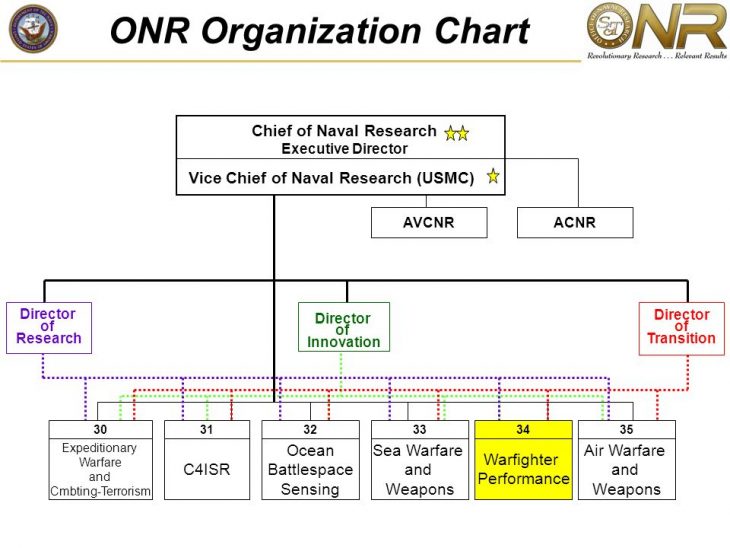
Source: slideplayer.com (C4ISR-Command, Control, Communications, Computers, Intelligence, Surveillance and Reconnaissance)
A July 20, 2018 Department of Defense listing of Navy/Office of Naval Research contracts states: “Woods Hole Oceanographic Institution, Woods Hole, Massachusetts, is awarded a $7,719,478 cost-plus-fixed-fee contract for development and demonstration of advanced ocean battlespace capabilities . . . This contract was competitively procured . . . for science and technology projects for advancement and improvement of Navy and Marine Corps operations, including Ocean Battlespace Sensing . . . The Office of Naval Research, Arlington, Virginia, is the contracting activity . . .”
Ocean Battlespace Sensing has to do with submarine and mine warfare. There is no information on WHOI’s web site about this nearly $8 million grant, or about what it is doing in the area of ocean battlespace sensing and submarine warfare. On April 7, 2016 when the new research vessel Neil Armstrong first arrived in Woods Hole, Dr. Frank Herr, head of the U.S. Navy’s Ocean Battlespace Sensing department (so-called “code 32” above), was among the notables addressing a gathered crowd. WHOI Director Mark Abbott also spoke, telling him and others, “We’re very proud to have been selected by the Office of Naval Research to operate the Neil Armstrong.” Navy-owned ships and advanced ocean battlespace work are not what we normally associate with a “non-profit organization dedicated to ocean research, exploration, and education” — WHOI’s stated activities. Defense-related activities are clearly a part of WHOI’s operations, but they are consistently edited out of the public image WHOI promotes.
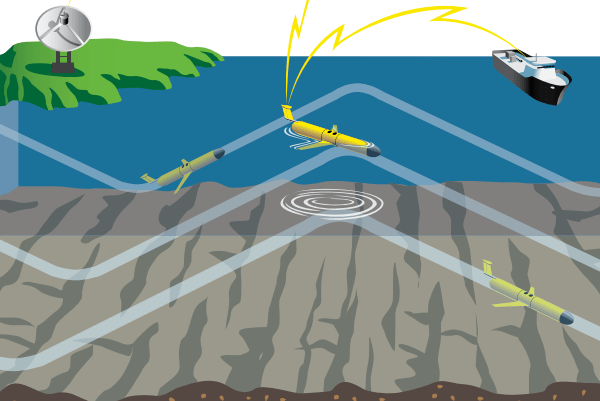
The Next Level – Drone Wars, breakfornews.com
As another example: according to an April 22, 2019 report by the DoD Defense Logistics Agency: “Woods Hole Oceanographic Institution, Woods Hole, Massachusetts, is awarded an $8,421,581 cost-plus-fixed-fee contract for the research effort entitled, “Project Sundance.” Except for the announcement of this contract, there is no information available anywhere on the web, or at WHOI’s own web site, about what Project Sundance is, leaving one to wonder if the project is classified — i.e., something the public is not entitled to know about.
Finally, in 1985, WHOI achieved fame when one of its scientists, Robert Ballard, discovered the wreckage of the Titanic. It wasn’t until years later that we got the full story. According to The National Geographic (November 21, 2017), the Titanic discovery only happened by the way in what was actually a top secret military operation to find two wrecked US Navy nuclear submarines. Remote sensing technology and an underwater submersible vehicle developed in Woods Hole and used aboard the WHOI research vessel, Knorr, was used in the discovery. National Geographic tells us the Knorr’s true mission: “the military wanted to know the fate of the nuclear reactors that powered the ships . . . this knowledge was to help determine the environmental safety of disposing of additional nuclear materials in the oceans.”
Ballard held the rank of Commander in the US Navy and was working as a liason to WHOI from the Office of Naval Research at the time of the discovery. Research on disposal of nuclear waste in the ocean is hardly in keeping with WHOI’s stated mission, “to advance knowledge about our planet, but also to ensure society’s long-term welfare and to help guide human stewardship of the environment.” Moreover, by making it look like this was just a fun adventure undertaken by WHOI to solve the mystery of the Titanic, a hoax was perpetrated on the public.
WHOI, the proponent of this new building project, is not being fully honest in the descriptions it gives of its mission and operations in Woods Hole. This calls WHOI’s credibility and full disclosure into question, and prompts further questions about the military-related role of the proposed new facility — “the epicenter of autonomous vehicle, sensor, and technology innovation.” The mentioned technology may well have uses in oceanographic research, but it may equally well have to do with “ocean battlespace sensing” — i.e., marine warfare. WHOI advertises itself as a humanitarian scientific institution without mentioning the clearly relevant fact that a significant part of its funding and research is from and for the US Department of Defense. It is not possible to fully evaluate a building proposal from an institution that is involved in secret projects because Cape Cod residents have no way of knowing if they are being given all the facts. Indeed, they have good reason to believe they are not being given all the facts,
The US military and its supporting contractors are the main source of wars of aggression and misery in the world today. It would be unethical to support expensive new facilities, paid for with our tax dollars and with what is left of our open space, for one of those contractors on Cape Cod. Yet war and militarization are so normalized in the American landscape, it is as if this is not even an issue.
August 29, 2019
Posted by aletho |
Deception, Environmentalism, Militarism, Nuclear Power | United States |
Leave a comment
In 2001, Australia became involved in the US “war on terror”, coined by former US President George W Bush as the pretext for invading Afghanistan. The rationale behind Australia’s decision was the ANZUS Treaty – a non-binding security between Australia, New Zealand and the US purportedly in line with the principles of the UN Charter.
Despite the treaty relating to possible attacks on either party in the Pacific, former Australian Prime Minister John Howard invoked Article VI to justify Australia’s involvement in Afghanistan, which states, “This treaty does not affect and shall not be interpreted as affecting in any way the rights and obligations of the Parties under the Charter of the United Nations or the responsibility of the United Nations for the maintenance of international peace and security.”
Since 2001, Australia has maintained a presence in Afghanistan and Iraq. Adopting US rhetoric on security and terrorism, the Australian Defence Ministry described its presence in Afghanistan thus: “Our fundamental objective in Afghanistan is to combat a clear threat from international terrorism to both international security and our own national security. Australia cannot afford, and Australians cannot afford, to let Afghanistan once again become a safe haven and training ground for terrorist organisations.”
Needless to say, the war on terror accomplished a continuation of the terrorism fomented by the US in its plans to permanently destabilise the region. Following its involvement in Afghanistan and Iraq, Australia has also cooperated with the North Atlantic Treaty Organisation (NATO) since 2005, thus prioritising security discourse at a national level.
In 2012, the Australia-NATO Joint Political Declaration established the foundations for cooperation and strategy – in other words, the prolongation of intervention abroad upon pretexts of security. The document recognises Australia as “one of the leading contributors to the NATO-led ISA mission in Afghanistan, which works under a UN Security Council mandate.”
Additionally, the declaration whitewashes foreign intervention through security concerns: “We understand the need to manage effectively risks and threats to our mutual interest, such as political instability from failed states, terrorism, the proliferation of weapons of mass destruction and their means of delivery, and cyber-attacks.” This statement has been reflected in the recent partnership agreement signed by NATO and Australia earlier this month.
NATO Secretary General Jens Stoltenberg described Australia’s role as “helping us to prevent Afghanistan from becoming a safe haven for international terrorists.” Days later, US President Donald Trump spoke about US presence in Afghanistan as a purported deterrent to prevent the country from becoming “a laboratory for terror.”
Far from deterring terrorism, international involvement in Afghanistan has created networks of terror which cannot be dissociated from foreign intervention. Dismantling terrorism in a failed state created by foreign intervention is the pretext for prolonged international presence.
Australia’s involvement in Iraq and Afghanistan as a non-NATO member has been one of the most prominent and reportedly in relation to training missions, although it was also involved in capturing and detaining alleged terror suspects.
As early as 2003 while working in close cooperation with the US, Australia not only was knowledgeable about the torture and abuse meted out at Abu Ghraib in Iraq – it was also a participant. Documents reveal that Australia’s representative at Abu Ghraib, officer and military lawyer George O’Kane, blocked the International Committee of the Red Cross access to detainees undergoing torture sessions. The Australian Government’s response to the revelations refuted responsibility, stating that the techniques applied against detainees were in concordance with the Geneva Conventions.
Australia was also one of the countries, among them NATO members and allies, participating in the Central Intelligence Agency’s (CIA) extraordinary rendition program, which involved the transfer of individuals suspected of terrorism to secret US detention and torture centres.
Speaking about the recently agreed framework, Stoltenberg highlighted Australia’s cooperation with NATO as focusing on preventing terrorism. “Training local forces is the best thing we can do in fighting terrorism; helping countries to stabilise their own countries.”
False premises instigated the war on terror. Maintaining it requires the regurgitation of past, dangerous lies. The West’s appropriation of what constitutes “individual liberty, democracy, human rights and the rule of law” has fomented perpetual war and subjugation to imperialist powers.
In the words of Australian Defence Minister as to the level of involvement of Australia in the region, “what we’re doing at the moment is assessing the ask from the United States, assessing what other allies are doing and how they’re considering this.” A simple statement that shows the Australian government has no consideration for the countries invaded by NATO, the mutating violence, dispossession of people and permanent instability. Neither, for that matter, will Australia assess its own involvement in terms of the human rights violations it helped to propagate. Dropping bombs in Iraq? Australia seems to have no problem with furthering an oppressive legacy.
August 29, 2019
Posted by aletho |
Illegal Occupation, Militarism, Subjugation - Torture | Afghanistan, Australia, Middle East, NATO, United States |
Leave a comment
 Aletho News
