UK seizes ‘Syria-bound oil tanker’ in Gibraltar on suspicion of violating EU bans
Press TV – July 4, 2019
The British overseas territory Gibraltar says it has seized a supertanker on suspicion of carrying crude oil to Syria in violation of European Union (EU) sanctions against the Arab country.
In a statement released on Thursday, Gibraltar Chief Minister Fabian Picardo said the territory’s police and customs agencies, aided by a detachment of British Royal Marines, had seized the Grace 1 vessel.
Gibraltar, he added, had reasonable grounds to believe that the tanker was carrying its crude oil shipment to the Banyas refinery in Syria.
“That refinery is the property of an entity that is subject to European Union sanctions against Syria,” Picardo said. “With my consent, our port and law enforcement agencies sought the assistance of the Royal Marines in carrying out this operation.”
A British Foreign Office spokesman welcomed what he called a “firm action by the Gibraltarian authorities, acting to enforce the EU Syria Sanctions regime,” which has been in place against the Arab country since 2011.
UK media claimed Refinitiv Eikon mapping indicates the ship had loaded “Iranian oil” on April 17 and sailed a longer route around the southern tip of Africa instead of via Egypt’s Suez Canal.
Syrian and Iranian officials have not yet commented on the report.
Spain: Tanker detained by on U.S. request to Britain
Later in the day, acting Spanish Foreign Minister Josep Borrell said Gibraltar detained the supertanker Grace 1 after a request by the United States to Britain.
Borrell was quoted by Reuters as saying that Spain was looking into the seizure of the ship and how it may affect Spanish sovereignty as it appears to have happened in Spanish waters.
Spain does not recognize the waters around Gibraltar as British.
Britain’s Foreign Office did not respond to a request for comment.
Koch and Soros Team Up For World Peace! WTF?
Corbett • 07/04/2019
In case you haven’t heard, George Soros’ Open Society Foundation and the Charles Koch Foundation have teamed up to help launch a new Washington think tank. The Quincy Institute for Responsible Statecraft will be “an action-oriented think tank that will lay the foundation for a new foreign policy centered on diplomatic engagement and military restraint.” So what gives? What’s the real agenda here? And what does this mean for those who hold a principled anti-war stance. Join James as he explores these issues on The Corbett Report today.
SHOW NOTES
In an astonishing turn, George Soros and Charles Koch team up to end US ‘forever war’ policy
Previous Corbett Report coverage on Soros
Podcast: Play in new window | Download | Embed
A race against time

Tilman Ruff’s life mission is to help rid the world of nuclear weapons
By Robert Fedele | Australian Nursing and Midwifery Journal | January 23, 2019
In 2007, Associate Professor Tilman Ruff and a small group of antinuclear activists founded the International Campaign to Abolish Nuclear Weapons (ICAN) in Melbourne. In 2017, the global nongovernmental organisation captured the first Nobel Peace Prize born in Australia after years drawing attention to the catastrophic humanitarian consequences of nuclear weapons and driving a historic UN prohibition treaty. In June 2019, Ruff, and fellow ICAN co-founder, Dimity Hawkins, were awarded Order of Australia Honours for their advocacy on nuclear disarmament.
Tilman Ruff’s life’s mission to help end nuclear weapons traces back to growing up in Melbourne in the 1980s living with the genuine fear that nuclear war could strike at any moment.
His family background passed on a profound awareness of the impacts of war.
“My family were German Christians living in communities in Palestine,” Professor Ruff explains. “My great grandparents married there. They were in turn displaced, imprisoned, and quite a few of them were killed in both World Wars and then brought to Australia as prisoners and locked up until 1947.
“So the indiscriminate trauma, loss, madness and horror of war and its terrible legacy across generations was something I heard from my grandmothers and my old people all the time.”
As an adolescent, several empowering experiences shaped Professor Ruff’s activism, including joining the movement to end Australia’s involvement in the Vietnam War and setting up the world’s first Amnesty International high school group in 1970 to support the release of a young man imprisoned for writing a political slogan on a wall.
They made the then 15-year-old Ruff truly believe he could make a difference.
A Public Health and Infectious Diseases Physician, Professor Ruff’s diverse career has included establishing the Nossal Institute for Global Health at the University of Melbourne, where he currently teaches on public health dimensions and nuclear technology, and a longstanding position as the International Medical Advisor for Australian Red Cross.
Looking back to his early days as a medical student, he reveals the presence of nuclear weapons struck him as “the most urgent global health threat and most demanding of urgent health professional attention.
“Many of us had this daily visceral fear that nuclear war could happen at any time. It was a palpable reality in your life.”
Professor Ruff suggests the birth of his daughter in 1982 added an emotional dimension that spurred him further to want to make the world a safer place for generations to come.
Soon he joined the International Physicians for the Prevention of Nuclear War (IPPNW), awarded a Nobel Peace Prize in 1985 for contributing to the end of the Cold War, where he became inspired by how effective and influential evidence-based advocacy imparted by health professionals could be.
Professor Ruff maintains overwhelming evidence shows nuclear war would cause catastrophic consequences and make it impossible to provide any effective health or humanitarian response.
The evidence is epitomised by the World Health Organization (WHO), which commissioned an expert group in 1983 to examine the issue and labelled nuclear war the greatest immediate threat to human health and welfare, with no health service in the world capable of responding to the devastation even a single nuclear weapon could inflict on a city.
“Nuclear weapons are different from any other weapons in two ways,” Professor Ruff says.
“One is the simple scale of the destruction. There have been single nuclear weapons built and tested that contained four times the explosive power of all explosives that have been used in all wars throughout human history.
“Of course, they’re qualitatively different too in producing radiation that transcends borders, that transcends its effects across generations, effects that can’t be undone, increasing the risk of cancer and genetic damage and chronic disease long-term for the lifetime of those exposed.”
Professor Ruff says recent scientific evidence points to nuclear weapons triggering climate disruption and a nuclear winter. Specifically, less than 1% of the world’s nuclear weapons targeted on cities would loft so much soot and smoke into the atmosphere that it would blanket the globe in darkness and cool the climate, decimating agriculture for decades and putting billions at risk of starvation across all corners of the globe.
“It doesn’t matter where they get used. It doesn’t matter whether you’re targeted by them or not. The idea that these gargantuan instruments of destruction could provide security for anybody is completely evidence free.”
The evolution of ICAN in Melbourne in 2007 was sparked by intense frustration and despair among members of IPPNW, and its Australian affiliate the Medical Association for Prevention of War (MAPW), that nuclear disarmament had fallen off the radar.
Importantly, Professor Ruff and his cofounders were encouraged by the success of the International Campaign to Ban Landmines and felt it could be replicated for nuclear weapons.
The plan was not to recreate a new organisation but instead form a coalition of existing organisations fixed on developing a treaty to ban nuclear weapons on account of their shattering humanitarian consequences.
“It’s got to be global, it’s got to engage young people, and balance horror, humour, hope and humanity,” Professor Ruff recalls of the group’s philosophy.
Fittingly, years of raising awareness about the dangers of nuclear weapons reached a pivotal point in July 2017 when the ICAN-led treaty to ban nuclear weapons was adopted by 122 countries at the United Nations in New York.
The treaty prohibits the use of nuclear weapons, their development, testing, stockpiling, production and threat of use, underlining that any use of these weapons contravenes the rules of international humanitarian law.
Unsurprisingly, the world’s nuclear-armed states – Russia, France, US, India, North Korea, UK, Pakistan, China and Israel – boycotted the treaty, as did many of their close allies like Australia. “They’re not only not disarming they’re actually investing massively in adding new capacities and modernising those weapons,” Professor Ruff says.
As the treaty negotiations unfolded at the UN General Assembly in New York, Professor Ruff says stories told in person by victims and survivors of nuclear bombings in Japan, together with survivors of nuclear testing around the world including Indigenous test survivors from Australia, exposed the reality of nuclear weapons like nothing else.
The room burst into joy when the treaty was adopted.
“It was a very emotional moment,” Professor Ruff recalls. “These are normally very formal and dry proceedings. When the vote happened, 122 to 1, the room just erupted with hugs, tears of joy. It was one of the most extraordinary moments you could ever witness.”
To date, 70 states have signed the treaty and 23 have ratified it.
It will enter into force once 50 states have signed and ratified it.
“It’s not the final perfect all-in-one solution that’s going to magically get rid of nuclear weapons overnight,” Professor Ruff concedes.
“But it’s the best thing that the rest of the world that doesn’t own the weapons could do.”
Professor Ruff is adamant the treaty marks a major step forward of historic significance, and through growing international support and an increased focus on stigmatisation, can finally help rid the world of nuclear weapons.
If anything, the fierce and bitter opposition expressed by the nuclear-armed states in the wake of the treaty has further reassured him.
“They wouldn’t do that if this didn’t matter. If this didn’t put them on notice and on the defensive.”
Professor Ruff praised the involvement of key health professional federations from around the world, such as the International Council of Nurses (ICN) and World Medical Association (WMA), in helping to reinforce how nuclear weapons pose a planetary health threat of the highest magnitude.
In this vein, he believes real change can only occur by influencing government policy and all health professionals, including nurses and midwives, should champion the power of health evidence.
“Our responsibility as health professionals is not just to alleviate suffering and try and cure diseases but to prevent illness, keep people and our communities healthy and be advocates.”
Several months after the treaty, ICAN was awarded the first Australian-born Nobel Peace Prize at a ceremony in Norway for its efforts.
“It was hugely important, humbling and just wonderful for a couple of reasons, apart from just the fact this has been blood, sweat and tears for me, endless nights and weekends, 365 days a year for more than a decade and for 20 years before that,” Professor Ruff reflects.
“It provides really important attention to the urgency of the issue and the need to make progress. It provides historic recognition for the importance of the treaty and gives enormous encouragement to civil society and governments.”
Disappointingly, Professor Ruff says the glaring lack of support and recognition from Australia’s leaders, both for the treaty and Nobel Peace Prize, remains difficult to comprehend.
“Basically, our policy is that we might need the US to use nuclear weapons on our behalf and we actually provide, through facilities and personnel assistance, for the possible use of nuclear weapons. That’s a completely immoral position. We’re part of the problem, not the solution.”
Regardless, Professor Ruff says the Nobel Peace Prize has opened doors and allowed ICAN to spread its message further.
The immediate task rests in getting as many states to sign and ratify the treaty as possible to strengthen its legal and political force. Pressure will also be ramped up on financial institutions, such as several of the big banks, invested in companies that make nuclear weapons.
In Australia, the strategy will likely focus on getting the next Labor Party government to join the treaty, given its current policy platform from 2018 which commits Labor in government to sign and ratify the Ban Treaty.
Professor Ruff says its imperative civil society organisations, including unions, band together to push for elimination.
While decades have passed since he was a youth growing up in Melbourne with the threat of nuclear war hovering Professor Ruff remains visibly determined to close the final chapter.
“Objectively, the danger of nuclear war is growing,” he declares.
“There’s no question that if these weapons are retained they will one day be used and we absolutely have to get the job done before that happens.”
THE FACTS ABOUT NUCLEAR WEAPONS
- Nuclear weapons release vast amounts of energy in the form of blast, heat and radiation, with no adequate humanitarian response possible
- A single nuclear bomb detonated over a large city could kill millions of people and the use of tens or hundreds of nuclear bombs would disrupt the global climate and cause widespread famine
- Nuclear weapons have been used twice in warfare – on the Japanese cities of Hiroshima and Nagasaki in 1945, killing more than 210,000 innocent civilians
- Nine countries possess around 15,000 nuclear weapons, with the US and Russia keeping about 1,800 of their nuclear weapons on high-alert, ready for launching within minutes.
Learn more about the International Campaign to Abolish Nuclear Weapons (ICAN).
US eyes Sri Lanka as its military logistics hub

Sri Lankan presidential aspirant Gotabaya Rajapaksa with the radical Buddhist monk Gnanasara Thera of Bodu Bala Sena. File photo.
By M. K. BHADRAKUMAR | Indian Punchline | July 3, 2019
The Easter Sunday terrorist attacks in Sri Lanka on 21st April in which 259 people were killed and over 500 injured were initially attributed to the Islamic State (IS). But no hard evidence is available to substantiate such a reading and it remains an open question as to the perpetrators.
The Sri Lankan President Maithripala Sirisena may have somewhat de-mystified the topic this week. On July 1, Sirisena charged at a public function that drug traffickers are behind the Easter Sunday bomb attacks. The following day he ordered the arrest of former Defense Secretary Hemasiri Fernando and the Inspector General of Police Pujith Jayasundara for their failure to prevent the Easter Sunday attacks despite prior knowledge of the attacks.
What lends enchantment to the view is that the United States had brilliantly succeeded in deploying to Sri Lanka the personnel of the Indo-Pacific Command within a couple of days of the Easter Sunday attacks on the pretext of investigating and assisting in Colombo’s upcoming fight against the IS. Historically, Sri Lanka is chary of allowing foreign military presence on its soil, but in this case Washington pressed home the deployment, since the ruling elite in Colombo was on the back foot, incoherent and in disarray in the immediate aftermath of the terrorist attacks.
In political terms, what Sirisena may have done this week is to reverse the ‘internationalisation’ of Sri Lanka’s terrorism problem. Indeed, for tackling a local drug mafia, Sri Lanka doesn’t need the expertise of the US’ Indo-Pacific Command.
This is just as well because in the downstream of the Easter Sunday attacks in April, Washington also began pushing hard for the signing of a Status of Forces Agreement (SOFA) with Sri Lanka, which Pentagon has traditionally demanded as the pre-requisite of establishment of military bases in foreign countries. (The SOFA establishes the rights and privileges of American personnel present in a host country in support of a larger security arrangement.)
Unsurprisingly, the Sri Lankan opinion militated against the SOFA project and suspected its real intentions. A huge uproar followed in the Sri Lankan media. Without doubt, the SOFA became yet another template of the power struggle between the staunchly nationalistic Sirisena and the famously ‘pro-western’ prime minister Ranil Wickremesinghe.
The net result is that the project which the US hoped to conclude in absolute secrecy, got derailed once the draft SOFA document under negotiation got somehow leaked to a Colombo newspaper. Interestingly, the US Secretary of State Mike Pompeo, who was scheduled to travel to Colombo following his recent visit to New Delhi was compelled to cancel the visit once it became apparent that the SOFA project has become a hot potato.
Meanwhile, the Empire strikes back. A case has been filed in the US District Court in central California by an American law firm claiming damages on behalf of alleged victims of human rights abuse during the war against separatist LTTE ten years ago. The plaintiffs have targeted Gotabaya Rajapaksa, then wartime defense chief and the younger brother of former president Mahinda Rajapaksa, as well as several government agencies, including military intelligence, the Criminal Investigation Department, the Terrorism Investigation Division, and the Special Intelligence Service, including some serving officials.
Of course, this is a blatant American attempt to put into jeopardy Gotabaya Rajapaksa’s plan to run for president in the upcoming Sri Lankan election in December. Gotabaya was a US citizen at the time of the war against the LTTE. He has dual citizenship and his request renouncing American citizenship is pending with Washington. Now, the catch is, the lawsuits in California could delay his bid to renounce his US citizenship, in which case he would not qualify to run for president under Sri Lankan electoral laws. Washington has tripped Gotabaya.
The US is making sure that the Rajapaksa family will not regain the calculus of power in Colombo following the December poll. Equally, the trial in California can expose former President Mahinda Rajapaksa as well — and even entangle Sirisena who had a direct role as acting defence minister in the final stages of the war. Clearly, Washington is interfering in the December election in Sri Lanka in a calibrated manner with a view to strengthen the prospects of a pro-American candidate such as Wickremesinghe or the Finance Minister Mangala Samaraweera who can be trusted to put the signature on the SOFA.
The US is determined to push ahead with the signing of the SOFA leading to the establishment of long-term American military presence in Sri Lanka. In August 2018, USS Anchorage, a Seventh Fleet vessel, and a unit of Marines visited the port of Trincomalee. In December 2018, the aircraft carrier USS John C. Stennis visited Trincomalee as part of the Pentagon’s plans to establish a logistic hub there for the US Navy. A Mass Communication Specialist on board USS John C. Stennis in a dispatch to the US Navy official web portal wrote:
“The primary purpose of the operation is to provide mission-critical supplies and services to U.S. Navy ships transiting through and operating in the Indian Ocean. The secondary purpose is to demonstrate the U.S. Navy’s ability to establish a temporary logistic hum ashore where no enduring U.S. Navy logistic footprint exists.”
The US disclaims any intention to set up military bases in Sri Lanka. This is factually true — except that it is sophistry. The US plan to use Sri Lanka as a ‘military logistics hub’ involves supportive measures that facilitate any American military operation in the Asia-Pacific region. Actually, this is well beyond the solitary use of a particular harbour such as Trincomalee as a military base. The point is, the entire island nation is being transformed into a ‘military logistics hub’.
Never before has there been such blatant US interference in Sri Lanka’s internal affairs. Washington tasted blood in the successful regime change project in January 2015 and it never looked back. The interference is so very extensive today that it is destabilising the Sri Lankan situation which is already highly polarised.
This is happening only due to India’s passivity bordering on acquiescence. The containment strategy against China in the Indian Ocean has become a common endeavour for Washington and Delhi. Is it in India’s long term interests that Sri Lanka is being destabilised, even if in the short term the Chinese Navy might be put to some difficulties in the Indian Ocean?
India’s medium and long term interests lie in regional stability. Its influence as a regional power is linked to regional stability. India cannot overlook that China has legitimate interests in our region. The US is a faraway power and is also in decline. It doesn’t make sense for India to bandwagon with the US in South Asia. A far more realistic approach will be to work with China and expand and deepen the common interests in regional security and stability.
North Korea Nuclear Freeze? Finally, a Realistic Proposal
By Thomas L. Knapp – Garrison Center – July 2, 2019
As President Donald Trump met with Supreme Leader Kim Jong-un for the third time at the end of June — becoming the first sitting US president to visit North Korea — the New York Times ran a piece suggesting the appearance of a new option on the proverbial table: A negotiated “nuclear freeze” rather than just another cycle of fruitless US demands for “de-nuclearization.”
The response from National Security Advisor John Bolton came swiftly via Twitter: “Neither the NSC staff nor I have discussed or heard of any desire to ‘settle for a nuclear freeze by NK.’ This was a reprehensible attempt by someone to box in the President.”
If Bolton and the National Security Council HAVEN’T discussed the possibility, they haven’t been doing their jobs. And if anyone’s being “boxed in” by having the idea called to public attention, it’s not Trump, it’s Bolton, who prefers saber-rattling theatrics for his hawkish friends on Capitol Hill to actually safeguarding the US.
There are really only two viable paths forward for improved US-North Korea relations.
One is for the US to start minding its own business: Withdraw US troops from and end all defense guarantees to South Korea, unilaterally lift sanctions on the North, and let the region work out its own problems without further American interference. Highly unlikely, at least for the moment.
The other is a “nuclear freeze” under which Kim keeps his existing nuclear arsenal but refrains from building more weapons, in return for sanctions relief and the US getting, and staying, out of the way of improving relations and closer ties between Pyongyang and Seoul.
That second option is eminently doable. It would cost the US nothing of real value. In fact, rightly handled, it would immediately reduce US “defense” outlays — a peace dividend, if we can keep the Military-Industrial Complex’s grubby hands off it.
Any US policy toward North Korea must account for two facts:
First, nuclear powers don’t give up their nukes. Only one, South Africa, has ever done so, and that regime didn’t face external foes on any large scale. North Korea has effectively been at war since the late 19th century, first against Japanese occupation, then against the South and the US from 1950 until now. Expecting Kim Jong-un to give up the ultimate deterrent to future invasions — by the US, by the South, by Japan, or even by current allies like China and Russia — is simply unrealistic. It’s not negotiable. The US knows it’s not negotiable. The only reason to even make the demand is to intentionally keep relations hostile.
Secondly, in the case of the United States, Kim has historical evidence as to what giving up his nukes might portend. He saw Iraq’s Saddam Hussein and Libya’s Muammar Gaddafi deposed and killed after they gave up their (never successful) nuclear weapons efforts. Kim would presumably prefer to remain alive and in charge.
A nuclear freeze agreement would not, in and of itself, produce peace. But it would be a giant step in that direction.
Thomas L. Knapp (Twitter: @thomaslknapp) is director and senior news analyst at the William Lloyd Garrison Center for Libertarian Advocacy Journalism (thegarrisoncenter.org).
Who Won the Debate?
Tulsi Gabbard let the genie out of the bottle
By Philip Giraldi • Unz Review • July 2, 2019
Last Wednesday’s debate among half of the announced Democratic Party candidates to become their party’s nominee for president in 2020 was notable for its lack of drama. Many of those called on to speak had little to say apart from the usual liberal bromides about health care, jobs, education and how the United States is a country of immigrants. On the following day the mainstream media anointed Elizabeth Warren as the winner based on the coherency of her message even though she said little that differed from what was being presented by most of the others on the stage. She just said it better, more articulately.
The New York Times’ coverage was typical, praising Warren for her grasp of the issues and her ability to present the same clearly and concisely, and citing a comment “They could teach classes in how warren talks about a problem and weaves in answers into a story. She’s not just wonk and stats.” It then went on to lump most of the other candidates together, describing their performances as “ha[ving] one or two strong answers, but none of them had the electric, campaign-launching moment they were hoping for.”
Inevitably, however, there was some disagreement on who had actually done best based on viewer reactions as well as the perceptions of some of the media that might not exactly be described as mainstream. The Drudge Report website had its poll running while the debate was going on and it registered overwhelmingly in favor of Hawaiian Congresswoman Tulsi Gabbard. Likewise, the Washington Examiner, a right-wing paper, opined that Gabbard had won by a knockout based on its own polling. Google’s search engine reportedly saw a surge in searches linked to Tulsi Gabbard both during and after the debate.
On the following day traditional conservative Pat Buchanan produced an article entitled “Memo for Trump: Trade Bolton for Tulsi,” similar to a comment made by Republican consultant Frank Luntz “She’s a long-shot to win the presidency, but Tulsi Gabbard is sounding like a prime candidate for Secretary of Defense.”
Tulsi, campaigning on her anti-war credentials, was indeed not like the other candidates, confronting directly the issue of war and peace which the other potential candidates studiously avoided. In response to a comment by neoliberal Congressman Tim Ryan who said that the U.S. has to remain “engaged” in places like Afghanistan, she referred to two American soldiers who had been killed that very day, saying “Is that what you will tell the parents of those two soldiers who were just killed in Afghanistan? Well, we just have to be engaged? As a soldier, I will tell you that answer is unacceptable.”
At another point she expanded on her thinking about America’s wars, saying “Let’s deal with the situation where we are, where this president and his chickenhawk cabinet have led us to the brink of war with Iran. I served in the war in Iraq at the height of the war in 2005, a war that took over 4,000 of my brothers and sisters in uniforms’ lives. The American people need to understand that this war with Iran would be far more devastating, far more costly than anything that we ever saw in Iraq. It would take many more lives. It would exacerbate the refugee crisis. And it wouldn’t be just contained within Iran. This would turn into a regional war. This is why it’s so important that every one of us, every single American, stand up and say no war with Iran.”
Tulsi also declared war on the Washington Establishment, saying that “For too long our leaders have failed us, taking us into one regime change war after the next, leading us into a new Cold War and arms race, costing us trillions of our hard-earned tax payer dollars and countless lives. This insanity must end.”
Blunt words, but it was a statement that few Americans whose livelihoods are not linked to “defense” or to the shamelessly corrupt U.S. Congress and media could disagree with, as it is clear that Washington is at the bottom of a deep hole and persists in digging. So why was there such a difference between what ordinary Americans and the Establishment punditry were seeing on their television screens? The difference was not so much in perception as in the desire to see a certain outcome. Anti-war takes away a lot of people’s rice bowls, be they directly employed on “defense” or part of the vast army of lobbyists and think tank parasites that keep the money flowing out of the taxpayers’ pockets and into the pockets of Raytheon, General Dynamics, Boeing and Lockheed Martin like a perpetual motion machine.
In the collective judgment of America’s Establishment, Tulsi Gabbard and anyone like her must be destroyed. She would not be the first victim of the political process shutting out undesirable opinions. One can go all the way back to Eugene McCarthy and his opposition to the Vietnam War back in 1968. McCarthy was right and Lyndon Johnson and the rest of the Democratic Party were wrong. More recently, Congressman Ron Paul tried twice to bring some sanity to the Republican Party. He too was marginalized deliberately by the GOP party apparatus working hand-in-hand with the media, to include the final insult of his being denied any opportunity to speak or have his delegates recognized at the 2012 nominating convention.
And the beat goes on. In 2016, Debbie Wasserman Shultz, head of the Democratic National Committee, fixed the nomination process so that Bernie Sanders, a peace candidate, would be marginalized and super hawk Hillary Clinton would be selected. Fortunately, the odor emanating from anything having to do with the Clintons kept her from being elected or we would already be at war with Russia and possibly also with China.
Tulsi Gabbard has let the genie of “end the forever wars” out of the bottle and it will be difficult to force it back in. She just might shake up the Democratic Party’s priorities, leading to more questions about just what has been wrong with U.S. foreign policy over the past twenty years. To qualify for the second round of debates she has to gain a couple of points in her approval rating or bring in more donations, either of which is definitely possible based on her performance. It is to be hoped that that will occur and that there will be no Debbie Wasserman Schultz hiding somewhere in the process who will finagle the polling results.
Yes, to some critics, Tulsi Gabbard is not a perfect candidate. On most domestic issues she appears to be a typical liberal Democrat and is also conventional in terms of her accommodation with Jewish power, but she also breaks with the Democratic Party establishment with her pledge to pardon Chelsea Manning, Julian Assange and Edward Snowden. She also has more of a moral compass than Elizabeth Warren, who cleverly evades the whole issue of Middle East policy, or a Joe Biden who would kiss Benjamin Netanyahu’s ass without any hesitation at all. Gabbard has openly criticized Netanyahu and she has also condemned Israel’s killing of “unarmed civilians” in Gaza. As a Hindu, her view of Muslims is somewhat complicated based on the historical interaction of the two groups, but she has moderated her views recently.
To be sure, Americans have heard much of the same before, much of it from out of the mouth of a gentleman named Donald Trump, but Tulsi Gabbard could well be the only genuine antiwar candidate that might truly be electable in the past fifty years. It is essential that we Americans who are concerned about the future of our country should listen to what she has to say very carefully and to respond accordingly.
Philip M. Giraldi, Ph.D., is Executive Director of the Council for the National Interest, a 501(c)3 tax deductible educational foundation (Federal ID Number #52-1739023) that seeks a more interests-based U.S. foreign policy in the Middle East. Website is councilforthenationalinterest.org, address is P.O. Box 2157, Purcellville VA 20134 and its email is inform@cnionline.org
Israeli attack on Syria is a message for Russia

Russian President Vladimir Putin met US President Donald Trump at Osaka on June 29, 2019
By M. K. BHADRAKUMAR | Indian Punchline | July 1, 2019
Although G20 summit in Osaka achieved nothing and there were no breakthrough decisions, a pleasant feeling had appeared momentarily that in the disjointed world situation, all the participants in the event at least reconfirmed their commitment to continue efforts to improve the global trade system, including work to reform the WTO. The G20 summits are generally convergent occasions and Osaka was no different.
The ensuing meditative reveries lingered on through Sunday like an opium-induced blurring of Romantic imagination out of Thomas De Quincey. However, by early Monday it dawned that life is real as the news broke that just past midnight Israeli jets stealthily approaching Syria via Lebanese air space had rained missiles at multiple targets in the suburbs of Damascus and Homs.
According to latest reports, sixteen people, including a baby, were killed and 21 others suffered injuries, including a month-old baby girl, who suffered burns and facial wounds. At one stroke, Israel demolished the chimera of global governance that the G20 symbolises. The missile attack constituted the violation of national sovereignty and territorial integrity of two UN member states — Lebanon and Syria. Israel committed a war crime by killing innocent unarmed civilians.
How is global governance possible without a rule-based order? The relentless promotion of trade war, protectionism and militarism that we are witnessing brings to mind the famous coinage of Thomas Hobbes — Bellum omnium contra omnes ( “the war of all against all”).
Yet, the much-awaited meeting between Trump and Putin at Osaka on Friday, which closely followed the ‘trilateral’ meeting of the national security advisors of the US, Russia and Israel in Jerusalem on Tuesday, was widely expected to produce some convergences regarding Syria and the situation around Iran.
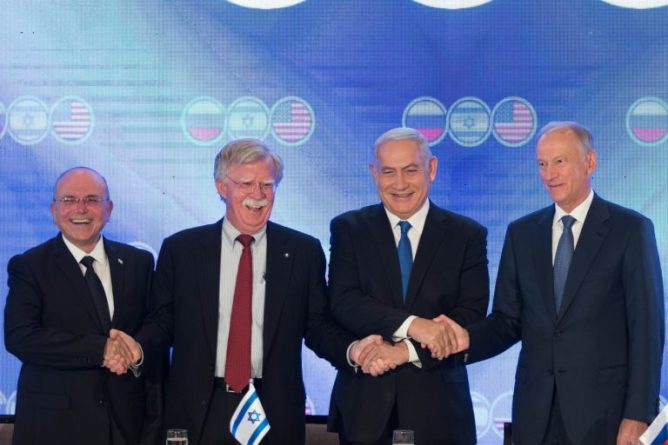
Israeli National Security Adviser Meir Ben-Shabbat, US National Security Adviser John Bolton, Prime Minister Benjamin Netanyahu and Secretary of the Russian Security Council Nikolai Patrushev at a trilateral summit at the Orient Hotel in Jerusalem on June 25, 2019.
Israel had hyped up the meeting of the NSAs and during a joint press conference with the visiting secretary of the Russian national security council Nikolai Patrushev, Israeli Prime Minister Benjamin Netanyahu had boasted that “security cooperation between Russia and Israel has already contributed much to the security and stability of our region and has made a fundamental difference in the situation in the region.”
But it was only typical Israeli bluster. In fact, today’s missile attack is an act of ‘coercive diplomacy’ by Israel. The Israelis are showing that they have neutralised the Russian S-300 missile system which is supposedly guarding Syrian air space. This is Israel’s angry riposte to Russia’s refusal to break up with Iran in Syria.
On the Israeli missile attack on Monday, the Russian Foreign Minister Sergey Lavrov has said, “We are establishing the facts now. We do not know what happened there. We want to gain insight into it, but the necessity to respect and execute the UN Security Council’s operating resolutions, that no one cancelled, is our principle which we will proceed from when assessing actions of any players in the region.”
Suffice to say that the Russian-Iranian axis in the Syrian conflict has far from outlived its utility — although the two countries would each have its specific interests in the Syrian situation. Thus, the Kremlin spokesman Dmitry Peskov disclosed today in Moscow that another trilateral summit on Syria between Russia, Iran and Turkey is due to take place in the near future.
To quote Peskov, “They raised the issue at the meeting of President Putin and Erdogan (at Osaka). They did talk about such a summit. It is understood that it will be held soon.” There are also media reports that Turkey will host the trilateral summit in July. The previous such summits took place in Sochi (November 2017), Ankara (April 2018), Tehran (September 2018) and Sochi (February 2019). Evidently, the raison d’être of the Russia-Turkey-Iran format remains even in the conditions of the current US-Iran standoff.
No doubt, the situation in Idlib province in northeast Syria is fraught with profound contradictions, which need to be reconciled urgently. This is one thing. (Read an insightful report by Xinhua news agency, here, on the strong undercurrents in the Idlib situation.)

However, the big picture out of all this is that although Putin had a “good meeting” with Trump in Osaka on Friday and they held “very business-like and pragmatic” discussions that “covered practically the entire range of issues of mutual interest” (in Putin’s words), all he would say was that the discussions on regional conflicts were “overall… useful consultations.”
Putin sounded frustrated that Washington has shown no intentions even to expand economic ties with Russia or tap the vast potential of bilateral trade. He noted, “That is why I have no idea if they (Trump administration) will do anything or not. At any rate, one thing is sure — we are not going to ask for anything. No means no. And if there is interest, we will respond in kind and do everything we can to turn the situation around.”
Of course, the two presidents have instructed their respective foreign ministers to launch consultations on a New START treaty. But even here, Putin noted, “I do not know if those consultations will lead to the extension of the New START treaty, it is too early to speak about it.”
The paradox lies herein. For Trump, the prime consideration in the period ahead will be that there are no serious hiccups on the foreign policy front that might upset his apple cart during his campaign for the November 2020 election. The Victory Day Parade in Moscow’s Red Square next May offers a great photo-op for him, which he wouldn’t want to miss. But basically, Trump went to Osaka wearing velvet gloves with a focused mind on creating foreign-policy underpinnings for his bid for a second term as president.
Israel certainly factored in the inconclusive meeting between Trump and Putin while launching the missile strike on Damascus. It is a stark reminder that Israel will continue to fuel the tensions over Iran’s presence in Syria and draw Trump into it.
Hope for a Breakthrough in Korea
By Ray McGovern – Consortium News – July 1, 2019
There is hope for some real progress in U.S.-North Korean relations after Sunday morning’s unscheduled meeting between President Donald Trump and North Korean leader Kim Jong-Un, largely because Russia and China seem more determined than ever to facilitate forward movement.
Sitting down before the talks began, Kim underlined the importance of the meeting.“I hope it can be the foundation for better things that people will not be expecting,” he said. “Our great relationship will provide the magical power with which to overcome hardships and obstacles in the tasks that needs to be done from now on.”
Trump was equally positive speaking of Kim:
“We’ve developed a very good relationship and we understand each other very well. I do believe he understands me, and I think I maybe understand him, and sometimes that can lead to very good things.”
Trump said the two sides would designate teams, with the U.S. team headed by special envoy Stephen Biegun under the auspices of Secretary of State Mike Pompeo, to start work in the next two to three weeks. “They’ll start a process, and we’ll see what happens,” he said.
New Impetus
Russian President Vladimir Putin and Chinese President Xi Jinping, who met individually with President Trump at the G20 in Osaka, have been singing from the same sheet of Korea music — particularly in the wake of Xi’s visit to North Korea on June 20-21. Putin’s remarks are the most illuminating.
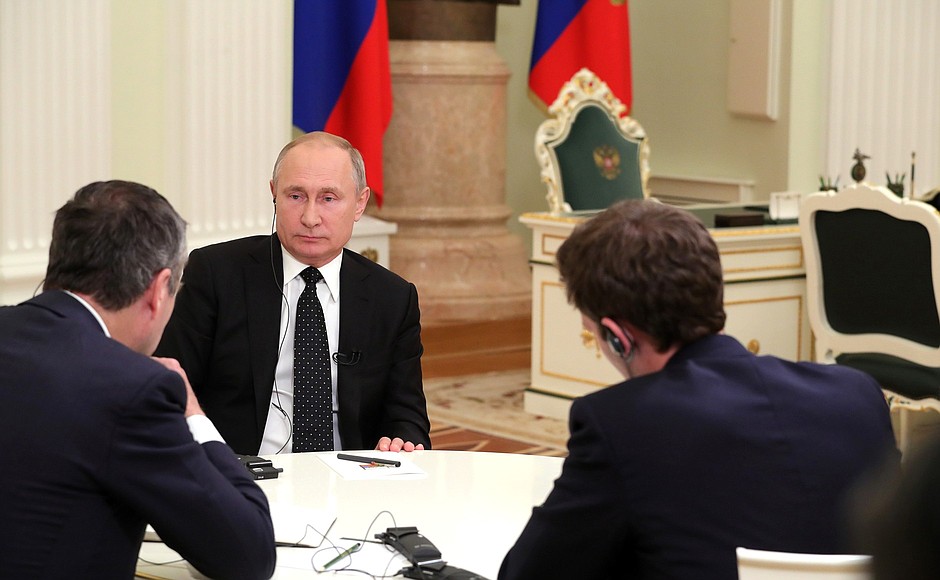
Putin at FT interview. (Kremlin photo)
In an interview with The Financial Times, Putin pointed to “the tragedies of Libya and Iraq” — meaning, of course, what happened to each of them as they lacked a nuclear deterrent. Applying that lesson to North Korea, Putin said,
“What we should be talking about is not how to make North Korea disarm, but how to ensure the unconditional security of North Korea and how to make any country, including North Korea, feel safe and protected by international law. …”
“We should think about guarantees, which we should use as the basis for talks with North Korea. We must take into account the dangers arising from … the presence of nuclear weapons,” he said, adding that if a way can be found to satisfy North Korea’s understandable determination to protect its security, “the situation may take a turn nobody can imagine today.”
“Whether we recognize North Korea as a nuclear power or not, the number of nuclear charges it has will not decrease. We must proceed from modern realities …” And those realities include fundamental, immediate security concerns for both Russia and China. Putin put it this way:
”[W]e have a common border, even if a short one, with North Korea, therefore, this problem has a direct bearing on us. The United States is located across the ocean … while we are right here, in this region, and the North Korean nuclear range is not far away from our border. This is why this concerns us directly, and we never stop thinking about it.”
Xi’s ‘Reasonable Expectations’
Last week in Pyongyang, Chinese President Xi Jinping said China is waiting for a desired response in stalled nuclear talks with the United States.
“North Korea would like to remain patient, but it hopes the relevant party will meet halfway with North Korea to explore resolution plans that accommodate each other’s reasonable concerns,” he said.
A commentary in China’s official Xinhua news agency said China could play a unique role in breaking the cycle of mistrust between North Korea and the U.S, but that both sides “need to have reasonable expectations and refrain from imposing unilateral and unrealistic demands.”
There is little doubt that the Russians and Chinese have been comparing notes on what they see as a potentially explosive (literally) problem in their respective backyards, the more so inasmuch as the two countries have become allies in all but name.
On a three-day visit to Moscow earlier this month, President Xi spoke of his “deep personal friendship” with Putin, with whom he has “met nearly 30 times in the past six years.” For his part, Putin claimed “Russian-Chinese relations have reached an unprecedented level. It is a global partnership and strategic cooperation.”
A Fundamental Strategic Change
Whether they are “best friends” or not, the claim of unprecedented strategic cooperation happens to be true — and is the most fundamental change in the world strategic equation in decades. Given the fear they share that things could get out of hand in Korea with the mercurial Trump and his hawkish advisers calling the shots, it is a safe bet that Putin and Xi have been coordinating closely on North Korea.
The next step could be stepped-up efforts to persuade Trump that China and Russia can somehow guarantee continued nuclear restraint on Pyongyang’s part, in return for U.S. agreement to move step by step — rather than full bore — toward at least partial North Korean denuclearization — and perhaps some relaxation in U.S. economic sanctions. Xi and Putin may have broached that kind of deal to Trump in Osaka.
There is also a salutary sign that President Trump has learned more about the effects of a military conflict with North Korea, and that he has come to realize that Pyongyang already has not only a nuclear, but also a formidable conventional deterrent: massed artillery.
“There are 35 million people in Seoul, 25 miles away,” Trump said on Sunday. “All accessible by what they already have in the mountains. There’s nothing like that anywhere in terms of danger.”
Obstacles Still Formidable
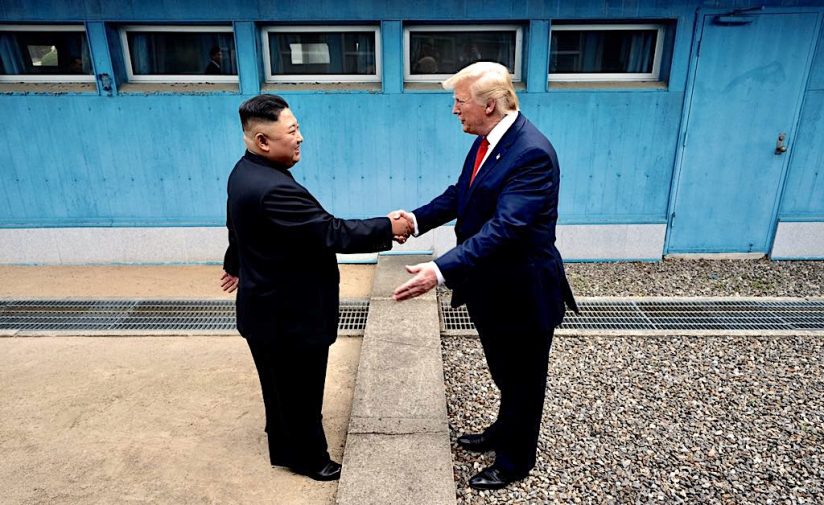
Trump and Kim meet Sunday before Trump became first US president to step on North Korean territory. (White House photo)
Trump will have to remind his national security adviser, John Bolton, and Secretary of State Mike Pompeo, that he is the president and that he intends to take a firmer grip on reins regarding Korean policy. Given their maladroit performance on both Iran and Venezuela, it would, at first blush, seem easy to jettison the two super-hawks.
But this would mean running afoul of the Military-Industrial-Congressional-Intelligence-Media-Academe-Think-Tank (MICIMATT) complex, in which the corporate-controlled media play the sine-qua-non role today.
In a harbinger of things to come, The Washington Post’s initial report on the outcome of the Trump-Kim talks contained two distortions: “Trump … misrepresented what had been achieved, claiming that North Korea had ceased ballistic missile tests and was continuing to send back remains of U.S. servicemen killed in the Korean War.”
The Trump administration could reasonably call that “fake news.” True, North Korea tested short-range ballistic missiles last spring, but Kim’s promise to Trump was to stop testing strategic not tactical missiles, and North Korea has adhered to that promise. As for the return of the remains of U.S. servicemen: True, such remains that remain are no longer being sent back to the U.S., but it was the U.S. that put a stop to that after the summit in Hanoi failed.
We can surely expect more disingenuous “reporting” of that kind.
Whether Trump can stand up to the MICIMATT on Korea remains to be seen. There is a huge amount of arms-maker-arms-dealer profiteering going on in the Far East, as long as tensions there can be stoked and kept at a sufficiently high level.
Ray McGovern works with Tell the Word, a publishing arm of the ecumenical Church of the Saviour in inner-city Washington. His first portfolio at CIA was referent-analyst for Soviet policy toward China, Korea, Vietnam, and Japan. In retirement he co-founded Veteran Intelligence Professionals for Sanity (VIPS).
Nasrallah: a War against Iran would Destroy Israel, the Saud and US Hegemony
Speech by Hezbollah Secretary General Sayed Hassan Nasrallah on Friday, May 31, 2019, on the occasion of Al-Quds (Jerusalem) International Day.
Transcript:
[…] Today, (the United States, Israel and Saudi Arabia) are focusing (their hostility) on the essential point of strength of this (Resistance) Axis. This is the next point (of my speech), namely Iran. Iran is the main power (of the Resistance Axis), no doubt about it. Iran is the heart of this Axis. It is Iran who helped Iraq during the invasion of Daesh, when (the terrorists) reached the outskirts of Karbala and Baghdad. It is Iran who helped the Syrian leadership and the Syrian army during the hard times (fighting Daesh). Iran stood alongside the Resistance in Lebanon and the Resistance in Palestine, etc., etc., etc. And Iran’s (anti-imperialist and anti-Zionist) stance is clear, unshakable and decisive. That is all.
Today, all this fury against Iran…. And it is Trump, Pompeo and the others who explicitly say so, that’s not my analysis. (They say) that besieging Iran and subjecting it to sanctions and pressures will cause all this (Resistance) Axis to weaken, collapse and disappear. And they start to count our (financial) losses, awaiting the end of each month to see if Hezbollah (is still able) to pay (the wages of its members and fighters) or not, isn’t it? All eyes are on Iran.
Yesterday, what did our brothers from (the Resistance factions) in Gaza say? They said: “Our (Arab & Islamic) Community has abandoned us, but Iran (fully) supported us. Iran helped us militarily and financially.” And that’s the truth. This is why (they put all their efforts) against Iran. They exert maximum pressure on Iran.
Against Iran, we find these same regimes who, since the first day, declared their hostility towards the Islamic Republic. From the first day of triumph (of the Revolution) of Imam Khomeini (in 1979), they planned and schemed (the downfall) of the Islamic Republic. And they kept doing so until today, for 40 years. They defamed Iran, launched false accusations against Iran, have sought to isolate Iran, incited (the Arab-Muslim peoples) against Iran… One day, they were defaming Iran by designating as Majus (Zoroastrians, non-Islamic): we all remember that the war (propaganda) of Saddam [Hussein] against Iran was based on the (alleged) fight against the Persians and the Majus. Of course, he could not claim that it was a Sunni-Shiite war, as did the Saudis, because more than half of the Iraqi people is Shiite, as well as a large part of the Iraqi army. It was not possible to present their war as a Sunni-Shiite war, so he depicted them as Majus. But the world has discovered (since) that the Iranian people is not Zoroastrian (but Muslim).
They first introduced the fight (against Iran) as a struggle of the Arabs against the Persians, and later on, they developed the battle as a Sunni-Shiite war. Then they (tried to) sell us (the risk) of the (conversion of peoples) to Shiism, be it Safavid, Alawi, etc. Finally, they came to economic sanctions, up to the threats of war culminating today.
Will there be a war or not? That is the burning issue of the day. For the last weeks, (the world) has been wondering if there will be (a new war) in the region. Of course, if there is a war between the US and Iran, the whole region will change radically. I’ll talk a little about it.
Some people push (the US) into a war with (all their) strength. That is, within the US administration —for Trump says he does not want war, but I mean others—, it is clear that Bolton pushes for war as much as he can. Bolton, the liar, the cartoon character —you remember (my joke 15 years ago about his comic looks and) his (extravagant) mustache—, what did he say yesterday? He said: “Our goal is not to overthrow the Iranian regime.” But a few months ago, during a meeting with the Iranian hypocrites (Mujahedeen-e-Khalq), he said that with the Grace of God, they all would commemorate the (Persian) New Year in Tehran in 2019 (after the regime gets toppled). What shameless (lies)! We do not forget (your previous statements), especially when they date only a few months, my friend! These are not statements that are 20 years old. They are only a few months old. These turncoats changed their story yet again! They got cold feet, to speak colloquially. I’ll tell you why they backtracked.
So there are Bolton, Bin Salman, Netanyahu and (let’s just say) other Gulf (leaders pushing for war), in order not to lengthen the list of names. Such is (the situation). They all push (for war). Anyone watching the media from the Gulf would believe that Trump is working for the Arab TV channels. (These media repeated day and night) that Trump was determined to launch a war, that it was imminent and that the US warships were on their way. (If one was to believe them), Trump was just watching these Arab television channels, and executing their orders.
I’ll start with the words of His Eminence the Imam and Leader (of the Islamic Community), Sayed Khamenei, may God preserve him. He is not a soothsayer. He is a man who has lead this Community for 30 years (according to the doctrine of Wilayat al-faqih, he is the Supreme Leader of Iran and of all Muslims worldwide), and he knows all the strategic data, all the details, all the facts and all the equations of strengths and weaknesses. And he (plainly) said that there would be no war. Neither war nor negotiations (with the US). The fact that there are no negotiations is a decision (entirely) in the hands of the Iranians (who refuse any negotiations before the end of the sanctions, despite US insistence on a meeting without preconditions). But the fact that there is no war involves everyone (the US and their allies on the one hand, Iran and its allies on the other hand). Let’s talk about the improbability of a war.
Why does (Sayed Khamenei assert that) there will be no war? Here is our analysis (of the situation). I do not pretend to present the actual reasons that made His Eminence Sayyed Khamenei say this, but our own analysis (Hezbollah’s).
First, it is the power of Iran (that prevents the possibility of a war). If there is no war, this is not due to anyone’s benevolence or generosity. If Iran was weak, the war would have taken place long ago. The (exceptional) level of hatred, resentment, plot and conspiracy of the Arab countries, the Gulf countries, the United States, Israel and the Zionists against Iran would have already lead to a war a long time ago if Iran had been weak. It is because Iran is strong and has (huge) capabilities, through its people, its armed forces, its regime, its Leader, its religious authorities and scholars, by its general situation and its specificities, and because firstly and lastly, Iran puts its trust in God, believes in Him and in His promise, because Iran is powerful, and that’s why Iran is feared by all. Iran is feared and respected. That is the first point (which explains the improbability of a war).
Trump does not face a regime that wouldn’t hold one or two weeks or whose planes would crash (without the United States, unlike what he said about Saudi Arabia), we speak of a true power. That’s the first point. This is the first reason (of the improbability of a war).
The second reason —and (I wish) that the whole world listens my words carefully— is that Mr. Trump, his administration and his intelligence services know very well that a war against Iran would not remain limited to the borders of Iran! A war against Iran would set fire to the whole region!
[Audience: At your service, O Nasrallah!]
The whole region will be engulfed in (the) flames (of war)! And all US forces and US interests in the region will be annihilated! And all those who conspired and plotted (against Iran) will pay the price, and primarily Israel and the Saud!
[Audience: At your service, O Nasrallah!]
And Trump knows that when the region goes up in flames… He doesn’t care about the (tens of thousands of) deaths. I’m talking about what matters to him! When the region goes up in flames, the price of oil will reach $200, $300 or even $400, and he will lose the (2020 presidential) elections. Such is the balance of power.
When His Eminence the Leader says that there will be no war, (it means that) Iran won’t initiate a war against anybody, but if the US wants to initiate this war, they must take into account all this data in their calculations, namely the extent of human and material losses that the US will suffer if they engage in such a war. And that’s what prevents the war from occurring.
As for those wretched (Saud), they want Trump to come fight in their defense, to serve their hatreds and resentments… Hey, uncle, Trump does not work for you, you are the ones at his service! You are the ones under his thumb! It is you who are the instruments of his project, and not the opposite! (He is not serving) your ambition and your hatred! His calculations are different from yours! He counts only in millions, billions, dollars, oil… Such are his calculations, very different from yours!
Now let us make things more relaxed. Let us assume that the United States launch a war against Iran. And let’s imagine that Iran doesn’t succeed in defeating this attack, and that God forbid, the United States emerge victorious and defeat Iran. How could Trump extract the remaining billions of dollars from the Gulf countries (once the alleged Iranian threat is no more)? How? Trump uses and exploits everything in an economic and financial purpose. Iran is powerful, and Trump has no interest in the Gulf countries agreeing, talking with Iran or concluding nonaggression pacts with Iran. He has no interest in that. His interest is to continue to ensure that the Gulf countries continue to be afraid of Iran so that he can milk, milk and milk them again (of all their billions)… until the very last drop! Isn’t it? If Trump launches this war, what will be the logic, what will be the need to sell all these missiles, all these warplanes, all these tanks, to send all these destroyers (to the Persian Gulf), to have all these bases in the region, etc. All this won’t make sense anymore. How stupid, how stupid (they are)! Such imbecility! Praise be to God !
Anyway, Trump’s priority is an economic war against Iran. And he wages an economic war against China, and even against Venezuela, which is not Iran, but his priority is still the economic war. Even against North Korea, his priority is economic warfare. Anyway, I want to mention strong indications that the probability of war has receded.
First, Trump himself, who is the decision maker, said on television that he does not want military confrontation with Iran, and that their war against Iran was economical because a military war would lead to more financial and human losses. And he categorically refuted the existence of a plan to send 120,000 American soldiers and officers in the region, and the (alleged) 120,000 soldiers have become 5,000, the 5,000 became 1,500, the 1,500 became 900, and they (ended up simply) extending the mission of the 600 US soldiers that were already present here. These are undeniable facts, aren’t they?
Basically, my brothers and sisters, Trump wants to leave the region, and he insisted to leave Syria. But immediately, the CIA, the Pentagon, Congress, Israel, Saudi Arabia and the UAE made a fuss, and all told him (in unison) that if he left Syria, the UAE and Saudi Arabia would go immediately to Damascus (to renew their relations with the regime), Damascus would come back in the Arab world, and it would strengthen Iran. So he (gave in to these pressures) and agreed to leave 200 troops in Syria. […]
See the previous parts of this speech:
Resistance Axis, Arab & Muslim Peoples will Never Forsake Palestine
Translation: resistancenewsunfiltered.blogspot.com
Memo to Trump: Trade Bolton for Tulsi
By Pat Buchanan • Unz Review • June 28, 2019
“For too long our leaders have failed us, taking us into one regime change war after the next, leading us into a new Cold War and arms race, costing us trillions of our hard-earned tax payer dollars and countless lives. This insanity must end.”
Donald Trump, circa 2016?
Nope. That denunciation of John Bolton interventionism came from Congresswoman Tulsi Gabbard of Hawaii during Wednesday night’s Democratic debate. At 38, she was the youngest candidate on stage.
Gabbard proceeded to rip both the “president and his chickenhawk cabinet (who) have led us to the brink of war with Iran.”
In a fiery exchange, Congressman Tim Ryan of Ohio countered that America cannot disengage from Afghanistan: “When we weren’t in there they started flying planes into our buildings.”
“The Taliban didn’t attack us on 9/11,” Gabbard replied, “Al-Qaida attacked us on 9/11. That’s why I and so many other people joined the military, to go after al-Qaida, not the Taliban.”
When Ryan insisted we must stay engaged, Gabbard shot back:
“Is that what you will tell the parents of those two soldiers who were just killed in Afghanistan? ‘Well, we just have to be engaged.’ As a solider, I will tell you, that answer is unacceptable. … We are no better off in Afghanistan that we were when this war began.”
By debate’s end, Gabbard was the runaway winner in both the Drudge Report and Washington Examiner polls and was far in front among all the Democratic candidates whose names were being searched on Google.
Though given less than seven minutes of speaking time in a two-hour debate, she could not have used that time more effectively. And her performance may shake up the Democratic race.
If she can rise a few points above her 1-2% in the polls, she could be assured a spot in the second round of debates.
If she is, moderators will now go to her with questions of foreign policy issues that would not have been raised without her presence, and these questions will expose the hidden divisions in the Democratic Party.
Leading Democratic candidates could be asked to declare what U.S. policy should be — not only toward Afghanistan but Iraq, Syria, Yemen, Saudi Arabia, Israel, Jared Kushner’s “Deal of the Century,” and Trump’s seeming rejection of the two-state solution.
If she makes it into the second round, Gabbard could become the catalyst for the kind of globalist vs. nationalist debate that broke out between Trump and Bush Republicans in 2016, a debate that contributed to Trump’s victory at the Cleveland convention and in November.
The problem Gabbard presents for Democrats is that, as was shown in the joust with Ryan, she takes positions that split her party, while her rivals prefer to talk about what unites the party, like the terribleness of Trump, free college tuition and soaking the rich.
Given more airtime, she will present problems for the GOP as well. For the foreign policy Tulsi Gabbard is calling for is not far off from the foreign policy Donald Trump promised in 2016 but has since failed to deliver.
We still have 2,000 troops in Syria, 5,000 in Iraq, 14,000 in Afghanistan. We just moved an aircraft carrier task force, B-52s and 1,000 troops to the Persian Gulf to confront Iran. We are about to impose sanctions on the Iranian foreign minister with whom we would need to negotiate to avoid a war.
Jared Kushner is talking up a U.S.-led consortium to raise $50 billion for the Palestinians in return for their forfeiture of sovereignty and an end to their dream of a nation-state on the West Bank and Gaza with Jerusalem as its capital.
John Bolton is talking of regime change in Caracas and confronting the “troika of tyranny” in Cuba, Nicaragua and Venezuela.
Rather than engaging Russia as Trump promised, we have been sanctioning Russia, arming Ukraine, sending warships into the Black Sea, beefing up NATO in the Baltic and trashing arms control treaties Ronald Reagan and other presidents negotiated in the Cold War
U.S. policy has managed to push our great adversaries, Russia and China, together as they have not been since the first Stalin-Mao decade of the Cold War.
This June, Vladimir Putin traveled to Beijing where he and Xi Jinping met in the Great Hall of the People to warn that in this time of “growing global instability and uncertainty,” Russia and China will “deepen their consultations on strategic stability issues.”
Xi presented Putin with China’s new Friendship Medal. Putin responded: “Cooperation with China is one of Russia’s top priorities and it has reached an unprecedented level.”
At the end of the Cold War, we were the lone superpower. Who forfeited our preeminence? Who bled us of 7,000 U.S. lives and $6 trillion in endless Middle East wars? Who got us into this Cold War II?
Was all this the doing of those damnable isolationists again?
Copyright 2019 Creators.com.
Monsters Walk the Earth. Why These Three Countries Are the Real Troika of Evil
By Philip Giraldi | Strategic Culture Foundation | June 27, 2019
There are monsters among us. Every day I read about an American “plan” to either invade some place new or to otherwise inflict pain to convince a “non-compliant” foreign government how to behave. Last week it was Iran but next week it could just as easily again be Lebanon, Syria or Venezuela. Or even Russia or China, both of whom are seen as “threats” even though American soldiers, sailors and marines sit on their borders and not vice versa. The United States is perhaps unique in the history of the world in that it sees threats everywhere even though it is not, in fact, threatened by anyone.
Just as often, one learns about a new atrocity by Israelis inflicted on the defenseless Arabs just because they have the power to do so. Last Friday in Gaza the Israeli army shot and killed four unarmed demonstrators and injured 300 more while the Jewish state’s police invaded a Palestinian orphanage school in occupied Jerusalem and shut it down because the students were celebrating a “Yes to peace, no to war” poetry festival. Peace is not in the Israeli authorized curriculum.
And then there are the Saudis, publicly chopping the heads off of 37 “dissidents” in a mass display of barbarity, and also murdering and dismembering a hapless journalist. And let’s not forget the bombing and deliberate starving of hundreds of thousands innocent civilians in Yemen.
It is truly a troika of evil, an expression favored by US National Security Advisor John Bolton, though he was applying it to Cuba, Venezuela and Nicaragua, all “socialist” nations currently on Washington’s “hit list.” Americans, Saudis and Israelis have become monsters in the eyes of the rest of the world even if in their own minds they are endowed with special privilege due to their being “Exceptional,” “Chosen by God” or “Guardians of Mecca and Medina.” All three countries share a dishonest sense of entitlement that supports the fiction that their oppressive and often illegal behavior is somehow perfectly legitimate.
To be sure not all Americans, Saudis or Israelis are individually monsters. Many are decent people who are appalled by what their respective governments are doing. Saudi citizens live under a despotism and have little to say about their government, but there is a formidable though fragmented peace movement in slightly less totalitarian Israel and in the United States there is growing anti-war sentiment. The discomfort in America is driven by a sense that the post 9/11 conflicts have only embroiled the country more deeply in wars that have no exit and no end. Unfortunately, the peace movement in Israel will never have any real power while the anti-war activists in America are leaderless and disorganized, waiting for someone to step up and take charge.
The current foreign policy debate centers around what Washington’s next moves in the Middle East might be. The decision-making will inevitably involve the US and its “close allies” Israel and Saudi Arabia, which should not surprise anyone. While it is clear that President Donald Trump ordered an attack on Iran before canceling the action at the last minute, exactly how that played out continues to be unclear. One theory, promoted by the president himself, is that the attack would have been disproportionate, killing possibly hundreds of Iranian military personnel in exchange for one admittedly very expensive surveillance drone. Killing the Iranians would have guaranteed an immediate escalation by Iran, which has both the will and the capability to hit high value targets in and around the Persian Gulf region, a factor that may also have figured into the presidential calculus.
Trump’s cancelation of the attack immediately produced cries of rage from the usual neoconservative chickenhawk crowd in Washington as well as a more subdued reiteration of the Israeli and Saudi demands that Iran be punished, though both are also concerned that a massive Iranian retaliation would hit them hard. They are both hoping that Washington’s immensely powerful strategic armaments will succeed in knocking Iran out quickly and decisively, but they have also both learned not to completely trust the White House.
To assuage the beast, the president has initiated a package of “major” new sanctions on Iran which will no doubt hurt the Iranian people while not changing government decision making one iota. There has also been a leak of a story relating to US cyber-attacks on Iranian military and infrastructure targets, yet another attempt to act aggressive to mitigate the sounds being emitted by the neocon chorus.
To understand the stop-and-go behavior by Trump requires application of the Occam’s Razor principle, i.e. that the simplest explanation is most likely correct. For some odd reason, Donald Trump wants to be reelected president in 2020 in spite of the fact that he appears to be uncomfortable in office. A quick, successful war would enhance his chances for a second term, which is probably what Pompeo promised, but any military action that is not immediately decisive would hurt his prospects, quite possibly inflicting fatal damage. Trump apparently had an intercession by Fox news analyst Tucker Carlson, who may have explained that reality to him shortly before he decided to cancel the attack. Tucker is, for what it’s worth, a highly respected critic coming from the political right who is skeptical of wars of choice, democracy building and the global liberal order.
The truth is that all of American foreign policy during the upcoming year will be designed to pander to certain constituencies that will be crucial to the 2020 presidential election. One can bank on even more concessions being granted to Israel and its murderous thug prime minister Benjamin Netanyahu to bring in Jewish votes and, more importantly, money. John Bolton was already in Israel getting his marching orders from Netanyahu on the weekend and Pence was effusive in his praise of Israel when he spoke at the meeting in Orlando earlier in the week launching the Trump 2020 campaign, so the game is already afoot. It is an interesting process to observe how Jewish oligarchs like Sheldon Adelson contribute tens of millions of dollars to the politicians who then in turn give the Jewish state taxpayer generated tens of billions of dollars in return. Bribing corrupt politicians is one of the best investments that one can make in today’s America.
Trump will also go easy on Saudi Arabia because he wants to sell them billions of dollars’ worth of weapons which will make the key constituency of the Military Industrial Complex (MIC) happy. And he will continue to exert “maximum pressure” on Iran and Venezuela to show how tough he can be for his Make America Great audience, though avoiding war if he possibly can just in case any of the hapless victims tries to fight back and embarrass him.
So, there it is folks. War with Iran is for the moment on hold, but tune in again next week as the collective White House memory span runs to only three or four days. By next week we Americans might be at war with Mongolia.
Featured Video

Iran’s Next Strike May Not Explode. It Could Shut You Down
or go to
Aletho News Archives – Video-Images
From the Archive
Zionism’s Violent Legacy
By Donald Neff | Washington Report On Middle East Affairs | January 1996
On January 4, 1948, Jewish terrorists drove a truck loaded with explosives into the center of the all Arab city of Jaffa and detonated it, killing 26 and wounding around 100 Palestinian men, women and children.[1] The attack was the work of the Irgun Zvai Leumi – the “National Military Organization,” also known by the Hebrew letters Etzel – the largest Jewish terrorist group in Palestine. The Irgun was headed by Revisionist Zionist Menachem Begin and had been killing and maiming Arabs, Britons and even Jews for the previous ten years in its efforts to establish a Jewish state.
This terror campaign meant that at the core of Revisionist Zionism there existed a philosophical embrace of violence. … continue
Blog Roll
 Aletho News
- Trump’s Iran war is on an Israeli leash
- Saudi oil boss issues global supply warning
- Riyadh Says Its Oil System Is Intact. The Numbers Say Otherwise.
- Trump and Netanyahu Want to “Finish the Job” on Iran
- US ‘one-sided dictation’ not Iran’s beliefs makes rational talks impossible: Baghaei
- Iran’s Next Strike May Not Explode. It Could Shut You Down /Col Doug Macgregor
- Iran: US political targets legitimate if assassinations return
- Iraq shuts key border crossing with Iran under US pressure: Report
- Undersea Internet cables could be targeted in retaliation for attacks on Iran: IRGC deputy chief
- EU sending ‘biased’ observers to interfere in Serbian election – president
- If Americans Knew
- Israel’s vision of regional security rests on keeping Arab states weak
- Heidi Levine recounts how Palestinian youths helped save her in settler attack
- DAILY UPDATE: Latest essential news on Palestine, Israel, & region
- Trump’s Intensifying Sabotage of the ICC, for Israel’s Sake
- Israeli military detain US and UK volunteers in West Bank including Democratic NY politician Brad Lander
- Americans at National Conservatism Conference held in Israel this year criticize Israel
- Christiane Amanpour exits CNN with a legacy shaped by the debate over Israel
- Israel’s war on Iran is the final move in a decades-old strategy
- Israel Denies Entry to French Journalist, U.S. Researcher Amid Rise in Entry Denials
- Gaza’s hospitals are running out of life-saving fuel – Daily Update
- No Tricks Zone
- E-Cars Reduce CO2 Emissions By Only 41% Compared To Internal Combustion Engine Vehicles
- Predictions Made By Renowned Climate Professor Over Past Decades Have Been Proven To Be Poor
- New Study Suggests Large Regions Of The Pacific Ocean Have Been Cooling For The Last 80 Years
- Germany’s Green Energy Debacle: High Energy Costs Force Kahla Porzellan to Close After 182 Years!
- New Study: 50 Years Of The Most Aggressive ‘Net Zero’ Policies Can Only Affect The Global Climate By 0.03°C
- US September “Heat” Was No Record…Many Records Set Decades Ago
- Latest European Green Energy Debacle; Portugal’s Largest Flagship Solar Park Insolvent!
- Green Energy Debacle: German Expert Professor Fritz Vahrenholt Warns Of Severe Economic And Social Consequences
- Two More Paleo Reconstructions Affirm Meters-Higher Sea Levels Across Ireland, Brazil 7000-6000 Years Ago
- New Study: Earth And Venus Surface Warmth Largely Explained By Convection And Lapse Rate, Not CO2 Or Radiation

