Republicans & Democrats agree: No war on Iran (without Congress at least)
RT | July 12, 2019
The House of Representatives has adopted the 2020 military spending bill, but with an amendment that blocks war on Iran without congressional approval – backed by President Donald Trump’s outspoken critics and supporters alike.
A bipartisan amendment to bar the executive branch from offensive action against Iran without explicit authorization from Congress was adopted with a 250-170 vote, with 27 Republicans joining the Democrats in support, and seven Democrats crossing the aisle in opposition.
Khanna made the point that Trump himself had campaigned against endless wars, but had advisers around him that were pushing him into a conflict with Iran.
“I believe he doesn’t want one,” Khanna said. After the amendment passed, he told reporters that it was “proof that opposition to war with Iran transcends partisan politics.”
Not surprisingly, the mainstream media outlets reported on the amendment’s passage as a rebuke of Trump by the Democrat-led House.
“The Democratic-controlled House votes to limit President Trump’s authority to make war against Iran,” said AP. “House votes to prevent Trump from entering an unauthorized war with Iran,” said the Washington Post. “The House voted to check President Trump’s authority to strike Iran by requiring him to get Congress’s approval first,” declared the New York Times.
Far from being a warmonger, however, Trump called off the strike against Iran last month – citing concerns over Iranian casualties – after Tehran shot down a US spy drone over the Straits of Hormuz. He has also opened dialogue with North Korea, ordered the US withdrawal from Syria, and his administration is currently conducting peace talks to conclude the 18-year-long conflict in Afghanistan.
Secretary of State Mike Pompeo and National Security Advisor John Bolton are considered hard-liners on the issue of Iran, as are many establishment Republicans in the House, including Liz Cheney (R-Wyoming), daughter of George W. Bush’s VP Dick Cheney, one of the architects of the 2003 Iraq invasion.
“A Cheney wanting us to get into war? Weird,” Gaetz joked to Fox, when asked about her objections to the amendment he and Khanna had proposed.
Another amendment, seeking to repeal the 2002 Authorization for Use of Military Force (AUMF) against Iraq, passed with a vote of 242-180. It was sponsored by Reps. Barbara Lee (D-California) and Justin Amash (I-Michigan), a former Republican.
The final vote on the 2020 National Defense Authorization Act (NDAA) passed by a vote of 220-197, along party lines. It authorizes $733 billion for the Pentagon in the next fiscal year, some $17 billion less than what the White House asked for.
How Real is the Trump Administration’s New Flexibility with North Korea?
By Gregory Elich | CounterPunch | July 12, 2019
Although widely derided by the Washington Establishment as an empty photo opportunity, the recent meeting between President Trump and Chairman Kim Jong Un at Panmunjom produced an agreement to resume working-level talks in the near future. According to the North Korean news agency KCNA, the two leaders discussed stumbling blocks in improving relations and easing tensions, and agreed to work towards a “breakthrough in the denuclearization of the Korean Peninsula and in the bilateral relations.”
The resumption of working-level talks comes as welcome relief after months of stalled progress since Trump pulled the plug on the Hanoi Summit due to North Korea’s failure to accede to the demand that it unilaterally disarm. At Hanoi, U.S. negotiators presented a plan that called for North Korea to denuclearize, while promising nothing in exchange. Nothing, that is, other than punishment in the form of “maximum pressure” sanctions. All that was on offer to the Democratic People’s Republic of Korea (DPRK, the official name for North Korea) was the vague mention of unspecified economic benefits after it had fully denuclearized.
In addition to denuclearization, the U.S. side widened the scope of talks at Hanoi by delivering a document to the North Koreans that demanded the dismantlement of chemical and biological warfare programs, as well as ballistic missiles and facilities. U.S. negotiators also wanted a detailed accounting of nuclear facilities, subject to intrusive U.S. inspections. For the North Koreans, to implement such a proposal would allow inspectors to map the bombing coordinates of its nuclear facilities, an obvious non-starter when the U.S. has yet to provide any semblance of a security guarantee.
In essence, what the U.S. offered at Hanoi was the Libya Model of denuclearization, in which obligations are loaded solely on its negotiating partner. That is not an approach that is going to work with North Korea, as among other reasons, its nuclear program is far more advanced than was the case with Libya’s. The DPRK has something substantial to trade, and it is not going to relinquish it for free.
The sanctions against the DPRK are designed to strangle its economy. The North Koreans regard sanctions relief as an essential element in the trade-off for denuclearization. The fate of small nations that the United States has attacked, such as Yugoslavia, Iraq, and Libya, did not go unnoticed in the DPRK. Those object lessons led the North Koreans to draw the logical conclusion that the only way for a small targeted nation to ensure its survival would be to develop a nuclear deterrent.
There has been much talk in the U.S. media about the Trump administration’s apparent intent to adopt a more flexible approach to negotiations. This has resulted in much hand-wringing among the Washington Establishment, panicked over a potential reduction in tensions, which it fears could have knock-on effects in sales of military hardware to Asian allies like South Korea and Japan. New pretexts would need to be developed to explain the military buildup in the Asia-Pacific that is aimed at China.
How real is this new flexibility? In a widely misread report in the New York Times, it is suggested that Trump may “settle” for a nuclear freeze, leaving the DPRK as a nuclear power. A careful reading of the article indicates, however, that the Trump administration does not envision a nuclear freeze as an end state, but rather as a “foundation for a new round of negotiations.” Talks “would begin with a significant – but limited – first step.” From there, U.S. negotiators would seek to persuade Kim to expand the range of nuclear facilities that would be dismantled.
On Trump’s return flight from South Korea, U.S. Special Representative for North Korea Stephen Biegun talked about U.S. plans for the next summit between Trump and Kim. Biegun said that the U.S. wanted a complete freeze on the DPRK’s weapons of mass destruction (WMD) programs while negotiations are underway. This is not different than what was stated in the New York Times report, leaving aside the misleading use of the word “settle” and the fretful comments the Times quoted from Establishment analysts.
Biegun’s choice of words is significant: ‘WMD,’ rather than ‘nuclear.’ John Bolton’s insistence on including chemical and biological weapons programs in any negotiated settlement remains very much to the fore. North Korea denies having any such operations and U.S. belief in their existence is predicated primarily on supposition, backed by weak and inconclusive indications. If the DPRK does not have a chemical or biological weapons program, then it cannot freeze what it does not have, and it cannot provide details on programs that remain a fantasy in the minds of Washington. It requires little imagination to anticipate how hawks in the Trump administration would seize upon North Korean denials as a means of sabotaging negotiations.
Whether North Korea has chemical and biological programs or not, it is likely to have misgivings about the United States adding demands while at the same time offering no concessions. When Libya denuclearized, it too faced an ever-expanding array of conditions, including visits by John Bolton and other U.S. officials, telling it how to vote at the United Nations and ordering it to cut military ties with Syria, Iran, and North Korea.
It is notable that at no time has any U.S. official mentioned what kind of security guarantee it could offer to the DPRK. Given the record of U.S. militarism in recent decades, it is difficult to conceive of any assurance the U.S. would provide that could be trusted. Whatever the U.S. may offer will need to be supplemented, and protection will have to come from elsewhere. Chinese President Xi Jinping alluded to the same during his recent visit to Pyongyang, when he stated, “China will take an active role in resolving North Korea’s security concerns.” In May, Russian Foreign Minister Sergey Lavrov announced that security guarantees are an “absolutely mandatory” component of any negotiated agreement with the DPRK. “Russia and China are prepared to work on such guarantees,” he added.
In his meeting with U.S. Secretary of State Mike Pompeo on May 14, Lavrov stressed the importance of providing security guarantees to the DPRK, but all Pompeo wanted to talk about was hitting North Korea as hard as possible with sanctions, without letup.
Much has been made of Stephen Biegun’s claim that the United States plans on a more flexible “simultaneous and parallel” approach to negotiations. When examined, there is less change than many suppose. Biegun is in line with the rest of the Trump administration, emphasizing that “in the abstract, we have no interest in sanctions relief before denuclearization.”
Since sanctions relief and security guarantees are off the negotiating table as far as U.S. officials are concerned, what are they ready to offer? According to Biegun, flexibility means the U.S. would consider agreeing to the two nations opening liaison offices in each other’s capitals, permitting some people-to-people talks, and humanitarian aid. That last point may mean that the United States would consider stopping its efforts to block humanitarian assistance. Or it could indicate a willingness by the U.S. to directly provide a token amount of aid while continuing to shut down independent aid operations in the DPRK.
To the North Koreans, this “flexibility” is a distinction without a difference. It remains the Libya Model. As such, it is a recipe for failure if the U.S. rigidly adheres to this strategy.
Complicating matters further is the rider the U.S. Senate attached to the National Defense Authorization Act for Fiscal Year 2020. If the rider makes it into the House version, then once the defense budget is signed into law, it would mandate secondary sanctions on any financial institution that does business with the DPRK. Current sanctions leave it to the discretion of the Treasury Department as to which firms to sanction. The Senate bill aims to cut off the North Korean economy from what little international trade it still has after sanctions, so as to inflict further harm on the population. Certainly, this also signals the Senate’s opposition to any negotiated settlement.
The North Koreans need two things in exchange for denuclearization: the lifting of sanctions and a security guarantee. What that security guarantee would look like is difficult to discern. A piece of paper is not going to do it. The DPRK needs a reliable means of assuring its security if it is going to denuclearize.
Across the entire U.S. Establishment, both within and outside the Trump administration, there is an unwavering belief that every action the DPRK takes towards denuclearization should be rewarded with “maximum pressure” sanctions.
It is a curious notion, this expectation that nothing need be offered to North Korea in exchange for meeting U.S. demands. Odder still is the conviction that the DPRK ought to be satisfied with being tormented by crippling sanctions for each concession it makes. But then, imperialism and arrogance go hand-in-hand. There is no reason, however, to expect the North Koreans to be servile. “North Korea wants actions, not words,” observes Christopher Green of the International Crisis Group. “I’m not sure the U.S. is mentally ready for it, even now.”
Whether or not North Korea denuclearizes depends entirely on the United States. If the Trump administration believes it can bully the DPRK into unilateral disarmament, then it is sadly mistaken. If on the other hand, it eventually comes to recognize that the only way to achieve its objective is to offer some measure of reciprocity, then denuclearization becomes an achievable goal. At this point, there is little indication that the U.S. is prepared to move beyond the former position.
Gregory Elich is a Korea Policy Institute associate and on the Board of Directors of the Jasenovac Research Institute. He is a member of the Solidarity Committee for Democracy and Peace in Korea, a columnist for Voice of the People, and one of the co-authors of Killing Democracy: CIA and Pentagon Operations in the Post-Soviet Period, published in the Russian language. He is also a member of the Task Force to Stop THAAD in Korea and Militarism in Asia and the Pacific. His website is https://gregoryelich.org
US pours oil into fire in Gulf, mum’s the word for India
By M. K. BHADRAKUMAR | Indian Punchline | July 12, 2019
The illegal seizure of an Iranian oil tanker off Gibralter by the British Navy last Friday is fast acquiring farcical character. Britain acted at the behest of the US; in turn, the US probably acted at the behest of the ‘B Team’. So far, only one top US official has expressed joy over the incident — National Security Advisor John Bolton, who is of course the member-secretary of the B Team. None of the other three members of the B Team — Israeli PM Benjamin Netanyahu or either of the two Gulf Crown Princes (bin Salman and bin Zayed)) has waded into the controversy.
The original intention behind the Anglo-American operation was clearly to provoke the Iranians into some retaliatory action. But Iran refused to be provoked and is biding its time. Had Iran acted impulsively or rashly, a military conflagration might have ensued, which would have provided just the alibi for a large-scale US military strike at Iranian targets. Even Article 5 of the NATO Charter on collective security might be invoked. The B Team has been angling for just such a window of opportunity. The US defence secretary’s last visit to Brussels was a mission to rally NATO support for a military strike against Iran.
Now, Iran is savvy enough to figure out the Anglo-American game plan. Tehran is indignant and has warned of consequences, but all in good time. Since Iran refused to be provoked, Britain made a false allegation that Tehran made an abortive attempt to “intimidate” a British oil tanker. Tehran, of course, furiously denied the allegation. Meanwhile, there is a parallel move by the US to assemble a ‘coalition of the willing’ ostensibly to protect oil tankers in the Strait of Hormuz, an Iranian waterway. Therein hangs a tale.
The false allegation by Britain has been promptly seized by the US Navy to press ahead with its master plan to establish military escorts for shipping in the Strait of Hormuz. General Mark Milley, who has been nominated to become chairman of the US Joint Chiefs of Staff, has been quoted as saying on July 11 during testimony before the Senate Armed Services Committee in Washington that the Pentagon is working to put together a coalition “in terms of providing military escort, naval escort to commercial shipping.” In his words, “I think that that will be developing over the next couple weeks.” Milley characterised the project as an assertion of a fundamental principle of “freedom of navigation”, a coinage Washington uses arbitrarily in its “Indo-Pacific” rule book.
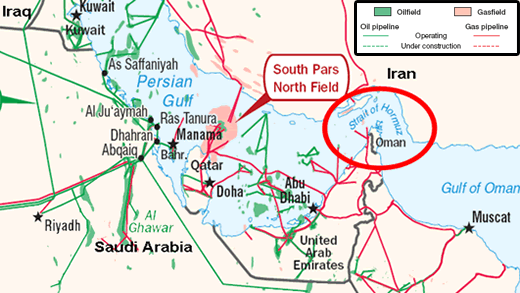
The Strait of Hormuz, located betweenIran and Oman connects the Persian Gulf with the Gulf of Oman and the Arabian Sea and is the world’s most important oil chokepoint.
It doesn’t need much ingenuity to figure out that the US intends to take control of the Strait of Hormuz — although the strait is Iranian-Omani waters under international law. As the narrowest point of the Strait of Hormuz is twenty-one nautical miles, all vessels passing through the Strait must traverse the territorial waters of Iran and Oman. The rights of passage for foreign vessels under international law will consequently be subject to either the rules of non-suspendable innocent passage or transit passage depending on the applicable legal regime.
The topic has come before the International Court of Justice. The ICJ confirmed the customary international law rule, used in international navigation, that foreign warships have the right of innocent passage in straits during peacetime, which means that during peacetime the coastal state could only prohibit the passage of any foreign-flagged vessel if its passage was non-innocent.
However, the grey area here (which the US wants to challenge) is that Iran has the legal right as a coastal state to prevent transit or non-suspendable innocent passage of ships if the ship that is in engaged in passage through the strait constitutes a threat or actual use of force against Iran’s sovereignty, territorial integrity, or political independence, or could be acting in any other manner in violation of the principles of international law embodied in the Charter of the United Nations.
In strategic terms, therefore, by precipitating the seizure of the Iranian oil tanker, the US and Britain are proceeding on a track to create a pretext to challenge Iran’s rights over the Strait of Hormuz and to take control of the strait. This is also contingency planning in advance insofar as under international law, if the US were to attack Iranian territory without a decision of the UN Security Council, the question would arise whether the provisions for transit passage under UNCLOS would continue to apply to the Strait of Hormuz or whether Iran could invoke the laws of war and take action against tankers, especially if they are deemed to be assisting the enemy.
Suffice to say, it is possible to see that what might have appeared as a maverick or silly act by Britain off Gibralter when it seized the Iranian tanker could actually be the tip of a calibrated project aimed at imposing effectively a naval blockade against Iran. Indeed, this forms the latest chapter in the US’‘maximum pressure’ policy against Iran.
By the way, a second leg of the current project is also to seize control of the strategic shipping lanes via the the Bab al-Mandab (off Yemen), which leads to the Suez Canal. (The narrow Bab al-Mandab connects the Red Sea with the Gulf of Aden and the Arabian Sea.)
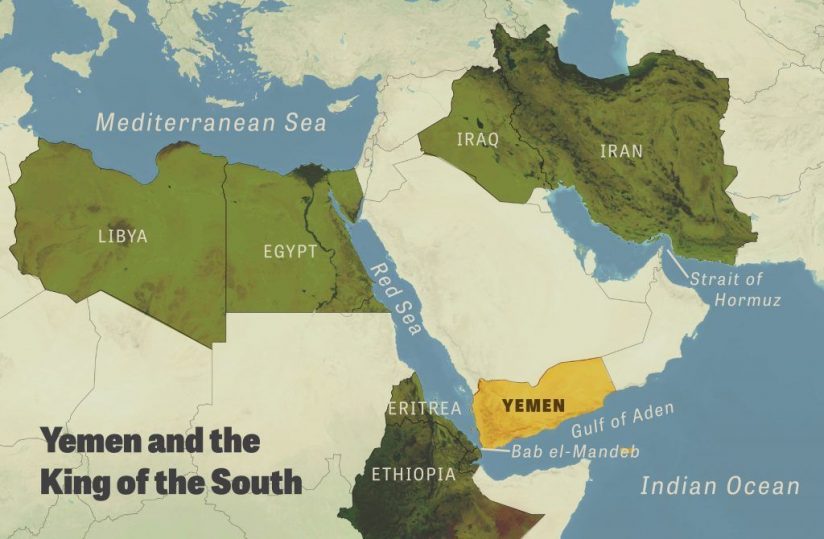
The chokepoint of Bab el-Mandab off Yemen connecting Indian Ocean to the Suez Canal via Red Sea
The US control of the Bab al-Mandab will mean that Iran’s use of the Suez Canal will come under intense US monitoring. The US has a military base in Djibouti facing the Bab al-Mandab. (Against this backdrop, the bitterly-fought war in Yemen falls into perspective, too.)
Of course, all this constitutes acts that are in gross violation of international law and the UN Charter and India should keep miles away from the Anglo-American project to impose naval blockade against Iran on whatever pretext.
Indeed, India will be called upon to take some tough decisions in the period ahead vis-a-vis the emergent situation in the Persian Gulf. First and foremost, India should stay clear of the US-led project to establish military escorts for ships in the Persian Gulf. There are reports that the Indian Navy has deployed two ships with helicopters in the Gulf of Oman. Presumably, this deployment will not form part of the US-led naval flotilla to intimidate and blockade Iran.
Second, there is a strong likelihood of the US invoking its privileges under the Logistics Exchange Memorandum of Agreement to gain access to Indian military facilities for the purpose of refuelling and replenishment of its ships. At the signing of the LEMOA in 2016, much criticism was expressed by Indian experts that it was a “strategic mistake”. In an impassioned plea, Bharat Karnad wrote in August 2016: “It (LEMOA) is, perhaps, the most serious strategic mistake made by the country in its nearly seven decades of independent existence.” Karnad’s criticism forewarning the serious consequences has turned out to be prescient. (here)
The LEMOA’s text remains secret. The Indian public doesn’t even know if India has an option to reject any US demarche for access to our military bases for their ships in a situation such as today’s when war clouds are gathering in our extended neighbourhood and Washington is stepping up preparations for a military operation against Iran, a friendly country with which India has had profound civilisational ties and common concerns in the contemporary regional setting.
The government will be betraying India’s medium and long-term national interests if it provides the US Navy with back-up facilities in its military bases at present under the LEMOA.
Third, most important, Delhi is maintaining deafening silence — for reasons best known to the policymakers — over the gathering storms in the Persian Gulf region. Damn it, over 7 million Indians live and work in that region. Even if one were to overlook that these Gulf-based NRIs give significant budgetary support to the Indian economy, running into billions of dollars annually through their remittances, the government owes it to its citizens to leave no stone unturned to ensure their physical safety and security. Tens of millions of their relatives in India depend on them critically for livelihood.
Shouldn’t the government say something to the effect that India opposes a war situation in the Persian Gulf and that the Trump administration should act with utmost restraint? If this is not a foreign policy issue of consequence for the Prime Minister to articulate, what else could be? Other countries such as Russia, China and the US’ close allies have spoken on the Persian Gulf crisis.
What explains the government’s cowardice? Fear of Trump? Are our elites far too compromised with the B Team? Faustian deal with Netanyahu (who is reportedly heading for Delhi to meet PM)? Or, plain Ostrich Approach of seeing no evil, hearing no evil or speaking no evil if it is about Uncle Sam? At any rate, what kind of impression of a regional power of India is it that the government is projecting? Shame on India!
Pentagon solicits virtual reality tech to prep soldiers for ‘battlefield nuclear warfare’

© Global Look / Sebastian Gollnow
RT | July 9, 2019
The Pentagon has put out a call for virtual reality training environments with “radiological/nuclear considerations” – another sign that the US’ unhealthy obsession with nuclear warfare isn’t going away anytime soon.
The Defense Threat Reduction Agency, a Department of Defense division focused on countering weapons of mass destruction, is looking for virtual reality systems it can use to train combat forces in a “battlefield nuclear warfare environment.” The agency issued a “sources sought notice” last week, seeking technical specs and other market information on “virtual training and testing programs” for combat troops “performing radiological threat objects find and interdict operations” – as well as fighting on the nuclear “battlefield.”
“AR/VR capabilities will not replace field training requirements,” the notice states, adding that its “purpose is to test warfighter scenarios and decision-making to provide users realistic outcomes to support training and course-of-action selection when faced with radiological/nuclear threats.” It may also be used for “planning training scenarios” and “equipment testing events.” While the addition of a realistic VR overlay of post-nuclear devastation could make soldiers more reluctant to push the big red button, that decision has never been left to the rank-and-file, and it’s unlikely their commanders will be lining up to experience even the most high-tech post-apocalyptic training module.
The US military is increasingly relying on training simulators, which carry obvious advantages including cost – avoiding the need to transport troops to the countries they’re training to occupy – and safety. The army awarded two contracts for training simulators last month with the goal of ultimately generating 400 different location-specific training environments. And virtual reality is the only way to provide soldiers with training in a post-nuclear scenario – for now, at least.
It’s the duty of a nation’s military to be prepared, and the Pentagon’s nuclear prepping wouldn’t be nearly so sinister if it hadn’t posted, then removed, a Joint Chiefs of Staff strategy paper last month providing “principles and guidance to plan, execute, and assess nuclear operation.” The chilling document matter-of-factly suggests “using nuclear weapons could create conditions for decisive results and the restoration of strategic stability.” Nor was that an isolated burst of nuclear cheerleading. Last month, Air Force Chief of Staff David Goldfein suggested that the military piggyback its nuclear command and control function on the ever-growing network of commercial satellites.
The US pulled out of the Intermediate-Range Nuclear Forces Treaty earlier this year, immediately embarking on the development of missiles that had been banned under the agreement. When the only military that has ever used nuclear weapons suggests there’s ever an acceptable time and place for their deployment, it’s understandable why the rest of the world might worry.
The Obama Wars
By David Swanson | War Is A Crime | July 10, 2019
 By “the Obama wars” I don’t mean some overgrown infants on television screaming racist insults or pretending that opposing racism requires cheering for Obama.
I mean: the widespread indiscriminate murder of human beings with missiles — many of them from robot airplanes — let loose to threaten any non-white country on earth by Obama and expanded by Trump. I mean the catastrophic destruction of Libya — still continued by Trump. I mean the war on Afghanistan, the vast bulk of which was overseen by Obama, though Bush and Trump have had minor roles. I mean the assault on Yemen, begun by Obama and escalated by Trump. I mean the war on Iraq and Syria escalated first by Obama and then by Trump (following the de-escalation locked in place by Bush though Obama fought it tooth-and-nail).
I mean the conflict with Iran, heightened by Obama and then dramatically again by Trump. I mean the expansion of conflict-producing troops and bases across Africa and Asia. I mean the creation of the new cold war with Russia. I mean the build up in nuclear weapons and the delusional rhetoric about “usable” nuclear weapons. I mean the support for Israel’s wars on Palestinians. I mean the coups in Ukraine and Honduras. I mean the threats to Venezuela. I mean the normalization of fantastical excuses for the gravest crimes. I mean the practice of campaigning on ending wars, never ending any of them, and never having anyone really care. I mean the constant shattering of past records in military spending.
Obama’s legacy, despite all sorts of variations, many of them superficial, and despite its role in defeating Hillary Clinton at the ballot box, has largely been maintained, advanced, and imitated by bipartisan consensus and by Donald Trump.
If you want to review what Obama did in that quirky little area of his job to which some 60% of federal discretionary spending is devoted, and which puts us all at risk of nuclear disaster, pick up a copy of Jeremy Kuzmarov’s book Obama’s Unending Wars: Fronting the Foreign Policy of the Permanent Warfare State. Kuzmarov places Obama in historical context and outlines his parallels with Woodrow Wilson, another extreme militarist generally understood as a peace visionary. Kuzmarov reviews — and adds information that many of us probably never knew to — the story of Obama’s rise to power and the story of all of his many wars.
We tend to forget that right up through the presidency of George W. Bush wars were thought of as temporary things that had endings. Now they’re hardly thought of at all, but they’re understood to be permanent. And they’re thought of in partisan terms. We sometimes forget that candidate Obama, like candidate Trump, promised a larger military. Candidate Obama promised a larger war on Afghanistan. And when it came time for Obama’s re-election to a second term, he reached out to the New York Times and asked that paper to write an article about how good he was at killing people, about how he carefully studied a list of men, women, and children and picked out the ones in whose name he would send missiles into clusters of unidentified victims. Obama’s claim, in his own words, was “I’m really good at killing people.” Nobody who liked Obama and didn’t like murder allowed themselves to become aware of this aspect of Obama’s re-election campaign; and they never will become aware of it.
The reason it matters is that over 20 Democrats are now campaigning for president, some of whom are promoting the same sort of militarism, some of whom are opposing it to some degree, and some of whom have revealed little or nothing about their positions on such matters. One of them, Joe Biden, was part of Obama’s wars. Biden is the guy who claimed of the mass-slaughter of people in Libya “We didn’t lose a single life.” Kamala Harris is the woman who will never ever question whether by “life” he meant “non-African life.” She’s too busy worrying that peace might break out in Korea. The stupidity of tokenism will plague us until we at least have the decency to regret having fallen for it before. The stupidity of militarism will plague us until we stop glorifying and excusing it and start supporting efforts to create peace.
Trump outflanks Iran to the west and east
By M. K. BHADRAKUMAR | Indian Punchline | July 5, 2019
The Turkish state news agency Anadolu has featured an analysis titled US sanctions on Iran increasing public unease, which is highly critical of the Iranian ruling elite’s approach to the current standoff with the US. The thrust of the commentary is that the Iranian ruling elites are deliberately provoking a showdown with the US by spurning President Trump’s repeated offers for unconditional negotiations because Tehran harbours the notion that it can lethally damage his bid for a second term in the 2020 election by entangling the US in an asymmetrical war and creates a Middle Eastern quagmire for him. The sub-text of the commentary is that the newfound belligerence in Tehran is attributable to the Supreme Leader and is not in the interests of the Iranian nation.
The opinion piece comes at a time when Turkey is quietly pleased with President Trump’s pragmatism in accommodating its purchase of the S-400 ABM system from Russia. It reinforces the impression from Trump’s extraordinary remarks at the press conference in Osaka on June 29 on Turkish President Erdogan that some sort of a deal has been struck by the two leaders. Trump had gone out of the way to defend Erdogan’s decision on purchase of the S-400 missiles (because “he got treated very unfairly” by the Obama administration), which is “not really Erdogan’s fault”. Trump had said he’s “working on it (S-400 deal). We’ll see what we can do.”
Erdogan claimed later that Trump told him at their meeting in Osaka that the US will not impose sanctions against Turkey on account of the S-400 deal with Russia. Meanwhile, the actual delivery of the S-400 system in Turkey is expected next week. (Erdogan had also said recently that a visit by Trump to Turkey in July “is being talked about”.)
Some sort of an understanding between Trump and Erdogan with regard to Iran cannot be ruled out. Of course, Turkey is in a position to render invaluable help to Iran to bust the US sanctions (which it actually did in the past under the infamous oil-for-gold deal between Turkish and Iranian business elites during the Obama presidency.) Trump would know that if Turkey denies “strategic depth” to Iran, it can be a game changer for the “maximum pressure” strategy against Tehran.
Significantly, Pakistan Prime Minister Imran Khan is also due to visit the US to meet Trump on July 22. Turkey and Pakistan aren’t exactly comparable but there are common elements here. Turkey is an estranged NATO ally which is open to reconciliation, whereas Pakistan is keenly seeking the resuscitation of its moribund strategic ties with the US.
The bottom line is that the US stands to gain out of “win-win” cooperation with both these Cold War allies over the vexed Iran problem.
Turkey’s cooperation is vital for the US to plug Iran’s land route to Syria’s ports in eastern Mediterranean and the US bases in eastern Turkey are key intelligence outposts eavesdropping on Iran. Similarly, the US hopes to keep a “very large” intelligence presence in the Afghan bases, which requires Pakistan’s acquiescence. Certainly, these US intelligence assets are not merely focused on the terrorism problem but also target Russia, China and Iran. In sum, the US intelligence assets in Turkey and Pakistan will play a crucial role in any military confrontation with Iran.
Fundamentally, in regard of both Turkey and Pakistan, their estrangement as allies happened due to the US’ flawed policies that failed to adequately accommodate their legitimate interests. In both cases, the degradation of the relationships and the ensuing nosedive took place under President Obama. The alienation of Turkey when the Obama administration began soft-pedalling on the regime project in Syria in 2012 and it exacerbated following the failed coup attempt in 2016 to overthrow Erdogan.
In the case of Pakistan also, that watershed moment was reached in 2011 when a series of incidents took place that rocked the US-Pakistan ties — the detention of ex-CIA employee Raymond Allen Davis in Lahore in January that year, the Abbottabad operation to kill Osama bin Laden in May and the slaughter of 28 Pakistani troops at two Pakistani border posts in Mohmand tribal agency by NATO Apache helicopters, an AC-130 gunship and fighter jets in November.)
Unsurprisingly, Trump didn’t say at the press conference in Osaka as to what Erdogan’s side of the bargain might be. But the Anadolu commentary hints that Turkey won’t erode the US’ “maximum pressure” on Iran. Turkey has closed its ports to Iranian oil, fully complying with US sanctions against its main supplier — although Erdogan had previously slammed the sanctions, saying they are destabilising for the region. Prior to May 2018, when the US pulled out of the Iran nuclear accord, Turkey imported an average of 912,000 tonnes of oil a month from Iran, or 47% of its total imports.
Again, last Tuesday, the US put the Baluchistan Liberation Army on its global terrorist watchlist and on Thursday, Islamabad made the formal announcement on Imran Khan’s visit to the US. Pakistan comes under the US Central Command theatre of operations. (So does Iran.) Currently, there are no US bases in Pakistan.
But Pakistan, like Turkey, also has a long history of hosting American military bases. In Baluchistan alone, there were several US drone bases — Shamsi Airfield, shrouded in secrecy, which exclusively used to conduct drone operations and housed US military personnel; PAF base on the Sindh-Baluchistan border, which was also used for CIA drone operations; Pasni Airport where US spy planes used to be based, and so on.
Seizure of Syria-bound tanker is all about Jeremy Hunter’s bid to become PM — Former UK Ambassador to Syria
By Peter Ford – July 5, 2019
Technically the measure will find UK Foreign Office lawyers to defend it, but other lawyers will deem the action illegal. While sending oil to Syria may be illegal under US law it is not illegal under EU law. The far-fetched justification seems to be that the Banyas oil refinery in Syria provides financial benefit to the Syrian government, is therefore subject to EU sanctions, and thus any contact with it whatever is sanctionable. An Iranian lawyer would point out that if the EU had intended its restrictions to prevent oil shipments to Syria it could easily have adopted a relevant regulation. It didn’t.
For five years until now since Banyas was sanctioned tankers have been making their way past Gibraltar heading for Banyas and the UK has not seen fit to intervene. Why now?
This is obviously Hunt trying to look macho; the UK currying favour with Trump to get a better trade deal.
This will increase tension with Iran, of course, at precisely the wrong moment, when even the US by its own admission is looking for a ‘workaround’ for Iranian oil shipments to China. How do we think Iran is more likely to react – by meekly kowtowing, or doubling down in some way ?
Ordinary Syrians are suffering greatly because of the impact of US oil sanctions. Hospitals don’t have fuel to power their generators. Car drivers have to queue for up to 12 hours to get petrol. We should be proud of ourselves…..Hunt on the Today BBC radio programme this morning refused to say if he considered fox hunting cruel. Bravo, macho man! Putting the boot into a prostrate Syria as well.
Spain may not be best pleased at this reminder of UK colonial arrogance. A spanner Macho Man has thrown into the Brexit works?
Russia has ‘political will’ for arms reduction deal, but ball is in US’ court – Putin
RT | July 4, 2019
Russia does not seek an arms race, only protection, Vladimir Putin said shortly after suspending the INF treaty in a mirror response to the US. Moscow is open to a new arms reduction deal, but the US must reciprocate, he added.
In an extended interview with Italy’s Corriere della Sera daily on Thursday, Putin pointed to the gargantuan difference between the US and Russian defense budgets, to dismiss the notion that Moscow could want to enter an arms race.
“Compare how much Russia spends on defense – some $48 billion, and how much the US spends – over $700 billion. Where is the arms race? We will not let ourselves be dragged into such a race, but we must ensure our security,” Putin said.
Reaching a comprehensive arms reduction agreement is what Moscow is striving for, but Washington doesn’t seem as willing, he said.
“Russia has the political will to work on this. Now it’s the US’ turn,” Putin said.
He pointed out that Moscow never heard back from the Trump administration after offering to sign a joint declaration on the inadmissibility of nuclear war in October, the same month Trump announced his intention to unilaterally withdraw from the cold-war era Intermediate-Range Nuclear Forces Treaty (INF).
Washington cited Russia’s alleged violations as it dismantled the cornerstone of European security, accusations that Moscow vehemently denied. In a mirror response, Russia has suspended the treaty as well. Putin signed the corresponding bill into law on Wednesday.
The treaty banned nuclear and non-nuclear ground-launched ballistic and cruise missiles with a range of up to 5,000km.
After pulling the US out of the INF, Trump signaled that he would like to thrash out a trilateral nuclear pact that would also include China. The US president said that he discussed the possibility of striking such a “three-way-deal” in a phone call in May.
In spite of this rhetoric, Trump has been aggressively expanding the already immense US nuclear arsenal, spending billions of dollars on its build-up.
Last week, Trump bragged about the US war industry churning out “brand new nuclear weapons” that he “hopefully” will never use.
EU choices for top posts a reflection of policies that led to its current mess
By John Laughland | RT | July 3, 2019
In spite of everything that has happened in the EU in the last five years, its member states contrived to select four politicians who embody total continuity with all the policies that led the EU into this mess in the first place.
None of the recent calamities have persuaded the bloc to even slightly alter its course. Not the rise of anti-system parties in Italy, Germany, France, Finland and elsewhere. Not the rise of patriotic forces in Poland and Hungary. And not Brexit, which in economic terms is equivalent to the loss of not one member state but 20, and which will destroy the current EU budget arrangements.
The four men and women whose appointments were hammered out on Tuesday are all determined to create a “United States of Europe” (to quote the future new president of the European Commission, Ursula von der Leyen) and therefore to proceed with the very same European integration which is causing so much internal stress in EU member states and its institutions. Moreover, three of the four come from the core EU states, the original founder members in 1951, with no one from the “new Europe” in Eastern or Central Europe. It is as if, in this time of deep crisis, the EU wanted to return to its sources from nearly 70 years ago, instead of re-inventing itself afresh to face the new challenges of the 21st century.
The most striking announcement is of course that of the top job, the German Defence Minister Ursula von der Leyen as Commission president. Because the Commission has a monopoly over the whole legislative and executive process in the EU institutions, this body is the motor which drives the whole machine. The parliament, by comparison, is powerless. The fact that Germany has now acquired control of the most important EU institution is remarkable, not least because it is the first time a German has held this post since the very first Commission president, Walter Hallstein, who had the job between 1958 and 1967. In the intervening decades, and especially since 1990, Germany has emerged as the hegemonic power in the EU and nothing is decided in Brussels without Berlin’s agreement.
Germany also dominates the European Parliament: four out of the seven groups in the parliament, and therefore over two-thirds of the members, are led by Germans. As Angela Merkel prepares to leave office in Berlin, therefore, she can be sure that her legacy will live on, and indeed increase, in Brussels and Strasbourg, where the EU institutions will be controlled by her closest political allies and heirs.
Ursula von der Leyen’s specific contribution, apart from her nationality and her status as a close ally of Angela Merkel, is that she is a committed supporter not only of the concept of a federal Europe but also of an EU army. As defense minister, she previously announced plans to invest €130 billion in Germany’s military over 15 years, and a 10 percent increase in 2019 to bring it up to €50 billion a year. If this re-militarization is dressed up in “European” clothes, then Cold War tensions on the European continent will only rise, something Mrs von der Leyen clearly wants: she is notorious for being one of the worst anti-Russian hawks in Germany and Europe.
Things are hardly better with the least important of the four nominations, that of Josep Borrell as foreign policy chief. Just as von der Leyen has said that Russia is no longer a partner, so Borrell described Russia as “an old enemy” in May: Russia summoned the Spanish ambassador in Moscow to the Foreign Ministry to protest. Borrell shares with von der Leyen a dogmatic yet self-contradictory belief in a “European defense compatible with Nato”: Nato is in reality dominated by the United States. And although he has been critical of the attempt by the US government to force regime change in Caracas, Borrell nonetheless supports the “recognition” of Juan Guaido as president of Venezuela: like his position on defense, this halfway house is also self-contradictory because if Guaido really were the legal president of Venezuela, as Borrell claims, then the young US puppet would have every right to remove Nicolas Maduro by force.
Charles Michel, the new president of the European Council, is the second Belgian to have occupied this essentially honorific post: Herman van Rompuy was appointed as the first president in 2009. (The second was Donald Tusk; Michel is the third.) It is often said of Belgium that it has seven parliaments but no state: now Michel will have 27 governments but still no state. It would be difficult to imagine a more conformist politician than Charles Michel: this born liberal has never uttered an original word in his life. Moreover, like Ursula von der Leyen, he has EU politics in his blood. Like Ernst Albrecht, Ursula von der Leyen’s father, who was a senior official at the European Commission before he became minister president of Lower Saxony (Ursula was born in Brussels and went to the European School), Charles Michel’s father, Louis, was a Belgian foreign minister and European commissioner. Two out of yesterday’s four appointments are therefore dynastic, emphasizing the caste-like European political class, to which one should perhaps add Josep Borrell who is a former president of the European Parliament and a former president of the European University Institute in Florence.
In short, none of the four shines as a personality while several of them have been embroiled in financial scandals – Borrell for failing to declare a €300,000 a year consultancy job in 2012 and Lagarde for approving a state payout to a friend of Nicolas Sarkozy. Leyen has often been accused of incompetence as a minister, more concerned with her perfect hairdo than with running the German Army. All four have survived in politics, in most cases for decades, precisely because they have never deviated from the party line and have instead got where they are by doing as they are told.
As for the man elected president of the European Parliament on Wednesday, he has no power at all. What little power the European Parliament has is vested in its members. David-Maria Sassoli’s election drives a further nail into the coffin of the principle of political representation because he represents a spent force in Italian politics. As a member of the Democratic Party, he stands for the old order which was swept away in Rome in 2018 when the new-left 5 Stars and new-right League built an alliance to thrust aside the old parties. Above all, Sassoli was vice-president in the previous parliament and therefore his election now is also an expression of continuity.
In short, faced with an existential crisis and a severe lack of credibility, the EU’s message to its voters and the world is: Business as usual.
John Laughland has a doctorate in philosophy from the University of Oxford and has taught at universities in Paris and Rome as a historian and specialist in international affairs.
Trump is finished with the Afghan war
By M. K. BHADRAKUMAR | Indian Punchline | July 4, 2019
There could be several ways of interpreting the US State Department’s decision on Tuesday to designate the Baloch Liberation Army (BLA) as a Specially Designated Global Terrorist, which imposes economic sanctions on the group and anyone affiliated with it. What is absolutely certain is that this is by no means an altruistic decision by Washington.
The BLA is based in Afghanistan and has been waging a violent armed struggle against Pakistan for the past decade and a half upholding the right of self-determination of the Baloch people and demanding the separation of Balochistan province from Pakistan, apart from being involved in ethnic-cleansing of non-Baloch minorities in Balochistan.
Curiously, the BLA’s timeline (starting from 2004) has been co-terminus with the US’ occupation of Afghanistan. It is inconceivable that the US and NATO forces in Afghanistan were unaware of the BLA’s subversive activities or who were its mentors. Islamabad has been shouting and screaming from the rooftop all this while that its adversaries exploited the group as a proxy to destabilise Pakistan.
Put differently, the timing of the State Department decision banning the BLA is noteworthy. Why now, at this juncture?
These are extraordinary times when almost anything and everything that the US does in the Greater Middle East would have an eye on Iran with which it is locked in an epochal rivalry. Can it be that by making this gesture, Washington hopes to recruit Pakistani military and intelligence to strengthen further its ‘maximum pressure’ strategy against Iran? The possibility cannot be ruled out.
Of course, this is not to suggest that Pakistan will make hostile moves against Iran. Although Pakistan-Iran relations have been highly problematic through the past four decades since the 1979 Islamic Revolution, and their mutual animosity kept frothing from time to time, things never reached a flashpoint as both sides observed certain ground rules of how far to go and what not to do. In the present context, Pakistan will take utmost care not to get entangled in the US-Iran standoff.
Having said that, there is a vital US-Pakistani convergence over Iran that cannot be overlooked, either. That is, when it comes to the Afghan situation. Iran has made it clear that if the US attacks it, it will retaliate against American assets all across the region. There have been two statements at least by senior US officials lately that Iran is moving against American assets in Afghanistan. Iran, of course, has stoutly rejected the allegation, but the US is paranoid — and not without reason.
The point is, apart from the traditional links with the Shi’ite groups in Afghanistan, Tehran also has dealings with the Taliban. Coincidence or not, Washington moved against the BLA within days of an incident in the eastern Afghan province of Wardak on June 26 in which two US soldiers were killed by the Taliban in an ambush.
The incident took place only a day after after Pompeo stopped in the Afghan capital, Kabul, for daylong talks with Afghan President Ashraf Ghani as well as other senior leaders and opposition politicians to discuss two topics, namely, the US’ ongoing efforts to reach a peace agreement with the Taliban and the potential that Iran has to carry out actions that would jeopardise the US exit strategy out of Afghanistan. (Read a report in Geopolitics magazine entitled Two Topics Dominating Pompeo’s Visit to Afghanistan.)
In fact, the US apprehends that an extremely dangerous situation is arising in Afghanistan even as the withdrawal of American troops accelerates. President Trump disclosed in an interview this week with Tucker Carlson on FOX television that the US troop level has come down to 9,000 from 16,000 already. Trump made no bones about the fact that he is finished with the war in Afghanistan.
At one point in the interview, Trump bursts out, “I’d like to just get out.” Trump claims that he intends to keep a “very strong” intelligence presence in Afghanistan. He couldn’t care less anymore whether there will be a broad-based government in Kabul or a Taliban takeover. He’s well past that point of agonising. At one point, Trump implied to Carlson — who also happens to be an inveterate critic of America’s “endless wars” — that he no longer trusts the judgment or integrity of the military commanders. (By the way, Carlson accompanied Trump to the meeting with North Korea Kim Jong-Un in Panmunjom while NSA John Bolton was sent away to Mongolia.)
This is where Pakistani help becomes critical. Ghani’s government lacks legitimacy but the holding of a presidential election in September, as planned, depends heavily on a settlement with the Taliban. The US expects Pakistani help in three directions: one, persuading the Taliban to reach an agreement at the Qatar talks without any further delay; two, enabling the US to withdraw the troops expeditiously and in an orderly fashion; and, three, creating politico-security conditions to facilitate a peaceful transfer of power in Kabul. Of course, it is a tall order.
The Americans know that Iran can escalate in Afghanistan anytime it wishes. Afghanistan falls within the domain of the elite Quds Force of Iran’s Islamic Revolutionary Guard Corps, commanded by the legendary general Qassem Soleimani who was the bête noire of the US and Israel in Iraq and Syria. Of course, if Soleimani creates a hopeless situation like in Vietnam (which forced the US into a humiliating retreat from the rooftop of the American embassy in Saigon), that will be highly damaging for Trump politically in the midst of his campaign for the 2020 election. And that is precisely why Trump is impatient to cut loose and get out from Afghanistan without even waiting for the implementation of any peace agreement with Taliban.
All this should be a morality play for the Indian strategists and policymakers as they pick up the debris of their own Afghan policies and its $2 billion price tag, which has been predicated so heavily through the past decade and a half on the US strategy. Equally, this should be a wake-up call for the Indian lobbyists who still want to bandwagon with the US in other regional theatres such as Sri Lanka, the Maldives or Nepal. (See blog US eyes Sri Lanka as its military logistics hub.)
For sure, the Afghan war has not ended. Trump recalled poignantly that the 9/11 attacks were not staged by Afghans but the Hindu Kush provided the plotters a “lab for terrorists”. Now, the US can only take the word of the Taliban that such a thing will not repeat. Washington’s best hope will be that Pakistan will keep an eagle’s eye to ensure that the terrorists from Afghanistan will not come visiting the US.
In turn, that is going to create an interdependency between the US and Pakistan. The IMF bailout, the ban on the BLA, the near-certainty that Pakistan is off the hook at the upcoming plenary of the Financial Action Task Force, an official visit by Prime Minister Imran Khan to the White House — these are the starters from the US side. Pakistan is highly experienced in dictating the terms of engagement with the US.
Airlines no longer avoiding Iran airspace despite US ban: Official
Press TV – July 4, 2019
Iran’s top aviation official says that major international airlines have been returning to skies south of the country after a brief hiatus caused by an Iran-US military escalation in the region.
Siavosh Amir Mokri, who heads Iran Airports and Air Navigation Company, said on Thursday that the number of flights using Iranian-controlled skies above the Persian Gulf and the Sea of Oman had increased over the past several days to reach its normal level of 840 flights a day.
The official said the increased use of the airspace came despite a notam (Notice to Airmen) issued by US Federal Aviation Administration on June 21 which banned flights from using skies above the region.
The notam came after Iran shot down an intruding American drone which officials said had violated the country’s airspace above the Persian Gulf waters.
The move caused a serious escalation in military tensions between Iran and the United States and caused major airlines, including British Airways, KLM and Lufthansa, to follow the FAA instructions and stop to use the Iranian airspace.
However, Amir Mokri said carriers had reversed the decision as they have noticed that security in the Persian Gulf has been restored. He said that returning to the Iranian airspace would also be more economic for the airlines.
“That tension is gone and airline companies have understood that the country’s airspace is still safe,” he said, adding that the number of international flights using the Iranian airspace had decreased to 800 a day, down five percent, since the downing of the US drone by Iran.
The official said Iran had lodged an official complaint with the International Civil Aviation Organization over the FAA notam as it inflicted losses on the country. He said Iran’s total revenues from overflight fees in the last Iranian calendar year which ended in March topped $180 million.
Featured Video

Iran’s Next Strike May Not Explode. It Could Shut You Down
or go to
Aletho News Archives – Video-Images
From the Archive
Zionism’s Violent Legacy
By Donald Neff | Washington Report On Middle East Affairs | January 1996
On January 4, 1948, Jewish terrorists drove a truck loaded with explosives into the center of the all Arab city of Jaffa and detonated it, killing 26 and wounding around 100 Palestinian men, women and children.[1] The attack was the work of the Irgun Zvai Leumi – the “National Military Organization,” also known by the Hebrew letters Etzel – the largest Jewish terrorist group in Palestine. The Irgun was headed by Revisionist Zionist Menachem Begin and had been killing and maiming Arabs, Britons and even Jews for the previous ten years in its efforts to establish a Jewish state.
This terror campaign meant that at the core of Revisionist Zionism there existed a philosophical embrace of violence. … continue
Blog Roll
 Aletho News
- Trump’s Iran war is on an Israeli leash
- Saudi oil boss issues global supply warning
- Riyadh Says Its Oil System Is Intact. The Numbers Say Otherwise.
- Trump and Netanyahu Want to “Finish the Job” on Iran
- US ‘one-sided dictation’ not Iran’s beliefs makes rational talks impossible: Baghaei
- Iran’s Next Strike May Not Explode. It Could Shut You Down /Col Doug Macgregor
- Iran: US political targets legitimate if assassinations return
- Iraq shuts key border crossing with Iran under US pressure: Report
- Undersea Internet cables could be targeted in retaliation for attacks on Iran: IRGC deputy chief
- EU sending ‘biased’ observers to interfere in Serbian election – president
- If Americans Knew
- Israel’s vision of regional security rests on keeping Arab states weak
- Heidi Levine recounts how Palestinian youths helped save her in settler attack
- DAILY UPDATE: Latest essential news on Palestine, Israel, & region
- Trump’s Intensifying Sabotage of the ICC, for Israel’s Sake
- Israeli military detain US and UK volunteers in West Bank including Democratic NY politician Brad Lander
- Americans at National Conservatism Conference held in Israel this year criticize Israel
- Christiane Amanpour exits CNN with a legacy shaped by the debate over Israel
- Israel’s war on Iran is the final move in a decades-old strategy
- Israel Denies Entry to French Journalist, U.S. Researcher Amid Rise in Entry Denials
- Gaza’s hospitals are running out of life-saving fuel – Daily Update
- No Tricks Zone
- E-Cars Reduce CO2 Emissions By Only 41% Compared To Internal Combustion Engine Vehicles
- Predictions Made By Renowned Climate Professor Over Past Decades Have Been Proven To Be Poor
- New Study Suggests Large Regions Of The Pacific Ocean Have Been Cooling For The Last 80 Years
- Germany’s Green Energy Debacle: High Energy Costs Force Kahla Porzellan to Close After 182 Years!
- New Study: 50 Years Of The Most Aggressive ‘Net Zero’ Policies Can Only Affect The Global Climate By 0.03°C
- US September “Heat” Was No Record…Many Records Set Decades Ago
- Latest European Green Energy Debacle; Portugal’s Largest Flagship Solar Park Insolvent!
- Green Energy Debacle: German Expert Professor Fritz Vahrenholt Warns Of Severe Economic And Social Consequences
- Two More Paleo Reconstructions Affirm Meters-Higher Sea Levels Across Ireland, Brazil 7000-6000 Years Ago
- New Study: Earth And Venus Surface Warmth Largely Explained By Convection And Lapse Rate, Not CO2 Or Radiation

