In late June, President Donald Trump flailed away with his own particular brand of non-diplomacy at the G20 Summit in Japan, but it is worthwhile noting on the plus side that his administration is so inept that it could not even plan and execute a proper coup in Venezuela. Nor has it been able to concoct sufficient lies about Iran effective enough to create a casus belli and unleash the B-52s. There is a certain comfort in knowing that the United States is now governed by the Three Stooges—“Larry” Trump, “Moe” Pompeo, and “Curly” Bolton—which means that starting new wars might just be beyond their cognitive ability to make mischief.
The real irony is that stupidity is both bipartisan and contagious in the federal government. The Democrats have not quite figured out that instead of playing identity politics, talking about reparations, gay rights, “undocumented migrants,” and free college, they should instead be discussing more important issues, notably the impending nuclear holocaust being stumbled into by the Trumpsters, which just might bring to an end life on this planet as we know it.
A college friend recently asked me what my nightmare scenario for a totally dysfunctional foreign and national security policy might be. I responded without thinking that it really is all about war and peace, that the worst case would be the impeachment of a bumbling Trump and his replacement by a much more capable and vicious Vice President Mike Pence, who actually wants to end the world so he can be raptured up to heaven.
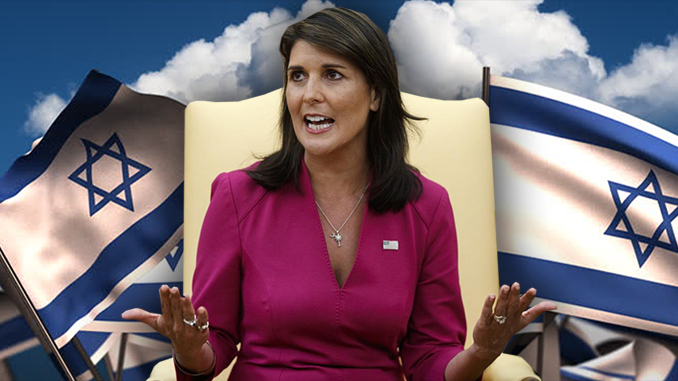
But my answer was wrong. Trump is unlikely to be impeached by a Senate in which the GOP holds a majority, so Pence’s ascent to the throne is not currently plausible unless the president suffers a cardiac arrest after ingesting too many cheeseburgers. The real danger is what comes after Trump, in 2024. The preferred candidate by Israel and its lobby, and therefore the prohibitive favorite, is Trump’s former United Nations Ambassador Nikki Haley. If you think Trump is blindly and blatantly pro-Israel at the expense of American interests, just wait until you see Haley’s naked self-interest at work.
Haley resigned from her position at the UN last October. Like many others in the foreign policy establishment, she was all for Israel because she understood that leaning that way provided instant access to money and plenty of positive press coverage. Completely ignorant of possible consequences, she declared that Washington was “locked and loaded,” prepared to exercise lethal military options against Syria and its Russian and Iranian allies, seen as enemies by Israel. Immediately upon taking office at the United Nations she complained that “nowhere has the UN’s failure been more consistent and more outrageous than in its bias against our close ally Israel” and vowed that the “days of Israel bashing are over.” Not surprisingly, she was greeted by rounds of applause and cheering when she spoke at the annual meeting of the American Israel Public Affairs Committee (AIPAC) last March, saying, “When I come to AIPAC I am with friends.”
Haley’s embrace of Israeli points of view was unrelenting, including blocking any investigation of the Israeli army’s slaughter of unarmed Palestinian demonstrators in Gaza. She also led the effort to cut funds going to the agency providing critical food and medical assistance to millions of Palestinian refugees. In February 2017, she blocked the appointment of former Palestinian Prime Minister Salam Fayyad to a diplomatic position at the United Nations because he was a Palestinian. In a congressional hearing she was asked about the decision: “Is it this administration’s position that support for Israel and support for the appointment of a well-qualified individual of Palestinian nationality to an appointment at the UN are mutually exclusive?” Haley responded yes, that the administration is “supporting Israel” by blocking every Palestinian.
Not surprisingly, Haley consistently took a hard line against Iran, aggressively supporting Trump’s abrogation of the agreement to control its nuclear weapons, and she famously warned that Washington would be “taking names” of countries that don’t support its agenda in the Middle East. If Haley were a recruited agent of influence for the Israeli Mossad she could not have been more cooperative than she apparently was voluntarily.
When Haley resigned, The New York Times predictably produced an astonishing editorial headlined “Nikki Haley Will Be Missed.” Other praise of her upon her impending departure from the UN was related to whom exactly she managed to please while she was in office. The ubiquitous neocon-in-chief Bill Kristol has long been promoting Haley for president. One leading member of Kristol’s neocon chorus, Mark Dubowitz of the Foundation for Defense of Democracies, tweeted, “Thank you @nikkihaley for your remarkable service. We look forward to welcoming you back to public service as president of the United States.” Dubowitz is a Canadian Jew, and it would be nice if he could be deported to a remote Internet-free spot on Baffin Island where he can cease interfering in American politics, but that would mean putting an end to the $560,000 in salary and benefits that he enjoys for being one of Israel’s most reliable Fifth Column traitors in the United States.
Nikki was also praised by Israeli Prime Minister Benjamin Netanyahu. “I would like to thank Ambassador @nikkihaley, who led the uncompromising struggle against hypocrisy at the UN, and on behalf of the truth and justice of our country. Best of luck!” The Israeli Army itself had nice things to say, tweeting, “Thank you @nikkihaley for your service in the @UN and unwavering support for Israel and the truth. The soldiers of the Israel Defense Forces salute you!”
It should surprise no one that Haley has recently been in Israel as the guest of the GOP’s leading donors, Sheldon and Miriam Adelson. Ha’aretz enthused over how she “. . . has a wonderful laugh. It’s warm, rounded, and the perfect length to fill the distance between you and her. Haley’s chuckle makes you feel for a moment that you genuinely amuse her, in a good way, so much so that you forget that the laugh came instead of the question you just asked her. When she runs for president, as she no doubt will one day, expect her to deploy that laugh a lot. It’s a valuable political tool. My question at which Haley laughed was ‘does the path to the White House pass through Jerusalem?’ She was in town as the guest of honor at the Israel Hayom Forum for U.S.-Israel Relations, and though I didn’t get an answer, Haley’s willingness to endure the five hours of the ‘forum’ reflected, if not the durability of U.S.-Israel relations, then certainly her relentlessness and professionalism as a politician. . . . Everything about Haley throughout the grueling evening, at least when on public display, showed her meticulous planning and determination, starting with her attire. Her long—and long-sleeved— dress on a sweltering Jerusalem summer evening contrasted with the much shorter dresses all around and drew approval from ultra-Orthodox men. ‘Wow, she really understands tzniess,’ one of them whispered to me, using the Yiddish word for modesty.”
So, Israel is just waiting for President Nikki to arrive and the line about the “path to the White House” running through Jerusalem is the kind of double entendre banter that close friends regularly exchange when discussing something that they know to be true.
It seems inevitable that we Americans go from one lover of Israel to another at the White House due largely to the impact of the narrative contrived through Zionist manipulation of the media and the direct corruption of the government itself by Jewish money. But even by that low standard, Haley is something else. She is a true believer with a fanatical gleam in her eye, just like Pence and Pompeo are in their dispensationalism, and that is very, very scary. Having her at the helm should be anyone’s worst foreign policy nightmare.
July 21, 2019
Posted by aletho |
Ethnic Cleansing, Racism, Zionism, Militarism, Wars for Israel | Israel, Palestine, United States, Zionism |
Leave a comment
Nevada state authorities have voiced fears that radioactivity could be released into the environment by powerful tremors, regularly hitting the proposed site of a nuclear waste repository, set to store thousands of tonnes of hazardous reactor fuel, according to the federal government’s plans.
Nevada Governor Steve Sisolak and the state’s six Congressmen and Congresswomen have confronted the country’s Department of Energy over plans to license a nuclear waste repository in Yucca Mountain in the Mojave Desert. The letter addressed to Energy Secretary Rick Perry followed powerful earthquakes in California in early July that hit an area just 100 miles northeast of the proposed waste dump site. It insisted that the seismic hazards in Yucca Mountain showed “one of the many geologic problems with the site as a nuclear waste repository”.
He stated that the quakes have only strengthened his “resolve to fight any continued federal effort to use Nevada as the nation’s nuclear dumping ground”.
“I’m proud to join our bipartisan group of federal representatives in once again sending the loud and clear message that Yucca has never been, and will never be, good for Nevada”, the letter from 16 July published by The Nevada Current reads.
The governor, joined by Senators and Representatives, threatened to challenge the DOE’s license application if its licensing resumes and criticised the federal government for considering proceeding with the development of the repository “at a location that evidences serious safety concerns and mounting uncertainties regarding its geological status”.
The letter cites the conclusions of the expert teams from the University of Nevada, Reno, and UNLV (University of Nevada in Las Vegas). In a separate letter to the governor from Reno’s experts, Nevada State Geologist James Faulds and Nevada State Seismologist Graham Kent noted that the proposed site “lies in a very dynamic, seismically active region, as evidenced by the Ridgecrest earthquakes as well as other historical temblors”. They insisted that more research is needed before the Yucca Mountain site can be determined as suitable for a nuclear waste storage.
The US government picked the area, stretching across the border between Nevada and California to store the by-products of reprocessing of old nuclear fuel into nuclear weapons-grade material in 2002. The state has fought these plans since then, debating whether the federal authorities are minimising seismic hazards there in their application to the Nuclear Regulatory Commission. In 2008, Nevada challenged the department’s conclusions during a NRC licensing hearing, and the project was put on hold two years later.
However, in March 2019, the current energy secretary decided to revive the licensing proceedings, allocating $116 million for the project.
July 19, 2019
Posted by aletho |
Environmentalism, Militarism, Nuclear Power, Timeless or most popular | United States |
Leave a comment
Mark Esper is expected to be confirmed in coming days as the new US Secretary of Defense. His appointment is awaiting final Congressional approval after customary hearings this week before senators. The 55-year-old nominee put forward by President Trump was previously a decorated Lieutenant Colonel and has served in government office during the GW Bush administration.
But what stands out as his most conspicuous past occupation is working for seven years as a senior lobbyist for Raytheon, the US’ third biggest military manufacturing company. The firm specializes in missile-defense systems, including the Patriot, Iron Dome and the Aegis Ashore system (the latter in partnership with Lockheed Martin).
As Defense Secretary, Esper will be the most senior civilian executive member of the US government, next to the president, on overseeing military policy, including decisions about declaring war and deployment of American armed forces around the globe. His military counterpart at the Pentagon is Chairman of the Joint Chiefs of Staff, currently held by Marine General Joseph Dunford who is expected to be replaced soon by General Mark Milley (also in the process of senate hearings).
Esper’s confirmation hearings this week were pretty much a rubber-stamp procedure, receiving lame questioning from senators about his credentials and viewpoints. The only exception was Senator Elizabeth Warren, who slammed the potential “conflict of interest” due to his past lobbying service for Raytheon. She said it “smacks of corruption”. Other than her solitary objection, Esper was treated with kid gloves by other senators and his appointment is expected to be whistled through by next week. During hearings, the former lobbyist even pointedly refused to recuse himself of any matters involving Raytheon if he becomes the defense boss.
As Rolling Stone magazine quipped on Esper’s nomination, “it is as swampy as you’d expect”.
“President Trump’s Cabinet is already rife with corruption, stocked full of former lobbyists and other private industry power players who don’t seem to mind leveraging their government positions to enrich themselves personally. Esper should fit right in,” wrote Rolling Stone.
The linkage between officials in US government, the Pentagon and private manufacturers is a notorious example of “revolving door”. It is not unusual, or even remarkable, that individuals go from one sector to another and vice versa. That crony relationship is fundamental to the functioning of the “military-industrial complex” which dominates the entire American economy and the fiscal budget ($730 billion annually – half the total discretionary public spend by federal government).
Nevertheless, Esper is a particularly brazen embodiment of the revolving-door’s seamless connection.
Raytheon is a $25 billion company whose business is all about selling missile-defense systems. Its products have been deployed in dozens of countries, including in the Middle East, as well as Japan, Romania and, as of next year, Poland. It is in Raytheon’s vital vested interest to capitalize on alleged security threats from Iran, Russia, China and North Korea in order to sell “defense” systems to nations that then perceive a “threat” and need to be “protected”.
It is a certainty that Esper shares the same worldview, not just for engrained ideological reasons, but also because of his own personal motives for self-aggrandizement as a former employee of Raytheon and quite possibly as a future board member when he retires from the Pentagon. The issue is not just merely about corruption and ethics, huge that those concerns are. It is also about how US foreign policy and military decisions are formulated and executed, including decisions on matters of conflict and ultimately war. The insidiousness is almost farcical, if the implications weren’t so disturbing, worthy of satire from the genre of Dr Strangelove or Catch 22.
How is Esper’s advice to the president about tensions with Russia, Iran, China or North Korea, or any other alleged adversary, supposed to be independent, credible or objective? Esper is a de facto lobbyist for the military-industrial complex sitting in the Oval Office and Situation Room. Tensions, conflict and war are meat and potatoes to this person.
During senate hearings this week, Esper openly revealed his dubious quality of thinking and the kind of policies he will pursue as Pentagon chief. He told credulous senators that Russia was to blame for the collapse of the Intermediate-Range Nuclear Forces (INF) Treaty. That equates to more Raytheon profits from selling defense systems in Europe. Also, in a clumsy inadvertent admission he advised that the US needs to get out of the INF in order to develop medium-range missiles to “counter China”. The latter admission explains the cynical purpose for why the Trump administration unilaterally ditched the INF earlier this year. It is not about alleged Russian breaches of the treaty; the real reason is for the US to obtain a freer hand to confront China.
It is ludicrous how blatant a so-called democratic nation (the self-declared “leader of the free world”) is in actuality an oligarchic corporate state whose international relations are conducted on the basis of making obscene profits from conflict and war.
Little wonder then than bilateral relations between the US and Russia are in such dire condition. Trump’s soon-to-be top military advisor Mark Esper is not going to make bilateral relations any better, that’s for sure.
Also at a precarious time of possible war with Iran, the last person Trump should consult is someone whose corporate cronies are craving for more weapons sales.
July 19, 2019
Posted by aletho |
Corruption, Militarism | INF treaty, United States |
Leave a comment
Washington’s claim that it downed an Iranian drone is another sign that tensions in the Persian Gulf are at risk of spiraling into a bigger conflict, Russia’s Deputy Foreign Minister Sergey Ryabkov warned.
President Donald Trump had earlier claimed that the assault ship USS ‘Boxer’ shot down an Iranian drone that was approaching it in the Strait of Hormuz. Iran denied losing any aircraft that day.
“The concentration of forces of different countries in the Persian Gulf is so high that any incidents are possible there,” the Russian diplomat told reporters on Friday, adding that the main task now is to “prevent the escalation.”
“As we see once again, the situation… can lead to an outbreak of a conflict.”
Ryabkov said that, despite calls to show restraint, Washington “stubbornly continues to follow the path of stoking tensions and maximum pressure on Tehran.”
This path is a mistake, and prone to cause further complications and shocks.
Last month, the Iranian military shot down a US drone it said had violated the nation’s airspace. Washington said the drone was destroyed over international waters.
July 19, 2019
Posted by aletho |
Militarism | Middle East, Russia, United States |
Leave a comment
Donald Trump’s reelection campaign is already sounding like a victory lap, but some may find his choice list of accomplishments puzzling. What does recognizing occupied Israeli land have to do with MAGA – and what about Americans?
US President Trump’s campaign refrain is one of “promises kept,” but Americans not immersed in the communal rapture of a reelection rally are forced to confront uncomfortable truths about which vows the president has chosen to fulfill. Opening an American embassy in Jerusalem doesn’t put food on their table, and killing the Iran nuclear deal doesn’t pay their medical bills. Trump has kept a very specific set of promises and let the others go, declaring his mission accomplished.
Touting his accomplishments at a Wednesday rally in Greenville, North Carolina, Trump preened about moving the embassy despite formidable “opposition” and boasted that for 52 years, Israel had tried and failed to get international recognition for the Golan Heights. He then appeared to sink into reverie for a moment, murmuring “We’re doing good…” before bragging about recognizing the “legitimate” government of Venezuela.
But are “we” doing good? Trump boasts of rock-bottom unemployment rates, but nearly half of American families still can’t afford basic living expenses, according to a frightening United Way study published in May. Trump, meanwhile, has proposed redefining how the federal poverty line is calculated, a move that would kick millions of people off the welfare rolls, thus saving the poor from the perils of socialism. Homelessness is at record highs in cities all over the country – but at least more of us are working. Who are we to complain if our wages can no longer pay for shelter and food?
Israel, on the other hand, is doing great. In addition to the $3.1 billion the US already provided in foreign aid, Trump tacked on $75 million in 2017, even as he asked for a 28 percent cut in the State Department budget. This year will see an additional $200 million donated, no strings attached, to the already-wealthy country.
Perhaps trying to prove his department worthy of US funding, Secretary of State Mike Pompeo promised a roomful of Jewish leaders that if Jeremy Corbyn were to get too close to power in the UK, he’d “push back” against the pro-Palestinian socialist.
On the 2020 campaign trail, there’s no more talk from Trump about pulling out of Syria or Afghanistan, or ending Middle Eastern wars at all – a promise that attracted voters from outside the Republican Party turned off by his opponent’s warmongering. Instead, Trump boasts that the US is spending more than ever on its military for the last three years running – as if that was a source of pride when the US already spends more than the next 10 countries put together and still gets substandard equipment.
Trump superseded the promise he made to Americans to end the endless war with a promise to Israel to remain in Syria as long as the Iranians (who had been invited by the government) were there – and has kept that promise, despite declaring ISIS vanquished and with it the legal authorization for the US’ presence in the country.
“2016 Trump” promised to repeal Obamacare and replace it with something better, something that would – presumably – allow Americans to access medical care without bankrupting themselves. While the frankly unconstitutional individual mandate was struck down in 2017, the Affordable Care Act remains in place, now hemorrhaging cash as healthy but poor young people are no longer forced to buy unaffordable health insurance and instead opt for the longstanding American healthcare plan of “don’t get sick.” Medical bills remain the leading cause of bankruptcy.
The border wall was Trump’s signature issue in 2016 and remains perhaps his most significant unkept promise. But it’s not as if he hasn’t tried – his determination to secure funding despite Democratic opposition led to the longest government shutdown in US history, a political game of chicken that dragged on for more than a month before he was forced to give in and seek other funding routes for an initiative that most Democrats had supported just a few short years ago.
Trump’s unkept promises, then, are not entirely Trump’s fault. His tentative efforts to pull troops out of Syria were stonewalled not only by Republicans, but by Democrats who’d developed a baffling and sudden concern for the welfare of Kurds they’d never heard of three months before. In fact, it wasn’t until Trump bombed Syria in response to a gas attack he blamed on President Bashar Assad that Democrats – or their mouthpieces in the mainstream media – let up on their criticism for a moment. The man they’d just finished calling a Russian agent was suddenly looking presidential, gushed pundits on programs bookended by commercials for Boeing.
When Trump calls out the “four horsewomen of the Apocalypse” in curiously structured tweets that demand they apologize to Israel before asking that they make amends with the US, he is merely pointing out to party leadership that they might want to get the rogue congresswomen under control before they make the next election difficult. Rashida Tlaib and Ilhan Omar have introduced a resolution to affirm Americans’ right to participate in boycotts ahead of a House vote on an anti-BDS bill, a juxtaposition that will force Democrats to make a difficult decision about whom they truly serve.
Would Trump be able to make similarly tough decisions to serve ordinary Americans and the country that he’s promised to “Make Great”?
July 18, 2019
Posted by aletho |
Ethnic Cleansing, Racism, Zionism, Militarism | Israel, Palestine, United States, Zionism |
Leave a comment
Russia has called on the United States to keep its nuclear weapons only on its own territory, a day after a NATO report unwittingly revealed that Washington has stored some of its nuclear weapons in several European countries, including Turkey.
“Russia deploys and stores its nuclear weapons exclusively on its own territory. We call on the US and NATO to do the same,” said Mikhail Ulyanov, Russia’s permanent representative to international organizations in Vienna, including the International Atomic Energy Agency (IAEA), on Wednesday.
His comments came a day after The Washington Post said in a report that a recently released — and subsequently deleted — document published by a NATO committee had inadvertently revealed that the US stores 150 items of its tactical nuclear weapons in Belgium, Germany, Italy, the Netherlands, and Turkey.
The US-based daily said that it had seen “a copy of the document published Tuesday by Belgian newspaper De Morgen.”
The document, which is attributed to Canadian senator Joseph Day and written for the defense and security committee of the NATO Parliamentary Assembly, was titled “A New Era For Nuclear Deterrence? Modernization, Arms Control and Allied Nuclear Forces.”
“These bombs are stored at six US and European bases — Kleine Brogel in Belgium, Buchel in Germany, Aviano and Ghedi-Torre in Italy, Volkel in The Netherlands, and Incirlik in Turkey,” the document said.
The US unilaterally suspended the implementation of the Intermediate-Range Nuclear Forces Treaty (INF) with Russia earlier this year.
Moscow reciprocated later.
Under the treaty, both sides had been banned from creating ground-launched nuclear missiles with ranges from 500 to 5,500 kilometers. The pact also banned the sides from deploying short and intermediate-range, land-based missiles in Europe.
The US alleged that Russia’s new 9M729 missile was in violation of the INF and had to be dismantled.
Russia rebutted the claim in January by unveiling the missile and its key specifications, saying the missile’s maximum range was about 480 kilometers, well within what was allowed under the INF.
July 18, 2019
Posted by aletho |
Militarism | NATO, United States |
Leave a comment
State-owned Israel Aerospace Industries (IAI) on Wednesday announced a $50 million deal to supply complementary MRSAM (medium-range surface-to-air missile) systems to the Indian Navy and the Mazagon Dock Shipbuilders. The Israeli firm will also supply compatible systems for the Air Defence Systems (ADS).
The Indian Navy will equip its major warships with MRSAM to defend against incoming anti-ship missiles.
“The deal involves a follow-up order for a range of maintenance and other services for various sub-systems of IAI’s advanced MRSAM ADS,” the company said, adding the contract is a “breakthrough as it advances us from system development and delivery to looking after the operational needs of our customers”.
The MRSAM is the successor to the Barak missile that currently equips many navy ships. The Barak missile, having a range of 10-15 km, can successfully engage current generations of anti-ship missiles such as the Harpoon and the Exocet. The long-range version of the missile was developed under an agreement signed between New Delhi and Tel Aviv in 2006. The upgraded version of the missile has a range of over 70 km.
The MRSAM is considered more manoeuvrable and is capable of engaging next-generation anti-ship missiles.
On 30 January 2019, the Israeli firm announced a $93 million contract with the Indian Navy and Cochin Shipyard Limited (CSL), to provide systems complementary to the MR-SAMs. Last year, it won $777 million in contracts to supply additional Barak-8 MRSAM systems to the navy.
India’s first indigenous aircraft carrier INS Vikrant will be equipped with Israeli missile defence systems.
The Barak-8 system was developed by IAI in collaboration with Israel’s MOD, India’s DRDO (Defence Research and Development Organization), the navies of both countries, IAI’s ELTA Group, RAFAEL and other industries in India and Israel.
July 17, 2019
Posted by aletho |
Militarism | India, Israel |
Leave a comment
Radiation levels in the Marshall Islands, where the US government tested its nuclear arsenal during the Cold War, are even higher than those found in Fukushima and Chernobyl, according to a newly released peer-reviewed study.
The research, published by scientists at Columbia University in New York, found that tests of soil samples taken from four of the islands contain radiation levels that are “significantly” higher than those found at the sites of the two worst nuclear power plant disasters in history, in Japan and Ukraine. On one of the islands, the concentrations of radioactive particles were found to be higher by a magnitude of 1,000.
One particularly disturbing find was the presence of plutonium-238 on Naen, an island in the Rongelap Atoll, some 100 miles away from the test sites on Bikini, Enjebi and Runit. That isotope is not a product of fallout, but is generally associated with nuclear waste, raising the possibility that Naen was used as a dumping ground.
“We can’t say for sure that is what happened,” said Ivana Nikolic Hughes, a chemistry professor at Columbia and one of the study’s authors. “But people should not be living on Rongelap until this is addressed.”
Another study also tested fruit from several of the islands and found that contamination levels were above safety levels established in countries affected by nuclear fallout – including Russia, Ukraine, Belarus and Japan.
The US government performed 67 nuclear tests in the South Pacific islands between 1946 and 1958, during its early arms race with the Soviet Union. The exercises left a trail of contamination throughout 21 islands roughly halfway between Hawaii and Australia. Although representing just 6 percent of the total US nuclear bomb testing activity, the denotations were responsible for over half of the total energy expended.
The most famous of them took place on Bikini Atoll, where Operation Crossroads and Operation Castle were launched in 1946 and 1954 respectively. The former has been described as “the world’s first nuclear disaster” while the latter resulted in an explosion (Castle Bravo) 1,000 times more powerful than the blasts caused by the bombs dropped on Hiroshima and Nagasaki during World War II.
Also on rt.com David v Goliath: Marshall Islands take on nuclear powers at UN court
Bikini Atoll’s inhabitants were cleared from the island to make way for the tests and resettled on the barren neighboring atoll of Rongerik. Struggling to survive, the Bikinians have tried to leave the island twice since. The US government had promised them that they would be able to return to Bikini once it was safe to do so.
In 1968, US President Lyndon Johnson allowed several hundred to return. Soon afterward, researchers found that nuclear contamination had entered the food chain. Bikini was abandoned again, and no residents have returned to the island since 1978.
July 16, 2019
Posted by aletho |
Environmentalism, Militarism, Timeless or most popular | Human rights, United States |
Leave a comment
The US Congress has backed an amendment to the 2020 US Defense budget which could force an investigation into allegations that the pentagon had weaponized insects, including ticks, in a secret program.
Rep. Christopher Smith (R-New Jersey), co-chair of the House Lyme Disease Caucus, asked a series of hard-hitting questions about the alleged ‘bioweaponization’ program and its potential side-effects, including the possible spread of a bacterial infection.
“Americans have a right to know whether any of this is true,” Smith said in a news release. “And have these experiments caused Lyme disease and other tick-borne disease to mutate and to spread? Who ordered it? Were any ticks released by design?”
Lawmakers are considering whether or not to include Smith’s amendment in the final version of the budget which will ultimately be presented to President Donald Trump.
The amendment to the House version of the Defense budget for 2020 would require the Department of Defense Office of the Inspector General to explain whether the US military had indeed experimented with weaponizing ticks and other insects between 1950 and 1975.
If found to be true, the inspector general must present Congress with information regarding the full extent and scope of the research.
Rumors have persisted for years of researchers at New York’s Plum Island and Maryland’s Fort Detrick conducting experiments on insects to turn them into biological weapons though no conclusive evidence of such biowarfare programs has been found. Yet.
July 16, 2019
Posted by aletho |
Deception, Militarism, Timeless or most popular, War Crimes | United States |
Leave a comment
60 years ago today the largest nuclear accident in U.S. history occurred above the Southern California community of Simi Valley when the Santa Susanna Field Laboratory (SSFL) site suffered a partial nuclear meltdown. That accident, kept secret for two decades, has resulted in ongoing local health effects that persist to this day and has pitted the community health and wellbeing against corporate financial interests and captured government agencies.
SSFL, a 2850 acre site, currently owned by the Department of Energy, NASA and the largest owner being Boeing, is a former nuclear reactor and rocket engine testing site. It is located in the hills above the Simi and San Fernando Valleys, at the headwaters of the Los Angeles River. Located about 25 miles from downtown Los Angeles, originally far from population areas, the area now has around 500,000 people within 10 miles of the site. Over its years of operation, there were 10 non-contained nuclear reactors that operated on the site as well as plutonium and uranium fuel fabrication facilities and a “hot lab” where highly irradiated fuel from around the U.S. nuclear complex was shipped for decladding and examination. In addition there were tens of thousands of rocket engine tests conducted over the many years of operation.
The Sodium Reactor Experiment or SRE was the first reactor to provide commercial nuclear power to a U.S. city in Moorpark. Then on July 13, 1959, a partial meltdown occurred in which a third of the fuel experienced melting. Dr. Arjun Makhijani estimated the incident released 260 times the amount of radioactive iodine as was released from the 1979 Three Mile Island accident.
As a result of this partial meltdown and numerous other reactor accidents, radioactive fires, massive chemical contamination in handling of the radioactive and chemically contaminated toxic materials that were routinely burned in open pits through the years at the site, it remains one of the most highly contaminated sites in the country. It has widespread contamination with radionuclides such as cesium-137, strontium-90, plutonium-239 and toxic chemicals perchlorate, trichloroethylene (TCE), heavy metals and dioxins.
In 2012, the U.S. EPA released the results of an extensive radiological survey of Area IV and the Northern Buffer Zone at SSFL, and found 500 samples with radioactivity above background levels, in some cases, thousands of times over background.
These toxins are associated with a multitude of health risks. Many are cancer causing, others are neurotoxins causing a host of issues including learning disabilities, birth defects and many other health effects. The most vulnerable tend to be women and children. Through the years, there have been many health studies performed. In 2006, a cluster of retinoblastoma cases, a rare eye cancer affecting young children, was identified within an area downwind of the site. The retinoblastoma mothers meeting at Los Angeles’s Children’s Hospital ultimately formed a chemo carpool.
The Public Health Institute’s 2012 California Breast Cancer Mapping Project found that the rate of breast cancer is higher in Thousand Oaks, Simi Valley, Oak Park and Moorpark than in almost any other place in the state.
In addition, studies by cancer registries found elevated rates of bladder cancer associated with proximity to SSFL.
There have been numerous additional studies including one by the UCLA School of Public Health that found significantly elevated cancer death rates among both the nuclear and rocket workers at SSFL from exposures to these toxic materials. Another study by UCLA found offsite exposures to hazardous chemicals by the neighboring population at levels exceeding EPA levels of concern.
A study performed for the Federal Agency for Toxic Substances and Disease Registry found the incidence of key cancers, those types known to be associated with the contaminants on site, were 60% higher in the offsite population within 5 miles of the site compared to further away.
Unfortunately, these contaminants do not stay on site. When it rains, they wash off site to the Valleys below. When it blows, they become airborne and migrate offsite. The 2017 Woolsey fire is a most recent example. After initially denials, officials finally admitted the fire actually started on the field lab site burning across almost the entire site and potentially spreading toxic chemicals over the basin. Unfortunately, no adequate monitoring was performed and only began days after the flames had moved on.
Ultimately, the California Department of Toxic Substances Control (DTSC), has regulatory oversight of the cleanup and of the responsible parties which include NASA, the Department of Energy (DOE), and Boeing. In 2010, the Department of Energy and NASA signed historic agreements with DTSC that committed them to cleaning up all detectable contamination. The agreements, or Administrative Orders on Consent (AOC), specified that the cleanup was to be completed by 2017. Boeing, which owns most of the SSFL property, refused to sign the cleanup agreements. Nevertheless, DTSC said that its normal procedures require it to defer to local governments’ land use plans and zoning, which for SSFL allow agricultural and rural residential uses. DTSC said SSFL’s zoning would thus require Boeing to conduct a cleanup equivalent to the NASA/DOE requirements.
In response, Boeing, currently under scrutiny after the 737 MAX crashes, launched a massive “greenwashing” campaign in an attempt to convince the public that SSFL’s contamination was minimal, never hurt anyone, and that the site doesn’t need much of a cleanup because it is going to be an open space park. Boeing prefers a re-designation to recreational cleanup standards that are based on someone being on the site infrequently limited to a few hours per week . But people who live near SSFL don’t live in recreational areas, they live in residential areas and as long as the site isn’t fully cleaned up, they will still be at risk of exposure to SSFL contamination.
Recently, both the Dept. of Energy and NASA, following Boeing’s lead, have said that they too want to break out of their legal cleanup agreements and also cleanup to a weak recreational standard. So, all three responsible parties are completely disregarding the state of California’s regulatory authority. In effect they are asserting that they, the polluters, get to decide how much of their contamination gets cleaned up. That violates federal Resource Conservation and Recovery Act laws as well as the AOC cleanup agreements. Now more than ever, we need our elected representatives to stand up and demand the existing cleanup agreements be upheld.
Melissa Bumstead, an adjacent West Hills resident whose daughter has twice survived a rare leukemia and who has mapped over 50 other rare pediatric cancers near SSFL, is bringing fresh energy and new voices into the cleanup fight. Her Change.org petition has now been signed by over 650,000 people and is helping to galvanize the community to fight for the full, promised cleanup.
Thus far, almost all local and federal elected officials have voiced concern that the cleanup agreements are being broken, especially in the wake of the Woolsey Fire. What is needed now is action. People ask how to protect themselves. The best thing people can do is fight for the full cleanup of SSFL. Each of has an opportunity to help this effort. We must contact all of our local officials and demand action today for a full cleanup of SSFL.
Robert Dodge is a family physician practicing in Ventura, California. He is the Co-Chair of the Security Committee of National Physicians for Social Responsibility. He is the President of Physicians for Social Responsibility Los Angeles.
July 14, 2019
Posted by aletho |
Environmentalism, Militarism | Boeing, Department of Energy, Human rights, NASA, United States |
Leave a comment
The UK’s sprawling nuclear processing Sellafield plant in Cumbria has a powerful claim to fame, dubbed the “most hazardous industrial building in western Europe”.
There have been 25 safety breaches reportedly logged at the huge Sellafield nuclear waste plant in the UK over the past two years, according to The Sun on Sunday.
The cited incidents include radiation ominously leaking from a water pipe, a nuclear waste container for some reason not welded completely shut, spilt uranium powder and a burst pipe found to be leaking acid, to name just a few.
Logs show a bomb squad was summoned in October 2017 after potentially unstable chemicals sparked a scare, while just a month later it was revealed that a worker had been exposed to a low level of radiation.
Earlier this year, when a high-voltage cable was sliced, causing a power loss, the Office for Nuclear Regulation was swift to hit Sellafield with an improvement notice.
The Cumbria compound has a 140 tonne plutonium stockpile and takes in radioactive waste from the UK’s working reactors.
As bosses insist nuclear safety is an “overriding priority”, the 6km long, razor-wired site has, nonetheless, been dubbed the most hazardous place in Europe.
Locals live in constant fear of a serious incident happening there, said Janine Smith, from the campaign group Cumbrians Opposed to a Radioactive Environment.
“One safety breach is one too many. There just shouldn’t be any. Just one error could be catastrophic. The buildings at Sellafield are all so close together that if something was to happen at that site it would be a disaster. It could be worse than Chernobyl”, said Smith.
In response to the nuclear security scares, Sellafield Ltd said it is “never complacent about safety.”
“None of the events recorded in the past two years have been above the lowest level of classification. In line with our commitment to openness and transparency, we investigate all incidents and report details on our website,” said a spokesman.
The Chernobyl disaster occurred on 26 April 1986 at the No. 4 nuclear reactor in the Chernobyl Nuclear Power Plant, near the city of Pripyat in the north of the Ukrainian SSR. The meltdown generated a blast [radiation] equivalent to the detonation of 500 nuclear bombs when a reactor exploded and burned.
It is one of just two nuclear energy disasters rated at the maximum severity level of 7, with the other being the 2011 Fukushima Daiichi nuclear disaster in Japan.
July 14, 2019
Posted by aletho |
Environmentalism, Militarism, Nuclear Power, Timeless or most popular | UK |
Leave a comment
On August 1, 1914, as dreadful war was breaking out in Europe, the German ambassador Prince Lichnowsky paid a visit to Britain’s Foreign Secretary Sir Edward Grey. Dr Rudolf Steiner commented as follows upon this meeting – in a 1916 lecture which he gave in Switzerland:
‘A single sentence and the war in the West would not have taken place.’
At that meeting, he averred that, with just one sentence, ‘this war could have been averted.’[1]
To examine that outrageous-sounding claim, we delve into what is a bit of a mystery, that of the first conflict between Germany and Britain for a thousand years: two nations bound by the same royal family, with every statesman in Europe loudly proclaiming that peace is desired, that war must at all costs be avoided; and then the bloodbath takes place, terminating the great hopes for European civilization and extinguishing its bright optimism, as what were set up as defensive alliances mysteriously flipped over and became offensive war-plans.
The ghastly ‘Schlieffen plan’ became activated, as the master-plan of Germany’s self-defense, which as it were contained the need for the dreadful speed with which catastrophe was precipitated. France and Russia had formed a mutual defense agreement (everyone claimed their military alliances were defensive). While Bismarck the wise statesman who founded Germany had lived, this was avoided, such an alliance being his darkest nightmare. But Kaiser Wilhelm did not manage to avoid this, and so Germany’s neighbors to East and West formed a mutual military alliance. The Schlieffen plan was based on the premise that Germany could not fight a war on two fronts but might be able to beat France quickly; so in the event of war looming against Russia in the East, its troops had to move westwards, crashing though Belgium as a route into France. It all had to happen quickly because Germany’s army was smaller than that of Russia.
The timing over those crucial days shows its awful speed: Russia mobilized its army on July 29th, in response to hostilities breaking out between Austro-Hungary and Serbia; two desperate cables were sent by the Kaiser to the Tsar on the 29th and 31st, imploring him not to proceed with full mobilisation of his army because that meant war; the French government ‘irreversibly decided’ to support Russia in the war on the evening of 31st, cabling this decision to the Russian foreign minister at 1 am on August 1st [2]; then, on the afternoon of that same day Germany proceeded to mobilise and declared war on Russia, and two days later went into Belgium. Britain’s House of Commons voted unanimously for war on 5th August, viewing Germany as the belligerent warmonger.
Kaiser Wilhelm’s Nemesis
The Kaiser had enjoyed the reputation of a peacemaker:
Now … he is acclaimed everywhere as the greatest factor for peace that our time can show. It was he, we hear, who again and again threw the weight of his dominating personality, backed by the greatest military organisation in the world – an organisation built up by himself – into the balance for peace wherever war clouds gathered over Europe. ‘(‘William II, King of Prussia and German Emperor, Kaiser 25 years a ruler, hailed as chief peacemaker,’ New York Times, 8 June, 1913. [3])
A former US President, William Howard Taft, said of him: ‘The truth of history requires the verdict that, considering the critically important part which has been his among the nations, he has been, for the last quarter of a century, the single greatest force in the practical maintenance of peace in the world.’ ([4],[5]). That is some tribute! In 1960 a BBC centenary tribute to the Kaiser was permitted to say: ‘Emphasis was placed on his love of England and his deep attachment to Queen Victoria,’ his grandmother.
A lover of peace …. skilled diplomat … deep attachment to Queen Victoria .. so remind me what the Great War was for, that took nine million lives?
Might the war have been averted if the Kaiser had, perhaps, focussed a bit more on the art of war – how to refrain from marching into Belgium? There was no ‘plan B’! In later days the Kaiser used to say, he had been swept away by the military timetable. Who wanted the war which locked Europe into such dreadful conflict? Did a mere sequence of interlocking treaties bring it on?
On the night of 30-31st of July, feeling entrapped by a seemingly inevitable march of events, Kaiser Wilhelm mused to himself doomily:
Frivolity and weakness are going to plunge the world into the most frightful war of which the ultimate object is the overthrow of Germany. For I no longer have any doubt that England, Russia and France have agreed among themselves – knowing that our treaty obligations compel us to support Austria – to use the Austro-Serb conflict as a pretext for waging a war of annihilation against us… In this way the stupidity and clumsiness of our ally [Austria] is turned into a noose. So the celebrated encirclement of Germany has finally become an accepted fact… The net has suddenly been closed over our heads, and the purely anti-German policy which England has been scornfully pursuing all over the world has won the most spectacular victory which we have proved ourselves powerless to prevent while they, having got us despite our struggles all alone into the net through our loyalty to Austria, proceed to throttle our political and economic existence. A magnificent achievement, which even those for whom it means disaster are bound to admire.’ [6]
‘Those dreadful fields of senseless carnage’
Did hundreds of thousands of young men, the flower of England, want to go out to muddy fields, to fight and die? Shells, bayonets, gas, machine guns – what was the point? In no way were they defending their country or its Empire – for no-one was threatening it. No European nation benefitted: it spelt ruin for all of them. Do we need to fear the imbecility of the poet’s words:
If I should die, think only this of me
There is some corner of a foreign field
That is forever England’? (Rupert Brooke)
A leading British pacifist, E.D. Morel, was widely vilified for the views expressed in his book Truth and the War (1916), and had his health wrecked (as Bertrand Russell described) by being put into Pentonville jail. In haunting words of insight, his book described how: ‘Those dreadful fields of senseless carnage’ had been brought about by ‘futile and wicked Statecraft’ – by ‘an autocratic and secret foreign policy’ carried out by those ‘who by secret plots and counter-plots … hound the peoples to mutual destruction.’ Of the war’s outbreak, Morel wrote: ‘It came therefore to this. While negative assurances had been given to the House of Commons, positive acts diametrically opposed to these assurances had been concerted by the War Office and the Admiralty with the authority of the Foreign Office. All the obligations of an alliance had been incurred, but incurred by the most dangerous and subtle methods; incurred in such a way as to leave the Cabinet free to deny the existence of any formal parchment recording them, and free to represent its policy at home and abroad as one of contractual detachment from the rival Continental groups.’ [7] A total analogy exists here with Blair taking Britain into the Iraq war, making a deal with Bush while continually denying back home that any such deal existed. Two Cabinet members resigned in August 1914, once the central importance of this concealed contract became evident: Viscount Morley and John Burns.
A more orthodox, deterministic view was given by Winston Churchill: ‘the invasion of Belgium brought the British Empire united to the field. Nothing in human power could break the fatal chain, once it had begun to unroll. A situation had been created where hundreds of officials had only to do their prescribed duty to their respective countries to wreck the world. They did their duty’. [8] That necessary chain leading to ruin began only after the crucial discussion alluded to by Dr Steiner, we observe.
Considering that Germany went into Belgium on the 3rd of August, whereas Churchill and Mountbatten, the First and Second Sea Lords, had ordered the mobilising of the British fleet over July 26 -30th, so that by days before the 3rd much of the world’s biggest navy was up north of Scotland all ready to pounce on Germany – his words may appear as some kind of extreme limit of hypocrisy. The mobilising of the British fleet was a massive event which greatly pre-empted political discussion, a week before Britain declared war. [9], [10]
A Secret Alliance
Britain was obliged by no necessity to enter a European war, having no alliance with France that the people of Britain or its parliament knew about, and having a long indeed normal policy of avoiding embroilment in European conflicts. However, ministers especially Grey the Foreign Minister had covertly made a deal with France. To quote from Bertrand Russell’s autobiography: ‘I had noticed during previous years how carefully Sir Edward Grey lied in order to prevent the public from knowing the methods by which he was committing us to the support of France in the event of war.’ [11] Would Britain be dragged into a European war on the coat-tails of France – for centuries, its traditional enemy – given that France had signed a treaty obligation to enter war in consequence of a German-Russian conflict? France was keen to avenge past grievances over the French-German border, aware of the superiority of troops which it and Russia combined had against Germany – and convinced that it could drag Britain into the fray.
On 24 March 1913, the Prime Minister had been asked about the circumstances under which British troops might land on the Continent. He replied, ‘As has been repeatedly stated, this country is not under any obligation not public and known to parliament which compels it to take part in any war’ – a double negative which concealed a hidden but then-existing accord!
Last Hope of Peace
We turn now to the question put, on August 1st by Germany’s ambassador to Britain’s Foreign Secretary, normally omitted from history books on the subject. If war and peace did indeed hinge upon it – as Dr Steiner averred – it may be worth quoting a few judgements about it. Here is Grey’s own letter, written that day:
Grey’s letter to the British ambassador in Berlin: 1 August, concerning his meeting with Prince Lichnowsky:
‘He asked me whether, if Germany gave a promise not to violate Belgian neutrality we would engage to remain neutral. I replied that I could not say that: our hands were still free, and we were considering what our attitude should be….I did not think that we could give a promise on that condition alone. The ambassador pressed me as to whether I could formulate conditions on which we would remain neutral. He even suggested that the integrity of France and her colonies might be guaranteed. I said that I felt obliged to refuse definitely any promise to remain neutral on similar terms, and I could only say that we must keep our hands free.’ [12],[13]
Swiss author George Brandes summarised this meeting:
‘Now Prince Lichnowsky, the German Ambassador in London, asked whether England would agree to remain neutral if Germany refrained from violating Belgium’s neutrality. Sir Edward Grey refused. Britain wanted to retain ‘a free hand’ (‘I did not think we could give a promise of neutrality on that condition alone’). Would he agree if Germany were to guarantee the integrity of both France and her colonies? No.’ [14]
The US historian Harry Elmer Barnes: ‘The only way whereby Grey could have prevented war, if at all, in 1914 would have been by declaring that England would remain neutral if Germany did not invade Belgium…,’ but Grey ‘refused to do’ this: ‘After Grey had refused to promise the German Ambassador that England would remain neutral in the event of Germany’s agreeing not to invade Belgium, the German ambassador asked Grey to formulate the conditions according to which England would remain neutral, but Grey refused point-blank to do so, though he afterwards falsely informed the Commons that he had stated these conditions’. [15] Barnes commended the editorial of the Manchester Guardian July 30th – opposing the pro-war jingoism of The Times – which declared: ‘not only are we neutral now, but we are and ought to remain neutral throughout the whole course of the war.’
The British judge and lawyer Robert Reid was the Earl of Loreburn as well as the Lord Chancellor of England from 1905 to 1912, so he should know what was going on. His book ‘How the War Came’ described how it was the secret deal with France which wrecked everything:
The final mistake was that when, on the actual crisis arising, a decision one way or the other might and, so far as can be judged, would have averted the Continental war altogether … The mischief is that Sir Edward Grey slipped into a new policy, but without either Army, or treaty, or warrant of Parliamentary approval … This country has a right to know its own obligations and prepare to meet them and to decide its own destinies. When the most momentous decision of our whole history had to be taken we were not free to decide. We entered a war to which we had been committed beforehand in the dark, and Parliament found itself at two hours’ notice unable, had it desired, to extricate us from this fearful predicament… If the government thought that either our honour or our safety did require us to intervene on behalf of France, then they ought to have said so unequivocally before the angry Powers on the Continent committed themselves to irrevocable steps in the belief that we should remain neutral. Instead of saying either, they kept on saying in the despatches that their hands were perfectly free, and told the Commons the same thing. The documents show conclusively that till after Germany declared war our Ministers had not made up their minds on either of the two questions, whether or not they would fight for France, and whether or not they would fight for Belgium. Of course Belgium was merely a corridor into France, and unless France was attacked Belgium was in no danger. [16]
After it was over, US President Woodrow Wilson in March of 1919 summed up its avoidability: ‘We know for a certainty that if Germany had thought for a moment that Great Britain would go in with France and Russia, she would never have undertaken the enterprise.’ (p.18, Lorenburn). That was the sense in which Britain precipitated the dreadful conflict. Clear words of truth could have avoided it – had that been desired.
We remind ourselves of Dr Steiner’s comparison: that the British Empire then covered one-quarter of the Earth’s land-surface; Russia one-seventh; France and her colonies one-thirteenth; and Germany, one thirty-third. (Karma, p.11)
Upon receiving a telegram from Prince Lichnowsky earlier in the day of August 1, the Kaiser ordered a bottle of champagne to celebrate, as if there might be hope of reaching a deal with Britain. Even though he was just that afternoon signing the order for mobilisation of the German army, he could in some degree have recalled it … but, it was a false hope, and a telegram from King Edward later that day explained to him that there had been a ‘misunderstanding’ between Britain’s Foreign Secretary and the German ambassador. [17]
Gray’s Duplicity
On the 26th or 27th, Grey told the Cabinet that he would have to resign, if it did not support his initiative to take Britain into war in support of ‘our ally,’ France. He would not be able to go along with British neutrality. Over these days up until the 1st, or 2nd, when the war was just starting, all the Cabinet of Britain’s Liberal Party government except for Churchill and Grey favoured British neutrality. It was those two who dragged Britain into war. Grey did not yet know whether the Belgian government would say ‘no’ to the German request to be allowed to pass through. To get his war, Grey had to swing it on the ‘poor little Belgium’ angle. Once Belgium had said ‘No’ and yet Germany still went in – as its only way to enter France – a cabinet majority would then became assured.
On August 2nd, Grey gave to the French ambassador what amounted to British assurance of war-support. On August 3rd, Grey gave the Commons an impassioned plea in favour of British intervention on behalf of France – making no mention of the German peace-offer. The MP Phillip Morrell spoke afterwards in the sole anti-war speech that day, and pointed out that a guarantee by Germany not to invade France had been offered, on condition of British neutrality, and spurned. As to why Grey did not mention the German offer, the view was later contrived that the German ambassador had merely been speaking in a private capacity! [18]
The supposed neutrality of Belgium was a sham, as ministers of that country had secretly drawn up detailed anti-German war-plans with Britain and France. No wonder the Kaiser had a sense of being ‘encircled’ by enemies, because ‘“neutral” Belgium had in reality become an active member of the coalition concluded against Germany’ [19] – i.e. it had plotted against a friendly nation. Quoting the commendably insightful George Bernard Shaw, ‘The violation of Belgian neutrality by the Germans was the mainstay of our righteousness; and we played it off on America for much more than it was worth. I guessed that when the German account of our dealings with Belgium reached the United states, backed with an array of facsimiles of secret diplomatic documents discovered by them in Brussels, it would be found that our own treatment of Belgium was as little compatible with neutrality as the German invasion.’ [20]
Steiner’s View
Rudolf Steiner’s judgement in his December 1916 lecture (during which Britain was declining a peace offer from Germany) was:
‘Let me merely remark, that certain things happened from which the only sensible conclusion to be drawn later turned out to be the correct one, namely that behind those who were in a way the puppets there stood in England a powerful and influential group of people who pushed matters doggedly towards a war with Germany and through whom the way was paved for the world war that had always been prophesied. For of course the way can be paved for what it is intended should happen. ..it is impossible to avoid realising how powerful was the group who like an outpost of mighty impulses, stood behind the puppets in the foreground. These latter are of course, perfectly honest people, yet they are puppets, and now they will vanish into obscurity …. [21]
Grey and Churchill were the two consistently pro-war cabinet ministers. The Conservative Party was solidly pro-war, and Churchill was ready to offer them a deal if perchance too many of the Liberal-party cabinet were going to resign rather than go to war. Steiner here remarked:
‘Anyone [in England] voicing the real reasons [for war] would have been swept away by public opinion. Something quite different was needed – a reason which the English people could accept, and that was the violation of Belgian neutrality. But this first had to be brought about. It is really true that Sir Edward Grey could have prevented it with a single sentence. History will one day show that the neutrality of Belgium would never have been violated if Sir Edward Grey had made the declaration which it would have been quite easy for him to make, if he had been in a position to follow his own inclination. But since he was unable to follow his own inclination but had to obey an impulse which came from another side, he had to make the declaration which made it necessary for the neutrality of Belgium to be violated. Georg Brandes pointed to this. By this act England was presented with a plausible reason. That had been the whole point of the exercise: to present England with a plausible reason! To the people who mattered, nothing would have been more uncomfortable than the non-violation of Belgian territory!’ [22]
Could powers behind Grey have wanted war, and steered events towards that end? Steiner argued against the widespread view of an inevitable slide into war: ‘You have no idea how excessively irresponsible it is to seek a simple continuity in these events, thus believing that without more ado the Great World War came about, or had to come about, as a result of Austria’s ultimatum to Serbia. (p.82)
We are here reminded of Morel’s account, of how secret plotting had paralysed debate:
‘The nemesis of their own secret acts gripped our ministers by the throat. It paralysed their sincere and desperate efforts to maintain peace. It cast dissension amongst them… They could not afford to be honest neither to the British people nor to the world. They could not hold in check the elements making for war in Germany by a timely declaration of solidarity with France and Russia, although morally committed to France.. In vain the Russians and the French implored them to make a pronouncement of British policy while there was still time.’ [23]
On August 4th, Britain declared war, and that same night cut through the transatlantic undersea telephone cables coming out of Germany, [24] enabling British atrocity propaganda to work largely unchallenged. Quoting a recent work on the subject, ‘The hallmark of Britain’s successful propaganda efforts were alleged German atrocities of gigantic proportions that strongly influenced naive Americans yearning for a chivalrous war from afar’. [25] Such consistent, intentional mendacity was fairly innovative, which was why it worked so well: ‘In that war, hatred propaganda was for the first time given something like organised attention’. [26] Thus, a nemesis of what Morel described as ‘futile and wicked statecraft’ here appeared, in that British soldiers were motivated to fight, by a nonstop torrent of lies – from their own government. [27]
In conclusion, can we agree with Dr Steiner? Quoting Barnes, ‘It is thus apparent that the responsibility for the fatal Russian mobilisation which produced the war must be shared jointly, and probably about equally, by France and Russia.’ This was because of the French cabinet’s general encouragement, then its final decision to embark upon war on the 29th July, of which Barnes remarked: ‘The secret conference of Poincaré, Viviani and Messimy, in consultation with Izvolski, on the night of 29th of July, marks the moment when the horrors of war were specifically unchained in Europe.’ (pp.328, 242) This had to be the time, it was the only opportunity, because these war-plotters would have known of the mobilisation of the world’s biggest navy, that of Great Britain, over these fateful days, all ready for war. The Russian generals browbeat the Tzar into signing the documents giving his assent – for a war he didn’t want [28]. On the 31st one more desperate telegram arrived from the Kaiser about how ‘The peace of Europe may still be maintained’ if only Russia would stop its mobilisation, but the Tzar no longer had that ability. Germany placed itself at a military disadvantage by refraining from declaring war or taking steps to mobilise until the afternoon of August 1st, much later than any of the other great powers involved. Had a deal been reached in London on that afternoon, a conflict in Eastern Europe would presumably still have taken place, but it would have been limited and diplomats could have dealt with it: yes, a world war could have been averted.
Essential texts:
- Alexander Fuehr, The Neutrality of Belgium, NY 1915
- E.D. Morel, Truth and the War, 1916
- The Earl Lorenburn, How the War Came, 1919
- Harry Elmer Barnes, The Genesis of the World War an Introduction to the Problem of War Guilt, 1926
- British documents on the origins of the war 1898-1914, Vol XI, HMSO 1926.
- Memorandum on Resignation by John Viscount, Morley, 1928, 39pp.
- Alfred von Wegerer, A Refutation of the Versailles War Guilt Thesis, 1930
- Winston Churchill, The Great War Vol. 1, 1933
- Captain Russell Grenfell, Unconditional Hatred, German War Guilt and the Future of Europe (mainly about WW2) NY, 1954
- M. Balfour, The Kaiser and His Times, 1964
- Stewart Halsey Ross, Propaganda for War, How the United States Was Conditioned to Fight the Great War of 1914-18, 2009.
Notes:
[1] Rudolf Steiner, The Karma of Untruthfulness Vol. 1 (13 lectures at Dornach, Switzerland, 4-31st December 1916), 1988, p.19. NB it’s available online as a Google-book, with the same pagination as here used. The new 2005 edition (subtitled Secret Societies, the Media, and Preparations for the Great War) has a fine Introduction by Terry Boardman.
[2] Barnes 1926, pp.284-8.
[3] Balfour, 1964, p.351.
[4] Ross, 2009, p.9. For a letter by US diplomat and presidential advisor Colonel E.House, concerning the pacific philosophy of the Kaiser, after a visit he paid in July 1914, see Barnes, p.523. For the ex-Kaiser’s view on ‘proof of Germany’s peaceful intentions’ i.e. how Germany had not prepared for war or expected it, see: My Memoirs, 1878-1918 by Ex-Kaiser William II, 1992, Ch.10 ‘The Outbreak of War.’
[5] Morel, p.122: Germany had ‘for forty and four years kept the peace when war broke out in August … No other Great Power can boast such a record.’ (Morel’s book may be viewed online)
[6] Balfour, 1964, p.354
[7] Morel, 1916, pp.6, 8, 13 and 42.
[8] Churchill, 1933, Vol. 1, p.107.
[9] Churchill, ibid., has the British fleet secretly mobilised over the night of 29-30th July. Hugh Martin, in Battle, the Life-story of the Rt Hon. Winston Churchill, 1937: ‘Churchill, upon his own responsibility and against the express decision of the Cabinet, ordered the mobilisation of the Naval Reserve’ On the 27th, ‘the fleet [was] sent North to prevent the possibility of it being bottled up,’ p.105. A ‘Test Mobilisation’ of the entire Royal Navy paraded before the King on July 26th, at Spitalhead, after which the Navy was held full battle-readiness (The Life and Times of Lord Mountbatten, John Terrence 1968, p11-14); then, ‘On July 29th Churchill secretly ordered the core of the fleet to move north to its protected wartime base .. riding at top speed and with its lights out, it tore through the night up the North sea.’ (To End All Wars, How WW1 Divided Britain, 2011, Adam Hochschild, p.85).
[10] The first indication for the Kaiser of war-imminence, was when he learned that the English fleet ‘had not dispersed after the review at Spitalhead but had remained concentrated.’ (My Memoirs, p.241).
[11] Bertrand Russell, Autobiography, Vol. 1, 1967, p.239. H.G. Wells judged that: ‘I think he (Gray) wanted the war and I think he wanted it to come when it did … The charge is, that he did not definitely warn Germany, that we should certainly come into the war, that he was sufficiently ambiguous to let her take a risk and attack, and that he did this deliberately. I think that this charge is sound.’ (Experiment in an Autobiography, II, 1934, p.770)
[12] Edward Grey letter Aug 1st: Britain’s ‘Blue Book,’ HMSO, 1926, p.261. See also Morley 1928, p.38-9.
[13] The noncommittal attitude expressed by Grey on August 1st to the German ambassador had been endorsed by the Cabinet and Prime Minister: Roy Jenkins, Asquith 1964, p.363.
[14] Steiner, Karma, p.18: Georg Brandes, Farbenblinde Neutralität, Zurich 1916 (Brandes was Danish). Steiner quotes extensively from it, Karma, pp. 14-23.
[15] Barnes, 1926, p.497.
[16] Loreburn, 1919, pp.15-19.
[17] Annika Mombauer, Helmuth von Moltke and the Origins of the First World War 2001 CUP p.219-223: Lichinowsky’s telegram misunderstood (NB I’m not endorsing her thesis of German war-guilt).
[18] Grey told cabinet about talk with Lichinowsky on 3rd, with a claim that the latter’s views were ‘merely personal and unauthorised.’ (Morley, pp.13-14) If so, why was the conversation recorded and published in Britain’s ‘White Book’ of key wartime documents? How could a German Ambassador make a merely personal proposal? Other such ‘White Book’ documents were recorded as personal, but not this one. As Morel pointed out (pp.26-7), the UK’s ‘Blue Book’ published its account of this interview with no hint that the Ambassador was merely acting privately – and Lichinowsky’s telegram to his Government dated 8.30 pm, August 1, indicated that he had been acting on ‘instructions.’ His offer was generally concordant with telegrams then being sent by the Kaiser and German Minister of Foreign Affairs. (Morel, p.26)
[19] Fuehr, 1915, pp.90, 117. (For comments on Fuehr see Ross 2009, pp.116-7: Fuehr’s account was ‘certainly biased’ but ‘well-documented.’) For the incriminating documents, see Ross p.300, note 55. The Kaiser recalled how piles of British army-coats and maps of Belgium were found concealed around the Belgian border, in anticipation of the war: My Memoirs, p.251-2.
[20] Ross, 2009, p.42.
[21] Steiner, Karma, pp.84-5.
[22] Ibid, p.86.
[23] Morel 1916, p.297.
[24] Ross, 2009, pp.15, 27.
[25] Ibid, p.3.
[26] Grenfell, 1954, p.125.
[27] Likewise from the French government: Barnes, …For a general comment see Georges Thiel, Heresy: ‘One grows dizzy at the listing of all those lies [against Germany] which, afterwards, were demolished one after the other.’ Historical Review Press, 2006, p.31.
[28] For the Ex-Kaiser’s account of how, as he later learned, his telegrams considerably affected Tzar Nicholas in those crucial days, see: My Memoirs, Ch.10.
July 13, 2019
Posted by aletho |
Militarism, Timeless or most popular |
Leave a comment

 Aletho News
