There’s More to Russia than Meets the Eye
By James V. DeLong | American Thinker | January 15, 2019
While I have only a concerned citizen’s knowledge of foreign affairs, I am baffled by the hysterical Russophobia of the MSM and the Democratic Party since the 2016 election.
As far as I can tell, there should be no real issues between Russia and the U.S. Ukraine or Crimea is freighted with questions of local ethnicity and brutal history and should be sorted out by the parties, or at most by Europe. We have no stake. As for the defense of Europe, it is not credible that Russia has designs on an entity that so outweighs it in population and wealth. Trump was right to point out that the Europeans themselves do not believe in the threat, since they are happy to shortchange defense while relying on Russia for natural gas. Why would the Russians send tanks when shutting a valve would cripple Germany?
I do not really understand why either nation is in Syria, and any Russian intervention in the 2016 election was trivial. In any case, of course the Russians want to influence our elections. We are the world’s 800-pound gorilla (or bull in the china shop), so everyone wants to influence our elections, and who can blame these people? People all over the world live and die depending on the self-centered whims of whoever holds power in the U.S. – just ask Moammar Gaddafi (“we came, we saw, he died“). Saudis, Israelis, Europeans, Brits, and many others have been meddling for decades and will continue to do so. So grow up, MSM.
Irritated by the repetitive triviality of the press, I began searching for sources that would broaden and deepen my perspective. Indeed, I found an avalanche of web material that rarely makes it through the gatekeepers in the U.S. The quality and honesty of these varies greatly, but, to help out readers who share my unease about the information they are getting from the MSM, or even from many U.S. conservative sites, I will list a few that are worth your attention because, in my estimation, they are intelligent observers who know what they are talking about and who are trying to tell their readers the truth as they see it.
Russia Observer is the site of Patrick Armstrong, a former analyst in the Canadian Department of National Defense. He writes a column on some current issue every week or so, plus a useful biweekly “SitRep” covering many issues in terse style. His orientation as follows:
[T]he predominant theme of my career was that we had a great opportunity when the USSR disappeared to make a more cooperative world. Instead, we have steadily turned Russia into an enemy – and a much more capable one than we casually assumed in the 1990s.
So here we are today. Paying for our arrogance, incompetence and maybe worse.
But I haven’t given up hope.
Everything Armstrong does is first-rate. His work also appears at Strategic Culture, a Russophile site that publishes dozens of authors of multifarious perspectives, but with a commonality that none is a fan of the U.S.
Irrussianality is the work of Paul Robinson, another Canadian, who teaches at the University of Ottawa. He writes every few days on “the relationship between Russia and the West; and the apparently irrational decision making processes which dominate much of international relations.” Again, everything he does is worthwhile. He also has an interesting blog roll, which I have only begun to explore.
Stephen F. Cohen is professor emeritus of Russian Studies at NYU and Princeton. He has been working the Russian beat at The Nation for several years, warning that something has gone seriously askew, and his new book of columns, War with Russia: From Putin & Ukraine to Trump & Russiagate, demands attention. To recommend the lefty Nation seems a bit droll, but virtue is where you find it.
What will you learn from these? Not long ago, Patrick Armstrong said, in Back to the USSR: How to Read Western News:
[H]as any Western news outlet reported, say, these ten true statements?
- People in Crimea are pretty happy to be in Russia.
- The US and its minions have given an enormous amount of weapons to jihadists.
- Elections in Russia reflect popular opinion polling.
- There really are a frightening number of well-armed nazis in Ukraine.
- Assad is pretty popular in Syria.
- The US and its minions smashed Raqqa to bits.
- The official Skripal story makes very little sense.
- Ukraine is much worse off, by any measurement, now than before Maidan.
- Russia actually had several thousand troops in Crimea before Maidan.
- There’s a documentary that exposes Browder that he keeps people from seeing.
I typed these out as they occurred to me. I could come up with another ten pretty easily. There’s some tiny coverage, far in the back pages, so that objectivity can be pretended, but most Western media consumers would answer they aren’t; didn’t; don’t; aren’t; isn’t; where?; does; not; what?; never heard of it.
Recently, at “The Blob Strikes Back,” Paul Robinson discussed Trump’s plan to withdraw from Syria:
The most recent [defense policy story] … could be well titled ‘The Blob Strikes Back’ – the ‘Blob’ being a derogatory term for the American security establishment, an amorphous being which defies easy definition and is decidedly hard to pin down, but which exerts enormous power and which seems to be impervious to outside realities, continuing along its chosen path regardless of all the disasters it confronts, and causes, along the way. … Starting wars is something the American security establishment can cope with; ending them is something which causes it real difficulties.
Stephen Cohen’s most recent column asks, “Do Russiagate Promotors Prefer Impeaching Trump to Avoiding War with Russia?“:
In large part due to … media malpractice, and despite the escalating dangers in US-Russian relations, in 2018 there continued to be no significant anti-Cold War opposition anywhere in mainstream American political life – not in Congress, the major political parties, think tanks, or on college campuses, only a very few individual dissenters. Accordingly, the policy of détente with Russia, or what Trump has repeatedly called “cooperation with Russia,” still found no significant supporters in mainstream politics, even though it was the policy of other Republican presidents, notably Eisenhower, Nixon, and Reagan. Trump has tried, but he has been thwarted, repeatedly again in 2018.
Agree or disagree, the points made by these authors are serious, and they deserve attention and discussion, not oblivion. They are not made in the MSM.
For those who wish to delve, here is one more recommendation.
Vladimir Putin has a website that prints English transcripts of his torrent of speeches, communiqués, and meetings. Putin is quite available; he meets frequently with groups of all stripes and holds news conferences that last for three or four hours. As with all politicians, total candor is improbable, but, on the other hand, he must use these events to communicate with Russia’s many constituencies, so one learns at least what he wants people to think he thinks, whether or not it is what he really thinks.
The Putin of these materials is not at all the thug of the MSM. One can read his remarks at the 2017 dedication of the Wall of Sorrow, a memorial to the victims of political repression, which, with other statements, expresses a clear understanding of need to keep green the memory of the Bolshevik tragedy.
Here one can read his 2018 Presidential Address to the Federal Assembly. Like a U.S. State of the Union address, it genuflects to multifarious interest groups, but it also places great emphasis on the importance of civil society. Putin is on the same page as the American conservatives who keep saying politics is downstream from culture. The speech also contains Putin’s view of the military balance, explaining why he thinks Russia can forestall any aggression by the U.S. while spending a tenth as much.
As stated above, agree or disagree, but it is better to read Putin’s own words than to have his thoughts filtered through the MSM. His speeches are far more substantive than what one gets from our own politicians. (In any case, whom are you going to believe – Chuck Schumer and Nancy Pelosi or Vladimir Putin? It’s not even close.)
Like Patrick Armstrong, I am appalled at the direction taken by Russian-American relations, but neither have I given up hope. Reading Armstrong and his confreres may help lead to a path out of this potentially deadly slough of misinformation.
James V DeLong is a retired lawyer, government official, and think-tank analyst.
Pyongyang Urges End of Foreign Military Exercises on Korean Peninsula – Envoy
Sputnik – 15.01.2019
Pyongyang calls for abandoning military exercises involving foreign forces on the Korean Peninsula, North Korean Ambassador to Russia Kim Hyun Joong said Tuesday.
“In order to eliminate military hostility between North and South Koreas in a fundamental way and turn the Korean Peninsula into a lasting and eternal peace zone, it is necessary to abandon conducting military exercises with foreign forces because North and South Korea agreed to follow the path of peace and prosperity,” Joong said at a dinner marking the occasion of the New Year at the Embassy of the Democratic People’s Republic of Korea in Moscow.
Joong went on saying that it was also necessary to abandon foreign strategic weapons on its territory.
The ambassador stressed that multilateral negotiations should be conducted with the aim to establish a system of peace on the Korean Peninsula through close cooperation with the countries that had signed an armistice agreement.
Pyongyang was ready to establish new relations with the United States in accordance with the spirit of the era and wishes of the people, the diplomat noted.
He further added that North Korean leader Kim Jong Un in his New Year’s speech declared his readiness to meet with US President Donald Trump once again.
The situation on the Korean Peninsula has improved since the beginning of this year. During this time, North Korean leader Kim Jon Un and South Korean President Moon Jae-in have held several meetings, while Kim even had a historic summit with US President Donald Trump. This summit yielded an agreement stipulating that North Korea would make efforts to promote the complete denuclearization of the peninsula in exchange for the United States and South Korea freezing their military drills as well as the potential removal of US sanctions.
READ MORE:
Trump Sends Letter to North Korean Leader Amid Preparations for Summit — Reports
‘NATO Has Outlived Its Usefulness & Should Go Into Dustbin of History’ – Scholar
Sputnik – January 15, 2019
On Monday, The New York Times cited unnamed senior administration officials as saying that US President Donald Trump has ostensibly questioned US membership in NATO and expressed a wish to withdraw the country from the bloc.
Radio Sputnik has discussed the report with Dr Joseph Cheng, Professor of Political Science at the City University of Hong Kong.
Sputnik: What are your thoughts on the report that US President Trump repeatedly expressed his wish to withdraw the country from NATO?
Dr. Joseph Cheng: Well, Trump as a businessman has approached this from the point of view of finances and of course until very recently only four other members of NATO paid the 2 percent of GDP — Britain, Poland, Greece, and Estonia — which he found unsatisfactory. But I believe there are other reasons why NATO has outlived its usefulness, including that, instead of serving as a defensive organisation against a no longer extent Soviet Union, it’s being used for wars of aggression such as the slaughter in Libya, which was orchestrated by Hillary Clinton with the approval of Barack Obama and John Brennan. It was a great atrocity of one of the most humane societies ever realised on the face of Earth.
And now I think the fact that there has been an encroachment on the Eastern Bloc nations [that] Ronald Reagan had solemnly agreed with Mikhail Gorbachev that they would not be weaponised, westernised, no attempt to be made become NATO nations that the United States has grossly violated, beginning with Bill Clinton. And therefore, I believe that withdrawing from NATO and allowing NATO to fall apart would be a good thing for the world, for Europe, for the United States altogether.Sputnik: Professor, the report by The New York Times details Trump’s alleged words dating back to last summer. Why is the media outlet reporting about this now?
Dr. Joseph Cheng: Well, that’s a great question. There has been a massive assault on Trump by the mainstream media and the Democrats because he is being far more successful than they had ever imagined. He has strengthened the American economy prior to the midterms, for example. He had a 50 percent approval rating according to the Rasmussen Poll. He even had a 40 percent approval rating from black Americans. This is devastating potentially to Democrats because if they lose the black vote on which they count having 90 to 95 percent, they are going to have great difficulty winning elections. This is another reason why they are opposing the wall. They want immigrants to come into the United States because they expect they are going vote Democratic. So I believe this is part of an ongoing effort to trash Trump, where the media is reporting only the Democratic version of events, which we know of course, was long since infiltrated by the CIA, in Operation Mockingbird beginning in the 1950s.
Sputnik: Professor, can Donald Trump actually withdraw the United States from NATO, like he withdrew from various other organisations?
Dr. Joseph Cheng: Well, of course, if the president the suggested that might be possible I would have to look at the legalities involving it, but certainly, some of his decisions of the past have been poor ones, withdrawing from the Iran agreement, for example, was not well founded. That was very-very troubling because it made it appear as though he was following an Israeli foreign policy rather than American. The three reasons he gave, namely that the treaty would expire in 2025 was meaningless because it could be renegotiated; that it didn’t cover Iranian military bases that would have been appropriate because it was only concerned with Iran’s nuclear programme and the fact that it didn’t cover Iran’s ballistic missile development was also inappropriate because every sovereign nation is entitled to its own self-defence. So he made a blunder with regard to the Iran deal. My personal opinion is, however, is that NATO has long since outlived its usefulness and should go into the dustbin of history.
Sputnik: How badly does Europe need the US in the bloc? Could they move to be more independent from the US?
Dr. Joseph Cheng: Well, I think that there are many reasons why Europe is growing more independent and, in fact, I think that there is a much more natural reliance between Europe and Russia for example than between Europe and the United States at this point in time; particularly on commercial and economic grounds. The Iran sanctions, for example, have threatened to cost Europe tens of billions of dollars in trade and commerce. So that is all very bad, detrimental to Europe to pursue a policy of sanctions on Iran that was not justified in the first place; where even American intelligence agencies as early as 2007 have concluded that Iran was not pursuing a nuclear weapons programme, which they reaffirmed in 2011 and D-D from the Mossad came on board in 2012 that Iran was not pursuing nuclear weapons, which means these sanctions which are harmful to Europe and to the rest of the world are a bad idea. And of course, pulling out of the Iran deal was not justified from the beginning. So, hopefully, he will display more wisdom in foreign policy than he has heretofore.
Washington in Panic Mode as Trump Reportedly Mulled Withdrawal From NATO
Sputnik – 15.01.2019
Since taking office in 2017, Donald Trump has on a multitude of occasions slammed NATO member states for failing to meet their annual defence spending obligations and insisted on fair burden-sharing.
Over the course of 2018, US President Donald Trump repeatedly expressed a willingness to withdraw from NATO, The New York Times reported, citing current and former senior administration officials.
Although the unnamed sources said that they were not sure if Trump was serious, they allegedly feared that POTUS would return to his threat as other alliance member states failed to boost their military donations to NATO and reach the spending target set by the bloc.
Days ahead of a NATO summit in Brussels last summer, Trump purportedly questioned the alliance’s raison d’être while speaking to senior national security officials, describing it as an exhausting burden on the United States.
The New York Times report suggests that Trump complained about Europe’s failure to meet defence spending goals, thus leaving the US to “carry an outsize burden”.
POTUS was allegedly frustrated with the fact that his transatlantic allies would not, on the spot, pledge to donate more. But at another leaders meeting during the same summit, NATO Secretary-General Jens Stoltenberg praised Washington’s example and suggested that European member states follow suit — Trump was allegedly taken by surprise.
Trump was purportedly annoyed, in particular, with German Chancellor Angela Merkel and her country’s military spending of 1 percent of its GDP.
At the time, then-Defence Secretary Jim Mattis and White House National Security Adviser John Bolton struggled to stick to American strategy without mentioning the potential withdrawal that would inevitably undermine Washington’s influence in Europe and embolden Russia, the newspaper wrote.
According to The New York Times, national security advisers are increasingly concerned over a possible pullout from NATO, as well as Trump’s purported efforts to keep his encounters with Russian President Vladimir Putin secret from his own aides, and an ongoing investigation into the alleged collusion between the Trump campaign and the Kremlin.
“It would destroy 70-plus years of painstaking work across multiple administrations, Republican and Democratic, to create perhaps the most powerful and advantageous alliance in history. And it would be the wildest success that Vladimir Putin could dream of”, Michèle A. Flournoy, an under-secretary of defence under President Barack Obama, told the media outlet.
The newspaper further cited retired Adm. Gen. James G. Stavridis, the former supreme allied commander of NATO, who said that “even discussing the idea of leaving NATO — let alone actually doing so — would be the gift of the century for Putin”.
After The New York Times reached the White House for comment, a senior administration official cited Trump’s remarks in July 2018, when he described Washington’s commitment to the military alliance as “very strong”, with the bloc itself being “very important”.
The insiders, who spoke to the newspaper on condition of anonymity, assumed that with a weakened NATO, President Putin would have “more freedom to behave as he wishes”, thus setting up Russia as a “counterweight” to the United States and Europe.
Although President Trump has not publicly threatened to leave the transatlantic alliance, relations between the US and Europe have hit their lowest point since he blasted other NATO members for not complying with their obligations to boost defence spending.
Trump has on numerous occasions emphasised that the other members of the bloc should pay their “fair share” and stressed that only five of the 29 member states were spending two percent of their GDP to defence, which was “insufficient to close gaps in modernising, readiness and the size of forces”.
On the sidelines of a NATO summit in Brussels in July, the allies agreed to start spending two percent of their GDP by 2024, with Trump pointing out that he was convinced that they would increase defence expenditures in line with their commitments.
At the same time, the US president suggested raising the military spending commitment up to four percent of GDP – that proposal, however, failed to find support.
US atomic bomb and missile tests crowded them onto Ebeye. Now their former Marshall Islands paradise is “the Slum of the Pacific.”

Photo by Vlad Sokhin shows North Camp, one of the most populated areas on Ebeye. Ebeye is the second most densely populated city in the world, home to at least 15,000.
By Vlad Sokhin | Beyond Nuclear International | November 25, 2018
The tiny island of Ebeye in Kwajalein Atoll, Marshall Islands, has a total area of 0.36 square kilometres and is home to over 15,000 people, most of whom were moved there from nearby islands because of a US Army missile range-testing program that was launched in the late 1940s. Overcrowding, poverty, outbreaks of infectious diseases and a high level of unemployment has led some to refer to Ebeye as the ‘ghetto of the Pacific’. Until the 1940s, the island’s population was negligible. During the Second World War, Japan occupied the Marshall Islands and moved some 1,000 settlers there and when the US captured the islands in 1944, a new naval base and the movement of people from other parts of the Atoll rapidly augmented Ebeye’s population.
In preparation for ‘Operation Crossroads’, an extensive missile testing programme that would eventually comprise 67 blasts, the US military decided to move all non-US personnel from around the Kwajalein Atoll onto Ebeye, which lies around five kilometres north of Kwajalein Island, the largest in the Atoll. On 1 March 1954, under the code name of ‘Castle Bravo’, the US military detonated a dry fuel hydrogen bomb on Bikini Atoll, in the north of the island chain, which was to be the most powerful nuclear device ever exploded by the United States. Though the Bikini Islanders had been persuaded to relocate to a neighbouring island in 1946, where they had suffered shortages and malnutrition, members of other nearby communities on Rongelap island were not evacuated until 3 days after the blast, causing many to suffer the effects of radiation sickness and birth defects.
Keen to return to their ancestral lands, Bikini islanders were tentatively allowed to come back to their homes three years after ‘Castle Bravo’ but had to be moved again after many developed leukaemia and thyroid tumours.
Over the coming decades, some islanders continued to return and try to reestablish their old communities but periodic tests of the soil, water and plant life on Bikini islands consistently suggested that the place had been so polluted by the nuclear fallout of ‘Castle Bravo’ and other tests that it was unsafe to live on the Atoll any longer. Many Bikini Islanders ended up on Ebeye, now the most densely populated of the Marshall islands, with the help of Greenpeace which in 1985 organised a mass evacuation from areas affected by fallout.
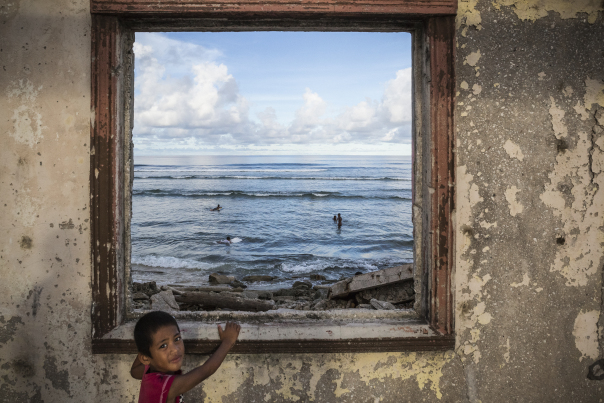
A child stands at the window opening in one of the many derelict houses on the island.
As the US nuclear testing programme developed and grew in the 1950s, most of the people living around the Kwajalein Atoll, where various US military installations that assist the nuclear test sites are based, were relocated from their homes and into a planned settlement on Ebeye. After they were joined by the ‘nuclear migrants’ from Bikini and other northern atolls, the poorly constructed settlements on Ebeye became increasingly crowded, leading to a polio outbreak in 1963, a measles outbreak in 1978 and regular occurrences of cholera, tuberculosis and other diseases up to the present day. The most overcrowded settlement of Northern Camp is a large shanty town without water supply or sewage system. Since much of the population is dependent on the service industry at US installations, unemployment is a major problem.
According to George Junior, a health worker at Ebeye’s hospital, ongoing missile testing around Kwajalein Atoll continues to impact on the health of local people. ‘When the Americans test their missiles and then the rain comes, the entire population of Ebeye gets sick. We have diarrhoea, flu and conjunctivitis. Such symptoms continue for 10 to 15 days and then everyone gets better until the next tests’ he says. And while US personnel enjoy excellent health care in places like Kwajalein Hospital, the majority of Ebeye residents who need emergency care are often referred to hospitals in Majuro, the administrative capital of the Marshall Islands, or to Manila or Hawaii since they do not have clearance to enter military installations.
Vlad Sokhin (Russia/Portugal) is a documentary photographer, videographer and multimedia producer. He covers social, cultural, environmental, health and human rights issues around the world, including post-conflict and natural disaster zones.
New Poll: US Military Occupations Supported By Far More Democrats Than Republicans
By Caitlin Johnstone | Medium | January 10, 2019
A new Politico/Morning Consult poll has found that there is much more support for ongoing military occupations among Democrats surveyed than Republicans.
To the question “As you may know, President Trump ordered an immediate withdrawal of more than 2,000 U.S. troops from Syria. Based on what you know, do you support or oppose President Trump’s decision?”, 29 percent of Democrats responded either “Somewhat support” or “Strongly support”, while 50 percent responded either “Somewhat oppose” or “Strongly oppose”. Republicans asked the same question responded with 73 percent either somewhat or strongly supporting and only 17 percent either somewhat or strongly opposing.
Those surveyed were also asked the question “As you may know, President Trump ordered the start of a reduction of U.S. military presence in Afghanistan, with about half of the approximately 14,000 U.S. troops there set to begin returning home in the near future. Based on what you know, do you support or oppose President Trump’s decision?” Forty percent of Democrats responded as either “Somewhat support” or “strongly support”, with 41 percent either somewhat or strongly opposing. Seventy-six percent of Republicans, in contrast, responded as either somewhat or strongly supporting Trump’s decision, while only 15 percent oppose it to any extent.
These results will be truly shocking and astonishing to anyone who has been in a coma since the Bush administration. For anyone who has been paying attention since then, however, especially for the last two years, this shouldn’t come as much of a surprise.
This didn’t happen by itself, and it didn’t happen by accident. American liberals didn’t just spontaneously start thinking endless military occupations of sovereign nations is a great idea yesterday, nor have they always been so unquestioningly supportive of the agendas of the US war machine. No, Democrats support the unconscionable bloodbaths that their government is inflicting around the world because they have been deliberately, methodically paced into that belief structure by an intensive mass media propaganda campaign.
The anti-war Democrats, after Barack Obama was elected on a pro-peace platform in 2008, went into an eight-year hibernation during which they gaslit themselves into ignoring or forgiving their president’s expansion of George W Bush’s wars, aided by a corporate media which marginalized, justified, and often outright ignored Obama’s horrifying military expansionism. Then in 2016 they were forced to gaslight themselves even further to justify their support for a fiendishly hawkish candidate who spearheaded the destruction of Libya, who facilitated the Iraq invasion, who was shockingly hawkish toward Russia, and who cited Henry Kissinger as a personal role model for foreign policy. I recall many online debates with Clinton fans in the lead up to the 2016 election who found themselves arguing that the Iraq invasion wasn’t that bad in order to justify their position.
After Clinton managed to botch the most winnable election of all time, mainstream liberal America was plunged into a panic that has been fueled at every turn by the plutocratic mass media, which have seized upon unthinking cultish anti-Trumpism to advance the cause of US military interventionism even further with campaigns like the sanctification of John McCain and the rehabilitation of George W Bush. Trump is constantly attacked as being too soft on Moscow despite having already dangerously escalated a new cold war against Russia which some experts are saying is more dangerous than the one the world miraculously survived. Trump’s occasional positive impulses, like the agenda to withdraw US troops from Syria and Afghanistan, are painted as weakness and foolishness by the intelligence veterans who now comprise so much of corporate liberal media punditry. And their audience laps it up because by now mainstream liberals have been trained to have far more interest in opposing Trump than in opposing war.
And how sick is that? Obviously Trump has advanced a lot of toxic agendas which need to be ferociously opposed, but how warped does your mind have to be to make a religion out of that opposition which is so all-consuming that it eclipses even the natural impulse to avoid inflicting death and destruction upon your fellow man? How viciously has the psyche of American liberals been brutalized with mass media psyops to drive them into this psychotic, twisted reality tunnel?
There was one group in the aforementioned survey which was not nearly as affected by the propaganda as armchair liberals. To the statement “The U.S. has been engaged in too many military conflicts in places such as Syria, Iraq and Afghanistan for too long, and should prioritize getting Americans out of harm’s way,” military households responded 54 percent that this statement aligns with their view. Turns out when it’s your own family’s blood and limbs on the line, people are a lot less willing to commit to endless violence. Sixty percent of Republicans agreed with this statement, while only 41 percent of Democrats did.
Could these statistics have something to do with the fact that younger veterans are statistically much more likely to be Republicans than Democrats? Is it possible that a major reason Trump beat Hillary Clinton, and a major reason Republicans are now far less bloodthirsty than Democrats, is because mothers, fathers, sisters and brothers are tired of flag-draped coffins being shipped home containing bodies which were ripped apart for no legitimate reason in senseless military entanglements on the other side of the world? Seems likely. And it also seems likely that the mass media propaganda machine is having a harder time steering people toward war once they’ve personally tasted its true cost.
A Clinton Memo That Killed Half a Million People
By Daniel Lazare | Consortium News | January 11, 2019
A Hillary Clinton memo that Wikileaks made public in 2016 has not gotten the attention it deserves.
It takes us back to 2012 and the early phase of the Syrian war.
At that point, it was largely an internal affair, although Saudi arms shipments were playing a greater and greater role in bolstering rebel forces. But once the Obama administration decided in favor of intervention, the conflict was quickly internationalized as thousands of holy warriors flooded in from as far away as western China.
The 1,200-word memo by then-Secretary of State Clinton begins with the subject of Iran, an important patron of Syria.
She dismisses any notion that nuclear talks will stop Iran “from improving the crucial part of any nuclear weapons program—the capability to enrich uranium.” If it does get the bomb, it goes on, Israel will suffer a strategic setback since it will no longer be able to “respond to provocations with conventional military strikes on Syria and Lebanon, as it can today.” Denied the ability to bomb at will, Israel might leave off secondary targets and strike at the main enemy instead.
Consequently, Clinton argues that the U.S. should topple the Assad regime so as to weaken Iran and allay the fears of Israel, which has long regarded the Islamic republic as its primary enemy. As the memo puts it:
“Bringing down Assad would not only be a massive boon to Israel’s security, it would also ease Israel’s understandable fear of losing its nuclear monopoly. Then, Israel and the United States might be able to develop a common view of when the Iranian program is so dangerous that military action could be warranted.”
This document making the case to arm Syrian rebels may have been largely overlooked because of the dates, which appear to be inaccurate.
One line gives the time as “2001-01-01 03:00” even though Clinton was still a New York senator-elect at that point. That date is also out of synch with the timeline of nuclear diplomacy with Iran.
Another contains a State Department case and document number and a date of Nov. 30, 2015. But that’s incorrect as well since it postdates Clinton’s resignation as secretary of state by better than two and a half years.
Central to the Great Debate
Consequently, anyone stumbling across the memo in the Wikileaks archives would have no idea of how its rather loopy logic figures in the great debate about whether to use force to bring down Syrian President Bashir al-Assad. But textual clues provide an answer. The second paragraph refers to nuclear talks with Iran “that began in Istanbul this April and will continue in Baghdad in May,” events that took place in 2012. The sixth invokes an interview with CNN’s Christiane Amanpour conducted with then-Israeli Defense Minister Ehud Barak “last week.” Since the interview took place on April 19, 2012, the memo can therefore be dated to the fourth week in April. This is shortly before Clinton joined forces with then-CIA Director David Petraeus to push for an aggressive program of rebel military aid.
Needless to say, Clinton’s skepticism about negotiating with Iran proved to be unwarranted since Iran eventually agreed to shut down its nuclear program. The memo thus illustrates her hawkishness along with her conviction that Israeli security trumps all other considerations even if it means setting fire to a region that’s been burned over more than once.
But the memo illustrates much else besides: Clinton’s recklessness, her lack of realism and her almost mystical belief that everything will fall neatly into place once the United States flexes its muscle. Overthrowing Assad would be nothing less than “transformative,” she writes:
“… Iran would be strategically isolated, unable to exert its influence in the Middle East. The resulting regime in Syria will see the United States as a friend, not an enemy. Washington would gain substantial recognition as fighting for the people in the Arab world, not the corrupt regimes. For Israel, the rationale for a bolt from the blue attack on Iran’s nuclear facilities would be eased. And a new Syrian regime might well be open to early action on the frozen peace talks with Israel. Hezbollah in Lebanon would be cut off from its Iranian sponsor since Syria would no longer be a transit point for Iranian training, assistance and missiles.”
It was “a low-cost high-payoff approach,” she writes, that would eliminate one enemy, weaken two more, and generate such joy among ordinary Syrians that peace talks between Damascus and Tel Aviv will spring back to life. The risks were nil. Since “the Libyan operation had no long-lasting consequences for the region,” the memo says, referring to the overthrow of strongman Muammer Gaddafi six months earlier, the Syrian operation wouldn’t either:
“Some argue that U.S. involvement risks a wider war with Russia. But the Kosovo example [in which NATO bombed Russian-ally Serbia] shows otherwise. In that case, Russia had genuine ethnic and political ties to the Serbs, which don’t exist between Russia and Syria, and even then Russia did little more than complain. Russian officials have already acknowledged they won’t stand in the way if intervention comes.”
So, there was nothing to worry about. Sixty-five years of Arab-Israeli conflict would fall by the wayside while Russia remains safely marginalized.
How it Turned Out
Needless to say, that’s not how things turned out. At that moment, Libya seemed under control. But three or four months later, it would explode as Western-backed Islamist militias blasted away at one another, imposing strict Sharia law, re-instituting slavery and rolling back decades of social progress. Once President Barack Obama approved a modified version of the Clinton-Petraeus plan, Syria would plunge into the same abyss as jihadis funded by Saudi Arabia and the other oil monarchies spread sectarian violence and fear.
Clinton’s assumption that the U.S. could neatly and cleanly decapitate the Syrian government without having to worry about broader consequences was little short of deluded.
The notion that ordinary Syrians would fall to their knees in gratitude was ludicrous while her disregard for the intricacies of Syrian politics was astonishing.
Then there’s the memo’s blithe suggestion that Washington “work with regional allies like Turkey, Saudi Arabia, and Qatar to organize, train, and arm Syrian rebel forces.”
In late 2009, Clinton wrote in another diplomatic memo made public by Wikileaks that “donors in Saudi Arabia constitute the most significant source of funding to Sunni terrorist groups worldwide.” So what made her think two years later that the kingdom would not fund Syrian jihadis of precisely the same ilk?
The 2009 memo slammed Qatar for allowing Al Qaeda, the Taliban and other terrorist groups to use the sheikdom “as a fundraising locale.” So what made her think that a pro-Al Qaeda autocracy would now help Syrians “fight for their freedom,” as the memo puts it? Wouldn’t Qatar be more likely to remove what little freedom Syrians had left? Of course, it would.
There is a remarkable continuity between the Syria policy that Clinton was proposing and earlier policies in Afghanistan and Libya. In the first, U.S. military aid wound up flowing to the notorious warlord Gulbuddin Hekmatyar, a religious sectarian and raging anti-western xenophobe who nonetheless was “the most efficient at killing Soviets,” as Steve Coll put it in “Ghost Wars,” his bestselling 2004 account of the CIA’s love affair with jihad.
Hekmatyar’s cutthroats wound up with the lion’s share of American arms. More or less the same thing happened in Libya once Clinton persuaded Qatar to join the anti-Gaddafi coalition. The sheikhdom seized the opportunity to distribute some $400 million to various rebel militias, many of them Islamist. The Obama administration said nothing in response.
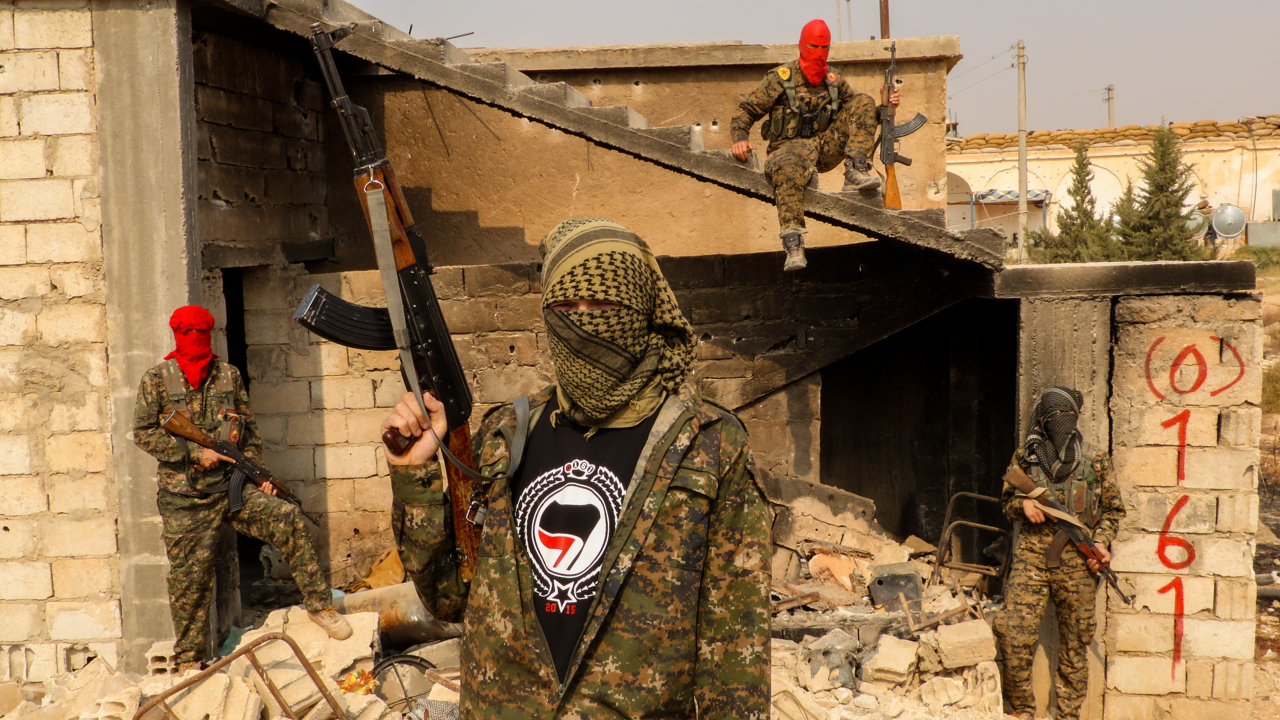
British Fighters with International Freedom Battalion in northern Iraq. (Wikimedia)
Once again, U.S. arms and materiel flowed to the most reactionary elements. The same would happen in Syria where U.S. and Saudi arms went to the local Al Qaeda affiliate, known as Jabhat al-Nusra, and even to ISIS, as a meticulous report by Conflict Armament Research, a Swiss and EU-funded study group in London, has shown. (See “Did Obama Arm Islamic State Killers?” Consortium News, Dec. 21, 2017.)
Insurgency Mix
By August 2012, a secret Defense Intelligence Agency report found that Salafists, the Muslim Brotherhood, and Al Qaeda were already “the major forces driving the insurgency” and that the U.S. and Gulf states backed them regardless. Speechwriter Ben Rhodes summed up the problem of “moderate” rebels who were indistinguishable from Al Qaeda in his White House memoir, “The World As It Is.” In that, he writes that “Al Nusra was probably the strongest fighting force within the opposition, and while there were extremist elements in the group, it was also clear that the more moderate opposition was fighting side by side with al Nusra. I argued that labeling al Nusra as terrorists would alienate the same people we want to help, while giving al Nusra less incentive to avoid extremist affiliations.”
The problem was how to separate the “good” Al Qaeda fighters from the “bad.” Rhodes later complained when Russian President Vladimir Putin said that he and his fellow Obama officials were “trying to climb a spruce tree naked without scratching our ass.” This was “smug,” Rhodes says. But Putin was merely using a colorful expression to say that the policy made no sense; which it didn’t.
The cost, half a dozen years after the Clinton email, is staggering. As many as 560,000 people have died, half the population has been displaced, while the World Bank has estimated total war damage at $226 billion, roughly six years’ income for every Syrian man, woman, and child. A cockeyed memo thus unleashed a real-life catastrophe that refuses to go away. It’s a nightmare from which President Donald Trump is struggling to escape in his confused and deluded way and that the Deep State – everyone from arch-neocon John Bolton to “liberal” Nancy Pelosi– is determined to renew.
Trump’s Nighttime Trip to Iraq Confirms the Debacle
By Jacob G. Hornberger | FFF | January 11, 2019
What better proof of the Iraq debacle than President Trump’s middle-of-the-night trip to that country at Christmastime to visit U.S. troops who are still occupying the country some 15 years after the Pentagon and the CIA invaded?
The U.S. national-security establishment has had a decade-and-half to bring its federally planned paradise into existence. From the very first day of the U.S. conquest of Iraq, a country that had never attacked the United States, the Pentagon and the CIA wielded total control over the country, being able to install whatever type of regime they wanted, with no pesky constitutional restraints to inhibit whatever they wanted to do.
After 15 years of building their paradise with such things as bombs, bullets, arrests, raids, indefinite detention, torture (e.g., Abu Ghraib), and assassination, the U.S. commander in chief has to leave Washington under cover of secrecy and darkness, land in Iraq in the middle of the night, talk to the troops for just a short while, and then skedaddle back to Washington in fear of being shot at by some disgruntled Iraqi who opposes the foreign invasion and occupation of his country.
If that’s not pathetic, I don’t know what is. Why can’t a U.S. commander in chief bravely and courageously fly into Iraq during the daytime the same way he would fly into London? Why can’t he freely travel into Baghdad and stay at a local hotel for a few days? Why can’t he meet with whoever happens to be the current U.S. puppet who is running the Iraqi government? Why does Trump have to instead sneak in and quickly sneak out of a country that the Pentagon and the CIA have had 15 long deadly and destructive years to convert into a paradise?
After all, the president of Iran doesn’t do this. He flies into Baghdad, stays several days in a hotel, and takes the time to meet with Iraqi officials. But not Trump. He and his national-security team think that it would just be too dangerous to do that in the paradise that the Pentagon and the CIA have constructed over a period of 15 years.
For that matter, notice that not one member of Congress has ever taken one of the prized congressional junkets to Iraq. Not even a family vacation. What’s up with that? Wouldn’t you think that they would relish traveling to a country that has been invaded and occupied by troops who they never cease thanking for “their service” in Iraq?
If there is anything that should cause the American people to reject the conservative-liberal paradigm of foreign empire, intervention, regime-change, and wars of aggression, it should be Iraq. Trump’s sneaky in-and-out trip to visit the troops in Iraq 15 years after they invaded and began occupying the country and turning it into their paradise says it all.
Trump Foreign Policy for 2019
By Philip Giraldi • Unz Review • January 8, 2019
Never before has any presidential administration been as all over the place in terms of national security and foreign policy as is that of Donald J. Trump. Indeed, one might well argue that there is no overriding policy at all in terms of a rational doctrine arrived at through risk versus gain analysis of developing international situations. Instead, there has been a pattern of emotional reactions fueled by media disinformation supplemented by “gut feelings” about a series of ultimately bilateral relationships that frequently have little or nothing to do with American national interests.
This is not to suggest that the “gut feelings” are always wrong. Established wisdom in Washington has long reflected the view that the United States must exercise leadership in establishing and maintaining the neoliberal consensus that gained currency after the devastation of the Second World War. Elections, free trade and a free media were to be the benchmarks of the new world order but they also came packaged with U.S. hegemony to confront those who resisted the development. And it turned out that those “benefits” were frequently difficult to achieve as elections sometimes produced bad results while trade agreements and an uncontrolled media often worked against broader U.S. objectives. All too often the United States found itself going to war against nations that it disapproves of for reasons unrelated to any actual interests, routinely claiming inaccurately that dissident regimes were both “threatening” and disruptive of the universal values that Washington claimed to be promoting.
To consider how the neoliberal order works in practice one only has to consider the Clintons, who justified brutal military interventions in the Balkans and in Libya based on what they claimed to be humanitarian principles. Or Obama, who demanded regime change in Damascus and was prepared to launch a large-scale attack on Syria before he realized that there was no public support for such a move and backed down.
More recently, particularly since 9/11, neoconservatives have dominated U.S. foreign policy through their think tanks, access to the media and their ability to infiltrate both major political parties based on their essentially fraudulent appraisals of threats to national security. They have been so successful at selling their product that the bogus claims that Iran is a threat to the United States are generally accepted without question by both Democrats and Republicans, not to mention the White House. Russia, meanwhile, remains the target of bipartisan wrath, from the left over the results of the 2016 election and from the right due to fearmongering over alleged threats to Eastern Europe.
But hope springs eternal, even in 2019. There have recently been some encouraging signs that change is in the air. Donald Trump has declared that he will be pulling all American soldiers out of Syria and half of U.S. forces out of Afghanistan, though the timetable appears to have slipped somewhat and might slow even more as the Establishment pushes back. That Trump may have chosen to break with the interventionist model with Syria, if he succeeds in doing so, is certainly commendable, but one wit has observed that the departure will be somewhat like the line in the Eagles’ song Hotel California, “you can check out any time you want, but you can never leave.”
There are other indications that something is afoot. On January 3rd, Trump offhandedly commented that Iran could do what it wishes in Syria, a comment that generated shock waves through the neoconnish Washington Post’s coverage of the remarks. To be sure, other Administration officials have continued to send different signals, with Secretary of State Mike Pompeo insisting that the U.S. will stay in Syria as long as Iran remains there.
Pompeo has also cautioned Iran against the development of ballistic missiles in connection with a claimed space program, a warning that Tehran has rejected. Israel meanwhile, presumably acting with U.S. connivance, has introduced a new destabilizing element into the Middle East cauldron, using civilian airliners to mask the approach of its military jets to attack targets in Syria. The possibility of an airliner being shot down with great loss of life by “accident” has thereby gone up exponentially.
To be sure, there are some who believe that the Trump anti-interventionist turn is essentially fraudulent. They cite the unrelenting hostility coming out of the White House regarding Iran, which is vilified on a nearly daily basis for its alleged threats not only to the Middle East region but also to Western Europe and the United States. That the Administration’s fulminations have little basis in reality is beside the point as it would seem that Trump, Pompeo, John Bolton and the now departed Nikki Haley all believe that the case for disarming Iran and bringing about regime change has been made effectively. Indeed, warfare directed against the Iranian economy has already begun by virtue of a punitive series of targeted sanctions with much more to come when a complete ban on oil exports kicks in in May.
Iran has responded to the threats by restating in early December its intention to exercise control over all ship traffic leaving the Persian Gulf via the Straits of Hormuz if its own oil exports are blocked by the United States. The U.S. responded immediately by sending the aircraft carrier U.S.S. John C. Stennis to the Gulf, the first such deployment in the region in eight months. With all the pieces in place, the possibility that there will be some accident in the region, presumably involving Iranian Revolutionary Guards and U.S. naval units, will escalate just as the largely contrived Gulf of Tonkin incident famously accelerated American involvement in the Vietnam War.
Much of what happens in the Middle East will ultimately depend on the extent to which America’s feckless allies, Saudi Arabia and Israel, succeed in selling their version of what is going on in the region. Trump, uncharacteristically, seems to be standing firm, telling a journalist that concerns about the Syria pullout are misplaced because “We give Israel $4.5 billion a year. And we give them, frankly, a lot more money than that, if you look at the books — a lot more money than that. And they’ve been doing a very good job for themselves.” Likewise, the much more important relationship, with Russia, will depend on the ability to ignore congressional hostility towards the Kremlin as well as the media bias that continues to promote Russiagate as a national security threat.
There is also North Korea, which has now indicated clearly that it is willing to talk to the U.S. but will revert to its nuclear development program unless sanctions are removed. And anyone for Latin America? Bolton has dubbed Cuba, Nicaragua and Venezuela as a “troika of tyranny,” though fortunately suggestions that Venezuela might be invaded by the U.S. to restore order appear to have faded.
If one reads the neocon press one cannot help but notice that China is the anointed over the horizon threat, but it is also a major trading partner and the drive to somehow renegotiate the terms whereby the two nations are linked economically will be complicated. Care must be taken lest what now appears to be an aggravated sense of great power competition becomes something more dangerous. The detention of Weng Manzhou in Canada one month ago together with the implication that the United States can and will enforce U.S. imposed sanctions globally could easily develop into a major problem with China as well as with others, including some NATO allies. The arrest has already disappeared from the media but several Canadians have been detained by Beijing and the U.S. government has warned American businessmen about traveling to China at the present time.
All of the above sounds somewhat depressingly familiar, but the real question is whether in 2019 Donald J. Trump will have both the vision and the necessary gumption to fulfill his campaign promises to change the face of American foreign policy by withdrawing from useless wars overseas and mending fences with countries that are actually important like Russia. There is admittedly a long way to go and it is very much a work in progress, but Trump actually has the ability to overrule the hawks in his administration and change the entire conversation about America’s place in the world.
Philip M. Giraldi, Ph.D., is Executive Director of the Council for the National Interest, a 501(c)3 tax deductible educational foundation that seeks a more interests-based U.S. foreign policy in the Middle East. Website is www.councilforthenationalinterest.org, address is P.O. Box 2157, Purcellville VA 20134 and its email is inform@cnionline.org.
Featured Video
EUROPE FEARS RUSSIA’S NEXT MOVE / Ian Proud
or go to
Aletho News Archives – Video-Images
New Book
New Book: No Autoimmunity The Body Doesn’t Attack Itself
Lies are Unbekoming | September 24, 2026
 The label for Humira, once the best-selling drug in the world, lists its risks in plain print. One of them, in the label’s own words, is new “autoimmune” disease.
A drug prescribed for a condition labelled autoimmune carries a warning that it can cause a condition labelled autoimmune. That contradiction sits in every box, on a folded paper almost nobody reads.
My new book starts there.
No Autoimmunity: The Body Doesn’t Attack Itself
For seventy years, “your body is attacking itself, and we don’t know why” has ended the conversation for people diagnosed with multiple sclerosis, lupus, rheumatoid arthritis, Hashimoto’s, Type 1 diabetes, Crohn’s and psoriasis. More than eighty conditions now carry the autoimmune label. The diagnosis comes with a prescription for life. It almost never comes with a question about cause.
This book asks the question and answers it from the framework’s own records: its drug labels, its journals, its regulatory filings, and its own experiments. … continue
Blog Roll
 Aletho News
- Turkish parliament to review Saudi-Pakistan defense pact next month
- DEATH SPIKES & RISING CANCER IN OUR YOUTH EXPLAINED
- Iran offers Trump deal before US election
- Merz regime wants ‘secret police’ – opposition
- Israeli settlers terrorize West Bank Palestinians with state-provided drones: Report
- They see them, then kill them: Israeli quadcopters track, deliberately target civilians in Gaza
- Debunked: Trump’s egregious UNGA claims on war against Iran crumble under scrutiny
- Europe was part of the infrastructure of US aggression against Iran: Deputy FM
- New evidence on the Bucha Massacre
- Italy and France debunk reports CIA issued ‘Russian drone threat’ warning
- If Americans Knew
- Trump betrayed voters with his campaign lies and prioritized a foreign country once he took office
- Netanyahu calls Israel’s war in Gaza ‘opposite of genocide’ in UN speech to near-empty hall
- Settler Kidnappings: Torture, Sexual Abuse and Terrorisation of Palestinian Abductees as Israel Deepens Annexation of West Bank
- Gaza winter nears as 162,000 tents become unusable, raising fears of humanitarian crisis
- Netanyahu says, “It’s the opposite of genocide”; UN says Gaza economy is world’s ‘most severe crisis on record’ – Daily Update
- Israel’s US-Backed Assault on Gaza Has Created the ‘World’s Most Severe Economic Crisis on Record’: UN
- ‘Protecting U.S. Citizens’… From Israel
- ‘This is where I live now, the back of a truck’: a day in the life of a grandmother in Gaza
- In UN Speech, Iran’s President Displays Pictures of Children Killed by US, Brings Attention to Israel’s Nuclear Arsenal
- Israel displaces hundreds of Palestinians amid wave of demolitions in West Bank
- No Tricks Zone
- New Study: Earth And Venus Surface Warmth Largely Explained By Convection And Lapse Rate, Not CO2 Or Radiation
- 2025 Nature Paper Claiming Worsening Global Drought Gets RETRACTED …Heavily Flawed
- New Study: ‘Global Drought Shows No Detectable Recent Acceleration Under Climate Warming’
- Economic Masterminds: German Socialists Suggest Taxing Productivity Gains Stemming From Using AI
- The South China Sea Has Not Been Cooperating With The Climate Change Narrative
- Energy Crisis: Germany Enters Heating Season With Historically Low Gas Reserve Fill Levels
- New Study: The Antarctic Ice Sheet Gained Mass From 2020-2024 Due To Staggering Snow And Ice Accumulation
- Study: Ocean Heating Rates From Thousands Of Years Ago ‘Dwarf’ Modern Ocean Heating Rates
- Climate Extremists Target, Attack Large-Scale Power Grid Infrastructure In Germany!
- New Study: Antarctic Ice Melt Has Contributed Less Than 1 Centimeter To Sea Level Rise In The Last 30 Years

