US Views the Balkans As Battlefield to Fight Russia
By Peter KORZUN | Strategic Culture Foundation | 06.12.2017
Otto von Bismarck, the legendary first Chancellor of Germany, scoffed at the notion of intervening in the Balkans. He believed that the region was “not worth the bones of a single Pomeranian grenadier.” The US appears to hold quite a different view on the matter. With a resurgent Russia on the international stage, it plans to ramp up the attempts aimed at establishing its dominance in the Balkan region.
Moscow is concerned over Washington’s attempts to increase its influence on the politics of the Balkan states and draw them into NATO. Andrey Kelin, Director of the Russian Foreign Ministry’s Department of European Cooperation, said that the US wants to “fully master the Western Balkans, and, after Montenegro, to draw other countries into its orbit too.” According to him, any wave of NATO expansion, especially at a time of poor relations between the bloc and Russia “is an additional factor complicating European security.”
The statement comes after the report entitled ‘Balkans Forward: A New US Strategy for the Region’, was published by the Washington-based Atlantic Council on Nov.28. It warns of increased Russia’s influence, blaming Moscow for “attempts by Russia to capitalize on the region’s lingering pathologies to undermine the European project” and other alleged wrongdoings. The authors claim that Russia is seeking “leverage” by making “as big a mess as possible” in the Balkans region, citing unconfirmed assertions and invented stories as evidence. For instance, the report states that Moscow has been “cultivating a client” in Milorad Dodik, the leader of Bosnia’s Serb-dominated entity of Republika Srpska. Russia’s “playing games” in Kosovo is another example. The list can go on. Not a single fact is adduced to support the stories.
The Russia bogie is used as a pretext to justify the calls for a permanent American military presence in the Balkans, a “historic rapprochement” between the US and Serbia, and for the US to regain its reputation as an “honest broker”. The authors believe that establishing a permanent US military presence in the region would “anchor the United States’ ability to influence developments”. Camp Bondsteel in Kosovo, which is built on Serbian land without consulting with the government of Serbia, is believed to be ideal for this purpose.
The report does not shy away from advocating outright interference into internal affairs. It singles out Serbia, saying “Belgrade can and should be a close partner and ally in the region, but it can only become one if it begins to meaningfully distance itself from Russia.”
The Atlantic Council is a meeting place for heads of state, military leaders, and international leaders from both sides of the Atlantic. It has great influence on the US foreign policy decision-making process. Some proposals unveiled in the report align with prior calls by US policy hawks, such as Senator John McCain, who in April called for a substantially strengthened US commitment to the region.
Looks like his calls are heard and recommendations are followed. Hoyt Brian Yee, US Deputy Assistant Secretary of State, will soon take up the post of US Ambassador to Macedonian capital Skopje. “For a long time, the United States is present in the Western Balkans, and we are planning to stay there,” he said at the conference organized by the Atlantic Council in Washington the next day after the report was published.
James Jay Carafano, a Heritage Foundation Vice President, has come up with a plan of his own, offering guidelines to boost US diplomatic, economic and military efforts to drive Russia from the region and make it dominated by the United States. He believes that “The Balkans remain a soft spot in US transatlantic policy. We need to be more proactive there – and sooner rather than later.”
With Montenegro having joint NATO recently, Macedonia appears to be next. The Atlantic Council’s report offers to launch mediation efforts aimed at putting an end the long-standing row between Athens and Skopje over Macedonia name and, thus, unblock Greece’s ongoing objections to the latter’s membership in NATO. The center-left government, which came to power in late May, sees NATO membership as a top priority. The Macedonian people think otherwise. According to a recent poll by the International Republican Institute (IRI), Macedonian support for NATO membership is at its lowest level since 2008.
It all goes to show that the US views the Balkans not as a region with prospects of economic cooperation and partnership on equal terms but rather as a battlefield against Russia. What the United States does is enforcing an openly destructive choice between the West and Russia on the Balkan countries. Such a policy will lead to increased tensions and destabilization on the European continent as well as in the region. The last thing the region needs is US military presence to oppose Russia – the country with strong historic and cultural ties to the Balkan states.
Pyongyang seeks direct dialogue with Washington, Moscow ready to help – Lavrov
RT | December 7, 2017
North Korea wants to engage directly with the US to assure its security, Russia’s foreign minister has revealed. Sergey Lavrov said he has briefed US Secretary of State Rex Tillerson on the developments and that Moscow is ready to “facilitate such talks.”
“We know that, above all, North Korea wants to talk to the US about its own security assurances,” he said in Vienna following his meeting with Tillerson. “Russia is ready to take part in facilitating such talks.” Lavrov and Tillerson spoke on the sidelines of an Organization for Security and Cooperation in Europe (OSCE) meeting.
Lavrov reiterated that all parties involved in the Korean crisis should “break the vicious cycle of confrontation, reckless schemes and sanctions” and engage in meaningful dialogue instead. He also pointed to American military exercises near the Korean Peninsula and Washington’s aggressive rhetoric, which he said only leads to a further escalation of tensions. This is “unacceptable,” Lavrov made clear.
Earlier Thursday, the head of Russia’s Senate’s Foreign Affairs Committee, Konsantin Kosachev, met with North Korea’s Ambassador to Moscow to discuss the situation on the peninsula. Following his exchange with Kim Young Jae, Kosachev said Pyongyang has absolutely no interest in ratcheting tensions, not to mention starting a full-blown military conflict. But, Kim added, Pyongyang “does not fear war” either.
Kosachev said a viable way to resolve the crisis is an all-in dialogue between relevant parties and joint efforts aimed at lowering tensions. “We are absolutely not interested in the escalation of tensions, in any military action,” Kosachev told the Interfax news agency following the meeting. Russia “will do everything it can to prevent this escalation,” he added.
Both Lavrov and Kosachev once again referred to the so-called “double freeze” initiative put forward by Russia and China soon after tensions heightened in early September. The plan envisages the US and its allies stop all major military exercises in the region in exchange for Pyongyang suspending its nuclear and ballistic missile program. The initiative, however, has been spurned by Washington, with the US envoy to the UN, Nikki Haley, denouncing it as “insulting.”
On Wednesday, the North Korean foreign ministry said US military drills near the Korean Peninsula as well as Washington’s belligerent rhetoric make an outbreak of war in the region inevitable. “The remaining question now is, when will the war break out,” the ministry’s spokesperson told the North Korean state news agency KCNA Wednesday.
On Monday, the US launched massive air drills together with South Korea. The five-day exercises, scheduled to last until December 8, involve a total of 12,000 personnel and over 230 military aircraft. Pointedly, the maneuvers particularly simulate attacks on Pyongyang’s nuclear and missile installations while claiming it to be “defensive.”
In late November, North Korea conducted yet another missile test, claiming it had successfully launched a new type of intercontinental ballistic missile capable of striking the US mainland.
John Lennon Was Right: The Government Is Run by Maniacs for Maniacal Means
By John W. Whitehead | Rutherford Institute | December 07, 2017
 Not much has changed in the 37 years since John Lennon was gunned down by an assassin’s bullet.
All of the many complaints we have about government today—surveillance, corruption, harassment, political persecution, spying, overcriminalization, etc.—were used against Lennon, who never refrained from speaking truth to power and calling for social justice, peace and a populist revolution.
Little wonder, then, that the U.S. government saw Lennon as enemy number one.
A prime example of the lengths to which the U.S. government will go to persecute those who dare to challenge its authority, Lennon was the subject of a four-year campaign of surveillance and harassment by the U.S. government (spearheaded by FBI Director J. Edgar Hoover), in an attempt by President Richard Nixon to have him “neutralized” and deported. As Adam Cohen of the New York Times points out, “The F.B.I.’s surveillance of Lennon is a reminder of how easily domestic spying can become unmoored from any legitimate law enforcement purpose.”
Years after Lennon’s assassination, it would be revealed that the FBI had collected 281 pages of surveillance files on him. As the New York Times notes, “Critics of today’s domestic surveillance object largely on privacy grounds. They have focused far less on how easily government surveillance can become an instrument for the people in power to try to hold on to power. ‘The U.S. vs. John Lennon’ … is the story not only of one man being harassed, but of a democracy being undermined.”
Such government-directed harassment was nothing new.
The FBI has had a long history of persecuting, prosecuting and generally harassing activists, politicians, and cultural figures, including Martin Luther King Jr.
In Lennon’s case, the ex-Beatle saw that his music could mobilize the public and help to bring about change. Yet while Lennon believed in the power of the people, he also understood the danger of a power-hungry government. “The trouble with government as it is, is that it doesn’t represent the people,” observed Lennon. “It controls them.”
By March 1971, when his “Power to the People” single was released, it was clear that Lennon was ready to participate in political activism against the U. S. government, the “monster” that was financing the war in Vietnam.
The release of Lennon’s Sometime in New York City album, which contained a radical anti-government message in virtually every song, only fanned the flames of the government’s war on Lennon.
In 1972, Nixon had the ex-Beatle served with deportation orders “in an effort to silence him as a voice of the peace movement.” Despite the fact that Lennon was not plotting to bring down the Nixon Administration, as the government feared, the government persisted in its efforts to have him deported. Equally determined to resist, Lennon dug in and fought back. Finally, in 1976, Lennon won the battle to stay in the country. By 1980, the old radical was back and ready to cause trouble.
Unfortunately, Lennon’s time as a troublemaker was short-lived.
Mark David Chapman was waiting in the shadows on Dec. 8, 1980, just as Lennon was returning to his New York apartment building. As Lennon stepped outside the car to greet the fans congregating outside, Chapman dropped into a two-handed combat stance, emptied his .38-caliber pistol and pumped four hollow-point bullets into Lennon’s back and left arm.
John Lennon was pronounced dead on arrival at the hospital.
Much like Martin Luther King Jr., John F. Kennedy, Malcolm X, Robert Kennedy and others who have died attempting to challenge the powers-that-be, Lennon had finally been “neutralized.”
Yet Lennon’s legacy lives on in his words, his music and his efforts to speak truth to power.
Even so, his work to change the world for the better is far from done.
As I make clear in my book Battlefield America: The War on the American People, peace remains out of reach. Activists and whistleblowers continue to be prosecuted for challenging the government’s authority. Militarism is on the rise, all the while the governmental war machine continues to wreak havoc on innocent lives. And those who do dare to speak up are labeled dissidents, troublemakers, terrorists, lunatics, or mentally ill and tagged for surveillance, censorship or, worse, involuntary detention.
As Lennon shared in a 1968 interview:
I think all our society is run by insane people for insane objectives… I think we’re being run by maniacs for maniacal means. If anybody can put on paper what our government and the American government and the Russian… Chinese… what they are actually trying to do, and what they think they’re doing, I’d be very pleased to know what they think they’re doing. I think they’re all insane. But I’m liable to be put away as insane for expressing that. That’s what’s insane about it.”
So what’s the answer?
Lennon had a multitude of suggestions.
“If everyone demanded peace instead of another television set, then there’d be peace.”
“Produce your own dream. If you want to save Peru, go save Peru. It’s quite possible to do anything, but not to put it on the leaders….You have to do it yourself.”
“Peace is not something you wish for; It’s something you make, Something you do, Something you are, And something you give away.”
“War is over, if you want it.”
In other words, fighting the evil of the American police state can only come about by way of conscious thoughts that are put into action.
Do you want an end to war? Then stop supporting the government’s military campaigns. Do you want government violence against the citizenry to end? Then demand that your local police de-militarize. Do you want a restoration of your freedoms? You’ll have to get the government to recognize that “we the people” are the masters in this relationship and government employees are our public servants.
The choice is ours.
The power (if we want it), as Lennon recognized, is in our hands.
“The people have the power, all we have to do is awaken that power in the people,” concluded Lennon. “The people are unaware. They’re not educated to realize that they have power. The system is so geared that everyone believes the government will fix everything. We are the government.”
For the moment, the choice is still ours: slavery or freedom, war or peace, death or life.
The point at which we have no choice is the point at which the monsters—the maniacs, the powers-that-be, the Deep State—win.
As Lennon warned, “You either get tired fighting for peace, or you die.”
Pentagon quadruples troop levels in Syria to ‘stabilize’ liberated areas
RT | December 7, 2017
The US military has increased the number of troops in Syria from 500 to 2,000, the Pentagon says, adding that the “conditions-based” military presence is justified by the need to “stabilize” liberated areas.
The Pentagon has officially announced that there are now 2,000 troops in Syria – a fourfold increase from the previous figures given. “The United States will continue necessary counterterrorism and stabilization effort,” Pentagon spokesman Colonel Robert Manning said.
“The United States will sustain a conditions-based military presence in Syria to combat the threat of insurgent-led insurgency, prevent the resurgence of ISIS and to stabilize liberated areas.”
Manning claimed that the Iraqi Army and Syrian Democratic Forces (SDF) have liberated about 97 percent “of the people and land” previously controlled by Islamic State (IS, formerly ISIS) in Iraq and Syria respectively. He said the campaign to defeat IS is now in a new phase in these countries.
Coalition forces are still needed in the two countries, Manning said, adding that they will now focus on “train, advise and assist” missions. “As the terrorist group continues to lose territory, important work remains to ensure its lasting defeat.”
The US military has repeatedly refused to acknowledge the number of troops and “military advisers” it has fighting alongside anti-government rebel forces. Under the Obama administration, the Pentagon routinely announced foreign troop deployments, but the Trump administration stopped disclosing such information regarding Operation Inherent Resolve. The policy was reversed in the spring of 2017 in order to maintain the “element of surprise” against Islamic State in both Syria and Iraq.
Damascus views the US military engagement in Syria as illegitimate, as there was no official request for intervention from the government. Early in November, Syrian leader Bashar Assad said his government will deal with any “illegal invader force.” He added that the war in Syria will continue until there is a full “recovery of security and stability to all Syrian lands.”
Washington insists its military presence in Syria is lawful and justified by UN mandate. In mid-November, US Defense Secretary James Mattis claimed the United Nations sanctioned the US presence in Syria.
“You know, the UN said that… basically we can go after ISIS. And we’re there to take them out,” Mattis said. Moscow responded by saying the UN cannot greenlight a foreign invasion of Syria, as it is contrary to international law.
Media reports indicate that the US is not planning to leave any time soon. According to the Washington Post, the US wants to keep troops in Syria long after Islamic State is defeated to help the Western-backed SDF establish “new local governance” structures in order to prevent complete victory by the Syrian government and its ally, Iran.
Read more:
France , Qatar sign deals worth around 12 billion euros: Macron
Press TV – December 7, 2017
French President Emmanuel Macron and Qatar’s ruling emir have signed contacts worth around 12 billion euros ($14.15 billion) during the French president’s visit to Doha.
“In total, it amounts to nearly 12 billion euros which was signed today and which underlines the closeness of our relations,” Macron said at a press conference with Qatari Emir Sheikh Tamim bin Hamad Al Thani on Thursday.
Macron and Sheikh Tamim agreed on a deal for Qatar to purchase at least a dozen French-made Dassault Rafale fighter jets with the option of buying 36 more. The deal also includes purchase of 490 VBCI armored vehicles from French firm Nexter.
Qatar would additionally buy 50 Airbus twin-engine A321s with the option of buying 30 more.
The small Persian Gulf country also signed a transportation deal with France’s national rail authority to manage and maintain Doha’s planned metro, as well as a light rail system north of Doha.
The French president is traveling with Foreign Minister Jean-Yves Le Drian, who in 2015 as defense minister helped negotiate a deal with Qatar buy dozens of Rafale fighter jets.
Macron’s one-day trip comes as Doha faces a continued boycott by some of its Saudi-led Arab neighbors.
In the rare press conference, Qatar’s ruling emir expressed his regret for the boycott and said it was especially disheartening that the crisis erupted in June.
Qatar has been locked in a political standoff with Saudi Arabia and three other Arab countries for the past months. Saudi Arabia, the United Arab Emirates, Bahrain and Egypt cut relations with Qatar in early June
Earlier this week, a Persian Gulf Cooperation Council (GCC) meeting in Kuwait failed to bring the standoff any closer to a resolution.
There has been almost no sign that Qatari authorities would bow to the demands of Saudi Arabia and its allies to restore diplomatic ties.
Among the conditions put forward for a full normalization of ties is the need for Qatar to downgrade its relations with Iran and expel foreign troops, including those from Turkey, from military bases in the country.
Macron visits US, French troops in Qatar
During his visit to Qatar, Macron traveled to the vast al-Udeid air base, which is home to some 10,000 American troops and the forward headquarters of the US military’s Central Command.
France also has a contingent of several hundred troops in Qatar as part of the 1,200 French forces deployed to the region.
The troops are a part of the US-led coalition, which is purportedly fighting the Daesh Takfiri terrorist group in Syria, Iraq and elsewhere.
Speaking to the soldiers, he said the next few months of battle would determine the outcome of the war against Daesh in Iraq in Syria.
“This military win does not signify the end of the operations and the end of our battle because first we need to stabilize and win peace in Iraq and Syria,” he said.
Macron also stressed in his remarks that France wanted to avoid the partitioning of Syria and “avoid the domination of certain international elements whose interests contradict peace.”
The US-led coalition has been conducting airstrikes against what are said to be Daesh targets inside Syria since September 2014 without any authorization from the Damascus government or a UN mandate.
The airstrikes, however, have on many occasions resulted in civilian casualties and failed to fulfill their declared aim of countering terrorism.
Propaganda, Confrontation and Profit
By Brian CLOUGHLEY | Strategic Culture Foundation | 06.12.2017
The waves, the artificial tides of anti-Russian propaganda continue to beat upon the ears and eyes of Western citizens, spurred by Washington politicians and bureaucrats whose motives vary from deviously duplicitous to blatantly commercial. It is no coincidence that there has been vastly increased expenditure on US weaponry by Eastern European countries.
Complementing the weapons’ build-up, which is so sustaining and lucrative for the US industrial-military complex, the naval, air and ground forces of the US-NATO military alliance continue operations ever closer to Russia’s borders.
Shares and dividends in US arms manufacturing companies have rocketed, in a most satisfactory spinoff from Washington’s policy of global confrontation, and the Congressional Research Service (CRS) records that “arms sales are recognized widely as an important instrument of state power. States have many incentives to export arms. These include enhancing the security of allies or partners; constraining the behaviour of adversaries; using the prospect of arms transfers as leverage on governments’ internal or external behaviour; and creating the economics of scale necessary to support a domestic arms industry.”
The CRS notes that arms deals “are often a key component in Congress’s approach to advancing US foreign policy objectives,” which is especially notable around the Baltic and throughout the Middle East, where US wars have created a bonanza for US weapons makers — and for the politicians whom the manufacturers reward so generously for their support. (Additionally, in 2017 arms manufacturers spent $93,937,493 on lobbying Congress.)
Some countries, however, do not wish to purchase US weaponry, and they are automatically categorised as being influenced by Russia, which is blamed for all that has gone wrong in America over the past couple of years. This classification is especially notable in the Central Asian Republics.
The US military’s Central Command (Centcom) states that its “area of responsibility spans more than 4 million square miles and is populated by more than 550 million people from 22 ethnic groups, speaking 18 languages… and confessing [sic] multiple religions which transect national borders. The demographics create opportunities for tension and rivalry.” Centcom is deeply engaged in the US wars in Iraq, Syria and Afghanistan, and supports Saudi Arabia in its war on Yemen, and the extent of its influence in the Pentagon’s self-allotted geographical Area of Responsibility is intriguing, to say the least. Some of its priorities were revealed in March 2017 by the Commander of this enormous military realm, General Joseph Votel, in testimony to the Armed Services Committee of the House of Representatives in Washington.
General Votel’s description of US self-allocated “responsibilities” was astonishing in its imperialistic arrogance.
As Commander of Centcom, General Votel gave the Armed Services Committee a colourful tour of his territory, describing nations in terms ranging from condescendingly supportive to patently insolent, and he devoted much time to describing relations with countries abutting Russia, Iran and China, which nations, he declared, are trying “to limit US influence in the sub-region.” That “sub-region” includes many countries immediately on the borders of Russia, Iran and China, and averaging 7,000 miles (11,000 kilometres) from Washington.
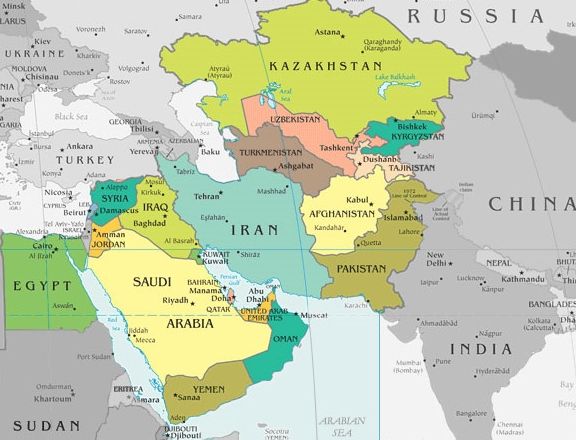
CENTCOM countries (coloured)
First he dealt with Kazakhstan with which the US has its “most advanced military relationship in Central Asia” in furtherance of which Washington is “making notable progress… despite enduring Russian influence.” It is obviously unacceptable to the Pentagon that Russia wishes to maintain cordial relations with a country with which it has a border of 6,800 kilometres. Then General Votel went into fantasyland by claiming that “Kazakhstan remains the most significant regional contributor to Afghan stability…” which even the members of the Congressional Committee would have realised is spurious nonsense.
But more nonsense was to follow, with General Votel referring to Kyrgyzstan in patronising terms usually associated with a Viceroy or other colonial master of a region that Votel describes as “widely characterized by pervasive instability and conflict,” which he failed to note were caused by the US wars in Afghanistan and Iraq.
He told the Committee that Kyrgyzstan “sees political pressure from its larger, more powerful neighbours, including Russia, hosting a small Russian airbase outside the capital, Bishkek. Despite ongoing challenges in our bilateral and security cooperation, we continue to seek opportunities to improve our mil-to-mil relationship.” He did not explain why Kyrgyzstan should be expected to embrace a military alliance with United States Central Command, but Viceroys don’t have to provide explanations.
Votel then moved to consider Tajikistan with which “our mil-to-mil relationship is deepening despite Moscow’s enduring ties and the presence of the military base near Tajikistan’s capital of Dushanbe, Russia’s largest military base outside of its borders.” Not only this, says Votel, but China (having a 400 Kilometre border with Tajikistan) has had the temerity to have “initiated a much stronger military cooperation partnership with Tajikistan, adding further complexity to Tajikistan’s multi-faceted approach to security cooperation.”
No: China hasn’t added any complexity to Tajikistan’s circumstances. What has complicated their relations is the fact that Afghanistan is in a state of chaos, following the US invasion of 2001, and drugs and terrorists cross the border (1,300 kilometres long) from Afghanistan into Tajikistan, which is trying to protect itself. During its sixteen years of war in Afghanistan there has been no attempt by the United States to secure that border.
None of these countries wants to be forced into a military pact with the United States, and Turkmenistan (border with Afghanistan 750 kilometres) has made it clear it doesn’t want to be aligned with anyone. But General Votel states that its “UN-recognized policy of ‘positive neutrality’ presents a challenge with respect to US engagement.” No matter what is desired by Turkmenistan, it seems, there must always be a way for the United States Central Command to establish military relations and, as General Votel told the Defence Committee, “we are encouraged somewhat by Turkmenistan’s expressed interest in increased mil-to-mil engagement with the US within the limits of their ‘positive neutrality’ policy.”
In the minds (to use the word loosely) of General Votel and his kind, it doesn’t matter if a country wants nothing whatever to do with the United States’ military machine, and wants very much to be left alone to get on with things without any interference. Adoption of such a policy by any nation presents a “challenge” and the United States, which in this region is overseen by General Votel’s Central Command, is determined to seek military “engagement” irrespective of what is desired by governments. Arms sales would swiftly follow.
Votel’s tour of his area of responsibility covered Afghanistan, about which his most absurd assertion was “I believe what Russia is attempting to do is they are attempting to be an influential party in this part of the world. I think it is fair to assume they may be providing some sort of support to [the Taliban] in terms of weapons or other things that may be there.”
There was not a shred of evidence provided, but the Committee accepted the pronouncement. Obviously if an allegation is made about Russia it doesn’t matter if it is false. It must be believed. But unfortunately for the imperial Votel and his deferential audience, a person with some sense of truth and balance came up two months later with a statement rubbishing Votel’s unfounded and provocative accusation. In May the Director of the US Defence Intelligence Agency told a Senate Committee that “We have seen indication that [Russia] offered some level of support [to the Taliban], but I have not seen real physical evidence of weapons or money being transferred.” The mainstream media gave no publicity to the truth, and continue to blame Russia for all the ills that befall the US Empire, at home and overseas.
The state of affairs was summed up admirably by Jacob Hornberger of the Future of Freedom Foundation on December 4 when he wrote that “Central to any national-security state is the need for official enemies, ones that are used to frighten and agitate the citizenry. If there are no official enemies, the American citizenry might begin asking some discomforting questions: What do we need a national-security state for? Why not abolish the CIA and dismantle the military-industrial complex and the NSA. Why can’t we have our limited-government, constitutional republic back?”
The Motto of the Pentagon’s Central Command is “Prepare, Pursue, Prevail.” and the Central Asian Republics would be well-advised to bear in mind these threats and think hard about the underlying motif of the US military-industrial complex which is “Propagandise, Provoke, Profit.”
The Cold War Now and Then
By William Blum | Dissident Voice | December 6, 2017
“He said he absolutely did not meddle in our election. He did not do what they are saying he did.” – President Trump re Vladimir Putin after their meeting in Vietnam.
Putin later added that he knew “absolutely nothing” about Russian contacts with Trump campaign officials. “They can do what they want, looking for some sensation. But there are no sensations.”1
Numerous US intelligence agencies have said otherwise. Former Director of National Intelligence, James Clapper, responded to Trump’s remarks by declaring: “The president was given clear and indisputable evidence that Russia interfered in the election.”
As we’ll see below, there isn’t too much of the “clear and indisputable” stuff. And this, of course, is the same James Clapper who made an admittedly false statement to Congress in March 2013, when he responded, “No, sir” and “not wittingly” to a question about whether the National Security Agency was collecting “any type of data at all” on millions of Americans. Lies don’t usually come in any size larger than that.
Virtually every member of Congress who has publicly stated a position on the issue has criticized Russia for interfering in the 2016 American presidential election. And it would be very difficult to find a member of the mainstream media which has questioned this thesis.
What is the poor consumer of news to make of these gross contradictions? Here are some things to keep in mind:
How do we know that the tweets and advertisements “sent by Russians” -– those presented as attempts to sway the vote -– were actually sent by Russians? The Veteran Intelligence Professionals for Sanity (VIPS), composed of National Security Agency and CIA veterans, recently declared that the CIA knows how to disguise the origin of emails and tweets. The Washington Post has as well reported that Twitter “makes it easy for users to hide their true identities.”2 Even if these communications were actually sent from Russia, how do we know that they came from the Russian government, and not from any of the other 144.3 million residents of Russia?
Even if they were sent by the Russian government, we have to ask: Why would they do that? Do the Russians think the United States is a Third World, under-developed, backward Banana Republic easily influenced and moved by a bunch of simple condemnations of the plight of blacks in America and the Clinton “dynasty”? Or clichéd statements about other controversial issues, such as gun rights and immigration? If so, many Democratic and Republican officials would love to know the secret of the Russians’ method. Consider also that Facebook has stated that 90 percent of the alleged-Russian-bought content that ran on its network did not even mention Trump or Clinton.3
On top of all this is the complete absence of even the charge, much less with any supporting evidence, of Russian interference in the actual voting or counting of votes.
After his remark suggesting he believed Putin’s assertion that there had been no Russian meddling in the election, Trump – of course, as usual – attempted to backtrack and distance himself from his words after drawing criticism at home; while James Clapper declared: “The fact the president of the United States would take Putin at his word over that of the intelligence community is quite simply unconscionable.”4
Given Clapper’s large-size lie referred to above, can Trump be faulted for being skeptical of the intelligence community’s Holy Writ? Purposeful lies of the intelligence community during the first Cold War were legendary, many hailed as brilliant tactics when later revealed. The CIA, for example, had phony articles and editorials planted in foreign newspapers (real Fake News), made sex films of target subjects caught in flagrante delicto who had been lured to Agency safe houses by female agents, had Communist embassy personnel expelled because of phony CIA documents, and much more.
The Post recently published an article entitled “How did Russian trolls get into your Facebook feed? Silicon Valley made it easy.” In the midst of this “exposé,” The Post stated: “There’s no way to tell if you personally saw a Russian post or tweet.”5 So … Do the Cold Warriors have a case to make or do they not? Or do they just want us to remember that the Russkis are bad? So it goes.
An organization in Czechoslovakia with the self-appointed name of European Values has produced a lengthy report entitled “The Kremlin’s Platform for ‘Useful Idiots’ in the West: An Overview of RT’s Editorial Strategy and Evidence of Impact”. It includes a long list of people who have appeared on the Russian-owned TV station RT (formerly Russia Today), which can be seen in the US, the UK and other countries. Those who’ve been guests on RT are the “idiots” useful to Moscow. (The list is not complete. I’ve been on RT about five times, but I’m not listed. Where is my Idiot Badge?)
RT’s YouTube channel has more than two million followers and claims to be the “most-watched news network” on the video site. Its Facebook page has more than 4 million likes and followers. Can this explain why the powers-that-be forget about a thing called freedom-of-speech and treat the station like an enemy? The US government recently forced RT America to register as a foreign agent and has cut off the station’s Congressional press credentials.
The Cold War strategist, George Kennan, wrote prophetically: “Were the Soviet Union to sink tomorrow under the waters of the ocean, the American military-industrial establishment would have to go on, substantially unchanged, until some other adversary could be invented. Anything else would be an unacceptable shock to the American economy.”6
Writer John Wight has described the new Cold War as being “in response to Russia’s recovery from the demise of the Soviet Union and the failed attempt to turn the country into a wholly owned subsidiary of Washington via the imposition of free market economic shock treatment thereafter.”
So let’s see what other brilliance the New Cold War brings us. … Ah yes, another headline in the Post (November 18, 2017): “British alarm rising over possible Russian meddling in Brexit”. Of course, why else would the British people have voted to leave the European Union? But wait a moment, again, one of the British researchers behind the report “said that the accounts they analyzed – which claimed Russian as their language when they were set up but tweeted in English – posted a mixture of pro-‘leave’ and pro-‘remain’ messages regarding Brexit. Commentators have said that the goal may simply have been to sow discord and division in society.”
Was there ever a time when the Post would have been embarrassed to be so openly, amateurishly biased about Russia? Perhaps during the few years between the two Cold Wars.
In case you don’t remember how stupid Cold War Number One was …
- 1948: The Pittsburgh Press published the names, addresses, and places of employment of about 1,000 citizens who had signed presidential-nominating petitions for former Vice President Henry Wallace, running under the Progressive Party. This, and a number of other lists of “communists”, published in the mainstream media, resulted in people losing their jobs, being expelled from unions, having their children abused, being denied state welfare benefits, and suffering various other punishments.
- Around 1950: The House Committee on Un-American Activities published a pamphlet, “100 Things You Should Know About Communism in the U.S.A.” This included information about what a communist takeover of the United States would mean:Q: What would happen to my insurance?A: It would go to the Communists.Q: Would communism give me something better than I have now?A: Not unless you are in a penitentiary serving a life sentence at hard labor.
- 1950s: Mrs. Ada White, member of the Indiana State Textbook Commission, believed that Robin Hood was a Communist and urged that books that told the Robin Hood story be banned from Indiana schools.
- As evidence that anti-communist mania was not limited to the lunatic fringe or conservative newspaper publishers, here is Clark Kerr, president of the University of California at Berkeley in a 1959 speech: “Perhaps 2 or even 20 million people have been killed in China by the new [communist] regime.” One person wrote to Kerr: “I am wondering how you would judge a person who estimates the age of a passerby on the street as being ‘perhaps 2 or even 20 years old.’ Or what would you think of a physician who tells you to take ‘perhaps 2 or even twenty teaspoonsful of a remedy’?”
- Throughout the cold war, traffic in phony Lenin quotes was brisk, each one passed around from one publication or speaker to another for years. Here’s U.S. News and World Report in 1958 demonstrating communist duplicity by quoting Lenin: “Promises are like pie crusts, made to be broken.” Secretary of State John Foster Dulles used it in a speech shortly afterward, one of many to do so during the cold war. Lenin actually did use a very similar line, but he explicitly stated that he was quoting an English proverb (it comes from Jonathan Swift) and his purpose was to show the unreliability of the bourgeoisie, not of communists.“First we will take Eastern Europe, then the masses of Asia, then we will encircle the United States, which will be the last bastion of capitalism. We will not have to attack. It will fall like an overripe fruit into our hands.” This Lenin “quotation” had the usual wide circulation, even winding up in the Congressional Record in 1962. This was not simply a careless attribution; this was an out-and-out fabrication; an extensive search, including by the Library of Congress and the United States Information Agency failed to find its origin.
- A favorite theme of the anti-communists was that a principal force behind drug trafficking was a communist plot to demoralize the United States. Here’s a small sample:Don Keller, District Attorney for San Diego County, California in 1953: “We know that more heroin is being produced south of the border than ever before and we are beginning to hear stories of financial backing by big shot Communists operating out of Mexico City.”Henry Giordano, Commissioner of the Federal Bureau of Narcotics, 1964, interviewed in the American Legion Magazine: Interviewer: “I’ve been told that the communists are trying to flood our country with narcotics to weaken our moral and physical stamina. Is that true?”Giordano: “As far as the drugs are concerned, it’s true. There’s a terrific flow of drugs coming out of Yunnan Province of China. … There’s no question that in that particular area this is the aim of the Red Chinese. It should be apparent that if you could addict a population you would degrade a nation’s moral fiber.”Fulton Lewis, Jr., prominent conservative radio broadcaster and newspaper columnist, 1965: “Narcotics of Cuban origin – marijuana, cocaine, opium, and heroin – are now peddled in big cities and tiny hamlets throughout this country. Several Cubans arrested by the Los Angeles police have boasted they are communists.” We were also told that along with drugs another tool of the commies to undermine America’s spirit was fluoridation of the water.
- Mickey Spillane was one of the most successful writers of the 1950s, selling millions of his anti-communist thriller mysteries. Here is his hero, Mike Hammer, in “One Lonely Night”, boasting of his delight in the grisly murders he commits, all in the name of destroying a communist plot to steal atomic secrets. After a night of carnage, the triumphant Hammer gloats, “I shot them in cold blood and enjoyed every minute of it. I pumped slugs into the nastiest bunch of bastards you ever saw. … They were Commies. … Pretty soon what’s left of Russia and the slime that breeds there won’t be worth mentioning and I’m glad because I had a part in the killing. God, but it was fun!”
- 1952: A campaign against the United Nations Educational, Scientific and Cultural Organization (UNESCO) because it was tainted with “atheism and communism”, and was “subversive” because it preached internationalism. Any attempt to introduce an international point of view in the schools was seen as undermining patriotism and loyalty to the United States. A bill in the US Senate, clearly aimed at UNESCO, called for a ban on the funding of “any international agency that directly or indirectly promoted one-world government or world citizenship.” There was also opposition to UNESCO’s association with the UN Declaration of Human Rights on the grounds that it was trying to replace the American Bill of Rights with a less liberty-giving covenant of human rights.
- 1955: A US Army 6-page pamphlet, “How to Spot a Communist”, informed us that a communist could be spotted by his predisposition to discuss civil rights, racial and religious discrimination, the immigration laws, anti-subversive legislation, curbs on unions, and peace. Good Americans were advised to keep their ears stretched for such give-away terms as “chauvinism”, “book-burning”, “colonialism”, “demagogy”, “witch hunt”, “reactionary”, “progressive”, and “exploitation”. Another “distinguishing mark” of “Communist language” was a “preference for long sentences.” After some ridicule, the Army rescinded the pamphlet.
- 1958: The noted sportscaster Bill Stern (one of the heroes of my innocent youth) observed on the radio that the lack of interest in “big time” football at New York University, City College of New York, Chicago, and Harvard “is due to the widespread acceptance of Communism at the universities.”
- 1960: US General Thomas Power speaking about nuclear war or a first strike by the US: “The whole idea is to kill the bastards! At the end of the war, if there are two Americans and one Russian, we win!” The response from one of those present was: “Well, you’d better make sure that they’re a man and a woman.”
- 1966: The Boys Club of America is, of course, wholesome and patriotic. Imagine their horror when they were confused with the Dubois Clubs. (W.E.B. Du Bois had been a very prominent civil rights activist.) When the Justice Department required the DuBois Clubs to register as a Communist front group, good loyal Americans knew what to do. They called up the Boys Club to announce that they would no longer contribute any money, or to threaten violence against them; and sure enough an explosion damaged the national headquarters of the youth group in San Francisco. Then former Vice President Richard Nixon, who was national board chairman of the Boys Club, declared: “This is an almost classic example of Communist deception and duplicity. The ‘DuBois Clubs’ are not unaware of the confusion they are causing among our supporters and among many other good citizens.”
- 1966: “Rhythm, Riots and Revolution: An Analysis of the Communist Use of Music, The Communist Master Music Plan”, by David A. Noebel, published by Christian Crusade Publications, (expanded version of 1965 pamphlet: “Communism, Hypnotism and the Beatles”). Some chapters: Communist Use of Mind Warfare … Nature of Red Record Companies … Destructive Nature of Beatle Music … Communist Subversion of Folk Music … Folk Music and the Negro Revolution … Folk Music and the College Revolution
- 1968: William Calley, US Army Lieutenant, charged with overseeing the massacre of more than 100 Vietnamese civilians in My Lai in 1968, said some years later: “In all my years in the Army I was never taught that communists were human beings. We were there to kill ideology carried by – I don’t know – pawns, blobs, pieces of flesh. I was there to destroy communism. We never conceived of old people, men, women, children, babies.”
- 1977: Scientists theorized that the earth’s protective ozone layer was being damaged by synthetic chemicals called chlorofluorocarbons. The manufacturers and users of CFCs were not happy. They made life difficult for the lead scientist. The president of one aerosol manufacturing firm suggested that criticism of CFCs was “orchestrated by the Ministry of Disinformation of the KGB.”
- 1978: Life inside a California youth camp of the ultra anti-communist John Birch Society: Five hours each day of lectures on communism, Americanism and “The Conspiracy”; campers learned that the Soviet government had created a famine and spread a virus to kill a large number of citizens and make the rest of them more manageable; the famine led starving adults to eat their children; communist guerrillas in Southeast Asia jammed chopsticks into children’s ears, piercing their eardrums; American movies are all under the control of the Communists; the theme is always that capitalism is no better than communism; you can’t find a dictionary now that isn’t under communist influence; the communists are also taking over the Bibles.
- The Reagan administration declared that the Russians were spraying toxic chemicals over Laos, Cambodia and Afghanistan – the so-called “yellow rain” – and had caused more than ten thousand deaths by 1982 alone, (including, in Afghanistan, 3,042 deaths attributed to 47 separate incidents between the summer of 1979 and the summer of 1981, so precise was the information). Secretary of State Alexander Haig was a prime dispenser of such stories, and President Reagan himself denounced the Soviet Union thusly more than 15 times in documents and speeches. The “yellow rain”, it turned out, was pollen-laden feces dropped by huge swarms of honeybees flying far overhead.
- 1982: In commenting about sexual harassment in the Army, General John Crosby stated that the Army doesn’t care about soldiers’ social lives – “The basic purpose of the United States Army is to kill Russians,” he said.
- 1983: The US invasion of Grenada, the home of the Cuban ambassador is damaged and looted by American soldiers; on one wall is written “AA”, symbol of the 82nd Airborne Division; beside it the message: “Eat shit, commie faggot.” … “I want to fuck communism out of this little island,” says a marine, “and fuck it right back to Moscow.”
- 1984: During a sound check just before his weekly broadcast, President Reagan spoke these words into the microphone: “My fellow Americans, I am pleased to tell you I have signed legislation to outlaw Russia, forever. We begin bombing in five minutes.” His words were picked up by at least two radio networks.
- 1985: October 29 BBC interview with Ronald Reagan: asked about the differences he saw between the US and Russia, the president replied: “I’m no linguist, but I’ve been told that in the Russian language there isn’t even a word for freedom.” (The word is “svoboda”.)
- 1986: Soviet artists and cultural officials criticized Rambo-like American films as an expression of “anti-Russian phobia even more pathological than in the days of McCarthyism”. Russian film-maker Stanislav Rostofsky claimed that on one visit to an American school “a young girl trembled with fury when she heard I was from the Soviet Union, and said she hated Russians.”
- 1986: Roy Cohn, who achieved considerable fame and notoriety in the 1950s as an assistant to the communist-witch-hunting Senator Joseph McCarthy, died, reportedly of AIDS. Cohn, though homosexual, had denied that he was and had denounced such rumors as communist smears.
- 1986: After American journalist Nicholas Daniloff was arrested in Moscow for “spying” and held in custody for two weeks, New York Mayor Edward Koch sent a group of 10 visiting Soviet students storming out of City Hall in fury. “The Soviet government is the pits,” said Koch, visibly shocking the students, ranging in age from 10 to 18 years. One 14-year-old student was so outraged he declared: “I don’t want to stay in this house. I want to go to the bus and go far away from this place. The mayor is very rude. We never had a worse welcome anywhere.” As matters turned out, it appeared that Daniloff had not been completely pure when it came to his news gathering.
- 1989: After the infamous Chinese crackdown on dissenters in Tiananmen Square in June, the US news media was replete with reports that the governments of Nicaragua, Vietnam and Cuba had expressed their support of the Chinese leadership. Said the Wall Street Journal: “Nicaragua, with Cuba and Vietnam, constituted the only countries in the world to approve the Chinese Communists’ slaughter of the students in Tiananmen Square.” But it was all someone’s fabrication; no such support had been expressed by any of the three governments. At that time, as now, there were few, if any, organizations other than the CIA which could manipulate major Western media in such a manner.7
NOTE: It should be remembered that the worst consequences of anti-communism were not those discussed above. The worst consequences, the ultra-criminal consequences, were the abominable death, destruction, and violation of human rights that we know under various names: Vietnam, Chile, Korea, Guatemala, Cambodia, Indonesia, Brazil, Greece, Afghanistan, El Salvador, and many others.
Al Franken
Poor Al, who made us laugh for years on Saturday Night Live, is now disgraced as a woman molester – not one of the worst of the current pathetic crop, but he still looks bad. However, everything is relative, and it must be pointed out that the Senator is guilty of a worse moral transgression.
The erstwhile comedian would like you to believe that he was against the war in Iraq since it began. But he went to that sad country at least four times to entertain American troops. Does that make sense? Why does the Defense Department bring entertainers to military bases? To lift the soldiers’ spirits, of course. And why does the military want to lift the soldiers’ spirits? Because a happier soldier does his job better. And what is the soldier’s job? For example, all the charming war crimes and human-rights violations in Iraq that have been documented in great detail for many years. Didn’t Franken know what American soldiers do for a living?
Country singer Darryl Worley, who leans “a lot to the right,” as he puts it, said he was far from pleased that Franken was coming along on the tour to Iraq. “You know, I just don’t understand – why would somebody be on this tour if they’re not supportive of the war? If he decides to play politics, I’m not gonna put up with it.”8
A year after the 2003 US invasion of Iraq, Franken criticized the Bush administration because they “failed to send enough troops to do the job right.”9 What “job” did the man think the troops were sent to do that had not been performed to his standards because of lack of manpower? Did he want them to be more efficient at killing Iraqis who resisted the occupation? The volunteer American troops in Iraq did not even have the defense of having been drafted against their wishes.
Franken has been lifting soldiers’ spirits for a long time. In 2009 he was honored by the United Service Organization (USO) for his ten years of entertaining troops abroad. That includes Kosovo in 1999, as imperialist an occupation as you’ll ever want to see. He called his USO experience “one of the best things I’ve ever done.”10 Franken has also spoken at West Point (2005), encouraging the next generation of imperialist warriors. Is this a man to challenge the militarization of America at home and abroad?
Tom Hayden wrote this about Franken in 2005 when Franken had a regular program on the Air America radio network: “Is anyone else disappointed with Al Franken’s daily defense of the continued war in Iraq? Not Bush’s version of the war, because that would undermine Air America’s laudable purpose of rallying an anti-Bush audience. But, well, Kerry’s version of the war, one that can be better managed and won, somehow with better body armor and fewer torture cells.”11
While in Iraq to entertain the troops, Franken declared that the Bush administration “blew the diplomacy so we didn’t have a real coalition,” then failed to send enough troops to do the job right. “Out of sheer hubris, they have put the lives of these guys in jeopardy.”8
Franken was implying that if the United States had been more successful in bribing and threatening other countries to lend their name to the coalition fighting the war in Iraq the United States would have had a better chance of WINNING the war.
Is this the sentiment of someone opposed to the war? Or in support of it? It is actually the mind of an American liberal in all its depressing mushiness.
To be put on the tombstone of Western civilization
On November 15, 2017, at Christie’s auction house in New York City, a painting was sold for $450,312,500.
- Washington Post, November 12, 2017.
- Washington Post, October 10, 2017.
- Washington Post, November 15, 2017.
- Reuters, November 12, 2017.
- Washington Post, November 2, 2017.
- Wikipedia entry for George Kennan
- Sources for almost all of this section can be found in William Blum, “Freeing the World to Death: Essays on the American Empire” (2005), chapter 12; or the author can be queried at moc.loa@6mulbb
- Washington Post, February 16, 2004.
- Ibid.
- Star Tribune, Minneapolis, March 26, 2009.
- Huffington Post, June 2005.
US Military Reverses Course, Won’t Ban Use of Cluster Bombs
Sputnik – 30.11.2017
The US had planned to end its use of cluster bombs, a type of explosive that ejects smaller submunitions to kill personnel and obliterate vehicles, by 2019, but on Thursday, the Pentagon approved a new policy reversing this promise.
US President George W. Bush declared in 2008 that US would stop using cluster bombs by 2019. On Thursday, though, the Pentagon declared that the weapons have a legitimate use in military operations.
When deployed, cluster bombs scatter hundreds or thousands of bomblets across swaths of territory than can encompass several football fields. The bombs are notorious for failing to explode during the initial weapon deployment — leaving mine-like explosives that can blow up decades later. Anywhere from two to 20 percent of the bomblets released in modern cluster bombs fail to detonate on first use, according to Legacies of War, a Washington-based non-profit.
The United Nations-backed Convention on Cluster Munitions banning the weapons took effect in 2010. More than 100 nations have become signatories to the agreement. The US, Israel, China, Russia, Brazil, Pakistan and India, though, opposed the treaty. These nations are believed to produce or stockpile cluster munitions in significant quantities.
Under the policy approved Thursday, the US will authorize military commanders to use cluster munitions at their discretion until a better option becomes available that reduces the humanitarian hazards, the Associated Press reports.
The policy, laid out in a memorandum written by Deputy Defense Secretary Patrick Shanahan, states that “cluster munitions are legitimate weapons with clear military utility.”
Although the Pentagon “seeks to field a new generation of more highly reliable munitions, we cannot risk mission failure or accept the potential of increased military and civilian casualties by forfeiting the best available capabilities.”
“This isn’t surprising,” Luke O’Brien, member of the Military Writers Guild, tweeted Thursday.
Time-sensitive moving targets that may be difficult to track as well as large formations of hostile troops are two examples cited by the Pentagon as viable military applications of cluster munitions. The Pentagon contends that if it stopped using cluster bombs it would have to resort to other weapons that could do even more damage to civilians located near where the bombs are dropped.
Cluster bombs have been used recently in Yemen, where the world’s most pressing humanitarian crisis rages.
In other countries such as Laos, which saw sustained use of cluster bombs in military operations for many years, hundreds of civilians continue to die every year from stepping on undetonated bomblets, and public education campaigns must be run to teach children to avoid the brightly colored bobbles if they encounter them. Although the US bombing of Laos ended over 40 years ago, an additional 20,000 people have died from unexploded cluster bombs found in agricultural fields since the war ended, rendering crucial farmland off limits in a country where the majority of the population relies on subsistence farming.
Featured Video
Trita Parsi: Israel Set a Trap for Total War in the Region
or go to
Aletho News Archives – Video-Images
From the Archive
Zionism’s Violent Legacy
By Donald Neff | Washington Report On Middle East Affairs | January 1996
On January 4, 1948, Jewish terrorists drove a truck loaded with explosives into the center of the all Arab city of Jaffa and detonated it, killing 26 and wounding around 100 Palestinian men, women and children.[1] The attack was the work of the Irgun Zvai Leumi – the “National Military Organization,” also known by the Hebrew letters Etzel – the largest Jewish terrorist group in Palestine. The Irgun was headed by Revisionist Zionist Menachem Begin and had been killing and maiming Arabs, Britons and even Jews for the previous ten years in its efforts to establish a Jewish state.
This terror campaign meant that at the core of Revisionist Zionism there existed a philosophical embrace of violence. … continue
Blog Roll
 Aletho News
- Trita Parsi: Israel Set a Trap for Total War in the Region
- Trump’s Iran war is on an Israeli leash
- Saudi oil boss issues global supply warning
- Riyadh Says Its Oil System Is Intact. The Numbers Say Otherwise.
- Trump and Netanyahu Want to “Finish the Job” on Iran
- US ‘one-sided dictation’ not Iran’s beliefs makes rational talks impossible: Baghaei
- Iran’s Next Strike May Not Explode. It Could Shut You Down /Col Doug Macgregor
- Iran: US political targets legitimate if assassinations return
- Iraq shuts key border crossing with Iran under US pressure: Report
- Undersea Internet cables could be targeted in retaliation for attacks on Iran: IRGC deputy chief
- If Americans Knew
- The Israel Lobby’s Changing Fortunes
- AIPAC has become such a political liability that it’s shifting to a more “nimble” approach to buying politicians
- At least 160 Israeli settler attacks in 2 weeks
- Will Gaza’s Ancient Christian Community Disappear Forever?
- Israel’s vision of regional security rests on keeping Arab states weak
- Heidi Levine recounts how Palestinian youths helped save her in settler attack
- DAILY UPDATE: Latest essential news on Palestine, Israel, & region
- Trump’s Intensifying Sabotage of the ICC, for Israel’s Sake
- Israeli military detain US and UK volunteers in West Bank including Democratic NY politician Brad Lander
- Americans at National Conservatism Conference held in Israel this year criticize Israel
- No Tricks Zone
- E-Cars Reduce CO2 Emissions By Only 41% Compared To Internal Combustion Engine Vehicles
- Predictions Made By Renowned Climate Professor Over Past Decades Have Been Proven To Be Poor
- New Study Suggests Large Regions Of The Pacific Ocean Have Been Cooling For The Last 80 Years
- Germany’s Green Energy Debacle: High Energy Costs Force Kahla Porzellan to Close After 182 Years!
- New Study: 50 Years Of The Most Aggressive ‘Net Zero’ Policies Can Only Affect The Global Climate By 0.03°C
- US September “Heat” Was No Record…Many Records Set Decades Ago
- Latest European Green Energy Debacle; Portugal’s Largest Flagship Solar Park Insolvent!
- Green Energy Debacle: German Expert Professor Fritz Vahrenholt Warns Of Severe Economic And Social Consequences
- Two More Paleo Reconstructions Affirm Meters-Higher Sea Levels Across Ireland, Brazil 7000-6000 Years Ago
- New Study: Earth And Venus Surface Warmth Largely Explained By Convection And Lapse Rate, Not CO2 Or Radiation

