New Cold War tensions are easing
By M K Bhadrakumar | Indian Punchline | March 3, 2017
After a 3-year interlude, NATO and Russia resumed contact at the military level today. Back in April 2014, in the immediate aftermath of the ‘regime change’ in Ukraine, the NATO Council had made a decision to freeze relations with Russia. The Russian Defence Ministry announced today that Chief of Russia’s General Staff General Valery Gerasimov had a phone conversation with the Chairman of the NATO Military Committee General Petr Pavel. The announcement in Moscow said, inter alia,
- The Chief of Russia’s General Staff drew his interlocutor’s attention to the existing concerns related to the considerable build-up of the North Atlantic alliance’s military activity near Russian borders and the deployment of the system of the NATO united forces’ forward stationing… The sides confirmed the need of mutual steps aimed at reducing tension and stabilizing the situation in Europe. Army General Gerasimov and General Pavel agreed on continuing such contacts.
Such a major NATO decision – resumption of ties with the Russian military top brass – could only have been possible with a green light or prior clearance from Washington. Simply put, the Donald Trump administration is chipping away at the Barack Obama administration’s policy to “isolate” Russia. Trump’s speech at the US Congress on Tuesday eschewed any reference to Russia. This was also a break from Obama’s diatribes against Russia in his final address to the Congress last year. (See my piece Trump Can Be Good for World Peace — If Only He’s His Way.)
Interestingly, the Russian Foreign Ministry announced on Thursday that German Foreign Minister Sigmar Gabriel will visit Moscow on March 9 and that the agenda will have “a focus on multilateral efforts to resolve the Ukraine and Syria crises and normalise the situation in Libya.”
Three days back, on February 28, Russian Deputy Foreign Minister Sergei Ryabkov hinted at a meeting between President Vladimir Putin and President Trump. In Ryabkov’s words,
- There is no understanding yet on the date and the place of holding such a meeting but practical preparations for it have been launched and there is mutual understanding with the U.S. side on this score. Naturally, at this initial stage of a dialog with the new administration, it is difficult to make a conclusion about how work will proceed further on specific issues. The forecasts for a perspective will become possible when we see Washington’s practical actions.
Meanwhile, in an unbelievable twist of fate, Russia and the US find themselves on the same side in northern Syria in an effort to restrain Turkey from precipitating a “war within the war” in Syria. (See my blog Turkish army to march deeper into Syria – alone and defiant.) The Syrian Kurdish militia (which is the US’ ally in northern Syria) has struck a deal with the Syrian government forces to block the Turkish troops from advancing toward Manjib. (To jog memory, Manjib was captured from the ISIS in a joint operation between the US Special Forces and the Kurdish militia last August.) And, curiously, Russia mediated the deal today between the Kurdish militia and the Syrian army. (TASS ) .
So, what do we have here? Turkey is planning to go for the jugular veins of the Kurdish militia who are in control of Manjib, knowing full well that the latter is backed to the hilt by the US Central Command and that US forces are on the ground with the militia. As a Reuters analysis put it, Turkey and the US are apparently on a “collision course”. And at this point, Russia steps in and gets the Syrian government to take charge from the Kurdish militia over the western approaches to Manjib to block the advancing Turkish forces.
Suffice it to say, it is difficult to believe that there have been no contacts between the US and Russian militaries at the operational level as regards the dangerous situation developing around Manjib. When the Kremlin spokesman Dmitry Peskov was asked earlier today about contacts between Russia and US on the Syrian crisis, he said, “There have been no substantial contacts.”
On February 28, Pentagon submitted to the White House its report on the strategy to fight the ISIS. A Moscow analyst on security issues Andrei Akulov has given a positive evaluation, visualizing the possibility of Russian-American cooperation and coordination in the fight against terrorism. The picture that emerges from a briefing given by the top US commander in Iraq Lt. General Stephen Townsend on Wednesday via a teleconference from Baghdad is also that
- US is unlikely to deploy a large number of troops in Syria;
- US will continue to regard the Kurdish militia as an indispensable ally in Syria;
- US military will not recommend any fundamental shift in strategy in Syria – namely, fighting “by, with and through our (US’) local partners”;
- Kurdish militia will have a significant role in the forthcoming operation to liberate Raqqa, ISIS’ de-facto capital in eastern Syria; and,
- US does not agree with Turkey’s perception that the Syrian Kurds pose a threat to its national security.
The transcript of Lt. Gen. Townsend’s teleconference is here. The big question is whether there could be prospects of US-Russia military cooperation in Syria. In a remark in mid-February, Defence Secretary James Mattis had ruled out such a possibility. But things can change. The resumption of high-level military contact today between the NATO and Russia signals that an overall easing of tensions in the West’s ties with Russia can be expected. Today’s phone call could be the harbinger of changes in the air. Let us call it the “Trump effect”.
Against this backdrop. German FM Gabriel’s talks in Moscow coming on Thursday assume importance. For the benefit of the uninitiated, Gabriel was a protégé of late Egon Bahr, the famous German SPD politician who is regarded as the creator of the so-called Ostpolitik – the foreign policy of détente with the former USSR and other Warsaw Pact member countries in general, beginning in 1969, which was promoted by the then Chancellor Willy Brandt.
A Confession on Meeting a Russian
By David Swanson | Consortium News | March 3, 2017
It was August 2014. Our secret and nefarious meeting had to be disguised as a public event. So, the Russian Ambassador to the United States, Sergey Ivanovich Kislyak, spoke at the University of Virginia, in an event organized by the Center for Politics, which no doubt has video of the proceedings and was of course in on the conspiracy.
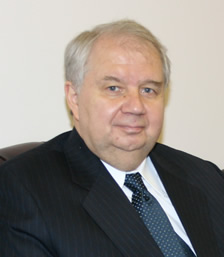
Russia’s Ambassador to the U.S. Sergey Kislyak
Kislyak was once ambassador to Belgium and to NATO. He served an eight-course Russian dinner for select guests prior to the public forum in an underground lair deep inside Observatory Hill.
Kislyak spoke to a packed auditorium at UVA and took, I think, well over an hour of questions. He spoke frankly, and the questions he was asked by students, professors, and other participants were polite and for the most part far more intelligent than he would have been asked on, for example, Meet the Press.
He told the audience that Russia had known there were no WMDs in Iraq, and had known that attacking Iraq would bring “great difficulties” to that country. “And look what is happening today,” he said. He made the same comment about Libya. He spoke of the U.S. and Russia working together to successfully remove chemical weapons from the Syrian government. But he warned against attacking Syria now.
There will be no new Cold War, Kislyak said, but there is now a greater divide in some ways than during the Cold War. Back then, he said, the U.S. Congress sent delegations over to meet with legislators, and the Supreme Court likewise. Now there is no contact. It’s easy in the U.S. to be anti-Russian, he said, and hard to defend Russia. He complained about U.S. economic sanctions against Russia intended to “suffocate” Russian agriculture.
Asked about “annexing” Crimea, Kislyak rejected that characterization, pointed to the armed overthrow of the Ukrainian government and insisted that Kiev must stop bombing its own people and instead talk about federalism within Ukraine.
There were remarkably few questions put to the ambassador that seemed informed by U.S. television “news.” One was from a politics professor who insisted that Kislyak assign blame to Russia over Ukraine. Kislyak didn’t.
Swanson’s ‘Contact’
I always sit in the back, thinking I might leave, but Kislyak was only taking questions from the front. So I moved up and was finally called on for the last question of the evening. For an hour and a half, Kislyak had addressed war and peace and Russian-U.S. relations, but he’d never blamed the U.S. for anything in Ukraine any more than Russia. No one had uttered the word “NATO.”
So I pointed out the then upcoming NATO protests. I recalled the history of Russia being told that NATO would not expand eastward. I asked Kislyak whether NATO ought to be disbanded.
The ambassador said that he had been the first Russian to “present his credentials” to NATO, and that he had “overestimated” NATO’s ability to work with Russia. He’d been disappointed by NATO actions in Serbia, he said, and Libya, by the expansion eastward, by NATO pressure on Ukraine and Poland, and by the pretense that Russia might be about to attack Poland.
“We were promised,” Kislyak said, that NATO would not expand eastward at all upon the reunification of Germany. “And now look.” NATO has declared that Ukraine and Georgia will join NATO, Kislyak pointed out, and NATO says this even while a majority of the people in Ukraine say they’re opposed.
The ambassador used the word “disappointed” a few times.
“We’ll have to take measures to assure our defense,” he said, “but we would have preferred to build on a situation with decreased presence and decreased readiness.”
Wouldn’t we all. I mean, all of us who aren’t interested in risking World War III as long as it can gin up a pretense that Hillary Clinton lost because of Russian evil.
Russia, NATO military chiefs in first high-level contact since 2014
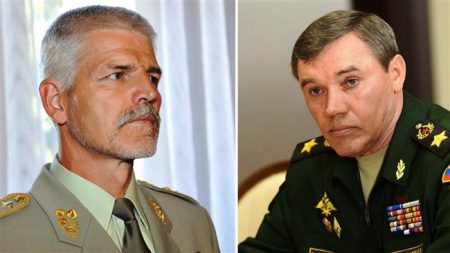
File photo shows Chief of Russia’s General Staff Valery Gerasimov (R) and Chairman of the NATO Military Committee General Petr Pavel
Press TV – March 3, 2017
In the first high-level contact after NATO unilaterally froze ties with Moscow over the crisis in Ukraine, military chiefs from Russia and the Western alliance have held a phone conversation.
“This is the first high-level military contact after the NATO Council made a decision on the freeze of relations with Russia,” Russia’s Defense Ministry said on Friday.
It also said the chief of Russia’s General Staff, First Deputy Defense Minister Army General Valery Gerasimov, had held the telephone talk with NATO’s chairman of military committee, General Petr Pavel.
The two sides, the Russian Defense Ministry said, exchanged opinions about current security issues.
The Russian side also relayed Moscow’s security concerns regarding NATO’s “considerable” buildup of military activity near Russian borders.
NATO’s headquarters in Brussels, Belgium, confirmed the phone conversation. It said “active military to military lines of communications are in the mutual interest of NATO and Russia.”
The NATO headquarters added that the frozen communication lines would “remain open,” without giving any details about what was discussed during the latest talks.
NATO severed ties with Moscow in 2014, after Crimea in eastern Ukraine rejoined the Russian Federation following a historic referendum. Since then, NATO has been deploying weapons and equipment close to Russia’s borders.
In early January, the US military began the deployment of hundreds of combat vehicles such as tanks and artillery guns along with 3,500 troops to Germany.
In mid-February, Russia’s President Vladimir Putin accused NATO of trying to embroil Moscow in confrontation by constant provocative actions.
NATO “has been expanding as it did before but now they seem to have found new serious reason to justify the bloc’s expansion and have sped up the process of deploying conventional and strategic weapons beyond the member states’ borders,” the Russian president said at a board meeting of the Federal Security Service (FSB).
Russia’s Defense Ministry said that during the phone conversation both military leaders agreed to make efforts to reduce tensions. “The sides confirmed the need of mutual steps aimed at reducing tension and stabilizing the situation in Europe.”
“The two generals agreed that they would remain in contact,” the ministry added.
Sweden reintroduces military conscription, citing alleged Russian threat
Press TV – March 3, 2017
Sweden has decided to reintroduce mandatory military service for both men and women next year, citing what it says is a military threat from Russia.
The Swedish Defense Ministry said on Thursday that thousands of male and female youths will be conscripted and selected for military training in a program starting in 2018. The decision has also been backed by the parliament.
Sweden, a member state of the European Union (EU), had ended compulsory military service in 2010.
Defense Minister Peter Hultqvist cited alleged Russian military buildup near the Baltic region and Moscow’s alleged involvement in the Ukrainian conflict as reasons for the decision. “We have more exercise activities in our neighborhood. So we have decided to build a stronger national defense,” he said.
The government will call up 4,000 men and women for military training per year in 2018 and 2019.
Back in December last year, Sweden’s Civil Contingency Agency asked local authorities across the country to improve security measures to face a possible military attack. The measures included maintaining and upgrading underground bunkers as emergency bases of operation.
According to a letter from the Agency, municipalities around the country were called to “increase their ability to resist an armed attack against Sweden from a qualified opponent.”
Sweden is not a member of NATO but cooperates closely with it.
NATO, which has suspended all ties with Russia since April 2014, has deployed thousands of its troops as well as military hardware near Russian borders. Russia has previously warned that it would take measures to respond to the increased activities near its borders.
Pentagon conducts 20 airstrikes in Yemen, first since botched raid
Press TV – March 3, 2017
The Pentagon has carried out its first major military operation in Yemen since a botched raid in January that killed women and children as well as an American commando.
US forces conducted more than 20 airstrikes involving a mix of manned and unmanned aircraft early on Thursday, the Pentagon said.
Navy Captain Jeff Davis said the airstrikes targeted al-Qaeda in the Arabian Peninsula in three south-central provinces of Abyan, Shabwah and al-Bayda.
“The strikes will degrade the AQAP’s ability to coordinate external terror attacks and limit their ability to use territory seized from the legitimate government of Yemen as a safe space for terror plotting,” the Pentagon spokesman said.
The US military did not share a casualty estimate, but local officials said at least nine suspected al-Qaeda militants were killed.
Davis said the operation was coordinated with resigned president, Abd Rabbuh Mansur Hadi, a strong ally of Saudi Arabia that has been engaged in its own military campaign against Yemen.
Troops engage al-Qaeda on the ground
Military helicopters and drones launched a flurry of fresh airstrikes in Shabwah province early on Friday, witnesses said, according to Reuters.
The raids targeted the residence of Sa’ad Atef, an al-Qaeda leader, as well as other suspected militant positions in the area.
The unidentified aircraft, believed to be American, also deployed troops to the al-Saeed area of the southern province, who engaged suspected al-Qaeda militants on the ground for nearly half an hour.
The military operations came more than a month since a January 29 raid, the first of its kind authorized by President Donald Trump, in al-Bayda which residents said left as many as 25 civilians dead.
An ongoing investigation by the US Central Command has also determined that civilians, including possibly children, lost their lives during the botched raid.
The White House hailed the operation as a success, but critics said it was a failure since it resulted in the death of civilians and 36-year-old Navy SEAL Ryan Owens.
Three other Americans were also wounded in the Navy SEAL Team Six mission and a military aircraft worth $75 million was destroyed after it crash-landed at the raid site.
Trump blames generals for botched raid
President Trump has tried to distance himself from the raid by emphasizing that the operation had been in the works long before he took office. “This was a mission that was started before I got here,” he said in an interview with Fox News this week.
“This was something that, you know, they wanted to do. They came to see me and they explained what they wanted to do, the generals, who are very respected,” the president said. “And they lost Ryan.”
During his address to a joint session of Congress on Tuesday, Trump paid tribute to the fallen SEAL, and insisted that the operation yielded valuable intelligence that would “lead to many more victories in the future.”
Some US officials, however, have disputed that claim, saying the raid gathered little, if any, workable intelligence.
The United States conducts drone strikes in Yemen and several countries. Washington claims the airstrikes target members of al-Qaeda and other militants, but according to local officials and witnesses, civilians have been the victims of the attacks in many cases.
Al-Qaeda in Yemen has grown in weapons and number since the start of the Saudi military campaign in March 2015, which was launched to bring back Hadi to power and undermine the Houthi Ansarullah movement.
House bill would slash US lethal military aid to Ukraine by half
RT | March 3, 2017
Amid a recent spike in violence in eastern Ukraine, a new bill to be introduced in the US House of Representatives proposes dramatically cutting military aid to Kiev, including lethal weapons, as well as logistical and intelligence support.
Reducing military-related costs inherited from the Obama administration is said to be the bottom line of the new 2017 Defense Appropriations bill, according to the House Appropriations Committee’s press release published on Thursday. The bill is due to be heard in the House next week.
Among other cost-saving measures, the bill proposes allocating only $150 million for “training, equipment, lethal weapons of a defensive nature, logistics support, supplies and services, sustainment, and intelligence support to the military and national security forces of Ukraine.”
While still sizeable, the figure is only half that transferred to Ukraine by the US last year. Under the 2016 National Defense Authorization Act, the US paid out $300 million to assist Kiev “in defending itself against actions by Russia and Russian-backed separatists.”
Notably, the use of funds “to procure or transfer man-portable air defense systems” is prohibited in the 2017 bill.
Low-intensity violence in eastern Ukraine quickly escalated in early February after Ukrainian government forces shelled the town of Avdeevka, which lies just 10 kilometers from Donetsk. Tanks, heavy armor, artillery, and multiple-launch rocket systems were used in what Ukrainian Deputy Defense Minister Igor Pavlovsky called a “meter-by-meter, step-by-step” advance towards Donetsk.
Reports from the OSCE’s Special Monitoring Mission (SMM) also confirmed that heavy weapons, which have long been banned under the landmark Minsk agreement, had been moved closer to the disengagement line.
Kiev has blamed the escalation on the rebels, while the OSCE says both sides of the conflict have violated the truce. In its latest report on Wednesday, the SMM said it had recorded “more ceasefire violations in both Donetsk and Luhansk regions, including more than twice as many explosions compared with the previous reporting period.”
In a February interview with Ukrainian and Russian media outlets, including RT, Ukrainian President Viktor Yanukovich, who was toppled in the 2014 Euromaidan coup, said that Kiev’s crackdown on eastern Ukraine amounted to a declaration of war on its own people.
“Of course, everyone who took part in this decision must be held responsible. This is a crime against their own people,” Yanukovich said. “The current authorities did not make a single attempt to talk to the people, who were against the coup,” he argued, adding that, instead, Kiev simply “divided the country into winners and losers,” prompting the alienation of the eastern regions.
Despite the rising civilian death toll in eastern Ukraine, the US and its NATO allies have been actively integrating Kiev’s forces into Western military structures. US Army-run exercises dubbed ‘Rapid Trident’ have been held in western Ukraine annually since 2014, while Ukrainian soldiers are often seen at various NATO-led war games in the Baltics and eastern Europe.
Read more:
NATO’s scaremongering about ‘Russia threat’ to Baltic States ‘is all about money’
RT | March 2, 2017
The US security establishment is trying to justify its existence, says Daniel McAdams of the Ron Paul Peace Institute, commenting on a new report which lists how NATO can help the Baltic States counter Russian ‘hybrid warfare.’
The American global policy think-tank, the RAND Corporation, published a report that claims NATO should do more to counter the potential Russian threat and strengthen the Baltic countries’ forces. The US government-funded body issued a report titled “Hybrid Warfare in the Baltics: Threats and Potential Responses.”
The document raises concern over “Russian use of “hybrid warfare” best understood as covert or deniable activities, supported by conventional or nuclear forces, to influence the domestic politics of target countries.”
The author of the report, Andrew Radin claims “these tactics are of particular concern in the Baltic countries of Estonia and Latvia, which have significant Russian-speaking minorities.” He warns that there is concern Russia will seek to use these minorities to gain influence in the region, “use covert action to seize territory, use subversion to justify a conventional attack, or otherwise use deniable or covert means to gain influence in the Baltics and undermine the EU and NATO.”
RT discussed the report with McAdams and asked him why potential “Russian aggression” is in the spotlight again. Is there a real threat?
In his view, what we are seeing is just another example of the national security establishment in the US “having to justify its existence.”
“The report itself outlines many things that NATO has to do to help the Baltics. The Baltics are absolutely irrelevant to the security of NATO. Their only relevance is geographic. They are close to Russia. Therefore, NATO can hold exercises on Russia’s border to provoke Russia. As far as the Baltics, look at Latvia, for example, if it is so concerned about Russian warfare or hybrid warfare, why do they spend 0.9 percent of their GDP on defense? They are clearly not worried. It really is just a ploy to get more free things from NATO. And for NATO to keep itself alive after it should have been shut down,” McAdams said.
In his opinion, “hybrid warfare” – the report refers to – is a term used when there’s no evidence that Russia has done anything wrong.
It was hybrid warfare when Russia “invaded Ukraine.” And that is just because we didn’t see any Russian military in Ukraine. It was hybrid warfare with “the little green men” in Crimea. Well, those little green men in Crimea were already there legally as part of the leased base in Sevastopol. All of these things are made up, it’s part of NATO’s ongoing aggression toward Russia, provocation of Russia and it is desperate to keep itself alive, to keep its budgets rising,” the analyst said. “And sadly, unfortunately, we are seeing that the US president who was rightly critical of NATO, calling it outdated, said in his recent speech to Congress that he loves NATO and thinks it’s great. So, unfortunately, it looks like it is going to be propped up for a while longer. And yes, it is about money,” he added.
Trump Retreats on Detente with Russia
By Gilbert Doctorow | Consortium News | March 1, 2017
Donald Trump’s speech on Tuesday to a joint session of Congress was a reasonably well-crafted and well-delivered exercise in communicating his case to the nation. The President opened with a description of the flurry of executive orders in his first 30 days in office, implementing promises made during the electoral campaign.
He then went on to describe the contours of legislation that his administration will send to Congress, starting with the budget and its scrapping of the cap on military spending, which is to enjoy a 10 percent rise in appropriations while domestic and other government spending is slashed. Then there was a review of his plans to repeal and replace Obamacare and a preview of his proposals for cutting taxes and regulations with the goal of creating more well-paying jobs.
In an emotional highpoint, Trump drew attention to the widow of a Special Forces soldier killed in a raid inside Yemen. He also presented a more compassionate – less combative – tone, calling on Democrats and Republicans to put aside their differences and work together. His 60-minute address was interrupted 93 times by applause, often standing ovations from Republicans but also some applause from the Democratic side, too.
Trump seemed to bask in the enthusiastic show of support, although such State of the Union speeches typically draw the same sort of surface adulation, with the members from the party in power cheering robustly and those from the other side offering sparser shows of support. Still, the televised images contrasted with the portrayal from the mainstream U.S. news media of an embattled leader caught in a Watergate-like scandal over supposedly illicit contacts with Russia, a narrative Trump mistakenly fed with the hasty firing of National Security Adviser Michael Flynn on Feb. 13 during a media frenzy about Flynn talking with the Russian ambassador during the transition.
Flynn became the target of elements inside the U.S. government and the press who opposed Trump’s plans for détente with Russia. Those anti-détente forces are now flexing their muscles, with U.S. Ambassador to the United Nations Nikki Haley sounding much like her hawkish predecessor Samantha Power, insisting that the United States will not recognize Russia’s takeover of Crimea and then, this week, co-sponsoring a resolution in the U.N. Security Council condemning the Assad regime in Syria for allegedly using chemical weapons, a move that provoked angry protests and a veto from Russia’s envoy.
Meanwhile, Vice President Mike Pence, Secretary of State Rex Tillerson and Defense Secretary James Mattis carried messages to Europe reaffirming the U.S. commitment to NATO allies and blaming Russia for the failure of the Minsk Accords to resolve the crisis in Ukraine (although a major obstacle was created by the Ukrainian government when it insisted that ethnic Russian rebels in the Donbass region effectively surrender before other steps would be taken). The U.S. statements could have been delivered by neoconservative and liberal-interventionist diplomats from the past several U.S. administrations.
Only the last five minutes of Trump’s address to Congress dealt with foreign relations. And his own words were consonant with what his cabinet officers had been saying. Trump’s campaign opinions about NATO’s obsolescence had disappeared. Russia was not mentioned by name once in the speech, while America’s allies in NATO and in the Pacific were reassured that “America is ready to lead.” That statement was a rare instance when the entire congressional audience rose to its feet in applause.
Back on His Words
Those who had feared that Trump’s populism and “America First” rhetoric spelled isolationism were reassured that “Our foreign policy calls for a direct, robust and meaningful engagement with the world.”
In fact, in the entire speech, there were only a few lines toward the end that might give heart to those who hoped that Trump might pursue a dramatically new foreign policy that drew back from America’s vast network of military bases and the tendency to intervene in other countries’ affairs.
Though sounding not unlike boiler-plate language that Presidents George W. Bush and Barack Obama might have used, those words did contain the possible seeds of a less warlike strategy. Trump said: “America is willing to find new friends and to forge new partnerships where shared interests align. We want harmony and stability, not war and conflict. America is friends today with former enemies. We want peace, wherever peace can be found. America is friends today with former enemies. Some of our closest allies decades ago fought on the opposite side of these terrible, terrible wars.”
Depending on the strength of one’s powers of self-delusion, those last words might be construed as a hint: just wait, allow me to get my footing and establish my popularity in Congress and in the broad public and I will come back and deliver on my détente aspirations.
But it is an inescapable reality that the firing of Flynn and Trump’s retreat from his foreign policy intentions were precipitated by the powerful collusion between the intelligence services, particularly the CIA, and the mainstream media with a clear intent to either neuter Trump by forcing a policy reversal on Russia détente or remove him through some form of impeachment. The phoniness of the McCarthyite charges of Russian connections used to smear Trump and his entourage has been well explained in recent articles by Professor Stephen Cohen in The Nation and by Gareth Porter at Consortiumnews.com.
Those with a more conspiratorial turn of mind have long spoken of the Deep State, which ensures continuity of policy whatever the results of U.S. elections with this subterranean power residing largely in the intelligence services, especially the CIA and FBI, in the Pentagon, and in the State Department.
State is said to have been purged in its policy-making “seventh floor” during the week of Secretary Tillerson’s European travels. But the text that was placed before the inexperienced Ambassador Haley for delivery in the Security Council shows that not all the old actors have been sent packing. Any purge of the CIA and Pentagon has not even begun.
The ability of neocons and hardliners at the Pentagon to sabotage presidential policy was demonstrated last September when a promising collaboration between Secretary of State John Kerry and Russian Foreign Minister Sergey Lavrov over a cease-fire in Syria was torn to shreds by an “accidental” attack by U.S. and Allied fighter jets on a Syrian government outpost at Deir ez-Zor that killed nearly 100 Syrian soldiers.
If these recalcitrant Cold Warriors in America’s “power ministries” remain untouched, they will be in a position to create provocations at any time of their choosing to override Trump’s planned détente policies. To do so would be child’s play, given the close proximity of U.S. and Russian forces in Ukraine, in Syria, in the Baltic States, on the Baltic Sea and on the Black Sea.
Given the poor state of relations and the minimal trust between Russia and the U.S.-led West, any accident in these areas could quickly escalate. And then we might see the side of Donald Trump’s personality that his Democratic opponents warned us about, his short temper and alpha-male nature which could bring us into an armed clash the outcome of which is unforeseeable but surely not good.
There is another troubling issue for those who hoped Trump would rein in military spending to finance his promised domestic infrastructure investments. Instead, Trump has focused on expanding military spending even more, financed by cuts in domestic spending. There has not been a word to suggest he is considering restructuring the $600 billion military appropriations, for example by cutting the military bases abroad, which are configured to support precisely the global hegemony and American imperialism that he has denounced.
What is at issue is not only the tens of billions of dollars in savings that would come from slashing this overseas base structure but also removing an American presence from countries where it only serves to foster anti-Americanism and to embroil us either in defending hated regimes or intervening in regional conflicts where we have no vital interests.
Without restructuring and reducing the gargantuan network of foreign military bases, the U.S. will be condemned to a never-ending succession of wars abroad and the entire plan of investment in America is doomed to failure. These are not issues that allow for tactical retreats but rather must be addressed head-on. But who will explain this to a headstrong President with the fawning applause of Congress ringing in his ears?
Gilbert Doctorow is a Brussels-based political analyst. His latest book, Does Russia Have a Future? was published in August 2015.
A Paradigm Shift in the Middle East: Iran as the Solution, Not the Problem

Photo by Always Shooting | CC BY 2.0
By Behrooz Ghamari Tabrizi | CounterPunch | February 28, 2017
A well-orchestrated alliance emerged against Iran during last week’s Munich Security Conference. The stage was set by Mike Pence after he called Tehran “the leading state sponsor terrorism,” and accused the Islamic Republic of continuing to “destabilize the Middle East.” Further, to reiterate the Trump administration’s dissatisfaction with Obama’s policy toward Iran, he speculated that with “the end of nuclear-related sanctions, Iran now has additional resources to devote to these efforts.”
One after another, representatives of Saudi Arabia, Israel, and, surprisingly, Turkey added their warnings about the rise of the Iranian menace and called for a united front to combat Iranian regional and global ambitions. The Saudi Foreign Minister, Adel al-Jubeir told delegates at the conference “Iran remains the single main sponsor of terrorism in the world.” Iran is, he said, “determined to upend the order in the Middle East.” In an act more reminiscent of a scene from a theater of the absurd, the Israeli Defense Minister, Avigdor Lieberman, declared “Iran had an ultimate objective of undermining Saudi Arabia in the Middle East.” He called for a multilateral dialogue with Sunni Arab states to defeat Iran and its “radical” elements in the region. This was not the first time that the Saudi and Israeli positions on the Middle East security coincided, but the similarities in the way Lieberman and al-Jubeir articulated their grievances against Iran, using the exact same language in listing Iranian transgressions was unprecedented.
Rather bewildering was the Turkish foreign minister, Mevlüt Çavuşoğlu, who added his voice of discontent with Iran and joined in the same vein to call for a concerted international effort against what he termed “an Iranian sectarian policy to undermine Bahrain and Saudi Arabia.” He told a friendly audience in Munich that Turkey will not tolerate divisive religious or sectarian policies and, he continued, “we are now normalizing our relations with Israel.” Çavuşoğlu’s address was particularly baffling since it came following a complex series of negotiations and agreement that was reached earlier this month between Russia, Turkey and Iran for a cooperation to end Syrian bloody civil war.
The Trump administration and a significant number of lawmakers, Republican and Democrats, will almost certainly use the display of unity among regional powers against the Islamic Republic to justify new sanctions on Iran. But why, despite the clear evidence to the contrary, are the U.S. and its allies in the region holding Iran solely responsible for destabilizing the Middle East? There are two, one geo-political and the other pure economic, reasons for such a flagrant distortion of realities on the ground.
From the early days of the Iranian revolution in 1979, the main strategic interest of the U.S. and its corrupt Arab allies have been to fend off the Iranian ambition of exporting its revolution. At the time, it was the stated purpose of the Islamic Republic to spread the message of what they believed to be the Islam of the downtrodden abroad. Almost four decades later, surviving an eight-year war with Saddam Hussein, which he fought on behalf of the  concerned Arab nations (with the exception of Syria) and their Western supporters, consolidating power by eliminating most opposition forces inside the country, and managing a beleaguered economy plagued with ongoing regimes of sanctions, the Islamic Republic has been transformed. At the end of the war with Iraq, it became evident that the mantra that the regime in Tehran now followed, as Henry Precht, the former head of the State Department’s Iran desk, once said, was not dominion abroad, but economic and political independence at home. Rather than an irrational ideological fervor, the Islamic Republic’s policies are primarily motivated by domestic stability, security, and economic growth. Iran has always been more sympathetic to the Christian Armenia than to Muslim Azerbaijan in their border disputes, more interested in closer ties with India than Pakistan, and in order to protect their trade relations with China, remained silent when the Chinese violently suppressed the grievances of their Muslims.
Domestically, Iran has also changed significantly since the brutal years of the 1980s reign of terror. There exists a vibrant and growing civil society, more than fifteen independent newspapers are published in Tehran, meaningful presidential and parliamentary elections with real participation and rivalries happen, unlike the a commonplace perception, women participate in social life despite patriarchal laws and cultures, more than 60% of university students are women. I do not intend to draw a rosy picture of Iran, the Islamic Republic is not a democratic regime, but in all cases it is certainly more democratic than all our allies in the region.
Oil is not the only rationale that defines our economic interest in the Middle East. Since the end of the Cold War, the U.S. arms sales in the Middle East have been rising exponentially. As a recent report by Stockholm International Peace Research Institute shows, more than half of the total American arms export goes to the Middle East. During the last four years the sales of arms to the Middle East has doubled. Saudi Arabia’s arms import has increased 212 percent from 2012 to 2016. During the same period Qatar’s import of weapons surged 245 percent. Saudi Arabia spends 25 percent of its budget, $85 billion a year, more than that of Russia, on defense. Last year the Obama administration approved a $38 billion military aid package to Israel for the next ten years. One-third of the world’s arms deals happen in the Middle East. All this happens when Iran uses only 2.5 percent of its national budget on defense and relies mostly on domestic production of weapons rather than on a shopping spree in the global arms market.
A military industrial complex has taken American foreign policy hostage. It has colonized American foreign policy through a marketing strategy that perpetuates hostilities and generates animosity between different nations. It has promoted an arms race, particularly in the Middle East, that is draining the resources of nations around the world and is weighing heavily on the shoulders of American taxpayers. Military aid to our allies in the region is nothing but a transfer of wealth from ordinary Americans to defense contractors. None of these sales and aid packages would be justifiable if it were not for the existence of an enemy such as the Islamic Republic of Iran reproduced in Pence’s caricature, an irrational, ideological nemesis that does not respond to conventional deterrence and needs to be forced into submission to our demands.
Washington needs to transcend its old-age reliance on allies in the Middle East whose interests are increasingly becoming detrimental to peace and stability in the region. The problem in the Middle East is not about Sunni and Shi’ite rivalry, it is not even about Israeli and Palestinian existential animosity. What plagues the Middle East is the narrow-mindedness of its ruling elites, both elected and self-appointed, who have failed to represent and safeguard the interests of their own people. Since the end of WWII, Washington’s policy has been exclusively based on securing economic and geo-political interests of American energy and military industrial corporations. Time has come for the U.S. to rethink its alignment with old patriarchal powers and to look beyond its narrow economic interests in the rising arms race in the Middle East. Extending and expanding sanctions against Iran would be an irreversible step toward opening a new war front, one with broader and more catastrophic consequences around the world.
Check out Behrooz Ghamari-Tabrizi’s new books, Remembering Akbar and Foucault in Iran.
US Navy’s Own Report Indicates Washington is Looking for a Pacific Fight
By Ulson Gunnar – New Eastern Outlook – February 27, 2017
The Pacific Ocean is large. Since World War II, weapon systems operating in this theater have required special provisions regarding extensive range, long duration performance and relative self-sufficiency during operations.
From America’s Gato-class submarines and PBY Catalina flying boats used to fight the Japanese and reassert American hegemony across Asia-Pacific during WWII, to America’s continued presence in Japan, South Korea and islands throughout the region, it is clear the lengths the US has gone through then and now to remain “engaged” in the Pacific.
More recently, a report by the Center for Strategic and Budgetary Assessments (CSBA), commissioned by the US Navy titled, “Restoring American Seapower: A New Fleet Architecture for the United States Navy,” obsesses over not how to defend American shores, but how to remain involved in Asia-Pacific despite the immense distances between there, and America.
The report’s introduction includes:
Great power competitors such as China and Russia increased their military capabilities over the last two decades and now appear willing to challenge the international order.
However, the report never addresses Chinese or Russian forces landing on American shores, or even threatening to do so. Rather, the report revolves around maintaining hegemony within spheres of influence much more appropriately (and likely inevitably) Chinese or Russian.
The report coins a term, “deny-and-punish” to describe the use of US power abroad to “stop aggression,” not in defense of America itself, but in “adjacent theaters.” Ironically, the report cites Iraq as an example, a nation the US, not China nor Russia, invaded, occupied and destroyed with considerable, unchallenged “aggression.”
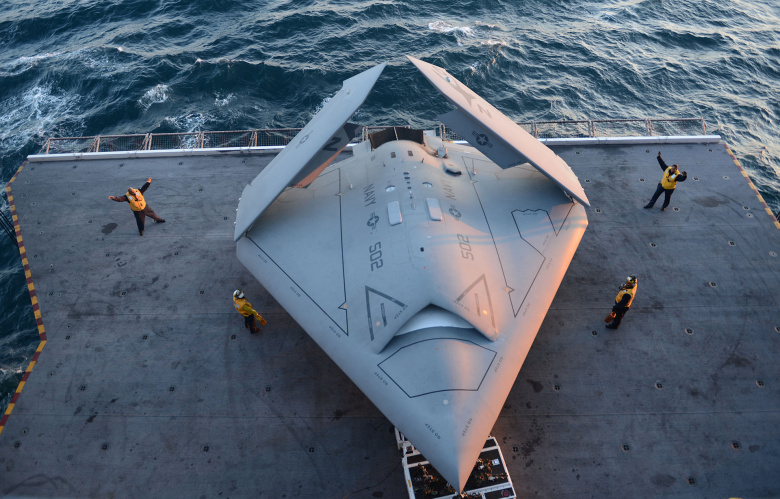
A more specific point in the 162-page report picked out by The National Interest in an article titled, “How to Guarantee America’s Aircraft Carriers Can Fight China in a War,” involves long-range air sorties of up to 2,000 miles.
The article elaborates:
…a 2000-mile mission would strain human endurance and an unrefueled range of more than 10 hours would require an enormous aircraft that might not fit on a carrier flight deck. Thus, the CSBA proposal calls for a smaller aircraft that would be supported by a tanker.
In other words, in order for the US to project considerable force beyond its own borders, across the Pacific Ocean, and within China’s logical, proximal sphere of influence, it needs not only drone aircraft capable of 10 hour sorties, it needs drone tankers to refuel them.

Defense contractors surely welcome the report’s findings, since it will require the development of not one new aircraft carrier-based vehicle, but two, including the tanker.
The CSBA report concludes by stating:
To be deterred in the 2030s, aggressors must be presented with the possibility that their goals will be denied or that the immediate costs to pursue them will be prohibitively high.
In reality, the “aggression” the United States fears is not the unjust encroachment on other, innocent nations, but rather the undoing of every aspect of its own global order, put together piece by piece through just such aggression. It is an order constructed not within any rational US sphere of influence, rather, one spanning the globe, so far from American shores combat pilots lack the endurance to fly the sorties required to “deter” other nations from reversing America’s grip upon it.
The US seeks to “deter aggression” that may potentially diminish or extinguish entirely America’s systematic and decades-spanning violation of Beijing’s “One China” policy regarding Hong Kong and Taiwan, China’s claims in the South China Sea or regimes the US puts into power along China’s peripheries to admittedly confound regional stability at Beijing’s expense,
Students of history will recognize much of this as a modern-day continuation of European colonization throughout Asia, where sophisticated and overbearing military might was used to corner China and its neighbors across the region, divide and conquer them, as well as prevent them from ever rolling back any of the gains colonial expansion gifted Europe and eventually America in the late 19th century.
The CSBA report is just one of many US policy papers that openly and repeatedly admits that China is not a threat to the United States as a nation, but a threat to the hegemonic order that nation attempts to maintain globally well into the 21st century.
And while the US seeks drone forces to bridge the vast distances between American territory and the territory it seeks to continue dominating, China and Russia are likewise developing weapons systems to make those vast distances greater still. While the CSBA report places urgent imperative in preventing China or Russia from exerting influence within their own territory or along their immediate peripheries, the final conclusion of this new arms race in long-range weapons systems may force the US to accept a reality in which the only region it dominates is the US itself. But the obvious question remains, why isn’t that already the case?
Trump’s Embattled ‘Revolution’
By Alastair Crooke | Consortium News | February 25, 2017
Pat Buchanan – perhaps the U.S. politician with the greatest feel (as a thrice-times U.S. presidential candidate himself) for what President Trump is trying to achieve – tells us compellingly, just why Trump is now the US President:
[Simply,] …“He [Trump], read the nation and the world, better than his rivals. He saw the surging power of American nationalism at home, and of ethno-nationalism in Europe. And he embraced Brexit. While our bipartisan establishment worships diversity, Trump saw Middle America recoiling from the demographic change brought about by Third World invasions. And he promised to curb them.
“While our corporatists burn incense at the shrine of the global economy, Trump went to visit the working-class casualties. And those forgotten Americans in Pennsylvania, Ohio, Michigan and Wisconsin, responded. And while Bush II and President Obama plunged us into Afghanistan, Iraq, Libya, Yemen, Syria, Trump saw that his countrymen wanted to be rid of the endless wars, and start putting America first. [And] He offered a new foreign policy … Putin’s Russia is not ‘our number one geopolitical foe.’”
That’s it. That’s Trump’s domestic, and his foreign policy, in one.
What we all presently are obsessed with, is the bellicosity and hysteria to which Trump and his agenda has given rise: Is détente with Russia now effectively dead, as a consequence of the new Russo-phobic McCathyism? Or, is that which we are witnessing nothing more than “a mere tantrum by a clutch of ‘spooks’ whose jobs are under threat … along with the liberal press having a ‘parallel tantrum’: [not believing] that they lost the election to Donald Trump” – as one American commentator told MK Bhadrakumar? Or, are we seeing a brittle American Establishment splitting apart, in a more profound way?
We do not know the answer. The notion of removing Trump from office seems somewhat far-fetched (see here). Certainly, America is deeply divided: Trump plainly evokes strong, emotional reactions. Three-fourths of Americans react to him strongly – either positively or negatively.
The Pew Research Center’s latest survey shows that only eight percent of Democrats and Democratic-leaning independents approve Trump’s job performance, which is the lowest rating for any new president from the opposing party in more than three decades. But interestingly, Pew also finds that 84 percent of Republicans and Republican-leaners, regard Trump’s initial job performance as president “favorably.”
A Divided Administration
But then, Gilbert Doctorow relates, as the new Administration got underway, “came a stunning about-face in the early roll-out of Donald Trump’s new foreign policy, which looked a lot like Barack Obama’s old foreign policy. We heard presidential press secretary Sean Spicer say Trump ‘expected the Russian government to … return Crimea’ to Ukraine.
“Then we heard Defense Secretary James Mattis in Brussels (NATO headquarters), Secretary of State Rex Tillerson in Bonn (G20 Foreign Ministers meeting) and Vice President Pence in Munich (Security Conference) collectively pledge unswerving loyalty to the NATO alliance, insist that any new talks with Russia must be conducted from ‘a position of strength,’ and vow to hold Russia accountable for the full implementation of the Minsk Accords, meaning all sanctions stay in place pending that achievement which the Ukrainian government has consistently blocked, while blaming Moscow.
“Amid these signals of surrender from the Trump Administration – suggesting continuation of the disastrous foreign policy of the last 25 years – the newly revived enemies of détente on Capitol Hill added more anti-Russian sanctions and threats. In response to alleged violations by the Kremlin of the Treaty on Intermediate and Short-range Missiles (INF) dating back to 1987, Sen. Tom Cotton, R-Arkansas, introduced a bill enabling the re-installation of American nuclear-tipped cruise missiles in Europe. If enacted, this would undo the main achievements of disarmament from the Reagan years, and bring us back to a full-blown Cold War.”
This has unnerved Trump supporters; apparently disappointed some in Moscow; and also failed to reassure anxious Europeans at the Munich Security Conference. They are puzzling over which Administration faction to believe more correctly reflects future U.S. policy: the Pence/Mattis/Haley ‘wing’, that Europeans would like to hope is dominant; or, the Trump/Bannon/Miller triumvirate, which Steve Bannon hints views the European Union as a flawed construct, and who foresees conducting future relations with Europe, on a bilateral basis.
Which of these two, reflects America’s likely path, more accurately? Has the Establishment now succeeded in walking-back Trump’s agenda? Who now speaks for the President?
The answer is not hard to fathom: return to Pat Buchanan’s clear explanation of how Trump became President: “He saw the surging power of American nationalism at home, and of ethno-nationalism in Europe. And he embraced Brexit. While our bipartisan establishment worships diversity, Trump saw Middle America recoiling from the demographic change, brought about by Third World invasions. And he promised to curb them.”
Obviously, it is the Trump-Bannon wing. Were Trump to abandon his reading of the nation and of the Europeans that brought him to the Presidency, he might as well throw in the towel now. He will not be re-elected.
Weakening the Dollar
And Mr. Trump is showing no signs of reversing (for all the mixed messaging that has emanated from his diverse team). So, back to basics. What then is his foreign policy? Simply this: If President Trump wishes to keep his 84 percent (Republican) approval rating – and stay elected – there is only one way that he can do that: he must continue to carry “the working-class casualties and those forgotten Americans” (as Buchanan called them) of the Midwest, Michigan, Indiana, Ohio, Wisconsin and Pennsylvania.
And the only way to do that is to bring back manufacturing jobs to this (white), Middle America, (hurting) constituency. And the only way you can bring those jobs back, is with a weak dollar. A strong dollar would be deadly to Trump’s project.
Today, the dollar is too strong to allow any real return of manufacturing to the U.S. Trump needs to staunch any propensity for the dollar to rise. And, in his very first interview upon taking office (with the Wall Street Journal), Trump’s main point, was that he wanted the U.S. dollar “down.”
Here it is, then: Trump’s main foreign policy objective is the return of jobs to Middle America – and that means, in practical terms, avoiding a strong dollar. Secondly, the ultimate point of détente with Russia – apart from Trump’s reading that Middle America is experiencing war fatigue – is that détente can release a “peace dividend” which would be vital for the task of rebuilding America’s frayed infrastructure. (His tax proposals ultimately will have to be revenue neutral if Trump is to avoid an ugly row with his Tea Party supporters, who are aggressively fiscal conservative.)
Again, détente with Russia is a domestic need, required to attend to the re-building of the frayed structures of the communities who voted him into office. It is not anchored in any particular foreign policy ideology, but merely in a sense of peoples’ fatigue.
Of course, wanting a weaker dollar and wanting détente with Russia, does not mean that Trump will get either; he will continue to face stiff internal resistance and filibustering. But these two aims, as it were, may be seen to constitute the overriding prism by which Trump views his foreign policy aims, in the longer term.
In the shorter term – perhaps – what we are seeing now, is a tactical pause, dictated by the malicious leaks from within the system, and by the unrelenting “war” being waged by the mainstream media – a pause to allow Trump to get on with sorting out his Administration – purging the leaks, putting in place his people, and contending with certain of the mainstream media.
It seems the purge is slowly happening (it must be a huge process, and be imposing a heavy demand on time). It is however, simply not very realistic for Trump to pursue an accord with either Russia or China while he is under siege, and when his very survival is being widely questioned. And, as is now widely known, Trump believes in negotiating from a position of strength, and not weakness. Pence and Mattis may well have been dispatched to Europe to apply some anaesthetizing balm, while the difficulties of the first month are being resolved.
So, how might this “foreign policy” be conducted in practice? Well, if Trump were to impose protectionist measures on other states (China, say), this would likely result in their currencies depreciating, as a consequence. A 30 percent tax might result in a 30 percent currency devaluation. We have seen something of the sort happening with the peso, in the case of Mexico. And, ipso facto, if the Mexican or Chinese currency weakens, the dollar appreciates (thus weakening U.S. capacity to compete).
There are two possible routes ahead: one is for Trump to negotiate bilaterally with (say) Germany, Japan, China and others, to warn them that either they revalue their currencies (or, at minimum, hold their foreign exchange value stable), or else to suffer the consequences of a U.S.-imposed protectionism, which would badly damage the health of their economies.
Or, Trump can revert to the Reagan tactic of the mid-1980s, when the then the U.S. President pulled together all the main global central banks and finance ministers in Paris, to instruct that the dollar was not to be allowed to rise in value any further (after its rapid appreciation in the early 1980s). This was known as the “Plaza Accord.”
Going with ‘Bilateralism’
It seems that Trump will pursue the first course (bilateralism), as he has already made it clear that he wants to negotiate on a fuller field than just the stability of foreign exchange values. Specific trade deals, and inward investment into the U.S., will be on the agenda – as well as his declared aim of leveraging U.S. defense provision as a bilaterally negotiated quid pro quo, in return further economic benefit to the U.S. – rather than having the U.S. defense umbrella being provided as a highly subsidized “good.”
The implications of this bilateral approach are significant. It does not imply, per se, that Trump should want to split Russia from China. Trump, by his own logic, would not want, ultimately, to resort to protectionism against China (other than as a negotiating ploy). Imposing punitive tariffs on China would likely lead to a strengthening of the dollar, and risk a devaluation of the yuan – even possibly a maxi-devaluation of the yuan. Rather, he wants a deal. One that would bring additional jobs and Chinese infrastructure investment to America.
The notion that America needs to divide Russia from China (or Iran) for strategic reasons (though one probably embraced by some of his team) is essentially “old think.” It belongs to the neoconservative era, which held that America must remain as a global defense and financial hegemon. And therefore must contain and weaken any contending rising power.
Russia will not, in any case, break with China. But in the Trumpian logic, why should that matter, so long as Trump has achieved satisfactory commercial deals with each? (Kissinger though, may try to persuade Trump otherwise.)
Again, pursuing the war on radical Islam (for which Trump has called for proposals from the Pentagon) would not necessarily call for decisive military U.S. interventions in the Middle East, on this logic. A change in policy, and in ethos, by a reformed CIA – away from using radical Islam as “a tool” by which to pursue its “interests” (as it has from Afghanistan in the 1980s to Syria in recent years), would in and of itself, bring about a profound change. It would quickly percolate through to European intelligence services – and more slowly – marinate Gulf thinking.
Changing the ‘Group Think’
Pat Lang, a former senior U.S. Defense Intelligence officer, notes how a small shift in bureaucratic “group think” from one paradigm to another can bring crucial change, simply by virtue of approaching a problem from a different direction:
“1. General Dunford, USMC, the uniformed head of the US armed forces, is meeting this week at Baku in Azarbaijan with General Gerasimov, the head of the Russian General Staff.
“2. My sources tell me that US and Russian air forces are increasingly coordinating and de-conflicting their air actions in Syria and Iraq. This can clearly be seen in USAF and US Navy air attacks on ‘moderate’ (in fact jihadi forces) in Idlib Province. These obviously have been coordinated with Russian air defenses.
“3. The CIA has stopped providing assistance to aforesaid ‘moderate’ jihadi and FSA forces in Syria. They would not have done that without instructions from outside and above CIA.
All of that tells me that sanity reigns in the Trump Administration no matter what lunatics like Schumer, Waters and McCain may do, think or say.” (emphasis added).
What then are the major risks to the Trump “paradigm”? They are not negligible. Any increase in international tension usually will lead to a flight to the “safety” of the U.S. dollar – thus to a “strengthening” of the dollar. (One good reason why Trump may stick with rhetoric against Iran, rather than action).
Secondly, although Trump has been trying to “talk down” the value of the U.S. dollar, most of his policies (de-offshoring of corporate cash, de-regulation and tax cuts) are seen as inflationary – and therefore are pushing the dollar upwards. So, too, are pronouncements by the Federal Reserve about the prospects for an interest rate hike next month. It is not clear that Trump will be able to keep the dollar weak, against a general sense that interest rates are heading upwards. David Stockman’s inflation index for the U.S., which uses more realistic values for energy, food, shelter and medical insurance than the official CPI index, is now rising at better than a 4 percent annual rate.
And thirdly, China may yet undo Trump’s plans. As one well-versed economic commentator notes:
“I strongly contend that a more than one-half Trillion ($) one-month Chinese Credit expansion in early 2017 will exert divergent inflationary impacts to those from early 2016…
“Inflationary biases evolve significantly over time… Liquidity will tend to further inflate the already inflating asset class(s); ‘hot money’ will chase the hottest speculative Bubble. Inflationary surges in Credit growth can, as well, have profoundly different impacts depending on inflationary expectations, economic structure and the nature of financial flows.
“I would argue that Chinese officials today face a more daunting task of containing mounting financial leverage and imbalances than just a few months ago. The clock continues to tick, with rising odds that Beijing will be forced to take the types of forceful measures that risk an accident.”
These inflationary risks threaten Trump, more than the unlikely prospect of impeachment. He has been consistent in warning that whomsoever won this Presidential election, would, sooner or later, face a financial crisis – and then possibly a concomitant social crisis. Like most revolutions, Trump’s revolution cannot afford to stand still: if it cannot, or does not, go forward, it will go backwards. We will return to the past. Trump, no doubt, grasps this.
Alastair Crooke is a former British diplomat who was a senior figure in British intelligence and in European Union diplomacy. He is the founder and director of the Conflicts Forum.
Featured Video

Racist Seinfeld Dances for Joy as Bibi Unveils His New Map
or go to
Aletho News Archives – Video-Images
TV Drama Review
Japanese drama projects Japan’s wartime atrocities onto Chinese characters

Global Times | October 25, 2026
By portraying Chinese characters as perpetrators of ruthless violence while casting Japanese Self-Defense Forces (SDF) intelligence operatives as defenders, the season 2 of the Japanese drama Vivant has recently drawn criticism from Chinese netizens, who argue that its depiction turns historical reality on its head while ignoring Japan’s wartime atrocities.
The TBS drama series – a spy suspense story in which an alleged unofficial intelligence unit of the SDF operates across the globe — has attracted a passionate fanbase. Its currently airing season 2 opened with a household rating of 18.8 percent, the highest for a TV drama this year, according toa commentary article by Japanese media Toyo Keizai.
What draws attention is the portrayal of the enemies in the series, the article noted. Scenes in which the Chinese organization subjects kidnapped members of the SDF unit to brutal torture are repeated with unrelenting intensity.
It is rare for Japanese TV dramas to explicitly portray a real-life country as the enemy, the article noted.
Japanese Prime Minister Sanae Takaichi also made a reference to the drama, saying that she has been recording Vivant and hopes to binge-watch it over the year-end and New Year holidays, according to Japanese media outlets.
China’s CCTV News report on Sunday revealed that the drama features scenes in which Chinese personnel cut off the fingers of and stab Japanese intelligence operatives in the abdomen. Such acts bear striking similarities to the torture inflicted on Chinese nationals by invading Japanese troops during the World War II.
The drama distorts the truth by attributing these atrocities to modern Chinese characters. Beneath the surface, it subtly glorifies Japan’s cross-border overseas operations, blurs the functional boundaries of the SDF and implicitly promotes an expansionist narrative, per CCTV News. … continue
Blog Roll
 Aletho News
- Up in arms… Koreans reject U.S. empire’s plan to make South Korea the next Ukraine
- Iran, Turkey, Pakistan, Saudi Arabia could advance region-led security framework in Tehran: FM spox
- Netizens condemn Japanese drama for projecting Japan’s wartime atrocities onto Chinese characters
- Racist Seinfeld Dances for Joy as Bibi Unveils His New Map
- A West Bank War for Netanyahu’s Election Campaign, Could It Backfire?
- Yemen denounces European Parliament’s ‘hypocritical’ push to blacklist Ansarullah
- Qalibaf: UAE’s UN bid aims to ‘clear the runway’ for ‘Greater Israel’, whitewash genocide
- Pakistan reopens Iran border after boosting security: Report
- Why are so many Brazilians voting for Flávio Bolsonaro?
- Democrats Put Anti-Russia Agenda Ahead of American Workers
- If Americans Knew
- An error has occurred; the feed is probably down. Try again later.
- No Tricks Zone
- Sudden Stratospheric Warming, Powerful El Niño Combination May Lead To Extreme Europe Cold, Energy Crisis!
- Two New Studies Find Thwaites Glacier Melt Cannot Be Driven By Human Activity Or A Warming Ocean
- E-Cars Reduce CO2 Emissions By Only 41% Compared To Internal Combustion Engine Vehicles
- Predictions Made By Renowned Climate Professor Over Past Decades Have Been Proven To Be Poor
- New Study Suggests Large Regions Of The Pacific Ocean Have Been Cooling For The Last 80 Years
- Germany’s Green Energy Debacle: High Energy Costs Force Kahla Porzellan to Close After 182 Years!
- New Study: 50 Years Of The Most Aggressive ‘Net Zero’ Policies Can Only Affect The Global Climate By 0.03°C
- US September “Heat” Was No Record…Many Records Set Decades Ago
- Latest European Green Energy Debacle; Portugal’s Largest Flagship Solar Park Insolvent!
- Green Energy Debacle: German Expert Professor Fritz Vahrenholt Warns Of Severe Economic And Social Consequences

