‘Aggressive Plans’ Behind US Repeatedly Accusing Russia of Violating INF Treaty
Sputnik | March 12, 2017
On Wednesday, the United States once again accused Russia of violating the Intermediate Nuclear Forces (INF) Treaty, an allegation repeatedly denied by Moscow.
Speaking in Congress, a senior US general said that Russia has allegedly deployed prohibited cruise missiles with a range of 500-5,000 kilometers.
“We believe that the Russians have deployed a land-based cruise missile that violates the spirit and intent of the Intermediate Nuclear Forces Treaty,” Gen. Paul Selva, the vice chairman of the Joint Chiefs of Staff, told the House Armed Services Committee.
The general added that by deploying prohibited missiles, Moscow poses a threat to “NATO and to facilities within the NATO area of responsibility.”
Earlier, the US had accused Russia of developing a ground-based analogue of the Kalibr-NK cruise missile and concealing the capabilities of the Iskander tactical missile system.
In mid-February, American senators also submitted legislation to toughen Washington’s stance on the INF Treaty, presuming funds for active defense measures and a retaliation strike. Moreover, the proposed bill would also enable transfer of INF missile systems to US allies.
Commenting on the allegations, Viktor Ozerov, the chairman of the Russian upper house of parliament’s defense committee, said that Russia has not violated the agreement.
“Russia strictly observes the agreement signed by Mikhail Gorbachev in 1987, despite the fact that, according to our evaluations, the agreement was not in the interests of the USSR and then Russia. In particular, it should be taken into account that the US has deployed missile systems and missile defenses in several European countries,” Ozerov said.
Aggressive Trend
Moscow and Washington have occasionally exchanged accusations of violating the INF Treaty. From time to time, Washington’s claims sound absurd; for example, calling to expand the treaty to include the RS-26 Yars-M mobile missile system, which possesses an operational range of 6,000-11,000 km.
The system, which has nothing to do with short-range and medium-range missiles, is expected to enter service with the Russian Strategic Forces in 2017. The missile is believed to be imperceptible for existing and advanced missile defenses.
“Probably, the US is concerned with its own exposure to a retaliation strike by the Russian Strategic Forces, rather than the security of its European allies. As a result, Washington has been engaged in complicated maneuvers, including inflating the mythical ‘Russian threat,’ strengthening NATO, expanding it to the east and accusing Russia of violating the INF Treaty. At the same time, the US continues to deploy its missiles across Europe,” Russian journalist and political commentator Alexander Khrolenko wrote in a piece for RIA Novosti.
According to the author, all of the above further contribute to the familiar American trend of resolving “geopolitical tensions by force” bypassing international law and the UN Security Council.
“However, there cannot be ‘shock and awe’ for Russia efficiently countering the pressure from the US and NATO. Probably, Washington’s allegations against Moscow [over INF Treaty violations] are only a façade for aggressive plans,” Khrolenko suggested.
Compromise
The Intermediate-Range Nuclear Forces Treaty is an indefinite agreement signed between the US and the Soviet Union in 1987. It came into effect on June 1, 1988.
The treaty prohibited the production, testing and deployment of ground-based ballistic and cruise missiles, with ranges of 500-1,000 km (short-range) and 1,000-5,000 (medium-range). It also banned all launchers and ground-based missiles with a range of 500-5,500 km.
By summer 1991, the USSR eliminated 1,846 missiles systems, while the US – 846 systems.
A longtime standoff between Washington and Moscow in the mid-1970s resulted in the creation of advanced missile target seekers, including laser and infrared systems. They guaranteed an unprecedented accuracy of a missile strike. In 1974, the US codified its limited nuclear war doctrine in the national nuclear strategy and began upgrading its forward bases’ missile defense system for European allies.
In 1977, Moscow responded with upgrading its arsenal of heavy intercontinental ballistic missiles with scattering warheads and deployed RSD-10 medium-range missiles to the Western border.In 1983, the NATO Council decided to deploy 572 Pershing II missiles to Europe. The missile had a flight time to the target of 6-8 minutes.
Finally, a compromise was reached in 1987 between the US and the USSR, after years of negotiations.
What’s Next?
The deployment of US Mk-41 launchers to Poland and Romania was a major violation of the INF Treaty. Those systems can be used for launching Tomahawk medium-range missiles.
Currently, the guidance system of the Pershing II is used in the Hera target missile, which can be qualified as a ground-based medium-range ballistic missile. The Pentagon continues missile defense tests and intensifies the development of heavy attack drones and cruise missiles.
“The US says that the modernization of its nuclear triad is not aimed at a new arms race. However, such efforts should have a practical goal. And if they are directed against Moscow the US should consider the modernization of Russia’s nuclear potential,” Khrolenko concluded.
See also:
Washington Assessing Security Consequences of Russia’s INF Treaty Violation – State Dep’t
US Accuses Russia of INF Treaty Violation to Exert Pressure on Trump – Lawmaker
McCain Calls for ‘Meaningful’ Response to Russia’s Alleged INF Treaty Violations
Moscow: Deployment of US Missile Base in Romania Undermines INF Agreements
Why Trump’s Syria ‘Surge’ Will Fail
By Ron Paul | March 13, 2017
Last week President Trump significantly escalated the US military presence in Syria, sending some 400 Marines to the ISIS-controlled Raqqa, and several dozen Army Rangers to the contested area around Manbij. According to press reports he will also station some 2,500 more US troops in Kuwait to be used as he wishes in Iraq and Syria.
Not only is it illegal under international law to send troops into another country without permission, it is also against US law for President Trump to take the country to war without a declaration. But not only is Trump’s first big war illegal: it is doomed to failure because it makes no sense.
President Trump says the purpose of the escalation is to defeat ISIS in Raqqa, its headquarters in Syria. However the Syrian Army with its allies Russia and Iran are already close to defeating ISIS in Syria. Why must the US military be sent in when the Syrian army is already winning? Does Trump wish to occupy eastern Syria and put a Washington-backed rebel government in charge? Has anyone told President Trump what that would to cost in dollars and lives – including American lives? How would this US-backed rebel government respond to the approach of a Syrian army backed up by the Russian military?
Is Trump planning on handing eastern Syria over to the Kurds, who have been doing much of the fighting in the area? How does he think NATO-ally Turkey would take a de facto Kurdistan carved out of Syria with its eyes on Kurdish-inhabited southern Turkey?
And besides, by what rights would Washington carve up Syria or any other country?
Or is Trump going to give up on the US policy of “regime change” and hand conquered eastern Syria back to Assad? If that is the case, why waste American lives and money if the Syrians and their allies are already doing the job? Candidate Trump even said he was perfectly happy with Russia and Syria getting rid of ISIS. If US policy is shifting toward accepting an Assad victory, it could be achieved by ending arms supplies to the rebels and getting out of the way.
It does not appear that President Trump or his advisors have thought through what happens next if the US military takes possession of Raqqa, Syria. What is the endgame? Maybe the neocons told him it would be a “cakewalk” as they promised before the 2003 Iraq invasion.
Part of the problem is that President Trump’s advisors believe the myth that the US “surge” in Iraq and Afghanistan was a great success and repeating it would bring the victory that eluded Obama with his reliance of drones and proxy military forces. A big show of US military force on the ground – like the 100,000 sent to Afghanistan by Obama in 2009 – is what is needed in Syria, these experts argue. Rarely is it asked that if the surge worked so well why are Afghanistan and Iraq still a disaster?
President Trump’s escalation in Syria is doomed to failure. He is being drawn into a quagmire by the neocons that will destroy scores of lives, cost us a fortune, and may well ruin his presidency. He must de-escalate immediately before it is too late.
Copyright © 2017 by RonPaul Institute.
Why is the Trudeau Government Escalating its Belligerence Towards Russia?
By Yves Engler | Dissident Voice | March 7, 2017
Yesterday it was confirmed that 200 Canadian troops would remain in the Ukraine for at least two more years. This “training” mission in the Ukraine is on top of two hundred troops in Poland, a naval frigate in the Mediterranean and Black Sea and a half dozen CF-18 fighter jets on their way to locations near Russia’s border. Alongside Britain, Germany and the US, Canada will soon lead a NATO battle group supposed to defend Eastern Europe from Moscow. About 450 Canadian troops are headed to Latvia while the three other NATO countries lead missions in Poland, Lithuania and Estonia.
From the Russian point of view it must certainly look like NATO is massing troops at its border.
Canada’s military buildup in Eastern Europe is the direct outgrowth of a coup in Kiev. In 2014 the right-wing nationalist EuroMaidan movement ousted Viktor Yanukovych who was oscillating between the European Union and Russia. The US-backed coup divided the Ukraine politically, geographically and linguistically (Russian is the mother tongue of 30% of Ukrainians).
While we hear a great deal about Russia’s nefarious influence in the Ukraine, there’s little attention given to Canada’s role in stoking tensions there. In July 2015 the Canadian Press reported that opposition protesters were camped in the Canadian Embassy for a week during the February 2014 rebellion against Yanukovich. “Canada’s embassy in Kyiv was used as a haven for several days by anti-government protesters during the uprising that toppled the regime of former president Viktor Yanukovych,” the story noted.
Since the mid-2000s Ottawa has actively supported opponents of Russia in the Ukraine. Federal government documents from 2007 explain that Ottawa was trying to be “a visible and effective partner of the United States in Russia, Ukraine and zones of instability in Eastern Europe.” During a visit to the Ukraine that year, Foreign Minister Peter MacKay said Canada would help provide a “counterbalance” to Russia. “There are outside pressures [on Ukraine], from Russia most notably. … We want to make sure they feel the support that is there for them in the international community.” As part of Canada’s “counterbalance” to Russia, MacKay announced $16 million in aid to support “democratic reform” in the Ukraine.
Ottawa played a part in Ukraine’s “Orange Revolution”. In “Agent Orange: Our secret role in Ukraine” Globe and Mail reporter Mark MacKinnon detailed how Canada funded a leading civil society opposition group and promised Ukraine’s lead electoral commissioner Canadian citizenship if he did “the right thing”. Ottawa also paid for 500 Canadians of Ukrainian descent to observe the 2004-05 elections. “[Canadian ambassador to the Ukraine, Andrew Robinson] began to organize secret monthly meetings of western ambassadors, presiding over what he called ‘donor coordination’ sessions among 20 countries interested in seeing Mr. [presidential candidate Viktor] Yushchenko succeed. Eventually, he acted as the group’s spokesman and became a prominent critic of the Kuchma government’s heavy-handed media control. Canada also invested in a controversial exit poll, carried out on election day by Ukraine’s Razumkov Centre and other groups that contradicted the official results showing Mr. Yanukovich [winning].”
For Washington and Ottawa the Ukraine is a proxy to weaken Russia, which blocked western plans to topple the Assad regime in Syria. As part of this campaign, 1,000 Canadian military personnel, a naval vessel and fighter jets will soon be on Russia’s border.
Where will this lead? A new cold war against a capitalist Russia? Or a much hotter war involving direct confrontation between Canadian and Russian troops?
What would the US response be to Russian troops massed on its border? The last time Russian missiles came within 90 miles of American soil, the world came very close to nuclear war.
Canada is participating in a “game” of brinksmanship that could end very badly.
Yves Engler is the author of A Propaganda System: How Canada’s Government, Corporations, Media and Academia Sell War and Canada in Africa: 300 years of aid and exploitation.
Official Washington Hails an Anti-Russia Hawk
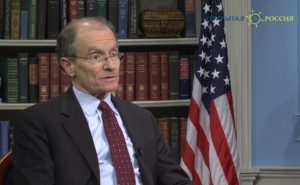
U.S. Ambassador Daniel Fried, who recently retired as the State Department’s coordinator for sanctions policy.
By James W Carden | Consortium News | March 7, 2017
It’s probably safe to wager that few people outside of Washington, and perhaps even quite a few people inside it, have ever heard of Ambassador Daniel Fried — at least not until very recently.
The longtime Ambassador, a 40-year veteran of the U.S. State Department, recently made headlines in Time, Newsweek, Reuters, Politico and NPR for a farewell speech he made to his State Department colleagues during which he took a parting shot at President Trump for the latter’s widely assumed (but yet to be acted upon) desire to come to an accommodation with Russia.
Fried’s address won praise from Establishment figures like former Deputy Secretary of State Antony Blinken (a “powerful defense of liberal international order”), Atlantic Council executive Damon Wilson ( a “clarion call for the U.S. to believe in itself and lead [a] liberal order”) and New York Times columnist Roger Cohen (“a superb summation of everything worth fighting for to keep this planet fit for human habitation”).
Why all the excitement? Well for one, Frieds’s farewell hit the many of Establishment’s erogenous zones:
–NATO expansion as an unalloyed good: NATO and the E.U. – grew to embrace 100 million liberated Europeans… this great achievement is now under assault by Russia
–Realists just don’t “get it”: George Kennan didn’t think much of what he termed America’s moralistic-legalistic tradition. But this foreign policy exceptionalism was the heart of our Grand Strategy through two World Wars, the Cold War and the post-1989 era, and it was crowned with success.
–And then there is Fried’s tendentious (and among neoconservatives and liberal interventionists widely shared) rendering of history and his puzzling conflation of the world situations as they obtained in 1940 and as it obtains currently, in 2017: In 1940, Germany offered Britain a sphere of influence deal: German recognition of the British Empire in exchange for London’s recognition of Germany dominance of continental Europe. Churchill didn’t take the deal then; we should not take similar deals now.
While there can be little doubt that Fried served loyally, with distinction and was in all likelihood an exemplary functionary of the U.S. foreign policy apparatus, what else explains the outpouring of praise for Fried?
Part of it of course is that in Washington, you get points for longevity regardless of your record. Recall the encomiums heaped upon Andrew Marshall a couple years ago when Marshall, who spent his career as the Pentagon’s chief policy hand, retired after four decades in 2015.
The Washington Post reverentially called Marshall “the Pentagon’s Yoda”; The Economist praised him as “the quiet American”; and that year a flattering book was released about Marshall entitled The Last Warrior: Andrew Marshall and the Shaping of Modern American Defense Strategy. In a review of the book, Notre Dame political scientist Michael Desch tartly noted that “at the end of the day, Marshall was not a saint but rather a public official who served too long and whose record was more mixed than his incense burners are prepared to admit.”
#Resistance to Trump
Another reason for the current praise for Fried’s address is that it combined two of the essential ingredients of the #Resistance that is currently so in vogue in today’s Washington: opposition to Trump and hostility to Russia – never mind whether the policy implications of such a stance are necessary or wise.
Days after he retired, Fried sat down with another tried-and-true Russia critic, former Moscow correspondent for The Washington Post Susan Glasser, and said that in his opinion, “Russia despises the West. And it is doing what it can to weaken the West.” Trump should not, said Fried, “be so desperate to rub up against a Russia which is busy trying to do us in all over the world.”
That Fried’s carries these opinions on Russia is unsurprising; a look at his career in the Foreign Service shows a diplomat who took the most hawkish positions possible regarding Russia in the post-Cold War period. Fried was a vocal champion of NATO enlargement, arguing, as U.S. Ambassador to Poland in January 1998 that “NATO membership had a stabilizing effect on Western Europe’s ‘ethnic rivalries’ and the prospect of membership in ‘the West’ has strengthened political moderates and weakened nationalists throughout Central Europe, to U.S. benefit.”
This assessment looks rather less than prescient in light of the recent rise in ethno-nationalist regimes in Poland, Hungary and, of course, Ukraine.
As U.S. Assistant Secretary for Europe under George W Bush, Fried declared that Russia’s defense of the ethnic Russian enclave of South Ossetia against the neoconservative puppet government of Mikheil Saakashvili was “not the sign of a strong nation. It is the sign of a weak one.”
Russia, said Fried, anticipating many of the same talking points we hear today, told the Washington Post in August 2008, “Russia is going to have to come to terms with the reality; it can either integrate with the world or it can be a self-isolated bully. But it can’t be both.”
Fried was one of the lead architects of U.S. sanctions against Russia in the aftermath of the Ukraine crisis and Crimean annexation. Having served as the State Department’s coordinator of sanctions policy, he recently argued that “without the sanctions the situation might well be much worse. And if you don’t think it can be worse then I think you just lack imagination. The Russians could have driven deeper into Ukraine and they could have tried to seize Mariupol or driven on land all the way to Crimea or attack Harkhiv. The sanctions may have stopped the Russians from going further.”
This summation is, to put it mildly, open to question, given that there is little evidence that the Russians even want the small part of Donetsk and Luhansk that they currently help to subsidize and support.
In the end, in judging the supposed wisdom of Fried’s recent fusillades against Trump and Russia we might look to the record of the man rather than his rhetoric.
James W Carden is a contributing writer for The Nation and editor of The American Committee for East-West Accord’s eastwestaccord.com. He previously served as an advisor on Russia to the Special Representative for Global Inter-governmental Affairs at the US State Department.
(Photo from YouTube)
Contacts with Russian Embassy
By Jack Matlock | March 4, 2017
Our press seems to be in a feeding frenzy regarding contacts that President Trump’s supporters had with Russian Ambassador Sergei Kislyak and with other Russian diplomats. The assumption seems to be that there was something sinister about these contacts, just because they were with Russian diplomats.

Former US Ambassador to the USSR Jack Matlock
As one who spent a 35-year diplomatic career working to open up the Soviet Union and to make communication between our diplomats and ordinary citizens a normal practice, I find the attitude of much of our political establishment and of some of our once respected media outlets quite incomprehensible. What in the world is wrong with consulting a foreign embassy about ways to improve relations? Anyone who aspires to advise an American president should do just that.
Yesterday I received four rather curious questions from Mariana Rambaldi of Univision Digital. I reproduce below the questions and the answers I have given.
Question 1: Seeing the case of Michael Flynn, that has to resign after it emerged that he spoke with the Russian ambassador about sanctions against Russia before Trump took office, and now Jeff Sessions is in a similar situation. Why is so toxic to talk with Sergey Kislyak?
Answer: Ambassador Kislyak is a distinguished and very able diplomat. Anyone interested in improving relations with Russia and avoiding another nuclear arms race — which is a vital interest of the United States — should discuss current issues with him and members of his staff. To consider him “toxic” is ridiculous. I understand that Michael Flynn resigned because he failed to inform the vice president of the full content of his conversation. I have no idea why that happened, but see nothing wrong with his contact with Ambassador Kislyak so long as it was authorized by the president-elect. Certainly, Ambassador Kislyak did nothing wrong.
Question 2: According to your experience, are Russian ambassadors under the sight of the Russian intelligence or they work together?
Answer: This is a strange question. Intelligence operations are normal at most embassies in the world. In the case of the United States, ambassadors must be informed of intelligence operations within the countries to which they are accredited and can veto operations that they consider unwise or too risky, or contrary to policy.
In the Soviet Union, during the Cold War, Soviet ambassadors did not have direct control over intelligence operations. Those operations were controlled directly from Moscow. I do not know what Russian Federation procedures are today. Nevertheless, whether controlled by the ambassador or not, all members of an embassy or consulate work for their host government. During the Cold War, at least, we sometimes used Soviet intelligence officers to get messages direct to the Soviet leadership. For example, during the Cuban missile crisis, President Kennedy used a “channel” through the KGB resident in Washington to work out the understanding under which Soviet nuclear missiles were withdrawn from Cuba.
Question 3. How common (and ethic[al]) is that a person related with a presidential campaign in the US has contact with the Russian embassy?
Answer: Why are you singling out the Russian embassy? If you want to understand the policy of another country, you need to consult that country’s representatives. It is quite common for foreign diplomats to cultivate candidates and their staffs. That is part of their job.
If Americans plan to advise the president on policy issues, they would be wise to maintain contact with the foreign embassy in question to understand that country’s attitude toward the issues involved. Certainly, both Democrats and Republicans would contact Soviet Ambassador Dobrynin during the Cold War and discuss the issues with him.
As the person in charge of our embassy in Moscow during several political campaigns, I would often set up meetings of candidates and their staffs with Soviet officials. Such contacts are certainly ethical so long as they do not involve disclosure of classified information or attempts to negotiate specific issues. In fact, I would say that any person who presumes to advise an incoming president on vital policy issues needs to understand the approach of the country in question and therefore is remiss if he or she does not consult with the embassy in question.
Question 4: In a few words, What’s your point of view about Sessions-Kislyak case? Is possible that Sessions finally resigns?
Answer: I don’t know whether Attorney General Sessions will resign or not. It would seem that his recusal from any investigation on the subject would be adequate. He would not have been my candidate for attorney general and if I had been in the Senate I most likely would not have voted in favor of his confirmation. Nevertheless, I have no problem with the fact that he occasionally exchanged words with Ambassador Kislyak.
In fact, I believe it is wrong to assume that such conversations are somehow suspect. When I was ambassador to the USSR and Gorbachev finally allowed competitive elections, we in the U.S. embassy talked to everyone. I made a special point to keep personal relations with Boris Yeltsin when he in effect led the opposition. That was not to help get him elected (we favored Gorbachev), but to understand his tactics and policies and to make sure he understood ours.
The whole brou-ha-ha over contacts with Russian diplomats has taken on all the earmarks of a witch hunt. President Trump is right to make that charge. If there was any violation of U.S. law by any of his supporters — for example disclosure of classified information to unauthorized persons — then the Department of Justice should seek an indictment and if they obtain one, prosecute the case. Until then, there should be no public accusations.
Also, I have been taught that in a democracy with the rule of law, the accused are entitled to a presumption of innocence until convicted. But we have leaks that imply that any conversation with a Russian embassy official is suspect. That is the attitude of a police state, and leaking such allegations violates every normal rule regarding FBI investigations. President Trump is right to be upset, though it is not helpful for him to lash out at the media in general.
Finding a way to improve relations with Russia is in the vital interest of the United States. Nuclear weapons constitute an existential threat to our nation, and indeed to humanity. We are on the brink of another nuclear arms race, which would be not only dangerous in itself, but would make cooperation with Russia on many other important issues virtually impossible. Those who are trying to find a way to improve relations with Russia should be praised, not scapegoated.
Jack Matlock served as U.S. Ambassador to the Soviet Union from 1987 to 1991.
Cheerleading for Israel
Everyone’s doing it

By Philip Giraldi • Unz Review • March 7, 2017
Those of us who voted for Donald Trump in hopes that he would turn out to be the peace candidate are facing disappointment. He has increased the already bloated military budget by $54 billion and has appointed an outspokenly anti-Russian and anti-Iranian active duty general as his National Security Advisor. A retired general with pretty much the same views heads the Pentagon. President Trump meanwhile vows to “extinguish” ISIS without presenting any plan regarding how exactly that might be accomplished.
The most important objective of all, resetting with Moscow to avoid World War 3, is in reverse gear, with the appointment of Fiona Hill, a critic of Vladimir Putin, as Russian specialist at the National Security Council. Meanwhile, our clueless United Nations Ambassador calls for Russia to withdraw from Crimea, where 58% of the population is Russian and only 24% is Ukrainian. Reports circulating in Washington suggest that the one phone call between Trump and Putin was a disaster, with the U.S. president demanding an end to the New START nuclear weapons reduction treaty, which the Kremlin wants to renew, before going off on a tangential monologue about his unexpected electoral victory.
In fact, even though the individual neocons have largely been outed from the foreign and security policy positions they once dominated it would not be completely inappropriate to suggest that their legacy of military interventionism lives on in terms of what the Trump administration has been so far promoting to keep America “safe.” Where all of this will go is anyone’s guess.
But if there is one constant in all of this it is the bright shining beacon of Israel, with Trump recently enthusing over the “unbreakable” bond between the two countries. One hopes that he misspoke and really meant “unbearable” or even “unspeakable” but it is clear from other indications that The Donald has succumbed to the inevitable Washington groupthink regarding America’s greatest ally and best friend in the whole wide world.
On Sunday New York Governor Andrew Cuomo met with Israeli Prime Minister Benjamin Netanyahu to discuss “trade and security issues” without anyone complaining that he was in violation of the Logan Act, which apparently only applies if you are talking to Russians. And a congressional delegation is in Israel right now studying the feasibility of moving the U.S. Embassy to Jerusalem, which most foreign policy pundits consider to be a very bad idea. Meanwhile at the United Nations, the U.S. has blocked the appointment of former Palestinian prime minister Salam Fayyad as special representative to Libya. U.S. Ambassador Nikki Haley explained the veto, saying irrelevantly “For too long the U.N. has been unfairly biased in favor of the Palestinian Authority to the detriment of our allies in Israel. The United States does not currently recognize a Palestinian state or support the signal this appointment would send within the United Nations.”
Ambassador Haley has also denounced the international body in general terms, stating that she was “underscore[ing] the ironclad support of the United States for Israel,” adding that “I am here to emphasize that United States is determined to stand up to the U.N.’s anti-Israel bias.” And if anyone failed to understand, on March 1st, U.S. envoy to the U.N. Human Rights Council in Geneva Erin Barclay told the group that it must drop its “obsession with Israel” or risk Washington withdrawing from the organization. The suggestion that the U.S. might consider departing came, incidentally, directly from Israeli Prime Minister Benjamin Netanyahu, who proposed such action to Donald Trump to “delegitimize” the U.N. body.
It is ironic that in the midst of a media and congressional feeding frenzy on foreign interference in the U.S., the one country in the world that consistently leads Washington by the nose is immune from criticism. The subservient role dutifully played by every U.S. president since JFK when dealing with Tel Aviv has resulted in defining United States national interests in terms of Israeli perceptions. The real irony is that even though Trump is giving the Israelis everything they want and is bowing to the Israel Lobby and Jewish groups at every opportunity, it is still not enough. It is never enough. That is because the neoconservatives, who are mostly Jewish and themselves complete Israel-firsters, hate him, having overwhelmingly favored Hillary Clinton as president due to their conviction that she would be the more aggressive president. They now believe that if they succeed in forcing Trump’s resignation or impeachment they will return to power in whatever new government formulation is put in place, so they continue to pile on.
Israel’s friends characteristically either run or have the ear of the media and they are supported by a formidable Washington based lobbying machine to get their point across. Whenever anything happens in the Middle East or elsewhere that is related to Israel’s perceived interests the machine goes to work with multiple position papers presented to every congressional office the next morning by runners from AIPAC, AEI, FPI, WINEP, JINSA and FDD. No one else has the clout of the Israel Lobby.
And Trump is also being battered by Jewish interests coming from the political left. France’s greatest living poseur-hypocrite Bernard-Henri Levy, described as a “philosopher, filmmaker and activist,” has hammered Trump twice recently, first in The New York Times on January 19th. Levy, who has described the brutal Israel Defense Forces as “a democratic army, which asks itself so many moral questions” and who was a war-on-Libya cheerleader, warns that Trump is a threat to all American Jews. Why? Because even though he has showered benefits on Israel his love for the Jewish people is “insufficient.” Levy explains, “This love is precisely what is required of an American president in dealings affecting Israel.”
The reader might well be astonished by the chutzpah of Levy in demanding love on top of the $38 billion already in the pipeline and wonder even more why the New York Times would print such garbage. But the French whiz kid does not really explain his remark, instead going on to denounce the “betrayal” of Israel by President Barack Obama at the United Nations before explaining that as Trump is “deeply unpopular” it would not do for American Jews to embrace him closely even if it appears he is doing good things for Israel. And Levy provides “evidence” that Trump might not be what he seems, citing inter alia his speech before the Republican Jewish Coalition in which he said he didn’t need their money. Levy sees this as a precursor to genuine, full blooded anti-Semitism, and speculates that Trump will take revenge against Jews to show “that he is indeed smarter than they are.” Why would he do that? Because he “respects only power, money and the perquisites of the palace.”
Levy’s second foray second foray, on CNN a month later, took Trump to task for his “incredible slip” on January 27th, Holocaust Remembrance Day, when he did not single out Jewish victims of Nazi crimes and instead cited all of those exterminated by the Germans. For Levy, Jewish deaths are intrinsically more memorable and valuable than those of others and the failure to grant them special status is a “tell-tale trope of Holocaust deniers” and a “hallmark of the new anti-Semitism.”
Bernard-Henri goes on to cite more evidence of Trump’s closet anti-Semitism, including the assertion that he has failed to address the reality of “Jewish children who go to school full of fear.” While it is possible to dismiss Levy as a completely self-serving bullshit artist who badly needs a haircut and a bath, he is far from alone. Also on the left there is the renowned Professor Alan Dershowitz of Harvard University.
Dershowitz, threatening to leave the Democratic Party if it elected Keith Ellison chair of the party’s central committee, appeared frequently on television and in the print media claiming that Ellison was an enemy of Israel and of the Jewish people. The threat to leave the Democrats produced numerous jokes directed at the abrasive and unpopular lawyer somewhat akin to those crafted at the expense of the Hollywood celebrities who promised to leave the country if Donald Trump were elected president. Unfortunately, I have to note that neither Dershowitz nor Barbra Streisand has yet departed.
Ellison was the preferred candidate of the Bernie Sanders liberal wing of the party and initial opinion polls suggested that he would likely win the position. While Dershowitz’s bombast could be regarded with some amusement, there was another, darker side to the campaign to sideline Ellison, who is black, a Muslim and not openly hostile to the Palestinians. This last attribute inevitably made it possible to start a whispering campaign labeling him as anti-Semitic and a number of Jewish Democratic fundraisers, to include Israeli Haim Saban of Hillary Clinton fame, privately made it known that they would end their donations to the party if Ellison were elected. Barack Obama and the Clintons also piled on, even working the phones to stop Ellison.
When Ellison lost in a close result, Dershowitz announced that he would not be leaving the party after all because the result was a “victory in the war against bigotry, anti-Semitism, [and] the anti-Israel push of the hard left within the Democratic Party.” As evidence of Ellison’s anti-Israel sentiment Dershowitz cited the congressman’s vote against funding Iron Dome, which is the Israel missile defense system. “Can you imagine any reasonable person voting against a missile system designed to protect innocent civilians against terrorist rocket attacks?”
Indeed Dersh, but maybe the Israelis should be paying for it, not the American taxpayer, which is actually the crux of the matter. I for one am tired of the perpetual whining of Alan Dershowitz and international professional Jews like Bernard-Henri Levi, who is frequently in the U.S. doing richly rewarded speaking tours on the so-called “Synagogue circuit.” And someone should wake U.N Ambassador Nikki Haley up to the fact that her job is to take care of the American people, not Israel. Quite frankly, if these folks are so much in love with Israel they should go live there and leave the rest of us as well as the U.S. Treasury alone.
If we are heading into yet another round of Israel-centric foreign policy we will be inevitably involved in new wars, starting with Iran which has always been Netanyahu’s enemy of choice. And then there is Syria, where the Israelis would prefer a continuation of chaos, presumably carried out by Washington which can pay the bills and take the casualties. As Bernard-Henri Levy has made clear and the Talmud asserts, Jewish lives are more important than those of gentiles, so it is fit and proper that Americans should fight and die to make sure that Israel might prosper.
‘They destroyed our homes, injured our kids’: Sanaa residents speak of horror of Saudi bombings
RT | March 5, 2017
Residents of one neighborhood in Sanaa say it has been hit by 37 bombs and rockets from the Saudi-led coalition since Riyadh began intervening in Yemen. They have nobody to help them in the dire situation, they told Ruptly news agency.
“Our homes were destroyed because of the aggression and we didn’t receive help from anyone, no one provided us with mattresses, blankets or food. We have absolutely nothing left inside our houses. All this because of the aggression,” one resident said.
Another said their home was destroyed by three rockets during a raid.
“Once we were hit by the rockets we started running away and everything was destroyed. There was fire and then we were homeless and lost everything and it started raining. We lost everything because of this aggression,” she said. “What did we do to deserve this, to be shelled? They destroyed our homes and injured our kids.”
One man said almost three dozen houses have been destroyed by the coalition in the Al-Masanie neighborhood, and many survivors have nowhere to live now.
“Some people rented other houses and some other living in tents. Their situation is so bad especially since there is no income anymore. Those families’ situation is miserable,” he said.
“The situation in this neighborhood is very bad,” another person said. “For more than a year they were targeted by rockets launched by fighter jets, which belongs to the alliance, the Saudi-American alliance. The houses were destroyed and people are living in a miserable situation.”
Since March 2015, when Riyadh sent its troops to prop up a pro-Saudi president ousted by rebel forces, an estimated 10,200 people have been killed in Yemen fighting. Up to three million were displaced, bringing the already-destitute Arab country to the brink of a humanitarian disaster.
Civilians in Yemen are suffering from a lack of basic supplies, including food, medicine, and fuel, partially due to a Saudi naval and air blockade. Civil rights groups say the Saudi intervention in the country may amount to war crimes.
Drastic Changes in the Middle East Happen Unbelievably Fast
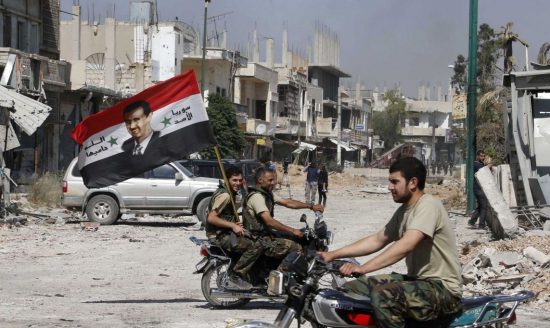
By Peter KORZUN | Strategic Culture Foundation | 04.03.2017
The situation in the Middle East is changing at an incredible speed. The things unbelievable yesterday, become reality today. Each of the events becomes part of a bigger picture, with the region gradually moving away from abyss to become a better place.
On March 1, Iraqi forces were reported to have taken control of the last major road out of western Mosul, preventing Islamic State (IS) militants from fleeing the city. The route leads to Tal Afar, another IS stronghold that is 40 km further west. They have since driven militants from the international airport, a military base, a power station and a number of residential areas. IS fighters began to flee. Total control over the city by Iraqi forces seems to be a matter of a few days, maybe hours.
Being almost defeated in Iraq, the IS has nowhere else to go but Syria – the country where they have just suffered a defeat, with Palmyra retaken by Syria’s government forces. Russia’s support has been crucial in the Syrian army’s push. Raqqa, the last remaining stronghold of the IS, will be the place of the final battle the extremist group is doomed to lose as many influential actors want it to be wiped away from the earth.
Turkey has announced its intent to launch an offensive to retake Raqqa but only after taking control of Manbij, the town held by the Kurds-dominated Syria Democratic Forces (SDF). The parties were in for a fight to benefit the IS and other terror groups. The US was at a loss as to how to prevent a clash between the NATO ally and the Kurds – the force it relies on in the fight against the IS. That’s when Moscow stepped in to avoid the worst, using its unique position as a mediator. It managed to do what nobody thought was possible. The military council in Manbij said on March 2 it will hand over areas west of the flashpoint town to Syrian government troops, after an agreement brokered by Russia.
Now the town is in Arab hands and Turkey has no reason to attack it. Syria and Turkey are not at war.
The United States had promised Turkey that Kurdish forces would withdraw from Manbij to the east of the Euphrates, but it never happened. Now Russia did what America had failed to do.
As a result of Russia’s effective mediation, Turkey can double down on its plans to advance to Raqqa, while Syria’s government has greatly strengthened its position. Turkey’s President Erdogan has just said he is ready to fight the IS together with Russia. He is coming to Moscow on March 9. It means no clash between Turkey and Syria will take place.
Many things are changing for the Syrian government and it has been going on for some time. It’s not a coincidence that voices get louder, calling for inviting Syrian President Assad to the March 29 Arab Summit in Amman – five years after Syria was expelled from the 22-member organization. Russia, Jordan and Egypt are applying efforts to reconcile the Arab community with the Syrian government. Last month, Egypt’s parliamentary committee for Arab affairs called for the return of Syria to the Arab League. This would signify the reconciliation between Saudi Arabia which backed the Syrian rebels – something unthinkable some time ago.
In 2015, then US President Obama predicted Russia would get stuck in Syria’s quagmire. He appears to have been wrong. Thanks to Russia’s involvement, one can see the light at the end of the tunnel to make the quagmire a thing of the past.
Moscow can facilitate the process of Iran joining with Arab states in the effort to reach agreement on Syria, bringing it to some mutual understanding with Saudi Arabia. Not much has been reported about some recent events of special significance. Iranian President Hassan Rouhani visited Kuwait and Oman on February 15. Saudi Arabian Foreign Minister Adel Al-Jubeir made a trip to Iraq on February 25, to be received by Iraqi Prime Minister Haider Al-Abadi. The trend is visible – Shia and Sunni are on speaking terms again and they are discussing something very important. It would have sounded incredible a short time ago but these are the facts.
All these events and emerging trends are taking place against the background of the ongoing UN-brokered Geneva talks on peaceful settlement in Syria. Here too we have an unexpected turn of events – the Syrian opposition seeks to meet with Russian officials!
According to Paul Vallely, a retired US Army Major General and senior military analyst for Fox News, Russia-US consultations on Syria are to start in two months after the presidents hold a summit. He said Russia is to play a key part in any scenario.
The recent days have literally shaken the Middle East. So many unexpected things happen to push things forward. Right in front of our eyes the impossible becomes possible.
As said before, Moscow is in a unique position to act as an intermediary and it plays its role aptly to achieve tangible results. If the current trend continues in the same direction, leading to the desired outcome, Russia’s effort will go down in history as an extraordinary achievement of military success combined with effective diplomacy.
Featured Video

Racist Seinfeld Dances for Joy as Bibi Unveils His New Map
or go to
Aletho News Archives – Video-Images
TV Drama Review
Japanese drama projects Japan’s wartime atrocities onto Chinese characters

Global Times | October 25, 2026
By portraying Chinese characters as perpetrators of ruthless violence while casting Japanese Self-Defense Forces (SDF) intelligence operatives as defenders, the season 2 of the Japanese drama Vivant has recently drawn criticism from Chinese netizens, who argue that its depiction turns historical reality on its head while ignoring Japan’s wartime atrocities.
The TBS drama series – a spy suspense story in which an alleged unofficial intelligence unit of the SDF operates across the globe — has attracted a passionate fanbase. Its currently airing season 2 opened with a household rating of 18.8 percent, the highest for a TV drama this year, according toa commentary article by Japanese media Toyo Keizai.
What draws attention is the portrayal of the enemies in the series, the article noted. Scenes in which the Chinese organization subjects kidnapped members of the SDF unit to brutal torture are repeated with unrelenting intensity.
It is rare for Japanese TV dramas to explicitly portray a real-life country as the enemy, the article noted.
Japanese Prime Minister Sanae Takaichi also made a reference to the drama, saying that she has been recording Vivant and hopes to binge-watch it over the year-end and New Year holidays, according to Japanese media outlets.
China’s CCTV News report on Sunday revealed that the drama features scenes in which Chinese personnel cut off the fingers of and stab Japanese intelligence operatives in the abdomen. Such acts bear striking similarities to the torture inflicted on Chinese nationals by invading Japanese troops during the World War II.
The drama distorts the truth by attributing these atrocities to modern Chinese characters. Beneath the surface, it subtly glorifies Japan’s cross-border overseas operations, blurs the functional boundaries of the SDF and implicitly promotes an expansionist narrative, per CCTV News. … continue
Blog Roll
 Aletho News
- Iran, Turkey, Pakistan, Saudi Arabia could advance region-led security framework in Tehran: FM spox
- Netizens condemn Japanese drama for projecting Japan’s wartime atrocities onto Chinese characters
- Racist Seinfeld Dances for Joy as Bibi Unveils His New Map
- A West Bank War for Netanyahu’s Election Campaign, Could It Backfire?
- Yemen denounces European Parliament’s ‘hypocritical’ push to blacklist Ansarullah
- Qalibaf: UAE’s UN bid aims to ‘clear the runway’ for ‘Greater Israel’, whitewash genocide
- Pakistan reopens Iran border after boosting security: Report
- Why are so many Brazilians voting for Flávio Bolsonaro?
- Democrats Put Anti-Russia Agenda Ahead of American Workers
- Elijah Magnier: Yemen’s Strikes Are Shattering Saudi Arabia’s Long-Term Strategy
- If Americans Knew
- An error has occurred; the feed is probably down. Try again later.
- No Tricks Zone
- Sudden Stratospheric Warming, Powerful El Niño Combination May Lead To Extreme Europe Cold, Energy Crisis!
- Two New Studies Find Thwaites Glacier Melt Cannot Be Driven By Human Activity Or A Warming Ocean
- E-Cars Reduce CO2 Emissions By Only 41% Compared To Internal Combustion Engine Vehicles
- Predictions Made By Renowned Climate Professor Over Past Decades Have Been Proven To Be Poor
- New Study Suggests Large Regions Of The Pacific Ocean Have Been Cooling For The Last 80 Years
- Germany’s Green Energy Debacle: High Energy Costs Force Kahla Porzellan to Close After 182 Years!
- New Study: 50 Years Of The Most Aggressive ‘Net Zero’ Policies Can Only Affect The Global Climate By 0.03°C
- US September “Heat” Was No Record…Many Records Set Decades Ago
- Latest European Green Energy Debacle; Portugal’s Largest Flagship Solar Park Insolvent!
- Green Energy Debacle: German Expert Professor Fritz Vahrenholt Warns Of Severe Economic And Social Consequences

