Breaking the Resistance with Terrorism and Proxy Wars
By Eric Draitser | New Eastern Outlook | March 17, 2015
With the situation in the Middle East seemingly spinning out of control, many political observers are left wondering what it all means. The war in Syria has been at the forefront of the news since 2011, and rightly so, as Syria has become the epicenter of a larger regional conflict, particularly with the ascendance of ISIS in the last year.
Undoubtedly, the mainstream acceptance of the ISIS threat has changed the strategic calculus vis-à-vis Syria, as the US prepares to launch yet another open-ended war, ostensibly to defeat it. And, while many in the West are willing to buy the ISIS narrative and pretext for war, they do so with little understanding or recognition of the larger geopolitical contours of this conflict. Essentially, almost everyone ignores the fact that ISIS and Syria-Iraq is only one theater of conflict in the broader regional war being waged by the US-NATO-GCC-Israel axis. Also of vital importance is an understanding of the proxy war against Iran (and all Shia in the region), being fomented by the very same terror and finance networks that have spread the ISIS disease in Syria.
In attempting to unravel the complex web of relations between the terror groups operating throughout the region, important commonalities begin to emerge. Not only are many of these groups directly or tangentially related to each other, their shadowy connections to western intelligence bring into stark relief an intricate mosaic of terror that is part of a broader strategy of sectarianism designed to destroy the “Axis of Resistance” which unites Iran, Syria, and Hezbollah. In so doing, these terror groups and their patrons hope to internationalize the war in Syria, and its destructive consequences.
Terrorism as a Weapon in Syria and Iraq
In order to understand how these seemingly disparate groups fit into the regional destabilization, one must first recognize how they are connected both in terms of ideology and shared relationships. On the one hand you have the well known terror outfits operating in the Syria-Iraq theater of this conflict. These would include the ubiquitous ISIS, along with its Al Qaeda-affiliated ally Jabhat Al-Nusra.
However, often left out of the western narrative is the fact that the so called “moderate rebels,” such as the Al Farouq Brigade and other similar groups affiliated with the “Free Syrian Army,” are also linked through various associations with a number of jihadi organizations in Syria and beyond. These alleged “moderates” have been documented as having committed a number of egregious war crimes including mutilation of their victims, and cross-border indiscriminate shelling. And these are the same “moderates” that the Obama Administration spent the last three years touting as allies, as groups worthy of US weapons, to say nothing of the recent revelations of cooperation with US air power. But of course US cooperation with these extremist elements is only the tip of the iceberg.
A recent UN report further corroborated the allegations that Israeli military and/or Mossad is cooperating with, and likely helping to organize, the Jabhat al-Nusra organization in and around the Golan Heights. Such claims of course dovetail with the reports from Israeli media that militant extremists fighting the Syrian government have been treated in Israeli medical facilities. Naturally, these clandestine activities carried out by Israel should be combined with the overt attacks on Syria carried out by Tel Aviv, including recent airstrikes, which despite the inaction of the UN and international community, undeniably constitute a war crime.
Beyond the US and Israel however, other key regional actors have taken part in the destabilization and war on Syria. Turkey has provided safe haven for terrorists streaming into Syria to wage war against the legally recognized government of President Assad. In cooperation with the CIA and other agencies, Turkey has worked diligently to foment civil war in Syria in hopes of toppling the Assad government, thereby allowing Ankara to elevate itself to a regional hegemon, or so the thinking of Erdogan and Davutoglu goes. Likewise, Jordan has provided training facilities for terrorists under the guidance and tutelage of “instructors” from the US, UK, and France.
But why rehash all these well-documented aspects of the destabilization and war on Syria? Simple. In order to fully grasp the regional dimension and global implications of this conflict, one must place the Syria war in its broader geopolitical context, and understand it as one part of a broader war on the “Axis of Resistance.” For, while Hezbollah and certain Iranian elements have been involved in the fighting and logistical support in Syria, another insidious threat has emerged – a renewed terror war against Iran in its Sistan and Baluchestan province in the east.
Rekindling the Proxy War against Iran
As the world’s attention has been understandably fixed upon the horrors of Syria, Iraq, and Libya, a new theater in the regional conflict has come to the forefront – Iran; specifically, Iran’s eastern Sistan and Baluchestan province, long a hotbed of separatism and anti-Shia terror, where a variety of terror groups have operated with the covert, and often overt, backing of western and Israeli intelligence agencies.
Just in the last year, there have been numerous attacks on Iranian military and non-military targets in the Sistan and Baluchestan region, attacks carried out by a variety of groups. Perhaps the most well known instance occurred in March 2014 when five Iranian border guards were kidnapped – one was later executed – by Jaish al-Adl which, according to the Terrorism Research and Analysis Consortium is:
an extremist Salafi group that has since its foundation claimed responsibility for a series of operations against Iran’s domestic security forces and Revolutionary Guards operating in Sistan and Balochistan province, including the detonation of mines [link added] against Revolutionary Guards vehicles and convoys, kidnapping of Iranian border guards and attacks against military bases… Jaish al-Adl is also opposed to the Iranian Government’s active support of the Syrian President Bashar al-Assad, which they regard as an attack on Sunni muslims… Jaish ul-Adl executes cross border operations between the border of Iran and Pakistan and is based in the Baluchistan province in Pakistan.
It is important to note the centrality of Iran’s support for Syria and the Syrian Arab Army (and of course Hezbollah) in the ideological framework of a group like Jaish al-Adl. Essentially, this terror group sees their war against the Iranian government as an adjunct of the war against Assad and Syria – a new front in a larger war. Of course, the sectarian aspect should not be diminished as this group, like its many terrorist cousins, makes no distinction between political and religious/sectarian divisions. A war on Iran is a war on Shia, and both are just, both are legitimate.
Similarly, the last 18 months have seen the establishment of yet another terror group known as Ansar al-Furqan – a fusion of the Balochi Harakat Ansar and Pashto Hizb al-Furqan, both of which had been operating along Iran’s eastern border with Pakistan. According to the Terrorism Research and Analysis Consortium:
They characterize themselves as Mujahideen aginst [sic] the Shia government in Iran and are linked to Katibat al Asad Al ‘Ilamiya; Al-Farooq activists; al Nursra Front (JN), Nosrat Deen Allah, Jaysh Muhammad, Jaysh al ‘Adal; and though it was denied for some time, appears to have at least personal relationships with Jundallah… The stated mission of Ansar al Furqan is “to topple the Iranian regime…”
Like its terrorist cousin Jaish al-Adl, Ansar al-Furqan has claimed responsibility for a number of attacks against the Iranian Government, including a May 2014 IED attack on a freight train belonging to government forces. While such attacks may not make a major splash in terms of international attention, they undoubtedly send a message heard loud and clear in Tehran: these terrorists and their sponsors will stop at nothing to destroy the Islamic Republic of Iran.
Two inescapable facts immediately come to the fore when examining these groups. On the one hand, they are Sunni extremists whose ultimate goal is the destruction of the Iranian state and all vestiges of Shia dominance, political, military or otherwise. On the other hand, these groups see their war against Iran as part and parcel of the terror wars on Syria and Iraq.
And then of course there’s Jundallah, the notorious terror organization lead for decades by the Rigi family. Anyone with even cursory knowledge of the group is undoubtedly aware of its long-standing ties to both US and Israeli intelligence. As Foreign Policy magazine reported in 2012, Israeli Mossad and US CIA operatives essentially competed with one another for control of the Jundallah network for years. This information of course directly links these agencies with the covert war against Iran going back years, to say nothing of the now well-known role of Israeli intelligence in everything from assassinations of Iranian scientists to the use of cyberweapons such as Stuxnet and Flame. These and other attacks by Israel and the US against Iranian interests constitute a major part of the dirty war against Iran – a war in which terror groups figure prominently.
It should be noted that a number of other terror outfits have been used through the decades in the ongoing “low-intensity” war against Iran, including the infamous Mujahideen-e-Khalq, a terrorist group hailed as heroes by the US neocon establishment. Thanks to Wikileaks, it is also now documented fact that Israel has long since attempted to use Kurdish groups such as PJAK (Iraqi Kurdish terror group) to wage continued terror war against Iran for the purposes of destabilization of the government. Additionally, there was a decades-long campaign of Arab separatism in Iran’s western Khuzestan region spearheaded by British intelligence. As Dr. Kaveh Farrokh and Mahan Abedin wrote in 2005, “there is a mass of evidence that connects the British secret state to Arab separatism in Iran.”
These and other groups, too numerous to name here, represent a part of the voluminous history of subversion against Iran. But why now? What is the ultimate strategy behind these seemingly disparate geopolitical machinations?
Encircling the Resistance in Order to Break It
To see the obvious strategic gambit by the US-NATO-GCC-Israel axis, one need only look at a map of the major conflicts mentioned above. Syria has been infiltrated by countless terrorist groups that have waged a brutal war against the Syrian government and people. They have used Turkey in the North, Jordan in the South, and to a lesser degree Lebanon and, indirectly, Israel in the West. Working in tandem with the ISIS forces originating in Iraq, Syria has been squeezed from all sides in hopes that military defeat and/or the internal collapse of the Syrian government would be enough to destroy the country.
Naturally, this strategy has necessarily drawn Hezbollah into the war as it is allied with Syria and, for more practical reasons, cannot allow a defeated and broken Syria to come to fruition as Hezbollah would then be cut off from their allies in Iran. And so, Hezbollah and Syria have been forced to fight on no less than two fronts, fighting for the survival of the Resistance in the Levant.
Simultaneously, the regional power Iran has made itself into a central player in the war in Syria, recognizing correctly that the war could prove disastrous to its own security and regional ambitions. However, Tehran cannot simply put all its energy into supporting and defending Syria and Hezbollah as it faces its own terror threat in the East. The groups seeking to topple the Iranian government may not be able to compete militarily with the Iranian Revolutionary Guards, but they can certainly create enough destabilization through terrorism to make it more difficult for Tehran to effectively aid in the fight in Syria.
The US-NATO-GCC-Israel alliance has not needed to put its own boots on the ground to achieve its strategic objectives. Instead, it is relying on irregular warfare, proxy terror wars, and small-scale destabilizations to achieve by stealth what it cannot achieve with military might alone.
But it remains paramount for all those interested in peace to make these connections, to understand the broad outlines of this vast covert war taking place. To see a war in Syria in isolation is to misunderstand its very nature. To see ISIS alone as the problem is to completely misread the essence of the conflict. This is a battle for regional hegemony, and in order to attain it, the Empire is employing every tool in the imperial toolkit, with terrorism being one of the most effective.
Learning to Love Drone Proliferation
By Charles Pierson | CounterPunch | March 17, 2015
The United States has a new policy on drone proliferation: we’re for it.
On February 17, the Obama Administration announced new, less strict conditions for selling killer drones to foreign governments.[1]
Up till now, sales of drones have been regulated by the 1987 Multilateral Technology Control Regime (MTCR). The MTCR was drafted with ballistic missiles in mind but now also encompasses drones.
As a control mechanism, the MTCR is seriously flawed. First, the MTCR is a voluntary control regime. Second, thirty-four states participate in the MTCR, but not China, India, Iran, Israel, or Pakistan. (On Friday, Pakistan revealed that it has developed an armed drone.)
The Predator and Reaper drones used for targeted kills fall under MTCR’s Category I which is defined as systems whether armed or unarmed which can deliver a 500 kg payload to a range of 300 kilometers. Transfers of Category I systems are subject to a “strong presumption of denial.”
The United States has only transferred armed drones to the United Kingdom (February 2007). The Obama Administration has previously turned down requests for armed drones from Turkey, Pakistan, Saudi Arabia, and the United Arab Emirates.[2] Under the new export policy, the MTCR’s “strong presumption of denial” may become a thing of the past.
True, the new policy does not promise a drone to all comers—a policy which, albeit alarming, would at least have the virtue of even-handedness. Instead, the US State Department assures us that sales will be evaluated on a “case-by-case basis.” The criteria that will be applied, like most of the new policy, are classified. We can expect the Administration will green-light armed drone transfer to countries we like and reject transfers to countries we don’t.
The Obama Administration has told us this much: prospective purchasers of UAS (unmanned aerial systems, i.e., drones) must meet the end-use restrictions set out in the State Department’s February 17 “Fact Sheet”:
* Purchasers must use UAS “in accordance with international law, including international humanitarian law and international human rights law, as applicable.”
* Purchasers must not use “military UAS to conduct unlawful surveillance or use unlawful force against their domestic populations.”
* “Armed and other advanced UAS are to be used in operations involving the use of force only when there is a lawful basis for use of force under international law, such as national self-defense.”
The problems with these restrictions should be immediately apparent. Discussing armed drones in February 2014, Director of National Intelligence James Clapper said: “I would hope, as other countries acquire similar capabilities, that they follow the model that we have for the care and precision that we exercise.”[3]
Let’s hope that they don’t. The US model for using drones includes staggering numbers of civilian deaths, including drone strikes on weddings and funerals, and “double tap” strikes on rescuers who go to aide those injured in an initial strike. Military-age males in conflict areas are assumed, without more, to be terrorists and thus legitimate targets—all this taking place in countries with which the US is not at war.
Micah Zenko of the Council for Foreign Relations says this about the new restrictions: “Even analysts less skeptical than me would ask if the United States itself adheres to these principles.”[4] Sarah Knuckey, who teaches at Columbia Law School and who was one of the authors of the influential study, Living under Drones, comments of the new policy that “the US has advanced interpretations of international law that many have described as dangerous, novel, and expansive.”[5]
Expansive, indeed. Start with the US interpretation of self-defense. Micah Zenko and Professor Sarah Kreps rightly observe that: “The United States takes a more expansive view of self-defense than its allies, not just with respect to drones and targeting individuals, but also to invading countries.”[6] Law professors of a right-wing bent justified the 2003 US invasion of Iraq as preemptive self-defense. Going further back, the US justified its 1989 invasion of Panama as self-defense because the Canal Zone was considered US territory and US nationals were stationed there. Given sufficient ingenuity, any act of aggression can be rebaptized as self-defense.
Call the Repo Man
William D. Hartung, Director of the Arms and Security Project at the Center for International Policy points out that: “Middle Eastern allies from Bahrain to Egypt to Saudi Arabia have used U.S.-supplied weapons to put down democracy movements. Yet these are precisely the kinds of regimes that Washington may be tempted to supply drones to for use in the war on the Islamic State group.”[7]
Suppose—even after if it swears not to—a state like Egypt unleashes a drone-fired Hellfire missile on the next crowd of demonstrators gathered in Tahrir Square? What could the US do about it? Send a repo man to Cairo?
Rear Admiral John Kirby, Pentagon Press Secretary, took a shot at these questions at a press conference on February 18. Kirby said that the Department of Defense “will have a role in what we—what we call end-use monitoring, so I mean, we will have a role as well as the State Department, in monitoring the use of these things.”
Kirby was then asked: “[G]iven that the United States use of drones to carry out extra-judicial killings abroad is a subject of great debate, about whether that conforms with international laws and human rights, how could the U.S. possibly ensure that these things be held to those standards if other countries are using them once we let the technology go.”
Kirby replied that the United States has been selling various arms overseas for years. (This is supposed to make us feel better?) The US knows how to do end use monitoring (EUM), and “We’re very good at this….”
No, we’re not. Kirby’s questioner was correct: once the US transfers weapons there’s no telling how they’ll be used or who they’ll wind up with. Don’t they get CNN in the Pentagon? Hasn’t Admiral Kirby heard about the weapons the US gave the Iraqi army which are now in the hands of ISIS? Or the arms we supplied in the 1980s to mujahideen groups in Afghanistan who later became Al-Qaeda?
Even if the US permits drone sales only to the most cuddly, lovable, human-rights observant states, nothing prevents those states from passing their drones on to someone nasty. Sure, the US can refuse to sell more drones to that country in the future, but the damage will be already done.
If only the drones we sell had an OFF switch the US could throw. The idea of installing some sort of malware in drones that would allow remote disabling has been kicked around in industry circles, but to date it remains science fiction.
Even if the US did have an OFF switch would we use it? Like the US itself, US allies do not commit rights violations. So ignore anyone who tells you that the US has repeatedly given weapons to states while knowing full well that those states would use those weapons against their own people or in attacks on neighboring countries.
Potentially, Congress could put a brake on drone sales abroad. Under the U.S. Arms Export Control Act of 1976, Congress must be notified of most arms sales over $14 million after which it is given 30 days to block the transaction. During the Cold War, any nation, however vile, which claimed to be fighting Communism could get all the US arms it wanted. Substitute “terrorists” for “Communists” and the same tactic works today.
Given the risks in selling drones overseas, why do it? Do we need to ask?
Back to the State Department Fact Sheet: the new UAS export policy “also ensures appropriate participation for U.S. industry in the emerging commercial UAS market, which will contribute to the health of the U.S. industrial base, and thus to U.S. national security which includes economic activity.” In other words, what’s good for General Atomics, maker of the Predator, is good for America. Micah Zenko writes: “With a projected $80 billion in global spending over the next ten years, drones constitute a potential growth industry for the aerospace and defense sectors.”[8] Putting corporate profits before human lives—there’s the real US model.
Charles Pierson is a lawyer and a member of the Pittsburgh Anti-Drone Warfare Coalition. E-mail him at Chapierson@yahoo.com.
[1] Missy Ryan, “Obama Administration to Allow Sales of Armed Drones to Allies,” WASHINGTON POST, Feb. 17, 2015.
[2] Micah Zenko, “The Great Drone Contradiction,” foreignpolicy.com, February 19, 2015.
[3] Quoted in Micah Zenko and Sarah Kreps, Limiting Armed Drone Proliferation, Council on Foreign Relations Special Report No. 69, June 2014, at page 15.
[4] Micah Zenko, “The Great Drone Contradiction,” foreignpolicy.com, February 19, 2015.
[5] Sarah Knuckey, “Washington’s New Drone Sales Policy Could Export US-Style Drone War,” justsecurity.org, February 20, 2015.
[6] Zenko and Kreps, Limiting Armed Drone Proliferation, at page 26.
[7] William D. Hartung, “A Lot Could Go Wrong Here,” Center for International Policy, cipoline.org, Mar. 7, 2015.
[8] Micah Zenko, Reforming U.S. Drone Strike Policies (Jan. 2013), at p. 18
U.S. Dominates Weapons Export Market as Profits Grow with Sales to the Middle East
By Noel Brinkerhoff | AllGov | March 17, 2015
The global arms trade business continues to thrive, with the United States being the biggest beneficiary of an ever-growing market that’s being fueled by Middle East purchases.
IHS Inc., an international information and analytics firm based in Colorado, reported in its Global Defense Trade Report that worldwide arms sales increased last year for the sixth straight year. The total in military trade went from $56.8 billion in 2013 to $64.4 billion in 2014—a 13.4% increase.
The U.S. was responsible for one-third of all defense exports and “was the main beneficiary of growth,” IHS reported. American exports of weapons were particularly popular among buyers in the Middle East.
Saudi Arabia surpassed India to become the largest defense market for U.S. weapons makers, as the oil sheikdom increased its defense imports 54% from 2013 to 2014. This year is expected to be another strong year for Saudi imports, IHS says, rising another 52% to $9.8 billion.
“One out of every seven dollars spent on defense imports in 2015 will be spent by Saudi Arabia,” according to IHS.
Ben Moores, senior defense analyst at IHS Aerospace, Defense & Security, said: “The Middle East is the biggest regional market, and there are $110 billion in opportunities in coming decade.”
To Learn More:
Saudi Arabia Replaces India as Largest Defence Market for US, IHS Study Says (IHS Inc.)
Charted: The World’s Biggest Arms Importers (by Alan Tovey, The Telegraph )
The SIPRI Top 100 Arms-Producing and Military Services Companies, 2013 (by Aude Fleurant and Sam Perlo-freeman, SIPRI) (pdf)
Obama Steps Up Foreign Weapons Sales, Overwhelming Other Arms Makers (by Noel Brinkerhoff and David Wallechinsky, AllGov )
US ‘played big role’ in botched Philippines raid
Press TV – March 17, 2015
A Philippine Senate report has revealed that US forces played a “substantial” role in a botched raid earlier this year that left 44 local police commandos dead.
Senator Grace Poe released on Tuesday the findings of a committee inquiry into the deadly police operation, known locally as Oplan Exodus, in January against the Moro Islamic Liberation Front (MILF), which seeks to establish an independent homeland in the troubled south of the Philippines.
“US personnel played a role in the training before, and monitoring, of the… operation,” said Poe, adding, “The committee found that the United States substantially invested in the entirety of Oplan Exodus. It provided equipment, training and intelligence.”
According to the report, three unnamed Americans were present at local army brigade headquarters during the police operation, creating tensions at a crucial time with the Philippine military commander.
“One of the Americans ordered Major General Edmundo Pangilinan to fire the artillery,” the report read, adding, “However, Pangilinan refused and told him, ‘Do not dictate to me what to do. I am the commander here.'”
Under a US-Philippines alliance, Washington provides military training and intelligence to Manila. However, American forces are forbidden to engage in combat.
The report also stated that although there was no evidence of US forces engaging in combat, there were concerns that Washington’s influence on the Philippine National Police (PNP) was too strong.
In addition, it raised questions about the accountability of the US, which has so far declined to specify its role in the raid.
Furthermore, the report also stated that President Benigno Aquino must “bear responsibility” for the fatalities.
A US embassy spokesman in the Philippines did not immediately answer to requests for comment about the Senate report.
On January 25, a 12-hour gun battle between the Philippine military and the other front claimed the lives of 44 security forces and 18 MILF members in the country’s southern province of Maguindanao.
The aim of the police operation was to capture or kill two men on the US government’s so-called list of “most wanted terrorists.” The men, Abdul Basit Usman and Malaysian national Zulkifli bin Hir, were living among MILF members in the southern farming communities of the Philippines. Hir was reportedly killed in the raid, but Usman escaped.
Following the raid, the MILF said it had acted in self-defense, with its vice chairman Ghazali Jaafar saying the unannounced presence of the Filipino armed forces led the MILF members to believe that they had come under attack.
Why ban nuclear weapons? Ask the French president
By John Loretz | International Physicians for the Prevention of Nuclear War | March 13, 2015
 President François Hollande of France has explained to the world why nuclear weapons must be banned and eliminated. Not intentionally, of course. Not because he made the fallacious argument that nuclear weapons make France more secure in a dangerous world (although he did); not because he lumped every conceivable and inconceivable threat to France into a confusing hash and came up with nuclear weapons as the final answer to every one (although he did that, too); and not because be shamelessly contradicted himself on the fundamental point that France is a champion of nuclear disarmament but finds its own “nuclear deterrent” indispensible (all the nuclear-armed States suffer from that particular mental health problem, as Sue Wareham has diagnosed it elsewhere on this blog).
In fact, his speech on February 19 to the French military and political elite at Istres Air Force Base was more frightening than that. I don’t want to twist his words, so here’s exactly what President Hollande said, taken from the English translation of the speech released by the French Ministry of Foreign Affairs:
“Our nuclear forces must be capable of inflicting absolutely unacceptable damages for the adversary, upon its centres of power, its political, economic and military nerve centres.” And since “the Head of State is the first citizen in France to speak and decide,” it’s up to President Hollande (or one of his successors) to decide if and when nuclear weapons will be used to “preserve the life of our nation.”
Never mind that this is delusional Cold-War thinking at its worst, since any use of nuclear weapons by France would almost certainly result in the use of nuclear weapons against France, rendering the “integrity of [it’s] territory” somewhat tentative. Never mind that the entire concept of nuclear deterrence—“to prevent any threat of blackmail by another state”—is itself the most extreme threat of blackmail. Never mind that every word of this speech ignores the evidence about the humanitarian impact of nuclear weapons presented at three international conferences over the past two years and is an arrogant attempt to rescue nuclear weapons from stigmatization.
No, what makes the French president’s tribute to “the credibility of our deterrence force” truly terrifying is that he has claimed the right to use nuclear weapons, more or less on his own say so, in order to make sure no one messes with France’s (or, I kid you not, Sony’s) “vital interests.” Apparently no price, not even the end the world (which would be a bit inconvenient for French citizens in a permanent season of nuclear winter), is too high to pay for “independence, freedom, and the ability to ensure our values prevail.” Which begs the question, what values are those, exactly, that prepare one to inflict “absolutely unacceptable damages” on millions upon millions of people?
Perhaps the rest of us lack President Hollande’s poetic vision. “France has, with its partners,” he said, “built a community of destiny,” with nuclear weapons as the ultimate expression of “heartfelt solidarity.” In a way, he’s right. But how many of you care to join him in that destiny?
White House petition on ‘47 GOP traitors’ draws 260,000 signatures

US Senate Majority Leader Mitch McConnell (left), Senator Ted Cruz (center) and Senator John Cornyn
Press TV – March 13, 2015
A petition to the White House demanding treason charges against 47 Republican senators who attempted to sabotage US President Barack Obama’s efforts to reach a nuclear accord with Iran has garnered more than 260,000 signatures.
The petition, on whitehouse.gov, was filed on Monday and had 263,312 signatures as of early Friday morning, well above the threshold of 100,000, which requires the White House to respond.
In an unprecedented move on Monday, a group of Republican senators ignored protocol and sent a letter to Iran, warning that whatever agreement reached with Obama would be a “mere executive agreement” that could be revoked “with the stroke of a pen and future Congresses could modify the terms of the agreement at any time.”
The letter appears at a time when US negotiators are preparing to return to Switzerland to participate in the nuclear talks between Iran and the P5+1 countries – the US, Britain, France, China, Russia, and Germany, which have entered a sensitive final stage.
According to the petition, the 47 Republican lawmakers “committed a treasonous offense when they decided to violate the Logan Act, a 1799 law which forbids unauthorized citizens from negotiating with foreign governments.”
The US federal law prohibits unauthorized American citizens from interfering in relations between the United States and foreign governments. Violation of the Logan Act is a felony.
“At a time when the United States government is attempting to reach a potential nuclear agreement with the Iranian government, 47 Senators saw fit to instead issue a condescending letter to the Iranian government stating that any agreement brokered by our President would not be upheld once the president leaves office,” the petition states.
“This is a clear violation of federal law. In attempting to undermine our own nation, these 47 senators have committed treason,” it adds.
In an interview with Press TV on Wednesday, Mark Dankof, former US Senate candidate, said, “The 47 Republican senators in all likelihood had violated the Logan Act, which, if understood properly, would suggest very strongly that there may be a legal case against these Republican senators in regard to having committed treason.”
Tom Cotton, a freshman senator from Arkansas, drafted the much-criticized letter. He claimed that the letter has more support in the US Congress than the Republican senators who have signed it.
On Tuesday, the New York Daily News denounced the 47 Republican senators as “traitors” for writing the letter to Iran. The Manhattan-based newspaper used its front page to condemn the Republicans for sending the letter to Iran’s leaders.
The tabloid’s front page prominently featured Senate Majority Leader Mitch McConnell and Senators Ted Cruz, Tom Cotton and Rand Paul.
Here are the names of 47 Republican senators who signed the Iran letter:
Signatories
Richard Shelby (Ala.)
Jeff Sessions (Ala.)
Dan Sullivan (Alaska)
John McCain (Ariz.)
John Boozman (Ark.)
Tom Cotton (Ark.)
Cory Gardner (Colo.)
Marco Rubio (Fla.)
Johnny Isakson (Ga.)
David Perdue (Ga.)
Mike Crapo (Idaho)
Jim Risch (Idaho)
Mark Kirk (Ill.)
Chuck Grassley (Iowa)
Joni Ernst (Iowa)
Pat Roberts (Kansas)
Jerry Moran (Kansas)
Mitch McConnell (Ky.)
Rand Paul (Ky.)
David Vitter (La.)
Bill Cassidy (La.)
Roger Wicker (Miss.)
Roy Blunt (Mo.)
Steve Daines (Mont.)
Deb Fischer (Neb.)
Ben Sasse (Neb.)
Dean Heller (Nev.)
Kelly Ayotte (N.H.)
Richard Burr (N.C.)
Thom Tillis (N.C.)
John Hoeven (N.D.)
Rob Portman (Ohio)
Jim Inhofe (Okla.)
James Lankford (Okla.)
Pat Toomey (Pa.)
Lindsey Graham (S.C.)
Tim Scott (S.C.)
John Thune (S.D.)
Mike Rounds (S.D.)
John Cornyn (Texas)
Ted Cruz (Texas)
Orin Hatch (Utah)
Mike Lee (Utah)
Shelley Moore Capito (W.V.)
Ron Johnson (Wis.)
Mike Enzi (Wyo.)
John Barrasso (Wyo.)
Intimidation in Puerto Rico?
By Carlos Borrero | CounterPunch | March 12, 2015
The significance of a recently divulged plan of the Pentagon to carry out military exercises in Puerto Rico under the name “Operation Borinquen Response” between the 14th and 21st of this month must not be underestimated. On the pretext of the need to prepare for a natural disaster, US imperialism has cynically prepared a series of military maneuvers for Puerto Rico in which more than 1,000 troops from the island, National Guard troops from West Virginia, Washington, Tennessee, Vermont and Nebraska, as well as international observers from Honduras and the Dominican Republic are slated to participate.[1]
This military deployment does not represent an isolated phenomenon. Rather, it is an extension of the policy of increased militarization of US society to its colony in anticipation of an intensification of mass discontent. In the past several years there have been a number of similar military simulations based on urban warfare scenarios carried out in US cities such as Houston, Miami and Minneapolis-St. Paul. These exercises have included the deployment of military aircraft such as Blackhawk helicopters as well as heavily armed paratroopers into residential areas. Indeed, Obama added a key piece to the legal architecture for this militarization of US society with the signing of the National Defense Authorization Act of 2012, which essentially repealed what remained of the Posse Comitatus statute that made the deployment of US armed forces on US soil illegal during times of peace. In this way, this Nobel Peace laureate has expanded the militarist policies of the previous administration both domestically and abroad.
Another critical component of this militarization of US society in recent years has been the supply of military grade equipment and weapons to urban police forces through the Department of Homeland Security. The brutal repression unleashed upon protesters in Ferguson, Missouri last year, as well as the recent revelations by The Guardian of the existence of secret prisons or ‘black sites’, such as the now infamous Homan Square[2], maintained by the Chicago Police in which the torture of civilians has been carried out are just two patent examples of this tendency.
In an age of the historical decline of its system, the only solution proposed by the capitalist class is war, both against the working masses within national borders and foreign rivals abroad. In fact, the practice of domestic military exercises is consistent with the recommendations made in a recent Pentagon study[3] that warns of the need to revise military doctrine in preparation for the eventuality of future interventions by the US Army in large urban areas. According to military theorists, the social and economic crises within so-called megacities, which they describe as ‘petri dishes’ for radicalism, will be particularly acute. The incipient wave of working class resistance, which is evidenced by recent strikes by west coast longshoremen and US refinery workers, coupled with the massive protests within working class communities of color subjected to brutal police repression, appear to be just the beginning of a new phase of intense class struggles within the center of world imperialism. As such, despite their rhetoric to the contrary, the strategists of US capitalism know very well that they are not immune to the type of social convulsions that have recently rocked other countries.
The objective conditions for popular opposition to the system have become particularly acute in Puerto Rico. Massive structural unemployment as well as economic stagnation over the past 8 years has highlighted the complete bankruptcy of the economic solutions imposed by the capitalists and their acolytes in the colony. In a recent report by the US Bureau of Labor Statistics it was revealed that in 2014 Puerto Rico registered the lowest labor participation rate in last 22 years, seeing a reduction of 37,000 people employed. It is a well known fact that this prolonged unemployment crisis has provoked a massive exodus of Puerto Ricans from the island, many of which are highly skilled, in what can only be described as brain drain. All of this is taking place within the context of a $70 Billion public debt, which represents almost 70% of GDP, and serves as a pretext for a campaign of austerity measures carried out against the mass of working class Puerto Ricans. And in an effort to guarantee the steady transfer of wealth to the financial parasites of Wall Street as well as their junior partners in the colony, the colonial administration has recently proposed an increase to the consumption tax as part of what it cynically calls ‘tax reform’.
This panorama of social and economic crises increasingly provokes a popular questioning of all the political institutions within the colony. As such, the planned military exercises represent a policy of psychological intimidation being carried out in anticipation of a new wave of popular protests within a colonial society that is crumbling from within. From the perspective of US imperialism and its defenders within the colony, there is a concern that any political change that takes place within its colony be carried out under terms that are acceptable and consistent with its strategic interests.
Notwithstanding, the military exercises planned for Puerto Rico cannot only be understood within the context of a response to the deepening of the social crisis in the colony. It must also be understood as an imperative of US imperialism within the context of the sharpening of geopolitical conflicts. Undoubtedly, the recent rapprochement between Washington and Havana as well as the destabilizing campaign carried out against Venezuela form part of the same strategy of the US ruling class to reassert its hegemony in the hemisphere against the threat of emerging rivals like China.
There exists in recent Puerto Rican history a powerful precedent for popular opposition to US militarism in the struggle to remove the US Navy from the island of Vieques. The task of assessing the strengths and weaknesses of this experience now falls upon those popular forces most committed to the working masses. Their capacity to foster the reorganization of popular resistance and international solidarity against this most recent example of US militarism is more urgent than ever.
Carlos Borrero is a New York-based writer.
Notes
[2] http://www.theguardian.com/us-news/2015/feb/27/chicago-abusive-confinment-homan-square
Neocons Guided Petraeus on Afghan War
By Robert Parry | Consortium News | December 19, 2012
Even after the Iraq War disaster and Barack Obama’s election in 2008, neoconservatives retained their influence over U.S. war policies in Afghanistan through their close ties to George W. Bush’s national security holdovers, such as Gen. David Petraeus who partnered with neocon war hawks in escalating the Afghan War.
How tight Petraeus’s relationship was with two neocons in particular, Frederick and Kimberly Kagan, was explored in a Washington Post article by war correspondent Rajiv Chandrasekaran who described how Petraeus installed the husband-and-wife team in U.S. offices in Kabul, granted them top-secret clearances and let them berate military officers about war strategy.
Though the Kagans received no pay from the U.S. government, they drew salaries from their respective think tanks which are supported by large corporations, including military contractors with interests in extending the Afghan War. Frederick Kagan works for the American Enterprise Institute, and Kimberly Kagan founded the Institute for the Study of War [ISW] in 2007 and is its current president.
According to ISW’s 2011 annual report, its original supporters were mostly right-wing foundations, such as the Smith-Richardson Foundation and the Lynde and Harry Bradley Foundation, but it was later backed by national security contractors, including major ones like General Dynamics, Northrop Grumman and CACI, as well as lesser-known firms such as DynCorp International, which provides training for Afghan police, and Palantir, a technology company founded with the backing of the CIA’s venture-capital arm, In-Q-Tel. Palantir supplies software to U.S. military intelligence in Afghanistan.
In her official bio at the ISW’s Web site, Kimberly Kagan touts her work “in Kabul for fifteen months in 2010 and 2011 as a ‘directed telescope’ to General David H. Petraeus and subsequently General John Allen, working on special projects for these commanders of the International Security Assistance Force.”
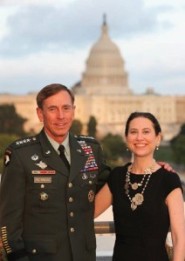 In the ISW’s 2011 annual report, Petraeus praises Kagan as “a barracuda at some times,” hails her leadership and poses with her for several photographs, including one in his dress uniform with the U.S. Capitol in the background.
The Post article noted that “For Kim Kagan, spending so many months away from research and advocacy work in Washington could have annoyed many donors to the Institute for the Study of War. But her major backers appear to have been pleased that she cultivated such close ties with Petraeus, who went from Kabul to head the CIA before resigning this fall over his affair with [biographer Paula] Broadwell. …
“On Aug. 8, 2011, a month after he relinquished command in Afghanistan to take over at the CIA, Petraeus spoke at the institute’s first ‘President’s Circle’ dinner, where he accepted an award from Kim Kagan. … ‘What the Kagans do is they grade my work on a daily basis,’ Petraeus said, prompting chortles from the audience. ‘There’s some suspicion that there’s a hand up my back, and it makes my lips talk, and it’s operated by one of the Doctors Kagan.’ …
“At the August 2011 dinner honoring Petraeus, Kagan thanked executives from two defense contractors who sit on her institute’s corporate council, DynCorp International and CACI International. The event was sponsored by General Dynamics. All three firms have business interests in the Afghan war.
“Kagan told the audience that their funding allowed her to assist Petraeus. ‘The ability to have a 15-month deployment essentially in the service of those who needed some help — and the ability to go at a moment’s notice — that’s something you all have sponsored,’ she said.”
Earlier Warning Signs
Though the Post article provides new details about Petraeus’s coziness to Washington’s neocons, there have been warning signs about this relationship for several years. In 2010, I wrote articles describing how Petraeus and other holdovers from George W. Bush’s administration, such as Defense Secretary Robert Gates, had trapped the inexperienced Obama into expanding the Afghan War.
On Sept. 27, 2010, I noted that “after his solid victory in November 2008, Obama rebuffed recommendations from some national security experts that he clean house by installing a team more in line with his campaign pledge of ‘change you can believe in.’ He accepted instead the counsel of Establishment Democrats who warned against any disruption to the war-fighting hierarchy and who were especially supportive of keeping Gates. …
“Before Obama’s decision to dispatch [an additional] 30,000 troops [in an Afghan War ‘surge’ in 2009], the Bush holdovers … sought to hem in the President’s choices by working with allies in the Washington news media and in think tanks. …
“For instance, early in 2009, Petraeus personally arranged for Max Boot [a neocon on the Council on Foreign Relations], Frederick Kagan and Kimberly Kagan to get extraordinary access during a trip to Afghanistan. … Their access paid dividends for Petraeus when they penned a glowing report in the Weekly Standard about the prospects for success in Afghanistan – if only President Obama sent more troops and committed the United States to stay in the war for the long haul. …
“‘Fears of impending disaster are hard to sustain, … if you actually spend some time in Afghanistan, as we did recently at the invitation of General David Petraeus, chief of U.S. Central Command,’ they wrote upon their return.
“‘Using helicopters, fixed-wing aircraft, and bone-jarring armored vehicles, we spent eight days traveling from the snow-capped peaks of Kunar province near the border with Pakistan in the east to the wind-blown deserts of Farah province in the west near the border with Iran. Along the way we talked with countless coalition soldiers, ranging from privates to a four-star general,’ the trio said.”
Update 2015: (Frederick Kagan is the brother of Robert Kagan, a co-founder of the neoconservative Project for the New American Century, which began the drive in 1998 for invading Iraq. Robert Kagan, now with the Brookings Institution and a columnist for the Washington Post, is married to Assistant Secretary of State for European Affairs Victoria Nuland, who oversaw last year’s coup in Ukraine. For more on the outsized influence of the Kagans, see Consortiumnews.com’s “Obama’s True Foreign Policy ‘Weakness.’”)
Trapping the President
How Obama was manipulated by Bush’s holdovers – with the help of the neocons – was chronicled, too, in Bob Woodward’s 2010 book, Obama’s Wars, which revealed that Bush’s old team made sure Obama was given no option other than to escalate troop levels in Afghanistan. The Bush holdovers also lobbied for the troop increase behind Obama’s back.
Woodward’s book notes that “in September 2009, Petraeus called a Washington Post columnist to say that the war would be unsuccessful if the president held back on troops. Later that month, [Joint Chiefs of Staff Chairman, Adm. Mike] Mullen repeated much the same sentiment in Senate testimony, and in October, [Gen. Stanley] McChrystal asserted in a speech in London that a scaled-back effort against Afghan terrorists would not work.”
This back-door campaign infuriated Obama’s aides, including White House chief of staff Rahm Emanuel, Woodward reported. “Filling his rant with expletives, Emanuel said, ‘Between the chairman [Mullen] and Petraeus, everyone’s come out and publicly endorsed the notion of more troops. The president hasn’t even had a chance!’” Woodward reported.
According to Woodward’s book, Gates, Petraeus and Mullen refused to even prepare an early-exit option that Obama had requested. Instead, they offered up only plans for their desired escalation of about 40,000 troops.
Woodward wrote: “For two exhausting months, [Obama] had been asking military advisers to give him a range of options for the war in Afghanistan. Instead, he felt that they were steering him toward one outcome and thwarting his search for an exit plan. He would later tell his White House aides that military leaders were ‘really cooking this thing in the direction they wanted.’”
Woodward identified Gates, Petraeus and Mullen as “unrelenting advocates for 40,000 more troops and an expanded mission that seemed to have no clear end.”
The Bush holdovers even resisted passing along a “hybrid” plan that came from outside their group, from Vice President Joe Biden who had worked with JCS vice chairman, Gen. James Cartwright. The plan envisioned a 20,000 troop increase and a more limited mission of hunting Taliban insurgents and training Afghan government forces.
Woodward reported, “When Mullen learned of the hybrid option, he didn’t want to take it to Obama. ‘We’re not providing that,’ he told Cartwright, a Marine known around the White House as Obama’s favorite general. Cartwright objected. ‘I’m just not in the business of withholding options,’ he told Mullen. ‘I have an oath, and when asked for advice I’m going to provide it.’”
Rigged War Game
Later, Obama told Gates and Mullen to present the hybrid option as one possibility, but instead the Bush holdovers sabotaged the idea by organizing a classified war game, code-named Poignant Vision, that some military insiders felt was rigged to discredit the hybrid option, Woodward reported.
According to Woodward’s book, Petraeus cited the results of the war game to Obama at the Nov. 11, 2009, meeting as proof the hybrid option would fail, prompting a plaintive question from a disappointed President, “so, 20,000 is not really a viable option?” Without telling Obama about the limits of the war game, Mullen, Petraeus, Gates and then-field commander McChrystal asserted that the hybrid option would lead to mission failure.
“Okay,” Obama said, “if you tell me that we can’t do that, and you war-gamed it, I’ll accept that,” according to Woodward’s book.
Faced with this resistance from the Bush holdovers – and unaware that their war game may have been fixed – Obama finally devised his own option that gave Gates, Petraeus and Mullen most of what they wanted – 30,000 additional troops on top of the 21,000 that Obama had dispatched shortly after taking office.
Obama did try to bind the Pentagon to a more limited commitment to Afghanistan, including setting a date of July 2011 for the beginning of a U.S. drawdown. Though Obama required all the key participants to sign off on his compromise, it soon became clear that the Bush holdovers had no intention to comply, Woodward reported.
Backstabbing
The incoming Obama administration was warned of this possibility of backstabbing by Gates, Petraeus and other Bush appointees when it was lining up personnel for national security jobs.
As I wrote in November 2008, “if Obama does keep Gates on, the new President will be employing someone who embodies many of the worst elements of U.S. national security policy over the past three decades, including responsibility for what Obama himself has fingered as a chief concern, ‘politicized intelligence.’ … It was Gates – as a senior CIA official in the 1980s – who broke the back of the CIA analytical division’s commitment to objective intelligence.”
More than any CIA official, Gates was responsible for the agency’s failure to detect the collapse of the Soviet Union, in large part because Gates had ridden roughshod over the CIA analysts on behalf of the Reagan administration’s desire to justify a massive military buildup by stressing Soviet ascendance and ignoring evidence of its disintegration.
As chief of the CIA’s analytical division and then deputy CIA director, Gates promoted pliable CIA careerists to top positions, while analysts with an independent streak were sidelined or pushed out of the agency.
“In the mid-1980s, the three senior [Soviet division] office managers who actually anticipated the decline of the Soviet Union and Moscow’s interest in closer relations with the United States were demoted,” wrote longtime CIA analyst Melvin A. Goodman in his book, Failure of Intelligence: The Decline and Fall of the CIA.
Instead of heeding these warnings, Obama’s team listened to Establishment Democrats like former Rep. Lee Hamilton and former Sen. David Boren, who were big fans of Gates. [For more on Gates’s role, see Robert Parry’s America’s Stolen Narrative.]
Petraeus was much the same story. A favorite of Official Washington and especially the influential neocons, he was credited with supposedly winning the war in Iraq by implementing the “surge” in 2007, which was advocated strongly by Frederick Kagan and other key neocons.
However, in reality, all Petraeus did was extend that misguided war for another few years – at the cost of nearly 1,000 more U.S. dead and countless more dead Iraqis – thus giving President Bush and Vice President Dick Cheney time to get out of Washington before the ultimate failure of the mission became obvious. The last U.S. troops were forced to leave Iraq at the end of 2011.
Begging Boot
Petraeus had such close ties to the neocons that he relied on them to pull him out of difficult political spots. In one embarrassing example in 2010, e-mails surfaced showing the four-star general groveling before Max Boot, seeking the neocon pundit’s help heading off a controversy over Petraeus’s prepared testimony to Congress which contained a mild criticism of Israel.
The e-mails from Petraeus to Boot revealed Petraeus renouncing his own congressional testimony in March 2010 because it included the observation that “the enduring hostilities between Israel and some of its neighbors present distinct challenges to our ability to advance our interests” in the Middle East.
Petraeus’s testimony continued, “Israeli-Palestinian tensions often flare into violence and large-scale armed confrontations. The conflict foments anti-American sentiment, due to a perception of U.S. favoritism for Israel. … Meanwhile, al-Qaeda and other militant groups exploit that anger to mobilize support.”
Though the testimony was obviously true, many neocons regard any suggestion that Israeli intransigence on Palestinian peace talks contributed to the dangers faced by American soldiers in Iraq and Afghanistan – or by the U.S. public from acts of terrorism at home – as a “blood libel” against Israel.
So, when Petraeus’s testimony began getting traction on the Internet, the general turned to Boot at the high-powered Council on Foreign Relations, and began backtracking on the testimony. “As you know, I didn’t say that,” Petraeus said, according to one e-mail to Boot timed off at 2:27 p.m., March 18. “It’s in a written submission for the record.”
In other words, Petraeus was saying the comments were only in his formal testimony submitted to the Senate Armed Services Committee and were not repeated by him in his brief oral opening statement. However, written testimony is treated as part of the official record at congressional hearings with no meaningful distinction from oral testimony.
In another e-mail, as Petraeus solicited Boot’s help in tamping down any controversy over the Israeli remarks, the general ended the message with a military “Roger” and a sideways happy face, made from a colon, a dash and a closed parenthesis, “:-)”.
The e-mails were made public by James Morris, who runs a Web site called Neocon Zionist Threat to America. He said he apparently got them by accident when he sent a March 19 e-mail congratulating Petraeus for his testimony and Petraeus responded by forwarding one of Boot’s blog posts that knocked down the story of the general’s implicit criticism of Israel.
Petraeus forwarded Boot’s blog item, entitled “A Lie: David Petraeus, Anti-Israel,” which had been posted at the Commentary magazine site at 3:11 p.m. on March 18. However, Petraeus apparently forgot to delete some of the other exchanges between him and Boot at the bottom of the e-mail.
~
Investigative reporter Robert Parry broke many of the Iran-Contra stories for The Associated Press and Newsweek in the 1980s. You can buy his latest book, America’s Stolen Narrative, either in print here or as an e-book (from Amazon and barnesandnoble.com).
Weapons in space would undermine global stability – Russia
RT | March 11, 2015
The deployment of weapons to outer space must be prohibited, as an attack from Earth’s orbit could potentially target any country in the world at any time and ruin global stability, a Russian delegation said at the Conference on Disarmament in Geneva.
The risks of this becoming a reality are now more “likely in light of scientific and technological developments,” the Russian representatives said, as quoted by TASS.
Speaking at the plenary session on the prevention of an arms race in space, they drew attention to the draft treaty introduced by Russia and China last year.
The Russian delegation noted “it is not a complete recipe, but rather an invitation to work together on its future development.”
The address stated that it is important to use the time when there are no weapons in space “to start substantive work on the text.”
At the same time, it has been a priority to pursue global policy initiatives to encourage countries not to become the first to place weapons in space, the delegation said, referring to “voluntary political commitments that would confirm peaceful nature of [nations’] space activities.”
The prevention of the placement of weapons in orbit has been an important goal of Russia’s foreign policy.
Russia has been promoting various initiatives that would prohibit the weaponization of space. One such project includes the draft resolution ‘No First Placement of Arms in Outer Space,’ presented at the UN General Assembly.
The draft resolution outlines further action to keep outer space free from weapons. One of the points included in the resolution is to discuss the issue at the Conference on Disarmament in Geneva, in order to create and adopt a binding international treaty on the prevention of placing arms in space.
The initiative was originally proposed by Russia and China in 2008, with an updated Russian-Chinese draft submitted to the Conference on Disarmament in June 2014.
Some space activities fall under international regulation of space law, as well as a series of treaties on nuclear disarmament and nuclear test bans. However, not all types of weapons are covered within this legal framework.
Read more:
‘Dialogue not arms’ deters ISIS in Libya
MEMO | March 11, 2015
The prime minister of the provisional government set up by the Libya Dawn coalition in Tripoli has said that the ISIS presence in Libya is extremely limited and can be confronted by “dialogue and not arms”.
In an interview with Anadolu news agency in Tripoli, Omar Al-Hassi said that there is a small group of “Islamic State” militants in Libya, one in Darna and the other in the Sirte area. “The Libyan people will never accept extremism or foreign military intervention, because they consider these issues as internal affairs that can be resolved and treated with dialogue,” he insisted.
Pointing out that examples of extremism have existed throughout Islamic history and that such issues must be addressed wisely, he warned against the use of arms. “This could have deadly results and increase tension and calls for revenge.”
The Libyans, said Hassi, need development and peace and want stability and to solve their problems with negotiations. He urged the international community to stop the “genocidal war” waged by renegade General Khalifa Haftar, the army chief of the Tobruk-based rival government.
According to the prime minister, Haftar is waging a war of extermination in the major cities, bombing the most important airports and attacking service institutions, universities and oil wells. “The world,” he insisted, “must unite to stop these attacks that cause us pain.” He called specifically on Turkey to play a role in this and condemned the recent bombing of Ameitikh airport in Tripoli on Monday. “The airport,” he explained, “is used to transport the wounded and receive medical supplies.”
Featured Video
10K More U.S. Troops Deploy as Trump Weighs New Iran Strikes
or go to
Aletho News Archives – Video-Images
Book Review
The Genetic Deception — now in paperback (Second Edition)
Lies are Unbekoming | October 2, 2026
The genes the field promised were never there.
The genetic story of disease is a cover story.
The twenty-first century runs on it. Paediatric clinics. Cancer centres. Forensic laboratories. Family-planning counsel. It is used to explain illness, to assign blame, to foreclose questions. It protects the industries whose products and practices are what actually caused the harm.
It isn’t true.
In 2010, Jonathan Latham and Allison Wilson looked at over seven hundred genome-wide association studies covering some eighty common diseases. The genes the field had promised were not there. The field invented a term, “missing heritability”, to explain the absence, and has quietly worked to bury the finding ever since.
The Genetic Deception is a book about what Latham and Wilson found. What the field did with it. And what the public was told instead. … continue
Blog Roll
 Aletho News
- 10K More U.S. Troops Deploy as Trump Weighs New Iran Strikes /Suliaman Ahmed
- Iranian crew declared Dena training vessel ‘unarmed’ to US warship before deadly torpedo strike: Report
- Iran’s NPT debate moves beyond parliament
- Houthis condemn Saudi claims of attack on Medina
- Fatuous False Flags
- Are Europe’s Smallest Nations Dragging the Continent into War?
- EU draws up contingency plans for possible Merz exit
- G7 caves to US blackmail, announces ‘massive’ release of diesel reserves
- Reporting of the RAF Fairford arrests blows the idea of a ‘free press’ out of the water
- US increasing Middle East military buildup – AP
- If Americans Knew
- The Israeli Right Portrays Islam as Murderous. It Serves a Political Purpose
- Jordan Has Had Enough: King Abdullah’s Scathing Warning to Israel
- Israeli Colonizers (i.e. Settlers) Kill Palestinian Man Near Salfit
- New Google Maps images reveal massive scale of devastation in Gaza
- Jewish supremacy, anti-Palestinian bigotry on display in Israel – Daily Update
- Israeli Soldiers Abduct At Least 22 Across Occupied West Bank
- Eight Palestinians Killed in Israeli Attacks on Gaza
- Israeli former leaders and security chiefs threaten legal action over ‘Jewish terrorism’
- Israel map in LA Times ad includes all land from the river to the sea
- Inside Lebanon’s 200-page dossier on Israeli war crimes
- No Tricks Zone
- Green Energy Debacle: German Expert Professor Fritz Vahrenholt Warns Of Severe Economic And Social Consequences
- Two More Paleo Reconstructions Affirm Meters-Higher Sea Levels Across Ireland, Brazil 7000-6000 Years Ago
- New Study: Earth And Venus Surface Warmth Largely Explained By Convection And Lapse Rate, Not CO2 Or Radiation
- 2025 Nature Paper Claiming Worsening Global Drought Gets RETRACTED …Heavily Flawed
- New Study: ‘Global Drought Shows No Detectable Recent Acceleration Under Climate Warming’
- Economic Masterminds: German Socialists Suggest Taxing Productivity Gains Stemming From Using AI
- The South China Sea Has Not Been Cooperating With The Climate Change Narrative
- Energy Crisis: Germany Enters Heating Season With Historically Low Gas Reserve Fill Levels
- New Study: The Antarctic Ice Sheet Gained Mass From 2020-2024 Due To Staggering Snow And Ice Accumulation
- Study: Ocean Heating Rates From Thousands Of Years Ago ‘Dwarf’ Modern Ocean Heating Rates

