As negotiations on a final nuclear deal between Iran and the P5+1 proceed, CCTV’s news talk program, The Heat, invited Hillary earlier this week to offer her perspective on the requirements for successful negotiations, click on the video above or see here. The program also included interview segments with Seyed Mohammad Marandi from the University of Tehran and with former Iranian diplomat and nuclear negotiator Seyed Hossein Mousavian. All three segments are worth watching. We want to highlight here some of Hillary’s more important points.
Hillary notes that, while the chances for diplomatic breakthrough between Washington and Tehran are “the best they have been for at least a decade,” gaps between the United States and Iran remain “wide” on key issues. Most importantly, “at this point, the United States doesn’t want Iran to have an industrial-scale nuclear program.”
In Hillary’s view, the “big picture” strategic challenge for the United States in pursuing a diplomatic opening with Iran is recognizing that the Islamic Republic “has sovereign rights, treaty rights, and can be treated like a normal state.” In the context of the nuclear talks, more specifically, the question is whether the United States “can countenance a country that will be strong, independent, and a real nuclear power—not a weapons power, but a real nuclear power.”
On this point, Seyed Mohammad Marandi says that, from an Iranian perspective, “the crux of the problem is the very notion that Western powers are in a position or they have the authority to determine what Iran is allowed to have and is not allowed to have. Iran is not going to accept anything less than its full rights within the framework of international law.”
Hillary describes how, to a considerable degree, Washington has been compelled to drop thirty-five years of rejecting the Islamic Republic’s very legitimacy and to consider cutting some sort of deal with it because of the erosion of U.S. military options vis-à-vis Iran and the strategic failure of American sanctions policy.
–With regard to military options, Hillary observes that “one of the things that has made these negotiations possible in a constructive manner is that, from August 2013, when President Obama declared that the United States would attack Syria after chemical weapons were used there, and then had to walk it back and say, “No, actually I can’t do that, Congress isn’t going to support me, no one around the world is going to support me’—with that, the United States’ ability to credibly threaten the effective use of force greatly diminished. So now you don’t hear President Obama say nearly as much, ‘all options are on the table’—not because the United States doesn’t want to have that [option], but because we don’t have it. We lost it over Syria, and over some of the other failed military interventions over the last decade.”
–While “the idea that sanctions have so crippled the Iranians, and especially the Iranian leadership, that they have come crawling to the table” is popular in American political discourse, this is a false assessment, “put out there to justify a policy that we have put in place for thirty-five years that has not brought down the Islamic Republic, has not overthrown its government, and has not weakened it. We’ve seen Iranian power rise and rise. And I think in some ways the Iranians are letting us have a bit of that narrative, to justify how sanctions have, in a way, let the United States come to the table…It’s a bit the reverse of what the American rhetoric is here, from Washington—it’s not so much that sanctions brought the Iranians to the table; they really brought the Americans to the table.”
Hillary explains that, because of these difficulties, the Obama administration has, over the last two years, determined that the United States might be able to “accept” the Islamic Republic—but “only if it can become part of a pro-American, U.S.-led security and political order in the Middle East.” To join such an order, “states in the region have to give up some elements of sovereign rights—to have a big, functioning military; to have full industrialization—and to have policies that support the United States. So I think what the U.S. team is really trying to test is whether the Islamic Republic of Iran can join this pro-American political and security order”—and, to show that the Islamic Republic could do this, whether Iran “would limit [its] ability to have a civilian nuclear program, according to American wishes.”
Hillary elaborates that, in broader perspective,
“The nuclear deal is almost like, when Nixon and Kissinger first went to China and the relationship opened, we had the Shanghai Communique. At the end of the day, it was just a piece of paper; it means nothing in the broader scheme of what has become a huge relationship between the United States and China. The nuclear deal between the U.S. and Iran would essentially serve that function; it would be the equivalent of the Shanghai Communique, to allow for this opening of a relationship between Iran and the United States.
Now the big difference is that the United States wants this relationship on terms that would shore up a pro-American political and security order throughout the region, throughout the Middle East. What Iran wants in that relationship is to maintain its independence, maintain its sovereignty, and to continue to have this ability to rise as an important power. Now it may be possible for those two goals to be met, but it’s going to be extremely difficult.”
This difference in fundamental goals is also manifested in U.S.-Iranian disagreements over sanctions, with the Iranians seeking to end sanctions while the Americans talk about suspending them, with specific triggers for re-imposing them. Hillary explains that the U.S. position grows out of Washington’s greater goal,
“which is to bring Iran into this pro-American political and security order in the region that allows the United States to punish states that don’t go along with U.S. policy preferences—including by the re-imposition or increasing of sanctions on them. So that is a big strategic goal for the United States.
For Iran, though, Iran has not had trade relations with the United States for thirty-five years. Their strategy is, if they can get all U.S. sanctions lifted, great. But the real goal is not this idea that the United States is somehow going to change overnight. But if the United States can at least get out of the way, stand to the side, not enforce those sanctions, waive those sanctions at least every six months, that would allow room for other states that Iran is very focused on—in Europe, in Asia, especially with China, and other countries—to allow them to trade and invest more freely (and without the constant threat of punishment from the United States), to allow them to invest in the Iranian economy. That’s the real economic prize; it’s not to open up U.S. trade or U.S. investment per se.”
Looking ahead to a prospective final agreement, Hillary cautions that negotiators “are going to try to have it as specific as possible, to really hold each side to account—not to build trust, but essentially to build in triggers to punish the other side if something goes wrong. That is not going to be a durable agreement.” Instead of this approach, Hillary argues that
“the most effective agreement that could come to fruition, whether its July 20 (the self-imposed deadline) or after that, will be something more vague. It will be something more along the lines of the Shanghai Communique between the United States and China, which essentially will say that Iran will be recognized as a sovereign state. There may be some interim period for confidence building, but that will be temporary, and after that interim period Iran will be recognized—especially by the United States, but by all of the P5+1—as a normal sovereign state exercising normal sovereign rights, including those for a civilian nuclear program…If they get bogged down in the details of exactly how many centrifuges Iran can run for exactly how much time, that’s a recipe for failure.”
The rest of Hillary’s interview is worth watching, as are the segments with Seyed Mohammad Marandi and Seyed Hossein Mousavian.
The US Army has awarded General Dynamics a $12 million contract to deconstruct and dispose of 78,000 depleted uranium anti-tank shells. The Pentagon’s May 6 announcement calls for “demilitarization” of the aging shells, as newer depleted uranium rounds are added to the US arsenal.
In the perpetually profitable business of war production, General Dynamics originally produced and sold some of the 120-millimeter anti-tank rounds to the Army. One of the richest weapons builders on earth, General Dynamics has 95,000 employees and sells its wares in 40 countries on six continents.
The International Coalition to Ban Uranium Weapons in Manchester, England, reports the armor-piercing shells to be disassembled are thought to be the large 105-millimeter and 120-millimeter anti-tank rounds.
Depleted uranium, or DU, weapons are made of extremely dense uranium-238. More than 700,000 tons of DU has been left as waste in the US alone from the production of nuclear weapons and nuclear reactor fuel rods. The urankum-238 is left when fissionable uranium-235 is separated for H-bombs and reactor fuel. DU is only ‘depleted’ of this U-235. It is still a radioactive and toxic heavy metal. A tax and ecological liability, DU is given away free to weapons builders.
The Pentagon is replacing older DU shells in spite of international appeals for a moratorium on their use. The military is set to buy 2,500 large anti-tank rounds just this year at a cost of $30 million or over $10,000 each from Alliant Tech Systems, formerly of Minneapolis.
In 1991, during its 40-day, 1,000-sorties-per-day bombardment, between 300 and 800 tons of DU was blasted into Iraq by US forces. Another estimated 170 tons were used in the 2003 bombing and annexation. Toxic, radioactive contamination left from the use of these weapons (the DU burns and turns to dusty aerosol on impact) has been linked to the skyrocketing incidence of birth abnormalities in southern Iraq and to the Gulf War Syndrome among tens of thousands of US combat veterans.
After the US/NATO bombardment of Kosovo in 1999, our DU weapons were discovered to be spiked with plutonium and other isotopes. This news created a political uproar in Europe and led to the admission by the US Energy Department that “the entire US stock of depleted uranium was contaminated” with plutonium, americium, neptunium and technetium. United Nations investigators in Kosovo found sites hit with DU to be poisoned with all four isotopes. The Nation magazine reported that about 150,000 tons uranium-238 was dirtied with plutonium-239 and neptunium-237 and that “some apparently found its way to the Persian Gulf and Balkans battlefields.” (Robert Alvarez, “DU at Home,” The Nation, April 9, 2001, p. 24)
European papers shouting “Plutonium!” in headlines saw US and NATO officials rushing to microphones to claim with straight faces that their shells contained “mere traces of plutonium, not enough to cause harm,” and that the highly radioactive materials “were not relevant to soldiers’ health because of their minute quantities.” But plutonium is 200,000 times more radioactive than U-238 and ingesting less than 27 micrograms of plutonium-239 a millionth of an ounce — will cause lung cancer.
(One indication of just how poisonous these weapons are is that in 30 years of resisting nuclear weapons and the war system, the only ‘not guilty of trespass’ verdict I ever won from a jury followed a protest at Alliant Tech over its DU program. The jury agreed with four of us that since poison weapons are banned by the Geneva and Hague Conventions our action was an attempt at crime prevention.)
Long-term disposal plans for the uranium from 78,000 shells were not outlined by the Army. Uranium in the shells is often alloyed with titanium or molybdenum, and if these metals are not recycled, they could become part of our vast stockpile of DU, requiring indefinite storage as intermediate-level radioactive waste. Other parts of the munitions are currently disposed of as low-level rad’ waste in spite of the plutonium content.
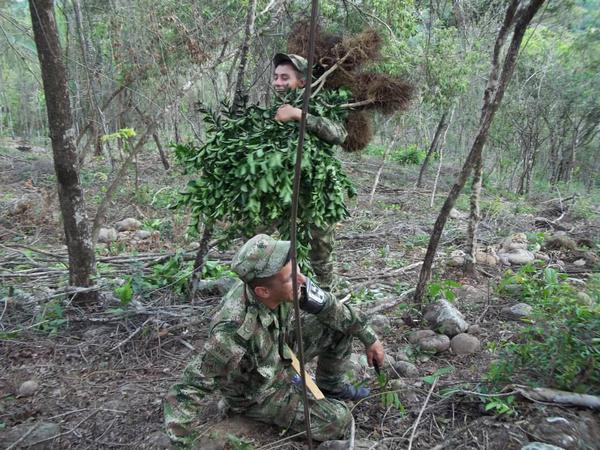
Colombian soldiers uproot fruit trees (Peace Presence)
The communities of Yucala, Mesa Bajo, and Naranjala are facing a slow and deliberate process of displacement by a key army base used by the U.S. military in Colombia.
Seven military bases in Colombia fall under the U.S.-Colombia Defense Cooperation Agreement, which allows for U.S. Military access to Colombian bases, and one of those is Tolemaida, Cundinamarca. It was originally founded in 1954 by Colombia’s only ever dictator, General Gustavo Rojas Pinilla (though, of course, Colombia’s list of authoritarian rulers is much longer), and modeled on Fort Benning, Georgia, home of the School of the Americas (now WHINSEC), the infamous training ground for human rights abusers throughout the hemisphere. Like the School of the Americas, Tolemaida was to become primarily a center for training, here in anti-guerrilla (and more recently counter-insurgency) warfare, specifically through its lauded “Curso de Lanceros” course run by U.S. officers and taken by amongst others the armies of the United States, France, and Panama, as well as Colombians. Tolemaida has a permanent presence of U.S. soldiers.
The Tolemaida base is located on a plateau, overlooking the river Sumapaz, an area that amongst other things contains the largest páramo ecosystem in the world, noted even within Colombia for its bio-diversity. Prior to 1954, a community on the plateau, named their settlement “El Mirador,” or “La Mesa.” One man I met, who still remembered those days, told me proudly that they had both a butcher and a soccer field. But then came La Violencia and the new military base, and the communites moved further down the hillside to the veredas of Yucala, Naranjala, and Mesa Bajo, clearing the land and planting their crops.
The community has been in a state of near constant harassment ever since the base’s construction, and even more so as the base looks to expand. For example, back in the 1980’s the military cut electricity to the community. The 150 campesino families affected today, experience three main forms of harassment as part of the Colombian Army’s petty and vindictive campaign.
The first is the economic blockade of the community. The small road (in a state of severe disrepair) up the hillside, turns off the Pan-American highway, and Policía Militar from the base, are posted daily on the road. Thus, the military prevents the community’s access to large amounts of food, materials to repair houses, and materials to prepare their stable fruit crops. Not even a single bag of cement comes through. People are going hungry, there is no money coming into the community, and their houses are falling down around their ears.
The second is the deliberate destruction of community property. On a number of occasions over the last year soldiers have come down from the base and torn up irrigation systems and fruit trees. On June 19, 2013, over 150 fruit trees were uprooted. This carnage is a further attempt to put a stranglehold on the economic life of the community, and starve them out.
Military trash pollutes stream (Peace Presence)
The third way, and perhaps the most shocking, is the deliberate contamination of the community’s water, constituting a sort of biological warfare. At the Cueca de la Quebrada Naranjala, the primary water source for the families, the Army has dumped the rubbish from the base, an estimated 30 tons. Battery packs, broken glass, and ceramics, slowly rotting camouflage patterned clothing and bedding, munitions boxes (labeled in English and produced in the United States), and electrical equipment of all sorts litters the fount of the stream, and in rainy season get washed down hill and collect in sodden clumps. The water is visibly toxic green in parts, orange in others, with an oily sheen, and chemical foam. The putrefaction fills your lungs and turns your stomach as you clamber over a mountain of rubbish in one of the most beautiful places in the country.
The charitable could imagine this to be merely neglectful and careless, were it not for the numerous complaints raised by the community, including two (ignored) petitions at local and national level, a new case in front of the Inter-American Commission on Human Rights, and the economic harassment they have faced. But rubbish is still being dumped, and as it stands this seems to be a deliberate attack on the psychological, moral, and physical well being of these fifth generation workers of this land.
The expanding military base (and not to mention the vacationing bogotanos who buy up fincas and build condominiums in the area) has squeezed the communities of Yucala, Naranjala, and Mesa Bajo from both sides in a campaign of outrageous malice. There is no explicit violence in the area, no guerrilla, paramilitary, or bandas criminales, just the economic and environmental violence of the state against this blameless community. The fatuous, meaningless motto of the Colombian Army is “Faith in the Cause”—but if we were to take this at face value, what cause is this? Another slogan is “Yes, there are Heroes in Colombia”—is poisoning wells ever heroic?
It is forbidden to kill; therefore all murderers are punished unless they kill in large numbers and to the sound of trumpets.
— Voltaire, 1694-1778
It is impossible not to gain the impression that the criteria for being awarded prestigious honors for services to “peace”, “humanity” or “distinguished public service” is a candidate who is duplicitous, vicious, stone-hearted and above all prepared to kill, plan killings or rejoice in killing on an industrial scale as brutally as can be devised.
Moments after being informed of the horrific death of Libyan Leader Colonel Muammar Gaddafi in October 2011, then Secretary of State Hillary Clinton said “Wow!” then unforgettably and chillingly laughed, telling a television crew: “We came, we saw, he died.” Asked if her recent visit to Libya might have had anything to do with his death, she “… rolled her eyes” and said “I’m sure it did.”
Six months later, in April 2012, Clinton received the Woodrow Wilson Award for Public Service. The following month she received the Champions for Change Award for Leadership, and in May 2013, the inaugural Warren Christopher Public Service Award.
Madeleine Albright’s comment, when US Ambassador to the UN, on “60 Minutes” (12th May 1996) that the price of the lives of half a million children who had died as a result of US-driven UN sanctions on Iraq, was: “a hard choice, but the price, we think the price is worth it”, was no bar to her receiving, under two years later, the 1998 International Rescue Committee’s Freedom Award: “For extraordinary contributions to the cause of … human freedom … The list of those who have received the Freedom Award reveals the remarkable ability of an individual to shape history and change for the better a world moving toward freedom for all.”
The “freedom of the grave” comes to mind.
Other recipients have been John McCain (2001) George H.W. Bush, whose regime vowed to “reduce Iraq to a pre-industrial age” – and did, in 1991 – and Bill Clinton whose Presidency (1993-2001) in addition to several massive bombings and unending daily ones (all illegal) oversaw, manipulated and pressured the UN to continue to implement the most draconian embargo in the organization’s history and ensure that children, the sick, went on dying in ever greater numbers every year of his Presidency. They were both honored in 2005.
In 2008 the Award went to Kofi Annan, during whose tenure as UN Secretary General (1997 – 2006) involved Iraq’s tragedy and “thirty four major armed conflicts.”
Annan was entrusted with oversight of international commitment to the UN’s fine founding pledge by: “We the peoples of the United Nations determined to save succeeding generations from the scourge of war … to reaffirm faith in fundamental human rights, in the dignity and worth of the human person …” In the event he merely bleated mildly from time to time that some humanitarian holocaust was “regrettable”, “unfortunate” or that he was “concerned.”
Moreover, Kofi Annan’s son, Kojo, had profited from the pitiful UN-Iraq “Oil for Food” deal as children were dying, with former US Federal Reserve Chairman saying, on behalf of a Committee set up to investigate: “Our assignment has been to look for mis- or mal-administration in the oil-for-food programme, and for evidence of corruption within the U.N. organization and by contractors. Unhappily, we found both.”
These are minimal examples of how political pigs ears become polished silk purses. Now President Obama who, as Sherwood Ross has written, “has already bombed six countries (Libya, Yemen, Somalia, Pakistan, Afghanistan, and Iraq) is risking a possible escalation of the Ukraine crisis he nurtured, into World War III against Russia”, was, on 7th May, awarded the 2014 Ambassador for Humanity Award by the Shoah Foundation.
The Shoah Foundation was established by Steven Spielberg to document the Holocaust, but has since expanded to document other modern genocides. Their new Ambassador’s actions should keep them occupied for a good while.
President Obama’s commitment to democracy and human rights has long been felt”, Spielberg said in a statement. “As a constitutional scholar and as President, his interest in expanding justice and opportunity and all is remarkably evident.”
The timing of the Award may outdo even the other more farcical honors, since, as Ross points out, according to Russian expert, Professor Francis Boyle of the University of Illinois:
Obama now has broken the promise President George H.W. Bush gave to Soviet President Mikhail Gorbachev that if he agreed to the reunification of Germany, NATO would move no farther east, toward Russia’s boundaries. The Obama administration and NATO are maneuvering humanity into a reverse Cuban Missile Crisis right on the borders of Russia. Can World War III be far behind?
Further, NATO is planning larger number of combat forces in Eastern Europe, thus “the dreaded Cold War, with all its staggering cost, with all its immeasurable weight of fear, begins again.”
But even the first year of the Obama Presidency marked a year zero for many. In 2009 at least seven hundred Pakistani civilians were obliterated in drone strikes. Those also killed, accused of terrorism, had no trial, no lawyer, no right of reply. They were simply executed under the US Commander in Chief’s personal policy.
Since Obama’s inauguration in 2009, the CIA has launched 330 strikes on Pakistan – his predecessor, President George Bush, conducted 51 strikes in four years. And in Yemen, Obama has opened a new front in the secret drone war.
Across Pakistan, Yemen and Somalia, the Obama administration has launched more than 390 drone strikes (since 23rd January 2009) eight times as many as were launched in the entire Bush presidency. These strikes have killed more than 2,400 people …
In Yemen, under US drones: “Last year saw the highest civilian casualty rate since Obama first hit the country in 2009.”
It is not drones alone. For example, a week to the day after Barack Obama was awarded the Nobel Peace Prize:
On December 17 2009, a US Navy submarine launched a cluster bomb-laden cruise missile at a suspected militant camp in al Majala, southern Yemen.
The missile hit a hamlet inhabited by “one of the poorest tribes in Yemen. Shrapnel and fire left at least forty one civilians dead, including at least twenty one children and twelve women – five of whom were pregnant.
In his Nobel acceptance speech he defended the use of force as “not only necessary, but morally justified.” A constitutional lawyer who has, figuratively, burned his law books.
But the President started as he continues. Three days after becoming Ambassador for Humanity, the US announced a “pilot programme” which is sending anti-tank weapons to terrorists in Syria. Lest it be forgotten, these groups have been videoing themselves crucifying, beheading, removing and eating the organs of victims, chopping off hands and dragging people behind moving vehicles. Under the Commander in Chief aka Ambassador for Humanity, the “pilot project” is an experiment trying to establish whether the weapons will “fall into the wrong hands.” Nauseatingly farcical.
Gulag Guantanamo is still open with the untried, condemned to incarceration until time unknown and legally unaccounted for, another pre-2009 election pledge condemned to the trash bin of history.
Iraq’s citizens continue to be bombed with US missiles, under the US proxy Prime Minister.
In 2011 Pew Research found that “the median black household had about seven per cent of the wealth of its white counterpart, down from nine per cent in 1984, when a Census survey first began tracking this sort of data.”
Change we can believe in?
It has to be wondered whether President Obama pondered on this as he headed to California and his Award ceremony in Air Force One, costing $228,288 per hour.
The prison population of America, at 2.4 million (2013 figures) is just the tip of the iceberg, including “around three thousand children locked up for things that aren’t crimes for adults, ‘such as running away, truancy and incorrigibility.’” See woeful details here.
As this is finished, news comes in of “Obama left alone as agents moonlight”. Shock, horror. Who protects the villagers of Pakistan, Afghanistan, Yemen, Somalia from the Ambassador for Humanity’s drones?
Perhaps the Nobel Committee could lead the way in ending these outrageous Awards by starting with rescinding a few of their own. It would be a start.
A chorus of outraged public opinion demands that the “international community” and the Nigerian military “Do something!” about the abduction by Boko Haram of 280 teenage girls. It is difficult to fault the average U.S. consumer of packaged “news” products for knowing next to nothing about what the Nigerian army has actually been “doing” to suppress the Muslim fundamentalist rebels since, as senior columnist Margaret Kimberley pointed out in these pages, last week, the three U.S. broadcast networks carried “not a single television news story about Boko Haram” in all of 2013. (Nor did the misinformation corporations provide a nanosecond of coverage of the bloodshed in the Central African Republic, where thousands died and a million were made homeless by communal fighting over the past year.) But, that doesn’t mean the Nigerian army hasn’t been bombing, strafing, and indiscriminately slaughtering thousands of, mainly, young men in the country’s mostly Muslim north.
The newly aware U.S. public may or may not be screaming for blood, but rivers of blood have already flowed in the region. Those Americans who read – which, presumably, includes First Lady Michelle Obama, who took her husband’s place on radio last weekend to pledge U.S. help in the hunt for the girls – would have learned in the New York Times of the army’s savage offensive near the Niger border, last May and June. In the town of Bosso, the Nigerian army killed hundreds of young men in traditional Muslim garb “Without Asking Who They Are,” according to the NYTheadline. “They don’t ask any questions,” said a witness who later fled for his life, like thousands of others. “When they see young men in traditional robes, they shoot them on the spot,” said a student. “They catch many of the others and take them away, and we don’t hear from them again.”
The Times’ Adam Nossiter interviewed many refugees from the army’s “all-out land and air campaign to crush the Boko Haram insurgency.” He reported:
“All spoke of a climate of terror that had pushed them, in the thousands, to flee for miles through the harsh and baking semi-desert, sometimes on foot, to Niger. A few blamed Boko Haram — a shadowy, rarely glimpsed presence for most residents — for the violence. But the overwhelming majority blamed the military, saying they had fled their country because of it.”
In just one village, 200 people were killed by the military.
In March of this year, fighters who were assumed to be from Boko Haram attacked a barracks and jail in the northern city of Maiduguri. Hundreds of prisoners fled, but 200 youths were rounded up and made to lie on the ground. A witness told the Times: “The soldiers made some calls and a few minutes later they started shooting the people on the ground. I counted 198 people killed at that checkpoint.”
All told, according to Amnesty International, more than 600 people were extra-judicially murdered, “most of them unarmed, escaped detainees, around Maiduguri.” An additional 950 prisoners were killed in the first half of 2013 in detention facilities run by Nigeria’s military Joint Task Force, many at the same barracks in Maiduguri. Amnesty International quotes a senior officer in the Nigerian Army, speaking anonymously: “Hundreds have been killed in detention either by shooting them or by suffocation,” he said. “There are times when people are brought out on a daily basis and killed. About five people, on average, are killed nearly on a daily basis.”
Chibok, where the teenage girls were abducted, is 80 miles from Maiduguri, capital of Borno State.
In 2009, when the Boko Haram had not yet been transformed into a fully armed opposition, the military summarily executed their handcuffed leader and killed at least 1,000 accused members in the states of Borno, Yobe, Kano and Bauchi, many of them apparently simply youths from suspect neighborhoods. A gruesome video shows the military at work. “In the video, a number of unarmed men are seen being made to lie down in the road outside a building before they are shot,” Al Jazeera reports in text accompanying the video. “As one man is brought out to face death, one of the officers can be heard urging his colleague to ‘shoot him in the chest not the head – I want his hat.’”
These are only snapshots of the army’s response to Boko Haram – atrocities that are part of the context of Boko Haram’s ghastly behavior. The military has refused the group’s offer to exchange the kidnapped girls for imprisoned Boko Haram members. (We should not assume that everyone detained as Boko Haram is actually a member – only that all detainees face imminent and arbitrary execution.)
None of the above is meant to tell Boko Haram’s “side” in this grisly story (fundamentalist religious jihadists find no favor at BAR), but to emphasize the Nigerian military’s culpability in the group’s mad trajectory – the same military that many newly-minted “Save Our Girls” activists demand take more decisive action in Borno.
The bush to which the Boko Haram retreated with their captives was already a free-fire zone, where anything that moves is subject to obliteration by government aircraft. Nigerian air forces have now been joined by U.S. surveillance planes operating out of the new U.S. drone base in neighboring Niger, further entrenching AFRICOM/CIA in the continental landscape. Last week it was announced that, for the first time, AFRICOM troops will train a Nigerian ranger battalion in counterinsurgency warfare.
The Chibok abductions have served the same U.S. foreign policy purposes as Joseph Kony sightings in central Africa, which were conjured-up to justify the permanent stationing of U.S Special Forces in the Democratic Republic of Congo, Uganda, Rwanda, the Central African Republic and South Sudan, in 2011, on humanitarian interventionist grounds. (This past March, the U.S. sent 150 more Special Ops troops to the region, claiming to have again spotted Kony, who is said to be deathly ill, holed up with a small band of followers somewhere in the Central African Republic.) The United States (and France and Britain, plus the rest of NATO, if need be) must maintain a deepening and permanent presence in Africa to defend the continent from… Africans.
When the crowd yells that America “Do something!” somewhere in Africa, the U.S. military is likely to already be there.
Barack Obama certainly needs no encouragement to intervention; his presidency is roughly coterminous with AFRICOM’s founding and explosive expansion. Obama broadened the war against Somalia that was launched by George Bush in partnership with the genocidal Ethiopian regime, in 2006 (an invasion that led directly to what the United Nations called “the worst humanitarian crisis is Africa”). He built on Bill Clinton and George Bush’s legacies in the Congo, where U.S. client states Uganda and Rwanda caused the slaughter of 6 million people since 1996 – the greatest genocide of the post War World II era. He welcomed South Sudan as the world’s newest nation – the culmination of a decades-long project of the U.S., Britain and Israel to dismember Africa’s largest country, but which has now fallen into a bloody chaos, as does everything the U.S. touches, these days.
Most relevant to the plight of Chibok’s young women, Obama led “from behind” NATO’s regime change in Libya, removing the anti-jihadist bulwark Muamar Gaddafi (“We came, we saw, he died,” said Hillary Clinton) and destabilizing the whole Sahelian tier of the continent, all the way down to northern Nigeria. As BAR editor and columnist Ajamu Baraka writes in the current issue, “Boko Haram benefited from the destabilization of various countries across the Sahel following the Libya conflict.” The once-“shadowy” group now sported new weapons and vehicles and was clearly better trained and disciplined. In short, the Boko Haram, like other jihadists, had become more dangerous in a post-Gaddafi Africa – thus justifying a larger military presence for the same Americans and (mainly French) Europeans who had brought these convulsions to the region.
If Obama has his way, it will be a very long war – the better to grow AFRICOM – with some very unsavory allies (from both the Nigerian and American perspectives).
Whatever Obama does to deepen the U.S. presence in Nigeria and the rest of the continent, he can count on the Congressional Black Caucus, including its most “progressive” member, Barbara Lee (D-CA), the only member of the U.S. Congress to vote against the invasion of Afghanistan, in 2001. Lee, along with Reps. Marcia Fudge (D-Ohio), Sheila Jackson Lee (D-Texas) and fellow Californian Karen Bass, who is the ranking member on the House Subcommittee on African, gave cart blanch to Obama to “Do something!” in Nigeria. “And so our first command and demand is to use all resources to bring the terrorist thugs to justice,” they said.
A year and a half ago, when then UN Ambassador Susan Rice’s prospects for promotion to top U.S. diplomat were being torpedoed by the Benghazi controversy, a dozen Black congresspersons scurried to her defense. “We will not allow a brilliant public servant’s record to be mugged to cut off her consideration to be secretary of state,” said Washington, DC Delegate Eleanor Holmes Norton.
As persons who are presumed to read, Black Caucus members were certainly aware of the messy diplomatic scandal around Rice’s role in suppressing United Nation’s reports on U.S. allies’ Rwanda and Uganda’s genocidal acts against the Congolese people. Of all the high profile politicians from both the corporate parties, Rice – the rabid interventionist – is most intimately implicated in the Congo Holocaust, dating back to the policy’s formulation under Clinton. Apparently, that’s not the part of Rice’s record that counts to Delegate Norton and the rest of the Black Caucus. Genocide against Africans does not move them one bit.
So, why are we to believe that they are really so concerned about the girls of Chibok?
There has been a “significant increase” in the number of UK Afghanistan veterans seeking treatment for mental disorders, a charity has said. The number is likely to rise as the British military prepares to withdraw from the country this year.
The charity Combat Stress has released new statistics to the British press on the number of UK war veterans seeking help for mental trauma. It documents a 57 percent rise in referrals in 2013 of veterans who have served in the Afghanistan conflict.
There were over 358 cases last year, in comparison with 228 referrals for Afghanistan-related mental trauma in 2012. At the moment, the charity is supporting over 660 Afghanistan veterans, but the organization expects the number to rise with the full withdrawal of US-led NATO troops scheduled for the end of this year.
According to the charity’s research, most veterans do not usually seek mental help until over a decade after serving in the army. However, in the case of Afghanistan veterans, the charity has found the average time lag has fallen as low as 18 months.
Commodore Andrew Cameron, the chief executive of Combat Stress, told The Guardian newspaper that mental disorders take time to present themselves, and as such the UK should be ready for a dramatic increase of cases off the back of the 13-year Afghan conflict.
“These statistics show that, although the Iraq war ended in 2011 and troops are withdrawing from Afghanistan later this year, a significant number of veterans who serve in the armed forces continue to relive the horrors they experienced on the front line or during their time in the armed forces,” Cameron said.
Combat Stress estimates that a large proportion of the 42,000 people who served in conflicts in Afghanistan and Iraq may develop some form of mental disorder in the coming decade. Conditions range from post-traumatic stress disorder to depression, and the veterans’ struggle against these disorders can “tear families apart,” Cameron said.
The charity says that even now it is still taking on cases from veterans of the Falklands War (1982) and the Gulf war (1990-1991).
According to figures by the BBC at least 453 members of the UK Armed Forces have been killed in Afghanistan since the US-led NATO invasion in 2001. The last of the alliance forces stationed in the country at set to be withdrawn at the end of this year.
However, Washington is pushing for a security pact to be signed by the Afghan government that will allow for a contingent of troops to remain in Afghanistan to aid in the security effort after alliance troops pull out.
Outgoing Afghan President Hamid Karzai has refused to sign the pact, but presidential elections were held this year in April and both the frontrunners have said they are prepared to put pen to paper on the deal.
The village of Novoaydar in the Lugansk region is being attacked by Ukrainian troops, according to the local self-defense leader.
“Around 15 APCs have come near Novoaydar,” Aleksey Chmilenko said. “Our self-defense guards are trying to stop the attack and prevent the vehicles moving farther in the direction of Lugansk.”
Meanwhile, representatives of another Lugansk region self-defense group, based in Krasny Luch, told RT that they have seen APCs in the region, but have not heard any fighting yet.
Reports of sightings of Ukrainian APCs in various towns and villages in the Lugansk region have been coming in throughout the day. One report said that as many as 45 APCs were moving from the Kharkov region in the direction of Lugansk.
Novoaydar election commission was reportedly evacuated by self-defense activists, after it had been attacked by National Guard troops.
Earlier in the day, shooting and artillery fire was heard on the outskirts of Slavyansk, in southeast Ukraine’s Donetsk region, RIA Novosti reported, citing its correspondent in the area.
There have also been reports of a military operation going on in the town of Krasny Liman, Donetsk region. Those emerged after communication was lost with two territorial self-determination referendum committees there, according to the head of the Central Election Commission of the self-proclaimed “Donetsk People’s Republic,” Roman Lyagin.
On Sunday, Donetsk and Lugansk regions opened polling stations for a referendum seeking autonomy from the central government. Local self-defense forces boosted security, fearing that Kiev could stage provocations to disrupt the self-determination vote.
Voting in four towns across Lugansk region has been disrupted, as military vehicles block passage to polling stations, representatives of referendum coordination council told Interfax.
“In four districts – Belokurakinsky, Svatovsky, Troitsky and Melovsky – APCs of the Ukrainian National Guard do not let residents pass to the referendum polling stations,” the sources said.
In total, two helicopters, 10 APCs and 100 National Guard troops are currently engaged in attempts at disrupting the referendum in the Lugansk region, according to deputy head of the Krasnoluchsky district referendum commission, Elena Khryapina. She says that turn-out is high despite the tense situation.
Meanwhile, the acting head of Ukraine’s presidential administration, Sergey Pashinsky, said Kiev’s military operation in the Donetsk region towns of Krasny Liman, Slavyansk and Kramatorsk was in its its final stage, adding that “a lot of separatists have been eliminated during the operation.” He would not provide any figures though.
An APC, allegedly captured by self-defense forces from Ukrainian troops, was set ablaze in the center of Mariupol in the aftermath of Friday’s bloody clashes. The Ukrainian National Guard has announced it will temporarily withdraw from the city center.
On Saturday afternoon, the sound of gunshots and explosions was once again heard in the center of the city, which is located on the Black Sea coast in southeast Ukraine.
A Ruptly producer said gunshots could be heard near the hospital where a wounded RT stringer is being treated.
Those were most likely from ammunition exploding inside an armored personnel carrier (APC), which was set on fire.
The APC appears to be the one captured a day earlier by self-defense forces. It was not immediately clear who had set the vehicle ablaze. There are unconfirmed reports that it was done by the locals, who threw Molotov cocktails at it.
Meanwhile, the Ukranian National Guard announced on Saturday it withdrew its troops from the center of Mariupol.
“Now forces of the National Guard have been withdrawn from the epicenter of events in order not to provoke more aggression of the part of activists and also for the sake of ensuring security for peaceful Mariupol residents,” the Guard’s press-service said.
The leadership of the National Guard has described the current situation in Mariupol as “steadily tense”.
Earlier on Saturday a day of mourning was declared in Mariupol by the city administration following Friday’s violence. Seven people died and 39 were wounded then as a result of clashes between Ukrainian troops and local self-defense activists, Mariupol health officials say.
“Because of the tragic events on May 9, 2014, which resulted in casualties, May 10 is declared a day of mourning in the city of Mariupol,” the city administration statement reads.
The Ukrainian Interior Ministry is providing a higher death toll for Friday’s violence in Mariupol, saying that 20 anti-Kiev activists were killed and four more were taken captive, according to a Facebook post by Interior Minister Arsen Avakov.
Kiev’s forces were using heavy weaponry and tanks in Mariupol to storm the local Interior Ministry building, where local police have barricaded themselves in, refusing to take orders from Kiev.
At some point, residents began flocking to the scene. A representative of the self-defense forces said that one of the armored vehicles opened fire at a group of unarmed civilians.
“What happened here was mayhem and genocide,” a Mariupol resident who only gave his first name, Aleksandr, told RT. “Ordinary citizens were killed. They started with the police officers, who approved of the idea of an independent Donetsk People’s Republic… If you go online and search through the social media, you’ll quickly come across videos of people being shot in the streets. How can one possibly conduct a military operation against peaceful citizens, unarmed and unable to fight back?”
Authorities in Kiev intensified their military operation against anti-government protesters in eastern Ukraine in early May. The hotspots for military activity have been the cities of Slavyansk, Kramatorsk, Konstantinovka and Mariupol, all situated in the Donetsk region, which is about to hold a referendum on the possibility of independence from Kiev.
The official environmental authority in the Iraqi governorate of Missan, which is located 390 kilometres away from Baghdad, has announced the discovery of dangerous radioactive contamination that is attributed to the 2003 US-led war on Iraq.
The director of the general authority for the environment in Missan, Samir Kadim, told the New Arab news website that the authority’s specialised staff found radioactive material, mainly in military equipment and the skeletons of cars, in a small village south of Missan known as Karima.
Kadim explained that the ministry’s authority is cautiously entering the three areas where radioactive material was discovered and is taking strict procedures to remove it.
The village witnessed one of the fiercest battles between the former Iraqi army and the US-led coalition forces in 2003.
“Unfortunately, we have discovered it late, after a number of the village’s residents have been diagnosed with various diseases,” Kadim said.
One of the village’s residents told the New Arab in a phone interview that: “Cancer has spread among us, in addition to birth defects among new-born babies and other diseases that doctors cannot explain.”
“But it is only now that we have discovered the cause – it is the US,” said 45-year-old Abboud Moussa.
Moussa described how a number of Karima’s villagers, including children and his own mother, died as a result of this radioactive material. Doctors diagnosed his mother with skin cancer and bone disease, and they told him that she needed to receive medical treatment abroad, but she died very quickly before she could travel.
According to Missan’s environment authority, Karima is the third place in the governorate where radioactive material has been discovered amid primitive treatment and an American refusal to take responsibility. Any US assistance in handling the radiation would be an acknowledgement of its use of internationally banned weapons in Iraq.
Abdel Khalek Mahmoud, an environmental expert, told the New Arab that “radioactive contamination in Iraq is divided into two types: The first, which is rarely found in Iraq, is high-level radioactivity that can be discovered by electronic devices. The second is low-level radioactivity, which is more difficult to discover. It was caused by the waste of depleted uranium that was used by the US in its 2003 war on Iraq. This is abundantly found and it has caused a lot of lethal damage in the country.”
“We have often said that the reason why thousands of Iraqi soldiers went missing is that their bodies burnt as a result of uranium-saturated bombs. But the country’s new leaders, who were empowered by the US, were not willing to bother the Americans,” Mahmoud added.
An Iranian official says Israel’s policies are the key reason behind the failure of the Nuclear Non-Proliferation Treaty (NPT) to fulfill its objectives.
“Non-Aligned Movement countries backed by many other states firmly believe that the Zionist regime [of Israel]’s policies and its opposition to the establishment of a region free from nuclear weapons in the Middle East is the most important contributor to the NPT’s failure to achieve its goals in [the field of] non-proliferation of nuclear weapons in the Middle East,” the Iranian Foreign Ministry’s Director General for Political Affairs Hamid Ba’eedinejad said on Saturday.
Signatories to the NPT are sharply divided over putting Israel under pressure in order to force the regime to sign the treaty and agree to the establishment of a Middle East region free from nuclear arms as well as weapons of mass destruction, he said.
The official underlined that certain Israeli allies oppose the NPT signatories’ unanimous stance on the necessity of Tel Aviv signing the treaty.
The Iranian official noted that the third session of the Preparatory Committee for the 2015 Review Conference of the Parties to the Treaty on the Non-Proliferation of Nuclear Weapons in New York failed to yield any tangible results over the implementation of the treaty. Ba’eedinejad had headed the Iranian delegation to the event.
Israel is widely believed to be the only possessor of nuclear arms in the Middle East, with an estimated stockpile of 200-400 nuclear warheads. In its Yearbook 2012, the Stockholm International Peace Research Institute (SIPRI) said that Israel possesses at least 80 “highly operational” nuclear warheads.
Israel, which rejects all regulatory international nuclear agreements, maintains a policy of deliberate ambiguity over its nuclear activities and refuses to allow its nuclear facilities to come under international regulatory inspections.
The Nuclear Regulator Commission is considering an application by the US Army for a permit to have depleted uranium at its Pohakuloa Training Area, a vast stretch of flat land in what’s called the “saddle” between the sacred mountains of Mauna Loa and Mauna Kea on Hawaii’s Big Island, and at the Schofield Barracks on the island of Oahu. In fact, what the Army is asking for is a permit to leave in place the DU left over from years of test firing of M101 mortar “spotting rounds,” that each contained close to half a pound of depleted uranium (DU). The Army, which originally denied that any DU weapons had been used at either location, now says that as many as 2000 rounds of M101 DU mortars might have been fired at Pohakuloa alone.
But that’s only a small part of the story.
The Army is actually seeking a master permit from the NRC to cover all the sites where it has fired DU weapons, including penetrator shells that, unlike the M101, are designed to hit targets and burn on impact, turning the DU in the warhead into a fine dust of uranium oxide. Hearings on this proposal were held in Hawaii on Aug. 26 and 27.
Uranium particles, whether pure uranium or in an oxidized form, are alpha emitters, and can be highly carcinogenic and mutagenic if ingested or inhaled, since they can lodge in one part of the body—the kidney or lung or gonad, for example—and then irradiate surrounding cells with large, destructive alpha particles (actually helium atoms), until some gene is compromised and a cell become malignant.
Among the sites identified by the NRC as being contaminated with DU are:
Ft. Hood, TX
Ft. Benning, GA
Ft. Campbell, KY
Ft. Knox, KY
Ft. Lewis, WA
Ft. Riley, KS
Aberdeen Proving Grounds, MD
Ft. Dix, NJ
Makua Military Reservation, HI
Other locations identified as having DU weapons contamination are:
China Lake Air Warfare Center, CA
Eglin AFB, Florida,
Nellis AFB, NV
Davis-Monthan AFB
Kirtland AFB, NM
White Sands Missile Range, NM
Ethan Allen Firing Range, VT
New Mexico Institute of Mining and Technology
An application for a 99-year permit to test DU weapons at the NM Inst. Of Mining and Technology claimed that that site’s test area was “so contaminated with DU… as to preclude any other use”!
DU weapons have also been used by the Navy at Vieques Island off Puerto Rico (the Navy claimed it was a “mistake.”)
The Pentagon continues a long history of claiming that DU–which is the uranium that is left after the fissionable isotope U-235 is removed to make nuclear fuel and bombs–is not dangerous, although this official stance is belied by the warnings it has given to its troops (though not to civilians in battle zones), to stay well clear of tanks and other equipment destroyed by US tanks, which used DU weapons as the ordnance of choice in both the Gulf War and the current Iraq War. During both wars, DU ammunition was used by Army and Marine tanks, by the Bradley Fighting Vehicle, the A-10 ground support jet, the Marine Harrier jet, and specially equipped F16 fighter jets. The Navy also switched from DU ammunition to tungsten ammunition in its Phalanx anti-missile ship defense system because of health and environmental concerns with the DU ammo.
In both wars, a high percentage of troops have returned with many physical ailments–auto-immune problems, cancers, and later, birth defects in offspring–which have been referred to as Gulf War and now Iraq War Syndrome. As many as a quarter of returning vets from the Gulf War have reported strange illnesses and cancers and the numbers are rising for Iraq War vets. As well, statistics from the National Institutes of Health show that counties hosting bases and test facilities where DU has been uses also show high cancer rates. This is certainly true for Hawaii’s Big Island, which has the highest cancer rates for the Hawaiian archipelago. Meanwhile, the lung cancer rate for the Ft. Knox area is 105-127 per 100,000 for the 2001-2005 period, high by state and national standards. The rate is among the highest in the state of Washington for Pierce County, where Ft. Lewis is located.
The Pentagon denies that it uses depleted uranium in bombs, missiles and cruise missile warheads, but military personnel have reported their use in all three delivery systems, and reports exist of DU bunker-buster bombs, DU-tipped penetrator warheads on Tomahawk cruise missiles and on some air-to-ground missiles.
It’s a good bet that all US munitions containing DU have been widely tested at various US military bases and testing grounds.
The bottom line is that at the same time that US government is continuing to warn about the danger of terrorists acquiring the materials to make a “dirty” bomb that could spread radioactive material in the US, the US military has for years been doing exactly that, and continues to do so, with no intention to clean up its messes, many of which are allowing depleted uranium to percolate into ground water or flow down streams to more populated areas.
Of course, it could have been worse. The M101 mortar that litters Pohakuloa was actually designed as a range-finder for the Davy Crocket mortar, which back in the late 1950s and the 1960s, and up until 1971 was designed to allow infantry troops to fire a small “tactical” nuclear mortar shell at targets just one to two miles distant. Some 700 of these “little nukes”, that had a power of “just” several kilotons or less, were made and actually made their way into the arsenals of troops in Europe and elsewhere during the Cold War. Fortunately there are no reports of any of them having been fired off at any of the military’s firing ranges–especially given that their radiation effect radius was larger than their firing range, meaning that launching one was an automatic suicide mission.
(Actually firing it would have been suicide.)
Then again, the Pentagon doesn’t exactly have a sterling record about telling the truth where nuclear weapons and DU weapons are concerned. (You start to notice as you look into this stuff that with uranium weapons, the military’s attitude towards troop safety is not a whole lot better than its attitude towards the people at the downrange end of the line.)
Nor is the NRC to be relied on to protect the American public. As an administrative judge wrote in a ruling on a case involving DU contamination at Jefferson Proving Ground in Indiana, the NRC exhibited a “more than casual attitude with regard to decommissioning of sites on which radioactive materials remain as a potential threat to public health and safety and to the environment.”
In another case, involving cleanup of the ShieldAlloy Metallurgical Corp.’s site in Newfield, NJ, where DU weapons were made, a judge said, “at the very least, the (NRC) staff has countenanced…a situation that will leave the citizens in the area surrounding the activity site in doubt for close to two decades regarding what measures will ultimately be taken for their protection.”
Tragically, President George H.W. Bush passed up a chance for a rapprochement with Iran because, after the Soviet Union imploded, the national-security apparatus needed a new threat to stave off budget cutters in Congress. Iran became the “manufactured crisis,” according to author Gareth Porter’s new book by that title.
Doubly tragic, Bush’s successor, Bill Clinton, compounded the dangerous folly by hyping the bogus threat. Why? That might be a good question for progressives to ask possible presidential candidate Hillary Clinton, who enjoys basking in her husband’s supposed presidential successes.
Porter writes,
That ramping up of pressure on Iran by the Clinton administration was still driven by the same bureaucratic incentives that had appeared at the end of the Cold War, but it shifted into overdrive because it was linked to support of the Israeli government’s drive to portray Iran as the great threat to peace in the world.
Clinton’s advisers saw the threat of nuclear proliferation as the path to beefing up the national-security apparatus. It was perfect for justifying new weapons systems and a continuing role as world policeman.
Moreover, the military focus on Iran, Porter adds, “dovetailed with the Clinton administration’s move to align its Iran policy with that of the Israeli government of Prime Minister Yitzhak Rabin.” Before assuming power, Clinton signaled his intention to be “more explicitly pro-Israel than the Bush administration had been.” To that end, he selected Martin Indyk as his campaign’s Middle East adviser. Indyk had been an adviser to former Israeli prime minister Yitzhak Shamir; a researcher at the chief pro-Israel lobbying organization, the American Israel Public Affairs Committee; and cofounder of AIPAC’s spinoff think tank, the Washington Institute for Near East Policy. (Today, Indyk is President Obama’s chief envoy to the failed U.S.-sponsored Israeli-Palestinian talks.)
The Clinton administration implemented the “dual containment” policy against Iraq and Iran. But Porter reports that Robert Pelletreau, the Middle East policymaker in the State Department, acknowledges “that it was ‘pretty much accepted in Washington’ that the policy had originated in Israel.”
Was there a case against Iran to justify the policy? The administration charged Iran with abetting international terrorism, beefing up its armed forces, and seeking nuclear weapons. But was there evidence?
Porter’s book is a heavily documented brief showing that Iran never had a policy or took steps to acquire nuclear weapons. It sought a uranium-enrichment capability in order to produce fuel for its civilian nuclear program, but it did not seek weapons. Moreover, Supreme Leader Ali Khamenei had issued a fatwa condemning nuclear weapons as a sin against Islam.
As for Iran’s military, the government sought to acquire medium-range missiles, but this was entirely consistent with its defense needs: Saddam Hussein of Iraq was a standing threat (he had launched an eight-year war complete with chemical attacks and missile strikes on Iran’s cities, including Tehran), and Israeli leaders often spoke of the need for a preemptive strike against the Islamic Republic, like the one staged in 1981 against Iraq’s nuclear-power reactor at Osirak.
And terrorism? “Reflecting both the hostility toward Iran within the national security bureaucracy and the influence of the Israeli line on its Iran policy, the Clinton administration also adopted the same a priori assumption that Iran was a threat to the issue of terrorism,” Porter writes. In other words, Clinton didn’t need evidence. Porter provides several examples of Iran being falsely blamed for terrorism committed by someone else. The pattern of blame without evidence persists.
Finally, why were Israel’s leadership and American supporters so determined to put Iran at the center of U.S. foreign policy, especially when Israel’s government had previously, if covertly, cooperated with the Shiite Islamic Republic on the grounds that both countries had a common enemy in Sunni extremism? Porter’s detailed and documented chapter on this aspect of the manufactured crisis concludes,
“The history of the origins and early development of Israel’s Iran nuclear scare and threat to attack Iran over its nuclear and missile programs highlights a pattern in which both the [Yitzhak] Rabin and [Benjamin] Netanyahu governments deliberately exaggerated the threat from Iran, in sharp contradiction with the Israeli intelligence assessment. The ruse served a variety of policy interests, most of which were related to the manipulation of US policy in the region.”
By Jon Rappoport | No More Fake News | July 8, 2021
Gene research companies tend to come and go. They start out banging and popping like fireworks in the sky, and then they fade out—selling themselves to larger outfits who’ve hired better liars…
Once upon a time, it sounded easy. Start with a disease, find the gene responsible for the disease, and correct the problem.
Then, researchers wondered, was disease the result of one gene or a group of genes acting together?
Either way, the proof would be in devising cures for diseases using gene therapy. “Not yet, but soon…”
And regardless, the major need was: money. Lots and lots of money.
This need required good PR people. “We have to pump up the idea that we’re on the edge of tremendous breakthroughs. We’re always on that edge…”
This hype also needed to obscure the fact that there wasn’t (and isn’t) ANY gene cure for ANY disease. … continue
This site is provided as a research and reference tool. Although we make every reasonable effort to ensure that the information and data provided at this site are useful, accurate, and current, we cannot guarantee that the information and data provided here will be error-free. By using this site, you assume all responsibility for and risk arising from your use of and reliance upon the contents of this site.
This site and the information available through it do not, and are not intended to constitute legal advice. Should you require legal advice, you should consult your own attorney.
Nothing within this site or linked to by this site constitutes investment advice or medical advice.
Materials accessible from or added to this site by third parties, such as comments posted, are strictly the responsibility of the third party who added such materials or made them accessible and we neither endorse nor undertake to control, monitor, edit or assume responsibility for any such third-party material.
The posting of stories, commentaries, reports, documents and links (embedded or otherwise) on this site does not in any way, shape or form, implied or otherwise, necessarily express or suggest endorsement or support of any of such posted material or parts therein.
The word “alleged” is deemed to occur before the word “fraud.” Since the rule of law still applies. To peasants, at least.
Fair Use
This site contains copyrighted material the use of which has not always been specifically authorized by the copyright owner. We are making such material available in our efforts to advance understanding of environmental, political, human rights, economic, democracy, scientific, and social justice issues, etc. We believe this constitutes a ‘fair use’ of any such copyrighted material as provided for in section 107 of the US Copyright Law. In accordance with Title 17 U.S.C. Section 107, the material on this site is distributed without profit to those who have expressed a prior interest in receiving the included information for research and educational purposes. For more info go to: http://www.law.cornell.edu/uscode/17/107.shtml. If you wish to use copyrighted material from this site for purposes of your own that go beyond ‘fair use’, you must obtain permission from the copyright owner.
DMCA Contact
This is information for anyone that wishes to challenge our “fair use” of copyrighted material.
If you are a legal copyright holder or a designated agent for such and you believe that content residing on or accessible through our website infringes a copyright and falls outside the boundaries of “Fair Use”, please send a notice of infringement by contacting atheonews@gmail.com.
We will respond and take necessary action immediately.
If notice is given of an alleged copyright violation we will act expeditiously to remove or disable access to the material(s) in question.
All 3rd party material posted on this website is copyright the respective owners / authors. Aletho News makes no claim of copyright on such material.


 Aletho News
