Canada deploys six fighter jets to Romania
Canada has sent six fighter jets to Romania as part of its contribution to NATO’s military presence in Eastern and Central Europe.
The six CF-18 fighter jets were deployed from Canadian Forces Base Bagotville in Quebec on Tuesday.
Canada’s Defense Minister Rob Nicholson, who was present for the aircrafts takeoff, told the pilots and their support staff that they were being sent in response to the crisis in Ukraine.
“Soon you will join our allies as part of Canada’s contribution to NATO’s efforts to reassure our allies in Central and Eastern Europe,” Nicholson said. “The work will be key in supporting international efforts to find a solution that respects the democratic aspirations of the Ukrainian people.”
Meanwhile, Denmark has also sent four warplanes to the region.
On April 28, Russian Defense Minister Sergei Shoigu expressed concern about what he described as an unparalleled increase in US and NATO military activity along Russia’s borders.
The planes, along with support staff, will be stationed in Romania, and will take part in NATO air patrols of the Baltic region and training activities. The air patrols operate on a rotational schedule, and the six Canadian CF-18s will be rotating in.
According to reports, some 150 US troops have been deployed in western Estonia and another 450 are presently stationed in Latvia, Lithuania and Poland.
Tensions between Moscow and the Western-backed interim government in Kiev heightened after Crimea declared independence from Ukraine and rejoined Russia following a referendum on March 16, in which almost 97 percent of the participants voted for rejoining the Russian Federation.
Obama Ends Asian Tour With Little to Show for it
Prensa Latina | April 29, 2014
 Manila – U.S. President Barack Obama ended a tour today that included four Asian countries, accomplishing only the signing of a military agreement with the Philippines.
Of all the issues in Obama’s agenda, that was the only agreement to be brought to fruition, while Japan delayed its joining to a free trade agreement and Malaysia did not sign on either.
Obama’s South Korean stopover included a confirmation of Washington’s military reinforcement to Seoul, but the president met with no success in his attempt to improve relations with Tokyo, a regional ally.
The defense and security agreement with the Philippines will facilitate a greater U.S. naval presence in the archipelago, but thousands of people took the streets to protest the visit and the agreement.
Although the White House backs the Philippines in a territorial dispute with China, Obama clarified that the bilateral agreement does not aim at Beijing, with whom the United States maintains a constructive relationship.
Obama’s Asian tour cost taxpayers almost one billion USD, taking into account that a single day abroad for Obama costs more than $100 million USD.
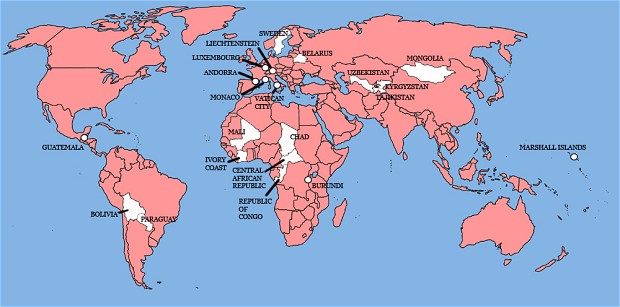
Britain has invaded all but 22 countries in the world
By Jasper Copping | World Observer | November 9, 2012
Every schoolboy used to know that at the height of the empire, almost a quarter of the atlas was coloured pink, showing the extent of British rule.
But that oft recited fact dramatically understates the remarkable global reach achieved by this country.
A new study has found that at various times the British have invaded almost 90 per cent of the countries around the globe.
The analysis of the histories of the almost 200 countries in the world found only 22 which have never experienced an invasion by the British.
Among this select group of nations are far-off destinations such as Guatemala, Tajikistan and the Marshall Islands, as well some slightly closer to home, such as Luxembourg.
The analysis is contained in a new book, All the Countries We’ve Ever Invaded: And the Few We Never Got Round To.
Stuart Laycock, the author, has worked his way around the globe, through each country alphabetically, researching its history to establish whether, at any point, they have experienced an incursion by Britain.
Only a comparatively small proportion of the total in Mr Laycock’s list of invaded states actually formed an official part of the empire.
The remainder have been included because the British were found to have achieved some sort of military presence in the territory – however transitory – either through force, the threat of force, negotiation or payment.
Incursions by British pirates, privateers or armed explorers have also been included, provided they were operating with the approval of their government.
So, many countries which once formed part of the Spanish empire and seem to have little historical connection with the UK, such as Costa Rica, Ecuador and El Salvador, make the list because of the repeated raids they suffered from state-sanctioned British sailors.
Among some of the perhaps surprising entries on the list are:
* Cuba, where in 1741, a force under Admiral Edward Vernon stormed ashore at Guantánamo Bay. He renamed it Cumberland Bay, before being forced to withdraw in the face of hostile locals and an outbreak of disease among his men. Twenty one years later, Havana and a large part of the island fell to the British after a bloody siege, only to be handed back to the Spanish in 1763, along with another unlikely British possession, the Philippines, in exchange for Florida and Minorca.
*Iceland, invaded in 1940 by the British after the neutral nation refused to enter the war on the Allies side. The invasion force, of 745 marines, met with strong protest from the Iceland government, but no resistance.
* Vietnam, which has experienced repeated incursions by the British since the seventeenth century. The most recent – from 1945 to 1946 – saw the British fight a campaign for control of the country against communists, in a war that has been overshadowed by later conflicts involving first the French and then Americans.
It is thought to be the first time such a list has been compiled.
Mr Laycock, who has previously published books on Roman history, began the unusual quest after being asked by his 11-year-old son, Frederick, how many countries the British had invaded.
After almost two years of research he said he was shocked by the answer. “I was absolutely staggered when I reached the total. I like to think I have a relatively good general knowledge. But there are places where it hadn’t occurred to me that these things had ever happened. It shocked me.
“Other countries could write similar books – but they would be much shorter. I don’t think anyone could match this, although the Americans had a later start and have been working hard on it in the twentieth century.”
The only other nation which has achieved anything approaching the British total, Mr Laycock said, is France – which also holds the unfortunate record for having endured the most British invasions. “I realise people may argue with some of my reasons, but it is intended to prompt debate,” he added.
He believes the actual figure may well be higher and is inviting the public to get in touch to provide evidence of other invasions.
In the case of Mongolia, for instance – one of the 22 nations “not invaded”, according to the book – he believes it possible that there could have been a British invasion, but could find no direct proof.
The country was caught up in the turmoil following the Russian Revolution, in which the British and other powers intervened. Mr Laycock found evidence of a British military mission in Russia approximately 50 miles from the Mongolian border, but could not establish whether it got any closer.
The research lists countries based on their current national boundaries and names. Many of the invasions took place when these did not apply.
The research covered the 192 other UN member states as well as the Vatican City and Kosovo, which are not member states, but are recognised by the UK government as independent states.
The earliest invasion launched from these islands was an incursion into Gaul – now France – at the end of the second century. Clodius Albinus led an army, thought to include many Britons, across the Channel in an attempt to seize the imperial throne. The force was defeated in 197 at Lyon.
Mr Laycock added: “On one level, for the British, it is quite amazing and quite humbling, that this is all part of our history, but clearly there are parts of our history that we are less proud of. The book is not intended as any kind of moral judgment on our history or our empire. It is meant as a light-hearted bit of fun.”
The countries never invaded by the British:
Andorra
Belarus
Bolivia
Burundi
Central African Republic
Chad
Congo, Republic of
Guatemala
Ivory Coast
Kyrgyzstan
Liechtenstein
Luxembourg
Mali
Marshall Islands
Monaco
Mongolia
Paraguay
Sao Tome and Principe
Sweden
Tajikistan
Uzbekistan
Vatican City
Ukraine army launches next stage of military op ‘to isolate Slavyansk’
RT | April 25, 2014
Kiev authorities say “the second stage” of the military operation in the eastern Ukrainian city of Slavyansk has been launched, which will “completely isolate” the anti-government stronghold. Self-defense forces are preparing for an assault.
Ukrainian troops were ordered to commence the next stage of the so-called ‘anti-terrorist operation’ around 12pm local time (10:00 GMT), according to coup-appointed acting head of presidential administration Sergey Pashinsky.
“The aim is to completely isolate Slavyansk to localize the problem. At the moment, the operation is ongoing,” the official told media as quoted by RIA Novosti.
Ukrainian armed forces have set up a military base some 20 kilometers from Slavayansk, RT’s stringer, Ukraine-based British journalist Graham Phillips reports. According to Phillips, there is an ongoing buildup of troops in the area and “snipers hiding in forests in position.” The city is being encircled, he tweets.
The military do not intend to storm Slavyansk, fearing civilian casualties, the Ukrainian Security Service has claimed.
“We will not go the length of [civilian] casualties, to storm the city. We understand that this may lead to many people coming to harm,” General Vasily Krutov, first deputy head of the Ukrainian Security Service (SBU), was quoted as saying by Interfax.
Pashinsky meanwhile repeated earlier Kiev’s claims that “terrorists have placed their key strong points in kindergartens and hospitals,” branding the situation in Slavyansk as “classic terrorism.” The claims have been dismissed by Slavyansk activists as “ridiculous.”
Despite the promises of no storming of the city planned, Slavyansk self-defense activists have braced for an assault, which they fear may soon start under the guise of the city’s “blockade.”
Self-defense activists cited by ITAR-TASS have claimed that a convoy of military armored vehicles and troops bearing “no insignia” was spotted moving in the direction of Slavyansk and then “disappeared in the woods” surrounding the city.
‘Bomb Syria… For Ukraine’s Sake!’
By Daniel McAdams | Ron Paul Institute | April 23, 2014
Anna-Marie Slaughter demonstrates that you need not scratch a “humanitarian interventionist” much to uncover the warmongering neoconservative just below the surface.
In an essay today, titled, “Stopping Russia Starts in Syria,” she argues that “the solution to the crisis in Ukraine lies in part in Syria.” President Obama must “demonstrate that he can order the offensive use of force in circumstances other than secret drone attacks or covert operations,” she writes.
Translation: to get Putin back for his supposed actions in Ukraine, Slaughter calls for President Obama to bomb Syria.
Slaughter recognizes the view of “Assad as the lesser evil compared to the Al Qaeda-affiliated members of the opposition” and admits that “the Syrian government does appear to be slowly giving up its chemical weapons, as it agreed last September to do.”
Nevertheless, she writes, “it is time to change Putin’s calculations, and Syria is the place to do it.”
“It is impossible to strike Syria legally so long as Russia sits on the United Nations Security Council,” she writes, so her solution is simply to do it illegally. She suggests that the US should begin bombing Syria to enforce UN Security Council Resolution 2139, even though that is not a “Chapter VII” resolution authorizing force.
It is ironic and highlights the cruel depravity of Slaughter that she suggests the bombing of Syria to enforce UNSC 2139, which was drawn up to facilitate the delivery of humanitarian relief to the war-ravaged Syrian people.
Using a humanitarian relief UN resolution as a cover for the most anti-humanitarian of all acts — dropping bombs — reveals the true colors of the “humanitarian interventionist” and “responsibility to protect” crowd.
Anne-Marie Slaughter embodies the disturbing trend of US government operatives (she was Director of Policy Planning for the U.S. State Department from January 2009 until February 2011) who move into the “non-governmental” sector while directing public-private “non-profit” resources toward the promotion of US government foreign policy.
In her current position as president of the New America Foundation, she is in active partnership with the US government to develop new tools to help promote regime-change overseas. According to the New York Times, the New America Foundation has been awarded a three year contract by the US Agency for International Development (USAID) to develop a kind of underground Internet system for Cuba.
Readers recall that USAID was recently embroiled in controversy when it covertly developed a “Cuban Twitter” platform whose purpose was to foment regime change in the Caribbean island nation.
Does anyone doubt that Slaughter’s New America Foundation is developing USAID’s “Cuban Internet” program for any reason other than to use it to further US regime change policy?
Anne-Marie Slaughter ends her preposterous “bomb Syria” essay with a phrase that could have been — and perhaps was — uttered by the likes of Sens. John McCain and Lindsay Graham:
Obama took office with the aim of ending wars, not starting them. But if the US meets bullets with words, tyrants will draw their own conclusions.
Bombs for peace. That is the neocon/humanitarian-interventionist war cry.
Putin: Kiev authorities are junta if they use force against civilians
RT | April 24, 2014
If Kiev authorities have started to use force against the civilian population, this is a serious crime, Russian President Vladimir Putin said. Taking this action makes them a “junta” and may affect their relations with other countries, he added.
“If the Kiev regime started military actions against the country’s population, this is without doubt a very serious crime,” Putin said at an All-Russia People’s Front media forum.
According to Putin, the current situation in East Ukraine is another proof that Russia was right when it supported Crimeans, when they decided to have a referendum.
“[Otherwise] it would have seen there the same things which are now happening in the east of Ukraine, or even worse,” he said. “That’s one more proof to the fact we did it all right and in time.”
Putin believes that the use of force by the coup-imposed government in Kiev means that it’s actually a junta.
“If current authorities in Kiev have done this [used force], then they are junta,” the president said. “For one thing, they don’t have nation-wide mandate. They might have some elements of legitimacy, but only within the framework of the parliament. The rest of the government bodies are for various reasons illegitimate.”
Vladimir Putin described the use of force in eastern Ukraine as a “reprisal raid” and said that it would have an impact on Russian-Ukrainian relations.
Earlier in the day, fighting erupted just outside Slavyansk, a town in eastern Ukraine where the population voiced their protest against the Kiev authorities. Ukrainian troops in tanks and armored vehicles have been trying to break into the town.
According to the Ukrainian Interior ministry, at least five self-defense guards have been killed and one policeman injured after the “anti-terrorist operation” launched by Kiev in the town. Three checkpoints erected by the anti-government protesters have also been destroyed.
Self-defense forces managed to repel an attack at one checkpoint 3 kilometers north of Slavyansk, forcing at least three infantry vehicles to retreat, Russia-24 TV reports.
On Wednesday, authorities in Kiev announced they were resuming a military operation against protesters in eastern Ukraine, which they described as an “anti-terrorist” one.
Protesters believe the move was contrary to the agreement on de-escalation reached in Geneva.
Another Nail in the Coffin of the NPT
By Dan Joyner | Arms Control Law | April 21, 2014
Another nail in the coffin of the Nuclear Non-Proliferation Treaty (NPT) is what this would be if it was actually adopted as policy by the Nuclear Suppliers Group (NSG). I’m talking about a Dutch paper, sponsored by the US, UK and the Czech Republic, and submitted to the NSG meeting a couple of weeks ago, which proposed that the NSG take a more “open-minded approach aimed at cooperation with non-NSG members and promoting transparency of the NSG guidelines.” According to our favorite nuclear reporter Fredrik Dahl:
The discussion paper, seen by Reuters, outlined different types of “possible benefits the NSG could consider granting” a country that is adhering to its trade guidelines even though it is not in the secretive 48-nation grouping.
These could include sharing of information, access to NSG meetings and “facilitated export arrangements”, suggesting possible access to some nuclear trade with NSG countries, for example related to safety.
Currently, Israel is the only non-NSG country that fulfils the criteria regarding “adherence” to its guidelines although India and Pakistan have informally indicated that they also follow them, the Dutch Foreign Ministry document said.
So, under this new and improved approach, India, Pakistan and Israel, at least, would likely be promoted to receiving most if not all of the substantive benefits of membership in the NPT – including most importantly civilian nuclear trade with NSG supplier states. So we would go from one travesty – the India exemption already granted by the NSG in 2005 – to at least three and maybe more.
Again, these would be states that have not signed the NPT, but have clandestinely developed nuclear weapons stockpiles on their own. And under this proposal, they would be granted by NSG supplier states, nuclear trade access which the 157 Non-Nuclear Weapons States (NNWS) parties to the NPT had to give up their legal privilege to possess nuclear weapons in order to secure.
Is this a game of how far can we push NPT NNWS before they will finally be convinced that the NPT grand bargain is dead, and that they are upholding their NPT obligations and tacitly consenting to a system of nuclear apartheid for nothing?
This isn’t how Mark Hibbs sees it. Mark seems to think this is a fine idea. In the article he’s quoted as follows:
Nuclear expert Mark Hibbs said such an acknowledgement by the NSG would be important for Israel. “It would be a recognition from a very important nuclear non-proliferation related body that Israel is a responsible nuclear state,” Hibbs, of the Carnegie Endowment think-tank, said.
That’s not the point, Mark. Responsible or not, you can’t undermine one part of the grand bargain of the NPT without expecting the other parts to fall down too.
Beggars’ Belief
The Farmers’ Resistance Movement on Iejima Island, Okinawa
By Jon Mitchell | November 14, 2009
The first American invasion of Iejima occurred on April 16th, 1945. U.S. Army accounts chronicle in meticulous detail the vicious battle for this small island, situated three miles west of Okinawa Hontou. One thousand troops aboard eighty landing craft stormed Iejima’s eastern beaches, meeting heavy resistance from dug-in Japanese defenders. In the following five days of bloodshed, two thousand Imperial Army soldiers were killed, together with one and a half thousand civilians. Three hundred Americans lost their lives, including Ernie Pyle – the combat correspondent famous for putting a human face to World War Two.
The second U.S. invasion came a decade later. It is barely documented by American historians, but to those who were living on the island, it wrought almost as much distress. On March 11th, 1955, with Okinawa under United States administration, landing craft came ashore once again on the beaches of Iejima. Their mission: to expropriate two-thirds of the island in readiness for the construction of an air-to-surface bombing range. This time, the Army only brought three hundred soldiers, but they assumed these would be sufficient – their new enemies were the island’s unarmed peanut and tobacco farmers, and the only shelters they had were the houses they’d constructed in the years since the end of the war.
The Americans made quick progress across the south of the island. They dragged families from their houses, burned down the buildings and bulldozed the smoldering ruins. Those who protested were assaulted and arrested, then sent to the regional capital for prosecution. When one family pled for their home to be spared because their six-year old daughter was seriously-ill in bed, soldiers carried the terrified child from the house and dumped her outside the doors of the island clinic. A herd of goats that impeded the Americans’ advance was let loose from its enclosure and slaughtered by rifle fire. After the entire village had been leveled, Army officers veneered the invasion with a thin layer of legitimacy – at gun-point, they forced fistfuls of military script into the hands of the farmers, then twisted their faces towards a camera and took pictures to send to Headquarters as proof of the islanders’ acquiescence.
“The Americans weren’t the only ones taking photographs that day,” explains Shoko Jahana, “The farmers realized that if they wanted the world to understand what they were going through, they needed their proof, too.” Jahana is a white-haired woman in her late sixties with a smile that instantly wipes twenty years from her full-moon face. She works as the caretaker of the Nuchidou Takara no Ie ( “Treasure House of Life Itself” ) – the Iejima museum dedicated to the farmers’ ongoing struggle to retrieve their land from the American military. The museum consists of a pair of ramshackle buildings, located very close to the shoreline where the Americans landed in 1955. Now the beach is home to a Japanese holiday resort, and as we speak, our conversation is punctuated by the shouts of Tokyo holidaymakers, the slap and drone of jet skis.
Jahana shows me the farmers’ photographs of the destruction from March 1955 – empty monochrome scenes of charred land and blackened bricks of coral. Some of the pictures are blurred as though the camera is trying to focus on where the houses used to be. “Shoko Ahagon was one of the farmers whose home was destroyed that day. He went on to organize the islanders in their struggle against the bombing range. People call him the Gandhi of Okinawa.”
Jahana points to a large colour photograph on the wall. A sun-wrinkled man smiles serenely from beneath the brim of a straw hat. Think a slimmer Cesar Chavez with thickly-hooded eyes that glimmer with intelligent compassion. Jahana tells me he gave lectures on the movement to visiting parties of schoolchildren right up until his death in 2002. He was 101 years old.
As she speaks, there’s a gentle knock on the door and an elderly woman enters, carrying a small convenience store bag. When she sees that Jahana is busy talking to me, she bows and sets the bag carefully on the side of her desk. It’s full of earthy cylinders pushing against the white plastic and I remember, earlier at the port, seeing the island’s famous peanuts for sale, alongside dusty bricks of black sugar and tangles of bright pink dragon fruit.
“Ahagon-sensei established the Treasure House in 1984,” Jahana continues, “He wanted to create a permanent exhibit of what went on here after the Americans came ashore in 1955. I’ll ask my assistant to show you around the main museum.” A younger woman in her forties comes in. Jahana lifts the plastic bag from the desk, but when she passes it to her assistant, its sides split open. A dozen rusty bullets clatter to the floor. I jump but neither woman bats an eyelid as they bend and scoop them back up.
The assistant walks me from the reception to the exhibition hall at the rear of the property. When she slides open the doors, I’m struck by a hot blast of air, the smell of second-hand clothes mixed with used book stores. Inside, the museum is a mélange of memorabilia from the past fifty years. American parachutes hang next to musty protest banners. Old newspaper articles line the walls alongside dozens of photographs taken by the farmers to record their struggle. Just in front of the doorway, there’s a massive mound of rusting metal – shell casings and missile fins, grenades and rockets. The assistant kneels down and adds the bullets to the heap. Her action wakes a small white gecko and it scuttles across the deadly pile, finding shelter in a half-blown mortar round.
“Within days of leveling the farmers’ houses, the Americans had completed construction of their bombing range. They marked huge bull’s eye targets with white sand trucked in from the beaches. The explosions went on day and night. Those shells are just a selection of the things they fired. Farmers still come across them now and bring them here for our collection.”
When I ask her what happened to the displaced villagers, she points to a photo of a row of tents. “The Americans had promised them building materials and they were good to their word.” She gives me a sad smile. “The cement they gave had already hardened to concrete in its bags. The boards were rotten and the nails long corroded spikes that couldn’t be used for anything.” One picture shows a family of fifteen packed into a small, open-sided tent. “The villagers quickly fell sick with dehydration, sunstroke and skin diseases.”
Along with the poor-quality building supplies, the American Army offered the farmers financial compensation. Realizing that any acceptance of the money would be interpreted as their assent to the seizure of their land, they refused. With no other means to support themselves, Ahagon and the villagers decided to throw themselves on the mercy of their fellow Okinawans. She shows me a letter they wrote to explain their actions. “There is no way for [us] to live except to beg. Begging is shameful, to be sure, but taking land by military force and causing us to beg is especially shameful.”
On July 21st 1955, the villagers boarded a ferry to Okinawa Hontou. Calling themselves the “March of Beggars”, over the next seven months, they made their way from Kunigami in the north to Itoman almost seventy miles to the south. In every town they passed, the villagers met with the local people and told them of their struggle. Throughout their walk, they were greeted with warm welcomes and sympathy. Even the poorest villages gave them food and shelter for the night. The assistant shows me the photos the farmers exchanged as thanks to the people who supported them. The men stare proudly at the camera – their trousers are patched and threadbare, but their shirts are starched clean white. The women try to hold their smiles while stopping the children from squirming from their knees.
The reception of the authorities stood in stark contrast to the hospitality encountered from ordinary people. Both Okinawan politicians and academics alike ignored Iejima’s farmers’ pleas for assistance. Many of these officials only retained their jobs with the mercurial support of the American administration and they feared dismissal. When the islanders confronted the U.S. High Commission, General James Moore played the Red card and claimed the farmers were uneducated dupes who were being manipulated by communist agitators. An Air Force spokesman called the problem “a petty dispute” – inconsequential in light of the practice bombings which were ensuring security “both for the Free World and for [Okinawan] people.”
After seven months on the road, the March of Beggars finally returned home to Iejima in February, 1956. They found their situation no better than when they had left; the leaking tents still stood and they continued to be denied access to the fields upon which they’d depended for their livelihoods. Bombings and jet plane strafings went on day and night, wearing down already tattered nerves and making rest impossible.
“When the farmers attempted to send word of their predicament to the main Japanese islands, their letters were intercepted by the American military,” explains the assistant. “They didn’t want the world to know what they were doing here.” Some letters, however, did make it through the cordon of censors, and when the Japanese media reported news of the farmers’ struggle, the people of the main islands rallied to their help. School students, homemakers, businessmen – even imprisoned war criminals – started sending care packages to Iejima. They flooded the islanders with powdered milk and sugar, rice and canned fish, notebooks, textbooks and pens. The boxes are on display at the museum. Many of them are addressed simply “To the brave farmers of Iejima.”
No matter how small the parcel, each one was rewarded with a handwritten banner of appreciation and a photograph from the islanders. Upon receiving a massive package from far-off Hokkaido, the entire village gathered to witness the opening of the thirty-one crates. Even the sick and elderly got out of bed to see the gifts from the snowbound northern island. The sign the villagers penned still hangs in the museum today – “To the coal miners of Kushiro, We who live in this southern country thank you very warmly.”
These packages, though substantial, were not enough to sustain the villagers forever. As the 1950s progressed, with no financial aid from the government or the military, many of the islanders were forced to support themselves in an increasingly desperate manner. Where once they harvested tobacco and sweet potatoes, now they scavenged the fringes of the bombing range for scraps of military metal. They collected chunks of shrapnel and bullet casings, and sold them to traders for a few yen a kilogram. From time to time, they’d come across a whole bomb that had failed to explode. The farmers would drag it away and defuse it themselves with a plumber’s wrench and a length of steel pipe. In this manner, they taught themselves to become bomb disposal technicians as expert as any found in modern armies. But for these men – like their professional counterparts – sometimes their luck ran out. Between 1956 and 1963, a dozen islanders were killed or wounded while collecting or dismantling American ordinance. Photos on the walls show farmers with their arms torn off and their faces sheered away – combat pictures from an island purportedly at peace.
“In the early 1960s,” says the assistant walking me down the room, “one of the farmers stumbled across a piece of scrap far too precious to sell.” She gestures towards a long white tube with four tell-tale fins. “He found it sticking out of his field one day. He hid it in his shed while the Americans searched high and low.”
I can well understand the military’s eagerness to retrieve this particular missile. I recognize it almost immediately from another story I’ve been covering about Okinawa. In December 1965, some hundred and fifty miles north of Iejima, the USS Ticonderoga ran into rough seas. A Sky Hawk jet that was on the ship’s deck slipped its cables and tumbled into the ocean. The accident would not have been particularly newsworthy if it hadn’t been for the payload it was carrying: a one megaton hydrogen bomb. The Japanese constitution prohibits nuclear weapons in its waters, and it was only when the device started to leak in 1989, that a nervous Pentagon confessed to Tokyo about the missing bomb.
The assistant must have noticed the panic on my face. “Don’t worry, it’s just a dummy one they used for practice runs.” It looks so real that this does little to allay my fears. Nearby a cicada ticks Geiger-like. “You can touch it if you want,” she offers. I take two steps back and she laughs.
Back in the reception, Jahana tells me of the successes achieved by Ahagon and the islanders. Thanks to their demonstrations throughout the 1960s and a concerted publicity campaign (including three books and a documentary), the bombings stopped and the range was closed down. Many of the farmers were able to recover the fields that were stolen in 1955.
Jahana takes a map of Iejima from her desk drawer. The western portion is marked off by a red dotted line. “Today, the American military controls a third of the island. The Marines have a training area where they still conduct parachute drops. A few years ago, some of their jumpers went astray and landed in a tobacco field. They wondered why the farmer was so angry. They’d only crushed a few tobacco plants – perhaps a carton of cigarettes’ worth. They don’t know what these people have had to put up with over the past fifty years. They have no idea of the sufferings they’ve been through.”
Before I head back to the port, I ask Jahana if she’s hopeful the Americans will change their policy and return the rest of the land. She smiles wryly. “Ahagon-sensei had a saying he often quoted. ‘Even the most evil beasts and devils are not beyond redemption. They might become human one day. All they need to be shown is the error of their ways.’ Ahagon-sensei believed this very strongly. That’s why he built this museum and that’s why it will be here until the day the farmers get back their land.”
Jon Mitchell is a Welsh-born writer, currently working at Tokyo Institute of Technology. He can be reached at: jon.w.mitchell@gmail.com
As the Light Unto the Nations
By Gilad Atzmon | November 21, 2009
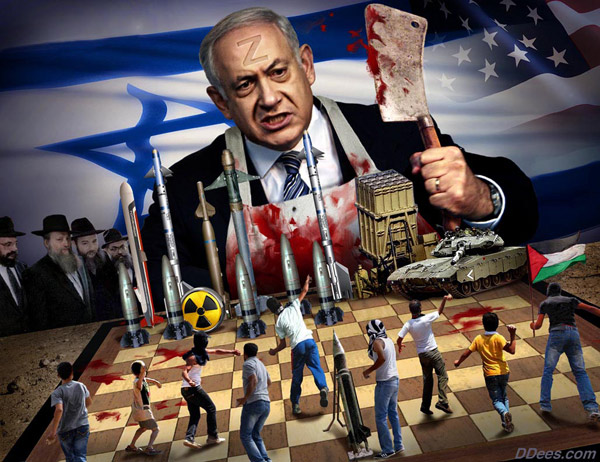
‘Israel is the light unto the nations’ says the Torah. Indeed it is, and not just because the Torah says so. Israel is ahead of everyone else in many fronts. Take for instance, terrorizing civilian populations and practicing some of the most devastating murderous tactics upon elders, women and young.
The Jerusalem Post reported yesterday that the Chairman of NATO’s Military Committee, Admiral Giampaolo Di Paola, visited Israel earlier this week to study “IDF tactics and methods that the military alliance can utilise for its war in Afghanistan.” A senior Israeli defence official added “The one thing on NATO’s mind today is how to win in Afghanistan… Di Paola was very impressed by the IDF, which is a major source of information due to our operational experience.”
I would advise both the Israeli official and Admiral Di Paola to slightly curb their enthusiasm. The IDF didn’t win a single war since 1967. Yes, it murdered many civilians, it flattened many cities, it starved millions, it has been committing war crimes on a daily basis for decades and yet, it didn’t win a war. Thus, the IDF cannot really teach NATO how to win in Afghanistan. If NATO generals are stupid enough to follow IDF tactics, like the Israeli generals, they will start to see the charges of war crimes pile up against them. They may even be lucky enough to share their cells with some Israelis in due course, once justice is performed.
Admiral Di Paola spent two days with the infamous IDF Chief of Staff Lt.-Gen. Gabi Ashkenazi, the man who led the IDF into Gaza last December.
In the Jewish state they were very enthusiastic with Admiral Di Paola’s visit. They regarded it as just another reassurance of ‘business as usual. The visit of a NATO high supreme official was there to convince them that no one takes note of the Goldstone report. “Di Paola’s visit is significant” says the Jerusalem Post, “since it comes at a time when the IDF is under increasing criticism in the wake of the Goldstone Report on Operation Cast Lead as well as a decision by Turkey – a NATO member – to ban Israel from joint aerial exercises.”
However, it would be crucial to elaborate on the emerging mutual interests between the two parties, Israel and NATO. “During their meeting on Wednesday, Ashkenazi and Di Paola discussed ways to upgrade Israeli-NATO military ties as well as the plan to include an Israeli Navy vessel in Active Endeavor, a NATO mission established after the 9/11 attacks under which NATO vessels patrol the Mediterranean to prevent illegal terror trafficking”. This is indeed a necessary move for the Israelis. At the moment the Israeli Navy is operating in the Mediterranean as a bunch of Yiddish Pirates (Yidisshe Piraten), assaulting, hijacking and robbing vessels in international waters. Once operating under the NATO flag, the Israelis would be able to terrorise every vessel in the high seas in the name of the ‘West’. For the Jewish state this would be a major step forward. Until now the Israelis have been committing atrocities in the name of the Jewish people. Once operating under the NATO flag, the Israelis will be able to perform their piracy in the name of ‘Europe’. Such a move is further evidence of the spiritual and ideological transition within Zionism from ‘promised land’ into ‘promised planet’.
While the Israelis desperately need NATO’s legitimacy, NATO is far more modest. All it needs is knowledge and tactics. For some reason it insists on learning from the Israelis how to inflict pain on a civilian population. More pain, that is, than it is already making. “NATO’s Defence officials said that Di Paola used his meetings with the IDF to learn about new technology that can be applied to the war in Afghanistan”. The Jerusalem Post reports that Israel is a “known world leader in the development of specialized armor to protect against improvised explosive devices (IEDs), otherwise known as roadside bombs.” This is indeed the case. Israeli generals realised a long time ago that their precious young soldiers prefer to hide in their tanks rather than engage with the ‘enemy’ i.e. the civilian population, kids, elders and women. But it doesn’t stop there, Di Paola was also interested in “Israeli intelligence-gathering capabilities and methods that the IDF uses when operating in civilian population centers.” Di Paola noted that “NATO and the IDF were facing similar threats – NATO in Afghanistan and Israel in its war against Hamas and Hizbullah.”
I would suggest to Admiral Di Paola to immediately read the Goldstone report thoroughly, so he grasps his own personal legal consequences once he starts to implement ‘Israeli tactics’. If Admiral Di Paola wants to serve his army, he should indeed visit Israel, he should also meet every war criminal both in the military and politics so he knows exactly what NOT to do.
NATO’s chances of winning in Afghanistan are not limited, they are actually exhausted. It can only lose. Some military analysts and veteran generals argue that it is lost already. NATO has brought enough carnage on the Afghani people without achieving any of its military or political goals. Given that Israel was severely humiliated in Lebanon in 2006 by a tiny paramilitary Hizbullah and failed to achieve its military goals in Operation Cast Lead in its genocidal war against Hamas, there is nothing for NATO to learn from the Israelis. Should NATO proceed in implementing added IDF tactics, all it will achieve is a dramatic reduction of security across Europe and America.
If we are concerned with peace and we want it to prevail, what we have to do is to move away as far as we can from any spiritual, ideological, political and military affiliation with Zionism, Israel and its lobbies. If ‘Israel’ is indeed a ‘light onto the nations’, someone better explain to us all, why its prospect of peace is becoming slimmer and darker.
My answer is actually simple. Israel can be easily seen as the ‘light of nations’ as long as you learn from Israel what not to do. In fact this is the message passed to us by the great humanist prophets Jesus and Marx. Love your neighbour, be among others, transcend yourself beyond the tribal into the realm of the universal. In fact this is exactly what the Israelis fail to grasp. For some reason, they love themselves almost as much as they hate their neighbours.
If Admiral Di Paola wants to win the hearts and the minds of the Afghan people (rather than ‘winning a war’), he should first learn to love. This is something he won’t learn in Jerusalem or Tel Aviv. Gaza, Ramallha and Nablus are more likely.
US Nuclear Weapons Proliferation
By John LaForge | CounterPunch | April 18, 2014
The corporate media is focused on the question of how or if Iran could ever break out of its promise under the Nuclear Nonproliferation Treaty to eschew nuclear weapons and use reactors only for civilian purposes. So many headlines refer to sanctions imposed against Iran that millions of people mistakenly think Iran has a nuclear arsenal. It doesn’t.
Meanwhile the Congress in January fully funded production of a new B61 thermonuclear gravity bomb, a program dubbed “Life Extension.” This year’s $537 million is the down payment on the new version of the B61 that the millionaires in DC agreed should get $11 billion over the next few years.
Dubbed the “solid gold nuke” by critics, the 700 pound H-bomb is running $28 million apiece at the moment. That much gold bullion is only worth $16 million.
The program to replace today’s B61s with a new “mod12,” is being condemned by our allies in NATO, by Congressional budget hawks and of course by the entire arms control community. Even former Vice Chairman of the Joint Chiefs of Staff Gen. James Cartwright has said the bombs are “practically nil” in military value. (Gen. Cartwright only is partly right: Since it seems the Department of Defense is in the business of producing suicides by the thousands, among veterans and active duty soldiers, the suicidal mission of deploying B61s across Europe — for detonation there — seems a perfect fit.)
“This decision represents the triumph of entrenched nuclear interests over good government. The B-61 is no longer relevant for U.S. national security, but continues to rob billions of dollars from programs that would make America safer,” President Joe Cirincione of the Ploughshares Fund told Hans M. Kristensen for the Federation of American Scientists.
Kristensen reported March 12 that the Pentagon has decided that the new B61 will begin its deployment in Europe next year.
This 300-to-500 kiloton “variable yield” thermonuclear device has 24 to 40 times the destructive power of the US bomb that killed 170,000 people at Hiroshima in 1945. Still, this machine’s threat of meaningless, genocidal, radioactive violence is called “tactical.”
Rush to Deploy New H-bomb Before it’s Killed by Public Opposition
The Air Force budget makes it appear that the older B61s will all be replaced — in Turkey, Italy, Belgium, The Netherlands and Germany — by 2020. This rush job is being hustled through the military-industrial-complex in a very big hurry because the broad international condemnation of the program is gaining depth and breadth.
Even the rightwing Senator Dianne Feinstein, D-Calif., along with Rep. Mike Quigley, D-Ill., and Rep Jared Polis, D-Colo., tried to curtail the program last year. Five NATO partners — Belgium, Germany, Luxembourg, The Netherlands and Norway — asked four years ago that all B61s be removed permanently from Europe. In Germany, every major political party has formally resolved to pursue final withdrawal of the 20 remaining B61s at Buchel AFB.
Major US allies in Europe informed Gen. Cartwright’s critical opinion. High-level European politicians have been saying the B61s are “militarily useless” since the end of the Cold War. In a widely published op/ed in 2010, former NATO secretary-general Willy Claes and three senior Belgian politicians said, “The US tactical nuclear weapons in Europe have lost all military importance.”
Still, Kristensen reports, “integration” of the new B61 is supposed to take place on Belgian, Dutch, and Turkish F-16 jets and on German and Italian Tornado fighter-bombers soon.
Another reason for the rush to deploy this perfect candidate for dumb bomb retirement is that Germany is considering replacing its Tornado jets in short order. All the expense of refitting its current Tornadoes to carry the “more accurate” and “more usable” B61-mod 12 would be wasted. New B61 production could also be made expensively moot by progress in arms control.
The “nuclear sharing” arrangement with the five technically non-nuclear NATO partners glaringly contradicts, in Kristensen’s words, “the non-proliferation standards that member countries are trying to promote in the post-Cold War world.” In its 2012 posture review, even NATO’s ministers pledged to work for a world without nuclear weapons.
So as the White House and its Secretary of State wag fingers at Iran, we and our NATO friends openly violate the binding promise made in the Nuclear Non-Proliferation Treaty “not to receive the transfer from any transferor whatsoever of nuclear weapons or other nuclear explosive devices or of control over such weapons or explosive devices directly, or indirectly.”
Maybe Iran can arrange for some sanctions to be imposed on us.
John LaForge works for Nukewatch, edits its Quarterly, and lives at the Plowshares Land Trust out of Luck, Wisconsin.
Thirty Venezuelan Military Officials Allegedly Under Arrest for Coup Plotting
By Ewan Robertson | Venezuelanalysis | Aprilm 14, 2014
Thirty Venezuelan military officers of different ranks, including several generals, have been arrested for alleged conspiracy to overthrow President Nicolas Maduro, a leading national newspaper has reported.
The information, reported by Ultimas Noticias, was attributed to “high level sources” in Miraflores presidential palace. The majority of those arrested are from the Venezuelan Air Force, however a few officers from the National Guard, Navy and Armed Forces were also arrested.
According to the sources, loyal military figures previously informed the national intelligence service that “something strange” was being planned by a group of officers, and due to this the alleged conspirators had been under observation by authorities for some time.
The UN report adds that a “destablisation attempt” was supposedly planned to occur on 20 March with an air operation and strafing of soldiers, among other incidents, to create “confusion” and “clashes”.
Further, the report alleges that “it has been confirmed” that the group of officers has been in contact “with at least one opposition leader”. There exist rumours that this politician is Julio Borges of the Justice First party, of which former presidential candidate Henrique Capriles is leader. According to the rumours, Borges met with a group of 60 military officials, to which those arrested would presumably belong.
Both Borges and Capriles participated in the nationally-broadcast dialogue meeting with the government last Thursday.
Authorities have not yet offered public comment on Ultimas Noticias’ allegations on the arrest of the thirty military officers.
On 25 March Maduro announced that three air force generals had been arrested “for conspiracy” but has not offered further details while the investigation continues. The government has also said that it has information of a plot from within a sector of the opposition to kill protest leader Leopoldo Lopez and blame the act on government supporters in order to provoke a coup attempt.
The Venezuelan armed forces are considered to be generally loyal to the government. The head of the Operational Strategic Command of the Armed Forces, Gen. Vladimir Padrino, said yesterday that a while a campaign was underway to “manipulate” the armed forces (FANB), the troops are committed to their role of upholding the Venezuelan constitution.
Venezuela has experienced a wave of opposition protests, riots and street barricades since early February, after hard-line leaders of the opposition called for resistance to the government in a strategy called “The Exit”.
Kiev to launch ‘full-scale’ military op as massive protests grip eastern Ukraine
RT | April 13, 2014
Thousands of pro-autonomy demonstrators rallied across eastern Ukraine, with the coup-imposed president in Kiev threatening to use military against the activists if they don’t clear the seized government buildings by Monday morning.
Over 10,000 people have taken part in protests in different town and villages of the Donetsk Region in Ukraine, the local administration said.
In the region’s capital, Donetsk, the local government headquarters still remain under the anti-Maidan activists’ control. Sunday, one of the leaders of the recently-declared Donetsk People’s Republic, Denis Pushilin, once again stressed the urgent need “to send activists, who’ll prepare a referendum, to different towns of the Donetsk region” as he spoke at a rally in city’s center.
The recruitment of volunteers, eager to travel to Slavyansk and other towns in eastern Ukraine where “an anti-terrorist operation” against the protestors by the Ukrainian security forces is underway, also took place during the rally. Over 100 people volunteered by mid-day Sunday, with buses already prepared to take them to their destinations.
Hundreds also gathered for rallies in support of federalization in Druzhovka, Debaltsevo and other Donbas towns.
According to Ukrainian media, the city authorities in Zhdanovsk and Kirovsk have expressed readiness to start talks on the recognition of the legitimacy of the Donetsk People’s Republic.
A rally in Mariupol in south-east of the country resulted in the seizure of city council by the pro-Russian protesters, ITAR-TASS news agency reports. Over 1,000 demonstrators, who chanted “Slavyansk, we’re with you!” and “Referendum,” have forced the police, guarding the building, to retreat.
Some 1,500-2,000 people are out in the square in front of the office Security Service of Ukraine (SBU) in Lugansk, which is held by the protestors for several days now. According to Rossiya 24 channel, the majority of the city’s police have switched to the side of the demonstrators, supporting their push for federalization.
Kharkov tensions
Meanwhile, dozens asked for medical assistance in Ukraine’s second-largest city, Kharkov, after the pro-federalization demonstrators clashed with the Maidan activists. The rallies of two antagonistic sides, which saw a joint turnout of around 3,000, were staged in the city simultaneously, with the police being unable to prevent provocations.
“50 people required medical aid. Around 10 of them were taken to city hospitals. The doctors are speaking of minor or moderate injuries. Among the wounded there’s one policeman,” the local law enforcement authorities said.
Baseball bats, sticks, stones and stun grenades were used by both sides during the scuffle, Moskovsky Komsomolets newspaper reports.
Kiev issues new ultimatum
In the capital, Ukraine’s Security Council convened for an urgent session following the events in Slavyansk. A decision was taken to launch “a large scale” operation, “with the involvement of the military,” Ukraine’s coup-imposed president, Aleksandr Turchinov, said in a televised address.
Later he said that the operation in the east will involve a non-regular regiment consisting of 350 reservists.
According to Turchinov, the anti-Maidan activists must lay down their arms and abandon the administrative offices they have occupied till Monday morning if they want to avoid prosecution.
Turchinov also said the new authorities in Kiev are ready to consider giving more powers to the region. Earlier parliament-appointed Prime Minister Arseny Yatsenyuk pledged to push through a law allowing regional referendums in the country.
The order to use military against the pro-federalization protesters in eastern Ukraine by coup-imposed president, Aleksandr Turchinov, is “criminal” in its nature, the Russian Foreign Ministry said in a statement.
Earlier on Sunday, a gun flight reportedly broke out at a checkpoint, which was established by protesters on the outskirts of the city of Slavyansk.
Reports on those killed and wounded kept streaming in all day, but lacked consistency and could not be independently verified. According to interim Interior Minister Arsen Avakov, one of the troops from Kiev was killed and five others were injured in the skirmish.
Protesters in Slavyansk said one person was killed and two others injured on their side, adding that two of the Kiev troops were killed.
Unrest has gripped eastern – Russian speaking – parts of Ukraine after pro-EU protests in Kiev ousted president, Viktor Yanukovich, back in February.
Following the accession of the Republic of Crime to Russia, people in Donetsk, Kharkov, Lugansk and other cities are also calling for a referendum to decide their future as part of Ukraine.
Featured Video
10K More U.S. Troops Deploy as Trump Weighs New Iran Strikes
or go to
Aletho News Archives – Video-Images
From the Archives
Genetic baloney in thick slices
MAYBE COULD BE INC.
By Jon Rappoport | No More Fake News | July 8, 2021
Gene research companies tend to come and go. They start out banging and popping like fireworks in the sky, and then they fade out—selling themselves to larger outfits who’ve hired better liars…
Once upon a time, it sounded easy. Start with a disease, find the gene responsible for the disease, and correct the problem.
Then, researchers wondered, was disease the result of one gene or a group of genes acting together?
Either way, the proof would be in devising cures for diseases using gene therapy. “Not yet, but soon…”
And regardless, the major need was: money. Lots and lots of money.
This need required good PR people. “We have to pump up the idea that we’re on the edge of tremendous breakthroughs. We’re always on that edge…”
This hype also needed to obscure the fact that there wasn’t (and isn’t) ANY gene cure for ANY disease. … continue
Blog Roll
 Aletho News
- UK Government Body Kept Files on People Criticizing Prevent Program
- US military withdrawal from Iraq and the collapse of US-Israeli hegemonic project in West Asia
- What does Europe want – a war with Russia?
- She Followed the Actual Data on COVID Vaccines and Masks — Her Career Took a Huge Hit
- Florida AG Sues Pfizer, Bourla Over Deceptive Marketing of COVID Vaccines
- Von der Leyen gifts her spin doctor a job for life
- 10K More U.S. Troops Deploy as Trump Weighs New Iran Strikes /Suliaman Ahmed
- Iranian crew declared Dena training vessel ‘unarmed’ to US warship before deadly torpedo strike: Report
- Iran’s NPT debate moves beyond parliament
- Houthis condemn Saudi claims of attack on Medina
- If Americans Knew
- Israel is squeezing the life out of Palestinians – Daily Update
- The Israeli Right Portrays Islam as Murderous. It Serves a Political Purpose
- Jordan Has Had Enough: King Abdullah’s Scathing Warning to Israel
- Israeli Colonizers (i.e. Settlers) Kill Palestinian Man Near Salfit
- New Google Maps images reveal massive scale of devastation in Gaza
- Jewish supremacy, anti-Palestinian bigotry on display in Israel – Daily Update
- Israeli Soldiers Abduct At Least 22 Across Occupied West Bank
- Eight Palestinians Killed in Israeli Attacks on Gaza
- Israeli former leaders and security chiefs threaten legal action over ‘Jewish terrorism’
- Israel map in LA Times ad includes all land from the river to the sea
- No Tricks Zone
- Green Energy Debacle: German Expert Professor Fritz Vahrenholt Warns Of Severe Economic And Social Consequences
- Two More Paleo Reconstructions Affirm Meters-Higher Sea Levels Across Ireland, Brazil 7000-6000 Years Ago
- New Study: Earth And Venus Surface Warmth Largely Explained By Convection And Lapse Rate, Not CO2 Or Radiation
- 2025 Nature Paper Claiming Worsening Global Drought Gets RETRACTED …Heavily Flawed
- New Study: ‘Global Drought Shows No Detectable Recent Acceleration Under Climate Warming’
- Economic Masterminds: German Socialists Suggest Taxing Productivity Gains Stemming From Using AI
- The South China Sea Has Not Been Cooperating With The Climate Change Narrative
- Energy Crisis: Germany Enters Heating Season With Historically Low Gas Reserve Fill Levels
- New Study: The Antarctic Ice Sheet Gained Mass From 2020-2024 Due To Staggering Snow And Ice Accumulation
- Study: Ocean Heating Rates From Thousands Of Years Ago ‘Dwarf’ Modern Ocean Heating Rates

