What shall we not talk about today?
“. . . a significant part of the community wants to talk about Israeli policy in the context of Jewish history and Jewish identity, and do so in a highly critical manner. Clearly a lot of people, including many in our community, want to have these conversations and regard them as necessary to resolving the Middle East conflict. We don’t. We are tired of serving as a platform for this discussion, including in the comment section, and don’t see the conversation as a productive one. From here on out, the Mondoweiss comment section will no longer serve as a forum to pillory Jewish culture and religion as the driving factors in Israeli and US policy.
We are making this change because this discussion makes for a toxic, often racist, discourse, and scares off others who would otherwise be drawn to the issues this site concerns itself with.”
Xymphora responds:
I look forward to the ‘Roots of Slavery in the Old South’ forum, which consists entirely of a discussion of the sufferings of the slaveholders, and how their actions derived entirely from the racism experienced by their Scots-Irish forefathers.
Of course, the deeper issue is that Zionism is based, not in Jewish suffering or the mythology of a universal irrational hatred of Jews, but in Jewish violent group supremacism. This is easy to see in that Zionism waxes in times of Jewish group dominance (like now), and wanes in the relatively rare times of Jewish group oppression. The lite Zionists are always more skittish about hiding Jewish supremacism than the hard-core Zionists.
~~~
Aletho News adds the following list containing the names of those who have publicly disavowed Gilad Atzmon due to his recognizing a connection between Jewish cultural identity and Zionist ideology:
As’ad AbuKhalil, The Angry Arab News Service, Turlock, CA
Suha Afyouni, solidarity activist, Beirut, LEBANON
Max Ajl, essayist, rabble-rouser, proprietor of Jewbonics blog site, Ithaca, NY
Haifaa Al-Moammar, activist, stay-at-home mom, and marathon walker, Los Angeles, CA
Electa Arenal, professor emerita, CUNY Graduate Center/Hispanic & Luso-Brazilian Literatures and Women’s Studies, New York, NY
Gabriel Ash, International Jewish Anti-Zionist Network, Geneva, SWITZERLAND
Joel Beinin, Donald J. McLachlan Professor of History, Stanford University, Palo Alto, CA
Dan Berger, Wild Poppies Collective, Philadelphia, PA
Chip Berlet, Boston, MA
Nazila Bettache, activist, Montréal, CANADA
Sam Bick, Tadamon!, Immigrant Workers Center, Montréal, Québec
Max Blumenthal, author; writing fellow, The Nation, New York, NY
Lenni Brenner, author, Zionism in the Age of the Dictators, New York, NY
Café Intifada
Paola Canarutto, Rete-ECO (Italian Network of Jews against the Occupation), Torino, ITALY
Paulette d’Auteuil, National Jericho Movement, Albuquerque, NM
Susie Day, Monthly Review, New York, NY
Ali Hocine Dimerdji, PhD student at The University of Nottingham, in Nottingham, UK
Roxanne Dunbar-Ortiz, professor emerita, California State University
Todd Eaton, Park Slope Food Coop Members for Boycott/Divestment/Sanctions, Brooklyn, NY
Mark Elf, Jews sans frontieres
S. EtShalom, registered nurse, Philadelphia, PA
Benjamin Evans, solidarity activist, Chicago, IL
First of May Anarchist Alliance
Sherna Berger Gluck, professor emerita, California State University/Israel Divestment Campaign, CA
Neta Golan, International Solidarity Movement
Tony Greenstein, Secretary Brighton Unemployed Centre/UNISON, Jews for Boycotting Israeli Goods, Brighton, UK
Andrew Griggs, Café Intifada, Los Angeles, CA
Jenny Grossbard, artist, designer, writer and fighter, New York, NY
Freda Guttman, activist, Montréal, CANADA
Adam Hanieh, lecturer, Department of Development Studies/SOAS, University of London, UK
Swaneagle Harijan, anti-racism, social justice activism, Seattle, WA
Sarah Hawas, researcher and solidarity activist, Cairo, EGYPT
Stanley Heller, “The Struggle” Video News, moderator “Jews Who Speak Out”
Mostafa Henaway, Tadamon!, Immigrant Workers Center, Montréal, CANADA
Elise Hendrick, Meldungen aus dem Exil/Noticias de una multipátrida, Cincinnati, OH
Doug Henwood, Left Business Observer, New York, NY
Ken Hiebert, activist, Ladysmith, CANADA
Elizabeth Horowitz, solidarity activist, New York, NY
Adam Hudson, writer/blogger, San Francisco Bay Area, CA
Dhruv Jain, Researcher at the Jan Van Eyck Academie and PhD student at York University, Paris, FRANCE
Tom Keefer, an editor of the journal Upping the Anti, Toronto, CANADA
Karl Kersplebedeb, Left Wing Books, Montréal, CANADA
Anne Key, Penrith, Cumbria, UK
Mark Klein, activist, Toronto, CANADA
Bill Koehnlein, Brecht Forum, New York, NY
L.A. Palestine Labor Solidarity Committee, Los Angeles, CA
Mark Lance, Georgetown University/Institute for Anarchist Studies, Washington, DC
David Landy, author, Jewish Identity and Palestinian Rights: Diaspora Jewish Opposition to Israel, Dublin, IRELAND
Bob Lederer, Pacifica/WBAI producer, Queers Against Israeli Apartheid, New York, NY
Matthew Lyons, Three Way Fight, Philadelphia, PA
Karen MacRae, solidarity activist, Toronto, CANADA
Heba Farouk Mahfouz, student activist, blogger, Cairo, EGYPT
Marvin Mandell and Betty Reid Mandell, co-editors, New Politics, West Roxbury, MA
Ruth Sarah Berman McConnell, retired teacher, DeLand, FL
Kathleen McLeod, poet, Brisbane, Australia
Karrie Melendres, Los Angeles, CA
Matt Meyer, Resistance in Brooklyn, New York, NY
Amirah Mizrahi, poet and educator, New York, NY
mesha Monge-Irizarry, co-director of Education Not Incarceration; SF MOOC City commissioner, San Francisco, CA
Matthew Morgan-Brown, solidarity activist, Ottawa, CANADA
Michael Novick, People Against Racist Terror/Anti-Racist Action, Los Angeles, CA
Saffo Papantonopoulou, New School Students for Justice in Palestine, New York, NY
Susan Pashkoff, Jews Against Zionism, London, UK
Tom Pessah, UC Berkeley Students for Justice in Palestine, Berkeley, CA
Marie-Claire Picher, Theater of the Oppressed Laboratory (TOPLAB), New York, NY
Sylvia Posadas (Jinjirrie), Kadaitcha, Noosa, AUSTRALIA
Roland Rance, Jews Against Zionism, London, UK
Danielle Ratcliff, San Francisco, CA
Liz Roberts, War Resisters League, New York, NY
Emma Rosenthal, contributor, Shifting Sands: Jewish Women Confront the Israeli Occupation, Los Angeles, CA
Penny Rosenwasser, PhD, Oakland, CA
Suzanne Ross, Free Mumia Abu-Jamal Coalition, The Riverside Church Prison Ministry, New York, NY
Gabriel San Roman, Orange County Weekly, Orange County, CA
Ian Saville, performer and lecturer, London, UK
Joel Schwartz, CSEA retiree/AFSCME, New York, NY
Tali Shapiro, Anarchists Against the Wall, Boycott From Within, Tel Aviv, OCCUPIED PALESTINE
Simona Sharoni, SUNY, author, Gender & the Israeli-Palestinian Conflict, Plattsburgh, NY
Jaggi Singh, No One Is Illegal-Montreal/Solidarity Across Borders, Montréal, CANADA
Michael S. Smith, board member, Center for Constitutional Rights, New York, NY
Pierre Stambul, Union juive française pour la paix (French Jewish Union for Peace), Paris, FRANCE
Muffy Sunde, Los Angeles, CA
Bhaskar Sunkara, editor of Jacobin, Bronx, NY
Tadamon! (http://www.tadamon.ca/), Montréal, CANADA
Ian Trujillo, atheist, Los Angeles, CA
Gabriella Turek, PhD, Auckland, NEW ZEALAND
Henry Walton, SEIU, retired, Los Angeles, CA
Bill Weinberg, New Jewish Resistance, New York, NY
Abraham Weizfeld, author, The End of Zionism and the liberation of the Jewish People, Montreal, CANADA
Ben White, author, Palestinians in Israel: Segregation, Discrimination, and Democracy, Cambridge, UK
Laura Whitehorn, former political prisoner, NYS Task Force on Political Prisoners, New York, NY
Naomi Wimborne-Idrissi, founding member, Jews for Boycotting Israeli Goods (J-BIG)
Asa Winstanley, journalist for Electronic Intifada, Al-Akhbar and others, London, UK
Ziyaad Yousef, solidarity activist
and also:
- Ali Abunimah
- Naseer Aruri, Professor Emeritus, University of Massachusetts, Dartmouth
- Omar Barghouti, human rights activist
- Hatem Bazian, Chair, American Muslims for Palestine
- Andrew Dalack, National Coordinating Committee, US Palestinian Community Network
- Haidar Eid, Gaza
- Nada Elia, US Academic and Cultural Boycott of Israel
- Toufic Haddad
- Kathryn Hamoudah
- Adam Hanieh, Lecturer, School of Oriental and African Studies (SOAS), London
- Mostafa Henaway, Tadamon! Canada
- Monadel Herzallah, National Coordinating Committee, US Palestinian Community Network
- Nadia Hijab, author and human rights advocate
- Andrew Kadi
- Abir Kobty, Palestinian blogger and activist
- Joseph Massad, Professor, Columbia University, NY
- Danya Mustafa, Israeli Apartheid Week US National Co-Coordinator & Students for Justice in Palestine- University of New Mexico
- Dina Omar, Columbia Students for Justice in Palestine
- Haitham Salawdeh, National Coordinating Committee, US Palestinian Community Network
- Sobhi Samour, School of Oriental and African Studies (SOAS), London
- Khaled Ziada, SOAS Palestine Society, London
- Rafeef Ziadah, poet and human rights advocate
Related articles
Israel strikes Sudan military facility: minister
Al Akhbar | October 24, 2012
Sudan’s information minister has accused Israel of striking a Sudanese military factory Wednesday causing it to explode and burst into flames.
An AFP reporter several kilometres (miles) away saw two or three fires flaring across a wide area, with heavy smoke and intermittent flashes of white light bursting above the state-owned Yarmouk facility in southern Khartoum.
“I heard a sound like a plane in the sky, but I didn’t see any light from a plane. Then I heard two explosions, and fire erupted in the compound,” said an area resident who asked to be identified only as Faize.
Witnesses said the explosions started at about midnight on Tuesday.
A woman living south of the Yarmouk compound also reported two initial blasts.
“I saw a plane coming from east to west and I heard explosions and there was a short length of time between the first one and the second one,” she said, asking not to be named.
“Then I saw fire and our neighbour’s house was hit by shrapnel, causing minor damage. The windows of my own house rattled after the second explosion.” Abdul Rahman Al-Khider, the governor of Khartoum state, told official media that preliminary investigation found that the explosion happened in a store room.
He dismissed speculation that “other reasons” caused the incident.
Khider said some people were hospitalized because of smoke inhalation but he gave no numbers.
The blaze spread to a neighbouring area of grass and trees, he said, adding that an investigation was underway to find the cause.
In 1998 Human Rights Watch said that a coalition of Sudanese opposition groups had alleged that Sudan stored chemical weapons for Iraq at the Yarmouk facility but government officials strenuously denied the charges.
In August of that year United States cruise missiles struck the al-Shifa pharmaceutical factory in North Khartoum, which the US said was linked to chemical weapons production. Evidence for that claim later proved questionable.
The sprawling Yarmouk facility is surrounded by barbed wire and set back about two kilometers from the district’s main road, meaning signs of damage were not visible later Wednesday when an AFP reporter visited.
But at least three houses in the neighbourhood had been punctured by shrapnel which left walls and a fence with holes about 20-centimetres (eight inches) in diameter, the reporter said.
There was also slight damage to a Coca-Cola warehouse.
A source familiar with the Yarmouk factory said its main compound and storage area had not been damaged by the explosions or fire.
Hannan, a resident who gave only one name, said some people had fled the area on foot because of the early-morning explosions, while others put their children in cars ready to make a getaway.
The fires appeared to be extinguished by 0030 GMT, more than three hours after they began, an AFP reporter said.
There have been other mysterious blasts in Sudan.
On the country’s Red Sea coast in May one person was killed when a car exploded, about a year after Sudan blamed Israel for an air strike on a vehicle in the same area. Witnesses to the May incident said they heard a big blast that set the car ablaze and left two holes in the ground.
In January 2009, foreign aircraft struck a truck convoy reportedly laden with weapons in eastern Sudan.
A September report from the Small Arms Survey, a Swiss-based independent research project, said evidence from weapons packaging suggests that Chinese-origin arms and ammunition are exported to the Yarmouk facility.
From there they have subsequently moved to Sudan’s far-west Darfur region which has been plagued by conflict for almost a decade, the report said.
Small Arms Survey said it was not clear whether Yarmouk served simply as a recipient “or whether they repackage or even assemble the Chinese-made weapons.”
Khartoum is seeking the removal of United States sanctions imposed in 1997 over support for international terrorism, its human rights record and other concerns.
(AFP, Al-Akhbar)
Those Despicable Foreigners
By Craig Murray on October 23, 2012
I have travelled this world much more extensively than either Obama or Romney, and I still do. I find everywhere, even in areas of conflict and economic difficulty, the vast majority of people are friendly, even kind, and have very similar aspirations, across cultures, to personal development and emotional fulfilment.
The striking thing about tonight’s US Presidential “foreign policy” debate, is when it did occasionally discuss foreign policy, the world out there was discussed not as a place of vast potential, but as a deeply disturbing place full of foreigners who are, apparently, all evil except the Israelis, who are perfect.
The vast benefits from cooperation and trade with “abroad” were not mentioned once that I noticed (though I confess the thing was so awful my attention wandered occasionally). Europe apparently doesn’t exist, other than Greece which is nothing more than a terrible warning of the dangers of not being right wing enough.
The correct attitude to all these foreigners that God so unfortunately and inexplicably placed on this planet, is apparently to maintain incredibly large armed forces, murder people with drones (they were both very enthusiastic on this one), place sanctions on them and declare them “currency manipulators”. The only surprising note was that both agreed that they could not kill everyone in Iran.
But “We can’t just kill our way out of this mess” was spoken with regret, rather than as an affirmation of the possibilities of cooperation instead. What a grim and joyless world view. Maybe I had better not step out of this hotel into Africa this morning; those Islamists might get me.
US Probes South Caucasus’ Attitude to Iran
Nezavisimaya Gazeta | October 18, 2012
Eric Rubin, US Deputy Assistant Secretary of State for Europe and Eurasian Affairs, is touring Azerbaijan, Georgia and Armenia to promote democracy and cooperation and develop partnership on the issues of Syria and Iran.
The media in Azerbaijan reports that Rubin’s visit to Georgia focused on economic issues, civil freedoms and Nagorno-Karabakh.
The US Embassy in Armenia’s press service said Rubin would attend a meeting of the US-Armenian group on economic cooperation to discuss stimulating investment in energy and trade, as well as nuclear power.
The agenda for high-ranking Washington officials’ visits to the South Caucasus seldom varies, and this is not simply because Azerbaijan, Georgia and Armenia face largely similar problems, but also for ethical reasons. Washington wants to convince them that they are all equal partners. Therefore, if Rubin talked about Iran in Georgia, he did or will do the same in the other two South Caucasus states.
“During the meetings with the President and future Prime Minister of Georgia, we discussed the international community’s efforts to prevent Iran from developing nuclear weapons,” Rubin told a press briefing at the US Embassy in Tbilisi as quoted by Azernews. “We are broadly cooperating over the Turkish-Syrian issue, and Georgia is called upon to play a peacekeeping role in the region.”
However, some Georgian experts believe that Rubin met with Mikheil Saakashvili and Bidzina Ivanishvili to probe Georgia’s attitude to Iran, where Washington will want Georgia to play a special role if the situation escalates.
Georgian politician Irina Sarishvili said before Rubin’s visit that many hospitals built in Georgia recently under a presidential program bear an alarming likeness to standard US military hospitals. Considering the speedy modernization and construction of airports for heavy transport planes and other infrastructure improvements, this could be more than straightforward concern for the Georgians.
Eric Rubin also said in Tbilisi, clearly referring to Russian bases in Abkhazia and South Ossetia that “the US position regarding the obligations that Russia undertook in 2008 to withdraw its troops from the Georgian territory remain unchanged.” He said the US stance on the sovereignty and territorial integrity of Georgia is firm and clear.
Commenting on the recent parliamentary election, Rubin congratulated Ivanishvili on the victory and praised Saakashvili’s personal contribution to positive developments in Georgia. He said the world can see that democracy in Georgia is real, and that the country can become a model for the region.
Rubin also met with ministerial nominees, notably Irakly Alasania who is slated to become the Defense Minister. Alasania assured him that Georgia would honor its commitments in Afghanistan. In response, Rubin said that Washington would redouble its efforts to promote Georgia’s rapprochement with NATO.
The US official refused to comment on Ivanishvili’s plans to participate in the Sochi Winter Olympics in 2014. He said he was pleased with Saakashvili’s assurances that Georgia is committed to strengthening ties with Euro-Atlantic organizations and the United States, and to guaranteeing press freedom.
Argentina takes Falklands sovereignty claim complaint to the Security Council
MercoPress | October 18, 2012
The Argentine Foreign ministry said in an official release on Wednesday that the UN Security Council had received, and incorporated to its agenda, a formal complaint on the UK’s latest military exercises in the Falkland Islands.
“The presidency of the Security Council incorporated as official document, and distributed among its members, the complaint letter that Foreign Minister Hector Timerman addressed to the council on 5 October” pointed out the release.
The document denounces “the unilateral military activities in which the UK is involved and includes the launching of missiles from the Falklands/Malvinas Islands, scheduled for October 18/19”.
The letter from Timerman and distributed among Security Council members says that the coming exercises follow on those of last July and show the UK’s ongoing contempt towards the calls from the international community to end the sovereignty dispute over the Malvinas Islands in a peaceful and definitive way.
“With these exercises which continue to our days, an unnecessary tension is generated which is an affront to all those countries from the region that practice a full, effective peace commitment”.
Argentina emphasizes that the fact “the UK is a permanent member of the Security Council does not exempt it of its international obligations”.
Furthermore, “the Security Council chair and the privileges it entails, demands a special responsibility as a guarantor of international peace and security, which the UK avoids by refusing to dialogue with Argentina and with the perpetuation of actions as those described afore”.
US missile defense: ‘global, mobile and threatening’ – Russia
RT | October 18, 2012
NATO’s missile defense system presents a threat to Russia’s national security and may trigger the militarization of Europe, Deputy Prime Minister Dmitry Rogozin told a NATO Parliamentary Assembly delegation on Thursday.
“This missile defense concept is global and mobile, and it creates unpredictability,” Rogozin said at a meeting with NATO officials at the Federation Council. “That is the real Figaro; Figaro here and Figaro there.”
Rogozin said Moscow is “awaiting explanations from NATO and Washington concerning the real purpose [of the system],” he stressed.
The Deputy Prime Minister remarked on the military defense components “that are being deployed around Norway, the bases in Romania,” which are aimed at intercepting “strategic rockets according to speed, range and altitude characteristics.”
Rogozin then mentioned the US naval group – the core of European missile defense – which “may be deployed in European ports rather far from the Russian territory (such as a base in Spain).”
However, “the same fleet will invariably appear in our northern seas under particular circumstances.”
“The radius of use of these weapons makes them a real threat to us,” Rogozin noted. “The strategic potential of Russia is a guarantee of its sovereignty and independence.”
The US missile defense system, first shelved then repackaged under the Obama administration, has been a thorn in the side of the Russia-US reset. Indeed, Russia has warned that the issue has all the potential to escalate into another arms race.
If new threats to Russia’s strategic potential appear, Russia will simply have to consider the threatening prospect of a militarized Europe.
Rogozin implored the NATO delegation not to push Russia into a position where it will be forced to respond.
“We request you don’t do that,” he stressed. “The Russian response has a…political and diplomatic nature at the moment, but you will not like the technical response we may have to pursue under certain circumstances.”
Although the Vice Premier said Russia has no reason to fear for the security of its western borders, he acknowledged there are threats that both Russia and the European Union share alike.
“We see new threats arising in Russia and European countries and… these threats are practically identical to both you and us,” Rogozin told the NATO delegation. “Russia is not an exporter of such threats to NATO states, and we can hardly reproach NATO for the presence of such threats.”
Russia regards the European Union as its unconditional strategic partner and Moscow is not interested in any conflicts or controversies disrupting the bilateral partnership, he stressed.
“The 21st century should…represent the revival of Russia’s full-scale presence in Europe’s common political affairs, which would be of much benefit both for Russia and Europe,” he declared.
Related articles
114,000 US contractors active in Afghan war
Press TV – October 18, 2012
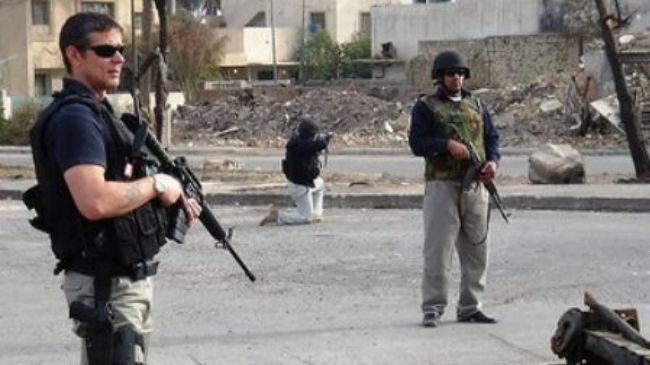
There are currently more private contractors working for the US military and other government agencies in Afghanistan than uniformed American military troops, reports indicate.
As of July, nearly 114,000 contractors were working for the US Defense Department in Afghanistan, compared to the 90,000 American troops in the country at the time, AFP reported Thursday, quoting “official statistics.”
The figures about the presence of a high number of US contractors working in Afghanistan emerged again after reports of a newly-released video showing American security contractors drunk and high on narcotics while on duty.
The US-based broadcaster ABC News, which released the footage and first reported on the incident, also cited a February 2011 report by a bipartisan commission set up to scrutinize the extraordinary use of contractors by the American military in Iraq and Afghanistan which concluded that the United States had wasted tens of billions of the nearly $177 billion that was spent on those contracts and grants since 2002.
The report, titled “At What Risk? Correcting Over-reliance on Contractors in Contingency Operations,” also stated that “about 200,000 contractor employees are working in Iraq and Afghanistan,” roughly equal to the American military forces deployed there in years prior to the report.
Numerous other reports verify such figures and also emphasize the relatively high number of casualties among the US contract workers that are often not reported and not accounted for.
According to official statistics released by Pentagon in May 2010, the total number of US military contractors working in Afghanistan, Iraq and its Central Command (covering the Middle East region) were 250,335, of which over 112,000 worked in Afghanistan, nearly 96,000 worked in Iraq and about 43,000 worked for the US Central Command (USCENTCOM).
The data also indicated that over 53,000 of the contractors were US citizens, 95,000 were third country nationals, and nearly 102,000 were locally employed.
Pointing to the relatively high number of casualty figures among US contractors working in Afghanistan, The New York Times reported earlier this year that in 2011 “at least 430 employees of American contractors were reported killed in Afghanistan,” compared to 418 American soldiers killed in the country in the same year, adding that the same trend was also true during the US occupation of Iraq.
The report, however, emphasized that the US military does not keep track of the casualties suffered by its contractors, noting that the country’s Department of Labor would hold the data only for American casualties that have been reported by US contractors hiring them. It added that there is hardly any counting of casualties suffered by US contract workers that are citizens of other nations.
The Times report also stressed that for every contractor killed in countries invaded by the US, “many more are seriously wounded.” It cites Labor Department’s statistics as reporting that in addition to the 430 contractors reported killed in Afghanistan in 2011, another 1,777 American contractors in the country got wounded.
Peace activists hinder departure of F16 airplanes to NATO nuclear weapons exercise
Vredesactie – BomSpotting – October 15, 2012

foto: Tim Dirven/Vredesactie
As of 7:30 AM peace activists are using non-violent means to try and stop the departure of F16 airplanes from the base in Kleine Brogel. Starting today, Belgian pilots are training for the deployment of nuclear weapons together with their NATO-partners. Small groups of activists are going onto the runway to stop the taking off of the F-16s. Meanwhile, the main gate of the base is being blocked. In this way, Vredesactie and Action pour la Paix hope to prevent the preparation for war crimes.
From 15 to 26 October, Belgian F-16s from the military base of Kleine Brogel are participating in the NATO-exercise “Steadfast Noon” in the German air base of Büchel. This exercise is a way of training for the deployment of nuclear weapons. All NATO-countries that have American nuclear weapons on their territory are participating: Belgium, Germany, Italy, Holland and Turkey. Some other countries are taking on a supportive role.
“The American nuclear weapons stored in Kleine Brogel are not merely relics from the Cold War”, says Roel Stynen from Vredesactie. “This NATO-exercise makes it clear that the deployment of these weapons is being actively prepared. If these nuclear weapons no longer have any military purpose – as we are told – then which scenarios are being practiced?”
Benoit Calvi from Action pour la Paix: “The majority of the population wants these nuclear weapons removed from our country. But our minister dodges any attempt to a debate. Apparently being a member of NATO is more important than having a functioning democracy.”
Preventing the preparation of war crimes
Small groups of activists have entered the base. They head towards the hangars for aeroplanes to stop the departure of combat planes, risking life and limb. Meanwhile a colourful blockade at the main gate stops entry of personnel to the base.
With this action the activists are trying to prevent the preparation of war crimes in a non-violent way. The use of nuclear weapons and the preparation for said use is in violation of international humanitarian law. The International Court has pointed out the fundamental rules of the law of war as applicable to nuclear weapons in its verdict of 8 July 1996.
First of all a distinction must be made between enemy combatants and civilians. It follows that weapons that are incapable of making such a distinction can never be used. Second, it is forbidden to inflict unnecessary suffering to enemy combatants. Therefore, weapons that inflict such suffering can not be used. The consequences of using nuclear weapons cannot be limited in time and space. The nuclear weapons stationed in Kleine Brogel can never be deployed without violating these fundamental rules of the law of war and without committing war crimes.
Belgian criminal law also penalizes these acts of preparation, e.g. in art. 136sexies of the penal code: “the keeping of an object destined for such a crime or which facilitates the perpetration of such a crime”. Participation in this exercise amounts to an active preparation for the use of nuclear weapons and therefore for crimes of war. It also makes it clear that the storage of nuclear weapons in Kleine Brogel is a part of this active preparation.
Belgian peace organizations file a complaint
On October 9 several Belgian peace organizations – Vredesactie, Pax Christi Vlaanderen, Vrede vzw, CNAPD, Action pour la Paix en MIR-IRG – already filed a complaint with the police against this exercise. Tom Sauer (professor of International Politics at the University of Antwerp) participated in filing a complaint: “These weapons are useless and dangerous. It is unacceptable that Belgian pilots are practicing for the deployment of weapons of mass destruction.”
So far neither the department of defence, nor the judicial authorities have indicated that the participation in the nuclear exercise will be suspended.
Related articles
- Independent Scotland would ban nuclear weapons but join Nato (telegraph.co.uk)
- NAM calls for total nuclear disarmament (alethonews.wordpress.com)
- Nuclear weapons should be banned from independent Scotland, says Alex Salmond (scotsman.com)
Majority in Turkey against war with Syria: Opinion poll
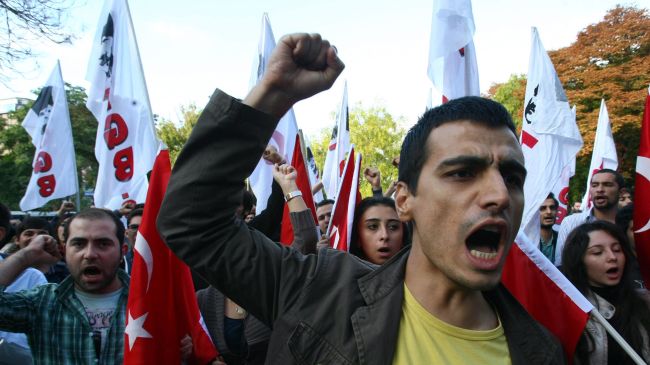
An anti-war protest was held in the Turkish capital Ankara on October 9, 2012
Press TV – October 14, 2012
A recent opinion poll has revealed that more than 75 percent of the Turkish people are against a war with neighboring Syria.
The opinion poll was conducted by Metropol, an agency close to the Turkish government, and surveyed 3,000 respondents.
Analysts believe that this majority is increasing further and there is a sharp mismatch between the government’s policies and the Turkish public opinion.
This comes as massive anti-war protests have taken place in many Turkish cities during the past weeks.
The row between Turkey and Syria escalated after Ankara held Damascus responsible for a mortar shell that killed five civilians in the southeastern town of Akcakale on October 3.
Ankara promptly responded with retaliatory fire that continued through the next days, and Turkish lawmakers also authorized the government to use military force against Syria when it deemed necessary.
Tensions have been running high between Syria and Turkey, with Damascus accusing Turkey along with Saudi Arabia and Qatar of backing a deadly insurgency that has claimed the lives of many Syrians, including security and army personnel.
Turkey has beefed up its military presence on its border with Syria over the past weeks, stationing tanks, anti-aircraft missiles, and additional troops in the area.
Turkish Prime Minister Recep Tayyip Erdogan warned on October 9 that Turkey’s armed forces would not hesitate to strike back in response to any attack on the Turkish soil after Turkey’s parliament authorized cross-border military action against Syria “when deemed right” On October 4.
Featured Video

Anthrax War – CBC The Passionate Eye
or go to
Aletho News Archives – Video-Images
Book Review
Shattered Dreams: The HPV Vaccine Exposed (2019)
By Christina England – 30 Q&As – Book Review & Summary
Lies are Unbekoming | September 4, 2026
… Gardasil received FDA fast-track approval in 2006, Cervarix followed in 2009, and Gardasil 9 was approved in December 2014 with more than double the aluminium adjuvant content of the original. The commercial context is specific. Merck was about to lose patent protection on Zocor and faced $18 billion in Vioxx injury claims from a cardiovascular drug the company had marketed while suppressing its own data showing a five-times increase in heart attacks. Analysts projected the global HPV vaccine market at $4 billion by 2011, contingent on government-funded national programs for teenage girls. The 1986 National Childhood Vaccine Injury Act had already granted manufacturers complete liability immunity. By 2013, Japan had withdrawn its HPV vaccine recommendation after cataloguing severe adverse reactions in hundreds of girls. No Western government followed. The establishment position across the UK, US, Australia, and most of Europe held, and still holds, that the vaccines are safe and effective, that reported injuries are coincidental, and that cervical cancer prevention justifies the program. The book was published into this position, not against a vacuum.
Shattered Dreams sits alongside Mary Holland’s The HPV Vaccine On Trial and Viera Scheibner’s foundational vaccination work as part of the documented record on what has been done to a generation of teenage girls under the banner of cancer prevention. The full summary unpacks three specific findings: that Merck used the aluminium adjuvant itself as the “placebo” control in 92.5% of trial subjects, making it structurally impossible to detect excess reactions from the adjuvant; that Dr. Sin Hang Lee found HPV DNA fragments bound to aluminium in every one of sixteen Gardasil samples tested, and in the blood and spleen of a New Zealand girl six months after her third dose; and that in every country with high vaccination coverage, including Australia, the UK, Norway, and Sweden, cervical cancer rates have stopped declining and started rising specifically in the vaccinated cohort. Martínez-Lavín’s 2017 calculation puts the number needed to seriously harm with Gardasil 9 at 140, and the number needed to vaccinate to prevent one case at 1,757. Thirteen young women are seriously harmed for every one who benefits. The vaccine was approved on the basis of trials that could not detect what the trials were supposed to detect, and it is still being given to twelve-year-olds today. … Read full review
Blog Roll
 Aletho News
- The Maidan Killings and the False-Flag Case
- Georgia’s Largest Healthcare System Will Fire Employees Who Refuse Flu Vaccine
- The Five-Year Fuel Crisis: Why the World Economy Is Paying for a War It Thinks Is Ending
- Trump’s Big Bluff on Iran
- Swiss scammed out of millions by Ukraine-linked call centers – media
- Germany facing potential ‘violent conflict’ with Russia – spy chief
- Ukraine’s EU neighbors reject new plea from Kiev – Politico
- British Transport Police Facial Recognition Trial Scanned 926,912 People With Zero Arrests
- House Bill Would Ban Federal Use of Flock ALPR Data
- Can a Spice Rival a Drug? 10 Head-to-Head Trials Put It to the Test.
- If Americans Knew
- “We See Our Homes Now From A Satellite, Like Strangers”
- Watch “Gaza: Doctors Under Attack”, originally censored by BBC
- NAZA: Israeli embassies in UK and US promote rival documentary to challenge Gaza genocide allegations
- David Ellison appoints Israeli to lead merged Paramount-Warner studios
- Turkish Red Crescent helps elderly Gaza man walk again after Israel confiscates his prosthetic limb
- Four Palestinians Killed in Israeli Attacks in Gaza
- Two Palestinian youths killed and village razed as Israeli attacks on West Bank continue
- Two more Christian women victims of Israeli raids on Gaza
- Cruelty, Deprivation, Indignity: A Journalist’s 22 Months in Israeli Prison
- New IDF Website Frames Slain Gaza Journalists as Terrorists
- No Tricks Zone
- Latest European Green Energy Debacle; Portugal’s Largest Flagship Solar Park Insolvent!
- Green Energy Debacle: German Expert Professor Fritz Vahrenholt Warns Of Severe Economic And Social Consequences
- Two More Paleo Reconstructions Affirm Meters-Higher Sea Levels Across Ireland, Brazil 7000-6000 Years Ago
- New Study: Earth And Venus Surface Warmth Largely Explained By Convection And Lapse Rate, Not CO2 Or Radiation
- 2025 Nature Paper Claiming Worsening Global Drought Gets RETRACTED …Heavily Flawed
- New Study: ‘Global Drought Shows No Detectable Recent Acceleration Under Climate Warming’
- Economic Masterminds: German Socialists Suggest Taxing Productivity Gains Stemming From Using AI
- The South China Sea Has Not Been Cooperating With The Climate Change Narrative
- Energy Crisis: Germany Enters Heating Season With Historically Low Gas Reserve Fill Levels
- New Study: The Antarctic Ice Sheet Gained Mass From 2020-2024 Due To Staggering Snow And Ice Accumulation

