The US build-up around Iran constitutes strategic war option, not ‘deterrence’
By Amro Allan | Al Mayadeen | February 23, 2026
The confrontation forming around Iran is increasingly defined not by diplomacy or de-escalatory statecraft, but by infrastructure: aircraft, tankers, ships, interceptors, forward bases, and the logistics that bind them into a usable strike system. What is being assembled around Iran is coercion by force posture—a regional arrangement designed to make the use of violence not only possible, but administratively routine.
The danger is not simply that the United States is “sending a message.” It is those messages, once backed by operational capability and sustained logistics, that develop their own momentum—especially in a region where a single incident, whether staged, misattributed, or opportunistically interpreted, can push escalation beyond the point where political actors can plausibly reverse it. That is how wars become “inevitable”: not because they must happen, but because the architecture is built until restraint begins to look like an admission of weakness.
What is underway is best understood as a transition from episodic pressure to a posture designed to make sustained operations feasible. Deterrence theatre is reversible: it can be intensified, paused, or theatrically concluded. War-enabling posture is different. It organizes the region for a campaign that could last weeks, not hours—requiring refuelling depth, airborne command, electronic warfare, forward munitions, missile defense, and a permissive regional geography. In other words, it is not the language of crisis management; it is the language of readiness for force.
The Israeli role
Any realistic scenario involving major strikes on Iran necessarily includes Israeli capabilities, even if formal command structures remain ambiguous. The Israeli Air Force is not simply a parallel instrument. It is a forward-deployed capacity that can be synchronized with US regional power while allowing Washington to stage-manage deniability until the moment of activation.
“Israel” maintains a large combat fleet with a long-range strike capacity built around multiple platforms: approximately 66 F-15 aircraft (including F-15I variants configured for longer-range strike), roughly 173 F-16 fighters, and about 48 F-35I stealth aircraft in service, with additional units expected over time. The operational implication is a structure suited to repeated waves rather than a single, demonstrative raid: stealth assets prioritized for penetration and suppression, with conventional fighters sustaining the bulk of strike and support roles once corridors are opened.
Defense planning in “Israel” also signals expectation of retaliation on a scale that exceeds symbolic exchange. The layered interception network—Arrow, Iron Dome, David’s Sling, and THAAD—is designed to deal with different classes of incoming fire, from rockets and drones to ballistic threats, and it functions as a prerequisite for any prolonged confrontation in which Israeli and US regional assets become primary targets.
This is where the political and military lines converge. Israeli leadership has long framed Iran as the central strategic adversary, and war planning has repeatedly been presented as a means of reshaping regional balances. Whatever language is used—“pre-emption”, “self-defense”, “containment”—the practical effect is to normalize the idea that Iran’s sovereignty can be overridden by an external security narrative. In that framework, escalation is not an accident; it is a policy option that is repeatedly rehearsed as common sense.
What the United States has built
The most revealing element in the US posture is not any single platform, but the way assets are being layered into an integrated strike system.
Open sources indicate that, on the air side, the forward package includes at least 30 F-35A fighters deployed in theatre, 24 F-15E aircraft, and an additional 36 F-16s moving toward the region. Electronic attack support includes 6 EA-18G Growlers, alongside 8–12 A-10 aircraft. Around a dozen additional F-16s are operating from Prince Sultan and possibly Al Dhafra, supported by 3 E-11A communications aircraft. In addition, a deployment of 12 F-22 stealth fighters is underway, with part of the force already forward-positioned and the remainder expected to continue toward regional bases.
The intelligence and command layer expands this into something far beyond a “show of force”: the movement or deployment of U-2 reconnaissance aircraft, an RC-135 signals-intelligence platform, a WC-135 nuclear-detection aircraft, and additional E-3 AWACS aircraft preparing for redeployment to forward bases—strengthening airborne battle management and command capability.
Operational persistence depends on fuel and lift. The posture is underpinned by up to 22 tanker aircraft operating from regional hubs, and sustained transport activity by C-17, C-5M, and C-130 aircraft delivering troops, equipment, and air-defence systems to forward locations.
At sea, the naval component includes the USS Gerald R. Ford carrier strike group moving toward the region while the USS Abraham Lincoln group operates in the Arabian Sea, alongside multiple Arleigh Burke destroyers positioned across key waterways (the Strait of Hormuz, the Gulf, the Red Sea, and the Mediterranean). The posture is reinforced by the USS Georgia, an Ohio-class guided-missile submarine capable of launching a large volume of cruise missiles.
Individually, each of these deployments can be framed as “routine”. Collectively, they form something more consequential: an operational environment in which launching a campaign becomes logistically straightforward. That is the essence of coercion-by-infrastructure. It does not announce war. It makes war easier to begin.
The aircraft carrier story
Washington foregrounds naval deployments because they are legible, dramatic, and politically manageable. Ships can be repositioned without forcing host governments into public commitments. Carrier strike groups allow Washington to appear decisive while keeping escalation thresholds ambiguous. This is useful domestically and diplomatically: it reassures partners, pressures adversaries, and sustains a narrative of control.
Yet the obsession with carriers often obscures the real center of gravity: land-based access, refuelling depth, persistent surveillance, and the defensive systems that keep regional bases operational. A serious campaign aimed at degrading Iran’s missile forces, air defenses, energy infrastructure, or nuclear-related facilities requires sortie generation and basing access that naval aviation alone cannot supply. The decisive question is not what is sailing; it is what is already positioned on land and in the air.
Iran reads this not as theatre, but as preparation. That reading is rational. When an adversary constructs a system designed for sustained strikes, it is the targeted state—not the deploying one—that is forced to plan for worst-case scenarios.
The geography of war
The enabling infrastructure of any sustained campaign sits in fixed locations. The operational map spans the Gulf and the Levant.
From Al Udeid in Qatar—often described as the operational heart of US Central Command—Washington can coordinate high-tempo operations supported by ISR and refuelling. Al Dhafra in the UAE extends its reach with advanced platforms and command integration. Prince Sultan in Saudi Arabia, if politically activated, shortens flight times and increases sortie density. The Harir airbase in Erbil provides forward access for strike and surveillance missions, while Jordanian airfields open western approach corridors. US positions in eastern Syria facilitate drone and reconnaissance activity along Iran’s western flank.
Beyond the Arab theatre, “Israel’s” bases operate in close alignment with US operational planning, forming an integrated environment even if formal command lines remain blurred. To the north, Azerbaijan offers potential basing or surveillance access along Iran’s sensitive frontier. Strategically, long-range bombers operating from the continental United States or Diego Garcia can be integrated through aerial refuelling and forward command nodes—adding strike capacity not captured by carrier-focused narratives.
This geography also clarifies what Washington rarely foregrounds: regional states become the battlefield’s enabling terrain. The bases, depots, radars, command centres, and runways that make sustained operations possible also sit within Iran’s retaliatory envelope. Iran does not need to neutralize a carrier to impose strategic and political costs. It can target the infrastructure that keeps the campaign running: runways, fuel depots, hangars, radar nodes, and the host-nation systems that sustain them.
If escalation occurs, the political question for host governments will not be abstract. It will be immediate: whether they are willing to absorb retaliation for choices made in Washington and Tel Aviv. That is precisely why the build-up is destabilizing. It expands the list of actors exposed to consequences while narrowing the space for de-escalation.
This is where the moral and legal questions sharpen. If host states provide launchpads, they are not passive bystanders; they become parties to the escalation. Yet these governments are rarely treated, in Western coverage, as societies that will absorb the consequences. They are treated as facilities—terrain, not people. Iran, by contrast, is treated as a problem to be managed.
Missile defense
If the escalation logic runs through bases, the defensive requirement runs through interceptors. Missile defense in this doctrine is a central operational requirement rather than a supporting function.
Patriot and THAAD batteries protect major airbases and logistics nodes across the Gulf and the Levant, integrated with early-warning radars, airborne surveillance, and regional command networks. Following the US withdrawal from Ain al-Assad in western Iraq, defensive emphasis shifted toward fewer but more politically sustainable bases: Al Udeid and Al Dhafra remain heavily protected, while positions in Jordan and eastern Syria rely on combinations of Patriot systems, shorter-range counter-drone defenses, and persistent surveillance.
“Israel” constitutes a distinct but integrated pillar in this interception architecture. Its layered air-defense network—Iron Dome, David’s Sling, Patriot, and Arrow—is linked to US early-warning and interception planning, forming a shared defensive envelope rather than a purely national shield.
Notably, the defensive geography is widening. Cyprus has deployed Israeli-made air-defense systems, and Greece is moving toward integrating Israeli interception technology into its own architecture—developments that point to the gradual emergence of an Eastern Mediterranean interception depth, built around interoperable sensors and strategic alignment rather than formal collective defence commitments.
At sea, US Aegis-equipped destroyers add a mobile interception layer capable of engaging aircraft, cruise missiles, and limited ballistic threats—again supplementing, not replacing, land-based interception.
This matters because missile defense introduces a vulnerability that carrier narratives often conceal: interceptor stocks are finite, and a sustained high-volume exchange strains them. In a scenario of large-scale missile and drone retaliation, the question becomes not simply “can you intercept?” but “for how long?”—and at what political cost to host governments whose territory becomes the absorbing surface for escalation.
Tehran’s strategic logic
Iran’s deterrence logic has been recalibrated by lived confrontation, namely the “12-day war”. The central conclusion drawn in Tehran is that survivability precedes deterrence. Missiles, air-defense systems, command-and-control, missile production, and retaliatory capabilities must be structured to endure the opening shock of war, not to dominate it.
In the opening phase of that confrontation, Iran’s air defenses suffered rapid degradation: fixed or semi-mobile systems were destroyed early, their locations effectively pre-mapped, and their network dependence exploited through precision strikes, electronic warfare, and intelligence integration. Mobile missile systems—long assumed to be the backbone of survivable retaliation—also proved vulnerable once movement became detectable under persistent surveillance and integrated strike networks. The conclusion Tehran extracts is structural: in a conflict dominated by satellite tracking and real-time targeting, anything that must move, emit, or communicate openly at the onset of war is at elevated risk of rapid attrition.
That assessment drives the turn toward underground infrastructure. Iran’s missile force is being reconfigured around hardened tunnels, concealed storage, underground silos, and pre-positioned launch infrastructure designed to reduce exposure time and reliance on vulnerable command links. In this model, air defense still matters, but its role is framed as damage limitation rather than denial: complicating targeting, absorbing strikes, and preserving enough capability to ensure retaliation after the opening exchange.
Disruptions cascade into command delays and coordination bottlenecks, so Tehran’s preparations increasingly prioritise hardened domestic infrastructure, reduced external dependencies, and decentralized command authority to ensure retaliation does not hinge on uninterrupted connectivity. Parallel to this is the elevation of the domestic front—civil defense, continuity, internal stability—as a core component of deterrence rather than an auxiliary concern.
This is not the posture of a state seeking war. It is the posture of a state that has learnt—through repeated threat and episodic attack—that its adversaries prefer to treat its security as negotiable. Tehran’s strategic lesson is bleak but coherent: if the US and “Israel” reserve an expansive right to strike, then Iran must reserve the ability to respond even after absorbing the first blow. This is not radical; it is the minimal condition of sovereignty.
The escalation problem
A central risk is that escalation is unlikely to remain geographically contained. Even if Washington frames an initial operation as “limited”, allied forces and partner theatres are not mechanically separable. Under conditions of sustained strikes on Iran, groups and allied actors across Yemen, Lebanon, and Iraq face their own strategic pressures, with intervention becoming a function of credibility and survival rather than preference.
Meanwhile, regional governments that host US assets occupy an exposed position. They may privately prefer de-escalation, but their bases and airspace can become operational requirements once Washington activates the posture it has assembled. Washington has 35,000–40,000 personnel deployed around Iran, expected to carry out the main attack in the event of war—an estimate that underscores how deeply the region is already militarily interlocked with any potential campaign.
This is where political constraint becomes as dangerous as military capability. When leaders publicly elevate threats, they increase the domestic cost of restraint; when adversaries interpret restraint as weakness, they increase the cost of compromise. In such conditions, accidental escalation—triggered by a strike, a misattributed attack, or a rapid chain of retaliation—can become more plausible than deliberate strategic design. And in an environment saturated with narrative warfare, the line between “accident” and “pretext” is rarely as clear as officials insist.
The build-up manufactures the conditions for war
The build-up is not reducible to theatre. It is a layered strike-and-defense system: forward stealth fighters and conventional strike aircraft; electronic warfare; airborne command and ISR; tanker depth and heavy lift; carrier groups and missile-capable submarines; a regional lattice of bases; and an expanding interception architecture stretching across the Gulf, the Levant, and into the Eastern Mediterranean. The combined effect is to make sustained operations technically feasible, while widening the geography of vulnerability and entanglement.
The strategic irony is that the more “prepared” this posture becomes, the less space remains for political off-ramps. Host governments become exposed. Interceptor sustainability becomes a decisive variable. Tehran’s retaliatory doctrine evolves toward survivability and endurance rather than symbolic signalling. In such an environment, the question is no longer whether war is “intended”. It is whether the operational infrastructure of war is now sufficiently in place that a single trigger—miscalculation, provocation, or opportunism—can transform a posture into a campaign faster than political channels can arrest it.
Iran’s reading of this is neither paranoia nor ideology. It is a basic inference. When a superpower constructs the machinery for a sustained strike and embeds it across neighbouring territories, the targeted state will plan accordingly. The real moral burden, then, lies not on Iran’s preparations for survival, but on the political decision—repeatedly rehearsed in Washington and Tel Aviv—that a regional order can be engineered through coercion and air power, while everyone else is expected to absorb the consequences.
If the international community is serious about preventing war, it should stop treating Iran’s defensive doctrine as the primary problem while granting the US-Israeli posture the presumption of legitimacy. The liability of proof lies with those constructing a regional strike system and calling it “stability”. There is nothing stabilizing about embedding a war option across neighbouring territories, then demanding that the targeted state behave as though this is normal. The region has seen this script before: coercion presented as protection, escalation presented as necessity, and catastrophe presented—after the fact—as an unfortunate surprise.
China supplies Iran with radar, surveillance tech to track US stealth aircraft: Report
The Cradle | February 23, 2026
China’s Ministry of State Security (MSS) has provided Iran with new technology in an effort to prevent infiltration by US and Israeli intelligence, and to help Tehran defend itself from advanced US and Israeli warplanes in the case of a renewed war, according to a 10 February report by Modern Diplomacy.
The report states that Beijing is urging its ally, Tehran, to abandon US and Israeli-made software and replace it with closed, encrypted Chinese systems that are difficult to penetrate.
This includes supplying Iran with advanced Chinese sensor systems and radars, such as the YLC-8B, capable of tracking stealth aircraft and conducting electronic surveillance.
Defense Security Asia stated that according to one analyst, the “YLC-8B is one of the few radars of its type in the world which can continuously detect and track a Western fifth-generation (stealth) aircraft at long range.”
The YLC-8B was developed by China’s Nanjing Research Institute of Electronics Technology. It uses UHF-band low-frequency surveillance to undermine the effectiveness of radar-absorbent shaping used by advanced US aircraft such as the F-35 warplane and B-2 bomber. The Israeli Air Force (IAF) reportedly has 48 F-35 stealth fighter jets in its fleet.
Beijing is also encouraging Iran to transition to the Chinese BeiDou satellite navigation system as an alternative to the US-created GPS system to avoid manipulation and prevent US intelligence from using it to track Iranian targets within the country, Modern Diplomacy reported.
The report comes as the US has amassed a significant amount of its naval and air power in the West Asia region, threatening a major attack on Iran.
China is seeking to assist Tehran to protect its massive investments in Iran, made as part of a 25-year strategic agreement signed under Beijing’s Belt and Road Initiative (BRI).
Beijing also fears the loss of access to Iranian oil if Washington launches an attack, leading Iran to close the Strait of Hormuz.
Iran is China’s largest supplier of oil, while some 20 to 30 percent of the world’s crude passes through the strategic straits on Iran’s southern coast.
Despite seeking to assist Iran with new technology, Beijing has made it clear it will not intervene militarily to assist Iran in the case of a war, Modern Diplomacy noted.
China has extensive economic relations with both the US and Israel.
Instead, China is expected to limit its support to the diplomatic sphere and condemn any unprovoked US or Israeli attack as a serious violation of international law and the UN Charter.
“Beijing remains wary of sliding into a full-blown conflict that could threaten the flow of oil from the Gulf. This is what prompts it to consistently call for restraint and a return to diplomatic solutions to avoid ‘catastrophic consequences’ for the global economy,” Modern Diplomacy added.
Zelensky rejects territorial concessions to Russia
RT | February 23, 2026
Kiev will never rescind its territorial claims on formerly Ukrainian regions lost to Russia and is set on seizing them back in the future, Vladimir Zelensky has stated, once again ruling out withdrawing from Donbass.
In an interview with the BBC published on Monday, Zelensky reiterated his refusal to withdraw from the areas of Donbass still under Ukrainian control, claiming such a move would only “divide” the country’s society.
A withdrawal has been one of the key Russian demands and the main issue of the ongoing US-mediated talks between Moscow and Kiev. Moreover, the Ukrainian leader said the country remains set on getting back all the territories it has lost to Russia.
“We’ll do it. That is absolutely clear. It is only a matter of time,” he stated.
Zelensky admitted that Ukraine is currently unable to accomplish this because it lacks both sufficient funds and troops.
“To do it today would mean losing a huge number of people – millions of people – because the [Russian] army is large, and we understand the cost of such steps,” he said. “And we also don’t have enough weapons. That depends not just on us, but on our partners.”
The Ukrainian leader repeated his longstanding talking point about getting all the territories within the 1991 borders, when the country became independent after the collapse of the Soviet Union. Seizing all the land back would constitute “victory of justice for the whole world,” Zelensky asserted.
The territories in question include Crimea, which broke away from Ukraine in the aftermath of the Western-backed 2014 Maidan coup and joined Russia via a referendum shortly after. The Donetsk (DPR) and Lugansk (LPR) People’s Republics declared their independence early on in the post-Maidan conflict in then-Ukrainian Donbass. The DPR and LPR joined Zaporozhye and Kherson Regions in being incorporated into Russia in late 2022 following referendums in which the overwhelming majority of the regions’ respective populations supported the move.
While Russia controls the entire territory of the LPR, Kiev’s forces still hold roughly 20% of the DPR. Moscow’s control of Kherson and Zaporozhye remains partial, with the respective namesake capital cities of the two regions held by Ukraine.
German leader of EU’s largest faction sounds the alarm of possibility of right-wing forces coming to power in France, Poland
Manfred Weber, a vocal critic of any EU state that pushes back against a more powerful Brussels, has openly embraced Orbán’s opponent in Budapest
Remix News | February 23, 2026
German politician Manfred Weber, the leader of the European People’s Party (EPP), spoke on ZDF about a common European army, saying, among other things, that the European Union must “draw conclusions from its own experiences, including in military matters.”
Weber spoke about the danger to the EU establishment posed by the presidential elections in France and the parliamentary elections in Poland, both to be held in 2027. Weber is concerned that there is a high probability of victory for forces that do not support the continuation of the EU’s centralization; forces that instead advocate for a Europe of sovereign nations. He said that EU must have the strength necessary, even by way of a common military, to presumably counter such possible outcomes.
Specifically mentioning Poland’s Law & Justice (PiS) leader, Jarosław Kaczyński, and France’s National Rally (RN) leader, Jordan Bardella, he said: “I hope that we now have the strength… to create a Europe that cannot be destroyed and that will weather the storms of the world order together… Now we need the same approach on the military front. We must prepare for scenarios in which Bardella becomes president of France and Kaczyński returns to power in Poland.”
Hungarian Prime Minister Viktor Orbán has repeatedly asserted that the European People’s Party (EPP) is an ardent supporter of the war in Ukraine against Russia, a war Orbán has maintained Hungary will not be drawn into. Notably, Orbán’s Fidesz party used to belong to the EPP grouping before parting ways to found the Patriots for Europe faction, with members committed to EU member states that want to preserve their sovereignty and traditional, conservative values. Now, Weber has been a strong promoter of the opposition leader, Péter Magyar, ahead of Budapest’s April parliamentary election.
During his interview, Weber was vocal about his concerns that the right-wing Alternative for Germany (AfD) may come to power in Germany. “During a visit to the Greek parliament, someone asked me, ‘What would happen if Germany built the largest land army, and at the same time the AfD had 25-30 percent?’” he told the station.
Putin: Developing Russia’s nuclear forces ‘absolute priority’
Press TV – February 23, 2026
President Vladimir Putin says developing Russia’s nuclear forces is now an “absolute priority” following the expiry of its last remaining nuclear treaty with the US.
“The development of the nuclear triad, which guarantees Russia’s security and ensures effective strategic deterrence and a balance of forces in the world, remains an absolute priority,” Putin said in a video speech on Sunday to mark Russia’s “Defender of the Fatherland Day.”
Putin pledged to further reinforce the army and navy, and draw on military experience gained during the nearly four-year conflict in Ukraine.
Moscow and Washington, the world’s two largest nuclear powers, are no longer bound by any arms control agreement following the expiration of the “New START” agreement earlier this month.
Russia and the US possess more than 90 percent of the world’s nuclear weapons.
As of January 2025, Russia had more than 4300, and the US had approximately 3700 nuclear warheads.
Analysts say both the US and Russia are modernizing their nuclear forces, effectively fueling an arms race already underway.
With nuclear weapons gaining renewed prominence and no breakthrough from talks such as Trump and Putin’s Alaska meeting last year, New START’s end signals a more volatile and dangerous phase in global security.
Hungary Blocks 20th Package of Anti-Russia Sanctions, $106B Loan to Ukraine – Szijjarto
Sputnik – 23.02.2026
Hungary blocked the 20th package of anti-Russia sanctions, as well as the 90 billion euro ($106 billion) loan to Ukraine, due to Kiev’s shutdown of the Druzhba oil pipeline, Hungarian Foreign Minister Peter Szijjarto said on Monday.
“At today’s meeting, I made it clear that we do not support the 20th package of sanctions and do not give permission for this. And I made it clear that we would not agree to Ukraine receiving a military loan of 90 billion euros. Because the Ukrainians cannot blackmail us, they cannot jeopardize the security of Hungary’s energy supply by conspiring with Brussels and the Hungarian opposition,” Szijjarto told reporters, following a meeting of the EU Council of Foreign Ministers.
Hungary considers Ukraine’s suspension of Russian oil transit through Druzhba as encroachment on its sovereignty, Szijjarto concluded.
The termination of Russian oil supplies via Druzhba pipeline was the result of collusion between Kiev and Brussels, Szijjarto said.
“It turned out to be a shocking fact that Ukraine is really colluding with Brussels, really colluding with the European Commission headed by von der Leyen in terms of blocking the supply of [Russian] oil [via Druzhba pipeline]. It was finally revealed and proven today,” Szijjarto told reporters, following a meeting of the EU Council of Foreign Ministers.
On February 18, Szijjarto said that Hungary stopped supplying diesel fuel to Ukraine. He said this was a response to Kiev’s blackmail, as Ukraine is not resuming the transit of Russian oil to Hungary via the Druzhba pipeline for political reasons, trying to cause an energy crisis in the country and influence the April elections.
The EU countries are preparing for a protracted conflict in Ukraine and want to send their troops there as soon as possible, the minister added.
Ukraine demands 155 billion euros ($183 billion) from the EU only for the maintenance of the army in 2026, a loan of 90 billion euros is not enough for it, Peter Szijjarto said.
“Colleagues have made it clear that the 90 billion euros previously agreed upon and now blocked by Hungary are not enough to meet Ukraine’s financial needs, and in the near future it is necessary to make a decision on sending even more resources, even more money to Ukraine. This was also confirmed by the Foreign Minister of Ukraine, who said that this year they need 155 billion euros only for the maintenance of the army,” Szijjarto told Hungarian journalists, following a meeting of the Council of Foreign Ministers of the EU countries.
NATO Must Return to 1997 Borders for Peace in Ukraine – Finnish Politician
Sputnik – 23.02.2026
NATO must revert to its 1997 borders to secure lasting peace in Ukraine, while European leaders pursue de-escalation and respect the alliance’s pledge against eastward expansion “one inch” toward Russia, Armando Mema, member of the Finnish national-conservative party Freedom Alliance, said on Monday.
“In order to achieve a lasting Peace in Ukraine and Europe, NATO must return to 1997 borders … The EU leaders must work in the coming years for a de-escalation, respect NATO historical promises of not expanding to one inch toward Russia,” Mema said on X.
NATO’s “disastrous policies of enlargement” will exact a heavy toll on Europeans, as well as Europe’s rapid rearmament and its “disastrous policies in Ukraine” send dangerous signals for the future, the politician said.
“Finland and Sweden should be among first countries to exit NATO as soon as possible,” he added.
In recent years, Russia has raised concerns about unprecedented NATO buildup along its western borders. The Kremlin argues that Russia poses no threat to anyone, but will not ignore actions potentially dangerous to its interests. In an interview with US journalist Tucker Carlson, Russian President Vladimir Putin said that Russia had no intention of attacking NATO allies and accused Western politicians of scaremongering.
Why the US-Israeli alliance will lose against Iran
By Robert Inlakesh | Al Mayadeen | February 21, 2026
While it is impossible to predict precisely what the war on the Islamic Republic of Iran and its regional allies will result in, the winnability of the regional conflict is clear. The only thing driving this attack is sheer Israeli arrogance, as there is no conceivable situation where all out regional war delivers anything short of uncontrollable chaos.
Why is an all out regional war unwinnable? Although there are various reasons as to why this is the case, it suffices to say that the US and Israelis have no way of controlling its outcomes, in addition to this, they simply do not possess the military industrial capacity to wage such a war for a long period of time.
Now, when this argument is made, it is not done from an idealistic point of view. Therefore, it is important to preface this piece on the fact that there is a clear Israeli-US superiority in terms of technology and the kinds of weapons they possess. Nobody disputes this. There is also clear superiority in the field of their intelligence agencies.
So, let us first assume that the United States and the Zionist entity manage to score all of their desired tactical victories. Working on this assumption will then definitively prove the injudicious nature of the endeavour.
Therefore, under the best case scenario for the Zionist coalition, perhaps they succeed in conducting another decapitation strike on the Iranian military leadership, manage to penetrate and destroy some missile bases, nuclear facilities, while gutting the Islamic Republic’s air defences. These are very likely goals that they will seek to achieve.
Let’s also work under the assumption that they manage to put Tehran on the backfoot for at least a week, due to the intensity of their air campaign, making it difficult for the Islamic Revolution Guards Corps (IRGC) to fire large bursts of ballistic missiles at a single time. Then, after achieving air dominance, strikes on essential infrastructure begin, including cultural sites, government buildings, the media, but also the likes of oil facilities, agricultural areas and water systems.
On top of all of this, assume hybrid warfare tactics will be ongoing. Militant groups, especially those focused along the Iranian periphery, will start major offensive operations, working in conjunction with foreign intelligence agents and operatives on the ground, similar to what we witnessed during the 12-day War in June of 2025.
Note that the much debated potential goal of assassinating Ayatollah Seyyed Ali Khamenei is not included above. Although many have speculated that the strategy could very well hindge upon this, it guarantees a war with no predictable end, no escalation ladder and will likely trigger calls for global Jihad.
An inevitable US-Israeli defeat
Giving the Zionist coalition the best possible conditions and achievements as a result of their opening offensive, this strategy will quickly begin to run into major issues.
As we saw last June, decapitation strikes against the Iranian leadership do not work at crippling the government and its military, they are simply replaced by another line of leadership, who implement a whole series of pre-planned counter attack strategies.
The Israelis wrongfully believed that their success during the initial attack on Iran last year was going to yield major results, even attempting to utilise their asset in the United States, the son of the deposed Iranian dictator, to call for a revolt. Not only did no such action take place, as Iranians outside of the diaspora do not support this clear Zionist puppet, but the very opposite occurred as the population rallied behind the flag.
Within 15 hours, the Iranians not only managed to get their air defences back online, but captured the initiative and began launching huge volleys of ballistic missiles into the heart of Tel Aviv. As the conflict evolved, a few important developments occurred: the Israeli air defences began to buckle – with the draining of anti-air munitions – while their agents on the ground carried out most of the attacks, something that is key to note.
While it is clear that the US will bring in greater firepower than the Israelis can muster, an air force is still run by human operators who get tired and operate equipment that needs to be serviced. Iran will very easily be able to launch drones waves constantly at US and Zionist positions, and even if their ability to launch large salvos of missiles is constrained during the first week of the conflict, eventually the opportunity will present itself.
If the Iranian State has not crumbled and civil war has not erupted within this time, then the US and Israelis will then be subjected to wave after wave of counterattacks. Inevitably, this means that airbases will be struck, equipment will be lost, and with fewer assets, this means less ability to keep up the pace of their offensive.
Bear in mind that warhawks employed by Washington and Tel Aviv based pro-war think tanks, who claim that the Iranian State is crumbling at least once a year, are far detached from reality. Take the latest round of foreign backed riots for example, the Western corporate media invented an alternate reality in order to sell the idea that Iran was falling, yet the entire ordeal was more or less over in two days.
It is clear to any learned observer, that without a significant ground element, toppling the Iranian government is impossible. Which then leads to the obvious next question: What if major militant offensives occur inside Iranian territory?
Answering this in depth would take time and a more nimble military mind. Yet, again assuming some level of success on the behalf of separatist militias and al-Qaeda linked Takfiri groups, even if they were to seize territory, Iran is a massive country that allows for mistakes. None of these groups compare and can stand up to the Iranian army and IRGC, nor do they likely possess any considerable advanced capabilities.
What this means is that even if they manage to see some level of initial success, the much larger, well trained, motivated and well equipped Iranian armed forces will eventually crush these insurgents. The only real threat is some kind of mass civilian mobilisation that will deal a blow to the Iranian economy, for which there is no indication this will happen, especially as the nation is suffering through a bloody war of aggression against it.
Then come the attacks on missile bases and nuclear sites. Even if some of these attacks are successful, they won’t destroy all of Iran’s capabilities, and as we saw in June of last year, the US attacks on the nuclear facilities don’t appear to have stopped the nuclear program. If it were that easy to simply take out Iran’s capabilities, it would have been done long ago. The Israelis tried last year and failed. If anything, on the nuclear issue, such a war could end up leading to Tehran actually reversing course on its stance against developing the bomb.
Even with full US-Israeli air superiority, the remaining air defences of Iran will at some point come back online, but even in the event that 100% of their anti-air capabilities are gone, their power is in their offensive, not defensive capabilities.
Once this initial period of assumed US-Israeli offensive dominance is over, Iran can easily block the flow of oil from the Persian Gulf, inflict large casualty events on US and Israeli targets, while taking out assets. It is impossible to predict which strikes will be the most effective, however, it is clear that everything will become a target. So expect a big hit on the global oil market, resulting in an economic crisis.
If Iran simply keeps up a pace of fire against the Israelis, the likes of which we saw during the 12-day War, then they only have a matter of weeks before their air defences also become useless.
This is all without factoring in Iran’s various allies, which may enter at any level of intensity at any point in this conflict. There’s Ansar Allah, which has the capability of striking the Israelis, but also assets throughout the Persian Gulf. If Hezbollah manages to wage a considerable ground war, the Israelis have proven in the past to be the weakest in this arena.
The Iraqi Popular Mobilisation Units (PMU/PMF, Hashd al-Shaabi) are around 250,000 men strong, alongside Saraya Awliya al-Dam, who can use their own capabilities to not only target the US, but the Israelis also. So far, since October 7, 2023, we have not seen a true demonstration of their power. Another factor which is not often discussed, but is also very important, is the role of the Palestinian resistance, who are more likely to wait for the right opportunity, but can also pose a major ground challenge to the Israelis from Gaza.
None of this considers the other elements that could come into play, such as the roles played by regional nations, armed groups we may not have previously heard of, the likes of the Fatemiyoun of Afghanistan and Zainabiyoun of Pakistan, or the general populations throughout the region and what we could see in the event that chaos erupts. Governments could be overthrown, the civilian populations of Jordan and Egypt could become active and out of control. There is also the possibility that some groups in Syria could seize the opportunity to attack the Israelis.
In the event that such a war occurs, the longer it goes on, the more chaotic and unpredictable it becomes. A situation will be totally out of the US’s control, especially as the only means of combating this regional explosion is through the air. As we witnessed with the US campaign against Yemen, airstrikes alone change very little. Even in Gaza, the armed resistance groups fought for over 2 years with no supply chain, and by the admissions of the US and Israelis, their fighting force is still roughly the same size.
If things don’t go their way very quickly, then the Zionist coalition is going to get battered, and not even nuclear weapons will get them out of it. Therefore, [if] the US and Israelis, as long as we again grant them another assumption, that they are somewhat sane, choose to go to war, they will have to try and establish an escalation ladder, devising a real exit strategy.
The question becomes whether the Iranians and their allies allow them to exit the fight. An all out war will be bloody, it will claim an enormous amount of civilian lives, and it will also inflict considerable damage on civilian infrastructure. Truly, the effects of such a war are not desired by anyone in the region, yet the Iranian-led Axis of Resistance have long prepared their capabilities in order to combat what appears to have been inevitable.
Another thing to be mentioned here is that the US government, under the Trump administration, is totally captured by the Zionist entity. For all the reasons noted above, no previous administrations have dared escalate to this extent. If it were easy to launch a regime change operation against Iran, it would have been carried out many years ago.
However, a Zionist stooge is occupying the White House, a narcissistic man whose already low cognitive abilities are clearly declining. He is a President that an FBI report concluded had been compromised by the Mossad, but even if that report isn’t to be taken seriously, his whole campaign was bankrolled by Zionist donors, and his administration is an embarrassing collection of Zionist war hawks. If there was ever any US administration that was foolish enough to launch such a war, it is that of Donald Trump.
Israel ready to strike Iran-backed armed groups – media
RT | February 20, 2026
Israel’s military is preparing to launch large-scale pre-emptive strikes on Iran-backed armed groups across the Middle East in order to prevent them from lending support to Tehran in any potential regional conflict, the Saudi daily Asharq Al-Awsat reported on Friday.
Israeli military sources told the newspaper that West Jerusalem has engaged mediators to warn Lebanon’s Hezbollah militant group, Yemen’s Houthi rebels, and armed factions in Iraq that any attack against Israel would be met with a “massive and unprecedented response.”
The sources said that Israeli defense officials believe Tehran is pushing its regional allies to take part in any potential escalation after concluding that their limited involvement in the 12-day Israel-Iran war was a strategic mistake.
Iran has allocated substantial resources, including an estimated $1 billion in 2025, to bolster its allies’ ability to strike targets in Israel and the region, the sources claimed.
Israeli assessments cited by the paper suggest that Kataib Hezbollah in Iraq is reluctant to take part in a confrontation, while Hezbollah in Lebanon and the Houthis are more likely to participate.
The IDF said on Thursday it had carried out airstrikes on alleged Hezbollah sites in southern Lebanon. Despite a fragile US-brokered ceasefire, Israel has routinely attacked its northern neighbor, accusing it of violating its side of their agreement.
The Houthis, who control much of Yemen, have halted missile and drone attacks on Israel and its commercial shipping in the Red Sea since the truce with Gaza was signed in October, after repeatedly targeting vessels in what they said was solidarity with Palestinians.
On Thursday, US President Donald Trump set a ten-day deadline for Iran to reach a nuclear deal with Washington, saying that failure to comply could trigger decisive measures. The warning followed Omani-mediated talks in Geneva on Tuesday, which both sides described as a positive step, although no breakthrough was made. At the same time, the US accelerated its troop buildup in the region.
Israeli Prime Minister Benjamin Netanyahu also warned about preparations for possible missile strikes on Iran. “We are prepared for any scenario,” he said, adding “they will experience a response they cannot even imagine.”
The US struck Iran’s nuclear sites during the 12-day Israel-Iran air war in June 2025. Tehran has maintained that its nuclear program is peaceful and has vowed it will not be deterred. Tehran’s UN envoy Amir Saeid Iravani reiterated on Thursday that Iran “will not initiate any war,” but will respond resolutely to being attacked.
Russian Foreign Minister Sergey Lavrov has accused the US of “playing with fire” and warned that strikes on Iran’s nuclear sites could lead to disaster.
In an interview with Al Arabiya aired on Wednesday, Lavrov said Moscow backs Tehran’s right to peaceful enrichment, adding that the current tensions stem from the US tearing up the 2015 Iran nuclear deal during Trump’s first term.
Behind US war drums against Iran: No goals, no plan, no off-ramp
Al Mayadeen | February 20, 2026
As the United States continues to amass unprecedented military firepower in West Asia, the largest such build-up since the 2003 invasion of Iraq, a senior analyst at the Atlantic Council is warning that Washington has yet to answer fundamental questions about what a military campaign against Iran would actually achieve, or what catastrophic consequences it might unleash.
In a piece published this week, Nate Swanson, director of the Atlantic Council’s Iran Strategy Project and senior advisor on Iran policy to successive US administrations, outlined six critical questions that US policymakers appear unable, or unwilling, to answer before potentially launching a “massive, weeks-long” aggression against Iran.
The analysis, while emerging from a Washington policy establishment that has long driven the logic of “maximum pressure” against Tehran, nonetheless lays bare the incoherence and recklessness of the current US posture.
No clear objective, no clear endgame
Swanson acknowledges that the White House has failed to define what it hopes to achieve militarily. The possible objectives he outlines, leveraging a strike to force nuclear concessions, decapitating Iran’s leadership, or launching symbolic attacks to appear supportive of rioters, each carry “significant obstacles.”
Most notably, Swanson concedes that Iran’s leadership appears to have calculated that dismantling its defense capabilities would be more dangerous than absorbing a US strike. In other words, Washington is considering going to war against a country that has already determined it will not surrender to US demands, regardless of the military cost.
No diplomatic path
Swanson is frank that a diplomatic off-ramp is effectively closed, though the reasons illuminate where responsibility lies. The Trump administration, he notes, is not seeking a deal in the conventional sense but something closer to “an Iranian surrender pact.”
Iran, meanwhile, insists on its sovereign right to a civilian nuclear program. The vast gap between the two positions is less a failure of Iranian diplomacy than a reflection of maximalist US demands that leave no room for negotiation.
The human cost
One of the more significant acknowledgements in Swanson’s piece is the human toll of the June 2025 unprovoked Israeli war on Iran, which the US supported. Over 900 Iranians were martyred in the aggression, including many civilians.
He cautions that a new, prolonged campaign would risk far greater casualties, which is something the great majority of Iranians would oppose. The analyst also notes that Iranians did not come out to protest against the government during the twelve-day war, so there is no reason to believe a large-scale US aggression would trigger protests to overthrow the Islamic Republic.
Regional alarm bells ignored
Arab and Turkish partners of the United States have spent the past month urging Washington to step back from the brink, with Gulf states publicly refusing to permit US use of their airspace for attacks on Iran. The regional consensus against military escalation is striking and largely being ignored in Washington’s war calculus.
Swanson also raises the possibility of Iran retaliating against Gulf states if it cannot de-escalate, echoing the 2019 precedent when Iran struck UAE and Saudi Arabian infrastructure during the last “maximum pressure” campaign. It is a reminder that Washington’s wars rarely stay contained to their intended theatres.
A war machine in search of a justification
Swanson’s analysis, despite being authored from within the US foreign policy establishment, ultimately underscores a troubling reality. The United States is on the edge of a potentially devastating war without a clear objective, without a viable diplomatic track, without regional support, and against the wishes of 70 percent of its own population.
The questions Swanson is asking should have been answered before B-2 bombers were positioned in Diego Garcia and carrier strike groups were dispatched to the Gulf.
That they remain unanswered speaks not to a failure of analysis but to the nature of a foreign policy apparatus that treats war as a tool of first resort.
Israel Pushing US Toward a Big and Damaging War With Iran – Ex-Pentagon Analyst
Sputnik – 19.02.2026
Israel was humiliated in the 12 day war with Iran and is seeking a similar humiliation for its rival, retired US Air Force Lt. Col. Karen Kwiatkowski, a former Pentagon analyst, tells Sputnik.
“Israeli demands for no nuclear capability, no enrichment, and no ballistic missiles for Iran is overtly ludicrous, but has been cultivated by numerous visits by Netanyahu to the White House to push for a big and damaging war,” Kwiatkowski says.
The Israeli leadership believes Iran is at its weakest point now — an opportunity that may not come again — and is pressing the US to act.
“Reports of excessive and invasive IDF and Mossad presence inside the Pentagon and Joint Staff planning arenas have made mainstream news, and that is likely due to leaks from inside the Pentagon, by Americans who are concerned about what the US stands to lose by fighting this final war for Israel,” the pundit points out.
How might the US-led operation unfold?
- This time, unlike before, the US and Israel are likely to strike together, combining major electronic and cyber attacks to blind Iran and simultaneous military action
- Experienced Pentagon planners know the risks, so if war comes, they’ll strike hard early hoping to limit Iranian missile retaliation and losses from Persian-controlled sea, land and air
- US forces are likely to play a more overt role in the early phase, partly because there’s limited loitering time for the USS Gerald Ford and Abraham Lincoln
- Throughout, US and Israeli forces will be coordinated by US Airborne Warning and Control System (AWACS)
However, they have to bear in mind that “Iranian forces and leadership are well aware of US and Israeli tendencies and styles in offensive warfare,” Kwiatkowski stresses.
Prof. Ted Postol: US–Iran War? Israel’s Fatal Gamble
Dialogue Works Highlights, hosted by Nima R. Alkhorshid | February 16, 2026
This interview with Theodore Postol, professor emeritus at the Massachusetts Institute of Technology (MIT), specializing in nuclear weapons technology, missile defense, and national security policy, examines rising tensions between the U.S., Iran, and Israel. Ted Postol argues that Israel crossed from military to urban targets, opening the door to devastating retaliation. He claims Iran’s growing ballistic missile numbers and improving accuracy could bring Israeli cities to a halt, while missile defenses are overstated. The discussion expands to nuclear risks, great-power involvement, and parallels with Ukraine, warning of strategic miscalculation and dangerous escalation.
Transcript: Resistance News
Host: We are somehow concerned about a new war in West Asia between the United States and Iran, which we know would include Israel as well, and which would be devastating for all the parties involved, in my opinion.
When we look at the current situation, the United States is bringing a lot of weapons to the region. The Iranians are not like in the 12-day war; they are prepared. They know the attack is coming. Israelis are prepared. Americans are prepared. Iranians are prepared. How do you see the current situation? And how do you see a confrontation between the two parties?
Ted Postol: Well, at a political level, I must admit I am a little baffled by the whole thing. It is clear that the leader of Israel, Netanyahu, is hellbent on attacking Iran and taking Iran’s military capacity away from it. I should point out that Iran has not instigated any attacks against Israel except in retaliation to attacks made by Israel against Iran. The rhetoric in the West is not very informed, unfortunately. Basically, the situation is being driven mostly by Israel and also by the United States.
It seems—I cannot be sure, since I am not what I would call a deeply knowledgeable political observer—that things did not go well between Netanyahu and Trump in the very recent meeting that just ended. It is clear that Netanyahu wanted the Americans to go against Iran again. It may well happen, given all the weapon systems that are being moved into place. But it does appear that Trump at least did not indicate to Netanyahu that he was just going to go ahead, which again does not necessarily mean he won’t, because this man is so erratic.
The problem really is that the Israelis have really made what I consider an extraordinary strategic blunder. I will talk a little about this so your audience understands what I mean by it. This strategic blunder is basically putting the Iranians in a position where they are justified in attacking Israeli cities.
Prior to the most recent situation, the Iranians were very careful to focus their attacks on Israeli military installations. But the most recent attack by the Israelis—I don’t know why they believe they could do it, but basically an attempt to take off the head of the Iranian government and cause it to collapse—involved a large number of attacks on urban installations. What that did was make it justifiable—and it is justifiable, sad but justifiable, in terms of retaliation—for the Iranians to focus on Israeli cities.
Israel has several big cities, but only a few. It is a small country. As I will show with some of my briefing slides, as Iran’s capacity with ballistic missiles increases—and it is going to increase, and I will explain what I mean by that shortly—as Iran’s ability increases with its ballistic missiles, it is going to become more and more possible for Iran to cause catastrophic disruptions of Israeli urban areas. I mean catastrophic.
It won’t be at the level of what the Israelis have done to Gaza, but it will in some ways begin to approach that kind of damage and disruption. Societies are organized systems. When you do damage to a society, you cannot measure the full extent of the damage by saying, “We destroyed 20 percent of the buildings.” If 20 percent of those buildings are embedded in a structure where they are connected to 75 percent of the other buildings in terms of supplies, relationships, services, etc., you are crippling a society in a major way.
Iran either already has, or soon will have, the ability to do that to Israel. That is not going to be tolerable for the Israelis. I do not know what they can do about it. I guess they could retaliate with nuclear weapons against Iran, but that would be suicidal, because Iran has the capacity to build nuclear weapons and use them.
It is one thing for the Iranians not to go ahead and build nuclear weapons, as they say they are not doing, and as American intelligence seems to agree that it’s not what they’re doing. But they have the capacity. The one way to assure that a country will use nuclear weapons on you, if they have the capacity, is to use nuclear weapons on them.
So it is a dilemma. It is a deep dilemma for Iran, but it is just as deep a dilemma for Israel. Iran is a bigger country. Nuclear weapons are enormously destructive, but you have to use a significant number of them if you are going to destroy urban areas and military assets. The number of military assets and cities in Iran is tremendously larger than what exists in Israel. This is not a good mathematical relationship from the point of view of the Israelis.
They have, in effect, opened the door to a potentially very dangerous confrontation and ladder of escalation of some kind. But the biggest immediate problem is the non-nuclear threat that Iran now has and will predictably grow.
It is not just that they have it now. As the size of Iran’s ballistic missile forces grows—by size, I mean numbers—as the numbers grow and the accuracy improves, it will have increasing meaning. The Russians are now talking about helping the Iranians improve their accuracy technology in ballistic missiles. That seems to be an arrangement the Russians are working on with the Iranians, and that is going to have big significance, as I’ll show you shortly.
China could choose to do that as well, because they have advanced missile guidance and control technology. Iran is only a small step away from improving its accuracy significantly. It already has tremendous technical capabilities, but it could get a good boost from either Russia or China. The increase in accuracy does not have to be enormous.
The evidence suggests that the accuracy of most of Iran’s ballistic missiles, as measured from the 12-day war, is probably around one thousand meters—a kilometer. When you have one-kilometer accuracy, getting to 500 meters is not a gigantic step. Getting to 100 meters would be a lot, but getting to 500 meters is not a lot in terms of improvements and technology.
Iran is poised to be able to do that, especially with Russian help. As this confrontation continues over time, Iran will have more missiles, because it is clear they understand these missiles are a unique tool to threaten and stand off Israel. As the guidance and control systems improve and accuracy increases, the effectiveness of those missiles for disrupting, possibly even closing down, the function of civil society in Israel will increase dramatically.
The clock is not on Israel’s side. This strategic blunder—among many strategic blunders—has put Israel in a very bad situation that can only get worse over time, and significantly worse.
So why don’t we start with slide two? I have a couple of simple slides.
The point I made earlier is that the attack on Tehran was a gigantic strategic blunder. In slide three, the reason for it is that it crossed the line from attacks on purely military targets to attacks on cities.
If we go to slide four, all we are saying is that Israel only has a small number of cities. The combination of large numbers of ballistic missiles and improved accuracy will, over time, give Iran an extraordinary and growing strategic lever against Israel.
Two factors will increase this capability to leverage against Israeli society. The first is obvious: the number of missiles will grow. The second is less obvious: the improved accuracy of those missiles.
Slide 6 [the 5 first slides only contain text that was read out loud]
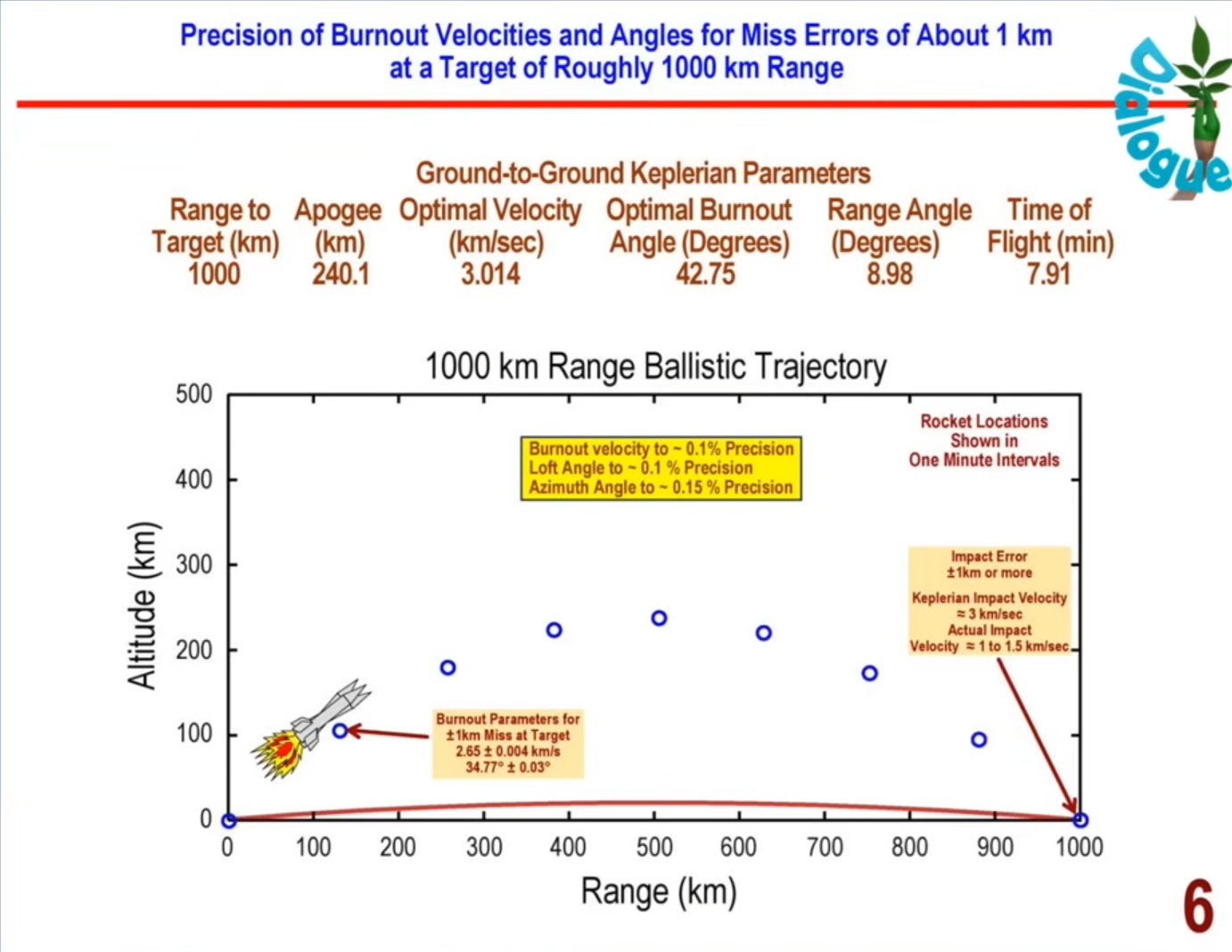
Slide six is a conceptual slide. Small problems in shutting down the rocket motor—when you are trying to place the rocket at a certain speed before the motor shuts down—create small differences in the angle at which the rocket is flying when the motor shuts down. Those small differences must be reduced if you want to increase the accuracy of the missile.
At the far end of the trajectory, errors are also introduced by the atmosphere. The missile may wobble a bit. But those kinds of errors can be reduced tremendously. The evidence suggests that the Iranians already know how to do that.
So, to significantly improve their accuracy—from about 1,000 meters to 500 meters—they mainly need to do better at shutting down the rocket motor at the right time and ensuring that the orientation of the missile at shutdown is accurate enough. They will likely get help with that from the Russians, if not from the Chinese.
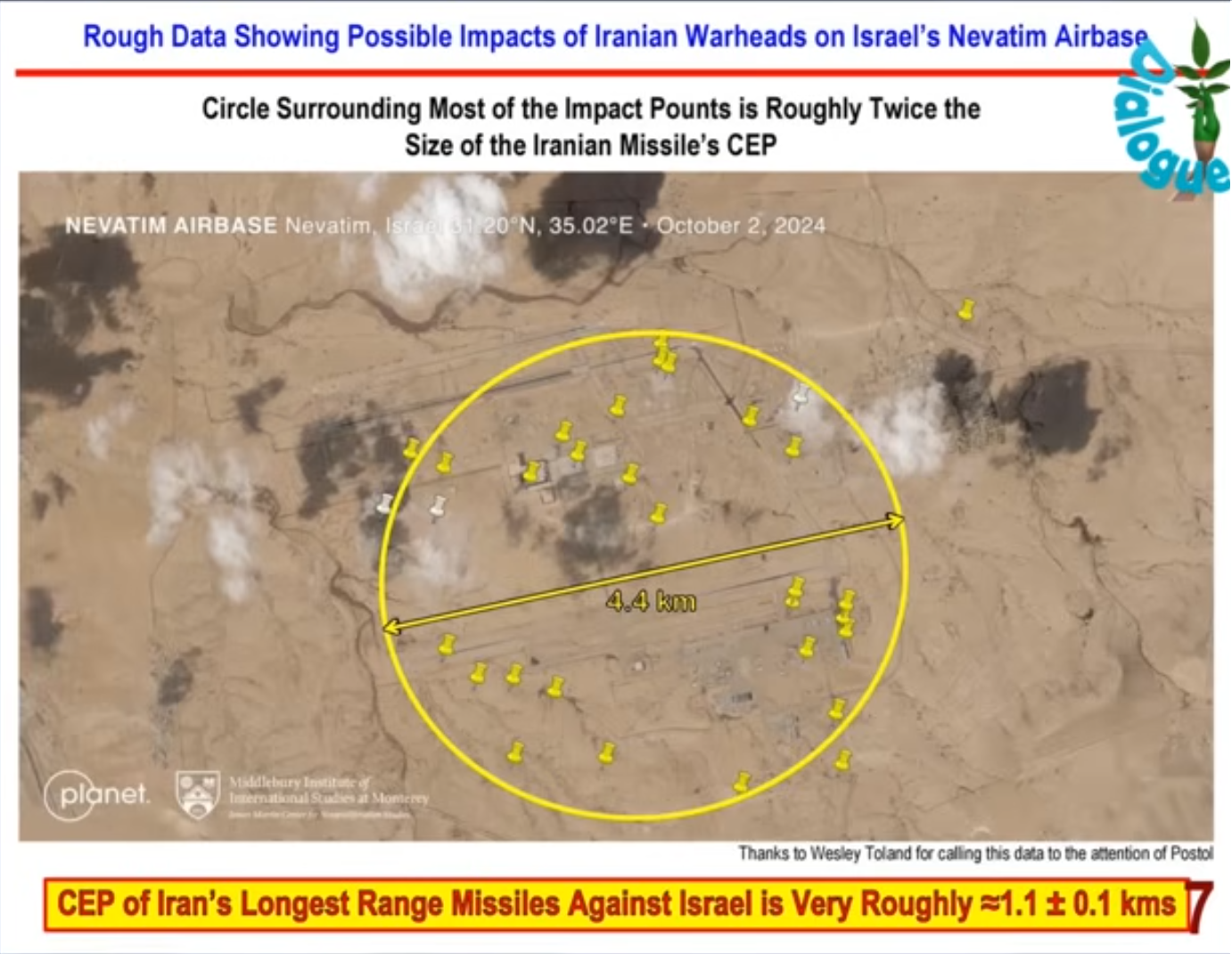
If we look at the situation, what we know —we go to slide seven— is that we have an estimate of the accuracy of these ballistic missiles from the attack on the Nevatim Air Base during the October war in 2024. They obviously wanted to damage the base. The distribution of warheads shows what their accuracy capabilities were at that time. One of the warheads actually hit a building and probably destroyed an F-35 inside. There is a lot of discussion about that. These are probabilistic events.
The distribution shown is how you estimate the accuracy of Iran’s ballistic missiles at that time. That does not mean it cannot improve. It will improve, and that has meaning in a different situation from the one people tend to focus on.
The possibility that the accuracy of Iran’s ballistic missiles will become so high that they can selectively target aircraft and shelters and things like that is very low in the near future. The technologies involved are extremely advanced and will be very difficult to implement, even for an advanced country like Iran. These technologies are very difficult to master for ballistic missiles.
Iran’s cruise missiles, however—I’m not talking about their drones—have demonstrated tremendous accuracy. In the attack on the Saudi Arabian oil fields, we saw evidence that Iranian cruise missiles have the ability to lock on to an object of a certain shape and home toward the center of that object. I could show that evidence in another discussion. So cruise missiles are extremely accurate, but ballistic missiles are a long way from there.
To understand what kind of damage ballistic missiles could do to an urban area, we need to understand what damage an explosion might cause.
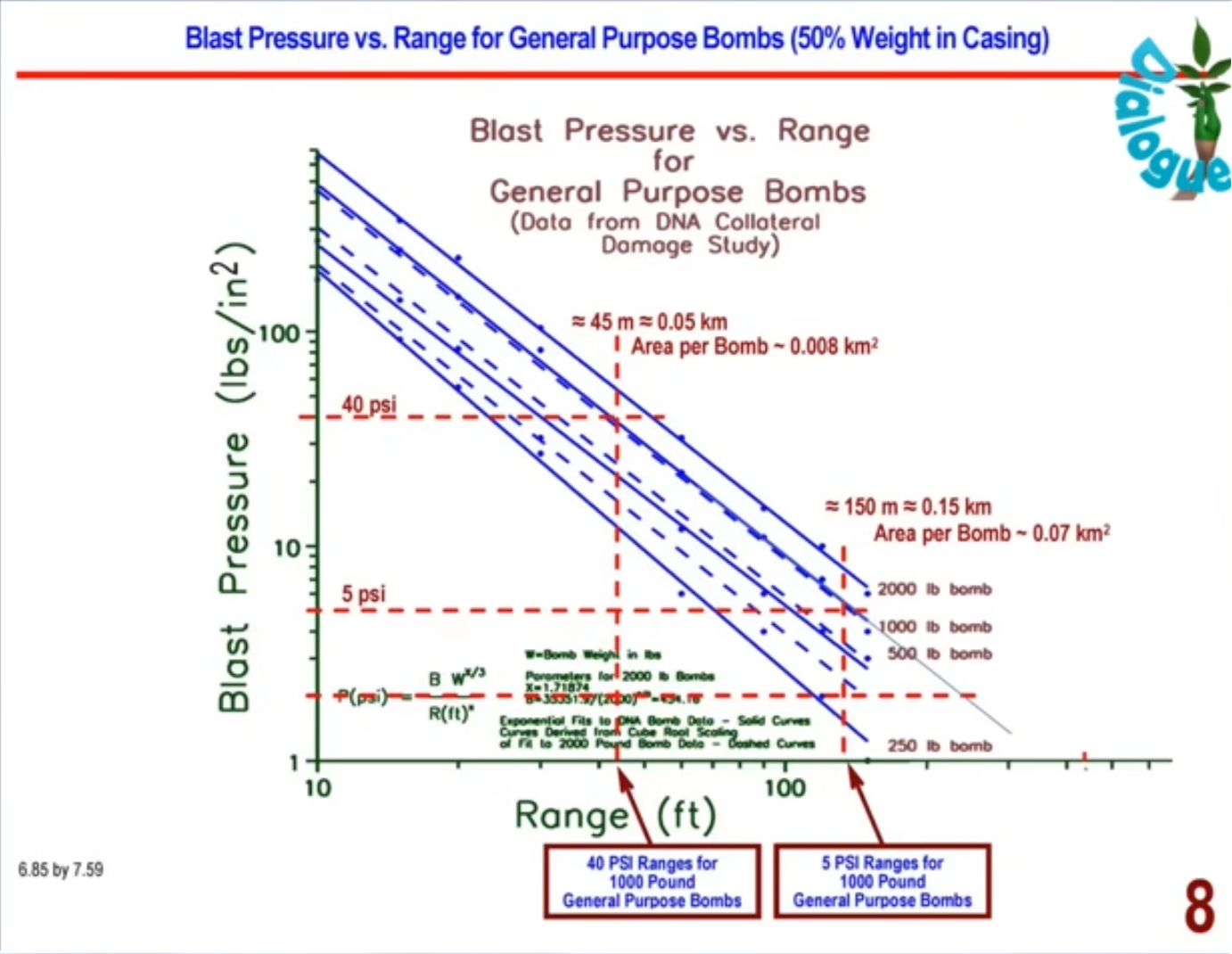
Slide eight shows the ranges at which certain levels of blast overpressure from a general-purpose bomb would occur. These are very general qualitative curves. For example, a 1,000-kilogram warhead, at about 100 meters you might get around two pounds per square inch. It could be 120 meters or 130, but approximately 100 meters. At 50 meters, you might get about five pounds per square inch. At around 15 meters, you might get over 40 pounds per square inch, which is enough to knock down a concrete and steel wall.
Let us look at slide nine to get a sense of what damage might look like.
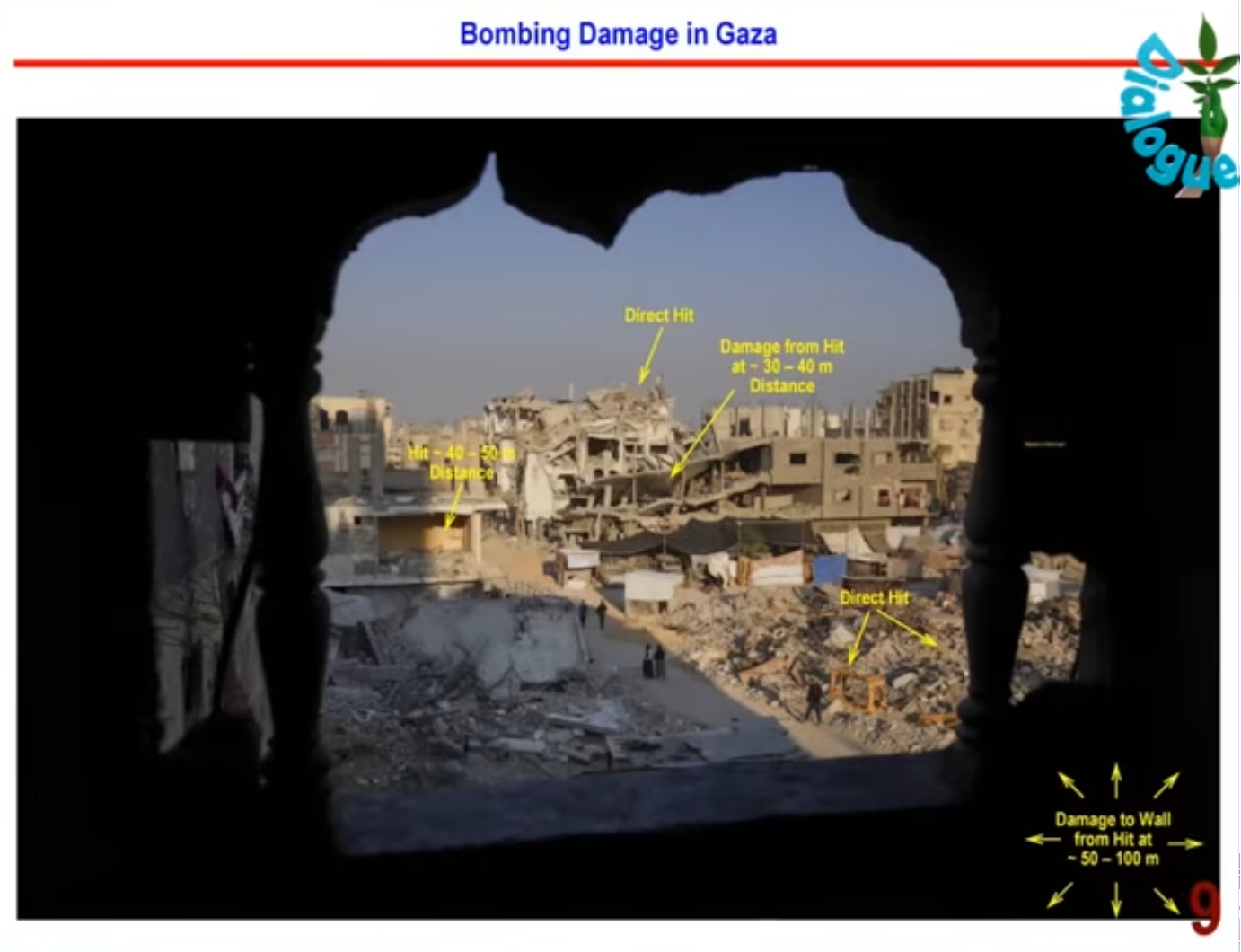
This is an image from Gaza. We are looking through a hole in the wall of a building. That hole was probably produced by the blast wave from a roughly 500- or 1,000-kilogram bomb that landed 50 to 100 meters away. It depends on the strength of the wall, but this is the kind of damage you can expect at that distance.
At the far end of the image, you can see what a direct hit looks like on a significant structure, concrete and steel, reinforced structure. The structure slightly forward of it was damaged not by a direct hit, but by secondary shock waves, perhaps from a bomb or bombs that landed 30 or 40 meters away.
The point is that there is a lot of damage beyond the point where a bomb hits.
On the left side, we see a building where the exterior walls have largely been knocked out, while the roof and floors appear intact. That was probably done by a blast 40 or 50 meters away, and the walls just collapsed or were blown inward. That is significant damage from bombs that did not directly hit the target.
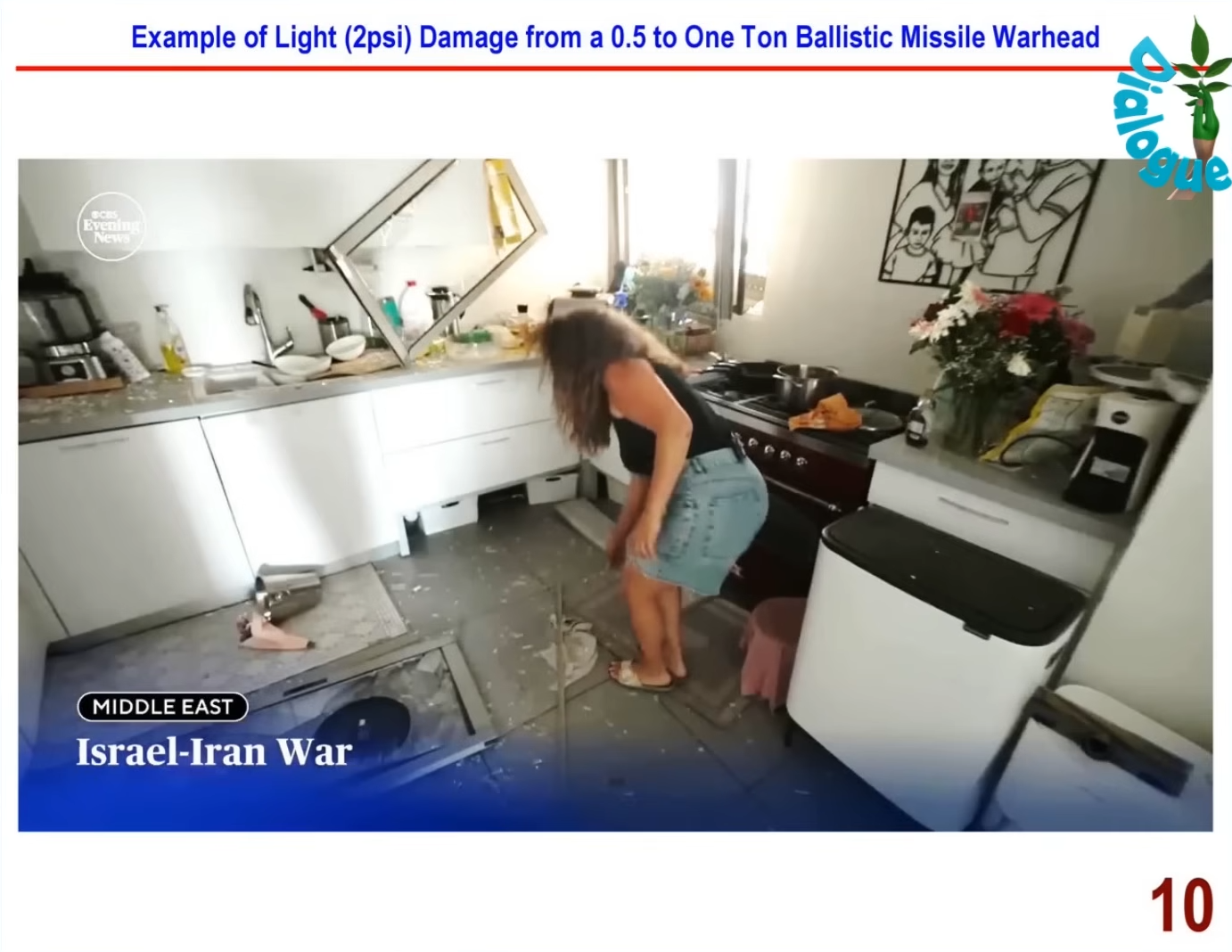
On the next slide, we see the interior of an apartment in Israel. This apartment was probably 100 to 150 meters away from a 500- to 1,000-kilogram ballistic missile explosion. At that distance—perhaps 50 to 100 meters—there is substantial general damage. The exterior window is blown out, and there is general disruption inside. If the blast had been at half that distance, the exterior wall could have been blown out.
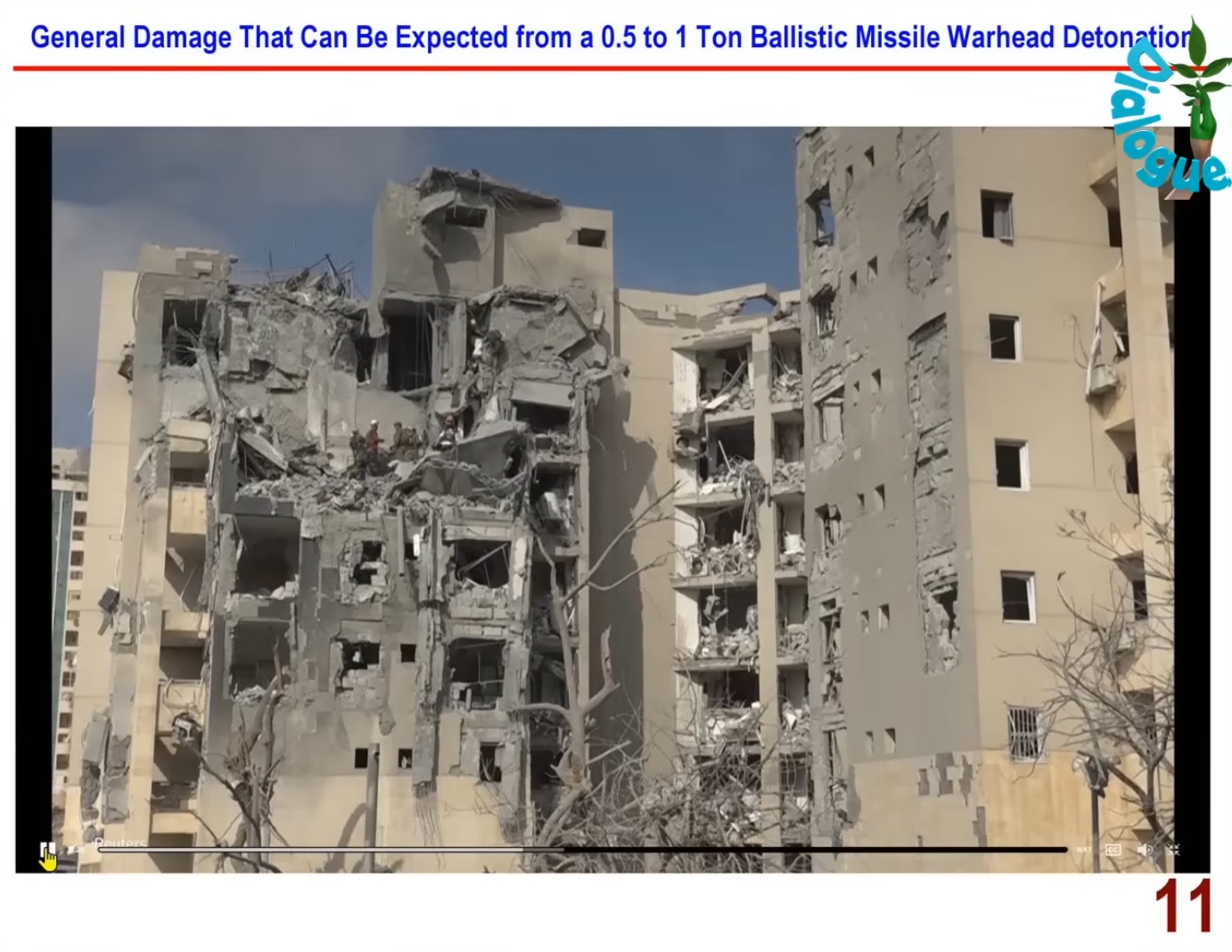
Slide 11 shows damage from a bomb that probably landed 50 or 60 meters away. The walls were shattered, and the interiors were badly damaged. There is evidence of fires in the building, which often occur in such events. There is usually no one around to fight the fires because people are injured or evacuating, and tremendous damage results.
Now that we have a sense of what the damage looks like, let us go to slide 12.
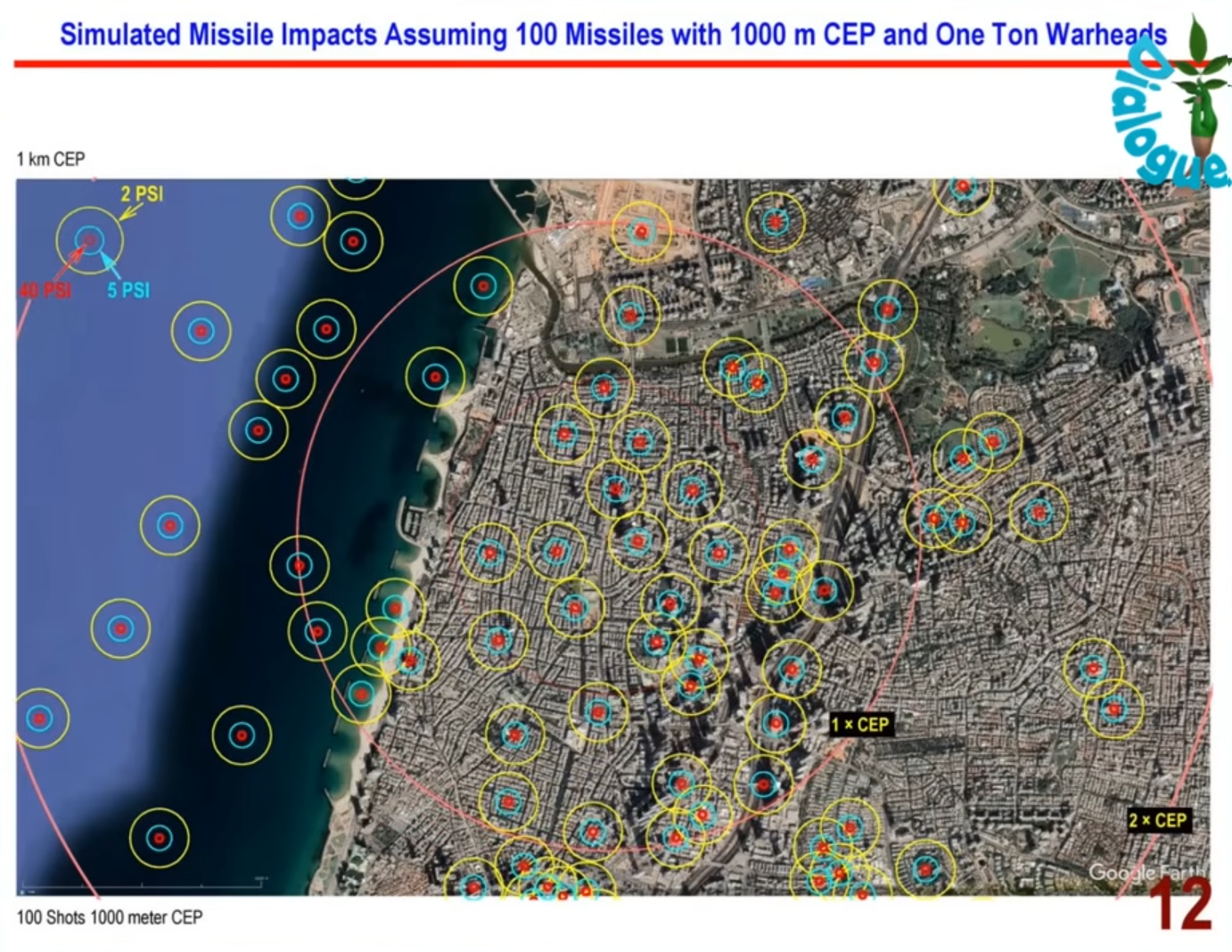
This is a simulated missile impact diagram. In the upper left corner, there is a key explaining the circles. The outer yellow circle represents about two pounds per square inch—damage similar to the apartment we saw earlier, where there was general internal damage without the walls being knocked down.
The five-psi contour shows the range at which a bomb landing nearby would severely damage the exterior walls of a building. It might not knock them down completely, but it would cause serious structural damage.
The 40-psi contour, shown in red, represents the range at which the structure itself would likely collapse or suffer severe structural damage.
This simulation shows 100 missiles with 1,000-meter accuracy, assuming a one-ton warhead. A 500-kilogram warhead would produce similar general conclusions.
If you were firing at Tel Aviv—and we know the Iranians were—a significant number of warheads would land in the downtown area, which we know occurred. There was considerable damage in downtown Tel Aviv, although the Israelis tried to mask it all. But if you went and talked to somebody who was in downtown Tel Aviv, they’d tell you there was bomb damage all over the place, you know. Very very damaging. Real problem. The Israelis tried to downplay it, but there was certainly a lot of reaction from the Israeli population.
And in fact I believe — I conjecture, I don’t know — that a lot of the discussion about running out of missile interceptors, or interceptors not working perfectly, is just a smokescreen. The defense interceptors were not working very well to begin with. These missiles basically came in unopposed, to a first approximation. There may have been some intercepts, but the number was very low—perhaps around five percent. I would be very surprised if it is as much as one in ten. I would be very surprised if it is that high.
There is a mythology that the Israelis have been trying to promulgate, which they cannot hide from their population because the Iranians showed their population what could happen. There is a big set of lies being promulgated to the Israeli people and to other organizations—that the defenses are simply running out of interceptors, that there are minor problems with intercept rates, and similar claims. In fact, these systems have never been effective at all.
Most of what the Iranians fired came through. When you have 1,000-meter precision, many warheads will simply fall into the Mediterranean, for example. That is what happens when you have a weapon that is not very accurate. Now what happens when 100 missiles have 500-meter accuracy rather than 1,000-meter accuracy, as shown in the next slide.
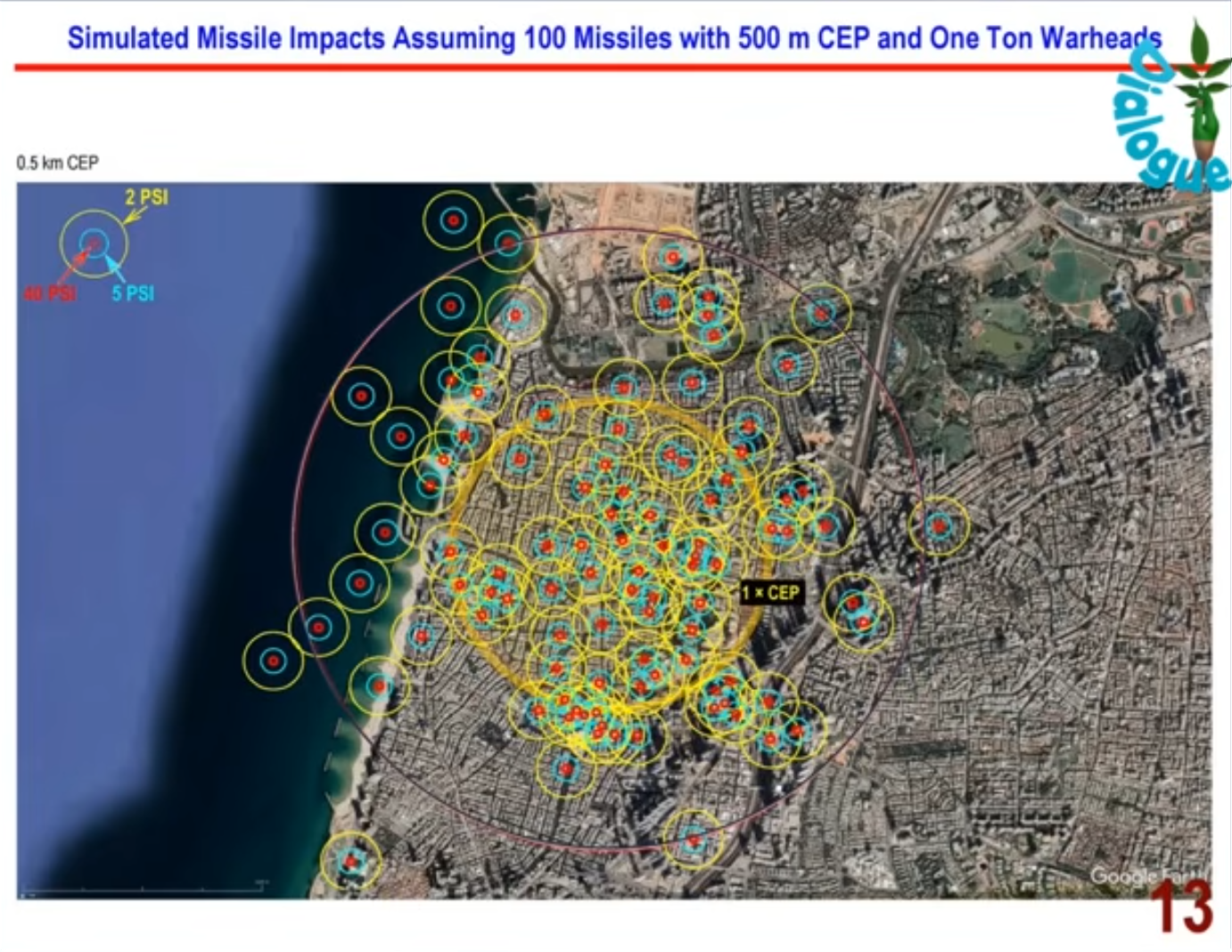
Things look a lot worse. A lot worse. You can see that the downtown Tel Aviv area gets at least twice the density of impacts. That is not a good sign if you are Israeli.
This simulation is for 100 missiles. Iran does not have to restrict itself to that number. Over time, Iran will not only improve its accuracy but also increase the number of missiles it can launch.
Let us look, in the next few slides, at what a 500-missile attack with 500-meter accuracy could look like.
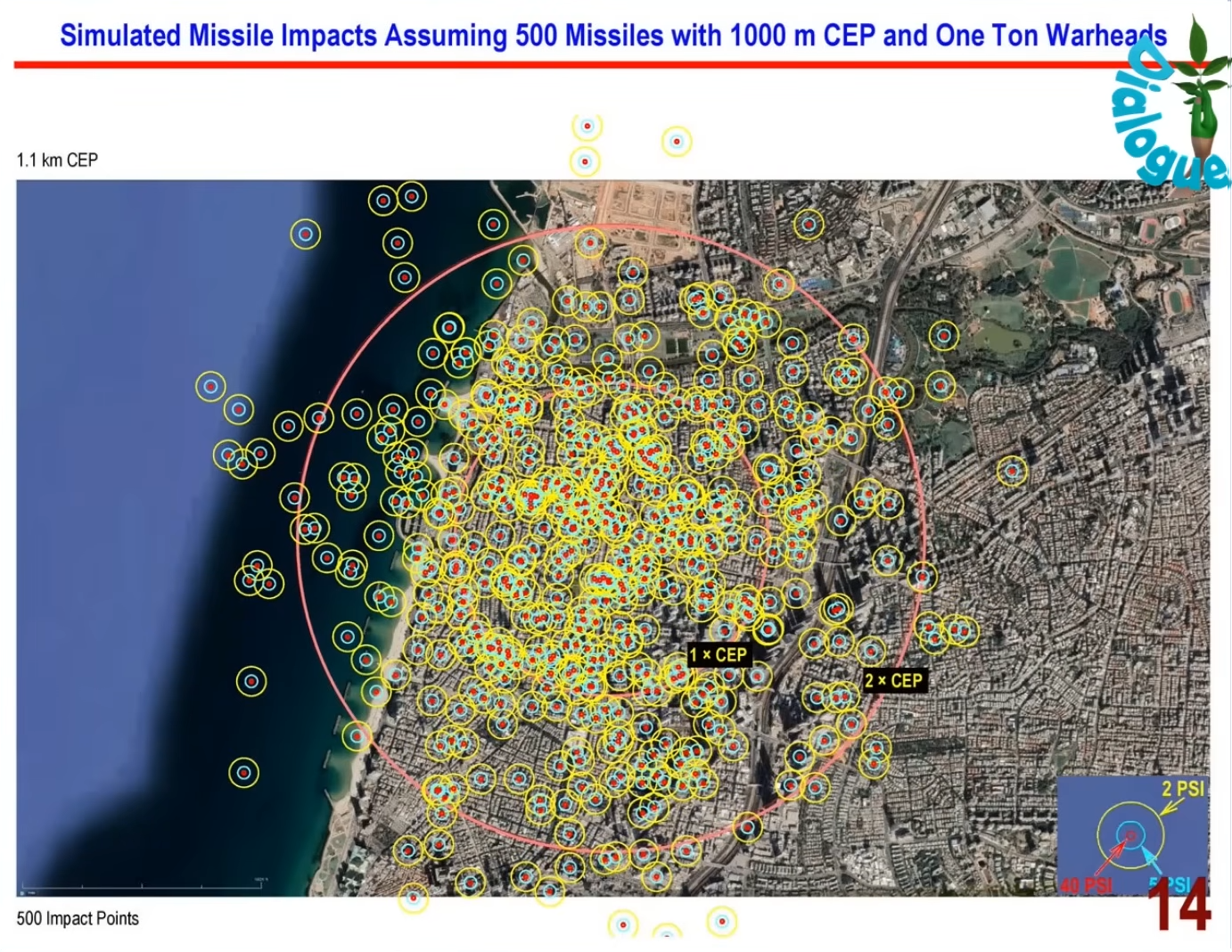
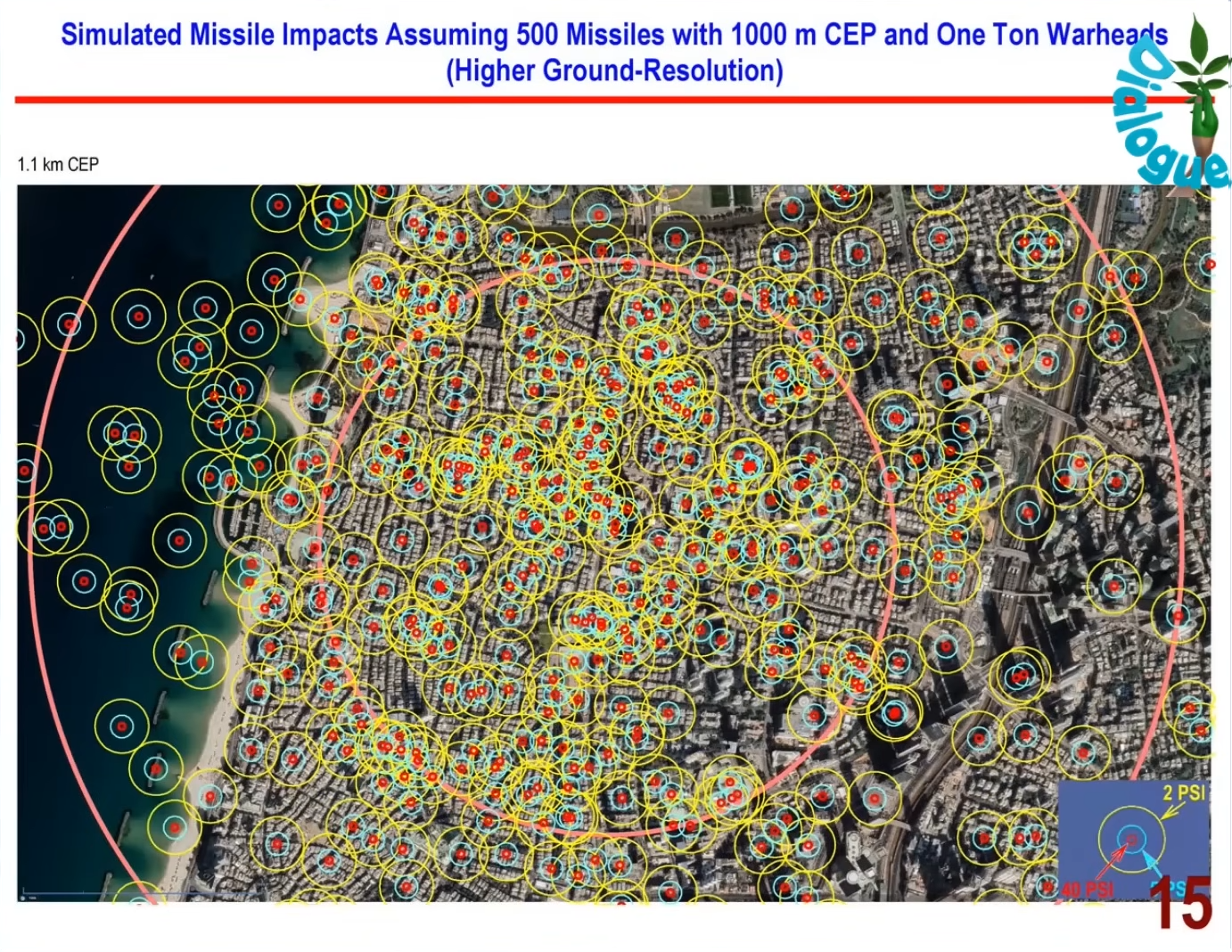
You see two roughly orange circles. One marks 1,000 meters of distance; the other marks 2,000 meters. A very large percentage of the warheads land within the urban built-up area of Tel Aviv.
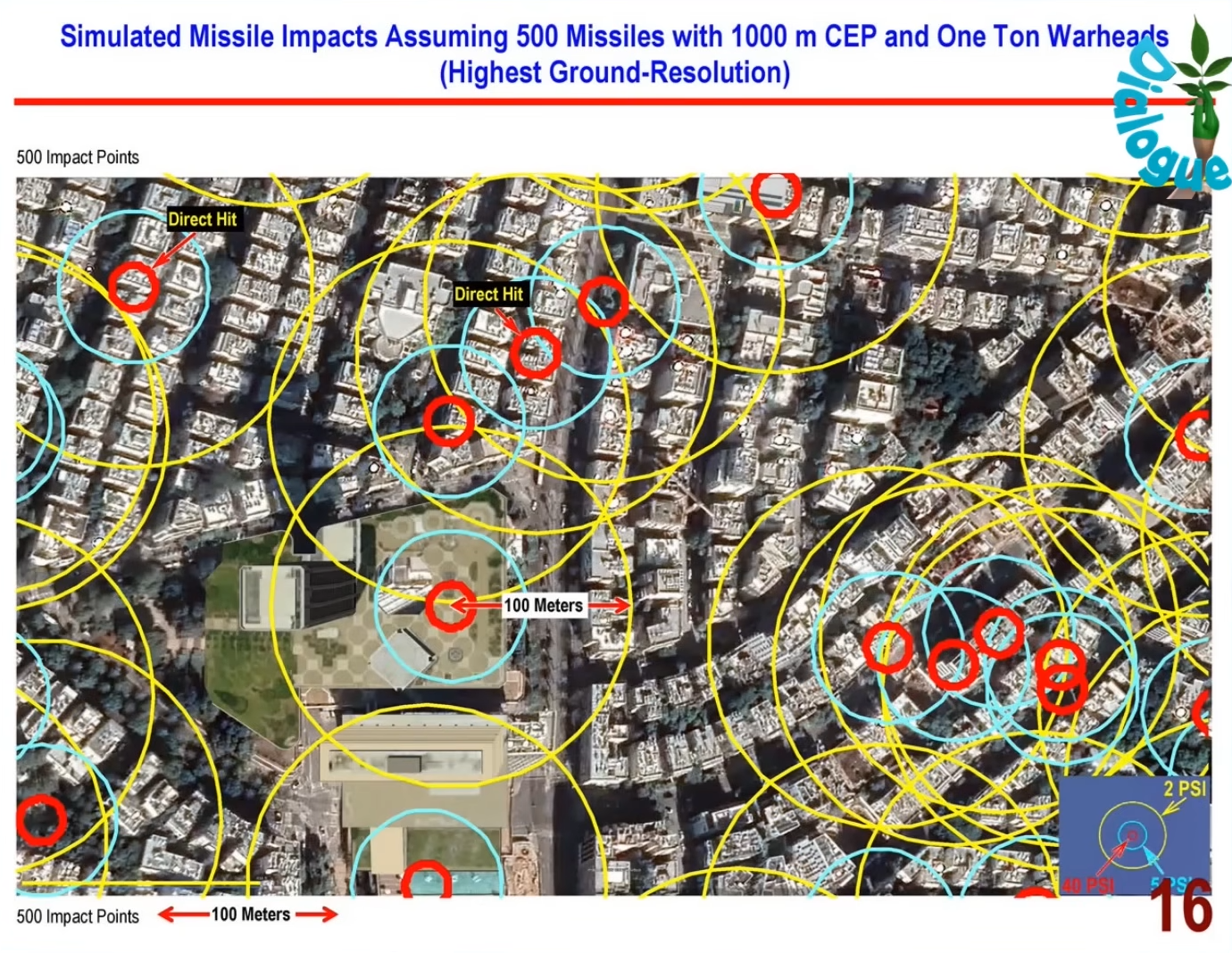
Slide 16 is a close-up. You can see the buildings and the density of impacts, to try and understand what it means. The red circles show areas where the blast intensity would be enough to knock down the buildings or large parts of them. That would be severe damage.
The blue lines show areas where extensive general damage would occur: interior apartment walls knocked out, fires initiated in many buildings, people injured by flying debris, evacuation under chaotic conditions, and widespread fires.
The yellow lines indicate areas of more general damage—broken windows and more in streets and buildings.
This entire area is covered with general damage and severe damage. It is just one arbitrarily selected area.
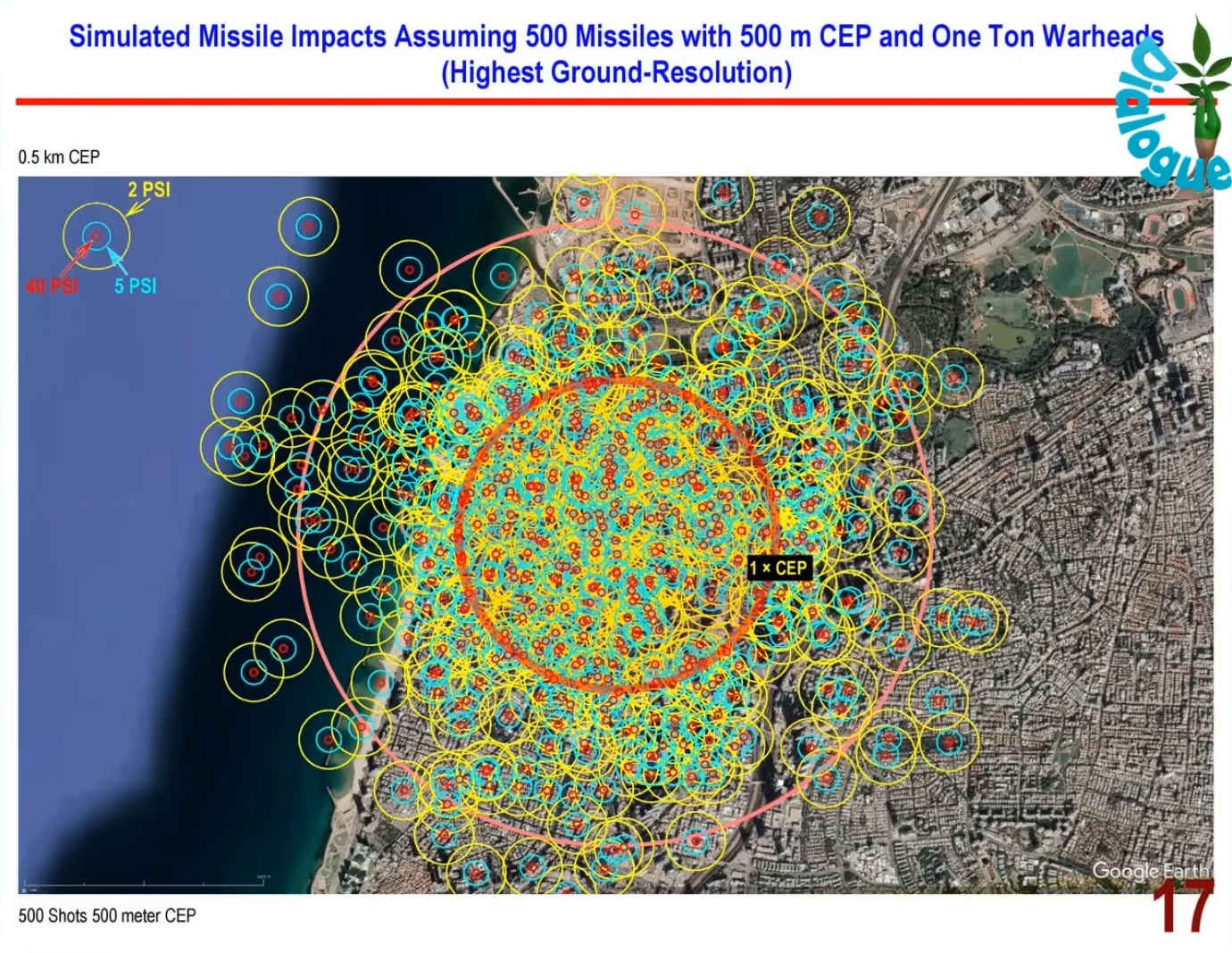
Slide 17 shows what the whole city looks like, in this case with 500-meter accuracy missiles: the density of impacts is so great that it blocks out the city. Each red dot represents severe damage to concrete and steel buildings—big, strongly built structures—along with widespread secondary damage to surrounding buildings and interiors.
After an attack like this, Tel Aviv is no longer a functioning city. Haifa is no longer a functioning city. Beersheba is no longer a functioning city. These cities could be shut down completely by a few thousand ballistic missiles with 500-meter accuracy, which you can be sure that in the next let’s say five years, Iran will have. Because Israel cannot stop them from building ballistic missiles. They will have, I think, the outreach from Russia and China, you know, they’ll be plenty of materials available, made available to Iran to continue manufacturing these ballistic missiles. And the technology for improving their accuracy is well in hand, as Iran is a sophisticated country with advanced engineering capabilities. All it needs is a little help from Russia or China or both to refine these missiles to 500-meter accuracy.
So we’re talking about a very big strategic problem that the Israelis have brought upon themselves by this aggressive behavior.
So let me go to slide 21, because I made a point about lying to the Israeli people. This is a slide from 1991. I think this may have occurred in Saudi Arabia, where Patriots were used to defend Saudi Arabia.
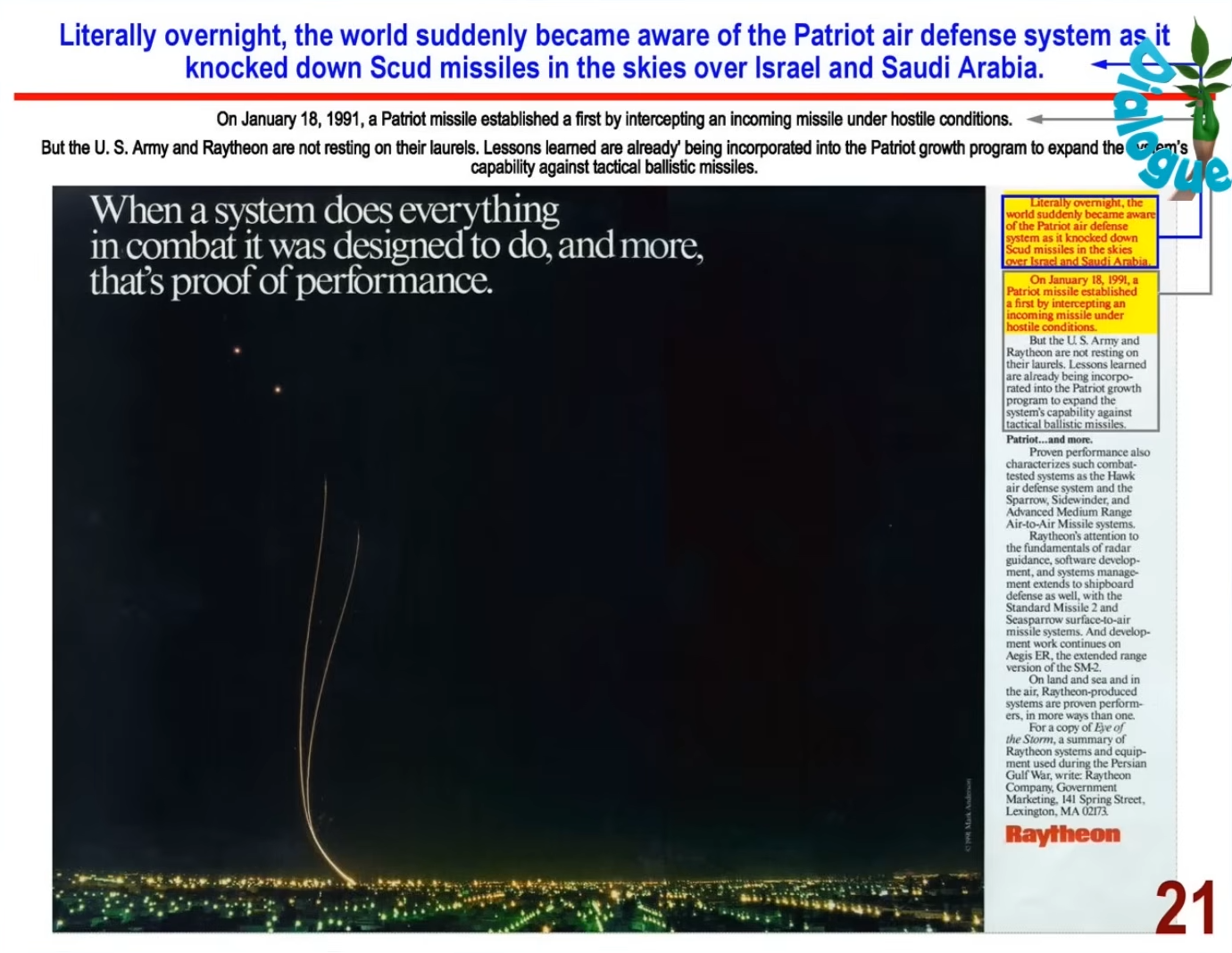
A spectacular photograph. Most people misunderstood it. And in fact, the Raytheon Corporation took a great… Let’s just look at what it says: “When a system does everything in combat it was designed to do and more, that’s proof of performance.” This was in Aviation Week & Space Technology, and it ran two pages. Two pages. A total lie by Raytheon, the company that is still building Patriots and claiming they work when they don’t.
This time-lapse photo—let’s stop for a second and understand how it works. The camera is focused on the skyline, and the aperture is open. It does not open and close like a regular photograph; it is just open. When a Patriot interceptor is launched, it has a rocket motor that burns. The rocket motor looks like a point of light, and that point of light traces a line on the film because this is a time exposure.
You see the line in both cases disappears because the Patriot burns out. It finishes its powered flight, then flies like a bullet and maneuvers by changing its orientation in the atmosphere.
Now you see those two dots in the sky. Those two dots are the explosions of the Patriot warheads. They have nothing to do with intercepting a Scud.
We found this engagement on a video camera and analyzed it frame by frame. One Scud came in. They missed it with both explosions. If they had hit the Scud, it should have appeared as a track on the black photo. The Scud was bright enough that you should have seen it as a track. Somebody took that track and blacked it out. So this was consciously a fraudulent photo.
This is what the Israelis tell their own people. This is what American contractors tell the Saudis, the Poles, the Ukrainians, and whoever else is foolish enough to spend money on their system for anti-missile.
It is a very effective system against aircraft, I want to be clear. You do not want to fly against Patriots if you are in an airplane. But as a ballistic missile defense, it is worthless, as we know from Ukraine as well.
What we have here is an example of layers upon layers upon layers of fraud that have been foisted off on the populations of different countries, and on the American taxpayer, who has bought most of these Patriots for other countries, including Israel and Ukraine.
What we have is nothing but a fraud against the American taxpayer, the Israeli public, and the Ukrainian population.
Ukraine is a horrific situation because we, the Americans have put the Ukrainians in a position where their country has been destroyed and will continue to be destroyed if it does not negotiate with what is left of it and with the Russians.
You can still find articles in The New York Times, the paper that is supposed to be the paper of record. Just the other day there was an article —I shouldn’t laugh, because it’s so serious— about how Prosk in Donbass had just fallen. Prosk fell two or three months ago. The New York Times is now reporting it? This is a crime.
You have unbelievably courageous Ukrainian soldiers fighting for their country, for what they believe is the survival of their country, and they are dying at a tremendous rate for nothing. This can all be stopped by carrying out a realistic negotiation.
But the political administration in Ukraine—my best analogy is Hitler letting all these Germans die as the Russians closed in on Berlin when the best thing to do would have been to surrender. The war was over. Why cause all these people to die? They were even executing their own people in the streets for not fighting.
It is this kind of fascism, and it is fascism, that is contributing to the complete destruction of Ukraine. I mean complete, because all of these dying soldiers are altering the demography of Ukraine for the next 20 years. There will be an incredible dip in the birth rate. There already is. Ukraine could potentially even disappear as a culture. I do not think it will, but it could.
All these extremists—banderites, white supremacists—who think they are saving Ukrainian ethnicity are destroying it.
We have all this complexity going on in the world in front of us, and the cynical political leadership of NATO and the United States as well is resulting in extraordinary loss of life. I am beside myself when I think about the loss of life in Ukraine for no reason.
Just negotiate. Stop trying to make yourself an existential enemy of the Russians. Just live beside them and stop this unbelievable slaughter, because the Russians are going to stop it anyway. They can stop it by reaching an understanding, or they can stop it by basically completely destroying Ukraine as a viable state, which I think is what will occur, unfortunately.
Sorry to jump around, but from the point of view of a technologist like myself, who is most deeply concerned with violence in the world and its negative consequences, I look at this with despair.
This talk is simple in some sense. The diagrams took a long time to put together. I did not just make them up. I wanted to make them understandable so you could visualize what 500-meter CEP means. When you see it laid out on a map, you begin to understand what the consequences are. We are visual animals. Our ability to learn is based on visual capabilities, and abstractions come after that.
That is what I have to share on this issue.
Featured Video
Marandi: US attacked world’s largest gas field & Iran declares economic war
or go to
Aletho News Archives – Video-Images
From the Archives
Why the UK, the EU and the US Gang-Up on Russia
By James Petras :: 03.20.2018
Introduction: For the greater part of a decade the US, the UK and the EU have been carrying out a campaign to undermine and overthrow the Russia government and in particular to oust President Putin. Fundamental issues are at stake including the real possibility of a nuclear war.
The most recent western propaganda campaign and one of the most virulent is the charge launched by the UK regime of Prime Minister Theresa May. The Brits have claimed that Russian secret agents conspired to poison a former Russian double-agent and his daughter in England, threatening the sovereignty and safety of the British people. No evidence has ever been presented. Instead the UK expelled Russian diplomats and demands harsher sanctions, to increase tensions. The UK and its US and EU patrons are moving toward a break in relations and a military build-up.
A number of fundamental questions arise regarding the origins and growing intensity of this anti-Russian animus.
Why do the Western regimes now feel Russia is a greater threat then in the past? Do they believe Russia is more vulnerable to Western threats or attacks? Why do the Western military leaders seek to undermine Russia’s defenses? Do the US economic elites believe it is possible to provoke an economic crisis and the demise of President Putin’s government? What is the strategic goal of Western policymakers? Why has the UK regime taken the lead in the anti-Russian crusade via the fake toxin accusations at this time?
This paper is directed at providing key elements to address these questions. … continue
Blog Roll
 Aletho News
- Iran’s weapons industry still churning out missiles despite war: IRGC
- Washington approves billions in new arms sales to Gulf states as concerns grow over stocks of air defenses
- Iran War: Pentagon’s $200B Budget Could Run Out in Just Five Months
- Seven US allies endorse Hormuz ‘coalition,’ offer ‘no commitment’ for military action
- ‘Safe’ corridor opening up through Strait of Hormuz: What we know so far
- Hormuz disruption exposes hidden strain on US military supply chains
- Allowing US to use UK bases amounts to participation in war: Araghchi
- Iran War Is Accelerating the End of US Dominance
- FBI Resumes Buying Americans’ Location Data Without Warrants
- IDF threatens ‘elimination’ for Russian leaders who ‘wish Israel ill’
- If Americans Knew
- Eid without worship in Al Aqsa – Not a ceasefire Day 161
- Trump: Israel attacked Iranian gas field without US knowledge. No more such attacks!
- America’s friends must help extricate it from an unlawful war
- Democratic Nat’l Committee’s Kneejerk Backing of Israel Is Political and Moral Failure
- Major revelations from former counterterrorism chief Joe Kent’s extensive interview
- More than half of Palestinian child detainees have no charges
- Grieving Parents in Iran Spend Every Night at the Graves of Their Children, Killed by U.S. Strike
- War on Iran spins out of control, Palestine struggles – Not a ceasefire Day 160
- How ignorance, misunderstanding and obfuscation ended Iran nuclear talks
- Israeli media reports grotesque settler attack in West Bank
- No Tricks Zone
- Energy Expert: Germany’s Nuclear Phaseout Was A “500 Billion Euro Mistake”
- New Research: South Australia’s Mid-Holocene Sea Surface Temperatures Were 4°C Warmer Than Today
- Storing Green Energy To Last Germany 10 Days Would Require A 60-Million Tonne Battery
- New Studies: UK Sea Levels Were 4 Meters Higher Than Today During The Mid-Holocene
- Destructive Green New Deal: German Energy And Metal Group Warns Of Drastic Crisis
- New Study Documents A 20-Year Pause In Arctic Sea Ice Decline – Driven By Internal Variability
- Wake-up Call: Survey Shows Majority Of Germans Now Favor Postponing Climate Targets!
- Televised! Leading German Political Candidate Tells Schoolchildren CO2 Makes Sun Hotter!
- New Study: A Century Warming Of 1.1°C Is ‘Commonplace’ And ‘Not Unusual’ During This Interglacial
- New Study: ‘Internal Noise’ And Volcanic Forcing Can Trigger 10-15°C Warming Within Decades
 Aletho News